Chhattisgarh – a change story: What
factors contributed to the rapid and
large declines in stunting?
Stories of Change in Nutrition
A study undertaken by the International Food Policy Research Institute
Authors:
Neha Kohli, Rasmi Avula, Phuong Nguyen, Purnima Menon
Funding: Bill & Melinda Gates Foundation, through POSHAN (managed by
IFPRI)
Chhattisgarh’s stunting decline (13+ percentage points) was the
highest in the last decade in India. We sought to understand
why change happened
• Multiple research methods
• Regression analyses – what factors
contributed to stunting decline?
• Data timeline – what determinants
of malnutrition changed over
time?
• Policy review – what was done in
policy efforts related to
determinants?
• Stakeholder interviews – what
drove policy changes? 0
10
20
30
40
50
60
70
80
90
100
2006 2016
Stunting (among children <5 years)
Percentage(%)
Improvements also seen in low-birth weight and anemia
among women (2006-2016)gg
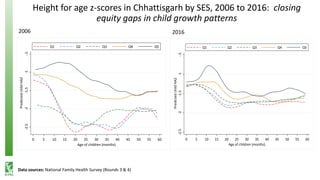
Height for age z-scores in Chhattisgarh by SES, 2006 to 2016: closing
equity gaps in child growth patterns
Data sources: National Family Health Survey (Rounds 3 & 4)
-2.5-2-1.5-1-.5
PredictedchildHAZ
0 5 10 15 20 25 30 35 40 45 50 55 60
Age of children (months)
Q1 Q2 Q3 Q4 Q5
-2.5-2-1.5-1-.5
PredictedchildHAZ
0 5 10 15 20 25 30 35 40 45 50 55 60
Age of children (months)
Q1 Q2 Q3 Q4 Q5
2006 2016
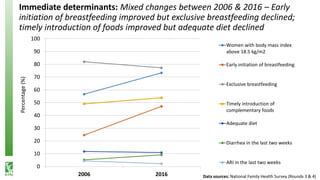
Immediate determinants: Mixed changes between 2006 & 2016 – Early
initiation of breastfeeding improved but exclusive breastfeeding declined;
timely introduction of foods improved but adequate diet declined
Data sources: National Family Health Survey (Rounds 3 & 4)
0
10
20
30
40
50
60
70
80
90
100
2006 2016
Women with body mass index
above 18.5 kg/m2
Early initiation of breastfeeding
Exclusive breastfeeding
Timely introduction of
complementary foods
Adequate diet
Diarrhea in the last two weeks
ARI in the last two weeks
Percentage(%)
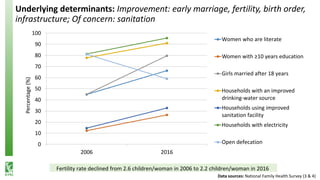
Underlying determinants: Improvement: early marriage, fertility, birth order,
infrastructure; Of concern: sanitation
Data sources: National Family Health Survey (3 & 4)
0
10
20
30
40
50
60
70
80
90
100
2006 2016
Women who are literate
Women with ≥10 years education
Girls married after 18 years
Households with an improved
drinking-water source
Households using improved
sanitation facility
Households with electricity
Open defecation
Percentage(%)
Fertility rate declined from 2.6 children/woman in 2006 to 2.2 children/woman in 2016
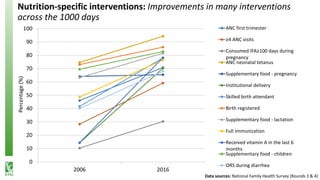
Nutrition-specific interventions: Improvements in many interventions
across the 1000 days
Data sources: National Family Health Survey (Rounds 3 & 4)
0
10
20
30
40
50
60
70
80
90
100
2006 2016
ANC first trimester
≥4 ANC visits
Consumed IFA≥100 days during
pregnancy
ANC neonatal tetanus
Supplementary food - pregnancy
Institutional delivery
Skilled birth attendant
Birth registered
Supplementary food - lactation
Full immunization
Received vitamin A in the last 6
months
Supplementary food - children
ORS during diarrhea
Percentage(%)
80.20
99.00
59.10
91.30
30.30
89.70
23.50
93.90
70.00
87.20
71.10
80.00
72.80
80.20
66.30
69.10
39.40
84.70
71.10 70.10
76.40
61.00
32.80
35.20
78.20
66.10
28.20
77.80
73.30
79.00
0
10
20
30
40
50
60
70
80
90
100
DemandforFPsatisfied
Iodizedsalt
>=4ANC
ReceivedIFA
Consumed100+IFA
Neonataltetanusprotection
Deworming
Weighing
Breastfeedingcounseling
Foodsupplementation
Health&nutritioneducation
Healthcheck-up(ICDS)
Institutionaldelivery
Skilledbirthattendant
JSY-Delivery
Postnatalcareformothers
Postnatalcareforbabies
Foodsupplementation
Health&nutritioneducation
Healthcheckup(ICDS)
Fullimmunisation
VitA
PaediatricIFA
Deworming
Careseekingforpneumonia
ORSduringDiarrhoea
ZincduringDiarrhoea
Foodsupplementation
Healthcheckup
Weighing(ICDS)
%
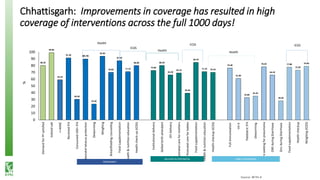
Chhattisgarh: Improvements in coverage has resulted in high
coverage of interventions across the full 1000 days!
PREGNANCY
DELIVERY & POSTNATAL EARLY CHILDHOOD
Health
Health Health
ICDS
ICDS ICDS
Source: NFHS-4
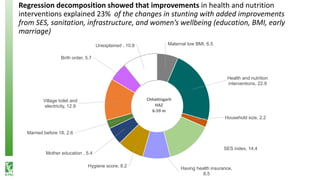
Regression decomposition showed that improvements in health and nutrition
interventions explained 23% of the changes in stunting with added improvements
from SES, sanitation, infrastructure, and women’s wellbeing (education, BMI, early
marriage)
Maternal low BMI, 6.5
Health and nutrition
interventions, 22.9
Household size, 2.2
SES index, 14.4
Having health insurance,
8.5
Hygiene score, 8.2
Mother education , 5.4
Married before 18, 2.6
Village toilet and
electricity, 12.9
Birth order, 5.7
Unexplained , 10.8
Chhattisgarh
HAZ
6-59 m
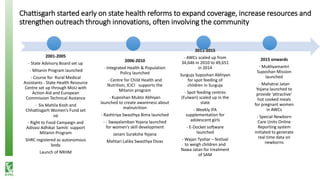
Chattisgarh started early on state health reforms to expand coverage, increase resources and
strengthen outreach through innovations, often involving the community
2001-2005
- State Advisory Board set up
- Mitanin Program launched
- Course for Rural Medical
Assistants - State Health Resource
Centre set up through MoU with
Action Aid and European
Commission Technical Asstance
- Six Mahila Kosh and
Chhattisgarh Women’s Fund set
up
- Right to Food Campaign and
Adivasi Adhikar Samiti support
Mitanin Program
SHRC registered as autonomous
body
Launch of NRHM
2006-2010
- Integrated Health & Population
Policy launched
- Centre for Child Health and
Nutrition, ICICI supports the
Mitanin program
- Kuposhan Mukto Abhiyan
launched to create awareness about
malnutrition
- Rashtriya Swasthya Bima launched
- - Swayalamban Yojana launched
for women’s skill development
Janani Suraksha Yojana
Mahtari Lalika Swasthya Divas
2011-2015
- AWCs scaled up from
34,646 in 2010 to 49,651
in 2014
Surguja Suposhan Abhiyan
for spot feeding of
children in Surguja
- Spot feeding centres
(Fulwari) scaled up in the
state
- Weekly IFA
supplementation for
adolescent girls
- E-Docket software
launched
- Wajan Tyohar – festival
to weigh children and
Nawa Jatan for treatment
of SAM
2015 onwards
- Mukhyamantri
Suposhan Mission
launched
- Mahatrai Jatan
Yojana launched to
provide ‘attractive’
hot cooked meals
for pregnant women
in AWCs
- Special Newborn
Care Units Online
Reporting system
initiated to generate
real time data on
newborns
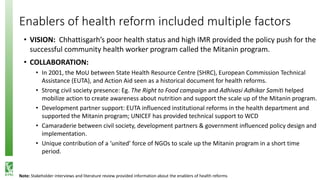
Enablers of health reform included multiple factors
• VISION: Chhattisgarh’s poor health status and high IMR provided the policy push for the
successful community health worker program called the Mitanin program.
• COLLABORATION:
• In 2001, the MoU between State Health Resource Centre (SHRC), European Commission Technical
Assistance (EUTA), and Action Aid seen as a historical document for health reforms.
• Strong civil society presence: Eg. The Right to Food campaign and Adhivasi Adhikar Samiti helped
mobilize action to create awareness about nutrition and support the scale up of the Mitanin program.
• Development partner support: EUTA influenced institutional reforms in the health department and
supported the Mitanin program; UNICEF has provided technical support to WCD
• Camaraderie between civil society, development partners & government influenced policy design and
implementation.
• Unique contribution of a ‘united’ force of NGOs to scale up the Mitanin program in a short time
period.
Note: Stakeholder interviews and literature review provided information about the enablers of health reforms
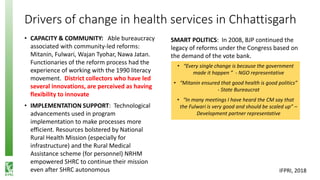
Drivers of change in health services in Chhattisgarh
• CAPACITY & COMMUNITY: Able bureaucracy
associated with community-led reforms:
Mitanin, Fulwari, Wajan Tyohar, Nawa Jatan.
Functionaries of the reform process had the
experience of working with the 1990 literacy
movement. District collectors who have led
several innovations, are perceived as having
flexibility to innovate
• IMPLEMENTATION SUPPORT: Technological
advancements used in program
implementation to make processes more
efficient. Resources bolstered by National
Rural Health Mission (especially for
infrastructure) and the Rural Medical
Assistance scheme (for personnel) NRHM
empowered SHRC to continue their mission
even after SHRC autonomous
• “Every single change is because the government
made it happen ” - NGO representative
• “Mitanin ensured that good health is good politics”
- State Bureaucrat
• “In many meetings I have heard the CM say that
the Fulwari is very good and should be scaled up” –
Development partner representative
SMART POLITICS: In 2008, BJP continued the
legacy of reforms under the Congress based on
the demand of the vote bank.
IFPRI, 2018
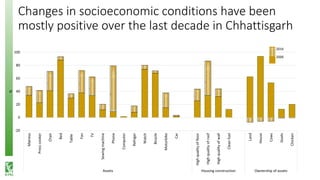
Changes in socioeconomic conditions have been
mostly positive over the last decade in Chhattisgarh
-20
0
20
40
60
80
100
Matress
Presscooker
Chair
Bed
Table
Fan
TV
Sewingmachine
Phone
Computer
Refriger
Watch
Bicycle
Motorbike
Car
Highqualityoffloor
Highqualityofroof
Highqualityofwall
Cleanfuel
Land
House
Cows
Goats
Chicken
Assets Housing construction Ownership of assets
%
2006
2016
Drivers of change in poverty and economic growth: PDS, job growth,
female participation in the labor force
• Some literature has attributed the decline in poverty to PDS (Dreze & Khera 2013, GIZ 2011).
A development partner poverty assessment has attributed it to health programs in addition
to PDS (GIZ 2011).
• Consumption inequality (0.31 Gini coefficient) in Chhattisgarh is lower than the national
average (World Bank 2016)
• After 2005, job growth (1.6 percent) in Chhattisgarh was higher than in most advanced
states - West Bengal, Uttar Pradesh, Rajasthan and Maharashtra (World Bank 2016).
• Faster job growth in construction and services in Chhattisgarh after 2005 (World Bank 2016)
• Female labor force participation (55 percent) in Chhattisgarh is higher than in most states
(World Bank 2016).
• There are gains in schooling for the young in Chhattisgarh. Public school enrollment in
Chhattisgarh is higher than the national average. Learning outcomes though have shown
little improvement, are better than in other low income states (World Bank 2016).
Data Source: Literature review and stakeholder interviews
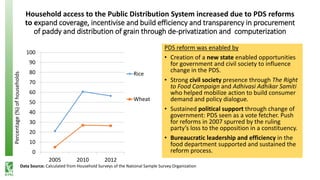
Household access to the Public Distribution System increased due to PDS reforms
to expand coverage, incentivise and build efficiency and transparency in procurement
of paddy and distribution of grain through de-privatization and computerization
PDS reform was enabled by
• Creation of a new state enabled opportunities
for government and civil society to influence
change in the PDS.
• Strong civil society presence through The Right
to Food Campaign and Adhivasi Adhikar Samiti
who helped mobilize action to build consumer
demand and policy dialogue.
• Sustained political support through change of
government: PDS seen as a vote fetcher. Push
for reforms in 2007 spurred by the ruling
party’s loss to the opposition in a constituency.
• Bureaucratic leadership and efficiency in the
food department supported and sustained the
reform process.
Data Source: Calculated from Household Surveys of the National Sample Survey Organization
0
10
20
30
40
50
60
70
80
90
100
2005 2010 2012
Rice
Wheat
Percentage(%)ofhouseholds
An enabling environment for change on many
fronts
• Creation of a new state brought political
opportunities: low hanging fruit to build up
from, the need to project itself better than it’s
poor status under former state, Madhya
Pradesh.
• Political stability – the BJP has been in power
for over 10 years in the state. The BJP
government continued (and added to) the
reforms associated by the previous
government.
• IMR reductions in 2003-04 (the highest in
north India) brought the attention of political
leaders.
• Culture of learning and evaluations to implement
programs.
• Infrastructural improvements in the state have
likely contributed to progress in programs.
• Diverse sources of funding: Untied funds, IAP,
District Mineral Fund, NREGA, private sector.
“There were other things like roads
and Anganwadi systems that
improved: Infact ASHAs work best
where these accompaniments also
work” - Academia and Civil Society
Representative

6. day 2 session 3 chhattisgarh soc final

  • 1.
    Chhattisgarh – achange story: What factors contributed to the rapid and large declines in stunting? Stories of Change in Nutrition A study undertaken by the International Food Policy Research Institute Authors: Neha Kohli, Rasmi Avula, Phuong Nguyen, Purnima Menon Funding: Bill & Melinda Gates Foundation, through POSHAN (managed by IFPRI)
  • 2.
    Chhattisgarh’s stunting decline(13+ percentage points) was the highest in the last decade in India. We sought to understand why change happened • Multiple research methods • Regression analyses – what factors contributed to stunting decline? • Data timeline – what determinants of malnutrition changed over time? • Policy review – what was done in policy efforts related to determinants? • Stakeholder interviews – what drove policy changes? 0 10 20 30 40 50 60 70 80 90 100 2006 2016 Stunting (among children <5 years) Percentage(%) Improvements also seen in low-birth weight and anemia among women (2006-2016)gg
  • 3.
    Height for agez-scores in Chhattisgarh by SES, 2006 to 2016: closing equity gaps in child growth patterns Data sources: National Family Health Survey (Rounds 3 & 4) -2.5-2-1.5-1-.5 PredictedchildHAZ 0 5 10 15 20 25 30 35 40 45 50 55 60 Age of children (months) Q1 Q2 Q3 Q4 Q5 -2.5-2-1.5-1-.5 PredictedchildHAZ 0 5 10 15 20 25 30 35 40 45 50 55 60 Age of children (months) Q1 Q2 Q3 Q4 Q5 2006 2016
  • 4.
    Immediate determinants: Mixedchanges between 2006 & 2016 – Early initiation of breastfeeding improved but exclusive breastfeeding declined; timely introduction of foods improved but adequate diet declined Data sources: National Family Health Survey (Rounds 3 & 4) 0 10 20 30 40 50 60 70 80 90 100 2006 2016 Women with body mass index above 18.5 kg/m2 Early initiation of breastfeeding Exclusive breastfeeding Timely introduction of complementary foods Adequate diet Diarrhea in the last two weeks ARI in the last two weeks Percentage(%)
  • 5.
    Underlying determinants: Improvement:early marriage, fertility, birth order, infrastructure; Of concern: sanitation Data sources: National Family Health Survey (3 & 4) 0 10 20 30 40 50 60 70 80 90 100 2006 2016 Women who are literate Women with ≥10 years education Girls married after 18 years Households with an improved drinking-water source Households using improved sanitation facility Households with electricity Open defecation Percentage(%) Fertility rate declined from 2.6 children/woman in 2006 to 2.2 children/woman in 2016
  • 6.
    Nutrition-specific interventions: Improvementsin many interventions across the 1000 days Data sources: National Family Health Survey (Rounds 3 & 4) 0 10 20 30 40 50 60 70 80 90 100 2006 2016 ANC first trimester ≥4 ANC visits Consumed IFA≥100 days during pregnancy ANC neonatal tetanus Supplementary food - pregnancy Institutional delivery Skilled birth attendant Birth registered Supplementary food - lactation Full immunization Received vitamin A in the last 6 months Supplementary food - children ORS during diarrhea Percentage(%)
  • 7.
    80.20 99.00 59.10 91.30 30.30 89.70 23.50 93.90 70.00 87.20 71.10 80.00 72.80 80.20 66.30 69.10 39.40 84.70 71.10 70.10 76.40 61.00 32.80 35.20 78.20 66.10 28.20 77.80 73.30 79.00 0 10 20 30 40 50 60 70 80 90 100 DemandforFPsatisfied Iodizedsalt >=4ANC ReceivedIFA Consumed100+IFA Neonataltetanusprotection Deworming Weighing Breastfeedingcounseling Foodsupplementation Health&nutritioneducation Healthcheck-up(ICDS) Institutionaldelivery Skilledbirthattendant JSY-Delivery Postnatalcareformothers Postnatalcareforbabies Foodsupplementation Health&nutritioneducation Healthcheckup(ICDS) Fullimmunisation VitA PaediatricIFA Deworming Careseekingforpneumonia ORSduringDiarrhoea ZincduringDiarrhoea Foodsupplementation Healthcheckup Weighing(ICDS) % Chhattisgarh: Improvementsin coverage has resulted in high coverage of interventions across the full 1000 days! PREGNANCY DELIVERY & POSTNATAL EARLY CHILDHOOD Health Health Health ICDS ICDS ICDS Source: NFHS-4
  • 8.
    Regression decomposition showedthat improvements in health and nutrition interventions explained 23% of the changes in stunting with added improvements from SES, sanitation, infrastructure, and women’s wellbeing (education, BMI, early marriage) Maternal low BMI, 6.5 Health and nutrition interventions, 22.9 Household size, 2.2 SES index, 14.4 Having health insurance, 8.5 Hygiene score, 8.2 Mother education , 5.4 Married before 18, 2.6 Village toilet and electricity, 12.9 Birth order, 5.7 Unexplained , 10.8 Chhattisgarh HAZ 6-59 m
  • 9.
    Chattisgarh started earlyon state health reforms to expand coverage, increase resources and strengthen outreach through innovations, often involving the community 2001-2005 - State Advisory Board set up - Mitanin Program launched - Course for Rural Medical Assistants - State Health Resource Centre set up through MoU with Action Aid and European Commission Technical Asstance - Six Mahila Kosh and Chhattisgarh Women’s Fund set up - Right to Food Campaign and Adivasi Adhikar Samiti support Mitanin Program SHRC registered as autonomous body Launch of NRHM 2006-2010 - Integrated Health & Population Policy launched - Centre for Child Health and Nutrition, ICICI supports the Mitanin program - Kuposhan Mukto Abhiyan launched to create awareness about malnutrition - Rashtriya Swasthya Bima launched - - Swayalamban Yojana launched for women’s skill development Janani Suraksha Yojana Mahtari Lalika Swasthya Divas 2011-2015 - AWCs scaled up from 34,646 in 2010 to 49,651 in 2014 Surguja Suposhan Abhiyan for spot feeding of children in Surguja - Spot feeding centres (Fulwari) scaled up in the state - Weekly IFA supplementation for adolescent girls - E-Docket software launched - Wajan Tyohar – festival to weigh children and Nawa Jatan for treatment of SAM 2015 onwards - Mukhyamantri Suposhan Mission launched - Mahatrai Jatan Yojana launched to provide ‘attractive’ hot cooked meals for pregnant women in AWCs - Special Newborn Care Units Online Reporting system initiated to generate real time data on newborns
  • 10.
    Enablers of healthreform included multiple factors • VISION: Chhattisgarh’s poor health status and high IMR provided the policy push for the successful community health worker program called the Mitanin program. • COLLABORATION: • In 2001, the MoU between State Health Resource Centre (SHRC), European Commission Technical Assistance (EUTA), and Action Aid seen as a historical document for health reforms. • Strong civil society presence: Eg. The Right to Food campaign and Adhivasi Adhikar Samiti helped mobilize action to create awareness about nutrition and support the scale up of the Mitanin program. • Development partner support: EUTA influenced institutional reforms in the health department and supported the Mitanin program; UNICEF has provided technical support to WCD • Camaraderie between civil society, development partners & government influenced policy design and implementation. • Unique contribution of a ‘united’ force of NGOs to scale up the Mitanin program in a short time period. Note: Stakeholder interviews and literature review provided information about the enablers of health reforms
  • 11.
    Drivers of changein health services in Chhattisgarh • CAPACITY & COMMUNITY: Able bureaucracy associated with community-led reforms: Mitanin, Fulwari, Wajan Tyohar, Nawa Jatan. Functionaries of the reform process had the experience of working with the 1990 literacy movement. District collectors who have led several innovations, are perceived as having flexibility to innovate • IMPLEMENTATION SUPPORT: Technological advancements used in program implementation to make processes more efficient. Resources bolstered by National Rural Health Mission (especially for infrastructure) and the Rural Medical Assistance scheme (for personnel) NRHM empowered SHRC to continue their mission even after SHRC autonomous • “Every single change is because the government made it happen ” - NGO representative • “Mitanin ensured that good health is good politics” - State Bureaucrat • “In many meetings I have heard the CM say that the Fulwari is very good and should be scaled up” – Development partner representative SMART POLITICS: In 2008, BJP continued the legacy of reforms under the Congress based on the demand of the vote bank. IFPRI, 2018
  • 12.
    Changes in socioeconomicconditions have been mostly positive over the last decade in Chhattisgarh -20 0 20 40 60 80 100 Matress Presscooker Chair Bed Table Fan TV Sewingmachine Phone Computer Refriger Watch Bicycle Motorbike Car Highqualityoffloor Highqualityofroof Highqualityofwall Cleanfuel Land House Cows Goats Chicken Assets Housing construction Ownership of assets % 2006 2016
  • 13.
    Drivers of changein poverty and economic growth: PDS, job growth, female participation in the labor force • Some literature has attributed the decline in poverty to PDS (Dreze & Khera 2013, GIZ 2011). A development partner poverty assessment has attributed it to health programs in addition to PDS (GIZ 2011). • Consumption inequality (0.31 Gini coefficient) in Chhattisgarh is lower than the national average (World Bank 2016) • After 2005, job growth (1.6 percent) in Chhattisgarh was higher than in most advanced states - West Bengal, Uttar Pradesh, Rajasthan and Maharashtra (World Bank 2016). • Faster job growth in construction and services in Chhattisgarh after 2005 (World Bank 2016) • Female labor force participation (55 percent) in Chhattisgarh is higher than in most states (World Bank 2016). • There are gains in schooling for the young in Chhattisgarh. Public school enrollment in Chhattisgarh is higher than the national average. Learning outcomes though have shown little improvement, are better than in other low income states (World Bank 2016). Data Source: Literature review and stakeholder interviews
  • 14.
    Household access tothe Public Distribution System increased due to PDS reforms to expand coverage, incentivise and build efficiency and transparency in procurement of paddy and distribution of grain through de-privatization and computerization PDS reform was enabled by • Creation of a new state enabled opportunities for government and civil society to influence change in the PDS. • Strong civil society presence through The Right to Food Campaign and Adhivasi Adhikar Samiti who helped mobilize action to build consumer demand and policy dialogue. • Sustained political support through change of government: PDS seen as a vote fetcher. Push for reforms in 2007 spurred by the ruling party’s loss to the opposition in a constituency. • Bureaucratic leadership and efficiency in the food department supported and sustained the reform process. Data Source: Calculated from Household Surveys of the National Sample Survey Organization 0 10 20 30 40 50 60 70 80 90 100 2005 2010 2012 Rice Wheat Percentage(%)ofhouseholds
  • 15.
    An enabling environmentfor change on many fronts • Creation of a new state brought political opportunities: low hanging fruit to build up from, the need to project itself better than it’s poor status under former state, Madhya Pradesh. • Political stability – the BJP has been in power for over 10 years in the state. The BJP government continued (and added to) the reforms associated by the previous government. • IMR reductions in 2003-04 (the highest in north India) brought the attention of political leaders. • Culture of learning and evaluations to implement programs. • Infrastructural improvements in the state have likely contributed to progress in programs. • Diverse sources of funding: Untied funds, IAP, District Mineral Fund, NREGA, private sector. “There were other things like roads and Anganwadi systems that improved: Infact ASHAs work best where these accompaniments also work” - Academia and Civil Society Representative

Editor's Notes

  • #9 -Health and Nutrition Interventions At least 4 ANC visits Consumed IFA during pregnancy Neonatal tetanus protection Deworming during pregnancy Weighed Skilled birth attendant Full immunization Pediatric IFA Vitamin A supplementation Deworming for children