A Presentation
ON
Nutrition Communication
Communication
• A process of exchanging information & data
person to person to a target audience, or
community with definite goals and objectives.
• Also includes the response of the recipients.
2 10/4/2017
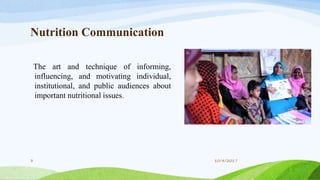
Nutrition Communication
The art and technique of informing,
influencing, and motivating individual,
institutional, and public audiences about
important nutritional issues.
3 10/4/2017
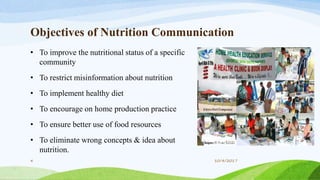
Objectives of Nutrition Communication
• To improve the nutritional status of a specific
community
• To restrict misinformation about nutrition
• To implement healthy diet
• To encourage on home production practice
• To ensure better use of food resources
• To eliminate wrong concepts & idea about
nutrition.
4 10/4/2017
Strategies of Nutrition Communication
• Must linked to the planned
intervention
• Follow a systematic field
information
• Aim to change the knowledge,
attitude of the beneficiary group of
population
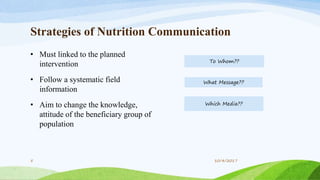
To Whom??
What Message??
Which Media??
5 10/4/2017
Identification Of Target Groups
• Primary target group: Mother of the children
Segment A: illiterate mothers living in rural areas
Segment B: illiterate mothers living in urban areas
Segment C: literate mothers
• Secondary target group: Health workers, social workers,
journalist, teachers.
• Tertiary target group: Administrative and technical officers
of various sectors, father of the children.
6 10/4/2017
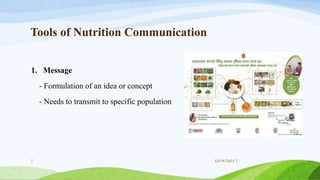
Tools of Nutrition Communication
1. Message
- Formulation of an idea or concept
- Needs to transmit to specific population
7 10/4/2017
Cont…
2. Media
- Channel of communication
- Which transmits message
Examples: Health centre and school lessons, Newspaper.
8 10/4/2017
Cont…
3. Supporting Materials
- Elements used in message transmission
Examples: Poster, Projector, white board, leaflet, wall chart etc.
9 10/4/2017
Media of Nutrition Communication
 Auditory aids: Microphones, tape recorders, radio.
 Visual aids: White board, flannel graph, projectors, silent films.
 Audio-visual aids: Tv, computer, slide tape combination, sound films.
10 10/4/2017
Limitation of Media
• Physiological: Difficulties in hearing, expression
• Psychological: Emotional disturbances ,
language or comprehension difficulties.
• Environmental: Noise, invisibility, congestion.
11 10/4/2017
Methods of Nutrition Communication
1. Individual approach
 Personal contact
 Home visits
 Personal letters
12 10/4/2017
Cont..
• Advantages
 Helps an agent in building rapport
 Facilitates to gaining about
knowledge of nutrition
 Helps in changing attitude of the
people
 Enhances effectiveness of group &
mass methods
 Facilitates getting feedback
information
• Disadvantages
 Time consuming
 Has low coverage of audience
 May develop bias towards some
persons
13 10/4/2017
Methods of Nutrition Communication
2. Group approach
 Lectures
 Demonstration
 Discussion methods
 Field visit
14 10/4/2017
Cont…
• Advantages
 Enables face-to-face contact
 More opportunities for interaction &
feedback
 Less expensive than individual method
 More effective than mass method
• Disadvantages
 May create a difficult
learning situation
15 10/4/2017
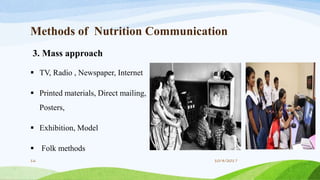
Methods of Nutrition Communication
3. Mass approach
 TV, Radio , Newspaper, Internet
 Printed materials, Direct mailing,
Posters,
 Exhibition, Model
 Folk methods
16 10/4/2017
Cont..
• Advantages
 Suitable for creating general
awareness
 Helps in transferring nutritional
knowledge
 Large number of people
communicated within a short time
 Facilitates quick communication
 Less expensive due to more
coverage
• Disadvantages
 Less intensive methods
 Little scope for personal contact
 Little opportunity for interaction
 Difficulty to get feedback
information
17 10/4/2017
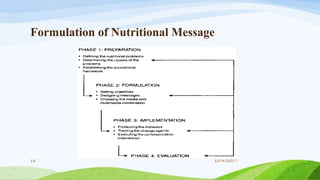
Formulation of Nutritional Message
18 10/4/2017
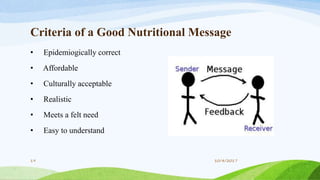
Criteria of a Good Nutritional Message
• Epidemiogically correct
• Affordable
• Culturally acceptable
• Realistic
• Meets a felt need
• Easy to understand
19 10/4/2017
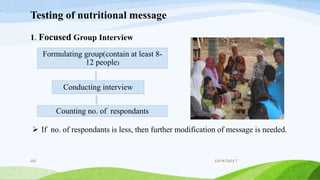
Testing of nutritional message
1. Focused Group Interview
Formulating group(contain at least 8-
12 people)
Conducting interview
Counting no. of respondants
 If no. of respondants is less, then further modification of message is needed.
20 10/4/2017
Cont…
2. Individual in-depth Interview
• Field testing on individual basis
• In-depth exploration of target
audience, attitude, belief and emotion
in response to the message
21 10/4/2017
Cont…
3. Questionnaire
Making open, closed or pictorial form
of questionnaire
Distributing the questionnaire to target
audience
Evaluating the response
22 10/4/2017
Development of Curriculum
• A two-way flow of information and resources should be emphasized in all
nutrition and communication programs.
• More and better quality training programs are recommended.
• Should effectively combine the process and approaches of social marketing,
social mobilization of communication.
23 10/4/2017
References
• Park Community Medicine
• ESSENTIALS OF PUBLIC HEALTH DENTISTRY – SOBEN PETER
• Bulletin of the World Health Organization 2009;87:116-122. doi:
10.2471/BLT.08.051789
• Social Communication in Nutrition: A Methodology for Intervention- Michel
Andrien
• Nutrition Education for the Public: Discussion Papers of the FAO ..., Issue
62-Food and Agriculture Organization of the United Nation
24 10/4/2017
Nutrition communication

Nutrition communication

  • 1.
  • 2.
    Communication • A processof exchanging information & data person to person to a target audience, or community with definite goals and objectives. • Also includes the response of the recipients. 2 10/4/2017
  • 3.
    Nutrition Communication The artand technique of informing, influencing, and motivating individual, institutional, and public audiences about important nutritional issues. 3 10/4/2017
  • 4.
    Objectives of NutritionCommunication • To improve the nutritional status of a specific community • To restrict misinformation about nutrition • To implement healthy diet • To encourage on home production practice • To ensure better use of food resources • To eliminate wrong concepts & idea about nutrition. 4 10/4/2017
  • 5.
    Strategies of NutritionCommunication • Must linked to the planned intervention • Follow a systematic field information • Aim to change the knowledge, attitude of the beneficiary group of population To Whom?? What Message?? Which Media?? 5 10/4/2017
  • 6.
    Identification Of TargetGroups • Primary target group: Mother of the children Segment A: illiterate mothers living in rural areas Segment B: illiterate mothers living in urban areas Segment C: literate mothers • Secondary target group: Health workers, social workers, journalist, teachers. • Tertiary target group: Administrative and technical officers of various sectors, father of the children. 6 10/4/2017
  • 7.
    Tools of NutritionCommunication 1. Message - Formulation of an idea or concept - Needs to transmit to specific population 7 10/4/2017
  • 8.
    Cont… 2. Media - Channelof communication - Which transmits message Examples: Health centre and school lessons, Newspaper. 8 10/4/2017
  • 9.
    Cont… 3. Supporting Materials -Elements used in message transmission Examples: Poster, Projector, white board, leaflet, wall chart etc. 9 10/4/2017
  • 10.
    Media of NutritionCommunication  Auditory aids: Microphones, tape recorders, radio.  Visual aids: White board, flannel graph, projectors, silent films.  Audio-visual aids: Tv, computer, slide tape combination, sound films. 10 10/4/2017
  • 11.
    Limitation of Media •Physiological: Difficulties in hearing, expression • Psychological: Emotional disturbances , language or comprehension difficulties. • Environmental: Noise, invisibility, congestion. 11 10/4/2017
  • 12.
    Methods of NutritionCommunication 1. Individual approach  Personal contact  Home visits  Personal letters 12 10/4/2017
  • 13.
    Cont.. • Advantages  Helpsan agent in building rapport  Facilitates to gaining about knowledge of nutrition  Helps in changing attitude of the people  Enhances effectiveness of group & mass methods  Facilitates getting feedback information • Disadvantages  Time consuming  Has low coverage of audience  May develop bias towards some persons 13 10/4/2017
  • 14.
    Methods of NutritionCommunication 2. Group approach  Lectures  Demonstration  Discussion methods  Field visit 14 10/4/2017
  • 15.
    Cont… • Advantages  Enablesface-to-face contact  More opportunities for interaction & feedback  Less expensive than individual method  More effective than mass method • Disadvantages  May create a difficult learning situation 15 10/4/2017
  • 16.
    Methods of NutritionCommunication 3. Mass approach  TV, Radio , Newspaper, Internet  Printed materials, Direct mailing, Posters,  Exhibition, Model  Folk methods 16 10/4/2017
  • 17.
    Cont.. • Advantages  Suitablefor creating general awareness  Helps in transferring nutritional knowledge  Large number of people communicated within a short time  Facilitates quick communication  Less expensive due to more coverage • Disadvantages  Less intensive methods  Little scope for personal contact  Little opportunity for interaction  Difficulty to get feedback information 17 10/4/2017
  • 18.
    Formulation of NutritionalMessage 18 10/4/2017
  • 19.
    Criteria of aGood Nutritional Message • Epidemiogically correct • Affordable • Culturally acceptable • Realistic • Meets a felt need • Easy to understand 19 10/4/2017
  • 20.
    Testing of nutritionalmessage 1. Focused Group Interview Formulating group(contain at least 8- 12 people) Conducting interview Counting no. of respondants  If no. of respondants is less, then further modification of message is needed. 20 10/4/2017
  • 21.
    Cont… 2. Individual in-depthInterview • Field testing on individual basis • In-depth exploration of target audience, attitude, belief and emotion in response to the message 21 10/4/2017
  • 22.
    Cont… 3. Questionnaire Making open,closed or pictorial form of questionnaire Distributing the questionnaire to target audience Evaluating the response 22 10/4/2017
  • 23.
    Development of Curriculum •A two-way flow of information and resources should be emphasized in all nutrition and communication programs. • More and better quality training programs are recommended. • Should effectively combine the process and approaches of social marketing, social mobilization of communication. 23 10/4/2017
  • 24.
    References • Park CommunityMedicine • ESSENTIALS OF PUBLIC HEALTH DENTISTRY – SOBEN PETER • Bulletin of the World Health Organization 2009;87:116-122. doi: 10.2471/BLT.08.051789 • Social Communication in Nutrition: A Methodology for Intervention- Michel Andrien • Nutrition Education for the Public: Discussion Papers of the FAO ..., Issue 62-Food and Agriculture Organization of the United Nation 24 10/4/2017