NUTRACEUTICALS AND PROXIMATE
ANALYSIS IN BRIEF
SHAHNAZ MOL A
NUTRACEUTICALS
“ Let food be thy medicine and medicine be 
thy food.”
                            ­ Hippocrates
Hybrid of Nutrition and Pharmaceuticals.
Coined by Dr. Stephen DeFelice.
ghghh
Dr.Stephen 
DeFelice
“Any substance that may be considered
a food or part of a food which
provides medical or health benefits
including the prevention and treatment
of diseases.”
CLASSIFICATION OF NUTRACEUTICALS
Based on food source :
 Dietary Fibre
 Probiotics
 Prebiotics
 Polyunsaturated Fatty Acid
 Antioxidant Vitamins
 Polyphenols
 Spices 
Birketvedt et al., 2005 found that dietary fibre 
lowers serum LDL cholesterol   and   improves 
glucose   tolerance.
Leray et al., 2001 states that Omega ­­ 3 ­fatty   
acids have three major   effects in cardio ­ 
vascular disease :
Anti­arrhythmic.  
Hypolipidemic  
Antithrombotic  
PROXIMATE ANALYSIS
“ Quantitative analysis which 
determines nutritional and 
biochemical point of view of foods.”
The methods recommended by the   
Association of Official Analytical 
Chemists (AOAC), 2000 were used for   
the determination of Proximate   
Analysis.  
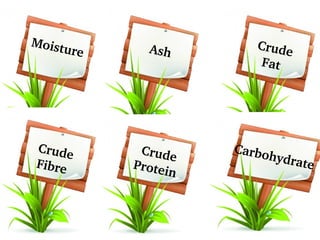
Moisture Ash
Crude
Fat
Crude
Fibre
Crude
Protein
Carbohydrate
DETERMINATION OF MOISTURE
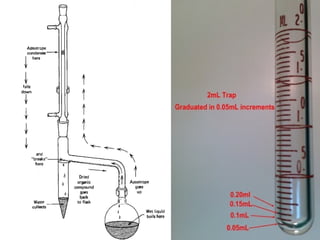
Immiscible solvent distillation method.
 Reflux distillation.
High boiling point solvent, Toluene (110.6°C).
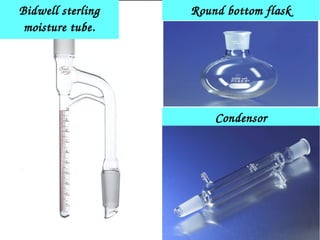
Apparatus used is Bidwell sterling moisture 
trap.
Bidwell sterling 
moisture tube.
Round bottom flask
Condensor
PROCEDURE
10 gm of ground sample was taken in a 
round bottom flask.
Toluene was added enough  
to cover the sample.
  Connect the round bottom flask to the   
side arm of Bidwell­ sterling tube.  
   Bidwell sterling tube was filled with 
solvent.
  Heating mantle adjusted to 100°C for 
1hr.
  Note the volume of water distilled.
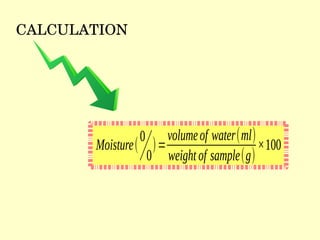
Moisture(
0
0
)=
volumeof water(ml)
weightof sample(g)
×100
CALCULATION
DETERMINATION OF ASH
 Indicator of minerals
Ash
 Ash refers to the inorganic residue remaining 
after either ignition or complete oxidation of 
organic matter in a foodstuff. 
 Dry ashing refers to the use of a muffle furnace 
capable of maintaining temperatures of 500–
650 C.◦
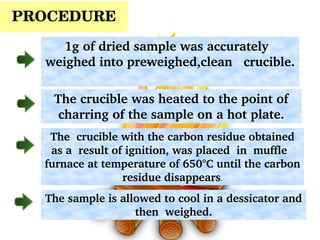
PROCEDURE
1g of dried sample was accurately   
weighed into pre­weighed,clean   crucible. 
 
The crucible was heated to the point of 
charring of the sample on a hot plate.
The  crucible with the carbon residue obtained 
as a  result of ignition, was placed  in  muffle   
furnace at temperature of 650°C until the carbon 
residue disappears.
The sample is allowed to cool in a dessicator and 
then  weighed.
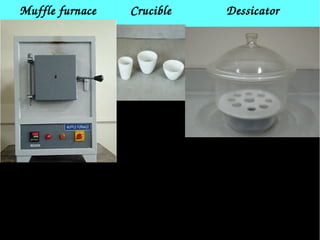
Muffle furnace Crucible Dessicator
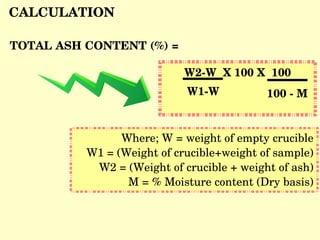
CALCULATION
TOTAL ASH CONTENT (%) =  
W2­W  X 100 X  100
W1­W 100 ­ M
Where; W = weight of empty crucible
W1 = (Weight of crucible+weight of sample)
W2 = (Weight of crucible + weight of ash)
M = % Moisture content (Dry basis)
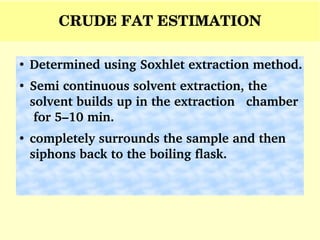
CRUDE FAT ESTIMATION
●
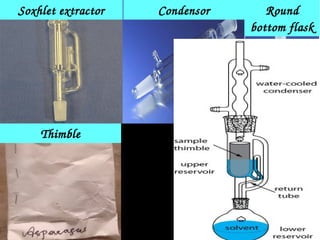
Determined using Soxhlet extraction method.
●
Semi continuous solvent extraction, the   
solvent builds up in the extraction   chamber  
 for 5–10 min. 
●
completely surrounds the sample and then   
siphons back to the boiling flask.
Soxhlet extractor
Thimble
Condensor Round 
bottom flask
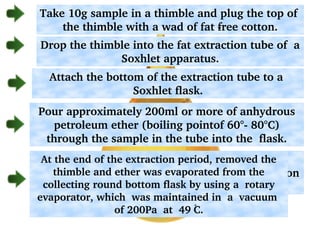
Take 10g sample in a thimble and plug the top of  
the thimble with a wad of fat ­free cotton.
Drop the thimble into the fat extraction tube of  a 
Soxhlet apparatus.
Attach the bottom of the extraction tube to a  
Soxhlet flask.
Pour approximately 200ml or more of anhydrous 
petroleum ether (boiling pointof 60°­ 80°C) 
through the sample in the tube into the  flask.
Attach the  top of  fat extraction tube to the 
condenser. Extract the sample for 8hr or longer on 
a  heating   mantle. 
At the end of the extraction period, removed the 
thimble and ether was evaporated from the 
collecting round bottom flask by using a  rotary 
evaporator, which  was maintained in  a  vacuum  
of 200Pa  at  49 C.
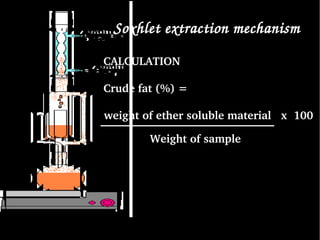
Soxhlet extraction mechanism
CALCULATION
Crude fat (%) =
 
weight of ether soluble material   x  100  
Weight of sample
DETERMINATION OF PROTEIN
Johan Kjeldahl
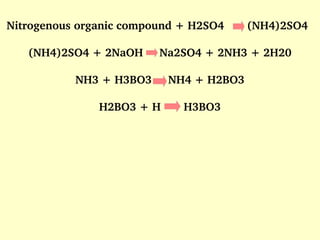
 Nitrogen content was estimated by the Kjeldahl method 
which was based on the determination of  the amount 
of reduced nitrogen present in the sample.
The various nitrogenous compounds were converted   
into ammonium sulphate by boiling with concentrated  
H2SO4.
The ammonium sulphate formed was decomposed with 
an alkali (NaOH), and ammonia liberated was absorbed 
in excess of neutral boric acid solution and then titrated 
against standard Hcl acid. 
  Nitrogenous organic compound + H2SO4       (NH4)2SO4
(NH4)2SO4 + 2NaOH     Na2SO4 + 2NH3 + 2H20
NH3 + H3BO3     NH4 + H2BO3
H2BO3 + H       H3BO3
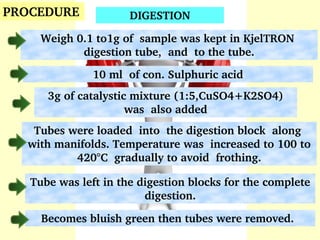
Weigh 0.1 to1g of  sample was kept in KjelTRON  
digestion tube,  and  to the tube.
PROCEDURE
Tubes were loaded  into  the digestion block  along  
with manifolds. Temperature was  increased to 100 to 
420°C  gradually to avoid  frothing.
DIGESTION
Tube was left in the digestion blocks for the complete 
digestion.
10 ml  of con. Sulphuric acid
3g of catalystic mixture (1:5,CuSO4+K2SO4) 
was  also added
Becomes bluish green then tubes were removed. 
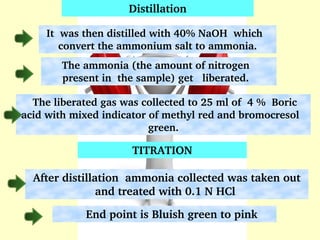
   The liberated gas was collected to 25 ml of  4 %  Boric   
acid with mixed indicator of methyl red and bromocresol   
green.
Distillation
It  was then distilled with 40% NaOH  which   
convert the ammonium salt to ammonia.
The ammonia (the amount of nitrogen   
present in  the sample) get   liberated.  
TITRATION
After distillation  ammonia collected was taken out 
and treated with 0.1 N HCl 
End point is Bluish green to pink
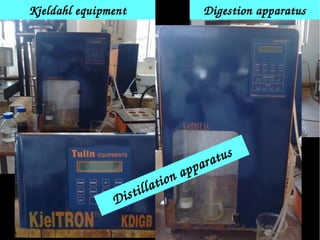
Kjeldahl equipment Digestion apparatus
Distillation apparatus
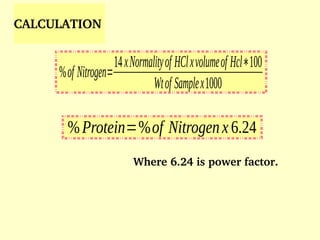
%of Nitrogen=
14xNormalityof HClxvolumeof Hcl∗100
Wtof Samplex1000
%Protein=%of Nitrogenx6.24
CALCULATION
Where 6.24 is power factor.
DETERMINATION OF CARBOHYDRATE
% of carbohydrate = 100 ­ [ Moisture + Ash + Fat   
+ Protein ]
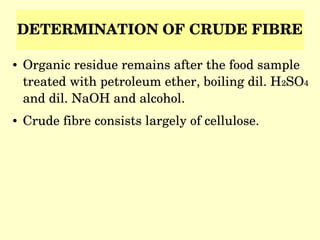
DETERMINATION OF CRUDE FIBRE
● Organic residue remains after the food sample 
treated with petroleum ether, boiling dil. H2SO4 
and dil. NaOH and alcohol.
● Crude fibre consists largely of cellulose.
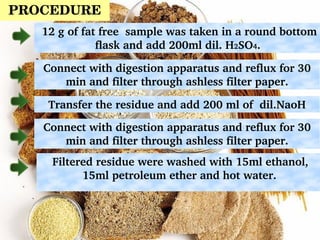
PROCEDURE
12 g of fat free  sample was taken in a round bottom 
flask and add 200ml dil. H2SO4. 
Connect with digestion apparatus and reflux for 30 
min and filter through ashless filter paper.
Transfer the residue and add 200 ml of  dil.NaoH
Connect with digestion apparatus and reflux for 30 
min and filter through ashless filter paper.
Filtered residue were washed with 15ml ethanol, 
15ml petroleum ether and hot water.
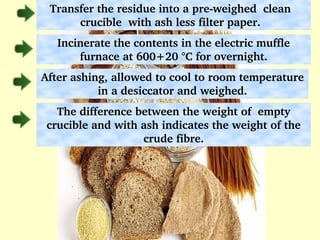
Transfer the residue into a pre­ weighed  clean   
crucible  with ash less filter paper.  
Incinerate the contents in the electric muffle 
furnace at 600+20 °C for overnight.
After ashing, allowed to cool to room temperature 
in a desiccator and weighed.
The difference between the weight of  empty 
crucible and with ash indicates the weight of the 
crude fibre.
Calculation 
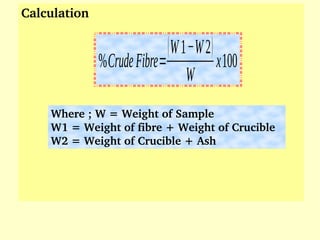
Where ; W = Weight of Sample
W1 = Weight of fibre + Weight of Crucible
W2 = Weight of Crucible + Ash
%CrudeFibre=
(W1−W2)
W
x100
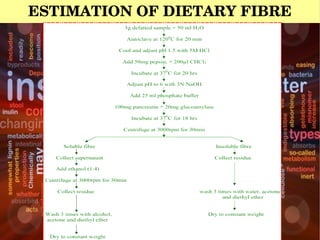
ESTIMATION OF DIETARY FIBRE

Nutraceuticals and Proximate Analysis in Brief