nursing department
O v e rv i e w a n d O u t c O m e s r e p O rt 2 0 0 8
Nursing Department

Overview and Outcomes Report 2008
Table of Contents
1     Letter from the Vice President of Patient Care Services
2     Vision/Core Beliefs
3     Professional Nursing Practice Model
23    Celebrating Excellence, Innovation and Advanced Learning
34    About Abbott Northwestern Hospital
Overview


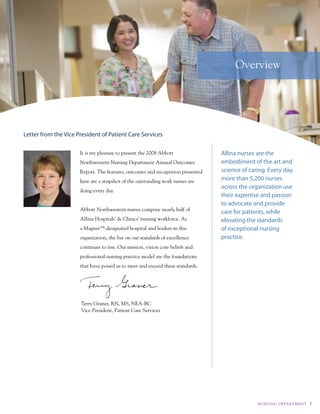
Letter from the Vice President of Patient Care Services

                      it is my pleasure to present the 2008 abbott               Allina nurses are the
                      northwestern nursing department annual Outcomes            embodiment of the art and
                      report. the features, outcomes and recognition presented   science of caring. Every day,
                      here are a snapshot of the outstanding work nurses are     more than 5,200 nurses
                                                                                 across the organization use
                      doing every day.
                                                                                 their expertise and passion
                                                                                 to advocate and provide
                      abbott northwestern nurses comprise nearly half of
                                                                                 care for patients, while
                      allina Hospitals’ & clinics’ nursing workforce. as         elevating the standards
                      a magnet™-designated hospital and leaders in this          of exceptional nursing
                      organization, the bar on our standards of excellence       practice.
                      continues to rise. Our mission, vision core beliefs and
                      professional nursing practice model are the foundations
                      that have poised us to meet and exceed these standards.


                      terry Graner, rn, ms, nea-Bc
                      vice president, patient care services


                                                                                               NuRS I Ng dE PA Rt M E Nt   1
Vision/Core Beliefs


           Allina’s Mission               Allina’s Nursing Vision
           We serve our communities       •	 Allina	will	be	nationally	known	and	trusted	for	exceptional	
           by providing exceptional          nursing practice.
           care, as we prevent illness,   •	 Allina	nurses	combine	the	best	of	science	and	caring	
           restore health and provide        to provide exceptional patient care through trusted
                                             partnerships and effective stewardship.
           comfort to all who entrust
                                          •	 Allina’s	healing	environment	fosters	nursing	practice	that	
           us with their care.               is evidence-based, innovative, and patient/family centered.
                                          •	 Allina	nurses	are	powerful,	passionate	and	diverse	in	talents	
                                             and thought.
                                          •	 Nursing	career	paths	provide	Allina	nurses	with	dynamic	
                                             opportunities for career enhancement to help them achieve
                                             their highest potential.
                                          •	 Nursing	leadership	is	relationship-centered,	holistic,	
                                             progressive, and responsive.


                                            Nursing Core Beliefs
                                            •	 Advocacy
                                            •	 Caring
                                            •	 Continuous	Improvement
                                            •	 Cultural	Awareness	and	Recognition
                                            •	 Ethics
                                            •	 Leadership
                                            •	 Relationships
                                            •	 Stewardship


2   O u t CO M E S R E P O Rt 2 0 0 9
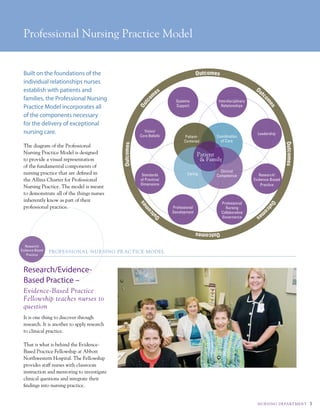
professional nursing practice model


 Built on the foundations of the                                                        Outcomes
 individual relationships nurses
 establish with patients and                                       s                                                 Ou
                                                                 me                                                    tc
 families, the Professional Nursing


                                                             o


                                                                                                                        om
                                                                           Systems              Interdisciplinary


                                                           tc
 Practice Model incorporates all


                                                         Ou
                                                                           Support                Relationships


                                                                                                                           e s
 of the components necessary
 for the delivery of exceptional
 nursing care.                                             Vision/
                                                                                                                      Leadership
                                                         Core Beliefs          Patient-        Coordination
                                                                               Centered          of Care


                                                                                                                                     Outcomes
                                              Outcomes


 the diagram of the professional
 nursing practice model is designed                                                     patient
 to provide a visual representation                                                      & Family
 of the fundamental components of
                                                                                                 Clinical
 nursing practice that are defined in                      Standards             Caring        Competence              Research/
 the allina charter for professional                      of Practice/                                              Evidence-Based
                                                          Dimensions                                                    Practice
 nursing practice. the model is meant
 to demonstrate all of the things nurses
 inherently know as part of their
                                                         s


                                                                                                                            Ou
                                                                                                   Professional
                                                             e


 professional practice.
                                                          om


                                                                         Professional                Nursing


                                                                                                                              tc
                                                                                                                                o
                                                                         Development
                                                                   tc                              Collaborative
                                                                                                                     me
                                                                 Ou                                Governance
                                                                                                                       s

                                                                                        Outcomes

   Research/
Evidence-Based
                 PROf E S SIONA L N u RSI Ng PR AC t IC E MOdEL
    Practice


 Research/Evidence-
 Based Practice –
 Evidence-Based Practice
 Fellowship teaches nurses to
 question
 it is one thing to discover through
 research. it is another to apply research
 to clinical practice.

 that is what is behind the evidence-
 Based practice Fellowship at abbott
 northwestern Hospital. the Fellowship
 provides staff nurses with classroom
 instruction and mentoring to investigate
 clinical questions and integrate their
 findings into nursing practice.


                                                                                                                      NuRS I Ng dE PA Rt M E Nt   3
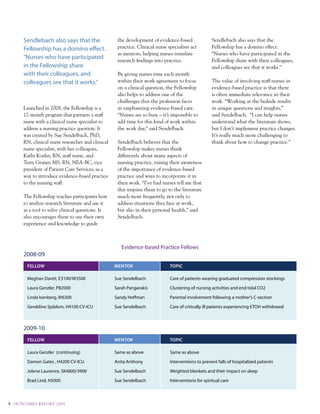
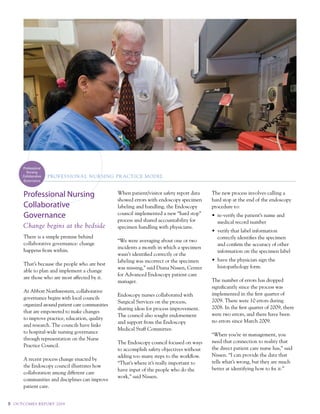
Sendlebach also says that the                 the development of evidence-based               sendlebach also says that the
          Fellowship has a domino effect.               practice. clinical nurse specialists act        Fellowship has a domino effect.
                                                        as mentors, helping nurses translate            “nurses who have participated in the
          “Nurses who have participated                 research findings into practice.                Fellowship share with their colleagues,
          in the Fellowship share                                                                       and colleagues see that it works.”
          with their colleagues, and                    By giving nurses time each month
          colleagues see that it works.”                within their work agreement to focus            the value of involving staff nurses in
                                                        on a clinical question, the Fellowship          evidence-based practice is that there
                                                        also helps to address one of the                is often immediate relevance in their
                                                        challenges that the profession faces            work. “working at the bedside results
          Launched	in	2008,	the	Fellowship	is	a	        in emphasizing evidence-based care.             in unique questions and insights,”
          12-month program that partners a staff        “nurses are so busy – it’s impossible to        said sendelbach. “i can help nurses
          nurse with a clinical nurse specialist to     add time for this kind of work within           understand what the literature shows,
          address a nursing practice question. it       the work day,” said sendelbach.                 but i don’t implement practice changes.
          was created by sue sendelbach, phd,                                                           it’s really much more challenging to
          rn, clinical nurse researcher and clinical    sendelbach believes that the                    think about how to change practice.”
          nurse specialist, with her colleagues,        Fellowship makes nurses think
          Kathi Koehn, rn, staff nurse, and             differently about many aspects of
          terry Graner, ms, rn, nea-Bc, vice            nursing practice, raising their awareness
          president of patient care services, as a      of the importance of evidence-based
          way to introduce evidence-based practice      practice and ways to incorporate it in
          to the nursing staff.                         their work. “i’ve had nurses tell me that
                                                        this inspires them to go to the literature
          the Fellowship teaches participants how       much more frequently, not only to
          to analyze research literature and use it     address situations they face at work,
          as a tool to solve clinical questions. it     but also in their personal health,” said
          also encourages them to use their own         sendelbach.
          experience and knowledge to guide


                                                          Evidence-based Practice Fellows
          2008-09
            Fellow                                     Mentor                     topic

            Meghan Davitt, E3100/W3500                 Sue Sendelbach             Care of patients wearing graduated compression stockings

            Laura Genzler, PB2000                      Sarah Pangarakis           Clustering of nursing activities and end tidal CO2

            Linda Isenberg, W6300                      Sandy Hoffman              Parental involvement following a mother’s C-section

            Geraldine Sjoblom, H4100 CV-ICU            Sue Sendelbach             Care of critically ill patients experiencing ETOH withdrawal


          2009-10
            Fellow                                     Mentor                     topic

            Laura Genzler (continuing)                 Same as above              Same as above

            Damon Gates , H4200 CV-ICU                 Anita Anthony              Interventions to prevent falls of hospitalized patients

            Jolene Laurence, SK4800/3900               Sue Sendelbach             Weighted blankets and their impact on sleep

            Brad Lind, H5000                           Sue Sendelbach             Interventions for spiritual care


4   O u t CO M E S R E P O Rt 2 0 0 9
Systems
 Support    PROf E S SIONA L N u RSI Ng PR AC t IC E MOdEL


Systems Support
Consistent stroke education
improves documentation

applying care standards consistently
among patients with similar needs is a
hallmark of effective patient care. the
challenge for nurses is incorporating such
standards into their workflow as they
manage a multitude of patient care tasks.

On H8000, excellian (the clinical
documentation system) has been
enhanced to better support nurses
in meeting a key quality standard:
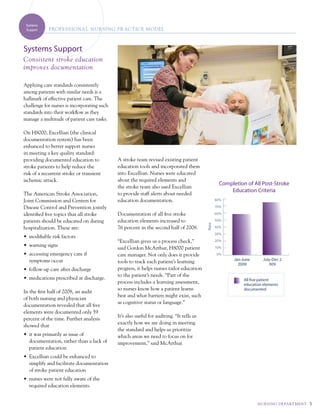
providing documented education to            a stroke team revised existing patient
stroke patients to help reduce the           education tools and incorporated them
risk of a recurrent stroke or transient      into excellian. nurses were educated
ischemic attack.                             about the required elements and
                                                                                                   Completion of All Post-Stroke
                                             the stroke team also used excellian
                                                                                                       Education Criteria
the american stroke association,             to provide staff alerts about needed
Joint commission and centers for             education documentation.                             80%

disease control and prevention jointly                                                            70%

identified five topics that all stroke       documentation of all five stroke                     60%

patients should be educated on during        education elements increased to                      50%
                                                                                           Rate


hospitalization. these are:                  76 percent in the second half of 2008.               40%
                                                                                                  30%
•	 modifiable	risk	factors
                                             “excellian gives us a process check,”                20%
•	 warning	signs
                                             said Gordon mcarthur, H8000 patient                  10%
•	 accessing	emergency	care	if	              care manager. not only does it provide               0%
   symptoms occur                                                                                        Jan-June      July-Dec 2
                                             tools to track each patient’s learning                        2009           009
•	 follow-up	care	after	discharge            progress, it helps nurses tailor education
                                             to the patient’s needs. “part of the
•	 medications	prescribed	at	discharge.                                                                      All five patient
                                             process includes a learning assessment,                         education elements
                                             so nurses know how a patient learns                             documented
in the first half of 2008, an audit
                                             best and what barriers might exist, such
of both nursing and physician
                                             as cognitive status or language.”
documentation revealed that all five
elements were documented only 59
                                             it’s also useful for auditing. “it tells us
percent of the time. Further analysis
                                             exactly how we are doing in meeting
showed that
                                             the standard and helps us prioritize
•	 it	was	primarily	as	issue	of	             which areas we need to focus on for
   documentation, rather than a lack of      improvement,” said mcarthur.
   patient education
•	 Excellian	could	be	enhanced	to	
   simplify and facilitate documentation
   of stroke patient education
•	 nurses	were	not	fully	aware	of	the	
   required education elements.


                                                                                                                    NuRS I Ng dE PA Rt M E Nt   5
Interdisciplinary
          Relationships     PROf E S SIONA L N u RSI Ng PR AC t IC E MOdEL


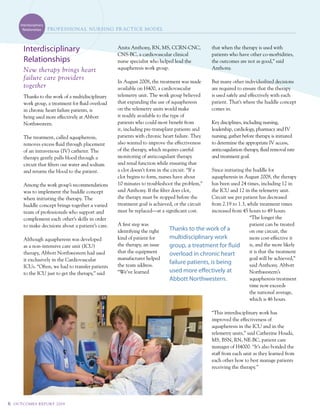
          Interdisciplinary                            anita anthony, rn, ms, ccrn-cnc,             that when the therapy is used with
                                                       cns-Bc, a cardiovascular clinical            patients who have other co-morbidities,
          Relationships                                nurse specialist who helped lead the         the outcomes are not as good,” said
          New therapy brings heart                     aquapheresis work group.                     anthony.
          failure care providers
                                                       in august 2008, the treatment was made       But many other individualized decisions
          together                                     available on H400, a cardiovascular          are required to ensure that the therapy
          thanks to the work of a multidisciplinary    telemetry unit. the work group believed      is used safely and effectively with each
          work group, a treatment for fluid overload   that expanding the use of aquapheresis       patient. that’s where the huddle concept
          in chronic heart failure patients, is        on the telemetry units would make            comes in.
          being used more effectively at abbott        it readily available to the type of
          northwestern.                                patients who could most benefit from         Key disciplines, including nursing,
                                                       it, including pre-transplant patients and    leadership, cardiology, pharmacy and iv
          the treatment, called aquapheresis,          patients with chronic heart failure. they    nursing, gather before therapy is initiated
          removes excess fluid through placement       also wanted to improve the effectiveness     to determine the appropriate iv access,
          of an intravenous (iv) catheter. the         of the therapy, which requires careful       anticoagulation therapy, fluid removal rate
          therapy gently pulls blood through a         monitoring of anticoagulant therapy          and treatment goal.
          circuit that filters out water and sodium    and renal function while ensuring that
          and returns the blood to the patient.        a clot doesn’t form in the circuit. “if a   since initiating the huddle for
                                                       clot begins to form, nurses have about      aquapheresis in august 2008, the therapy
          among the work group’s recommendations       10 minutes to troubleshoot the problem,”    has been used 24 times, including 12 in
          was to implement the huddle concept          said anthony. if the filter does clot,      the icu and 12 in the telemetry unit.
          when initiating the therapy. the             the therapy must be stopped before the      circuit use per patient has decreased
          huddle concept brings together a varied      treatment goal is achieved, or the circuit  from 2.19 to 1.3, while treatment times
          team of professionals who support and        must be replaced—at a significant cost.     increased from 45 hours to 49 hours.
          complement each other’s skills in order                                                                     “the longer the
          to make decisions about a patient’s care.    a first step was                                               patient can be treated
                                                       identifying the right    Thanks to the work of a               on one circuit, the
          although aquapheresis was developed          kind of patient for      multidisciplinary work                more cost-effective it
          as a non-intensive care unit (icu)           the therapy, an issue    group, a treatment for fluid          is, and the more likely
          therapy, abbott northwestern had used        that the equipment       overload in chronic heart             it is that the treatment
          it exclusively in the cardiovascular         manufacturer helped                                            goal will be achieved,”
                                                       the team address.
                                                                                failure patients, is being            said anthony. abbott
          icus. “Often, we had to transfer patients
          to the icu just to get the therapy,” said    “we’ve learned           used more effectively at              northwestern’s
                                                                                Abbott Northwestern.                  aquapheresis treatment
                                                                                                                      time now exceeds
                                                                                                                      the national average,
                                                                                                                      which is 46 hours.

                                                                                                    “this interdisciplinary work has
                                                                                                    improved the effectiveness of
                                                                                                    aquapheresis in the icu and in the
                                                                                                    telemetry units,” said catherine Houda,
                                                                                                    ms, Bsn, rn, ne-Bc, patient care
                                                                                                    manager of H4000. “it’s also bonded the
                                                                                                    staff from each unit as they learned from
                                                                                                    each other how to best manage patients
                                                                                                    receiving the therapy.”


6   O u t CO M E S R E P O Rt 2 0 0 9
Leadership
             PROf E S SIONA L N u RSI Ng PR AC t IC E MOdEL


Leadership
Magnet™ designation—
a journey to success
although it was called the magnet
journey, the 2008 effort that led
to abbott northwestern’s magnet
accreditation might well be described
as an all-out mobilization.

tonya montesinos, director of
professional nursing practice
and magnet coordinator, led the
charge, involving nurses in all job
classifications and specialties to
assemble the mammoth documentation
and prepare for the onsite survey
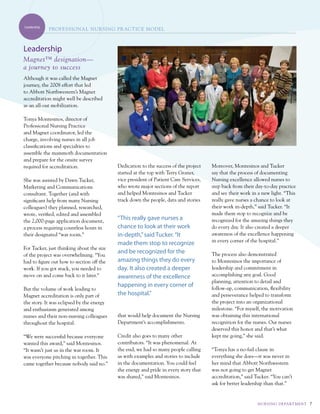
required for accreditation.                dedication to the success of the project   moreover, montesinos and tucker
                                           started at the top with terry Graner,      say that the process of documenting
she was assisted by dawn tucker,           vice president of patient care services,   nursing excellence allowed nurses to
marketing and communications               who wrote major sections of the report     step back from their day-to-day practice
consultant. together (and with             and helped montesinos and tucker           and see their work in a new light. “this
significant help from many nursing         track down the people, data and stories    really gave nurses a chance to look at
colleagues) they planned, researched,                                                 their work in-depth,” said tucker. “it
wrote, verified, edited and assembled                                                 made them stop to recognize and be
the 2,000-page application document,
                                           “This really gave nurses a                 recognized for the amazing things they
a process requiring countless hours in     chance to look at their work               do every day. it also created a deeper
their designated “war room.”               in-depth,” said Tucker. “It                awareness of the excellence happening
                                                                                      in every corner of the hospital.”
                                           made them stop to recognize
For tucker, just thinking about the size
                                           and be recognized for the                  the process also demonstrated
of the project was overwhelming. “You
had to figure out how to section off the   amazing things they do every               to montesinos the importance of
work. if you got stuck, you needed to      day. It also created a deeper              leadership and commitment in
move on and come back to it later.”        awareness of the excellence                accomplishing any goal. Good
                                                                                      planning, attention to detail and
                                           happening in every corner of               follow-up, communication, flexibility
But the volume of work leading to
magnet accreditation is only part of       the hospital.”                             and perseverance helped to transform
the story. it was eclipsed by the energy                                              the project into an organizational
and enthusiasm generated among                                                        milestone. “For myself, the motivation
nurses and their non-nursing colleagues    that would help document the nursing       was obtaining this international
throughout the hospital.                   department’s accomplishments.              recognition for the nurses. Our nurses
                                                                                      deserved this honor and that’s what
“we were successful because everyone       credit also goes to many other             kept me going,” she said.
wanted this award,” said montesinos.       contributors. “it was phenomenal. at
“it wasn’t just us in the war room. it     the end, we had so many people calling     “tonya has a no-fail clause in
was everyone pitching in together. this    us with examples and stories to include    everything she does—it was never in
came together because nobody said no.”     in the documentation. You could feel       her mind that abbott northwestern
                                           the energy and pride in every story that   was not going to get magnet
                                           was shared,” said montesinos.              accreditation,” said tucker. “You can’t
                                                                                      ask for better leadership than that.”


                                                                                                            NuRS I Ng dE PA Rt M E Nt   7
Professional
            Nursing
          Collaborative   PROf E S SIONA L N u RSI Ng PR AC t IC E MOdEL
          Governance


          Professional Nursing                        when patient/visitor safety report data   the new process involves calling a
                                                      showed errors with endoscopy specimen     hard stop at the end of the endoscopy
          Collaborative                               labeling and handling, the endoscopy      procedure to:
          Governance                                  council implemented a new “hard stop”
                                                      process and shared accountability for
                                                                                                •	 re-verify	the	patient’s	name	and	
                                                                                                   medical record number
          Change begins at the bedside                specimen handling with physicians.
                                                                                                •	 verify	that	label	information	
          there is a simple premise behind                                                         correctly identifies the specimen
                                                      “we were averaging about one or two
          collaborative governance: change                                                         and confirm the accuracy of other
                                                      incidents a month in which a specimen
          happens from within.                                                                     information on the specimen label
                                                      wasn’t identified correctly or the
                                                      labeling was incorrect or the specimen    •	 have	the	physician	sign	the	
          that’s because the people who are best
                                                      was missing,” said diana nissen, center      histopathology form.
          able to plan and implement a change
                                                      for advanced endoscopy patient care
          are those who are most affected by it.
                                                      manager.                                  the number of errors has dropped
                                                                                                significantly since the process was
          at abbott northwestern, collaborative
                                                      endoscopy nurses collaborated with        implemented in the first quarter of
          governance begins with local councils
                                                      surgical services on the process,         2009. there were 10 errors during
          organized around patient care communities
                                                      sharing ideas for process improvement.    2008. in the first quarter of 2009, there
          that are empowered to make changes
                                                      the council also sought endorsement       were two errors, and there have been
          to improve practice, education, quality
                                                      and support from the endoscopy            no errors since march 2009.
          and research. the councils have links
                                                      medical staff committee.
          to hospital-wide nursing governance
                                                                                                “when you’re in management, you
          through representation on the nurse
                                                      the endoscopy council focused on ways     need that connection to reality that
          practice council.
                                                      to accomplish safety objectives without   the direct patient care nurse has,” said
                                                      adding too many steps to the workflow.    nissen. “i can provide the data that
          a recent process change enacted by
                                                      “that’s where it’s really important to    tells what’s wrong, but they are much
          the endoscopy council illustrates how
                                                      have input of the people who do the       better at identifying how to fix it.”
          collaboration among different care
                                                      work,” said nissen.
          communities and disciplines can improve
          patient care.


8   O u t CO M E S R E P O Rt 2 0 0 9
Professional
Development    PROf E S SIONA L N u RSI Ng PR AC t IC E MOdEL


Professional                                 in 2007, Blake joined an interdisciplinary   showed how room set-up and cord
                                             team of nurses and physicians who            entanglement could impede an
Development                                  completed simulation training at             emergency patient transfer.
Simulation training helps                    the stanford school of medicine’s
                                             center for advanced pediatric and            But she has found that simulation
create a better reality
                                             perinatal education (cape) program.          training is particularly useful in
when Barbara Blake, rnc-OB, started          state-of-the-art simulation equipment        enhancing critical thinking skills,
her nursing career, obstetrical nursing      was acquired in 2008 and has allowed         teamwork and communication.
had an immediate appeal. “i jumped           abbott northwestern to develop one of        participants learn the importance of
into	Labor	and	Delivery	nursing	and	         the only simulation programs of its kind     voicing their concerns or observations
have remained in this area for most of       in the region.                               out loud and how to do so productively.
my career,” she said. she has worked at                                                   “it also helps you see how your behavior
abbott northwestern’s Birth center for       Led	by	Birth	Center	educators	Jone	          affects care. it really opens your eyes,”
22 years.                                    tiffany, ms, rnc-OB, and Katie               said Blake.
                                             molitor, rnc-OB, the team has
But recently she has had the opportunity     created a variety of lifelike scenarios to   in addition, many of the lessons learned
to apply her knowledge and experience in     help train for situations like shoulder      in simulation training can be applied
a new way—by learning to use simulation      dystocia, emergency cesarean sections,       to a variety of patient care situations.
training to help colleagues better prepare   newborn resuscitation, anesthesia            “nursing has always been focused on
for obstetrical emergencies.                 emergencies and more.                        tasks and skills, but this is developing
                                                                                          much more than that,” said molitor.
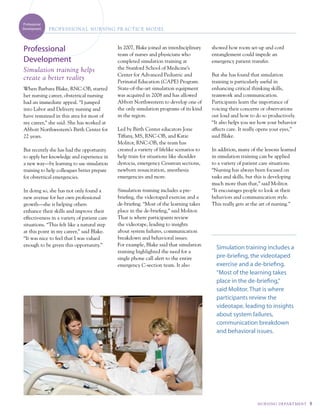
in doing so, she has not only found a        simulation training includes a pre-          “it encourages people to look at their
new avenue for her own professional          briefing, the videotaped exercise and a      behaviors and communication style.
growth—she is helping others                 de-briefing. “most of the learning takes     this really gets at the art of nursing.”
enhance their skills and improve their       place in the de-briefing,” said molitor.
effectiveness in a variety of patient care   that is where participants review
situations. “this felt like a natural step   the videotape, leading to insights
at this point in my career,” said Blake.     about system failures, communication
“it was nice to feel that i was valued       breakdown and behavioral issues.
enough to be given this opportunity.”        For example, Blake said that simulation
                                                                                            Simulation training includes a
                                             training highlighted the need for a
                                             single phone call alert to the entire          pre-briefing, the videotaped
                                             emergency c-section team. it also              exercise and a de-briefing.
                                                                                            “Most of the learning takes
                                                                                            place in the de-briefing,”
                                                                                            said Molitor. That is where
                                                                                            participants review the
                                                                                            videotape, leading to insights
                                                                                            about system failures,
                                                                                            communication breakdown
                                                                                            and behavioral issues.


                                                                                                                NuRS I Ng dE PA Rt M E Nt   9
Stamdards
         of Practice/
         Dimensions     PROf E S SIONA L N u RSI Ng PR AC t IC E MOdEL


         Standards of Practice/                          tomography (ct) contrast dye and               supporting materials, including laminated
                                                         can be flushed with saline instead of          instruction cards, were distributed. then
         Dimensions—                                     heparin. with growing awareness of             they took time to do rounds on patient
         Elevating nursing standards,                    the danger and prevalence of heparin           care units and demonstrate the technique
                                                         allergies, the team felt it would offer        for available staff.
         one PICC line at a time
                                                         clear benefits to patients.
                                                                                                        Olson also used a simple demonstration
         the word static simply doesn’t apply            But soon after introducing the catheters,      with blue dye in a clear catheter that
         to nursing.                                     the team began receiving reports of clots      showed how blood could reflux into the
                                                         in the lines and increased use of tissue       end of the catheter if the flushing wasn’t
         practice standards, technology, procedures      plasminogen activator (tpa) to clear the       done properly. Blood in the catheter can
         and medications are in constant flux and        clots. similar reports surfaced at other       lead to a clot. “it’s one thing to talk about
         it’s up to nursing specialists to ensure that   hospitals using the catheters, including       a new procedure, but sometimes if you
         as patient care evolves, it does so safely,     other allina hospitals.                        don’t see it, it doesn’t click,” said Olson.
         effectively and efficiently.
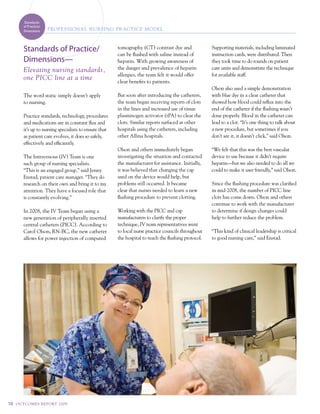
                                                         Olson and others immediately began             “we felt that this was the best vascular
         the intravenous (iv) team is one                investigating the situation and contacted      device to use because it didn’t require
         such group of nursing specialists.              the manufacturer for assistance. initially,    heparin—but we also needed to do all we
         “this is an engaged group,” said Jenny          it was believed that changing the cap          could to make it user friendly,” said Olson.
         enstad, patient care manager. “they do          used on the device would help, but
         research on their own and bring it to my        problems still occurred. it became             since the flushing procedure was clarified
         attention. they have a focused role that        clear that nurses needed to learn a new        in mid-2008, the number of picc line
         is constantly evolving.”                        flushing procedure to prevent clotting.        clots has come down. Olson and others
                                                                                                        continue to work with the manufacturer
         in 2008, the iv team began using a              working with the picc and cap                  to determine if design changes could
         new generation of peripherally inserted         manufacturers to clarify the proper            help to further reduce the problem.
         central catheters (picc). according to          technique, iv team representatives went
         carol Olson, rn-Bc, the new catheter            to local nurse practice councils throughout    “this kind of clinical leadership is critical
         allows for power injection of computed          the hospital to teach the flushing protocol.   to good nursing care,” said enstad.


10   O u t CO ME S R E P O Rt 2 0 0 9
Remaining Standards                          protocol for at-risk patients. By the end    WomenCare Community
                                             of 2008, the number of pressure ulcers       improving care for patients who are
of Practice/Dimensions                       had decreased from 30 percent in the         Morbidly obese During pregnancy
                                             first quarter of 2008 to zero percent in     patients who are morbidly obese during
Cardiovascular Community                     the fourth quarter of 2008.                  pregnancy are at a significant risk for
reducing Heart Failure readmissions                                                       medical and obstetric complications.
                                             improving the critical care                  a multi-disciplinary team is working
Heart failure is the most common
                                             orientation process                          to improve quality of care and safety
discharge diagnosis in center for
                                             the critical care design team was            for these patients while providing
medicare services (cms) patients and
                                             formed as a collaborative effort to          compassionate care. patients are referred
is a leading cause of hospitalization,
                                             standardize and enhance the critical         to an obstetric care coordinator who
re-hospitalization and clinic visits.
                                             care orientation process for H4100,          works with the clinical nurse specialist
the cardiovascular community
                                             H4200, pB2000, post-anesthesia               to develop an individualized plan of
significantly reduced heart failure
                                             care unit and critical care Float            care. this addresses any specialized
readmissions (for any cause) within
                                             pool. in 2008, the team implemented          needs related to hospitalization, labor,
30 days, achieving a 16.2 percent
                                             a centralized critical care orientation      surgery and post-partum care. the
readmission rate for fourth quarter.
                                             calendar. it includes standardized           care coordinators arrange for specialty
this is a 23 percent reduction from
                                             introductory and closure days for            consultation as needed, and patients
the 2006 baseline rate. a variety of
                                             all orientees (while maintaining a           complete an activities of daily living
strategies contributed to the reduction,
                                             station-specific component), a single        assessment to help identify needs related
including nurse follow-up phone calls
                                             critical care orientation book and           to mobility, sleep apnea and personal
within 24-48 hours, one-time home
                                             folder, streamlined and standardized         care. an obstetric/bariatric equipment
nurse visits for high risk patients who
                                             learning packets and a variety of other      and supply cart is being developed to
did not qualify for home care, a care
                                             tools and support materials. it also         ensure easy access to items that are
management pilot, and advanced care
                                             incorporates the essentials of critical      essential for the care of these patients.
planning sessions for heart failure
                                             care Orientation (eccO) online
patients through palliative care.
                                             program and classes, simulation training,
                                             float days and clinical shifts. this has
reducing Hospital-Acquired
                                             resulted in a more efficient and effective
pressure Ulcer incidence
                                             orientation process and has created many
the incidence of pressure ulcers is a key
                                             opportunities for the various critical
nursing quality indicator. in spring 2008,
                                             care teams to learn from each other.
the pressure ulcer incidence rate peaked
on H4200 cardiovascular medical
intensive care. the pressure ulcers were
related to equipment used to secure the
patients’ airways. a multi-disciplinary
team addressed the problem by changing       The Cardiovascular Community significantly
endo-tracheal products, educating the
                                             reduced heart failure readmissions (for any
staff about the use of tubes and plates
against the skin, reviewing and updating     cause) within 30 days, achieving a 16.2 percent
procedures related to the care of the        readmission rate for fourth quarter.
intubated patient, emphasizing the
nursing skin assessment upon admission,
initiating weekly skin rounds and
piloting a medical nutrition therapy


                                                                                                               NuRSI Ng dE PA RtM E Nt   11
Critical Care Community (PB2000, H4100,
         H4200)
         reducing the incidence of Ventilator-Assisted
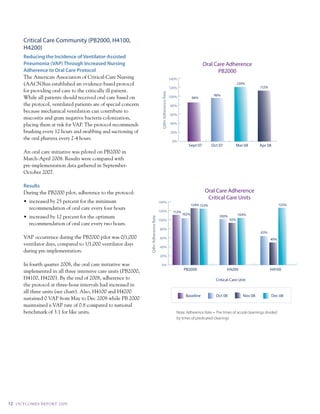
         pneumonia (VAp) through increased nursing                                                                                     Oral Care Adherence
         Adherence to oral care protocol                                                                                                     PB2000
         the american association of critical-care nursing                                                       140%
         (aacn)has established an evidence-based protocol                                                                                                     120%
                                                                                                                 120%                                                     112%
         for providing oral care to the critically ill patient.


                                                                                           Q4hr Adherence Rate
                                                                                                                                              96%
         while all patients should received oral care based on                                                   100%            86%
         the protocol, ventilated patients are of special concern                                                80%
         because mechanical ventilation can contribute to
                                                                                                                 60%
         mucositis and gram negative bacteria colonization,
         placing them at risk for vap. the protocol recommends                                                   40%

         brushing every 12 hours and swabbing and suctioning of                                                  20%
         the oral pharynx every 2-4 hours.
                                                                                                                  0%
                                                                                                                             Sept 07         Oct 07        Mar 08         Apr 08
         an oral care initiative was piloted on pB2000 in
         march-april 2008. results were compared with
         pre-implementation data gathered in september-
         October 2007.

         results
         during the pB2000 pilot, adherence to the protocol:                                                                            Oral Care Adherence
                                                                                                                                         Critical Care Units
         •	 increased	by	25	percent	for	the	minimum	                                      140%
                                                                                                                                 124% 123%                                             125%
            recommendation of oral care every four hours
                                                                                          120%                     112%
                                                                                                                          102%                                104%
         •	 increased	by	12	percent	for	the	optimum	                                                                                             100%
                                                                    Q4hr Adherence Rate


                                                                                          100%                                                          92%
            recommendation of oral care every two hours.
                                                                                          80%
                                                                                                                                                                          63%
         vap occurrence during the pB2000 pilot was 0/1,000                               60%                                                                                    49%
         ventilator days, compared to 1/1,000 ventilator days
                                                                                          40%
         during pre-implementation.
                                                                                          20%

         in fourth quarter 2008, the oral care initiative was                              0%
         implemented in all three intensive care units (pB2000,                                                           PB2000                      H4200                      H4100

         H4100, H4200). By the end of 2008, adherence to                                                                                       Critical Care Unit
         the protocol at three-hour intervals had increased in
         all three units (see chart). also, H4100 and H4200
                                                                                                                           Baseline            Oct 08            Nov 08          Dec 08
         sustained 0 vap from may to dec 2008 while pB 2000
         maintained a vap rate of 0.8 compared to national
         benchmark of 3.1 for like units.                                                                           Note: Adherence Rate = The times of acutal clearnings divided
                                                                                                                    by times of predicated cleanings


12   O u t CO ME S R E P O Rt 2 0 0 9
Spine Institute – H7000                        Orthopaedics Community – H7200/H8200
  Using learning paths to improve                creating a patient-centered experience
  the orientation process                        in september 2008, abbott northwestern Hospital implemented the Joint replacement
  with an increased volume of newly              center, a multi-faceted program dedicated to care for joint replacement patients. it
  hired nurses, the spine institute              provides a patient-centered experience focusing on patient preparation and education
  introduced the concept of learning             (before and during hospitalization), innovative and proven surgical techniques, multi-
  paths to improve the orientation               modal pain control and an accelerated post-operative recovery program offering skilled
  process for both preceptors and                and compassionate care. patients are cared for on a dedicated floor by an experienced
  orientees.	Learning	paths:	                    staff and participate in group therapy. the Joint replacement center’s multidisciplinary
  •	 help	track	an	orientee’s	progress	          team meets monthly to evaluate strategies to improve the care they deliver.
     through the orientation process
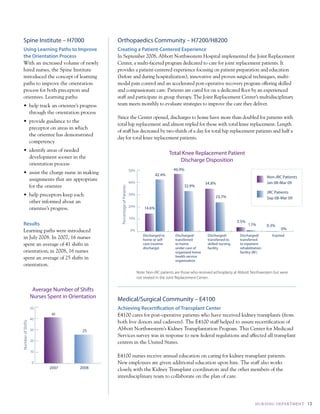
                                                 since the center opened, discharges to home have more than doubled for patients with
  •	 provide	guidance	to	the	
                                                 total	hip	replacement	and	almost	tripled	for	those	with	total	knee	replacement.	Length	
     preceptor on areas in which
                                                 of staff has decreased by two-thirds of a day for total hip replacement patients and half a
     the orientee has demonstrated
                                                 day for total knee replacement patients.
     competency
  •	 identify	areas	of	needed	
                                                                                                      Total Knee Replacement Patient
     development sooner in the
                                                                                                           Discharge Disposition
     orientation process
                                                                            50%                         46.9%
  •	 assist	the	charge	nurse	in	making	                                                       42.4%
                                                                                                                                                                Non-JRC Patients
     assignments that are appropriate
                                                                            40%                                           34.8%                                 Jan 08-Mar 09
     for the orientee                                                                                         32.9%
                                                   Percentage of Patients


                                                                                                                                                                JRC Patients
  •	 help	preceptors	keep	each	                                             30%
                                                                                                                                 23.7%                          Sep 08-Mar 09
     other informed about an
                                                                            20%
     orientee’s progress.                                                             14.6%

                                                                            10%
                                                                                                                                              3.5%
  results                                                                                                                                            1.1%       0.3%
                                                                                                                                                                       0%
  Learning	paths	were	introduced	                                           0%
                                                                                     Discharged to       Discharged/        Discharged/        Discharged/        Expired
  in July 2008. in 2007, 16 nurses                                                   home or self        transferred        transferred to     transferred
  spent an average of 41 shifts in                                                   care (routine       to home            skilled nursing    to inpatient
                                                                                     discharge)          under care of      facility           rehabilitation
  orientation; in 2008, 16 nurses                                                                        organized home                        facility (RF)
  spent an average of 25 shifts in                                                                       health service
                                                                                                         organization
  orientation.
                                                                                  Note: Non-JRC patients are those who received arthroplasty at Abbott Northwestern but were
                                                                                  not treated in the Joint Replacement Center.

                    Average Number of Shifts
                   Nurses Spent in Orientation
                                                 Medical/Surgical Community – E4100
                   50                            Achieving recertification of transplant center
                           41                    e4100 cares for post-operative patients who have received kidney transplants (from
                   40
                                                 both live donors and cadavers). the e4100 staff helped to assure recertification of
Number of Shifts


                   30                   25       abbott northwestern’s Kidney transplantation program. this center for medicaid
                                                 services survey was in response to new federal regulations and affected all transplant
                   20                            centers in the united states.
                   10
                                                 e4100 nurses receive annual education on caring for kidney transplant patients.
                    0                            new employees are given additional education upon hire. the staff also works
                           2007        2008      closely with the Kidney transplant coordinators and the other members of the
                                                 interdisciplinary team to collaborate on the plan of care.


                                                                                                                                                         NuRSI Ng dE PA RtM E Nt   13
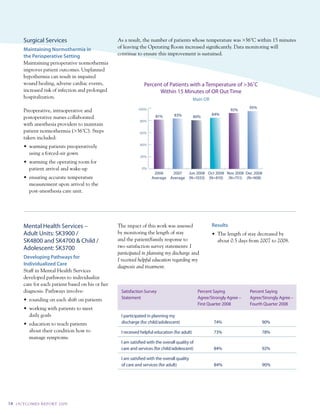
Surgical Services                           as a result, the number of patients whose temperature was >36˚c within 15 minutes
         Maintaining normothermia in                 of leaving the Operating room increased significantly. data monitoring will
         the perioperative Setting                   continue to ensure this improvement is sustained.
         maintaining perioperative normothermia
         improves patient outcomes. unplanned
         hypothermia can result in impaired
         wound healing, adverse cardiac events,                    Percent of Patients with a Temperature of >36˚C
         increased risk of infection and prolonged                       Within 15 Minutes of OR Out Time
         hospitalization.                                                                        Main OR

                                                               100%                                                         95%
         preoperative, intraoperative and                                                                            92%
                                                                         81%        83%                    84%
         postoperative nurses collaborated                                                       80%
                                                                80%
         with anesthesia providers to maintain
         patient normothermia (>36˚c). steps                    60%
         taken included:
                                                                40%
         •	 warming	patients	preoperatively	
            using a forced-air gown
                                                                20%
         •	 warming	the	operating	room	for	
            patient arrival and wake-up                          0%
                                                                        2006    2007   Jun 2008 Oct 2008 Nov 2008 Dec 2008
         •	 ensuring	accurate	temperature	                             Average Average (N=1033) (N=810) (N=751) (N=908)
            measurement upon arrival to the
            post-anesthesia care unit.


         Mental Health Services –                    the impact of this work was assessed                  results
         Adult Units: SK3900 /                       by monitoring the length of stay                      •	 The	length	of	stay	decreased	by	
         SK4800 and SK4700 & Child /                 and the patient/family response to                       about 0.5 days from 2007 to 2008.
         Adolescent: SK3700                          two satisfaction survey statements: I
                                                     participated in planning my discharge and
         Developing pathways for
                                                     I received helpful education regarding my
         individualized care
                                                     diagnosis and treatment.
         staff in mental Health services
         developed pathways to individualize
         care for each patient based on his or her
         diagnosis. pathways involve:                 Satisfaction Survey                          Percent Saying           Percent Saying
         •	 rounding	on	each	shift	on	patients	       Statement                                    Agree/Strongly Agree –   Agree/Strongly Agree –
                                                                                                   First Quarter 2008       Fourth Quarter 2008
         •	 working	with	patients	to	meet	
            daily goals                               I participated in planning my
         •	 education	to	teach	patients	              discharge (for child/adolescent)                     74%                    90%
            about their condition how to              I received helpful education (for adult)             73%                    78%
            manage symptoms.
                                                      I am satisfied with the overall quality of
                                                      care and services (for child/adolescent)             84%                    92%

                                                      I am satisfied with the overall quality
                                                      of care and services (for adult)                     84%                    90%


14   O u t CO ME S R E P O Rt 2 0 0 9
Sister Kenny® Rehabilitation
Institute – W2300
Using care navigation to
improve outcomes
sister Kenny rehabilitation institute
implemented the care navigation
role in July 2008. the role is filled
by licensed registered rehabilitation
nurses, who are ideally positioned to
help individuals affected by chronic
illness physical disability adapt to
their disabilities, achieve their greatest
potential and work toward productive,
independent lives.

care navigators help patients
achieve goals that are necessary to                        Float Pool                                   the study analyzed three 8-hour shifts
transition successfully from the acute                                                                  and two 12-hour shifts (total of 217
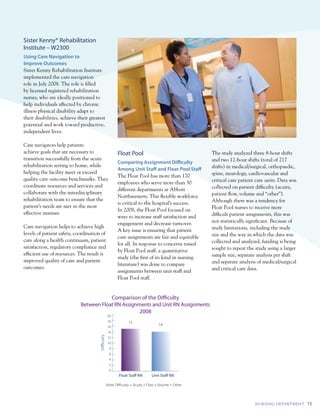
                                                           comparing Assignment Difficulty
rehabilitation setting to home, while                                                                   shifts) in medical/surgical, orthopaedic,
                                                           Among Unit Staff and Float pool Staff
helping the facility meet or exceed                                                                     spine, neurology, cardiovascular and
                                                           the Float pool has more than 170
quality care outcome benchmarks. they                                                                   critical care patient care units. data was
                                                           employees who serve more than 30
coordinate resources and services and                                                                   collected on patient difficulty (acuity,
                                                           different departments at abbott
collaborate with the interdisciplinary                                                                  patient flow, volume and “other”).
                                                           northwestern. this flexible workforce
rehabilitation team to ensure that the                                                                  although there was a tendency for
                                                           is critical to the hospital’s success.
patient’s needs are met in the most                                                                     Float pool nurses to receive more
                                                           in 2008, the Float pool focused on
effective manner.                                                                                       difficult patient assignments, this was
                                                           ways to increase staff satisfaction and
                                                           engagement and decrease turnover.            not statistically significant. Because of
care navigation helps to achieve high                                                                   study limitations, including the study
                                                           a key issue is ensuring that patient
levels of patient safety, coordination of                                                               size and the way in which the data was
                                                           care assignments are fair and equitable
care along a health continuum, patient                                                                  collected and analyzed, funding is being
                                                           for all. in response to concerns raised
satisfaction, regulatory compliance and                                                                 sought to repeat the study using a larger
                                                           by Float pool staff, a quantitative
efficient use of resources. the result is                                                               sample size, separate analysis per shift
                                                           study (the first of its kind in nursing
improved quality of care and patient                                                                    and separate analysis of medical/surgical
                                                           literature) was done to compare
outcomes.                                                                                               and critical care data.
                                                           assignments between unit staff and
                                                           Float pool staff.


                                         Comparison of the Difficulty
                             Between Float RN Assignments and Unit RN Assignments
                                                     2008
                                                    20
                                                    18            15
                                                    16
                                                                                      14
                                                    14
                                       Difficulty


                                                    12
                                                    10
                                                     8
                                                     6
                                                     4
                                                     2
                                                     0
                                                            Float Staff RN       Unit Staff RN

                                                    Note: Difficulty = Acuity + Flow + Volume + Other


                                                                                                                             NuRSI Ng dE PA RtM E Nt   15
Outpatient
         enhancing the patient experience
         through care continuity                                                          Overall Quality of Care and Services
         nurses in the ambulatory surgery                                                                                                                          90%
                                                              100%
         center (asc) provide care and                                                                                                                                      78%
                                                                                                            73%      71%      75%
         continuous evaluation for outpatients                    80%   69%               71% 67%                                                        68%
                                                                                 61%                                                   64%
         undergoing procedures that require                                                                                                     60%


                                                    % Excellent
                                                                  60%
         local anesthesia, intravenous
         sedation or general anesthesia.                          40%
         nursing assignments are structured to
         support care continuity throughout                       20%

         a patient’s visit. For example, the
                                                                  0%
         asc peri-operative nurse performs a

                                                                        Jan 08

                                                                                 Feb 08

                                                                                          Mar 08

                                                                                                   Apr 08

                                                                                                            May 08

                                                                                                                     Jun 08

                                                                                                                              Jul 08

                                                                                                                                       Aug 08

                                                                                                                                                Sep 08

                                                                                                                                                          Oct 08

                                                                                                                                                                   Nov 08

                                                                                                                                                                            Dec 08
         pre-operative assessment and is able to
         develop a rapport with each patient. at
         this assessment, integrative therapies
         may be initiated, such as music therapy
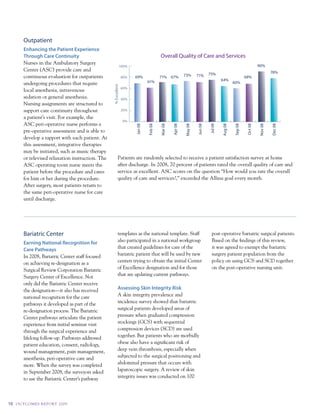
         or televised relaxation instruction. the           patients are randomly selected to receive a patient satisfaction survey at home
         asc operating room nurse meets the                 after discharge. in 2008, 70 percent of patients rated the overall quality of care and
         patient before the procedure and cares             service as excellent. asc scores on the question “How would you rate the overall
         for him or her during the procedure.               quality of care and services?,” exceeded the allina goal every month.
         after surgery, most patients return to
         the same peri-operative nurse for care
         until discharge.


         Bariatric Center                                   templates as the national template. staff                           post-operative bariatric surgical patients.
         earning national recognition for                   also participated in a national workgroup                           Based on the findings of this review,
         care pathways                                      that created guidelines for care of the                             it was agreed to exempt the bariatric
         in 2008, Bariatric center staff focused            bariatric patient that will be used by new                          surgery patient population from the
         on achieving re-designation as a                   centers trying to obtain the initial center                         policy on using Gcs and scd together
         surgical review corporation Bariatric              of excellence designation and for those                             on the post-operative nursing unit.
         surgery center of excellence. not                  that are updating current pathways.
         only did the Bariatric center receive
         the designation—it also has received               Assessing Skin integrity risk
         national recognition for the care                  a skin integrity prevalence and
         pathways it developed as part of the               incidence survey showed that bariatric
         re-designation process. the Bariatric              surgical patients developed areas of
         center pathways articulate the patient             pressure when graduated compression
         experience from initial seminar visit              stockings (Gcs) with sequential
         through the surgical experience and                compression devices (scd) are used
         lifelong follow-up. pathways addressed             together. But patients who are morbidly
         patient education, consent, radiology,             obese also have a significant risk of
         wound management, pain management,                 deep vein thrombosis, especially when
         anesthesia, peri-operative care and                subjected to the surgical positioning and
         more. when the survey was completed                abdominal pressure that occurs with
         in september 2008, the surveyors asked             laparoscopic surgery. a review of skin
         to use the Bariatric center’s pathway              integrity issues was conducted on 100


16   O u t CO ME S R E P O Rt 2 0 0 9
ED/CDART                                                                   Patient Flow Indicators—Time Intervals in Minutes
improving patient Flow and wait
times                                                                                                                               Jan-08                Dec-08
the emergency department total
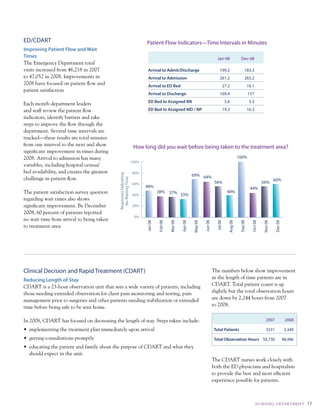
visits increased from 46,218 in 2007                                        Arrival to Admit/Discharge                                199.2                  183.3
to 47,052 in 2008. improvements in                                          Arrival to Admission                                      261.2                  265.2
2008 have focused on patient flow and                                       Arrival to eD Bed                                               27.2                  16.1
patient satisfaction
                                                                            Arrival to Discharge                                      169.4                       157
                                                                            eD Bed to Assigned rn                                            5.6                   5.3
each month department leaders
and staff review the patient flow                                           eD Bed to Assigned MD / np                                      19.3                  16.3
indicators, identify barriers and take
steps to improve the flow through the
department. several time intervals are
tracked—these results are total minutes
from one interval to the next and show                               How long did you wait before being taken to the treatment area?
significant improvement in times during
2008. arrival to admission has many                                                                                                                     100%
                                                                    100%
variables, including hospital census/
bed availability, and creates the greatest                          80%
                                             Responses Indicating


                                                                                                               69% 64%
challenge in patient flow.
                                               No Waiting Time


                                                                                                                                                                                      60%
                                                                    60%                                                           56%                                        56%
                                                                           48%                                                                                     44%
the patient satisfaction survey question                            40%
                                                                                    38% 37%
                                                                                            33%
                                                                                                                                              40%
regarding wait times also shows
significant improvement. By december                                20%
2008, 60 percent of patients reported
                                                                     0%
no wait time from arrival to being taken
                                                                           Jan 08

                                                                                    Feb 08


                                                                                                                                                                    Oct 08
                                                                                             Mar 08

                                                                                                      Apr 08

                                                                                                               May 08

                                                                                                                        Jun 08

                                                                                                                                   Jul 08

                                                                                                                                               Aug 08

                                                                                                                                                         Sep 08


                                                                                                                                                                             Nov 08

                                                                                                                                                                                      Dec 08
to treatment area:


Clinical Decision and Rapid Treatment (CDART)                                                                                    the numbers below show improvement
reducing length of Stay                                                                                                          in the length of time patients are in
cdart is a 23-hour observation unit that sees a wide variety of patients, including                                              cdart. total patient count is up
those needing extended observation for chest pain monitoring and testing, pain                                                   slightly but the total observation hours
management prior to surgeries and other patients needing stabilization or extended                                               are down by 2,244 hours from 2007
time before being safe to be sent home.                                                                                          to 2008.


in 2008, cdart has focused on decreasing the length of stay. steps taken include:                                                                                              2007             2008

•	 implementing	the	treatment	plan	immediately	upon	arrival	                                                                      total patients                               3331             3,340
•	 getting	consultations	promptly	                                                                                                total observation Hours 50,730                               48,486
•	 educating	the	patient	and	family	about	the	purpose	of	CDART	and	what	they	
   should expect in the unit.
                                                                                                                                 the cdart nurses work closely with
                                                                                                                                 both the ed physicians and hospitalists
                                                                                                                                 to provide the best and most efficient
                                                                                                                                 experience possible for patients.


                                                                                                                                                                         NuRSI Ng dE PA RtM E Nt        17
Mental Health Services
         Outpatient Mental Health Clinic
         enhancing Services
         this outpatient mental health clinic is
         staffed by a multidisciplinary team that
         includes two registered nurses and four
         nurse practitioners. the clinic moved
         from the medical Office Building
         to wasie 6th floor to provide an
         environment better suited for patients
         needing outpatient follow-up care. in
         collaboration with the womencare
         community, the outpatient clinic
         was set up as a second location for
         the post-partum depression program.
         a transitions program was created to
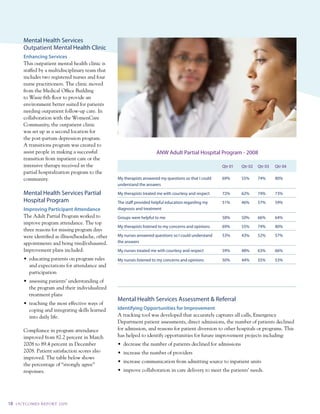
         assist people in making a successful                              ANW Adult Partial Hospital Program - 2008
         transition from inpatient care or the
         intensive therapy received in the                                                                  Qtr 01   Qtr 02   Qtr 03   Qtr 04
         partial hospitalization program to the
         community.                                   My therapists answered my questions so that I could   69%      55%      74%      80%
                                                      understand the answers

         Mental Health Services Partial               My therapists treated me with courtesy and respect    72%      62%      74%      73%
         Hospital Program                             The staff provided helpful education regarding my     51%      46%      57%      59%
         improving participant Attendance             diagnosis and treatment
         the adult partial program worked to          Groups were helpful to me                             58%      50%      66%      64%
         improve program attendance. the top
                                                      My therapists listened to my concerns and opinions    69%      55%      74%      80%
         three reasons for missing program days
         were identified as illness/headache, other   My nurses answered questions so I could understand    53%      43%      52%      57%
         appointments and being tired/exhausted.      the answers
         improvement plans included:                  My nurses treated me with courtesy and respect        59%      48%      63%      66%
         •	 educating	patients	on	program	rules	      My nurses listened to my concerns and opinions        50%      44%      55%      53%
            and expectations for attendance and
            participation
         •	 assessing	patients’	understanding	of	
            the program and their individualized
            treatment plans
                                                      Mental Health Services Assessment & Referral
         •	 teaching	the	most	effective	ways	of	
            coping and integrating skills learned     identifying opportunities for improvement
            into daily life.                          a tracking tool was developed that accurately captures all calls, emergency
                                                      department patient assessments, direct admissions, the number of patients declined
         compliance in program attendance             for admission, and reasons for patient diversion to other hospitals or programs. this
         improved from 82.2 percent in march          has helped to identify opportunities for future improvement projects including:
         2008 to 89.4 percent in december             •	 decrease	the	number	of	patients	declined	for	admissions	
         2008. patient satisfaction scores also       •	 increase	the	number	of	providers	
         improved. the table below shows
                                                      •	 increase	communication	from	admitting	source	to	inpatient	units	
         the percentage of “strongly agree”
         responses.                                   •	 improve	collaboration	in	care	delivery	to	meet	the	patients’	needs.


18   O u t CO ME S R E P O Rt 2 0 0 9
Abbott Northwestern’s                      achievement. additionally, the           Electroconvulsive
Infectious Disease Clinic                  initial work-up (a repeat ua) for an     Therapy (ECT)
                                           abnormal test was significantly more
improving renal Health Among                                                        improving patient education
                                           likely to be completed after guideline
people with HiV                                                                     Materials
                                           implementation.
recently, the increased risk for chronic                                            electroconvulsive therapy (ect)
kidney disease for people with Hiv                                                  educational materials for patients
                                           practice changes occurred among
has come to the forefront. a nurse-led                                              and families were improved through
                                           the physicians, nursing, social work,
evidence-based practice improvement                                                 development of a video with up-to-
                                           and dietary staff, which resulted
project was successfully implemented                                                date information about ect. an
                                           in improved renal health care for
with the multidisciplinary team.                                                    allina-wide educational teaching
                                           individuals with Hiv. identification
this project had two components:                                                    sheet was developed to compliment
                                           and involvement of key stakeholders
implementing agency-specific renal                                                  the video so that patients/families
                                           was imperative for success. Ongoing
care guidelines by care providers and                                               have current information about
                                           reinvention includes development of
initiating renal and general health                                                 choosing this treatment option. all
                                           a clear follow-up protocol to manage
education by supporting clinical staff.                                             patients receive this information
                                           abnormal renal screening tests and
                                                                                    before starting the treatment program.
                                           continued data analysis to sustain the
Overall, after implementing the
                                           practice changes.
guidelines, there was statistically
significant improvement in the
proportion of urinalyses (ua) and
estimated glomerular filtration rate
(eGFr) completion for patients during
their initial clinic visit (ua p < .001,
eGFr p =.002) and for those requiring
yearly (ua p < .001, eGFr p < .001)
or twice yearly (ua p < .001, eGFr p
< .001) renal testing. the rate of renal
health education was 60.7 percent,
which was less than the anticipated
rate of success. However, close analysis
revealed partial implementation


                                                                                                        NuRSI Ng dE PA RtM E Nt   19
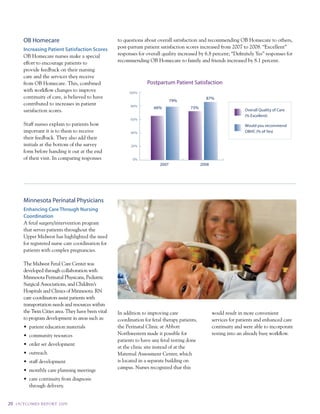
OB Homecare                                  to questions about overall satisfaction and recommending OB Homecare to others,
         increasing patient Satisfaction Scores       post-partum patient satisfaction scores increased from 2007 to 2008. “excellent”
         OB Homecare nurses make a special            responses for overall quality increased by 6.8 percent; “definitely Yes” responses for
         effort to encourage patients to              recommending OB Homecare to family and friends increased by 8.1 percent.
         provide feedback on their nursing
         care and the services they receive
         from OB Homecare. this, combined                           Postpartum Patient Satisfaction
         with workflow changes to improve                  100%
         continuity of care, is believed to have                                                   87%
                                                                                  79%
         contributed to increases in patient                80%
                                                                        66%               73%
         satisfaction scores.                                                                                          Overall Quality of Care
                                                                                                                       (% Excellent)
                                                            60%
         staff nurses explain to patients how                                                                          Would you recommend
         important it is to them to receive                 40%                                                        OBHC (% of Yes)
         their feedback. they also add their
         initials at the bottom of the survey               20%
         form before handing it out at the end
         of their visit. in comparing responses              0%
                                                                           2007                  2008


         Minnesota Perinatal Physicians
         enhancing care through nursing
         coordination
         a fetal surgery/intervention program
         that serves patients throughout the
         upper midwest has highlighted the need
         for registered nurse care coordination for
         patients with complex pregnancies.

         the midwest Fetal care center was
         developed through collaboration with
         minnesota perinatal physicans, pediatric
         surgical associations, and children’s
         Hospitals and clinics of minnesota. rn
         care coordinators assist patients with
         transportation needs and resources within
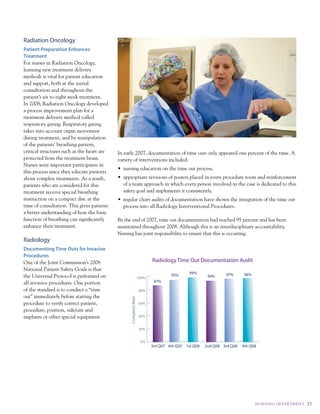
         the twin cities area. they have been vital   in addition to improving care                     would result in more convenient
         to program development in areas such as:     coordination for fetal therapy patients,          services for patients and enhanced care
         •	 patient	education	materials               the perinatal clinic at abbott                    continuity and were able to incorporate
         •	 community	resources                       northwestern made it possible for                 testing into an already busy workflow.
                                                      patients to have any fetal testing done
         •	 order	set	development
                                                      at the clinic site instead of at the
         •	 outreach                                  maternal assessment center, which
         •	 staff	development                         is located in a separate building on
                                                      campus. nurses recognized that this
         •	 monthly	care	planning	meetings
         •	 care	continuity	from	diagnosis	
            through delivery.


20   O u t CO ME S R E P O Rt 2 0 0 9
Radiation Oncology
patient preparation enhances
treatment
For nurses in radiation Oncology,
learning new treatment delivery
methods is vital for patient education
and support, both at the initial
consultation and throughout the
patient’s six to eight week treatment.
in 2008, radiation Oncology developed
a process improvement plan for a
treatment delivery method called
respiratory gating. respiratory gating
takes into account organ movement
during treatment, and by manipulation
of the patients’ breathing pattern,
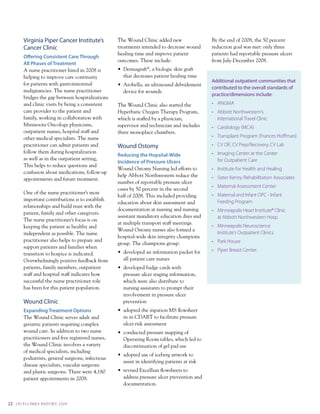
critical structures such as the heart are   in early 2007, documentation of time outs only appeared one percent of the time. a
protected from the treatment beam.          variety of interventions included:
nurses were important participants in
                                            •	 nursing	education	on	the	time	out	process,	
this process since they educate patients
about complex treatments. as a result,      •	 appropriate	revisions	of	posters	placed	in	every	procedure	room	and	reinforcement	
patients who are considered for this           of a team approach in which every person involved in the case is dedicated to this
treatment receive special breathing            safety goal and implements it consistently.
instruction on a compact disc at the        •	 regular	chart	audits	of	documentation	have	shown	the	integration	of	the	time	out	
time of consultation. this gives patients      process into all radiology interventional procedures.
a better understanding of how the basic
function of breathing can significantly     By the end of 2007, time out documentation had reached 95 percent and has been
enhance their treatment.                    maintained throughout 2008. although this is an interdisciplinary accountability,
                                            nursing has joint responsibility to ensure that this is occurring.
Radiology
Documenting time outs for invasive
procedures
One of the Joint commission’s 2008                                        Radiology Time Out Documentation Audit
national patient safety Goals is that
                                                                                             99%               97%       98%
the universal protocol is performed on                                             95%                 94%
                                                                   100%
all invasive procedures. One portion                                       87%

of the standard is to conduct a “time                              80%
out” immediately before starting the
                                                  Compliant Rate


procedure to verify correct patient,                               60%
procedure, position, side/site and
implants or other special equipment.                               40%


                                                                   20%


                                                                    0%
                                                                          3rd Q07 4th Q07   1st Q08   2nd Q08 3rd Q08   4th Q08


                                                                                                                               NuRSI Ng dE PA RtM E Nt   21
Virginia Piper Cancer Institute’s           the wound clinic added new                  By the end of 2008, the 50 percent
         Cancer Clinic                               treatments intended to decrease wound       reduction goal was met: only three
                                                     healing time and improve patient            patients had reportable pressure ulcers
         offering consistent care through
                                                     outcomes. these include:                    from July-december 2008.
         All phases of treatment
         a nurse practitioner hired in 2008 is       •	 Dermagraft®, a biologic skin graft
         helping to improve care continuity             that decreases patient healing time
                                                                                                 Additional outpatient communities that
         for patients with gastrointestinal          •	 Arobella,	an	ultrasound	debridement	
                                                                                                 contributed to the overall standards of
         malignancies. the nurse practitioner           device for wounds.
                                                                                                 practice/dimensions include:
         bridges the gap between hospitalizations
         and clinic visits by being a consistent     the wound clinic also started the           •	 ANGMA
         care provider to the patient and            Hyperbaric Oxygen therapy program,          • Abbott Northwestern’s
         family, working in collaboration with       which is staffed by a physician,              International Travel Clinic
         minnesota Oncology physicians,              supervisor and technician and includes      •	 Cardiology	(MCA)
         outpatient nurses, hospital staff and       three monoplace chambers.
         other medical specialists. the nurse                                                    •	 Transplant	Program	(Frances	Hoffman)
         practitioner can admit patients and         Wound Ostomy                                •	 CV	OR,	CV	Prep/Recovery,	CV	Lab
         follow them during hospitalization                                                      •	 Imaging	Center	at	the	Center	
                                                     reducing the Hopsital-wide
         as well as in the outpatient setting,                                                      for Outpatient Care
                                                     incidence of pressure Ulcers
         this helps to reduce questions and
                                                     wound Ostomy nursing led efforts to         •	 Institute	for	Health	and	Healing
         confusion about medications, follow-up
                                                     help abbott northwestern reduce the         •	 Sister	Kenny	Rehabilitation	Associates
         appointments and future treatment.
                                                     number of reportable pressure ulcer
                                                                                                 •	 Maternal	Assessment	Center
                                                     cases by 50 percent in the second
         One of the nurse practitioner’s most                                                    •	 Maternal	and	Infant	OPC	-	Infant	
                                                     half of 2008. this included providing
         important contributions is to establish                                                    Feeding	Program
                                                     education about skin assessment and
         relationships and build trust with the
                                                     documentation at nursing and nursing        •	 Minneapolis	Heart	Institute®	Clinic	
         patient, family and other caregivers.
                                                     assistant mandatory education days and         at	Abbott	Northwestern	Hosp.
         the nurse practitioner’s focus is on
                                                     at multiple transport staff meetings.
         keeping the patient as healthy and                                                      •	 Minneapolis	Neuroscience	
                                                     wound Ostomy nurses also formed a
         independent as possible. the nurse                                                         Institute’s Outpatient Clinics
                                                     hospital-wide skin integrity champions
         practitioner also helps to prepare and                                                  •	 Park	House
                                                     group. the champions group:
         support patients and families when
                                                     •	 developed	an	information	packet	for	     •	 Piper	Breast	Center.
         transition to hospice is indicated.
         Overwhelmingly positive feedback from          all patient care nurses
         patients, family members, outpatient        •	 developed	badge	cards	with	
         staff and hospital staff indicates how         pressure ulcer staging information,
         successful the nurse practitioner role         which were also distribute to
         has been for this patient population.          nursing assistants to prompt their
                                                        involvement in pressure ulcer
         Wound Clinic                                   prevention
         expanding treatment options                 •	 adopted	the	inpation	MS	flowsheet	
         the wound clinic serves adult and              in in cdart to facilitate pressure
         geriatric patients requiring complex           ulcer risk assessment
         wound care. in addition to two nurse        •	 conducted	pressure	mapping	of	
         practitioners and five registered nurses,      Operating room tables, which led to
         the wound clinic involves a variety            discontinuation of gel pad use
         of medical specialists, including
                                                     •	 adopted	use	of	iceberg	artwork	to	
         podiatrists, general surgeons, infectious
                                                        assist in identifying patients at risk
         disease specialists, vascular surgeons
         and plastic surgeons. there were 4,180      •	 revised	Excellian	flowsheets	to	
         patient appointments in 2008.                  address pressure ulcer prevention and
                                                        documentation.


22   O u t CO ME S R E P O Rt 2 0 0 9
celebrating
excellence,
innovation and
Advanced	Learning


         NEuROSC I E N C E I N StI t u tE   23
We have tried to be as accurate as possible in this listing of nurses’ accomplishments. To correct errors or omissions, please e-mail them to dawn.tucker@allina.com.


         Awards & Recognition                                        Sue Gorg, E3100/W3500	–	Marguerite	S.	Richards	
                                                                     Nursing	Mentorship	Award
                                                                                                                                  Faculty
         Kelly Aakhus,	E3100/W3500	–	Carol	Huttner	                                                                               Aanna Johannes,	SK3700	–	University	of	Minnesota
                                                                     Gayle Hafner,	PACU/POCC	–	The	Petersen	Award
         Nursing	Excellence	in	Practice	Award
                                                                                                                                  Jone tiffany,	W6400	–	College	of	St.	Catherine
                                                                     Judy lester,	H5000	–	Carol	Huttner	Nursing	
         Jen Adair,	Emergency	Department	–	Carol	Huttner	
                                                                     Excellence	in	Practice	Award
         Collaborative Colleague Award
                                                                     Gordon McArthur, H8000	–	Paul	&	Sheila	Wellstone	
         Sherryn Adelmann,	W6400	–	Irene	Briggs	Award
                                                                     Social	Justice	Award                                         Adjunct Faculty
         Voula Armendariz,	W6300	–	Marguerite	S.	Richards	                                                                        Susan Arnold,	Penny	George	Institute	for	Health	
                                                                     Katie Molitor, WomenCare	–	Jane	Wachtler	Becker	
         Nursing	Preceptorship	Award                                                                                              and	Healing	–	Anoka	Ramsey	Community	College
                                                                     Award
         lori Ballantyne,	H5200	–	Outstanding	student	                                                                            emily Bendson,	H5000	–	Clinical	facilitator	at	
                                                                     tonya Montesinos, Nursing	Administration	–	Carol	
         finalist	in	Nursing	at	Metro	State	University                                                                            Abbott	Northwestern	for	MINC
                                                                     Huttner	Nursing	Leadership	Award
         rachel Bebus,	Float	Pool	–	Marguerite	S.	Richards	                                                                       Brian Goodroad, International Disease & Travel
                                                                     carrie olson,	E3100/W3500	–	Abbott	Northwestern	
         Nursing	Preceptorship	Award                                                                                              Clinic	–	Metropolitan	State	University
                                                                     Employee Recognition Award
         Megan Berg,	H4000	–	Abbott	Northwestern	                                                                                 Kerstin McSteen, hospital-wide consultation
                                                                     Kristi olson,	Emergency	Department	–	Carol	
         Employee Recognition Award                                                                                               service	–	University	of	Minnesota	School	of	Nursing
                                                                     Huttner	Nursing	Excellence	in	Practice	Award
         patrice Beyer,	H5000	–	Marguerite	S.	Richards	                                                                           Michele Schirmers,	Emergency	Department	–	
                                                                     Mary peterson,	E4000	–	Jane	Wachtler	Becker	Award
         Nursing	Preceptorship	Award                                                                                              Hennepin	Technical	College

                                                                                                                                  Sue Sendelbach,	clinical	nurse	researcher	–	
                                                                                                                                  University	of	Minnesota,	School	of	Nursing


                                                                                                                                  Guest Lectures
                                                                                                                                  Susan Arnold,	Penny	George	Institute	for	Health	
                                                                                                                                  and	Healing	–	“Holistic	Health,”	Third	District	Nurses

                                                                                                                                  Jill ell, SK3700	–	“Mothers	of	Soldiers	in	Combat,”	
                                                                                                                                  College	of	St.	Scholastica

                                                                                                                                  Brian Goodroad, International Disease and Travel
                                                                                                                                  Clinic	–	“Men’s	Health,”	Metropolitan	State	University

                                                                                                                                  Janet Havens,	SK3900/4800	–	“Chronic	Illness	and	
                                                                                                                                  its	Effect	on	the	Family	Members,”	College	of	St.	
                                                                                                                                  Catherine

                                                                                                                                  rebekah rook,	Perinatal	Clinic	–	“OB	Nursing	
                                                                                                                                  and	Why	Nursing	is	an	Excellent	Job	Choice,”	
         Jocelyn Black,	H8000	–	Carol	Huttner	Nursing	               Heather potts,	Infant	Feeding	Program	–	Carol	               Montgomery	High	School	Health	Careers	class
         Excellence	in	Practice	Award                                Huttner	Nursing	Excellence	in	Practice	Award

         terrance Boehland,	H8000	–	H8000	Superstar                  Dusty powers,	E4000	–	Abbott	Northwestern	

         Molly Brusman,	SK3700	–	Jane	Wachtler	Becker	Award
                                                                     Employee Recognition Award
                                                                                                                                  Presentations
                                                                     Jason Schultz,	PB2000	–	Abbott	Northwestern	
         emily calonder,	PACU/OSDU	–	Carol	Huttner	                                                                               Barbara Bly,	Quality	and	Patient	Safety	and	Paul	
                                                                     Employee Recognition Award
         Nursing	Excellence	in	Practice	Award                                                                                     Krogh,	pharmacy	manager	–	“Medication	Safety	for	
                                                                     peggy A. Severson,	OR	Preop/Postop	–	Abbott	                 New	Graduates.”	Abbott	Northwestern	Hospital,	Nov.	
         Seamus conroy, SK3900/4800	–	Carol	Huttner	
                                                                     Northwestern Employee Recognition Award                      11	and	24,	2008.	
         Excellence	in	Nursing	Practice	Award
                                                                     cathleen Skrypek, Infant	Feeding	Program	–	Carol	            lindsay campbell, Main	OR-Preop/Postop	–	
         lynn engler,	PB2000	–	Carol	Huttner	Excellence	in	
                                                                     Huttner	Nursing	Excellence	in	Practice	Award                 “Nurses	Going	Green	for	Health.”	MNA	5th	District,	
         Nursing	Practice	Award
                                                                                                                                  Bloomington,	Minn.
                                                                     Jan Steile,	W6400	–	Marguerite	S.	Richards	Nursing	
         Stephanie erickson,	H5000	–	North	Dakota	Nurse	
                                                                     Mentorship	Award                                             wendy George,	H4200;	Barb Unger, CV
         of	the	Year	–	Rising	Star
                                                                                                                                  Administration;	Michael	Mooney,	MD;	and	
                                                                     Jessica thompson,	SK3900/4800	–	Marguerite	S.	
         collette eze,	H4100	–	Jane	Wachtler	Becker	Award                                                                         pam rush,	Quality	Management	–	“Therapeutic	
                                                                     Richards	Nursing	Mentorship	Award
                                                                                                                                  Hypothermia	Post-Cardiac	Arrest.”	National	Teaching	
         tina Fenske, E4000	–	Marguerite	S.	Richards	
                                                                     Mary Veneman,	H4100	–	Marguerite	S.	Richards	                Institute for American Association of Critical-Care
         Nursing	Preceptorship	Award
                                                                     Nursing	Preceptorship	Award                                  Nurses,	Chicago,	Ill.,	May	6,	2008.
         Alicia Goodman, H5000	–	Abbott	Northwestern	
                                                                     cassie werner, W6300	–	Irene	Briggs	Award
         Employee Recognition Award


24   O u t CO ME S R E P O Rt 2 0 0 9
We have tried to be as accurate as possible in this listing of nurses’ accomplishments. To correct errors or omissions, please e-mail them to dawn.tucker@allina.com.


wendy George,	H4200;	Barb Unger, CV                         Jolene laurence, Sk3900/4800	–	“Community	                   Sue Sendelbach, clinical	nurse	researcher;	K.	
Administration;	Sue Sendelbach, nurse	researcher;	          Mental	Health.”	Gloria	Dei	Lutheran	Church,	St.	Paul,	       Sandau;	and	K.	Doran	–	“National	survey	of	US	
Michael	Mooney,	MD;	and	pam rush, Quality                   Minn.,	Oct.	10,	2008.                                        cardiologists’ perceptions and use of continuous
Management	–	“Induced	Hypothermia	in	the	                                                                                ST-segment	monitoring.”	National	Teaching	Institute.	
                                                            Mimi lindell,	Penny	George	Institute	for	Health	and	
Post-Arrest	Patient.”	University	of	Minnesota	School	                                                                    May	2008.	Chicago,	IL.
                                                            Healing	–	“Dimensions	in	Oncology.”	Unity	Hospital,	
of	Nursing	Research	Day,	April	11,	2008.
                                                            May	16	and	Oct.	3,	2008.                                     Jan VanAmber and Susan Dillon-chose, E4100
Brian Goodroad	and	Edwin	DeJesus,	MD,	                                                                                   –	Presented	at	New	Graduate	Skills	Days,	Abbott	
                                                            Donna lindsay,	Neuroscience	Administration	–	
International	Disease	and	Travel	Clinic	–	Presented	                                                                     Northwestern	Hospital.
                                                            Presented	at	the	Minnesota	Stroke	Registry	Annual	
at	the	Association	of	Nurses	in	AIDS	Care	National	
                                                            Conference.	St.	Paul,	Minn.,	Oct.	14,	2008	and	the	          Jean Vreeland, H5200	–	“H5200	Sheath	Pull	Pilot.”	
Conference.	Tucson,	Ariz.,	Nov.	8,	2008.
                                                            BlueCross/BlueShield	Case	Manager	Workshop,	                 CSI:	Allina	–	Uncovering	Evidence-Based	Nursing	
Brian Goodroad, International Disease and Travel            Bloomington,	Minn.,	June	9,	2008.                            Practice.	Allina	Commons,	March	13,	2008.
Clinic	–	Presented	at	the	Iowa	State-wide	HIV	Case	                                                                      Faith	Zwirchitz,	PB2000	–	“Seasons	of	Change.”		
                                                            Gordon McArthur,	H8000	–	“Health	Care	Reform.”	
Manager	Meeting.	Des	Moines,	Iowa,	March	7,	2008.                                                                        Roseville,	Minn.,	Feb.	2,	2008.
                                                            MNA	Day	on	the	Hill,	St.	Paul,	Minn.,	Feb.	20,	2009.
cynthia Hanson-Scott, E4100	–	Presented	at	the	
                                                            Kerstin McSteen, Hospital-wide	consultation	service;	
Allina	Frontline	Nursing	Leadership	Forum
                                                            Terri	Maxwell,	MD;	and	Denise	Stahl	–	“Advanced	
Janet Havens,	SK3900/4800	–	“How	Faith	Can	                 Complex	Symptom	Management.”	Oncology	Nursing	               Published Articles
Support	Someone	with	Mental	Illness	–	One	Family’s	         Society	Congress,	Philadelphia,	Pa.,	May	14,	2008.           Sandra Hoffman. 2008.	Books	at	a	glance.	
Perspective.”	Gloria	Dei	Lutheran	Church,	St.	Paul,	                                                                     AWHONN’s	Perinatal	Nursing.	The Journal for Advance
                                                            Kerstin McSteen,	Hospital-wide	consultation	
Minn.,	Jan.	8,	2009	and	“How	to	Process	Tragedy	                                                                         Nursing Practice. 22(3):158.	
                                                            service;	Maggie	O’Connor,	MD;	and	Bill	Axness	–	
from	a	Faith	Perspective.”	Colonial	Church,	Edina,	
                                                            “Palliative	Care:	Best	Practice	for	Advanced	Illness.”	      Jayson King.	2008.	A	Rose	is	a	Rose:	A	Story	of	Spirit	
Minn.,	Oct.	20,	2008.
                                                            Allina	Commons,	Sept.	29,	2008.                              in Acute Care. AHNA Beginnings.
peggy Hoeft and Anita Anthony,	H4200	–	
                                                            Brian Meltzer,	H4200	–	“Hemodynamics.”	Abbott	               Jennifer neitzel.	2008.	Books	at	a	glance.	The	
“Intermediate	EKG.”	Allina	Commons,	April	6	and	
                                                            Northwestern	Hospital,	presented	throughout	the	year.        Scoliosis	Desk	Reference:	A	Practical	guide	For	
Nov.	8,	2008.
                                                            Angel olson,	W6400	–	Presented	at	the	National	OB	           Identifying	the	Early	Signs	of	Scoliosis.	22(3):158.
Sandy Hoffman,	WomenCare	Administration	-	
                                                            Forum.	Las	Vegas,	Nev.,	April,	21,	2008.                     carol olson	et	al.	2008.	Clinical	performance	
“Perinatal	Substance	Abuse:	How	Can	We	Make	A	
Difference?”,	“Hypertensive	Disorders	in	Pregnancy:	        carol olson,	IV	Team	–	Presented	at	the	3M	forum.	           of a new transparent chlorhexidine gluconate
Reducing	Critical	Complications”	and	“Advances	             Maplewood,	Minn.,	Jan.	1,	2008.                              central venous catheter dressing. The Journal of the
in	the	Diagnosis	of	Ruptured	Membranes.”	25th	                                                                           Association of Vascular Access.	13(1):13-19.
                                                            carol olson, the Vascular Access Team of Abbott
Annual Obstetric Nursing Conference sponsored                                                                            Sarah pangarakis,	Kathryn	Harrington,	Ruth	
                                                            Northwestern	Hospital	and	JM	Heilman	–	“Clinical	
by	Contemporary	Forums,	Las	Vegas,	Nev.,	April	                                                                          Lindquist,	C.	Peden-McAlpine,	and	S.	Finkelstein.	
                                                            performance of a new transparent chlorhexidine
21-23,	2008.                                                                                                             2008.	Electronic	feedback	messages	for	home	
                                                            gulconate	central	venous	catheter	dressing.”	
Sarah Huffman, W6400	–	“Fetal	Monitoring.”	Regina	          GAVeCelt.	Rome,	Italy.	December	2008.                        spirometry lung transplant recipients. Heart and
Medical	Center,	Hastings,	Minn.,	March	17,	2008.                                                                         Lung: The Journal of Acute and Critical Care.
                                                            Sarah pangarakis,	Critical	Care	–	“Point/
Jayson King and Mary ellen Kinney, Penny	                   Counterpoint:	Gastric	vs.	post	pyloric	tube	feeding	         Lindquist	R,	Sendelbach S, windensburg Dc,
George	Institute	for	Health	and	Healing	–	“Co-              placement.”	American	Association	of	Critical-Care	           Vanwormer A, treat-Jacobson D & chose D.
Creative	Mentorship.”	Presented	at	the	American	            Nurses	Crossroads,	St.	Louis	Park,	Minn.,	Nov.	8,	2008.      2008.	Challenges	of	implementing	a	feasibility	study	
Holistic	Nursing	Association	Conference.	Mount	                                                                          of acupuncture in acute and critical care. AACN
                                                            Bridget parks and emily Anderson,	H4200	–	                   Advanced Critical Care.	19(2):202-210.
Washington,	N.H.,	June	3,	2008.
                                                            Presented	at	the	summer	intern	pull-out	day.	Abbott	
Jayson King,	Penny	George	Institute	for	Health	             Northwestern	Hospital,	June	23,	2008.                        Sue Sendelbach.	2008.	Books	at	a	glance.	
and	Healing	–	Presented	at	the	Holistic	Therapies:	                                                                      Clinical Nurse Specialist: The Journal for Advance
                                                            nicole polanco, Float	Pool;	Jeff Fliss,	Float	Pool;	         Nursing Practice.	22(1):49.
Discovering	Health	and	Harmony	Conference.	St.	
                                                            Sue Sendelbach, clinical	nurse	researcher;	and	
Paul,	Minn.,	Feb.	15,	2008.                                                                                              Sue Sendelbach.	2008.	Books	at	a	glance.	
                                                            P.	Gilliard	–	“Staffing	patterns	of	scheduled	unit	
Mary ellen Kinney,	Penny	George	Institute	                  staff	nurses	versus	float	pool	staff:	a	pilot	study.”	       Clinical Nurse Specialist: The Journal for Advance
for	Health	and	Healing	–	“Integrative	Medicine,	            Academy	of	Medical	Surgical	Nurses.	October	                 Nursing Practice.	22(3):158.
An	Overview.”	Palliative	Care	Conference.	Allina	           2008.	Nashville,	TN.                                         Sue Sendelbach.	2008.	Notes	from	the	board:	
Commons,	Sept.	29,	2008.                                                                                                 President’s	message.	Clinical Nurse Specialist: The
                                                            Michele Schirmers,	Emergency	Department	–	
Katheren Koehn,	H7000	–	“Pathway	to	Excellence.”	           “RMC.”	RMC	in	Waconia,	Minn.,	Jan.	1,	2008.                  Journal for Advance Nursing Practice. 22(3):117.
Wyoming	Nurses	Association,	Sept.	17,	2008.                                                                              Sue Sendelbach. 2008.	Evidence	based	practice:	
                                                            Sue Sendelbach,	clinical	nurse	researcher	–	
Denise Kukielka, H8000	–	“Hospital	Corpsmen	                “Integrative	therapies	and	patients	undergoing	              Then and now. American Journal of Nursing.
Skills	Basic.”	Naval	Operations	Support	Center,	            open	heart	surgery.”	American	Heart	Association.	            108(10):75-6
Chicago,	Ill.,	Jan.	16,	2008.                               November	2008.	New	Orleans,	LA.                              Sue Sendelbach. 2008.	Is	the	standard	nursing	care	
Sara lacoco, H7000	–	Presented	at	the	2008	Spine	                                                                        of	patients	with	graduated	compression	stockings	
Symposium.	Minneapolis,	Minn.,	March	17,	2008.                                                                           evidence-based?	American Journal of Nursing. 108(9):	
                                                                                                                         46-7.


                                                                                                                                                      NuRSI Ng dE PA RtM E Nt      25
We have tried to be as accurate as possible in this listing of nurses’ accomplishments. To correct errors or omissions, please e-mail them to dawn.tucker@allina.com.


         Research Projects                                           Jennifer Koomen, MHI	Clinic	–	Genetic	Arrythmia	
                                                                     Center
                                                                                                                                     Jane otte, Mental	Health	Services	–	Abbott	
                                                                                                                                     Northwestern	Hospital	Sister	Kenny	Auxiliary	Grant,	
         *This	is	a	list	of	research	projects	ongoing	in	2008.                                                                       Funds for de-escalation materials
                                                                     Mimi lindell, Penny	George	Institute	for	Health	&	Healing	
         carol Anderson, H4200	–	Nursing	rounds/pressure	            –	Transformative	Nurse	Training	application	study               nancy reiners,	OB	Homecare	–	Abbott	
         ulcers                                                                                                                      Northwestern	Hospital	Foundation,	Establish	
                                                                     Donna lindsay,	Neuroscience	Administration	–	
                                                                                                                                     childbirth	class	for	Somalian	families	delivering	at	
         laura Angell,	H5000	–	Hand	hygiene                          Sleep	apnea
                                                                                                                                     Abbott Northwestern
         Abby Bathke,	PB2000	–	Anxiety	Management	in	                carol Machemer,	Main	OR	–	Preop/Postop	–	
                                                                                                                                     Diane wenninger,	E4000	–	Parish	nurse	grant	to	
         Ventilated	Patients                                         Temperature measurement in patients undergoing
                                                                                                                                     begin	Befrienders	Ministry	at	church
                                                                     colorectal and gynecologic surgery: a comparison of
         carrie Bengston,	H4100	–	HOB	height	for	tube	
                                                                     esophageal	core,	temporal	artery	and	oral	methods               Serena willey, SK4700	–	Minnesota	Nurses	
         feedings
                                                                                                                                     Association	Sarah	Colvin	Scholarship
                                                                     egla Maiyo, H4200	–	Use	of	geriatric	depression	
         cheryl Bond, H4100	–	Anxiety	Reduction	in	the	
                                                                     scale in older patients                                         Faith Zwirchitz, PB2000	–	Minnesota	Nurses	
         Ventilated	Patient
                                                                                                                                     Association	Foundation	Graduate	Degree	Research	
                                                                     Anita Matos,	H4200	–	Graduate	thesis:	What	are	
         Meghan Davitt, E3100/W3500	-	Are	thigh	high	                                                                                Grant
                                                                     clients’ perceptions of their interactions with parish
         graduated	compression	stockings	(GCS)	the	best	
                                                                     nurses
         method for the prevention of blood clots in the
         lower	extremities?	                                         Sarah pangarakis,	Critical	Care	–	End	Tidal	CO2	
         Mary Fracchia, Nursing	Administration	–	Is	ginger	
                                                                     Monitoring	with	Neurologically	Compromised	                     Professional
         effective	and	safe	for	treating	nausea?
                                                                     Ventilated	Patients
                                                                                                                                     Organizations
                                                                     Danielle lapage rausch, Nursing	Administration	–	
         Brian Goodroad, International Disease and Travel                                                                            carol Anderson,	H4200	–	American	Association	of	
                                                                     Reducing 1:1 attendants through psychiatric liaison nursing
         Clinic	–	Integrating	HIV-related	evidence-based	                                                                            Critical-Care	Nurses	(AACN)
         renal	care	guidelines	into	adult	HIV	clinics                Debra Smith,	Penny	George	Institute	for	Health	&	
                                                                                                                                     Fern Anderson, H4000	–	American	Association	of	
                                                                     Healing	–	Transformative	Nurse	Training	application	
         cindy Gustafson, Main	OR	–	Preop/Postop	–	                                                                                  Critical-Care	Nurses	(AACN)
                                                                     study
         Temperature measurement in patients undergoing
                                                                                                                                     Jamie Anderson,	Surgical	Services	–	CNOR-
         colorectal and gynecologic surgery: a comparison of         Faith Zwirchitz,	PB2000	–	Best	Practices	for	End	of	
                                                                                                                                     Perioperative	Nursing	Practice
         esophageal	core,	temporal	artery	and	oral	methods           Life	Discussions	in	Assisted	Living	Facilities
                                                                                                                                     laura Angell,	H5000	–	Sigma	Theta	Tau
         Kristi Hartway,	W5500/6300	–	Development	of	an	
         Inpatient	Lactation	Program                                                                                                 Anita Anthony,	Heart	Hospital	–	American	
         linda isenberg, W5500/6300	–	Paternal	satisfaction/         Grants                                                          Association	Critical-Care	Nurses	(AACN);	National	
                                                                                                                                     Association	of	Clinical	Nurse	Specialists	(NACNS);	
         attachment through early caregiving activities              Jody Beck,	H8000	–	Faith	Community	Nurse	                       Sigma	Theta	Tau
         Aanna Johannes,	SK3700	–	Team	COOL,	looking	                Network	of	the	Twin	Cities,	the	Minneapolis	Jewish	
                                                                     Federation,	the	Department	of	Human	Services	and	               Susan Arnold,	Penny	George	Institute	for	Health	
         at obesity in adolescents attending alternative high
                                                                     the Federal Administration on Aging                             &	Healing	–	Minnesota	Holistic	Nurses	Association;	
         schools
                                                                                                                                     American	Holistic	Nurses	Association
         Donna Johnson,	Main	OR	–	Preop/Postop	-	                    cindy Gustafson,	Main	OR	–	Preop/Postop	–	
                                                                     Minnesota	Nurses	Association	Foundation	and	                    Jayme Bawdon,	E4100	–	National	League	of	Nursing
         Temperature measurement in patients undergoing
         colorectal and gynecologic surgery: a comparison of         American	Society	of	PeriAnesthesia	Nurses	study	grants          emily Bendson,	H5000	–	Sigma	Theta	Tau,	Chi	Chapter
         esophageal	core,	temporal	artery	and	oral	methods           rebecca Hansen,	Med/Surg	-	Abbott	Northwestern	                 carrie Bengston,	H4100	–	American	Association	of	
         Mary ellen Kinney, Penny	George	Institute	for	              Hospital	Sister	Kenny	Auxiliary	Grant,	Blanket	                 Critical-Care	Nurses	(AACN);	Sigma	Theta	Tau
         Health	&	Healing	–	Transformative	Nurse	Training	           warmers	on	E3100/W3500
                                                                                                                                     BonnieSue Bennett,	MHI	Clinic	–	American	
         application study                                           Jayson King, Penny	George	Institute	for	Health	and	             Radiology Nursing Association
                                                                     Healing,	Abbott	Northwestern	Hospital	Sister	Kenny	
                                                                     Auxiliary	Legacy	Grant	for	inpatient	art	care	supplies          Jean Berquist,	Float	Pool	–	American	Association	of	
                                                                                                                                     Critical-Care Nurses
                                                                     cassandra Knuth, E3000	–	Abbott	Northwestern	
                                                                     Hospital	Sister	Kenny	Auxiliary	Grant,	Patient	sleeper	chairs   cristin Betzold,	E3000	–	Oncology	Nursing	Society

                                                                     carol Machemer,	Main	OR	–	Preop/Postop	                         Anne Binczik,	H7200/8200	–	National	Association	
                                                                     –	American	Society	of	Perianesthesia	Nurses,	                   of	Orthopaedic	Nurses	(NAON);	Minnesota	Nurses	
                                                                     Temperature study research                                      Association delegate

                                                                                                                                     laura Bloomquist,	H4200	–	American	Association	
                                                                                                                                     of	Critical-Care	Nurses	(AACN)

                                                                                                                                     cheryl Bond, H4100	–	Sigma	Theta	Tau;	American	
                                                                                                                                     Association of Critical-Care Nurses


26   O u t CO ME S R E P O Rt 2 0 0 9
We have tried to be as accurate as possible in this listing of nurses’ accomplishments. To correct errors or omissions, please e-mail them to dawn.tucker@allina.com.


Betsy Brandes,	W5500/6300	–	Sigma	Theta	Tau                  Heather Garth,	E3000	–	Oncology	Nursing	Society;	           peggy Hoeft,	H4200	–	American	Association	of	
                                                             National	Association	of	Clinical	Nurse	Specialists	         Critical-Care	Nurses	(AACN)
Jill Breitkreutz,	W5400	–	Association	of	Women’s	
                                                             (NACNS);	Sigma	Theta	Tau
Health,	Obstetric	and	Neonatal	Nurses	(AWHONN);	                                                                         Anna Hogen,	Neuroscience	Clinic	–	American	
Sigma	Theta	Tau                                              Damon Gates, H4200	–	American	Association	                  Association	of	Neuroscience	Nurses	(AANN),	
                                                             Critical-Care	Nurses	(AACN)                                 National	Chapter	&	Twin	Cities	Chapter;	American	
Molly Brusman, SK3700	–	Sigma	Theta	Tau
                                                                                                                         Stroke	Association	
                                                             Miranda George,	H4000	–	American	Holistic	
Jennifer Bush, W5500/6300	–	Sigma	Theta	Tau;	
                                                             Nursing	Association	(AHNA)                                  rebecca Hokanson, PB2000	–	Sigma	Theta	Tau
American Nurses Association
                                                             wendy George,	H4200	–	American	Association	                 Mari Holt,	WomenCare	Administration	–	
Susan campbell, W5500/6300	–	International	
                                                             of	Critical-Care	Nurses	(AACN);	Greater	Twin	Cities	        Association	of	Women’s	Health,	Obstetric	
Lactation	Consultation	Association	(ILCA)
                                                             Chapter-AACN                                                and	Neonatal	Nurses	(AWHONN);	Minnesota	
catherine caron, Center for Advanced Endoscopy                                                                           Organization	of	Leaders	in	Nursing	(MOLN)
                                                             Brian Goodroad, International Disease and Travel
–	Society	of	Gastroenterology	Nurses	and	
                                                             Clinic	–	American	Academy	of	Nurse	Practitioners	           Mary Hoversten,	E3000	–	Oncology	Nursing	Society
Associates,	Inc.
                                                             (AANP);	Association	of	Nurses	in	AIDS	Care
                                                                                                                         Sarah Huffman,	W6400	–	Association	of	Women’s	
Susan carroll, H7000	–	American	Nurses	Association
                                                             Daniel Greene,	PB2000	–	American	Association	of	            Health,	Obstetric	and	Neonatal	Nurses	(AWHONN)
Judy christensen,	SK4700	–	American	Psychiatric	             Critical-Care	Nurses	(AACN)
                                                                                                                         robin Hugo,	E3000	–	Oncology	Nursing	Society
Nurses	Association	(APNA)
                                                             Holly Gruys,	W5400	–	Sigma	Theta	Tau
Hsiao chung,	H5000	–	American	Association	of	
Critical-Care	Nurses	(AACN)

Kathryn coburn,	H8000	–	Sigma	Theta	Tau

Kate coleman,	E3100/W3500	–	Sigma	Theta	Tau

Julie conger, Main	OR	–American	College	of	
Cardiovascular Nurses

emily conrad,	H4200	–	American	Association	of	
Critical-Care Nurses

Jennifer Daniels,	H4100	–	American	Association	
Critical-Care	Nurses	(AACN);	Sigma	Theta	Tau	
International

Stephanie Davis,	SK3900/4800	–	American	
Psychiatric	Nurses	Association	(APNA)

lynda Day,	SK3900/4800	–	Sigma	Theta	Tau;	

Joy Decker,	H7200/8200	–	National	Association	of	
Orthopaedic	Nurses	(NAON)

Geraldine Dooley,	H4100	–	American	Association	
                                                             cindy Gustafson, Main	OR	–	Preop/Postop	–	                  lora Huston,	Main	OR	–	Association	of	peri-
of	Critical-Care	Nurses	(AACN)
                                                             American	Society	of	PeriAnesthesia	Nurses	(ASPAN)           Operative	Registered	Nurses	(AORN)
Maggie Dukinfield,	H4200	–	American	Association	
                                                             Judy Hagen,	CV	OR	–	Association	of	peri-Operative	          Joanne Jacobsen,	Main	OR	–	Association	of	
of	Critical-Care	Nurses	(AACN)
                                                             Registered	Nurses	(AORN)                                    peri-Operative	Registered	Nurses	(AORN)
Jill ell,	SK3700	–	American	Psychiatric	Nurses	Association
                                                             cheryl Haima,	CV	OR	–	Association	of	peri-                  lynn Jenson,	Wound/Ostomy	Clinic	–	Wound,	
Angela escobar,	Main	OR	–	Association	of	peri-               Operative	Registered	Nurses	(AORN)                          Ostomy	and	Continence	Nurse	Society	(WOCN)
Operative	Registered	Nurses	(AORN)
                                                             rebecca Hansen,	Med/Surg	–	Minnesota	                       Kyla Joerger,	E3000	–	Oncology	Nursing	Society
Diane evenson, H8000	–	American	Association	of	              Organization	of	Leaders	in	Nursing	(MOLN)
                                                                                                                         Aanna Johannes,	SK3700	–	Sigma	Theta	Tau;	
Neuroscience	Nurses	(AANN)
                                                             tracy Harms, H800	–	American	Association	of	                Minnesota	Research	Society
Sarah Farthing,	MCA-MCSC	–	Sigma	Theta	Tau;	                 Neuroscience	Nurses	(AANN)	
                                                                                                                         Diane c. Johnson, Patient	Placement	–	United	
American	Academy	of	Nurse	Practitioners	(AANP)
                                                             cynthia Harris,	H8000	–	American	Association	of	            American Nurses
Ann Foran,	Main	OR	–	Preop/Postop	–	American	                Neuroscience	Nurses	(AANN);	National	Nursing	Staff	
                                                                                                                         Donna Johnson,	Main	OR	–	Preop/Postop	–	
Association	of	Critical-Care	Nurses	(AACN);	American	        Development	Organization	(NNSDO)
                                                                                                                         American	Society	of	PeriAnesthesia	Nurses	(ASPAN)
Society	of	PeriAnesthesia	Nurses	(ASPAN)
                                                             Kristi Hartway, W5500/6300	–	Association	of	
                                                                                                                         leslie Johnson,	Main	OR	–	Association	of	peri-
Jane Buysse Fox,	Main	OR	–	Association	of	                   Women’s	Health,	Obstetric	and	Neonatal	Nurses	
                                                                                                                         Operative	Registered	Nurses	(AORN)
peri-Operative	Registered	Nurses	(AORN)                      (AWHONN)
                                                                                                                         Valerie Johnson,	SK3700	–	Sigma	Theta	Tau
Alice Marie Frederick,	H4100	–	American	                     Janet Havens,	SK3900/4800	–	Sigma	Theta	Tau
Association	of	Critical-Care	Nurses	(AACN)                                                                               carrie Goffin Johnson,	H5000	–	American	
                                                             Katie Hellickson,	H4100	–	American	Association	of	
                                                                                                                         Association	of	Critical-Care	Nurses	(AACN)
                                                             Critical-Care	Nurses	(AACN)


                                                                                                                                                     NuRSI Ng dE PA RtM E Nt   27
We have tried to be as accurate as possible in this listing of nurses’ accomplishments. To correct errors or omissions, please e-mail them to dawn.tucker@allina.com.


         Kathleen Juul,	Perinatal	Clinic	–	Association	of	           Kari Maland,	Main	OR	–	Association	of	peri-                  Sarah pangarakis, Critical	Care	–	American	
         Women’s	Health,	Obstetric	and	Neonatal	Nurses	              Operative	Registered	Nurses	(AORN)                           Association	of	Critical-Care	Nurses	(AACN);	National	
         (AWHONN)                                                                                                                 Association	of	Clinical	Nurse	Specialists	(NACNS)
                                                                     elizabeth Malinao,	Float	Pool	–	Philippine	Nurses	
         pamela Kalthoff,	H4200	–	American	Association	of	           Association	of	Minnesota                                     Bridget parks,	H4200	–	American	Association	of	
         Critical-Care	Nurses	(AACN)                                                                                              Critical-Care	Nurses	(AACN)
                                                                     Kate McDearmon,	W5400	–	Association	of	Women’s	
         roxanne Kelly, E4000	–	Sigma	Theta	Tau	International        Health,	Obstetric	and	Neonatal	Nurses	(AWHONN)               Jack peltier, Float	Pool	–	American	Association	of	
                                                                                                                                  Neuroscience	Nurses	(AANN);	American	Association	
         Kathryn Kerber,	Penny	George	Institute	for	Health	          Kerstin McSteen, hospital-wide consultation
                                                                                                                                  Critical-Care	Nurses	(AACN)
         &	Healing	–	Sigma	Theta	Tau;	American	Holistic	             service	–	Hospice	and	Palliative	Nurses	Association	
         Nursing	Association;	Healing	Touch	International            (HPNA);	Sigma	Theta	Tau;	National	Association	of	            Megan pfeifer, H4200	–	Sigma	Theta	Tau
                                                                     Clinical	Nurse	Specialists
         Mary Kielty,	H7000	–	National	Association	of	                                                                            Muriel philipp,	SK4700	–	Sigma	Theta	Tau
         Orthopaedic	Nurses	(NAON)                                   Mary Meester,	W6400	–	Association	of	Women’s	
                                                                                                                                  Judith piotrowski,	OB	Homecare	–	International	
                                                                     Health,	Obstetric	and	Neonatal	Nurses	(AWHONN);	
         e. paige King,	H4200	–	Sigma	Theta	Tau                                                                                   Lactation	Consultation	Association	(ILCA)
                                                                     Sigma	Theta	Tau
         Jayson King,	Penny	George	Institute	for	Health	and	                                                                      nicole polanco,	Float	Pool	–	Sigma	Theta	Tau
                                                                     Judy Melinat,	E3000	–	Holistic	Nursing	Association
         Healing	–	American	Holistic	Nursing	Association	
                                                                                                                                  pat rasmussen,	H4200	–	American	Association	of	
         (AHNA);	American	Massage	Therapy	Association	               Brian Meltzer,	H4200	–	American	Association	of	
                                                                                                                                  Critical-Care	Nurses	(AACN)
         (AMTA)                                                      Critical-Care	Nurses	(AACN)
                                                                                                                                  nancy reiners,	OB	Homecare	–	Sigma	Theta	Tau;	
         Mary ellen Kinney,	Penny	George	Institute	for	Health	       Jeanine Metzdorff,	H4200	–	American	Association	
                                                                                                                                  Association	of	Women’s	Health,	Obstetric	and	
         &	Healing	–	American	Holistic	Nursing	Association           of	Critical-Care	Nurses	(AACN);	Third	District	Nursing	
                                                                                                                                  Neonatal	Nurses	(AWHONN)
                                                                     Association
         carrie Kitner, MHI	Outpatient	Clinic	–	American	
                                                                                                                                  Sharon reuter,	E3100/W3500	–	Academy	of	
         Association	of	Critical-Care	Nurses	(AACN)                  Angela Miller,	E3100/W3500	–	Sigma	Theta	Tau
                                                                                                                                  Medical-Surgical	Nursing	(AMSN)
         cassandra Knuth,	E3000	–	Oncology	Nursing	                  robin Moede, E4000	–	Sigma	Theta	Tau
                                                                                                                                  pam richardson,	H4100	–	American	Association	of	
         Society;	Metro	Minnesota	Oncology	Nursing	Society
                                                                     Katie Molitor,	W6400	–	Association	of	Women’s	               Critical-Care	Nurses	(AACN)
         Jodi Kloss, W6400	–	Association	of	Women’s	Health,	         Health,	Obstetric	and	Neonatal	Nurses	(AWHONN)
                                                                                                                                  linda rifenberick,	Main	OR	–	Preop/Postop	–	
         Obstetric	and	Neonatal	Nurses	(AWHONN)
                                                                     tonya Montesinos, Nursing	Administration	–	Sigma	            National	Association	of	Orthopaedic	Nurses	(NAON)
         Katheren Koehn,	H7000	–	South	Dakota	Nurses	                Theta	Tau;	National	Nursing	Staff	Development	
                                                                                                                                  Susan robinson, Nursing	Administration	–	NNSDO;	
         Association;	American	Association	for	the	History	of	       Organization	(NNSDO)
                                                                                                                                  Sigma	Theta	Tau
         Nursing
                                                                     Kristen Moore,	Nursing	Administration	–	National	
                                                                                                                                  Kim Sames,	H4100	–	American	Association	of	
         Kimberly Kopitzke,	Emergency	Department	–	                  Nursing	Staff	Development	Organization	(NNSDO);	
                                                                                                                                  Critical-Care	Nurses	(AACN)
         Sigma	Theta	Tau	International                               Sigma	Theta	Tau
                                                                                                                                  Andrea Sanders,	Main	OR	–	Association	of	peri-
         Susan Starr Kremer,	Infusion	Center	–	Oncology	             Susan Murray,	SK4700	–	American	Nurses	
                                                                                                                                  Operative	Registered	Nurses	(AORN)
         Nursing	Society                                             Association
                                                                                                                                  Jillian Schmitz,	H8000	–	Sigma	Theta	Tau
         Denise Kukielka,	H8000	–	American	Association	of	           Jennifer neitzel,	H7200/8200	–	National	
         Neuroscience	Nurses	(AANN);	Navy	Nurse	Corps                Association	of	Clinical	Nurse	Specialists	(NACNS);	          Susan Schneiderhan,	SK3900/4800	–	Third	District	
                                                                     National	Association	of	Orthopaedic	Nurses	(NAON);	          Nurses
         tony lacroix-Dalluhn,	Emergency	Department	–	
                                                                     Sigma	Theta	Tau,	Zeta	Chapter
         Emergency	Nurses	Association	(ENA)                                                                                       Deanne Schwanke,	Mental	Health	Services	–	
                                                                     Geri nerby, H8000	–	American	Association	of	                 American	Psychiatric	Nurses	Association	(APNA)
         linda larson,	Quality	&	Patient	Safety	–	American	
                                                                     Neuroscience Nurses
         Psychiatric	Nurses	Association	(APNA)                                                                                    Sue Sendelbach,	clinical	nurse	researcher	–	
                                                                     Katie nichols,	H4200	–	American	Association	                 president,	National	Association	of	Clinical	Nurse	
         theresa las-peters,	W5400	–	American	Nurses	
                                                                     Critical-Care	Nurses	(AACN)                                  Specialists;	ANA	–	Congress	on	Nursing	Practice	and	
         Association
                                                                                                                                  Economics.
                                                                     ogbo nwigwe,	SK3900/4800	–	Nursing	and	
         nancy lash,	Emergency	Department	–	Emergency	
                                                                     Midwifery	Council	of	Nigeria                                 Alida Seningen,	E3000	–	Oncology	Nursing	Society
         Nurses	Association	(ENA)
                                                                     carol olson,	IV	Team	–	Association	for	Vascular	             peggy Severson,	Main	OR	–	Preop/Postop	–	
         Mimi lindell,	Penny	George	Institute	for	Health	&	
                                                                     Access	(AVA);	Infusion	Nurses	Society	(INS)                  American	Association	of	Critical-Care	Nurses	(AACN)
         Healing	–	American	Holistic	Nursing	Association	(AHNA)
                                                                     David olson, Emergency	Department	–	Emergency	               Diane Shoemaker,	MHI	Clinic	–	Preventive	
         Donna lindsay,	Neuroscience	Administration	–	
                                                                     Nurses	Association	(ENA)                                     Cardiovascular	Nurses	Association	(PCNA)
         American	Association	of	Critical-Care	Nurses	(AACN);	
         American Association of Neuroscience Nurses                 Janine olson, H5000	–	American	Association	of	               Diana Simonpietri, OB	Homecare	–	American	
         (AANN);	National	Association	of	Clinical	Nurse	             Critical-Care	Nurses	(AACN);	Greater	Twin	Cities	            College	of	Nurse	Midwives	(ACNM)
         Specialists	(NACNS)                                         Nurses Association
                                                                                                                                  Anne Sioco, H5200	–	Progressive	Care	Certified	
         terrell lucius, WomenCare	–	Association	of	Women’s	         Jane otte,	Mental	Health	Services	–	American	                Nurses	(PCCN)
         Health,	Obstetric	and	Neonatal	Nurses	(AWHONN)              Psychiatric	Nurses	Association	(APNA)
                                                                                                                                  Debra Smith, Penny	George	Institute	for	Health	
         carol Machemer,	Main	OR	–	Preop/Postop	–	                   Shannon owens,	E3000	–	Oncology	Nursing	                     &	Healing	–	American	Holistic	Nursing	Association	
         American	Society	of	PeriAnesthesia	Nurses	(ASPAN)           Society;	Sigma	Theta	Tau                                     (AHNA);	Minnesota	Holistic	Nurses	Association


28   O u t CO ME S R E P O Rt 2 0 0 9
We have tried to be as accurate as possible in this listing of nurses’ accomplishments. To correct errors or omissions, please e-mail them to dawn.tucker@allina.com.


K. laShel Solberg,	W6500	–	Association	of	
Women’s	Health,	Obstetric	and	Neonatal	Nurses	
(AWHONN)

laurie Sorensen,	H7200/8200	–	National	
Association	of	Orthopaedic	Nurses	(NAON)

tami Steichen,	Main	OR	–	Association	of	peri-
Operative	Registered	Nurses	(AORN)

lynn Stoneberg,	H5200	–	Sigma	Theta	Tau,	Delta	
Phi	Chapter

Heidi Streed,	Main	OR	–	Preop/Postop	–	Certified	
Research	Professionals

laura Swenson, H4200	–	Sigma	Theta	Tau

David tetley,	H4200	–	American	Association	
Critical-Care	Nurses	(AACN);	Emergency	Nurses	
Association	(ENA)

Joan thomas,	Infusion	Center	–	Oncology	Nursing	
Society	

Jone tiffany, W6400	–	Association	of	Women’s	
                                                            Leadership Positions                                         Donna lindsay, Neuroscience	–	Board	member,	
                                                                                                                         Minnesota	Stroke	Association;	Immediate	past	
Health,	Obstetric	and	Neonatal	Nurses	(AWHONN);	            Anita Anthony,	clinical	nurse	specialist	–	Research	         president,	American	Association	of	Neuroscience	
International Nursing Association in Clinical               chairperson,	Greater	Twin	Cities	Area	Chapter	of	            Nurses	(AANN)
Simulation;	Sigma	Theta	Tau	International                   American Association of Critical-Care Nurses
                                                                                                                         elizabeth Malinao,	Float	Pool	–	Board	member,	
Mary trygestad,	OB	Homecare	–	Association	of	               Susan Arnold,	Penny	George	Institute	for	Health	             Philippine	Nurses	Association	of	Minnesota
Vascular	Access,	Minnesota	Chapter                          &	Healing	–	Governing	Council,	Minnesota	Holistic	
                                                                                                                         Kerstin McSteen, hospital-wide consultation
                                                            Nurses Association
Jan Ubiera,	H5000	–	Association	of	Women’s	                                                                              service	–	President,	National	Board	for	Certification	
Health,	Obstetric	and	Neonatal	Nurses	(AWHONN)              Jody Beck,	H8000	–	Congregational	nurse,	Temple	Israel       of	Hospice	&	Palliative	Nurses	(NBCHPN)

Mary Ann Vertin,	E3000	–	Oncology	Nursing	Society           emily Bendson,	H5000	–	Board	member,	Sigma	                  robin Moede,	E4000	–	Chair	of	Legislative	
                                                            Theta	Tau	–	Chi	Chapter                                      Committee,	4th	District	Minnesota	Nurses	
Sarah walker,	CV	Nursing	Administration	–	
                                                                                                                         Association;	Chairperson	of	Cultural	Diverstiy	Task	
American	Association	of	Critical-Care	Nurses	(AACN)         Anne Binczik,	H7200/8200	–	Delegate,	Minnesota	
                                                                                                                         Force,	Minnesota	Nurses	Association
                                                            Nurses Association
Kelley wardell,	E3100/W3500	–	Sigma	Theta	Tau
                                                                                                                         carol olson,	IV	Team	–	Vice	president,	Minnivan:	
                                                            cheryl Bond,	H4100	–	Chapter	president,	
Kimberly webster, Center for Advanced                                                                                    Regional	AVA	Network
                                                            Greater	Twin	Cities	Area	Chapter	of	the	American	
Endoscopy	–	Society	of	Gastroenterology	Nurses	
                                                            Association of Critical-Care Nurses                          Muriel philipp, SK4700	–	Vice	president,	Chi-at-
and	Associates,	Inc.
                                                                                                                         Large	Sigma	Theta	Tau
                                                            Jennifer Daniels, H4100	–	Big	sister,	University	of	
linda wiltfang,	Infusion	Center	–	Oncology	
                                                            Wisconsin-Madison                                            Jone tiffany, W6400	–	Assistant	Professor	of	
Nursing	Society
                                                                                                                         Nursing,	College	of	St.	Catherine
                                                            Joellen evavold,	H4200	–	Flight	nurse,	Minnesota	
lori winters,	H7000	–	Third	District	Nurses	MNA;	
                                                            Air	National	Guard                                           carla wolterstorff, Telemetry	–	Membership-elect	
National	Nurses	in	Staff	Development;	National	
                                                                                                                         (Board	of	Directors),	Greater	Twin	Cities	Area	
Association	of	Orthopaedic	Nurses	(NAON)                    Kristi Hartway, W5500/6300	–	Legislator	coordinator,	
                                                                                                                         Chapter-AACN
                                                            Minnesota	Chapter	of	Association	of	Women’s	Health,	
carla wolterstorff,	Telemetry	–	Greater	Twin	Cities	
                                                            Obstetric	and	Neonatal	Nurses	(AWHONN)                       Deb wood, International Disease and Travel Clinic
Area	Chapter	–	American	Association	of	Critical-Care	
                                                                                                                         –	Commissioner	of	Governmental	Affairs,	Minnesota	
Nurses;	AACN;	American	Association	of	Heart	Failure	        Sarah Huffman, W6400	–	OB	Resource	nurse,	
                                                                                                                         Nurses	Association;	Bylaws	chairperson	–	Minnesota	
Nurses	(AAHFN)                                              Regina	Medical	Center
                                                                                                                         Nurses Association
Deb wood,	International	Disease	and	Travel	Clinic	–	        Diane c. Johnson,	Patient	Placement	–	Secretary,	
United	American	Nurses	Association                          Minnesota	Nurses	Association

Diana Young,	E4000	–Society	of	                             Katheren Koehn, H7000	–	Co-chairperson	of	
Otorhinolaryngology	and	Head-Neck	Nurses	(SOHN)             the	Governing	Council	of	Pathways	to	Excellence,	
                                                            American	Nurses	Credentialing	Center;	Practice	
Faith Zwirchitz,	PB2000	–	American	Association	of	
                                                            Commissision,	American	Nurses	Association
Critical-Care	Nurses	(AACN)
                                                            Denise Kukielka,	H8000	–	Lieutenant	Commander,	
                                                            United	States	Navy

                                                            nancy lash,	Emergency	Department	–	Charter	
                                                            representative,	Emergency	Nurses	Association


                                                                                                                                                     NuRSI Ng dE PA RtM E Nt      29
We have tried to be as accurate as possible in this listing of nurses’ accomplishments. To correct errors or omissions, please e-mail them to dawn.tucker@allina.com.


         2008 Certifications                                         cheryl Bond, H4100	–	Adult	CCRN                              Geraldine Dooley,	H4100	–	AACN-Critical	Care	
                                                                                                                                  Nurse;	Adult	CCRN
                                                                     elizabeth Brandes,	W6300	–	NCC-Maternal	
         Kelly Aakhus,	E3100	–	ANCC	Medical-Surgical
                                                                     Newborn	Nurse;	NCC-Low	Risk	Neonatal	Nursing                 Kelly Drake,	W6400	–	ANCC-Pain	Management;	
         Kay Althoff,	MCA	Pacer/ICD	–	International	Board	of	                                                                     ANCC-Medical-Surgical
                                                                     Allie Briley, VPCI	Clinics	–	ANCC	Adult	Nurse	
         Heart	Rhythm	Examiners
                                                                     Practitioner                                                 Alexandra Drevecky, OB	Homecare	–	NCC-
         cheryl Anderson,	H4100	–	Adult	CCRN                                                                                      Maternal	Newborn	Nurse
                                                                     Mary Brill,	E3000	–	ONCC-Oncology	Certified	Nurse
         Fern Anderson,	H4000	–	ANCC-Cardiac/Vascular	Nurse                                                                       Jane Dube,	CV	Lab	–	CCRN-Adult	Critical-Care
                                                                     Suzanne Brill,	MCA	Pacer/ICD	–	Cardiac	Pacing	
         patricia Anderson,	E3000	–	ONCC-Oncology	                   Defibrillation                                               Stephanie Duffy,	E3100	–	ANCC-Medical-Surgical	
         Certified Nurse
                                                                     laura Burns,	Emergency	Department	-	HAZMAT                   Betty Dye,	E4000	–	ANCC-Medical-Surgical
         Anita Anthony,	CV	Nursing	Administration	–	CCRN
                                                                     Jennifer Bush, W6300	–	NCC-Maternal	Newborn	Nurse            ryan egeberg,	PB2000	–	ANCC-Adult	Critical	Care
         Voula Armendariz, W6300	–	NCC-Low	Risk	
                                                                     Jane Buysse Fox,	Surgical	Services	–	CNOR-                   Kim eikevik,	OB	Homecare	–	NCC	Maternal	
         Neonatal Nursing
                                                                     Perioperative	Nursing	Practice                               Newborn Nurse
         Jill Attleson, Float	Pool,	ANCC-Medical-Surgical	Nurse
                                                                     Susan campbell, W6300	–	International	Board	                 Debra erickson,	Maternal	Assessment	Center	–	
         tammy Bailey, W2300	–	CCRN-Certified	                       of	Certified	Lactation	Consultants;	NCC-Maternal	            NCC-Inpatient Obstetric Nursing
         Rehabilitation Nurse                                        Newborn Nurse
                                                                                                                                  teresa ervasti,	Wound	Clinic	–	WOCNCB-Wound,	
         carol Baker,	Center	for	Advanced	Endoscopy	–	               catherine caron, Center for Advanced Endoscopy               Ostomy & Continence
         ANCC-Gerontological                                         –	Gastroenterolgy
                                                                                                                                  Angela escobar,	Surgical	Services	–	CNOR-
         Mary Battle, Wound	Clinic	–	COCN-Certified	                 Alan carr, W2300	–	CRRN                                      Perioperative	Nursing	Practice
         Ostomy Nurse
                                                                     Margaret carr, Rapid	Response	Team	–	Adult	CCRN              collette eze,	H4100	–	Adult	CCRN
         connie Baumgard,	MCA	Nursing	Services	–	ANCC	
                                                                     Denise carter,	MCA	Nursing	Services	–	ANCC-                  Susan Falk,	Heart	Transplant	–	Certified	Clinical	
         Family	Nurse	Practitioner
                                                                     Family	Nurse	Practitioner                                    Transplant Coordinator
         Michael Becchetti,	Emergency	Department	–	
                                                                     roberta cassidy,	Nursing	Administration	–	ANCC-              Sarah Farthing,	MCA	Medlevel	Providers	–	AANP-
         Certified	Emergency	Nurse	(CEN);	HAZMAT
                                                                     Nursing	Professional	Development                             Adult	Nurse	Practitioner
         linda Bendix, E3100	–	ANCC-Pain	Management
                                                                     Michael cavanaugh,	MCA	Pacer/ICD	–	NASPEXAM-                 Kim Feehan, Emergency	Department	–	ANCC-
         carrie Bengston,	H4100	–	Cardiac	Medicine	                  Cardiac	Pacing	&	Cardioversion	Defibrillation                Medical-Surgical;	ANCC-Family	Nurse	Practitioner
         Certification;	Cardiac	Surgery	Certification
                                                                     laurie chihak,	Radiation	Oncology,	ONCC-                     constance Ferdinand,	H8000	–	ABNN-Certified	
         BonnieSue Bennett,	Vascular	Surgeon	Support	                Oncology Certified Nurse                                     Neuroscience Nurse
         –	Radiological	Nurses	Certification	Board-Certified	
                                                                     Heather christie,	VPCI	Clinic	–	Urology	Certified	Nurse      Kimberly Fields,	VPCI	Community	Group	Oncology	
         Radiologic Nurse
                                                                                                                                  Program	–	CCRC-Clinical	Research	Coordinator
                                                                     Mary Helen collier,	MCA	Midlevel	Providers	–	
         patricia Benredjeb, E3000	–	ONCC-	Oncology	
                                                                     ANCC	Adult	Nurse	Practitioner                                Susan Folen,	Radiation	Oncology	–	Certified	
         Certified Nurse
                                                                                                                                  Hospice	and	Palliative	Nurse
                                                                     paula colwell,	VPCI	Clinic	–	ONCC-Oncology	
         Krista Bernander, H5200	–	ANCC-Cardiac/Vascular	
                                                                     Certified Nurse                                              Ann Foran, PACU/POCC	–	CCRN-Adult	Critical-Care;	
         Nurse
                                                                                                                                  CPAN-Certified	Post	Anesthesia	Nurse
                                                                     Julie conger,	PACU/POCC	–	CCRN-Adult	Critical-Care
         Susan Berning,	MCA	Pacer/ICD	–	International	
                                                                                                                                  rosalina Foster,	E3000	–	ONCC-Oncology	Certified	
         Board	of	Heart	Rhythm	Examiners-Cardiac	Rhythm	             emily louise conrad,	H4200	–	CCRN
                                                                                                                                  Nurse
         Device Therapy
                                                                     colleen cook,	Surgical	Services	–	CNOR-
                                                                                                                                  Sheila Foster, SK4700	–	ANCC-Psychiatric	&	Mental	
         Kristi May Bernstein, PB2000	–	Adult	CCRN                   Perioperative	Nursing	Practice
                                                                                                                                  Health	
         Diane Bernthal,	SK4800	–	ANCC-Psychiatric	&	                erin cox,	W6400	–	NCC-Inpatient	Obstetric	Nursing
                                                                                                                                  teresa Fourniea, PEI	–	ANCC-Gerontological
         Mental	Health
                                                                     Marilyn curran,	Adult	Partial	Mental	Health	
                                                                                                                                  Sally	Fraki,	VPCI	Clinical	Research	–	CCRC-Clinical	
         Julie Berthiaume,	W6400	–	Inpatient	Obstetric	Nurse         Services	–	ANCC-Psychiatric	&	Mental	Health
                                                                                                                                  Research Coordinator
         laurel Best,	W2300	–	CRRN-Rehabilitation	Nurse              lester curtis,	W2300	–	CRRN-Rehabilitation	Nurse
                                                                                                                                  Alice Frederick, H4100	–	CCRN
         Mary Biffle,	W6400	–	NCC-Inpatient	Obstetric	Nurse          Jean Dahlke,	SK3700	–	ANCC-Psychology
                                                                                                                                  eunice Froehlich, Center for Advanced Endoscopy
         theresa Bilse-Kraft, H4100	–	CCRN                           lynda Day,	SK4800	–	ANCC-Psychiatric	&	Mental	Health         –	ANCC-Gerontological

         Ann Marie Binczik, H7200/8200	–	Orthopedic	                 Joy Decker,	H7200/8200	–	ANCC-Gerontolgical                  Karen Fussy, SK4800	–	ANCC-Psychiatrica	&	Mental	
         Nurse Certification                                                                                                      Health
                                                                     Amanda Deniger,	Emergency	Department/CDART	
         Barbara Blake,	W6400	–	NCC-Inpatient	Obstetric	             –	HAZMAT                                                     Kelly Gannon,	PB2000	–	CNRN-Certified	
         Nursing;	Electronic	Fetal	Monitoring                                                                                     Neuroscience	Nurse;	ANCC-Adult	Health	Nurse	
                                                                     therese Devine,	E3000	–	ONCC-Oncology	Certified	
                                                                                                                                  Specialist
         Anna Blem Hogen,	Neuro	Ortho	Spine	                         Nurse
         Administration	–	American	Board	of	Neuroscience	                                                                         Damon Gates,	H4200	–	Adult	CCRN;	CMC	Cardiac	
         Nurses-Certified Neuroscience RN                                                                                         Medicine	Certification

30   O u t CO ME S R E P O Rt 2 0 0 9
We have tried to be as accurate as possible in this listing of nurses’ accomplishments. To correct errors or omissions, please e-mail them to dawn.tucker@allina.com.


wendy George,	H4200	–	CCRN-Adult	Critical-Care              Mari Holt, WomenCare	Administration	–	ANCC-                  Mary Kalb, Admission/Discharge	Center	–	Adult	
                                                            Nursing	Professional	Development                             CCRN
Shirley Gilbert, W6400	–	NCC
                                                            christina Hotger, MCA	Nursing	Services	–	ANCC-               pamela Kalthoff,	H4200	–	CCRN-Adult	Critical-Care
Janice Ginn, W5400	–	NCC-	Inpatient	Obstetric	
                                                            Cardiac Vascular Nurse
Nursing                                                                                                                  Kristine Kemp, H7000	–	CRRN
                                                            catherine Ann Houda,	H4000	–	ANCC-Nursing	
David Glanzer,	Infectious	Disease	&	Travel	Clinic	–	                                                                     Kathryn Kerber,	Integrative	Medicine	–	AHNCC-
                                                            Administration
ACRN-AIDS	Certified	Nurse                                                                                                Advanced	Holistic
                                                            robin Hugo,	E3000	–	ONCC-Oncology	Certified	
Susan Gorg,	E3100	–	ANCC-Pain	Management;	                                                                               Michael Keyes, H8000	–	CNRN
                                                            Nurse
ANCC-Medical-Surgical
                                                                                                                         Mary Kielty, H7000	–	Orthopedic	Nurse	
                                                            Beverly Hull, Emergency	Department/CDART	–	
Michael Grams,	MCA	Pacer/ICD	–	International	                                                                            Certification
                                                            BCEN-Certified	Emergency	Nurse
Board	of	Heart	Rhythm	Examiners
                                                                                                                         Dawn Kiffmeyer, MCA	Pacer/ICD	–	Cardiac	Pacing	
                                                            roslyn Huneke, E4000	–	ANCC-Medical-Surgical	
Susan Gray, E3000	–	ONCC-Oncology	Certified	                                                                             Tamera	Kight,	H4200	–	CCRN-Adult	Critical-Care
                                                            Nurse;	CCRN
Nurse
                                                                                                                         Jayson King, Penny	George	Institute	for	Health	&	
                                                            elizabeth Hunt,	MCA	Midlevel	Providers	–	ANCC-
Amanda Greene,	MCA	Midlevel	Providers	–	ANCC-                                                                            Healing	–	AHNCC-Cardiac	Pacing	&	Defibrillation
                                                            Family	Nurse	Practitioner
Family	Nurse	Practitioner
                                                                                                                         Mary Kinney,	Penny	George	Institute	for	Health	&	
                                                            linda irmen, Wound	Clinic	–	WOCNCB-Wound,	
Diane Griffin,	Special	Care	Nursery	–	International	                                                                     Healing	–	AHNCC-Advanced	Holistic
                                                            Ostomy	&	Continence	Nursing;	CWCN
Associatio	of	Infant	Massage
                                                                                                                         christopher Kissell,	Emergency	Department/
                                                            Joanne Jacobsen,	Surgical	Services	–	CNOR
Amy Glubka, MCA	Pacer/ICD                                                                                                CDART	–	Hazardous	Waste	Operations	and	
                                                            lisa James, PEI	–	CNOR-Sterile	Processing	&	                 Emergency Response
Jennifer Gurska, Sister	Kenny	Rehabilitation	
                                                            Distribution
Associates	–	CRRN-Rehabilitation	RN                                                                                      Kathleen Klardie, MCA	Midlevel	Providers	–	ANCC-
                                                            Kristeen Jensen,	Outpatient	Diabetes	Services	–	             Adult	Nurse	Practitioner
Judy Hagen, CV	OR	–	CNOR-Perioperative	Nursing	
                                                            Certified Diabetes Educator
Practice                                                                                                                 cassandra Knuth, E3000	–	ONCC-Oncology	
                                                            Kyla Joerger, E3000	–	ANCC-Nursing	Professional	             Certified Nurse
Victoria Hall, H8000	–	ANCC-Gerontological
                                                            Development	Anita	Johnson,	Patient	Placement	–	
                                                                                                                         renee Koemptgen, Mental	Health	Services	–	
Jennifer Hanson,	PACU/POCC	–	Adult	CCRN                     CCRN-Adult Critical-Care
                                                                                                                         ANCC-Adult	Psychiatric	&	Mental	Health	Nurse
cynthia Harris,	H8000	–	ANCC-Nursing	Professional	          Dianne Johnson, Radiation	Oncology	–	ONCC-
                                                                                                                         Jennifer Koomen,	MCA	Pacer/ICD	–	Cardiac	Pacing
Development                                                 Oncology Certified Nurse
                                                                                                                         Jody Krou,	Maternal	Assessment	Center	–	NCC-
Kristie Hartway, WomenCare	Administration	–	                Donna Johnson, PACU/Phase	II	–	ANCC-Nursing	
                                                                                                                         Inpatient Obstetric Nursing
ANCC-Clinical	Specialist	in	Community	Health                Professional	Development
                                                                                                                         Kim Kuffel, E3000	–	CHPN
Kay Hastings, OB	Homecare	–	Adult	CCRN                      JoAnn Johnson, Special	Care	Nursery	–	IBCLC;	
                                                            NCC-Low	Risk	Neonatal	Nursing                                Sara lacoco,	H7000	–	ANCC-Pain	
pamela Hawkinson,	H7200/8200	–	ONCC-
                                                                                                                         Management
Oncology Certified Nurse                                    leslie Johnson, Surgical	Services	–	CNOR
                                                                                                                         tony lacroix-Dalluhn, Emergency	Department	–	
pamela Hayes,	E3000	–	ONCC-Oncology	Certified	              Margaret Johnson, ASC-Pass-Through	–	CNOR-
                                                                                                                         Certified Emergency Nurse
Nurse                                                       Perioperative	Nursing	Practice
                                                                                                                         tamara langeberg, MCA	Nursing	Services	–	ANCC	
tara Helfritz, MCA	Nursing	Services	–	ANCC-Acute	           rochelle Johnson, W6300	–	NCC-Maternal	
                                                                                                                         Family	Nurse	Practitioner
Care	Nurse	Practitioner                                     Newborn Nurse
                                                                                                                         Deborah lantz, W6400	–	Certified	Emergency	Nurse
elizabeth Heikes, PB2000	–	Certified	Medical-               Glenn Donald Johnston,	CV	Lab	–	CCRN
Surgical	Registered	Nurse	(CMSRN)                                                                                        Danielle lapage,	Mental	Health	Services	
                                                            Anne Jones,	Surgical	Services	–	ANCC-Nurse	
                                                                                                                         Administration	–	ANCC-Psychiatric	&	Mental	
Kathryn Henry, Maternal	Assessment	Center	–	                Executive
                                                                                                                         Health	Nurse	
NCC-Inpatient Obstetric Nursing
                                                            Janine Jungbauer, H8000	–	ACRN
Jennifer Hensel, E4000	–	ANCC-Medical-Surgical
                                                            Marcia Justic, Mental	Health	Services	–	ANCC-Adult	
teri Herron, Sister	Kenny	Admissions	–	CRRN                 Psychiatric	&	Mental	Health	Nurse
Barbara Heuer, Kidne	Acquisition	–	ABTC-Clinical	           Kathleen Juul, High	Risk	Perinatal	–	NCC-Inpatient	
Transplant Coordinator                                      Obstetric Nursing
Melissa Hoag, VPCI	Clinical	Research	–	ONCC-
Oncology Certified Nurse

Frances Hoffman, Heart	Transplant	–	ABTC-Clinical	
Transplant Coordinator


                                                                                                                                                     NuRSI Ng dE PA RtM E Nt   31
We have tried to be as accurate as possible in this listing of nurses’ accomplishments. To correct errors or omissions, please e-mail them to dawn.tucker@allina.com.


         nancy lash, Admission/Discharge	Center	–	                   Mary Meester, Maternal	Assessment	Center	–	NCC-              elin nelson,	W6400	–	NCC-Inpatient	Obstetric	Nursing
         Certified Emergency Nurse                                   Electronic	Fetal	Monitoring
                                                                                                                                  Janette nelson,	Ambulatory	Surgery	Center	–	
         Jolene laurence, SK4800	–	ANCC-Psychiatric	&	               Jeanine Metsdorff,	H4200	–	NBCHPN-Certified	                 Certified	Post	Anesthesia	Nurse
         Mental	Health                                               Hospice	&	Palliative	Nurse
                                                                                                                                  Kristin nelson, W5400	–	Fetal	Monitoring
         Susan lavell,	Maternal	Assessment	Center	–	NCC-RNC          Ann Meuwisson, E3000	–	CCRN;	ONCC-Oncology	
                                                                                                                                  Geri nerby, H8000	–	ABNN-Certified	Neuroscience	
                                                                     Certified Nurse
         linda lease,	PB2000	–	Adult	CCRN                                                                                         Nurse
                                                                     Michelle Meyer-Gorman, Case	Management	–	CRRN
         rebecca leischner, ECT	–	ANCC-Psychiatric	&	                                                                             Jennifer nilles, SK4700	–	ANCC-Psychiatric	&	
         Mental	Health	                                              Marilyn Millard, PB2000	–	Adult	CCRN                         Mental	Health

         Mimi lindell, Penny	George	Institute	for	Health	&	          Angela Miller,	E3100	–	ANCC-Medical-Surgical                 Scott nissen,	W2300	–	CRRN
         Healing	–	AHNCC-Certified	Holistic	Nurse
                                                                     catherine Mary Miller,	Surgical	Services	–	CBUNA-            Joy Foster o’Brien, W63000	–	NCC-Inpatient	
         Donna lindsay, Neuro	Ortho	Spine	Administration	            Certified	Urologic	Nurse;	CNOR                               Obstetric Nursing
         –	ABNN-Certified	Neuroscience	Nurse
                                                                     Susan Mitchell,	Float	Pool	–	ANCC-Medical-Surgical           Michelle oerter-clark, SK4700	–	ANCC-Psychiatric	
         terrell lucius, W5500/6300	–	NCC-Maternal	                                                                               &	Mental	Health
                                                                     robin Moede,	E4000	–	ANCC-Pain	Management
         Newborn Nurse
                                                                                                                                  Angel olson, Maternal	Assessment	Center	–	NCC-
                                                                     Mary Moench, E3000	–	ONCC-Oncology	Certified	Nurse
         lynn lymer, W2300	–	CRRN                                                                                                 Inpatient Obstetric Nursing

                                                                                                                                  carol olson, IV	Team	–	ANCC-Medical-Surgical	Nurse

                                                                                                                                  David olson, Emergency	Department/CDART	–	HAZMAT

                                                                                                                                  Kristi olson, Emergency	Department/CDART	–	HAZMAT

                                                                                                                                  Mark olson,	Infectious	Disease	&	Travel	Clinic	–	ACRN

                                                                                                                                  penelope Mary otis,	E3000	–	ONCC-Oncology	
                                                                                                                                  Nurse	Certified;	ANCC-Medical-Surgical

                                                                                                                                  Jane otte, Mental	Health	Services	–	ANCC-
                                                                                                                                  Psychiatric	&	Mental	Health

                                                                                                                                  Melissa owens, MCA	Pacer/ICD	-	International	
                                                                                                                                  Board	of	Heart	Rhythm	Examiners

                                                                                                                                  Monica palmquist-tess,	Vascular	Surgeons		–	
                                                                                                                                  ANCC-Adult	Nurse	Practitioner

                                                                                                                                  Sarah pangarakis,	Med/Surg	Administration	–	
                                                                                                                                  Adult CCRN

                                                                                                                                  cynthia parker, Maternal	Assessment	Center	–	
                                                                                                                                  NCC-Inpatient	Obstetric	Nursing;	NCC-Electronic	
                                                                     Kathryn Molitor, WomenCare	Administration	–	                 Fetal	Monitoring
         lisa lyons,	E3100	–	ANCC-Medical	Surgical
                                                                     NCC-Inpatient Obstetric Nursing                              Bridget parks, H4200	–	Adult	CCRN
         Susan Machutt,	MCA	Midlevel	Proividers	–	ANCC-
                                                                     tonya Montesinos,	Nursing	Administration	–	                  Kathleen patten-Marsh,	PACU/POCC	–	Adult	CCRN
         Adult	Nurse	Practitioner
                                                                     ANCC-Nursing	Professional	Development
                                                                                                                                  Amanda peitrzak,	Emergency	Department	–	HAZMAT
         Sherri Macrae, OB	Homecare	–	IBCLC-Certified	
                                                                     Julie Morphew, VPCI	Clinic	–	ONCC-Oncology	
         Lactation	Consultation                                                                                                   Jack peltier, Float	Pool	–	CNRN
                                                                     Certified Nurse
         Allysa Maizan, PT	ANW	Executives	–	ANCC-Acute	                                                                           erin peterson, PB2000	–	CMSRN-Medical	Surgical
                                                                     Jill Mortenson,	Surgical	Services	–	CNOR-
         Care	Nurse	Practitioner
                                                                     Perioperative	Nursing	Practice                               Mary peterson,	Wound	Clinic	–	CWOCN-Wound,	
         Joan Mattila, Surgical	Services	–	NCC-Inpatient	                                                                         Ostomy	&	Continence	Nursing;	CWCN
                                                                     casey Mueller,	MCA	Pacer/ICD	–	International	
         Obstetric Nursing
                                                                     Board	of	Heart	Rhythm	Examiners                              Melissa philipp, PACU/POCC	–	CV	Prep/Recovery
         April McGaver,	Heart	Transplant	–	ABTC-Clinical	
                                                                     Susan Murray,	SK4700	–	ANCC	–	ANCC-Psychiatric	              elizabeth phillips, E3000	–	ANCC;	ONCC-Oncology	
         Transplant Coordinator
                                                                     &	Mental	Health	Nurse                                        Certified Nurse
         linda Mccolley, Wound	Clinic	–	CWOCN-Wound,	
                                                                     ngozi Florence nbibi, W5400	–	NCC-Inpatient	                 peggy Joanne phillips,	W6300	-	International	
         Ostomy & Continence Nursing
                                                                     Obstetric Nursing                                            Board	of	Lactation	Consultant	Examiners
         Martha Mcnutt, Palliative	Care	Program	–	ABTC-
                                                                     Jennifer neitzel,	Neuro	Ortho	Spine	Administration	          Heather potts, Maternal	&	Infant	Outpatient	–	
         Clinical Transplant Coordinator
                                                                     –	ONCB-Orthopaedic	Certified	Nurse                           IBCLC-Lactation	Consultant
         Susan McShane,	H4100	–	CCRN
                                                                     Ammie nelson,	W6300	–	NCC-Maternal	Newborn	                  Holly Qann elmore, W6300	–	NCC-Maternal	
         Kerstin McSteen, Palliative	Care	Program	–	ANCC-            Nurse                                                        Newborn Nurse
         Clinical	Specialist	in	Medical-Surgical

32   O u t CO ME S R E P O Rt 2 0 0 9
We have tried to be as accurate as possible in this listing of nurses’ accomplishments. To correct errors or omissions, please e-mail them to dawn.tucker@allina.com.


patricia rasmussen, H4200	–	Adult	CCRN                      Alida Seningen, E3000	–	ONCC-Oncology	Certified	             catherine Svensk, SK4700	–	ANCC-Psychiatric	&	
                                                            Nurse                                                        Mental	Health
Joni redfern-Hall, Nursing	Administration	–	ANCC-
Nursing Administration                                      peggy Severson,	PACU/POCC	–	ANCC-Clinical	                   cheri talsness,	Infection	Control	–	CBIC-Infection	
                                                            Nurse	Specialist;	Adult	CCRN                                 Control & Epidemiology
cheryl reece,	SK4800	–	ANCC-Psychiatric	&	Mental	
Health                                                      Brenda Shelby, Float	Pool	–	ANCC-Medical-Surgical            Zenaida tanigucji, W2300	–	CRRN

louise reid, W2300	–	CRRN                                   patricia Shrake, VPCI	CGOP	–	ONCC-Oncology	                  David tetley, H4200	–	CCRN;	Certified	Emergency	Nurse
                                                            Certified Nurse
Sharon reuter, Med/Surg	Administration	–	ANCC-                                                                           Joan thomas, E3000	–	ONCC-Oncology	Certified	Nurse
Nursing	Professional	Development                            nancy Siemers, Heart	Transplant	–	ABTC-Clinical	
                                                                                                                         laura thomas, PACU/POCC	–	CPAN
                                                            Transplant Coordinator
roxanne ricci,	MCA	Nursing	Services	–	ANCC-
                                                                                                                         Jessica thompson, SK4800	–	ANCC-Psychiatric	&	
Family	Nurse	Practitioner                                   Mary Simon, W2300	–	CRRN
                                                                                                                         Mental	Health
Kathy rice, PB2000	–	Adult	CCRN                             Diana Simonpietri, OB	Homecare	–	Certified	
                                                                                                                         Andrea lynn threinen, E3000	–	ONCC-Oncology	
                                                            Nurse/Midwife	(CNM)
Amanda richards, Neuro	Ortho	Spine	Administration	                                                                       Certified Nurse
–	ANCC-Clinical	Specialist	in	Adult	Health                  Katherine Simonton, Center for Advanced
                                                                                                                         Jone tiffany, WomenCare	Adminsitration	–	NCC-
                                                            Endoscopy	–	ABCGN-Gastroenterology	Nurse
linda rifenberick,	Surgical	Services	–	ONCB-                                                                             Inpatient Obstetric Nursing
Orthopedic Nurse Certification                              Donna Skoog,	MCA	Nursing	Services	–	ANCC-
                                                                                                                         Sharon Sue tilley, OB	Homecare	–	International	
                                                            Gerentological	Nurse	Practitioner
Susan riley,	H4100	–	CCRN                                                                                                Board	of	Certified	Lactation	Consultants
                                                            cathleen Skrypek,	Maternal	&	Infant	Outpatient	–	
Keith rischer, Float	Pool	–	Certified	Emergency	Nurse                                                                    Maureen tomb, Maternal	Assessment	Center	–	NCC
                                                            IBCLC-Lactation	Consultant
Susan robinson, Nursing	Administration	–	ANCC-                                                                           Diane Van leer,	SK4800	–	ANCC-Psychiatric	&	
                                                            Debra Smith, Penny	George	Institute	for	Health	&	
Nursing	Professional	Development                                                                                         Mental	Health
                                                            Healing	–	AHNCC-Holistic	Nurse
elizabeth rossini, PB2000	–	ANCC	Nursing	                                                                                Margaret Vansant,	W2300	–	CRRN
                                                            Michelle Smith, WomenCare	Administration	–	
Professional	Development
                                                            NCC-Inpatient Obstetric Nursing                              theresa Vest, E3100	–	ANCC-Pain	Management;	
Marianne Friedman Salsberg,	Kidney	Acquisition	                                                                          ANCC-Medical-Surgical
                                                            laura Snyder,	Surgical	Services	–	CNOR-
–	ABTC	Clinical	Transplant	Coordinator
                                                            Perioperative	Nursing	Practice                               elizabeth von der Marwitz, E3100/W3500	–	ANCC-
Dawn Sachwitz, Emergency	Department	–	HAZMAT                                                                             Medical-Surgical
                                                            lashel Solberg,	W6400	–	NCC-Inpatient	Obstetric	
Andra Sawh, MCA	Nursing	Services	–	ANCC	–	Adult	            Nursing                                                      Mary Von Fischer, Float	Pool	–	ANCC-Medical	
Nurse	Practitioner                                                                                                       Surgical;	ONCC-Oncology	Nurse	Certified
                                                            Sandra Sommers,	E3100	–	ANCC-Medical-Surgical
Amber Schaap, H5000	–	ANCC-Gerontological                                                                                Jean Vreeland,	H5200	–	ANCC-Cardiovascular;	PCCN
                                                            laurie Sorenson, H7200/8200	–	ONCC-Oncology	
Joan Scherrer,	PB2000	–	Adult	CCRN                          Certified Nurse                                              lisa wahowske, VPCI	CGOP	–	ONCC-Oncology	
                                                                                                                         Certified Nurse
Michele Schirmers, Emergency	Department/                    Debra Spawn, H4100	–	CCRN
CDART	–	CEN-Certified	Emergency	Nurse;	HAZMAT                                                                            carolyn wall,	Radiation	Oncology	–	ONCC-
                                                            teri Specktor, Surgical	Services	–	CNOR-Certified	
                                                                                                                         Oncology Nurse Certified
Kara Schmitz, E3100	–	ANCC-Pain	Management;	                Perioperative	Nurse
ANCC-Medical-Surgical                                                                                                    Joann warden, W2300	–	CRRN
                                                            Maureen Stanton-Howat,	SK4800	–	ANCC-
Susan Schneiderhan, SK4800	–	ANCC-Psychiatric	&	            Psychiatric	&	Mental	Health                                  Jennifer wehking,	Emergency	Department/CDART	
Mental	Health                                                                                                            –	Certified	Emergency	Nurse
                                                            Myra Starkenburg, SK4800	–	ANCC-Psychiatric	&	
Amy Schoeneman,	Maternal	Assessment	Center	                 Mental	Health                                                patrice weishaar, E4100	–	ANCC-Medical-Surgical
–	NCC-Inpatient	Obstetric	Nursing;	NCC-Electronic	
                                                            Alan Starzl, MCA	Pacer/ICD	–	Cardiac	Pacing                  Michelle wenner, W6400	–	NCC-Inpatient	Obstetric	
Fetal	Monitoring
                                                                                                                         Nursing
                                                            tami Steichen, Surgical	Services	–	CNOR-
Sally Schuett,	Radiation	Oncology	–	ONCC-
                                                            Perioperative	Nursing	Practice                               Sandra wiczek,	E4100	–	ANCC-Medical-Surgical
Oncology Certified Nurse
                                                            Janet Steile, W6400	–	NCC-Inpatient	Obstetric	               Karen winger,	Float	Pool	–	CCRN
Deanne Schwanke, Mental	Health	Services	
                                                            Nursing;	Electronic	Fetal	Monitoring
Adminsitration	–	ANCC-Nurse	Executive                                                                                    lori winters, H7000	–	ANCC-Nursing	Professional	
                                                            Jennifer Stoneman, W6400	–	NCC                               Development
Deborah Scott, H5200	–	ANCC-Nurse	Executive
                                                            Jeanne Storm, H7000	–	ANCC-Medical-Surgical                  Beatrice wolf, CV	Lab	–	CCRN
Kristine Scott, OB	Homecare	–	NCC-Inpatient	
Obstetric	Nursing;	IBCLC-Certified	Lactation	Consultant     laurie Ann Sublett, MCA	Medlevel	Providers	–	                carlamae wolterstoff, Admission/Discharge	Center	
                                                            ANCC-Gerontological	Nurse	Practitioner                       –	CCRN;	CMC
Mary Seipp, MCA	Medlevel	Providers	–	ANCC-
Family	Nurse	Practitioner                                   laura Sullivan,	E3100/W3500	–	ANCC-Medical-                  rebecca Youngberb, PB2000	–	Adult	CCRN	
                                                            Surgical
Sue Sendelbach, Nursing	Administration	–	Adult	
CCNS	Certification	Program                                  Marie Svendsen, Radiology	–	ANCC-Psychiatric	&	
                                                            Mental	Health


                                                                                                                                                     NuRSI Ng dE PA RtM E Nt     33
About Abbott Northwestern


                                        Abbott Northwestern Hospital is the            Abbott Northwestern and its Medical
                                        largest not-for-profit hospital in the twin    Staff are dedicated to providing
                                        Cities area, with 633 available beds and 65    outstanding care and service to patients
                                        bassinets. Each year, the hospital provides    and their families. We’re proud of what
                                        comprehensive health care for more than        we offer the community: exceptional
                                        200,000 patients and their families from the   physicians, nurses and support staff; a
         Abbott Northwestern and its
                                        twin Cities area and throughout the upper      commitment to research, education
         Medical Staff are dedicated                                                   and outcomes; a foundation of clinical
                                        Midwest. More than 5,000 employees, 1,600
         to providing outstanding       physicians and 550 volunteers work as a team   partnerships that span the region;
         care and service to patients   for the benefit of each patient served.        and a cultural enthusiasm for growth
                                                                                       and improvement. Brought together
         and their families.
                                        Abbott Northwestern Hospital is a part         in one institution, these factors
                                        of Allina Hospitals & Clinics, a family        create an energetic and sophisticated
                                        of hospitals, clinics and care services in     environment that inspires caregivers to
                                        Minnesota and Western Wisconsin.               collaborate in new ways for the benefit
                                                                                       of patients.
                                        for more than 125 years, Abbott
                                        Northwestern has had a reputation for          Our passion for finding new and better
                                        quality services. the hospital is well known   approaches to care drives extensive
                                        for its centers of excellence:                 research efforts in clinical areas across
                                                                                       the hospital. this ensures that new
                                        •	 cardiovascular	services	in	partnership	
                                                                                       treatment advances benefit patients as
                                           with the Minneapolis Heart Institute®
                                                                                       quickly as possible, supports a dynamic
                                        •	 Mental	Health	Services                      environment for medical and nursing
                                        •	 medical/surgical	services                   education, and is the catalyst for our
                                        •	 Neuroscience	Institute	                     outcomes measurement program.

                                        •	 Orthopaedic	Institute	
                                        •	 physical	rehabilitation	through	the	
                                           Sister Kenny Rehabilitation Institute
                                        •	 Spine	Institute
                                        •	 Virginia	Piper	Cancer	Institute™
                                        •	 perinatology,	obstetrics	and	gynecology	
                                           through WomenCare.


34   O u t CO ME S R E P O Rt 2 0 0 9
To Admit a Patient to                          Minneapolis Heart Institute® at
                                               Abbott Northwestern
Abbott Northwestern                            For referring physicians, we offer:
Hospital                                       •	 one	of	the	largest	cardiology	outreach	and	
                                                  mobile diagnostic programs in the uS, with
Physician-to-Physician Program                    regular cardiology consultations in more
1-800-828-8900. Available 24 hours a day,         than 30 communities across Minnesota and
seven days a week.                                the upper Midwest
One number access to:                          •	 physician	follow-up	with	primary	care	or	
•	 telephone	and	telemedicine	consultations       referring physicians to help them ensure
                                                  patients are receiving a continuum of
•	 hospital	admissions	and	specialist	            quality care before, during and after their
   appointments                                   experience with the Minneapolis Heart
•	 transportation	to	Abbott	Northwestern	         Institute®.
   Hospital and affiliated physician clinics
•	 the	Hospitalist	Program                     to make an appointment at our Minneapolis
                                               location or to determine which Minneapolis
•	 specialty	services	that	might	not	be	
                                               Heart Institute® location is most convenient
   available in your community.
                                               for your patient for a cardiology consultation
                                               or diagnosis, please call the Minneapolis
                                               Heart Institute® at 612-863-3900 or toll-free
Emergency Department-                          at 1-800-582-5175.
to-Emergency Department
(ED to ED)
For urgent consultation and transfer
assistance call 612-863-4233.
this program includes:
•	 ED	to	ED	transfers
•	 ED-facilitated	direct	admissions
•	 ED	physician	triage	and	consultation


To learn more about Abbott Northwestern Hospital,
visit www.abbottnorthwestern.com
or call 612-863-4000.


                                                                                   NuRSI Ng dE PA RtM E Nt   35
In Appreciation
                                        Our sincere thanks go to the Abbott Northwestern Hospital
                                        foundation for its support of Abbott Northwestern’s
                                        Outcomes Institute and the production of this Overview
                                        and Outcomes Report. the commitment of the foundation
                                        and Abbott Northwestern’s generous donors to improving
                                        patient care through these efforts is greatly appreciated.


36   O u t CO ME S R E P O Rt 2 0 0 9
Nursing Department                 NONPROFIT	ORG
                                                800 East 28th Street                US	POSTAGE	
                                                Minneapolis, MN 55407-3799             PAID
                                                                                   ALLINA	HEALTH	
                                                612-863-6877
                                                                                      SYSTEM	

                                                abbottnorthwestern.com


01-10 ©2010 ALLINA HEALTH SYSTEM ®A REGISTERED TRADEMARK OF ALLINA HEALTH SYSTEM

Nursing Outcomes/Annual Report

  • 1.
    nursing department O ve rv i e w a n d O u t c O m e s r e p O rt 2 0 0 8
  • 2.
    Nursing Department Overview andOutcomes Report 2008 Table of Contents 1 Letter from the Vice President of Patient Care Services 2 Vision/Core Beliefs 3 Professional Nursing Practice Model 23 Celebrating Excellence, Innovation and Advanced Learning 34 About Abbott Northwestern Hospital
  • 3.
    Overview Letter from theVice President of Patient Care Services it is my pleasure to present the 2008 abbott Allina nurses are the northwestern nursing department annual Outcomes embodiment of the art and report. the features, outcomes and recognition presented science of caring. Every day, here are a snapshot of the outstanding work nurses are more than 5,200 nurses across the organization use doing every day. their expertise and passion to advocate and provide abbott northwestern nurses comprise nearly half of care for patients, while allina Hospitals’ & clinics’ nursing workforce. as elevating the standards a magnet™-designated hospital and leaders in this of exceptional nursing organization, the bar on our standards of excellence practice. continues to rise. Our mission, vision core beliefs and professional nursing practice model are the foundations that have poised us to meet and exceed these standards. terry Graner, rn, ms, nea-Bc vice president, patient care services NuRS I Ng dE PA Rt M E Nt 1
  • 4.
    Vision/Core Beliefs Allina’s Mission Allina’s Nursing Vision We serve our communities • Allina will be nationally known and trusted for exceptional by providing exceptional nursing practice. care, as we prevent illness, • Allina nurses combine the best of science and caring restore health and provide to provide exceptional patient care through trusted partnerships and effective stewardship. comfort to all who entrust • Allina’s healing environment fosters nursing practice that us with their care. is evidence-based, innovative, and patient/family centered. • Allina nurses are powerful, passionate and diverse in talents and thought. • Nursing career paths provide Allina nurses with dynamic opportunities for career enhancement to help them achieve their highest potential. • Nursing leadership is relationship-centered, holistic, progressive, and responsive. Nursing Core Beliefs • Advocacy • Caring • Continuous Improvement • Cultural Awareness and Recognition • Ethics • Leadership • Relationships • Stewardship 2 O u t CO M E S R E P O Rt 2 0 0 9
  • 5.
    professional nursing practicemodel Built on the foundations of the Outcomes individual relationships nurses establish with patients and s Ou me tc families, the Professional Nursing o om Systems Interdisciplinary tc Practice Model incorporates all Ou Support Relationships e s of the components necessary for the delivery of exceptional nursing care. Vision/ Leadership Core Beliefs Patient- Coordination Centered of Care Outcomes Outcomes the diagram of the professional nursing practice model is designed patient to provide a visual representation & Family of the fundamental components of Clinical nursing practice that are defined in Standards Caring Competence Research/ the allina charter for professional of Practice/ Evidence-Based Dimensions Practice nursing practice. the model is meant to demonstrate all of the things nurses inherently know as part of their s Ou Professional e professional practice. om Professional Nursing tc o Development tc Collaborative me Ou Governance s Outcomes Research/ Evidence-Based PROf E S SIONA L N u RSI Ng PR AC t IC E MOdEL Practice Research/Evidence- Based Practice – Evidence-Based Practice Fellowship teaches nurses to question it is one thing to discover through research. it is another to apply research to clinical practice. that is what is behind the evidence- Based practice Fellowship at abbott northwestern Hospital. the Fellowship provides staff nurses with classroom instruction and mentoring to investigate clinical questions and integrate their findings into nursing practice. NuRS I Ng dE PA Rt M E Nt 3
  • 6.
    Sendlebach also saysthat the the development of evidence-based sendlebach also says that the Fellowship has a domino effect. practice. clinical nurse specialists act Fellowship has a domino effect. as mentors, helping nurses translate “nurses who have participated in the “Nurses who have participated research findings into practice. Fellowship share with their colleagues, in the Fellowship share and colleagues see that it works.” with their colleagues, and By giving nurses time each month colleagues see that it works.” within their work agreement to focus the value of involving staff nurses in on a clinical question, the Fellowship evidence-based practice is that there also helps to address one of the is often immediate relevance in their challenges that the profession faces work. “working at the bedside results Launched in 2008, the Fellowship is a in emphasizing evidence-based care. in unique questions and insights,” 12-month program that partners a staff “nurses are so busy – it’s impossible to said sendelbach. “i can help nurses nurse with a clinical nurse specialist to add time for this kind of work within understand what the literature shows, address a nursing practice question. it the work day,” said sendelbach. but i don’t implement practice changes. was created by sue sendelbach, phd, it’s really much more challenging to rn, clinical nurse researcher and clinical sendelbach believes that the think about how to change practice.” nurse specialist, with her colleagues, Fellowship makes nurses think Kathi Koehn, rn, staff nurse, and differently about many aspects of terry Graner, ms, rn, nea-Bc, vice nursing practice, raising their awareness president of patient care services, as a of the importance of evidence-based way to introduce evidence-based practice practice and ways to incorporate it in to the nursing staff. their work. “i’ve had nurses tell me that this inspires them to go to the literature the Fellowship teaches participants how much more frequently, not only to to analyze research literature and use it address situations they face at work, as a tool to solve clinical questions. it but also in their personal health,” said also encourages them to use their own sendelbach. experience and knowledge to guide Evidence-based Practice Fellows 2008-09 Fellow Mentor topic Meghan Davitt, E3100/W3500 Sue Sendelbach Care of patients wearing graduated compression stockings Laura Genzler, PB2000 Sarah Pangarakis Clustering of nursing activities and end tidal CO2 Linda Isenberg, W6300 Sandy Hoffman Parental involvement following a mother’s C-section Geraldine Sjoblom, H4100 CV-ICU Sue Sendelbach Care of critically ill patients experiencing ETOH withdrawal 2009-10 Fellow Mentor topic Laura Genzler (continuing) Same as above Same as above Damon Gates , H4200 CV-ICU Anita Anthony Interventions to prevent falls of hospitalized patients Jolene Laurence, SK4800/3900 Sue Sendelbach Weighted blankets and their impact on sleep Brad Lind, H5000 Sue Sendelbach Interventions for spiritual care 4 O u t CO M E S R E P O Rt 2 0 0 9
  • 7.
    Systems Support PROf E S SIONA L N u RSI Ng PR AC t IC E MOdEL Systems Support Consistent stroke education improves documentation applying care standards consistently among patients with similar needs is a hallmark of effective patient care. the challenge for nurses is incorporating such standards into their workflow as they manage a multitude of patient care tasks. On H8000, excellian (the clinical documentation system) has been enhanced to better support nurses in meeting a key quality standard: providing documented education to a stroke team revised existing patient stroke patients to help reduce the education tools and incorporated them risk of a recurrent stroke or transient into excellian. nurses were educated ischemic attack. about the required elements and Completion of All Post-Stroke the stroke team also used excellian Education Criteria the american stroke association, to provide staff alerts about needed Joint commission and centers for education documentation. 80% disease control and prevention jointly 70% identified five topics that all stroke documentation of all five stroke 60% patients should be educated on during education elements increased to 50% Rate hospitalization. these are: 76 percent in the second half of 2008. 40% 30% • modifiable risk factors “excellian gives us a process check,” 20% • warning signs said Gordon mcarthur, H8000 patient 10% • accessing emergency care if care manager. not only does it provide 0% symptoms occur Jan-June July-Dec 2 tools to track each patient’s learning 2009 009 • follow-up care after discharge progress, it helps nurses tailor education to the patient’s needs. “part of the • medications prescribed at discharge. All five patient process includes a learning assessment, education elements so nurses know how a patient learns documented in the first half of 2008, an audit best and what barriers might exist, such of both nursing and physician as cognitive status or language.” documentation revealed that all five elements were documented only 59 it’s also useful for auditing. “it tells us percent of the time. Further analysis exactly how we are doing in meeting showed that the standard and helps us prioritize • it was primarily as issue of which areas we need to focus on for documentation, rather than a lack of improvement,” said mcarthur. patient education • Excellian could be enhanced to simplify and facilitate documentation of stroke patient education • nurses were not fully aware of the required education elements. NuRS I Ng dE PA Rt M E Nt 5
  • 8.
    Interdisciplinary Relationships PROf E S SIONA L N u RSI Ng PR AC t IC E MOdEL Interdisciplinary anita anthony, rn, ms, ccrn-cnc, that when the therapy is used with cns-Bc, a cardiovascular clinical patients who have other co-morbidities, Relationships nurse specialist who helped lead the the outcomes are not as good,” said New therapy brings heart aquapheresis work group. anthony. failure care providers in august 2008, the treatment was made But many other individualized decisions together available on H400, a cardiovascular are required to ensure that the therapy thanks to the work of a multidisciplinary telemetry unit. the work group believed is used safely and effectively with each work group, a treatment for fluid overload that expanding the use of aquapheresis patient. that’s where the huddle concept in chronic heart failure patients, is on the telemetry units would make comes in. being used more effectively at abbott it readily available to the type of northwestern. patients who could most benefit from Key disciplines, including nursing, it, including pre-transplant patients and leadership, cardiology, pharmacy and iv the treatment, called aquapheresis, patients with chronic heart failure. they nursing, gather before therapy is initiated removes excess fluid through placement also wanted to improve the effectiveness to determine the appropriate iv access, of an intravenous (iv) catheter. the of the therapy, which requires careful anticoagulation therapy, fluid removal rate therapy gently pulls blood through a monitoring of anticoagulant therapy and treatment goal. circuit that filters out water and sodium and renal function while ensuring that and returns the blood to the patient. a clot doesn’t form in the circuit. “if a since initiating the huddle for clot begins to form, nurses have about aquapheresis in august 2008, the therapy among the work group’s recommendations 10 minutes to troubleshoot the problem,” has been used 24 times, including 12 in was to implement the huddle concept said anthony. if the filter does clot, the icu and 12 in the telemetry unit. when initiating the therapy. the the therapy must be stopped before the circuit use per patient has decreased huddle concept brings together a varied treatment goal is achieved, or the circuit from 2.19 to 1.3, while treatment times team of professionals who support and must be replaced—at a significant cost. increased from 45 hours to 49 hours. complement each other’s skills in order “the longer the to make decisions about a patient’s care. a first step was patient can be treated identifying the right Thanks to the work of a on one circuit, the although aquapheresis was developed kind of patient for multidisciplinary work more cost-effective it as a non-intensive care unit (icu) the therapy, an issue group, a treatment for fluid is, and the more likely therapy, abbott northwestern had used that the equipment overload in chronic heart it is that the treatment it exclusively in the cardiovascular manufacturer helped goal will be achieved,” the team address. failure patients, is being said anthony. abbott icus. “Often, we had to transfer patients to the icu just to get the therapy,” said “we’ve learned used more effectively at northwestern’s Abbott Northwestern. aquapheresis treatment time now exceeds the national average, which is 46 hours. “this interdisciplinary work has improved the effectiveness of aquapheresis in the icu and in the telemetry units,” said catherine Houda, ms, Bsn, rn, ne-Bc, patient care manager of H4000. “it’s also bonded the staff from each unit as they learned from each other how to best manage patients receiving the therapy.” 6 O u t CO M E S R E P O Rt 2 0 0 9
  • 9.
    Leadership PROf E S SIONA L N u RSI Ng PR AC t IC E MOdEL Leadership Magnet™ designation— a journey to success although it was called the magnet journey, the 2008 effort that led to abbott northwestern’s magnet accreditation might well be described as an all-out mobilization. tonya montesinos, director of professional nursing practice and magnet coordinator, led the charge, involving nurses in all job classifications and specialties to assemble the mammoth documentation and prepare for the onsite survey required for accreditation. dedication to the success of the project moreover, montesinos and tucker started at the top with terry Graner, say that the process of documenting she was assisted by dawn tucker, vice president of patient care services, nursing excellence allowed nurses to marketing and communications who wrote major sections of the report step back from their day-to-day practice consultant. together (and with and helped montesinos and tucker and see their work in a new light. “this significant help from many nursing track down the people, data and stories really gave nurses a chance to look at colleagues) they planned, researched, their work in-depth,” said tucker. “it wrote, verified, edited and assembled made them stop to recognize and be the 2,000-page application document, “This really gave nurses a recognized for the amazing things they a process requiring countless hours in chance to look at their work do every day. it also created a deeper their designated “war room.” in-depth,” said Tucker. “It awareness of the excellence happening in every corner of the hospital.” made them stop to recognize For tucker, just thinking about the size and be recognized for the the process also demonstrated of the project was overwhelming. “You had to figure out how to section off the amazing things they do every to montesinos the importance of work. if you got stuck, you needed to day. It also created a deeper leadership and commitment in move on and come back to it later.” awareness of the excellence accomplishing any goal. Good planning, attention to detail and happening in every corner of follow-up, communication, flexibility But the volume of work leading to magnet accreditation is only part of the hospital.” and perseverance helped to transform the story. it was eclipsed by the energy the project into an organizational and enthusiasm generated among milestone. “For myself, the motivation nurses and their non-nursing colleagues that would help document the nursing was obtaining this international throughout the hospital. department’s accomplishments. recognition for the nurses. Our nurses deserved this honor and that’s what “we were successful because everyone credit also goes to many other kept me going,” she said. wanted this award,” said montesinos. contributors. “it was phenomenal. at “it wasn’t just us in the war room. it the end, we had so many people calling “tonya has a no-fail clause in was everyone pitching in together. this us with examples and stories to include everything she does—it was never in came together because nobody said no.” in the documentation. You could feel her mind that abbott northwestern the energy and pride in every story that was not going to get magnet was shared,” said montesinos. accreditation,” said tucker. “You can’t ask for better leadership than that.” NuRS I Ng dE PA Rt M E Nt 7
  • 10.
    Professional Nursing Collaborative PROf E S SIONA L N u RSI Ng PR AC t IC E MOdEL Governance Professional Nursing when patient/visitor safety report data the new process involves calling a showed errors with endoscopy specimen hard stop at the end of the endoscopy Collaborative labeling and handling, the endoscopy procedure to: Governance council implemented a new “hard stop” process and shared accountability for • re-verify the patient’s name and medical record number Change begins at the bedside specimen handling with physicians. • verify that label information there is a simple premise behind correctly identifies the specimen “we were averaging about one or two collaborative governance: change and confirm the accuracy of other incidents a month in which a specimen happens from within. information on the specimen label wasn’t identified correctly or the labeling was incorrect or the specimen • have the physician sign the that’s because the people who are best was missing,” said diana nissen, center histopathology form. able to plan and implement a change for advanced endoscopy patient care are those who are most affected by it. manager. the number of errors has dropped significantly since the process was at abbott northwestern, collaborative endoscopy nurses collaborated with implemented in the first quarter of governance begins with local councils surgical services on the process, 2009. there were 10 errors during organized around patient care communities sharing ideas for process improvement. 2008. in the first quarter of 2009, there that are empowered to make changes the council also sought endorsement were two errors, and there have been to improve practice, education, quality and support from the endoscopy no errors since march 2009. and research. the councils have links medical staff committee. to hospital-wide nursing governance “when you’re in management, you through representation on the nurse the endoscopy council focused on ways need that connection to reality that practice council. to accomplish safety objectives without the direct patient care nurse has,” said adding too many steps to the workflow. nissen. “i can provide the data that a recent process change enacted by “that’s where it’s really important to tells what’s wrong, but they are much the endoscopy council illustrates how have input of the people who do the better at identifying how to fix it.” collaboration among different care work,” said nissen. communities and disciplines can improve patient care. 8 O u t CO M E S R E P O Rt 2 0 0 9
  • 11.
    Professional Development PROf E S SIONA L N u RSI Ng PR AC t IC E MOdEL Professional in 2007, Blake joined an interdisciplinary showed how room set-up and cord team of nurses and physicians who entanglement could impede an Development completed simulation training at emergency patient transfer. Simulation training helps the stanford school of medicine’s center for advanced pediatric and But she has found that simulation create a better reality perinatal education (cape) program. training is particularly useful in when Barbara Blake, rnc-OB, started state-of-the-art simulation equipment enhancing critical thinking skills, her nursing career, obstetrical nursing was acquired in 2008 and has allowed teamwork and communication. had an immediate appeal. “i jumped abbott northwestern to develop one of participants learn the importance of into Labor and Delivery nursing and the only simulation programs of its kind voicing their concerns or observations have remained in this area for most of in the region. out loud and how to do so productively. my career,” she said. she has worked at “it also helps you see how your behavior abbott northwestern’s Birth center for Led by Birth Center educators Jone affects care. it really opens your eyes,” 22 years. tiffany, ms, rnc-OB, and Katie said Blake. molitor, rnc-OB, the team has But recently she has had the opportunity created a variety of lifelike scenarios to in addition, many of the lessons learned to apply her knowledge and experience in help train for situations like shoulder in simulation training can be applied a new way—by learning to use simulation dystocia, emergency cesarean sections, to a variety of patient care situations. training to help colleagues better prepare newborn resuscitation, anesthesia “nursing has always been focused on for obstetrical emergencies. emergencies and more. tasks and skills, but this is developing much more than that,” said molitor. in doing so, she has not only found a simulation training includes a pre- “it encourages people to look at their new avenue for her own professional briefing, the videotaped exercise and a behaviors and communication style. growth—she is helping others de-briefing. “most of the learning takes this really gets at the art of nursing.” enhance their skills and improve their place in the de-briefing,” said molitor. effectiveness in a variety of patient care that is where participants review situations. “this felt like a natural step the videotape, leading to insights at this point in my career,” said Blake. about system failures, communication “it was nice to feel that i was valued breakdown and behavioral issues. enough to be given this opportunity.” For example, Blake said that simulation Simulation training includes a training highlighted the need for a single phone call alert to the entire pre-briefing, the videotaped emergency c-section team. it also exercise and a de-briefing. “Most of the learning takes place in the de-briefing,” said Molitor. That is where participants review the videotape, leading to insights about system failures, communication breakdown and behavioral issues. NuRS I Ng dE PA Rt M E Nt 9
  • 12.
    Stamdards of Practice/ Dimensions PROf E S SIONA L N u RSI Ng PR AC t IC E MOdEL Standards of Practice/ tomography (ct) contrast dye and supporting materials, including laminated can be flushed with saline instead of instruction cards, were distributed. then Dimensions— heparin. with growing awareness of they took time to do rounds on patient Elevating nursing standards, the danger and prevalence of heparin care units and demonstrate the technique allergies, the team felt it would offer for available staff. one PICC line at a time clear benefits to patients. Olson also used a simple demonstration the word static simply doesn’t apply But soon after introducing the catheters, with blue dye in a clear catheter that to nursing. the team began receiving reports of clots showed how blood could reflux into the in the lines and increased use of tissue end of the catheter if the flushing wasn’t practice standards, technology, procedures plasminogen activator (tpa) to clear the done properly. Blood in the catheter can and medications are in constant flux and clots. similar reports surfaced at other lead to a clot. “it’s one thing to talk about it’s up to nursing specialists to ensure that hospitals using the catheters, including a new procedure, but sometimes if you as patient care evolves, it does so safely, other allina hospitals. don’t see it, it doesn’t click,” said Olson. effectively and efficiently. Olson and others immediately began “we felt that this was the best vascular the intravenous (iv) team is one investigating the situation and contacted device to use because it didn’t require such group of nursing specialists. the manufacturer for assistance. initially, heparin—but we also needed to do all we “this is an engaged group,” said Jenny it was believed that changing the cap could to make it user friendly,” said Olson. enstad, patient care manager. “they do used on the device would help, but research on their own and bring it to my problems still occurred. it became since the flushing procedure was clarified attention. they have a focused role that clear that nurses needed to learn a new in mid-2008, the number of picc line is constantly evolving.” flushing procedure to prevent clotting. clots has come down. Olson and others continue to work with the manufacturer in 2008, the iv team began using a working with the picc and cap to determine if design changes could new generation of peripherally inserted manufacturers to clarify the proper help to further reduce the problem. central catheters (picc). according to technique, iv team representatives went carol Olson, rn-Bc, the new catheter to local nurse practice councils throughout “this kind of clinical leadership is critical allows for power injection of computed the hospital to teach the flushing protocol. to good nursing care,” said enstad. 10 O u t CO ME S R E P O Rt 2 0 0 9
  • 13.
    Remaining Standards protocol for at-risk patients. By the end WomenCare Community of 2008, the number of pressure ulcers improving care for patients who are of Practice/Dimensions had decreased from 30 percent in the Morbidly obese During pregnancy first quarter of 2008 to zero percent in patients who are morbidly obese during Cardiovascular Community the fourth quarter of 2008. pregnancy are at a significant risk for reducing Heart Failure readmissions medical and obstetric complications. improving the critical care a multi-disciplinary team is working Heart failure is the most common orientation process to improve quality of care and safety discharge diagnosis in center for the critical care design team was for these patients while providing medicare services (cms) patients and formed as a collaborative effort to compassionate care. patients are referred is a leading cause of hospitalization, standardize and enhance the critical to an obstetric care coordinator who re-hospitalization and clinic visits. care orientation process for H4100, works with the clinical nurse specialist the cardiovascular community H4200, pB2000, post-anesthesia to develop an individualized plan of significantly reduced heart failure care unit and critical care Float care. this addresses any specialized readmissions (for any cause) within pool. in 2008, the team implemented needs related to hospitalization, labor, 30 days, achieving a 16.2 percent a centralized critical care orientation surgery and post-partum care. the readmission rate for fourth quarter. calendar. it includes standardized care coordinators arrange for specialty this is a 23 percent reduction from introductory and closure days for consultation as needed, and patients the 2006 baseline rate. a variety of all orientees (while maintaining a complete an activities of daily living strategies contributed to the reduction, station-specific component), a single assessment to help identify needs related including nurse follow-up phone calls critical care orientation book and to mobility, sleep apnea and personal within 24-48 hours, one-time home folder, streamlined and standardized care. an obstetric/bariatric equipment nurse visits for high risk patients who learning packets and a variety of other and supply cart is being developed to did not qualify for home care, a care tools and support materials. it also ensure easy access to items that are management pilot, and advanced care incorporates the essentials of critical essential for the care of these patients. planning sessions for heart failure care Orientation (eccO) online patients through palliative care. program and classes, simulation training, float days and clinical shifts. this has reducing Hospital-Acquired resulted in a more efficient and effective pressure Ulcer incidence orientation process and has created many the incidence of pressure ulcers is a key opportunities for the various critical nursing quality indicator. in spring 2008, care teams to learn from each other. the pressure ulcer incidence rate peaked on H4200 cardiovascular medical intensive care. the pressure ulcers were related to equipment used to secure the patients’ airways. a multi-disciplinary team addressed the problem by changing The Cardiovascular Community significantly endo-tracheal products, educating the reduced heart failure readmissions (for any staff about the use of tubes and plates against the skin, reviewing and updating cause) within 30 days, achieving a 16.2 percent procedures related to the care of the readmission rate for fourth quarter. intubated patient, emphasizing the nursing skin assessment upon admission, initiating weekly skin rounds and piloting a medical nutrition therapy NuRSI Ng dE PA RtM E Nt 11
  • 14.
    Critical Care Community(PB2000, H4100, H4200) reducing the incidence of Ventilator-Assisted pneumonia (VAp) through increased nursing Oral Care Adherence Adherence to oral care protocol PB2000 the american association of critical-care nursing 140% (aacn)has established an evidence-based protocol 120% 120% 112% for providing oral care to the critically ill patient. Q4hr Adherence Rate 96% while all patients should received oral care based on 100% 86% the protocol, ventilated patients are of special concern 80% because mechanical ventilation can contribute to 60% mucositis and gram negative bacteria colonization, placing them at risk for vap. the protocol recommends 40% brushing every 12 hours and swabbing and suctioning of 20% the oral pharynx every 2-4 hours. 0% Sept 07 Oct 07 Mar 08 Apr 08 an oral care initiative was piloted on pB2000 in march-april 2008. results were compared with pre-implementation data gathered in september- October 2007. results during the pB2000 pilot, adherence to the protocol: Oral Care Adherence Critical Care Units • increased by 25 percent for the minimum 140% 124% 123% 125% recommendation of oral care every four hours 120% 112% 102% 104% • increased by 12 percent for the optimum 100% Q4hr Adherence Rate 100% 92% recommendation of oral care every two hours. 80% 63% vap occurrence during the pB2000 pilot was 0/1,000 60% 49% ventilator days, compared to 1/1,000 ventilator days 40% during pre-implementation. 20% in fourth quarter 2008, the oral care initiative was 0% implemented in all three intensive care units (pB2000, PB2000 H4200 H4100 H4100, H4200). By the end of 2008, adherence to Critical Care Unit the protocol at three-hour intervals had increased in all three units (see chart). also, H4100 and H4200 Baseline Oct 08 Nov 08 Dec 08 sustained 0 vap from may to dec 2008 while pB 2000 maintained a vap rate of 0.8 compared to national benchmark of 3.1 for like units. Note: Adherence Rate = The times of acutal clearnings divided by times of predicated cleanings 12 O u t CO ME S R E P O Rt 2 0 0 9
  • 15.
    Spine Institute –H7000 Orthopaedics Community – H7200/H8200 Using learning paths to improve creating a patient-centered experience the orientation process in september 2008, abbott northwestern Hospital implemented the Joint replacement with an increased volume of newly center, a multi-faceted program dedicated to care for joint replacement patients. it hired nurses, the spine institute provides a patient-centered experience focusing on patient preparation and education introduced the concept of learning (before and during hospitalization), innovative and proven surgical techniques, multi- paths to improve the orientation modal pain control and an accelerated post-operative recovery program offering skilled process for both preceptors and and compassionate care. patients are cared for on a dedicated floor by an experienced orientees. Learning paths: staff and participate in group therapy. the Joint replacement center’s multidisciplinary • help track an orientee’s progress team meets monthly to evaluate strategies to improve the care they deliver. through the orientation process since the center opened, discharges to home have more than doubled for patients with • provide guidance to the total hip replacement and almost tripled for those with total knee replacement. Length preceptor on areas in which of staff has decreased by two-thirds of a day for total hip replacement patients and half a the orientee has demonstrated day for total knee replacement patients. competency • identify areas of needed Total Knee Replacement Patient development sooner in the Discharge Disposition orientation process 50% 46.9% • assist the charge nurse in making 42.4% Non-JRC Patients assignments that are appropriate 40% 34.8% Jan 08-Mar 09 for the orientee 32.9% Percentage of Patients JRC Patients • help preceptors keep each 30% 23.7% Sep 08-Mar 09 other informed about an 20% orientee’s progress. 14.6% 10% 3.5% results 1.1% 0.3% 0% Learning paths were introduced 0% Discharged to Discharged/ Discharged/ Discharged/ Expired in July 2008. in 2007, 16 nurses home or self transferred transferred to transferred spent an average of 41 shifts in care (routine to home skilled nursing to inpatient discharge) under care of facility rehabilitation orientation; in 2008, 16 nurses organized home facility (RF) spent an average of 25 shifts in health service organization orientation. Note: Non-JRC patients are those who received arthroplasty at Abbott Northwestern but were not treated in the Joint Replacement Center. Average Number of Shifts Nurses Spent in Orientation Medical/Surgical Community – E4100 50 Achieving recertification of transplant center 41 e4100 cares for post-operative patients who have received kidney transplants (from 40 both live donors and cadavers). the e4100 staff helped to assure recertification of Number of Shifts 30 25 abbott northwestern’s Kidney transplantation program. this center for medicaid services survey was in response to new federal regulations and affected all transplant 20 centers in the united states. 10 e4100 nurses receive annual education on caring for kidney transplant patients. 0 new employees are given additional education upon hire. the staff also works 2007 2008 closely with the Kidney transplant coordinators and the other members of the interdisciplinary team to collaborate on the plan of care. NuRSI Ng dE PA RtM E Nt 13
  • 16.
    Surgical Services as a result, the number of patients whose temperature was >36˚c within 15 minutes Maintaining normothermia in of leaving the Operating room increased significantly. data monitoring will the perioperative Setting continue to ensure this improvement is sustained. maintaining perioperative normothermia improves patient outcomes. unplanned hypothermia can result in impaired wound healing, adverse cardiac events, Percent of Patients with a Temperature of >36˚C increased risk of infection and prolonged Within 15 Minutes of OR Out Time hospitalization. Main OR 100% 95% preoperative, intraoperative and 92% 81% 83% 84% postoperative nurses collaborated 80% 80% with anesthesia providers to maintain patient normothermia (>36˚c). steps 60% taken included: 40% • warming patients preoperatively using a forced-air gown 20% • warming the operating room for patient arrival and wake-up 0% 2006 2007 Jun 2008 Oct 2008 Nov 2008 Dec 2008 • ensuring accurate temperature Average Average (N=1033) (N=810) (N=751) (N=908) measurement upon arrival to the post-anesthesia care unit. Mental Health Services – the impact of this work was assessed results Adult Units: SK3900 / by monitoring the length of stay • The length of stay decreased by SK4800 and SK4700 & Child / and the patient/family response to about 0.5 days from 2007 to 2008. Adolescent: SK3700 two satisfaction survey statements: I participated in planning my discharge and Developing pathways for I received helpful education regarding my individualized care diagnosis and treatment. staff in mental Health services developed pathways to individualize care for each patient based on his or her diagnosis. pathways involve: Satisfaction Survey Percent Saying Percent Saying • rounding on each shift on patients Statement Agree/Strongly Agree – Agree/Strongly Agree – First Quarter 2008 Fourth Quarter 2008 • working with patients to meet daily goals I participated in planning my • education to teach patients discharge (for child/adolescent) 74% 90% about their condition how to I received helpful education (for adult) 73% 78% manage symptoms. I am satisfied with the overall quality of care and services (for child/adolescent) 84% 92% I am satisfied with the overall quality of care and services (for adult) 84% 90% 14 O u t CO ME S R E P O Rt 2 0 0 9
  • 17.
    Sister Kenny® Rehabilitation Institute– W2300 Using care navigation to improve outcomes sister Kenny rehabilitation institute implemented the care navigation role in July 2008. the role is filled by licensed registered rehabilitation nurses, who are ideally positioned to help individuals affected by chronic illness physical disability adapt to their disabilities, achieve their greatest potential and work toward productive, independent lives. care navigators help patients achieve goals that are necessary to Float Pool the study analyzed three 8-hour shifts transition successfully from the acute and two 12-hour shifts (total of 217 comparing Assignment Difficulty rehabilitation setting to home, while shifts) in medical/surgical, orthopaedic, Among Unit Staff and Float pool Staff helping the facility meet or exceed spine, neurology, cardiovascular and the Float pool has more than 170 quality care outcome benchmarks. they critical care patient care units. data was employees who serve more than 30 coordinate resources and services and collected on patient difficulty (acuity, different departments at abbott collaborate with the interdisciplinary patient flow, volume and “other”). northwestern. this flexible workforce rehabilitation team to ensure that the although there was a tendency for is critical to the hospital’s success. patient’s needs are met in the most Float pool nurses to receive more in 2008, the Float pool focused on effective manner. difficult patient assignments, this was ways to increase staff satisfaction and engagement and decrease turnover. not statistically significant. Because of care navigation helps to achieve high study limitations, including the study a key issue is ensuring that patient levels of patient safety, coordination of size and the way in which the data was care assignments are fair and equitable care along a health continuum, patient collected and analyzed, funding is being for all. in response to concerns raised satisfaction, regulatory compliance and sought to repeat the study using a larger by Float pool staff, a quantitative efficient use of resources. the result is sample size, separate analysis per shift study (the first of its kind in nursing improved quality of care and patient and separate analysis of medical/surgical literature) was done to compare outcomes. and critical care data. assignments between unit staff and Float pool staff. Comparison of the Difficulty Between Float RN Assignments and Unit RN Assignments 2008 20 18 15 16 14 14 Difficulty 12 10 8 6 4 2 0 Float Staff RN Unit Staff RN Note: Difficulty = Acuity + Flow + Volume + Other NuRSI Ng dE PA RtM E Nt 15
  • 18.
    Outpatient enhancing the patient experience through care continuity Overall Quality of Care and Services nurses in the ambulatory surgery 90% 100% center (asc) provide care and 78% 73% 71% 75% continuous evaluation for outpatients 80% 69% 71% 67% 68% 61% 64% undergoing procedures that require 60% % Excellent 60% local anesthesia, intravenous sedation or general anesthesia. 40% nursing assignments are structured to support care continuity throughout 20% a patient’s visit. For example, the 0% asc peri-operative nurse performs a Jan 08 Feb 08 Mar 08 Apr 08 May 08 Jun 08 Jul 08 Aug 08 Sep 08 Oct 08 Nov 08 Dec 08 pre-operative assessment and is able to develop a rapport with each patient. at this assessment, integrative therapies may be initiated, such as music therapy or televised relaxation instruction. the patients are randomly selected to receive a patient satisfaction survey at home asc operating room nurse meets the after discharge. in 2008, 70 percent of patients rated the overall quality of care and patient before the procedure and cares service as excellent. asc scores on the question “How would you rate the overall for him or her during the procedure. quality of care and services?,” exceeded the allina goal every month. after surgery, most patients return to the same peri-operative nurse for care until discharge. Bariatric Center templates as the national template. staff post-operative bariatric surgical patients. earning national recognition for also participated in a national workgroup Based on the findings of this review, care pathways that created guidelines for care of the it was agreed to exempt the bariatric in 2008, Bariatric center staff focused bariatric patient that will be used by new surgery patient population from the on achieving re-designation as a centers trying to obtain the initial center policy on using Gcs and scd together surgical review corporation Bariatric of excellence designation and for those on the post-operative nursing unit. surgery center of excellence. not that are updating current pathways. only did the Bariatric center receive the designation—it also has received Assessing Skin integrity risk national recognition for the care a skin integrity prevalence and pathways it developed as part of the incidence survey showed that bariatric re-designation process. the Bariatric surgical patients developed areas of center pathways articulate the patient pressure when graduated compression experience from initial seminar visit stockings (Gcs) with sequential through the surgical experience and compression devices (scd) are used lifelong follow-up. pathways addressed together. But patients who are morbidly patient education, consent, radiology, obese also have a significant risk of wound management, pain management, deep vein thrombosis, especially when anesthesia, peri-operative care and subjected to the surgical positioning and more. when the survey was completed abdominal pressure that occurs with in september 2008, the surveyors asked laparoscopic surgery. a review of skin to use the Bariatric center’s pathway integrity issues was conducted on 100 16 O u t CO ME S R E P O Rt 2 0 0 9
  • 19.
    ED/CDART Patient Flow Indicators—Time Intervals in Minutes improving patient Flow and wait times Jan-08 Dec-08 the emergency department total visits increased from 46,218 in 2007 Arrival to Admit/Discharge 199.2 183.3 to 47,052 in 2008. improvements in Arrival to Admission 261.2 265.2 2008 have focused on patient flow and Arrival to eD Bed 27.2 16.1 patient satisfaction Arrival to Discharge 169.4 157 eD Bed to Assigned rn 5.6 5.3 each month department leaders and staff review the patient flow eD Bed to Assigned MD / np 19.3 16.3 indicators, identify barriers and take steps to improve the flow through the department. several time intervals are tracked—these results are total minutes from one interval to the next and show How long did you wait before being taken to the treatment area? significant improvement in times during 2008. arrival to admission has many 100% 100% variables, including hospital census/ bed availability, and creates the greatest 80% Responses Indicating 69% 64% challenge in patient flow. No Waiting Time 60% 60% 56% 56% 48% 44% the patient satisfaction survey question 40% 38% 37% 33% 40% regarding wait times also shows significant improvement. By december 20% 2008, 60 percent of patients reported 0% no wait time from arrival to being taken Jan 08 Feb 08 Oct 08 Mar 08 Apr 08 May 08 Jun 08 Jul 08 Aug 08 Sep 08 Nov 08 Dec 08 to treatment area: Clinical Decision and Rapid Treatment (CDART) the numbers below show improvement reducing length of Stay in the length of time patients are in cdart is a 23-hour observation unit that sees a wide variety of patients, including cdart. total patient count is up those needing extended observation for chest pain monitoring and testing, pain slightly but the total observation hours management prior to surgeries and other patients needing stabilization or extended are down by 2,244 hours from 2007 time before being safe to be sent home. to 2008. in 2008, cdart has focused on decreasing the length of stay. steps taken include: 2007 2008 • implementing the treatment plan immediately upon arrival total patients 3331 3,340 • getting consultations promptly total observation Hours 50,730 48,486 • educating the patient and family about the purpose of CDART and what they should expect in the unit. the cdart nurses work closely with both the ed physicians and hospitalists to provide the best and most efficient experience possible for patients. NuRSI Ng dE PA RtM E Nt 17
  • 20.
    Mental Health Services Outpatient Mental Health Clinic enhancing Services this outpatient mental health clinic is staffed by a multidisciplinary team that includes two registered nurses and four nurse practitioners. the clinic moved from the medical Office Building to wasie 6th floor to provide an environment better suited for patients needing outpatient follow-up care. in collaboration with the womencare community, the outpatient clinic was set up as a second location for the post-partum depression program. a transitions program was created to assist people in making a successful ANW Adult Partial Hospital Program - 2008 transition from inpatient care or the intensive therapy received in the Qtr 01 Qtr 02 Qtr 03 Qtr 04 partial hospitalization program to the community. My therapists answered my questions so that I could 69% 55% 74% 80% understand the answers Mental Health Services Partial My therapists treated me with courtesy and respect 72% 62% 74% 73% Hospital Program The staff provided helpful education regarding my 51% 46% 57% 59% improving participant Attendance diagnosis and treatment the adult partial program worked to Groups were helpful to me 58% 50% 66% 64% improve program attendance. the top My therapists listened to my concerns and opinions 69% 55% 74% 80% three reasons for missing program days were identified as illness/headache, other My nurses answered questions so I could understand 53% 43% 52% 57% appointments and being tired/exhausted. the answers improvement plans included: My nurses treated me with courtesy and respect 59% 48% 63% 66% • educating patients on program rules My nurses listened to my concerns and opinions 50% 44% 55% 53% and expectations for attendance and participation • assessing patients’ understanding of the program and their individualized treatment plans Mental Health Services Assessment & Referral • teaching the most effective ways of coping and integrating skills learned identifying opportunities for improvement into daily life. a tracking tool was developed that accurately captures all calls, emergency department patient assessments, direct admissions, the number of patients declined compliance in program attendance for admission, and reasons for patient diversion to other hospitals or programs. this improved from 82.2 percent in march has helped to identify opportunities for future improvement projects including: 2008 to 89.4 percent in december • decrease the number of patients declined for admissions 2008. patient satisfaction scores also • increase the number of providers improved. the table below shows • increase communication from admitting source to inpatient units the percentage of “strongly agree” responses. • improve collaboration in care delivery to meet the patients’ needs. 18 O u t CO ME S R E P O Rt 2 0 0 9
  • 21.
    Abbott Northwestern’s achievement. additionally, the Electroconvulsive Infectious Disease Clinic initial work-up (a repeat ua) for an Therapy (ECT) abnormal test was significantly more improving renal Health Among improving patient education likely to be completed after guideline people with HiV Materials implementation. recently, the increased risk for chronic electroconvulsive therapy (ect) kidney disease for people with Hiv educational materials for patients practice changes occurred among has come to the forefront. a nurse-led and families were improved through the physicians, nursing, social work, evidence-based practice improvement development of a video with up-to- and dietary staff, which resulted project was successfully implemented date information about ect. an in improved renal health care for with the multidisciplinary team. allina-wide educational teaching individuals with Hiv. identification this project had two components: sheet was developed to compliment and involvement of key stakeholders implementing agency-specific renal the video so that patients/families was imperative for success. Ongoing care guidelines by care providers and have current information about reinvention includes development of initiating renal and general health choosing this treatment option. all a clear follow-up protocol to manage education by supporting clinical staff. patients receive this information abnormal renal screening tests and before starting the treatment program. continued data analysis to sustain the Overall, after implementing the practice changes. guidelines, there was statistically significant improvement in the proportion of urinalyses (ua) and estimated glomerular filtration rate (eGFr) completion for patients during their initial clinic visit (ua p < .001, eGFr p =.002) and for those requiring yearly (ua p < .001, eGFr p < .001) or twice yearly (ua p < .001, eGFr p < .001) renal testing. the rate of renal health education was 60.7 percent, which was less than the anticipated rate of success. However, close analysis revealed partial implementation NuRSI Ng dE PA RtM E Nt 19
  • 22.
    OB Homecare to questions about overall satisfaction and recommending OB Homecare to others, increasing patient Satisfaction Scores post-partum patient satisfaction scores increased from 2007 to 2008. “excellent” OB Homecare nurses make a special responses for overall quality increased by 6.8 percent; “definitely Yes” responses for effort to encourage patients to recommending OB Homecare to family and friends increased by 8.1 percent. provide feedback on their nursing care and the services they receive from OB Homecare. this, combined Postpartum Patient Satisfaction with workflow changes to improve 100% continuity of care, is believed to have 87% 79% contributed to increases in patient 80% 66% 73% satisfaction scores. Overall Quality of Care (% Excellent) 60% staff nurses explain to patients how Would you recommend important it is to them to receive 40% OBHC (% of Yes) their feedback. they also add their initials at the bottom of the survey 20% form before handing it out at the end of their visit. in comparing responses 0% 2007 2008 Minnesota Perinatal Physicians enhancing care through nursing coordination a fetal surgery/intervention program that serves patients throughout the upper midwest has highlighted the need for registered nurse care coordination for patients with complex pregnancies. the midwest Fetal care center was developed through collaboration with minnesota perinatal physicans, pediatric surgical associations, and children’s Hospitals and clinics of minnesota. rn care coordinators assist patients with transportation needs and resources within the twin cities area. they have been vital in addition to improving care would result in more convenient to program development in areas such as: coordination for fetal therapy patients, services for patients and enhanced care • patient education materials the perinatal clinic at abbott continuity and were able to incorporate • community resources northwestern made it possible for testing into an already busy workflow. patients to have any fetal testing done • order set development at the clinic site instead of at the • outreach maternal assessment center, which • staff development is located in a separate building on campus. nurses recognized that this • monthly care planning meetings • care continuity from diagnosis through delivery. 20 O u t CO ME S R E P O Rt 2 0 0 9
  • 23.
    Radiation Oncology patient preparationenhances treatment For nurses in radiation Oncology, learning new treatment delivery methods is vital for patient education and support, both at the initial consultation and throughout the patient’s six to eight week treatment. in 2008, radiation Oncology developed a process improvement plan for a treatment delivery method called respiratory gating. respiratory gating takes into account organ movement during treatment, and by manipulation of the patients’ breathing pattern, critical structures such as the heart are in early 2007, documentation of time outs only appeared one percent of the time. a protected from the treatment beam. variety of interventions included: nurses were important participants in • nursing education on the time out process, this process since they educate patients about complex treatments. as a result, • appropriate revisions of posters placed in every procedure room and reinforcement patients who are considered for this of a team approach in which every person involved in the case is dedicated to this treatment receive special breathing safety goal and implements it consistently. instruction on a compact disc at the • regular chart audits of documentation have shown the integration of the time out time of consultation. this gives patients process into all radiology interventional procedures. a better understanding of how the basic function of breathing can significantly By the end of 2007, time out documentation had reached 95 percent and has been enhance their treatment. maintained throughout 2008. although this is an interdisciplinary accountability, nursing has joint responsibility to ensure that this is occurring. Radiology Documenting time outs for invasive procedures One of the Joint commission’s 2008 Radiology Time Out Documentation Audit national patient safety Goals is that 99% 97% 98% the universal protocol is performed on 95% 94% 100% all invasive procedures. One portion 87% of the standard is to conduct a “time 80% out” immediately before starting the Compliant Rate procedure to verify correct patient, 60% procedure, position, side/site and implants or other special equipment. 40% 20% 0% 3rd Q07 4th Q07 1st Q08 2nd Q08 3rd Q08 4th Q08 NuRSI Ng dE PA RtM E Nt 21
  • 24.
    Virginia Piper CancerInstitute’s the wound clinic added new By the end of 2008, the 50 percent Cancer Clinic treatments intended to decrease wound reduction goal was met: only three healing time and improve patient patients had reportable pressure ulcers offering consistent care through outcomes. these include: from July-december 2008. All phases of treatment a nurse practitioner hired in 2008 is • Dermagraft®, a biologic skin graft helping to improve care continuity that decreases patient healing time Additional outpatient communities that for patients with gastrointestinal • Arobella, an ultrasound debridement contributed to the overall standards of malignancies. the nurse practitioner device for wounds. practice/dimensions include: bridges the gap between hospitalizations and clinic visits by being a consistent the wound clinic also started the • ANGMA care provider to the patient and Hyperbaric Oxygen therapy program, • Abbott Northwestern’s family, working in collaboration with which is staffed by a physician, International Travel Clinic minnesota Oncology physicians, supervisor and technician and includes • Cardiology (MCA) outpatient nurses, hospital staff and three monoplace chambers. other medical specialists. the nurse • Transplant Program (Frances Hoffman) practitioner can admit patients and Wound Ostomy • CV OR, CV Prep/Recovery, CV Lab follow them during hospitalization • Imaging Center at the Center reducing the Hopsital-wide as well as in the outpatient setting, for Outpatient Care incidence of pressure Ulcers this helps to reduce questions and wound Ostomy nursing led efforts to • Institute for Health and Healing confusion about medications, follow-up help abbott northwestern reduce the • Sister Kenny Rehabilitation Associates appointments and future treatment. number of reportable pressure ulcer • Maternal Assessment Center cases by 50 percent in the second One of the nurse practitioner’s most • Maternal and Infant OPC - Infant half of 2008. this included providing important contributions is to establish Feeding Program education about skin assessment and relationships and build trust with the documentation at nursing and nursing • Minneapolis Heart Institute® Clinic patient, family and other caregivers. assistant mandatory education days and at Abbott Northwestern Hosp. the nurse practitioner’s focus is on at multiple transport staff meetings. keeping the patient as healthy and • Minneapolis Neuroscience wound Ostomy nurses also formed a independent as possible. the nurse Institute’s Outpatient Clinics hospital-wide skin integrity champions practitioner also helps to prepare and • Park House group. the champions group: support patients and families when • developed an information packet for • Piper Breast Center. transition to hospice is indicated. Overwhelmingly positive feedback from all patient care nurses patients, family members, outpatient • developed badge cards with staff and hospital staff indicates how pressure ulcer staging information, successful the nurse practitioner role which were also distribute to has been for this patient population. nursing assistants to prompt their involvement in pressure ulcer Wound Clinic prevention expanding treatment options • adopted the inpation MS flowsheet the wound clinic serves adult and in in cdart to facilitate pressure geriatric patients requiring complex ulcer risk assessment wound care. in addition to two nurse • conducted pressure mapping of practitioners and five registered nurses, Operating room tables, which led to the wound clinic involves a variety discontinuation of gel pad use of medical specialists, including • adopted use of iceberg artwork to podiatrists, general surgeons, infectious assist in identifying patients at risk disease specialists, vascular surgeons and plastic surgeons. there were 4,180 • revised Excellian flowsheets to patient appointments in 2008. address pressure ulcer prevention and documentation. 22 O u t CO ME S R E P O Rt 2 0 0 9
  • 25.
  • 26.
    We have triedto be as accurate as possible in this listing of nurses’ accomplishments. To correct errors or omissions, please e-mail them to dawn.tucker@allina.com. Awards & Recognition Sue Gorg, E3100/W3500 – Marguerite S. Richards Nursing Mentorship Award Faculty Kelly Aakhus, E3100/W3500 – Carol Huttner Aanna Johannes, SK3700 – University of Minnesota Gayle Hafner, PACU/POCC – The Petersen Award Nursing Excellence in Practice Award Jone tiffany, W6400 – College of St. Catherine Judy lester, H5000 – Carol Huttner Nursing Jen Adair, Emergency Department – Carol Huttner Excellence in Practice Award Collaborative Colleague Award Gordon McArthur, H8000 – Paul & Sheila Wellstone Sherryn Adelmann, W6400 – Irene Briggs Award Social Justice Award Adjunct Faculty Voula Armendariz, W6300 – Marguerite S. Richards Susan Arnold, Penny George Institute for Health Katie Molitor, WomenCare – Jane Wachtler Becker Nursing Preceptorship Award and Healing – Anoka Ramsey Community College Award lori Ballantyne, H5200 – Outstanding student emily Bendson, H5000 – Clinical facilitator at tonya Montesinos, Nursing Administration – Carol finalist in Nursing at Metro State University Abbott Northwestern for MINC Huttner Nursing Leadership Award rachel Bebus, Float Pool – Marguerite S. Richards Brian Goodroad, International Disease & Travel carrie olson, E3100/W3500 – Abbott Northwestern Nursing Preceptorship Award Clinic – Metropolitan State University Employee Recognition Award Megan Berg, H4000 – Abbott Northwestern Kerstin McSteen, hospital-wide consultation Kristi olson, Emergency Department – Carol Employee Recognition Award service – University of Minnesota School of Nursing Huttner Nursing Excellence in Practice Award patrice Beyer, H5000 – Marguerite S. Richards Michele Schirmers, Emergency Department – Mary peterson, E4000 – Jane Wachtler Becker Award Nursing Preceptorship Award Hennepin Technical College Sue Sendelbach, clinical nurse researcher – University of Minnesota, School of Nursing Guest Lectures Susan Arnold, Penny George Institute for Health and Healing – “Holistic Health,” Third District Nurses Jill ell, SK3700 – “Mothers of Soldiers in Combat,” College of St. Scholastica Brian Goodroad, International Disease and Travel Clinic – “Men’s Health,” Metropolitan State University Janet Havens, SK3900/4800 – “Chronic Illness and its Effect on the Family Members,” College of St. Catherine rebekah rook, Perinatal Clinic – “OB Nursing and Why Nursing is an Excellent Job Choice,” Jocelyn Black, H8000 – Carol Huttner Nursing Heather potts, Infant Feeding Program – Carol Montgomery High School Health Careers class Excellence in Practice Award Huttner Nursing Excellence in Practice Award terrance Boehland, H8000 – H8000 Superstar Dusty powers, E4000 – Abbott Northwestern Molly Brusman, SK3700 – Jane Wachtler Becker Award Employee Recognition Award Presentations Jason Schultz, PB2000 – Abbott Northwestern emily calonder, PACU/OSDU – Carol Huttner Barbara Bly, Quality and Patient Safety and Paul Employee Recognition Award Nursing Excellence in Practice Award Krogh, pharmacy manager – “Medication Safety for peggy A. Severson, OR Preop/Postop – Abbott New Graduates.” Abbott Northwestern Hospital, Nov. Seamus conroy, SK3900/4800 – Carol Huttner Northwestern Employee Recognition Award 11 and 24, 2008. Excellence in Nursing Practice Award cathleen Skrypek, Infant Feeding Program – Carol lindsay campbell, Main OR-Preop/Postop – lynn engler, PB2000 – Carol Huttner Excellence in Huttner Nursing Excellence in Practice Award “Nurses Going Green for Health.” MNA 5th District, Nursing Practice Award Bloomington, Minn. Jan Steile, W6400 – Marguerite S. Richards Nursing Stephanie erickson, H5000 – North Dakota Nurse Mentorship Award wendy George, H4200; Barb Unger, CV of the Year – Rising Star Administration; Michael Mooney, MD; and Jessica thompson, SK3900/4800 – Marguerite S. collette eze, H4100 – Jane Wachtler Becker Award pam rush, Quality Management – “Therapeutic Richards Nursing Mentorship Award Hypothermia Post-Cardiac Arrest.” National Teaching tina Fenske, E4000 – Marguerite S. Richards Mary Veneman, H4100 – Marguerite S. Richards Institute for American Association of Critical-Care Nursing Preceptorship Award Nursing Preceptorship Award Nurses, Chicago, Ill., May 6, 2008. Alicia Goodman, H5000 – Abbott Northwestern cassie werner, W6300 – Irene Briggs Award Employee Recognition Award 24 O u t CO ME S R E P O Rt 2 0 0 9
  • 27.
    We have triedto be as accurate as possible in this listing of nurses’ accomplishments. To correct errors or omissions, please e-mail them to dawn.tucker@allina.com. wendy George, H4200; Barb Unger, CV Jolene laurence, Sk3900/4800 – “Community Sue Sendelbach, clinical nurse researcher; K. Administration; Sue Sendelbach, nurse researcher; Mental Health.” Gloria Dei Lutheran Church, St. Paul, Sandau; and K. Doran – “National survey of US Michael Mooney, MD; and pam rush, Quality Minn., Oct. 10, 2008. cardiologists’ perceptions and use of continuous Management – “Induced Hypothermia in the ST-segment monitoring.” National Teaching Institute. Mimi lindell, Penny George Institute for Health and Post-Arrest Patient.” University of Minnesota School May 2008. Chicago, IL. Healing – “Dimensions in Oncology.” Unity Hospital, of Nursing Research Day, April 11, 2008. May 16 and Oct. 3, 2008. Jan VanAmber and Susan Dillon-chose, E4100 Brian Goodroad and Edwin DeJesus, MD, – Presented at New Graduate Skills Days, Abbott Donna lindsay, Neuroscience Administration – International Disease and Travel Clinic – Presented Northwestern Hospital. Presented at the Minnesota Stroke Registry Annual at the Association of Nurses in AIDS Care National Conference. St. Paul, Minn., Oct. 14, 2008 and the Jean Vreeland, H5200 – “H5200 Sheath Pull Pilot.” Conference. Tucson, Ariz., Nov. 8, 2008. BlueCross/BlueShield Case Manager Workshop, CSI: Allina – Uncovering Evidence-Based Nursing Brian Goodroad, International Disease and Travel Bloomington, Minn., June 9, 2008. Practice. Allina Commons, March 13, 2008. Clinic – Presented at the Iowa State-wide HIV Case Faith Zwirchitz, PB2000 – “Seasons of Change.” Gordon McArthur, H8000 – “Health Care Reform.” Manager Meeting. Des Moines, Iowa, March 7, 2008. Roseville, Minn., Feb. 2, 2008. MNA Day on the Hill, St. Paul, Minn., Feb. 20, 2009. cynthia Hanson-Scott, E4100 – Presented at the Kerstin McSteen, Hospital-wide consultation service; Allina Frontline Nursing Leadership Forum Terri Maxwell, MD; and Denise Stahl – “Advanced Janet Havens, SK3900/4800 – “How Faith Can Complex Symptom Management.” Oncology Nursing Published Articles Support Someone with Mental Illness – One Family’s Society Congress, Philadelphia, Pa., May 14, 2008. Sandra Hoffman. 2008. Books at a glance. Perspective.” Gloria Dei Lutheran Church, St. Paul, AWHONN’s Perinatal Nursing. The Journal for Advance Kerstin McSteen, Hospital-wide consultation Minn., Jan. 8, 2009 and “How to Process Tragedy Nursing Practice. 22(3):158. service; Maggie O’Connor, MD; and Bill Axness – from a Faith Perspective.” Colonial Church, Edina, “Palliative Care: Best Practice for Advanced Illness.” Jayson King. 2008. A Rose is a Rose: A Story of Spirit Minn., Oct. 20, 2008. Allina Commons, Sept. 29, 2008. in Acute Care. AHNA Beginnings. peggy Hoeft and Anita Anthony, H4200 – Brian Meltzer, H4200 – “Hemodynamics.” Abbott Jennifer neitzel. 2008. Books at a glance. The “Intermediate EKG.” Allina Commons, April 6 and Northwestern Hospital, presented throughout the year. Scoliosis Desk Reference: A Practical guide For Nov. 8, 2008. Angel olson, W6400 – Presented at the National OB Identifying the Early Signs of Scoliosis. 22(3):158. Sandy Hoffman, WomenCare Administration - Forum. Las Vegas, Nev., April, 21, 2008. carol olson et al. 2008. Clinical performance “Perinatal Substance Abuse: How Can We Make A Difference?”, “Hypertensive Disorders in Pregnancy: carol olson, IV Team – Presented at the 3M forum. of a new transparent chlorhexidine gluconate Reducing Critical Complications” and “Advances Maplewood, Minn., Jan. 1, 2008. central venous catheter dressing. The Journal of the in the Diagnosis of Ruptured Membranes.” 25th Association of Vascular Access. 13(1):13-19. carol olson, the Vascular Access Team of Abbott Annual Obstetric Nursing Conference sponsored Sarah pangarakis, Kathryn Harrington, Ruth Northwestern Hospital and JM Heilman – “Clinical by Contemporary Forums, Las Vegas, Nev., April Lindquist, C. Peden-McAlpine, and S. Finkelstein. performance of a new transparent chlorhexidine 21-23, 2008. 2008. Electronic feedback messages for home gulconate central venous catheter dressing.” Sarah Huffman, W6400 – “Fetal Monitoring.” Regina GAVeCelt. Rome, Italy. December 2008. spirometry lung transplant recipients. Heart and Medical Center, Hastings, Minn., March 17, 2008. Lung: The Journal of Acute and Critical Care. Sarah pangarakis, Critical Care – “Point/ Jayson King and Mary ellen Kinney, Penny Counterpoint: Gastric vs. post pyloric tube feeding Lindquist R, Sendelbach S, windensburg Dc, George Institute for Health and Healing – “Co- placement.” American Association of Critical-Care Vanwormer A, treat-Jacobson D & chose D. Creative Mentorship.” Presented at the American Nurses Crossroads, St. Louis Park, Minn., Nov. 8, 2008. 2008. Challenges of implementing a feasibility study Holistic Nursing Association Conference. Mount of acupuncture in acute and critical care. AACN Bridget parks and emily Anderson, H4200 – Advanced Critical Care. 19(2):202-210. Washington, N.H., June 3, 2008. Presented at the summer intern pull-out day. Abbott Jayson King, Penny George Institute for Health Northwestern Hospital, June 23, 2008. Sue Sendelbach. 2008. Books at a glance. and Healing – Presented at the Holistic Therapies: Clinical Nurse Specialist: The Journal for Advance nicole polanco, Float Pool; Jeff Fliss, Float Pool; Nursing Practice. 22(1):49. Discovering Health and Harmony Conference. St. Sue Sendelbach, clinical nurse researcher; and Paul, Minn., Feb. 15, 2008. Sue Sendelbach. 2008. Books at a glance. P. Gilliard – “Staffing patterns of scheduled unit Mary ellen Kinney, Penny George Institute staff nurses versus float pool staff: a pilot study.” Clinical Nurse Specialist: The Journal for Advance for Health and Healing – “Integrative Medicine, Academy of Medical Surgical Nurses. October Nursing Practice. 22(3):158. An Overview.” Palliative Care Conference. Allina 2008. Nashville, TN. Sue Sendelbach. 2008. Notes from the board: Commons, Sept. 29, 2008. President’s message. Clinical Nurse Specialist: The Michele Schirmers, Emergency Department – Katheren Koehn, H7000 – “Pathway to Excellence.” “RMC.” RMC in Waconia, Minn., Jan. 1, 2008. Journal for Advance Nursing Practice. 22(3):117. Wyoming Nurses Association, Sept. 17, 2008. Sue Sendelbach. 2008. Evidence based practice: Sue Sendelbach, clinical nurse researcher – Denise Kukielka, H8000 – “Hospital Corpsmen “Integrative therapies and patients undergoing Then and now. American Journal of Nursing. Skills Basic.” Naval Operations Support Center, open heart surgery.” American Heart Association. 108(10):75-6 Chicago, Ill., Jan. 16, 2008. November 2008. New Orleans, LA. Sue Sendelbach. 2008. Is the standard nursing care Sara lacoco, H7000 – Presented at the 2008 Spine of patients with graduated compression stockings Symposium. Minneapolis, Minn., March 17, 2008. evidence-based? American Journal of Nursing. 108(9): 46-7. NuRSI Ng dE PA RtM E Nt 25


  • 28.
    We have triedto be as accurate as possible in this listing of nurses’ accomplishments. To correct errors or omissions, please e-mail them to dawn.tucker@allina.com. Research Projects Jennifer Koomen, MHI Clinic – Genetic Arrythmia Center Jane otte, Mental Health Services – Abbott Northwestern Hospital Sister Kenny Auxiliary Grant, *This is a list of research projects ongoing in 2008. Funds for de-escalation materials Mimi lindell, Penny George Institute for Health & Healing carol Anderson, H4200 – Nursing rounds/pressure – Transformative Nurse Training application study nancy reiners, OB Homecare – Abbott ulcers Northwestern Hospital Foundation, Establish Donna lindsay, Neuroscience Administration – childbirth class for Somalian families delivering at laura Angell, H5000 – Hand hygiene Sleep apnea Abbott Northwestern Abby Bathke, PB2000 – Anxiety Management in carol Machemer, Main OR – Preop/Postop – Diane wenninger, E4000 – Parish nurse grant to Ventilated Patients Temperature measurement in patients undergoing begin Befrienders Ministry at church colorectal and gynecologic surgery: a comparison of carrie Bengston, H4100 – HOB height for tube esophageal core, temporal artery and oral methods Serena willey, SK4700 – Minnesota Nurses feedings Association Sarah Colvin Scholarship egla Maiyo, H4200 – Use of geriatric depression cheryl Bond, H4100 – Anxiety Reduction in the scale in older patients Faith Zwirchitz, PB2000 – Minnesota Nurses Ventilated Patient Association Foundation Graduate Degree Research Anita Matos, H4200 – Graduate thesis: What are Meghan Davitt, E3100/W3500 - Are thigh high Grant clients’ perceptions of their interactions with parish graduated compression stockings (GCS) the best nurses method for the prevention of blood clots in the lower extremities? Sarah pangarakis, Critical Care – End Tidal CO2 Mary Fracchia, Nursing Administration – Is ginger Monitoring with Neurologically Compromised Professional effective and safe for treating nausea? Ventilated Patients Organizations Danielle lapage rausch, Nursing Administration – Brian Goodroad, International Disease and Travel carol Anderson, H4200 – American Association of Reducing 1:1 attendants through psychiatric liaison nursing Clinic – Integrating HIV-related evidence-based Critical-Care Nurses (AACN) renal care guidelines into adult HIV clinics Debra Smith, Penny George Institute for Health & Fern Anderson, H4000 – American Association of Healing – Transformative Nurse Training application cindy Gustafson, Main OR – Preop/Postop – Critical-Care Nurses (AACN) study Temperature measurement in patients undergoing Jamie Anderson, Surgical Services – CNOR- colorectal and gynecologic surgery: a comparison of Faith Zwirchitz, PB2000 – Best Practices for End of Perioperative Nursing Practice esophageal core, temporal artery and oral methods Life Discussions in Assisted Living Facilities laura Angell, H5000 – Sigma Theta Tau Kristi Hartway, W5500/6300 – Development of an Inpatient Lactation Program Anita Anthony, Heart Hospital – American linda isenberg, W5500/6300 – Paternal satisfaction/ Grants Association Critical-Care Nurses (AACN); National Association of Clinical Nurse Specialists (NACNS); attachment through early caregiving activities Jody Beck, H8000 – Faith Community Nurse Sigma Theta Tau Aanna Johannes, SK3700 – Team COOL, looking Network of the Twin Cities, the Minneapolis Jewish Federation, the Department of Human Services and Susan Arnold, Penny George Institute for Health at obesity in adolescents attending alternative high the Federal Administration on Aging & Healing – Minnesota Holistic Nurses Association; schools American Holistic Nurses Association Donna Johnson, Main OR – Preop/Postop - cindy Gustafson, Main OR – Preop/Postop – Minnesota Nurses Association Foundation and Jayme Bawdon, E4100 – National League of Nursing Temperature measurement in patients undergoing colorectal and gynecologic surgery: a comparison of American Society of PeriAnesthesia Nurses study grants emily Bendson, H5000 – Sigma Theta Tau, Chi Chapter esophageal core, temporal artery and oral methods rebecca Hansen, Med/Surg - Abbott Northwestern carrie Bengston, H4100 – American Association of Mary ellen Kinney, Penny George Institute for Hospital Sister Kenny Auxiliary Grant, Blanket Critical-Care Nurses (AACN); Sigma Theta Tau Health & Healing – Transformative Nurse Training warmers on E3100/W3500 BonnieSue Bennett, MHI Clinic – American application study Jayson King, Penny George Institute for Health and Radiology Nursing Association Healing, Abbott Northwestern Hospital Sister Kenny Auxiliary Legacy Grant for inpatient art care supplies Jean Berquist, Float Pool – American Association of Critical-Care Nurses cassandra Knuth, E3000 – Abbott Northwestern Hospital Sister Kenny Auxiliary Grant, Patient sleeper chairs cristin Betzold, E3000 – Oncology Nursing Society carol Machemer, Main OR – Preop/Postop Anne Binczik, H7200/8200 – National Association – American Society of Perianesthesia Nurses, of Orthopaedic Nurses (NAON); Minnesota Nurses Temperature study research Association delegate laura Bloomquist, H4200 – American Association of Critical-Care Nurses (AACN) cheryl Bond, H4100 – Sigma Theta Tau; American Association of Critical-Care Nurses 26 O u t CO ME S R E P O Rt 2 0 0 9
  • 29.
    We have triedto be as accurate as possible in this listing of nurses’ accomplishments. To correct errors or omissions, please e-mail them to dawn.tucker@allina.com. Betsy Brandes, W5500/6300 – Sigma Theta Tau Heather Garth, E3000 – Oncology Nursing Society; peggy Hoeft, H4200 – American Association of National Association of Clinical Nurse Specialists Critical-Care Nurses (AACN) Jill Breitkreutz, W5400 – Association of Women’s (NACNS); Sigma Theta Tau Health, Obstetric and Neonatal Nurses (AWHONN); Anna Hogen, Neuroscience Clinic – American Sigma Theta Tau Damon Gates, H4200 – American Association Association of Neuroscience Nurses (AANN), Critical-Care Nurses (AACN) National Chapter & Twin Cities Chapter; American Molly Brusman, SK3700 – Sigma Theta Tau Stroke Association Miranda George, H4000 – American Holistic Jennifer Bush, W5500/6300 – Sigma Theta Tau; Nursing Association (AHNA) rebecca Hokanson, PB2000 – Sigma Theta Tau American Nurses Association wendy George, H4200 – American Association Mari Holt, WomenCare Administration – Susan campbell, W5500/6300 – International of Critical-Care Nurses (AACN); Greater Twin Cities Association of Women’s Health, Obstetric Lactation Consultation Association (ILCA) Chapter-AACN and Neonatal Nurses (AWHONN); Minnesota catherine caron, Center for Advanced Endoscopy Organization of Leaders in Nursing (MOLN) Brian Goodroad, International Disease and Travel – Society of Gastroenterology Nurses and Clinic – American Academy of Nurse Practitioners Mary Hoversten, E3000 – Oncology Nursing Society Associates, Inc. (AANP); Association of Nurses in AIDS Care Sarah Huffman, W6400 – Association of Women’s Susan carroll, H7000 – American Nurses Association Daniel Greene, PB2000 – American Association of Health, Obstetric and Neonatal Nurses (AWHONN) Judy christensen, SK4700 – American Psychiatric Critical-Care Nurses (AACN) robin Hugo, E3000 – Oncology Nursing Society Nurses Association (APNA) Holly Gruys, W5400 – Sigma Theta Tau Hsiao chung, H5000 – American Association of Critical-Care Nurses (AACN) Kathryn coburn, H8000 – Sigma Theta Tau Kate coleman, E3100/W3500 – Sigma Theta Tau Julie conger, Main OR –American College of Cardiovascular Nurses emily conrad, H4200 – American Association of Critical-Care Nurses Jennifer Daniels, H4100 – American Association Critical-Care Nurses (AACN); Sigma Theta Tau International Stephanie Davis, SK3900/4800 – American Psychiatric Nurses Association (APNA) lynda Day, SK3900/4800 – Sigma Theta Tau; Joy Decker, H7200/8200 – National Association of Orthopaedic Nurses (NAON) Geraldine Dooley, H4100 – American Association cindy Gustafson, Main OR – Preop/Postop – lora Huston, Main OR – Association of peri- of Critical-Care Nurses (AACN) American Society of PeriAnesthesia Nurses (ASPAN) Operative Registered Nurses (AORN) Maggie Dukinfield, H4200 – American Association Judy Hagen, CV OR – Association of peri-Operative Joanne Jacobsen, Main OR – Association of of Critical-Care Nurses (AACN) Registered Nurses (AORN) peri-Operative Registered Nurses (AORN) Jill ell, SK3700 – American Psychiatric Nurses Association cheryl Haima, CV OR – Association of peri- lynn Jenson, Wound/Ostomy Clinic – Wound, Angela escobar, Main OR – Association of peri- Operative Registered Nurses (AORN) Ostomy and Continence Nurse Society (WOCN) Operative Registered Nurses (AORN) rebecca Hansen, Med/Surg – Minnesota Kyla Joerger, E3000 – Oncology Nursing Society Diane evenson, H8000 – American Association of Organization of Leaders in Nursing (MOLN) Aanna Johannes, SK3700 – Sigma Theta Tau; Neuroscience Nurses (AANN) tracy Harms, H800 – American Association of Minnesota Research Society Sarah Farthing, MCA-MCSC – Sigma Theta Tau; Neuroscience Nurses (AANN) Diane c. Johnson, Patient Placement – United American Academy of Nurse Practitioners (AANP) cynthia Harris, H8000 – American Association of American Nurses Ann Foran, Main OR – Preop/Postop – American Neuroscience Nurses (AANN); National Nursing Staff Donna Johnson, Main OR – Preop/Postop – Association of Critical-Care Nurses (AACN); American Development Organization (NNSDO) American Society of PeriAnesthesia Nurses (ASPAN) Society of PeriAnesthesia Nurses (ASPAN) Kristi Hartway, W5500/6300 – Association of leslie Johnson, Main OR – Association of peri- Jane Buysse Fox, Main OR – Association of Women’s Health, Obstetric and Neonatal Nurses Operative Registered Nurses (AORN) peri-Operative Registered Nurses (AORN) (AWHONN) Valerie Johnson, SK3700 – Sigma Theta Tau Alice Marie Frederick, H4100 – American Janet Havens, SK3900/4800 – Sigma Theta Tau Association of Critical-Care Nurses (AACN) carrie Goffin Johnson, H5000 – American Katie Hellickson, H4100 – American Association of Association of Critical-Care Nurses (AACN) Critical-Care Nurses (AACN) NuRSI Ng dE PA RtM E Nt 27
  • 30.
    We have triedto be as accurate as possible in this listing of nurses’ accomplishments. To correct errors or omissions, please e-mail them to dawn.tucker@allina.com. Kathleen Juul, Perinatal Clinic – Association of Kari Maland, Main OR – Association of peri- Sarah pangarakis, Critical Care – American Women’s Health, Obstetric and Neonatal Nurses Operative Registered Nurses (AORN) Association of Critical-Care Nurses (AACN); National (AWHONN) Association of Clinical Nurse Specialists (NACNS) elizabeth Malinao, Float Pool – Philippine Nurses pamela Kalthoff, H4200 – American Association of Association of Minnesota Bridget parks, H4200 – American Association of Critical-Care Nurses (AACN) Critical-Care Nurses (AACN) Kate McDearmon, W5400 – Association of Women’s roxanne Kelly, E4000 – Sigma Theta Tau International Health, Obstetric and Neonatal Nurses (AWHONN) Jack peltier, Float Pool – American Association of Neuroscience Nurses (AANN); American Association Kathryn Kerber, Penny George Institute for Health Kerstin McSteen, hospital-wide consultation Critical-Care Nurses (AACN) & Healing – Sigma Theta Tau; American Holistic service – Hospice and Palliative Nurses Association Nursing Association; Healing Touch International (HPNA); Sigma Theta Tau; National Association of Megan pfeifer, H4200 – Sigma Theta Tau Clinical Nurse Specialists Mary Kielty, H7000 – National Association of Muriel philipp, SK4700 – Sigma Theta Tau Orthopaedic Nurses (NAON) Mary Meester, W6400 – Association of Women’s Judith piotrowski, OB Homecare – International Health, Obstetric and Neonatal Nurses (AWHONN); e. paige King, H4200 – Sigma Theta Tau Lactation Consultation Association (ILCA) Sigma Theta Tau Jayson King, Penny George Institute for Health and nicole polanco, Float Pool – Sigma Theta Tau Judy Melinat, E3000 – Holistic Nursing Association Healing – American Holistic Nursing Association pat rasmussen, H4200 – American Association of (AHNA); American Massage Therapy Association Brian Meltzer, H4200 – American Association of Critical-Care Nurses (AACN) (AMTA) Critical-Care Nurses (AACN) nancy reiners, OB Homecare – Sigma Theta Tau; Mary ellen Kinney, Penny George Institute for Health Jeanine Metzdorff, H4200 – American Association Association of Women’s Health, Obstetric and & Healing – American Holistic Nursing Association of Critical-Care Nurses (AACN); Third District Nursing Neonatal Nurses (AWHONN) Association carrie Kitner, MHI Outpatient Clinic – American Sharon reuter, E3100/W3500 – Academy of Association of Critical-Care Nurses (AACN) Angela Miller, E3100/W3500 – Sigma Theta Tau Medical-Surgical Nursing (AMSN) cassandra Knuth, E3000 – Oncology Nursing robin Moede, E4000 – Sigma Theta Tau pam richardson, H4100 – American Association of Society; Metro Minnesota Oncology Nursing Society Katie Molitor, W6400 – Association of Women’s Critical-Care Nurses (AACN) Jodi Kloss, W6400 – Association of Women’s Health, Health, Obstetric and Neonatal Nurses (AWHONN) linda rifenberick, Main OR – Preop/Postop – Obstetric and Neonatal Nurses (AWHONN) tonya Montesinos, Nursing Administration – Sigma National Association of Orthopaedic Nurses (NAON) Katheren Koehn, H7000 – South Dakota Nurses Theta Tau; National Nursing Staff Development Susan robinson, Nursing Administration – NNSDO; Association; American Association for the History of Organization (NNSDO) Sigma Theta Tau Nursing Kristen Moore, Nursing Administration – National Kim Sames, H4100 – American Association of Kimberly Kopitzke, Emergency Department – Nursing Staff Development Organization (NNSDO); Critical-Care Nurses (AACN) Sigma Theta Tau International Sigma Theta Tau Andrea Sanders, Main OR – Association of peri- Susan Starr Kremer, Infusion Center – Oncology Susan Murray, SK4700 – American Nurses Operative Registered Nurses (AORN) Nursing Society Association Jillian Schmitz, H8000 – Sigma Theta Tau Denise Kukielka, H8000 – American Association of Jennifer neitzel, H7200/8200 – National Neuroscience Nurses (AANN); Navy Nurse Corps Association of Clinical Nurse Specialists (NACNS); Susan Schneiderhan, SK3900/4800 – Third District National Association of Orthopaedic Nurses (NAON); Nurses tony lacroix-Dalluhn, Emergency Department – Sigma Theta Tau, Zeta Chapter Emergency Nurses Association (ENA) Deanne Schwanke, Mental Health Services – Geri nerby, H8000 – American Association of American Psychiatric Nurses Association (APNA) linda larson, Quality & Patient Safety – American Neuroscience Nurses Psychiatric Nurses Association (APNA) Sue Sendelbach, clinical nurse researcher – Katie nichols, H4200 – American Association president, National Association of Clinical Nurse theresa las-peters, W5400 – American Nurses Critical-Care Nurses (AACN) Specialists; ANA – Congress on Nursing Practice and Association Economics. ogbo nwigwe, SK3900/4800 – Nursing and nancy lash, Emergency Department – Emergency Midwifery Council of Nigeria Alida Seningen, E3000 – Oncology Nursing Society Nurses Association (ENA) carol olson, IV Team – Association for Vascular peggy Severson, Main OR – Preop/Postop – Mimi lindell, Penny George Institute for Health & Access (AVA); Infusion Nurses Society (INS) American Association of Critical-Care Nurses (AACN) Healing – American Holistic Nursing Association (AHNA) David olson, Emergency Department – Emergency Diane Shoemaker, MHI Clinic – Preventive Donna lindsay, Neuroscience Administration – Nurses Association (ENA) Cardiovascular Nurses Association (PCNA) American Association of Critical-Care Nurses (AACN); American Association of Neuroscience Nurses Janine olson, H5000 – American Association of Diana Simonpietri, OB Homecare – American (AANN); National Association of Clinical Nurse Critical-Care Nurses (AACN); Greater Twin Cities College of Nurse Midwives (ACNM) Specialists (NACNS) Nurses Association Anne Sioco, H5200 – Progressive Care Certified terrell lucius, WomenCare – Association of Women’s Jane otte, Mental Health Services – American Nurses (PCCN) Health, Obstetric and Neonatal Nurses (AWHONN) Psychiatric Nurses Association (APNA) Debra Smith, Penny George Institute for Health carol Machemer, Main OR – Preop/Postop – Shannon owens, E3000 – Oncology Nursing & Healing – American Holistic Nursing Association American Society of PeriAnesthesia Nurses (ASPAN) Society; Sigma Theta Tau (AHNA); Minnesota Holistic Nurses Association 28 O u t CO ME S R E P O Rt 2 0 0 9
  • 31.
    We have triedto be as accurate as possible in this listing of nurses’ accomplishments. To correct errors or omissions, please e-mail them to dawn.tucker@allina.com. K. laShel Solberg, W6500 – Association of Women’s Health, Obstetric and Neonatal Nurses (AWHONN) laurie Sorensen, H7200/8200 – National Association of Orthopaedic Nurses (NAON) tami Steichen, Main OR – Association of peri- Operative Registered Nurses (AORN) lynn Stoneberg, H5200 – Sigma Theta Tau, Delta Phi Chapter Heidi Streed, Main OR – Preop/Postop – Certified Research Professionals laura Swenson, H4200 – Sigma Theta Tau David tetley, H4200 – American Association Critical-Care Nurses (AACN); Emergency Nurses Association (ENA) Joan thomas, Infusion Center – Oncology Nursing Society Jone tiffany, W6400 – Association of Women’s Leadership Positions Donna lindsay, Neuroscience – Board member, Minnesota Stroke Association; Immediate past Health, Obstetric and Neonatal Nurses (AWHONN); Anita Anthony, clinical nurse specialist – Research president, American Association of Neuroscience International Nursing Association in Clinical chairperson, Greater Twin Cities Area Chapter of Nurses (AANN) Simulation; Sigma Theta Tau International American Association of Critical-Care Nurses elizabeth Malinao, Float Pool – Board member, Mary trygestad, OB Homecare – Association of Susan Arnold, Penny George Institute for Health Philippine Nurses Association of Minnesota Vascular Access, Minnesota Chapter & Healing – Governing Council, Minnesota Holistic Kerstin McSteen, hospital-wide consultation Nurses Association Jan Ubiera, H5000 – Association of Women’s service – President, National Board for Certification Health, Obstetric and Neonatal Nurses (AWHONN) Jody Beck, H8000 – Congregational nurse, Temple Israel of Hospice & Palliative Nurses (NBCHPN) Mary Ann Vertin, E3000 – Oncology Nursing Society emily Bendson, H5000 – Board member, Sigma robin Moede, E4000 – Chair of Legislative Theta Tau – Chi Chapter Committee, 4th District Minnesota Nurses Sarah walker, CV Nursing Administration – Association; Chairperson of Cultural Diverstiy Task American Association of Critical-Care Nurses (AACN) Anne Binczik, H7200/8200 – Delegate, Minnesota Force, Minnesota Nurses Association Nurses Association Kelley wardell, E3100/W3500 – Sigma Theta Tau carol olson, IV Team – Vice president, Minnivan: cheryl Bond, H4100 – Chapter president, Kimberly webster, Center for Advanced Regional AVA Network Greater Twin Cities Area Chapter of the American Endoscopy – Society of Gastroenterology Nurses Association of Critical-Care Nurses Muriel philipp, SK4700 – Vice president, Chi-at- and Associates, Inc. Large Sigma Theta Tau Jennifer Daniels, H4100 – Big sister, University of linda wiltfang, Infusion Center – Oncology Wisconsin-Madison Jone tiffany, W6400 – Assistant Professor of Nursing Society Nursing, College of St. Catherine Joellen evavold, H4200 – Flight nurse, Minnesota lori winters, H7000 – Third District Nurses MNA; Air National Guard carla wolterstorff, Telemetry – Membership-elect National Nurses in Staff Development; National (Board of Directors), Greater Twin Cities Area Association of Orthopaedic Nurses (NAON) Kristi Hartway, W5500/6300 – Legislator coordinator, Chapter-AACN Minnesota Chapter of Association of Women’s Health, carla wolterstorff, Telemetry – Greater Twin Cities Obstetric and Neonatal Nurses (AWHONN) Deb wood, International Disease and Travel Clinic Area Chapter – American Association of Critical-Care – Commissioner of Governmental Affairs, Minnesota Nurses; AACN; American Association of Heart Failure Sarah Huffman, W6400 – OB Resource nurse, Nurses Association; Bylaws chairperson – Minnesota Nurses (AAHFN) Regina Medical Center Nurses Association Deb wood, International Disease and Travel Clinic – Diane c. Johnson, Patient Placement – Secretary, United American Nurses Association Minnesota Nurses Association Diana Young, E4000 –Society of Katheren Koehn, H7000 – Co-chairperson of Otorhinolaryngology and Head-Neck Nurses (SOHN) the Governing Council of Pathways to Excellence, American Nurses Credentialing Center; Practice Faith Zwirchitz, PB2000 – American Association of Commissision, American Nurses Association Critical-Care Nurses (AACN) Denise Kukielka, H8000 – Lieutenant Commander, United States Navy nancy lash, Emergency Department – Charter representative, Emergency Nurses Association NuRSI Ng dE PA RtM E Nt 29
  • 32.
    We have triedto be as accurate as possible in this listing of nurses’ accomplishments. To correct errors or omissions, please e-mail them to dawn.tucker@allina.com. 2008 Certifications cheryl Bond, H4100 – Adult CCRN Geraldine Dooley, H4100 – AACN-Critical Care Nurse; Adult CCRN elizabeth Brandes, W6300 – NCC-Maternal Kelly Aakhus, E3100 – ANCC Medical-Surgical Newborn Nurse; NCC-Low Risk Neonatal Nursing Kelly Drake, W6400 – ANCC-Pain Management; Kay Althoff, MCA Pacer/ICD – International Board of ANCC-Medical-Surgical Allie Briley, VPCI Clinics – ANCC Adult Nurse Heart Rhythm Examiners Practitioner Alexandra Drevecky, OB Homecare – NCC- cheryl Anderson, H4100 – Adult CCRN Maternal Newborn Nurse Mary Brill, E3000 – ONCC-Oncology Certified Nurse Fern Anderson, H4000 – ANCC-Cardiac/Vascular Nurse Jane Dube, CV Lab – CCRN-Adult Critical-Care Suzanne Brill, MCA Pacer/ICD – Cardiac Pacing patricia Anderson, E3000 – ONCC-Oncology Defibrillation Stephanie Duffy, E3100 – ANCC-Medical-Surgical Certified Nurse laura Burns, Emergency Department - HAZMAT Betty Dye, E4000 – ANCC-Medical-Surgical Anita Anthony, CV Nursing Administration – CCRN Jennifer Bush, W6300 – NCC-Maternal Newborn Nurse ryan egeberg, PB2000 – ANCC-Adult Critical Care Voula Armendariz, W6300 – NCC-Low Risk Jane Buysse Fox, Surgical Services – CNOR- Kim eikevik, OB Homecare – NCC Maternal Neonatal Nursing Perioperative Nursing Practice Newborn Nurse Jill Attleson, Float Pool, ANCC-Medical-Surgical Nurse Susan campbell, W6300 – International Board Debra erickson, Maternal Assessment Center – tammy Bailey, W2300 – CCRN-Certified of Certified Lactation Consultants; NCC-Maternal NCC-Inpatient Obstetric Nursing Rehabilitation Nurse Newborn Nurse teresa ervasti, Wound Clinic – WOCNCB-Wound, carol Baker, Center for Advanced Endoscopy – catherine caron, Center for Advanced Endoscopy Ostomy & Continence ANCC-Gerontological – Gastroenterolgy Angela escobar, Surgical Services – CNOR- Mary Battle, Wound Clinic – COCN-Certified Alan carr, W2300 – CRRN Perioperative Nursing Practice Ostomy Nurse Margaret carr, Rapid Response Team – Adult CCRN collette eze, H4100 – Adult CCRN connie Baumgard, MCA Nursing Services – ANCC Denise carter, MCA Nursing Services – ANCC- Susan Falk, Heart Transplant – Certified Clinical Family Nurse Practitioner Family Nurse Practitioner Transplant Coordinator Michael Becchetti, Emergency Department – roberta cassidy, Nursing Administration – ANCC- Sarah Farthing, MCA Medlevel Providers – AANP- Certified Emergency Nurse (CEN); HAZMAT Nursing Professional Development Adult Nurse Practitioner linda Bendix, E3100 – ANCC-Pain Management Michael cavanaugh, MCA Pacer/ICD – NASPEXAM- Kim Feehan, Emergency Department – ANCC- carrie Bengston, H4100 – Cardiac Medicine Cardiac Pacing & Cardioversion Defibrillation Medical-Surgical; ANCC-Family Nurse Practitioner Certification; Cardiac Surgery Certification laurie chihak, Radiation Oncology, ONCC- constance Ferdinand, H8000 – ABNN-Certified BonnieSue Bennett, Vascular Surgeon Support Oncology Certified Nurse Neuroscience Nurse – Radiological Nurses Certification Board-Certified Heather christie, VPCI Clinic – Urology Certified Nurse Kimberly Fields, VPCI Community Group Oncology Radiologic Nurse Program – CCRC-Clinical Research Coordinator Mary Helen collier, MCA Midlevel Providers – patricia Benredjeb, E3000 – ONCC- Oncology ANCC Adult Nurse Practitioner Susan Folen, Radiation Oncology – Certified Certified Nurse Hospice and Palliative Nurse paula colwell, VPCI Clinic – ONCC-Oncology Krista Bernander, H5200 – ANCC-Cardiac/Vascular Certified Nurse Ann Foran, PACU/POCC – CCRN-Adult Critical-Care; Nurse CPAN-Certified Post Anesthesia Nurse Julie conger, PACU/POCC – CCRN-Adult Critical-Care Susan Berning, MCA Pacer/ICD – International rosalina Foster, E3000 – ONCC-Oncology Certified Board of Heart Rhythm Examiners-Cardiac Rhythm emily louise conrad, H4200 – CCRN Nurse Device Therapy colleen cook, Surgical Services – CNOR- Sheila Foster, SK4700 – ANCC-Psychiatric & Mental Kristi May Bernstein, PB2000 – Adult CCRN Perioperative Nursing Practice Health Diane Bernthal, SK4800 – ANCC-Psychiatric & erin cox, W6400 – NCC-Inpatient Obstetric Nursing teresa Fourniea, PEI – ANCC-Gerontological Mental Health Marilyn curran, Adult Partial Mental Health Sally Fraki, VPCI Clinical Research – CCRC-Clinical Julie Berthiaume, W6400 – Inpatient Obstetric Nurse Services – ANCC-Psychiatric & Mental Health Research Coordinator laurel Best, W2300 – CRRN-Rehabilitation Nurse lester curtis, W2300 – CRRN-Rehabilitation Nurse Alice Frederick, H4100 – CCRN Mary Biffle, W6400 – NCC-Inpatient Obstetric Nurse Jean Dahlke, SK3700 – ANCC-Psychology eunice Froehlich, Center for Advanced Endoscopy theresa Bilse-Kraft, H4100 – CCRN lynda Day, SK4800 – ANCC-Psychiatric & Mental Health – ANCC-Gerontological Ann Marie Binczik, H7200/8200 – Orthopedic Joy Decker, H7200/8200 – ANCC-Gerontolgical Karen Fussy, SK4800 – ANCC-Psychiatrica & Mental Nurse Certification Health Amanda Deniger, Emergency Department/CDART Barbara Blake, W6400 – NCC-Inpatient Obstetric – HAZMAT Kelly Gannon, PB2000 – CNRN-Certified Nursing; Electronic Fetal Monitoring Neuroscience Nurse; ANCC-Adult Health Nurse therese Devine, E3000 – ONCC-Oncology Certified Specialist Anna Blem Hogen, Neuro Ortho Spine Nurse Administration – American Board of Neuroscience Damon Gates, H4200 – Adult CCRN; CMC Cardiac Nurses-Certified Neuroscience RN Medicine Certification 30 O u t CO ME S R E P O Rt 2 0 0 9
  • 33.
    We have triedto be as accurate as possible in this listing of nurses’ accomplishments. To correct errors or omissions, please e-mail them to dawn.tucker@allina.com. wendy George, H4200 – CCRN-Adult Critical-Care Mari Holt, WomenCare Administration – ANCC- Mary Kalb, Admission/Discharge Center – Adult Nursing Professional Development CCRN Shirley Gilbert, W6400 – NCC christina Hotger, MCA Nursing Services – ANCC- pamela Kalthoff, H4200 – CCRN-Adult Critical-Care Janice Ginn, W5400 – NCC- Inpatient Obstetric Cardiac Vascular Nurse Nursing Kristine Kemp, H7000 – CRRN catherine Ann Houda, H4000 – ANCC-Nursing David Glanzer, Infectious Disease & Travel Clinic – Kathryn Kerber, Integrative Medicine – AHNCC- Administration ACRN-AIDS Certified Nurse Advanced Holistic robin Hugo, E3000 – ONCC-Oncology Certified Susan Gorg, E3100 – ANCC-Pain Management; Michael Keyes, H8000 – CNRN Nurse ANCC-Medical-Surgical Mary Kielty, H7000 – Orthopedic Nurse Beverly Hull, Emergency Department/CDART – Michael Grams, MCA Pacer/ICD – International Certification BCEN-Certified Emergency Nurse Board of Heart Rhythm Examiners Dawn Kiffmeyer, MCA Pacer/ICD – Cardiac Pacing roslyn Huneke, E4000 – ANCC-Medical-Surgical Susan Gray, E3000 – ONCC-Oncology Certified Tamera Kight, H4200 – CCRN-Adult Critical-Care Nurse; CCRN Nurse Jayson King, Penny George Institute for Health & elizabeth Hunt, MCA Midlevel Providers – ANCC- Amanda Greene, MCA Midlevel Providers – ANCC- Healing – AHNCC-Cardiac Pacing & Defibrillation Family Nurse Practitioner Family Nurse Practitioner Mary Kinney, Penny George Institute for Health & linda irmen, Wound Clinic – WOCNCB-Wound, Diane Griffin, Special Care Nursery – International Healing – AHNCC-Advanced Holistic Ostomy & Continence Nursing; CWCN Associatio of Infant Massage christopher Kissell, Emergency Department/ Joanne Jacobsen, Surgical Services – CNOR Amy Glubka, MCA Pacer/ICD CDART – Hazardous Waste Operations and lisa James, PEI – CNOR-Sterile Processing & Emergency Response Jennifer Gurska, Sister Kenny Rehabilitation Distribution Associates – CRRN-Rehabilitation RN Kathleen Klardie, MCA Midlevel Providers – ANCC- Kristeen Jensen, Outpatient Diabetes Services – Adult Nurse Practitioner Judy Hagen, CV OR – CNOR-Perioperative Nursing Certified Diabetes Educator Practice cassandra Knuth, E3000 – ONCC-Oncology Kyla Joerger, E3000 – ANCC-Nursing Professional Certified Nurse Victoria Hall, H8000 – ANCC-Gerontological Development Anita Johnson, Patient Placement – renee Koemptgen, Mental Health Services – Jennifer Hanson, PACU/POCC – Adult CCRN CCRN-Adult Critical-Care ANCC-Adult Psychiatric & Mental Health Nurse cynthia Harris, H8000 – ANCC-Nursing Professional Dianne Johnson, Radiation Oncology – ONCC- Jennifer Koomen, MCA Pacer/ICD – Cardiac Pacing Development Oncology Certified Nurse Jody Krou, Maternal Assessment Center – NCC- Kristie Hartway, WomenCare Administration – Donna Johnson, PACU/Phase II – ANCC-Nursing Inpatient Obstetric Nursing ANCC-Clinical Specialist in Community Health Professional Development Kim Kuffel, E3000 – CHPN Kay Hastings, OB Homecare – Adult CCRN JoAnn Johnson, Special Care Nursery – IBCLC; NCC-Low Risk Neonatal Nursing Sara lacoco, H7000 – ANCC-Pain pamela Hawkinson, H7200/8200 – ONCC- Management Oncology Certified Nurse leslie Johnson, Surgical Services – CNOR tony lacroix-Dalluhn, Emergency Department – pamela Hayes, E3000 – ONCC-Oncology Certified Margaret Johnson, ASC-Pass-Through – CNOR- Certified Emergency Nurse Nurse Perioperative Nursing Practice tamara langeberg, MCA Nursing Services – ANCC tara Helfritz, MCA Nursing Services – ANCC-Acute rochelle Johnson, W6300 – NCC-Maternal Family Nurse Practitioner Care Nurse Practitioner Newborn Nurse Deborah lantz, W6400 – Certified Emergency Nurse elizabeth Heikes, PB2000 – Certified Medical- Glenn Donald Johnston, CV Lab – CCRN Surgical Registered Nurse (CMSRN) Danielle lapage, Mental Health Services Anne Jones, Surgical Services – ANCC-Nurse Administration – ANCC-Psychiatric & Mental Kathryn Henry, Maternal Assessment Center – Executive Health Nurse NCC-Inpatient Obstetric Nursing Janine Jungbauer, H8000 – ACRN Jennifer Hensel, E4000 – ANCC-Medical-Surgical Marcia Justic, Mental Health Services – ANCC-Adult teri Herron, Sister Kenny Admissions – CRRN Psychiatric & Mental Health Nurse Barbara Heuer, Kidne Acquisition – ABTC-Clinical Kathleen Juul, High Risk Perinatal – NCC-Inpatient Transplant Coordinator Obstetric Nursing Melissa Hoag, VPCI Clinical Research – ONCC- Oncology Certified Nurse Frances Hoffman, Heart Transplant – ABTC-Clinical Transplant Coordinator NuRSI Ng dE PA RtM E Nt 31
  • 34.
    We have triedto be as accurate as possible in this listing of nurses’ accomplishments. To correct errors or omissions, please e-mail them to dawn.tucker@allina.com. nancy lash, Admission/Discharge Center – Mary Meester, Maternal Assessment Center – NCC- elin nelson, W6400 – NCC-Inpatient Obstetric Nursing Certified Emergency Nurse Electronic Fetal Monitoring Janette nelson, Ambulatory Surgery Center – Jolene laurence, SK4800 – ANCC-Psychiatric & Jeanine Metsdorff, H4200 – NBCHPN-Certified Certified Post Anesthesia Nurse Mental Health Hospice & Palliative Nurse Kristin nelson, W5400 – Fetal Monitoring Susan lavell, Maternal Assessment Center – NCC-RNC Ann Meuwisson, E3000 – CCRN; ONCC-Oncology Geri nerby, H8000 – ABNN-Certified Neuroscience Certified Nurse linda lease, PB2000 – Adult CCRN Nurse Michelle Meyer-Gorman, Case Management – CRRN rebecca leischner, ECT – ANCC-Psychiatric & Jennifer nilles, SK4700 – ANCC-Psychiatric & Mental Health Marilyn Millard, PB2000 – Adult CCRN Mental Health Mimi lindell, Penny George Institute for Health & Angela Miller, E3100 – ANCC-Medical-Surgical Scott nissen, W2300 – CRRN Healing – AHNCC-Certified Holistic Nurse catherine Mary Miller, Surgical Services – CBUNA- Joy Foster o’Brien, W63000 – NCC-Inpatient Donna lindsay, Neuro Ortho Spine Administration Certified Urologic Nurse; CNOR Obstetric Nursing – ABNN-Certified Neuroscience Nurse Susan Mitchell, Float Pool – ANCC-Medical-Surgical Michelle oerter-clark, SK4700 – ANCC-Psychiatric terrell lucius, W5500/6300 – NCC-Maternal & Mental Health robin Moede, E4000 – ANCC-Pain Management Newborn Nurse Angel olson, Maternal Assessment Center – NCC- Mary Moench, E3000 – ONCC-Oncology Certified Nurse lynn lymer, W2300 – CRRN Inpatient Obstetric Nursing carol olson, IV Team – ANCC-Medical-Surgical Nurse David olson, Emergency Department/CDART – HAZMAT Kristi olson, Emergency Department/CDART – HAZMAT Mark olson, Infectious Disease & Travel Clinic – ACRN penelope Mary otis, E3000 – ONCC-Oncology Nurse Certified; ANCC-Medical-Surgical Jane otte, Mental Health Services – ANCC- Psychiatric & Mental Health Melissa owens, MCA Pacer/ICD - International Board of Heart Rhythm Examiners Monica palmquist-tess, Vascular Surgeons – ANCC-Adult Nurse Practitioner Sarah pangarakis, Med/Surg Administration – Adult CCRN cynthia parker, Maternal Assessment Center – NCC-Inpatient Obstetric Nursing; NCC-Electronic Kathryn Molitor, WomenCare Administration – Fetal Monitoring lisa lyons, E3100 – ANCC-Medical Surgical NCC-Inpatient Obstetric Nursing Bridget parks, H4200 – Adult CCRN Susan Machutt, MCA Midlevel Proividers – ANCC- tonya Montesinos, Nursing Administration – Kathleen patten-Marsh, PACU/POCC – Adult CCRN Adult Nurse Practitioner ANCC-Nursing Professional Development Amanda peitrzak, Emergency Department – HAZMAT Sherri Macrae, OB Homecare – IBCLC-Certified Julie Morphew, VPCI Clinic – ONCC-Oncology Lactation Consultation Jack peltier, Float Pool – CNRN Certified Nurse Allysa Maizan, PT ANW Executives – ANCC-Acute erin peterson, PB2000 – CMSRN-Medical Surgical Jill Mortenson, Surgical Services – CNOR- Care Nurse Practitioner Perioperative Nursing Practice Mary peterson, Wound Clinic – CWOCN-Wound, Joan Mattila, Surgical Services – NCC-Inpatient Ostomy & Continence Nursing; CWCN casey Mueller, MCA Pacer/ICD – International Obstetric Nursing Board of Heart Rhythm Examiners Melissa philipp, PACU/POCC – CV Prep/Recovery April McGaver, Heart Transplant – ABTC-Clinical Susan Murray, SK4700 – ANCC – ANCC-Psychiatric elizabeth phillips, E3000 – ANCC; ONCC-Oncology Transplant Coordinator & Mental Health Nurse Certified Nurse linda Mccolley, Wound Clinic – CWOCN-Wound, ngozi Florence nbibi, W5400 – NCC-Inpatient peggy Joanne phillips, W6300 - International Ostomy & Continence Nursing Obstetric Nursing Board of Lactation Consultant Examiners Martha Mcnutt, Palliative Care Program – ABTC- Jennifer neitzel, Neuro Ortho Spine Administration Heather potts, Maternal & Infant Outpatient – Clinical Transplant Coordinator – ONCB-Orthopaedic Certified Nurse IBCLC-Lactation Consultant Susan McShane, H4100 – CCRN Ammie nelson, W6300 – NCC-Maternal Newborn Holly Qann elmore, W6300 – NCC-Maternal Kerstin McSteen, Palliative Care Program – ANCC- Nurse Newborn Nurse Clinical Specialist in Medical-Surgical 32 O u t CO ME S R E P O Rt 2 0 0 9
  • 35.
    We have triedto be as accurate as possible in this listing of nurses’ accomplishments. To correct errors or omissions, please e-mail them to dawn.tucker@allina.com. patricia rasmussen, H4200 – Adult CCRN Alida Seningen, E3000 – ONCC-Oncology Certified catherine Svensk, SK4700 – ANCC-Psychiatric & Nurse Mental Health Joni redfern-Hall, Nursing Administration – ANCC- Nursing Administration peggy Severson, PACU/POCC – ANCC-Clinical cheri talsness, Infection Control – CBIC-Infection Nurse Specialist; Adult CCRN Control & Epidemiology cheryl reece, SK4800 – ANCC-Psychiatric & Mental Health Brenda Shelby, Float Pool – ANCC-Medical-Surgical Zenaida tanigucji, W2300 – CRRN louise reid, W2300 – CRRN patricia Shrake, VPCI CGOP – ONCC-Oncology David tetley, H4200 – CCRN; Certified Emergency Nurse Certified Nurse Sharon reuter, Med/Surg Administration – ANCC- Joan thomas, E3000 – ONCC-Oncology Certified Nurse Nursing Professional Development nancy Siemers, Heart Transplant – ABTC-Clinical laura thomas, PACU/POCC – CPAN Transplant Coordinator roxanne ricci, MCA Nursing Services – ANCC- Jessica thompson, SK4800 – ANCC-Psychiatric & Family Nurse Practitioner Mary Simon, W2300 – CRRN Mental Health Kathy rice, PB2000 – Adult CCRN Diana Simonpietri, OB Homecare – Certified Andrea lynn threinen, E3000 – ONCC-Oncology Nurse/Midwife (CNM) Amanda richards, Neuro Ortho Spine Administration Certified Nurse – ANCC-Clinical Specialist in Adult Health Katherine Simonton, Center for Advanced Jone tiffany, WomenCare Adminsitration – NCC- Endoscopy – ABCGN-Gastroenterology Nurse linda rifenberick, Surgical Services – ONCB- Inpatient Obstetric Nursing Orthopedic Nurse Certification Donna Skoog, MCA Nursing Services – ANCC- Sharon Sue tilley, OB Homecare – International Gerentological Nurse Practitioner Susan riley, H4100 – CCRN Board of Certified Lactation Consultants cathleen Skrypek, Maternal & Infant Outpatient – Keith rischer, Float Pool – Certified Emergency Nurse Maureen tomb, Maternal Assessment Center – NCC IBCLC-Lactation Consultant Susan robinson, Nursing Administration – ANCC- Diane Van leer, SK4800 – ANCC-Psychiatric & Debra Smith, Penny George Institute for Health & Nursing Professional Development Mental Health Healing – AHNCC-Holistic Nurse elizabeth rossini, PB2000 – ANCC Nursing Margaret Vansant, W2300 – CRRN Michelle Smith, WomenCare Administration – Professional Development NCC-Inpatient Obstetric Nursing theresa Vest, E3100 – ANCC-Pain Management; Marianne Friedman Salsberg, Kidney Acquisition ANCC-Medical-Surgical laura Snyder, Surgical Services – CNOR- – ABTC Clinical Transplant Coordinator Perioperative Nursing Practice elizabeth von der Marwitz, E3100/W3500 – ANCC- Dawn Sachwitz, Emergency Department – HAZMAT Medical-Surgical lashel Solberg, W6400 – NCC-Inpatient Obstetric Andra Sawh, MCA Nursing Services – ANCC – Adult Nursing Mary Von Fischer, Float Pool – ANCC-Medical Nurse Practitioner Surgical; ONCC-Oncology Nurse Certified Sandra Sommers, E3100 – ANCC-Medical-Surgical Amber Schaap, H5000 – ANCC-Gerontological Jean Vreeland, H5200 – ANCC-Cardiovascular; PCCN laurie Sorenson, H7200/8200 – ONCC-Oncology Joan Scherrer, PB2000 – Adult CCRN Certified Nurse lisa wahowske, VPCI CGOP – ONCC-Oncology Certified Nurse Michele Schirmers, Emergency Department/ Debra Spawn, H4100 – CCRN CDART – CEN-Certified Emergency Nurse; HAZMAT carolyn wall, Radiation Oncology – ONCC- teri Specktor, Surgical Services – CNOR-Certified Oncology Nurse Certified Kara Schmitz, E3100 – ANCC-Pain Management; Perioperative Nurse ANCC-Medical-Surgical Joann warden, W2300 – CRRN Maureen Stanton-Howat, SK4800 – ANCC- Susan Schneiderhan, SK4800 – ANCC-Psychiatric & Psychiatric & Mental Health Jennifer wehking, Emergency Department/CDART Mental Health – Certified Emergency Nurse Myra Starkenburg, SK4800 – ANCC-Psychiatric & Amy Schoeneman, Maternal Assessment Center Mental Health patrice weishaar, E4100 – ANCC-Medical-Surgical – NCC-Inpatient Obstetric Nursing; NCC-Electronic Alan Starzl, MCA Pacer/ICD – Cardiac Pacing Michelle wenner, W6400 – NCC-Inpatient Obstetric Fetal Monitoring Nursing tami Steichen, Surgical Services – CNOR- Sally Schuett, Radiation Oncology – ONCC- Perioperative Nursing Practice Sandra wiczek, E4100 – ANCC-Medical-Surgical Oncology Certified Nurse Janet Steile, W6400 – NCC-Inpatient Obstetric Karen winger, Float Pool – CCRN Deanne Schwanke, Mental Health Services Nursing; Electronic Fetal Monitoring Adminsitration – ANCC-Nurse Executive lori winters, H7000 – ANCC-Nursing Professional Jennifer Stoneman, W6400 – NCC Development Deborah Scott, H5200 – ANCC-Nurse Executive Jeanne Storm, H7000 – ANCC-Medical-Surgical Beatrice wolf, CV Lab – CCRN Kristine Scott, OB Homecare – NCC-Inpatient Obstetric Nursing; IBCLC-Certified Lactation Consultant laurie Ann Sublett, MCA Medlevel Providers – carlamae wolterstoff, Admission/Discharge Center ANCC-Gerontological Nurse Practitioner – CCRN; CMC Mary Seipp, MCA Medlevel Providers – ANCC- Family Nurse Practitioner laura Sullivan, E3100/W3500 – ANCC-Medical- rebecca Youngberb, PB2000 – Adult CCRN Surgical Sue Sendelbach, Nursing Administration – Adult CCNS Certification Program Marie Svendsen, Radiology – ANCC-Psychiatric & Mental Health NuRSI Ng dE PA RtM E Nt 33
  • 36.
    About Abbott Northwestern Abbott Northwestern Hospital is the Abbott Northwestern and its Medical largest not-for-profit hospital in the twin Staff are dedicated to providing Cities area, with 633 available beds and 65 outstanding care and service to patients bassinets. Each year, the hospital provides and their families. We’re proud of what comprehensive health care for more than we offer the community: exceptional 200,000 patients and their families from the physicians, nurses and support staff; a Abbott Northwestern and its twin Cities area and throughout the upper commitment to research, education Medical Staff are dedicated and outcomes; a foundation of clinical Midwest. More than 5,000 employees, 1,600 to providing outstanding physicians and 550 volunteers work as a team partnerships that span the region; care and service to patients for the benefit of each patient served. and a cultural enthusiasm for growth and improvement. Brought together and their families. Abbott Northwestern Hospital is a part in one institution, these factors of Allina Hospitals & Clinics, a family create an energetic and sophisticated of hospitals, clinics and care services in environment that inspires caregivers to Minnesota and Western Wisconsin. collaborate in new ways for the benefit of patients. for more than 125 years, Abbott Northwestern has had a reputation for Our passion for finding new and better quality services. the hospital is well known approaches to care drives extensive for its centers of excellence: research efforts in clinical areas across the hospital. this ensures that new • cardiovascular services in partnership treatment advances benefit patients as with the Minneapolis Heart Institute® quickly as possible, supports a dynamic • Mental Health Services environment for medical and nursing • medical/surgical services education, and is the catalyst for our • Neuroscience Institute outcomes measurement program. • Orthopaedic Institute • physical rehabilitation through the Sister Kenny Rehabilitation Institute • Spine Institute • Virginia Piper Cancer Institute™ • perinatology, obstetrics and gynecology through WomenCare. 34 O u t CO ME S R E P O Rt 2 0 0 9
  • 37.
    To Admit aPatient to Minneapolis Heart Institute® at Abbott Northwestern Abbott Northwestern For referring physicians, we offer: Hospital • one of the largest cardiology outreach and mobile diagnostic programs in the uS, with Physician-to-Physician Program regular cardiology consultations in more 1-800-828-8900. Available 24 hours a day, than 30 communities across Minnesota and seven days a week. the upper Midwest One number access to: • physician follow-up with primary care or • telephone and telemedicine consultations referring physicians to help them ensure patients are receiving a continuum of • hospital admissions and specialist quality care before, during and after their appointments experience with the Minneapolis Heart • transportation to Abbott Northwestern Institute®. Hospital and affiliated physician clinics • the Hospitalist Program to make an appointment at our Minneapolis location or to determine which Minneapolis • specialty services that might not be Heart Institute® location is most convenient available in your community. for your patient for a cardiology consultation or diagnosis, please call the Minneapolis Heart Institute® at 612-863-3900 or toll-free Emergency Department- at 1-800-582-5175. to-Emergency Department (ED to ED) For urgent consultation and transfer assistance call 612-863-4233. this program includes: • ED to ED transfers • ED-facilitated direct admissions • ED physician triage and consultation To learn more about Abbott Northwestern Hospital, visit www.abbottnorthwestern.com or call 612-863-4000. NuRSI Ng dE PA RtM E Nt 35
  • 38.
    In Appreciation Our sincere thanks go to the Abbott Northwestern Hospital foundation for its support of Abbott Northwestern’s Outcomes Institute and the production of this Overview and Outcomes Report. the commitment of the foundation and Abbott Northwestern’s generous donors to improving patient care through these efforts is greatly appreciated. 36 O u t CO ME S R E P O Rt 2 0 0 9
  • 40.
    Nursing Department NONPROFIT ORG 800 East 28th Street US POSTAGE Minneapolis, MN 55407-3799 PAID ALLINA HEALTH 612-863-6877 SYSTEM abbottnorthwestern.com 01-10 ©2010 ALLINA HEALTH SYSTEM ®A REGISTERED TRADEMARK OF ALLINA HEALTH SYSTEM