LILLIAN TRIBBLE
Research on the Career of
Nursing
Introduction
 My name is Lillian Tribble and I am a Junior at
Clemson University. I am majoring in Public Health
Sciences and minoring in Psychology. I am hoping to
attend nursing school after college.
 This presentation describes why nursing is of
interest to me, the history of nursing, growth in the
nursing field, specialization in the nursing field, why
I feel that I am a good candidate for nursing school,
how my strongest qualities relate to nursing, and the
relevance of my academic path to nursing.
Nursing as an interest to me...
 I have been interested in science and medicine my
entire life.
 First, I had an interest in going to Physician
Assistant school. I had intentions to finish P.A.
school and continue my education to become a
surgical physician assistant.
 After shadowing two physician assistants, one a
dermatology P.A. and one a cardiovascular and
thoracic surgical physician assistant, I had great
respect for that career path.
Nursing as an interest to me continued…
 In the summer of 2014 I changed my career path of
choice to nursing for the following reasons…
1. A nurse has flexibility in work hours, specialties, and
opportunities.
2. A nursing career allows one to move up in the
department chosen. For example, one can advance to
becoming a head nurse.
3. If I do become a nurse, I have the option to take time
off for an extended time period if I am needed else
where (for example, a family need). I understand
maintaining my license would be necessary, and
rejoining the nursing work force may require some re-
training after an absence if that were to be the case.
A Brief History of Nursing
 The first nurses were usually caretakers, nuns, or even monks in the local community. There were no
nursing schools or training facilities. Nurses learned from their experience and the experience of their
mentors.
 When the Crimean war broke out in Europe in the 1850s, Florence Nightingale, who became a nurse
by training with the convent of Irish Catholic nursing sisters, decreased the number of deaths of
soldiers dramatically by cleaning the barracks and hospital wards. She also cared for the soldiers
themselves during the day and night. When Nightingale returned from war, she was granted a fund
from the British government for her work. She used this fund to establish the St. Thomas’ Hospital
which included the Nightingale Training School for Nurses in London. (“Florence Nightingale and the
Crimean War”)
 The United States did not recognize nursing as a profession until after the Civil War broke out.
Thousands of women volunteered to nurse wounded soldiers back to health having only their
experience as education. After the Civil War, nursing remained a profession ,but the first nursing
school was not established until 1872.
 The first nursing school was the nursing training school of Women’s Hospital of Philadelphia. It was
modeled after Nightingale’s nursing school in London. Following the opening of the Nursing school in
Philadelphia, many schools opened around the country.(“Chapter One: History of Nursing”)
 Since the opening of the first nursing school, there are over a thousand nursing schools in the United
States.
 Nursing is now considered the United States’ largest health care profession. Nursing also embodies the
largest single component of the hospital staff. (“Nursing Fact Sheet”)
Nursing Growth Getting into the field
 There are a number of paths in nursing that one can take.
 The first option is becoming a licensed practical nurse or a licensed vocational nurse. This
path is the most convenient for individuals who have other responsibilities at home or in
another work place because school and training is not over an extended period of time.
LPNs and LVNs both require a passing score on the NCLEX-ON exam upon graduating
LPN/LVN school. NCLEX-PN stands for National Council Licensure Examination-
Practical Nurse. (“Types of Nursing Degrees”)
 The second available path is earning an associate degree in nursing to start a career as a
registered nurse. This is a good option for an individual who would like to become a
registered nurse sooner than the four years required to obtain a Bachelor of Science in
Nursing. Individuals who enter the program can be a licensed LPN, LVN, or a student
who has met all of the prerequisites. After completing school, students are required to
pass the NCLEX-RN to be a licensed registered nurse. (“Types of Nursing Degrees”)
 The third option is enrolling in a four-year Bachelor of Science in Nursing program at a
college or university. After completing the program, one will take the NCLEX-RN and
become a licensed register nurse. The requirements for these programs differ ,but all
requirements to attend the university should be met. These requirements include a high
school diploma, a good SAT score, and completion of entrance exams. Note: One who has
a Bachelor’s degree can also obtain a Bachelor’s of Science Degree in Nursing in two
years. The second degree option is shorter because credits from the first bachelor’s degree
are accepted. (“Types of Nursing Degrees”)
Growth in the Field Specialization
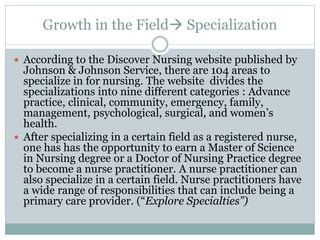
 According to the Discover Nursing website published by
Johnson & Johnson Service, there are 104 areas to
specialize in for nursing. The website divides the
specializations into nine different categories : Advance
practice, clinical, community, emergency, family,
management, psychological, surgical, and women’s
health.
 After specializing in a certain field as a registered nurse,
one has has the opportunity to earn a Master of Science
in Nursing degree or a Doctor of Nursing Practice degree
to become a nurse practitioner. A nurse practitioner can
also specialize in a certain field. Nurse practitioners have
a wide range of responsibilities that can include being a
primary care provider. (“Explore Specialties”)
Reference Chart
Title Annual Salary School time Common requirements
Licensed Practical Nurse
(LPN) and Licensed
Vocational nurse (LVN) *
$42,490 Typically 12 months. Programs
are available are community
colleges, vocational schools,
and universities.
• Hold a high school
diploma or a GED.
• Be at least 18 years of age
• Pass criminal background
checks and drug tests
Registered Nurse (RN) $66,640 • 2 to 3 years if you are
earning an associates
degree.
• 4 years if you are earning
a bachelor’s degree
• Minimum SAT or Act
exam scores
• A high GPA [specific
ranges depend on school]
• 3 years of math and
science classes
• 4 years of English
• 2 years of a foreign
language
Nurse Practitioner Ranges between $83,000 and
$107,00. It depends on
responsibilities and specialty.
It usually two years to obtain a
Master of Science in Nursing
degree. Nurse Practitioners
will also have clinical training.
• A state RN license
• Scores from the GRE or
the Miller Analogies Test
• College Transcripts
• Letters of reference
• An essay
Sources include (“Nursing Salary for LPN, RN, AP”)
Descriptions of other common specializations
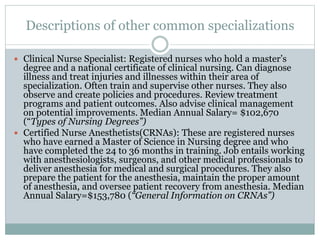
 Clinical Nurse Specialist: Registered nurses who hold a master’s
degree and a national certificate of clinical nursing. Can diagnose
illness and treat injuries and illnesses within their area of
specialization. Often train and supervise other nurses. They also
observe and create policies and procedures. Review treatment
programs and patient outcomes. Also advise clinical management
on potential improvements. Median Annual Salary= $102,670
(“Types of Nursing Degrees”)
 Certified Nurse Anesthetists(CRNAs): These are registered nurses
who have earned a Master of Science in Nursing degree and who
have completed the 24 to 36 months in training. Job entails working
with anesthesiologists, surgeons, and other medical professionals to
deliver anesthesia for medical and surgical procedures. They also
prepare the patient for the anesthesia, maintain the proper amount
of anesthesia, and oversee patient recovery from anesthesia. Median
Annual Salary=$153,780 (“General Information on CRNAs”)
Descriptions of other common specializations
continued
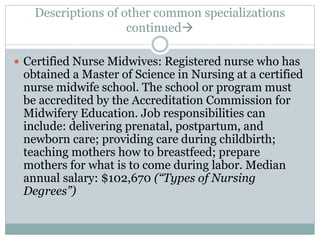
 Certified Nurse Midwives: Registered nurse who has
obtained a Master of Science in Nursing at a certified
nurse midwife school. The school or program must
be accredited by the Accreditation Commission for
Midwifery Education. Job responsibilities can
include: delivering prenatal, postpartum, and
newborn care; providing care during childbirth;
teaching mothers how to breastfeed; prepare
mothers for what is to come during labor. Median
annual salary: $102,670 (“Types of Nursing
Degrees”)
Programs I am Interested In…
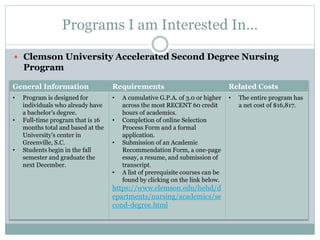
 Clemson University Accelerated Second Degree Nursing
Program
General Information Requirements Related Costs
• Program is designed for
individuals who already have
a bachelor’s degree.
• Full-time program that is 16
months total and based at the
University's center in
Greenville, S.C.
• Students begin in the fall
semester and graduate the
next December.
• A cumulative G.P.A. of 3.0 or higher
across the most RECENT 60 credit
hours of academics.
• Completion of online Selection
Process Form and a formal
application.
• Submission of an Academic
Recommendation Form, a one-page
essay, a resume, and submission of
transcript.
• A list of prerequisite courses can be
found by clicking on the link below.
https://www.clemson.edu/hehd/d
epartments/nursing/academics/se
cond-degree.html
• The entire program has
a net cost of $16,817.
Programs I am Interested In..
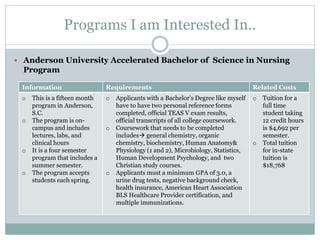
 Anderson University Accelerated Bachelor of Science in Nursing
Program
Information Requirements Related Costs
o This is a fifteen month
program in Anderson,
S.C.
o The program is on-
campus and includes
lectures, labs, and
clinical hours
o It is a four semester
program that includes a
summer semester.
o The program accepts
students each spring.
o Applicants with a Bachelor’s Degree like myself
have to have two personal reference forms
completed, official TEAS V exam results,
official transcripts of all college coursework.
o Coursework that needs to be completed
includes general chemistry, organic
chemistry, biochemistry, Human Anatomy&
Physiology (1 and 2), Microbiology, Statistics,
Human Development Psychology, and two
Christian study courses.
o Applicants must a minimum GPA of 3.0, a
urine drug tests, negative background check,
health insurance, American Heart Association
BLS Healthcare Provider certification, and
multiple immunizations.
o Tuition for a
full time
student taking
12 credit hours
is $4,692 per
semester.
o Total tuition
for in-state
tuition is
$18,768
Programs I am Interested In
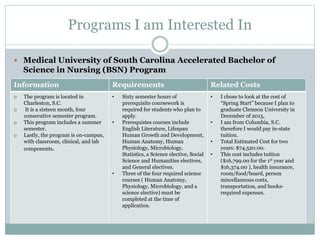
 Medical University of South Carolina Accelerated Bachelor of
Science in Nursing (BSN) Program
Information Requirements Related Costs
o The program is located in
Charleston, S.C.
o It is a sixteen month, four
consecutive semester program.
o This program includes a summer
semester.
o Lastly, the program is on-campus,
with classroom, clinical, and lab
components.
• Sixty semester hours of
prerequisite coursework is
required for students who plan to
apply.
• Prerequistes courses include
English Literature, Lifespan
Human Growth and Development,
Human Anatomy, Human
Physiology, Microbiology,
Statistics, a Science elective, Social
Science and Humanities electives,
and General electives.
• Three of the four required science
courses ( Human Anatomy,
Physiology, Microbiology, and a
science elective) must be
completed at the time of
application.
• I chose to look at the cost of
“Spring Start” because I plan to
graduate Clemson University in
December of 2015,
• I am from Columbia, S.C.
therefore I would pay in-state
tuition.
• Total Estimated Cost for two
years: $74,520.00.
• This cost includes tuition
($16,799.00 for the 1st year and
$16,374.00 ), health insurance,
room/food/board, person
miscellaneous costs,
transportation, and books-
required expenses.
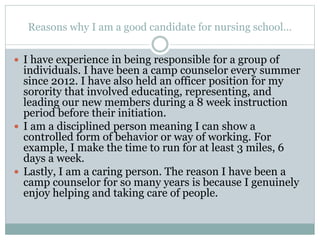
Reasons why I am a good candidate for nursing school…
 I have experience in being responsible for a group of
individuals. I have been a camp counselor every summer
since 2012. I have also held an officer position for my
sorority that involved educating, representing, and
leading our new members during a 8 week instruction
period before their initiation.
 I am a disciplined person meaning I can show a
controlled form of behavior or way of working. For
example, I make the time to run for at least 3 miles, 6
days a week.
 Lastly, I am a caring person. The reason I have been a
camp counselor for so many years is because I genuinely
enjoy helping and taking care of people.
O* Net results + my qualities
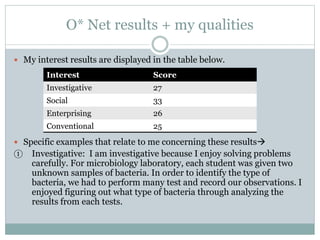
 My interest results are displayed in the table below.
 Specific examples that relate to me concerning these results
① Investigative: I am investigative because I enjoy solving problems
carefully. For microbiology laboratory, each student was given two
unknown samples of bacteria. In order to identify the type of
bacteria, we had to perform many test and record our observations. I
enjoyed figuring out what type of bacteria through analyzing the
results from each tests.
Interest Score
Investigative 27
Social 33
Enterprising 26
Conventional 25
O*Net+ My Qualities [continued]
② Social: I am apart of many organizations on Clemson’s campus. Also, I
come from a very large extended and immediate family. As the youngest
of five children, I have learned how to interact with many different
personality types.
③ Enterprising: I have an enterprising spirit because I enjoy taking on new
projects. I ran on my high school’s track team from 8th to 12th grade. Each
year I ran, I advanced into a faster level eventually winning the state
championship in the 1600 meter race my senior year. As a junior in high
school, I ran for Student Body Treasurer. I won the race by making the
effort to meet and give every one in the school a neon sticker labeled with
my campaign slogan “Let Lil Pay the Bill!”.
④ Conventional: I am conventional because I obey rules and am cautious.
As a sophomore in college, I was selected by my sorority to be on the
standards committee. The standards committee is responsible for
enforcing the bylaws of chapter. As a member of the standards
committee, I had to understand and follow the bylaws of the chapter
without question.
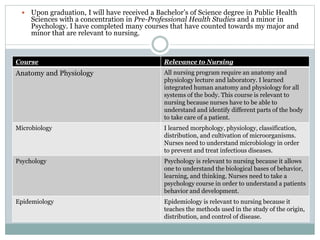
 Upon graduation, I will have received a Bachelor’s of Science degree in Public Health
Sciences with a concentration in Pre-Professional Health Studies and a minor in
Psychology. I have completed many courses that have counted towards my major and
minor that are relevant to nursing.
Course Relevance to Nursing
Anatomy and Physiology All nursing program require an anatomy and
physiology lecture and laboratory. I learned
integrated human anatomy and physiology for all
systems of the body. This course is relevant to
nursing because nurses have to be able to
understand and identify different parts of the body
to take care of a patient.
Microbiology I learned morphology, physiology, classification,
distribution, and cultivation of microorganisms.
Nurses need to understand microbiology in order
to prevent and treat infectious diseases.
Psychology Psychology is relevant to nursing because it allows
one to understand the biological bases of behavior,
learning, and thinking. Nurses need to take a
psychology course in order to understand a patients
behavior and development.
Epidemiology Epidemiology is relevant to nursing because it
teaches the methods used in the study of the origin,
distribution, and control of disease.
Conclusion..
 In conclusion, nursing is a field that allows for many
opportunities. It also allows one to find a
specialization or position that they really enjoy. It
also is a rewarding job in that one is given the option
to help someone else.
 I am excited to start my career as a nurse and to
eventually help many patients.
Sources in MLA format
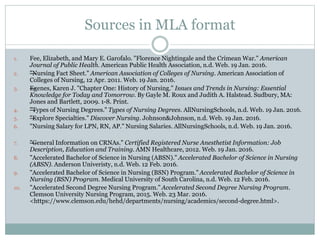
1. Fee, Elizabeth, and Mary E. Garofalo. "Florence Nightingale and the Crimean War." American
Journal of Public Health. American Public Health Association, n.d. Web. 19 Jan. 2016.
2. —"Nursing Fact Sheet." American Association of Colleges of Nursing. American Association of
Colleges of Nursing, 12 Apr. 2011. Web. 19 Jan. 2016.
3. —Egenes, Karen J. "Chapter One: History of Nursing." Issues and Trends in Nursing: Essential
Knowledge for Today and Tomorrow. By Gayle M. Roux and Judith A. Halstead. Sudbury, MA:
Jones and Bartlett, 2009. 1-8. Print.
4. —"Types of Nursing Degrees." Types of Nursing Degrees. AllNursingSchools, n.d. Web. 19 Jan. 2016.
5. —"Explore Specialties." Discover Nursing. Johnson&Johnson, n.d. Web. 19 Jan. 2016.
6. "Nursing Salary for LPN, RN, AP." Nursing Salaries. AllNursingSchools, n.d. Web. 19 Jan. 2016.
7. —"General Information on CRNAs." Certified Registered Nurse Anesthetist Information: Job
Description, Education and Training. AMN Healthcare, 2012. Web. 19 Jan. 2016.
8. "Accelerated Bachelor of Science in Nursing (ABSN)." Accelerated Bachelor of Science in Nursing
(ABSN). Anderson Univeristy, n.d. Web. 12 Feb. 2016.
9. "Accelerated Bachelor of Science in Nursing (BSN) Program." Accelerated Bachelor of Science in
Nursing (BSN) Program. Medical University of South Carolina, n.d. Web. 12 Feb. 2016.
10. "Accelerated Second Degree Nursing Program." Accelerated Second Degree Nursing Program.
Clemson University Nursing Program, 2015. Web. 23 Mar. 2016.
<https://www.clemson.edu/hehd/departments/nursing/academics/second-degree.html>.

Career path powerpoint Lillian Tribble

  • 1.
    LILLIAN TRIBBLE Research onthe Career of Nursing
  • 2.
    Introduction  My nameis Lillian Tribble and I am a Junior at Clemson University. I am majoring in Public Health Sciences and minoring in Psychology. I am hoping to attend nursing school after college.  This presentation describes why nursing is of interest to me, the history of nursing, growth in the nursing field, specialization in the nursing field, why I feel that I am a good candidate for nursing school, how my strongest qualities relate to nursing, and the relevance of my academic path to nursing.
  • 3.
    Nursing as aninterest to me...  I have been interested in science and medicine my entire life.  First, I had an interest in going to Physician Assistant school. I had intentions to finish P.A. school and continue my education to become a surgical physician assistant.  After shadowing two physician assistants, one a dermatology P.A. and one a cardiovascular and thoracic surgical physician assistant, I had great respect for that career path.
  • 4.
    Nursing as aninterest to me continued…  In the summer of 2014 I changed my career path of choice to nursing for the following reasons… 1. A nurse has flexibility in work hours, specialties, and opportunities. 2. A nursing career allows one to move up in the department chosen. For example, one can advance to becoming a head nurse. 3. If I do become a nurse, I have the option to take time off for an extended time period if I am needed else where (for example, a family need). I understand maintaining my license would be necessary, and rejoining the nursing work force may require some re- training after an absence if that were to be the case.
  • 5.
    A Brief Historyof Nursing  The first nurses were usually caretakers, nuns, or even monks in the local community. There were no nursing schools or training facilities. Nurses learned from their experience and the experience of their mentors.  When the Crimean war broke out in Europe in the 1850s, Florence Nightingale, who became a nurse by training with the convent of Irish Catholic nursing sisters, decreased the number of deaths of soldiers dramatically by cleaning the barracks and hospital wards. She also cared for the soldiers themselves during the day and night. When Nightingale returned from war, she was granted a fund from the British government for her work. She used this fund to establish the St. Thomas’ Hospital which included the Nightingale Training School for Nurses in London. (“Florence Nightingale and the Crimean War”)  The United States did not recognize nursing as a profession until after the Civil War broke out. Thousands of women volunteered to nurse wounded soldiers back to health having only their experience as education. After the Civil War, nursing remained a profession ,but the first nursing school was not established until 1872.  The first nursing school was the nursing training school of Women’s Hospital of Philadelphia. It was modeled after Nightingale’s nursing school in London. Following the opening of the Nursing school in Philadelphia, many schools opened around the country.(“Chapter One: History of Nursing”)  Since the opening of the first nursing school, there are over a thousand nursing schools in the United States.  Nursing is now considered the United States’ largest health care profession. Nursing also embodies the largest single component of the hospital staff. (“Nursing Fact Sheet”)
  • 6.
    Nursing Growth Gettinginto the field  There are a number of paths in nursing that one can take.  The first option is becoming a licensed practical nurse or a licensed vocational nurse. This path is the most convenient for individuals who have other responsibilities at home or in another work place because school and training is not over an extended period of time. LPNs and LVNs both require a passing score on the NCLEX-ON exam upon graduating LPN/LVN school. NCLEX-PN stands for National Council Licensure Examination- Practical Nurse. (“Types of Nursing Degrees”)  The second available path is earning an associate degree in nursing to start a career as a registered nurse. This is a good option for an individual who would like to become a registered nurse sooner than the four years required to obtain a Bachelor of Science in Nursing. Individuals who enter the program can be a licensed LPN, LVN, or a student who has met all of the prerequisites. After completing school, students are required to pass the NCLEX-RN to be a licensed registered nurse. (“Types of Nursing Degrees”)  The third option is enrolling in a four-year Bachelor of Science in Nursing program at a college or university. After completing the program, one will take the NCLEX-RN and become a licensed register nurse. The requirements for these programs differ ,but all requirements to attend the university should be met. These requirements include a high school diploma, a good SAT score, and completion of entrance exams. Note: One who has a Bachelor’s degree can also obtain a Bachelor’s of Science Degree in Nursing in two years. The second degree option is shorter because credits from the first bachelor’s degree are accepted. (“Types of Nursing Degrees”)
  • 7.
    Growth in theField Specialization  According to the Discover Nursing website published by Johnson & Johnson Service, there are 104 areas to specialize in for nursing. The website divides the specializations into nine different categories : Advance practice, clinical, community, emergency, family, management, psychological, surgical, and women’s health.  After specializing in a certain field as a registered nurse, one has has the opportunity to earn a Master of Science in Nursing degree or a Doctor of Nursing Practice degree to become a nurse practitioner. A nurse practitioner can also specialize in a certain field. Nurse practitioners have a wide range of responsibilities that can include being a primary care provider. (“Explore Specialties”)
  • 8.
    Reference Chart Title AnnualSalary School time Common requirements Licensed Practical Nurse (LPN) and Licensed Vocational nurse (LVN) * $42,490 Typically 12 months. Programs are available are community colleges, vocational schools, and universities. • Hold a high school diploma or a GED. • Be at least 18 years of age • Pass criminal background checks and drug tests Registered Nurse (RN) $66,640 • 2 to 3 years if you are earning an associates degree. • 4 years if you are earning a bachelor’s degree • Minimum SAT or Act exam scores • A high GPA [specific ranges depend on school] • 3 years of math and science classes • 4 years of English • 2 years of a foreign language Nurse Practitioner Ranges between $83,000 and $107,00. It depends on responsibilities and specialty. It usually two years to obtain a Master of Science in Nursing degree. Nurse Practitioners will also have clinical training. • A state RN license • Scores from the GRE or the Miller Analogies Test • College Transcripts • Letters of reference • An essay Sources include (“Nursing Salary for LPN, RN, AP”)
  • 9.
    Descriptions of othercommon specializations  Clinical Nurse Specialist: Registered nurses who hold a master’s degree and a national certificate of clinical nursing. Can diagnose illness and treat injuries and illnesses within their area of specialization. Often train and supervise other nurses. They also observe and create policies and procedures. Review treatment programs and patient outcomes. Also advise clinical management on potential improvements. Median Annual Salary= $102,670 (“Types of Nursing Degrees”)  Certified Nurse Anesthetists(CRNAs): These are registered nurses who have earned a Master of Science in Nursing degree and who have completed the 24 to 36 months in training. Job entails working with anesthesiologists, surgeons, and other medical professionals to deliver anesthesia for medical and surgical procedures. They also prepare the patient for the anesthesia, maintain the proper amount of anesthesia, and oversee patient recovery from anesthesia. Median Annual Salary=$153,780 (“General Information on CRNAs”)
  • 10.
    Descriptions of othercommon specializations continued  Certified Nurse Midwives: Registered nurse who has obtained a Master of Science in Nursing at a certified nurse midwife school. The school or program must be accredited by the Accreditation Commission for Midwifery Education. Job responsibilities can include: delivering prenatal, postpartum, and newborn care; providing care during childbirth; teaching mothers how to breastfeed; prepare mothers for what is to come during labor. Median annual salary: $102,670 (“Types of Nursing Degrees”)
  • 11.
    Programs I amInterested In…  Clemson University Accelerated Second Degree Nursing Program General Information Requirements Related Costs • Program is designed for individuals who already have a bachelor’s degree. • Full-time program that is 16 months total and based at the University's center in Greenville, S.C. • Students begin in the fall semester and graduate the next December. • A cumulative G.P.A. of 3.0 or higher across the most RECENT 60 credit hours of academics. • Completion of online Selection Process Form and a formal application. • Submission of an Academic Recommendation Form, a one-page essay, a resume, and submission of transcript. • A list of prerequisite courses can be found by clicking on the link below. https://www.clemson.edu/hehd/d epartments/nursing/academics/se cond-degree.html • The entire program has a net cost of $16,817.
  • 12.
    Programs I amInterested In..  Anderson University Accelerated Bachelor of Science in Nursing Program Information Requirements Related Costs o This is a fifteen month program in Anderson, S.C. o The program is on- campus and includes lectures, labs, and clinical hours o It is a four semester program that includes a summer semester. o The program accepts students each spring. o Applicants with a Bachelor’s Degree like myself have to have two personal reference forms completed, official TEAS V exam results, official transcripts of all college coursework. o Coursework that needs to be completed includes general chemistry, organic chemistry, biochemistry, Human Anatomy& Physiology (1 and 2), Microbiology, Statistics, Human Development Psychology, and two Christian study courses. o Applicants must a minimum GPA of 3.0, a urine drug tests, negative background check, health insurance, American Heart Association BLS Healthcare Provider certification, and multiple immunizations. o Tuition for a full time student taking 12 credit hours is $4,692 per semester. o Total tuition for in-state tuition is $18,768
  • 13.
    Programs I amInterested In  Medical University of South Carolina Accelerated Bachelor of Science in Nursing (BSN) Program Information Requirements Related Costs o The program is located in Charleston, S.C. o It is a sixteen month, four consecutive semester program. o This program includes a summer semester. o Lastly, the program is on-campus, with classroom, clinical, and lab components. • Sixty semester hours of prerequisite coursework is required for students who plan to apply. • Prerequistes courses include English Literature, Lifespan Human Growth and Development, Human Anatomy, Human Physiology, Microbiology, Statistics, a Science elective, Social Science and Humanities electives, and General electives. • Three of the four required science courses ( Human Anatomy, Physiology, Microbiology, and a science elective) must be completed at the time of application. • I chose to look at the cost of “Spring Start” because I plan to graduate Clemson University in December of 2015, • I am from Columbia, S.C. therefore I would pay in-state tuition. • Total Estimated Cost for two years: $74,520.00. • This cost includes tuition ($16,799.00 for the 1st year and $16,374.00 ), health insurance, room/food/board, person miscellaneous costs, transportation, and books- required expenses.
  • 14.
    Reasons why Iam a good candidate for nursing school…  I have experience in being responsible for a group of individuals. I have been a camp counselor every summer since 2012. I have also held an officer position for my sorority that involved educating, representing, and leading our new members during a 8 week instruction period before their initiation.  I am a disciplined person meaning I can show a controlled form of behavior or way of working. For example, I make the time to run for at least 3 miles, 6 days a week.  Lastly, I am a caring person. The reason I have been a camp counselor for so many years is because I genuinely enjoy helping and taking care of people.
  • 15.
    O* Net results+ my qualities  My interest results are displayed in the table below.  Specific examples that relate to me concerning these results ① Investigative: I am investigative because I enjoy solving problems carefully. For microbiology laboratory, each student was given two unknown samples of bacteria. In order to identify the type of bacteria, we had to perform many test and record our observations. I enjoyed figuring out what type of bacteria through analyzing the results from each tests. Interest Score Investigative 27 Social 33 Enterprising 26 Conventional 25
  • 16.
    O*Net+ My Qualities[continued] ② Social: I am apart of many organizations on Clemson’s campus. Also, I come from a very large extended and immediate family. As the youngest of five children, I have learned how to interact with many different personality types. ③ Enterprising: I have an enterprising spirit because I enjoy taking on new projects. I ran on my high school’s track team from 8th to 12th grade. Each year I ran, I advanced into a faster level eventually winning the state championship in the 1600 meter race my senior year. As a junior in high school, I ran for Student Body Treasurer. I won the race by making the effort to meet and give every one in the school a neon sticker labeled with my campaign slogan “Let Lil Pay the Bill!”. ④ Conventional: I am conventional because I obey rules and am cautious. As a sophomore in college, I was selected by my sorority to be on the standards committee. The standards committee is responsible for enforcing the bylaws of chapter. As a member of the standards committee, I had to understand and follow the bylaws of the chapter without question.
  • 17.
     Upon graduation,I will have received a Bachelor’s of Science degree in Public Health Sciences with a concentration in Pre-Professional Health Studies and a minor in Psychology. I have completed many courses that have counted towards my major and minor that are relevant to nursing. Course Relevance to Nursing Anatomy and Physiology All nursing program require an anatomy and physiology lecture and laboratory. I learned integrated human anatomy and physiology for all systems of the body. This course is relevant to nursing because nurses have to be able to understand and identify different parts of the body to take care of a patient. Microbiology I learned morphology, physiology, classification, distribution, and cultivation of microorganisms. Nurses need to understand microbiology in order to prevent and treat infectious diseases. Psychology Psychology is relevant to nursing because it allows one to understand the biological bases of behavior, learning, and thinking. Nurses need to take a psychology course in order to understand a patients behavior and development. Epidemiology Epidemiology is relevant to nursing because it teaches the methods used in the study of the origin, distribution, and control of disease.
  • 18.
    Conclusion..  In conclusion,nursing is a field that allows for many opportunities. It also allows one to find a specialization or position that they really enjoy. It also is a rewarding job in that one is given the option to help someone else.  I am excited to start my career as a nurse and to eventually help many patients.
  • 19.
    Sources in MLAformat 1. Fee, Elizabeth, and Mary E. Garofalo. "Florence Nightingale and the Crimean War." American Journal of Public Health. American Public Health Association, n.d. Web. 19 Jan. 2016. 2. —"Nursing Fact Sheet." American Association of Colleges of Nursing. American Association of Colleges of Nursing, 12 Apr. 2011. Web. 19 Jan. 2016. 3. —Egenes, Karen J. "Chapter One: History of Nursing." Issues and Trends in Nursing: Essential Knowledge for Today and Tomorrow. By Gayle M. Roux and Judith A. Halstead. Sudbury, MA: Jones and Bartlett, 2009. 1-8. Print. 4. —"Types of Nursing Degrees." Types of Nursing Degrees. AllNursingSchools, n.d. Web. 19 Jan. 2016. 5. —"Explore Specialties." Discover Nursing. Johnson&Johnson, n.d. Web. 19 Jan. 2016. 6. "Nursing Salary for LPN, RN, AP." Nursing Salaries. AllNursingSchools, n.d. Web. 19 Jan. 2016. 7. —"General Information on CRNAs." Certified Registered Nurse Anesthetist Information: Job Description, Education and Training. AMN Healthcare, 2012. Web. 19 Jan. 2016. 8. "Accelerated Bachelor of Science in Nursing (ABSN)." Accelerated Bachelor of Science in Nursing (ABSN). Anderson Univeristy, n.d. Web. 12 Feb. 2016. 9. "Accelerated Bachelor of Science in Nursing (BSN) Program." Accelerated Bachelor of Science in Nursing (BSN) Program. Medical University of South Carolina, n.d. Web. 12 Feb. 2016. 10. "Accelerated Second Degree Nursing Program." Accelerated Second Degree Nursing Program. Clemson University Nursing Program, 2015. Web. 23 Mar. 2016. <https://www.clemson.edu/hehd/departments/nursing/academics/second-degree.html>.

Editor's Notes

  • #6 http://www.ncbi.nlm.nih.gov/pmc/articles/PMC2920984/ http://www.aacn.nche.edu/media-relations/fact-sheets/nursing-fact-sheet http://www.jblearning.com/samples/0763752258/52258_ch01_roux.pdf
  • #7 http://www.allnursingschools.com/nursing-careers/article/nursing-program-types/
  • #8 https://www.discovernursing.com/explore-specialties#no-filters
  • #9 *Note: Difference between a LPN and a LVN=mainly the name. According to some sources, the two occupations have the same responsibilities. Some states use LPN and some use LVN ,but essentially they are the same job. http://www.allnursingschools.com/nursing-careers/article/nursing-salaries/ http://www.allnursingschools.com/nursing-careers/article/nursing-program-types/ http://www.allnursingschools.com/nursing-careers/registered-nursing/degrees/
  • #10 http://www.allnursingschools.com/nursing-careers/article/nursing-salaries/ http://www.anesthesiazone.com/crna-information.aspx