





NURSING COURSE
MRS. RAQUEL CAMACHO V.
ENGLISH TEACHER
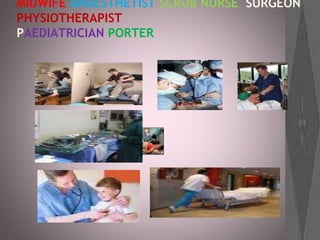
MIDWIFE ANAESTHETIST SCRUB NURSE SURGEON
PHYSIOTHERAPIST
PAEDIATRICIAN PORTER
1. SURGEON
2. PHARMACIST
3. MIDWIFE
4. PHYSIOTHERAPIST
5. CARDIOLOGIST
6. RADIOLOGIST
7. PARAMEDIC
8. PAEDIATRICIAN
9. SCRUB NURSE
10. PORTER
11. CONSULTANT
12. RECEPTIONIST
13. ANAESTHETIST
14. LAB TECHNICIAN
WHAT PEOPLE DO
2. Midwife - delivers
3 cardiologist
specializes
4 porter moves
5 radiologist takes
6 scrub nurse supports
7 pharmacist prepares
8. Paramedic gives
9. Surgeon
perfoms
10. Lab technician
examines
WHAT DOES AN ANAESTHETIC DO?1. loss of consciousness
2. Solve problems
3. manipulation, massage,
exercise therapy.
4. answer telephones,
screening and directing
calls, and taking messages,
5. works with surgeons and
the medical team
6. responds to emergency calls
and provides on-scene
medical treatment
7. physician who deals with
the growth, development
and the health of children,
from birth to adolescence.
Scrub nurse,
Consultant
receptionist
paramedic,
anaesthetic,
paediatrician
Physiotherapist
WHAT DOES A N ANAESTHETIST DO?
HELLO, MY
NAME´S___________
WHAT´S YOUR NAME?
MY NAME´S_______
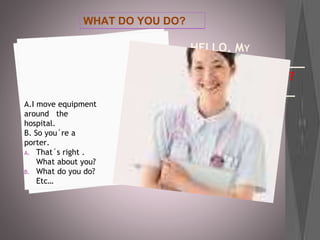
WHAT DO YOU DO?A.I move equipment
around the
hospital.
B. So you´re a
porter.
A. That´s right .
What about you?
B. What do you do?
Etc…
WHAT DO YOU DO?
A JOB INTERVIEW
1. How do you feel about interviews?
2. Are you good at them?
3. When was you last interview?
4. What was it for?
5. How did it go?
I felt nervous,
scared, worried.
It was last month
Because I was
unemmployed
It was a little
stressful
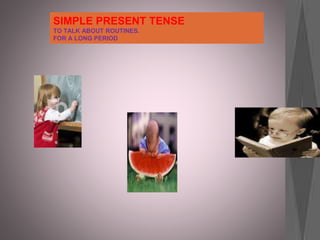
SIMPLE PRESENT TENSE
TO TALK ABOUT ROUTINES.
FOR A LONG PERIOD
SPEAKING TEST UNIT 1
1. WHAT DOES A PHYCHIATRIC DO?
2. WHAT DOES A HEALTH VISITOR DO?
3. WHO DELIVERS BABIES?
4. WHERE DOES A TRIAGE NURSE WORK?
5. WHERE DOES A PRACTICE NURSE WORK?
6. DOES A NURSING OFFICER WORK ON THE WARDS?
7. WHAT THREE ADJECTIVES ARE USED TO DESCRIBE NURSES BEFORE
FLORENCE NIGHTNGALE MADE NURSING INTO A PROFESSION?
8. HOW IS THE NURSING PROFESSION ORGANIZED IN ECUADOR?
9. WHAT DO PEOPLE IN ECUADOR THINK ABOUT THE NURSING
PROFESSION?
10. WHAT DO NURSES IN ECUADOR THINK ABOUT THEIR PROFESSION?
UNIT 2 IN AND AROUND THE
HOSPITAL
a. Is for monotoring the heart ( an ECG)
b. Is for examining tissues, samples, etc, very closely
( a microscope)
c. Is for separating substances by spinning them ( a centrifuge)
d. Is for weighing substances ( scales)
e. Is for building strength after injury ( an exercise machine)
f. Is for fixing a broken bone ( a bone plate)
g. Is for removing damaged skin ( a dermabrader)
h. Is for cleaning the blood when the kidneys don`t work ( a
dialysis machine)
I. Is for testing for sensation in nerves ( neurological pinwheel)
j. Is a special spoon for children to grip ( paediatric spoon)
k. Is for perfominig surgery ( a scalpel)
l. Is for taking a photo of bones ( an x- ray machine)
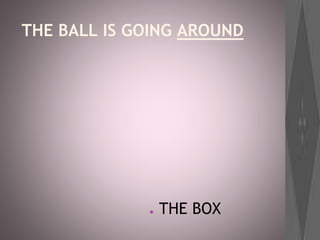
THE BALL IS GOING AROUND
● THE BOX
The ball is going…
Across
the bridge
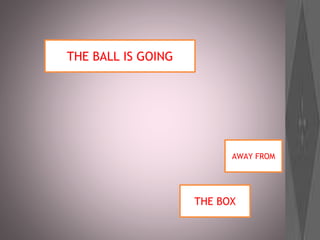
THE BALL IS GOING
AWAY FROM
THE BOX
THE BALL IS GOING
DOWN
THE STAIRS
THE BALL IS GOING TO
UP THE STAIRS
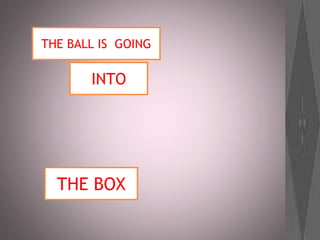
THE BALL IS GOING
INTO
THE BOX
THE BALL IS
GETTING
OFF THE BOX
THE BALL IS GETTIING
ONTO
THE BOX
THE BALL IS COMING
OUT OF
THE BOX
The ball is going…
Through
the box.
The ball is going…
Past
the box.
The ball is
going…
Over
the
box
The ball is going…
the Box
The ball is…
…going Under the box
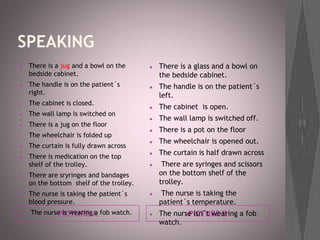
SPEAKING
PICTURE A PICTURE B
● There is a jug and a bowl on the
bedside cabinet.
● The handle is on the patient´s
right.
● The cabinet is closed.
● The wall lamp is switched on
● There is a jug on the floor
● The wheelchair is folded up
● The curtain is fully drawn across
● There is medication on the top
shelf of the trolley.
● There are sryringes and bandages
on the bottom shelf of the trolley.
● The nurse is taking the patient´s
blood pressure.
● The nurse is wearing a fob watch.
● There is a glass and a bowl on
the bedside cabinet.
● The handle is on the patient´s
left.
● The cabinet is open.
● The wall lamp is switched off.
● There is a pot on the floor
● The wheelchair is opened out.
● The curtain is half drawn across
● There are syringes and scissors
on the bottom shelf of the
trolley.
● The nurse is taking the
patient´s temperature.
● The nurse isn´t wearing a fob
watch.
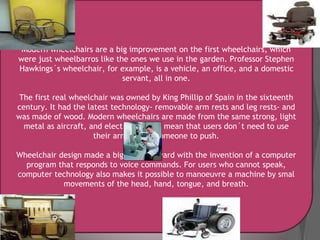
Modern wheelchairs are a big improvement on the first wheelchairs, which
were just wheelbarros like the ones we use in the garden. Professor Stephen
Hawkings´s wheelchair, for example, is a vehicle, an office, and a domestic
servant, all in one.
The first real wheelchair was owned by King Phillip of Spain in the sixteenth
century. It had the latest technology- removable arm rests and leg rests- and
was made of wood. Modern wheelchairs are made from the same strong, light
metal as aircraft, and electric engines mean that users don´t need to use
their arms have soomeone to push.
Wheelchair design made a big jump forward with the invention of a computer
program that responds to voice commands. For users who cannot speak,
computer technology also makes it possible to manoeuvre a machine by smal
movements of the head, hand, tongue, and breath.
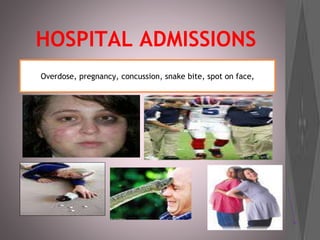
HOSPITAL ADMISSIONS
Overdose, pregnancy, concussion, snake bite, spot on face,
1. WHICH PATIENTS ARE SEEN FIRST?
2. WHERE DO PATIENTS SIT WHILE THEY WAIT
FOR TREATMENT?
3. WHAT KIND OF INFORMATION GOES ON A
HOSPITAL REGISTRATION FORM?
4. WHERE DOES THE DOCTOR TREAT THE
PATIENT?
SURNAME Grady FIRST NAME JIM
DOB (day of birth) 2.3.50 Gender M F
OCCUPATION Retired
MARITAL STATUS widowed
NEXT OF KIN Son
CONTACT NO. 07765432178
SMOKING INTAKE n/a (non active)
ALCOHOL INTAKE 30 units per week
REASON FOR ADMISSION Snake bite
MEDICAL HISTORY High blood pressure
ALLERGIES None
GP (doctor of the family) Dr. Parkinson Central Surgery.
PATIENT RECORD
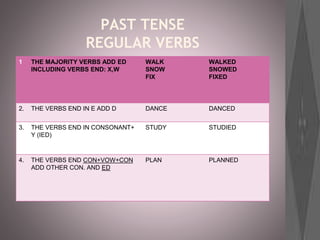
PAST TENSE
REGULAR VERBS
1 THE MAJORITY VERBS ADD ED
INCLUDING VERBS END: X,W
WALK
SNOW
FIX
WALKED
SNOWED
FIXED
2. THE VERBS END IN E ADD D DANCE DANCED
3. THE VERBS END IN CONSONANT+
Y (IED)
STUDY STUDIED
4. THE VERBS END CON+VOW+CON
ADD OTHER CON. AND ED
PLAN PLANNED
Modern wheelchairs are a big improvement on the first wheelchairs, which
were just wheelbarros like the ones we use in the garden. Professor Stephen
Hawkings´s wheelchair, for example, is a vehicle, an office, and a domestic
servant, all in one.
The first real wheelchair was owned by King Phillip of Spain in the sixteenth
century. It had the latest technology- removable arm rests and leg rests- and
was made of wood. Modern wheelchairs are made from the same strong, light
metal as aircraft, and electric engines mean that users don´t need to use
their arms have soomeone to push.
Wheelchair design made a big jump forward with the invention of a computer
program that responds to voice commands. For users who cannot speak,
computer technology also makes it possible to manoeuvre a machine by smal
movements of the head, hand, tongue, and breath.
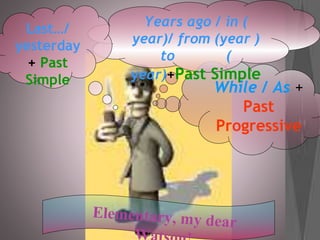
While / As +
Past
Progressive
Years ago / in (
year)/ from (year )
to (
year)+Past Simple
Last…/
yesterday
+ Past
Simple
PAST CONTINUOUS
● We use the past continuous to talk about
temporary situation in past.
I was feeling ill yesterday.
● Activities in progress at a particular time in
the past.
At eight o ´clock last night , I was
watching TV.
● A situation in the past that is interrupted by
an action or event. The verb connected with
this action or event is in the past simple
tense.
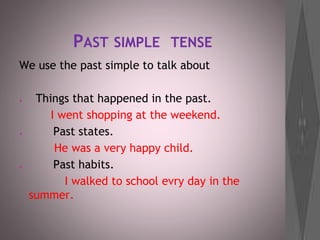
PAST SIMPLE TENSE
We use the past simple to talk about
● Things that happened in the past.
I went shopping at the weekend.
● Past states.
He was a very happy child.
● Past habits.
I walked to school evry day in the
summer.
UNIT 4 ACCIDENTS AND
EMERGENCIES
BANDAGES,MORPHINE, ASPIRIN,DISPOSABLE
GLOVES,TWEEZERS, FIRST AID MANUAL, HYPODERMIC
NEEDLES, HYPODERMIC NEEDLES,ADHESIVE TAPE
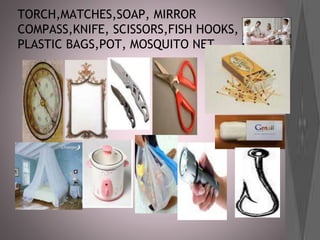
TORCH,MATCHES,SOAP, MIRROR
COMPASS,KNIFE, SCISSORS,FISH HOOKS,
PLASTIC BAGS,POT, MOSQUITO NET,
HAPPY HOLIDAYS LADIES
MEDICAL
●Adhesive tape – many uses, not just medical
●Disposable gloves – useful for storing water, for example
●Morphine- there is nthing else to relieve a sick or i njured person
●Hypodermic needles- to administer the Morphine
●A first aid manual
GENERAL
●A box of matches – essential for cooking , heating, and signalling
●A compass- necessaary in any featureless environment
●A knife- a blade is necessaru for all kinds of purposes
● a cooking pot- heavy, but without it you´d be restricted to unboiled
water and raw food.
●Soap- keeping clean is essential for health and morale.
FIRST AID
INSTRUCTIONS
1. A PATIENT BREATHING
2. COUNT UP TO
BETWEEN BREATHS.
3. STERILE NEEDLE
4. A PATIENT TRIES TO
STAND UP
5. BURNT AREA
6. BANDAGE THE WOUND
7. DON´T TIE THE
BANDAGE TIGHT
8. GIVE A DOSAGE
9. PATIENT´S PULSE
10.APPLY THE PADS
A
B
C D
E
F
G H
I
J
INSTRUCTIONS
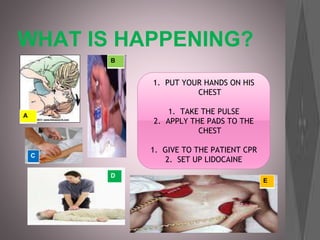
WHAT IS HAPPENING?
1. PUT YOUR HANDS ON HIS
CHEST
1. TAKE THE PULSE
2. APPLY THE PADS TO THE
CHEST
1. GIVE TO THE PATIENT CPR
2. SET UP LIDOCAINE
A
B
C
D
E
LISTENING (CPR TRAINING DUMMY)
READING
IT´S MY JOB
COMBINATIONS
SIGNS AND SYMPTOMS
9 INTESTINES
4
CARDIOVASCUL
AR
5
RESPIRA
TORY
10
ABDOMINAL
8
GASTROINTES
TINAL
3
ABNORM
ALLY/
DANGER
OUSLY
2 COMA1 CENTRAL
NERVOUS
SYSTEM
7
DANGEROUSLY
/ ABNORMALLY6 BLOOD PRESSURE
UNIT 5 PAIN
A continuous or prolonged dull pain in
some part of one's body is called an ache.
Pain is a more general term, but it is not restricted
to the skin. It comes on suddenly, can be local or
widespread, and can be mild or acute. Ache, on the
other hand, is persistent, generally restricted to an
area or organ and is chronic. Ache does not hinder
you from doing something while pain does.
And ache comes out of tiring, say of muscles for
example, and lasts a while. Unlike pain, it is
persistent and dull. It is the body’s signal to take
suitable remedial measures.
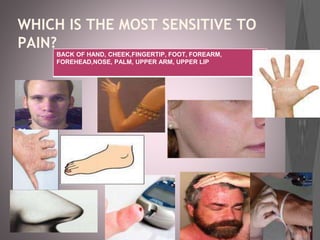
WHICH IS THE MOST SENSITIVE TO
PAIN?
BACK OF HAND, CHEEK,FINGERTIP, FOOT, FOREARM,
FOREHEAD,NOSE, PALM, UPPER ARM, UPPER LIP
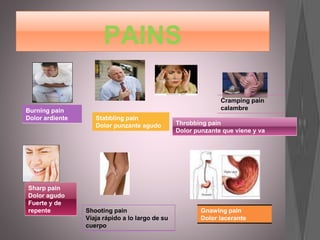
PAINS
Burning pain
Dolor ardiente Stabbling pain
Dolor punzante agudo Throbbing pain
Dolor punzante que viene y va
Sharp pain
Dolor agudo
Fuerte y de
repente Shooting pain
Viaja rápido a lo largo de su
cuerpo
Gnawing pain
Dolor lacerante
Cramping pain
calambre
DESCRIBING PAINS
● ARE YOU STILL IN PAIN?
● HOW´S THE PAIN TODAY?
● HOW OFTEN DO YOU GET THE PAIN?
● DOES IT FEEL THE SAME ALL THE TIME?
● WHEN DID IT START?
DESCRIBING PAIN
LISTENING PAIN CHART
1 2 3 4
Burning (quemante, ardiente) /
Stabbing ( punzante, agudo)
Throbbing (punzante, late con fuerza) /
Shooting ( que se dispara) /
Constant /
Frequent /
Occasional /
Mild (ligero) / /
Moderate / /
Severe /
Getting better (mejorando) /
Getting worse (empeorando) / /
Staying the same (lo mismo) /
1. OLD OLDER THAN THE OLDEST
2 BAD WORSE THAN THE WORST
3 DIFFICULT MORE DIFFICULT THAN THE MOST DIFFICULT
4 LARGE LARGER THAN THE LARGEST
5 GOOD BETTER THAN THE BEST
6 BIG BIGGER THAN THE BIGGEST
7 EASY EASIER THAN THE EASIEST
8 MUCH MORE THAN THE MOST
9. LITTLE LESS THAN THE LEAST
10 INTERESTING MORE INTERESTING
THAN
THE MOST INTERESTING
SAD SADDER THAN THE SADDEST
FLAT FLATTER THAN THE FLATTEST
EASTERN MORE EASTERN THAN THE MOST EASTEREST
NOISY NOISIER THAN THE NOISIEST
BIG BIGGER THAN THE BIGGEST
FEW FEWER THAN THE FEWEST
MODERN MORE MODERN THAN THE MOST MODERN
CLEAN CLEANER THAN THE CLEANEST
NEW NEWER THAN THE NEWEST
NICE NICER THAN THE NICEST
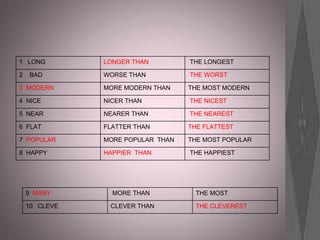
1 LONG LONGER THAN THE LONGEST
2 BAD WORSE THAN THE WORST
3 MODERN MORE MODERN THAN THE MOST MODERN
4 NICE NICER THAN THE NICEST
5 NEAR NEARER THAN THE NEAREST
6 FLAT FLATTER THAN THE FLATTEST
7 POPULAR MORE POPULAR THAN THE MOST POPULAR
8 HAPPY HAPPIER THAN THE HAPPIEST
9 MANY MORE THAN THE MOST
10 CLEVE CLEVER THAN THE CLEVEREST
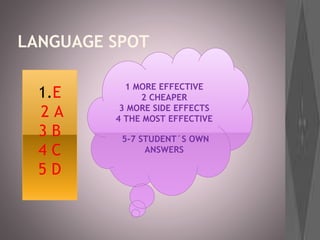
LANGUAGE SPOT
1.E
2 A
3 B
4 C
5 D
1 MORE EFFECTIVE
2 CHEAPER
3 MORE SIDE EFFECTS
4 THE MOST EFFECTIVE
5-7 STUDENT´S OWN
ANSWERS
PAIN RELIEF
1 DIFFERENT
SEXES
2 GAS AND AIR
3 DIDN´T MAKE
4 ALL
5 DIDN´T HAVE
6 ALL
1 RELIEVE
2 WEARS OFF
3 FEEL
4 BECAME
5 COPE WITH
6 TOOK AWAY
7 GOT
8 LOSING
PRONUNCIATION
HURT, NURSE, FIRST, WORSE
AIR,CARE, HAIR, WHERE
ULCER, DOCTOR, APPOINTMENT, TUMOUR
READING
1.T
2.F
3.T
4.F
5.T
1 PROTECT
2 TREAT
3 MANAGE
4 PREVENT
5 CONTROL
6 SUFFER
WH+ AUX+S+V+C?
1. Where does
2. Does it
3. When did it start
4. Does the pain
5. How much
6. Can you
7. does anything
make
8. What makes it
a. Worse?
b. It hurt?
c. does it hurt?
d. Describe the pain?
e. Hurting?
f. Hurt all the time?
g. Stay iin one place
or move aroun?
h. The pain feel
better?
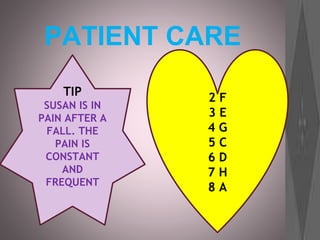
PATIENT CARE
TIP
SUSAN IS IN
PAIN AFTER A
FALL. THE
PAIN IS
CONSTANT
AND
FREQUENT
2 F
3 E
4 G
5 C
6 D
7 H
8 A
Where does it hurt?
When does it start hurting?
How bad is it?
What type of pain is it? (29)
Is the pain in the same place or moving?
Are you getting better?
Are you getting worse?
What helps to getting better?
What do you make it getting worse?
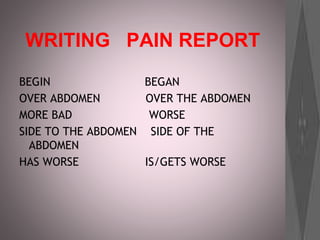
WRITING PAIN REPORT
BEGIN BEGAN
OVER ABDOMEN OVER THE ABDOMEN
MORE BAD WORSE
SIDE TO THE ABDOMEN SIDE OF THE
ABDOMEN
HAS WORSE IS/GETS WORSE
BODY BITS
AREAS OF REFERRED PAIN
SHORT ANSWERS
● IS YOUR MOM DOING A NIGHT
SHIFT?
● ARE YOU GOOD AT LISTENING?
● WERE YOU BORN IN GUAYAQUIL?
● DO YOU HAVE ANY PAIN?
● DOES ROBERT FEEL RELIEF?
● CAN YOU TAKE ANY MEDICINE?
● DID YOU WEAR A UNIFORM?
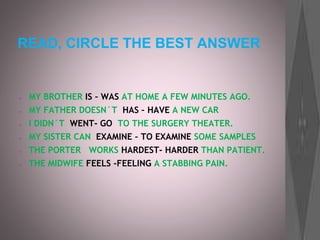
READ, CIRCLE THE BEST ANSWER
● MY BROTHER IS – WAS AT HOME A FEW MINUTES AGO.
● MY FATHER DOESN´T HAS – HAVE A NEW CAR
● I DIDN´T WENT- GO TO THE SURGERY THEATER.
● MY SISTER CAN EXAMINE – TO EXAMINE SOME SAMPLES
● THE PORTER WORKS HARDEST- HARDER THAN PATIENT.
● THE MIDWIFE FEELS -FEELING A STABBING PAIN.
UNIT 6 SYMPTOMS
NAUSEA ,COUGH, DIARROHEA, NUMBNESS,ACHING,BRUISING ,TIREDNESS
AMORATADO ENTUMECIDO
CANSANCIO ADOLORIDO
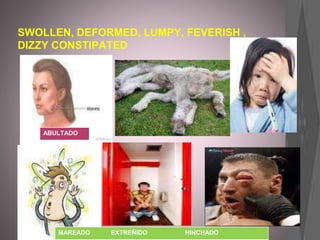
SWOLLEN, DEFORMED, LUMPY, FEVERISH ,
DIZZY CONSTIPATED
ABULTADO
MAREADO EXTREÑIDO HINCHADO
A RUNNY NOSE (A COLD)
ITCHING ( AN INSECT BITE)
SICKNESS ( FOOD POISONING)
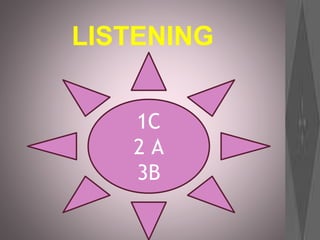
LISTENING
1C
2 A
3B
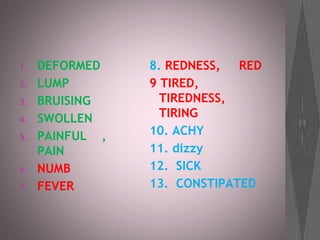
1. DEFORMED
2. LUMP
3. BRUISING
4. SWOLLEN
5. PAINFUL ,
PAIN
6. NUMB
7. FEVER
8. REDNESS, RED
9 TIRED,
TIREDNESS,
TIRING
10. ACHY
11. dizzy
12. SICK
13. CONSTIPATED
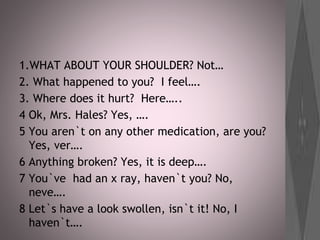
LANGUAGE SPOT
1.WHAT ABOUT YOUR SHOULDER? Not…
2. What happened to you? I feel….
3. Where does it hurt? Here…..
4 Ok, Mrs. Hales? Yes, ….
5 You aren`t on any other medication, are you?
Yes, ver….
6 Anything broken? Yes, it is deep….
7 You`ve had an x ray, haven`t you? No,
neve….
8 Let`s have a look swollen, isn`t it! No, I
haven`t….
IT´S MY JOB
NIGHT COUGHING
1WHEEZE 2 OCCURS
5 GET
6
BREATH
E
7
SOUNDS
4
MAKE
3
HAS
9
ACCOMPANIED
8
ARE
10
COUGHING
UP
A HELPING CALL
THE CHILD MAY HAVE EITHER A
BAD COLD OR PNEUMONIA .
HIS LOWISH TEMPERATURE
MAKES A BAD COLD MORE
LIKELY, BUT THE WHEEZING
COULD INDICATE SOMETHING
MORE SERIOUS.
SYMPTOMS REPORT
●LOSS APPETITE
●ADMITTED HOSPITAL
●PAIN HER LOWER RIGHT SIDE
●LOSS OF APPETITE
●ADMITTED TO HOSPITAL
●PAIN IN HER LOWER RIGHT
SIDE
POSSIBLE ANSWER
YESTERDAY IVAN ABASHEV
WAS VOMITING , HAD
DIARRHOEA, AND
COMPLAINED OF
HEADACHES. ON ADMISSION
TO HOSPITAL, HE HAD
SEVERE ABDOMINAL PAIN,
AND A HIGH FEVER. TODAY
HE IS COMPLAINING OF
WEAKNESS, AND IS
SHIVERING. HE SAYS HE
HAS A CONSTANT
STABBING PAIN IN THE
LEFT SIDE OF HIS
ABDOMEN.
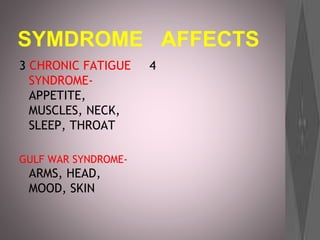
READING
SYMDROME AFFECTS
3 CHRONIC FATIGUE
SYNDROME-
APPETITE,
MUSCLES, NECK,
SLEEP, THROAT
GULF WAR SYNDROME-
ARMS, HEAD,
MOOD, SKIN
4
TONGUE DIAGNOSIS
UNIT 7
CARING FOR THE ELDERLY
● MEDICATION less able to tolerate medication,
may find it difficult to follow regime.
● DIAGNOSIS more complex, may suffer from a
whole series of conditions which affect each
other.
● RECOVERY generally slower, may not be able to
follow treatment, for example medication,
physiotherapy.
● MIND may find it hard to understant what`s
wrong , what decision to make( fdor example
whether or not to have surgery, go home, etc).
More likely to suffer from loneliness and
depression
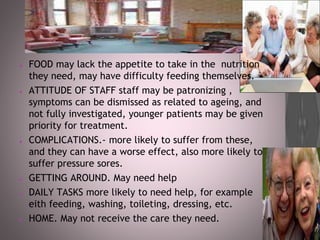
● FOOD may lack the appetite to take in the nutrition
they need, may have difficulty feeding themselves.
● ATTITUDE OF STAFF staff may be patronizing ,
symptoms can be dismissed as related to ageing, and
not fully investigated, younger patients may be given
priority for treatment.
● COMPLICATIONS.- more likely to suffer from these,
and they can have a worse effect, also more likely to
suffer pressure sores.
● GETTING AROUND. May need help
● DAILY TASKS more likely to need help, for example
eith feeding, washing, toileting, dressing, etc.
● HOME. May not receive the care they need.
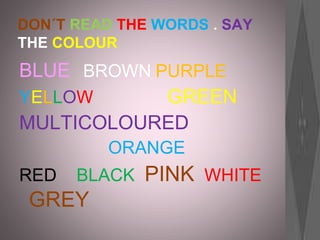
DON´T READ THE WORDS . SAY
THE COLOUR
BLUE BROWN PURPLE
YELLOW GREEN
MULTICOLOURED
ORANGE
RED BLACK PINK WHITE
GREY
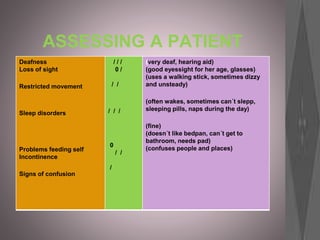
ASSESSING A PATIENT
Deafness
Loss of sight
Restricted movement
Sleep disorders
Problems feeding self
Incontinence
Signs of confusion
/ / /
0 /
/ /
/ / /
0
/ /
/
(very deaf, hearing aid)
(good eyessight for her age, glasses)
(uses a walking stick, sometimes dizzy
and unsteady)
(often wakes, sometimes can´t slepp,
sleeping pills, naps during the day)
(fine)
(doesn´t like bedpan, can´t get to
bathroom, needs pad)
(confuses people and places)
Nursing

Nursing

  • 1.
    NURSING COURSE MRS. RAQUELCAMACHO V. ENGLISH TEACHER
  • 2.
    MIDWIFE ANAESTHETIST SCRUBNURSE SURGEON PHYSIOTHERAPIST PAEDIATRICIAN PORTER
  • 3.
    1. SURGEON 2. PHARMACIST 3.MIDWIFE 4. PHYSIOTHERAPIST 5. CARDIOLOGIST 6. RADIOLOGIST 7. PARAMEDIC 8. PAEDIATRICIAN 9. SCRUB NURSE 10. PORTER 11. CONSULTANT 12. RECEPTIONIST 13. ANAESTHETIST 14. LAB TECHNICIAN
  • 4.
    WHAT PEOPLE DO 2.Midwife - delivers 3 cardiologist specializes 4 porter moves 5 radiologist takes 6 scrub nurse supports 7 pharmacist prepares 8. Paramedic gives 9. Surgeon perfoms 10. Lab technician examines
  • 5.
    WHAT DOES ANANAESTHETIC DO?1. loss of consciousness 2. Solve problems 3. manipulation, massage, exercise therapy. 4. answer telephones, screening and directing calls, and taking messages, 5. works with surgeons and the medical team 6. responds to emergency calls and provides on-scene medical treatment 7. physician who deals with the growth, development and the health of children, from birth to adolescence. Scrub nurse, Consultant receptionist paramedic, anaesthetic, paediatrician Physiotherapist WHAT DOES A N ANAESTHETIST DO?
  • 6.
    HELLO, MY NAME´S___________ WHAT´S YOURNAME? MY NAME´S_______ WHAT DO YOU DO?A.I move equipment around the hospital. B. So you´re a porter. A. That´s right . What about you? B. What do you do? Etc… WHAT DO YOU DO?
  • 7.
    A JOB INTERVIEW 1.How do you feel about interviews? 2. Are you good at them? 3. When was you last interview? 4. What was it for? 5. How did it go? I felt nervous, scared, worried. It was last month Because I was unemmployed It was a little stressful
  • 8.
    SIMPLE PRESENT TENSE TOTALK ABOUT ROUTINES. FOR A LONG PERIOD
  • 9.
    SPEAKING TEST UNIT1 1. WHAT DOES A PHYCHIATRIC DO? 2. WHAT DOES A HEALTH VISITOR DO? 3. WHO DELIVERS BABIES? 4. WHERE DOES A TRIAGE NURSE WORK? 5. WHERE DOES A PRACTICE NURSE WORK? 6. DOES A NURSING OFFICER WORK ON THE WARDS? 7. WHAT THREE ADJECTIVES ARE USED TO DESCRIBE NURSES BEFORE FLORENCE NIGHTNGALE MADE NURSING INTO A PROFESSION? 8. HOW IS THE NURSING PROFESSION ORGANIZED IN ECUADOR? 9. WHAT DO PEOPLE IN ECUADOR THINK ABOUT THE NURSING PROFESSION? 10. WHAT DO NURSES IN ECUADOR THINK ABOUT THEIR PROFESSION?
  • 10.
    UNIT 2 INAND AROUND THE HOSPITAL
  • 11.
    a. Is formonotoring the heart ( an ECG) b. Is for examining tissues, samples, etc, very closely ( a microscope) c. Is for separating substances by spinning them ( a centrifuge) d. Is for weighing substances ( scales) e. Is for building strength after injury ( an exercise machine) f. Is for fixing a broken bone ( a bone plate) g. Is for removing damaged skin ( a dermabrader) h. Is for cleaning the blood when the kidneys don`t work ( a dialysis machine) I. Is for testing for sensation in nerves ( neurological pinwheel) j. Is a special spoon for children to grip ( paediatric spoon) k. Is for perfominig surgery ( a scalpel) l. Is for taking a photo of bones ( an x- ray machine)
  • 12.
    THE BALL ISGOING AROUND ● THE BOX
  • 13.
    The ball isgoing… Across the bridge
  • 14.
    THE BALL ISGOING AWAY FROM THE BOX
  • 15.
    THE BALL ISGOING DOWN THE STAIRS
  • 16.
    THE BALL ISGOING TO UP THE STAIRS
  • 17.
    THE BALL ISGOING INTO THE BOX
  • 18.
  • 19.
    THE BALL ISGETTIING ONTO THE BOX
  • 20.
    THE BALL ISCOMING OUT OF THE BOX
  • 21.
    The ball isgoing… Through the box.
  • 22.
    The ball isgoing… Past the box.
  • 23.
  • 24.
    The ball isgoing… the Box
  • 25.
  • 26.
    SPEAKING PICTURE A PICTUREB ● There is a jug and a bowl on the bedside cabinet. ● The handle is on the patient´s right. ● The cabinet is closed. ● The wall lamp is switched on ● There is a jug on the floor ● The wheelchair is folded up ● The curtain is fully drawn across ● There is medication on the top shelf of the trolley. ● There are sryringes and bandages on the bottom shelf of the trolley. ● The nurse is taking the patient´s blood pressure. ● The nurse is wearing a fob watch. ● There is a glass and a bowl on the bedside cabinet. ● The handle is on the patient´s left. ● The cabinet is open. ● The wall lamp is switched off. ● There is a pot on the floor ● The wheelchair is opened out. ● The curtain is half drawn across ● There are syringes and scissors on the bottom shelf of the trolley. ● The nurse is taking the patient´s temperature. ● The nurse isn´t wearing a fob watch.
  • 27.
    Modern wheelchairs area big improvement on the first wheelchairs, which were just wheelbarros like the ones we use in the garden. Professor Stephen Hawkings´s wheelchair, for example, is a vehicle, an office, and a domestic servant, all in one. The first real wheelchair was owned by King Phillip of Spain in the sixteenth century. It had the latest technology- removable arm rests and leg rests- and was made of wood. Modern wheelchairs are made from the same strong, light metal as aircraft, and electric engines mean that users don´t need to use their arms have soomeone to push. Wheelchair design made a big jump forward with the invention of a computer program that responds to voice commands. For users who cannot speak, computer technology also makes it possible to manoeuvre a machine by smal movements of the head, hand, tongue, and breath.
  • 28.
    HOSPITAL ADMISSIONS Overdose, pregnancy,concussion, snake bite, spot on face,
  • 29.
    1. WHICH PATIENTSARE SEEN FIRST? 2. WHERE DO PATIENTS SIT WHILE THEY WAIT FOR TREATMENT? 3. WHAT KIND OF INFORMATION GOES ON A HOSPITAL REGISTRATION FORM? 4. WHERE DOES THE DOCTOR TREAT THE PATIENT?
  • 30.
    SURNAME Grady FIRSTNAME JIM DOB (day of birth) 2.3.50 Gender M F OCCUPATION Retired MARITAL STATUS widowed NEXT OF KIN Son CONTACT NO. 07765432178 SMOKING INTAKE n/a (non active) ALCOHOL INTAKE 30 units per week REASON FOR ADMISSION Snake bite MEDICAL HISTORY High blood pressure ALLERGIES None GP (doctor of the family) Dr. Parkinson Central Surgery. PATIENT RECORD
  • 31.
    PAST TENSE REGULAR VERBS 1THE MAJORITY VERBS ADD ED INCLUDING VERBS END: X,W WALK SNOW FIX WALKED SNOWED FIXED 2. THE VERBS END IN E ADD D DANCE DANCED 3. THE VERBS END IN CONSONANT+ Y (IED) STUDY STUDIED 4. THE VERBS END CON+VOW+CON ADD OTHER CON. AND ED PLAN PLANNED
  • 32.
    Modern wheelchairs area big improvement on the first wheelchairs, which were just wheelbarros like the ones we use in the garden. Professor Stephen Hawkings´s wheelchair, for example, is a vehicle, an office, and a domestic servant, all in one. The first real wheelchair was owned by King Phillip of Spain in the sixteenth century. It had the latest technology- removable arm rests and leg rests- and was made of wood. Modern wheelchairs are made from the same strong, light metal as aircraft, and electric engines mean that users don´t need to use their arms have soomeone to push. Wheelchair design made a big jump forward with the invention of a computer program that responds to voice commands. For users who cannot speak, computer technology also makes it possible to manoeuvre a machine by smal movements of the head, hand, tongue, and breath.
  • 33.
    While / As+ Past Progressive Years ago / in ( year)/ from (year ) to ( year)+Past Simple Last…/ yesterday + Past Simple
  • 34.
    PAST CONTINUOUS ● Weuse the past continuous to talk about temporary situation in past. I was feeling ill yesterday. ● Activities in progress at a particular time in the past. At eight o ´clock last night , I was watching TV. ● A situation in the past that is interrupted by an action or event. The verb connected with this action or event is in the past simple tense.
  • 35.
    PAST SIMPLE TENSE Weuse the past simple to talk about ● Things that happened in the past. I went shopping at the weekend. ● Past states. He was a very happy child. ● Past habits. I walked to school evry day in the summer.
  • 37.
    UNIT 4 ACCIDENTSAND EMERGENCIES
  • 38.
    BANDAGES,MORPHINE, ASPIRIN,DISPOSABLE GLOVES,TWEEZERS, FIRSTAID MANUAL, HYPODERMIC NEEDLES, HYPODERMIC NEEDLES,ADHESIVE TAPE
  • 39.
    TORCH,MATCHES,SOAP, MIRROR COMPASS,KNIFE, SCISSORS,FISHHOOKS, PLASTIC BAGS,POT, MOSQUITO NET,
  • 40.
  • 41.
    MEDICAL ●Adhesive tape –many uses, not just medical ●Disposable gloves – useful for storing water, for example ●Morphine- there is nthing else to relieve a sick or i njured person ●Hypodermic needles- to administer the Morphine ●A first aid manual
  • 42.
    GENERAL ●A box ofmatches – essential for cooking , heating, and signalling ●A compass- necessaary in any featureless environment ●A knife- a blade is necessaru for all kinds of purposes ● a cooking pot- heavy, but without it you´d be restricted to unboiled water and raw food. ●Soap- keeping clean is essential for health and morale.
  • 44.
  • 45.
    INSTRUCTIONS 1. A PATIENTBREATHING 2. COUNT UP TO BETWEEN BREATHS. 3. STERILE NEEDLE 4. A PATIENT TRIES TO STAND UP 5. BURNT AREA 6. BANDAGE THE WOUND 7. DON´T TIE THE BANDAGE TIGHT 8. GIVE A DOSAGE 9. PATIENT´S PULSE 10.APPLY THE PADS A B C D E F G H I J
  • 46.
  • 47.
    WHAT IS HAPPENING? 1.PUT YOUR HANDS ON HIS CHEST 1. TAKE THE PULSE 2. APPLY THE PADS TO THE CHEST 1. GIVE TO THE PATIENT CPR 2. SET UP LIDOCAINE A B C D E
  • 49.
  • 51.
  • 52.
  • 53.
  • 54.
    SIGNS AND SYMPTOMS 9INTESTINES 4 CARDIOVASCUL AR 5 RESPIRA TORY 10 ABDOMINAL 8 GASTROINTES TINAL 3 ABNORM ALLY/ DANGER OUSLY 2 COMA1 CENTRAL NERVOUS SYSTEM 7 DANGEROUSLY / ABNORMALLY6 BLOOD PRESSURE
  • 55.
    UNIT 5 PAIN Acontinuous or prolonged dull pain in some part of one's body is called an ache. Pain is a more general term, but it is not restricted to the skin. It comes on suddenly, can be local or widespread, and can be mild or acute. Ache, on the other hand, is persistent, generally restricted to an area or organ and is chronic. Ache does not hinder you from doing something while pain does. And ache comes out of tiring, say of muscles for example, and lasts a while. Unlike pain, it is persistent and dull. It is the body’s signal to take suitable remedial measures.
  • 56.
    WHICH IS THEMOST SENSITIVE TO PAIN? BACK OF HAND, CHEEK,FINGERTIP, FOOT, FOREARM, FOREHEAD,NOSE, PALM, UPPER ARM, UPPER LIP
  • 57.
    PAINS Burning pain Dolor ardienteStabbling pain Dolor punzante agudo Throbbing pain Dolor punzante que viene y va Sharp pain Dolor agudo Fuerte y de repente Shooting pain Viaja rápido a lo largo de su cuerpo Gnawing pain Dolor lacerante Cramping pain calambre
  • 58.
    DESCRIBING PAINS ● AREYOU STILL IN PAIN? ● HOW´S THE PAIN TODAY? ● HOW OFTEN DO YOU GET THE PAIN? ● DOES IT FEEL THE SAME ALL THE TIME? ● WHEN DID IT START?
  • 59.
  • 60.
    LISTENING PAIN CHART 12 3 4 Burning (quemante, ardiente) / Stabbing ( punzante, agudo) Throbbing (punzante, late con fuerza) / Shooting ( que se dispara) / Constant / Frequent / Occasional / Mild (ligero) / / Moderate / / Severe / Getting better (mejorando) / Getting worse (empeorando) / / Staying the same (lo mismo) /
  • 61.
    1. OLD OLDERTHAN THE OLDEST 2 BAD WORSE THAN THE WORST 3 DIFFICULT MORE DIFFICULT THAN THE MOST DIFFICULT 4 LARGE LARGER THAN THE LARGEST 5 GOOD BETTER THAN THE BEST 6 BIG BIGGER THAN THE BIGGEST 7 EASY EASIER THAN THE EASIEST 8 MUCH MORE THAN THE MOST 9. LITTLE LESS THAN THE LEAST 10 INTERESTING MORE INTERESTING THAN THE MOST INTERESTING
  • 62.
    SAD SADDER THANTHE SADDEST FLAT FLATTER THAN THE FLATTEST EASTERN MORE EASTERN THAN THE MOST EASTEREST NOISY NOISIER THAN THE NOISIEST BIG BIGGER THAN THE BIGGEST FEW FEWER THAN THE FEWEST MODERN MORE MODERN THAN THE MOST MODERN CLEAN CLEANER THAN THE CLEANEST NEW NEWER THAN THE NEWEST NICE NICER THAN THE NICEST
  • 63.
    1 LONG LONGERTHAN THE LONGEST 2 BAD WORSE THAN THE WORST 3 MODERN MORE MODERN THAN THE MOST MODERN 4 NICE NICER THAN THE NICEST 5 NEAR NEARER THAN THE NEAREST 6 FLAT FLATTER THAN THE FLATTEST 7 POPULAR MORE POPULAR THAN THE MOST POPULAR 8 HAPPY HAPPIER THAN THE HAPPIEST 9 MANY MORE THAN THE MOST 10 CLEVE CLEVER THAN THE CLEVEREST
  • 65.
    LANGUAGE SPOT 1.E 2 A 3B 4 C 5 D 1 MORE EFFECTIVE 2 CHEAPER 3 MORE SIDE EFFECTS 4 THE MOST EFFECTIVE 5-7 STUDENT´S OWN ANSWERS
  • 66.
    PAIN RELIEF 1 DIFFERENT SEXES 2GAS AND AIR 3 DIDN´T MAKE 4 ALL 5 DIDN´T HAVE 6 ALL 1 RELIEVE 2 WEARS OFF 3 FEEL 4 BECAME 5 COPE WITH 6 TOOK AWAY 7 GOT 8 LOSING
  • 67.
    PRONUNCIATION HURT, NURSE, FIRST,WORSE AIR,CARE, HAIR, WHERE ULCER, DOCTOR, APPOINTMENT, TUMOUR
  • 68.
    READING 1.T 2.F 3.T 4.F 5.T 1 PROTECT 2 TREAT 3MANAGE 4 PREVENT 5 CONTROL 6 SUFFER
  • 69.
    WH+ AUX+S+V+C? 1. Wheredoes 2. Does it 3. When did it start 4. Does the pain 5. How much 6. Can you 7. does anything make 8. What makes it a. Worse? b. It hurt? c. does it hurt? d. Describe the pain? e. Hurting? f. Hurt all the time? g. Stay iin one place or move aroun? h. The pain feel better?
  • 70.
    PATIENT CARE TIP SUSAN ISIN PAIN AFTER A FALL. THE PAIN IS CONSTANT AND FREQUENT 2 F 3 E 4 G 5 C 6 D 7 H 8 A
  • 71.
    Where does ithurt? When does it start hurting? How bad is it? What type of pain is it? (29) Is the pain in the same place or moving? Are you getting better? Are you getting worse? What helps to getting better? What do you make it getting worse?
  • 72.
    WRITING PAIN REPORT BEGINBEGAN OVER ABDOMEN OVER THE ABDOMEN MORE BAD WORSE SIDE TO THE ABDOMEN SIDE OF THE ABDOMEN HAS WORSE IS/GETS WORSE
  • 73.
    BODY BITS AREAS OFREFERRED PAIN
  • 74.
    SHORT ANSWERS ● ISYOUR MOM DOING A NIGHT SHIFT? ● ARE YOU GOOD AT LISTENING? ● WERE YOU BORN IN GUAYAQUIL? ● DO YOU HAVE ANY PAIN? ● DOES ROBERT FEEL RELIEF? ● CAN YOU TAKE ANY MEDICINE? ● DID YOU WEAR A UNIFORM?
  • 75.
    READ, CIRCLE THEBEST ANSWER ● MY BROTHER IS – WAS AT HOME A FEW MINUTES AGO. ● MY FATHER DOESN´T HAS – HAVE A NEW CAR ● I DIDN´T WENT- GO TO THE SURGERY THEATER. ● MY SISTER CAN EXAMINE – TO EXAMINE SOME SAMPLES ● THE PORTER WORKS HARDEST- HARDER THAN PATIENT. ● THE MIDWIFE FEELS -FEELING A STABBING PAIN.
  • 76.
    UNIT 6 SYMPTOMS NAUSEA,COUGH, DIARROHEA, NUMBNESS,ACHING,BRUISING ,TIREDNESS AMORATADO ENTUMECIDO CANSANCIO ADOLORIDO
  • 77.
    SWOLLEN, DEFORMED, LUMPY,FEVERISH , DIZZY CONSTIPATED ABULTADO MAREADO EXTREÑIDO HINCHADO
  • 78.
    A RUNNY NOSE(A COLD) ITCHING ( AN INSECT BITE) SICKNESS ( FOOD POISONING)
  • 79.
  • 80.
    1. DEFORMED 2. LUMP 3.BRUISING 4. SWOLLEN 5. PAINFUL , PAIN 6. NUMB 7. FEVER 8. REDNESS, RED 9 TIRED, TIREDNESS, TIRING 10. ACHY 11. dizzy 12. SICK 13. CONSTIPATED
  • 82.
  • 83.
    1.WHAT ABOUT YOURSHOULDER? Not… 2. What happened to you? I feel…. 3. Where does it hurt? Here….. 4 Ok, Mrs. Hales? Yes, …. 5 You aren`t on any other medication, are you? Yes, ver…. 6 Anything broken? Yes, it is deep…. 7 You`ve had an x ray, haven`t you? No, neve…. 8 Let`s have a look swollen, isn`t it! No, I haven`t….
  • 84.
  • 85.
    NIGHT COUGHING 1WHEEZE 2OCCURS 5 GET 6 BREATH E 7 SOUNDS 4 MAKE 3 HAS 9 ACCOMPANIED 8 ARE 10 COUGHING UP
  • 86.
  • 87.
    THE CHILD MAYHAVE EITHER A BAD COLD OR PNEUMONIA . HIS LOWISH TEMPERATURE MAKES A BAD COLD MORE LIKELY, BUT THE WHEEZING COULD INDICATE SOMETHING MORE SERIOUS.
  • 88.
    SYMPTOMS REPORT ●LOSS APPETITE ●ADMITTEDHOSPITAL ●PAIN HER LOWER RIGHT SIDE ●LOSS OF APPETITE ●ADMITTED TO HOSPITAL ●PAIN IN HER LOWER RIGHT SIDE
  • 89.
    POSSIBLE ANSWER YESTERDAY IVANABASHEV WAS VOMITING , HAD DIARRHOEA, AND COMPLAINED OF HEADACHES. ON ADMISSION TO HOSPITAL, HE HAD SEVERE ABDOMINAL PAIN, AND A HIGH FEVER. TODAY HE IS COMPLAINING OF WEAKNESS, AND IS SHIVERING. HE SAYS HE HAS A CONSTANT STABBING PAIN IN THE LEFT SIDE OF HIS ABDOMEN.
  • 90.
  • 91.
    SYMDROME AFFECTS 3 CHRONICFATIGUE SYNDROME- APPETITE, MUSCLES, NECK, SLEEP, THROAT GULF WAR SYNDROME- ARMS, HEAD, MOOD, SKIN 4
  • 92.
  • 93.
    UNIT 7 CARING FORTHE ELDERLY ● MEDICATION less able to tolerate medication, may find it difficult to follow regime. ● DIAGNOSIS more complex, may suffer from a whole series of conditions which affect each other. ● RECOVERY generally slower, may not be able to follow treatment, for example medication, physiotherapy. ● MIND may find it hard to understant what`s wrong , what decision to make( fdor example whether or not to have surgery, go home, etc). More likely to suffer from loneliness and depression
  • 94.
    ● FOOD maylack the appetite to take in the nutrition they need, may have difficulty feeding themselves. ● ATTITUDE OF STAFF staff may be patronizing , symptoms can be dismissed as related to ageing, and not fully investigated, younger patients may be given priority for treatment. ● COMPLICATIONS.- more likely to suffer from these, and they can have a worse effect, also more likely to suffer pressure sores. ● GETTING AROUND. May need help ● DAILY TASKS more likely to need help, for example eith feeding, washing, toileting, dressing, etc. ● HOME. May not receive the care they need.
  • 95.
    DON´T READ THEWORDS . SAY THE COLOUR BLUE BROWN PURPLE YELLOW GREEN MULTICOLOURED ORANGE RED BLACK PINK WHITE GREY
  • 96.
    ASSESSING A PATIENT Deafness Lossof sight Restricted movement Sleep disorders Problems feeding self Incontinence Signs of confusion / / / 0 / / / / / / 0 / / / (very deaf, hearing aid) (good eyessight for her age, glasses) (uses a walking stick, sometimes dizzy and unsteady) (often wakes, sometimes can´t slepp, sleeping pills, naps during the day) (fine) (doesn´t like bedpan, can´t get to bathroom, needs pad) (confuses people and places)