Introduction to Anatomy &
Physiology
Musculo-Skeletal
System
Articular System
1. Discuss the classification, types, location, structure and functions,
the blood and nervous supply of bones, joints, cartilages and
muscles;
2. Locate the major cartilages of the adult skeleton.
3. Discuss the functional properties of the types of cartilages.
4. Describe the location, structure and function of skeletal, smooth
and cardiac muscles;
Objectives
Joint
• Are known as articulations
• Functional junctions between bones
• Bind parts of skeletal system together
• Make bone growth possible
• Permit parts of the skeleton to change shape
during childbirth
• Enable body to move in response to skeletal
muscle contraction
• Three (3) classifications of joints will be considered
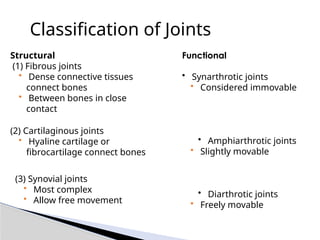
Classification of Joints
Structural
(1) Fibrous joints
• Dense connective tissues
connect bones
• Between bones in close
contact
(2) Cartilaginous joints
• Hyaline cartilage or
fibrocartilage connect bones
(3) Synovial joints
• Most complex
• Allow free movement
Functional
• Synarthrotic joints
• Considered immovable
• Amphiarthrotic joints
• Slightly movable
• Diarthrotic joints
• Freely movable
Fibrous Joints
• There are three (3) types of fibrous joints (synarthroses):
• Syndesmosis
• Suture
• Gomphosis
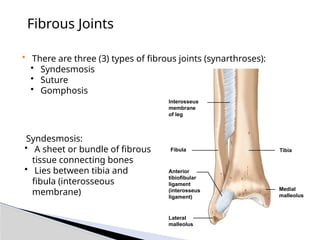
• Syndesmosis:
• A sheet or bundle of fibrous
tissue connecting bones
• Lies between tibia and
fibula (interosseous
membrane)
Fibula
Interosseus
membrane
of leg
Tibia
Medial
malleolus
Anterior
tibiofibular
ligament
(interosseus
ligament)
Lateral
malleolus
Fibrous Joints
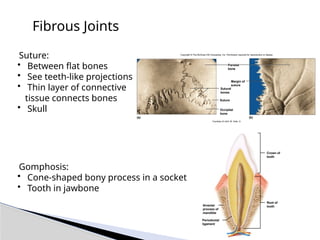
• Suture:
• Between flat bones
• See teeth-like projections
• Thin layer of connective
tissue connects bones
• Skull
• Gomphosis:
• Cone-shaped bony process in a socket
• Tooth in jawbone
Margin of
suture
Parietal
bone
Suture
Sutural
bones
Occipital
bone
(a) (b)
Copyright © The McGraw-Hill Companies, Inc. Permission required for reproduction or display.
Courtesy of John W. Hole, Jr.
Periodontal
ligament
Alveolar
process of
mandible
Root of
tooth
Crown of
tooth
Cartilaginous Joints
• There are two (2) types of cartilaginous joints (amphiarthroses):
• Synchondrosis
• Symphysis
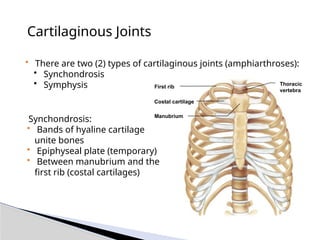
• Synchondrosis:
• Bands of hyaline cartilage
unite bones
• Epiphyseal plate (temporary)
• Between manubrium and the
first rib (costal cartilages)
Thoracic
vertebra
Costal cartilage
Manubrium
First rib
Cartilaginous Joints
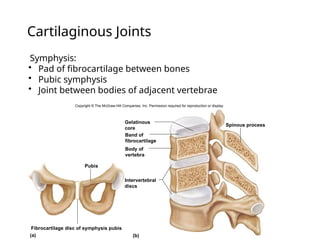
• Symphysis:
• Pad of fibrocartilage between bones
• Pubic symphysis
• Joint between bodies of adjacent vertebrae
Copyright © The McGraw-Hill Companies, Inc. Permission required for reproduction or display.
Gelatinous
core
Spinous process
Band of
fibrocartilage
Pubis
Fibrocartilage disc of symphysis pubis
Intervertebral
discs
(a) (b)
Body of
vertebra
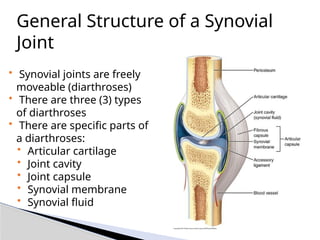
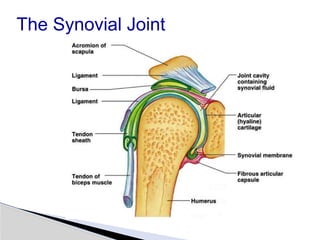
General Structure of a Synovial
Joint
• Synovial joints are freely
moveable (diarthroses)
• There are three (3) types
of diarthroses
• There are specific parts of
a diarthroses:
• Articular cartilage
• Joint cavity
• Joint capsule
• Synovial membrane
• Synovial fluid
Types of Joint Movements
• Movement at a joint occurs when a muscle
contracts and its fibers pull its moveable end
(insertion) towards its fixed end (origin).
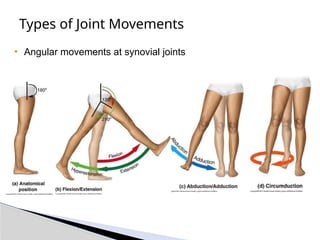
Types of Joint Movements
• Angular movements at synovial joints
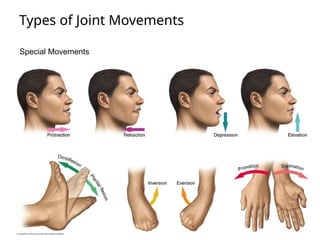
Types of Joint Movements
Special Movements
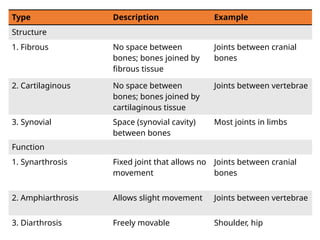
Type Description Example
Structure
1. Fibrous No space between
bones; bones joined by
fibrous tissue
Joints between cranial
bones
2. Cartilaginous No space between
bones; bones joined by
cartilaginous tissue
Joints between vertebrae
3. Synovial Space (synovial cavity)
between bones
Most joints in limbs
Function
1. Synarthrosis Fixed joint that allows no
movement
Joints between cranial
bones
2. Amphiarthrosis Allows slight movement Joints between vertebrae
3. Diarthrosis Freely movable Shoulder, hip
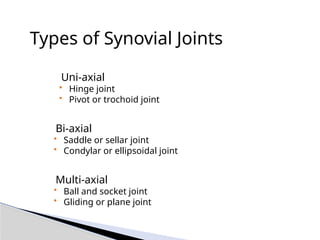
Types of Synovial Joints
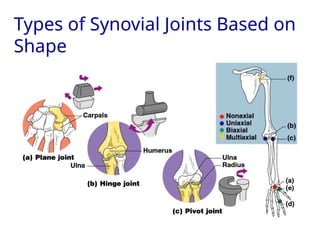
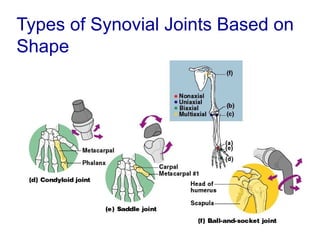
• Uni-axial
• Hinge joint
• Pivot or trochoid joint
• Bi-axial
• Saddle or sellar joint
• Condylar or ellipsoidal joint
• Multi-axial
• Ball and socket joint
• Gliding or plane joint
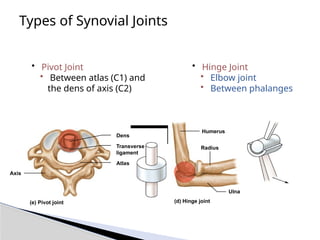
Types of Synovial Joints
• Pivot Joint
• Between atlas (C1) and
the dens of axis (C2)
• Hinge Joint
• Elbow joint
• Between phalanges
(e) Pivot joint
Dens
Transverse
ligament
Atlas
Axis
(d) Hinge joint
Humerus
Ulna
Radius
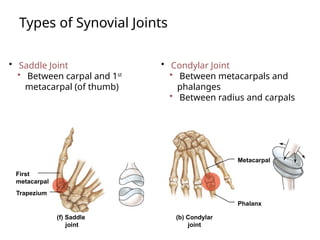
Types of Synovial Joints
• Saddle Joint
• Between carpal and 1st
metacarpal (of thumb)
• Condylar Joint
• Between metacarpals and
phalanges
• Between radius and carpals
Metacarpal
Phalanx
(b) Condylar
joint
(f) Saddle
joint
First
metacarpal
Trapezium
Types of Synovial Joints
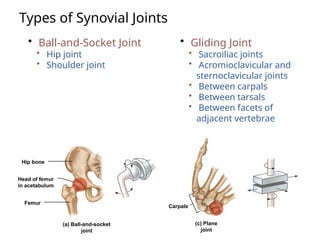
• Ball-and-Socket Joint
• Hip joint
• Shoulder joint
• Gliding Joint
• Sacroiliac joints
• Acromioclavicular and
sternoclavicular joints
• Between carpals
• Between tarsals
• Between facets of
adjacent vertebrae
Hip bone
(a) Ball-and-socket
joint
Head of femur
in acetabulum
Femur
(c) Plane
joint
Carpals
Types of Synovial Joints Based on
Shape
Types of Synovial Joints Based on
Shape
Examples of Synovial Joints
• The shoulder, elbow, hip, and knee are large, freely
moveable joints.
 Augment the mechanical stability of joints
 Guide joint motion
 Prevent excessive motion
Ligaments
 Attach muscle to bone
 Transmit tensile loads from muscle to bone
 Position of muscle relative to joint
Tendons
 Dense connective tissue (parallel-fibers of
collagen)
- Sparsely vascularized
 Cellular (fibroblasts) – 20 %
 Extracellular (80%)
- 70% H2O
- 30% solids –collagen, ground substance,
elastin
Composition
 Collagen
- ligaments - 75% of solids
- tendons – 75%+ of solids
Composition
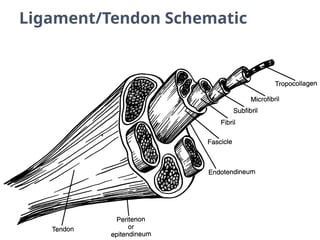
Ligament/Tendon Schematic
 sustain high tensile forces
 flexible to allow changes in direction of muscle pull
Tendon - Structure and Function
 pliant and flexible
 strong and inextensible/inelastic
Ligament - Structure and Function
 Rate of impact
 Amount of load
Injury is affected by:
The Synovial Joint
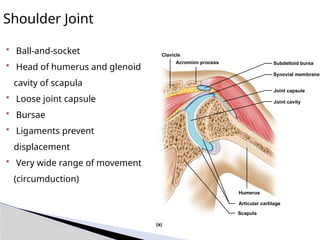
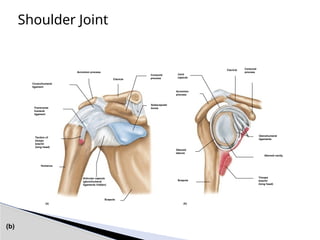
Shoulder Joint
• Ball-and-socket
• Head of humerus and glenoid
cavity of scapula
• Loose joint capsule
• Bursae
• Ligaments prevent
displacement
• Very wide range of movement
(circumduction)
Humerus
Articular cartilage
Scapula
Clavicle
Acromion process Subdeltoid bursa
Synovial membrane
Joint capsule
Joint cavity
(a)
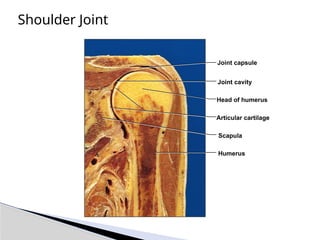
Shoulder Joint
Head of humerus
Joint cavity
Joint capsule
Articular cartilage
Scapula
Humerus
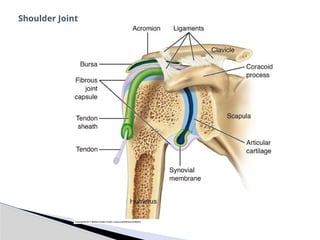
Shoulder Joint
Shoulder Joint
(b)
Coracohumeral
ligament
Transverse
humeral
ligament
Tendon of
biceps
brachii
(long head)
Acromion process
Clavicle
Coracoid
process
Acromion
process
Subscapular
bursa
Joint
capsule
Coracoid
process
Clavicle
Glenohumeral
ligaments
Glenoid cavity
Triceps
brachii
(long head)
Glenoid
labrum
Scapula
Humerus
Scapula
Articular capsule
(glenohumeral
ligaments hidden)
(a) (b)
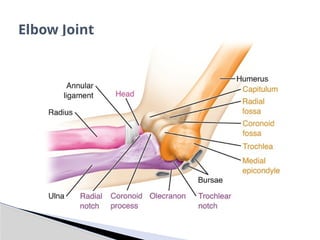
Elbow Joint
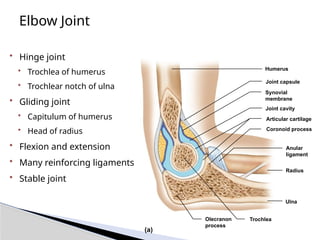
Elbow Joint
• Hinge joint
• Trochlea of humerus
• Trochlear notch of ulna
• Gliding joint
• Capitulum of humerus
• Head of radius
• Flexion and extension
• Many reinforcing ligaments
• Stable joint
Humerus
Joint capsule
Synovial
membrane
Joint cavity
Articular cartilage
Coronoid process
Anular
ligament
Radius
Ulna
Olecranon
process
Trochlea
(a)
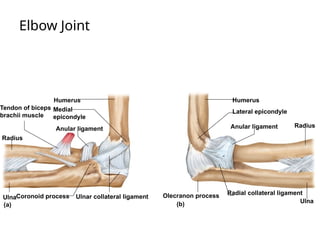
Elbow Joint
Radius
Ulna
Radius
Tendon of biceps
brachii muscle
Anular ligament
Humerus
Medial
epicondyle
Ulnar collateral ligament
Coronoid process
Ulna
Humerus
Lateral epicondyle
Anular ligament
Olecranon process Radial collateral ligament
(b)
(a)
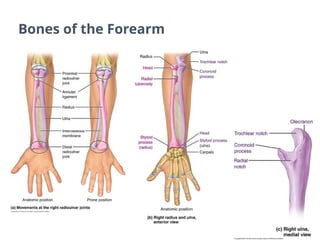
Bones of the Forearm
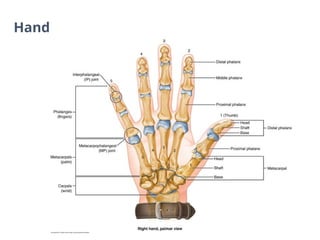
Hand
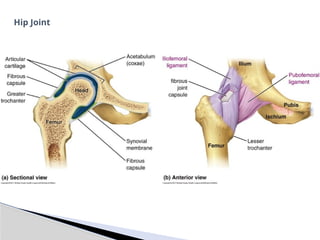
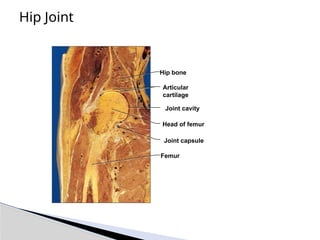
Hip Joint
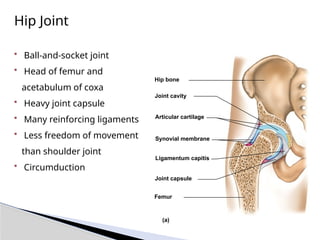
Hip Joint
• Ball-and-socket joint
• Head of femur and
acetabulum of coxa
• Heavy joint capsule
• Many reinforcing ligaments
• Less freedom of movement
than shoulder joint
• Circumduction
Hip bone
Joint cavity
Articular cartilage
Synovial membrane
Joint capsule
Ligamentum capitis
Femur
(a)
Hip Joint
Joint cavity
Articular
cartilage
Hip bone
Head of femur
Joint capsule
Femur
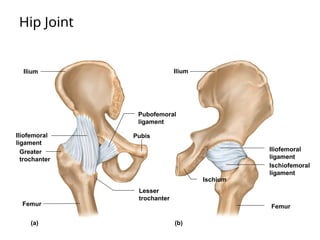
Hip Joint
Ilium
Iliofemoral
ligament
Greater
trochanter
Femur
Lesser
trochanter
Pubis
Pubofemoral
ligament
Ischium
Iliofemoral
ligament
Femur
Ilium
(a) (b)
Ischiofemoral
ligament
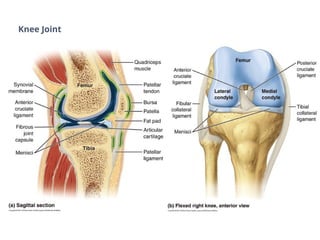
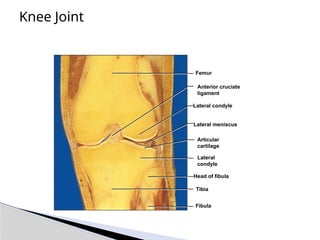
Knee Joint
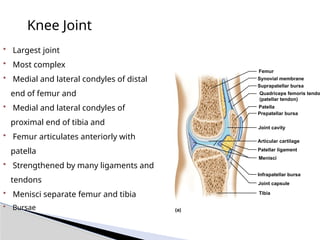
Knee Joint
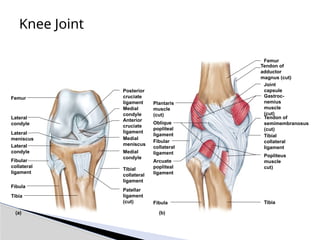
• Largest joint
• Most complex
• Medial and lateral condyles of distal
end of femur and
• Medial and lateral condyles of
proximal end of tibia and
• Femur articulates anteriorly with
patella
• Strengthened by many ligaments and
tendons
• Menisci separate femur and tibia
• Bursae
Femur
Quadriceps femoris tendo
(patellar tendon)
Synovial membrane
Suprapatellar bursa
Patella
Prepatellar bursa
Joint cavity
Articular cartilage
Menisci
Patellar ligament
Infrapatellar bursa
Joint capsule
Tibia
(a)
Knee Joint
Lateral meniscus
Anterior cruciate
ligament
Femur
Lateral condyle
Articular
cartilage
Lateral
condyle
Head of fibula
Tibia
Fibula
Knee Joint
Tendon of
semimembranosus
(cut)
Tendon of
adductor
magnus (cut)
Gastroc-
nemius
muscle
(cut)
Popliteus
muscle
cut)
Oblique
popliteal
ligament
Arcuate
popliteal
ligament
Fibula Tibia
Femur
Joint
capsule
Fibular
collateral
ligament
Plantaris
muscle
(cut)
Tibial
collateral
ligament
(a) (b)
Femur
Lateral
condyle
Lateral
meniscus
Lateral
condyle
Fibular
collateral
ligament
Fibula
Tibia
Medial
condyle
Anterior
cruciate
ligament
Medial
meniscus
Medial
condyle
Tibial
collateral
ligament
Patellar
ligament
(cut)
Posterior
cruciate
ligament
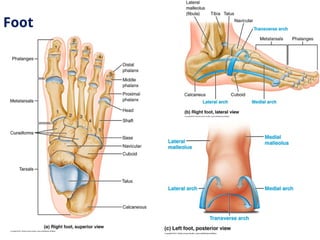
Foot
Lifespan Changes
• Joint stiffness is an early sign of aging
• Fibrous joints first to change; can strengthen however over a
lifetime
• Changes in symphysis joints of vertebral column diminish
flexibility and decrease height (remember water loss from the
IVDs)
• Synovial joints lose elasticity
• Disuse hampers the blood supply
• Activity and exercise can keep joints functional longer
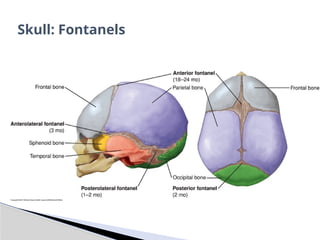
Skull: Fontanels
Inflammatory Conditions
Associated with Joints
· Bursitis – inflammation of a bursa usually
caused by a blow or friction
· Tendonitis – inflammation of tendon sheaths
· Arthritis – inflammatory or degenerative
diseases of joints
· Over 100 different types
· The most widespread crippling disease in the
United States
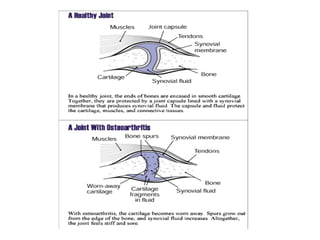
Clinical Forms of Arthritis
· Osteoarthritis
· Most common chronic arthritis
· Probably related to normal aging processes
· Rheumatoid arthritis
· An autoimmune disease – the immune system
attacks the joints
· Symptoms begin with bilateral inflammation of
certain joints
· Often leads to deformities
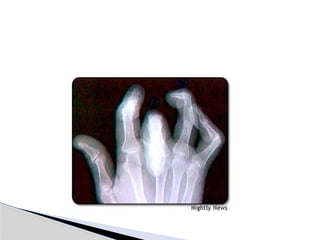
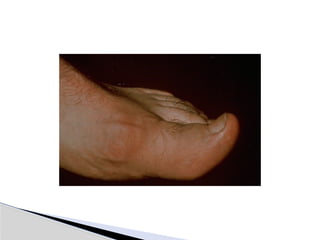
Clinical Forms of Arthritis
· Gouty Arthritis
·Inflammation of joints is caused by a
deposition of urate crystals from the blood
·Can usually be controlled with diet
 McConnell, T. H. & Hull, K. L. (2011). Human form and function:
Essentials of anatomy& physiology. Philadelphia: Wolters
Kluwer, Lippincott Williams & Wilkins.
 Shier, D., Lewis, R. & Butler, J. (2002). Hole’s human anatomy &
physiology. New York: McGraw Hill.
 Tortora, Gerard J. & Derrickson, Bryan H. (2011). Principles of
anatomy and physiology. Somerset, New Jersey: John Wiley &
Sons.
Recommended Reading

NURS1108_Lecture_6_-_jhkArticular[1].pptx

  • 1.
  • 2.
  • 3.
    1. Discuss theclassification, types, location, structure and functions, the blood and nervous supply of bones, joints, cartilages and muscles; 2. Locate the major cartilages of the adult skeleton. 3. Discuss the functional properties of the types of cartilages. 4. Describe the location, structure and function of skeletal, smooth and cardiac muscles; Objectives
  • 4.
    Joint • Are knownas articulations • Functional junctions between bones • Bind parts of skeletal system together • Make bone growth possible • Permit parts of the skeleton to change shape during childbirth • Enable body to move in response to skeletal muscle contraction • Three (3) classifications of joints will be considered
  • 5.
    Classification of Joints Structural (1)Fibrous joints • Dense connective tissues connect bones • Between bones in close contact (2) Cartilaginous joints • Hyaline cartilage or fibrocartilage connect bones (3) Synovial joints • Most complex • Allow free movement Functional • Synarthrotic joints • Considered immovable • Amphiarthrotic joints • Slightly movable • Diarthrotic joints • Freely movable
  • 6.
    Fibrous Joints • Thereare three (3) types of fibrous joints (synarthroses): • Syndesmosis • Suture • Gomphosis • Syndesmosis: • A sheet or bundle of fibrous tissue connecting bones • Lies between tibia and fibula (interosseous membrane) Fibula Interosseus membrane of leg Tibia Medial malleolus Anterior tibiofibular ligament (interosseus ligament) Lateral malleolus
  • 7.
    Fibrous Joints • Suture: •Between flat bones • See teeth-like projections • Thin layer of connective tissue connects bones • Skull • Gomphosis: • Cone-shaped bony process in a socket • Tooth in jawbone Margin of suture Parietal bone Suture Sutural bones Occipital bone (a) (b) Copyright © The McGraw-Hill Companies, Inc. Permission required for reproduction or display. Courtesy of John W. Hole, Jr. Periodontal ligament Alveolar process of mandible Root of tooth Crown of tooth
  • 8.
    Cartilaginous Joints • Thereare two (2) types of cartilaginous joints (amphiarthroses): • Synchondrosis • Symphysis • Synchondrosis: • Bands of hyaline cartilage unite bones • Epiphyseal plate (temporary) • Between manubrium and the first rib (costal cartilages) Thoracic vertebra Costal cartilage Manubrium First rib
  • 9.
    Cartilaginous Joints • Symphysis: •Pad of fibrocartilage between bones • Pubic symphysis • Joint between bodies of adjacent vertebrae Copyright © The McGraw-Hill Companies, Inc. Permission required for reproduction or display. Gelatinous core Spinous process Band of fibrocartilage Pubis Fibrocartilage disc of symphysis pubis Intervertebral discs (a) (b) Body of vertebra
  • 10.
    General Structure ofa Synovial Joint • Synovial joints are freely moveable (diarthroses) • There are three (3) types of diarthroses • There are specific parts of a diarthroses: • Articular cartilage • Joint cavity • Joint capsule • Synovial membrane • Synovial fluid
  • 11.
    Types of JointMovements • Movement at a joint occurs when a muscle contracts and its fibers pull its moveable end (insertion) towards its fixed end (origin).
  • 12.
    Types of JointMovements • Angular movements at synovial joints
  • 13.
    Types of JointMovements Special Movements
  • 14.
    Type Description Example Structure 1.Fibrous No space between bones; bones joined by fibrous tissue Joints between cranial bones 2. Cartilaginous No space between bones; bones joined by cartilaginous tissue Joints between vertebrae 3. Synovial Space (synovial cavity) between bones Most joints in limbs Function 1. Synarthrosis Fixed joint that allows no movement Joints between cranial bones 2. Amphiarthrosis Allows slight movement Joints between vertebrae 3. Diarthrosis Freely movable Shoulder, hip
  • 15.
    Types of SynovialJoints • Uni-axial • Hinge joint • Pivot or trochoid joint • Bi-axial • Saddle or sellar joint • Condylar or ellipsoidal joint • Multi-axial • Ball and socket joint • Gliding or plane joint
  • 16.
    Types of SynovialJoints • Pivot Joint • Between atlas (C1) and the dens of axis (C2) • Hinge Joint • Elbow joint • Between phalanges (e) Pivot joint Dens Transverse ligament Atlas Axis (d) Hinge joint Humerus Ulna Radius
  • 17.
    Types of SynovialJoints • Saddle Joint • Between carpal and 1st metacarpal (of thumb) • Condylar Joint • Between metacarpals and phalanges • Between radius and carpals Metacarpal Phalanx (b) Condylar joint (f) Saddle joint First metacarpal Trapezium
  • 18.
    Types of SynovialJoints • Ball-and-Socket Joint • Hip joint • Shoulder joint • Gliding Joint • Sacroiliac joints • Acromioclavicular and sternoclavicular joints • Between carpals • Between tarsals • Between facets of adjacent vertebrae Hip bone (a) Ball-and-socket joint Head of femur in acetabulum Femur (c) Plane joint Carpals
  • 19.
    Types of SynovialJoints Based on Shape
  • 20.
    Types of SynovialJoints Based on Shape
  • 21.
    Examples of SynovialJoints • The shoulder, elbow, hip, and knee are large, freely moveable joints.
  • 22.
     Augment themechanical stability of joints  Guide joint motion  Prevent excessive motion Ligaments
  • 23.
     Attach muscleto bone  Transmit tensile loads from muscle to bone  Position of muscle relative to joint Tendons
  • 24.
     Dense connectivetissue (parallel-fibers of collagen) - Sparsely vascularized  Cellular (fibroblasts) – 20 %  Extracellular (80%) - 70% H2O - 30% solids –collagen, ground substance, elastin Composition
  • 25.
     Collagen - ligaments- 75% of solids - tendons – 75%+ of solids Composition
  • 26.
  • 27.
     sustain hightensile forces  flexible to allow changes in direction of muscle pull Tendon - Structure and Function
  • 28.
     pliant andflexible  strong and inextensible/inelastic Ligament - Structure and Function
  • 29.
     Rate ofimpact  Amount of load Injury is affected by:
  • 30.
  • 31.
    Shoulder Joint • Ball-and-socket •Head of humerus and glenoid cavity of scapula • Loose joint capsule • Bursae • Ligaments prevent displacement • Very wide range of movement (circumduction) Humerus Articular cartilage Scapula Clavicle Acromion process Subdeltoid bursa Synovial membrane Joint capsule Joint cavity (a)
  • 32.
    Shoulder Joint Head ofhumerus Joint cavity Joint capsule Articular cartilage Scapula Humerus
  • 33.
  • 34.
    Shoulder Joint (b) Coracohumeral ligament Transverse humeral ligament Tendon of biceps brachii (longhead) Acromion process Clavicle Coracoid process Acromion process Subscapular bursa Joint capsule Coracoid process Clavicle Glenohumeral ligaments Glenoid cavity Triceps brachii (long head) Glenoid labrum Scapula Humerus Scapula Articular capsule (glenohumeral ligaments hidden) (a) (b)
  • 35.
  • 36.
    Elbow Joint • Hingejoint • Trochlea of humerus • Trochlear notch of ulna • Gliding joint • Capitulum of humerus • Head of radius • Flexion and extension • Many reinforcing ligaments • Stable joint Humerus Joint capsule Synovial membrane Joint cavity Articular cartilage Coronoid process Anular ligament Radius Ulna Olecranon process Trochlea (a)
  • 37.
    Elbow Joint Radius Ulna Radius Tendon ofbiceps brachii muscle Anular ligament Humerus Medial epicondyle Ulnar collateral ligament Coronoid process Ulna Humerus Lateral epicondyle Anular ligament Olecranon process Radial collateral ligament (b) (a)
  • 38.
    Bones of theForearm
  • 39.
  • 40.
  • 41.
    Hip Joint • Ball-and-socketjoint • Head of femur and acetabulum of coxa • Heavy joint capsule • Many reinforcing ligaments • Less freedom of movement than shoulder joint • Circumduction Hip bone Joint cavity Articular cartilage Synovial membrane Joint capsule Ligamentum capitis Femur (a)
  • 42.
    Hip Joint Joint cavity Articular cartilage Hipbone Head of femur Joint capsule Femur
  • 43.
  • 44.
  • 45.
    Knee Joint • Largestjoint • Most complex • Medial and lateral condyles of distal end of femur and • Medial and lateral condyles of proximal end of tibia and • Femur articulates anteriorly with patella • Strengthened by many ligaments and tendons • Menisci separate femur and tibia • Bursae Femur Quadriceps femoris tendo (patellar tendon) Synovial membrane Suprapatellar bursa Patella Prepatellar bursa Joint cavity Articular cartilage Menisci Patellar ligament Infrapatellar bursa Joint capsule Tibia (a)
  • 46.
    Knee Joint Lateral meniscus Anteriorcruciate ligament Femur Lateral condyle Articular cartilage Lateral condyle Head of fibula Tibia Fibula
  • 47.
    Knee Joint Tendon of semimembranosus (cut) Tendonof adductor magnus (cut) Gastroc- nemius muscle (cut) Popliteus muscle cut) Oblique popliteal ligament Arcuate popliteal ligament Fibula Tibia Femur Joint capsule Fibular collateral ligament Plantaris muscle (cut) Tibial collateral ligament (a) (b) Femur Lateral condyle Lateral meniscus Lateral condyle Fibular collateral ligament Fibula Tibia Medial condyle Anterior cruciate ligament Medial meniscus Medial condyle Tibial collateral ligament Patellar ligament (cut) Posterior cruciate ligament
  • 48.
  • 49.
    Lifespan Changes • Jointstiffness is an early sign of aging • Fibrous joints first to change; can strengthen however over a lifetime • Changes in symphysis joints of vertebral column diminish flexibility and decrease height (remember water loss from the IVDs) • Synovial joints lose elasticity • Disuse hampers the blood supply • Activity and exercise can keep joints functional longer
  • 50.
  • 51.
    Inflammatory Conditions Associated withJoints · Bursitis – inflammation of a bursa usually caused by a blow or friction · Tendonitis – inflammation of tendon sheaths · Arthritis – inflammatory or degenerative diseases of joints · Over 100 different types · The most widespread crippling disease in the United States
  • 52.
    Clinical Forms ofArthritis · Osteoarthritis · Most common chronic arthritis · Probably related to normal aging processes · Rheumatoid arthritis · An autoimmune disease – the immune system attacks the joints · Symptoms begin with bilateral inflammation of certain joints · Often leads to deformities
  • 55.
    Clinical Forms ofArthritis · Gouty Arthritis ·Inflammation of joints is caused by a deposition of urate crystals from the blood ·Can usually be controlled with diet
  • 57.
     McConnell, T.H. & Hull, K. L. (2011). Human form and function: Essentials of anatomy& physiology. Philadelphia: Wolters Kluwer, Lippincott Williams & Wilkins.  Shier, D., Lewis, R. & Butler, J. (2002). Hole’s human anatomy & physiology. New York: McGraw Hill.  Tortora, Gerard J. & Derrickson, Bryan H. (2011). Principles of anatomy and physiology. Somerset, New Jersey: John Wiley & Sons. Recommended Reading

Editor's Notes

  • #6 Also in Radius and ulnar
  • #7 Gomphosis – only found where the peridental ligament joins to the mandible or maxilla
  • #10 synovial membrane lines the interior of the joint capsule and secretes synovial fluid into the joint cavity. This fluid lubricates, cushions shocks, prevents abrasion, and supports the chondrocytes of the articular cartilages through nutrient distribution. Even in a large joint such as the knee, the total quantity of synovial fluid in a joint is normally less than 3 mL.
  • #33 The forearm consists of the radius and ulna. A. The radius and ulna are uncrossed in anatomical position, but cross over when the arm is pronated. B. Right radius and ulna, anterior view in the anatomical position. C. Right ulna, medial view. Question: Which bone has the coronoid process? Answer: Ulna
  • #35 Question: Which structure is continuous with the synovial membrane – the tendon sheath or the ligaments? Answer: Tendon sheath
  • #38 The right elbow is illustrated in the flexed position. Question: Name the ligament that wraps around the radius. Answer: Annular ligament
  • #39 Question: How many phalanges are found in the thumb? Answer: Two
  • #40 A. Sectional view B. Anterior view Question: What is the name of the socket into which the ball of the femoral head fits? Answer: Acetabulum
  • #44 A. Sagittal section. B. Flexed knee, anterior view. The patella and other anterior structures have been removed. Question: Which 2 ligaments are found within the synovial cavity? Answer: Anterior and posterior cruciate ligaments
  • #48 Click to add notes
  • #50 The infant skull at birth, showing the fontanels. The fontanels close at the age shown in the brackets. Question: Which fontanel closes last? Answer: Anterior fontanel