C programming codes


         Prof Makhan kumbhkar
         Christian Eminent
         College Indore(mp)
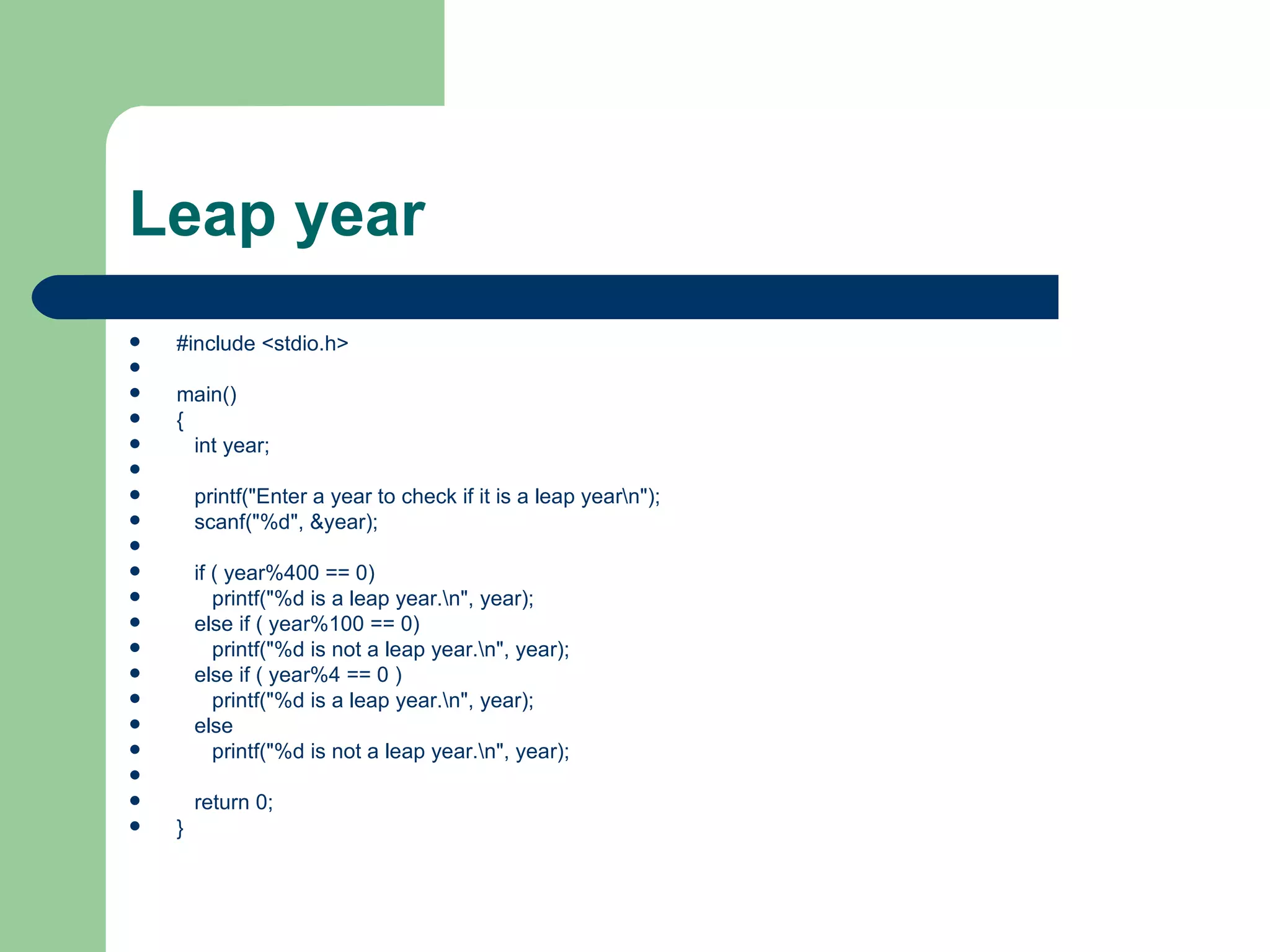
Leap year
   #include <stdio.h>

   main()
   {
     int year;

       printf("Enter a year to check if it is a leap yearn");
       scanf("%d", &year);

       if ( year%400 == 0)
          printf("%d is a leap year.n", year);
       else if ( year%100 == 0)
          printf("%d is not a leap year.n", year);
       else if ( year%4 == 0 )
          printf("%d is a leap year.n", year);
       else
          printf("%d is not a leap year.n", year);

       return 0;
   }
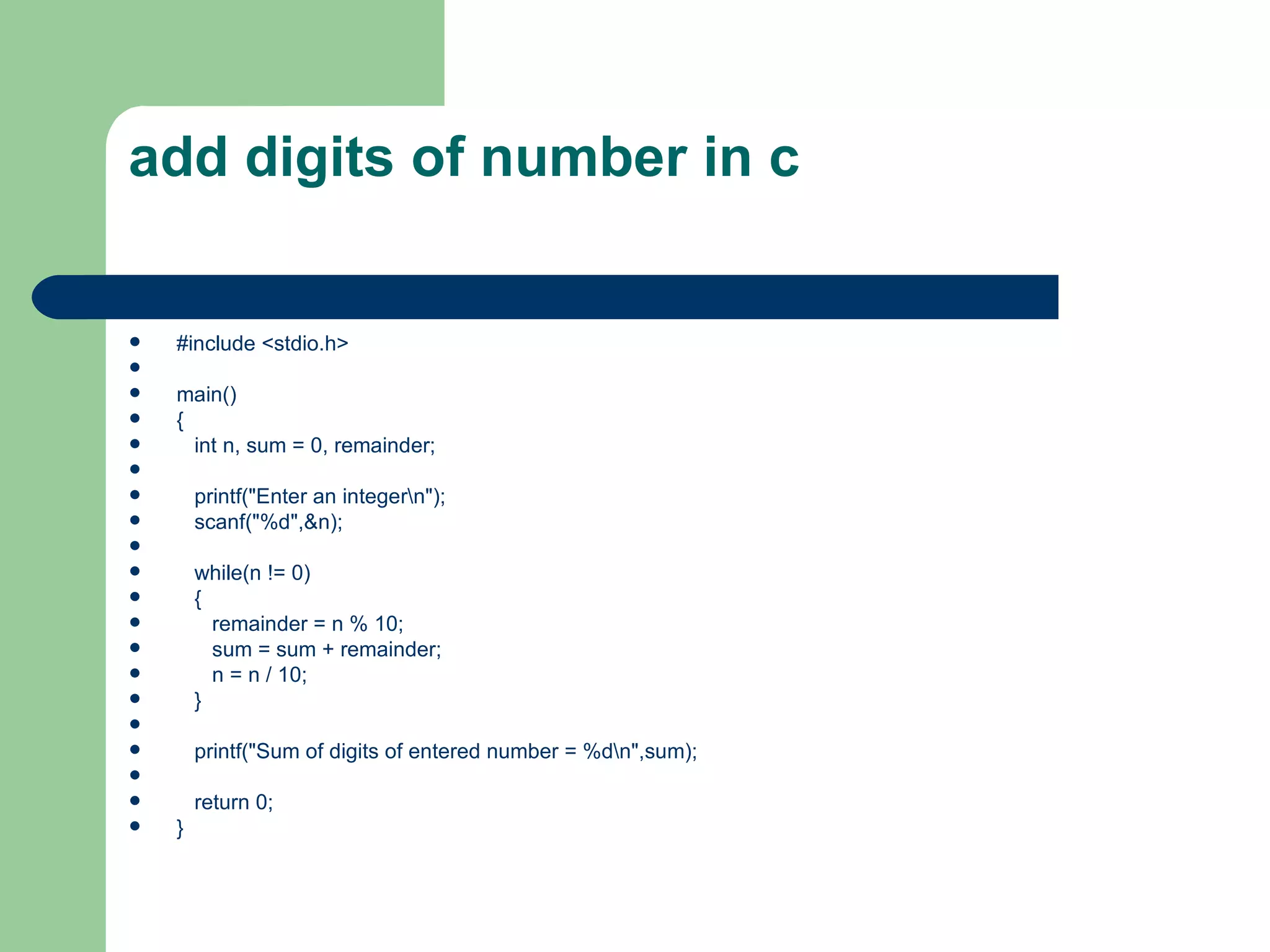
add digits of number in c


   #include <stdio.h>

   main()
   {
     int n, sum = 0, remainder;

       printf("Enter an integern");
       scanf("%d",&n);

       while(n != 0)
       {
         remainder = n % 10;
         sum = sum + remainder;
         n = n / 10;
       }

       printf("Sum of digits of entered number = %dn",sum);

       return 0;
   }
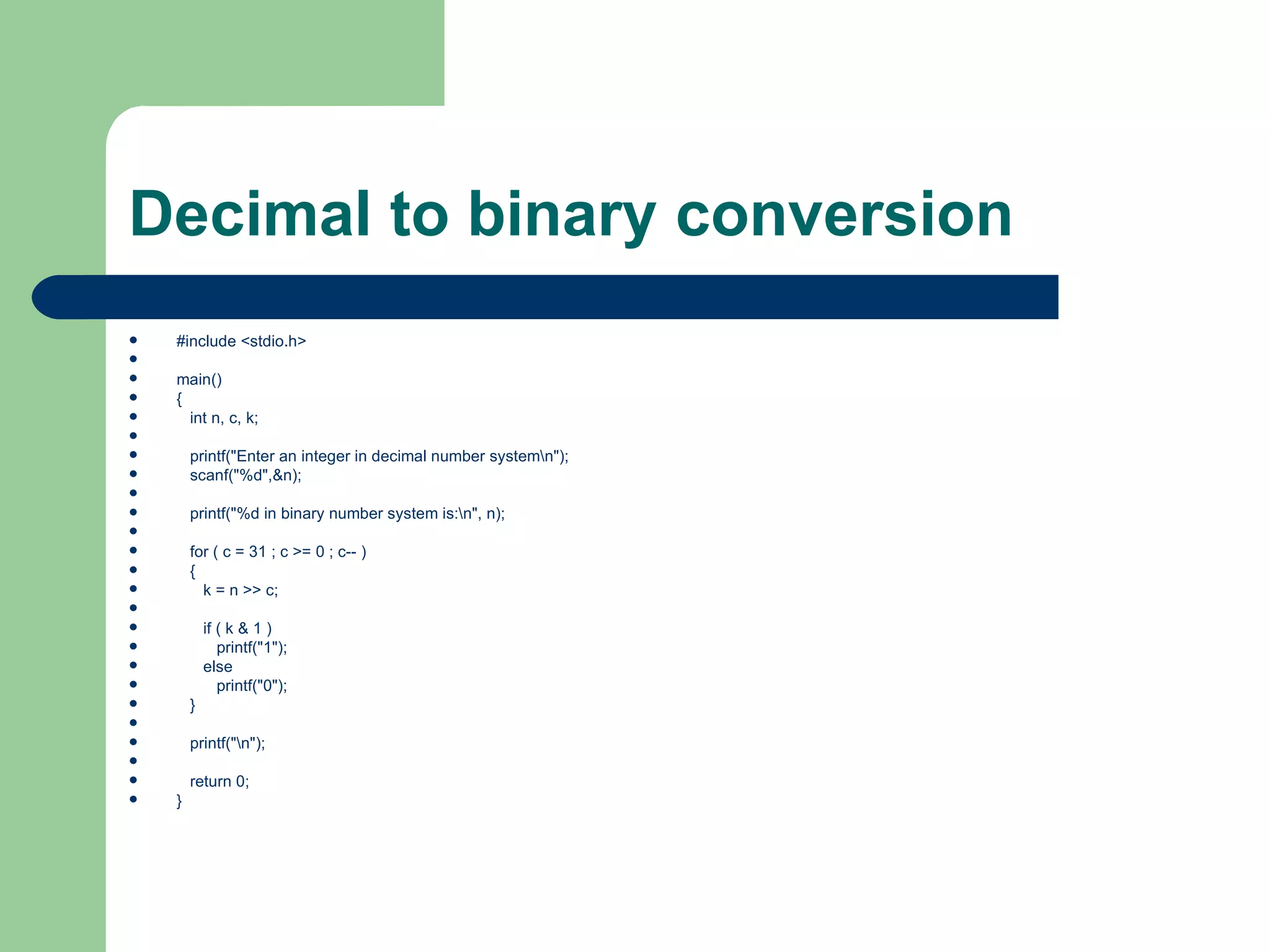
Decimal to binary conversion
   #include <stdio.h>

   main()
   {
     int n, c, k;

       printf("Enter an integer in decimal number systemn");
       scanf("%d",&n);

       printf("%d in binary number system is:n", n);

       for ( c = 31 ; c >= 0 ; c-- )
       {
         k = n >> c;

           if ( k & 1 )
              printf("1");
           else
              printf("0");
       }

       printf("n");

       return 0;
   }
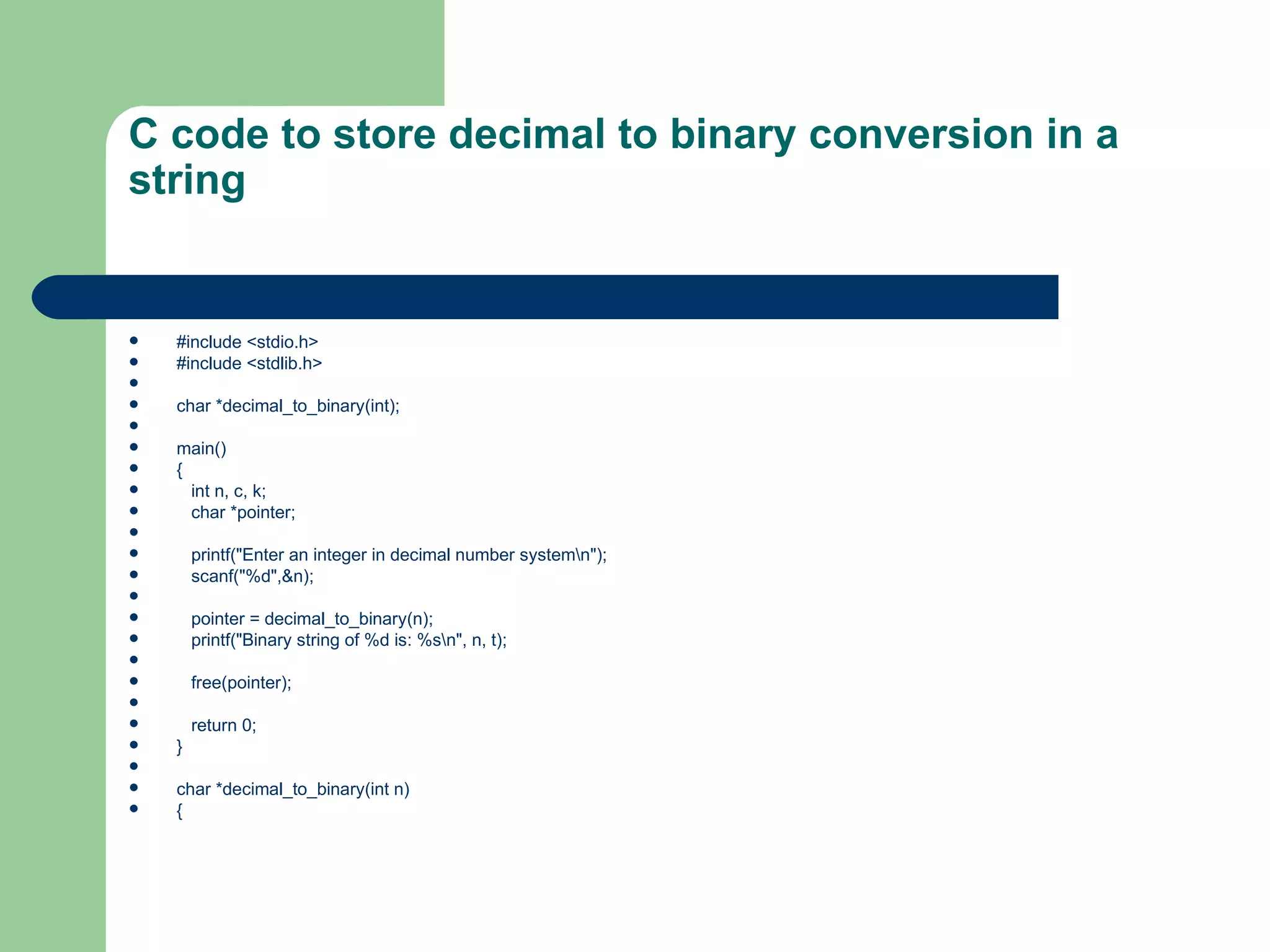
C code to store decimal to binary conversion in a
string


   #include <stdio.h>
   #include <stdlib.h>

   char *decimal_to_binary(int);

   main()
   {
     int n, c, k;
     char *pointer;

       printf("Enter an integer in decimal number systemn");
       scanf("%d",&n);

       pointer = decimal_to_binary(n);
       printf("Binary string of %d is: %sn", n, t);

       free(pointer);

       return 0;
   }

   char *decimal_to_binary(int n)
   {
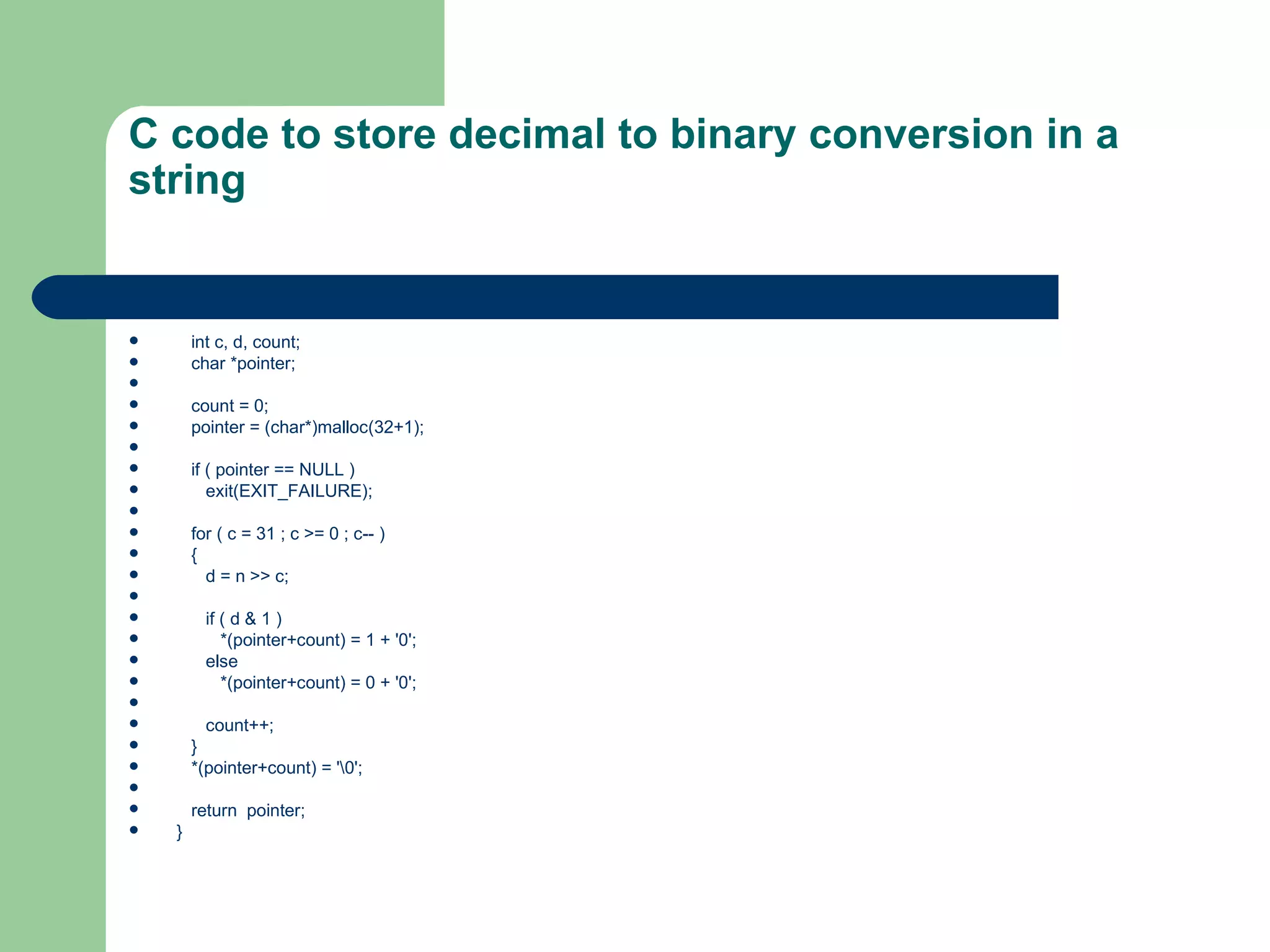
C code to store decimal to binary conversion in a
string


       int c, d, count;
       char *pointer;

       count = 0;
       pointer = (char*)malloc(32+1);

       if ( pointer == NULL )
          exit(EXIT_FAILURE);

       for ( c = 31 ; c >= 0 ; c-- )
       {
         d = n >> c;

         if ( d & 1 )
            *(pointer+count) = 1 + '0';
         else
            *(pointer+count) = 0 + '0';

         count++;
       }
       *(pointer+count) = '0';

       return pointer;
   }
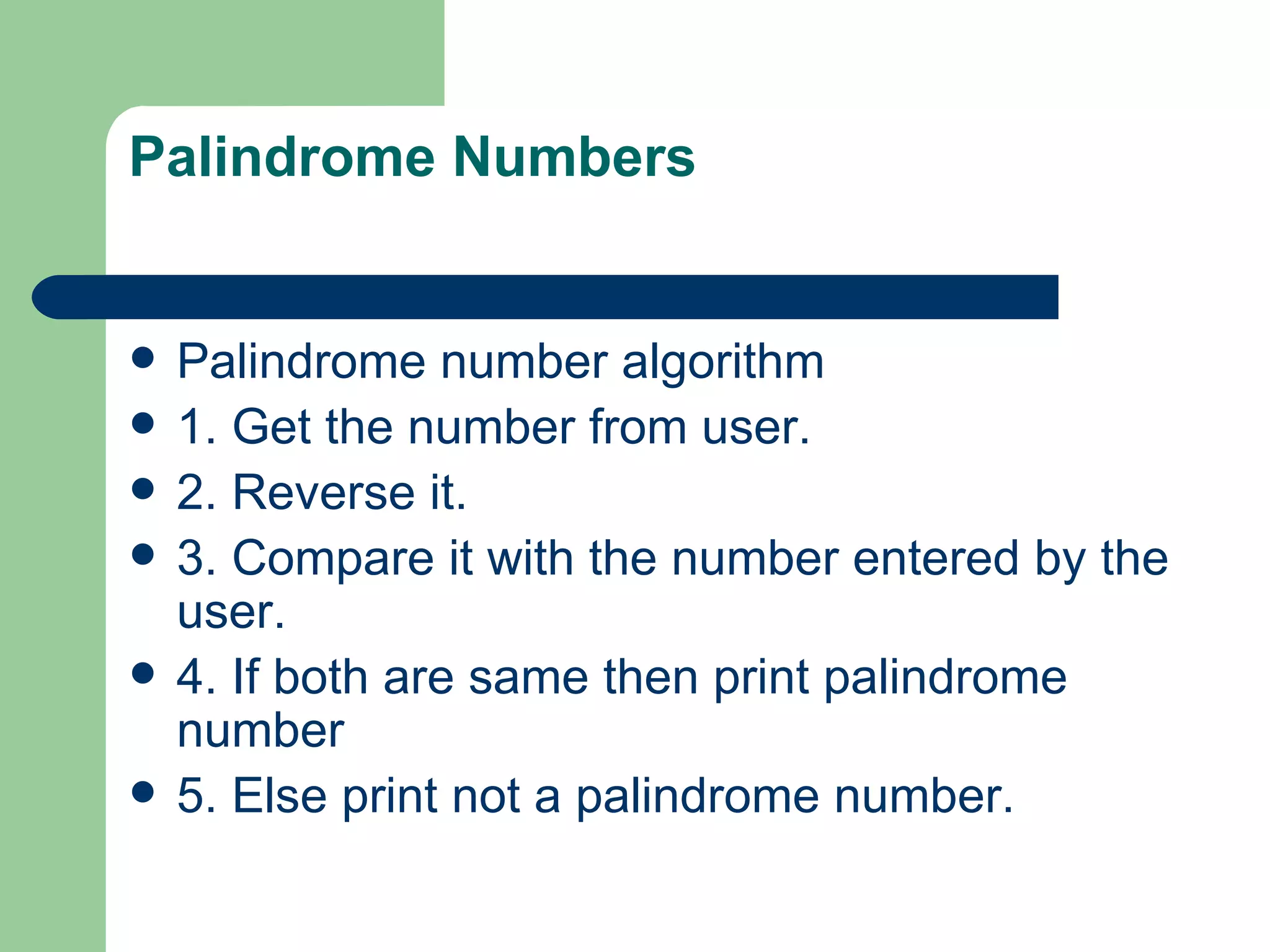
Palindrome Numbers


   Palindrome number algorithm
   1. Get the number from user.
   2. Reverse it.
   3. Compare it with the number entered by the
    user.
   4. If both are same then print palindrome
    number
   5. Else print not a palindrome number.
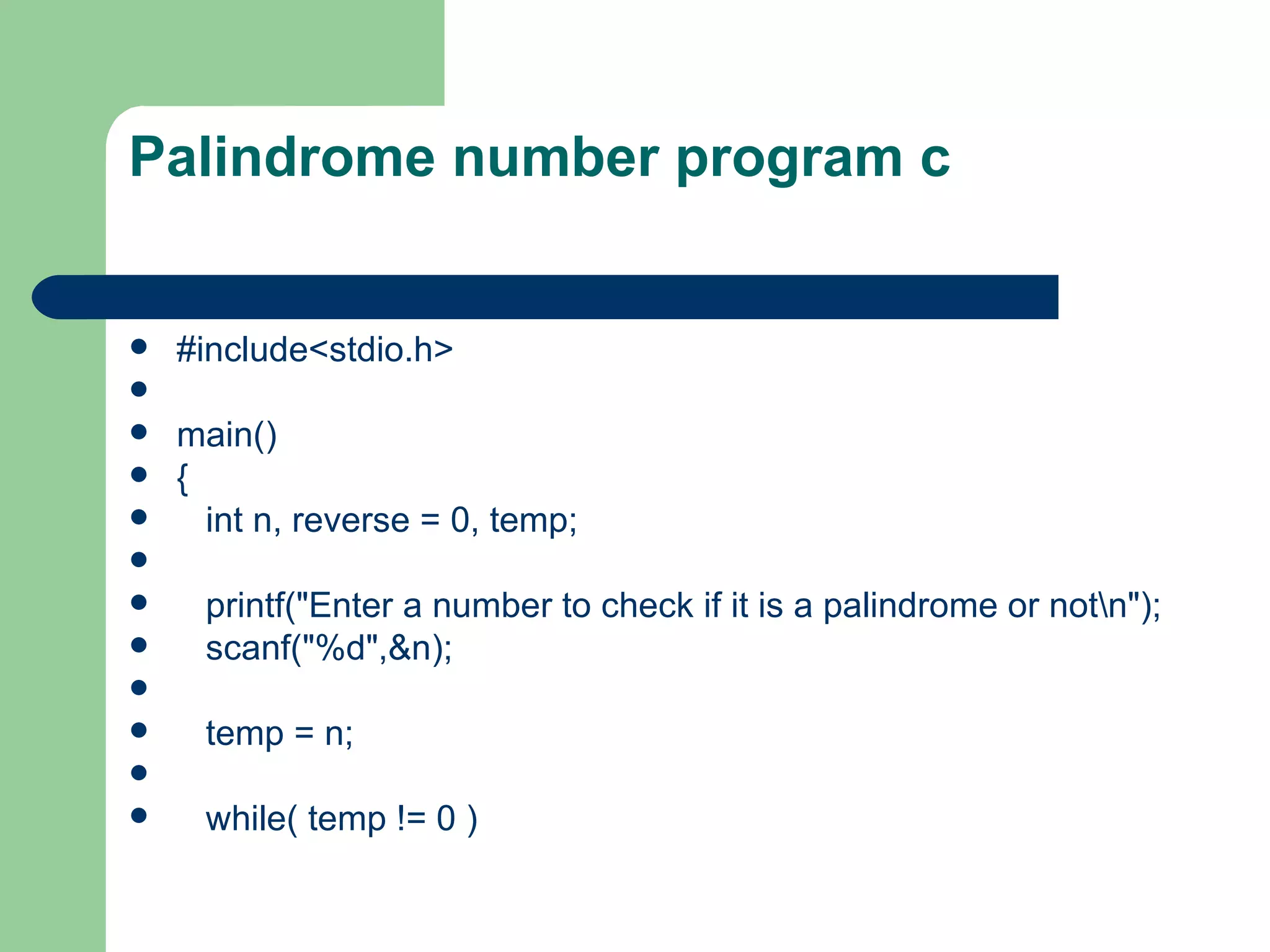
Palindrome number program c


   #include<stdio.h>

   main()
   {
     int n, reverse = 0, temp;

    printf("Enter a number to check if it is a palindrome or notn");
    scanf("%d",&n);

    temp = n;

    while( temp != 0 )
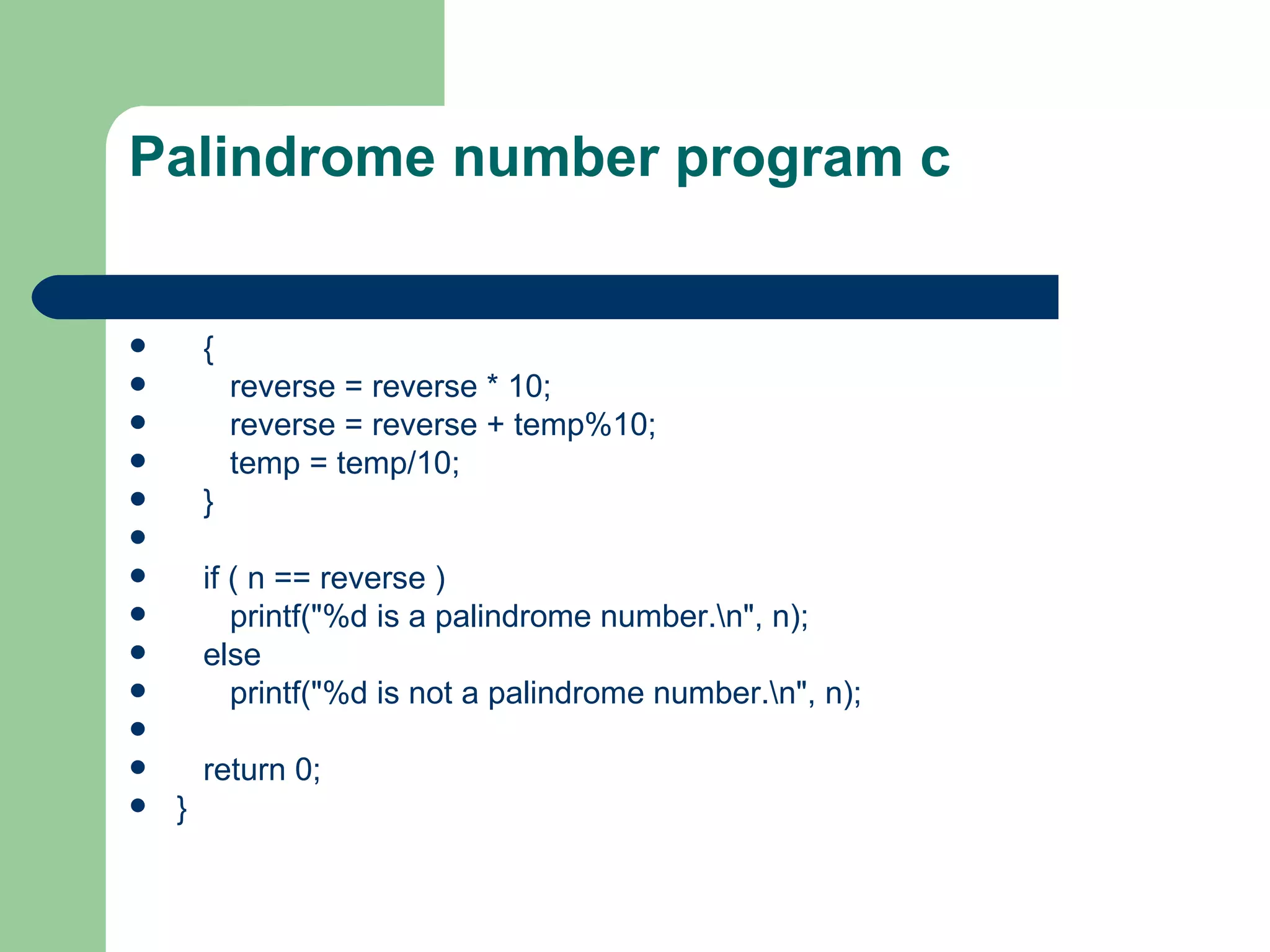
Palindrome number program c


       {
           reverse = reverse * 10;
           reverse = reverse + temp%10;
           temp = temp/10;
       }

       if ( n == reverse )
          printf("%d is a palindrome number.n", n);
       else
          printf("%d is not a palindrome number.n", n);

       return 0;
   }
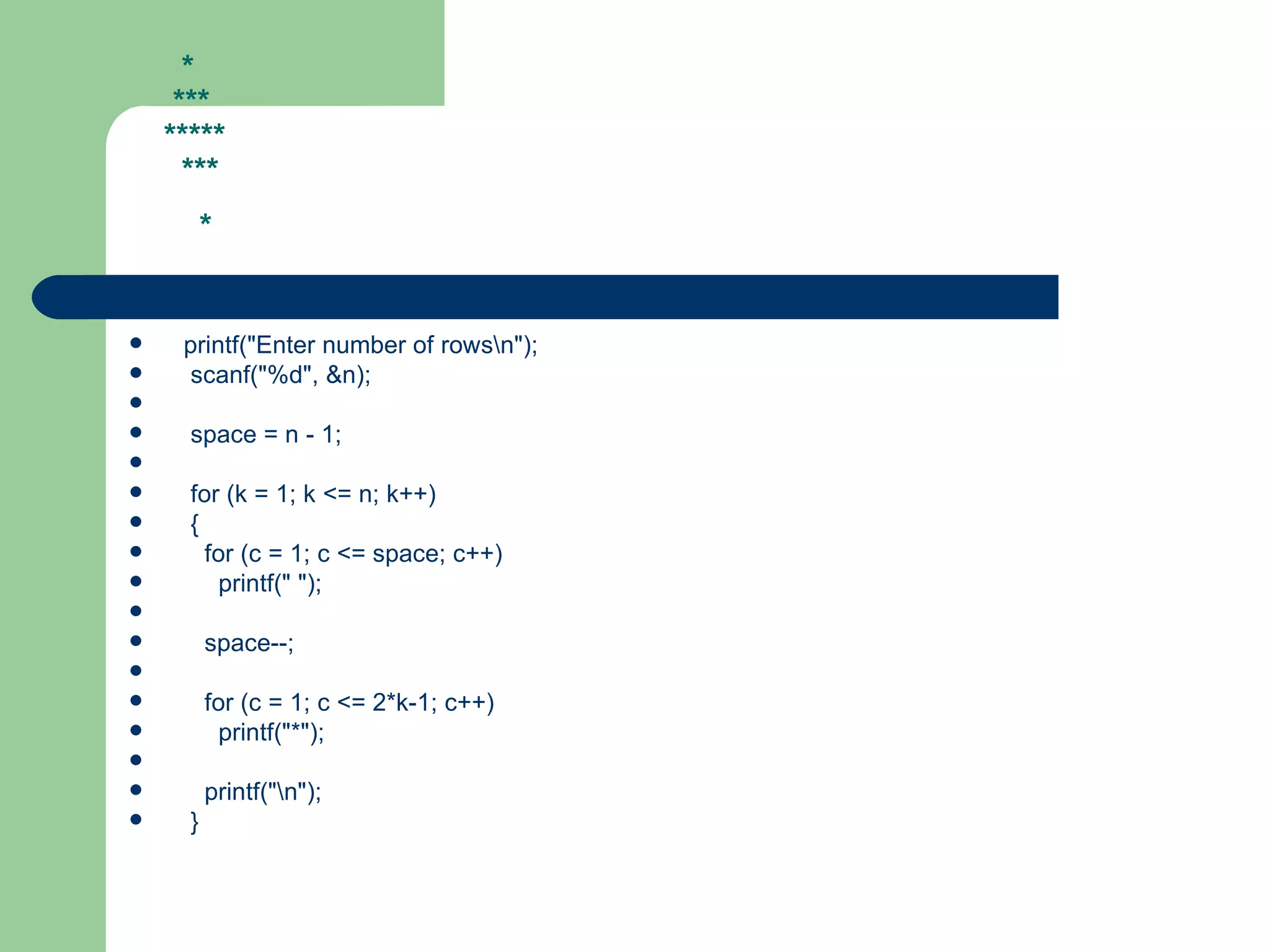
*
     ***
    *****
      ***
          *


    printf("Enter number of rowsn");
     scanf("%d", &n);

     space = n - 1;

     for (k = 1; k <= n; k++)
     {
       for (c = 1; c <= space; c++)
        printf(" ");

         space--;

         for (c = 1; c <= 2*k-1; c++)
          printf("*");

         printf("n");
     }
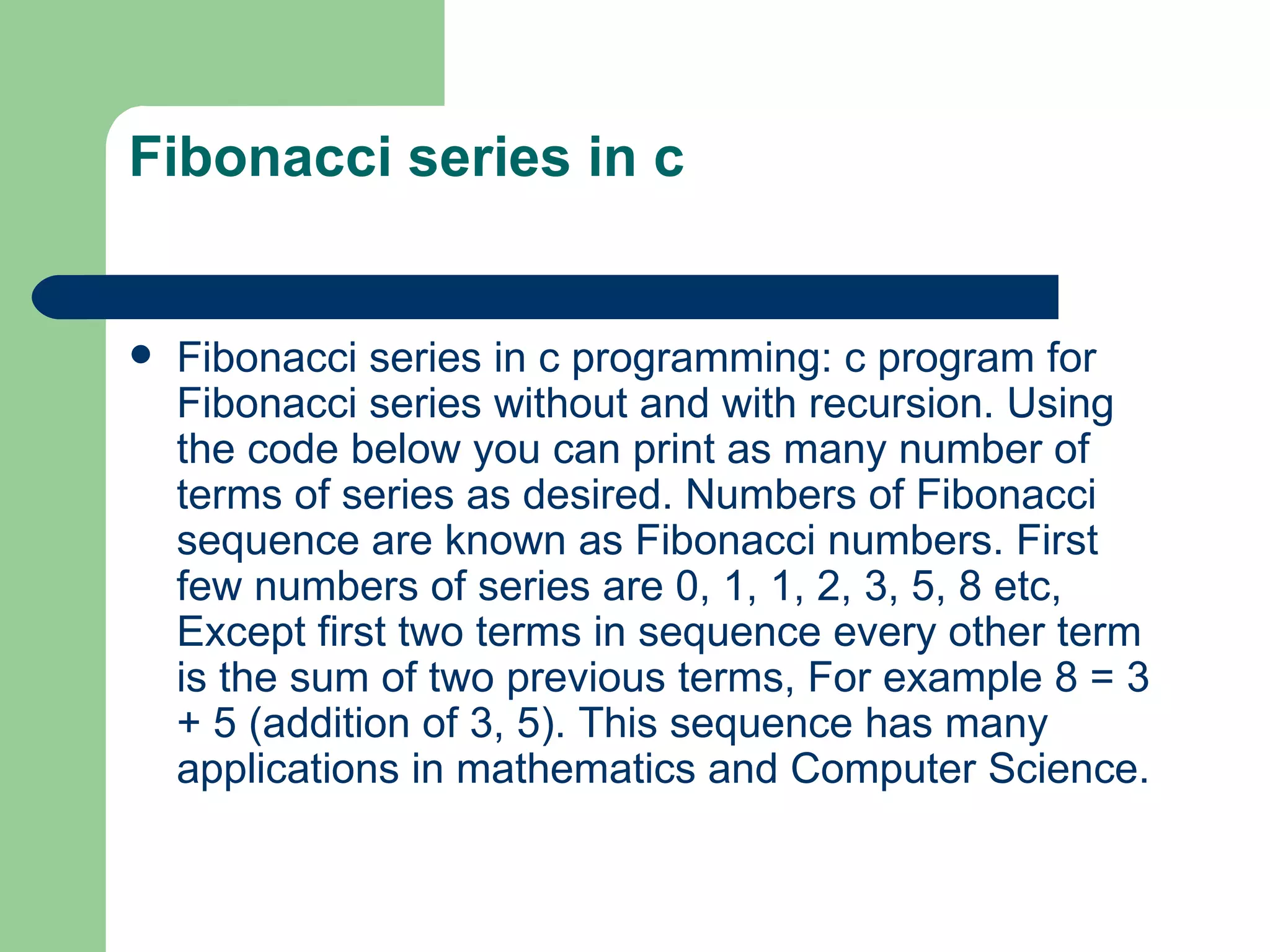
Fibonacci series in c


   Fibonacci series in c programming: c program for
    Fibonacci series without and with recursion. Using
    the code below you can print as many number of
    terms of series as desired. Numbers of Fibonacci
    sequence are known as Fibonacci numbers. First
    few numbers of series are 0, 1, 1, 2, 3, 5, 8 etc,
    Except first two terms in sequence every other term
    is the sum of two previous terms, For example 8 = 3
    + 5 (addition of 3, 5). This sequence has many
    applications in mathematics and Computer Science.
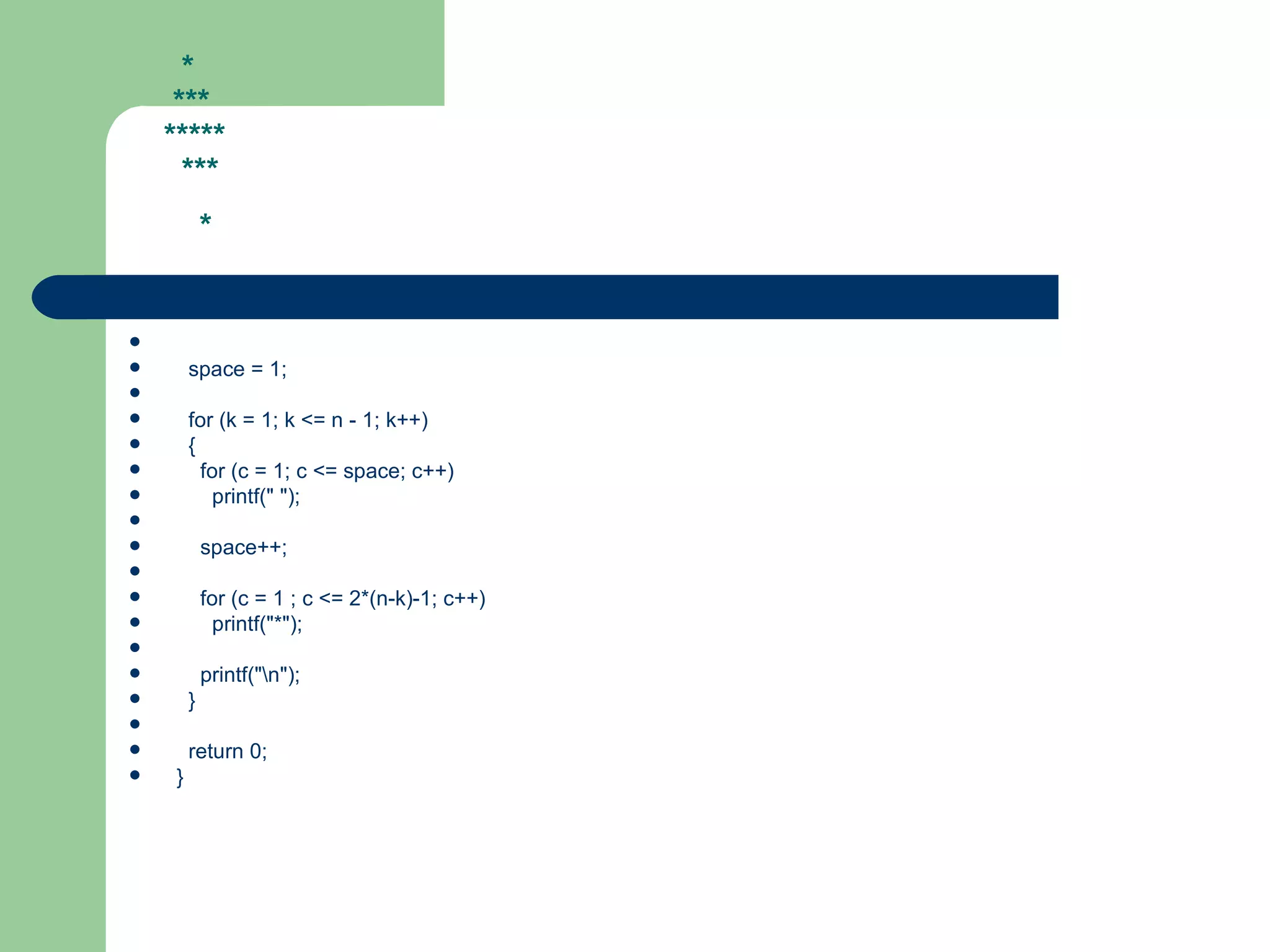
*
     ***
    *****
      ***
             *



        space = 1;

        for (k = 1; k <= n - 1; k++)
        {
          for (c = 1; c <= space; c++)
           printf(" ");

            space++;

            for (c = 1 ; c <= 2*(n-k)-1; c++)
             printf("*");

            printf("n");
        }

        return 0;
    }
Fibonacci series in c

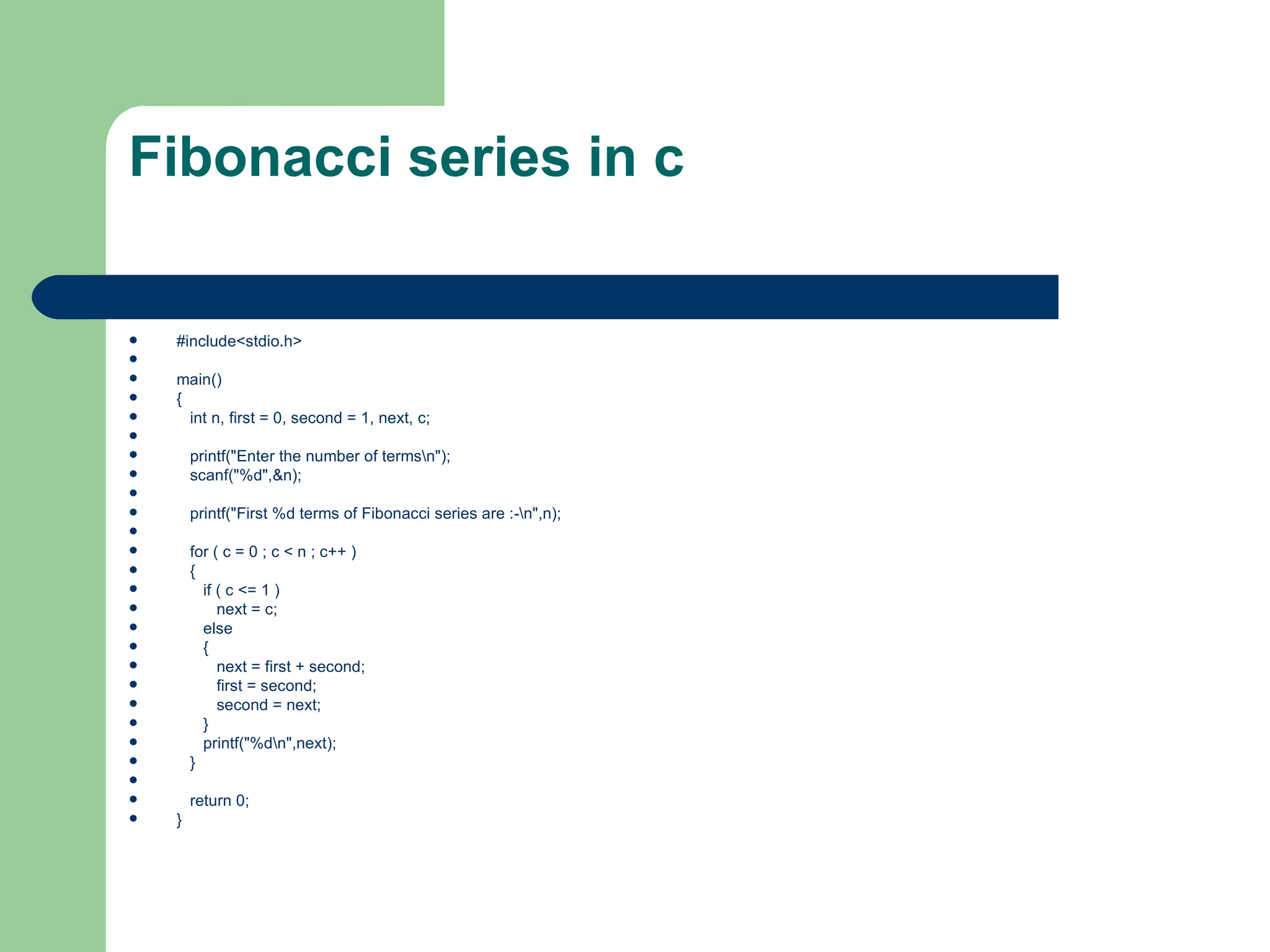
   #include<stdio.h>

   main()
   {
     int n, first = 0, second = 1, next, c;

       printf("Enter the number of termsn");
       scanf("%d",&n);

       printf("First %d terms of Fibonacci series are :-n",n);

       for ( c = 0 ; c < n ; c++ )
       {
         if ( c <= 1 )
            next = c;
         else
         {
            next = first + second;
            first = second;
            second = next;
         }
         printf("%dn",next);
       }

       return 0;
   }
Linear search in c


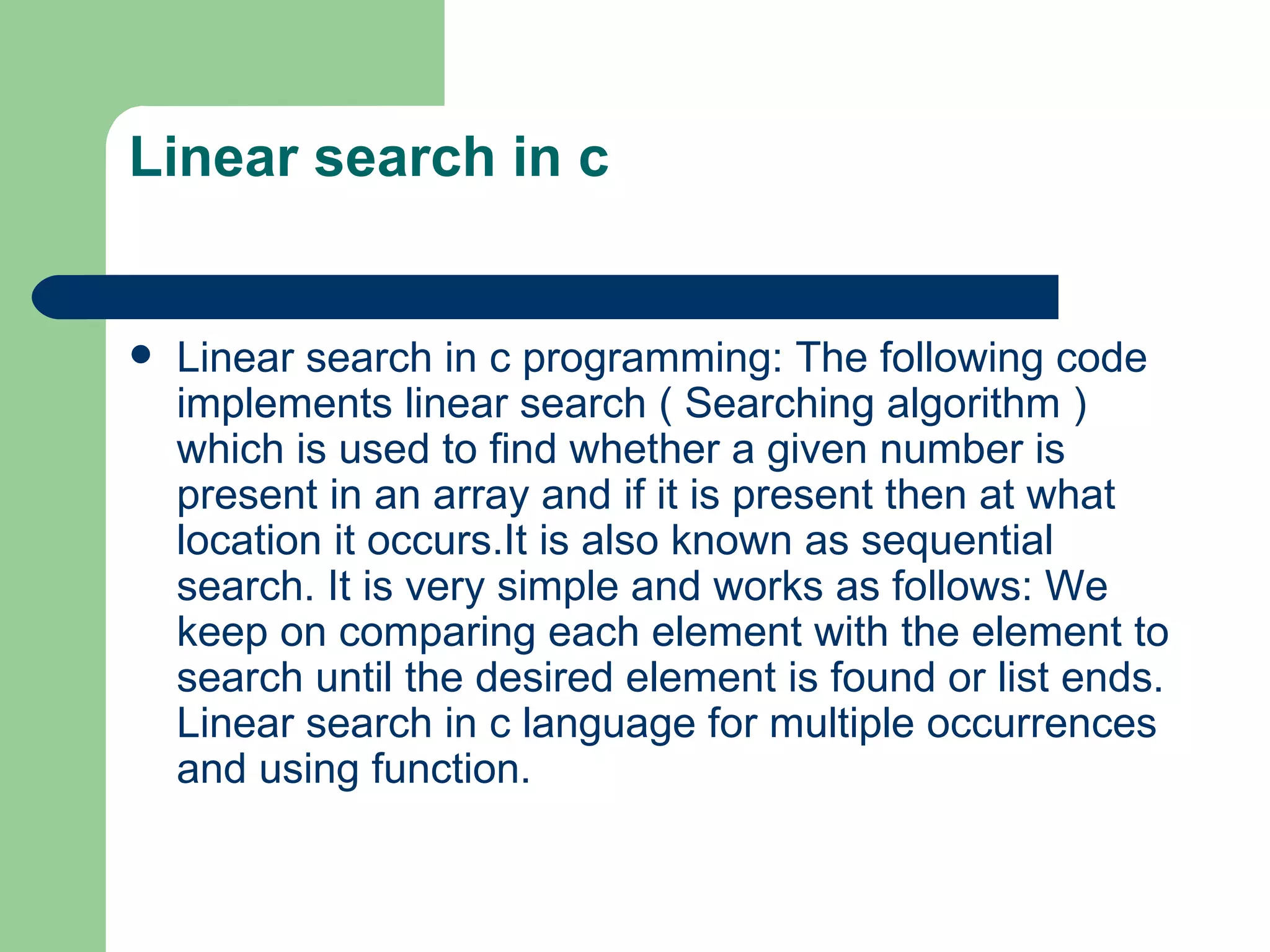
   Linear search in c programming: The following code
    implements linear search ( Searching algorithm )
    which is used to find whether a given number is
    present in an array and if it is present then at what
    location it occurs.It is also known as sequential
    search. It is very simple and works as follows: We
    keep on comparing each element with the element to
    search until the desired element is found or list ends.
    Linear search in c language for multiple occurrences
    and using function.
linear search in c


   #include<stdio.h>

   main()
   {
     int array[100], search, c, number;

    printf("Enter the number of elements in arrayn");
    scanf("%d",&number);

    printf("Enter %d numbersn", number);

    for ( c = 0 ; c < number ; c++ )
      scanf("%d",&array[c]);

    printf("Enter the number to searchn");
linear search in c


       scanf("%d",&search);

       for ( c = 0 ; c < number ; c++ )
       {
          if ( array[c] == search ) /* if required element found */
          {
             printf("%d is present at location %d.n", search, c+1);
               break;
          }
       }
       if ( c == number )
          printf("%d is not present in array.n", search);

       return 0;
   }
C program for binary search


   C program for binary search: This code implements
    binary search in c language. It can only be used for
    sorted arrays, but it's fast as compared to linear
    search. If you wish to use binary search on an array
    which is not sorted then you must sort it using some
    sorting technique say merge sort and then use
    binary search algorithm to find the desired element in
    the list. If the element to be searched is found then
    its position is printed.
C program for binary search


   #include<stdio.h>

   main()
   {
     int c, first, last, middle, n, search, array[100];

     printf("Enter number of elementsn");
     scanf("%d",&n);

     printf("Enter %d integersn", n);

     for ( c = 0 ; c < n ; c++ )
       scanf("%d",&array[c]);

     printf("Enter value to findn");
     scanf("%d",&search);

     first = 0;
     last = n - 1;
     middle = (first+last)/2;
c program to insert an element in an array


   This code will insert an element into an array, For
    example consider an array a[10] having three
    elements in it initially and a[0] = 1, a[1] = 2 and a[2] =
    3 and you want to insert a number 45 at location 1
    i.e. a[0] = 45, so we have to move elements one step
    below so after insertion a[1] = 1 which was a[0]
    initially, and a[2] = 2 and a[3] = 3. Array insertion
    does not mean increasing its size i.e array will not be
    containing 11 elements.
c program to insert an element in an array


   #include <stdio.h>

   main()
   {
     int array[100], position, c, n, value;

     printf("Enter number of elements in arrayn");
     scanf("%d", &n);

     printf("Enter %d elementsn", n);

     for ( c = 0 ; c < n ; c++ )
        scanf("%d", &array[c]);

     printf("Enter the location where you wish to insert an elementn");
     scanf("%d", &position);
c program to insert an element in an array



       printf("Enter the value to insertn");
       scanf("%d", &value);

       for ( c = n - 1 ; c >= position - 1 ; c-- )
          array[c+1] = array[c];

       array[position-1] = value;

       printf("Resultant array isn");

       for( c = 0 ; c <= n ; c++ )
           printf("%dn", array[c]);

       return 0;
   }
C program for binary search



       while( first <= last )
       {
         if ( array[middle] < search )
            first = middle + 1;
         else if ( array[middle] == search )
         {
            printf("%d found at location %d.n", search, middle+1);
            break;
         }
         else
            last = middle - 1;

         middle = (first + last)/2;
       }
       if ( first > last )
          printf("Not found! %d is not present in the list.n", search);

       return 0;
   }
c program for bubble sort
:

   c program for bubble sort: c programming
    code for bubble sort to sort numbers or
    arrange them in ascending order. You can
    easily modify it to print numbers in
    descending order.
c program for bubble sort


   /* Bubble sort code */

   #include<stdio.h>

   main()
   {
     int array[100], n, c, d, swap;

     printf("Enter number of elementsn");
     scanf("%d", &n);

     printf("Enter %d integersn", n);

     for ( c = 0 ; c < n ; c++ )
        scanf("%d", &array[c]);

     for ( c = 0 ; c < ( n - 1 ) ; c++ )
     {
c program for bubble sort


           for ( d = 0 ; d < n - c - 1 ; d++ )
           {
              if ( array[d] > array[d+1] ) /* For decreasing order use < */
              {
                 swap = array[d];
                 array[d] = array[d+1];
                 array[d+1] = swap;
              }
           }
       }

       printf("Sorted list in ascending order:n");

       for ( c = 0 ; c < n ; c++ )
          printf("%dn", array[c]);

       return 0;
   }
insertion sort in c


   Insertion sort in c: c program for insertion sort
    to sort numbers. This code implements
    insertion sort algorithm to arrange numbers
    of an array in ascending order. With a little
    modification it will arrange numbers in
    descending order.
insertion sort in c


   * insertion sort ascending order */

   #include <stdio.h>

   int main()
   {
     int n, array[1000], c, d, t;

    printf("Enter number of elementsn");
    scanf("%d", &n);

    printf("Enter %d integersn", n);

    for (c = 0; c < n; c++) {
      scanf("%d", &array[c]);
    }

    for (c = 1 ; c <= n - 1; c++) {
insertion sort in c


           d = c;

           while ( d > 0 && array[d] < array[d-1]) {
            t       = array[d];
            array[d] = array[d-1];
            array[d-1] = t;

               d--;
           }
       }

       printf("Sorted list in ascending order:n");

       for (c = 0; c <= n - 1; c++) {
         printf("%dn", array[c]);
       }

       return 0;
   }
selection sort in c


   Selection sort in c: c program for selection
    sort to sort numbers. This code implements
    selection sort algorithm to arrange numbers
    of an array in ascending order. With a little
    modification it will arrange numbers in
    descending order.
selection sort in c


   #include<stdio.h>

   main()
   {
     int array[100], n, c, d, position, swap;

     printf("Enter number of elementsn");
     scanf("%d", &n);

     printf("Enter %d integersn", n);

     for ( c = 0 ; c < n ; c++ )
       scanf("%d", &array[c]);

     for ( c = 0 ; c < ( n - 1 ) ; c++ )
     {
       position = c;

       for ( d = c + 1 ; d < n ; d++ )
selection sort in c


           {
               if ( array[position] > array[d] )
                  position = d;
           }
           if ( position != c )
           {
              swap = array[c];
              array[c] = array[position];
              array[position] = swap;
           }
       }

       printf("Sorted list in ascending order:n");

       for ( c = 0 ; c < n ; c++ )
         printf("%dn", array[c]);

       return 0;
   }
Matrix multiplication in c


   Matrix multiplication in c language: c program to multiply
    matrices (two dimensional array), this program multiplies two
    matrices which will be entered by the user. Firstly user will
    enter the order of a matrix. If the entered orders of two matrix is
    such that they can't be multiplied then an error message is
    displayed on the screen. You have already studied the logic to
    multiply them in Mathematics. Matrices are frequently used
    while doing programming and are used to represent graph data
    structure, in solving system of linear equations and many more.
Matrix multiplication in c

   #include <stdio.h>

   int main()
   {
     int m, n, p, q, c, d, k, sum = 0;
     int first[10][10], second[10][10], multiply[10][10];

    printf("Enter the number of rows and columns of first matrixn");
    scanf("%d%d", &m, &n);
    printf("Enter the elements of first matrixn");

    for ( c = 0 ; c < m ; c++ )
      for ( d = 0 ; d < n ; d++ )
        scanf("%d", &first[c][d]);

    printf("Enter the number of rows and columns of second matrixn");
    scanf("%d%d", &p, &q);

    if ( n != p )
      printf("Matrices with entered orders can't be multiplied with each other.n");
    else
    {
      printf("Enter the elements of second matrixn");

     for ( c = 0 ; c < p ; c++ )
       for ( d = 0 ; d < q ; d++ )
        scanf("%d", &second[c][d]);
Matrix multiplication in c


           for ( c = 0 ; c < m ; c++ )
           {
             for ( d = 0 ; d < q ; d++ )
             {
               for ( k = 0 ; k < p ; k++ )
               {
                 sum = sum + first[c][k]*second[k][d];
               }

                   multiply[c][d] = sum;
                   sum = 0;
               }
           }

           printf("Product of entered matrices:-n");

           for ( c = 0 ; c < m ; c++ )
           {
             for ( d = 0 ; d < q ; d++ )
              printf("%dt", multiply[c][d]);

               printf("n");
           }
       }

       return 0;
   }

All important c programby makhan kumbhkar

  • 1.
    C programming codes Prof Makhan kumbhkar Christian Eminent College Indore(mp)
  • 2.
    Leap year  #include <stdio.h>   main()  {  int year;   printf("Enter a year to check if it is a leap yearn");  scanf("%d", &year);   if ( year%400 == 0)  printf("%d is a leap year.n", year);  else if ( year%100 == 0)  printf("%d is not a leap year.n", year);  else if ( year%4 == 0 )  printf("%d is a leap year.n", year);  else  printf("%d is not a leap year.n", year);   return 0;  }
  • 3.
    add digits ofnumber in c  #include <stdio.h>   main()  {  int n, sum = 0, remainder;   printf("Enter an integern");  scanf("%d",&n);   while(n != 0)  {  remainder = n % 10;  sum = sum + remainder;  n = n / 10;  }   printf("Sum of digits of entered number = %dn",sum);   return 0;  }
  • 4.
    Decimal to binaryconversion  #include <stdio.h>   main()  {  int n, c, k;   printf("Enter an integer in decimal number systemn");  scanf("%d",&n);   printf("%d in binary number system is:n", n);   for ( c = 31 ; c >= 0 ; c-- )  {  k = n >> c;   if ( k & 1 )  printf("1");  else  printf("0");  }   printf("n");   return 0;  }
  • 5.
    C code tostore decimal to binary conversion in a string  #include <stdio.h>  #include <stdlib.h>   char *decimal_to_binary(int);   main()  {  int n, c, k;  char *pointer;   printf("Enter an integer in decimal number systemn");  scanf("%d",&n);   pointer = decimal_to_binary(n);  printf("Binary string of %d is: %sn", n, t);   free(pointer);   return 0;  }   char *decimal_to_binary(int n)  {
  • 6.
    C code tostore decimal to binary conversion in a string  int c, d, count;  char *pointer;   count = 0;  pointer = (char*)malloc(32+1);   if ( pointer == NULL )  exit(EXIT_FAILURE);   for ( c = 31 ; c >= 0 ; c-- )  {  d = n >> c;   if ( d & 1 )  *(pointer+count) = 1 + '0';  else  *(pointer+count) = 0 + '0';   count++;  }  *(pointer+count) = '0';   return pointer;  }
  • 7.
    Palindrome Numbers  Palindrome number algorithm  1. Get the number from user.  2. Reverse it.  3. Compare it with the number entered by the user.  4. If both are same then print palindrome number  5. Else print not a palindrome number.
  • 8.
    Palindrome number programc  #include<stdio.h>   main()  {  int n, reverse = 0, temp;   printf("Enter a number to check if it is a palindrome or notn");  scanf("%d",&n);   temp = n;   while( temp != 0 )
  • 9.
    Palindrome number programc  {  reverse = reverse * 10;  reverse = reverse + temp%10;  temp = temp/10;  }   if ( n == reverse )  printf("%d is a palindrome number.n", n);  else  printf("%d is not a palindrome number.n", n);   return 0;  }
  • 10.
    * *** ***** *** *  printf("Enter number of rowsn");  scanf("%d", &n);   space = n - 1;   for (k = 1; k <= n; k++)  {  for (c = 1; c <= space; c++)  printf(" ");   space--;   for (c = 1; c <= 2*k-1; c++)  printf("*");   printf("n");  }
  • 11.
    Fibonacci series inc  Fibonacci series in c programming: c program for Fibonacci series without and with recursion. Using the code below you can print as many number of terms of series as desired. Numbers of Fibonacci sequence are known as Fibonacci numbers. First few numbers of series are 0, 1, 1, 2, 3, 5, 8 etc, Except first two terms in sequence every other term is the sum of two previous terms, For example 8 = 3 + 5 (addition of 3, 5). This sequence has many applications in mathematics and Computer Science.
  • 12.
    * *** ***** *** *   space = 1;   for (k = 1; k <= n - 1; k++)  {  for (c = 1; c <= space; c++)  printf(" ");   space++;   for (c = 1 ; c <= 2*(n-k)-1; c++)  printf("*");   printf("n");  }   return 0;  }
  • 13.
    Fibonacci series inc  #include<stdio.h>   main()  {  int n, first = 0, second = 1, next, c;   printf("Enter the number of termsn");  scanf("%d",&n);   printf("First %d terms of Fibonacci series are :-n",n);   for ( c = 0 ; c < n ; c++ )  {  if ( c <= 1 )  next = c;  else  {  next = first + second;  first = second;  second = next;  }  printf("%dn",next);  }   return 0;  }
  • 14.
    Linear search inc  Linear search in c programming: The following code implements linear search ( Searching algorithm ) which is used to find whether a given number is present in an array and if it is present then at what location it occurs.It is also known as sequential search. It is very simple and works as follows: We keep on comparing each element with the element to search until the desired element is found or list ends. Linear search in c language for multiple occurrences and using function.
  • 15.
    linear search inc  #include<stdio.h>   main()  {  int array[100], search, c, number;   printf("Enter the number of elements in arrayn");  scanf("%d",&number);   printf("Enter %d numbersn", number);   for ( c = 0 ; c < number ; c++ )  scanf("%d",&array[c]);   printf("Enter the number to searchn");
  • 16.
    linear search inc  scanf("%d",&search);   for ( c = 0 ; c < number ; c++ )  {  if ( array[c] == search ) /* if required element found */  {  printf("%d is present at location %d.n", search, c+1);  break;  }  }  if ( c == number )  printf("%d is not present in array.n", search);   return 0;  }
  • 17.
    C program forbinary search  C program for binary search: This code implements binary search in c language. It can only be used for sorted arrays, but it's fast as compared to linear search. If you wish to use binary search on an array which is not sorted then you must sort it using some sorting technique say merge sort and then use binary search algorithm to find the desired element in the list. If the element to be searched is found then its position is printed.
  • 18.
    C program forbinary search  #include<stdio.h>   main()  {  int c, first, last, middle, n, search, array[100];   printf("Enter number of elementsn");  scanf("%d",&n);   printf("Enter %d integersn", n);   for ( c = 0 ; c < n ; c++ )  scanf("%d",&array[c]);   printf("Enter value to findn");  scanf("%d",&search);   first = 0;  last = n - 1;  middle = (first+last)/2;
  • 19.
    c program toinsert an element in an array  This code will insert an element into an array, For example consider an array a[10] having three elements in it initially and a[0] = 1, a[1] = 2 and a[2] = 3 and you want to insert a number 45 at location 1 i.e. a[0] = 45, so we have to move elements one step below so after insertion a[1] = 1 which was a[0] initially, and a[2] = 2 and a[3] = 3. Array insertion does not mean increasing its size i.e array will not be containing 11 elements.
  • 20.
    c program toinsert an element in an array  #include <stdio.h>   main()  {  int array[100], position, c, n, value;   printf("Enter number of elements in arrayn");  scanf("%d", &n);   printf("Enter %d elementsn", n);   for ( c = 0 ; c < n ; c++ )  scanf("%d", &array[c]);   printf("Enter the location where you wish to insert an elementn");  scanf("%d", &position);
  • 21.
    c program toinsert an element in an array   printf("Enter the value to insertn");  scanf("%d", &value);   for ( c = n - 1 ; c >= position - 1 ; c-- )  array[c+1] = array[c];   array[position-1] = value;   printf("Resultant array isn");   for( c = 0 ; c <= n ; c++ )  printf("%dn", array[c]);   return 0;  }
  • 22.
    C program forbinary search   while( first <= last )  {  if ( array[middle] < search )  first = middle + 1;  else if ( array[middle] == search )  {  printf("%d found at location %d.n", search, middle+1);  break;  }  else  last = middle - 1;   middle = (first + last)/2;  }  if ( first > last )  printf("Not found! %d is not present in the list.n", search);   return 0;  }
  • 23.
    c program forbubble sort :  c program for bubble sort: c programming code for bubble sort to sort numbers or arrange them in ascending order. You can easily modify it to print numbers in descending order.
  • 24.
    c program forbubble sort  /* Bubble sort code */   #include<stdio.h>   main()  {  int array[100], n, c, d, swap;   printf("Enter number of elementsn");  scanf("%d", &n);   printf("Enter %d integersn", n);   for ( c = 0 ; c < n ; c++ )  scanf("%d", &array[c]);   for ( c = 0 ; c < ( n - 1 ) ; c++ )  {
  • 25.
    c program forbubble sort  for ( d = 0 ; d < n - c - 1 ; d++ )  {  if ( array[d] > array[d+1] ) /* For decreasing order use < */  {  swap = array[d];  array[d] = array[d+1];  array[d+1] = swap;  }  }  }   printf("Sorted list in ascending order:n");   for ( c = 0 ; c < n ; c++ )  printf("%dn", array[c]);   return 0;  }
  • 26.
    insertion sort inc  Insertion sort in c: c program for insertion sort to sort numbers. This code implements insertion sort algorithm to arrange numbers of an array in ascending order. With a little modification it will arrange numbers in descending order.
  • 27.
    insertion sort inc  * insertion sort ascending order */   #include <stdio.h>   int main()  {  int n, array[1000], c, d, t;   printf("Enter number of elementsn");  scanf("%d", &n);   printf("Enter %d integersn", n);   for (c = 0; c < n; c++) {  scanf("%d", &array[c]);  }   for (c = 1 ; c <= n - 1; c++) {
  • 28.
    insertion sort inc  d = c;   while ( d > 0 && array[d] < array[d-1]) {  t = array[d];  array[d] = array[d-1];  array[d-1] = t;   d--;  }  }   printf("Sorted list in ascending order:n");   for (c = 0; c <= n - 1; c++) {  printf("%dn", array[c]);  }   return 0;  }
  • 29.
    selection sort inc  Selection sort in c: c program for selection sort to sort numbers. This code implements selection sort algorithm to arrange numbers of an array in ascending order. With a little modification it will arrange numbers in descending order.
  • 30.
    selection sort inc  #include<stdio.h>   main()  {  int array[100], n, c, d, position, swap;   printf("Enter number of elementsn");  scanf("%d", &n);   printf("Enter %d integersn", n);   for ( c = 0 ; c < n ; c++ )  scanf("%d", &array[c]);   for ( c = 0 ; c < ( n - 1 ) ; c++ )  {  position = c;   for ( d = c + 1 ; d < n ; d++ )
  • 31.
    selection sort inc  {  if ( array[position] > array[d] )  position = d;  }  if ( position != c )  {  swap = array[c];  array[c] = array[position];  array[position] = swap;  }  }   printf("Sorted list in ascending order:n");   for ( c = 0 ; c < n ; c++ )  printf("%dn", array[c]);   return 0;  }
  • 32.
    Matrix multiplication inc  Matrix multiplication in c language: c program to multiply matrices (two dimensional array), this program multiplies two matrices which will be entered by the user. Firstly user will enter the order of a matrix. If the entered orders of two matrix is such that they can't be multiplied then an error message is displayed on the screen. You have already studied the logic to multiply them in Mathematics. Matrices are frequently used while doing programming and are used to represent graph data structure, in solving system of linear equations and many more.
  • 33.
    Matrix multiplication inc  #include <stdio.h>   int main()  {  int m, n, p, q, c, d, k, sum = 0;  int first[10][10], second[10][10], multiply[10][10];   printf("Enter the number of rows and columns of first matrixn");  scanf("%d%d", &m, &n);  printf("Enter the elements of first matrixn");   for ( c = 0 ; c < m ; c++ )  for ( d = 0 ; d < n ; d++ )  scanf("%d", &first[c][d]);   printf("Enter the number of rows and columns of second matrixn");  scanf("%d%d", &p, &q);   if ( n != p )  printf("Matrices with entered orders can't be multiplied with each other.n");  else  {  printf("Enter the elements of second matrixn");   for ( c = 0 ; c < p ; c++ )  for ( d = 0 ; d < q ; d++ )  scanf("%d", &second[c][d]);
  • 34.
    Matrix multiplication inc   for ( c = 0 ; c < m ; c++ )  {  for ( d = 0 ; d < q ; d++ )  {  for ( k = 0 ; k < p ; k++ )  {  sum = sum + first[c][k]*second[k][d];  }   multiply[c][d] = sum;  sum = 0;  }  }   printf("Product of entered matrices:-n");   for ( c = 0 ; c < m ; c++ )  {  for ( d = 0 ; d < q ; d++ )  printf("%dt", multiply[c][d]);   printf("n");  }  }   return 0;  }