Legal 
Defamation 
Defamation is very similar to libel. Defamation means to communicate false information about a person or 
people that could harm their reputation. 
Some journalists may be inclined to publish false information about a certain person or group of people because 
of their own bias or prejudice. They may want to encourage their readers to share their views. 
Magazines and newspapers usually produce stories that agree with their political views. Journalists may want to 
tell a story in a way that agrees with their views. They may end up giving false information in order to make their 
story match with their own views. 
Earlier this year, Scarlett Johansson won a case agains French writer Grégoire Delacourt. He had used her for 
a character in his book. In the book her character had multiple affairs. Johansson claimed that her name had 
been exploited, and her reputation could be damaged.
Copyright 
Copyright is the law that protects work from being stolen and claimed as someone else's other than the 
creators. Copyright gives the creator of a piece of work exclusive rights to their work. 
Journalists are bound by law to only publish their own work, and to not steal the work of others publishing it as 
their own. In some cases clearly referencing where they got their information can prevent copyright 
infringement. 
Copyright can be damaging to the creator of the original work. It can result in huge losses of money for them as 
consumers purchase the work from somebody else. It can also cause the original creator to lose respect from 
the consumer as they are being lead to believe someone else is the original creator. 
As well as being damaging to the original creator, it can be damaging to the journalist.Copyright infringement 
can result in huge fines, and so should be taken very seriously by all journalists. Being found guilty of copyright 
infringement can be detrimental to a journalist. They may lose the trust of the consumer and could lose their job. 
In September of this year there was a dispute between the BBC and collecting society Eos over how much the 
BBC should pay to be allowed to broadcast the Welsh-language music. Eos said the fee should be £1.5 million, 
though the BBC argued that it should only be £100,000.
Children and Young Persons 
Journalists are given very clear guidelines on the way in which journalists must handle stories about children. 
These rules are put in place to prevent children from being harassed exploited by journalists. 
One of the rules put in place is that journalists must not interfere with children at school. Meaning that they cannot 
approach a child to speak to them or to take their photograph while they are at school. This is unless the school 
gives consent to it. This is to protect children from being harassed by journalists. 
The second rule states that children under 16 cannot be interviewed on their welfare or that of another child, 
unless consent is given by a responsible adult. Children must also not be funded for giving information on the 
welfare or that of another child. By giving a child money in exchange for information could be seen as exploiting 
that child. 
These rules can be found in the Editors Code of Practice.
Confidentiality 
Confidentiality is a set of rules put in place that restricts access to certain information. 
Journalists will sometimes be speaking to people who could be at risk if their name or any information about 
them were to be published. They could be at risk of arrest, or attack from another member of the public. 
Journalists have a duty to protect all of their sources who may be at risk. They have the right to keep the 
names and other information about their sources confidential. 
Official Secrets 
Official secrets are secrets regarding the government, the military or MI5. Official secrets are protected under 
the Official Secrets Act. The Official Secrets Act was put in place to prevent people from speaking about 
matters to do with the government, the military or MI5 that aren't in the interest of the public. It has also been 
used to force journalists to reveal their sources if they think that it is in the interest of the public. 
In some cases a journalist will have to sign a contract to the Official Secrets Act before and after their 
employment, preventing them from publishing particular information. Journalists must make sure to abide by 
these rules. I Journalists who do not abide by these rules could face prison. 
Back in 2002, David Shayler, a former MI5 officer was convicted of disclosing secret information to a national 
newspaper. He then faced six months in prison for it.
Ethical 
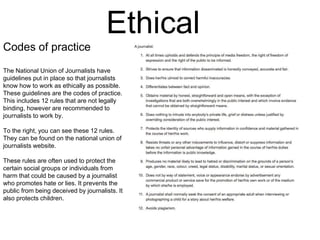
Codes of practice 
The National Union of Journalists have 
guidelines put in place so that journalists 
know how to work as ethically as possible. 
These guidelines are the codes of practice. 
This includes 12 rules that are not legally 
binding, however are recommended to 
journalists to work by. 
To the right, you can see these 12 rules. 
They can be found on the national union of 
journalists website. 
These rules are often used to protect the 
certain social groups or individuals from 
harm that could be caused by a journalist 
who promotes hate or lies. It prevents the 
public from being deceived by journalists. It 
also protects children.
Privacy 
Everybody is entitled to privacy, and journalists must always abide by that right. It is important to not publish 
information that could be regarded as being private as it could possibly be damaging to the person. It may result in 
the arrest of the journalist, or a fine, depending on the circumstances. 
There was a case a while ago involving some paparazzi and Kate Middleton. The paparazzi took photographs of h 
er topless of a private beach while on holiday. The photographs were published in a French magazine, though 
Kate and William won a court order that banned the magazine from selling or republishing the photographs, with 
risk of a 100,000 euro fine. The court called this case a brutal invasion of privacy. 
A journalist may publish something about someone’s private life that could be seen as in the public interest. The pu 
blic interest meaning that it could be damaging to the public to not be informed. This could be that an 
individual or group of people are being deceiving to the public. 
Intrusion 
Intrusion is referring to someone being present when they are not wanted. It is intrusive for journalists to pry into s 
omeone’s private life, or perhaps to be on someone’s property when not invited. Journalists must always 
consider whether they are being intrusive into someone’s life. 
A journalist may want to intrude on someone’s life in order to get the opportunity to ask them for information. The j 
ournalist may know that the person would disagree to speaking to them in person, so the journalist may see 
intrusion as the only way to get information on a story. 
The example case I gave before about Kate Middleton and the paparazzi is a good example of where someone ha 
s been extremely intrusive. Kate was on a private beach, so was obviously avoiding being seen by other 
people.
Harassment 
It can be extremely distressing to be a victim of harassment. A journalist may harass someone in order to 
pressure them into providing information for a story. A journalist might continually visit this person, ask questions, o 
r take photographs. The journalist might even continually publish negative stories about the person. 
Many celebrities suffer great amounts of harassment by journalist wanting stories and photographs. Someone who 
has been continually harassed by journalists and paparazzi is Britney Spears. The huge extent of the harassment 
drove Britney to have a breakdown in 2007. 
Another example of a more recent case is Tulisa Contostavlos. She was a victim of entrapment by journalist 
Mazher Mahmood, who claimed that she was dealing drugs. After these claims were published, she had 
journalists waiting outside her house day and night, meaning that she had to leave her home. 
Though it is not technically illegal for a journalist to continually approach someone, the victim may see it fit to get a 
restraining order against the journalist to prevent them from approaching them again.

NUJ Presentation Part 3

  • 1.
    Legal Defamation Defamationis very similar to libel. Defamation means to communicate false information about a person or people that could harm their reputation. Some journalists may be inclined to publish false information about a certain person or group of people because of their own bias or prejudice. They may want to encourage their readers to share their views. Magazines and newspapers usually produce stories that agree with their political views. Journalists may want to tell a story in a way that agrees with their views. They may end up giving false information in order to make their story match with their own views. Earlier this year, Scarlett Johansson won a case agains French writer Grégoire Delacourt. He had used her for a character in his book. In the book her character had multiple affairs. Johansson claimed that her name had been exploited, and her reputation could be damaged.
  • 2.
    Copyright Copyright isthe law that protects work from being stolen and claimed as someone else's other than the creators. Copyright gives the creator of a piece of work exclusive rights to their work. Journalists are bound by law to only publish their own work, and to not steal the work of others publishing it as their own. In some cases clearly referencing where they got their information can prevent copyright infringement. Copyright can be damaging to the creator of the original work. It can result in huge losses of money for them as consumers purchase the work from somebody else. It can also cause the original creator to lose respect from the consumer as they are being lead to believe someone else is the original creator. As well as being damaging to the original creator, it can be damaging to the journalist.Copyright infringement can result in huge fines, and so should be taken very seriously by all journalists. Being found guilty of copyright infringement can be detrimental to a journalist. They may lose the trust of the consumer and could lose their job. In September of this year there was a dispute between the BBC and collecting society Eos over how much the BBC should pay to be allowed to broadcast the Welsh-language music. Eos said the fee should be £1.5 million, though the BBC argued that it should only be £100,000.
  • 3.
    Children and YoungPersons Journalists are given very clear guidelines on the way in which journalists must handle stories about children. These rules are put in place to prevent children from being harassed exploited by journalists. One of the rules put in place is that journalists must not interfere with children at school. Meaning that they cannot approach a child to speak to them or to take their photograph while they are at school. This is unless the school gives consent to it. This is to protect children from being harassed by journalists. The second rule states that children under 16 cannot be interviewed on their welfare or that of another child, unless consent is given by a responsible adult. Children must also not be funded for giving information on the welfare or that of another child. By giving a child money in exchange for information could be seen as exploiting that child. These rules can be found in the Editors Code of Practice.
  • 4.
    Confidentiality Confidentiality isa set of rules put in place that restricts access to certain information. Journalists will sometimes be speaking to people who could be at risk if their name or any information about them were to be published. They could be at risk of arrest, or attack from another member of the public. Journalists have a duty to protect all of their sources who may be at risk. They have the right to keep the names and other information about their sources confidential. Official Secrets Official secrets are secrets regarding the government, the military or MI5. Official secrets are protected under the Official Secrets Act. The Official Secrets Act was put in place to prevent people from speaking about matters to do with the government, the military or MI5 that aren't in the interest of the public. It has also been used to force journalists to reveal their sources if they think that it is in the interest of the public. In some cases a journalist will have to sign a contract to the Official Secrets Act before and after their employment, preventing them from publishing particular information. Journalists must make sure to abide by these rules. I Journalists who do not abide by these rules could face prison. Back in 2002, David Shayler, a former MI5 officer was convicted of disclosing secret information to a national newspaper. He then faced six months in prison for it.
  • 5.
    Ethical Codes ofpractice The National Union of Journalists have guidelines put in place so that journalists know how to work as ethically as possible. These guidelines are the codes of practice. This includes 12 rules that are not legally binding, however are recommended to journalists to work by. To the right, you can see these 12 rules. They can be found on the national union of journalists website. These rules are often used to protect the certain social groups or individuals from harm that could be caused by a journalist who promotes hate or lies. It prevents the public from being deceived by journalists. It also protects children.
  • 6.
    Privacy Everybody isentitled to privacy, and journalists must always abide by that right. It is important to not publish information that could be regarded as being private as it could possibly be damaging to the person. It may result in the arrest of the journalist, or a fine, depending on the circumstances. There was a case a while ago involving some paparazzi and Kate Middleton. The paparazzi took photographs of h er topless of a private beach while on holiday. The photographs were published in a French magazine, though Kate and William won a court order that banned the magazine from selling or republishing the photographs, with risk of a 100,000 euro fine. The court called this case a brutal invasion of privacy. A journalist may publish something about someone’s private life that could be seen as in the public interest. The pu blic interest meaning that it could be damaging to the public to not be informed. This could be that an individual or group of people are being deceiving to the public. Intrusion Intrusion is referring to someone being present when they are not wanted. It is intrusive for journalists to pry into s omeone’s private life, or perhaps to be on someone’s property when not invited. Journalists must always consider whether they are being intrusive into someone’s life. A journalist may want to intrude on someone’s life in order to get the opportunity to ask them for information. The j ournalist may know that the person would disagree to speaking to them in person, so the journalist may see intrusion as the only way to get information on a story. The example case I gave before about Kate Middleton and the paparazzi is a good example of where someone ha s been extremely intrusive. Kate was on a private beach, so was obviously avoiding being seen by other people.
  • 7.
    Harassment It canbe extremely distressing to be a victim of harassment. A journalist may harass someone in order to pressure them into providing information for a story. A journalist might continually visit this person, ask questions, o r take photographs. The journalist might even continually publish negative stories about the person. Many celebrities suffer great amounts of harassment by journalist wanting stories and photographs. Someone who has been continually harassed by journalists and paparazzi is Britney Spears. The huge extent of the harassment drove Britney to have a breakdown in 2007. Another example of a more recent case is Tulisa Contostavlos. She was a victim of entrapment by journalist Mazher Mahmood, who claimed that she was dealing drugs. After these claims were published, she had journalists waiting outside her house day and night, meaning that she had to leave her home. Though it is not technically illegal for a journalist to continually approach someone, the victim may see it fit to get a restraining order against the journalist to prevent them from approaching them again.