WORKSHOP ON
WORKSHOP ON
Performance Management System
&
&
Performance Related Pay
Presentation by
Presentation by
NSIC
NSIC
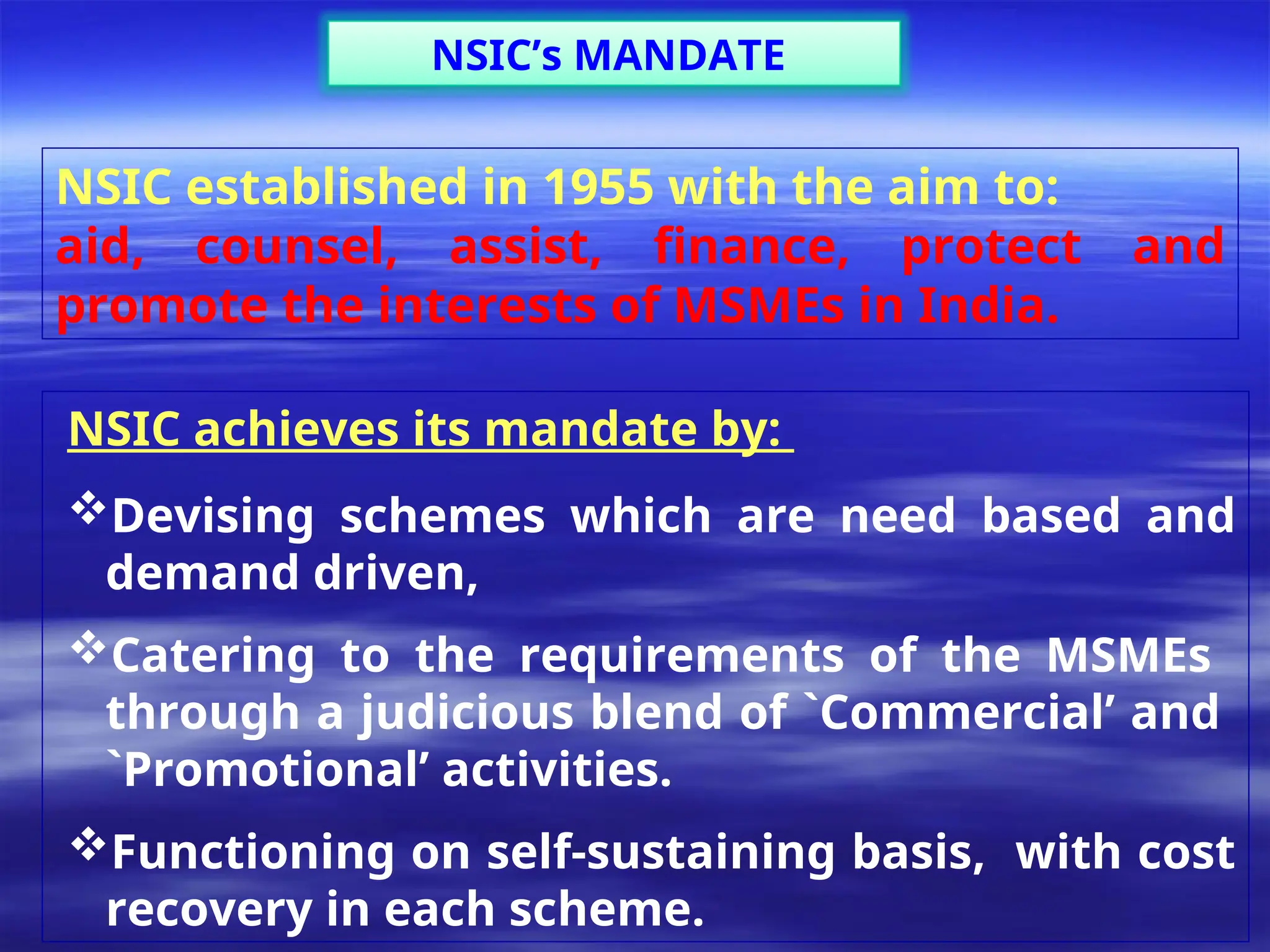
NSIC established in 1955 with the aim to:
aid, counsel, assist, finance, protect and
promote the interests of MSMEs in India.
NSIC achieves its mandate by:
Devising schemes which are need based and
demand driven,
Catering to the requirements of the MSMEs
through a judicious blend of `Commercial’ and
`Promotional’ activities.
Functioning on self-sustaining basis, with cost
recovery in each scheme.
NSIC’s MANDATE
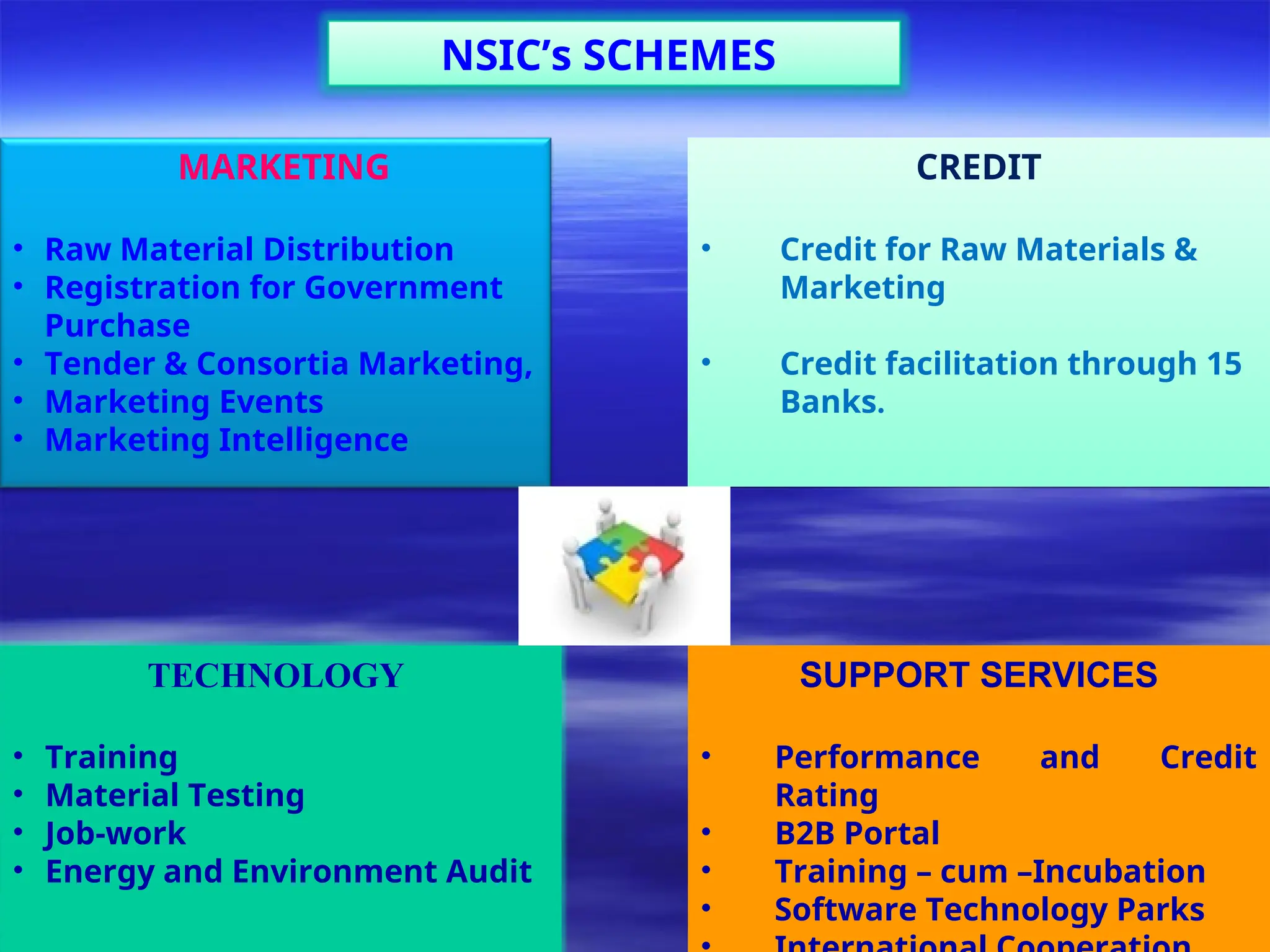
NSIC’s SCHEMES
MARKETING
• Raw Material Distribution
• Registration for Government
Purchase
• Tender & Consortia Marketing,
• Marketing Events
• Marketing Intelligence
TECHNOLOGY
• Training
• Material Testing
• Job-work
• Energy and Environment Audit
SUPPORT SERVICES
• Performance and Credit
Rating
• B2B Portal
• Training – cum –Incubation
• Software Technology Parks
CREDIT
• Credit for Raw Materials &
Marketing
• Credit facilitation through 15
Banks.
1)
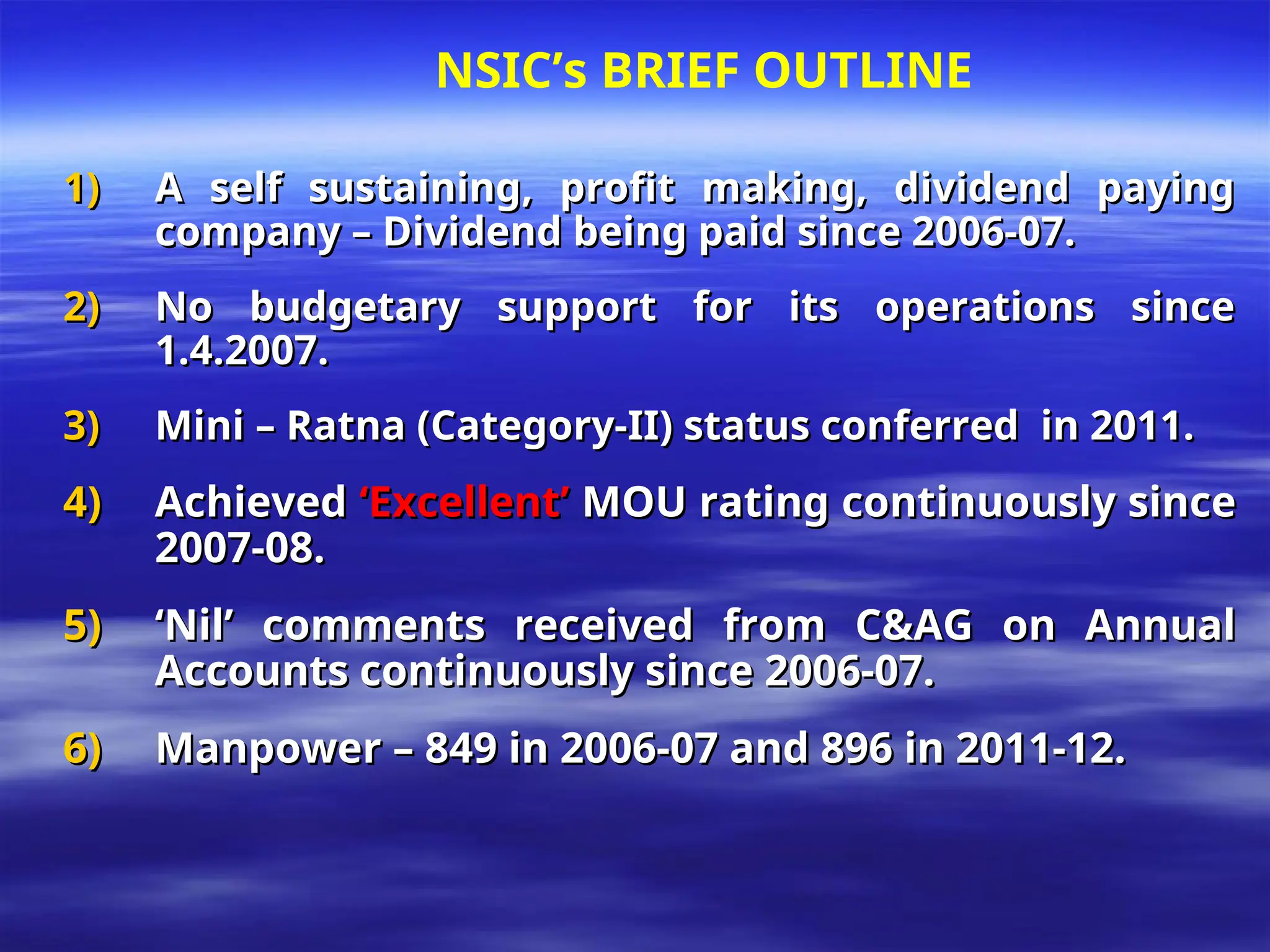
1) A self sustaining, profit making, dividend paying
A self sustaining, profit making, dividend paying
company – Dividend being paid since 2006-07.
2)
2) No budgetary support for its operations since
No budgetary support for its operations since
1.4.2007.
1.4.2007.
3)
3) Mini – Ratna (Category-II) status conferred in 2011.
Mini – Ratna (Category-II) status conferred in 2011.
4)
4) Achieved
Achieved ‘Excellent’
‘Excellent’ MOU rating continuously since
MOU rating continuously since
2007-08.
2007-08.
5)
5) ‘
‘Nil’ comments received from C&AG on Annual
Nil’ comments received from C&AG on Annual
Accounts continuously since 2006-07.
6)
6) Manpower – 849 in 2006-07 and 896 in 2011-12.
Manpower – 849 in 2006-07 and 896 in 2011-12.
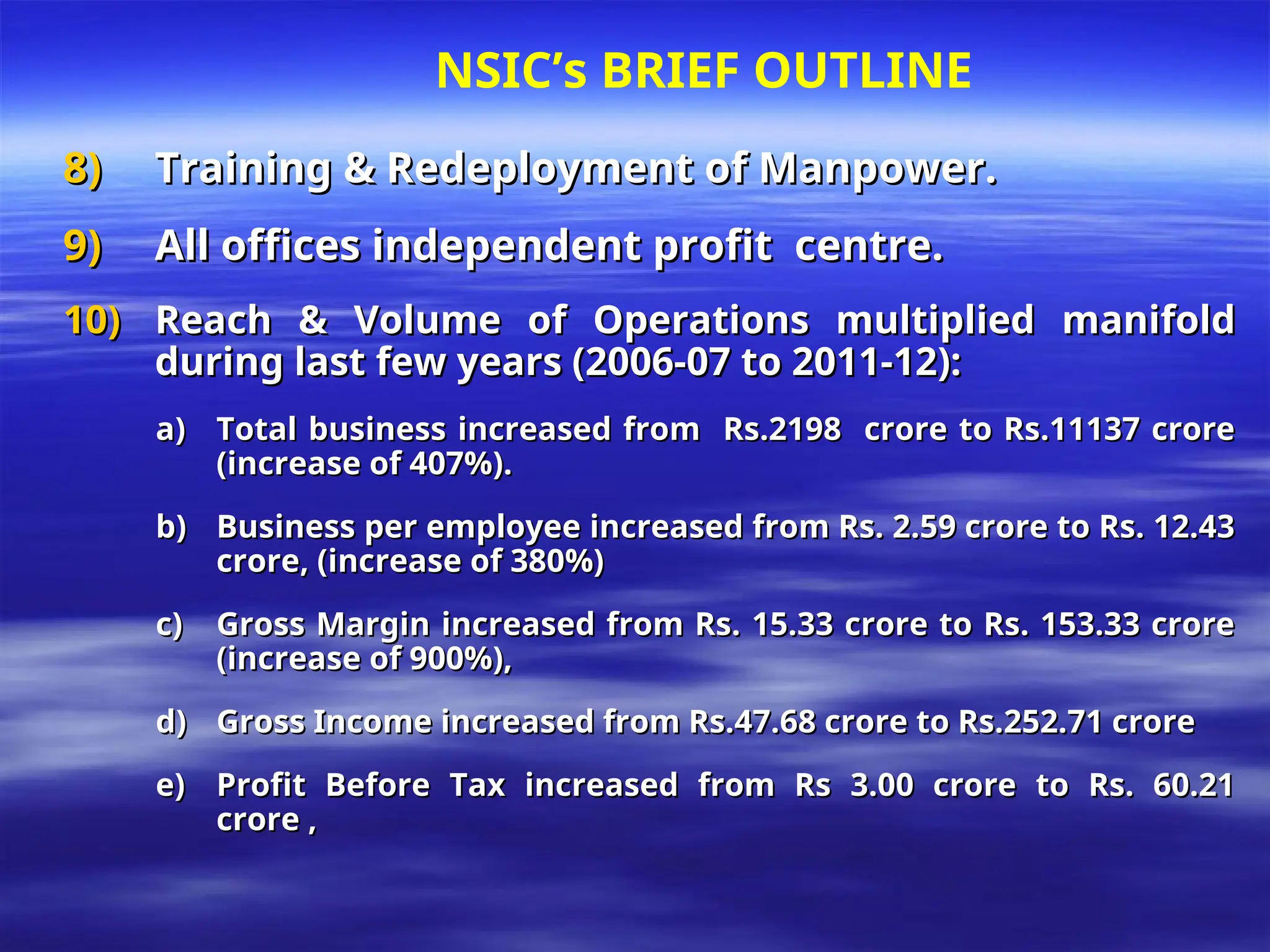
NSIC’s BRIEF OUTLINE
8)
8) Training & Redeployment of Manpower.
Training & Redeployment of Manpower.
9)
9) All offices independent profit centre.
All offices independent profit centre.
10)
10) Reach & Volume of Operations multiplied manifold
Reach & Volume of Operations multiplied manifold
during last few years (2006-07 to 2011-12):
a)
a) Total business increased from Rs.2198 crore to Rs.11137 crore
Total business increased from Rs.2198 crore to Rs.11137 crore
(increase of 407%).
(increase of 407%).
b)
b) Business per employee increased from Rs. 2.59 crore to Rs. 12.43
Business per employee increased from Rs. 2.59 crore to Rs. 12.43
crore, (increase of 380%)
c)
c) Gross Margin increased from Rs. 15.33 crore to Rs. 153.33 crore
Gross Margin increased from Rs. 15.33 crore to Rs. 153.33 crore
(increase of 900%),
(increase of 900%),
d)
d) Gross Income increased from Rs.47.68 crore to Rs.252.71 crore
Gross Income increased from Rs.47.68 crore to Rs.252.71 crore
e)
e) Profit Before Tax increased from Rs 3.00 crore to Rs. 60.21
Profit Before Tax increased from Rs 3.00 crore to Rs. 60.21
crore ,
crore ,
NSIC’s BRIEF OUTLINE
Performance Appraisal System in NSIC
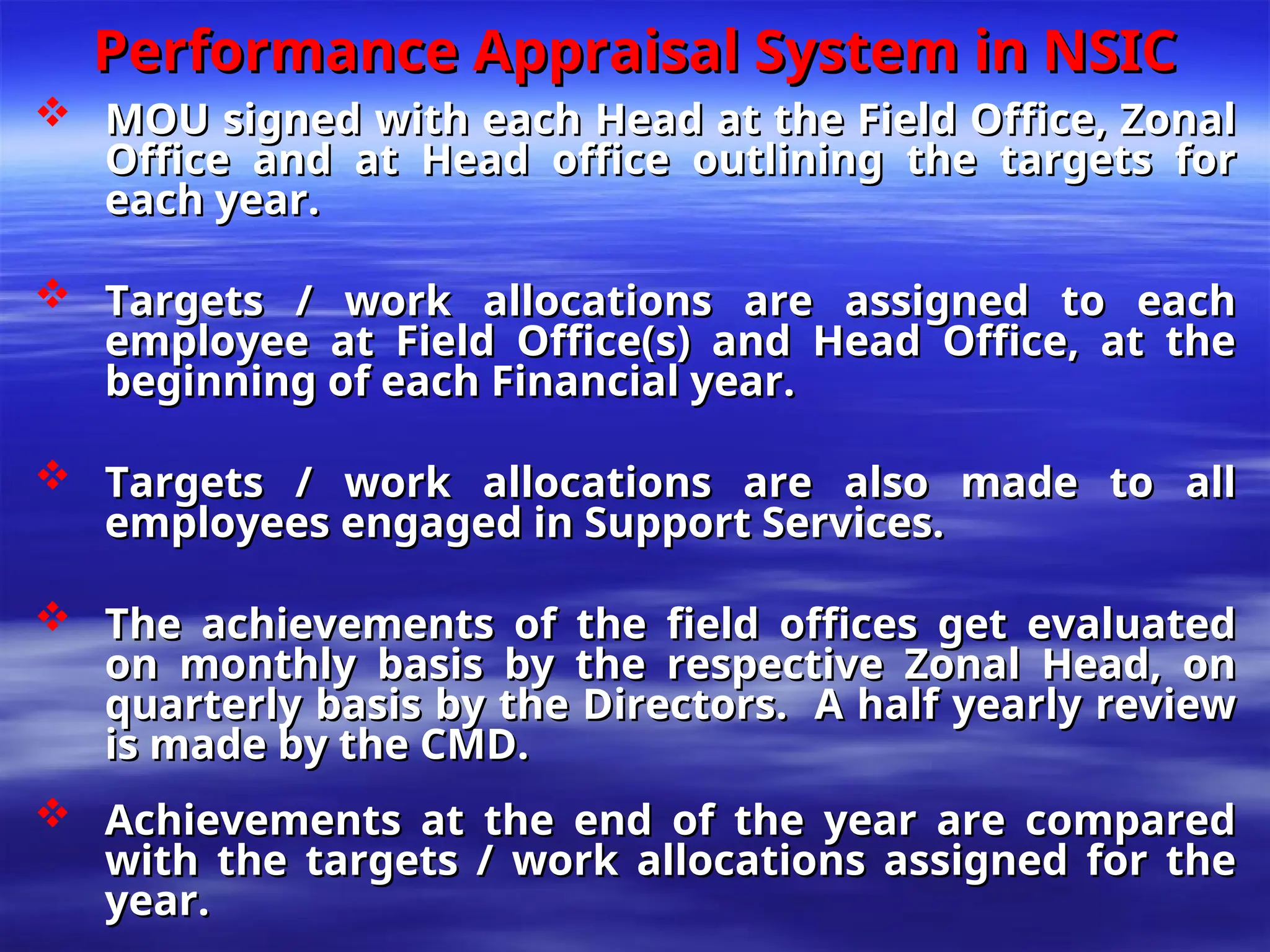
 MOU signed with each Head at the Field Office, Zonal
MOU signed with each Head at the Field Office, Zonal
Office and at Head office outlining the targets for
each year.
each year.
 Targets / work allocations are assigned to each
Targets / work allocations are assigned to each
employee at Field Office(s) and Head Office, at the
beginning of each Financial year.
 Targets / work allocations are also made to all
Targets / work allocations are also made to all
employees engaged in Support Services.
 The achievements of the field offices get evaluated
The achievements of the field offices get evaluated
on monthly basis by the respective Zonal Head, on
quarterly basis by the Directors. A half yearly review
is made by the CMD.
is made by the CMD.
 Achievements at the end of the year are compared
Achievements at the end of the year are compared
with the targets / work allocations assigned for the
year.
year.
Performance Appraisal System in NSIC
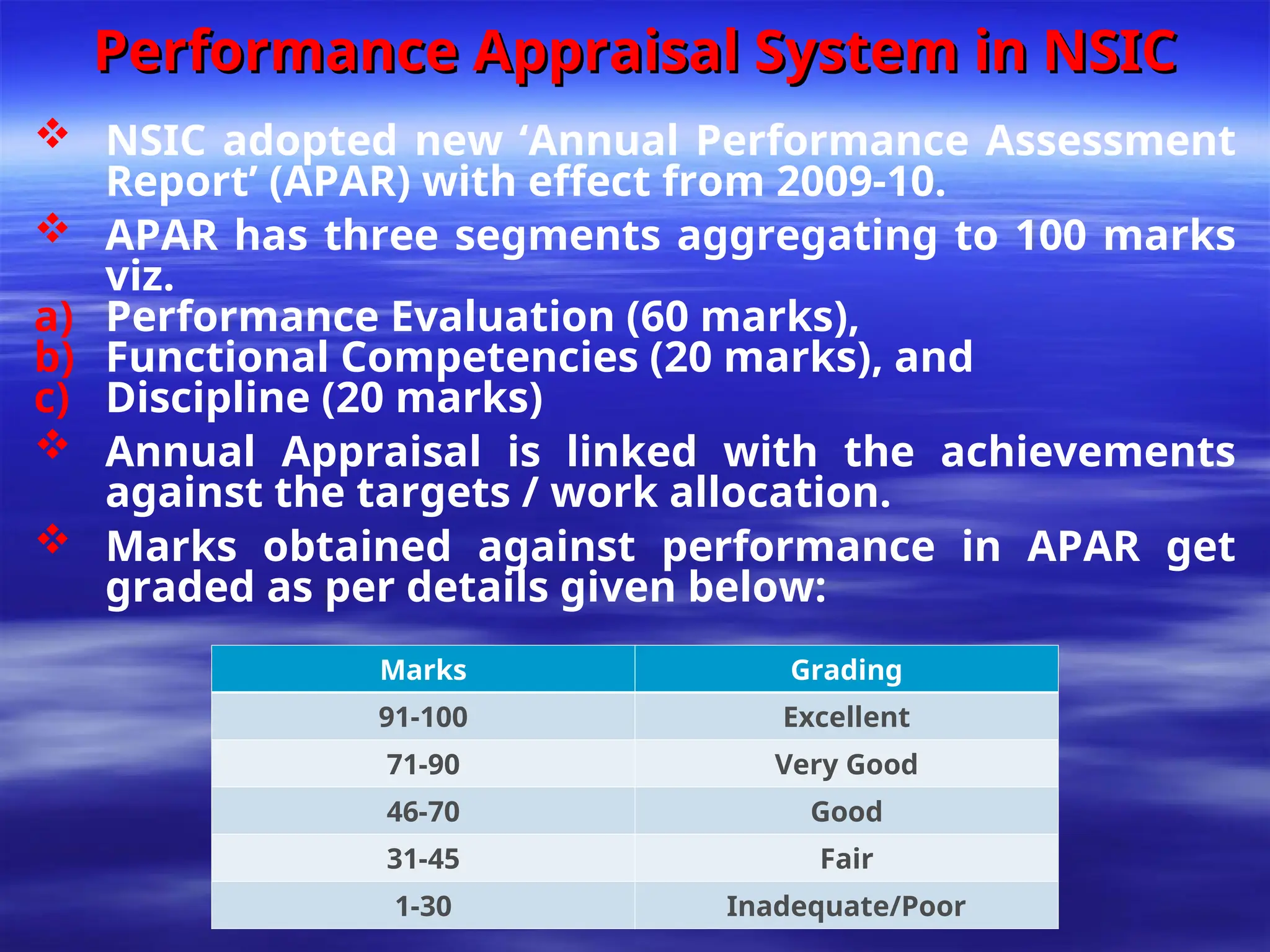
Marks Grading
91-100 Excellent
71-90 Very Good
46-70 Good
31-45 Fair
1-30 Inadequate/Poor
 NSIC adopted new ‘Annual Performance Assessment
Report’ (APAR) with effect from 2009-10.
 APAR has three segments aggregating to 100 marks
viz.
a) Performance Evaluation (60 marks),
b) Functional Competencies (20 marks), and
c) Discipline (20 marks)
 Annual Appraisal is linked with the achievements
against the targets / work allocation.
 Marks obtained against performance in APAR get
graded as per details given below:
Performance Appraisal System in NSIC
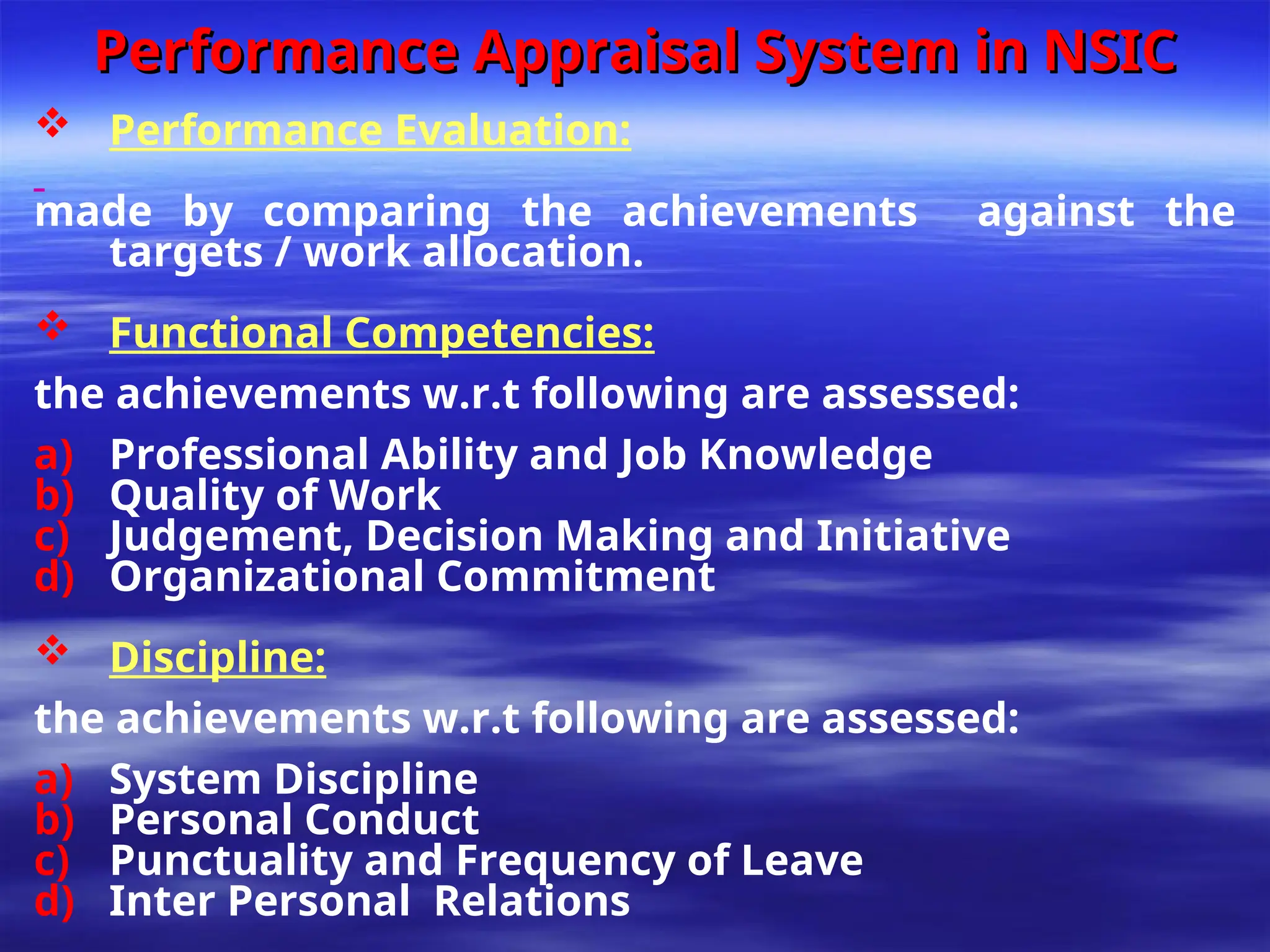
 Performance Evaluation:
made by comparing the achievements against the
targets / work allocation.
 Functional Competencies:
the achievements w.r.t following are assessed:
a) Professional Ability and Job Knowledge
b) Quality of Work
c) Judgement, Decision Making and Initiative
d) Organizational Commitment
 Discipline:
the achievements w.r.t following are assessed:
a) System Discipline
b) Personal Conduct
c) Punctuality and Frequency of Leave
d) Inter Personal Relations
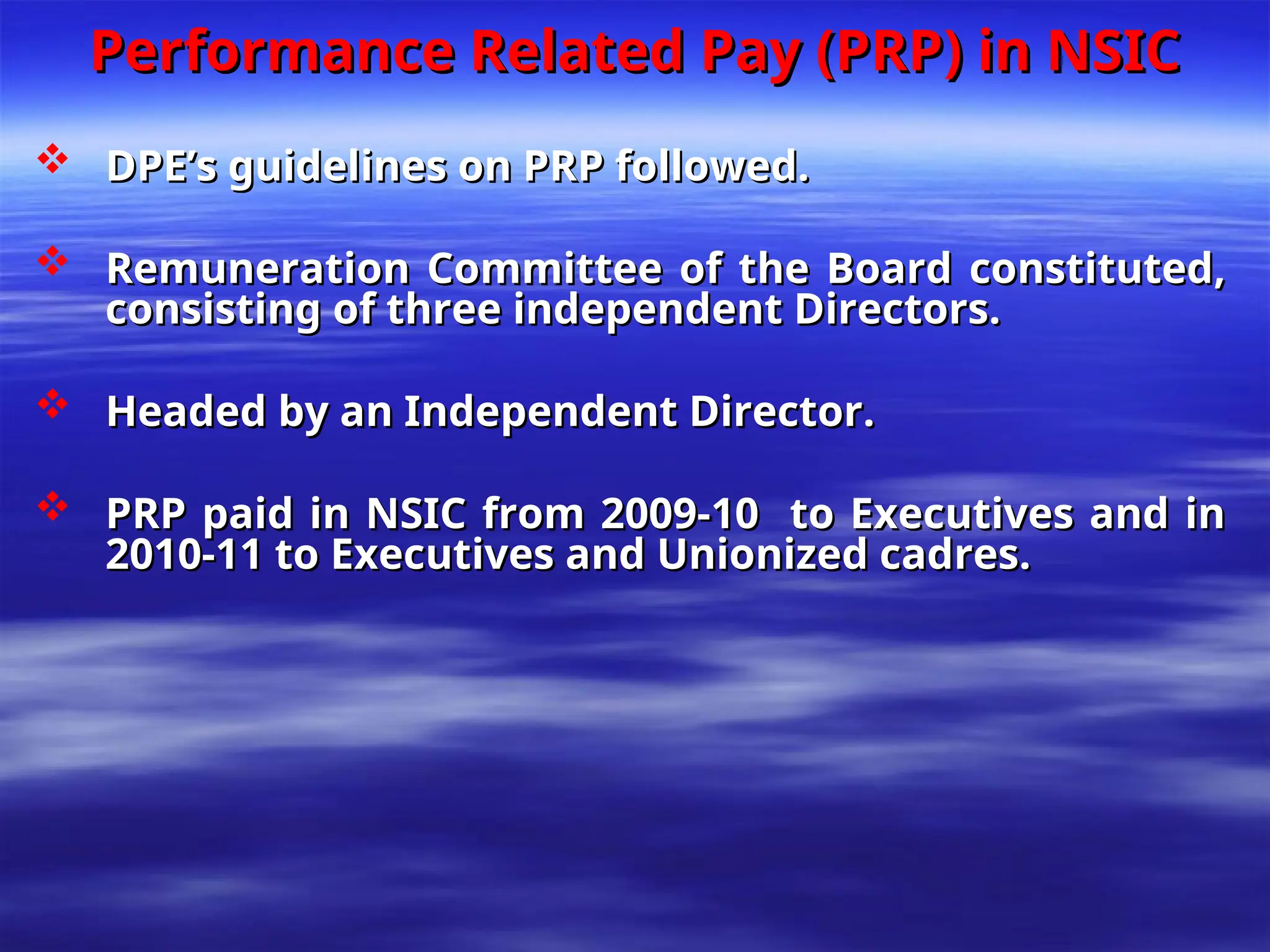
Performance Related Pay (PRP) in NSIC
 DPE’s guidelines on PRP followed.
DPE’s guidelines on PRP followed.
 Remuneration Committee of the Board constituted,
Remuneration Committee of the Board constituted,
consisting of three independent Directors.
 Headed by an Independent Director.
Headed by an Independent Director.
 PRP paid in NSIC from 2009-10 to Executives and in
PRP paid in NSIC from 2009-10 to Executives and in
2010-11 to Executives and Unionized cadres.
Financia
l Year
PBT 3%
of
PBT
PRP
from
3%
Incremental
PBT
10%
of
Col.
6
2% of
PBT
PRP
from
Col. 6
5%
PBT
Total
PRP
Distrib
utable
Profit
Year Amt.
1 2 3 4 5 6 7 8 9 10 11 12
2009-10 25.94 0.78 0.78 (09-10)
(-)
(08-09)
19.02 1.90 0.52 0.52 1.30 3.27 1.30
2010-11 35.17 1.06 1.06 (10-11)
(-)
(09-10)
9.23 0.92 0.70 0.70 1.76 3.97 1.76
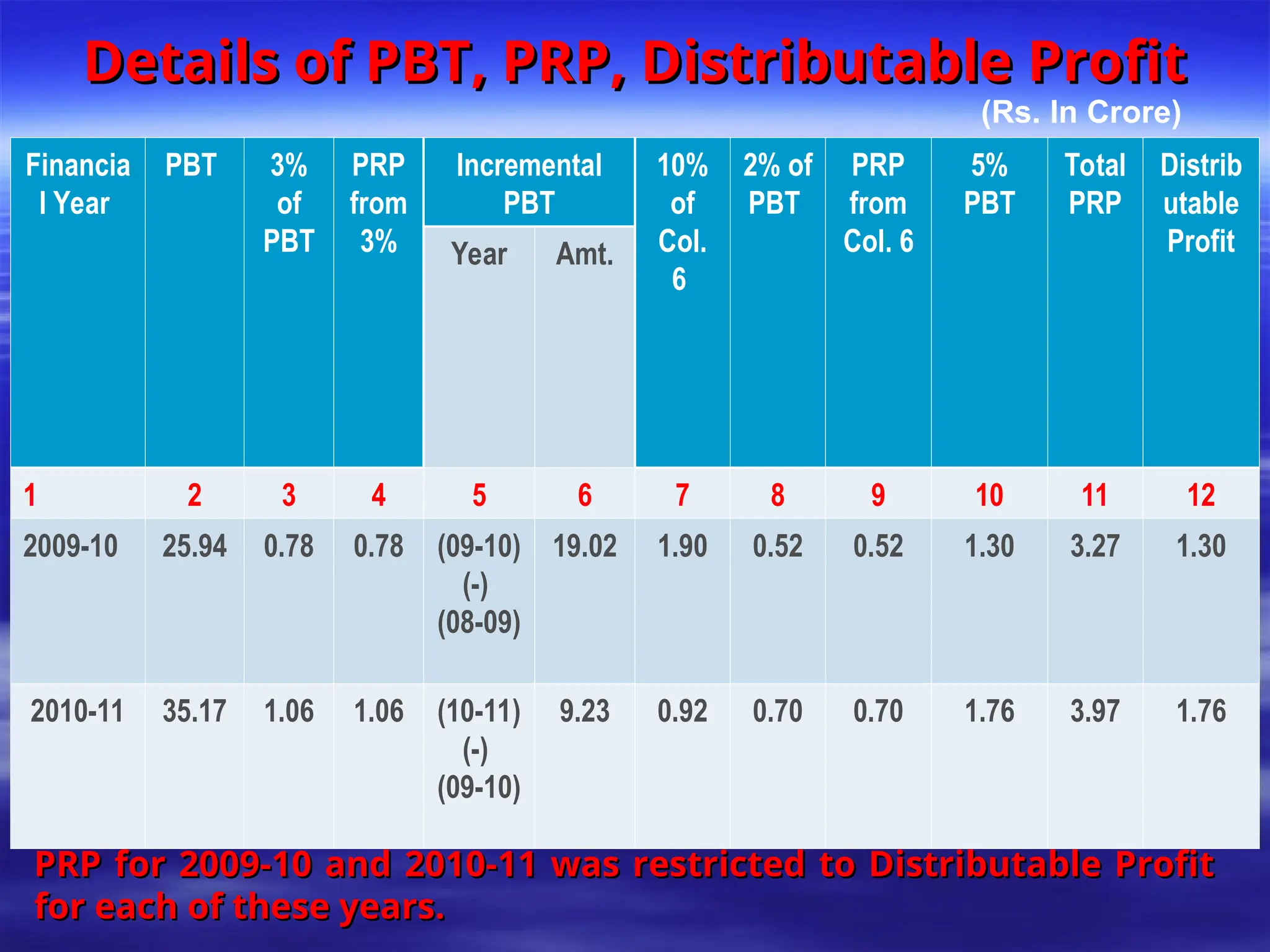
Details of PBT, PRP, Distributable Profit
(Rs. In Crore)
PRP for 2009-10 and 2010-11 was restricted to Distributable Profit
for each of these years.
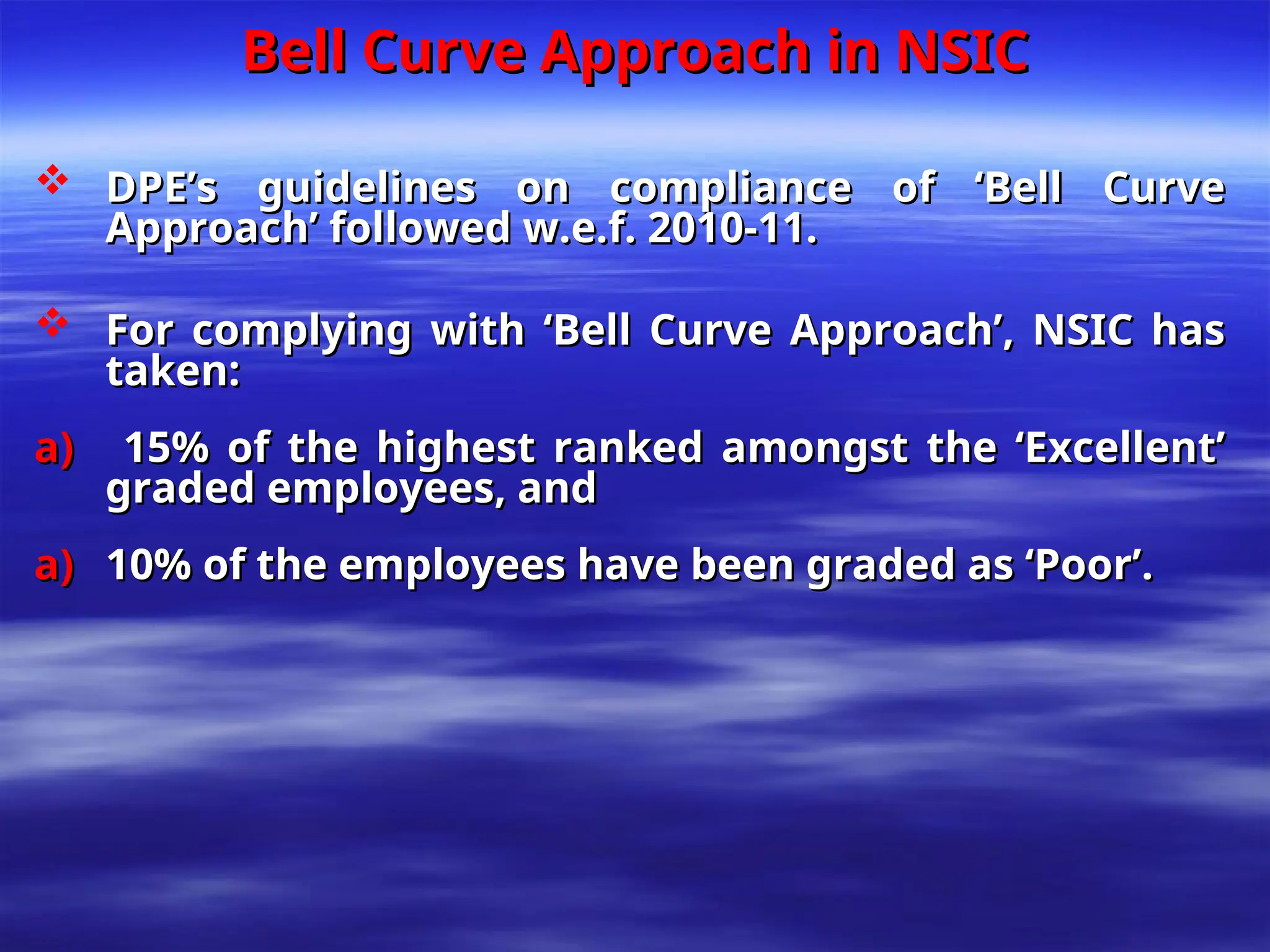
Bell Curve Approach in NSIC
 DPE’s guidelines on compliance of ‘Bell Curve
DPE’s guidelines on compliance of ‘Bell Curve
Approach’ followed w.e.f. 2010-11.
 For complying with ‘Bell Curve Approach’, NSIC has
For complying with ‘Bell Curve Approach’, NSIC has
taken:
taken:
a)
a) 15% of the highest ranked amongst the ‘Excellent’
15% of the highest ranked amongst the ‘Excellent’
graded employees, and
a)
a) 10% of the employees have been graded as ‘Poor’.
10% of the employees have been graded as ‘Poor’.
THANK YOU
THANK YOU

NSIC-PRESENTATION_0.ppt personal Performance Review

  • 1.
    WORKSHOP ON WORKSHOP ON PerformanceManagement System Performance Management System & & Performance Related Pay Performance Related Pay Presentation by Presentation by NSIC NSIC
  • 2.
    NSIC established in1955 with the aim to: aid, counsel, assist, finance, protect and promote the interests of MSMEs in India. NSIC achieves its mandate by: Devising schemes which are need based and demand driven, Catering to the requirements of the MSMEs through a judicious blend of `Commercial’ and `Promotional’ activities. Functioning on self-sustaining basis, with cost recovery in each scheme. NSIC’s MANDATE
  • 3.
    NSIC’s SCHEMES MARKETING • RawMaterial Distribution • Registration for Government Purchase • Tender & Consortia Marketing, • Marketing Events • Marketing Intelligence TECHNOLOGY • Training • Material Testing • Job-work • Energy and Environment Audit SUPPORT SERVICES • Performance and Credit Rating • B2B Portal • Training – cum –Incubation • Software Technology Parks CREDIT • Credit for Raw Materials & Marketing • Credit facilitation through 15 Banks.
  • 4.
    1) 1) A selfsustaining, profit making, dividend paying A self sustaining, profit making, dividend paying company – Dividend being paid since 2006-07. company – Dividend being paid since 2006-07. 2) 2) No budgetary support for its operations since No budgetary support for its operations since 1.4.2007. 1.4.2007. 3) 3) Mini – Ratna (Category-II) status conferred in 2011. Mini – Ratna (Category-II) status conferred in 2011. 4) 4) Achieved Achieved ‘Excellent’ ‘Excellent’ MOU rating continuously since MOU rating continuously since 2007-08. 2007-08. 5) 5) ‘ ‘Nil’ comments received from C&AG on Annual Nil’ comments received from C&AG on Annual Accounts continuously since 2006-07. Accounts continuously since 2006-07. 6) 6) Manpower – 849 in 2006-07 and 896 in 2011-12. Manpower – 849 in 2006-07 and 896 in 2011-12. NSIC’s BRIEF OUTLINE
  • 5.
    8) 8) Training &Redeployment of Manpower. Training & Redeployment of Manpower. 9) 9) All offices independent profit centre. All offices independent profit centre. 10) 10) Reach & Volume of Operations multiplied manifold Reach & Volume of Operations multiplied manifold during last few years (2006-07 to 2011-12): during last few years (2006-07 to 2011-12): a) a) Total business increased from Rs.2198 crore to Rs.11137 crore Total business increased from Rs.2198 crore to Rs.11137 crore (increase of 407%). (increase of 407%). b) b) Business per employee increased from Rs. 2.59 crore to Rs. 12.43 Business per employee increased from Rs. 2.59 crore to Rs. 12.43 crore, (increase of 380%) crore, (increase of 380%) c) c) Gross Margin increased from Rs. 15.33 crore to Rs. 153.33 crore Gross Margin increased from Rs. 15.33 crore to Rs. 153.33 crore (increase of 900%), (increase of 900%), d) d) Gross Income increased from Rs.47.68 crore to Rs.252.71 crore Gross Income increased from Rs.47.68 crore to Rs.252.71 crore e) e) Profit Before Tax increased from Rs 3.00 crore to Rs. 60.21 Profit Before Tax increased from Rs 3.00 crore to Rs. 60.21 crore , crore , NSIC’s BRIEF OUTLINE
  • 6.
    Performance Appraisal Systemin NSIC Performance Appraisal System in NSIC  MOU signed with each Head at the Field Office, Zonal MOU signed with each Head at the Field Office, Zonal Office and at Head office outlining the targets for Office and at Head office outlining the targets for each year. each year.  Targets / work allocations are assigned to each Targets / work allocations are assigned to each employee at Field Office(s) and Head Office, at the employee at Field Office(s) and Head Office, at the beginning of each Financial year. beginning of each Financial year.  Targets / work allocations are also made to all Targets / work allocations are also made to all employees engaged in Support Services. employees engaged in Support Services.  The achievements of the field offices get evaluated The achievements of the field offices get evaluated on monthly basis by the respective Zonal Head, on on monthly basis by the respective Zonal Head, on quarterly basis by the Directors. A half yearly review quarterly basis by the Directors. A half yearly review is made by the CMD. is made by the CMD.  Achievements at the end of the year are compared Achievements at the end of the year are compared with the targets / work allocations assigned for the with the targets / work allocations assigned for the year. year.
  • 7.
    Performance Appraisal Systemin NSIC Performance Appraisal System in NSIC Marks Grading 91-100 Excellent 71-90 Very Good 46-70 Good 31-45 Fair 1-30 Inadequate/Poor  NSIC adopted new ‘Annual Performance Assessment Report’ (APAR) with effect from 2009-10.  APAR has three segments aggregating to 100 marks viz. a) Performance Evaluation (60 marks), b) Functional Competencies (20 marks), and c) Discipline (20 marks)  Annual Appraisal is linked with the achievements against the targets / work allocation.  Marks obtained against performance in APAR get graded as per details given below:
  • 8.
    Performance Appraisal Systemin NSIC Performance Appraisal System in NSIC  Performance Evaluation: made by comparing the achievements against the targets / work allocation.  Functional Competencies: the achievements w.r.t following are assessed: a) Professional Ability and Job Knowledge b) Quality of Work c) Judgement, Decision Making and Initiative d) Organizational Commitment  Discipline: the achievements w.r.t following are assessed: a) System Discipline b) Personal Conduct c) Punctuality and Frequency of Leave d) Inter Personal Relations
  • 9.
    Performance Related Pay(PRP) in NSIC Performance Related Pay (PRP) in NSIC  DPE’s guidelines on PRP followed. DPE’s guidelines on PRP followed.  Remuneration Committee of the Board constituted, Remuneration Committee of the Board constituted, consisting of three independent Directors. consisting of three independent Directors.  Headed by an Independent Director. Headed by an Independent Director.  PRP paid in NSIC from 2009-10 to Executives and in PRP paid in NSIC from 2009-10 to Executives and in 2010-11 to Executives and Unionized cadres. 2010-11 to Executives and Unionized cadres.
  • 10.
    Financia l Year PBT 3% of PBT PRP from 3% Incremental PBT 10% of Col. 6 2%of PBT PRP from Col. 6 5% PBT Total PRP Distrib utable Profit Year Amt. 1 2 3 4 5 6 7 8 9 10 11 12 2009-10 25.94 0.78 0.78 (09-10) (-) (08-09) 19.02 1.90 0.52 0.52 1.30 3.27 1.30 2010-11 35.17 1.06 1.06 (10-11) (-) (09-10) 9.23 0.92 0.70 0.70 1.76 3.97 1.76 Details of PBT, PRP, Distributable Profit Details of PBT, PRP, Distributable Profit (Rs. In Crore) PRP for 2009-10 and 2010-11 was restricted to Distributable Profit PRP for 2009-10 and 2010-11 was restricted to Distributable Profit for each of these years. for each of these years.
  • 11.
    Bell Curve Approachin NSIC Bell Curve Approach in NSIC  DPE’s guidelines on compliance of ‘Bell Curve DPE’s guidelines on compliance of ‘Bell Curve Approach’ followed w.e.f. 2010-11. Approach’ followed w.e.f. 2010-11.  For complying with ‘Bell Curve Approach’, NSIC has For complying with ‘Bell Curve Approach’, NSIC has taken: taken: a) a) 15% of the highest ranked amongst the ‘Excellent’ 15% of the highest ranked amongst the ‘Excellent’ graded employees, and graded employees, and a) a) 10% of the employees have been graded as ‘Poor’. 10% of the employees have been graded as ‘Poor’.
  • 12.