COMMODITY AN EMERGING CLASS
1
Mr. Nitin Barker
Asst Prof
1. Mohit Panwar 17mba ab-36
2. Abishek Raghuwanshi 17mba ab-38
3. Aman Srivastava 17mba ab-68
4. Deepak Gangwar 17mba ab-42
5. Kumar Singh 17mba ab-56
6. Shivam Dwivedi 17mba ab-58
7. Anand Patel 17mba ab-76
8. D.P Mowardun 17mba ab-99
9. Rahul Anjana 17mba ab-101
10. Pushpendra Singh 17mba ab-86
Presented by
Subject- commodity Future Trading
Department of Agricultural Economics
Sam Higginbottom University of Agriculture Technology And Sciences
Presented to
Why are commodities emerging as a distinct asset class?
 With the advent of commodity futures, commodities
have emerged as a distinct asset class where individual
can actually participate through the market
mechanism.
 when we talk of commodities we are talking with
specific reference to commodity futures
 The Big Advantages with commodity future is the
benefit of Leverage
COMMODITY AN EMERGING CLASS 2
Characteristics of Commodity that make as emerging class
Leverage
Margins
Liquidity
Returns
Equity
Diversifications
Standardizations
Inflation Index
COMMODITY AN EMERGING CLASS
3
How Leverage Feature play role
What do we mean by leverage?
 When you take position in commodity futures, you
only pay a small margin to initiate the position.
 The margin normally consists of a combination of
SPAN margin and an extreme loss margin.
 In case of commodity futures this is normally around
5-6 % which gives the trader a leverage of nearly 20
times. Thus, even with a small margin investment, one
is able to take a position in commodities
COMMODITY AN EMERGING CLASS 4
Role of Margin in Commodity future trading
 In order to contain the risk arising out of transactions
entered into by the members in various Securities
either on their own account or on behalf of their
clients,
 BSE has a well designed risk-management system
which inter-alia, includes collection of margins from
the Members. BSE accordingly imposes various kinds
of margins on the Members based on their
outstanding positions in the market
COMMODITY AN EMERGING CLASS 5
 SPAN margin derives its origin from SPAN i.e.
Standard Portfolio Analysis of Risk which is a method
for measuring portfolio risk.
 In Indian stock markets, SPAN margin is also
commonly referred to as VaR margin or initial margin
which is the minimum margin requirement for
initiating a trade in the markets.
COMMODITY AN EMERGING CLASS 6
These margins comprise of 2 components which include
SPAN margins and Exposure margins.
Contd..
 Over and above the SPAN margin requirements,
brokers also collect an additional margin known as the
Exposure Margin or Extreme Loss margin
 SPAN Margins for popular contracts in India
 NIFTY SPAN Margin – 5%
 BANK NIFTY SPAN Margin – 5%
 USDINR SPAN Margin – 1%
 Gold SPAN Margin – 5%
COMMODITY AN EMERGING CLASS 7
Contd..
What is Extreme Loss Margin ?
 The term Extreme Loss Margin replaces the terms
"exposure limits" and "second line of defense" that
have been used hitherto.
 covers the expected loss in situations that go beyond
those envisaged in the 99% value at risk estimates
used in the VaR margin
 The Extreme Loss Margin for any stock is higher of:
5%, and 1.5 times the standard deviation of daily
logarithmic returns of the stock price in the last six
months.
COMMODITY AN EMERGING CLASS 8
 For this purpose, there is no netting of positions across
different settlements.
 The Extreme Loss margin so collected is released along
with the pay-in.
 The ELM amount applicable in respect of the
Securities is also disseminated on the BSE website
COMMODITY AN EMERGING CLASS 9
Contd..
Nature of Commodity Future
 Commodity futures are extremely liquid.
 At least major commodities like crude oil, gold, silver,
mentha oil, cardamom, nickel, zinc, copper are all
extremely liquid.
 Getting large transactions executed is quite simple and
does not involve too much of impact cost.
 Unlike physical commodities, these commodity futures are
standardized and can be held purely for investment
purposes.
 Commodity futures allow you to participate in
commodities without bothering to take physical delivery;
making it cheaper and more convenient
COMMODITY AN EMERGING CLASS 10
How does this happen ?.
Normally commodities are part of most inflation
indices.
For example, the inflation index has an agricultural
component and also a non-agricultural component. It
is possible to participate in the rise in price of these
commodities through futures.
Hence it becomes an automatic hedge against
inflation. In fact, among various asset classes
commodities offer the closest hedge against inflation
COMMODITY AN EMERGING CLASS 11
Commodities act as a good inflation hedge
What do we mean by diversification in commodity ?
 You do not want your entire portfolio to be similar in
nature as the entire portfolio will underperform if the
conditions are unfavorable.
 By adding commodities the overall portfolio gets
diversified as commodities have a low correlation with
equity and debt.
 Also as an asset class, commodities tend to follow
distinct cycles, which make them a good diversified of
risk.
COMMODITY AN EMERGING CLASS 12
 Commodity futures offer the benefit of simplicity and
diversification to traders. For traders and investors
used to traditional avenues like equity and debt,
commodity markets offer an attractive alternative.
COMMODITY AN EMERGING CLASS 13
Contd..
Standardization of commodities
 Unlike equities, commodities are heterogeneous
products with sub -classification on the basis of type,
quality, grade, purity etc.
 By standardizing these into similar baskets,
commodity future simplified the entire process of
trading commodities into one simple algorithm.
 Also when you trade commodities through the futures
route, you do not have to worry about physical
delivery, holding, demurrage etc
COMMODITY AN EMERGING CLASS 14
Transaction facilitation Nature in Commodity
 Commodity futures are traded on an electronic
exchange where prices are determined in a transparent
manner through the forces of demand and supply.
 Traders in commodities know exactly the price at
which their order is getting executed and that
transparency makes the entire process a lot simpler
and democratic.
 Commodity futures are executed on an exchange
where the clearing corporation actually guarantees
each and every transaction.
COMMODITY AN EMERGING CLASS 15
 Commodities can also be used as a lead indicator for
taking trading decisions in equities.
 For example, Sterlite and copper prices tend to move in
tandem and the commodity price tends to precede the
stock price. There is a similar relationship between
Titan and gold prices.
 Similarly, there is a positive correlation between the
price of crude and the stock price of stocks like ONGC
and Oil India. Such relationships can be leveraged
upon.
COMMODITY AN EMERGING CLASS 16
Commodity futures lead indicator for taking trading
decisions in equities
 There is another very important advantage in commodities
but which is not appreciated by a lot of trader.
 Most of the key commodities like gold, silver, nickel,
copper, tin, aluminum etc are denominated in US$. As a
result they tend to have a negative relation with the dollar.
 So effectively when you buy commodity futures you are
short on the dollar and when you sell commodity futures,
you are long on the dollar. This is more so for commodities
where the domestic price is set based on international
prices
COMMODITY AN EMERGING CLASS 17
Note:
Contd..
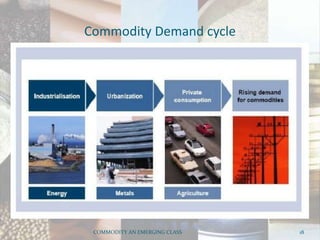
Commodity Demand cycle
COMMODITY AN EMERGING CLASS 18
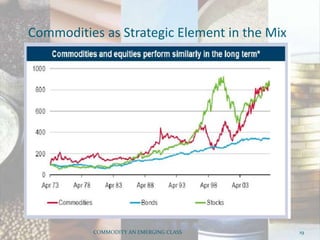
Commodities as Strategic Element in the Mix
COMMODITY AN EMERGING CLASS 19
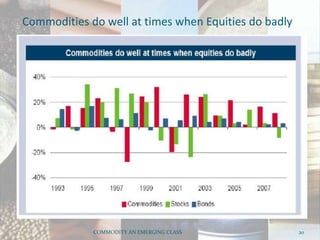
Commodities do well at times when Equities do badly
COMMODITY AN EMERGING CLASS 20
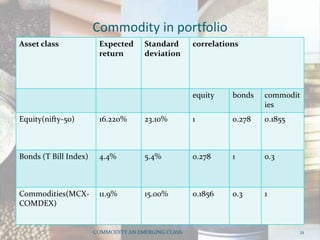
Commodity in portfolio
Asset class Expected
return
Standard
deviation
correlations
equity bonds commodit
ies
Equity(nifty-50) 16.220% 23.10% 1 0.278 0.1855
Bonds (T Bill Index) 4.4% 5.4% 0.278 1 0.3
Commodities(MCX-
COMDEX)
11.9% 15.00% 0.1856 0.3 1
COMMODITY AN EMERGING CLASS 21
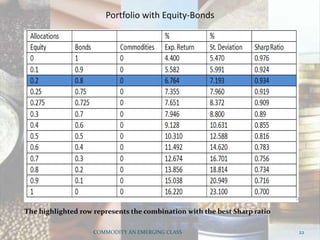
Portfolio with Equity-Bonds
COMMODITY AN EMERGING CLASS 22
The highlighted row represents the combination with the best Sharp ratio
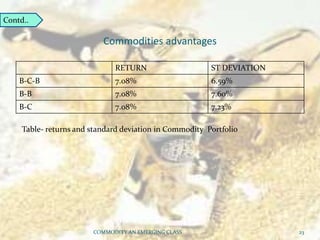
Commodities advantages
RETURN ST DEVIATION
B-C-B 7.08% 6.59%
B-B 7.08% 7.60%
B-C 7.08% 7.23%
COMMODITY AN EMERGING CLASS 23
Contd..
Table- returns and standard deviation in Commodity Portfolio
Conclusion
 Commodities in portfolio would definitely provide better Risk-Return
combinations.
 Commodities have high correlation with Equity in India contradicting
diversification advantage in developed markets
 Commodity prices in India are not Inflation Indexed.
 Commodity futures offer the benefit of simplicity and diversification to
traders. For traders and investors used to traditional avenues like equity
and debt, commodity markets offer an attractive alternative.
 The reasons might be that the commodity market, in terms of Volume
is not developed in India and hence investors relate it to stock market
which accounts for the high correlation between them
COMMODITY AN EMERGING CLASS 24
COMMODITY AN EMERGING CLASS 25
Commodity Future market in India; riding the growth phase-
A whitepaper by Dr. Alok Kumar Mishra
Website:
www.nseindia.com
www.mcxindia.com
www.rbi.org.in
www.finman.nic.in
Reference:
COMMODITY AN EMERGING CLASS 26

Commodity emerging class

  • 1.
    COMMODITY AN EMERGINGCLASS 1 Mr. Nitin Barker Asst Prof 1. Mohit Panwar 17mba ab-36 2. Abishek Raghuwanshi 17mba ab-38 3. Aman Srivastava 17mba ab-68 4. Deepak Gangwar 17mba ab-42 5. Kumar Singh 17mba ab-56 6. Shivam Dwivedi 17mba ab-58 7. Anand Patel 17mba ab-76 8. D.P Mowardun 17mba ab-99 9. Rahul Anjana 17mba ab-101 10. Pushpendra Singh 17mba ab-86 Presented by Subject- commodity Future Trading Department of Agricultural Economics Sam Higginbottom University of Agriculture Technology And Sciences Presented to
  • 2.
    Why are commoditiesemerging as a distinct asset class?  With the advent of commodity futures, commodities have emerged as a distinct asset class where individual can actually participate through the market mechanism.  when we talk of commodities we are talking with specific reference to commodity futures  The Big Advantages with commodity future is the benefit of Leverage COMMODITY AN EMERGING CLASS 2
  • 3.
    Characteristics of Commoditythat make as emerging class Leverage Margins Liquidity Returns Equity Diversifications Standardizations Inflation Index COMMODITY AN EMERGING CLASS 3
  • 4.
    How Leverage Featureplay role What do we mean by leverage?  When you take position in commodity futures, you only pay a small margin to initiate the position.  The margin normally consists of a combination of SPAN margin and an extreme loss margin.  In case of commodity futures this is normally around 5-6 % which gives the trader a leverage of nearly 20 times. Thus, even with a small margin investment, one is able to take a position in commodities COMMODITY AN EMERGING CLASS 4
  • 5.
    Role of Marginin Commodity future trading  In order to contain the risk arising out of transactions entered into by the members in various Securities either on their own account or on behalf of their clients,  BSE has a well designed risk-management system which inter-alia, includes collection of margins from the Members. BSE accordingly imposes various kinds of margins on the Members based on their outstanding positions in the market COMMODITY AN EMERGING CLASS 5
  • 6.
     SPAN marginderives its origin from SPAN i.e. Standard Portfolio Analysis of Risk which is a method for measuring portfolio risk.  In Indian stock markets, SPAN margin is also commonly referred to as VaR margin or initial margin which is the minimum margin requirement for initiating a trade in the markets. COMMODITY AN EMERGING CLASS 6 These margins comprise of 2 components which include SPAN margins and Exposure margins. Contd..
  • 7.
     Over andabove the SPAN margin requirements, brokers also collect an additional margin known as the Exposure Margin or Extreme Loss margin  SPAN Margins for popular contracts in India  NIFTY SPAN Margin – 5%  BANK NIFTY SPAN Margin – 5%  USDINR SPAN Margin – 1%  Gold SPAN Margin – 5% COMMODITY AN EMERGING CLASS 7 Contd..
  • 8.
    What is ExtremeLoss Margin ?  The term Extreme Loss Margin replaces the terms "exposure limits" and "second line of defense" that have been used hitherto.  covers the expected loss in situations that go beyond those envisaged in the 99% value at risk estimates used in the VaR margin  The Extreme Loss Margin for any stock is higher of: 5%, and 1.5 times the standard deviation of daily logarithmic returns of the stock price in the last six months. COMMODITY AN EMERGING CLASS 8
  • 9.
     For thispurpose, there is no netting of positions across different settlements.  The Extreme Loss margin so collected is released along with the pay-in.  The ELM amount applicable in respect of the Securities is also disseminated on the BSE website COMMODITY AN EMERGING CLASS 9 Contd..
  • 10.
    Nature of CommodityFuture  Commodity futures are extremely liquid.  At least major commodities like crude oil, gold, silver, mentha oil, cardamom, nickel, zinc, copper are all extremely liquid.  Getting large transactions executed is quite simple and does not involve too much of impact cost.  Unlike physical commodities, these commodity futures are standardized and can be held purely for investment purposes.  Commodity futures allow you to participate in commodities without bothering to take physical delivery; making it cheaper and more convenient COMMODITY AN EMERGING CLASS 10
  • 11.
    How does thishappen ?. Normally commodities are part of most inflation indices. For example, the inflation index has an agricultural component and also a non-agricultural component. It is possible to participate in the rise in price of these commodities through futures. Hence it becomes an automatic hedge against inflation. In fact, among various asset classes commodities offer the closest hedge against inflation COMMODITY AN EMERGING CLASS 11 Commodities act as a good inflation hedge
  • 12.
    What do wemean by diversification in commodity ?  You do not want your entire portfolio to be similar in nature as the entire portfolio will underperform if the conditions are unfavorable.  By adding commodities the overall portfolio gets diversified as commodities have a low correlation with equity and debt.  Also as an asset class, commodities tend to follow distinct cycles, which make them a good diversified of risk. COMMODITY AN EMERGING CLASS 12
  • 13.
     Commodity futuresoffer the benefit of simplicity and diversification to traders. For traders and investors used to traditional avenues like equity and debt, commodity markets offer an attractive alternative. COMMODITY AN EMERGING CLASS 13 Contd..
  • 14.
    Standardization of commodities Unlike equities, commodities are heterogeneous products with sub -classification on the basis of type, quality, grade, purity etc.  By standardizing these into similar baskets, commodity future simplified the entire process of trading commodities into one simple algorithm.  Also when you trade commodities through the futures route, you do not have to worry about physical delivery, holding, demurrage etc COMMODITY AN EMERGING CLASS 14
  • 15.
    Transaction facilitation Naturein Commodity  Commodity futures are traded on an electronic exchange where prices are determined in a transparent manner through the forces of demand and supply.  Traders in commodities know exactly the price at which their order is getting executed and that transparency makes the entire process a lot simpler and democratic.  Commodity futures are executed on an exchange where the clearing corporation actually guarantees each and every transaction. COMMODITY AN EMERGING CLASS 15
  • 16.
     Commodities canalso be used as a lead indicator for taking trading decisions in equities.  For example, Sterlite and copper prices tend to move in tandem and the commodity price tends to precede the stock price. There is a similar relationship between Titan and gold prices.  Similarly, there is a positive correlation between the price of crude and the stock price of stocks like ONGC and Oil India. Such relationships can be leveraged upon. COMMODITY AN EMERGING CLASS 16 Commodity futures lead indicator for taking trading decisions in equities
  • 17.
     There isanother very important advantage in commodities but which is not appreciated by a lot of trader.  Most of the key commodities like gold, silver, nickel, copper, tin, aluminum etc are denominated in US$. As a result they tend to have a negative relation with the dollar.  So effectively when you buy commodity futures you are short on the dollar and when you sell commodity futures, you are long on the dollar. This is more so for commodities where the domestic price is set based on international prices COMMODITY AN EMERGING CLASS 17 Note: Contd..
  • 18.
  • 19.
    Commodities as StrategicElement in the Mix COMMODITY AN EMERGING CLASS 19
  • 20.
    Commodities do wellat times when Equities do badly COMMODITY AN EMERGING CLASS 20
  • 21.
    Commodity in portfolio Assetclass Expected return Standard deviation correlations equity bonds commodit ies Equity(nifty-50) 16.220% 23.10% 1 0.278 0.1855 Bonds (T Bill Index) 4.4% 5.4% 0.278 1 0.3 Commodities(MCX- COMDEX) 11.9% 15.00% 0.1856 0.3 1 COMMODITY AN EMERGING CLASS 21
  • 22.
    Portfolio with Equity-Bonds COMMODITYAN EMERGING CLASS 22 The highlighted row represents the combination with the best Sharp ratio
  • 23.
    Commodities advantages RETURN STDEVIATION B-C-B 7.08% 6.59% B-B 7.08% 7.60% B-C 7.08% 7.23% COMMODITY AN EMERGING CLASS 23 Contd.. Table- returns and standard deviation in Commodity Portfolio
  • 24.
    Conclusion  Commodities inportfolio would definitely provide better Risk-Return combinations.  Commodities have high correlation with Equity in India contradicting diversification advantage in developed markets  Commodity prices in India are not Inflation Indexed.  Commodity futures offer the benefit of simplicity and diversification to traders. For traders and investors used to traditional avenues like equity and debt, commodity markets offer an attractive alternative.  The reasons might be that the commodity market, in terms of Volume is not developed in India and hence investors relate it to stock market which accounts for the high correlation between them COMMODITY AN EMERGING CLASS 24
  • 25.
    COMMODITY AN EMERGINGCLASS 25 Commodity Future market in India; riding the growth phase- A whitepaper by Dr. Alok Kumar Mishra Website: www.nseindia.com www.mcxindia.com www.rbi.org.in www.finman.nic.in Reference:
  • 26.