A
SEMINAR PRESENTATION
ON
THE IMPACT OF PLANT DISEASE ON FOOD
SECURITY
PRESENTED
BY
UKPONG, NSENDINO RICHARD
MATRIC NO: 10/91077
DEPARTMENT OF BOTANY, UNIVERSITY OF CALABAR
SUPERVISOR: DR. E.J. UMANA
CO-ORDINATOR: DR. A.A. MARKSON
AUGUST, 2015
Design and Implemented by Bhalodew Contact Global Limited www.balodew.com.ng
FULL WORK
AVIALABLE
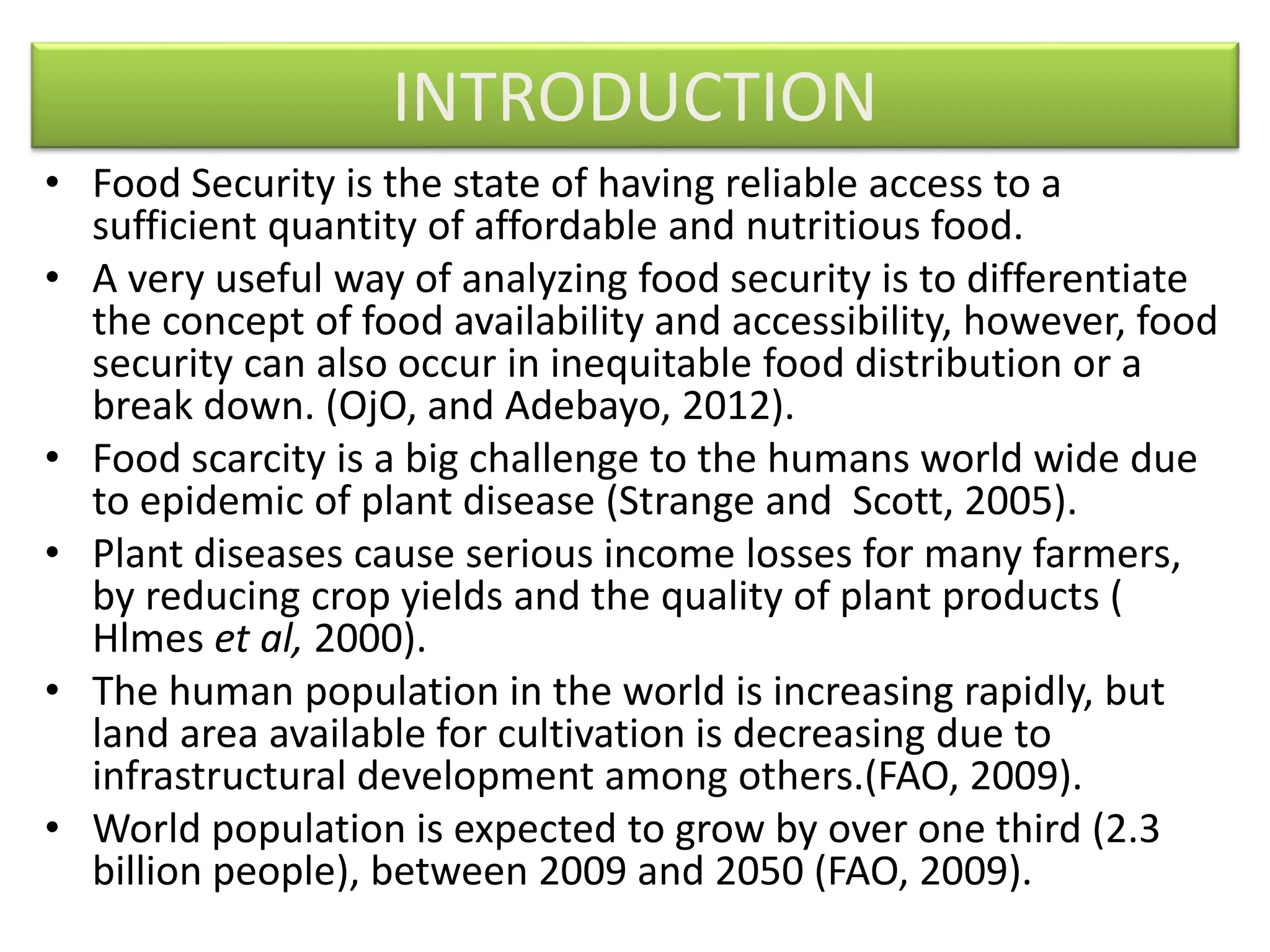
INTRODUCTION
• Food Security is the state of having reliable access to a
sufficient quantity of affordable and nutritious food.
• A very useful way of analyzing food security is to differentiate
the concept of food availability and accessibility, however, food
security can also occur in inequitable food distribution or a
break down. (OjO, and Adebayo, 2012).
• Food scarcity is a big challenge to the humans world wide due
to epidemic of plant disease (Strange and Scott, 2005).
• Plant diseases cause serious income losses for many farmers,
by reducing crop yields and the quality of plant products (
Hlmes et al, 2000).
• The human population in the world is increasing rapidly, but
land area available for cultivation is decreasing due to
infrastructural development among others.(FAO, 2009).
• World population is expected to grow by over one third (2.3
billion people), between 2009 and 2050 (FAO, 2009).
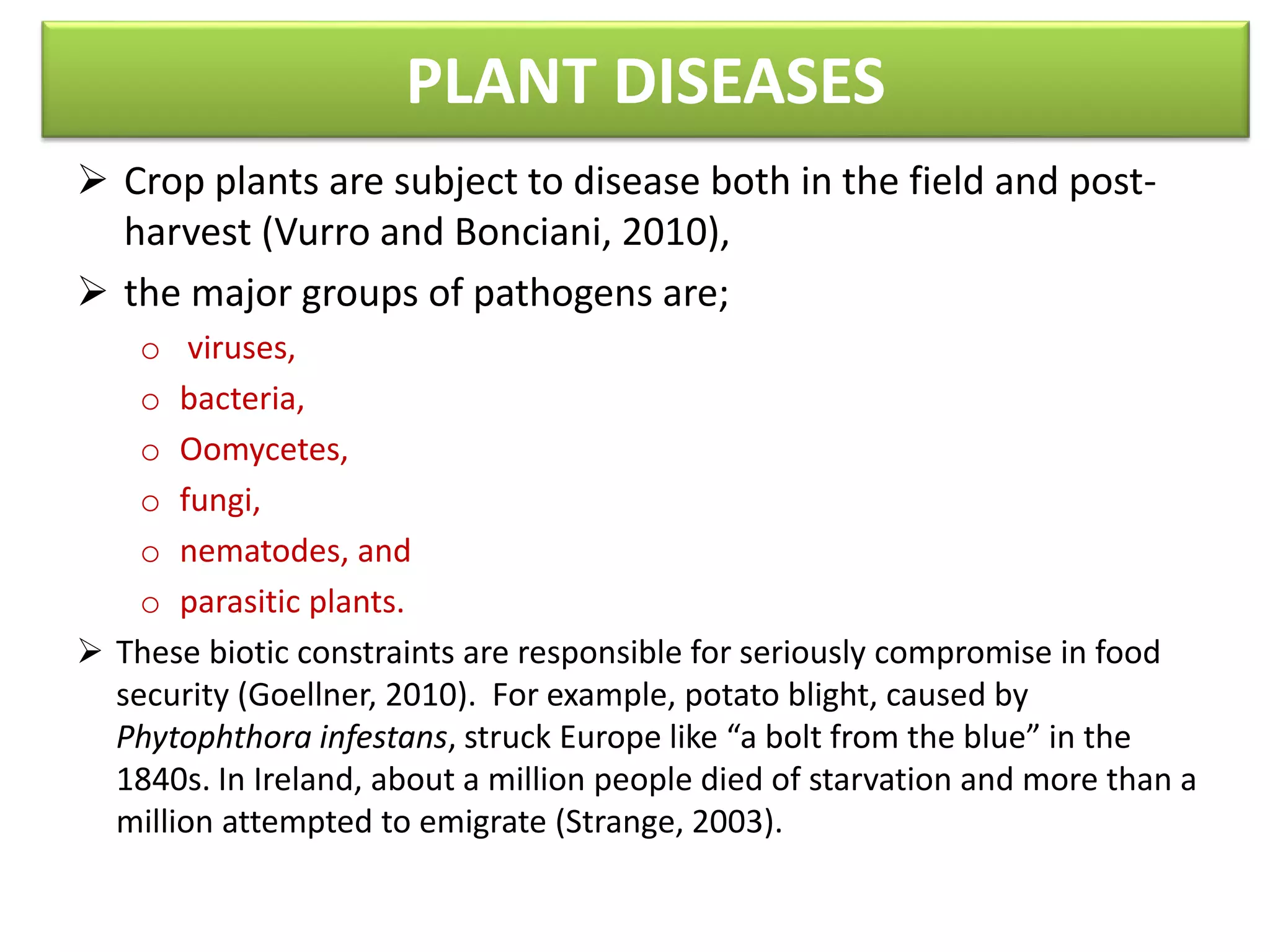
PLANT DISEASES
 Crop plants are subject to disease both in the field and post-
harvest (Vurro and Bonciani, 2010),
 the major groups of pathogens are;
o viruses,
o bacteria,
o Oomycetes,
o fungi,
o nematodes, and
o parasitic plants.
 These biotic constraints are responsible for seriously compromise in food
security (Goellner, 2010). For example, potato blight, caused by
Phytophthora infestans, struck Europe like “a bolt from the blue” in the
1840s. In Ireland, about a million people died of starvation and more than a
million attempted to emigrate (Strange, 2003).
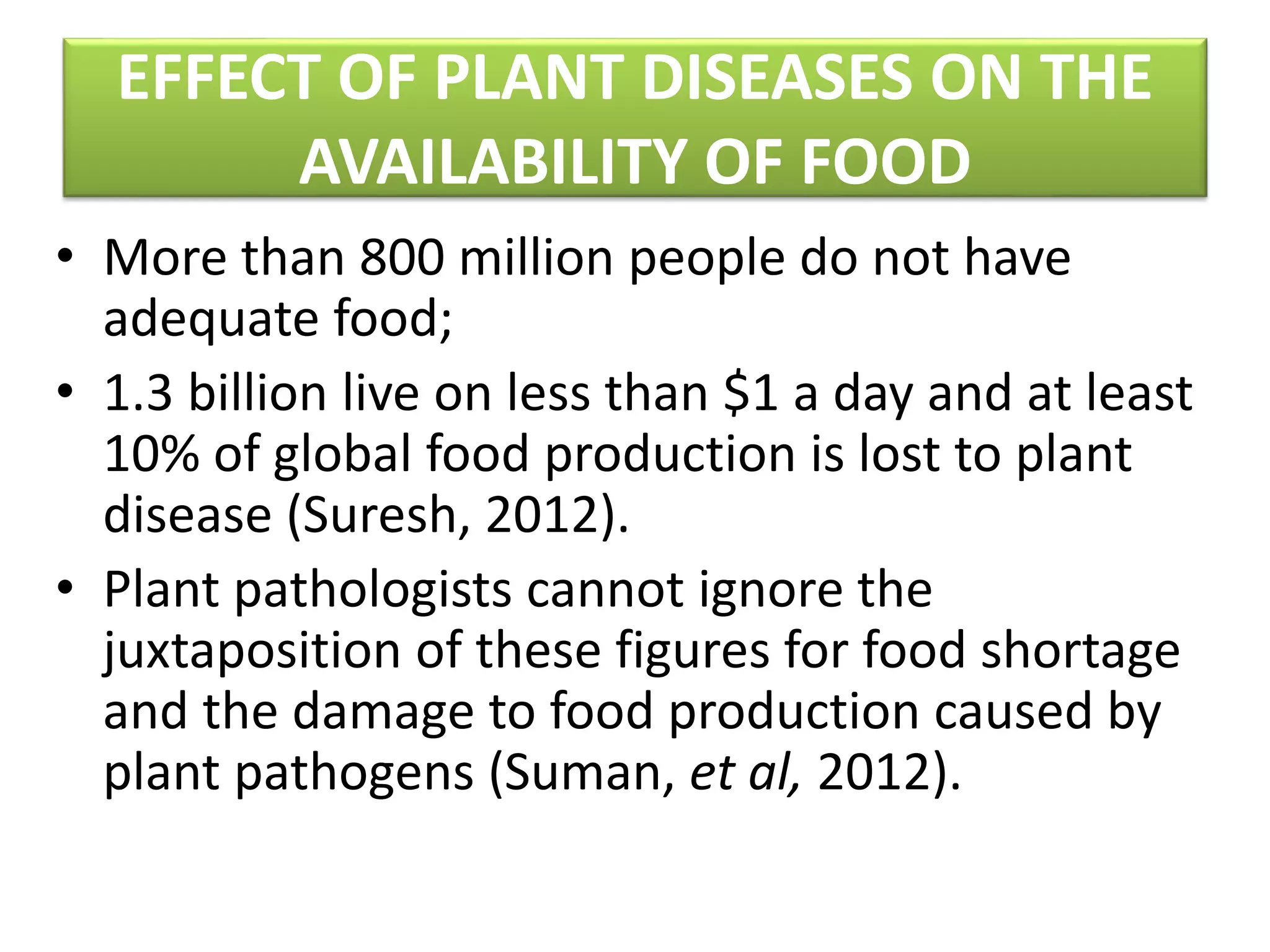
EFFECT OF PLANT DISEASES ON THE
AVAILABILITY OF FOOD
• More than 800 million people do not have
adequate food;
• 1.3 billion live on less than $1 a day and at least
10% of global food production is lost to plant
disease (Suresh, 2012).
• Plant pathologists cannot ignore the
juxtaposition of these figures for food shortage
and the damage to food production caused by
plant pathogens (Suman, et al, 2012).
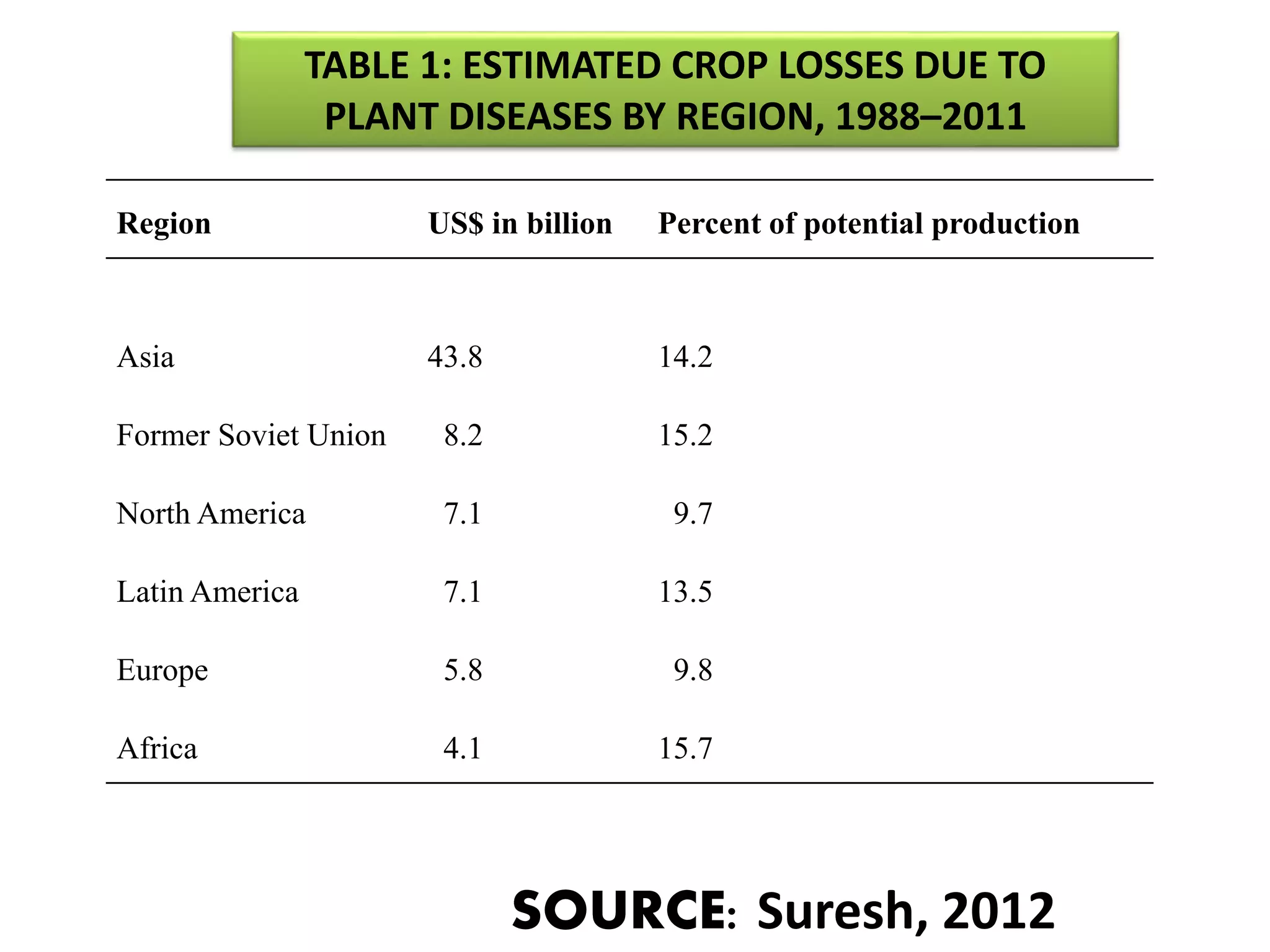
Region US$ in billion Percent of potential production
Asia 43.8 14.2
Former Soviet Union 8.2 15.2
North America 7.1 9.7
Latin America 7.1 13.5
Europe 5.8 9.8
Africa 4.1 15.7
TABLE 1: ESTIMATED CROP LOSSES DUE TO
PLANT DISEASES BY REGION, 1988–2011
SOURCE: Suresh, 2012
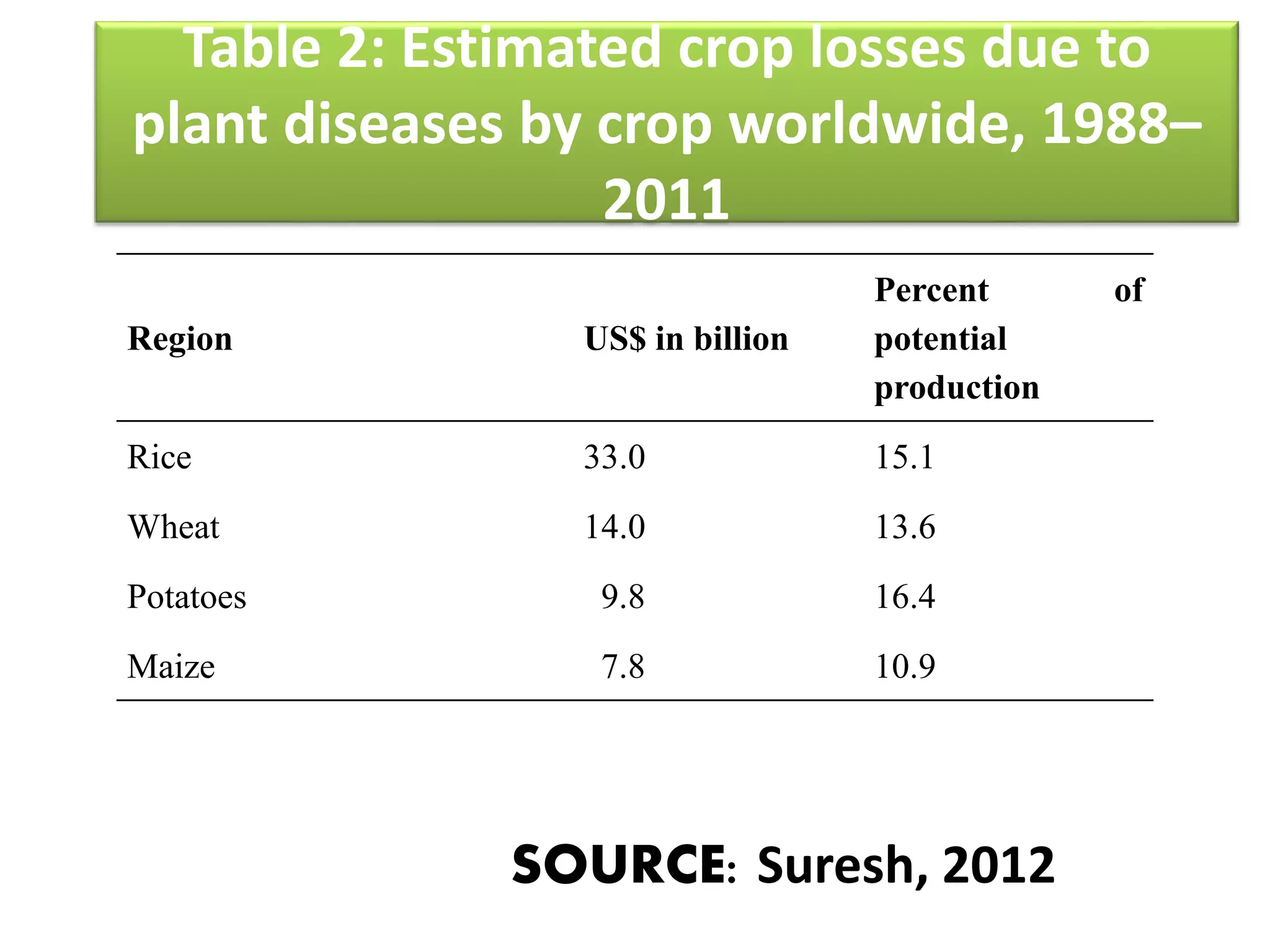
Table 2: Estimated crop losses due to
plant diseases by crop worldwide, 1988–
2011
Region US$ in billion
Percent of
potential
production
Rice 33.0 15.1
Wheat 14.0 13.6
Potatoes 9.8 16.4
Maize 7.8 10.9
SOURCE: Suresh, 2012
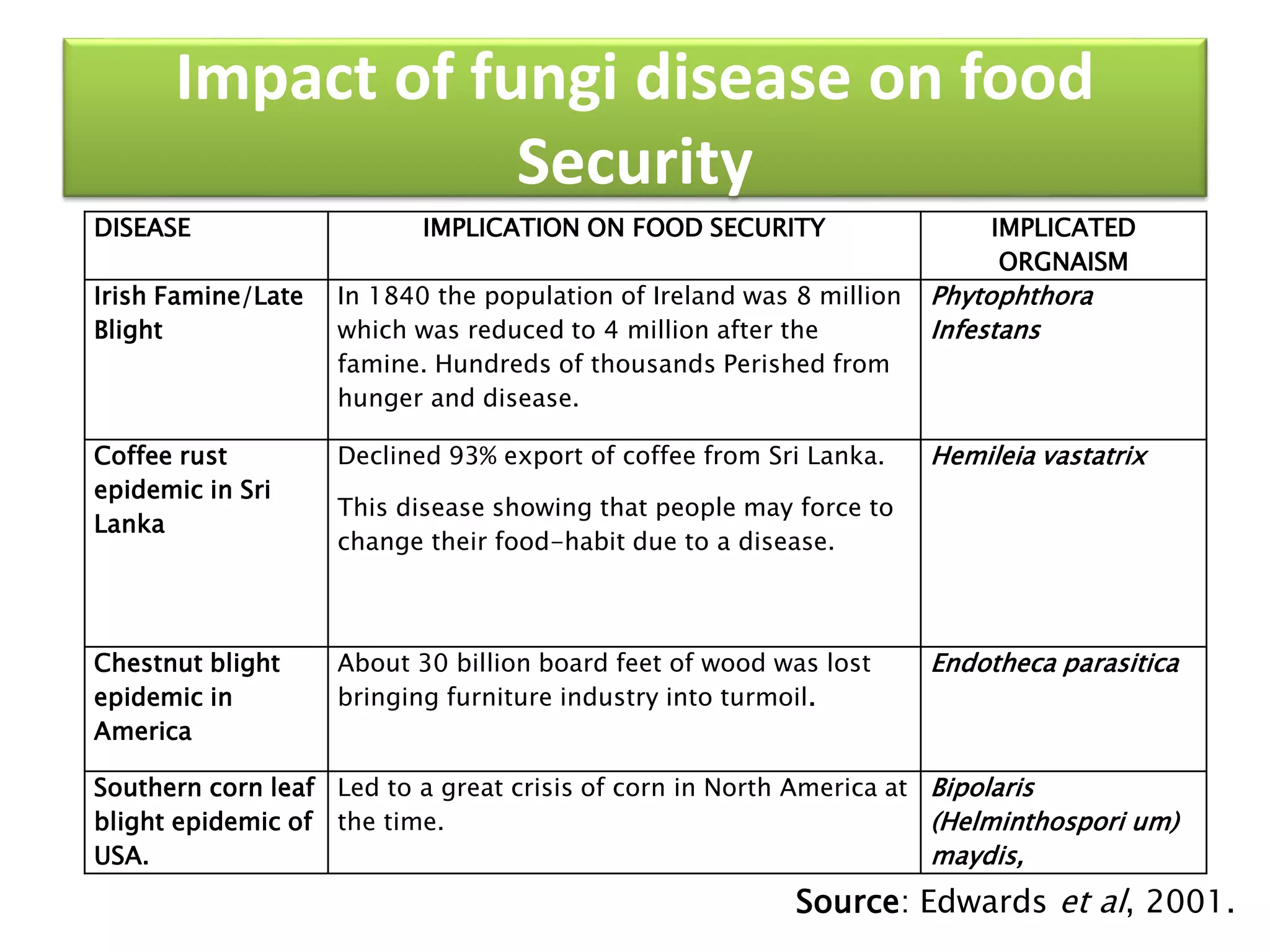
Impact of fungi disease on food
Security
DISEASE IMPLICATION ON FOOD SECURITY IMPLICATED
ORGNAISM
Irish Famine/Late
Blight
In 1840 the population of Ireland was 8 million
which was reduced to 4 million after the
famine. Hundreds of thousands Perished from
hunger and disease.
Phytophthora
Infestans
Coffee rust
epidemic in Sri
Lanka
Declined 93% export of coffee from Sri Lanka.
This disease showing that people may force to
change their food-habit due to a disease.
Hemileia vastatrix
Chestnut blight
epidemic in
America
About 30 billion board feet of wood was lost
bringing furniture industry into turmoil.
Endotheca parasitica
Southern corn leaf
blight epidemic of
USA.
Led to a great crisis of corn in North America at
the time.
Bipolaris
(Helminthospori um)
maydis,
Source: Edwards et al, 2001.
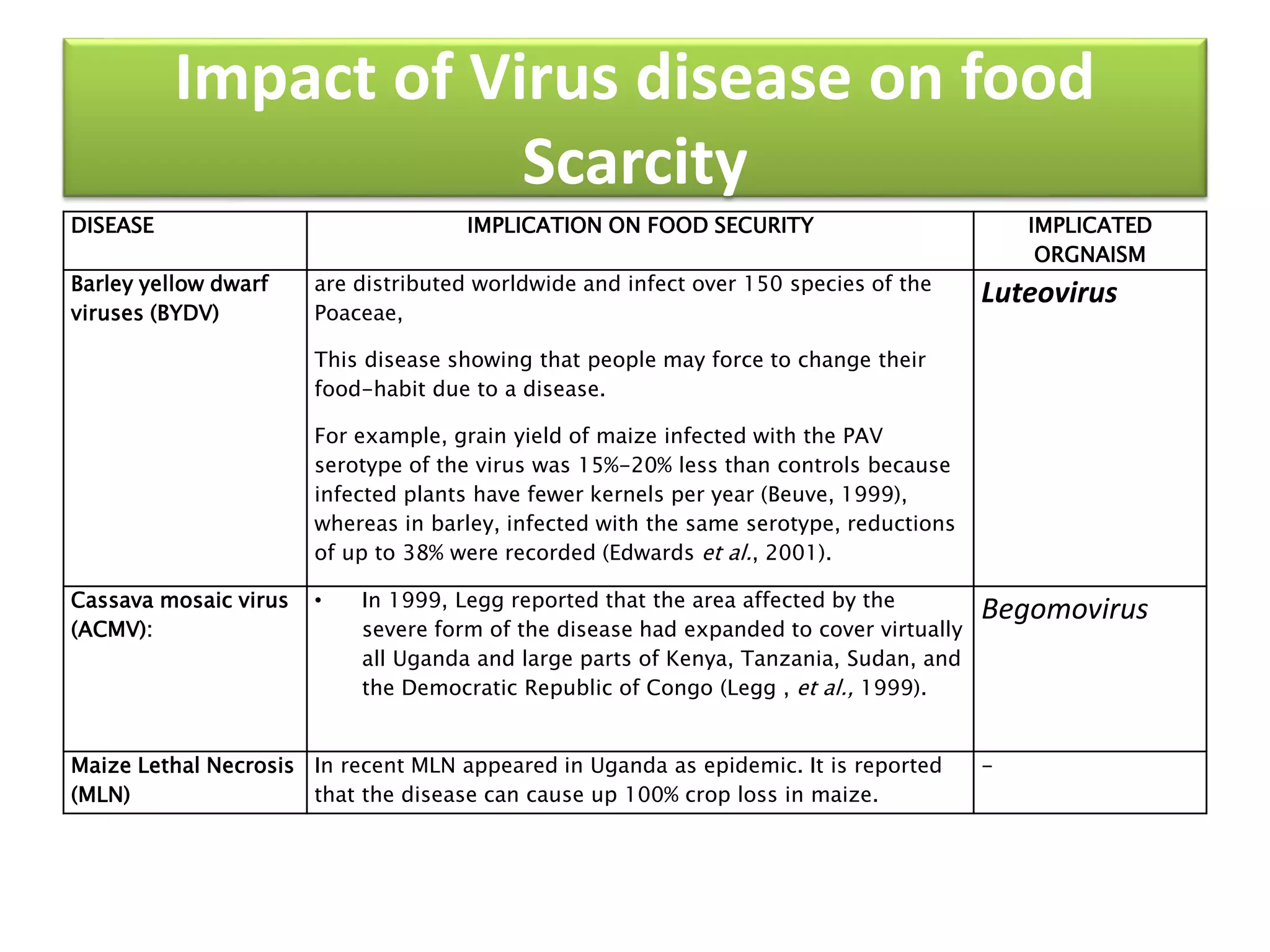
Impact of Virus disease on food
Scarcity
DISEASE IMPLICATION ON FOOD SECURITY IMPLICATED
ORGNAISM
Barley yellow dwarf
viruses (BYDV)
are distributed worldwide and infect over 150 species of the
Poaceae,
This disease showing that people may force to change their
food-habit due to a disease.
For example, grain yield of maize infected with the PAV
serotype of the virus was 15%-20% less than controls because
infected plants have fewer kernels per year (Beuve, 1999),
whereas in barley, infected with the same serotype, reductions
of up to 38% were recorded (Edwards et al., 2001).
Luteovirus
Cassava mosaic virus
(ACMV):
• In 1999, Legg reported that the area affected by the
severe form of the disease had expanded to cover virtually
all Uganda and large parts of Kenya, Tanzania, Sudan, and
the Democratic Republic of Congo (Legg , et al., 1999).
Begomovirus
Maize Lethal Necrosis
(MLN)
In recent MLN appeared in Uganda as epidemic. It is reported
that the disease can cause up 100% crop loss in maize.
-
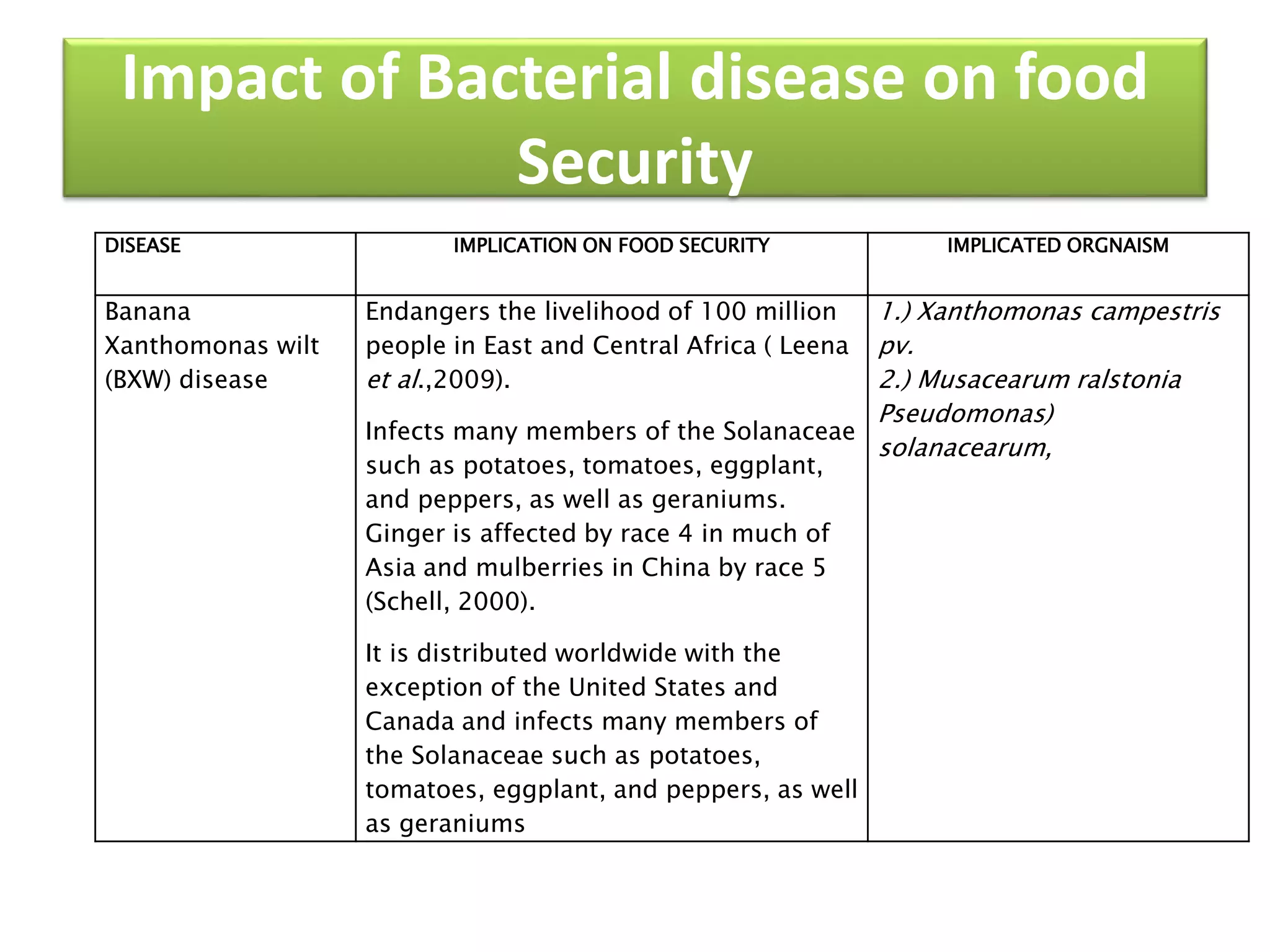
Impact of Bacterial disease on food
Security
DISEASE IMPLICATION ON FOOD SECURITY IMPLICATED ORGNAISM
Banana
Xanthomonas wilt
(BXW) disease
Endangers the livelihood of 100 million
people in East and Central Africa ( Leena
et al.,2009).
Infects many members of the Solanaceae
such as potatoes, tomatoes, eggplant,
and peppers, as well as geraniums.
Ginger is affected by race 4 in much of
Asia and mulberries in China by race 5
(Schell, 2000).
It is distributed worldwide with the
exception of the United States and
Canada and infects many members of
the Solanaceae such as potatoes,
tomatoes, eggplant, and peppers, as well
as geraniums
1.) Xanthomonas campestris
pv.
2.) Musacearum ralstonia
Pseudomonas)
solanacearum,
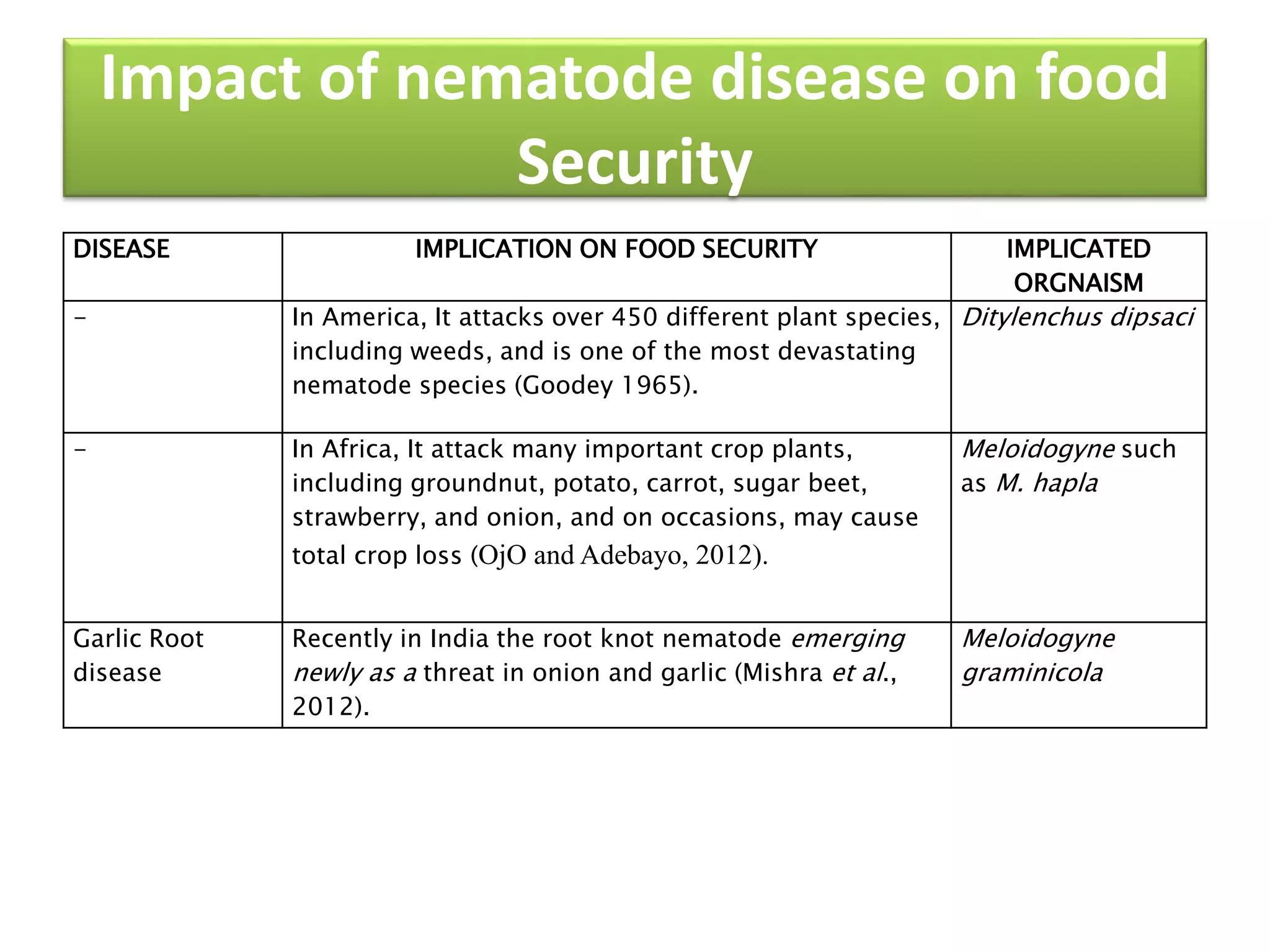
Impact of nematode disease on food
Security
DISEASE IMPLICATION ON FOOD SECURITY IMPLICATED
ORGNAISM
- In America, It attacks over 450 different plant species,
including weeds, and is one of the most devastating
nematode species (Goodey 1965).
Ditylenchus dipsaci
- In Africa, It attack many important crop plants,
including groundnut, potato, carrot, sugar beet,
strawberry, and onion, and on occasions, may cause
total crop loss (OjO and Adebayo, 2012).
Meloidogyne such
as M. hapla
Garlic Root
disease
Recently in India the root knot nematode emerging
newly as a threat in onion and garlic (Mishra et al.,
2012).
Meloidogyne
graminicola
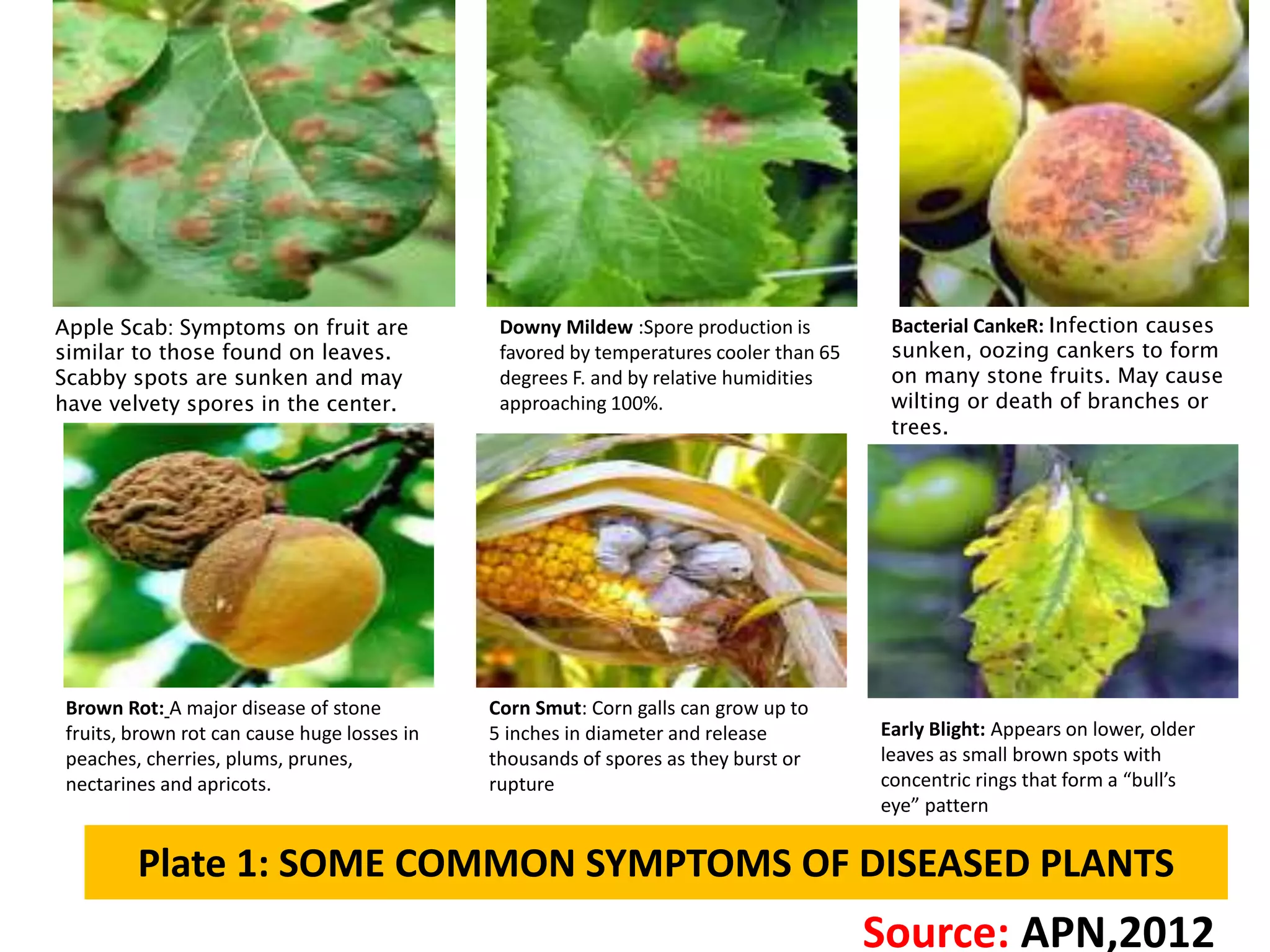
Plate 1: SOME COMMON SYMPTOMS OF DISEASED PLANTS
Source: APN,2012
Apple Scab: Symptoms on fruit are
similar to those found on leaves.
Scabby spots are sunken and may
have velvety spores in the center.
Bacterial CankeR: Infection causes
sunken, oozing cankers to form
on many stone fruits. May cause
wilting or death of branches or
trees.
Brown Rot: A major disease of stone
fruits, brown rot can cause huge losses in
peaches, cherries, plums, prunes,
nectarines and apricots.
Corn Smut: Corn galls can grow up to
5 inches in diameter and release
thousands of spores as they burst or
rupture
Downy Mildew :Spore production is
favored by temperatures cooler than 65
degrees F. and by relative humidities
approaching 100%.
Early Blight: Appears on lower, older
leaves as small brown spots with
concentric rings that form a “bull’s
eye” pattern
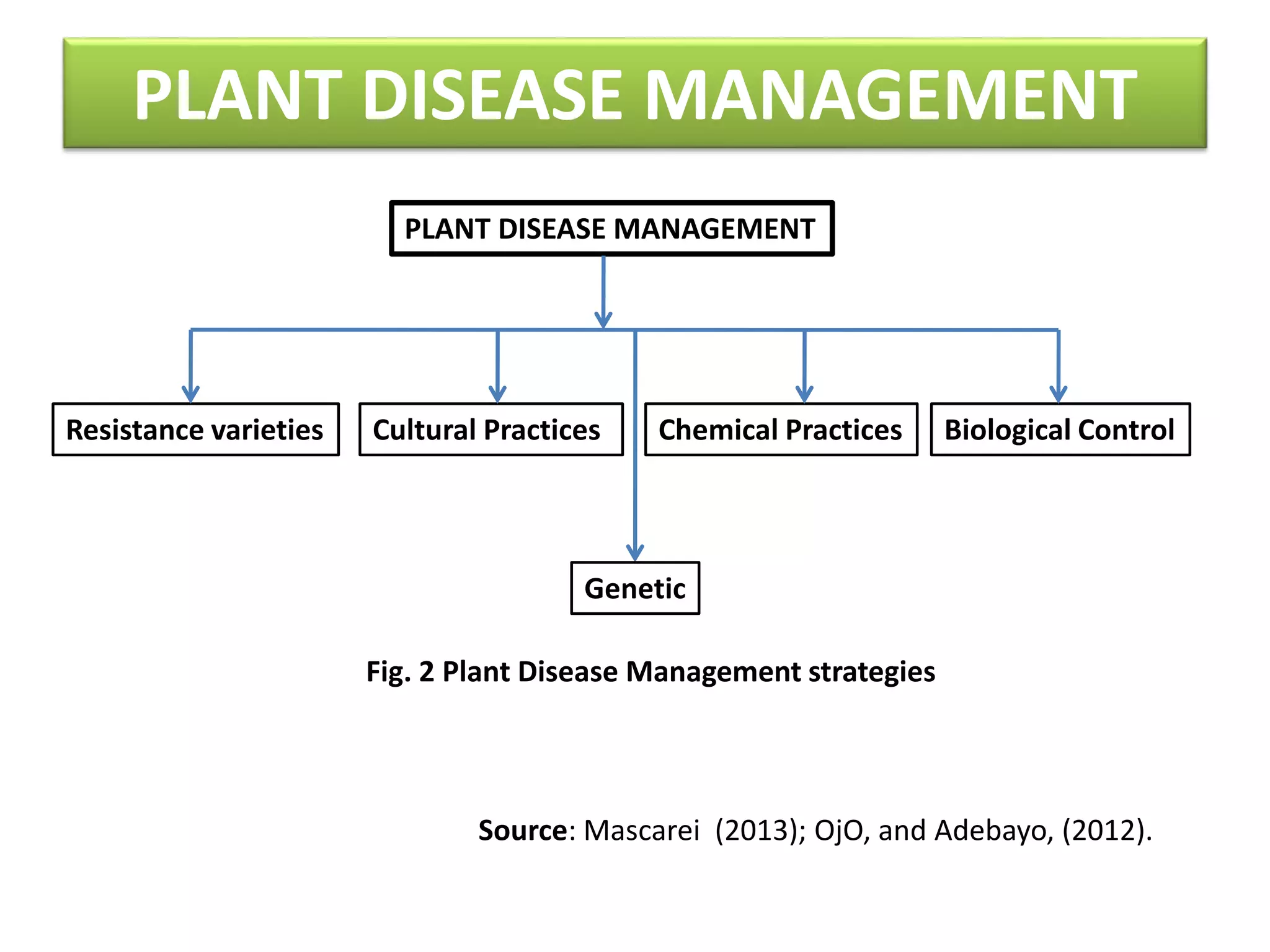
PLANT DISEASE MANAGEMENT
Resistance varieties
PLANT DISEASE MANAGEMENT
Cultural Practices Chemical Practices Biological Control
Genetic
Fig. 2 Plant Disease Management strategies
Source: Mascarei (2013); OjO, and Adebayo, (2012).
SUMMARY/CONCLUSION
• Global food security at present or in future can be achieved by
raising productivity especially in Africa and some parts of Asia
where yields remain low compared to developed countries.
• Plant disease issues are often ignored despite their impact on
livelihoods and food security. area for improving productivity is
to lose less of what we produce, by systematic monitoring of
plant health problems in the field and the collection of reliable
field data.
• Reducing these losses should have a big impact on productivity
and consequently on food security.
• At the political level, there is a need to acknowledge that plant
diseases threaten our food availability and to devote adequate
resources to their control.
Nsendino presentation

Nsendino presentation

  • 1.
    A SEMINAR PRESENTATION ON THE IMPACTOF PLANT DISEASE ON FOOD SECURITY PRESENTED BY UKPONG, NSENDINO RICHARD MATRIC NO: 10/91077 DEPARTMENT OF BOTANY, UNIVERSITY OF CALABAR SUPERVISOR: DR. E.J. UMANA CO-ORDINATOR: DR. A.A. MARKSON AUGUST, 2015 Design and Implemented by Bhalodew Contact Global Limited www.balodew.com.ng FULL WORK AVIALABLE
  • 2.
    INTRODUCTION • Food Securityis the state of having reliable access to a sufficient quantity of affordable and nutritious food. • A very useful way of analyzing food security is to differentiate the concept of food availability and accessibility, however, food security can also occur in inequitable food distribution or a break down. (OjO, and Adebayo, 2012). • Food scarcity is a big challenge to the humans world wide due to epidemic of plant disease (Strange and Scott, 2005). • Plant diseases cause serious income losses for many farmers, by reducing crop yields and the quality of plant products ( Hlmes et al, 2000). • The human population in the world is increasing rapidly, but land area available for cultivation is decreasing due to infrastructural development among others.(FAO, 2009). • World population is expected to grow by over one third (2.3 billion people), between 2009 and 2050 (FAO, 2009).
  • 3.
    PLANT DISEASES  Cropplants are subject to disease both in the field and post- harvest (Vurro and Bonciani, 2010),  the major groups of pathogens are; o viruses, o bacteria, o Oomycetes, o fungi, o nematodes, and o parasitic plants.  These biotic constraints are responsible for seriously compromise in food security (Goellner, 2010). For example, potato blight, caused by Phytophthora infestans, struck Europe like “a bolt from the blue” in the 1840s. In Ireland, about a million people died of starvation and more than a million attempted to emigrate (Strange, 2003).
  • 4.
    EFFECT OF PLANTDISEASES ON THE AVAILABILITY OF FOOD • More than 800 million people do not have adequate food; • 1.3 billion live on less than $1 a day and at least 10% of global food production is lost to plant disease (Suresh, 2012). • Plant pathologists cannot ignore the juxtaposition of these figures for food shortage and the damage to food production caused by plant pathogens (Suman, et al, 2012).
  • 5.
    Region US$ inbillion Percent of potential production Asia 43.8 14.2 Former Soviet Union 8.2 15.2 North America 7.1 9.7 Latin America 7.1 13.5 Europe 5.8 9.8 Africa 4.1 15.7 TABLE 1: ESTIMATED CROP LOSSES DUE TO PLANT DISEASES BY REGION, 1988–2011 SOURCE: Suresh, 2012
  • 6.
    Table 2: Estimatedcrop losses due to plant diseases by crop worldwide, 1988– 2011 Region US$ in billion Percent of potential production Rice 33.0 15.1 Wheat 14.0 13.6 Potatoes 9.8 16.4 Maize 7.8 10.9 SOURCE: Suresh, 2012
  • 7.
    Impact of fungidisease on food Security DISEASE IMPLICATION ON FOOD SECURITY IMPLICATED ORGNAISM Irish Famine/Late Blight In 1840 the population of Ireland was 8 million which was reduced to 4 million after the famine. Hundreds of thousands Perished from hunger and disease. Phytophthora Infestans Coffee rust epidemic in Sri Lanka Declined 93% export of coffee from Sri Lanka. This disease showing that people may force to change their food-habit due to a disease. Hemileia vastatrix Chestnut blight epidemic in America About 30 billion board feet of wood was lost bringing furniture industry into turmoil. Endotheca parasitica Southern corn leaf blight epidemic of USA. Led to a great crisis of corn in North America at the time. Bipolaris (Helminthospori um) maydis, Source: Edwards et al, 2001.
  • 8.
    Impact of Virusdisease on food Scarcity DISEASE IMPLICATION ON FOOD SECURITY IMPLICATED ORGNAISM Barley yellow dwarf viruses (BYDV) are distributed worldwide and infect over 150 species of the Poaceae, This disease showing that people may force to change their food-habit due to a disease. For example, grain yield of maize infected with the PAV serotype of the virus was 15%-20% less than controls because infected plants have fewer kernels per year (Beuve, 1999), whereas in barley, infected with the same serotype, reductions of up to 38% were recorded (Edwards et al., 2001). Luteovirus Cassava mosaic virus (ACMV): • In 1999, Legg reported that the area affected by the severe form of the disease had expanded to cover virtually all Uganda and large parts of Kenya, Tanzania, Sudan, and the Democratic Republic of Congo (Legg , et al., 1999). Begomovirus Maize Lethal Necrosis (MLN) In recent MLN appeared in Uganda as epidemic. It is reported that the disease can cause up 100% crop loss in maize. -
  • 9.
    Impact of Bacterialdisease on food Security DISEASE IMPLICATION ON FOOD SECURITY IMPLICATED ORGNAISM Banana Xanthomonas wilt (BXW) disease Endangers the livelihood of 100 million people in East and Central Africa ( Leena et al.,2009). Infects many members of the Solanaceae such as potatoes, tomatoes, eggplant, and peppers, as well as geraniums. Ginger is affected by race 4 in much of Asia and mulberries in China by race 5 (Schell, 2000). It is distributed worldwide with the exception of the United States and Canada and infects many members of the Solanaceae such as potatoes, tomatoes, eggplant, and peppers, as well as geraniums 1.) Xanthomonas campestris pv. 2.) Musacearum ralstonia Pseudomonas) solanacearum,
  • 10.
    Impact of nematodedisease on food Security DISEASE IMPLICATION ON FOOD SECURITY IMPLICATED ORGNAISM - In America, It attacks over 450 different plant species, including weeds, and is one of the most devastating nematode species (Goodey 1965). Ditylenchus dipsaci - In Africa, It attack many important crop plants, including groundnut, potato, carrot, sugar beet, strawberry, and onion, and on occasions, may cause total crop loss (OjO and Adebayo, 2012). Meloidogyne such as M. hapla Garlic Root disease Recently in India the root knot nematode emerging newly as a threat in onion and garlic (Mishra et al., 2012). Meloidogyne graminicola
  • 11.
    Plate 1: SOMECOMMON SYMPTOMS OF DISEASED PLANTS Source: APN,2012 Apple Scab: Symptoms on fruit are similar to those found on leaves. Scabby spots are sunken and may have velvety spores in the center. Bacterial CankeR: Infection causes sunken, oozing cankers to form on many stone fruits. May cause wilting or death of branches or trees. Brown Rot: A major disease of stone fruits, brown rot can cause huge losses in peaches, cherries, plums, prunes, nectarines and apricots. Corn Smut: Corn galls can grow up to 5 inches in diameter and release thousands of spores as they burst or rupture Downy Mildew :Spore production is favored by temperatures cooler than 65 degrees F. and by relative humidities approaching 100%. Early Blight: Appears on lower, older leaves as small brown spots with concentric rings that form a “bull’s eye” pattern
  • 12.
    PLANT DISEASE MANAGEMENT Resistancevarieties PLANT DISEASE MANAGEMENT Cultural Practices Chemical Practices Biological Control Genetic Fig. 2 Plant Disease Management strategies Source: Mascarei (2013); OjO, and Adebayo, (2012).
  • 13.
    SUMMARY/CONCLUSION • Global foodsecurity at present or in future can be achieved by raising productivity especially in Africa and some parts of Asia where yields remain low compared to developed countries. • Plant disease issues are often ignored despite their impact on livelihoods and food security. area for improving productivity is to lose less of what we produce, by systematic monitoring of plant health problems in the field and the collection of reliable field data. • Reducing these losses should have a big impact on productivity and consequently on food security. • At the political level, there is a need to acknowledge that plant diseases threaten our food availability and to devote adequate resources to their control.