Hyo Eun Lee
Network Science Lab
Dept. of Biotechnology
The Catholic University of Korea
E-mail: gydnsml@gmail.com
2023.09.04
AAAI 2019
1
 Introduction
• Background
• Present Work
• Propose
 Related work
• Kernel Methods
• GNN Methods
2
1. Introduction
Background
• Graph structures are used in a variety of domains and applications
• Thus, it is important to develop machine learning techniques
that can utilize the information embedded in the graph structure and feature information of nodes and edges
• Recently, methods using graph kernel-based and graph neural network algorithms were proposed
3
1. Introduction
Background
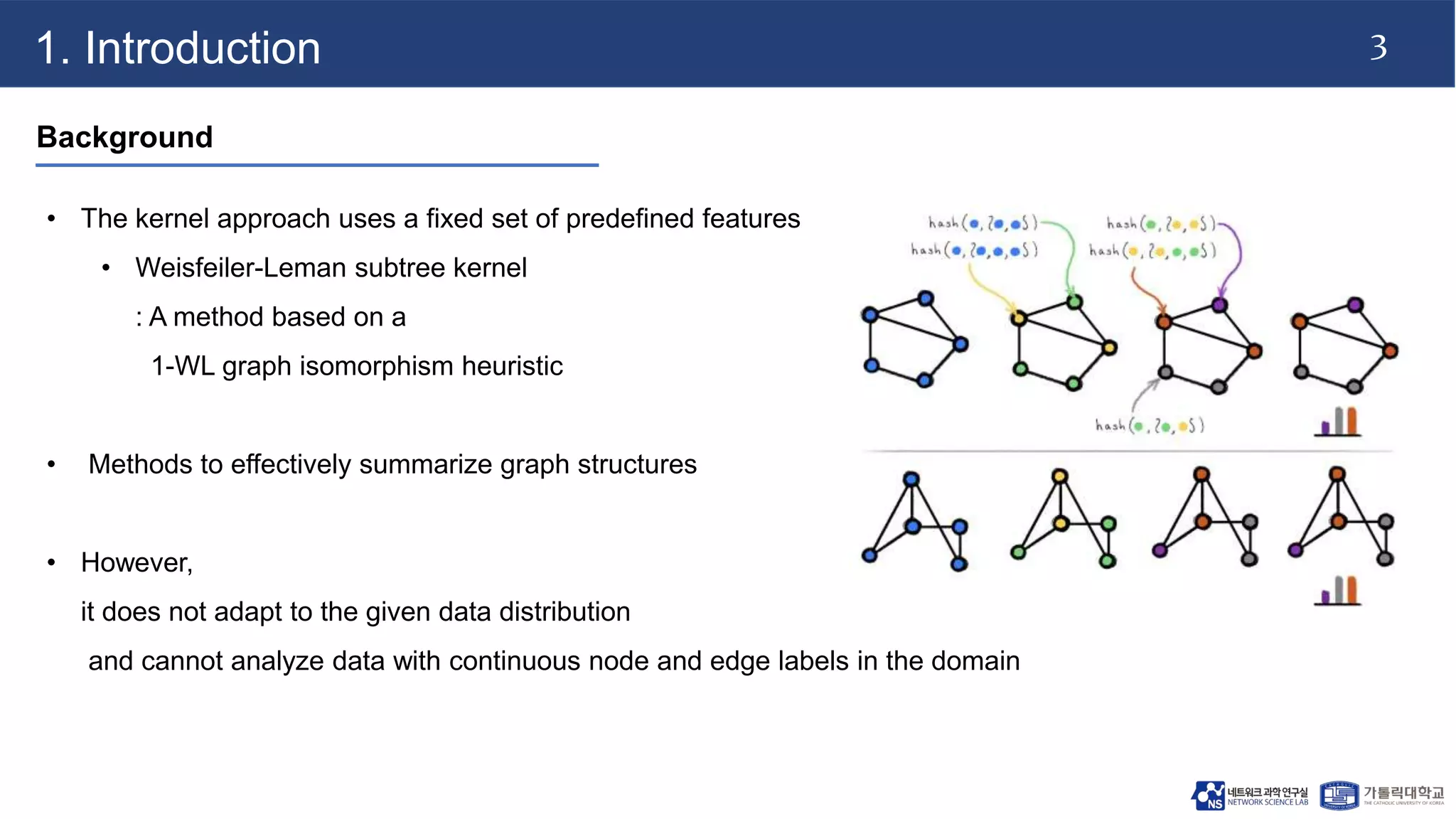
• The kernel approach uses a fixed set of predefined features
• Weisfeiler-Leman subtree kernel
: A method based on a
1-WL graph isomorphism heuristic
• Methods to effectively summarize graph structures
• However,
it does not adapt to the given data distribution
and cannot analyze data with continuous node and edge labels in the domain
4
1. Introduction
Background
• Graph neural network methods solve the limitations of graph kernel methods
using a machine learning framework
• Aggregate using a neural network with node neighbors using feature vectors
• A method that neuralizes the 1-WL algorithm
• GNN framework has the characteristics of message passing in terms of aggregating and forwarding local
neighborhood information.
• So it can be trained in an end-to-end method, allowing for adaptability and better generalization
5
1. Introduction
Present Work
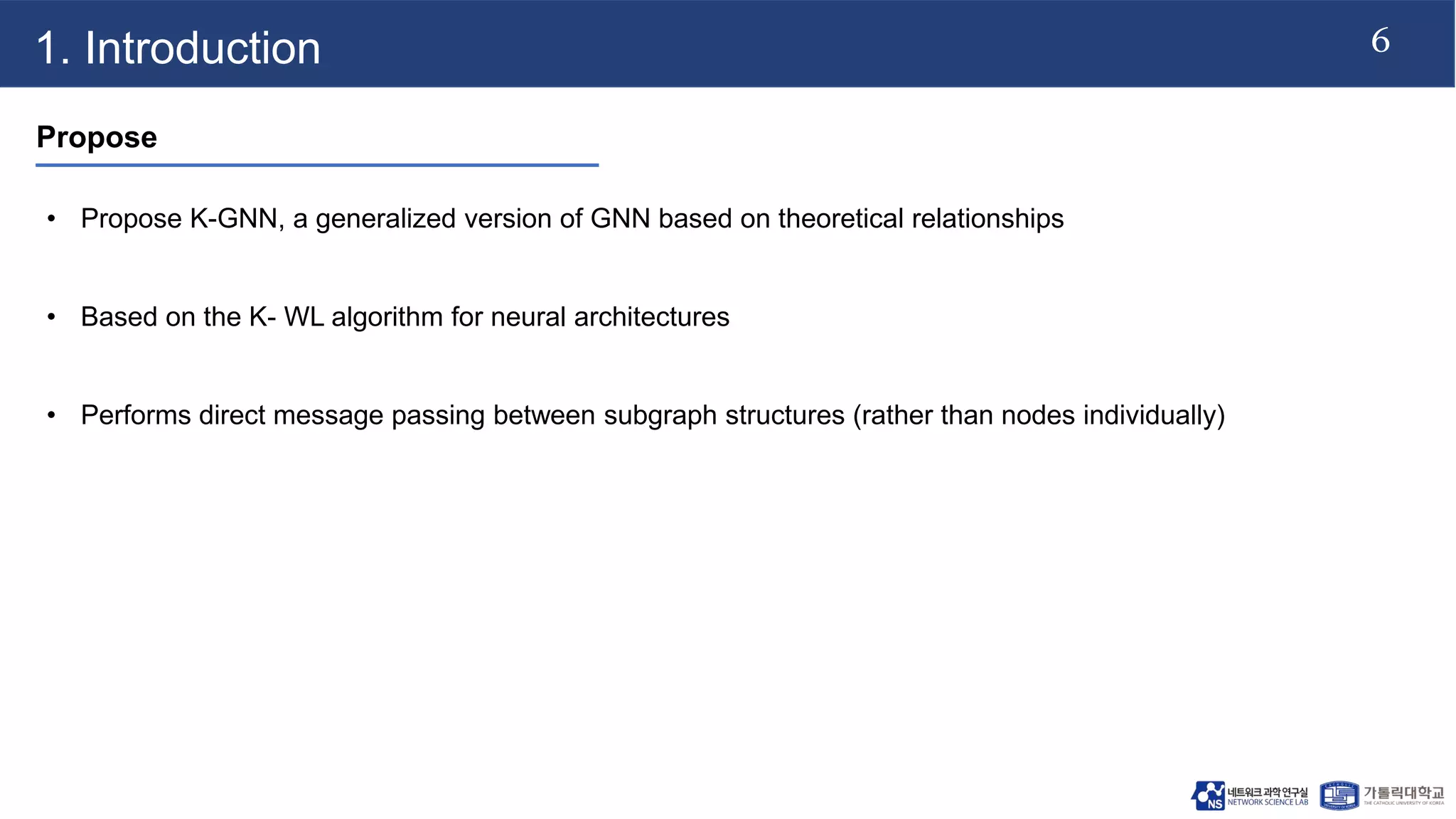
• Theoretical study of the relationship between GNNs and kernels
• GNNs cannot be more powerful than 1-WL in distinguishing between nonisomorphic graphs
→ but can have the same level of representation power with proper parameter initialization
6
1. Introduction
Propose
• Propose K-GNN, a generalized version of GNN based on theoretical relationships
• Based on the K- WL algorithm for neural architectures
• Performs direct message passing between subgraph structures (rather than nodes individually)
7
1. Introduction
Summary
• Show that GNNs cannot be more powerful than 1-WL in distinguishing between isomorphic (sub)graphs
(which was not clear in theory)
, and that GNNs have the same ability as 1-WL, assuming proper parameter initialization
• Propose k-GNNs and "1-k-GNNs", a hierarchical version of k-GNNs
, a model that can capture the fine and continuous structure of graphs and the relationship
• Experimentally prove
that higher-order graph characterization is important for graph classification and regression tasks
8
2. Related work
Kernel Methods
• Mapping a Graph to Hilbert Space
• One of the most common methods used in supervised learning
• Important early research: random walk-based kernels, shortest path-based kernels
• Recent research focuses on scalability and avoiding gram matrix computation
9
2. Related work
Kernel Methods
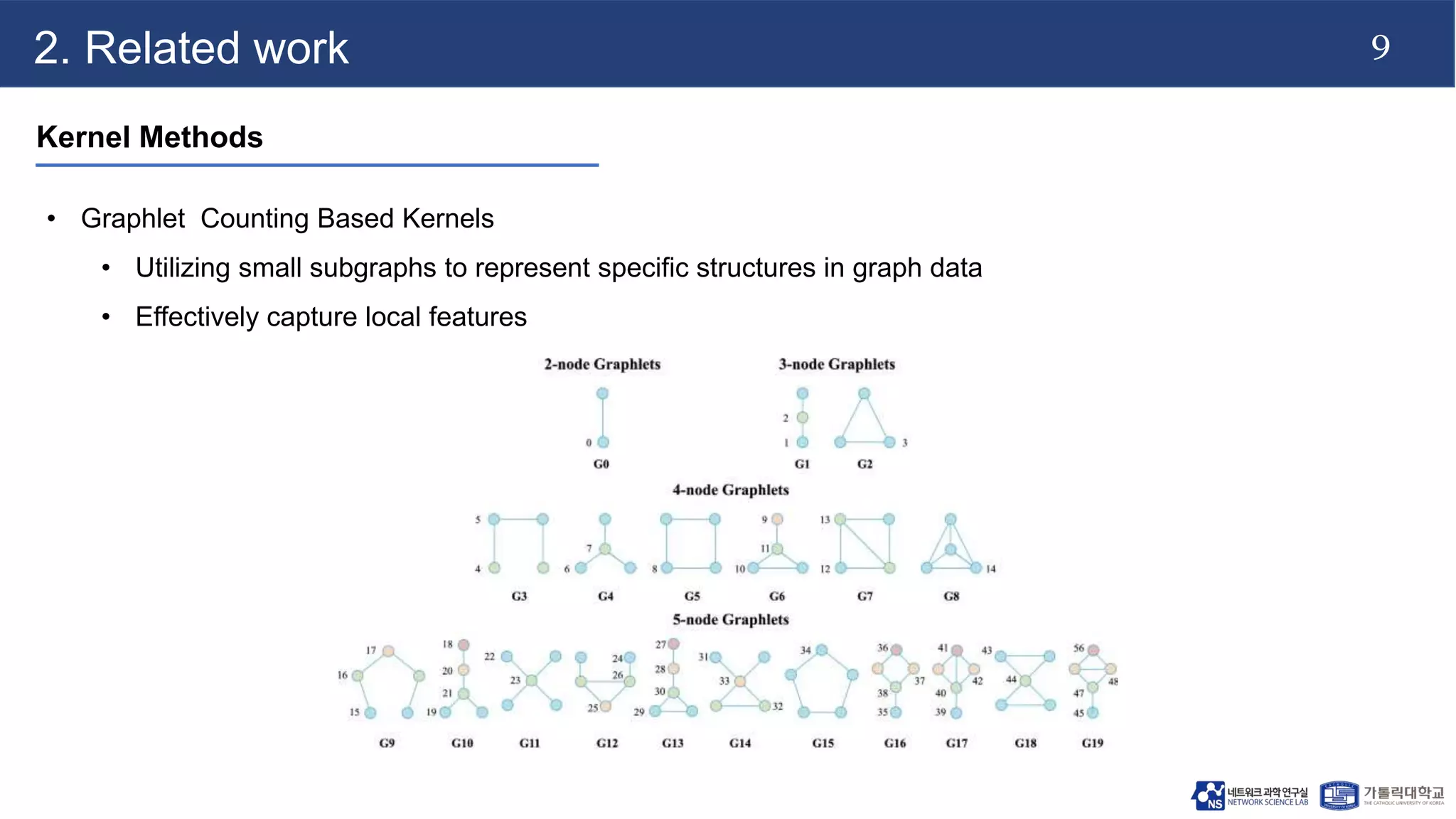
• Graphlet Counting Based Kernels
• Utilizing small subgraphs to represent specific structures in graph data
• Effectively capture local features
10
2. Related work
Kernel Methods
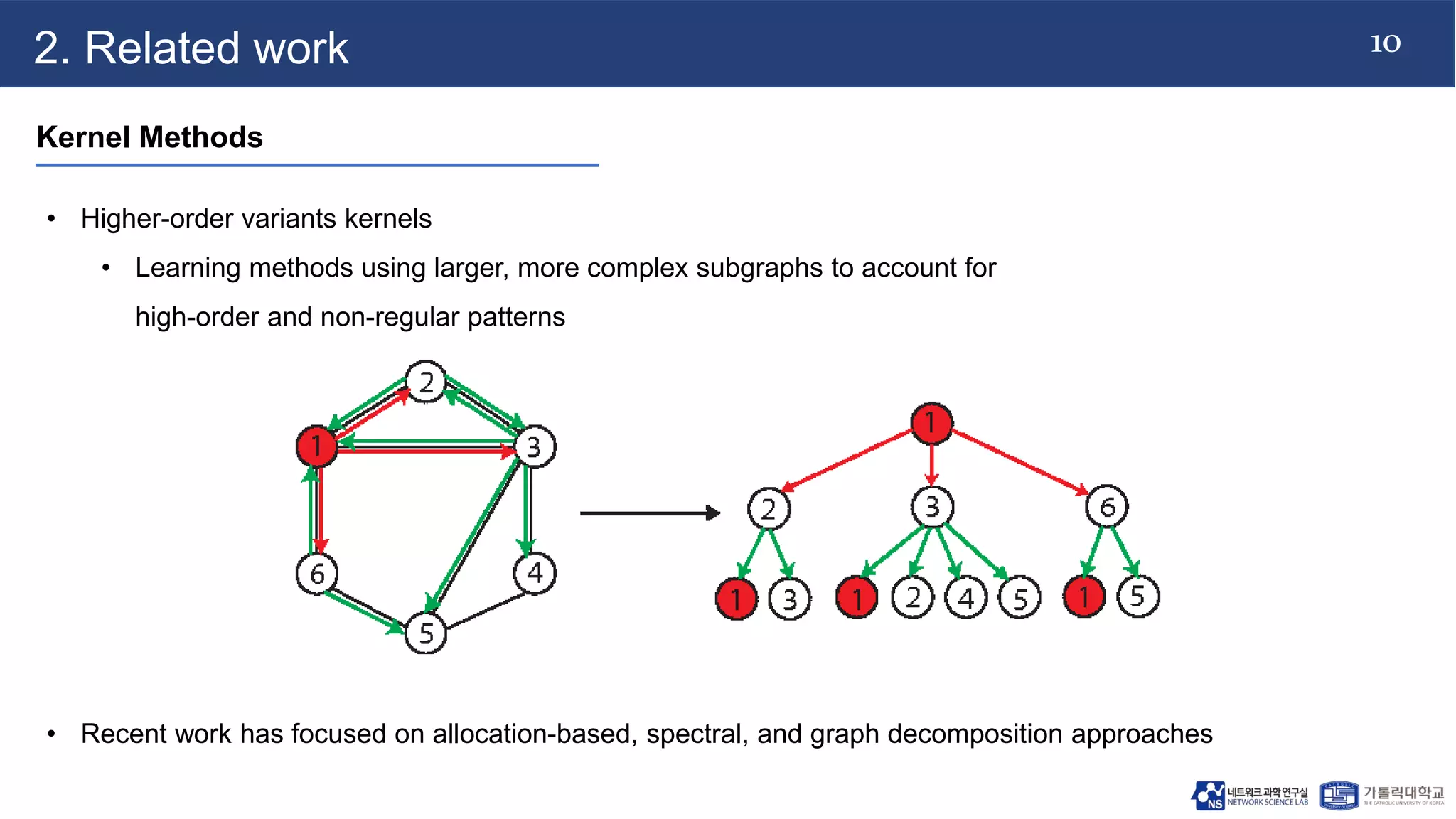
• Higher-order variants kernels
• Learning methods using larger, more complex subgraphs to account for
high-order and non-regular patterns
• Recent work has focused on allocation-based, spectral, and graph decomposition approaches
11
2. Related work
GNN Methods
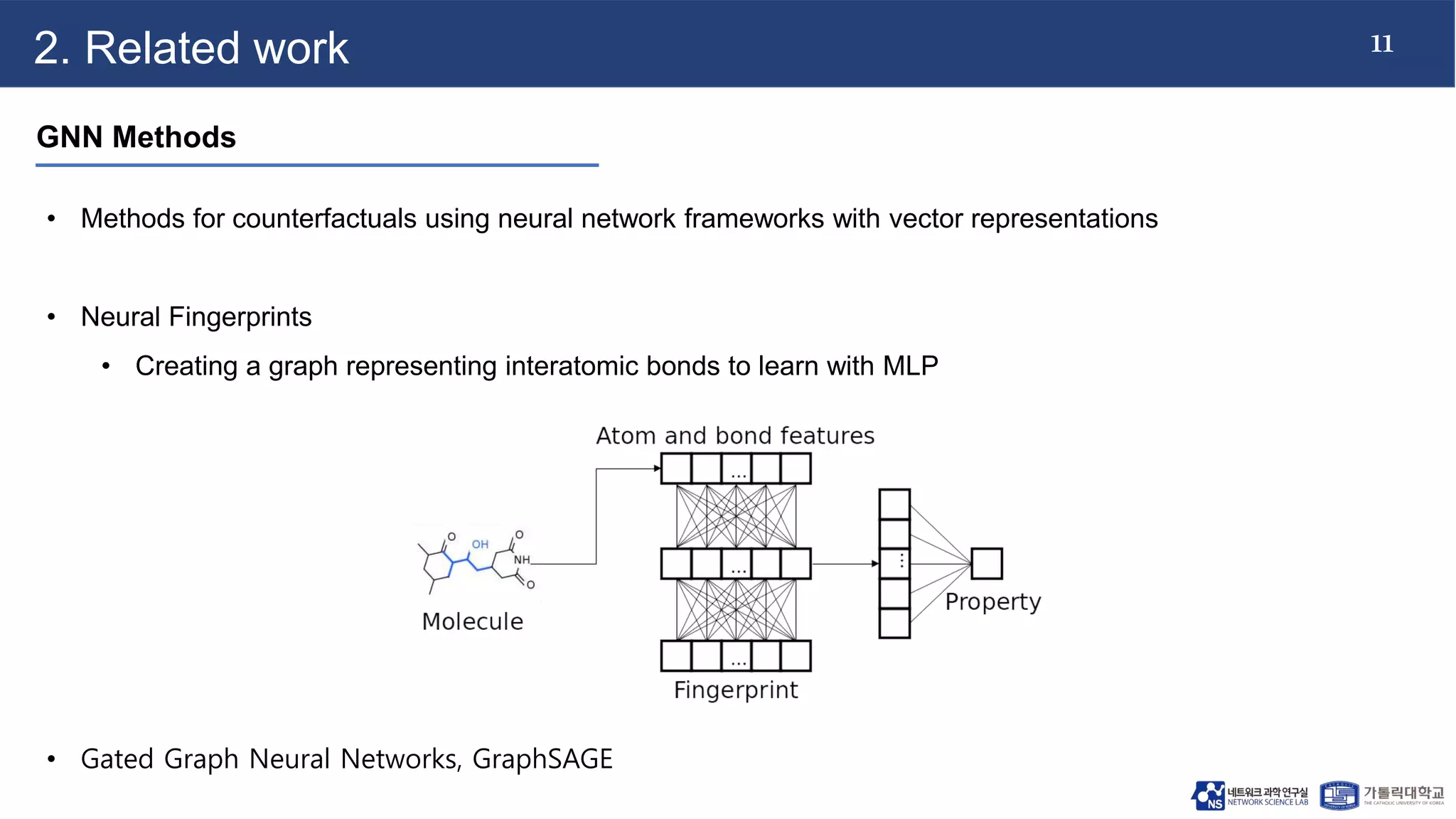
• Methods for counterfactuals using neural network frameworks with vector representations
• Neural Fingerprints
• Creating a graph representing interatomic bonds to learn with MLP
• Gated Graph Neural Networks, GraphSAGE
12
2. Related work
GNN Methods
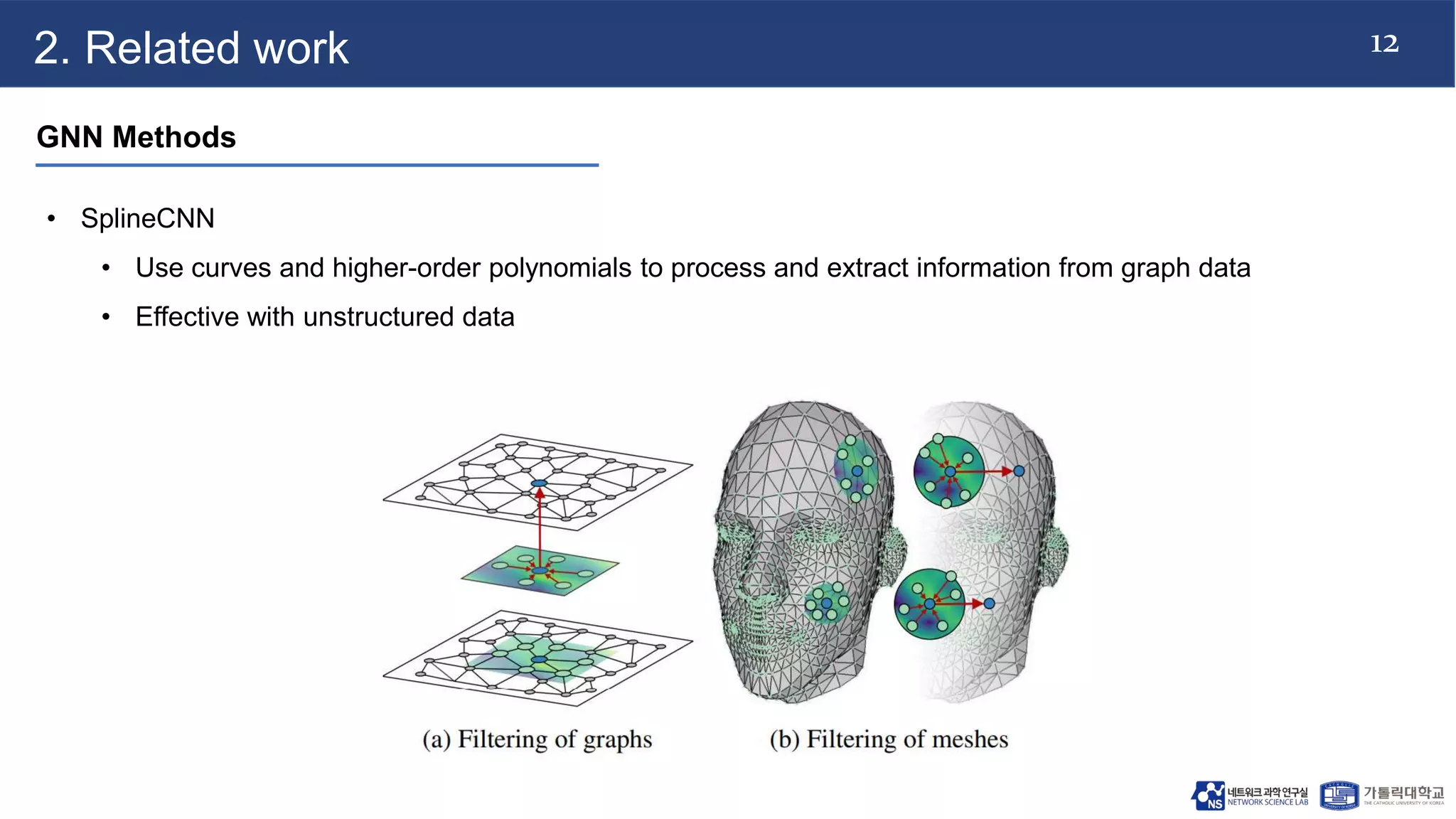
• SplineCNN
• Use curves and higher-order polynomials to process and extract information from graph data
• Effective with unstructured data
NS-CUK Seminar: H.E.Lee,  Review on "Weisfeiler and Leman Go Neural: Higher-Order Graph Neural Networks", AAAI 2019

NS-CUK Seminar: H.E.Lee, Review on "Weisfeiler and Leman Go Neural: Higher-Order Graph Neural Networks", AAAI 2019

  • 1.
    Hyo Eun Lee NetworkScience Lab Dept. of Biotechnology The Catholic University of Korea E-mail: gydnsml@gmail.com 2023.09.04 AAAI 2019
  • 2.
    1  Introduction • Background •Present Work • Propose  Related work • Kernel Methods • GNN Methods
  • 3.
    2 1. Introduction Background • Graphstructures are used in a variety of domains and applications • Thus, it is important to develop machine learning techniques that can utilize the information embedded in the graph structure and feature information of nodes and edges • Recently, methods using graph kernel-based and graph neural network algorithms were proposed
  • 4.
    3 1. Introduction Background • Thekernel approach uses a fixed set of predefined features • Weisfeiler-Leman subtree kernel : A method based on a 1-WL graph isomorphism heuristic • Methods to effectively summarize graph structures • However, it does not adapt to the given data distribution and cannot analyze data with continuous node and edge labels in the domain
  • 5.
    4 1. Introduction Background • Graphneural network methods solve the limitations of graph kernel methods using a machine learning framework • Aggregate using a neural network with node neighbors using feature vectors • A method that neuralizes the 1-WL algorithm • GNN framework has the characteristics of message passing in terms of aggregating and forwarding local neighborhood information. • So it can be trained in an end-to-end method, allowing for adaptability and better generalization
  • 6.
    5 1. Introduction Present Work •Theoretical study of the relationship between GNNs and kernels • GNNs cannot be more powerful than 1-WL in distinguishing between nonisomorphic graphs → but can have the same level of representation power with proper parameter initialization
  • 7.
    6 1. Introduction Propose • ProposeK-GNN, a generalized version of GNN based on theoretical relationships • Based on the K- WL algorithm for neural architectures • Performs direct message passing between subgraph structures (rather than nodes individually)
  • 8.
    7 1. Introduction Summary • Showthat GNNs cannot be more powerful than 1-WL in distinguishing between isomorphic (sub)graphs (which was not clear in theory) , and that GNNs have the same ability as 1-WL, assuming proper parameter initialization • Propose k-GNNs and "1-k-GNNs", a hierarchical version of k-GNNs , a model that can capture the fine and continuous structure of graphs and the relationship • Experimentally prove that higher-order graph characterization is important for graph classification and regression tasks
  • 9.
    8 2. Related work KernelMethods • Mapping a Graph to Hilbert Space • One of the most common methods used in supervised learning • Important early research: random walk-based kernels, shortest path-based kernels • Recent research focuses on scalability and avoiding gram matrix computation
  • 10.
    9 2. Related work KernelMethods • Graphlet Counting Based Kernels • Utilizing small subgraphs to represent specific structures in graph data • Effectively capture local features
  • 11.
    10 2. Related work KernelMethods • Higher-order variants kernels • Learning methods using larger, more complex subgraphs to account for high-order and non-regular patterns • Recent work has focused on allocation-based, spectral, and graph decomposition approaches
  • 12.
    11 2. Related work GNNMethods • Methods for counterfactuals using neural network frameworks with vector representations • Neural Fingerprints • Creating a graph representing interatomic bonds to learn with MLP • Gated Graph Neural Networks, GraphSAGE
  • 13.
    12 2. Related work GNNMethods • SplineCNN • Use curves and higher-order polynomials to process and extract information from graph data • Effective with unstructured data

Editor's Notes

  • #6 - But s, GNNs have focused on empirical evaluations and analyses, and the theoretical benefits are not clear.
  • #8 Can capture more structural information at the node level
  • #9 Can capture more structural information at the node level