
August 2016
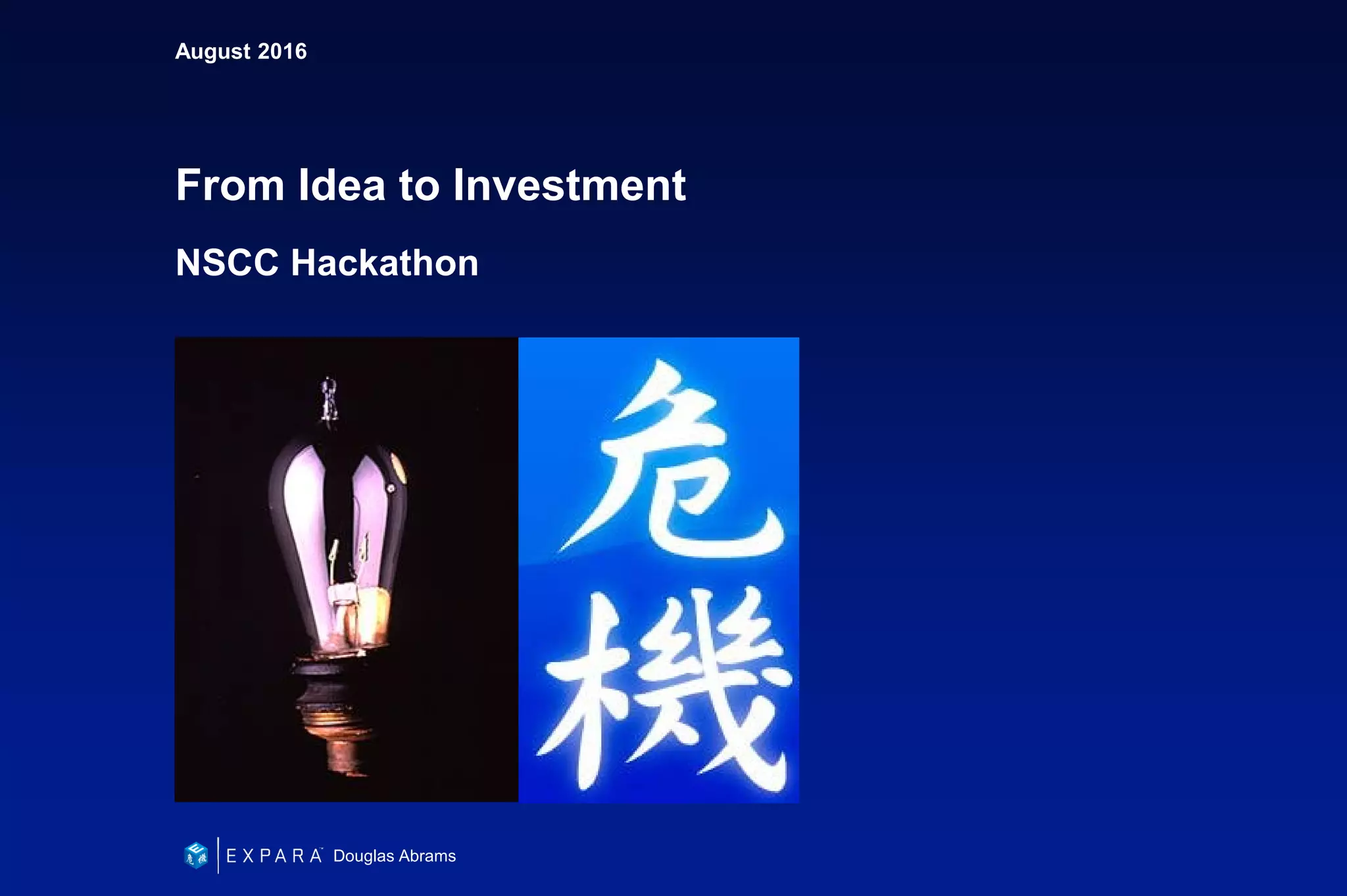
From Idea to Investment
NSCC Hackathon
Douglas Abrams
2
6XXXX
Douglas Abrams
About the facilitator
• Wharton MBA
• JP Morgan – Vice President - IB Technology, Global
Markets Internet Marketing
• Parallax Capital Management – Co-founder and
MD - Venture Capital
• Extream Ventures – Co-founder and MD - S$20
million VC fund
• Expara – Founder and MD - IDM Ventures
Incubator, fund, advisory, training
• NUS – Adjunct Associate Professor, Business
School, Entrepreneurship
• Sasin – Visiting Professor, Venture Capital
3
6XXXX
Douglas Abrams
From Idea to Investment
• Overview of business models
• Preparing the idea for investment
4
6XXXX
Douglas Abrams
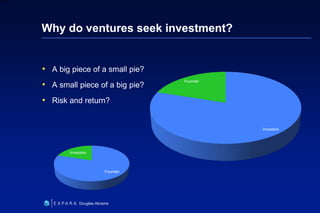
Why do ventures seek investment?
• A big piece of a small pie?
• A small piece of a big pie?
• Risk and return?
Founder
Investors
Investors
Founder
5
6XXXX
Douglas Abrams
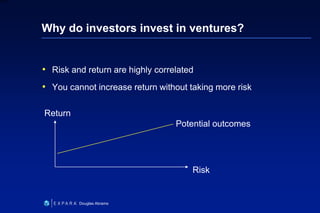
Why do investors invest in ventures?
• Risk and return are highly correlated
• You cannot increase return without taking more risk
Return
Risk
Potential outcomes
6
6XXXX
Douglas Abrams
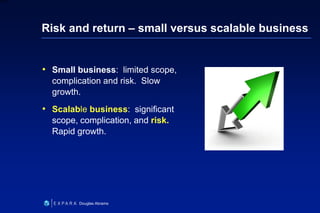
Risk and return – small versus scalable business
• Small business: limited scope,
complication and risk. Slow
growth.
• Scalable business: significant
scope, complication, and risk.
Rapid growth.
7
6XXXX
Douglas Abrams
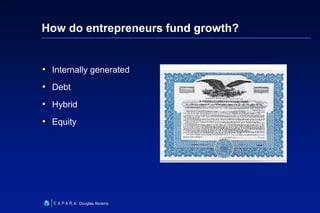
How do entrepreneurs fund growth?
• Internally generated
• Debt
• Hybrid
• Equity
8
6XXXX
Douglas Abrams
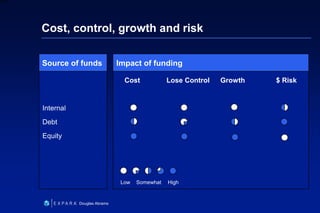
Cost, control, growth and risk
Internal
Debt
Equity
Source of funds
Cost Lose Control Growth $ Risk
Impact of funding
Low Somewhat High
9
6XXXX
Douglas Abrams
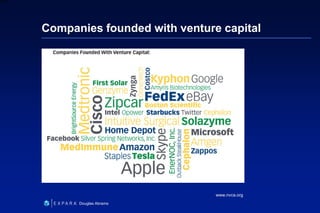
Companies founded with venture capital
www.nvca.org
10
6XXXX
Douglas Abrams
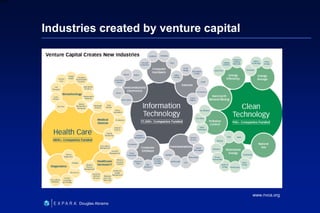
Industries created by venture capital
www.nvca.org
11
6XXXX
Douglas Abrams
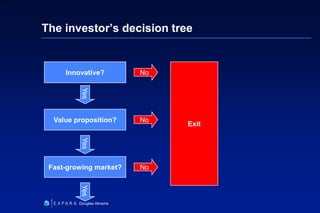
The investor’s decision tree
Innovative?
Yes
Value proposition?
Yes
Fast-growing market?
Yes
Exit
No
No
No
12
6XXXX
Douglas Abrams
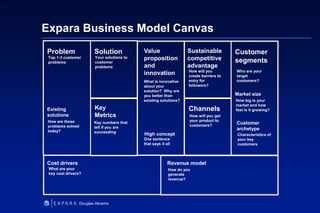
Problem Solution
Key
Metrics
Cost drivers Revenue model
Value
proposition
and
innovation
Sustainable
competitive
advantage
Channels
Customer
segments
Market size
Customer
archetype
High concept
Existing
solutions
Top 1-3 customer
problems
How are these
problems solved
today?
Your solutions to
customer
problems
Key numbers that
tell if you are
succeeding
What is innovative
about your
solution? Why are
you better than
existing solutions?
One sentence
that says it all
How will you
create barriers to
entry for
followers?
How will you get
your product to
customers?
Who are your
target
customers?
How big is your
market and how
fast is it growing?
Characteristics of
your key
customers
How do you
generate
revenue?
What are your
key cost drivers?
Expara Business Model Canvas
13
6XXXX
Douglas Abrams
Key elements for success
• Develop an innovative product – Innovation
• Solve a problem for customers – Value proposition
• Identify your customers – Market identification and analysis
• Reach your customers – Marketing strategy
• Compete when others enter - Sustainable competitive advantage
• Make money – Business model and financial plan
• Team – A team or B team
14
6XXXX
Douglas Abrams
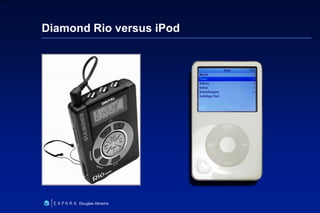
Diamond Rio versus iPod
15
6XXXX
Douglas Abrams
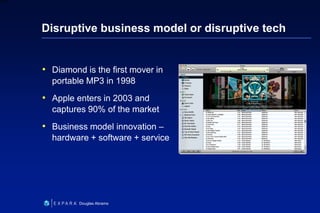
Disruptive business model or disruptive tech
• Diamond is the first mover in
portable MP3 in 1998
• Apple enters in 2003 and
captures 90% of the market
• Business model innovation –
hardware + software + service
16
6XXXX
Douglas Abrams
Business model innovation: Gillette to Google
• Gillette – razor and blade
• Southwest Airlines – budget airlines
• Dell Computer – mass customization
• Charles Schwab – on-line broker
• Amazon – ecommerce
• eBay – peer to peer marketplace
• Google – search-based advertising
17
6XXXX
Douglas Abrams
From Idea to Investment
• Overview of business models
• Preparing the idea for investment
18
6XXXX
Douglas Abrams
Questions to answer
• Innovation
• Value proposition
• Market identification and analysis
• Marketing strategy
• Sustainable competitive advantage
• Financials
19
6XXXX
Douglas Abrams
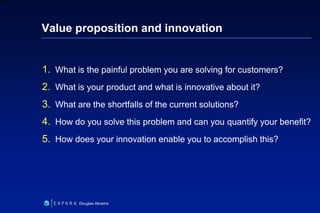
Value proposition and innovation
1. What is the painful problem you are solving for customers?
2. What is your product and what is innovative about it?
3. What are the shortfalls of the current solutions?
4. How do you solve this problem and can you quantify your benefit?
5. How does your innovation enable you to accomplish this?
20
6XXXX
Douglas Abrams
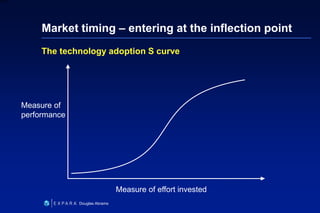
Market timing – entering at the inflection point
Measure of
performance
Measure of effort invested
The technology adoption S curve
21
6XXXX
Douglas Abrams
Types of markets
• Existing markets
• Re-segmented markets/niche market
• New market
• Clone market
22
6XXXX
Douglas Abrams
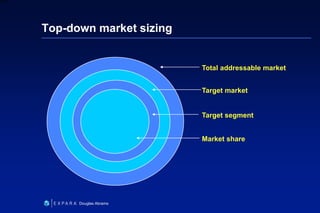
Top-down market sizing
Total addressable market
Target market
Target segment
Market share
23
6XXXX
Douglas Abrams
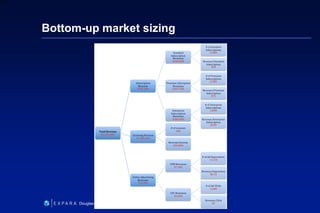
Bottom-up market sizing
24
6XXXX
Douglas Abrams
Market identification and analysis
1. What is your market type?
2. How big is your market and how fast is it growing?
– Top-down approach
– Bottom-up approach
3. What are trends in your market are favourable for you?
– Technological, social, demographic, regulatory
4. Who are your direct and indirect competitors?
25
6XXXX
Douglas Abrams
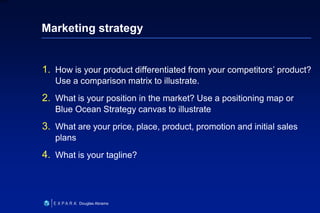
Marketing strategy
1. How is your product differentiated from your competitors’ product?
Use a comparison matrix to illustrate.
2. What is your position in the market? Use a positioning map or
Blue Ocean Strategy canvas to illustrate
3. What are your price, place, product, promotion and initial sales
plans
4. What is your tagline?
26
6XXXX
Douglas Abrams
Questions: creating and sustaining advantage
1. How is your product better than your competitors?
2. How are you positioned in your market?
3. What are your IP and competitive strategies to create barriers to
entry for small followers and large companies?
27
6XXXX
Douglas Abrams
In the financial section of the business plan
1. Business model
– Revenue model
– Cost structure
2. Financial projections
3. Valuation
4. Funding required and equity offered
5. Use of Proceeds
6. Exit Strategy and ROI
28
6XXXX
Douglas Abrams
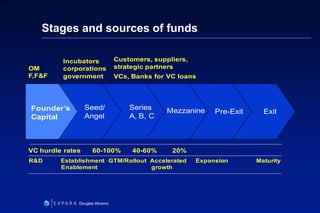
Stages and sources of funds
Founder’s
Capital
Seed/
Angel
Series
A, B, C
Mezzanine Pre-Exit Exit
VC hurdle rates 60-100% 40-60% 20%
OM
F,F&F
Incubators
corporations
government
Customers, suppliers,
strategic partners
VCs, Banks for VC loans
R&D Establishment GTM/Rollout Accelerated Expansion Maturity
Enablement growth
29
6XXXX
Douglas Abrams
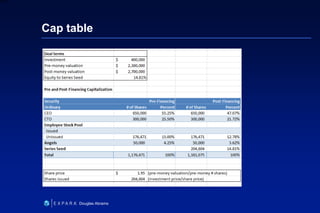
Cap table
30
6XXXX
Douglas Abrams
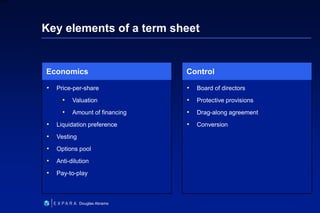
Key elements of a term sheet
• Board of directors
• Protective provisions
• Drag-along agreement
• Conversion
Control
• Price-per-share
• Valuation
• Amount of financing
• Liquidation preference
• Vesting
• Options pool
• Anti-dilution
• Pay-to-play
Economics
31
6XXXX
Douglas Abrams
Entrepreneur and investor communication
• Executive summary – 1-3 pages
• Business plan – 25 – 50 pages
• Investor presentation slides
• Verbal presentations to investors – informal and formal
32
6XXXX
Douglas Abrams
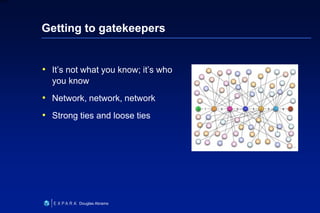
Getting to gatekeepers
• It’s not what you know; it’s who
you know
• Network, network, network
• Strong ties and loose ties
33
6XXXX
Douglas Abrams
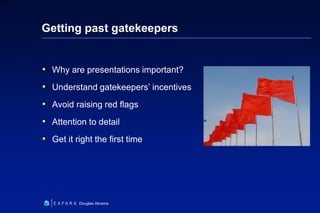
Getting past gatekeepers
• Why are presentations important?
• Understand gatekeepers’ incentives
• Avoid raising red flags
• Attention to detail
• Get it right the first time
34
6XXXX
Douglas Abrams
Effective presentations are simple
• Your message needs to be clear, concise and simple
• Clean visual design – avoid chart junk and “design-itis”
• On presentation slides, less is more – slides, bullet points, text
• Use meaningful titles
• Do not read your slides
35
6XXXX
Douglas Abrams
Practice and test
• Analyze the details of your presentation, then master those details
by practice, practice, practice.
• Arrive early and if you are using any technology, test it
• If you can not get in early, try to test the night before
• It is OK to be nervous before you begin
36
6XXXX
Douglas Abrams
Nailing the Q&A
• Audience has a chance to ask you about what is on their mind.
• Q&A is do or die time.
• Prepare for Q&A by studying your material in-depth
• Anticipate likely difficult questions and formulate answers
• Note questions you are asked and if you did not have a good
answer to a specific question, formulate one for next time.
• Don’t disagree - agree
37
6XXXX
Douglas Abrams
Contact us
• Douglas Abrams
• Expara Pte. Ltd.
• dka@expara.com
• www.expara.com
• 65-6323-3084, 65-9780-5381 (hp)
• Block 71 Ayer Rajah Crescent, #02-10/11 Singapore 139951

Nscc hackathon

  • 1.
    August 2016 From Ideato Investment NSCC Hackathon Douglas Abrams
  • 2.
    2 6XXXX Douglas Abrams About thefacilitator • Wharton MBA • JP Morgan – Vice President - IB Technology, Global Markets Internet Marketing • Parallax Capital Management – Co-founder and MD - Venture Capital • Extream Ventures – Co-founder and MD - S$20 million VC fund • Expara – Founder and MD - IDM Ventures Incubator, fund, advisory, training • NUS – Adjunct Associate Professor, Business School, Entrepreneurship • Sasin – Visiting Professor, Venture Capital
  • 3.
    3 6XXXX Douglas Abrams From Ideato Investment • Overview of business models • Preparing the idea for investment
  • 4.
    4 6XXXX Douglas Abrams Why doventures seek investment? • A big piece of a small pie? • A small piece of a big pie? • Risk and return? Founder Investors Investors Founder
  • 5.
    5 6XXXX Douglas Abrams Why doinvestors invest in ventures? • Risk and return are highly correlated • You cannot increase return without taking more risk Return Risk Potential outcomes
  • 6.
    6 6XXXX Douglas Abrams Risk andreturn – small versus scalable business • Small business: limited scope, complication and risk. Slow growth. • Scalable business: significant scope, complication, and risk. Rapid growth.
  • 7.
    7 6XXXX Douglas Abrams How doentrepreneurs fund growth? • Internally generated • Debt • Hybrid • Equity
  • 8.
    8 6XXXX Douglas Abrams Cost, control,growth and risk Internal Debt Equity Source of funds Cost Lose Control Growth $ Risk Impact of funding Low Somewhat High
  • 9.
    9 6XXXX Douglas Abrams Companies foundedwith venture capital www.nvca.org
  • 10.
    10 6XXXX Douglas Abrams Industries createdby venture capital www.nvca.org
  • 11.
    11 6XXXX Douglas Abrams The investor’sdecision tree Innovative? Yes Value proposition? Yes Fast-growing market? Yes Exit No No No
  • 12.
    12 6XXXX Douglas Abrams Problem Solution Key Metrics Costdrivers Revenue model Value proposition and innovation Sustainable competitive advantage Channels Customer segments Market size Customer archetype High concept Existing solutions Top 1-3 customer problems How are these problems solved today? Your solutions to customer problems Key numbers that tell if you are succeeding What is innovative about your solution? Why are you better than existing solutions? One sentence that says it all How will you create barriers to entry for followers? How will you get your product to customers? Who are your target customers? How big is your market and how fast is it growing? Characteristics of your key customers How do you generate revenue? What are your key cost drivers? Expara Business Model Canvas
  • 13.
    13 6XXXX Douglas Abrams Key elementsfor success • Develop an innovative product – Innovation • Solve a problem for customers – Value proposition • Identify your customers – Market identification and analysis • Reach your customers – Marketing strategy • Compete when others enter - Sustainable competitive advantage • Make money – Business model and financial plan • Team – A team or B team
  • 14.
  • 15.
    15 6XXXX Douglas Abrams Disruptive businessmodel or disruptive tech • Diamond is the first mover in portable MP3 in 1998 • Apple enters in 2003 and captures 90% of the market • Business model innovation – hardware + software + service
  • 16.
    16 6XXXX Douglas Abrams Business modelinnovation: Gillette to Google • Gillette – razor and blade • Southwest Airlines – budget airlines • Dell Computer – mass customization • Charles Schwab – on-line broker • Amazon – ecommerce • eBay – peer to peer marketplace • Google – search-based advertising
  • 17.
    17 6XXXX Douglas Abrams From Ideato Investment • Overview of business models • Preparing the idea for investment
  • 18.
    18 6XXXX Douglas Abrams Questions toanswer • Innovation • Value proposition • Market identification and analysis • Marketing strategy • Sustainable competitive advantage • Financials
  • 19.
    19 6XXXX Douglas Abrams Value propositionand innovation 1. What is the painful problem you are solving for customers? 2. What is your product and what is innovative about it? 3. What are the shortfalls of the current solutions? 4. How do you solve this problem and can you quantify your benefit? 5. How does your innovation enable you to accomplish this?
  • 20.
    20 6XXXX Douglas Abrams Market timing– entering at the inflection point Measure of performance Measure of effort invested The technology adoption S curve
  • 21.
    21 6XXXX Douglas Abrams Types ofmarkets • Existing markets • Re-segmented markets/niche market • New market • Clone market
  • 22.
    22 6XXXX Douglas Abrams Top-down marketsizing Total addressable market Target market Target segment Market share
  • 23.
  • 24.
    24 6XXXX Douglas Abrams Market identificationand analysis 1. What is your market type? 2. How big is your market and how fast is it growing? – Top-down approach – Bottom-up approach 3. What are trends in your market are favourable for you? – Technological, social, demographic, regulatory 4. Who are your direct and indirect competitors?
  • 25.
    25 6XXXX Douglas Abrams Marketing strategy 1.How is your product differentiated from your competitors’ product? Use a comparison matrix to illustrate. 2. What is your position in the market? Use a positioning map or Blue Ocean Strategy canvas to illustrate 3. What are your price, place, product, promotion and initial sales plans 4. What is your tagline?
  • 26.
    26 6XXXX Douglas Abrams Questions: creatingand sustaining advantage 1. How is your product better than your competitors? 2. How are you positioned in your market? 3. What are your IP and competitive strategies to create barriers to entry for small followers and large companies?
  • 27.
    27 6XXXX Douglas Abrams In thefinancial section of the business plan 1. Business model – Revenue model – Cost structure 2. Financial projections 3. Valuation 4. Funding required and equity offered 5. Use of Proceeds 6. Exit Strategy and ROI
  • 28.
    28 6XXXX Douglas Abrams Stages andsources of funds Founder’s Capital Seed/ Angel Series A, B, C Mezzanine Pre-Exit Exit VC hurdle rates 60-100% 40-60% 20% OM F,F&F Incubators corporations government Customers, suppliers, strategic partners VCs, Banks for VC loans R&D Establishment GTM/Rollout Accelerated Expansion Maturity Enablement growth
  • 29.
  • 30.
    30 6XXXX Douglas Abrams Key elementsof a term sheet • Board of directors • Protective provisions • Drag-along agreement • Conversion Control • Price-per-share • Valuation • Amount of financing • Liquidation preference • Vesting • Options pool • Anti-dilution • Pay-to-play Economics
  • 31.
    31 6XXXX Douglas Abrams Entrepreneur andinvestor communication • Executive summary – 1-3 pages • Business plan – 25 – 50 pages • Investor presentation slides • Verbal presentations to investors – informal and formal
  • 32.
    32 6XXXX Douglas Abrams Getting togatekeepers • It’s not what you know; it’s who you know • Network, network, network • Strong ties and loose ties
  • 33.
    33 6XXXX Douglas Abrams Getting pastgatekeepers • Why are presentations important? • Understand gatekeepers’ incentives • Avoid raising red flags • Attention to detail • Get it right the first time
  • 34.
    34 6XXXX Douglas Abrams Effective presentationsare simple • Your message needs to be clear, concise and simple • Clean visual design – avoid chart junk and “design-itis” • On presentation slides, less is more – slides, bullet points, text • Use meaningful titles • Do not read your slides
  • 35.
    35 6XXXX Douglas Abrams Practice andtest • Analyze the details of your presentation, then master those details by practice, practice, practice. • Arrive early and if you are using any technology, test it • If you can not get in early, try to test the night before • It is OK to be nervous before you begin
  • 36.
    36 6XXXX Douglas Abrams Nailing theQ&A • Audience has a chance to ask you about what is on their mind. • Q&A is do or die time. • Prepare for Q&A by studying your material in-depth • Anticipate likely difficult questions and formulate answers • Note questions you are asked and if you did not have a good answer to a specific question, formulate one for next time. • Don’t disagree - agree
  • 37.
    37 6XXXX Douglas Abrams Contact us •Douglas Abrams • Expara Pte. Ltd. • dka@expara.com • www.expara.com • 65-6323-3084, 65-9780-5381 (hp) • Block 71 Ayer Rajah Crescent, #02-10/11 Singapore 139951