white house
neighborhood revitalization initiative

             UNCA Neighborhood Revitalization Conference
                                           August 2, 2012
neighborhood revitalization initiative:
                                                           what is it?

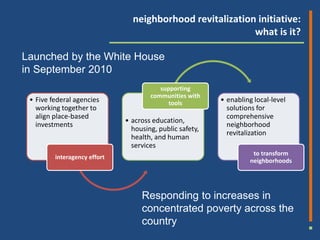
Launched by the White House
in September 2010
                                         supporting
                                      communities with
 • Five federal agencies                    tools         • enabling local-level
   working together to                                      solutions for
   align place-based                                        comprehensive
                              • across education,
   investments                                              neighborhood
                                housing, public safety,
                                                            revitalization
                                health, and human
                                services
                                                                     to transform
         interagency effort
                                                                    neighborhoods


                                   Responding to increases in
                                   concentrated poverty across the
                                   country
neighborhood revitalization initiative:
                                 why are we working together?

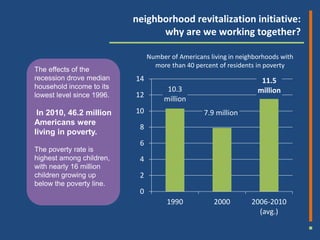
                                Number of Americans living in neighborhoods with
                                  more than 40 percent of residents in poverty
The effects of the
recession drove median     14                                        11.5
household income to its               10.3                          million
lowest level since 1996.   12
                                     million
 In 2010, 46.2 million     10                     7.9 million
Americans were
                            8
living in poverty.
                            6
The poverty rate is
highest among children,     4
with nearly 16 million
children growing up         2
below the poverty line.
                            0
                                      1990            2000        2006-2010
                                                                    (avg.)
neighborhood revitalization initiative:
                                   why are we working together?

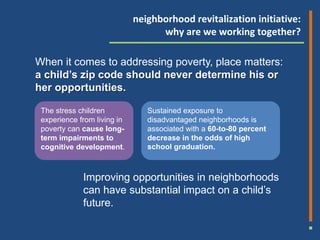
When it comes to addressing poverty, place matters:
a child’s zip code should never determine his or
her opportunities.

 The stress children            Sustained exposure to
 experience from living in      disadvantaged neighborhoods is
 poverty can cause long-        associated with a 60-to-80 percent
 term impairments to            decrease in the odds of high
 cognitive development.         school graduation.


             Improving opportunities in neighborhoods
             can have substantial impact on a child’s
             future.
neighborhood revitalization initiative:
                           why are we working together?


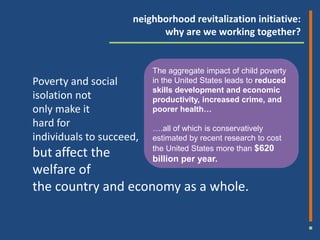
                          The aggregate impact of child poverty
Poverty and social        in the United States leads to reduced
                          skills development and economic
isolation not             productivity, increased crime, and
only make it              poorer health…
hard for                  ….all of which is conservatively
individuals to succeed,   estimated by recent research to cost

but affect the            the United States more than $620
                    billion per year.
welfare of
the country and economy as a whole.
neighborhood revitalization initiative:
                           how are we working together?


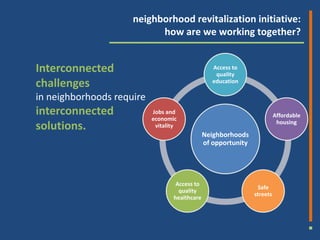
Interconnected                                    Access to
                                                   quality
challenges                                        education

in neighborhoods require
interconnected             Jobs and
                                                                          Affordable
                           economic
solutions.                  vitality
                                                                           housing

                                               Neighborhoods
                                               of opportunity


                                   Access to
                                                                 Safe
                                    quality
                                                                streets
                                  healthcare
neighborhood revitalization initiative:
                                            how are we working together?

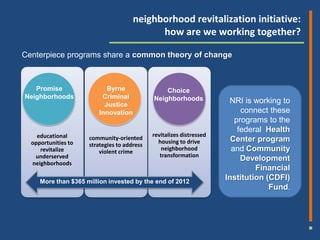
Centerpiece programs share a common theory of change


   Promise                 Byrne                 Choice
Neighborhoods            Criminal            Neighborhoods
                          Justice
                                                                       NRI is working to
                        Innovation                                         connect these
                                                                         programs to the
                                                                          federal Health
    educational                              revitalizes distressed
                     community-oriented                                 Center program
  opportunities to                             housing to drive
                     strategies to address
     revitalize                                  neighborhood           and Community
                         violent crime
   underserved                                  transformation
                                                                           Development
  neighborhoods
                                                                               Financial
     More than $365 million invested by the end of 2012
                                                                      Institution (CDFI)
                                                                                   Fund.
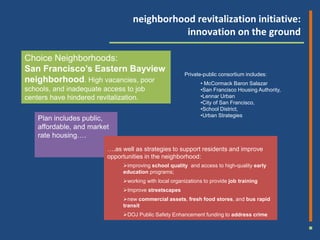
housing plan includes 624 units (504 onsite and 121 offsite senior building). 1100 homes are planned for the site, with that balance the current responsibility of

                                                                  neighborhood revitalization initiative:
                                                                             innovation on the ground

          Choice Neighborhoods:
          San Francisco’s Eastern Bayview
                                                                                            Private-public consortium includes:
          neighborhood. High vacancies, poor                                                        • McCormack Baron Salazar
          40 percent of residents live in poverty to job
          schools, and inadequate access                                                            •San Francisco Housing Authority,
          centers have hindered revitalization.                                                     •Lennar Urban
                                                                                                    •City of San Francisco,
                                                                                                    •School District,
                                                                                                    •Urban Strategies
                 Plan includes public,
                 affordable, and market
                 rate housing….
                                                     ….as well as strategies to support residents and improve
                                                     opportunities in the neighborhood:
                                                             improving school quality and access to high-quality early
                                                             education programs;
                                                             working with local organizations to provide job training
                                                             Improve streetscapes
                                                             new commercial assets, fresh food stores, and bus rapid
                                                             transit
                                                             DOJ Public Safety Enhancement funding to address crime
neighborhood revitalization initiative:
                              how are we working together?

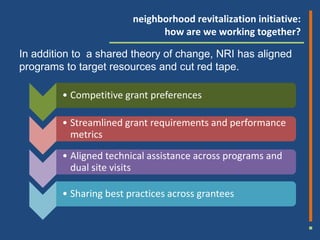
In addition to a shared theory of change, NRI has aligned
programs to target resources and cut red tape.

        • Competitive grant preferences

        • Streamlined grant requirements and performance
          metrics

        • Aligned technical assistance across programs and
          dual site visits

        • Sharing best practices across grantees
neighborhood revitalization initiative:
                                                  innovation on the ground

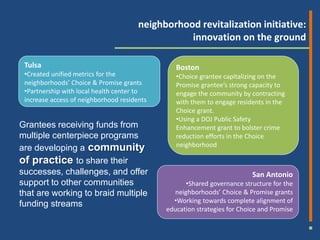
 Tulsa                                          Boston
 •Created unified metrics for the               •Choice grantee capitalizing on the
 neighborhoods’ Choice & Promise grants         Promise grantee’s strong capacity to
 •Partnership with local health center to       engage the community by contracting
 increase access of neighborhood residents      with them to engage residents in the
                                                Choice grant.
                                                •Using a DOJ Public Safety
Grantees receiving funds from                   Enhancement grant to bolster crime
multiple centerpiece programs                   reduction efforts in the Choice
                                                neighborhood
are developing a community
of practice to share their
successes, challenges, and offer                                          San Antonio
support to other communities                       •Shared governance structure for the
that are working to braid multiple             neighborhoods’ Choice & Promise grants
                                               •Working towards complete alignment of
funding streams
                                             education strategies for Choice and Promise
neighborhood revitalization initiative:
                                     building neighborhood capacity

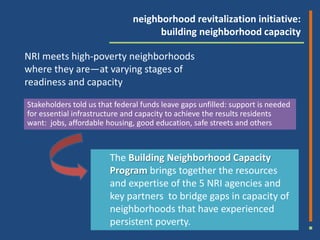
NRI meets high-poverty neighborhoods
where they are—at varying stages of
readiness and capacity

Stakeholders told us that federal funds leave gaps unfilled: support is needed
for essential infrastructure and capacity to achieve the results residents
want: jobs, affordable housing, good education, safe streets and others


                        The Building Neighborhood Capacity
                        Program brings together the resources
                        and expertise of the 5 NRI agencies and
                        key partners to bridge gaps in capacity of
                        neighborhoods that have experienced
                        persistent poverty.
neighborhood revitalization initiative:
                               building neighborhood capacity

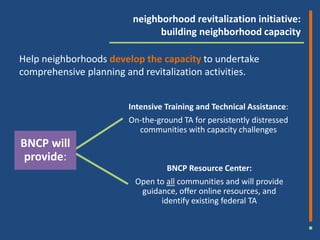
Help neighborhoods develop the capacity to undertake
comprehensive planning and revitalization activities.


                        Intensive Training and Technical Assistance:
                        On-the-ground TA for persistently distressed
                           communities with capacity challenges
BNCP will
 provide:
                                 BNCP Resource Center:
                         Open to all communities and will provide
                          guidance, offer online resources, and
                               identify existing federal TA
neighborhood revitalization initiative:
                                               building neighborhood capacity

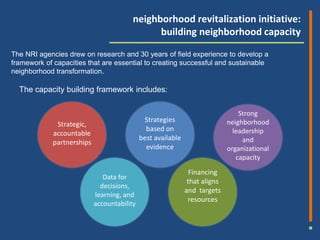
The NRI agencies drew on research and 30 years of field experience to develop a
framework of capacities that are essential to creating successful and sustainable
neighborhood transformation.

  The capacity building framework includes:

                                                                                 Strong
                                              Strategies                     neighborhood
              Strategic,
                                               based on                        leadership
             accountable
                                             best available                       and
             partnerships
                                               evidence                      organizational
                                                                                capacity

                                                                Financing
                               Data for
                                                               that aligns
                              decisions,
                                                              and targets
                            learning, and
                                                               resources
                            accountability
neighborhood revitalization initiative:
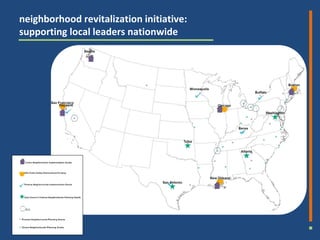
supporting local leaders nationwide
neighborhood revitalization initiative:
                                           Innovation on the ground

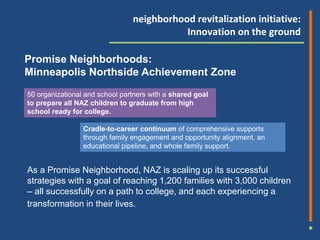
Promise Neighborhoods:
Minneapolis Northside Achievement Zone
50 organizational and school partners with a shared goal
to prepare all NAZ children to graduate from high
school ready for college.

                 Cradle-to-career continuum of comprehensive supports
                 through family engagement and opportunity alignment, an
                 educational pipeline, and whole family support.


As a Promise Neighborhood, NAZ is scaling up its successful
strategies with a goal of reaching 1,200 families with 3,000 children
– all successfully on a path to college, and each experiencing a
transformation in their lives.
neighborhood revitalization initiative:
                                                 where are we going?

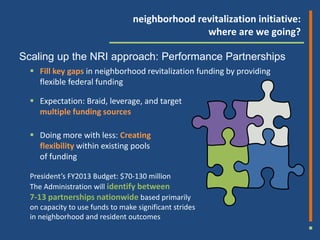
Scaling up the NRI approach: Performance Partnerships
   Fill key gaps in neighborhood revitalization funding by providing
    flexible federal funding

   Expectation: Braid, leverage, and target
    multiple funding sources

   Doing more with less: Creating
    flexibility within existing pools
    of funding

  President’s FY2013 Budget: $70-130 million
  The Administration will identify between
  7-13 partnerships nationwide based primarily
  on capacity to use funds to make significant strides
  in neighborhood and resident outcomes
neighborhood revitalization initiative:
                                       where are we going?


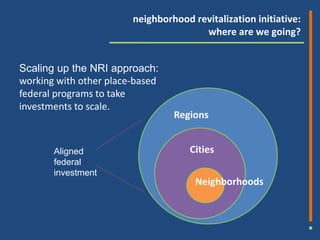
Scaling up the NRI approach:
working with other place-based
federal programs to take
investments to scale.
                                 Regions


       Aligned                       Cities
       federal
       investment
                                      Neighborhoods
neighborhood revitalization initiative:
                                                             online resources
NRI web page and report:
     http://www.whitehouse.gov/administration/eop/oua/initiatives/neighborhood-revitalization
     http://www.whitehouse.gov/sites/default/files/nri_pb_agencies_final_9.pdf
     http://www2.ed.gov/programs/promiseneighborhoods/resources.html
Centerpiece programs:
     Choice Neighborhoods:
          http://www.hud.gov/offices/pih/programs/ph/cn/
     Byrne Criminal Justice Innovation:
          https://www.bja.gov/ProgramDetails.aspx?Program_ID=70
     Promise Neighborhoods:
          http://www2.ed.gov/programs/promiseneighborhoods/index.html
     Building Neighborhood Capacity Program
          http://www.ojp.usdoj.gov/BJA/grant/11BNCTTAsol.pdf
     Health Center Program:
         •   http://bphc.hrsa.gov/
Memo from OMB describing the Administration’s Place-Based Focus:
     http://www.whitehouse.gov/sites/default/files/omb/assets/memoranda_2010/m10-21.pdf

White House Neighborhood Revitalization Initiative

  • 1.
    white house neighborhood revitalizationinitiative UNCA Neighborhood Revitalization Conference August 2, 2012
  • 2.
    neighborhood revitalization initiative: what is it? Launched by the White House in September 2010 supporting communities with • Five federal agencies tools • enabling local-level working together to solutions for align place-based comprehensive • across education, investments neighborhood housing, public safety, revitalization health, and human services to transform interagency effort neighborhoods Responding to increases in concentrated poverty across the country
  • 3.
    neighborhood revitalization initiative: why are we working together? Number of Americans living in neighborhoods with more than 40 percent of residents in poverty The effects of the recession drove median 14 11.5 household income to its 10.3 million lowest level since 1996. 12 million In 2010, 46.2 million 10 7.9 million Americans were 8 living in poverty. 6 The poverty rate is highest among children, 4 with nearly 16 million children growing up 2 below the poverty line. 0 1990 2000 2006-2010 (avg.)
  • 4.
    neighborhood revitalization initiative: why are we working together? When it comes to addressing poverty, place matters: a child’s zip code should never determine his or her opportunities. The stress children Sustained exposure to experience from living in disadvantaged neighborhoods is poverty can cause long- associated with a 60-to-80 percent term impairments to decrease in the odds of high cognitive development. school graduation. Improving opportunities in neighborhoods can have substantial impact on a child’s future.
  • 5.
    neighborhood revitalization initiative: why are we working together? The aggregate impact of child poverty Poverty and social in the United States leads to reduced skills development and economic isolation not productivity, increased crime, and only make it poorer health… hard for ….all of which is conservatively individuals to succeed, estimated by recent research to cost but affect the the United States more than $620 billion per year. welfare of the country and economy as a whole.
  • 6.
    neighborhood revitalization initiative: how are we working together? Interconnected Access to quality challenges education in neighborhoods require interconnected Jobs and Affordable economic solutions. vitality housing Neighborhoods of opportunity Access to Safe quality streets healthcare
  • 7.
    neighborhood revitalization initiative: how are we working together? Centerpiece programs share a common theory of change Promise Byrne Choice Neighborhoods Criminal Neighborhoods Justice NRI is working to Innovation connect these programs to the federal Health educational revitalizes distressed community-oriented Center program opportunities to housing to drive strategies to address revitalize neighborhood and Community violent crime underserved transformation Development neighborhoods Financial More than $365 million invested by the end of 2012 Institution (CDFI) Fund.
  • 8.
    housing plan includes624 units (504 onsite and 121 offsite senior building). 1100 homes are planned for the site, with that balance the current responsibility of neighborhood revitalization initiative: innovation on the ground Choice Neighborhoods: San Francisco’s Eastern Bayview Private-public consortium includes: neighborhood. High vacancies, poor • McCormack Baron Salazar 40 percent of residents live in poverty to job schools, and inadequate access •San Francisco Housing Authority, centers have hindered revitalization. •Lennar Urban •City of San Francisco, •School District, •Urban Strategies Plan includes public, affordable, and market rate housing…. ….as well as strategies to support residents and improve opportunities in the neighborhood: improving school quality and access to high-quality early education programs; working with local organizations to provide job training Improve streetscapes new commercial assets, fresh food stores, and bus rapid transit DOJ Public Safety Enhancement funding to address crime
  • 9.
    neighborhood revitalization initiative: how are we working together? In addition to a shared theory of change, NRI has aligned programs to target resources and cut red tape. • Competitive grant preferences • Streamlined grant requirements and performance metrics • Aligned technical assistance across programs and dual site visits • Sharing best practices across grantees
  • 10.
    neighborhood revitalization initiative: innovation on the ground Tulsa Boston •Created unified metrics for the •Choice grantee capitalizing on the neighborhoods’ Choice & Promise grants Promise grantee’s strong capacity to •Partnership with local health center to engage the community by contracting increase access of neighborhood residents with them to engage residents in the Choice grant. •Using a DOJ Public Safety Grantees receiving funds from Enhancement grant to bolster crime multiple centerpiece programs reduction efforts in the Choice neighborhood are developing a community of practice to share their successes, challenges, and offer San Antonio support to other communities •Shared governance structure for the that are working to braid multiple neighborhoods’ Choice & Promise grants •Working towards complete alignment of funding streams education strategies for Choice and Promise
  • 11.
    neighborhood revitalization initiative: building neighborhood capacity NRI meets high-poverty neighborhoods where they are—at varying stages of readiness and capacity Stakeholders told us that federal funds leave gaps unfilled: support is needed for essential infrastructure and capacity to achieve the results residents want: jobs, affordable housing, good education, safe streets and others The Building Neighborhood Capacity Program brings together the resources and expertise of the 5 NRI agencies and key partners to bridge gaps in capacity of neighborhoods that have experienced persistent poverty.
  • 12.
    neighborhood revitalization initiative: building neighborhood capacity Help neighborhoods develop the capacity to undertake comprehensive planning and revitalization activities. Intensive Training and Technical Assistance: On-the-ground TA for persistently distressed communities with capacity challenges BNCP will provide: BNCP Resource Center: Open to all communities and will provide guidance, offer online resources, and identify existing federal TA
  • 13.
    neighborhood revitalization initiative: building neighborhood capacity The NRI agencies drew on research and 30 years of field experience to develop a framework of capacities that are essential to creating successful and sustainable neighborhood transformation. The capacity building framework includes: Strong Strategies neighborhood Strategic, based on leadership accountable best available and partnerships evidence organizational capacity Financing Data for that aligns decisions, and targets learning, and resources accountability
  • 14.
  • 15.
    neighborhood revitalization initiative: Innovation on the ground Promise Neighborhoods: Minneapolis Northside Achievement Zone 50 organizational and school partners with a shared goal to prepare all NAZ children to graduate from high school ready for college. Cradle-to-career continuum of comprehensive supports through family engagement and opportunity alignment, an educational pipeline, and whole family support. As a Promise Neighborhood, NAZ is scaling up its successful strategies with a goal of reaching 1,200 families with 3,000 children – all successfully on a path to college, and each experiencing a transformation in their lives.
  • 16.
    neighborhood revitalization initiative: where are we going? Scaling up the NRI approach: Performance Partnerships  Fill key gaps in neighborhood revitalization funding by providing flexible federal funding  Expectation: Braid, leverage, and target multiple funding sources  Doing more with less: Creating flexibility within existing pools of funding President’s FY2013 Budget: $70-130 million The Administration will identify between 7-13 partnerships nationwide based primarily on capacity to use funds to make significant strides in neighborhood and resident outcomes
  • 17.
    neighborhood revitalization initiative: where are we going? Scaling up the NRI approach: working with other place-based federal programs to take investments to scale. Regions Aligned Cities federal investment Neighborhoods
  • 18.
    neighborhood revitalization initiative: online resources NRI web page and report:  http://www.whitehouse.gov/administration/eop/oua/initiatives/neighborhood-revitalization  http://www.whitehouse.gov/sites/default/files/nri_pb_agencies_final_9.pdf  http://www2.ed.gov/programs/promiseneighborhoods/resources.html Centerpiece programs:  Choice Neighborhoods:  http://www.hud.gov/offices/pih/programs/ph/cn/  Byrne Criminal Justice Innovation:  https://www.bja.gov/ProgramDetails.aspx?Program_ID=70  Promise Neighborhoods:  http://www2.ed.gov/programs/promiseneighborhoods/index.html  Building Neighborhood Capacity Program  http://www.ojp.usdoj.gov/BJA/grant/11BNCTTAsol.pdf  Health Center Program: • http://bphc.hrsa.gov/ Memo from OMB describing the Administration’s Place-Based Focus:  http://www.whitehouse.gov/sites/default/files/omb/assets/memoranda_2010/m10-21.pdf