CUYAHOGA COUNTY
NATURAL RESOURCES
ASSISTANCE COUNCIL
CLEAN OHIO
CONSERVATION
APPLICANT WORKSHOP
ROUND 8
October 31, 2013 Canalway Visitor Center
AGENDA

1.

Overview of the Clean Ohio Green Space Conservation
Program




2.

The Cuyahoga County Conservation Program Natural
Resources Assistance Council (NRAC)




3.

Statewide and District 1
Purpose
Program Requirements

Applications
Evaluation Methodology
Round 8 Application Requirements

Q.&A.
CLEAN OHIO


The Clean Ohio Fund restores, protects, and
connects Ohio's important natural and urban
places by preserving green space and
farmland, developing state-wide recreational
trails, and cleaning up brownfields to
encourage redevelopment and revitalize
communities.



The Clean Ohio Green Space Conservation
Program helps to fund preservation of open
spaces, sensitive ecological areas, and
CLEAN OHIO CONSERVATION Statewide
From 2000-2013:
UPDATE Info below:
 812 Projects were funded
 $235.4 million have been awarded
 Area protected:
 64,400

acres of natural areas and
greenspace
CLEAN OHIO CONSERVATION –
OPWC Policies for Round 8
Projects not scheduled for acquisition within
12 months from the date of the Project
Agreement will be rejected by the
Commission.
 All post acquisition activities must be
concluded within a two-year period from the
date of acquisition unless a formal extension
has been approved by OPWC.
 Program Year 8 applications will be required
to have a certified appraisal performed by an
Ohio Department of Transportation
Prequalified Appraiser

CLEAN OHIO CONSERVATION –
OPWC Policies for Round 8


APPRAISALS:








Projects with Purchase Contracts exceeding the
appraised value will be returned to the Natural Resources
Assistance Councils for validation. These projects will
not be issued a Notice to Proceed until this validation has
occurred.
Projects that consist of leveraging the difference between
the appraised value and purchase contract will also be
required to have an appraisal review performed by an
Ohio Department of Transportation Prequalified Appraisal
Reviewer to ensure that the purchase price history,
comparables, adjustments, and disclaimers are accurate.
Applicants that have an appraisal review rejected will not
be issued a Notice to Proceed until these discrepancies
are resolved.
Properties above appraised value are eligible, but it is
important for the NRAC to be cognitive of this difference
and must validate the value of properties that are using
the difference between the Purchase Contract and
CLEAN OHIO CONSERVATION –
OPWC Policies for Round 8
OPWC POLICY REGARDING MINERAL RIGHTS:
 Existing oil and gas leases, at the time the Natural
Resources Assistance Council approves the project,
will be treated as pre-existing easements. Thus, these
applications will be approved as submitted.
 Requests to engage in oil and gas leasing on Clean
Ohio Properties that have been acquired along with the
mineral rights will be denied.
 Requests to engage in these activities on Clean Ohio
Properties acquired with a third party holding the
mineral rights will be dealt with on a case by case
basis in conjunction with the OPWC’s legal counsel
CLEAN OHIO CONSERVATIONCuyahoga County
From 2000- Present:
79 Projects were submitted
 44 Projects have been funded
 $21.5 million have been awarded
Area Protected:
 934 acres of natural areas and
greenspace
 12,000 lineal feet of riparian corridors

PURPOSE
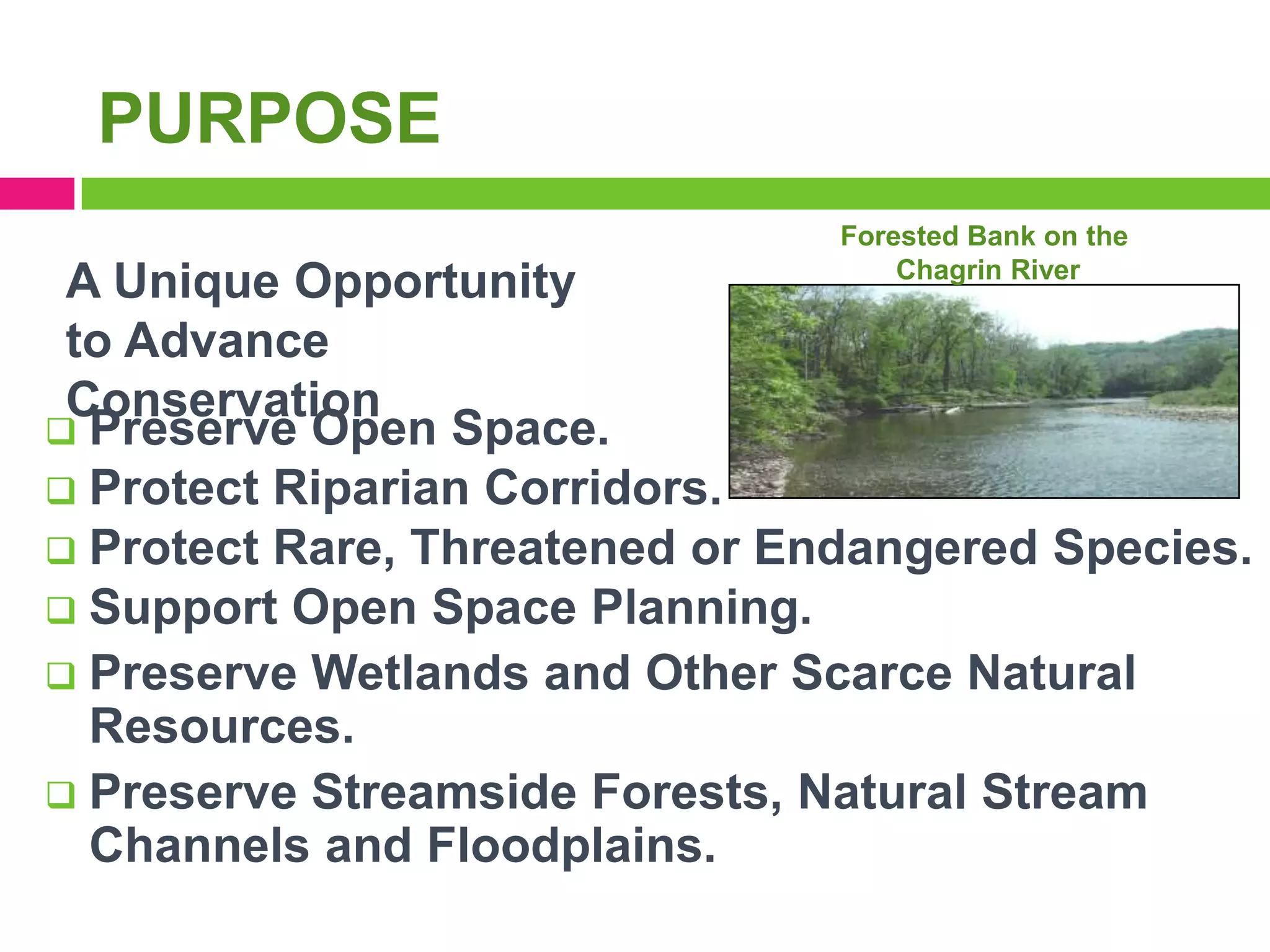
Forested Bank on the
Chagrin River

A Unique Opportunity
to Advance
Conservation
 Preserve Open Space.
 Protect Riparian Corridors.
 Protect Rare, Threatened or Endangered Species.
 Support Open Space Planning.
 Preserve Wetlands and Other Scarce Natural
Resources.
 Preserve Streamside Forests, Natural Stream
Channels and Floodplains.
TYPES OF
PROJECTS

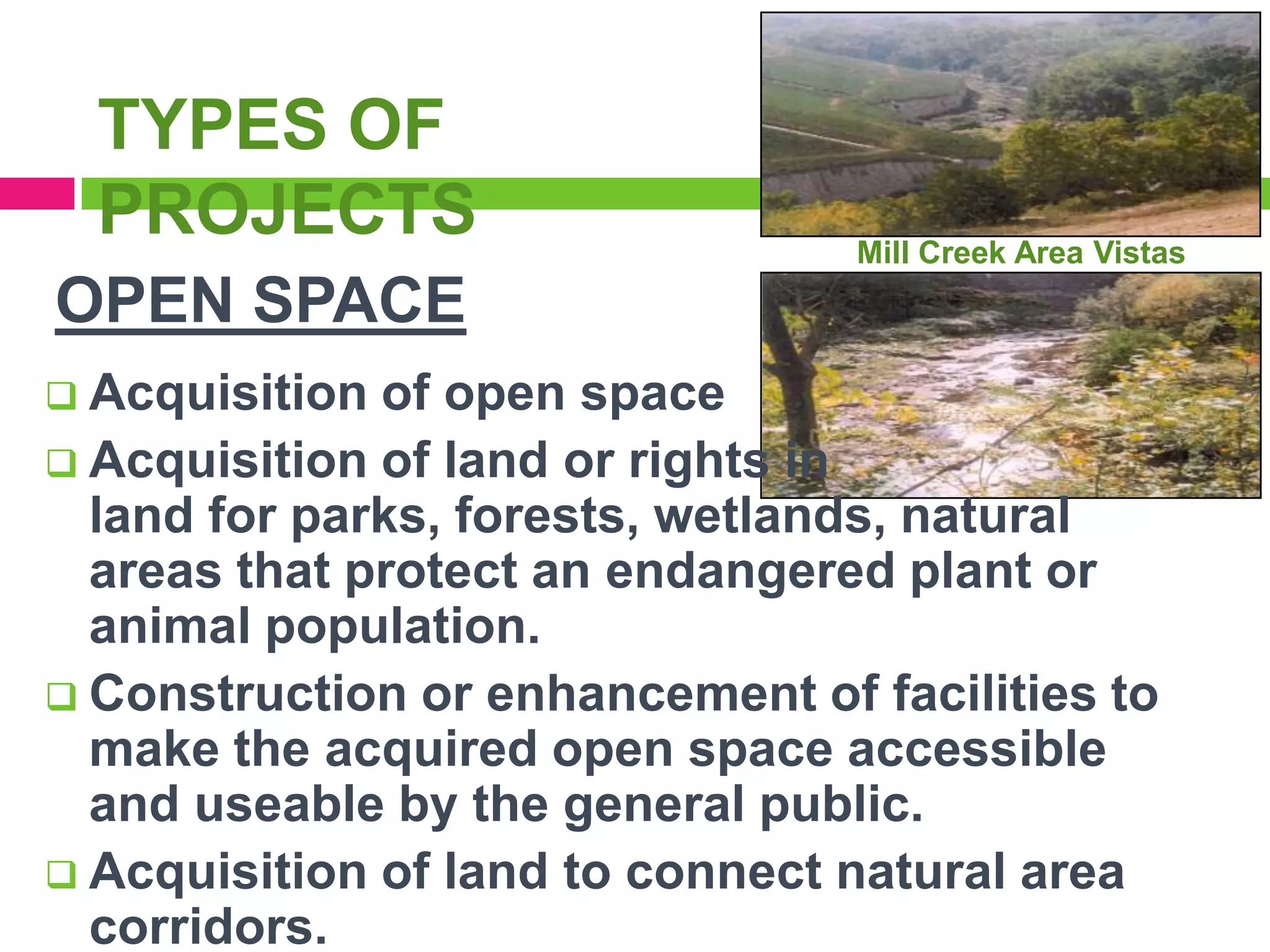
Mill Creek Area Vistas

OPEN SPACE
 Acquisition

of open space
 Acquisition of land or rights in
land for parks, forests, wetlands, natural
areas that protect an endangered plant or
animal population.
 Construction or enhancement of facilities to
make the acquired open space accessible
and useable by the general public.
 Acquisition of land to connect natural area
corridors.
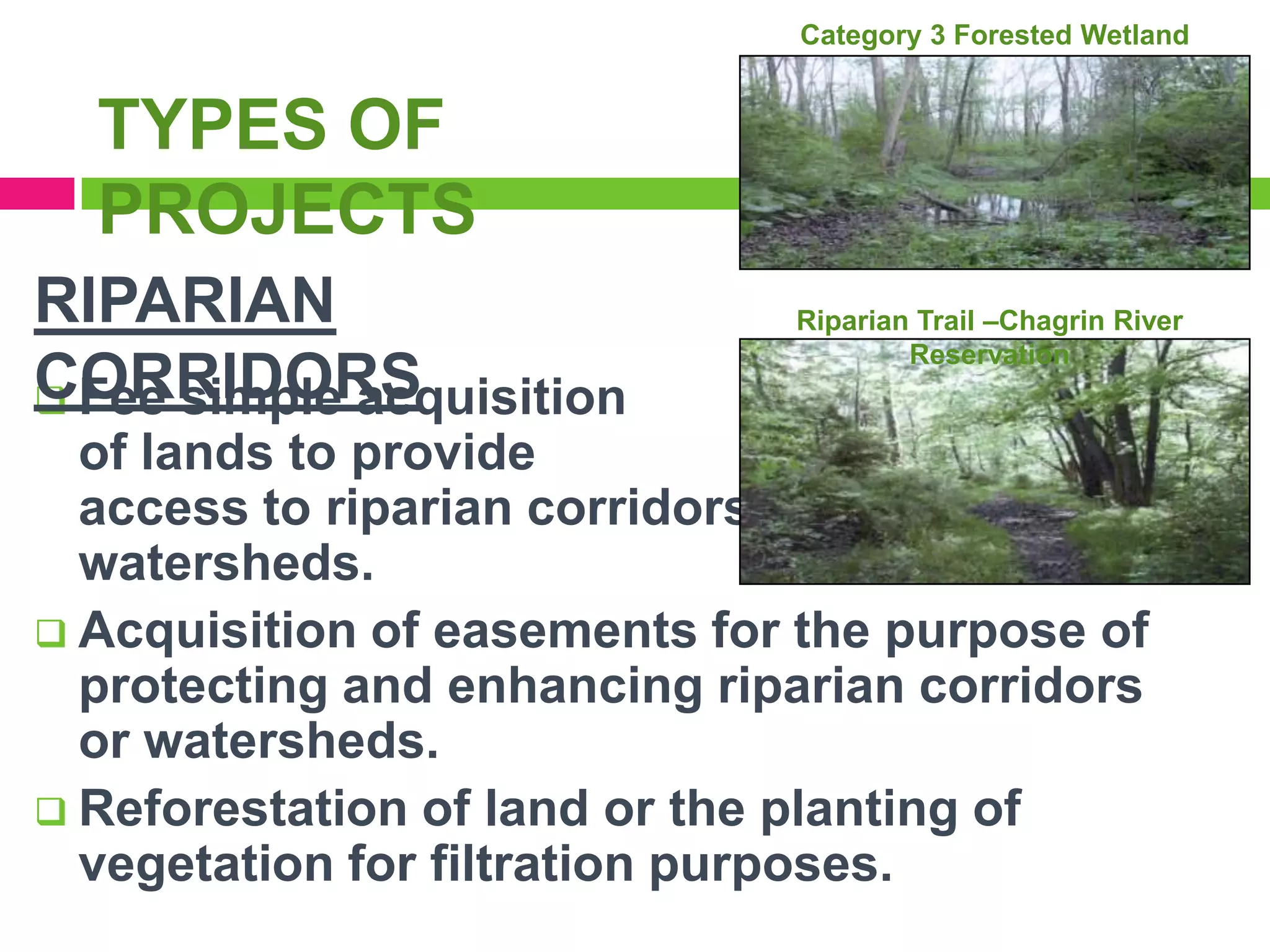
Category 3 Forested Wetland

TYPES OF
PROJECTS
RIPARIAN
CORRIDORS
 Fee simple acquisition

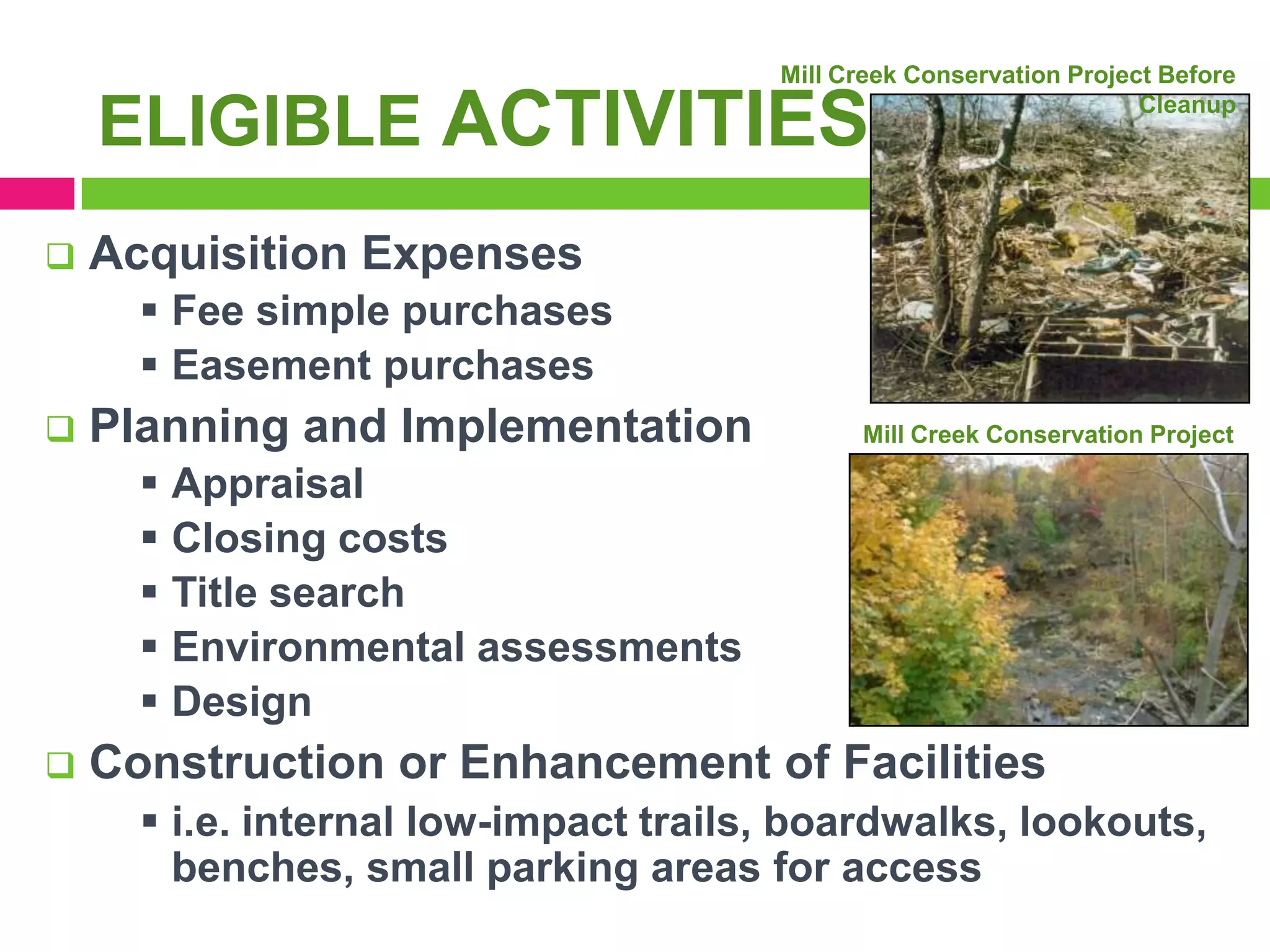
Riparian Trail –Chagrin River
Reservation

of lands to provide
access to riparian corridors or
watersheds.
 Acquisition of easements for the purpose of
protecting and enhancing riparian corridors
or watersheds.
 Reforestation of land or the planting of
vegetation for filtration purposes.
Mill Creek Conservation Project Before
Cleanup

ELIGIBLE ACTIVITIES


Acquisition Expenses
 Fee simple purchases
 Easement purchases



Planning and Implementation
 Appraisal
 Closing costs
 Title search
 Environmental assessments
 Design



Mill Creek Conservation Project
Today

Construction or Enhancement of Facilities
 i.e. internal low-impact trails, boardwalks, lookouts,
benches, small parking areas for access
INELIGIBLE PROJECTS AND
ACTIVITIES




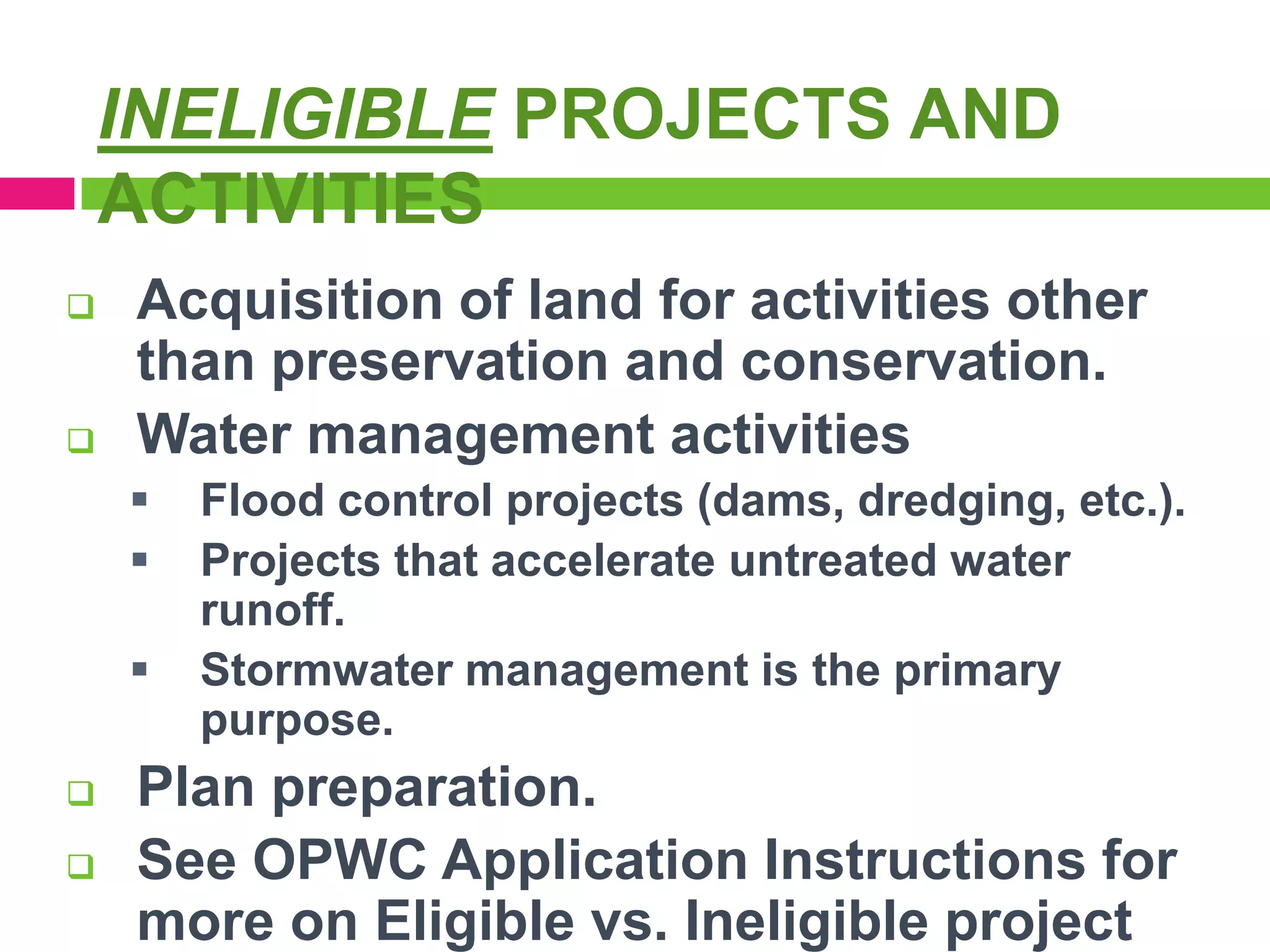
Acquisition of land for activities other
than preservation and conservation.
Water management activities







Flood control projects (dams, dredging, etc.).
Projects that accelerate untreated water
runoff.
Stormwater management is the primary
purpose.

Plan preparation.
See OPWC Application Instructions for
more on Eligible vs. Ineligible project
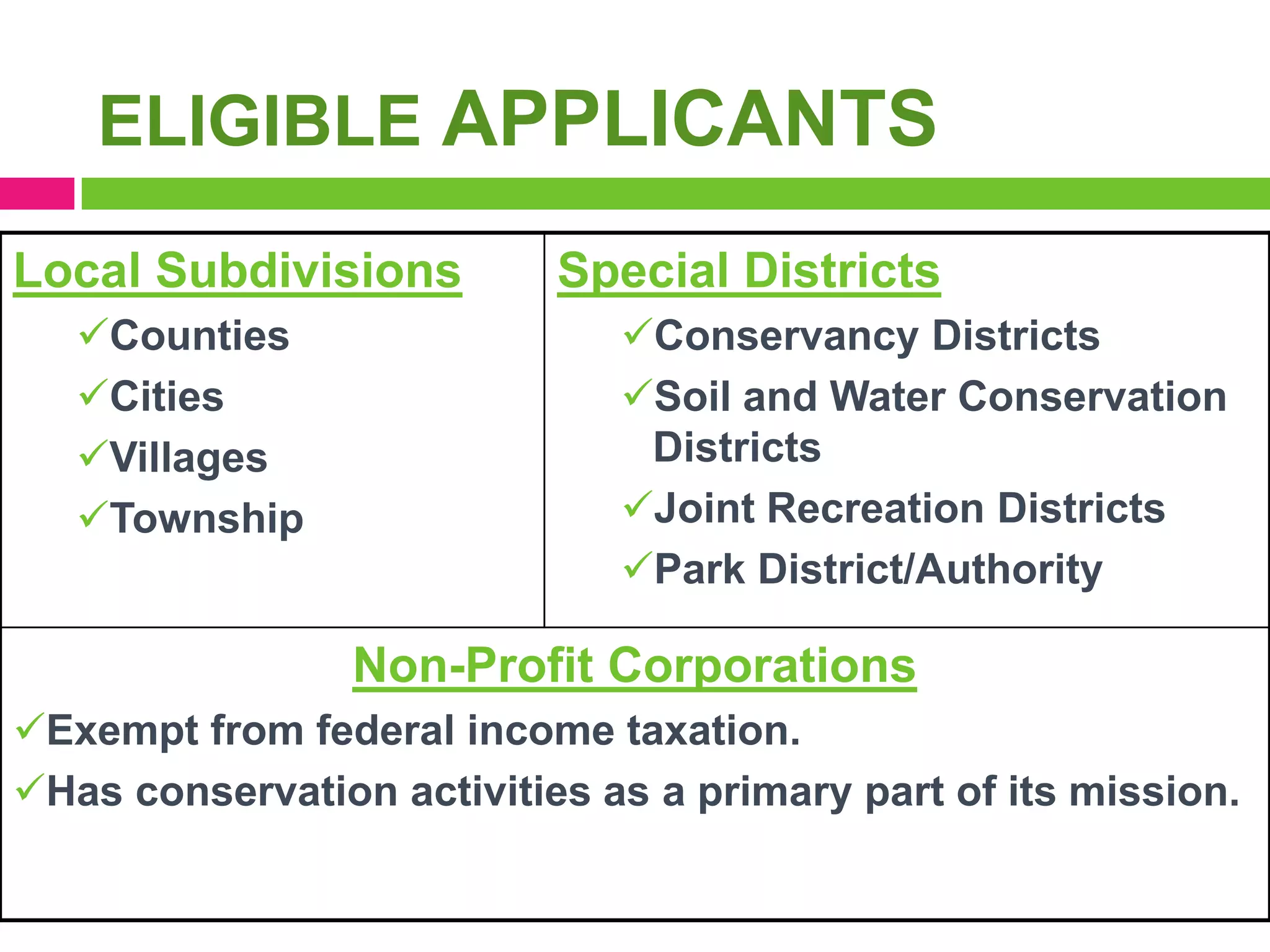
ELIGIBLE APPLICANTS
Local Subdivisions
Counties
Cities
Villages
Township

Special Districts
Conservancy Districts
Soil and Water Conservation
Districts
Joint Recreation Districts
Park District/Authority

Non-Profit Corporations
Exempt from federal income taxation.
Has conservation activities as a primary part of its mission.
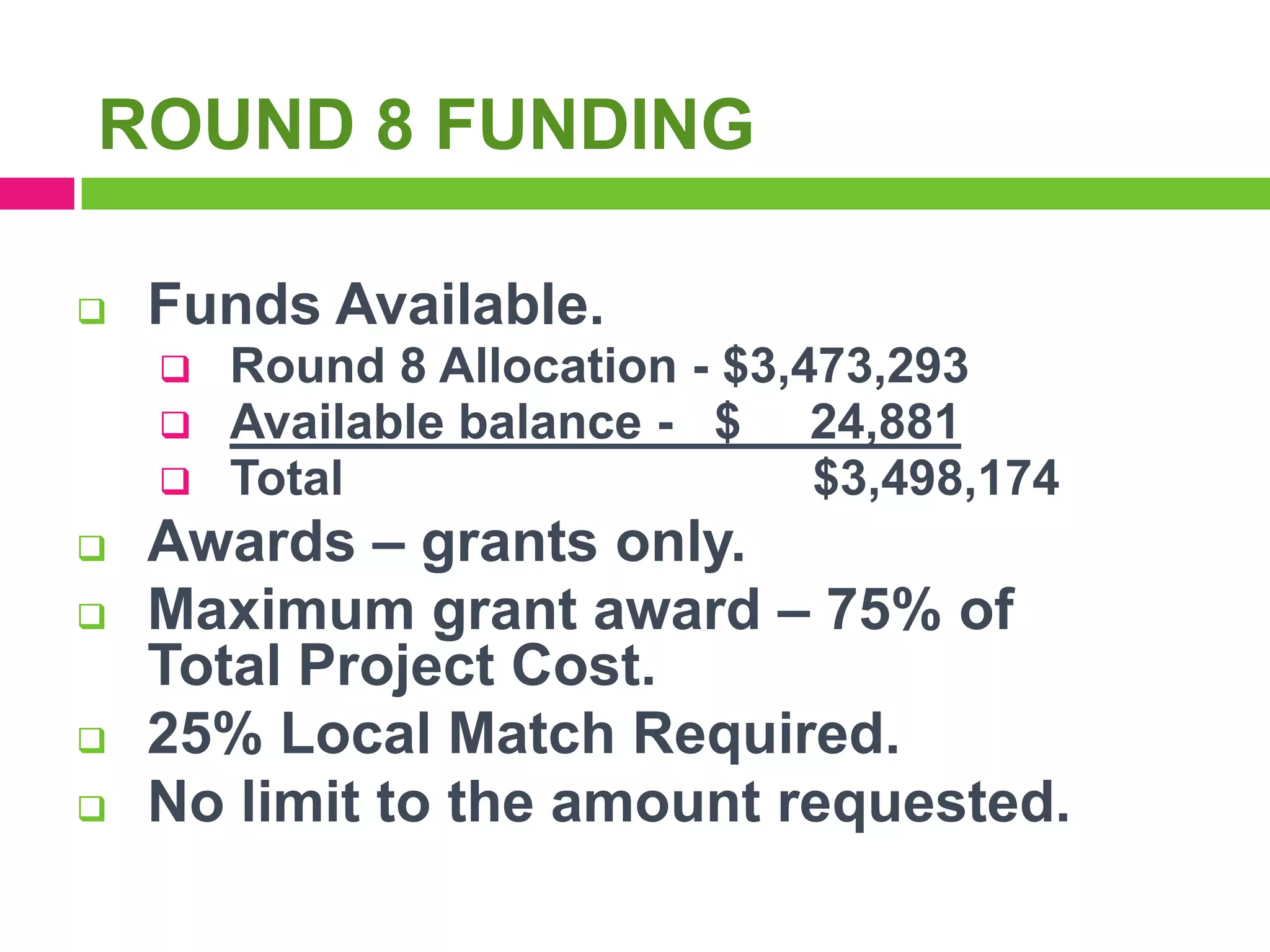
ROUND 8 FUNDING


Funds Available.









Round 8 Allocation - $3,473,293
Available balance - $ 24,881
Total
$3,498,174

Awards – grants only.
Maximum grant award – 75% of
Total Project Cost.
25% Local Match Required.
No limit to the amount requested.
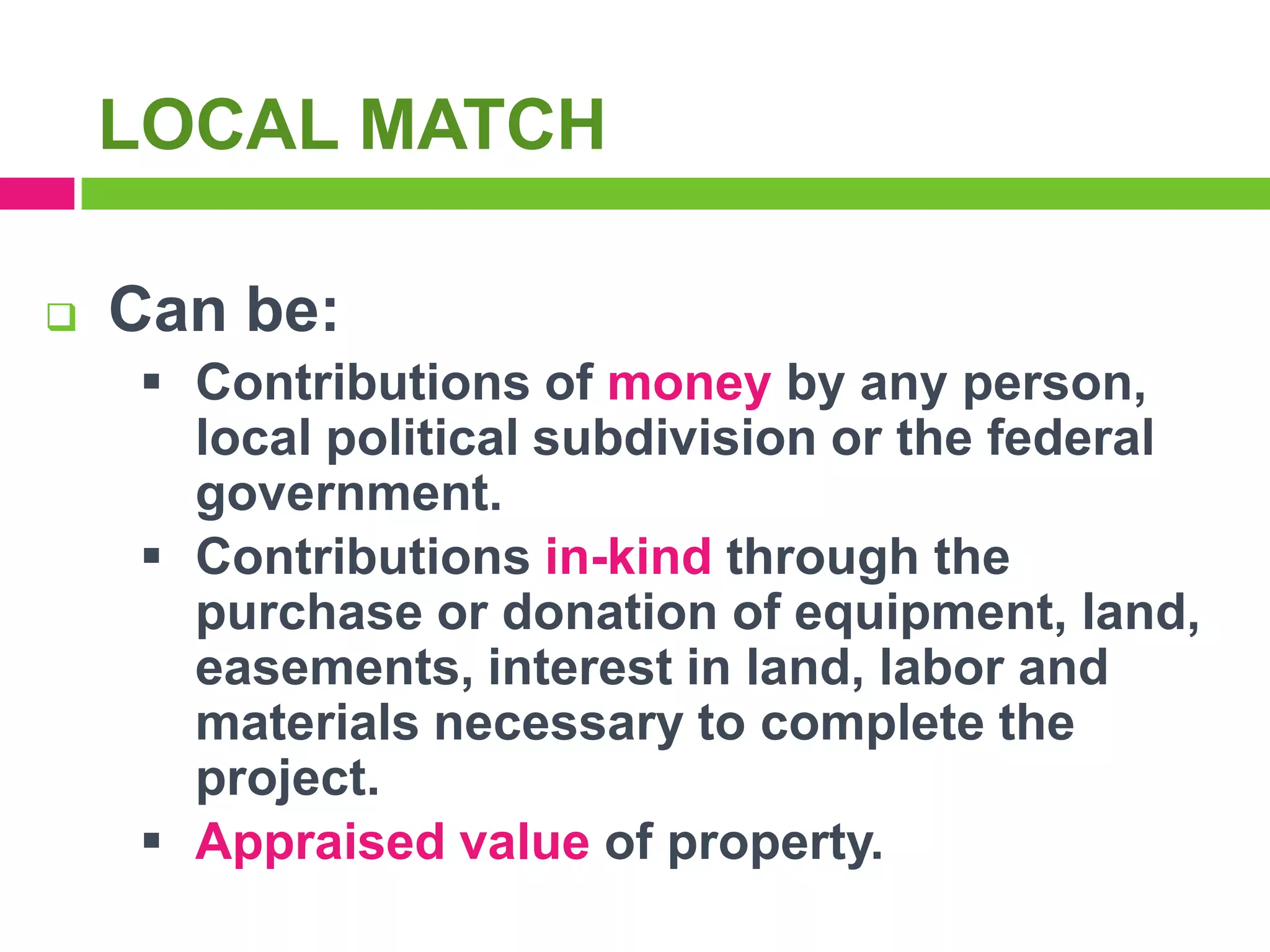
LOCAL MATCH


Can be: funds
 Contributions of money by any person,
local political subdivision or the federal
government.
 Contributions in-kind through the
purchase or donation of equipment, land,
easements, interest in land, labor and
materials necessary to complete the
project.
 Appraised value of property.
CONSERVATION PROGRAM
IMPLEMENTATION
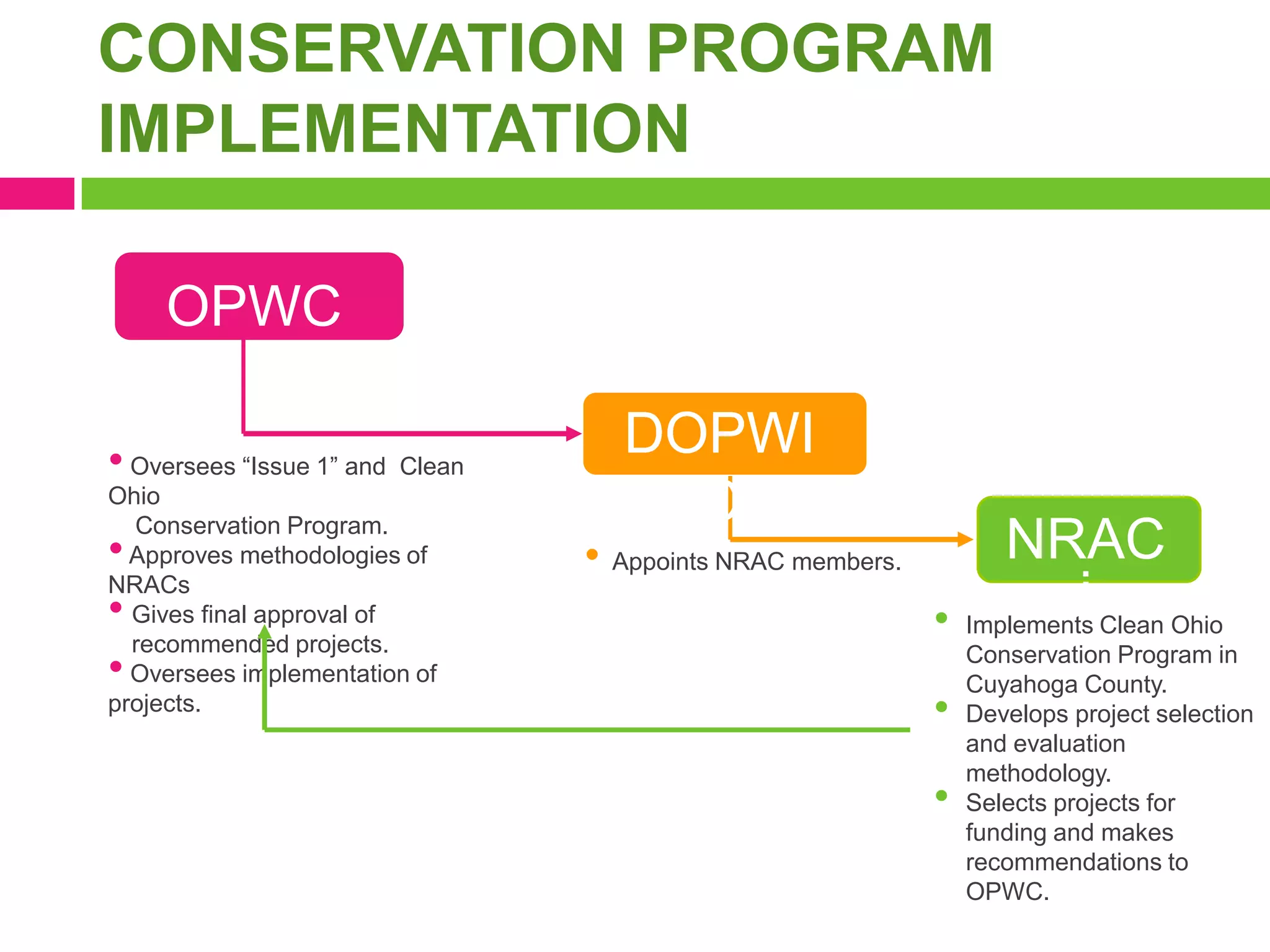
OPWC
• Oversees “Issue 1” and

Clean

Ohio
Conservation Program.
Approves methodologies of
NRACs
Gives final approval of
recommended projects.
Oversees implementation of
projects.

•
•
•

DOPWI
C

NRAC

• Appoints NRAC members.
•
•
•

Implements Clean Ohio
Conservation Program in
Cuyahoga County.
Develops project selection
and evaluation
methodology.
Selects projects for
funding and makes
recommendations to
OPWC.
CUYAHOGA COUNTY
CONSERVATION PROGRAM
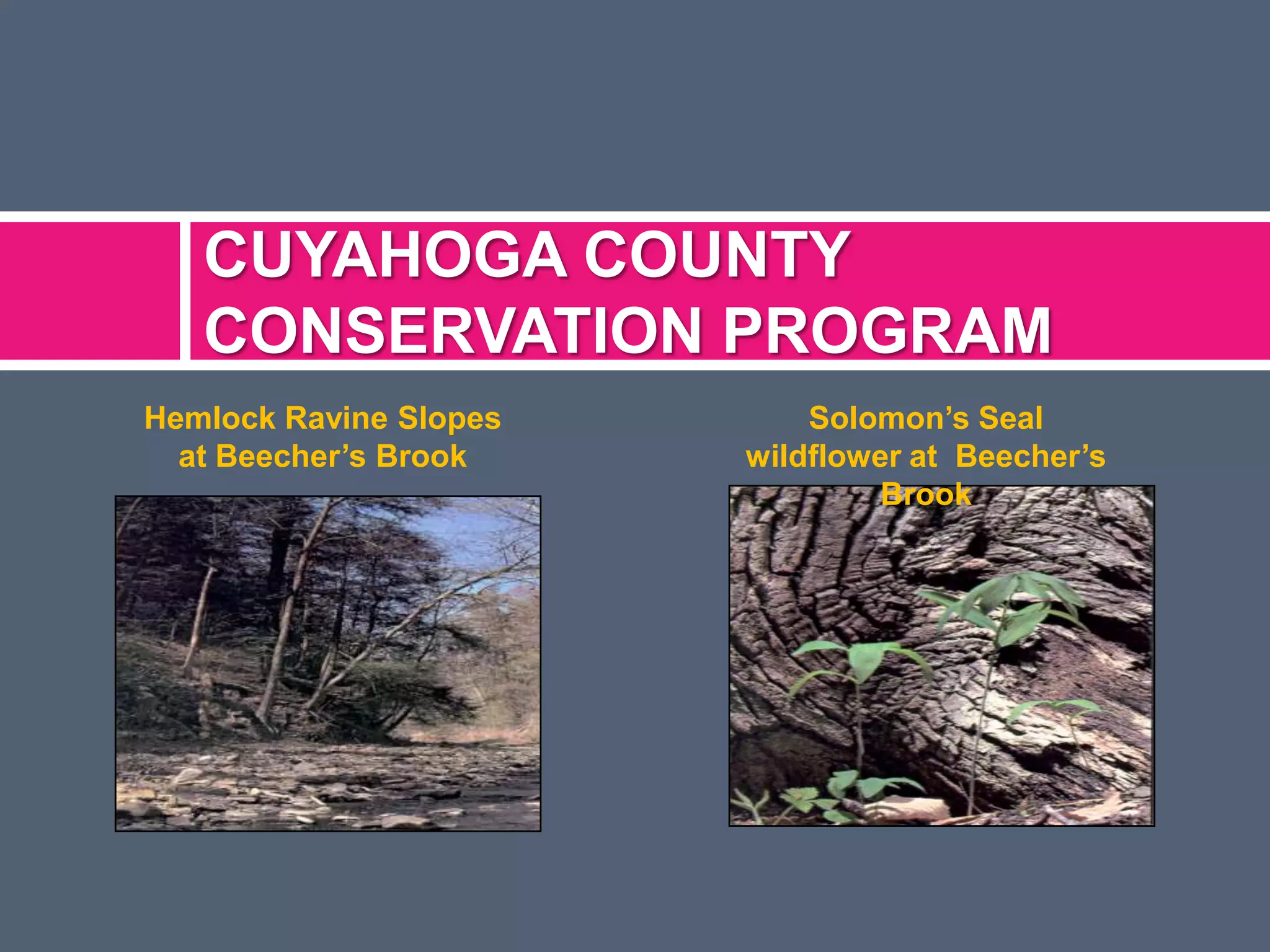
Hemlock Ravine Slopes
at Beecher’s Brook

Solomon’s Seal
wildflower at Beecher’s
Brook
NATURAL RESOURCES
ASSISTANCE COUNCIL
(NRAC)


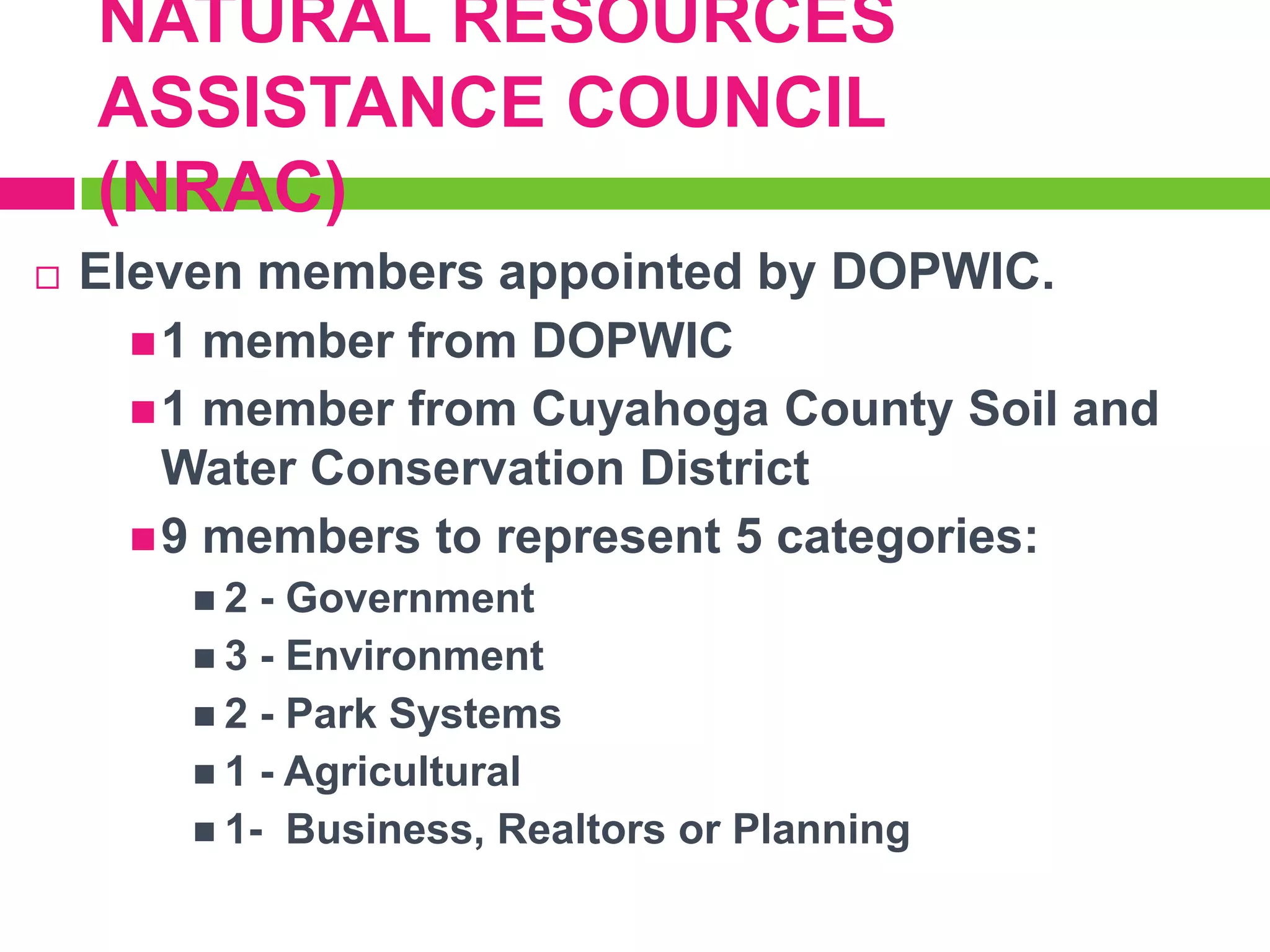
Eleven members appointed by DOPWIC.
 1 member from DOPWIC
 1 member from Cuyahoga County Soil and
Water Conservation District
 9 members to represent 5 categories:
2

- Government
 3 - Environment
 2 - Park Systems
 1 - Agricultural
 1- Business, Realtors or Planning
CUYAHOGA COUNTY
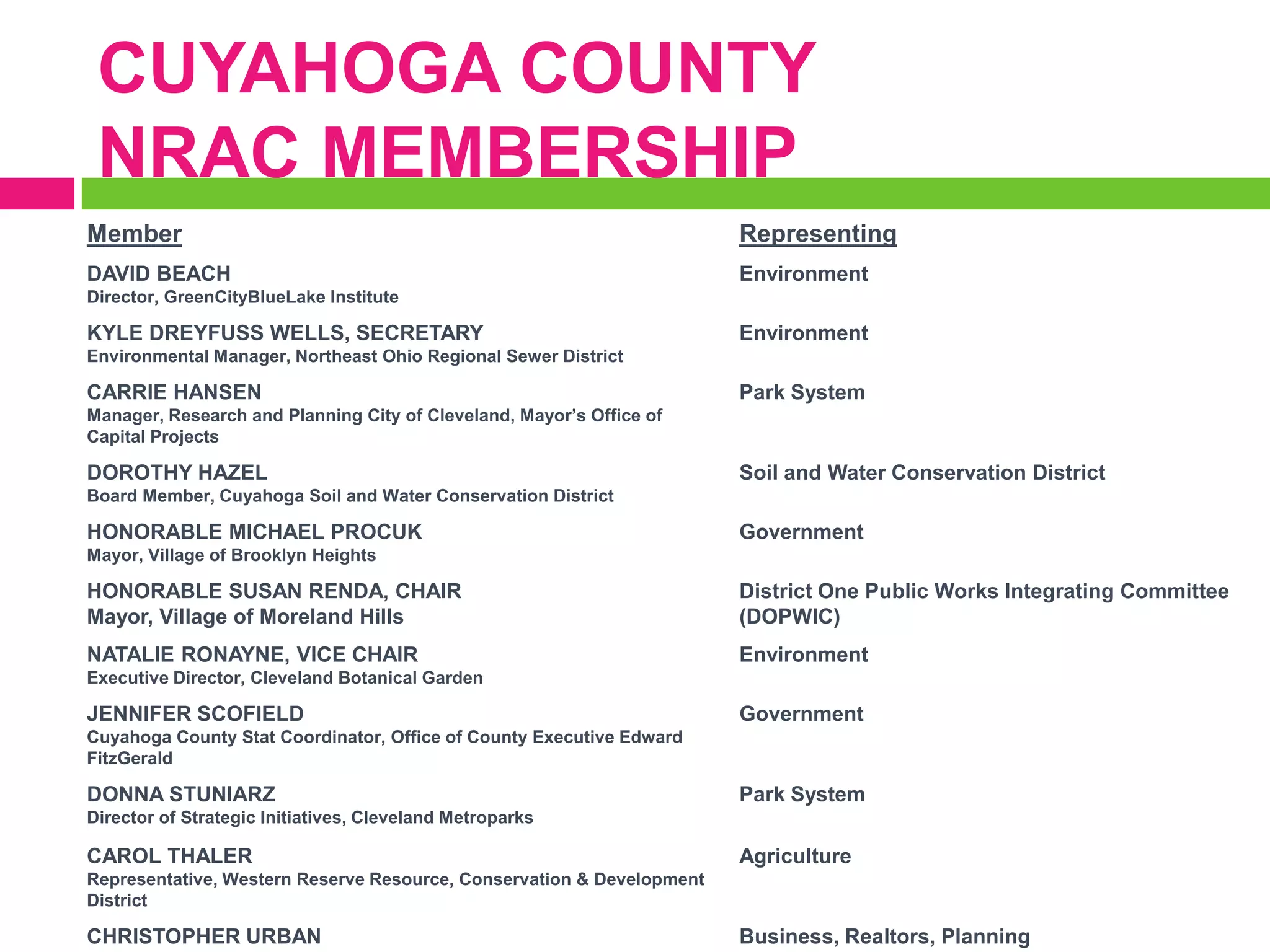
NRAC MEMBERSHIP
Member

Representing

DAVID BEACH

Environment

Director, GreenCityBlueLake Institute

KYLE DREYFUSS WELLS, SECRETARY

Environment

Environmental Manager, Northeast Ohio Regional Sewer District

CARRIE HANSEN

Park System

Manager, Research and Planning City of Cleveland, Mayor’s Office of
Capital Projects

DOROTHY HAZEL

Soil and Water Conservation District

Board Member, Cuyahoga Soil and Water Conservation District

HONORABLE MICHAEL PROCUK

Government

Mayor, Village of Brooklyn Heights

HONORABLE SUSAN RENDA, CHAIR
Mayor, Village of Moreland Hills

District One Public Works Integrating Committee
(DOPWIC)

NATALIE RONAYNE, VICE CHAIR

Environment

Executive Director, Cleveland Botanical Garden

JENNIFER SCOFIELD

Government

Cuyahoga County Stat Coordinator, Office of County Executive Edward
FitzGerald

DONNA STUNIARZ

Park System

Director of Strategic Initiatives, Cleveland Metroparks

CAROL THALER

Agriculture

Representative, Western Reserve Resource, Conservation & Development
District

CHRISTOPHER URBAN

Business, Realtors, Planning
OPEN SPACE IN CUYAHOGA
COUNTY





Largest and most urbanized of Ohio’s counties.
90% of land is developed and only 10% is designated
open space.
Existing open space areas.
Existing Open Spaces
 Fragmented
 Not always accessible
to the public
 Some are degraded/
destroyed by pollution
and mismanagement
 Others abandoned due to poor
planning and outmigration
DISTRICT ONE NRAC
PRINCIPLES

To ensure that projects are visible, accessible and
instructional, the NRAC has 5 guiding principles:
1. Preserve natural areas or open space.
2. Restore landscapes that have been
degraded or destroyed.
3. Enhance the quality of natural areas or open
space.
4. Link natural areas to each other or to county
cultural and civic heritage areas.
5. Provide public access to natural areas
and/or county cultural and civic heritage
areas.
RESTORATION ACTIVITIES






Restoration MUST be accompanied by
acquisition of land for protection
Restoration activities MUST be included in the
project budget to be eligible for restoration
points.
Examples of restoration components:
Returning the open space to a natural state;
 Ensuring the integrity and sustainability of the
species (flora/fauna) are both native and resilient;
 Integrate the community’s cultural heritage; and
 Provide opportunities for cultural and ecological
relationships.

PROJECT APPLICATION AND
SELECTION PROCESS
APPLICATION MATERIALS
1. OPWC Clean Ohio Conservation Application
 OPWC website:
http://www.pwc.state.oh.us/GSCApplication.html
2. NRAC Application Supplement
 Cuyahoga County Planning Commission website:
http://planning.co.cuyahoga.oh.us/nrac/
 Available as a PDF and Word document
3. A certified appraisal performed by an Ohio
Department of Transportation Prequalified Appraiser
who is credentialed in value analysis.
4. Cuyahoga County Fiscal Officer’s property valuation.
 http://fiscalofficer.cuyahogacounty.us/enUS/REPI.aspx
APPLICATION MATERIALS
5. Resolution(s) of Support: A project will need a
resolution of support from the appropriate political
subdivision(s) (Cuyahoga County, municipalities,
townships) as determined by the Ohio Revised Code,
section 164.23
6. Documentation of pending land transaction, e.g.
purchase agreement, letter of intent, memorandum of
understanding if applying for open space acquisition.
7. Maps and other Documents as needed.
8. A compact disc or flash drive with items 1 and 2; as
well as all supporting documentation.

A Glossary of Terms is also available.
APPRAISAL REQUIREMENTS
A certified appraisal must be included.
 Appraisals must be done by an Ohio
Department of Transportation Prequalified
Appraiser, who is credentialed in value
analysis.
 http://www.dot.state.oh.us/Divisions/Engineer
ing/RealEstate/Pages/LPA.aspx
 http://www.dot.state.oh.us/Divisions/Engineer
ing/Consultant/Consultant/prequal-row.pdf
 The project will not be evaluated if the
appraisals and supporting documentation is
not attached.

RESOLUTIONS OF SUPPORT










Except as otherwise provided in the ORC, a copy
of a resolution supporting the project from each
county in which the proposed project is to be
conducted
All resolutions from Cuyahoga County will be read
on at least two (2) separate regular Council
meetings
In between readings, the resolutions will be heard
in committee. A staff member from your
organization should plan to be present at the
committee hearing.
Alison Ball of the Cuyahoga County Planning
Commission will assist applicants through the
process.
Resolution requests are due by November 15,
2013 at 4:30PM.
APPLICATION SUBMITTAL to
NRAC

 Must

submit 1 original and 12 copies.
Copies to be submitted:
 13 Hard copies – double sided;
 1 Digitally on compact disc or flash
drive.
 Materials must be typed using at least an
11 font.
 All copies should be bound on the lefthand side.
PROJECT EVALUATION AND
SCORING
APPLICATION SPECIFICS
OPWC APPLICATION – Important
points.
 Financial Information – Page 2
 Financial Resources – Page 2
 Project Schedule – Page 3
 Project Description – Page 4
 Project Officials – Page 5
 Attachments – Page 6
APPLICATION SPECIFICS
NRAC APPLICATION SUPPLEMENT
 Relates directly to the NRAC Evaluation
Methodology.

 Used along with the OPWC Application to
review projects.
 Applicant is responsible in making sure all
documents are complete and accurate.
PROJECT EVALUATION
The Evaluation Process is divided into three major
components:
Phase 1: Preliminary Project Evaluation

Phase 2: Preliminary Project Scoring (includes
Applicant Interviews) and Public Meeting
Phase 3: Final Project Scoring and
Recommendations to OPWC
PROJECT EVALUATION
The NRAC Application Supplement has six major sections
that are scored:
Section One: Project Emphasis
Section Two: Project Description
Section Three: County Principles
Section Four: Project Benefits
Section Five: Needs Of The District
Section Six: Other Relevant Factors
Section 1. PROJECT EMPHASIS
Page 2:
Based on the factors stated in authorizing
legislation
 Indicate each factor that will be achieved by the
project
 Check as many as apply in one category


EXAMPLE: Open space project will acquire property
identified in the city’s open space plan and will preserve a
high quality wetland that will be used by the city’s school
district as a hands-on science laboratory.

NO POINTS AWARDED
Section 2. PROJECT
DESCRIPTION
Page 3:



Project Name
Type of Project
 Acquisition of land
 Acquisition of land/facilities for accessibility
 Riparian Corridor restoration




Appraisal or Conservation Value
Provide no more than a three-page project
description that includes a map showing the
project location(s) and the local setting.
NO POINTS AWARDED
Section 2. PROJECT
DESCRIPTION (cont).
Types of Acquisition:
Project site must be secured in perpetuity.
 Land Securement Tools 





Fee simple: Absolute title to the land, free of any
conditions, easements, limitations,
encumbrances, or other claims against the title
such that a property owner can sell the property
or leave it to another by will or inheritance.
Conservation Easement: a right or interest in land
that is held for the public purpose of retaining
land, water, or wetland areas predominantly in
their natural, scenic, open, or wooded condition.
Recorded as a deed restriction.
Section 2. PROJECT
DESCRIPTION (cont).
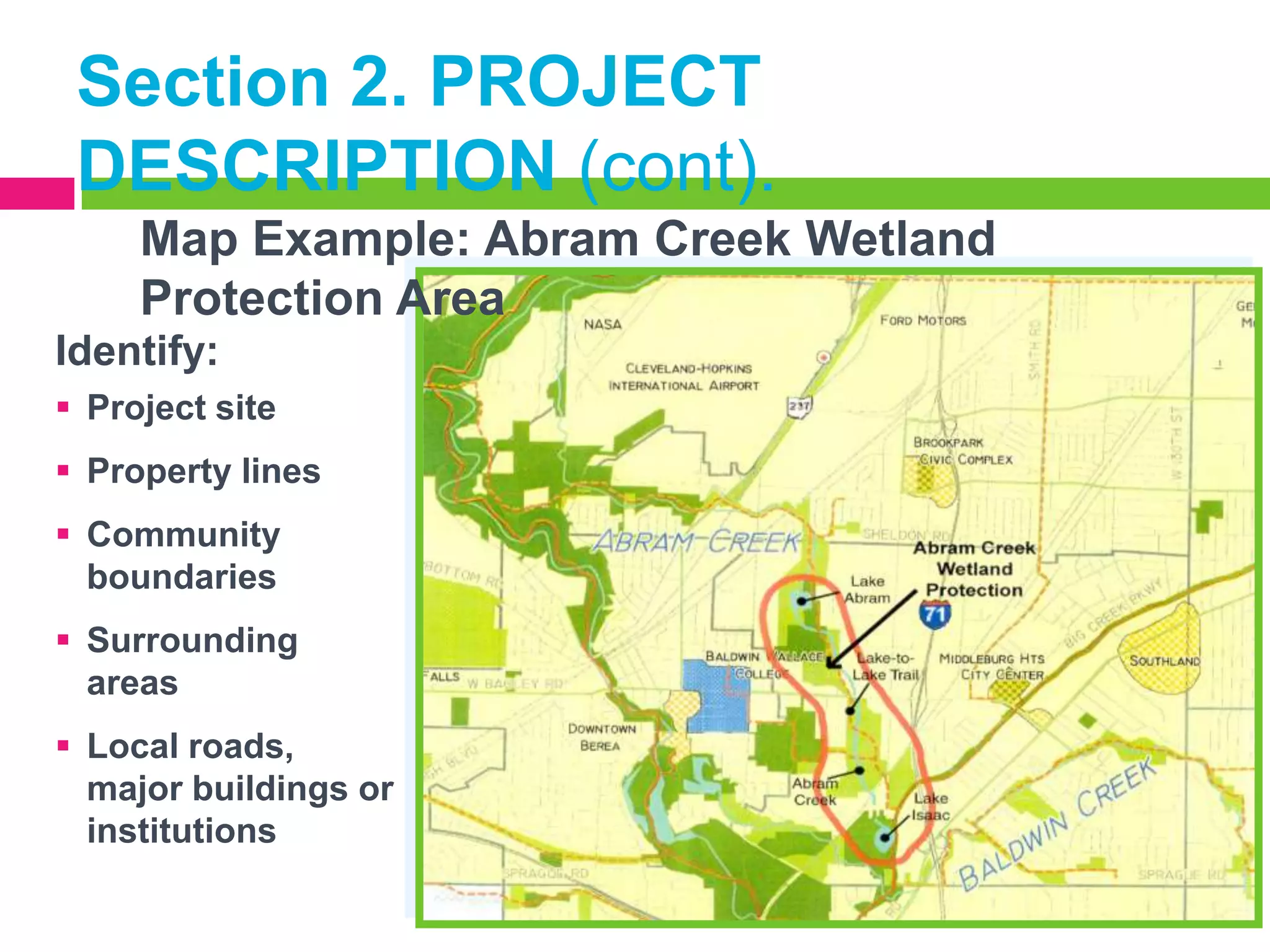
Map Example: Abram Creek Wetland
Protection Area
Identify:
 Project site
 Property lines
 Community
boundaries
 Surrounding
areas
 Local roads,
major buildings or
institutions
Section 3. COUNTY
PRINCIPLES
Page 4:


Foundation of the NRAC methodology.
•Preserve •Enhance •Provide
•Restore •Link




Identify the principle(s) that will be
advanced by the project.
Describe how the project will achieve the
identified principles.
MAXIMUM POINTS - 10 POINTS PER PRINCIPLE
Section 4. PROJECT BENEFITS
Page 5: ECONOMIC BENEFITS
Explain the economic benefits that apply:






Improving a community’s image
Increasing the value of surrounding property
Adding amenities that retain and attract businesses and
property owners
Reducing blighted images
Decreasing the cost of municipal services

MAXIMUM POINTS - 10
Section 4. PROJECT BENEFITS
(cont.)
Page 5: SOCIAL BENEFITS
Explain the individual and community benefits that
apply:








Protecting and improving human health
Creating educational opportunities
Providing for communal activities and social
interaction
Creating exercise opportunities
Enhancing the cultural and civic assets of an area
Maintaining the history and heritage of an area
Providing psychological benefits

MAXIMUM POINTS - 10
Section 4. PROJECT BENEFITS
(cont.)

Page 5: ENVIRONMENTAL BENEFITS

Explain the ecological benefits of acquiring, conserving
or restoring the project:
 Improving

biodiversity and protecting plants and animals
 Creating wildlife habitats
 Removing invasive species
 Conserving energy and reducing “heat island” effects
 Cleaning urban water, land and air
 Reducing stormwater runoff and improving water
infiltration and sequestration

MAXIMUM POINTS - 10
Section 5. NEEDS OF THE
DISTRICT

Page 6:

Will the Project…
 Advance a Concept from an Adopted Plan?
 Be of Regional or County Significance?
 Retain Parts of the County’s Natural Heritage?
 Provide Openspace to Areas that Lack
Access?
 Provide Openspace to Low-Income Minority
Neighborhoods?
MAXIMUM POINTS - 10
Section 6. OTHER RELEVANT
FACTORS
Page 7:
Other Project Funding:
 Each

project requires a minimum 25% local match
 Points awarded based on percentage of local match
– the higher the local match the higher the points.
MAXIMUM POINTS - 10

Level of Coordination:
Project is coordinated with another NRAC project.
Another community, federal/state agency,
community or conservation organization, or a
business group.
MAXIMUM POINTS - 10
Section 6. OTHER PROJECT
FACTORS
Page 7:
Readiness to Proceed:
Project will be ready-to-go within 6 months or 1 year.

MAXIMUM POINTS - 10

Immediacy:
Project requires immediate action or the conservation
opportunity will be lost.
MAXIMUM 10 BONUS POINTS
Section 6. OTHER PROJECT
FACTORS
Page 7:
Mineral rights are emerging as a major influence on property values.
Explain what property rights will be conveyed by the terms of purchase
of land or conservation easement, specifically in regards to mineral
and extraction rights.
The

date of any pre-existing lease or similar agreement on the mineral
rights, including oil, gas and/or extraction leases and if the lease or
agreement allows for surface disturbance within the property.

Property

Rights:

Explain if the current landowner will retain the mineral rights;
The mineral rights will be purchased and transferred to another entity; or
The mineral rights will be purchased and maintained.

MAXIMUM 10 BONUS POINTS
Reminders for Round 8:
 Appraisals

ODOT Pre-approved
 County Auditor’s Valuation


 Restoration

Points
 Mineral Rights Disclosure for Bonus Points
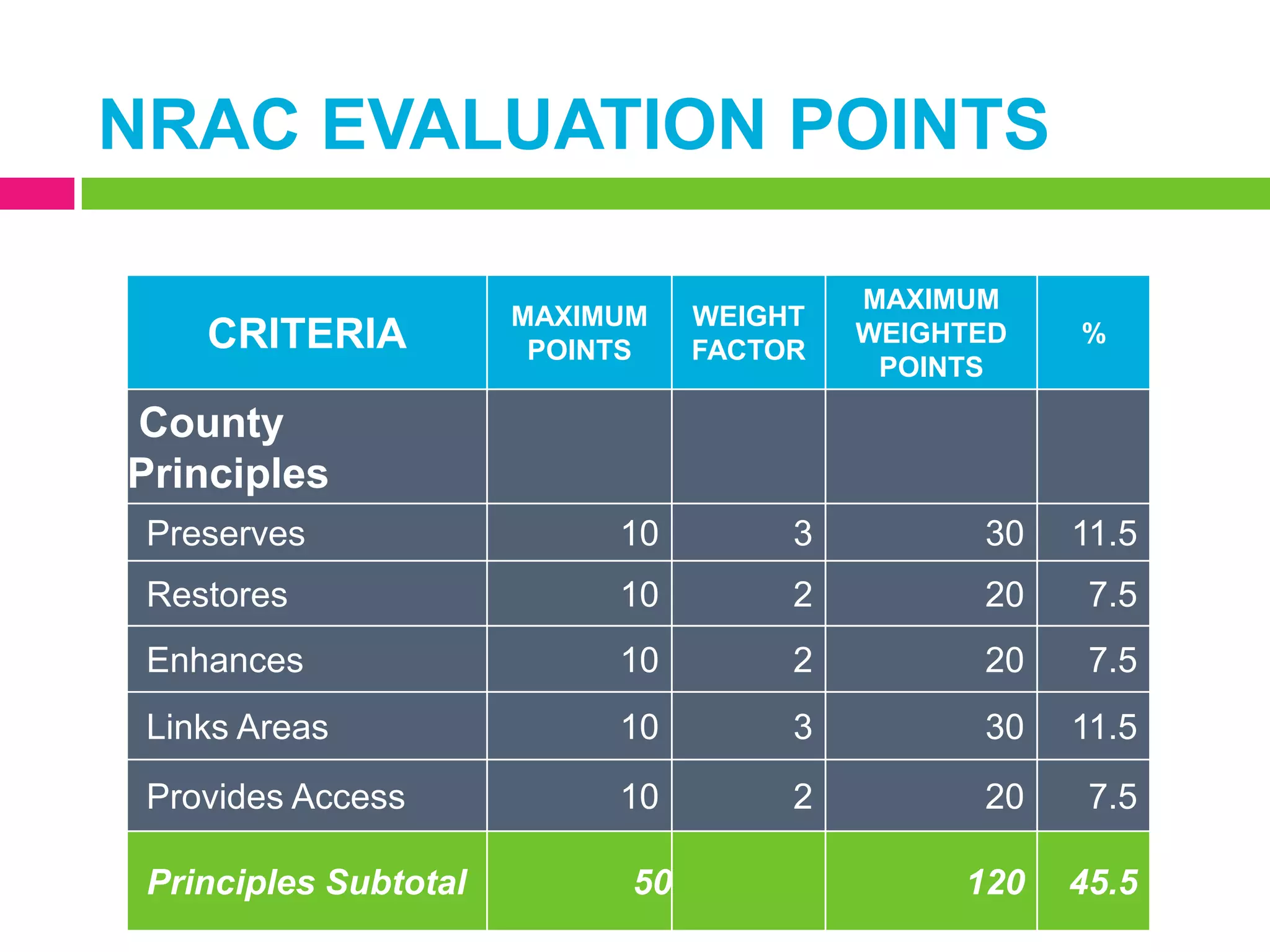
NRAC EVALUATION POINTS
CRITERIA

MAXIMUM
POINTS

WEIGHT
FACTOR

MAXIMUM
WEIGHTED
POINTS

%

County
Principles
Preserves

10

3

30

11.5

Restores

10

2

20

7.5

Enhances

10

2

20

7.5

Links Areas

10

3

30

11.5

Provides Access

10

2

20

7.5

120

45.5

Principles Subtotal

50
NRAC EVALUATION POINTS
CRITERIA

MAXIMUM
POINTS

WEIGHT
FACTOR

MAXIMUM
WEIGHTED
POINTS

%

Benefits
Economic

10

1

10

4.0

Social

10

2

20

7.5

Environmental

10

3

30

11.5

60

23.0

30

11.5

Benefits Subtotal

30

Needs of the District

10

3
NRAC EVALUATION POINTS
CRITERIA

MAXIMUM
POINTS

MAXIMUM
WEIGHTED
POINTS

WEIGHT
FACTOR

%

Other Relevant Factors
Other Project Funding

10

1

10

4.0

Level of Coordination

10

1

10

4.0

Readiness to Proceed

10

1

10

4.0

Immediacy (bonus)

10

1

10

4.0

Property Rights

10

1

10

4.0

50

16.0

Other Subtotal

TOTAL*

50

140

260 100

*PROJECTS MUST RECEIVE A SCORE OF AT LEAST 60% or 156
WEIGHTED POINTS OF THE TOTAL POINTS AVAILABLE TO BE
ROUND 8
APPLICATION REQUIREMENTS
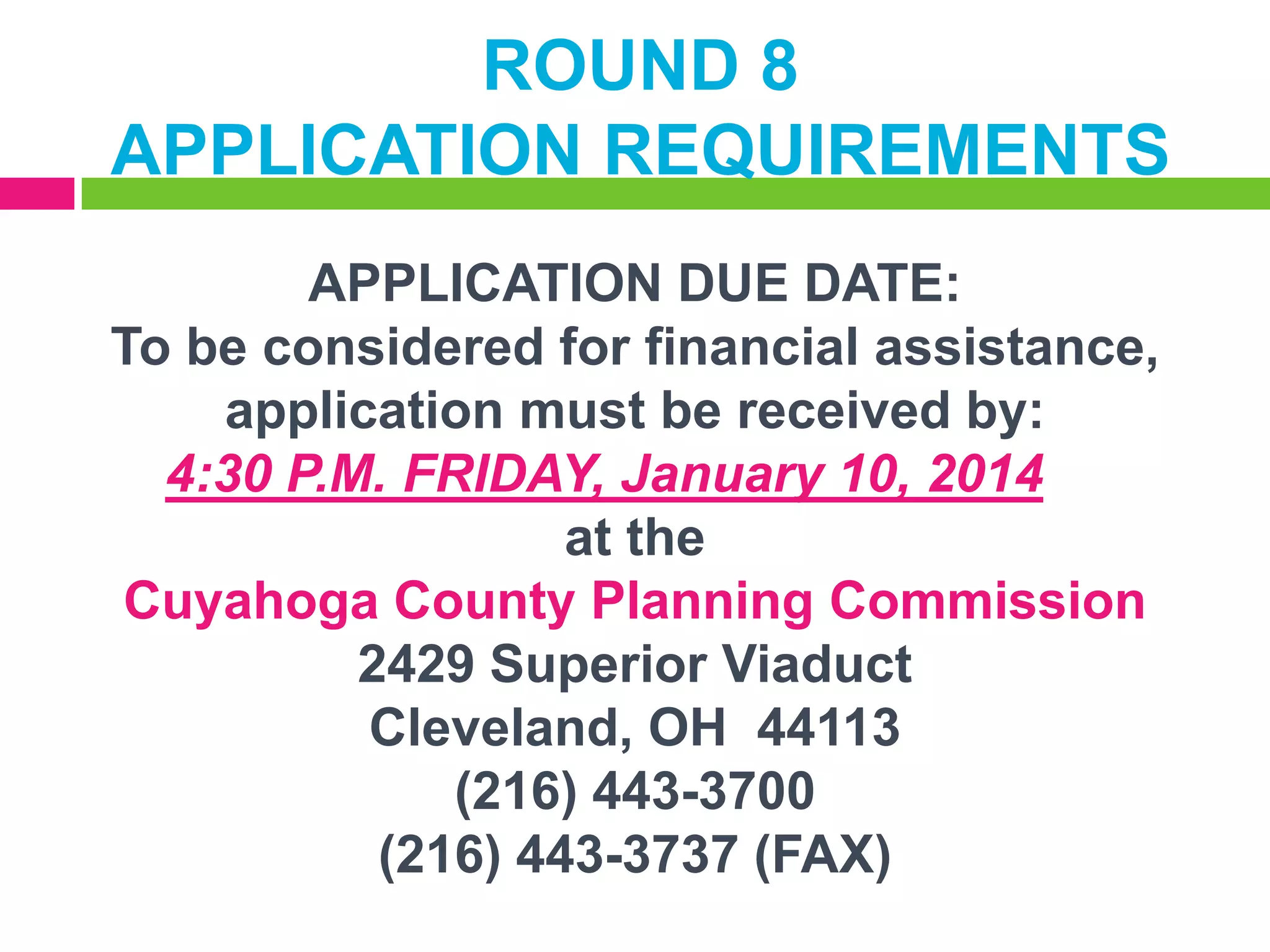
APPLICATION DUE DATE:
To be considered for financial assistance,
application must be received by:
4:30 P.M. FRIDAY, January 10, 2014 at
at the
Cuyahoga County Planning Commission
2429 Superior Viaduct
Cleveland, OH 44113
(216) 443-3700
(216) 443-3737 (FAX)
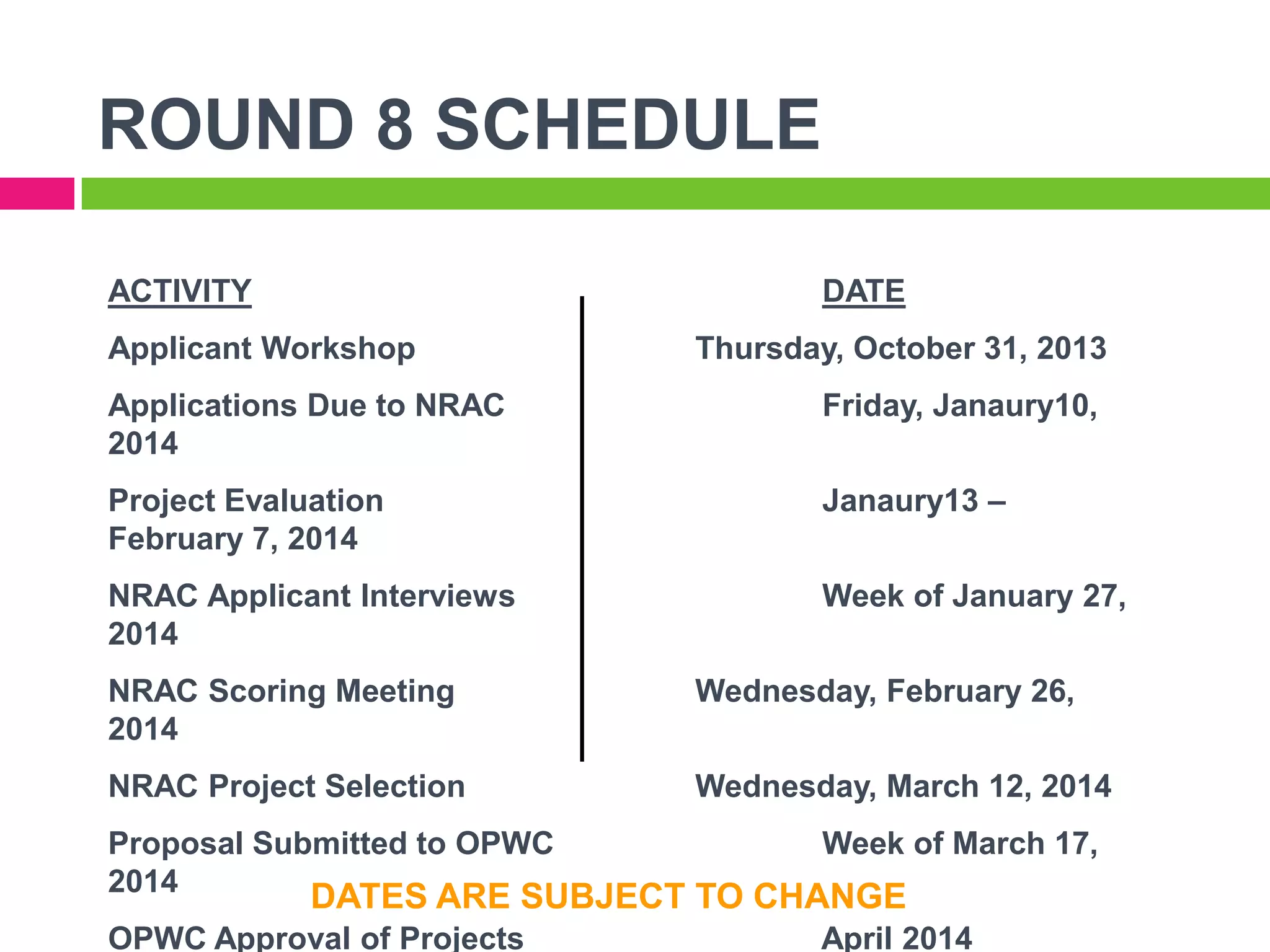
ROUND 8 SCHEDULE
ACTIVITY

DATE

Applicant Workshop

Thursday, October 31, 2013

Applications Due to NRAC
2014

Friday, Janaury10,

Project Evaluation
February 7, 2014

Janaury13 –

NRAC Applicant Interviews
2014

Week of January 27,

NRAC Scoring Meeting
2014

Wednesday, February 26,

NRAC Project Selection

Wednesday, March 12, 2014

Proposal Submitted to OPWC
2014

Week of March 17,

OPWC Approval of Projects

April 2014

DATES ARE SUBJECT TO CHANGE
CONTACT INFORMATION
Clean Ohio Conservation Program contact:
Lou Mascari, Program Representative
Ohio Public Works Commission
(614) 752-8117
lou.mascari@pwc.state.oh.us
Cuyahoga County Natural Resources Assistance Council
contact:
Alison Ball
Cuyahoga County Planning Commission
(216) 443-3727
aball@cuyahogacounty.us
QUESTIONS
AND
ANSWERS

2013 Cuyahoga County Natural Resources Assistance Council Applicant Workshop

  • 1.
    CUYAHOGA COUNTY NATURAL RESOURCES ASSISTANCECOUNCIL CLEAN OHIO CONSERVATION APPLICANT WORKSHOP ROUND 8 October 31, 2013 Canalway Visitor Center
  • 2.
    AGENDA 1. Overview of theClean Ohio Green Space Conservation Program    2. The Cuyahoga County Conservation Program Natural Resources Assistance Council (NRAC)    3. Statewide and District 1 Purpose Program Requirements Applications Evaluation Methodology Round 8 Application Requirements Q.&A.
  • 3.
    CLEAN OHIO  The CleanOhio Fund restores, protects, and connects Ohio's important natural and urban places by preserving green space and farmland, developing state-wide recreational trails, and cleaning up brownfields to encourage redevelopment and revitalize communities.  The Clean Ohio Green Space Conservation Program helps to fund preservation of open spaces, sensitive ecological areas, and
  • 4.
    CLEAN OHIO CONSERVATIONStatewide From 2000-2013: UPDATE Info below:  812 Projects were funded  $235.4 million have been awarded  Area protected:  64,400 acres of natural areas and greenspace
  • 5.
    CLEAN OHIO CONSERVATION– OPWC Policies for Round 8 Projects not scheduled for acquisition within 12 months from the date of the Project Agreement will be rejected by the Commission.  All post acquisition activities must be concluded within a two-year period from the date of acquisition unless a formal extension has been approved by OPWC.  Program Year 8 applications will be required to have a certified appraisal performed by an Ohio Department of Transportation Prequalified Appraiser 
  • 6.
    CLEAN OHIO CONSERVATION– OPWC Policies for Round 8  APPRAISALS:     Projects with Purchase Contracts exceeding the appraised value will be returned to the Natural Resources Assistance Councils for validation. These projects will not be issued a Notice to Proceed until this validation has occurred. Projects that consist of leveraging the difference between the appraised value and purchase contract will also be required to have an appraisal review performed by an Ohio Department of Transportation Prequalified Appraisal Reviewer to ensure that the purchase price history, comparables, adjustments, and disclaimers are accurate. Applicants that have an appraisal review rejected will not be issued a Notice to Proceed until these discrepancies are resolved. Properties above appraised value are eligible, but it is important for the NRAC to be cognitive of this difference and must validate the value of properties that are using the difference between the Purchase Contract and
  • 7.
    CLEAN OHIO CONSERVATION– OPWC Policies for Round 8 OPWC POLICY REGARDING MINERAL RIGHTS:  Existing oil and gas leases, at the time the Natural Resources Assistance Council approves the project, will be treated as pre-existing easements. Thus, these applications will be approved as submitted.  Requests to engage in oil and gas leasing on Clean Ohio Properties that have been acquired along with the mineral rights will be denied.  Requests to engage in these activities on Clean Ohio Properties acquired with a third party holding the mineral rights will be dealt with on a case by case basis in conjunction with the OPWC’s legal counsel
  • 8.
    CLEAN OHIO CONSERVATIONCuyahogaCounty From 2000- Present: 79 Projects were submitted  44 Projects have been funded  $21.5 million have been awarded Area Protected:  934 acres of natural areas and greenspace  12,000 lineal feet of riparian corridors 
  • 9.
    PURPOSE Forested Bank onthe Chagrin River A Unique Opportunity to Advance Conservation  Preserve Open Space.  Protect Riparian Corridors.  Protect Rare, Threatened or Endangered Species.  Support Open Space Planning.  Preserve Wetlands and Other Scarce Natural Resources.  Preserve Streamside Forests, Natural Stream Channels and Floodplains.
  • 10.
    TYPES OF PROJECTS Mill CreekArea Vistas OPEN SPACE  Acquisition of open space  Acquisition of land or rights in land for parks, forests, wetlands, natural areas that protect an endangered plant or animal population.  Construction or enhancement of facilities to make the acquired open space accessible and useable by the general public.  Acquisition of land to connect natural area corridors.
  • 11.
    Category 3 ForestedWetland TYPES OF PROJECTS RIPARIAN CORRIDORS  Fee simple acquisition Riparian Trail –Chagrin River Reservation of lands to provide access to riparian corridors or watersheds.  Acquisition of easements for the purpose of protecting and enhancing riparian corridors or watersheds.  Reforestation of land or the planting of vegetation for filtration purposes.
  • 12.
    Mill Creek ConservationProject Before Cleanup ELIGIBLE ACTIVITIES  Acquisition Expenses  Fee simple purchases  Easement purchases  Planning and Implementation  Appraisal  Closing costs  Title search  Environmental assessments  Design  Mill Creek Conservation Project Today Construction or Enhancement of Facilities  i.e. internal low-impact trails, boardwalks, lookouts, benches, small parking areas for access
  • 13.
    INELIGIBLE PROJECTS AND ACTIVITIES   Acquisitionof land for activities other than preservation and conservation. Water management activities      Flood control projects (dams, dredging, etc.). Projects that accelerate untreated water runoff. Stormwater management is the primary purpose. Plan preparation. See OPWC Application Instructions for more on Eligible vs. Ineligible project
  • 14.
    ELIGIBLE APPLICANTS Local Subdivisions Counties Cities Villages Township SpecialDistricts Conservancy Districts Soil and Water Conservation Districts Joint Recreation Districts Park District/Authority Non-Profit Corporations Exempt from federal income taxation. Has conservation activities as a primary part of its mission.
  • 15.
    ROUND 8 FUNDING  FundsAvailable.        Round 8 Allocation - $3,473,293 Available balance - $ 24,881 Total $3,498,174 Awards – grants only. Maximum grant award – 75% of Total Project Cost. 25% Local Match Required. No limit to the amount requested.
  • 16.
    LOCAL MATCH  Can be:funds  Contributions of money by any person, local political subdivision or the federal government.  Contributions in-kind through the purchase or donation of equipment, land, easements, interest in land, labor and materials necessary to complete the project.  Appraised value of property.
  • 17.
    CONSERVATION PROGRAM IMPLEMENTATION OPWC • Oversees“Issue 1” and Clean Ohio Conservation Program. Approves methodologies of NRACs Gives final approval of recommended projects. Oversees implementation of projects. • • • DOPWI C NRAC • Appoints NRAC members. • • • Implements Clean Ohio Conservation Program in Cuyahoga County. Develops project selection and evaluation methodology. Selects projects for funding and makes recommendations to OPWC.
  • 18.
    CUYAHOGA COUNTY CONSERVATION PROGRAM HemlockRavine Slopes at Beecher’s Brook Solomon’s Seal wildflower at Beecher’s Brook
  • 19.
    NATURAL RESOURCES ASSISTANCE COUNCIL (NRAC)  Elevenmembers appointed by DOPWIC.  1 member from DOPWIC  1 member from Cuyahoga County Soil and Water Conservation District  9 members to represent 5 categories: 2 - Government  3 - Environment  2 - Park Systems  1 - Agricultural  1- Business, Realtors or Planning
  • 20.
    CUYAHOGA COUNTY NRAC MEMBERSHIP Member Representing DAVIDBEACH Environment Director, GreenCityBlueLake Institute KYLE DREYFUSS WELLS, SECRETARY Environment Environmental Manager, Northeast Ohio Regional Sewer District CARRIE HANSEN Park System Manager, Research and Planning City of Cleveland, Mayor’s Office of Capital Projects DOROTHY HAZEL Soil and Water Conservation District Board Member, Cuyahoga Soil and Water Conservation District HONORABLE MICHAEL PROCUK Government Mayor, Village of Brooklyn Heights HONORABLE SUSAN RENDA, CHAIR Mayor, Village of Moreland Hills District One Public Works Integrating Committee (DOPWIC) NATALIE RONAYNE, VICE CHAIR Environment Executive Director, Cleveland Botanical Garden JENNIFER SCOFIELD Government Cuyahoga County Stat Coordinator, Office of County Executive Edward FitzGerald DONNA STUNIARZ Park System Director of Strategic Initiatives, Cleveland Metroparks CAROL THALER Agriculture Representative, Western Reserve Resource, Conservation & Development District CHRISTOPHER URBAN Business, Realtors, Planning
  • 21.
    OPEN SPACE INCUYAHOGA COUNTY    Largest and most urbanized of Ohio’s counties. 90% of land is developed and only 10% is designated open space. Existing open space areas. Existing Open Spaces  Fragmented  Not always accessible to the public  Some are degraded/ destroyed by pollution and mismanagement  Others abandoned due to poor planning and outmigration
  • 22.
    DISTRICT ONE NRAC PRINCIPLES Toensure that projects are visible, accessible and instructional, the NRAC has 5 guiding principles: 1. Preserve natural areas or open space. 2. Restore landscapes that have been degraded or destroyed. 3. Enhance the quality of natural areas or open space. 4. Link natural areas to each other or to county cultural and civic heritage areas. 5. Provide public access to natural areas and/or county cultural and civic heritage areas.
  • 23.
    RESTORATION ACTIVITIES    Restoration MUSTbe accompanied by acquisition of land for protection Restoration activities MUST be included in the project budget to be eligible for restoration points. Examples of restoration components: Returning the open space to a natural state;  Ensuring the integrity and sustainability of the species (flora/fauna) are both native and resilient;  Integrate the community’s cultural heritage; and  Provide opportunities for cultural and ecological relationships. 
  • 24.
  • 25.
    APPLICATION MATERIALS 1. OPWCClean Ohio Conservation Application  OPWC website: http://www.pwc.state.oh.us/GSCApplication.html 2. NRAC Application Supplement  Cuyahoga County Planning Commission website: http://planning.co.cuyahoga.oh.us/nrac/  Available as a PDF and Word document 3. A certified appraisal performed by an Ohio Department of Transportation Prequalified Appraiser who is credentialed in value analysis. 4. Cuyahoga County Fiscal Officer’s property valuation.  http://fiscalofficer.cuyahogacounty.us/enUS/REPI.aspx
  • 26.
    APPLICATION MATERIALS 5. Resolution(s)of Support: A project will need a resolution of support from the appropriate political subdivision(s) (Cuyahoga County, municipalities, townships) as determined by the Ohio Revised Code, section 164.23 6. Documentation of pending land transaction, e.g. purchase agreement, letter of intent, memorandum of understanding if applying for open space acquisition. 7. Maps and other Documents as needed. 8. A compact disc or flash drive with items 1 and 2; as well as all supporting documentation. A Glossary of Terms is also available.
  • 27.
    APPRAISAL REQUIREMENTS A certifiedappraisal must be included.  Appraisals must be done by an Ohio Department of Transportation Prequalified Appraiser, who is credentialed in value analysis.  http://www.dot.state.oh.us/Divisions/Engineer ing/RealEstate/Pages/LPA.aspx  http://www.dot.state.oh.us/Divisions/Engineer ing/Consultant/Consultant/prequal-row.pdf  The project will not be evaluated if the appraisals and supporting documentation is not attached. 
  • 28.
    RESOLUTIONS OF SUPPORT      Exceptas otherwise provided in the ORC, a copy of a resolution supporting the project from each county in which the proposed project is to be conducted All resolutions from Cuyahoga County will be read on at least two (2) separate regular Council meetings In between readings, the resolutions will be heard in committee. A staff member from your organization should plan to be present at the committee hearing. Alison Ball of the Cuyahoga County Planning Commission will assist applicants through the process. Resolution requests are due by November 15, 2013 at 4:30PM.
  • 29.
    APPLICATION SUBMITTAL to NRAC Must submit 1 original and 12 copies. Copies to be submitted:  13 Hard copies – double sided;  1 Digitally on compact disc or flash drive.  Materials must be typed using at least an 11 font.  All copies should be bound on the lefthand side.
  • 30.
  • 31.
    APPLICATION SPECIFICS OPWC APPLICATION– Important points.  Financial Information – Page 2  Financial Resources – Page 2  Project Schedule – Page 3  Project Description – Page 4  Project Officials – Page 5  Attachments – Page 6
  • 32.
    APPLICATION SPECIFICS NRAC APPLICATIONSUPPLEMENT  Relates directly to the NRAC Evaluation Methodology.  Used along with the OPWC Application to review projects.  Applicant is responsible in making sure all documents are complete and accurate.
  • 33.
    PROJECT EVALUATION The EvaluationProcess is divided into three major components: Phase 1: Preliminary Project Evaluation Phase 2: Preliminary Project Scoring (includes Applicant Interviews) and Public Meeting Phase 3: Final Project Scoring and Recommendations to OPWC
  • 34.
    PROJECT EVALUATION The NRACApplication Supplement has six major sections that are scored: Section One: Project Emphasis Section Two: Project Description Section Three: County Principles Section Four: Project Benefits Section Five: Needs Of The District Section Six: Other Relevant Factors
  • 35.
    Section 1. PROJECTEMPHASIS Page 2: Based on the factors stated in authorizing legislation  Indicate each factor that will be achieved by the project  Check as many as apply in one category  EXAMPLE: Open space project will acquire property identified in the city’s open space plan and will preserve a high quality wetland that will be used by the city’s school district as a hands-on science laboratory. NO POINTS AWARDED
  • 36.
    Section 2. PROJECT DESCRIPTION Page3:   Project Name Type of Project  Acquisition of land  Acquisition of land/facilities for accessibility  Riparian Corridor restoration   Appraisal or Conservation Value Provide no more than a three-page project description that includes a map showing the project location(s) and the local setting. NO POINTS AWARDED
  • 37.
    Section 2. PROJECT DESCRIPTION(cont). Types of Acquisition: Project site must be secured in perpetuity.  Land Securement Tools    Fee simple: Absolute title to the land, free of any conditions, easements, limitations, encumbrances, or other claims against the title such that a property owner can sell the property or leave it to another by will or inheritance. Conservation Easement: a right or interest in land that is held for the public purpose of retaining land, water, or wetland areas predominantly in their natural, scenic, open, or wooded condition. Recorded as a deed restriction.
  • 38.
    Section 2. PROJECT DESCRIPTION(cont). Map Example: Abram Creek Wetland Protection Area Identify:  Project site  Property lines  Community boundaries  Surrounding areas  Local roads, major buildings or institutions
  • 39.
    Section 3. COUNTY PRINCIPLES Page4:  Foundation of the NRAC methodology. •Preserve •Enhance •Provide •Restore •Link   Identify the principle(s) that will be advanced by the project. Describe how the project will achieve the identified principles. MAXIMUM POINTS - 10 POINTS PER PRINCIPLE
  • 40.
    Section 4. PROJECTBENEFITS Page 5: ECONOMIC BENEFITS Explain the economic benefits that apply:      Improving a community’s image Increasing the value of surrounding property Adding amenities that retain and attract businesses and property owners Reducing blighted images Decreasing the cost of municipal services MAXIMUM POINTS - 10
  • 41.
    Section 4. PROJECTBENEFITS (cont.) Page 5: SOCIAL BENEFITS Explain the individual and community benefits that apply:        Protecting and improving human health Creating educational opportunities Providing for communal activities and social interaction Creating exercise opportunities Enhancing the cultural and civic assets of an area Maintaining the history and heritage of an area Providing psychological benefits MAXIMUM POINTS - 10
  • 42.
    Section 4. PROJECTBENEFITS (cont.) Page 5: ENVIRONMENTAL BENEFITS Explain the ecological benefits of acquiring, conserving or restoring the project:  Improving biodiversity and protecting plants and animals  Creating wildlife habitats  Removing invasive species  Conserving energy and reducing “heat island” effects  Cleaning urban water, land and air  Reducing stormwater runoff and improving water infiltration and sequestration MAXIMUM POINTS - 10
  • 43.
    Section 5. NEEDSOF THE DISTRICT Page 6: Will the Project…  Advance a Concept from an Adopted Plan?  Be of Regional or County Significance?  Retain Parts of the County’s Natural Heritage?  Provide Openspace to Areas that Lack Access?  Provide Openspace to Low-Income Minority Neighborhoods? MAXIMUM POINTS - 10
  • 44.
    Section 6. OTHERRELEVANT FACTORS Page 7: Other Project Funding:  Each project requires a minimum 25% local match  Points awarded based on percentage of local match – the higher the local match the higher the points. MAXIMUM POINTS - 10 Level of Coordination: Project is coordinated with another NRAC project. Another community, federal/state agency, community or conservation organization, or a business group. MAXIMUM POINTS - 10
  • 45.
    Section 6. OTHERPROJECT FACTORS Page 7: Readiness to Proceed: Project will be ready-to-go within 6 months or 1 year. MAXIMUM POINTS - 10 Immediacy: Project requires immediate action or the conservation opportunity will be lost. MAXIMUM 10 BONUS POINTS
  • 46.
    Section 6. OTHERPROJECT FACTORS Page 7: Mineral rights are emerging as a major influence on property values. Explain what property rights will be conveyed by the terms of purchase of land or conservation easement, specifically in regards to mineral and extraction rights. The date of any pre-existing lease or similar agreement on the mineral rights, including oil, gas and/or extraction leases and if the lease or agreement allows for surface disturbance within the property. Property Rights: Explain if the current landowner will retain the mineral rights; The mineral rights will be purchased and transferred to another entity; or The mineral rights will be purchased and maintained. MAXIMUM 10 BONUS POINTS
  • 47.
    Reminders for Round8:  Appraisals ODOT Pre-approved  County Auditor’s Valuation   Restoration Points  Mineral Rights Disclosure for Bonus Points
  • 48.
  • 49.
  • 50.
    NRAC EVALUATION POINTS CRITERIA MAXIMUM POINTS MAXIMUM WEIGHTED POINTS WEIGHT FACTOR % OtherRelevant Factors Other Project Funding 10 1 10 4.0 Level of Coordination 10 1 10 4.0 Readiness to Proceed 10 1 10 4.0 Immediacy (bonus) 10 1 10 4.0 Property Rights 10 1 10 4.0 50 16.0 Other Subtotal TOTAL* 50 140 260 100 *PROJECTS MUST RECEIVE A SCORE OF AT LEAST 60% or 156 WEIGHTED POINTS OF THE TOTAL POINTS AVAILABLE TO BE
  • 51.
    ROUND 8 APPLICATION REQUIREMENTS APPLICATIONDUE DATE: To be considered for financial assistance, application must be received by: 4:30 P.M. FRIDAY, January 10, 2014 at at the Cuyahoga County Planning Commission 2429 Superior Viaduct Cleveland, OH 44113 (216) 443-3700 (216) 443-3737 (FAX)
  • 52.
    ROUND 8 SCHEDULE ACTIVITY DATE ApplicantWorkshop Thursday, October 31, 2013 Applications Due to NRAC 2014 Friday, Janaury10, Project Evaluation February 7, 2014 Janaury13 – NRAC Applicant Interviews 2014 Week of January 27, NRAC Scoring Meeting 2014 Wednesday, February 26, NRAC Project Selection Wednesday, March 12, 2014 Proposal Submitted to OPWC 2014 Week of March 17, OPWC Approval of Projects April 2014 DATES ARE SUBJECT TO CHANGE
  • 53.
    CONTACT INFORMATION Clean OhioConservation Program contact: Lou Mascari, Program Representative Ohio Public Works Commission (614) 752-8117 lou.mascari@pwc.state.oh.us Cuyahoga County Natural Resources Assistance Council contact: Alison Ball Cuyahoga County Planning Commission (216) 443-3727 aball@cuyahogacounty.us
  • 54.

Editor's Notes

  • #3 One: Overview Briefly cover the IMPACT that the Clean Ohio Conservation program has had on a State-wide and a County-wide basisThe purpose and mission of the programProgram Requirements, including: projects and activities that are eligible; projects and activities that are ineligible; and eligible applicantsAnd Funding and match specificsTwo: We’ll be going over how the Clean Ohio Fund is implemented in District One by the NRAC Going over application specifics and how the projects are evaluated
  • #4 One: Overview Briefly cover the IMPACT that the Clean Ohio Conservation program has had on a State-wide and a County-wide basisLOU The purpose and mission of the programProgram Requirements, including: projects and activities that are eligible; projects and activities that are ineligible; and eligible applicants
  • #5 Lou – Overview of State Programthe numbers are impressive:From 2000- Present, 812 projects across the state have been fundedA little over 235.4 million dollars have been awarded64,400 acres of natural areas and greenspace have been acquired, protected or restored.
  • #6 Lou – Overview of OPWC policiesBased on the previous rounds the Ohio Public Works Commission made the following policy changes for Round 8:-new application-Acquisition must be made within 12 months of project agreement which will be in…-Certified appraisals by an ODOT prequalified appraiser-post acquisition activities have 2 years for completion unless otherwise arranged with OPWC
  • #7 Lou – Overview of OPWC policiesBased on the previous rounds the Ohio Public Works Commission made the following policy changes for Round 8:-new application-Acquisition must be made within 12 months of project agreement which will be in…-Certified appraisals by an ODOT prequalified appraiser-post acquisition activities have 2 years for completion unless otherwise arranged with OPWC
  • #8 Lou – Overview of OPWC policiesBased on the previous rounds the Ohio Public Works Commission made the following policy changes for Round 7:Existing oil and gas leases, at the time the Natural Resources Assistance Council approves the project, will be treated as pre-existing easements which the applicant has no or little control over. Thus, these applications will be approved as submitted. Requests to engage in oil and gas leasing on Clean Ohio Properties that have been acquired along with the mineral rights will be denied.
  • #9 In Cuyahoga County, from 2000-Present44 PROJECTS $63,279,930 $21,653,315 934 acres preserved Of the 79 projects that have been submitted, 44 of them have been funded—so half of those who have applied have received fundingRoughly 21 million dollars have been awarded744 acres of natural areas AND 12,000 lineal feet of riparian corridors have been acquired, protected or restored.
  • #11 Acquisition of open space, we’ll get into later, but this includes many sorts of property acquisitions including fee simple, conservation easements, and other kinds of conservation encumbrances on the land.
  • #12 Filtration purposed—this will be tale
  • #30 It is the applicant’s responsibility to ensure that all of the documents are accurate, complete and in accordance with the requirements, terms, and conditions set down by the OPWC and the NRAC. Failure to meet these conditions may result in the disqualification of a project.
  • #32 Lou to Present OPWC Application specifics – slide 31