UNIT 4
Research Proposal
1
4.1. Function of the research proposal
 A Research proposal is known as a detailed work
plan, catalog, outline, statement of intent, or draft
plan.
• A research proposal is essentially a road map,
showing clearly the location from which a journey
begins, the destination to be reached, and the method
of getting there.
2
Cont. …
• Proposal is also useful both for sponsors and for researchers.
For researchers proposal helps:
• To have a tentative work plan that charts the logical steps
needed to accomplish the stated goals
• To spot flaws in the logic, errors in assumptions, or
problems that are not adequately addressed by the objectives
and design
• To serve as a guideline for the researcher throughout the
investigation once the proposal is accepted.
3
Cont. …
For sponsors:
• To assess the sincerity of the purpose, the clarity of
the design, the extent of the background material, and
fitness of the researcher to undertake the project.
• To assess both the researcher and the proposed
design, to compare them against competing proposals,
and to make the best selection for the project
• Provides a basis to evaluate the results of the
project.
4
4.1.1. Function of the research proposal
 Research proposal may function at least in three ways,
namely, as a means of communication, as a plan and
as a contract.
 Proposal as a means of communication serves to
communicate the investigator’s research plan to those
who-give consultations and / or disburse fund.
 Research proposal as plan helps the researcher to
organize his idea in a systematic manner and to look
for strengths and flaws.
• That is, it provides an inventory of what will be done
and which materials have to be collected as a
preliminary step.
5
Cont. …
 Proposal also functions as a contract. A completed proposal
approved for execution and signed by all members of the
sponsoring committee, constitute a bond of agreement between
the researcher and that committee.
• An approved grant proposal results in a contract between the
investigator (and often the university) and funding sources.
6
4.1.2 Importance of the research proposal
 In general, purpose of research proposal has the
following importance.
• It serves as a basis for determining the feasibility of the
research project.
• It provides a systematic plan of procedure for the
researcher to follow.
• It gives the research supervisor a basis for guiding the
researcher while conducting the study.
• It reduces the probability of costly mistake.
NB: Preparation of a full-fledged proposal is not a one-
time endeavor. But, it is the result of continuous
modification and amendment through discussion with
experts in the field.
7
4.2. General Format and Elements of Proposal
There is no single way of writing research
proposals.
 There can be different formats for research
proposals depending on the funding
organizations.
• However, the following proposal components
are usually important.
8
Cont. …
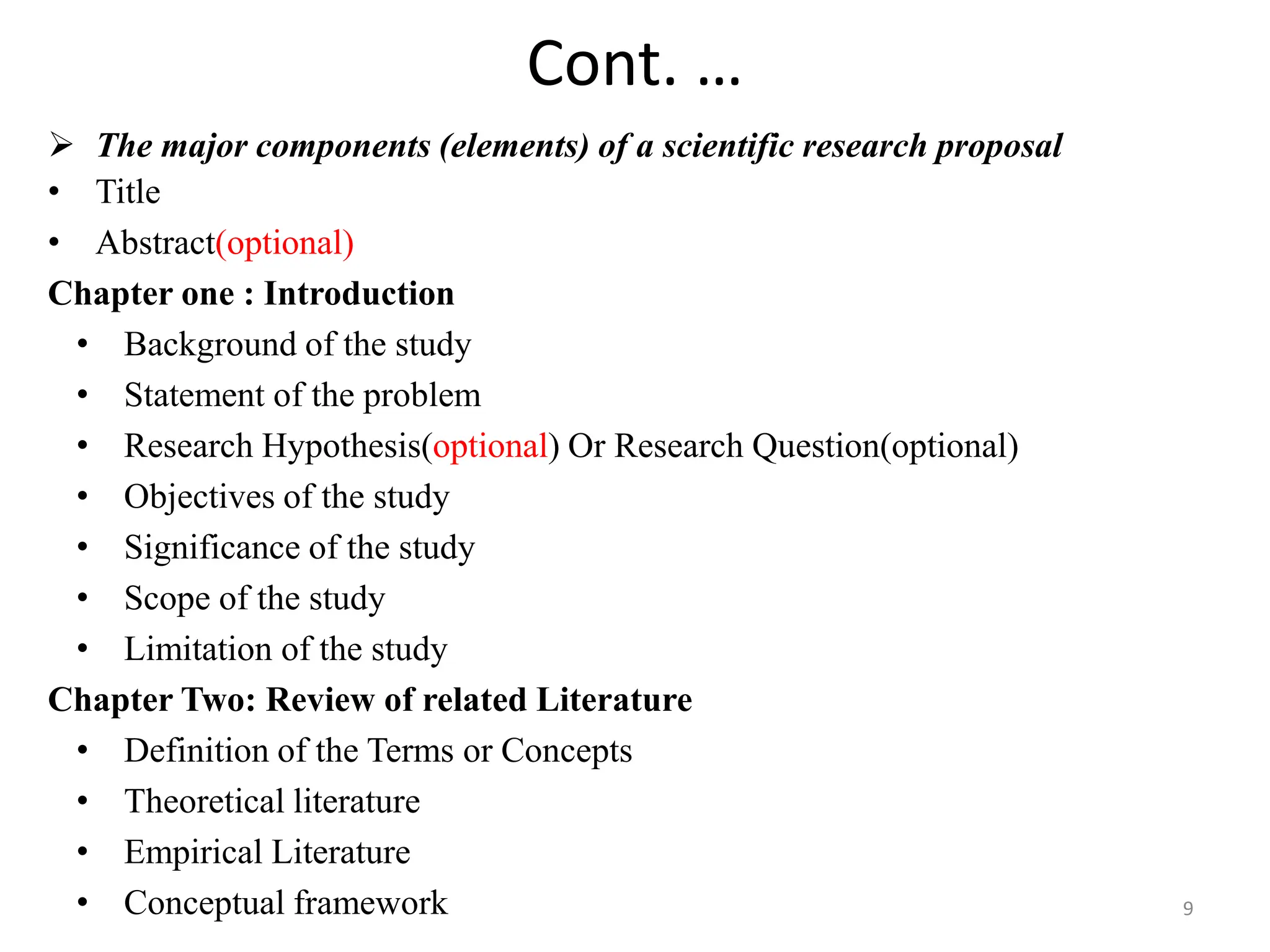
 The major components (elements) of a scientific research proposal
• Title
• Abstract(optional)
Chapter one : Introduction
• Background of the study
• Statement of the problem
• Research Hypothesis(optional) Or Research Question(optional)
• Objectives of the study
• Significance of the study
• Scope of the study
• Limitation of the study
Chapter Two: Review of related Literature
• Definition of the Terms or Concepts
• Theoretical literature
• Empirical Literature
• Conceptual framework 9
Cont. …
Chapter Three: Research methodology and description of the
study
– Description of the Study area
– Census/Sampling methods
– Sample size
– Type and Method of data collection
– Method of data analysis
– Description of variables
Chapter four: Work and Budget Plan
• Time Breakdown
• Budget/Cost
Finally
• References
• Appendix/Annex
10
Detail on elements of Research proposal
1. Title
• The title should be as explicit as possible and
transparent.
• It should be worded in such a way that it gives sufficient
information about the nature of the study.
• It should enable the readers to understand the concepts
of the study.
 It is the most widely read part of your proposal.
• It should contain the key words – the important words
that indicate the subject.
11
Cont. …
• In selecting a title for investigation the researcher should
consider the following points:
A. The Title shouldn’t be too lengthy
• It should be specific to the area of study. For example
the following topic appears to be long.
“ A study of academic achievement of children in pastoral
regions whose parents had participated literacy classes
against those whose parents didn’t”
B. The Title shouldn’t be too brief or too short
• The following sentence is too short “Marketing in Japan”
or “Unemployment in Ethiopia”
12
Cont. …
 General structure of title page
 It contains the working title followed by the purpose of the
study [in your case may be stated as:
• A Research Proposal for the Term-Paper in Partial
Fulfillment of the Requirements for the Course Introduction
to Research Methods for Economists, Econ-2063].
• Then, the name of the author/researcher and
advisor/course instructor followed by institutional
affiliation stated as Department of Economics, Rift valley
University Woliso Campus.
• Then, the date (month and year) and place (name of
town/city) of proposal development at the right bottom
corner shall be presented.
13
Cont. …
College Of Business And Economics Department Of Economics
Determinants Of Household Saving In Case of Woliso Town
A research proposal Submitted in Partial Fulfillment of the Requirements for
the Bachelor of Arts (BA) Degree In Economics
By: Kasahun Lelisa
Advisor: Fikadu D. (MSc)
August,2024
Woliso, Ethiopia
14
Cont. …
2. Abstract:
• Is summary, which reflects the whole content of the proposal
(most of the time less than 300 words?)
• It should be concise and informative, giving readers the
chance to grasp the essentials of the proposal without having
to read the details.
• It is a short summary of the research proposal. This allows a
busy manager or sponsor to understand quickly the thrust of
the proposal.
15
Cont. …
 The abstract of a proposal should contain the following
points.
• Title or topic of the research
• Statement of the problem and objective
• Methodology of investigation
• Expected result (tentative only if a researcher starts with
a formulated hypothesis)
• Mention the expected outputs, expected beneficiaries,
the methods to be used, sampling design, types of data,
method of data analysis, etc.
• The abstract presents all parts of the proposal, each part
condensed according to the significance of information
in it but the total shall not exceed a page (usually half a
page).
• Mostly written in Italic form
16
Chapter One
Introduction
1.1. Background of the Study
• Some question to be addressed in this part may
include:
What are current and previous studies that have
been made on the issues to be studied?
What is the present gap in knowledge and current
trend?
What makes worth studying?
Why has the problem not been solved yet?
What do we intend to fill the gap or solve the
problem?
17
Cont. …
1.2. Statement of the problem/The Rationale
• More specifically, statement of the problem is targeted
towards the following:
 Stating the background facts which justify the study to
be in order
 Developing hypotheses or key questions, which may
show the direction of the whole exercise.
18
Cont. …
1.3. Objectives of the study
• In this section, it is where the investigator discusses
the major and specific objectives of his /her
investigation.
• Generally this section should focus on the points
 What is to be achieved by the proposed investigation
has to be stated plainly and concisely
 Should be stated in a form which shows the relations
between variables
 Must clearly state the target of the research activity,
i.e., what kind of results are expected or sought from
conducting research.
19
Cont. …
General Objective
 General objectives are the broad goals that has to be achieved
• It states what the researcher expects to achieve from the study in general
terms
• The general objective provides a short statement of the scientific goal being
pursued by the research.
• General objectives can broken into small logically connected parts to form
specific objectives
Specific objectives
 These are short term and narrow in focus
 The specific objectives are operational in nature.
 Specific objectives systematically address various aspects of problem
 Specific objectives should specify what the researcher will do in the study,
where & for what purpose
 They may indicate specific types of knowledge to be produced.
20
Cont. …
• General objective is met through accomplishing all the
specific objectives
 Research objectives have should be SMART (specific,
measurable, achievable, realistic and time-bounded)
and that the specific objectives derive from the general
objective.
 Research objective use action verbs that are specified
enough to be evaluated.
Examples of action verbs are:
 To assess, to compare, to calculate , to measure, to
explore, to identify, to describe, to find out, to analyze,
to determine, to establish.
21
Cont. …
Example: Title: “Analysis of rural households poverty and vulnerability”
• The overall objective of this research is to analyze rural households
poverty and vulnerability, and its major determinants. As part of the
general objective, this research work intends to achieve the following
specific objectives as well:
1. To measure the extents, depth and severity of poverty, and vulnerability
to poverty in the study area
2. To identify the major determinants of welfare (consumption expenditure
as a proxy), poverty gap and poverty severity, and vulnerability to
poverty
3. To measure the welfare (consumption expenditure) inequality in the
study area
Example: Title: Analysis of customer satisfaction in South West Shoa Zone
• The over all objective is to analyze the extents of customer satisfaction
and its determinants. Specific objective
• To measure the extents of customer satisfaction
• To identify the major determinants of customer satisfaction
22
Cont. …
1.4. Research Hypothesis
• In a research context, a hypothesis can be defined as a suggested
solution for a particular problem.
• By suggesting a possible solution to a problem, research can take
a certain direction, otherwise much time can be wasted in an
investigation without direction.
• Example Title: “Analysis of rural HH poverty and vulnerability”
 Family size, dependency ratio, distance to the main market and
drought will be positively and significantly correlated to
household poverty.
 Asset holding including oxen, land size and home asset value will
have a negative and significant effect on the household’s poverty
status.
 Off-farm income participation, access to credit and access to
extension service will affect poverty negatively and significantly.
23
Cont. …
1.5. Scope of the study
• The scope of the study delaminates(bounds) the
research activities in terms of :
1. Issues that must be included
2. Area that the study cared out
3. Target population & sample size , methods of
sampling
4. Types of data (cross-section & longitudinal data),
and methods of data analysis (descriptive and
econometric).
24
Cont. …
1.6. Significance of the study
• Significance of the study tries to associate the
possible research finding & expected beneficiaries
from that particular finding.
• Who is the possible beneficiaries from a particular
finding?
• Having a certain finding benefit …which stakeholders.
1. Does the outcome benefit policy makers?
2. Does the outcome benefit NGOs?
3. Does the outcome benefit investors?
4. Does the outcome benefit hhs ?
 Why a certain group get benefit from a particular
finding and How it could be?
25
Cont. …
• In general, the significance of the study contains
three paragraphs based on three basic questions:
1. Why the study is important?....B/c you are
getting relevant finding
2. How the study is important?....by filling the gap,
by providing the way how to solve the problem,
or by directly showing the immediate cause for a
problem, etc.
3. For whom the study is important?....directly
indicated the immediate beneficiaries from a
certain outcome
26
Cont. …
G. Limitation of the Study
• Although a researcher tries his best to design his
research as properly as possible, there are externals
(uncontrolled) variables that confront his/her
investigation and affect his/her conclusion.
• In his/ her research proposal, the researcher has to
specify such factors that hinder the attainment of
his/her objectives. The possible sources include:
 Practical witness in the methodologies the researcher
applied.
 Lack of access to the appropriate data
 Poor development of instruments
 Sampling restriction
 Lack of up to date literature in the areas.
27
CHAPTER TWO
LITERATURE REVIEW
2. Literature review
• Literature review means locating literature in a variety of
sources reading it carefully and thoroughly organizing it
into themes along with the line of investigation.
• Objective of the literature review
 To establish a familiarity with a body of knowledge and
establishes credibility.
 To show the path of prior research and how a current
project is linked to it
 To integrate and summarize what is known in the area
 To learn from others and stimulate new ideas.
28
Cont. …
Types of reviewed literature can be
2.1 Theoretical works and review,
Definition of the Terms or Concepts
• The technical terms or words and phrases having
special meaning need to be defined operationally by
the help of special dictionaries
• Methodological review,
2.2 Empirical (Original findings and reviews of them)
• Reading or review for research could take place in three
stages of the research project. These include the following
 At the beginning of the research:
 During your research
 After your research
2.3. Conceptual framework
29
Chapter Three
Methodology of the Study
3.1.Description of the study area
3.2.Methodology of the study
• The methodologies are the core and the largest part of
the scientific research proposal.
• An accurate, clear and valid methodology is required
• The methodology generally addresses the issues related
to the study area, data types, sources of data, data
collection methods, target population, sample size and
sampling techniques, methods of data analysis, methods
of hypothesis testing.
30
Cont. …
• Methodology should give full details to show how the
research activity is going to be carried out.
• Researchers are advised to split the methodology part it
in to sub-sections as
i. Data (materials used) and
 Type of data..
 The source of the data
 Where data is collected?
31
Cont. …
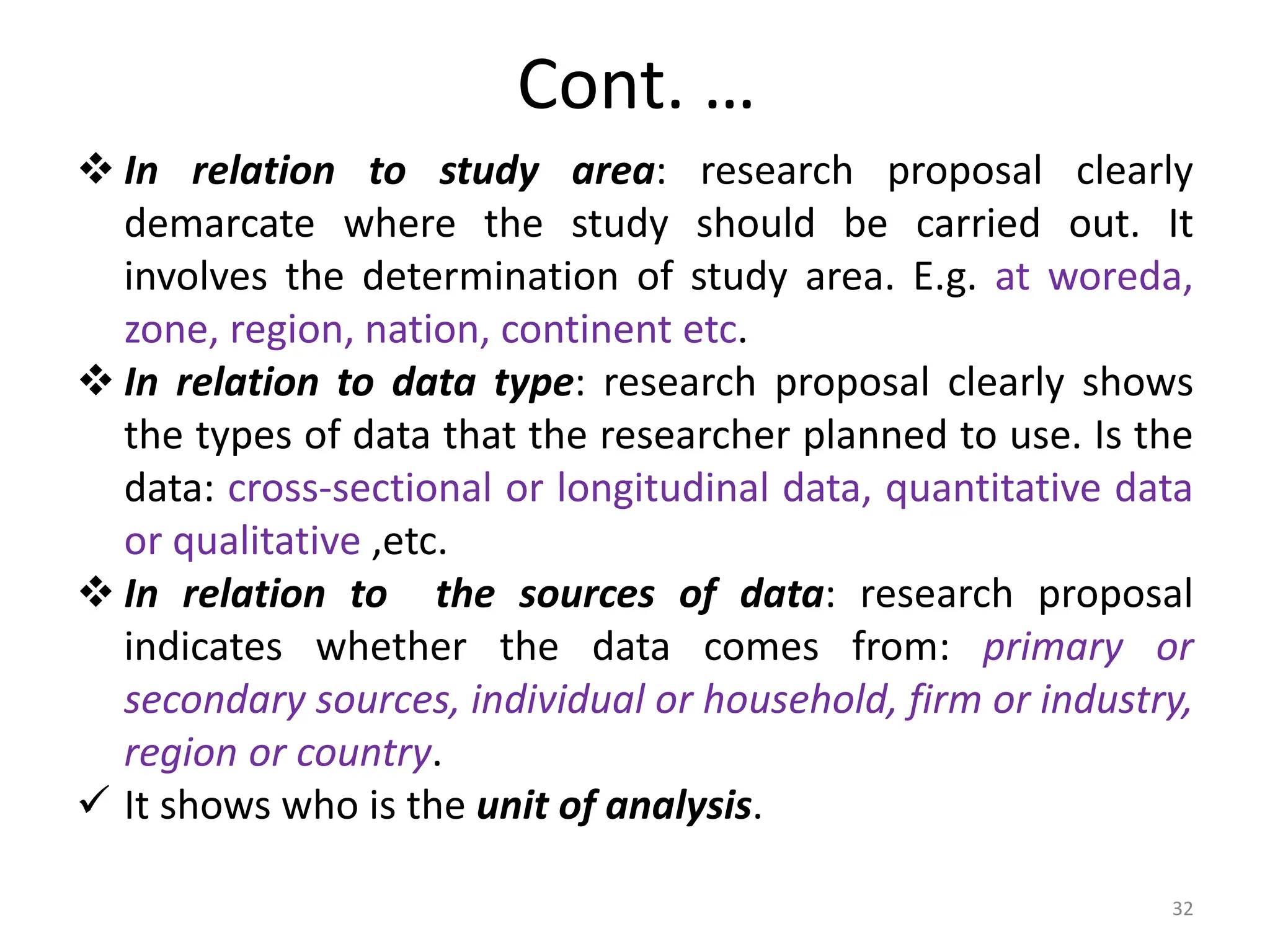
 In relation to study area: research proposal clearly
demarcate where the study should be carried out. It
involves the determination of study area. E.g. at woreda,
zone, region, nation, continent etc.
 In relation to data type: research proposal clearly shows
the types of data that the researcher planned to use. Is the
data: cross-sectional or longitudinal data, quantitative data
or qualitative ,etc.
 In relation to the sources of data: research proposal
indicates whether the data comes from: primary or
secondary sources, individual or household, firm or industry,
region or country.
 It shows who is the unit of analysis.
32
Cont. …
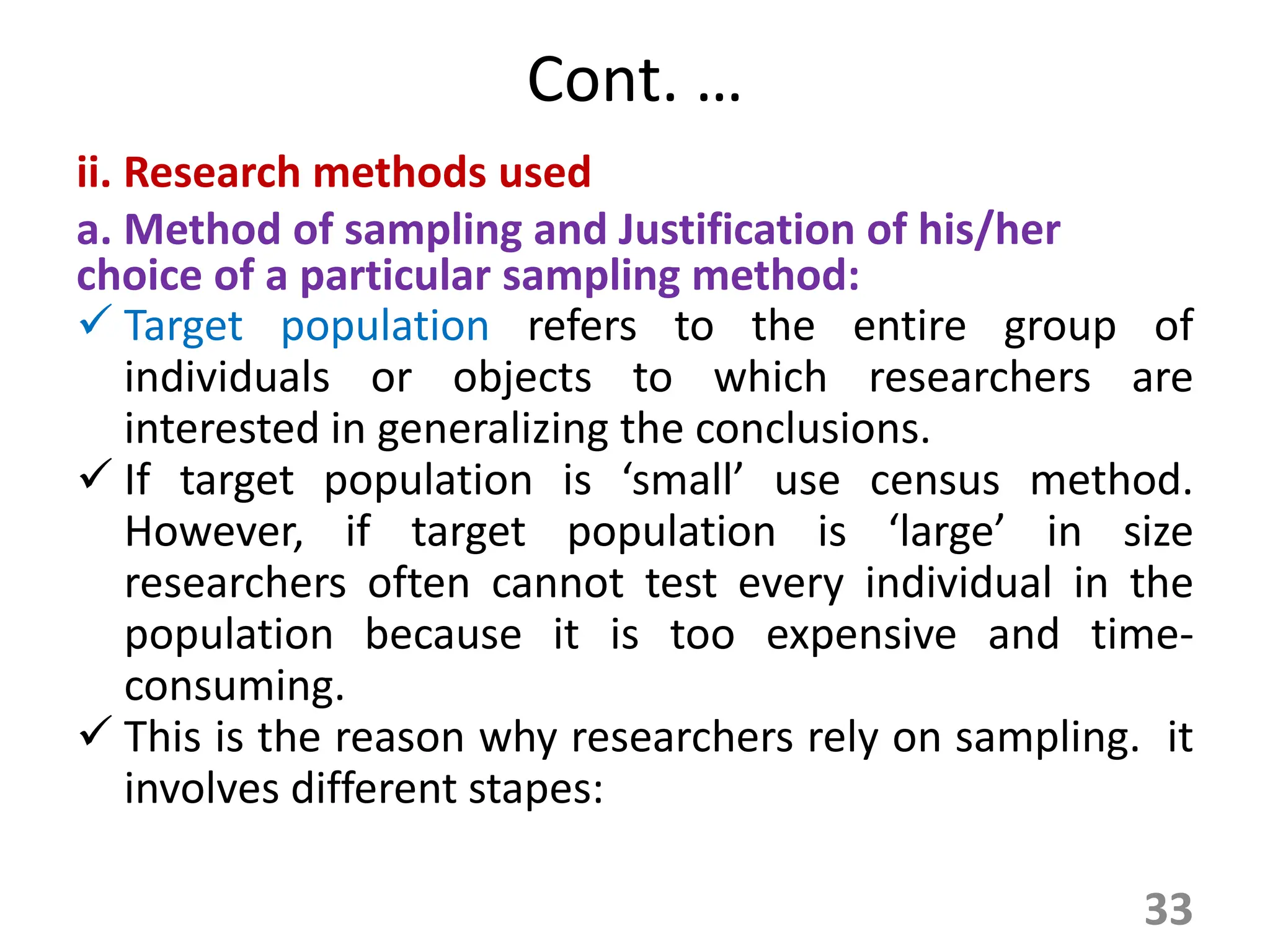
ii. Research methods used
a. Method of sampling and Justification of his/her
choice of a particular sampling method:
 Target population refers to the entire group of
individuals or objects to which researchers are
interested in generalizing the conclusions.
 If target population is ‘small’ use census method.
However, if target population is ‘large’ in size
researchers often cannot test every individual in the
population because it is too expensive and time-
consuming.
 This is the reason why researchers rely on sampling. it
involves different stapes:
33
Cont. …
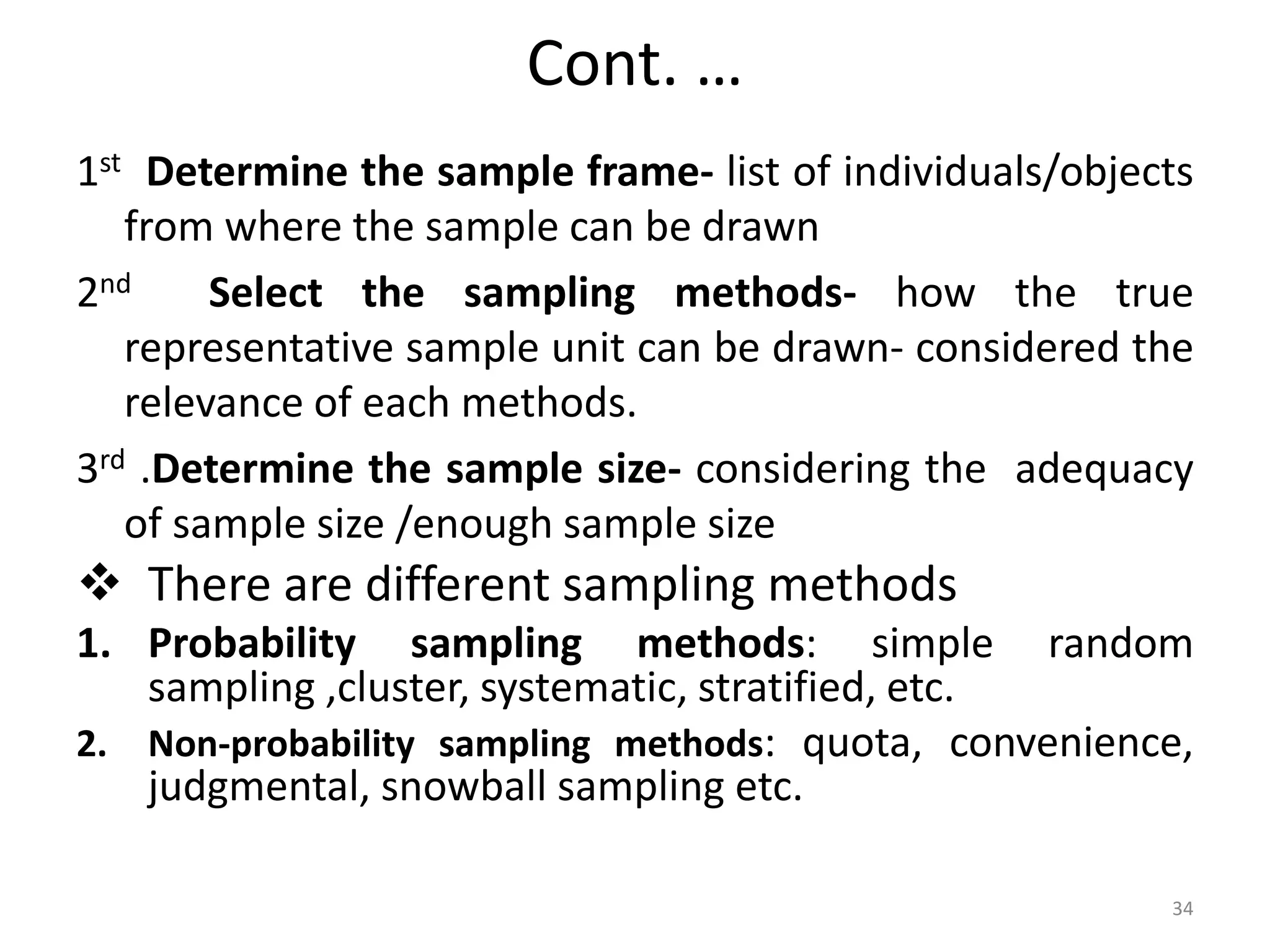
1st Determine the sample frame- list of individuals/objects
from where the sample can be drawn
2nd Select the sampling methods- how the true
representative sample unit can be drawn- considered the
relevance of each methods.
3rd .Determine the sample size- considering the adequacy
of sample size /enough sample size
 There are different sampling methods
1. Probability sampling methods: simple random
sampling ,cluster, systematic, stratified, etc.
2. Non-probability sampling methods: quota, convenience,
judgmental, snowball sampling etc.
34
Cont. …
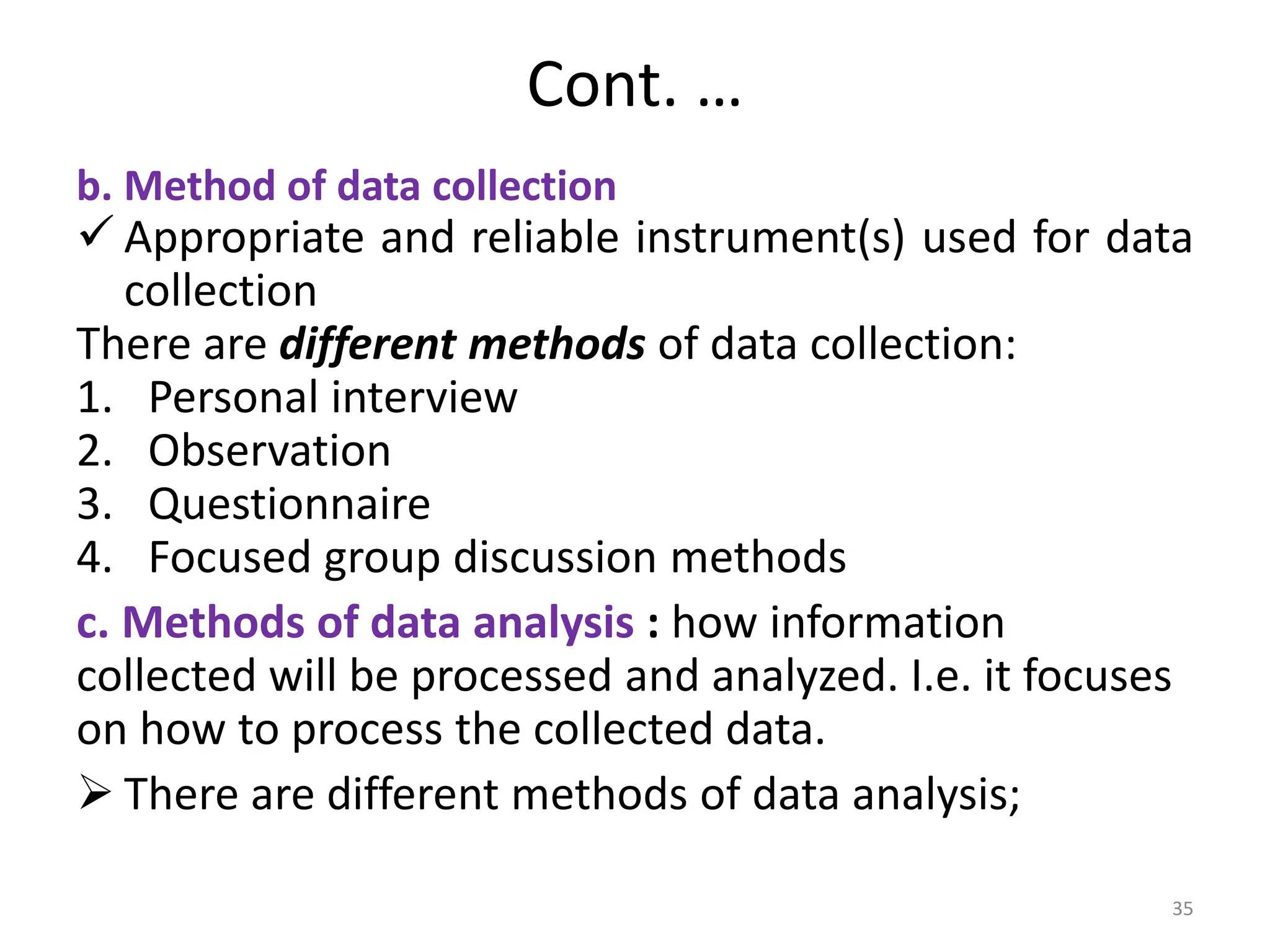
b. Method of data collection
 Appropriate and reliable instrument(s) used for data
collection
There are different methods of data collection:
1. Personal interview
2. Observation
3. Questionnaire
4. Focused group discussion methods
c. Methods of data analysis : how information
collected will be processed and analyzed. I.e. it focuses
on how to process the collected data.
 There are different methods of data analysis;
35
Cont. …
1. Descriptive analysis (using statistical tools)- explain the
relationship between dependent and any one of the
independent variable without controlling the effect of other
independent variables on the dependent variable.
2. Inference models (like econometric models, mathematical
programming models, simulation models, etc.)- it tries to
look the effect of anyone of the independent variable on a
dependent variable with controlling the impact of other
independent variables.
d. Method of presenting the outcome: the way of that general
public get access of research result. This is important if the
research is not a part of a particular study program (like, master
or doctoral study).
36
CHAPTER FOUR
WORK PLAN AND COST(BUDGET )BREAKDOWN
4.1. Time Budget :Work plan
 A time table explaining how the researcher expects
to carry out his project and when each of the
important phases will be completed.
• It is a plan in terms of numbers of weeks or months
and expected completion dates.
37
Cont. …
4.2. Cost budget
The research proposals which are submitted to the government, private or
autonomy agencies for financial assistance should also include a budget
proposal estimating funds required for travel expenses, typing, printing,
purchase of equipment, tools, books, etc.
• These are items like:
 Cost of materials
 Field expenses for data collection( transportation )
 Pay for consultants where they are necessary
 Travel and all such items needed to be detailed
 A sum of money for contingencies
 A carefully developed budget reflects the seriousness of the
proposal and the degree to which it is a realistic assessment
of what is needed.
38
Cont. …
5. Reference (Bibliography/ Literature cited)
• All works cited in the proposal are listed either
alphabetically or numerically at the end of the
document usually under the heading of “References
or Bibliography “ .
• Some conservative authors would like to make
distinction between references and bibliography as
mentioned below.
 References: are lists of literature, which have been
cited in the text of a document
 Bibliography: includes also items, which were not
cited but are relevant to the document.
39
Cont. …
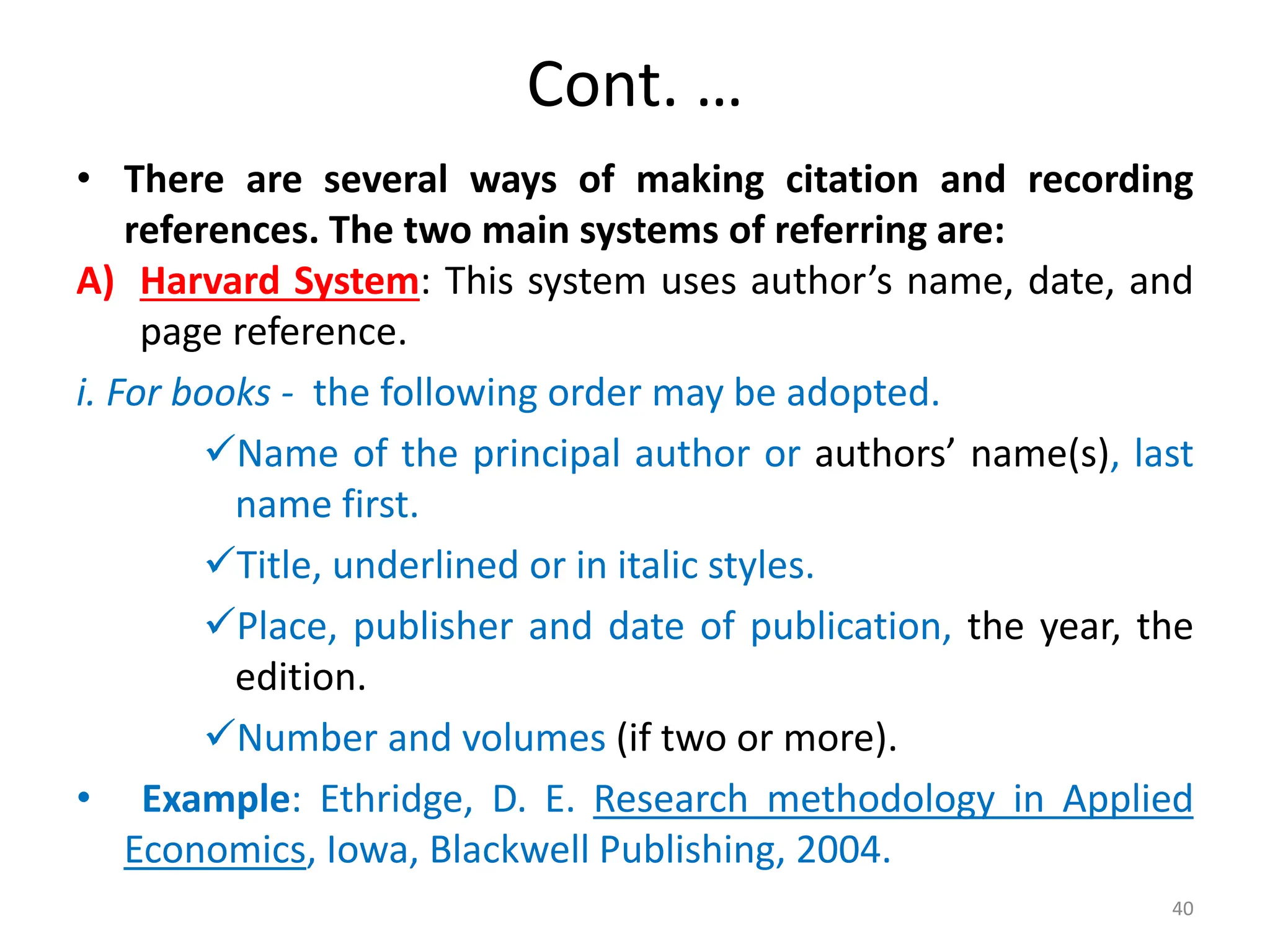
• There are several ways of making citation and recording
references. The two main systems of referring are:
A) Harvard System: This system uses author’s name, date, and
page reference.
i. For books - the following order may be adopted.
Name of the principal author or authors’ name(s), last
name first.
Title, underlined or in italic styles.
Place, publisher and date of publication, the year, the
edition.
Number and volumes (if two or more).
• Example: Ethridge, D. E. Research methodology in Applied
Economics, Iowa, Blackwell Publishing, 2004.
40
Cont. …
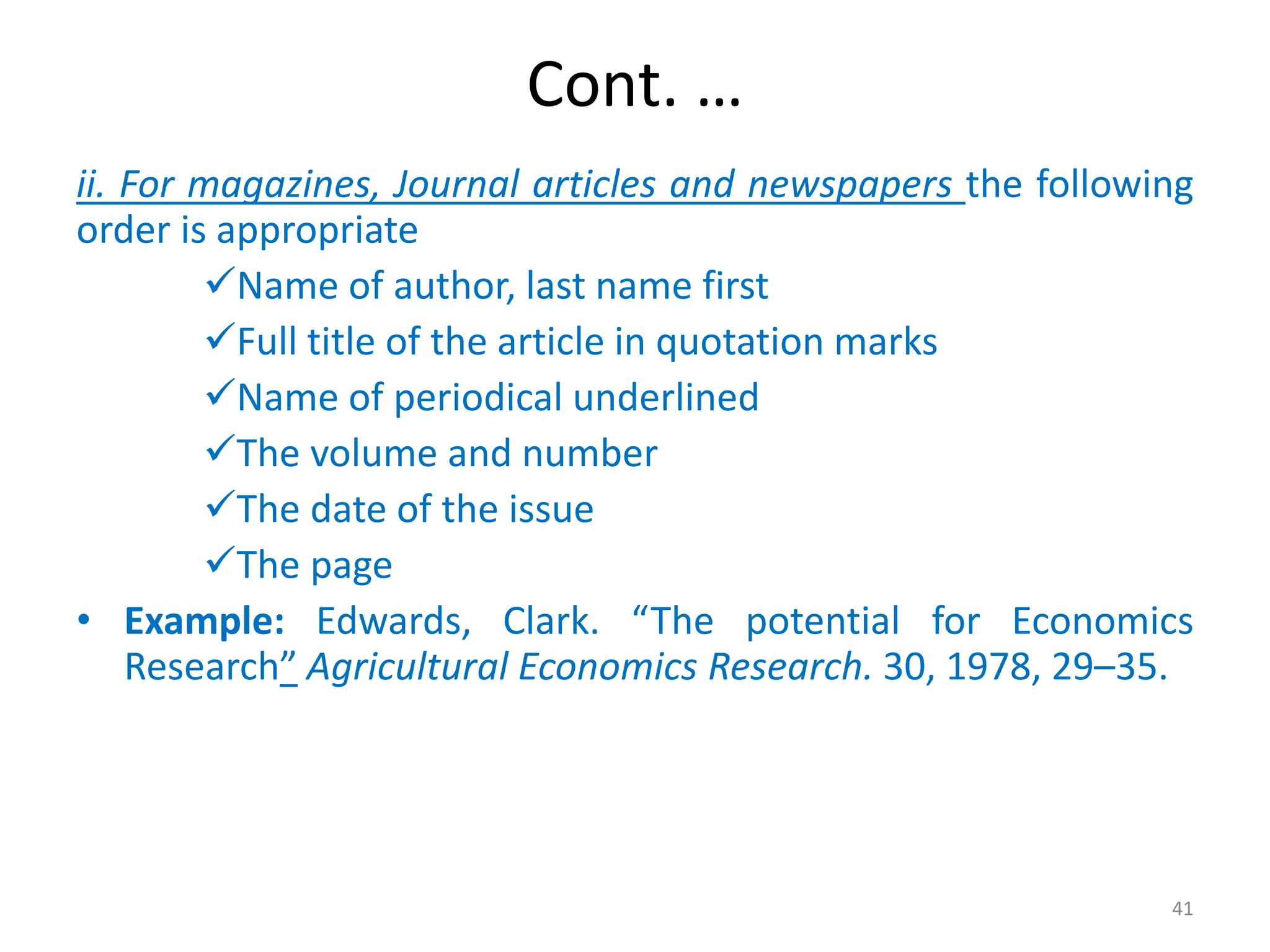
ii. For magazines, Journal articles and newspapers the following
order is appropriate
Name of author, last name first
Full title of the article in quotation marks
Name of periodical underlined
The volume and number
The date of the issue
The page
• Example: Edwards, Clark. “The potential for Economics
Research” Agricultural Economics Research. 30, 1978, 29–35.
41
Cont. …
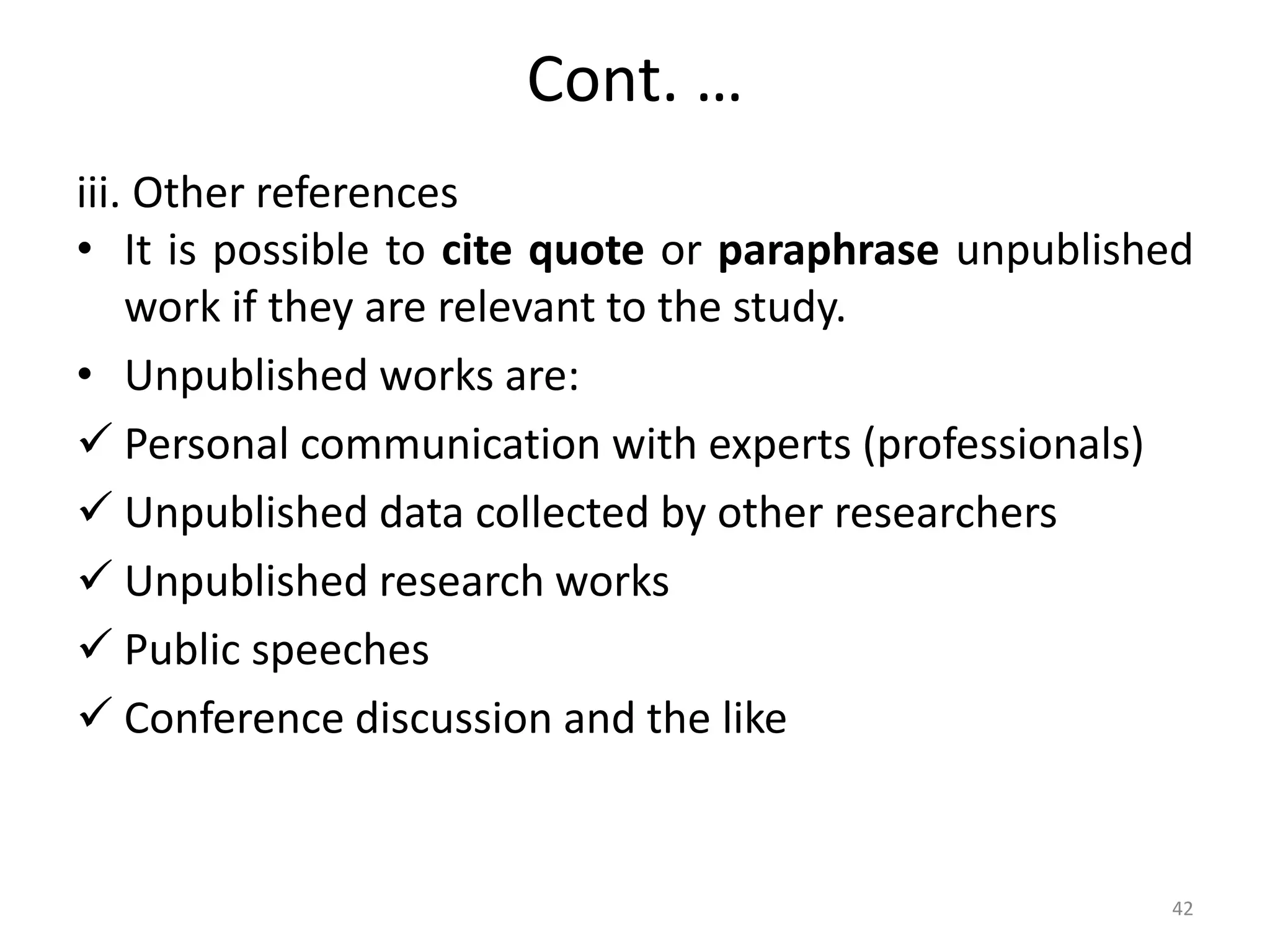
iii. Other references
• It is possible to cite quote or paraphrase unpublished
work if they are relevant to the study.
• Unpublished works are:
 Personal communication with experts (professionals)
 Unpublished data collected by other researchers
 Unpublished research works
 Public speeches
 Conference discussion and the like
42
Cont. …
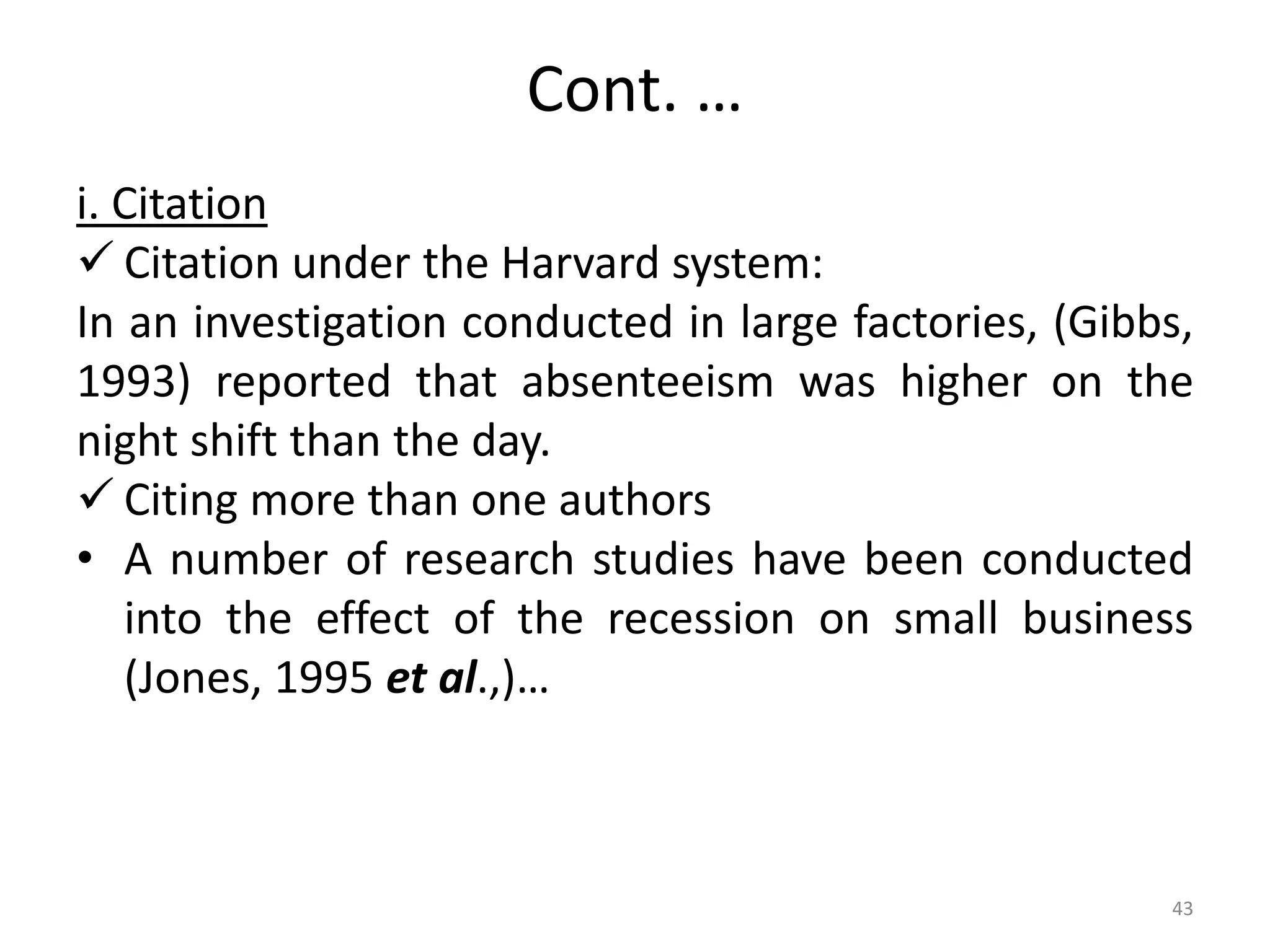
i. Citation
 Citation under the Harvard system:
In an investigation conducted in large factories, (Gibbs,
1993) reported that absenteeism was higher on the
night shift than the day.
 Citing more than one authors
• A number of research studies have been conducted
into the effect of the recession on small business
(Jones, 1995 et al.,)…
43
Cont. …
Citation and Referring or listing the cited works for Books
Book (one author):
• In-text: (Neville, 2007)
• References : Neville, C. (2007). The complete guide to
referencing and avoiding plagiarism. Maidenhead: Open
University Press.
Book (two authors):
• In-text: (Peck & Coyle, 2005)
• References : Peck, J. & Coyle, M. (2005). The student’s guide
to writing. Basingstoke: Palgrave Macmillan.
Book (three or more authors):
• In-text: (Dolowitz et al., 2008)
• References : Dolowitz, D., Buckler, S. and Sweeney, F. (2008).
Researching on-line. Basingstoke: Palgrave Macmillan.
44
Cont. …
 The researcher should not put such an unpublished
work in reference list unless it has been fully
approved a date set for its publication.
• Unpublished references are not usually found or
catalogued in libraries. And such unpublished
reference should be placed in the body of the text,
not in the reference list.
45
Cont. …
B) Vancouver System: uses in-text number instead of an
author, date, and page reference.
• The same superscript or bracketed text number is given
in the text each time the source is sited.
• It is used in the applied science such as chemistry,
physics and mathematics.
Example:
• “In an investigation conducted in large factories, Gibbs1
reported that absenteeism was higher on the night
shift than the day” Or
• “In an investigation conducted in large factories, it has
been reported that absenteeism on the night shift was
measured and found to be significantly higher…Gibbs1
46
Cont. …
6. Appendix (Annex)
• It is not mandatory to have this section. If the
researcher thinks that having this section will
increase the quality of the research proposal he is
free to do so.
• Information types provided in this section are those
additional details, which are difficult to
accommodate within the body of standard headings
• The annexes should contain any additional
information needed to enable professionals to follow
your research procedures and data analysis.
47
Cont. …
• Stuffs to be included in appendix:
 Detail Questionnaires and interview schedules
 Detailed experimental design (in experimental research)
 Detailed statistical procedures
 Samples of research materials (chemical and some
biological materials)
 Survey and other geographic maps
 complex tables, statistical tests, supporting documents,
copies of forms used, detailed description of the
methodology, instructions to field workers, and any other
evidence that may be important.
48
Criteria of a Good Research
Proposal
 Relevance, either to the funding body or student’s course
 The research is unique, or offers new insight or development
 The title, aims and objectives are all clear and concise
 Comprehensive and systematic background research and
literature review has been undertaken
 There is a good match between the issues to be addressed
and the approach being adopted
 The researcher demonstrates relevant background knowledge
and/or experience
 Timetable, resources and budget have all been worked out
carefully, with most eventualities covered
 Useful policy and practice implications
49
Why Research Proposals Fail?
 Aims and objectives are unclear or vague
 There is a mismatch between the approach being adopted and the issues
to be addressed
 The overall plan is too ambitious and difficult to achieve in the
timescale
 The researcher does not seem to have conducted enough in-depth
background research
 Problem is of insufficient importance
 Information about the data collection method is insufficiently detailed
 Information about the data analysis method is insufficiently detailed
 Timescale is inappropriate or unrealistic.
 Resources and budget have not been carefully thought out
 If topic has been done too many times (Overdone research topic is not
worthy!)
50

chapter_4_Research_Method_(201s6)[1].pdf

  • 1.
  • 2.
    4.1. Function ofthe research proposal  A Research proposal is known as a detailed work plan, catalog, outline, statement of intent, or draft plan. • A research proposal is essentially a road map, showing clearly the location from which a journey begins, the destination to be reached, and the method of getting there. 2
  • 3.
    Cont. … • Proposalis also useful both for sponsors and for researchers. For researchers proposal helps: • To have a tentative work plan that charts the logical steps needed to accomplish the stated goals • To spot flaws in the logic, errors in assumptions, or problems that are not adequately addressed by the objectives and design • To serve as a guideline for the researcher throughout the investigation once the proposal is accepted. 3
  • 4.
    Cont. … For sponsors: •To assess the sincerity of the purpose, the clarity of the design, the extent of the background material, and fitness of the researcher to undertake the project. • To assess both the researcher and the proposed design, to compare them against competing proposals, and to make the best selection for the project • Provides a basis to evaluate the results of the project. 4
  • 5.
    4.1.1. Function ofthe research proposal  Research proposal may function at least in three ways, namely, as a means of communication, as a plan and as a contract.  Proposal as a means of communication serves to communicate the investigator’s research plan to those who-give consultations and / or disburse fund.  Research proposal as plan helps the researcher to organize his idea in a systematic manner and to look for strengths and flaws. • That is, it provides an inventory of what will be done and which materials have to be collected as a preliminary step. 5
  • 6.
    Cont. …  Proposalalso functions as a contract. A completed proposal approved for execution and signed by all members of the sponsoring committee, constitute a bond of agreement between the researcher and that committee. • An approved grant proposal results in a contract between the investigator (and often the university) and funding sources. 6
  • 7.
    4.1.2 Importance ofthe research proposal  In general, purpose of research proposal has the following importance. • It serves as a basis for determining the feasibility of the research project. • It provides a systematic plan of procedure for the researcher to follow. • It gives the research supervisor a basis for guiding the researcher while conducting the study. • It reduces the probability of costly mistake. NB: Preparation of a full-fledged proposal is not a one- time endeavor. But, it is the result of continuous modification and amendment through discussion with experts in the field. 7
  • 8.
    4.2. General Formatand Elements of Proposal There is no single way of writing research proposals.  There can be different formats for research proposals depending on the funding organizations. • However, the following proposal components are usually important. 8
  • 9.
    Cont. …  Themajor components (elements) of a scientific research proposal • Title • Abstract(optional) Chapter one : Introduction • Background of the study • Statement of the problem • Research Hypothesis(optional) Or Research Question(optional) • Objectives of the study • Significance of the study • Scope of the study • Limitation of the study Chapter Two: Review of related Literature • Definition of the Terms or Concepts • Theoretical literature • Empirical Literature • Conceptual framework 9
  • 10.
    Cont. … Chapter Three:Research methodology and description of the study – Description of the Study area – Census/Sampling methods – Sample size – Type and Method of data collection – Method of data analysis – Description of variables Chapter four: Work and Budget Plan • Time Breakdown • Budget/Cost Finally • References • Appendix/Annex 10
  • 11.
    Detail on elementsof Research proposal 1. Title • The title should be as explicit as possible and transparent. • It should be worded in such a way that it gives sufficient information about the nature of the study. • It should enable the readers to understand the concepts of the study.  It is the most widely read part of your proposal. • It should contain the key words – the important words that indicate the subject. 11
  • 12.
    Cont. … • Inselecting a title for investigation the researcher should consider the following points: A. The Title shouldn’t be too lengthy • It should be specific to the area of study. For example the following topic appears to be long. “ A study of academic achievement of children in pastoral regions whose parents had participated literacy classes against those whose parents didn’t” B. The Title shouldn’t be too brief or too short • The following sentence is too short “Marketing in Japan” or “Unemployment in Ethiopia” 12
  • 13.
    Cont. …  Generalstructure of title page  It contains the working title followed by the purpose of the study [in your case may be stated as: • A Research Proposal for the Term-Paper in Partial Fulfillment of the Requirements for the Course Introduction to Research Methods for Economists, Econ-2063]. • Then, the name of the author/researcher and advisor/course instructor followed by institutional affiliation stated as Department of Economics, Rift valley University Woliso Campus. • Then, the date (month and year) and place (name of town/city) of proposal development at the right bottom corner shall be presented. 13
  • 14.
    Cont. … College OfBusiness And Economics Department Of Economics Determinants Of Household Saving In Case of Woliso Town A research proposal Submitted in Partial Fulfillment of the Requirements for the Bachelor of Arts (BA) Degree In Economics By: Kasahun Lelisa Advisor: Fikadu D. (MSc) August,2024 Woliso, Ethiopia 14
  • 15.
    Cont. … 2. Abstract: •Is summary, which reflects the whole content of the proposal (most of the time less than 300 words?) • It should be concise and informative, giving readers the chance to grasp the essentials of the proposal without having to read the details. • It is a short summary of the research proposal. This allows a busy manager or sponsor to understand quickly the thrust of the proposal. 15
  • 16.
    Cont. …  Theabstract of a proposal should contain the following points. • Title or topic of the research • Statement of the problem and objective • Methodology of investigation • Expected result (tentative only if a researcher starts with a formulated hypothesis) • Mention the expected outputs, expected beneficiaries, the methods to be used, sampling design, types of data, method of data analysis, etc. • The abstract presents all parts of the proposal, each part condensed according to the significance of information in it but the total shall not exceed a page (usually half a page). • Mostly written in Italic form 16
  • 17.
    Chapter One Introduction 1.1. Backgroundof the Study • Some question to be addressed in this part may include: What are current and previous studies that have been made on the issues to be studied? What is the present gap in knowledge and current trend? What makes worth studying? Why has the problem not been solved yet? What do we intend to fill the gap or solve the problem? 17
  • 18.
    Cont. … 1.2. Statementof the problem/The Rationale • More specifically, statement of the problem is targeted towards the following:  Stating the background facts which justify the study to be in order  Developing hypotheses or key questions, which may show the direction of the whole exercise. 18
  • 19.
    Cont. … 1.3. Objectivesof the study • In this section, it is where the investigator discusses the major and specific objectives of his /her investigation. • Generally this section should focus on the points  What is to be achieved by the proposed investigation has to be stated plainly and concisely  Should be stated in a form which shows the relations between variables  Must clearly state the target of the research activity, i.e., what kind of results are expected or sought from conducting research. 19
  • 20.
    Cont. … General Objective General objectives are the broad goals that has to be achieved • It states what the researcher expects to achieve from the study in general terms • The general objective provides a short statement of the scientific goal being pursued by the research. • General objectives can broken into small logically connected parts to form specific objectives Specific objectives  These are short term and narrow in focus  The specific objectives are operational in nature.  Specific objectives systematically address various aspects of problem  Specific objectives should specify what the researcher will do in the study, where & for what purpose  They may indicate specific types of knowledge to be produced. 20
  • 21.
    Cont. … • Generalobjective is met through accomplishing all the specific objectives  Research objectives have should be SMART (specific, measurable, achievable, realistic and time-bounded) and that the specific objectives derive from the general objective.  Research objective use action verbs that are specified enough to be evaluated. Examples of action verbs are:  To assess, to compare, to calculate , to measure, to explore, to identify, to describe, to find out, to analyze, to determine, to establish. 21
  • 22.
    Cont. … Example: Title:“Analysis of rural households poverty and vulnerability” • The overall objective of this research is to analyze rural households poverty and vulnerability, and its major determinants. As part of the general objective, this research work intends to achieve the following specific objectives as well: 1. To measure the extents, depth and severity of poverty, and vulnerability to poverty in the study area 2. To identify the major determinants of welfare (consumption expenditure as a proxy), poverty gap and poverty severity, and vulnerability to poverty 3. To measure the welfare (consumption expenditure) inequality in the study area Example: Title: Analysis of customer satisfaction in South West Shoa Zone • The over all objective is to analyze the extents of customer satisfaction and its determinants. Specific objective • To measure the extents of customer satisfaction • To identify the major determinants of customer satisfaction 22
  • 23.
    Cont. … 1.4. ResearchHypothesis • In a research context, a hypothesis can be defined as a suggested solution for a particular problem. • By suggesting a possible solution to a problem, research can take a certain direction, otherwise much time can be wasted in an investigation without direction. • Example Title: “Analysis of rural HH poverty and vulnerability”  Family size, dependency ratio, distance to the main market and drought will be positively and significantly correlated to household poverty.  Asset holding including oxen, land size and home asset value will have a negative and significant effect on the household’s poverty status.  Off-farm income participation, access to credit and access to extension service will affect poverty negatively and significantly. 23
  • 24.
    Cont. … 1.5. Scopeof the study • The scope of the study delaminates(bounds) the research activities in terms of : 1. Issues that must be included 2. Area that the study cared out 3. Target population & sample size , methods of sampling 4. Types of data (cross-section & longitudinal data), and methods of data analysis (descriptive and econometric). 24
  • 25.
    Cont. … 1.6. Significanceof the study • Significance of the study tries to associate the possible research finding & expected beneficiaries from that particular finding. • Who is the possible beneficiaries from a particular finding? • Having a certain finding benefit …which stakeholders. 1. Does the outcome benefit policy makers? 2. Does the outcome benefit NGOs? 3. Does the outcome benefit investors? 4. Does the outcome benefit hhs ?  Why a certain group get benefit from a particular finding and How it could be? 25
  • 26.
    Cont. … • Ingeneral, the significance of the study contains three paragraphs based on three basic questions: 1. Why the study is important?....B/c you are getting relevant finding 2. How the study is important?....by filling the gap, by providing the way how to solve the problem, or by directly showing the immediate cause for a problem, etc. 3. For whom the study is important?....directly indicated the immediate beneficiaries from a certain outcome 26
  • 27.
    Cont. … G. Limitationof the Study • Although a researcher tries his best to design his research as properly as possible, there are externals (uncontrolled) variables that confront his/her investigation and affect his/her conclusion. • In his/ her research proposal, the researcher has to specify such factors that hinder the attainment of his/her objectives. The possible sources include:  Practical witness in the methodologies the researcher applied.  Lack of access to the appropriate data  Poor development of instruments  Sampling restriction  Lack of up to date literature in the areas. 27
  • 28.
    CHAPTER TWO LITERATURE REVIEW 2.Literature review • Literature review means locating literature in a variety of sources reading it carefully and thoroughly organizing it into themes along with the line of investigation. • Objective of the literature review  To establish a familiarity with a body of knowledge and establishes credibility.  To show the path of prior research and how a current project is linked to it  To integrate and summarize what is known in the area  To learn from others and stimulate new ideas. 28
  • 29.
    Cont. … Types ofreviewed literature can be 2.1 Theoretical works and review, Definition of the Terms or Concepts • The technical terms or words and phrases having special meaning need to be defined operationally by the help of special dictionaries • Methodological review, 2.2 Empirical (Original findings and reviews of them) • Reading or review for research could take place in three stages of the research project. These include the following  At the beginning of the research:  During your research  After your research 2.3. Conceptual framework 29
  • 30.
    Chapter Three Methodology ofthe Study 3.1.Description of the study area 3.2.Methodology of the study • The methodologies are the core and the largest part of the scientific research proposal. • An accurate, clear and valid methodology is required • The methodology generally addresses the issues related to the study area, data types, sources of data, data collection methods, target population, sample size and sampling techniques, methods of data analysis, methods of hypothesis testing. 30
  • 31.
    Cont. … • Methodologyshould give full details to show how the research activity is going to be carried out. • Researchers are advised to split the methodology part it in to sub-sections as i. Data (materials used) and  Type of data..  The source of the data  Where data is collected? 31
  • 32.
    Cont. …  Inrelation to study area: research proposal clearly demarcate where the study should be carried out. It involves the determination of study area. E.g. at woreda, zone, region, nation, continent etc.  In relation to data type: research proposal clearly shows the types of data that the researcher planned to use. Is the data: cross-sectional or longitudinal data, quantitative data or qualitative ,etc.  In relation to the sources of data: research proposal indicates whether the data comes from: primary or secondary sources, individual or household, firm or industry, region or country.  It shows who is the unit of analysis. 32
  • 33.
    Cont. … ii. Researchmethods used a. Method of sampling and Justification of his/her choice of a particular sampling method:  Target population refers to the entire group of individuals or objects to which researchers are interested in generalizing the conclusions.  If target population is ‘small’ use census method. However, if target population is ‘large’ in size researchers often cannot test every individual in the population because it is too expensive and time- consuming.  This is the reason why researchers rely on sampling. it involves different stapes: 33
  • 34.
    Cont. … 1st Determinethe sample frame- list of individuals/objects from where the sample can be drawn 2nd Select the sampling methods- how the true representative sample unit can be drawn- considered the relevance of each methods. 3rd .Determine the sample size- considering the adequacy of sample size /enough sample size  There are different sampling methods 1. Probability sampling methods: simple random sampling ,cluster, systematic, stratified, etc. 2. Non-probability sampling methods: quota, convenience, judgmental, snowball sampling etc. 34
  • 35.
    Cont. … b. Methodof data collection  Appropriate and reliable instrument(s) used for data collection There are different methods of data collection: 1. Personal interview 2. Observation 3. Questionnaire 4. Focused group discussion methods c. Methods of data analysis : how information collected will be processed and analyzed. I.e. it focuses on how to process the collected data.  There are different methods of data analysis; 35
  • 36.
    Cont. … 1. Descriptiveanalysis (using statistical tools)- explain the relationship between dependent and any one of the independent variable without controlling the effect of other independent variables on the dependent variable. 2. Inference models (like econometric models, mathematical programming models, simulation models, etc.)- it tries to look the effect of anyone of the independent variable on a dependent variable with controlling the impact of other independent variables. d. Method of presenting the outcome: the way of that general public get access of research result. This is important if the research is not a part of a particular study program (like, master or doctoral study). 36
  • 37.
    CHAPTER FOUR WORK PLANAND COST(BUDGET )BREAKDOWN 4.1. Time Budget :Work plan  A time table explaining how the researcher expects to carry out his project and when each of the important phases will be completed. • It is a plan in terms of numbers of weeks or months and expected completion dates. 37
  • 38.
    Cont. … 4.2. Costbudget The research proposals which are submitted to the government, private or autonomy agencies for financial assistance should also include a budget proposal estimating funds required for travel expenses, typing, printing, purchase of equipment, tools, books, etc. • These are items like:  Cost of materials  Field expenses for data collection( transportation )  Pay for consultants where they are necessary  Travel and all such items needed to be detailed  A sum of money for contingencies  A carefully developed budget reflects the seriousness of the proposal and the degree to which it is a realistic assessment of what is needed. 38
  • 39.
    Cont. … 5. Reference(Bibliography/ Literature cited) • All works cited in the proposal are listed either alphabetically or numerically at the end of the document usually under the heading of “References or Bibliography “ . • Some conservative authors would like to make distinction between references and bibliography as mentioned below.  References: are lists of literature, which have been cited in the text of a document  Bibliography: includes also items, which were not cited but are relevant to the document. 39
  • 40.
    Cont. … • Thereare several ways of making citation and recording references. The two main systems of referring are: A) Harvard System: This system uses author’s name, date, and page reference. i. For books - the following order may be adopted. Name of the principal author or authors’ name(s), last name first. Title, underlined or in italic styles. Place, publisher and date of publication, the year, the edition. Number and volumes (if two or more). • Example: Ethridge, D. E. Research methodology in Applied Economics, Iowa, Blackwell Publishing, 2004. 40
  • 41.
    Cont. … ii. Formagazines, Journal articles and newspapers the following order is appropriate Name of author, last name first Full title of the article in quotation marks Name of periodical underlined The volume and number The date of the issue The page • Example: Edwards, Clark. “The potential for Economics Research” Agricultural Economics Research. 30, 1978, 29–35. 41
  • 42.
    Cont. … iii. Otherreferences • It is possible to cite quote or paraphrase unpublished work if they are relevant to the study. • Unpublished works are:  Personal communication with experts (professionals)  Unpublished data collected by other researchers  Unpublished research works  Public speeches  Conference discussion and the like 42
  • 43.
    Cont. … i. Citation Citation under the Harvard system: In an investigation conducted in large factories, (Gibbs, 1993) reported that absenteeism was higher on the night shift than the day.  Citing more than one authors • A number of research studies have been conducted into the effect of the recession on small business (Jones, 1995 et al.,)… 43
  • 44.
    Cont. … Citation andReferring or listing the cited works for Books Book (one author): • In-text: (Neville, 2007) • References : Neville, C. (2007). The complete guide to referencing and avoiding plagiarism. Maidenhead: Open University Press. Book (two authors): • In-text: (Peck & Coyle, 2005) • References : Peck, J. & Coyle, M. (2005). The student’s guide to writing. Basingstoke: Palgrave Macmillan. Book (three or more authors): • In-text: (Dolowitz et al., 2008) • References : Dolowitz, D., Buckler, S. and Sweeney, F. (2008). Researching on-line. Basingstoke: Palgrave Macmillan. 44
  • 45.
    Cont. …  Theresearcher should not put such an unpublished work in reference list unless it has been fully approved a date set for its publication. • Unpublished references are not usually found or catalogued in libraries. And such unpublished reference should be placed in the body of the text, not in the reference list. 45
  • 46.
    Cont. … B) VancouverSystem: uses in-text number instead of an author, date, and page reference. • The same superscript or bracketed text number is given in the text each time the source is sited. • It is used in the applied science such as chemistry, physics and mathematics. Example: • “In an investigation conducted in large factories, Gibbs1 reported that absenteeism was higher on the night shift than the day” Or • “In an investigation conducted in large factories, it has been reported that absenteeism on the night shift was measured and found to be significantly higher…Gibbs1 46
  • 47.
    Cont. … 6. Appendix(Annex) • It is not mandatory to have this section. If the researcher thinks that having this section will increase the quality of the research proposal he is free to do so. • Information types provided in this section are those additional details, which are difficult to accommodate within the body of standard headings • The annexes should contain any additional information needed to enable professionals to follow your research procedures and data analysis. 47
  • 48.
    Cont. … • Stuffsto be included in appendix:  Detail Questionnaires and interview schedules  Detailed experimental design (in experimental research)  Detailed statistical procedures  Samples of research materials (chemical and some biological materials)  Survey and other geographic maps  complex tables, statistical tests, supporting documents, copies of forms used, detailed description of the methodology, instructions to field workers, and any other evidence that may be important. 48
  • 49.
    Criteria of aGood Research Proposal  Relevance, either to the funding body or student’s course  The research is unique, or offers new insight or development  The title, aims and objectives are all clear and concise  Comprehensive and systematic background research and literature review has been undertaken  There is a good match between the issues to be addressed and the approach being adopted  The researcher demonstrates relevant background knowledge and/or experience  Timetable, resources and budget have all been worked out carefully, with most eventualities covered  Useful policy and practice implications 49
  • 50.
    Why Research ProposalsFail?  Aims and objectives are unclear or vague  There is a mismatch between the approach being adopted and the issues to be addressed  The overall plan is too ambitious and difficult to achieve in the timescale  The researcher does not seem to have conducted enough in-depth background research  Problem is of insufficient importance  Information about the data collection method is insufficiently detailed  Information about the data analysis method is insufficiently detailed  Timescale is inappropriate or unrealistic.  Resources and budget have not been carefully thought out  If topic has been done too many times (Overdone research topic is not worthy!) 50