What’s new about …
What’s new about
Richard Harvey
www.mmjt.eu
The New Perspective on Paul
Not ‘New’
• Phrase goes back to
Dunn
• Return to Pauline
Worldview
Perspectives
How can I find a
gracious God?
“Though I lived as a monk without
reproach, I felt that I was a sinner
before God with an extremely
disturbed conscience. I could not
believe that he was placated by my
satisfaction…….Thus I raged with a
fierce and troubled conscience.
Nevertheless, I beat importunately
upon Paul at that place, most
ardently desiring to know what St.
Paul wanted.”
Lutheran Soteriology
•Imputation of Christ’s
Righteousness
•Faith v Works, Law v Gospel
•Same Situation which Paul faced
in Galatians/Early Church.
•Developed in Protestant
Theology and Praxis
“Faith without works is sufficient for
salvation, and alone justifies”
Faith in Jesus as opposed to moral effort
… yet we know that a person is not
justified by works of the law but
through faith in Jesus Christ, so we
also have believed in Christ Jesus, in
order to be justified by faith in Christ
and not by works of the law, because
by works of the law no one will be
justified.
Lutheran Exegesis and Interpretation of Gal. 2:16
Justified: Declared Righteous, become a Christian
‘Works of the law’: Self-Effort, Works Righteousness
With Paul we absolutely deny the
possibility of self-merit. God never yet
gave to any person grace and
everlasting life as a reward for merit.
The opinions of the papists are the
intellectual pipe-dreams of idle pates,
that serve no other purpose but to draw
men away from the true worship of God.
The papacy is founded upon
hallucinations.
“What are these false apostles doing?” Paul cries. “They are
turning Law into grace, and grace into Law. They are changing
Moses into Christ, and Christ into Moses. By teaching that
besides Christ and His righteousness the performance of the
Law is necessary unto salvation, they put the Law in the place
of Christ, they attribute to the Law the power to save, a power
that belongs to Christ only.”
Problems with the Old Perspective
• “Judaism was a Religion of Merit”
• “Judaism did not resolve Paul’s
burden of guilt”
• “Justification by Faith was a new
revelation”
• “Paul’s focus was on the
individual’s relation to God”
• “Faith replaced works”
• “Law stood in opposition to Grace”
Advocates of the NPP - Sanders
• Not ‘getting in’ but
‘staying in’
• Covenantal nomism
• Problem first, then
solution
• Sceptical on truth and
resurrection of Jesus
• Judaism not a religion
of legalism
Pattern of Covenantal Nomism
(1) God has chosen Israel and (2) given the law. The law
implies both (3) God’s promise to maintain election and
(4) the requirement to obey. (5) God rewards obedience
and punishes transgression. (6) The law provides for
means of atonement, and atonement results in (7)
maintenance or re-establishment of the covenantal
relationship. (8) All those who are maintained in the
covenant by obedience, atonement and God’s mercy
belong to the group which will be saved. An important
interpretation of the first and last points is that election
and ultimately salvation are considered to be by God’s
mercy rather than human achievement (Paul and PJ
p.422).
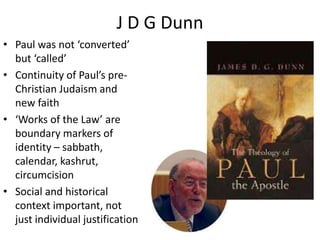
J D G Dunn
• Paul was not ‘converted’
but ‘called’
• Continuity of Paul’s pre-
Christian Judaism and
new faith
• ‘Works of the Law’ are
boundary markers of
identity – sabbath,
calendar, kashrut,
circumcision
• Social and historical
context important, not
just individual justification
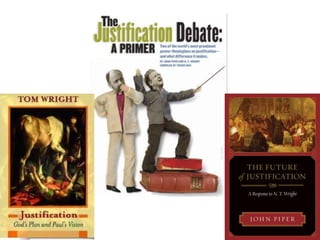
N T Wright
• Not just individual
consciences cleansing but
being part of the People of
God
• Justification – forensic,
covenantal, ecclesiological
and eschatological
• Israel’s return from Exile
Badges of Identity
The ‘ works of Torah’ were not a
legalist ladder, up which one climbed
in order to earn the divine favour,
but were the badges that one wore
as the marks of identity, of
belonging to the chosen people in the
present, and hence the all important
signs, to oneself and one’s
neighbours, that one belonged to the
company who would be vindicated
when the covenant God acted to
redeem his people. They were the
present signs of future vindication.
… yet we know that a person is not
justified by works of the law but
through faith in Jesus Christ, so we
also have believed in Christ Jesus, in
order to be justified by faith in Christ
and not by works of the law, because
by works of the law no one will be
justified.
NPP Exegesis and Interpretation of Galatians
‘Works of the law’: Torah but specifically circumcision,
food laws, Badges of Identity, Covenant Community
Markers
Justified: Declared righteous, declared to be in the
covenant family. Covenant, Lawcourt, Eschatology
Gains of the NPP
• Law/Torah as positive gift
• New Covenant the solution to
plight of National Israel
• Criticism of Law does not do
away with Law – except where
– It denies Messiahship of Yeshua
– It exclusifies Israel against the
nations
• Does not separate faith and
works
• Does not separate Law and
Grace
NPP as Threat?
• Exit Justification by faith?
• Enter Salvation by works?
• Exit need for Jewish
people to know Yeshua?
• Understanding of
humanity, last things,
Holy Spirit?
Benefits of NPP
• Renewed discussion
and insights
• Appreciation of Jewish
roots, context and
practice of Paul
• Better understanding of
Scripture
• More balanced and
integrated faith
• Integrates Christian and
Jewish understandings?
Beyond the NPP…
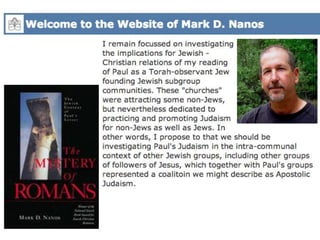
• Daniel Boyarin
• Mark Nanos
• Pamela Eisenbraun
• Jacob Taubes
• Mark Kinzer
Daniel Boyarin’s Radical Paul
• Judaism and Christianity
not separate religions
until 4th century
• Paul was a Platonist
• His aim was to produce
One Single Family
• Nuanced dualism of flesh
and spirit, letter and
spirit, body and soul
• “allegorised ahistorical
reading” (NT Wright)
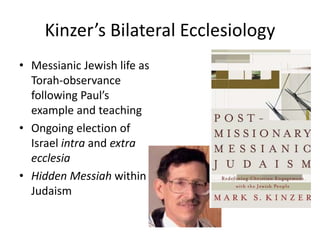
Kinzer’s Bilateral Ecclesiology
• Messianic Jewish life as
Torah-observance
following Paul’s
example and teaching
• Ongoing election of
Israel intra and extra
ecclesia
• Hidden Messiah within
Judaism
Questions for discussion
• How does this debate
relate to the Israeli
context?
• Is Judaism a religion of
Law or Grace?
• How can Messianic
Jews keep Torah?
• Who is going to read
all these books?
Npp tel aviv 130514c

Npp tel aviv 130514c

  • 2.
  • 3.
    What’s new about RichardHarvey www.mmjt.eu
  • 4.
    The New Perspectiveon Paul Not ‘New’ • Phrase goes back to Dunn • Return to Pauline Worldview Perspectives
  • 5.
    How can Ifind a gracious God? “Though I lived as a monk without reproach, I felt that I was a sinner before God with an extremely disturbed conscience. I could not believe that he was placated by my satisfaction…….Thus I raged with a fierce and troubled conscience. Nevertheless, I beat importunately upon Paul at that place, most ardently desiring to know what St. Paul wanted.”
  • 6.
    Lutheran Soteriology •Imputation ofChrist’s Righteousness •Faith v Works, Law v Gospel •Same Situation which Paul faced in Galatians/Early Church. •Developed in Protestant Theology and Praxis “Faith without works is sufficient for salvation, and alone justifies”
  • 7.
    Faith in Jesusas opposed to moral effort … yet we know that a person is not justified by works of the law but through faith in Jesus Christ, so we also have believed in Christ Jesus, in order to be justified by faith in Christ and not by works of the law, because by works of the law no one will be justified. Lutheran Exegesis and Interpretation of Gal. 2:16 Justified: Declared Righteous, become a Christian ‘Works of the law’: Self-Effort, Works Righteousness
  • 8.
    With Paul weabsolutely deny the possibility of self-merit. God never yet gave to any person grace and everlasting life as a reward for merit. The opinions of the papists are the intellectual pipe-dreams of idle pates, that serve no other purpose but to draw men away from the true worship of God. The papacy is founded upon hallucinations. “What are these false apostles doing?” Paul cries. “They are turning Law into grace, and grace into Law. They are changing Moses into Christ, and Christ into Moses. By teaching that besides Christ and His righteousness the performance of the Law is necessary unto salvation, they put the Law in the place of Christ, they attribute to the Law the power to save, a power that belongs to Christ only.”
  • 10.
    Problems with theOld Perspective • “Judaism was a Religion of Merit” • “Judaism did not resolve Paul’s burden of guilt” • “Justification by Faith was a new revelation” • “Paul’s focus was on the individual’s relation to God” • “Faith replaced works” • “Law stood in opposition to Grace”
  • 11.
    Advocates of theNPP - Sanders • Not ‘getting in’ but ‘staying in’ • Covenantal nomism • Problem first, then solution • Sceptical on truth and resurrection of Jesus • Judaism not a religion of legalism
  • 13.
    Pattern of CovenantalNomism (1) God has chosen Israel and (2) given the law. The law implies both (3) God’s promise to maintain election and (4) the requirement to obey. (5) God rewards obedience and punishes transgression. (6) The law provides for means of atonement, and atonement results in (7) maintenance or re-establishment of the covenantal relationship. (8) All those who are maintained in the covenant by obedience, atonement and God’s mercy belong to the group which will be saved. An important interpretation of the first and last points is that election and ultimately salvation are considered to be by God’s mercy rather than human achievement (Paul and PJ p.422).
  • 14.
    J D GDunn • Paul was not ‘converted’ but ‘called’ • Continuity of Paul’s pre- Christian Judaism and new faith • ‘Works of the Law’ are boundary markers of identity – sabbath, calendar, kashrut, circumcision • Social and historical context important, not just individual justification
  • 15.
    N T Wright •Not just individual consciences cleansing but being part of the People of God • Justification – forensic, covenantal, ecclesiological and eschatological • Israel’s return from Exile
  • 16.
    Badges of Identity The‘ works of Torah’ were not a legalist ladder, up which one climbed in order to earn the divine favour, but were the badges that one wore as the marks of identity, of belonging to the chosen people in the present, and hence the all important signs, to oneself and one’s neighbours, that one belonged to the company who would be vindicated when the covenant God acted to redeem his people. They were the present signs of future vindication.
  • 17.
    … yet weknow that a person is not justified by works of the law but through faith in Jesus Christ, so we also have believed in Christ Jesus, in order to be justified by faith in Christ and not by works of the law, because by works of the law no one will be justified. NPP Exegesis and Interpretation of Galatians ‘Works of the law’: Torah but specifically circumcision, food laws, Badges of Identity, Covenant Community Markers Justified: Declared righteous, declared to be in the covenant family. Covenant, Lawcourt, Eschatology
  • 18.
    Gains of theNPP • Law/Torah as positive gift • New Covenant the solution to plight of National Israel • Criticism of Law does not do away with Law – except where – It denies Messiahship of Yeshua – It exclusifies Israel against the nations • Does not separate faith and works • Does not separate Law and Grace
  • 19.
    NPP as Threat? •Exit Justification by faith? • Enter Salvation by works? • Exit need for Jewish people to know Yeshua? • Understanding of humanity, last things, Holy Spirit?
  • 20.
    Benefits of NPP •Renewed discussion and insights • Appreciation of Jewish roots, context and practice of Paul • Better understanding of Scripture • More balanced and integrated faith • Integrates Christian and Jewish understandings?
  • 22.
    Beyond the NPP… •Daniel Boyarin • Mark Nanos • Pamela Eisenbraun • Jacob Taubes • Mark Kinzer
  • 23.
    Daniel Boyarin’s RadicalPaul • Judaism and Christianity not separate religions until 4th century • Paul was a Platonist • His aim was to produce One Single Family • Nuanced dualism of flesh and spirit, letter and spirit, body and soul • “allegorised ahistorical reading” (NT Wright)
  • 25.
    Kinzer’s Bilateral Ecclesiology •Messianic Jewish life as Torah-observance following Paul’s example and teaching • Ongoing election of Israel intra and extra ecclesia • Hidden Messiah within Judaism
  • 26.
    Questions for discussion •How does this debate relate to the Israeli context? • Is Judaism a religion of Law or Grace? • How can Messianic Jews keep Torah? • Who is going to read all these books?