



Now + New + Next

Rethinking “Rewards” in the New Engagement Economy
December 10, 2013

Proprietary and Confidential © 2011 Maritz

1
Mary Luckey
Director
Reward Strategy

Barry Kirk
Vice President
Loyalty Strategy

Proprietary and Confidential © 2011 Maritz

2
I am:
•Currently running a rewards program.
•Planning to launch a program soon.
•Evaluating whether to launch a program.

Proprietary and Confidential © 2011 Maritz

3
Proprietary and Confidential © 2011 Maritz

4
5
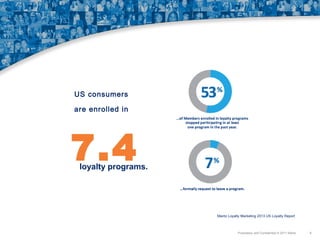
US consumers
are enrolled in

7.4

loyalty programs.

Maritz Loyalty Marketing 2013 US Loyalty Report

Proprietary and Confidential © 2011 Maritz

6
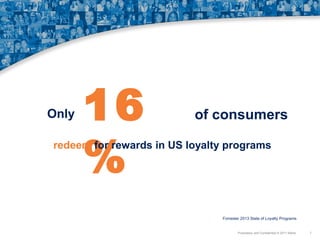
Only

16
%

of consumers

redeem for rewards in US loyalty programs

Forrester 2013 State of Loyalty Programs
Proprietary and Confidential © 2011 Maritz

7
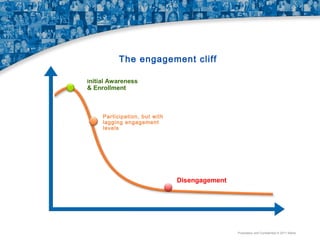
The engagement cliff
Initial Awareness

Participation

& Enrollment

Participation, but with
lagging engagement
levels

Disengagement

Time
Proprietary and Confidential © 2011 Maritz
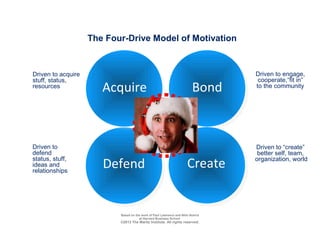
The Four-Drive Model of Motivation

Driven to acquire
stuff, status,
resources

Acquire

Bond

Driven to engage,
cooperate,“fit in”
to the community

CHOICE
Driven to
defend
status, stuff,
ideas and
relationships

Defend

Create

Driven to “create”
better self, team,
organization, world

Based on the work of Paul Lawrence and Nitin Nohria
at Harvard Business School

©2013 The Maritz Institute. All rights reserved.
9
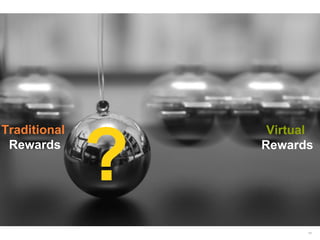
Traditional
Rewards

?

Pendulum swing

Virtual
Rewards

10
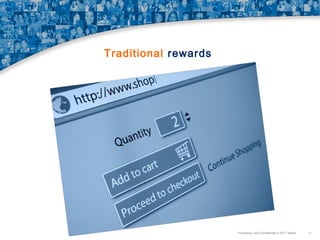
Traditional rewards

Proprietary and Confidential © 2011 Maritz

11
Proprietary and Confidential © 2011 Maritz

12
Proprietary and Confidential © 2011 Maritz

13
Proprietary and Confidential © 2011 Maritz

14
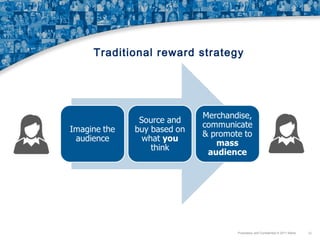
Traditional reward strategy

Proprietary and Confidential © 2011 Maritz

15
Today

we have
an avalanche of data
…

Proprietary and Confidential © 2011 Maritz
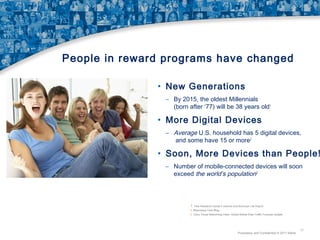
People in reward programs have changed
• New Generations
– By 2015, the oldest Millennials
(born after ‘77) will be 38 years old 1

• More Digital Devices
– Average U.S. household has 5 digital devices,
and some have 15 or more2

• Soon, More Devices than People!
– Number of mobile-connected devices will soon
exceed the world’s population3

1

Pew Research Center’s Internet and American Life Report

2 Bloomberg Tech Blog
3 Cisco Visual Networking Index: Global Mobile Data Traffic Forecast Update

Proprietary and Confidential © 2011 Maritz

17
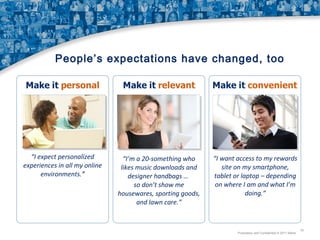
People’s expectations have changed, too

“I expect personalized
experiences in all my online
environments.”

“I’m a 20-something who
likes music downloads and
designer handbags …
so don’t show me
housewares, sporting goods,
and lawn care.”

“I want access to my rewards
site on my smartphone,
tablet or laptop – depending
on where I am and what I’m
doing.”

Proprietary and Confidential © 2011 Maritz

18
Consumers are in the drivers seat

Proprietary and Confidential © 2011 Maritz

19
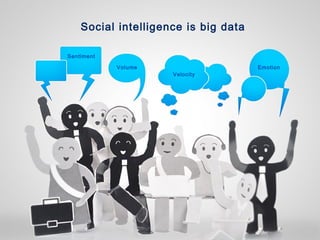
Social intelligence is big data
Sentiment
Volume

Velocity

Emotion

Proprietary and Confidential © 2011 Maritz

20
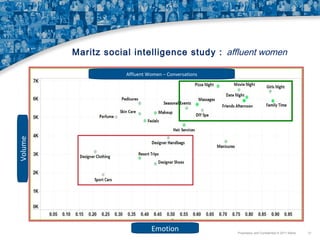
Maritz social intelligence study : affluent women

Volume

Affluent Women – Conversations

Emotion

Proprietary and Confidential © 2011 Maritz

21
Proprietary and Confidential © 2011 Maritz

22
Behavioral Intelligence
is also big data

Proprietary and Confidential © 2011 Maritz

23
We are:
•Currently using big data in our reward
strategy.
•Evaluating how to use big data in our
reward strategy.
•What’s big data?

Proprietary and Confidential © 2011 Maritz

24
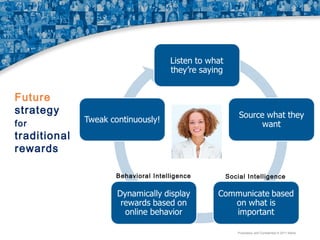
Future
strategy
for

traditional
rewards
Behavioral Intelligence

Social Intelligence

Proprietary and Confidential © 2011 Maritz
Traditional
Rewards

?

Pendulum swing

Virtual
Rewards

26
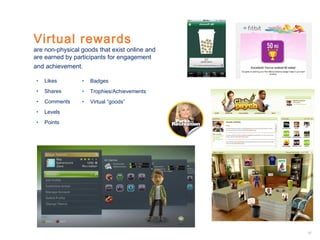
Virtual rewards

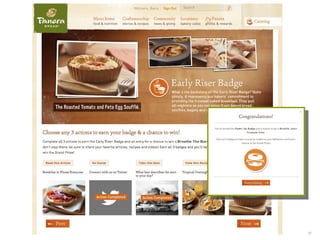
are non-physical goods that exist online and
are earned by participants for engagement
and achievement.
•

Likes

•

Badges

•

Shares

•

Trophies/Achievements

•

Comments

•

Virtual “goods”

•

Levels

•

Points

27
We are:
•Currently using virtual rewards in our
rewards mix.
•Evaluating whether to integrate virtual
rewards into our rewards mix.
•Not planning to include virtual rewards in
our program.

Proprietary and Confidential © 2011 Maritz

28
Proprietary and Confidential © 2011 Maritz
Tran
actions
s
Proprietary and Confidential © 2011 Maritz
Inter actions

Proprietary and Confidential © 2011 Maritz
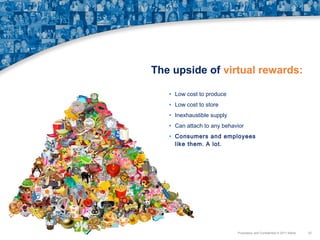
The upside of virtual rewards:
• Low cost to produce
• Low cost to store
• Inexhaustible supply
• Can attach to any behavior
• Consumers and employees
like them. A lot.

Proprietary and Confidential © 2011 Maritz

32
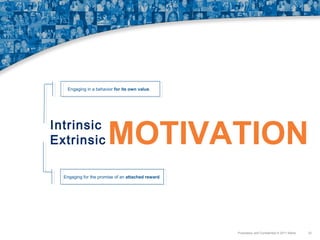
Engaging in a behavior for its own value.

Intrinsic
Extrinsic

MOTIVATION

Engaging for the promise of an attached reward.

Proprietary and Confidential © 2011 Maritz

33
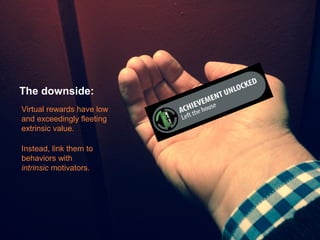
The downside:
Virtual rewards have low
and exceedingly fleeting
extrinsic value.
Instead, link them to
behaviors with
intrinsic motivators.

34
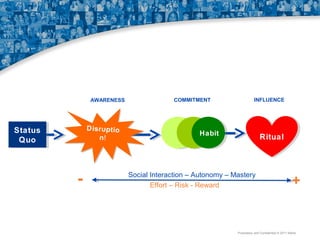
AWARENESS

D is ruptio
D isruptio
n!!
n

Status
Status
Quo
Quo

-

COMMITMENT

INFLUENCE

Habit

Ritual
Ritual

Social Interaction – Autonomy – Mastery
Effort – Risk - Reward

+

Proprietary and Confidential © 2011 Maritz
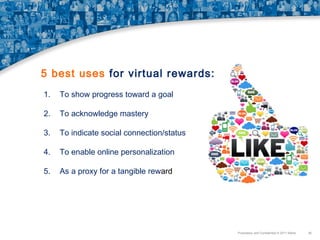
5 best uses for virtual rewards:
1.

To show progress toward a goal

2.

To acknowledge mastery

3.

To indicate social connection/status

4.

To enable online personalization

5.

As a proxy for a tangible reward

Proprietary and Confidential © 2011 Maritz

36
37
38
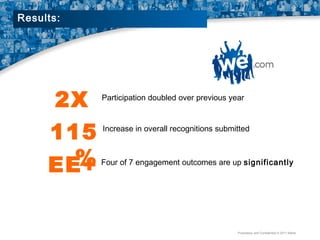
Results:

2X
115
%
EE+

Participation doubled over previous year

Increase in overall recognitions submitted

Four of 7 engagement outcomes are up significantly

Proprietary and Confidential © 2011 Maritz

39
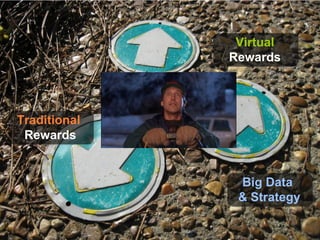
Virtual
Rewards

Traditional
Rewards

Big Data
& Strategy
40
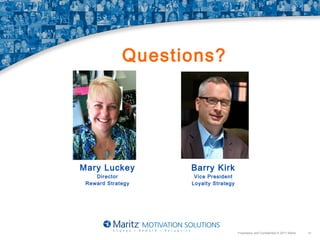
Questions?

Mary Luckey
Director
Reward Strategy

Barry Kirk
Vice President
Loyalty Strategy

Proprietary and Confidential © 2011 Maritz

41
Thank You

Proprietary and Confidential © 2011 Maritz

42

Now + New + Next: Rethinking Rewards in the New Engagement Economy

Editor's Notes

  • #7 Why worry about rewards and engagement? 3% of Members enrolled in loyalty programs stopped actively participating in at least one loyalty program in the past year. This number is disconcerting for program operators, yet of even greater concern is that only 7% of these defecting customers actively defect – meaning formally request leaving a program.
  • #9 The challenge is, those traditional models having started to show some signs of fatigue. We see this already in many loyalty programs, evidenced by this very common engagement curve. - high enrollment, followed by a steep drop off in engagement for many members (60% or more)
  • #12 Traditional Awards can be defined as the tangible awards in a consumer loyalty program for which people redeem. After accumulating a number of points they get to spend it on REAL stuff – like merchandise and gift cards   For decades now, the methodology for determining what the actual awards are in a program been very tactical and not very strategic – the tangible awards have actually been almost an afterthought.  
  • #13 Basically award strategy has pretty much worked like this.. someone - picks out a limited selection of merchandise, retail and travel gift cards, Over time additional awards are added like online travel then a competitor adds charitable awards – so you do. Then you see magazines in another program, so you add that. And before you know it…. You have 
  • #15 something like this! Kind of a HODGEPOGE of rewards. Most programs just keep throwing new awards at consumers because they don’t really know what else to do And you usually the consumers just get confused. They can’t find things, it’s tough to navigate
  • #16 Some tangible award collections get a little more strategic … You might have a different selection for different segments and it would work like this: you think about the people in a segment – let’s say high net worth or “premier” customers. And try to envision what they want. Burberry and Coach bags, and high end trip to places like Africa. You source, and fulfill the awards But you never real know if you’ve hit the mark except for the occasional survey Well, guess what- the world has changed (but our awards strategy has not!) What if you could actually understand what your customers want? We used to “guess” what people wanted beccause we didn’t have enough data… Guess what we have now?
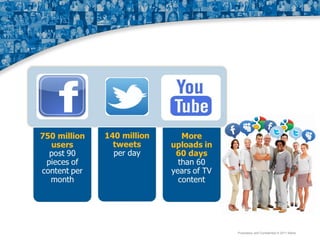
  • #17 You got it ! There’s this thing called Big Data – maybe you’ve heard of it? The amount of data out there is staggering! 750 million people facebook users post 90 pieces of content per month There are over 140 million tweets per day And my favorite – there are more videos posted on You Tube in 60 days then there is content that network television created in 60 YEARS. It’s mind boggling!
  • #18 And people have changed too.
  • #19 People’s expectations have changed too. People wanted personalized experiences They want relevant awards - don’t show me stuff I don’t want!“ They also want to have a great shopping experience whether they are on their phone, tablet or laptop. “ Let’s face it…
  • #20 consumers are in the driver’s seat – they want what they want, when they want it! And they want their shopping and buying experience to be just as good on their reward programs as it is on any online retail site. So, how can we take all this big data and what we know about consumers and make the tangible award experience more strategic and targeted.? Well, we can start by listening to what consumers are saying.  
  • #21 Yes, people are talking online all day about what they want and don’t want. We just have to listen. We’re working with one of Maritz’ research companies – Evolve24 to find out what people really want. Evolve is social media intelligence company. They not only monitor conversations and other digital content, but they have patent pending processes that also captures sentiment – are conversations positive or negative Volume and velocity – how much is being said, and how fast is it spreading And emotion – how strongly do people feel about what they’re talking about We talked earlier about important emotions are in human beings. What we’ve found out that the online conversations that have very little emotion aren’t very important. What you need to pay attention to are conversations that have very strong emotions tied to them You need to pay attention to things people LOVE and things people HATE. Let’s go back to the high net work segment we were talking about before.
  • #23 Show lifestyle shots of affluent women having a girls night out… This will capture their emotions. And you can feature a special girls night out in New York City and the latest designer jewelry. Ongoing monitoring will enable us to really keep our finger on the pulse of what people are saying and adjust the award collection based on what we learn. Next slide – Another way to use this big data is use behavioral data Barry and I are on the same program but Barry would I phone
  • #26 The future of delivering effective tangible awards Is using DATA and Analytics to provide meaningful and relevant awards to your consumers. In addition to using social media monitoring to capture what your people are saying, You need to add other tools to understanding what your consumers are viewing, what they’re buying and what targeted communications they’re responding to – just like you’re doing in other aspects of the consumer loyalty program. If you follow this model, you’ll start to actually see the individuals in your program and will be better able to engage them. If you don’t capture their emotions and their wants at the right time, and you don’t give them what they want WHEN they want it, you won’t capture their loyalty.
  • #30 Why are we even looking at virtual rewards - Shift to social and online behavior – explosion of new touch points
  • #32 So many new touch points, you need a cost effective way to reward behavior that doesn’t have an explicit dollar value attached
  • #33 A similar survey was performed by Make Their Day in 2007, in which 57 percent of respondents reported that their meaningful recognition had no dollar value—today, that number has jumped to 70 percent. So, why not just use them instead of traditional tangible rewards.
  • #35 – so focus them on the intrinsic end of the continuum
  • #40 All engagement outcomes improved (one remained same) Four of 7 engagement outcomes are up significantly e.g. I feel motivated to go beyond my formal responsibilities up from 3.9 to 4.2