Online Moderation Theoretical background and practical hints Jan Ehlers
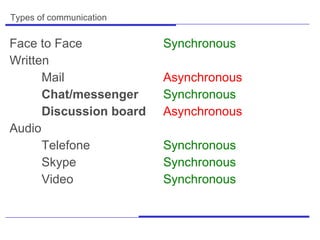
Types of communication Face to Face Written Mail Chat/messenger Discussion board Audio Telefone Skype Video Synchronous Asynchronous Synchronous Asynchronous Synchronous Synchronous Synchronous
Model of mass communication  (MALETZKE 1963)
Model of mass communication  (MALETZKE 1963) Own interpretation of information No non-verbal information CAVE: rumour and gossip Sleeper-effekt  (disconnection of message and author) Kognitive dissonance  (selective cognition)
Real and virtual opinion leaders  (MERTEN 1988) Receiver of opinions of virtual opinion leaders Medium with virtual opinion leader (V) Autonomous opinion making Real opinion leader  Opinions Receiver of opinions of real opinion leaders
Roles of moderators Pedagogical Social Management Technical Organisator  Animator/Motivator  Content expert  Transfer expert
Competencies Understanding  of online-communication processes (development of trust) Technical  skills and knowledge  (tools, helpdesk) Ability  to communicate online (striking the right note) Know-how   (e.g. about content of group) Personality   (self-confidence, no craving for recognition)
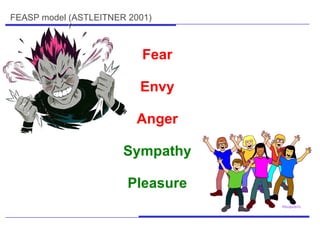
FEASP model (ASTLEITNER 2001) Fear Envy Anger Sympathy Pleasure
5-step model of e-moderation (SALMON 2001)
Questions as tools of moderation Open and closed questions Clarifying recapitulations Questions for concretion Conducive questions (to results, problems) Questions activating resources or abilities (who could help here?) Clarifying and collecting emotions
Tools of moderation Summaries Reminding of forgotten topics Stay on topic (off-topic vs. coherence) Job: moderation not content The shorter the postings of moderators, the more the participants will post
Uses and Gratifications Approach  (PALMGREEN 1084) Affektive: relaxation, amusement Kognitive: information, knowledge Integrative: identification, acknowledgement Interactive: friendship, „social“ relationships => Response-time Beliefs Evaluations Wanted gratifi-cations Use of media Gratifi-cations received
CAVE!! Flaming and lurking Generalisations Spiral of silence Nettiquette
Theories SIDE : Social Identity and Deindividuation (Anonymity and identifiability)  REICHER, SPEARS und POSTMES 1995 Messaging treshold Ansatz  (Additional expenses of online-communication, cost-benefit-calculus)  REID, MALINEK, STOTT und EVANS 1996 Media Richness Theory  (Richness of media avoids ambiguity)  DAFT und LENGEL 1986
Legal issues Questions of patient owners Complaints Evidence based medicine Objectivity vs. advertisement  §
Sarah and Tierney How to deal with the NOVICE tools…

NOVICEproject: Online Moderation

  • 1.
    Online Moderation Theoreticalbackground and practical hints Jan Ehlers
  • 2.
    Types of communicationFace to Face Written Mail Chat/messenger Discussion board Audio Telefone Skype Video Synchronous Asynchronous Synchronous Asynchronous Synchronous Synchronous Synchronous
  • 3.
    Model of masscommunication (MALETZKE 1963)
  • 4.
    Model of masscommunication (MALETZKE 1963) Own interpretation of information No non-verbal information CAVE: rumour and gossip Sleeper-effekt (disconnection of message and author) Kognitive dissonance (selective cognition)
  • 5.
    Real and virtualopinion leaders (MERTEN 1988) Receiver of opinions of virtual opinion leaders Medium with virtual opinion leader (V) Autonomous opinion making Real opinion leader Opinions Receiver of opinions of real opinion leaders
  • 6.
    Roles of moderatorsPedagogical Social Management Technical Organisator Animator/Motivator Content expert Transfer expert
  • 7.
    Competencies Understanding of online-communication processes (development of trust) Technical skills and knowledge (tools, helpdesk) Ability to communicate online (striking the right note) Know-how (e.g. about content of group) Personality (self-confidence, no craving for recognition)
  • 8.
    FEASP model (ASTLEITNER2001) Fear Envy Anger Sympathy Pleasure
  • 9.
    5-step model ofe-moderation (SALMON 2001)
  • 10.
    Questions as toolsof moderation Open and closed questions Clarifying recapitulations Questions for concretion Conducive questions (to results, problems) Questions activating resources or abilities (who could help here?) Clarifying and collecting emotions
  • 11.
    Tools of moderationSummaries Reminding of forgotten topics Stay on topic (off-topic vs. coherence) Job: moderation not content The shorter the postings of moderators, the more the participants will post
  • 12.
    Uses and GratificationsApproach (PALMGREEN 1084) Affektive: relaxation, amusement Kognitive: information, knowledge Integrative: identification, acknowledgement Interactive: friendship, „social“ relationships => Response-time Beliefs Evaluations Wanted gratifi-cations Use of media Gratifi-cations received
  • 13.
    CAVE!! Flaming andlurking Generalisations Spiral of silence Nettiquette
  • 14.
    Theories SIDE :Social Identity and Deindividuation (Anonymity and identifiability) REICHER, SPEARS und POSTMES 1995 Messaging treshold Ansatz  (Additional expenses of online-communication, cost-benefit-calculus) REID, MALINEK, STOTT und EVANS 1996 Media Richness Theory (Richness of media avoids ambiguity) DAFT und LENGEL 1986
  • 15.
    Legal issues Questionsof patient owners Complaints Evidence based medicine Objectivity vs. advertisement  §
  • 16.
    Sarah and TierneyHow to deal with the NOVICE tools…

Editor's Notes

  • #2 FOLIE 1: Thank you Mr Chairman, Ladies and Gentlemen, Good Morning. I will talk about the question if there is a need for eLearning in veterinary continuing education.