LIST’s “Environmental Research & Innovation” (ERIN) department
develops strategies, technologies and tools to better monitor,
assess, use and safeguard natural and renewable resources.
Our research topics are water security and safety, plants for biomass,
biopolymers and bioenergy, life cycle sustainability and risk assessment,
and e-Science for environmental and biological applications.
More information at LIST.lu/erin
Environmental
Research and
Innovation
( ERIN )
RDI Department
Our RDI Departments
and their
competence domains
© LIST - December 2014 - printed on FSC certified paper
Equipment and tools
Contacts
Prof. Dr Lucien Hoffmann
Director
lucien.hoffmann@list.lu
Dr Paul Schosseler
Deputy Director
paul.schosseler@list.lu
ERIN operates a comprehensive set of monitoring, analytical and modelling resources. Besides laboratory
infrastructures in biochemistry, isotope hydrology, microscopy, microbiology, toxicology, as well as for the culture and
maintenance of living organisms (cell culture models, viruses, bacteria, fungi, in vitro plants, insects), we host three
technology platforms:
uu The Analytical Chemistry Platform allows the identification and qualification of a wide array of inorganic and
organic chemical substances (metabolites, biopolymers, major to trace elements, xenobiotics, …) in various
environmental and biological matrices.
uu The Genomics, Proteomics, and Metabolomics Analysis Platform offers technologies to fully characterize
the molecular profiles of biological samples (with a specialization on plants), including genetic sequencing and
genotyping, gene expression, different protein expression analysis approaches, as well as cellular metabolite
fingerprinting.
uu The High Performance Computing Platform consists of a Linux cluster plus peripheral hardware and is dedicated
to parallel computing and modelling, centralized storage as well as to data pre-/postprocessing and visualization
of results.
The department’s ecotechnology facilities comprise fully automated bioreactors and pilots of different scales for
the optimization of bioenergy and wastewater treatment processes, including on-line analytical sensors for measuring
water quality and gases such as CH4
, CO2
, H2
S, and N2
O.
The environmental monitoring resources of the department span a wide range of applications – including sampling
and in situ analysis of biological, chemical, hydro-meteorological, and geophysical parameters. The Observatory
for Climate and Environment runs a unique hydro-meteorological instrument network in the Alzette River basin
– covering a wide array of geological, topographical and land use characteristics. The department’s environmental
monitoring vehicle is fully equipped for the combined acquisition of air quality and meteorological data. An airborne
thermal hyperspectral camera with its associated spectral lab and field equipment allows to retrieve quantitative
attributes over natural surfaces at field to landscape scales.
Luxembourg Institute of
Science and Technology (LIST)
5, avenue des Hauts-Fourneaux
L-4362 Esch/Azette
Tél. : 275 888 - 1
info@list.lu
LIST.lu
Follow us on social media
www.list.lu/social-media
AboutLIST
A key player in research and innovation in
Luxembourg, the Luxembourg Institute
of Science and Technology (LIST) covers
with its 630 employees the domains of
materials, environment and IT. As a RTO
(Research and Technology Organisation)
and with its interdisciplinary impact-
driven approach, LIST contributes to the
development of Luxembourg’s economy
and society.
More information  : LIST.lu
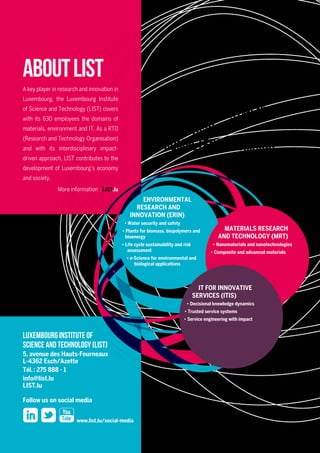
ENVIRONMENTAL
RESEARCH AND
INNOVATION (ERIN)
• Water security and safety
• Plants for biomass, biopolymers and
bioenergy
• Life cycle sustainability and risk
assessment
• e-Science for environmental and
biological applications
MATERIALS RESEARCH
AND TECHNOLOGY (MRT)
• Nanomaterials and nanotechnologies
• Composite and advanced materials
IT FOR INNOVATIVE
SERVICES (ITIS)
• Decisional knowledge dynamics
• Trusted service systems
• Service engineering with impact
1.	 Water security and safety
World-wide, water resources are increasingly put under pressure by climate and land use change as well as
anthropogenic pollution. We strive to:
uu Better understand how catchments store and release water and pollutants, using new generations of
environmental tracers and remote sensing methods;
uu Identify the sources and fate of microbes in the water cycle;
uu Develop innovative technological solutions and new real-time decision support tools for keeping our water
resources safe and secure.
2.	 Plants for biomass, biopolymers and bioenergy
Natural biological raw materials are crucial for our economic system, but they are increasingly overexploited for the
provision of food, materials and energy. Lignocellulosic biomass, mainly composed of plant cell walls, is the most
abundant biological raw material on Earth. Our aim is to:
uu Elucidate underlying mechanisms of plant cell wall biopolymer formation and deconstruction using integrative
biology and green biotechnologies;
uu Valorize plant biomass as a source for bioenergy and biopolymers for innovative and commercially interesting
applications.
3.	 Life cycle sustainability and risk assessment
Industrial activities and human consumption patterns put considerable pressure on ecosystems and natural resources
as well as impact our health. Our goal is to develop:
uu Methods and transferable tools for integrative sustainability assessment of products, technologies and policies
leading to the definition and implementation of resource and energy efficient strategies;
uu Applicable and reliable tools for environmental and human risk assessment for (mixtures of) chemicals with a
focus on nanomaterials present in water, air or soil.
4.	 e-Science for environmental and biological applications
High throughput analytical technologies, high-frequency sensor networks as well as powerful simulators generate
large quantities of environmental and biological data challenging our capacity for validation, analysis, visualization or
storage. Our ambition is to:
uu Design and implement new software tools and infrastructures;
uu Propose new data processing techniques for big data management;
uu Explore new visualization methods and theories to support data-driven scientific advancement.
ERIN’s services and technology offer relies on the scientific and technological core competencies within the four RDI
domains and the Environmental Resource Centre. We propose multiple opportunities and set-ups for collaboration
with industry and public stakeholders, aiming at the production and transfer of market and societal relevant
knowledge, methods and products.
Our valorization and partnership team ensures a well-structured and efficient interaction with external partners,
including a transparent and professional IP handling, supporting the technology and knowledge transfer, key account
and customer relationship management, extensive networking and matchmaking of interests.
We make state-of-the-art monitoring, analytical, computational and modelling resources accessible via collaboration
with our research laboratories and research support platforms, ecotechnology facilities and environmental monitoring
resources.
Examples of our services, products, methods include:
uu Air quality monitoring and modelling;
uu Bio-based materials and products for industrial applications;
uu Biodiversity monitoring, bioindication of environmental quality;
uu Biomethane potential determination of energy crops and organic waste products;
uu Data analytics and visualization software, image processing, GIS-based analyses, land cover mapping and
validation;
uu Development of hydrologic and hydraulic prediction tools;
uu High throughput genomic, transcriptomic and proteomic analyses and their bioinformatic treatment;
uu Identification and quantification of xenobiotics (pesticides, heavy metals, PCBs, pharmaceutical residuals,
mycotoxins, nanomaterials) and microorganisms in water, biota, food and feed, including risk assessment;
uu In situ and space-borne high resolution and high frequency monitoring of environmental variables;
uu Life cycle sustainability assessment and ecodesign tools for decision support;
uu Pest and disease identification and monitoring, resistance monitoring;
uu Prototypes for innovative ecotechnologies (bioenergy, water treatment), including automation and control.
Our research topics
Our services and
technology offer
Leveraging the complementary
expertise of the former departments
“Environment and Agro-biotechnologies” (EVA)
and “Informatics, Systems and Collaboration”
(ISC)oftheCRP-GabrielLippmann,aswellasofthe
“Resource Centre for Environmental Technologies”
(CRTE) of the CRP Henri Tudor, the ERIN ambition
is to implement a smart green vision, striving
for scientific excellence in the understanding of
complex environmental and biologicalsystemsand
their interaction with the technosphere, in order to
accelerate innovation towards the sustainable
management of natural resources and the
transitiontowardsacirculareconomy.
Climate change mitigation, ecosystem resilience,
sustainable energy systems, efficient use of renewable
resources, environmental pollution prevention
and control, … The “Environmental Research and
Innovation” (ERIN) department of the Luxembourg
Institute of Science and Technology (LIST) brings
together the necessary interdisciplinary knowledge
and skills to tackle major environmental challenges
that our society is facing today.
Our interdisciplinary team of 170 life, environmental,
and IT scientists and engineers develops strategies,
technologies and tools to better monitor, assess, use
and safeguard natural and renewable resources. The
portfolio of our RDI activities ranges from laboratory
and field experiments, environmental model and
software development, process control and automation
to environmental technologies. The understanding,
analysis and evaluation of complex natural and
anthropic systems are supported by advanced tools for
big data analytics, visualization and management.
Our RDI activities embrace four thematic domains:
uu Water security and safety;
uu Plants for biomass, biopolymers and bioenergy;
uu Life cycle sustainability and risk assessment;
uu e-Science for environmental and biological
applications.
Specific needs and innovation challenges of public
authorities and companies, in particular SMEs at
national level, are furthermore addressed through our
Environmental Resource Centre, offering science-
based policy and technology support for:
uu Control and prevention of industrial emissions and
employment of best available techniques;
uu Chemical substance management
(national REACH&CLP Helpdesk);
uu Crop protection in agriculture and viticulture;
uu Environmental (air, soil, water, biodiversity) and
climate monitoring and data management.
What we do
ERIN advises governments on
determining sustainable policies for
the future and provides innovative and
high-quality environmental solutions
at national and international level,
whereby small and large companies
can gain a competitive advantage
and create green jobs.
Excellence
technoLogy Interdisciplinarity
relevance
1.	 Water security and safety
World-wide, water resources are increasingly put under pressure by climate and land use change as well as
anthropogenic pollution. We strive to:
uu Better understand how catchments store and release water and pollutants, using new generations of
environmental tracers and remote sensing methods;
uu Identify the sources and fate of microbes in the water cycle;
uu Develop innovative technological solutions and new real-time decision support tools for keeping our water
resources safe and secure.
2.	 Plants for biomass, biopolymers and bioenergy
Natural biological raw materials are crucial for our economic system, but they are increasingly overexploited for the
provision of food, materials and energy. Lignocellulosic biomass, mainly composed of plant cell walls, is the most
abundant biological raw material on Earth. Our aim is to:
uu Elucidate underlying mechanisms of plant cell wall biopolymer formation and deconstruction using integrative
biology and green biotechnologies;
uu Valorize plant biomass as a source for bioenergy and biopolymers for innovative and commercially interesting
applications.
3.	 Life cycle sustainability and risk assessment
Industrial activities and human consumption patterns put considerable pressure on ecosystems and natural resources
as well as impact our health. Our goal is to develop:
uu Methods and transferable tools for integrative sustainability assessment of products, technologies and policies
leading to the definition and implementation of resource and energy efficient strategies;
uu Applicable and reliable tools for environmental and human risk assessment for (mixtures of) chemicals with a
focus on nanomaterials present in water, air or soil.
4.	 e-Science for environmental and biological applications
High throughput analytical technologies, high-frequency sensor networks as well as powerful simulators generate
large quantities of environmental and biological data challenging our capacity for validation, analysis, visualization or
storage. Our ambition is to:
uu Design and implement new software tools and infrastructures;
uu Propose new data processing techniques for big data management;
uu Explore new visualization methods and theories to support data-driven scientific advancement.
ERIN’s services and technology offer relies on the scientific and technological core competencies within the four RDI
domains and the Environmental Resource Centre. We propose multiple opportunities and set-ups for collaboration
with industry and public stakeholders, aiming at the production and transfer of market and societal relevant
knowledge, methods and products.
Our valorization and partnership team ensures a well-structured and efficient interaction with external partners,
including a transparent and professional IP handling, supporting the technology and knowledge transfer, key account
and customer relationship management, extensive networking and matchmaking of interests.
We make state-of-the-art monitoring, analytical, computational and modelling resources accessible via collaboration
with our research laboratories and research support platforms, ecotechnology facilities and environmental monitoring
resources.
Examples of our services, products, methods include:
uu Air quality monitoring and modelling;
uu Bio-based materials and products for industrial applications;
uu Biodiversity monitoring, bioindication of environmental quality;
uu Biomethane potential determination of energy crops and organic waste products;
uu Data analytics and visualization software, image processing, GIS-based analyses, land cover mapping and
validation;
uu Development of hydrologic and hydraulic prediction tools;
uu High throughput genomic, transcriptomic and proteomic analyses and their bioinformatic treatment;
uu Identification and quantification of xenobiotics (pesticides, heavy metals, PCBs, pharmaceutical residuals,
mycotoxins, nanomaterials) and microorganisms in water, biota, food and feed, including risk assessment;
uu In situ and space-borne high resolution and high frequency monitoring of environmental variables;
uu Life cycle sustainability assessment and ecodesign tools for decision support;
uu Pest and disease identification and monitoring, resistance monitoring;
uu Prototypes for innovative ecotechnologies (bioenergy, water treatment), including automation and control.
Our research topics
Our services and
technology offer
Leveraging the complementary
expertise of the former departments
“Environment and Agro-biotechnologies” (EVA)
and “Informatics, Systems and Collaboration”
(ISC)oftheCRP-GabrielLippmann,aswellasofthe
“Resource Centre for Environmental Technologies”
(CRTE) of the CRP Henri Tudor, the ERIN ambition
is to implement a smart green vision, striving
for scientific excellence in the understanding of
complex environmental and biologicalsystemsand
their interaction with the technosphere, in order to
accelerate innovation towards the sustainable
management of natural resources and the
transitiontowardsacirculareconomy.
Climate change mitigation, ecosystem resilience,
sustainable energy systems, efficient use of renewable
resources, environmental pollution prevention
and control, … The “Environmental Research and
Innovation” (ERIN) department of the Luxembourg
Institute of Science and Technology (LIST) brings
together the necessary interdisciplinary knowledge
and skills to tackle major environmental challenges
that our society is facing today.
Our interdisciplinary team of 170 life, environmental,
and IT scientists and engineers develops strategies,
technologies and tools to better monitor, assess, use
and safeguard natural and renewable resources. The
portfolio of our RDI activities ranges from laboratory
and field experiments, environmental model and
software development, process control and automation
to environmental technologies. The understanding,
analysis and evaluation of complex natural and
anthropic systems are supported by advanced tools for
big data analytics, visualization and management.
Our RDI activities embrace four thematic domains:
uu Water security and safety;
uu Plants for biomass, biopolymers and bioenergy;
uu Life cycle sustainability and risk assessment;
uu e-Science for environmental and biological
applications.
Specific needs and innovation challenges of public
authorities and companies, in particular SMEs at
national level, are furthermore addressed through our
Environmental Resource Centre, offering science-
based policy and technology support for:
uu Control and prevention of industrial emissions and
employment of best available techniques;
uu Chemical substance management
(national REACH&CLP Helpdesk);
uu Crop protection in agriculture and viticulture;
uu Environmental (air, soil, water, biodiversity) and
climate monitoring and data management.
What we do
ERIN advises governments on
determining sustainable policies for
the future and provides innovative and
high-quality environmental solutions
at national and international level,
whereby small and large companies
can gain a competitive advantage
and create green jobs.
Excellence
technoLogy Interdisciplinarity
relevance
1.	 Water security and safety
World-wide, water resources are increasingly put under pressure by climate and land use change as well as
anthropogenic pollution. We strive to:
uu Better understand how catchments store and release water and pollutants, using new generations of
environmental tracers and remote sensing methods;
uu Identify the sources and fate of microbes in the water cycle;
uu Develop innovative technological solutions and new real-time decision support tools for keeping our water
resources safe and secure.
2.	 Plants for biomass, biopolymers and bioenergy
Natural biological raw materials are crucial for our economic system, but they are increasingly overexploited for the
provision of food, materials and energy. Lignocellulosic biomass, mainly composed of plant cell walls, is the most
abundant biological raw material on Earth. Our aim is to:
uu Elucidate underlying mechanisms of plant cell wall biopolymer formation and deconstruction using integrative
biology and green biotechnologies;
uu Valorize plant biomass as a source for bioenergy and biopolymers for innovative and commercially interesting
applications.
3.	 Life cycle sustainability and risk assessment
Industrial activities and human consumption patterns put considerable pressure on ecosystems and natural resources
as well as impact our health. Our goal is to develop:
uu Methods and transferable tools for integrative sustainability assessment of products, technologies and policies
leading to the definition and implementation of resource and energy efficient strategies;
uu Applicable and reliable tools for environmental and human risk assessment for (mixtures of) chemicals with a
focus on nanomaterials present in water, air or soil.
4.	 e-Science for environmental and biological applications
High throughput analytical technologies, high-frequency sensor networks as well as powerful simulators generate
large quantities of environmental and biological data challenging our capacity for validation, analysis, visualization or
storage. Our ambition is to:
uu Design and implement new software tools and infrastructures;
uu Propose new data processing techniques for big data management;
uu Explore new visualization methods and theories to support data-driven scientific advancement.
ERIN’s services and technology offer relies on the scientific and technological core competencies within the four RDI
domains and the Environmental Resource Centre. We propose multiple opportunities and set-ups for collaboration
with industry and public stakeholders, aiming at the production and transfer of market and societal relevant
knowledge, methods and products.
Our valorization and partnership team ensures a well-structured and efficient interaction with external partners,
including a transparent and professional IP handling, supporting the technology and knowledge transfer, key account
and customer relationship management, extensive networking and matchmaking of interests.
We make state-of-the-art monitoring, analytical, computational and modelling resources accessible via collaboration
with our research laboratories and research support platforms, ecotechnology facilities and environmental monitoring
resources.
Examples of our services, products, methods include:
uu Air quality monitoring and modelling;
uu Bio-based materials and products for industrial applications;
uu Biodiversity monitoring, bioindication of environmental quality;
uu Biomethane potential determination of energy crops and organic waste products;
uu Data analytics and visualization software, image processing, GIS-based analyses, land cover mapping and
validation;
uu Development of hydrologic and hydraulic prediction tools;
uu High throughput genomic, transcriptomic and proteomic analyses and their bioinformatic treatment;
uu Identification and quantification of xenobiotics (pesticides, heavy metals, PCBs, pharmaceutical residuals,
mycotoxins, nanomaterials) and microorganisms in water, biota, food and feed, including risk assessment;
uu In situ and space-borne high resolution and high frequency monitoring of environmental variables;
uu Life cycle sustainability assessment and ecodesign tools for decision support;
uu Pest and disease identification and monitoring, resistance monitoring;
uu Prototypes for innovative ecotechnologies (bioenergy, water treatment), including automation and control.
Our research topics
Our services and
technology offer
Leveraging the complementary
expertise of the former departments
“Environment and Agro-biotechnologies” (EVA)
and “Informatics, Systems and Collaboration”
(ISC)oftheCRP-GabrielLippmann,aswellasofthe
“Resource Centre for Environmental Technologies”
(CRTE) of the CRP Henri Tudor, the ERIN ambition
is to implement a smart green vision, striving
for scientific excellence in the understanding of
complex environmental and biologicalsystemsand
their interaction with the technosphere, in order to
accelerate innovation towards the sustainable
management of natural resources and the
transitiontowardsacirculareconomy.
Climate change mitigation, ecosystem resilience,
sustainable energy systems, efficient use of renewable
resources, environmental pollution prevention
and control, … The “Environmental Research and
Innovation” (ERIN) department of the Luxembourg
Institute of Science and Technology (LIST) brings
together the necessary interdisciplinary knowledge
and skills to tackle major environmental challenges
that our society is facing today.
Our interdisciplinary team of 170 life, environmental,
and IT scientists and engineers develops strategies,
technologies and tools to better monitor, assess, use
and safeguard natural and renewable resources. The
portfolio of our RDI activities ranges from laboratory
and field experiments, environmental model and
software development, process control and automation
to environmental technologies. The understanding,
analysis and evaluation of complex natural and
anthropic systems are supported by advanced tools for
big data analytics, visualization and management.
Our RDI activities embrace four thematic domains:
uu Water security and safety;
uu Plants for biomass, biopolymers and bioenergy;
uu Life cycle sustainability and risk assessment;
uu e-Science for environmental and biological
applications.
Specific needs and innovation challenges of public
authorities and companies, in particular SMEs at
national level, are furthermore addressed through our
Environmental Resource Centre, offering science-
based policy and technology support for:
uu Control and prevention of industrial emissions and
employment of best available techniques;
uu Chemical substance management
(national REACH&CLP Helpdesk);
uu Crop protection in agriculture and viticulture;
uu Environmental (air, soil, water, biodiversity) and
climate monitoring and data management.
What we do
ERIN advises governments on
determining sustainable policies for
the future and provides innovative and
high-quality environmental solutions
at national and international level,
whereby small and large companies
can gain a competitive advantage
and create green jobs.
Excellence
technoLogy Interdisciplinarity
relevance
LIST’s “Environmental Research & Innovation” (ERIN) department
develops strategies, technologies and tools to better monitor,
assess, use and safeguard natural and renewable resources.
Our research topics are water security and safety, plants for biomass,
biopolymers and bioenergy, life cycle sustainability and risk assessment,
and e-Science for environmental and biological applications.
More information at LIST.lu/erin
Environmental
Research and
Innovation
( ERIN )
RDI Department
Our RDI Departments
and their
competence domains
© LIST - December 2014 - printed on FSC certified paper
Equipment and tools
Contacts
Prof. Dr Lucien Hoffmann
Director
lucien.hoffmann@list.lu
Dr Paul Schosseler
Deputy Director
paul.schosseler@list.lu
ERIN operates a comprehensive set of monitoring, analytical and modelling resources. Besides laboratory
infrastructures in biochemistry, isotope hydrology, microscopy, microbiology, toxicology, as well as for the culture and
maintenance of living organisms (cell culture models, viruses, bacteria, fungi, in vitro plants, insects), we host three
technology platforms:
uu The Analytical Chemistry Platform allows the identification and qualification of a wide array of inorganic and
organic chemical substances (metabolites, biopolymers, major to trace elements, xenobiotics, …) in various
environmental and biological matrices.
uu The Genomics, Proteomics, and Metabolomics Analysis Platform offers technologies to fully characterize
the molecular profiles of biological samples (with a specialization on plants), including genetic sequencing and
genotyping, gene expression, different protein expression analysis approaches, as well as cellular metabolite
fingerprinting.
uu The High Performance Computing Platform consists of a Linux cluster plus peripheral hardware and is dedicated
to parallel computing and modelling, centralized storage as well as to data pre-/postprocessing and visualization
of results.
The department’s ecotechnology facilities comprise fully automated bioreactors and pilots of different scales for
the optimization of bioenergy and wastewater treatment processes, including on-line analytical sensors for measuring
water quality and gases such as CH4
, CO2
, H2
S, and N2
O.
The environmental monitoring resources of the department span a wide range of applications – including sampling
and in situ analysis of biological, chemical, hydro-meteorological, and geophysical parameters. The Observatory
for Climate and Environment runs a unique hydro-meteorological instrument network in the Alzette River basin
– covering a wide array of geological, topographical and land use characteristics. The department’s environmental
monitoring vehicle is fully equipped for the combined acquisition of air quality and meteorological data. An airborne
thermal hyperspectral camera with its associated spectral lab and field equipment allows to retrieve quantitative
attributes over natural surfaces at field to landscape scales.
Luxembourg Institute of
Science and Technology (LIST)
5, avenue des Hauts-Fourneaux
L-4362 Esch/Azette
Tél. : 275 888 - 1
info@list.lu
LIST.lu
Follow us on social media
www.list.lu/social-media
AboutLIST
A key player in research and innovation in
Luxembourg, the Luxembourg Institute
of Science and Technology (LIST) covers
with its 630 employees the domains of
materials, environment and IT. As a RTO
(Research and Technology Organisation)
and with its interdisciplinary impact-
driven approach, LIST contributes to the
development of Luxembourg’s economy
and society.
More information  : LIST.lu
ENVIRONMENTAL
RESEARCH AND
INNOVATION (ERIN)
• Water security and safety
• Plants for biomass, biopolymers and
bioenergy
• Life cycle sustainability and risk
assessment
• e-Science for environmental and
biological applications
MATERIALS RESEARCH
AND TECHNOLOGY (MRT)
• Nanomaterials and nanotechnologies
• Composite and advanced materials
IT FOR INNOVATIVE
SERVICES (ITIS)
• Decisional knowledge dynamics
• Trusted service systems
• Service engineering with impact
LIST’s “Environmental Research & Innovation” (ERIN) department
develops strategies, technologies and tools to better monitor,
assess, use and safeguard natural and renewable resources.
Our research topics are water security and safety, plants for biomass,
biopolymers and bioenergy, life cycle sustainability and risk assessment,
and e-Science for environmental and biological applications.
More information at LIST.lu/erin
Environmental
Research and
Innovation
( ERIN )
RDI Department
Our RDI Departments
and their
competence domains
© LIST - December 2014 - printed on FSC certified paper
Equipment and tools
Contacts
Prof. Dr Lucien Hoffmann
Director
lucien.hoffmann@list.lu
Dr Paul Schosseler
Deputy Director
paul.schosseler@list.lu
ERIN operates a comprehensive set of monitoring, analytical and modelling resources. Besides laboratory
infrastructures in biochemistry, isotope hydrology, microscopy, microbiology, toxicology, as well as for the culture and
maintenance of living organisms (cell culture models, viruses, bacteria, fungi, in vitro plants, insects), we host three
technology platforms:
uu The Analytical Chemistry Platform allows the identification and qualification of a wide array of inorganic and
organic chemical substances (metabolites, biopolymers, major to trace elements, xenobiotics, …) in various
environmental and biological matrices.
uu The Genomics, Proteomics, and Metabolomics Analysis Platform offers technologies to fully characterize
the molecular profiles of biological samples (with a specialization on plants), including genetic sequencing and
genotyping, gene expression, different protein expression analysis approaches, as well as cellular metabolite
fingerprinting.
uu The High Performance Computing Platform consists of a Linux cluster plus peripheral hardware and is dedicated
to parallel computing and modelling, centralized storage as well as to data pre-/postprocessing and visualization
of results.
The department’s ecotechnology facilities comprise fully automated bioreactors and pilots of different scales for
the optimization of bioenergy and wastewater treatment processes, including on-line analytical sensors for measuring
water quality and gases such as CH4
, CO2
, H2
S, and N2
O.
The environmental monitoring resources of the department span a wide range of applications – including sampling
and in situ analysis of biological, chemical, hydro-meteorological, and geophysical parameters. The Observatory
for Climate and Environment runs a unique hydro-meteorological instrument network in the Alzette River basin
– covering a wide array of geological, topographical and land use characteristics. The department’s environmental
monitoring vehicle is fully equipped for the combined acquisition of air quality and meteorological data. An airborne
thermal hyperspectral camera with its associated spectral lab and field equipment allows to retrieve quantitative
attributes over natural surfaces at field to landscape scales.
Luxembourg Institute of
Science and Technology (LIST)
5, avenue des Hauts-Fourneaux
L-4362 Esch/Azette
Tél. : 275 888 - 1
info@list.lu
LIST.lu
Follow us on social media
www.list.lu/social-media
AboutLIST
A key player in research and innovation in
Luxembourg, the Luxembourg Institute
of Science and Technology (LIST) covers
with its 630 employees the domains of
materials, environment and IT. As a RTO
(Research and Technology Organisation)
and with its interdisciplinary impact-
driven approach, LIST contributes to the
development of Luxembourg’s economy
and society.
More information  : LIST.lu
ENVIRONMENTAL
RESEARCH AND
INNOVATION (ERIN)
• Water security and safety
• Plants for biomass, biopolymers and
bioenergy
• Life cycle sustainability and risk
assessment
• e-Science for environmental and
biological applications
MATERIALS RESEARCH
AND TECHNOLOGY (MRT)
• Nanomaterials and nanotechnologies
• Composite and advanced materials
IT FOR INNOVATIVE
SERVICES (ITIS)
• Decisional knowledge dynamics
• Trusted service systems
• Service engineering with impact

Presentation leaflet - “Environmental Research and Innovation” (ERIN) department

  • 1.
    LIST’s “Environmental Research& Innovation” (ERIN) department develops strategies, technologies and tools to better monitor, assess, use and safeguard natural and renewable resources. Our research topics are water security and safety, plants for biomass, biopolymers and bioenergy, life cycle sustainability and risk assessment, and e-Science for environmental and biological applications. More information at LIST.lu/erin Environmental Research and Innovation ( ERIN ) RDI Department Our RDI Departments and their competence domains © LIST - December 2014 - printed on FSC certified paper Equipment and tools Contacts Prof. Dr Lucien Hoffmann Director lucien.hoffmann@list.lu Dr Paul Schosseler Deputy Director paul.schosseler@list.lu ERIN operates a comprehensive set of monitoring, analytical and modelling resources. Besides laboratory infrastructures in biochemistry, isotope hydrology, microscopy, microbiology, toxicology, as well as for the culture and maintenance of living organisms (cell culture models, viruses, bacteria, fungi, in vitro plants, insects), we host three technology platforms: uu The Analytical Chemistry Platform allows the identification and qualification of a wide array of inorganic and organic chemical substances (metabolites, biopolymers, major to trace elements, xenobiotics, …) in various environmental and biological matrices. uu The Genomics, Proteomics, and Metabolomics Analysis Platform offers technologies to fully characterize the molecular profiles of biological samples (with a specialization on plants), including genetic sequencing and genotyping, gene expression, different protein expression analysis approaches, as well as cellular metabolite fingerprinting. uu The High Performance Computing Platform consists of a Linux cluster plus peripheral hardware and is dedicated to parallel computing and modelling, centralized storage as well as to data pre-/postprocessing and visualization of results. The department’s ecotechnology facilities comprise fully automated bioreactors and pilots of different scales for the optimization of bioenergy and wastewater treatment processes, including on-line analytical sensors for measuring water quality and gases such as CH4 , CO2 , H2 S, and N2 O. The environmental monitoring resources of the department span a wide range of applications – including sampling and in situ analysis of biological, chemical, hydro-meteorological, and geophysical parameters. The Observatory for Climate and Environment runs a unique hydro-meteorological instrument network in the Alzette River basin – covering a wide array of geological, topographical and land use characteristics. The department’s environmental monitoring vehicle is fully equipped for the combined acquisition of air quality and meteorological data. An airborne thermal hyperspectral camera with its associated spectral lab and field equipment allows to retrieve quantitative attributes over natural surfaces at field to landscape scales. Luxembourg Institute of Science and Technology (LIST) 5, avenue des Hauts-Fourneaux L-4362 Esch/Azette Tél. : 275 888 - 1 info@list.lu LIST.lu Follow us on social media www.list.lu/social-media AboutLIST A key player in research and innovation in Luxembourg, the Luxembourg Institute of Science and Technology (LIST) covers with its 630 employees the domains of materials, environment and IT. As a RTO (Research and Technology Organisation) and with its interdisciplinary impact- driven approach, LIST contributes to the development of Luxembourg’s economy and society. More information  : LIST.lu ENVIRONMENTAL RESEARCH AND INNOVATION (ERIN) • Water security and safety • Plants for biomass, biopolymers and bioenergy • Life cycle sustainability and risk assessment • e-Science for environmental and biological applications MATERIALS RESEARCH AND TECHNOLOGY (MRT) • Nanomaterials and nanotechnologies • Composite and advanced materials IT FOR INNOVATIVE SERVICES (ITIS) • Decisional knowledge dynamics • Trusted service systems • Service engineering with impact
  • 2.
    1. Water securityand safety World-wide, water resources are increasingly put under pressure by climate and land use change as well as anthropogenic pollution. We strive to: uu Better understand how catchments store and release water and pollutants, using new generations of environmental tracers and remote sensing methods; uu Identify the sources and fate of microbes in the water cycle; uu Develop innovative technological solutions and new real-time decision support tools for keeping our water resources safe and secure. 2. Plants for biomass, biopolymers and bioenergy Natural biological raw materials are crucial for our economic system, but they are increasingly overexploited for the provision of food, materials and energy. Lignocellulosic biomass, mainly composed of plant cell walls, is the most abundant biological raw material on Earth. Our aim is to: uu Elucidate underlying mechanisms of plant cell wall biopolymer formation and deconstruction using integrative biology and green biotechnologies; uu Valorize plant biomass as a source for bioenergy and biopolymers for innovative and commercially interesting applications. 3. Life cycle sustainability and risk assessment Industrial activities and human consumption patterns put considerable pressure on ecosystems and natural resources as well as impact our health. Our goal is to develop: uu Methods and transferable tools for integrative sustainability assessment of products, technologies and policies leading to the definition and implementation of resource and energy efficient strategies; uu Applicable and reliable tools for environmental and human risk assessment for (mixtures of) chemicals with a focus on nanomaterials present in water, air or soil. 4. e-Science for environmental and biological applications High throughput analytical technologies, high-frequency sensor networks as well as powerful simulators generate large quantities of environmental and biological data challenging our capacity for validation, analysis, visualization or storage. Our ambition is to: uu Design and implement new software tools and infrastructures; uu Propose new data processing techniques for big data management; uu Explore new visualization methods and theories to support data-driven scientific advancement. ERIN’s services and technology offer relies on the scientific and technological core competencies within the four RDI domains and the Environmental Resource Centre. We propose multiple opportunities and set-ups for collaboration with industry and public stakeholders, aiming at the production and transfer of market and societal relevant knowledge, methods and products. Our valorization and partnership team ensures a well-structured and efficient interaction with external partners, including a transparent and professional IP handling, supporting the technology and knowledge transfer, key account and customer relationship management, extensive networking and matchmaking of interests. We make state-of-the-art monitoring, analytical, computational and modelling resources accessible via collaboration with our research laboratories and research support platforms, ecotechnology facilities and environmental monitoring resources. Examples of our services, products, methods include: uu Air quality monitoring and modelling; uu Bio-based materials and products for industrial applications; uu Biodiversity monitoring, bioindication of environmental quality; uu Biomethane potential determination of energy crops and organic waste products; uu Data analytics and visualization software, image processing, GIS-based analyses, land cover mapping and validation; uu Development of hydrologic and hydraulic prediction tools; uu High throughput genomic, transcriptomic and proteomic analyses and their bioinformatic treatment; uu Identification and quantification of xenobiotics (pesticides, heavy metals, PCBs, pharmaceutical residuals, mycotoxins, nanomaterials) and microorganisms in water, biota, food and feed, including risk assessment; uu In situ and space-borne high resolution and high frequency monitoring of environmental variables; uu Life cycle sustainability assessment and ecodesign tools for decision support; uu Pest and disease identification and monitoring, resistance monitoring; uu Prototypes for innovative ecotechnologies (bioenergy, water treatment), including automation and control. Our research topics Our services and technology offer Leveraging the complementary expertise of the former departments “Environment and Agro-biotechnologies” (EVA) and “Informatics, Systems and Collaboration” (ISC)oftheCRP-GabrielLippmann,aswellasofthe “Resource Centre for Environmental Technologies” (CRTE) of the CRP Henri Tudor, the ERIN ambition is to implement a smart green vision, striving for scientific excellence in the understanding of complex environmental and biologicalsystemsand their interaction with the technosphere, in order to accelerate innovation towards the sustainable management of natural resources and the transitiontowardsacirculareconomy. Climate change mitigation, ecosystem resilience, sustainable energy systems, efficient use of renewable resources, environmental pollution prevention and control, … The “Environmental Research and Innovation” (ERIN) department of the Luxembourg Institute of Science and Technology (LIST) brings together the necessary interdisciplinary knowledge and skills to tackle major environmental challenges that our society is facing today. Our interdisciplinary team of 170 life, environmental, and IT scientists and engineers develops strategies, technologies and tools to better monitor, assess, use and safeguard natural and renewable resources. The portfolio of our RDI activities ranges from laboratory and field experiments, environmental model and software development, process control and automation to environmental technologies. The understanding, analysis and evaluation of complex natural and anthropic systems are supported by advanced tools for big data analytics, visualization and management. Our RDI activities embrace four thematic domains: uu Water security and safety; uu Plants for biomass, biopolymers and bioenergy; uu Life cycle sustainability and risk assessment; uu e-Science for environmental and biological applications. Specific needs and innovation challenges of public authorities and companies, in particular SMEs at national level, are furthermore addressed through our Environmental Resource Centre, offering science- based policy and technology support for: uu Control and prevention of industrial emissions and employment of best available techniques; uu Chemical substance management (national REACH&CLP Helpdesk); uu Crop protection in agriculture and viticulture; uu Environmental (air, soil, water, biodiversity) and climate monitoring and data management. What we do ERIN advises governments on determining sustainable policies for the future and provides innovative and high-quality environmental solutions at national and international level, whereby small and large companies can gain a competitive advantage and create green jobs. Excellence technoLogy Interdisciplinarity relevance
  • 3.
    1. Water securityand safety World-wide, water resources are increasingly put under pressure by climate and land use change as well as anthropogenic pollution. We strive to: uu Better understand how catchments store and release water and pollutants, using new generations of environmental tracers and remote sensing methods; uu Identify the sources and fate of microbes in the water cycle; uu Develop innovative technological solutions and new real-time decision support tools for keeping our water resources safe and secure. 2. Plants for biomass, biopolymers and bioenergy Natural biological raw materials are crucial for our economic system, but they are increasingly overexploited for the provision of food, materials and energy. Lignocellulosic biomass, mainly composed of plant cell walls, is the most abundant biological raw material on Earth. Our aim is to: uu Elucidate underlying mechanisms of plant cell wall biopolymer formation and deconstruction using integrative biology and green biotechnologies; uu Valorize plant biomass as a source for bioenergy and biopolymers for innovative and commercially interesting applications. 3. Life cycle sustainability and risk assessment Industrial activities and human consumption patterns put considerable pressure on ecosystems and natural resources as well as impact our health. Our goal is to develop: uu Methods and transferable tools for integrative sustainability assessment of products, technologies and policies leading to the definition and implementation of resource and energy efficient strategies; uu Applicable and reliable tools for environmental and human risk assessment for (mixtures of) chemicals with a focus on nanomaterials present in water, air or soil. 4. e-Science for environmental and biological applications High throughput analytical technologies, high-frequency sensor networks as well as powerful simulators generate large quantities of environmental and biological data challenging our capacity for validation, analysis, visualization or storage. Our ambition is to: uu Design and implement new software tools and infrastructures; uu Propose new data processing techniques for big data management; uu Explore new visualization methods and theories to support data-driven scientific advancement. ERIN’s services and technology offer relies on the scientific and technological core competencies within the four RDI domains and the Environmental Resource Centre. We propose multiple opportunities and set-ups for collaboration with industry and public stakeholders, aiming at the production and transfer of market and societal relevant knowledge, methods and products. Our valorization and partnership team ensures a well-structured and efficient interaction with external partners, including a transparent and professional IP handling, supporting the technology and knowledge transfer, key account and customer relationship management, extensive networking and matchmaking of interests. We make state-of-the-art monitoring, analytical, computational and modelling resources accessible via collaboration with our research laboratories and research support platforms, ecotechnology facilities and environmental monitoring resources. Examples of our services, products, methods include: uu Air quality monitoring and modelling; uu Bio-based materials and products for industrial applications; uu Biodiversity monitoring, bioindication of environmental quality; uu Biomethane potential determination of energy crops and organic waste products; uu Data analytics and visualization software, image processing, GIS-based analyses, land cover mapping and validation; uu Development of hydrologic and hydraulic prediction tools; uu High throughput genomic, transcriptomic and proteomic analyses and their bioinformatic treatment; uu Identification and quantification of xenobiotics (pesticides, heavy metals, PCBs, pharmaceutical residuals, mycotoxins, nanomaterials) and microorganisms in water, biota, food and feed, including risk assessment; uu In situ and space-borne high resolution and high frequency monitoring of environmental variables; uu Life cycle sustainability assessment and ecodesign tools for decision support; uu Pest and disease identification and monitoring, resistance monitoring; uu Prototypes for innovative ecotechnologies (bioenergy, water treatment), including automation and control. Our research topics Our services and technology offer Leveraging the complementary expertise of the former departments “Environment and Agro-biotechnologies” (EVA) and “Informatics, Systems and Collaboration” (ISC)oftheCRP-GabrielLippmann,aswellasofthe “Resource Centre for Environmental Technologies” (CRTE) of the CRP Henri Tudor, the ERIN ambition is to implement a smart green vision, striving for scientific excellence in the understanding of complex environmental and biologicalsystemsand their interaction with the technosphere, in order to accelerate innovation towards the sustainable management of natural resources and the transitiontowardsacirculareconomy. Climate change mitigation, ecosystem resilience, sustainable energy systems, efficient use of renewable resources, environmental pollution prevention and control, … The “Environmental Research and Innovation” (ERIN) department of the Luxembourg Institute of Science and Technology (LIST) brings together the necessary interdisciplinary knowledge and skills to tackle major environmental challenges that our society is facing today. Our interdisciplinary team of 170 life, environmental, and IT scientists and engineers develops strategies, technologies and tools to better monitor, assess, use and safeguard natural and renewable resources. The portfolio of our RDI activities ranges from laboratory and field experiments, environmental model and software development, process control and automation to environmental technologies. The understanding, analysis and evaluation of complex natural and anthropic systems are supported by advanced tools for big data analytics, visualization and management. Our RDI activities embrace four thematic domains: uu Water security and safety; uu Plants for biomass, biopolymers and bioenergy; uu Life cycle sustainability and risk assessment; uu e-Science for environmental and biological applications. Specific needs and innovation challenges of public authorities and companies, in particular SMEs at national level, are furthermore addressed through our Environmental Resource Centre, offering science- based policy and technology support for: uu Control and prevention of industrial emissions and employment of best available techniques; uu Chemical substance management (national REACH&CLP Helpdesk); uu Crop protection in agriculture and viticulture; uu Environmental (air, soil, water, biodiversity) and climate monitoring and data management. What we do ERIN advises governments on determining sustainable policies for the future and provides innovative and high-quality environmental solutions at national and international level, whereby small and large companies can gain a competitive advantage and create green jobs. Excellence technoLogy Interdisciplinarity relevance
  • 4.
    1. Water securityand safety World-wide, water resources are increasingly put under pressure by climate and land use change as well as anthropogenic pollution. We strive to: uu Better understand how catchments store and release water and pollutants, using new generations of environmental tracers and remote sensing methods; uu Identify the sources and fate of microbes in the water cycle; uu Develop innovative technological solutions and new real-time decision support tools for keeping our water resources safe and secure. 2. Plants for biomass, biopolymers and bioenergy Natural biological raw materials are crucial for our economic system, but they are increasingly overexploited for the provision of food, materials and energy. Lignocellulosic biomass, mainly composed of plant cell walls, is the most abundant biological raw material on Earth. Our aim is to: uu Elucidate underlying mechanisms of plant cell wall biopolymer formation and deconstruction using integrative biology and green biotechnologies; uu Valorize plant biomass as a source for bioenergy and biopolymers for innovative and commercially interesting applications. 3. Life cycle sustainability and risk assessment Industrial activities and human consumption patterns put considerable pressure on ecosystems and natural resources as well as impact our health. Our goal is to develop: uu Methods and transferable tools for integrative sustainability assessment of products, technologies and policies leading to the definition and implementation of resource and energy efficient strategies; uu Applicable and reliable tools for environmental and human risk assessment for (mixtures of) chemicals with a focus on nanomaterials present in water, air or soil. 4. e-Science for environmental and biological applications High throughput analytical technologies, high-frequency sensor networks as well as powerful simulators generate large quantities of environmental and biological data challenging our capacity for validation, analysis, visualization or storage. Our ambition is to: uu Design and implement new software tools and infrastructures; uu Propose new data processing techniques for big data management; uu Explore new visualization methods and theories to support data-driven scientific advancement. ERIN’s services and technology offer relies on the scientific and technological core competencies within the four RDI domains and the Environmental Resource Centre. We propose multiple opportunities and set-ups for collaboration with industry and public stakeholders, aiming at the production and transfer of market and societal relevant knowledge, methods and products. Our valorization and partnership team ensures a well-structured and efficient interaction with external partners, including a transparent and professional IP handling, supporting the technology and knowledge transfer, key account and customer relationship management, extensive networking and matchmaking of interests. We make state-of-the-art monitoring, analytical, computational and modelling resources accessible via collaboration with our research laboratories and research support platforms, ecotechnology facilities and environmental monitoring resources. Examples of our services, products, methods include: uu Air quality monitoring and modelling; uu Bio-based materials and products for industrial applications; uu Biodiversity monitoring, bioindication of environmental quality; uu Biomethane potential determination of energy crops and organic waste products; uu Data analytics and visualization software, image processing, GIS-based analyses, land cover mapping and validation; uu Development of hydrologic and hydraulic prediction tools; uu High throughput genomic, transcriptomic and proteomic analyses and their bioinformatic treatment; uu Identification and quantification of xenobiotics (pesticides, heavy metals, PCBs, pharmaceutical residuals, mycotoxins, nanomaterials) and microorganisms in water, biota, food and feed, including risk assessment; uu In situ and space-borne high resolution and high frequency monitoring of environmental variables; uu Life cycle sustainability assessment and ecodesign tools for decision support; uu Pest and disease identification and monitoring, resistance monitoring; uu Prototypes for innovative ecotechnologies (bioenergy, water treatment), including automation and control. Our research topics Our services and technology offer Leveraging the complementary expertise of the former departments “Environment and Agro-biotechnologies” (EVA) and “Informatics, Systems and Collaboration” (ISC)oftheCRP-GabrielLippmann,aswellasofthe “Resource Centre for Environmental Technologies” (CRTE) of the CRP Henri Tudor, the ERIN ambition is to implement a smart green vision, striving for scientific excellence in the understanding of complex environmental and biologicalsystemsand their interaction with the technosphere, in order to accelerate innovation towards the sustainable management of natural resources and the transitiontowardsacirculareconomy. Climate change mitigation, ecosystem resilience, sustainable energy systems, efficient use of renewable resources, environmental pollution prevention and control, … The “Environmental Research and Innovation” (ERIN) department of the Luxembourg Institute of Science and Technology (LIST) brings together the necessary interdisciplinary knowledge and skills to tackle major environmental challenges that our society is facing today. Our interdisciplinary team of 170 life, environmental, and IT scientists and engineers develops strategies, technologies and tools to better monitor, assess, use and safeguard natural and renewable resources. The portfolio of our RDI activities ranges from laboratory and field experiments, environmental model and software development, process control and automation to environmental technologies. The understanding, analysis and evaluation of complex natural and anthropic systems are supported by advanced tools for big data analytics, visualization and management. Our RDI activities embrace four thematic domains: uu Water security and safety; uu Plants for biomass, biopolymers and bioenergy; uu Life cycle sustainability and risk assessment; uu e-Science for environmental and biological applications. Specific needs and innovation challenges of public authorities and companies, in particular SMEs at national level, are furthermore addressed through our Environmental Resource Centre, offering science- based policy and technology support for: uu Control and prevention of industrial emissions and employment of best available techniques; uu Chemical substance management (national REACH&CLP Helpdesk); uu Crop protection in agriculture and viticulture; uu Environmental (air, soil, water, biodiversity) and climate monitoring and data management. What we do ERIN advises governments on determining sustainable policies for the future and provides innovative and high-quality environmental solutions at national and international level, whereby small and large companies can gain a competitive advantage and create green jobs. Excellence technoLogy Interdisciplinarity relevance
  • 5.
    LIST’s “Environmental Research& Innovation” (ERIN) department develops strategies, technologies and tools to better monitor, assess, use and safeguard natural and renewable resources. Our research topics are water security and safety, plants for biomass, biopolymers and bioenergy, life cycle sustainability and risk assessment, and e-Science for environmental and biological applications. More information at LIST.lu/erin Environmental Research and Innovation ( ERIN ) RDI Department Our RDI Departments and their competence domains © LIST - December 2014 - printed on FSC certified paper Equipment and tools Contacts Prof. Dr Lucien Hoffmann Director lucien.hoffmann@list.lu Dr Paul Schosseler Deputy Director paul.schosseler@list.lu ERIN operates a comprehensive set of monitoring, analytical and modelling resources. Besides laboratory infrastructures in biochemistry, isotope hydrology, microscopy, microbiology, toxicology, as well as for the culture and maintenance of living organisms (cell culture models, viruses, bacteria, fungi, in vitro plants, insects), we host three technology platforms: uu The Analytical Chemistry Platform allows the identification and qualification of a wide array of inorganic and organic chemical substances (metabolites, biopolymers, major to trace elements, xenobiotics, …) in various environmental and biological matrices. uu The Genomics, Proteomics, and Metabolomics Analysis Platform offers technologies to fully characterize the molecular profiles of biological samples (with a specialization on plants), including genetic sequencing and genotyping, gene expression, different protein expression analysis approaches, as well as cellular metabolite fingerprinting. uu The High Performance Computing Platform consists of a Linux cluster plus peripheral hardware and is dedicated to parallel computing and modelling, centralized storage as well as to data pre-/postprocessing and visualization of results. The department’s ecotechnology facilities comprise fully automated bioreactors and pilots of different scales for the optimization of bioenergy and wastewater treatment processes, including on-line analytical sensors for measuring water quality and gases such as CH4 , CO2 , H2 S, and N2 O. The environmental monitoring resources of the department span a wide range of applications – including sampling and in situ analysis of biological, chemical, hydro-meteorological, and geophysical parameters. The Observatory for Climate and Environment runs a unique hydro-meteorological instrument network in the Alzette River basin – covering a wide array of geological, topographical and land use characteristics. The department’s environmental monitoring vehicle is fully equipped for the combined acquisition of air quality and meteorological data. An airborne thermal hyperspectral camera with its associated spectral lab and field equipment allows to retrieve quantitative attributes over natural surfaces at field to landscape scales. Luxembourg Institute of Science and Technology (LIST) 5, avenue des Hauts-Fourneaux L-4362 Esch/Azette Tél. : 275 888 - 1 info@list.lu LIST.lu Follow us on social media www.list.lu/social-media AboutLIST A key player in research and innovation in Luxembourg, the Luxembourg Institute of Science and Technology (LIST) covers with its 630 employees the domains of materials, environment and IT. As a RTO (Research and Technology Organisation) and with its interdisciplinary impact- driven approach, LIST contributes to the development of Luxembourg’s economy and society. More information  : LIST.lu ENVIRONMENTAL RESEARCH AND INNOVATION (ERIN) • Water security and safety • Plants for biomass, biopolymers and bioenergy • Life cycle sustainability and risk assessment • e-Science for environmental and biological applications MATERIALS RESEARCH AND TECHNOLOGY (MRT) • Nanomaterials and nanotechnologies • Composite and advanced materials IT FOR INNOVATIVE SERVICES (ITIS) • Decisional knowledge dynamics • Trusted service systems • Service engineering with impact
  • 6.
    LIST’s “Environmental Research& Innovation” (ERIN) department develops strategies, technologies and tools to better monitor, assess, use and safeguard natural and renewable resources. Our research topics are water security and safety, plants for biomass, biopolymers and bioenergy, life cycle sustainability and risk assessment, and e-Science for environmental and biological applications. More information at LIST.lu/erin Environmental Research and Innovation ( ERIN ) RDI Department Our RDI Departments and their competence domains © LIST - December 2014 - printed on FSC certified paper Equipment and tools Contacts Prof. Dr Lucien Hoffmann Director lucien.hoffmann@list.lu Dr Paul Schosseler Deputy Director paul.schosseler@list.lu ERIN operates a comprehensive set of monitoring, analytical and modelling resources. Besides laboratory infrastructures in biochemistry, isotope hydrology, microscopy, microbiology, toxicology, as well as for the culture and maintenance of living organisms (cell culture models, viruses, bacteria, fungi, in vitro plants, insects), we host three technology platforms: uu The Analytical Chemistry Platform allows the identification and qualification of a wide array of inorganic and organic chemical substances (metabolites, biopolymers, major to trace elements, xenobiotics, …) in various environmental and biological matrices. uu The Genomics, Proteomics, and Metabolomics Analysis Platform offers technologies to fully characterize the molecular profiles of biological samples (with a specialization on plants), including genetic sequencing and genotyping, gene expression, different protein expression analysis approaches, as well as cellular metabolite fingerprinting. uu The High Performance Computing Platform consists of a Linux cluster plus peripheral hardware and is dedicated to parallel computing and modelling, centralized storage as well as to data pre-/postprocessing and visualization of results. The department’s ecotechnology facilities comprise fully automated bioreactors and pilots of different scales for the optimization of bioenergy and wastewater treatment processes, including on-line analytical sensors for measuring water quality and gases such as CH4 , CO2 , H2 S, and N2 O. The environmental monitoring resources of the department span a wide range of applications – including sampling and in situ analysis of biological, chemical, hydro-meteorological, and geophysical parameters. The Observatory for Climate and Environment runs a unique hydro-meteorological instrument network in the Alzette River basin – covering a wide array of geological, topographical and land use characteristics. The department’s environmental monitoring vehicle is fully equipped for the combined acquisition of air quality and meteorological data. An airborne thermal hyperspectral camera with its associated spectral lab and field equipment allows to retrieve quantitative attributes over natural surfaces at field to landscape scales. Luxembourg Institute of Science and Technology (LIST) 5, avenue des Hauts-Fourneaux L-4362 Esch/Azette Tél. : 275 888 - 1 info@list.lu LIST.lu Follow us on social media www.list.lu/social-media AboutLIST A key player in research and innovation in Luxembourg, the Luxembourg Institute of Science and Technology (LIST) covers with its 630 employees the domains of materials, environment and IT. As a RTO (Research and Technology Organisation) and with its interdisciplinary impact- driven approach, LIST contributes to the development of Luxembourg’s economy and society. More information  : LIST.lu ENVIRONMENTAL RESEARCH AND INNOVATION (ERIN) • Water security and safety • Plants for biomass, biopolymers and bioenergy • Life cycle sustainability and risk assessment • e-Science for environmental and biological applications MATERIALS RESEARCH AND TECHNOLOGY (MRT) • Nanomaterials and nanotechnologies • Composite and advanced materials IT FOR INNOVATIVE SERVICES (ITIS) • Decisional knowledge dynamics • Trusted service systems • Service engineering with impact