Mob, Chaos, Dungeon
Hidden, Deprived of Light
Individualized, Orderly,
Cell
Wednesday, November 25th
Hence, the major effect of the Panopticon: to induce in the inmate a sense of
conscious and permanent visibility that assures the automatic function of
power. (201)
Paraphrase #1: The Panopticon creates individuals who feel like they have to be
on guard, that are always being observed and judged. This judgment occurs
unconsciously, without the individuals express awareness of judging him or
herself. This is how the panopticon gets people to conform.
Paraphrase #2: Power operates seemingly spontaneously, almost instinctively,
beneath the level of consciousness. It occurs because individuals - what Foucault
calls “inmates’ - become their own observers and judges. The panopticon installs
within each of us a personal, psychological guard tower that gets us to
unconsciously stay in line.
The panoptic scheme, without disappearing as such or losing any of its
properties, was destined to spread throughout the social body; its vocation
was to become a generalized function. (207)
Paraphrase #1: The invisible, undetected “map” of the panopticon’s doesn’t lose
its potency when mapped on to other contexts. Moreover, the panopticon’s
hierarchy of observation, normalization of judgment, and examination works
beyond the criminal justice system. These characteristics, associated with jails,
operates in other social systems: education, medicine, and industry. Thus, the
panoptic scheme produces discipline and control in a variety of social spaces.
Paraphrase #2: The traits of panoptic society - hierarchy of observation,
normalization of judgement, and examination - infect other social institutions
beyond prison industrial complex. In education, mental and physical health, and
labor, panopticon is a broad organizing principle, roomy enough to serve many
institutions.
[Bentham’s Panopticon] reverses the
principle of the dungeon; or rather it’s
three functions - to enclose, to deprive
of light and to hide - it preserves only
the first and eliminates the other two.
Full lighting and the eye of a supervisor
capture better than darkness, which is
ultimately protected. Visibility is a trap.
(200)
In a panoptic regime, “The
crowd, a compact mass, a locus
of multiple exchanges,
individualities merging together,
a collective effect,is abolished
and replaced by a collection of
separated individualities”. (201)
. . . [Bentham] laid down the principle
that power should be visible and
unverifiable. Visible: The inmate will
constantly have before his eyes the tall
outline of the central tower from which
he is spied upon. Unverifiable: the
inmate must never know whether he is
being looked at in any one moment; but
he must be sure that he may always be
so. (201)
[The Panopticon] is an important
mechanism, for it automotizes and
disindividuates power. Power has its
principle not so much in a person as
in a certain concerted distribution of
bodies, surfaces, lights, gazes; in an
arrangement whose internal
mechanisms produce the relation in
which individuals are caught up.
(202)
[The Panopticon] is an important mechanism, for it
automotizes and disindividuates power. Power has
its principle not so much in a person as in a certain
concerted distribution of bodies, surfaces, lights,
gazes; in an arrangement whose internal
mechanisms produce the relation in which
individuals are caught up. (202) In other words, this
version of power doesn’t reside in a single body or
agency. Instead, power is spread out, a dispersed
but focused system of surveillance. In this case,
judgment happens to and is enacted by individuals.
People, like a consumer of social media that
features “likes” and feedback, are ranked by other
participants, even as they rank others on the
network.
But the Panopticon must not be understood as a dream building; it is a diagram of
a mechanism of power reduced to its ideal form; its functioning, abstracted from
any obstacle, resistance or friction, must be represented as a pure architectural
and optical system, it is fact a figure of political technology that may and must be
detached from any specific use.
It is polyvalent in it’s application it serves to reform prisoners, but also to treat
patients, to instruct schoolchildren, to confine the insance, to supervise workers, to
put beggars an didlers to work. It is a type of location of bodies in space, of
distribution of individual in relation to one another, of hierarchical organization. . . .
It is . . applicable to all establishments whatever, in which within a space not too
large to be covered or commanded by building, a number of persons meant to be
kept under inspection. (205 - 206)
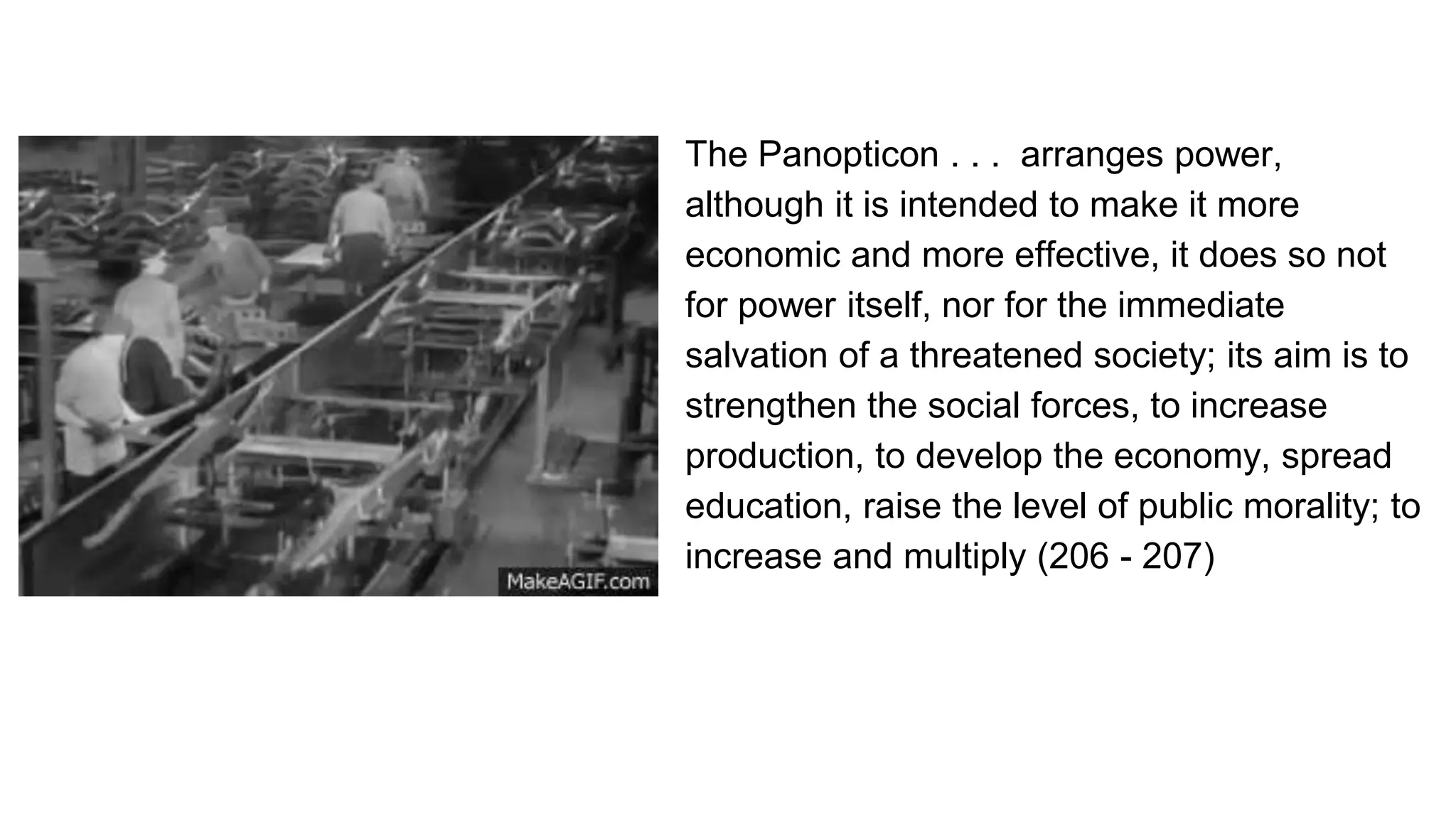
The Panopticon . . . arranges power,
although it is intended to make it more
economic and more effective, it does so not
for power itself, nor for the immediate
salvation of a threatened society; its aim is to
strengthen the social forces, to increase
production, to develop the economy, spread
education, raise the level of public morality; to
increase and multiply (206 - 207)
Embryo Story - Brave New World
And opening a door Mr. Foster led the way
down a staircase into the basement.
The temperature was still tropical. Two doors
and a passage with a double turn insured the
cellar against any possible infiltration of the
day. ( Huxley 11)
. . . Bentham envisaged on the inside,
partitions that intersected the hall at right
angles, and in order to pass from one quarter
to the other, not doors, but zig-zag opening;
for the slightest noise, a gleam of light, a
brightness if a half opened door would betray
the presence of a guardian. (Foucault 20)

November 25th Notes

  • 1.
    Mob, Chaos, Dungeon Hidden,Deprived of Light Individualized, Orderly, Cell Wednesday, November 25th
  • 2.
    Hence, the majoreffect of the Panopticon: to induce in the inmate a sense of conscious and permanent visibility that assures the automatic function of power. (201) Paraphrase #1: The Panopticon creates individuals who feel like they have to be on guard, that are always being observed and judged. This judgment occurs unconsciously, without the individuals express awareness of judging him or herself. This is how the panopticon gets people to conform. Paraphrase #2: Power operates seemingly spontaneously, almost instinctively, beneath the level of consciousness. It occurs because individuals - what Foucault calls “inmates’ - become their own observers and judges. The panopticon installs within each of us a personal, psychological guard tower that gets us to unconsciously stay in line.
  • 3.
    The panoptic scheme,without disappearing as such or losing any of its properties, was destined to spread throughout the social body; its vocation was to become a generalized function. (207) Paraphrase #1: The invisible, undetected “map” of the panopticon’s doesn’t lose its potency when mapped on to other contexts. Moreover, the panopticon’s hierarchy of observation, normalization of judgment, and examination works beyond the criminal justice system. These characteristics, associated with jails, operates in other social systems: education, medicine, and industry. Thus, the panoptic scheme produces discipline and control in a variety of social spaces. Paraphrase #2: The traits of panoptic society - hierarchy of observation, normalization of judgement, and examination - infect other social institutions beyond prison industrial complex. In education, mental and physical health, and labor, panopticon is a broad organizing principle, roomy enough to serve many institutions.
  • 4.
    [Bentham’s Panopticon] reversesthe principle of the dungeon; or rather it’s three functions - to enclose, to deprive of light and to hide - it preserves only the first and eliminates the other two. Full lighting and the eye of a supervisor capture better than darkness, which is ultimately protected. Visibility is a trap. (200)
  • 5.
    In a panopticregime, “The crowd, a compact mass, a locus of multiple exchanges, individualities merging together, a collective effect,is abolished and replaced by a collection of separated individualities”. (201)
  • 6.
    . . .[Bentham] laid down the principle that power should be visible and unverifiable. Visible: The inmate will constantly have before his eyes the tall outline of the central tower from which he is spied upon. Unverifiable: the inmate must never know whether he is being looked at in any one moment; but he must be sure that he may always be so. (201)
  • 7.
    [The Panopticon] isan important mechanism, for it automotizes and disindividuates power. Power has its principle not so much in a person as in a certain concerted distribution of bodies, surfaces, lights, gazes; in an arrangement whose internal mechanisms produce the relation in which individuals are caught up. (202)
  • 8.
    [The Panopticon] isan important mechanism, for it automotizes and disindividuates power. Power has its principle not so much in a person as in a certain concerted distribution of bodies, surfaces, lights, gazes; in an arrangement whose internal mechanisms produce the relation in which individuals are caught up. (202) In other words, this version of power doesn’t reside in a single body or agency. Instead, power is spread out, a dispersed but focused system of surveillance. In this case, judgment happens to and is enacted by individuals. People, like a consumer of social media that features “likes” and feedback, are ranked by other participants, even as they rank others on the network.
  • 9.
    But the Panopticonmust not be understood as a dream building; it is a diagram of a mechanism of power reduced to its ideal form; its functioning, abstracted from any obstacle, resistance or friction, must be represented as a pure architectural and optical system, it is fact a figure of political technology that may and must be detached from any specific use. It is polyvalent in it’s application it serves to reform prisoners, but also to treat patients, to instruct schoolchildren, to confine the insance, to supervise workers, to put beggars an didlers to work. It is a type of location of bodies in space, of distribution of individual in relation to one another, of hierarchical organization. . . . It is . . applicable to all establishments whatever, in which within a space not too large to be covered or commanded by building, a number of persons meant to be kept under inspection. (205 - 206)
  • 10.
    The Panopticon .. . arranges power, although it is intended to make it more economic and more effective, it does so not for power itself, nor for the immediate salvation of a threatened society; its aim is to strengthen the social forces, to increase production, to develop the economy, spread education, raise the level of public morality; to increase and multiply (206 - 207)
  • 11.
    Embryo Story -Brave New World And opening a door Mr. Foster led the way down a staircase into the basement. The temperature was still tropical. Two doors and a passage with a double turn insured the cellar against any possible infiltration of the day. ( Huxley 11) . . . Bentham envisaged on the inside, partitions that intersected the hall at right angles, and in order to pass from one quarter to the other, not doors, but zig-zag opening; for the slightest noise, a gleam of light, a brightness if a half opened door would betray the presence of a guardian. (Foucault 20)