Panopticism
ARIN6903 Exploring Digital Cultures
         Nicola Giusto
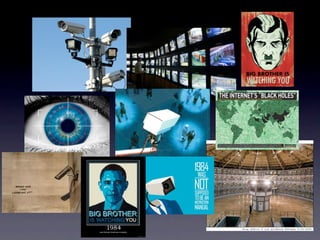
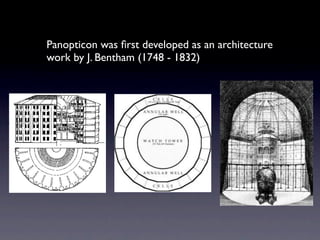
Panopticon was first developed as an architecture
work by J. Bentham (1748 - 1832)
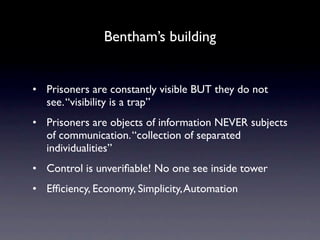
Bentham’s building


• Prisoners are constantly visible BUT they do not
  see. “visibility is a trap”
• Prisoners are objects of information NEVER subjects
  of communication. “collection of separated
  individualities”
• Control is unverifiable! No one see inside tower
• Efficiency, Economy, Simplicity, Automation
M. Foucault (1926 - 1984)


• The birth of the clinic, 1963
• Discourse on language, 1970
• Discipline & Punish: the birth of the prison, 1975
• Lectures at Collège De France: Security, Territory,
  Population, 1977 - 78, & The birth of biopolitics,
  1978 - 1979
Overall Foucaultian thought

• Knowledge is Power. Information empowers
  action, action provokes new information (circular
  process)
• Technology changes the model of power /
  knowledge
• Active role of observation. Objectivation
  produces, evokes its own object
• Contra Structuralist theory, analysis has to be
  related to a defined historical context
Panopticism as power

• Embodied power relationships... “political
  anatomy” ... individual is fabricated
   “[...] the body is reduced as a political force at the
   least cost and maximezed as a useful force” p. 368
• Exercised continuously
   “[...] these tiny, everyday, physical mechanisms, by all
   those systems of micro-power that are essentially
   non-egalitarian and asymmetrical that we call the
   discipline”
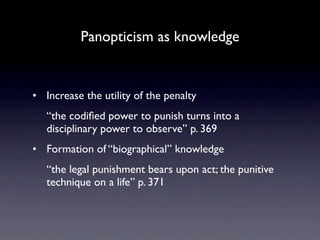
Panopticism as knowledge


• Increase the utility of the penalty
   “the codified power to punish turns into a
   disciplinary power to observe” p. 369
• Formation of “biographical” knowledge
   “the legal punishment bears upon act; the punitive
   technique on a life” p. 371
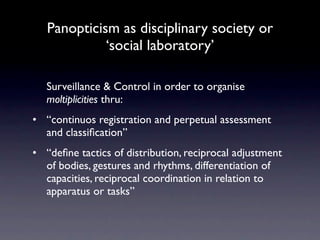
Panopticism as disciplinary society or
             ‘social laboratory’

   Surveillance & Control in order to organise
   moltiplicities thru:
• “continuos registration and perpetual assessment
  and classification”
• “define tactics of distribution, reciprocal adjustment
  of bodies, gestures and rhythms, differentiation of
  capacities, reciprocal coordination in relation to
  apparatus or tasks”
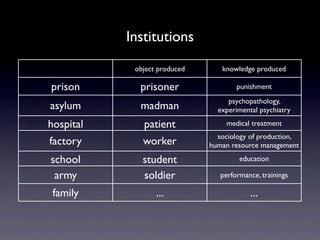
Institutions

            object produced      knowledge produced

prison       prisoner                 punishment
                                   psychopathology,
asylum       madman             experimental psychiatry

hospital      patient             medical treatment
                                sociology of production,
factory       worker          human resource management

school        student                  education

 army         soldier            performance, trainings

 family           ...                     ...
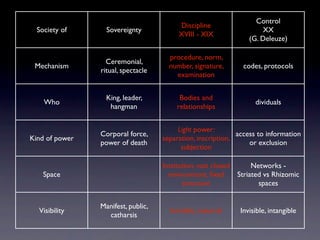
To summarise
Control
                                         Discipline
  Society of      Sovereignty                                          XX
                                         XVIII - XIX
                                                                  (G. Deleuze)

                                      procedure, norm,
                  Ceremonial,
 Mechanism                            number, signature,        codes, protocols
                ritual, spectacle
                                        examination


                  King, leader,           Bodies and
    Who                                                             dividuals
                   hangman               relationships


                                         Light power:
                Corporal force,                              access to information
Kind of power                       separation, inscription,
                power of death                                   or exclusion
                                          subjection

                                    Institution, vast closed        Networks -
    Space                             environment, fixed        Striated vs Rhizomic
                                           structure                  spaces


                Manifest, public,
  Visibility                          Invisible, material      Invisible, intangible
                  catharsis
What’s up today?
Deleuze’s Postscript on the societies of
               control

[...] In the societies of control, on the other hand, what
is important is no longer either a signature or a
number, but a code: the code is a password, while on
the other hand disciplinary societies are regulated by
watchwords (as much from the point of view of
integration as from that of resistance). The numerical
language of control is made of codes that mark access
to information, or reject it. We no longer find
ourselves dealing with the mass/individual pair.
Individuals have become "dividuals," and masses,
samples, data, markets, or "banks."
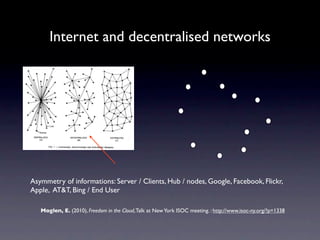
Internet and decentralised networks


Asymmetry of informations: Server / Clients, Hub / nodes, Google, Facebook, Flickr,
Apple, AT&T, Bing / End User

   Moglen, E. (2010), Freedom in the Cloud, Talk at New York ISOC meeting. : http://www.isoc-ny.org/?p=1338
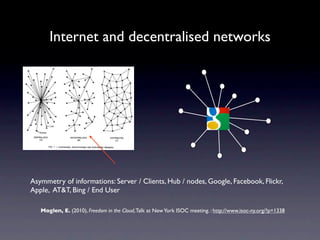
Internet and decentralised networks


Asymmetry of informations: Server / Clients, Hub / nodes, Google, Facebook, Flickr,
Apple, AT&T, Bing / End User

   Moglen, E. (2010), Freedom in the Cloud, Talk at New York ISOC meeting. : http://www.isoc-ny.org/?p=1338
Mapping - make the social graph visible


• map of security cameras in Venice
  Anoption project
• participated cartography
  Biopolitics map Venice 2007
• create & share data maps
  Targetmap
Thanks

What's Panopticism? Exploring Digital Cultures

  • 1.
  • 2.
    Panopticon was firstdeveloped as an architecture work by J. Bentham (1748 - 1832)
  • 3.
    Bentham’s building • Prisonersare constantly visible BUT they do not see. “visibility is a trap” • Prisoners are objects of information NEVER subjects of communication. “collection of separated individualities” • Control is unverifiable! No one see inside tower • Efficiency, Economy, Simplicity, Automation
  • 4.
    M. Foucault (1926- 1984) • The birth of the clinic, 1963 • Discourse on language, 1970 • Discipline & Punish: the birth of the prison, 1975 • Lectures at Collège De France: Security, Territory, Population, 1977 - 78, & The birth of biopolitics, 1978 - 1979
  • 5.
    Overall Foucaultian thought •Knowledge is Power. Information empowers action, action provokes new information (circular process) • Technology changes the model of power / knowledge • Active role of observation. Objectivation produces, evokes its own object • Contra Structuralist theory, analysis has to be related to a defined historical context
  • 6.
    Panopticism as power •Embodied power relationships... “political anatomy” ... individual is fabricated “[...] the body is reduced as a political force at the least cost and maximezed as a useful force” p. 368 • Exercised continuously “[...] these tiny, everyday, physical mechanisms, by all those systems of micro-power that are essentially non-egalitarian and asymmetrical that we call the discipline”
  • 7.
    Panopticism as knowledge •Increase the utility of the penalty “the codified power to punish turns into a disciplinary power to observe” p. 369 • Formation of “biographical” knowledge “the legal punishment bears upon act; the punitive technique on a life” p. 371
  • 8.
    Panopticism as disciplinarysociety or ‘social laboratory’ Surveillance & Control in order to organise moltiplicities thru: • “continuos registration and perpetual assessment and classification” • “define tactics of distribution, reciprocal adjustment of bodies, gestures and rhythms, differentiation of capacities, reciprocal coordination in relation to apparatus or tasks”
  • 9.
    Institutions object produced knowledge produced prison prisoner punishment psychopathology, asylum madman experimental psychiatry hospital patient medical treatment sociology of production, factory worker human resource management school student education army soldier performance, trainings family ... ...
  • 10.
  • 11.
    Control Discipline Society of Sovereignty XX XVIII - XIX (G. Deleuze) procedure, norm, Ceremonial, Mechanism number, signature, codes, protocols ritual, spectacle examination King, leader, Bodies and Who dividuals hangman relationships Light power: Corporal force, access to information Kind of power separation, inscription, power of death or exclusion subjection Institution, vast closed Networks - Space environment, fixed Striated vs Rhizomic structure spaces Manifest, public, Visibility Invisible, material Invisible, intangible catharsis
  • 12.
  • 13.
    Deleuze’s Postscript onthe societies of control [...] In the societies of control, on the other hand, what is important is no longer either a signature or a number, but a code: the code is a password, while on the other hand disciplinary societies are regulated by watchwords (as much from the point of view of integration as from that of resistance). The numerical language of control is made of codes that mark access to information, or reject it. We no longer find ourselves dealing with the mass/individual pair. Individuals have become "dividuals," and masses, samples, data, markets, or "banks."
  • 16.
    Internet and decentralisednetworks Asymmetry of informations: Server / Clients, Hub / nodes, Google, Facebook, Flickr, Apple, AT&T, Bing / End User Moglen, E. (2010), Freedom in the Cloud, Talk at New York ISOC meeting. : http://www.isoc-ny.org/?p=1338
  • 17.
    Internet and decentralisednetworks Asymmetry of informations: Server / Clients, Hub / nodes, Google, Facebook, Flickr, Apple, AT&T, Bing / End User Moglen, E. (2010), Freedom in the Cloud, Talk at New York ISOC meeting. : http://www.isoc-ny.org/?p=1338
  • 18.
    Mapping - makethe social graph visible • map of security cameras in Venice Anoption project • participated cartography Biopolitics map Venice 2007 • create & share data maps Targetmap
  • 19.