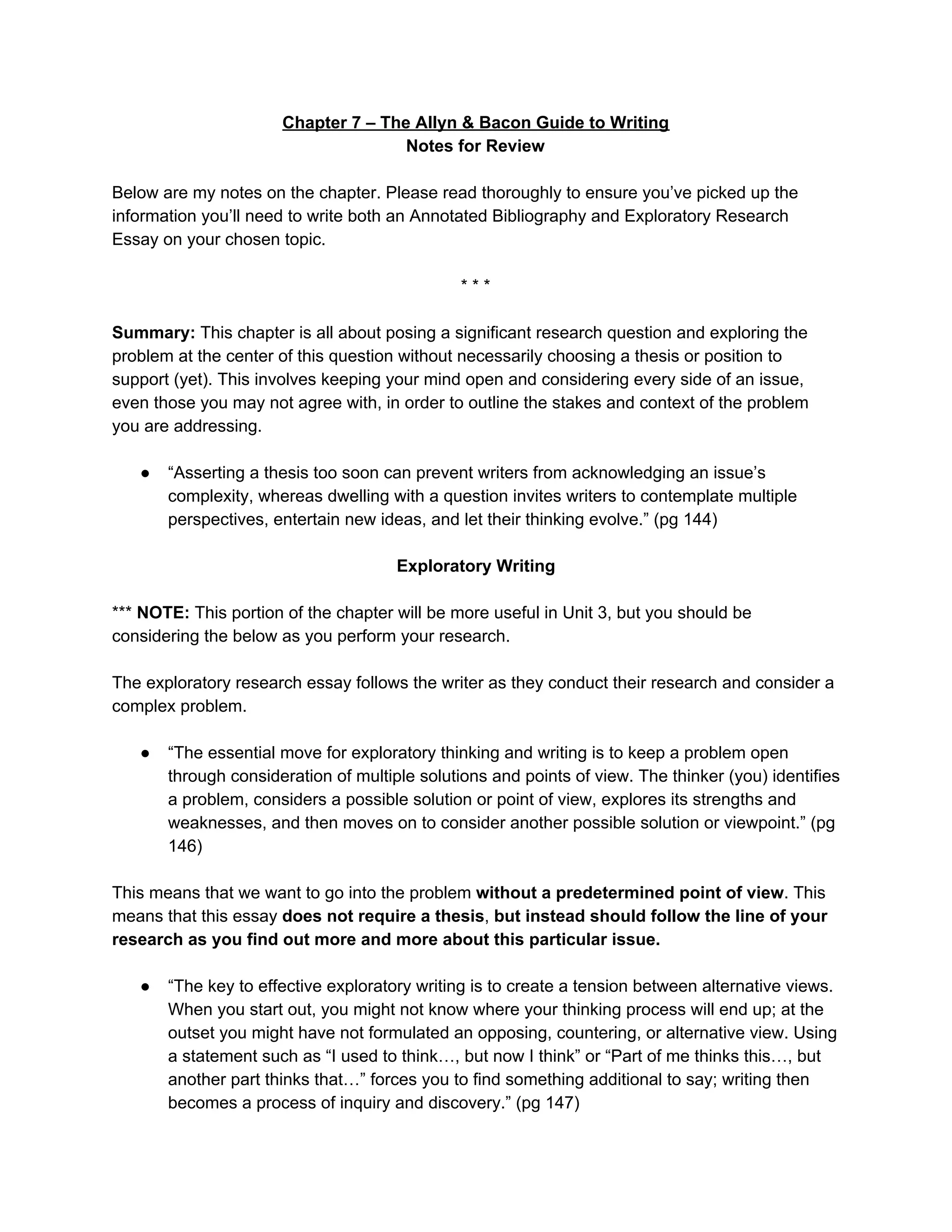
Chapter 7 – The Allyn & Bacon Guide to Writing
Notes for Review
Below are my notes on the chapter. Please read thoroughly to ensure you’ve picked up the
information you’ll need to write both an Annotated Bibliography and Exploratory Research
Essay on your chosen topic.
* * *
Summary:​ This chapter is all about posing a significant research question and exploring the
problem at the center of this question without necessarily choosing a thesis or position to
support (yet). This involves keeping your mind open and considering every side of an issue,
even those you may not agree with, in order to outline the stakes and context of the problem
you are addressing.
● “Asserting a thesis too soon can prevent writers from acknowledging an issue’s
complexity, whereas dwelling with a question invites writers to contemplate multiple
perspectives, entertain new ideas, and let their thinking evolve.” (pg 144)
Exploratory Writing
*** ​NOTE: ​This portion of the chapter will be more useful in Unit 3, but you should be
considering the below as you perform your research.
The exploratory research essay follows the writer as they conduct their research and consider a
complex problem.
● “The essential move for exploratory thinking and writing is to keep a problem open
through consideration of multiple solutions and points of view. The thinker (you) identifies
a problem, considers a possible solution or point of view, explores its strengths and
weaknesses, and then moves on to consider another possible solution or viewpoint.” (pg
146)
This means that we want to go into the problem ​without a predetermined point of view​. This
means that this essay ​does not require a thesis​, ​but instead should follow the line of your
research as you find out more and more about this particular issue.
● “The key to effective exploratory writing is to create a tension between alternative views.
When you start out, you might not know where your thinking process will end up; at the
outset you might have not formulated an opposing, countering, or alternative view. Using
a statement such as “I used to think…, but now I think” or “Part of me thinks this…, but
another part thinks that…” forces you to find something additional to say; writing then
becomes a process of inquiry and discovery.” (pg 147)
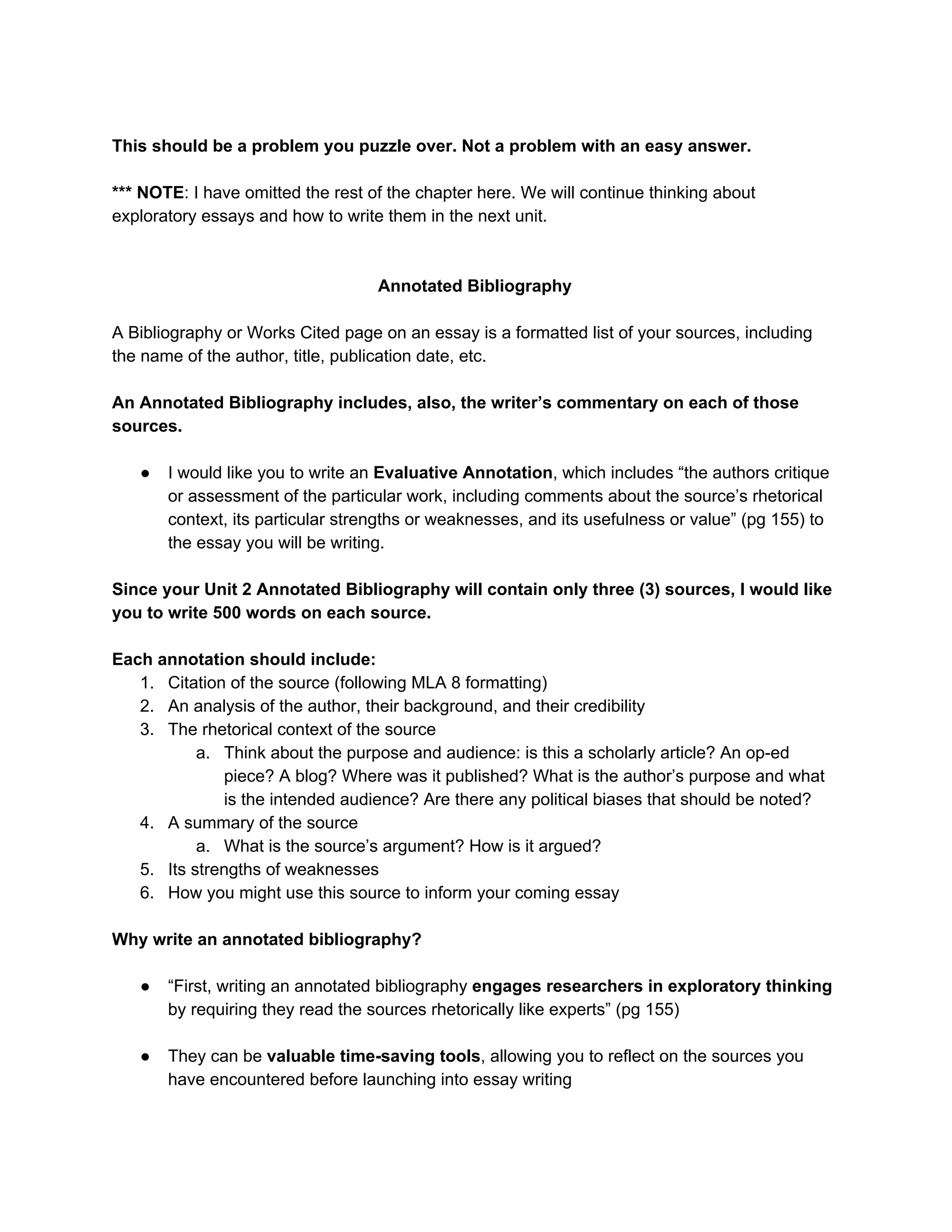
This should be a problem you puzzle over. Not a problem with an easy answer.
*** NOTE​: I have omitted the rest of the chapter here. We will continue thinking about
exploratory essays and how to write them in the next unit.
Annotated Bibliography
A Bibliography or Works Cited page on an essay is a formatted list of your sources, including
the name of the author, title, publication date, etc.
An Annotated Bibliography includes, also, the writer’s commentary on each of those
sources.
● I would like you to write an ​Evaluative Annotation​, which includes “the authors critique
or assessment of the particular work, including comments about the source’s rhetorical
context, its particular strengths or weaknesses, and its usefulness or value” (pg 155) to
the essay you will be writing.
Since your Unit 2 Annotated Bibliography will contain only three (3) sources, I would like
you to write 500 words on each source.
Each annotation should include:
1. Citation of the source (following MLA 8 formatting)
2. An analysis of the author, their background, and their credibility
3. The rhetorical context of the source
a. Think about the purpose and audience: is this a scholarly article? An op-ed
piece? A blog? Where was it published? What is the author’s purpose and what
is the intended audience? Are there any political biases that should be noted?
4. A summary of the source
a. What is the source’s argument? How is it argued?
5. Its strengths of weaknesses
6. How you might use this source to inform your coming essay
Why write an annotated bibliography?
● “First, writing an annotated bibliography ​engages researchers in exploratory thinking
by requiring they read the sources rhetorically like experts” (pg 155)
● They can be ​valuable time-saving tools​, allowing you to reflect on the sources you
have encountered before launching into essay writing
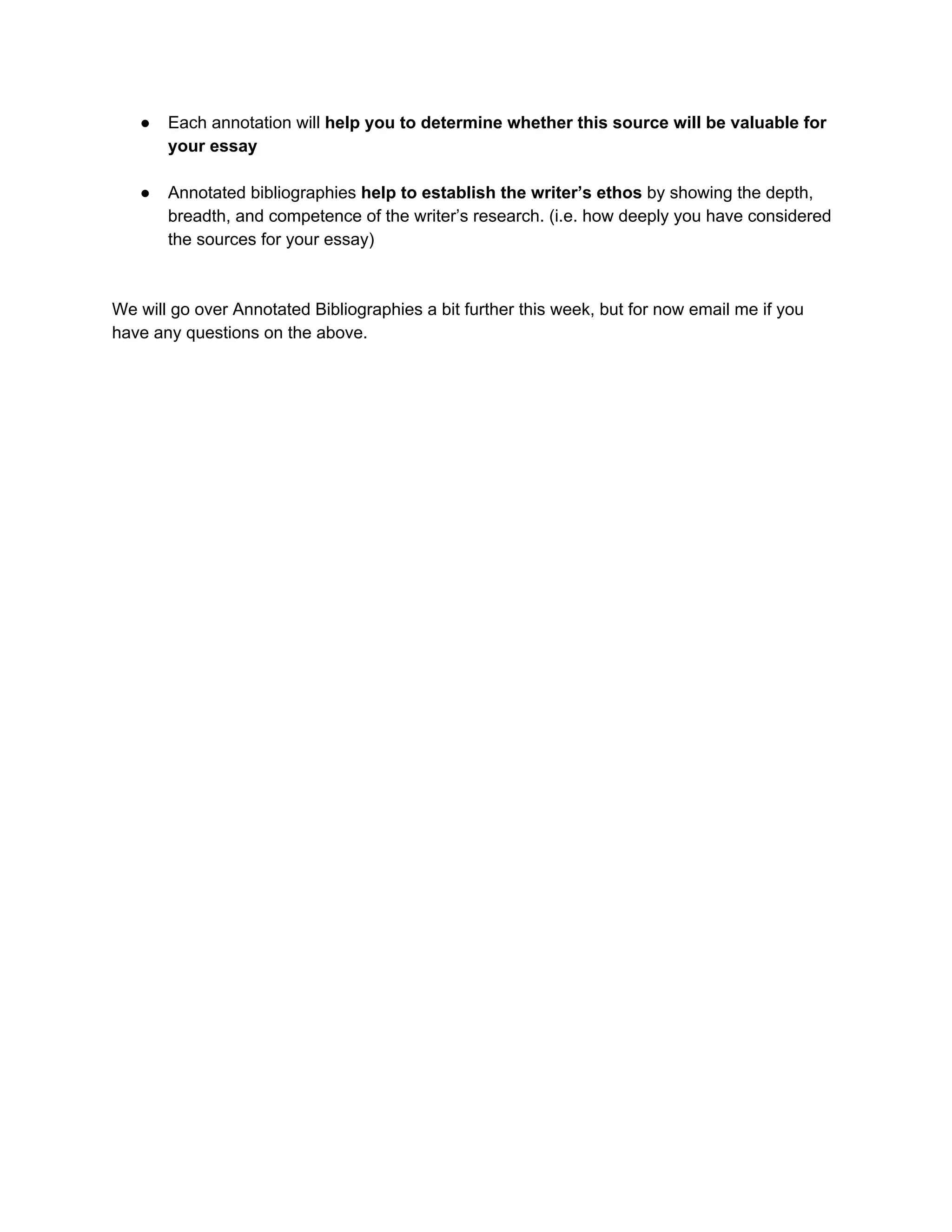
● Each annotation will ​help you to determine whether this source will be valuable for
your essay
● Annotated bibliographies ​help to establish the writer’s ethos​ by showing the depth,
breadth, and competence of the writer’s research. (i.e. how deeply you have considered
the sources for your essay)
We will go over Annotated Bibliographies a bit further this week, but for now email me if you
have any questions on the above.

Notes chapter 7, the allyn & bacon guide to writing

  • 1.
    Chapter 7 –The Allyn & Bacon Guide to Writing Notes for Review Below are my notes on the chapter. Please read thoroughly to ensure you’ve picked up the information you’ll need to write both an Annotated Bibliography and Exploratory Research Essay on your chosen topic. * * * Summary:​ This chapter is all about posing a significant research question and exploring the problem at the center of this question without necessarily choosing a thesis or position to support (yet). This involves keeping your mind open and considering every side of an issue, even those you may not agree with, in order to outline the stakes and context of the problem you are addressing. ● “Asserting a thesis too soon can prevent writers from acknowledging an issue’s complexity, whereas dwelling with a question invites writers to contemplate multiple perspectives, entertain new ideas, and let their thinking evolve.” (pg 144) Exploratory Writing *** ​NOTE: ​This portion of the chapter will be more useful in Unit 3, but you should be considering the below as you perform your research. The exploratory research essay follows the writer as they conduct their research and consider a complex problem. ● “The essential move for exploratory thinking and writing is to keep a problem open through consideration of multiple solutions and points of view. The thinker (you) identifies a problem, considers a possible solution or point of view, explores its strengths and weaknesses, and then moves on to consider another possible solution or viewpoint.” (pg 146) This means that we want to go into the problem ​without a predetermined point of view​. This means that this essay ​does not require a thesis​, ​but instead should follow the line of your research as you find out more and more about this particular issue. ● “The key to effective exploratory writing is to create a tension between alternative views. When you start out, you might not know where your thinking process will end up; at the outset you might have not formulated an opposing, countering, or alternative view. Using a statement such as “I used to think…, but now I think” or “Part of me thinks this…, but another part thinks that…” forces you to find something additional to say; writing then becomes a process of inquiry and discovery.” (pg 147)
  • 2.
    This should bea problem you puzzle over. Not a problem with an easy answer. *** NOTE​: I have omitted the rest of the chapter here. We will continue thinking about exploratory essays and how to write them in the next unit. Annotated Bibliography A Bibliography or Works Cited page on an essay is a formatted list of your sources, including the name of the author, title, publication date, etc. An Annotated Bibliography includes, also, the writer’s commentary on each of those sources. ● I would like you to write an ​Evaluative Annotation​, which includes “the authors critique or assessment of the particular work, including comments about the source’s rhetorical context, its particular strengths or weaknesses, and its usefulness or value” (pg 155) to the essay you will be writing. Since your Unit 2 Annotated Bibliography will contain only three (3) sources, I would like you to write 500 words on each source. Each annotation should include: 1. Citation of the source (following MLA 8 formatting) 2. An analysis of the author, their background, and their credibility 3. The rhetorical context of the source a. Think about the purpose and audience: is this a scholarly article? An op-ed piece? A blog? Where was it published? What is the author’s purpose and what is the intended audience? Are there any political biases that should be noted? 4. A summary of the source a. What is the source’s argument? How is it argued? 5. Its strengths of weaknesses 6. How you might use this source to inform your coming essay Why write an annotated bibliography? ● “First, writing an annotated bibliography ​engages researchers in exploratory thinking by requiring they read the sources rhetorically like experts” (pg 155) ● They can be ​valuable time-saving tools​, allowing you to reflect on the sources you have encountered before launching into essay writing
  • 3.
    ● Each annotationwill ​help you to determine whether this source will be valuable for your essay ● Annotated bibliographies ​help to establish the writer’s ethos​ by showing the depth, breadth, and competence of the writer’s research. (i.e. how deeply you have considered the sources for your essay) We will go over Annotated Bibliographies a bit further this week, but for now email me if you have any questions on the above.