SECTION 8.2   Parallelograms
PARALLELOGRAMS

 How can I recognize a parallelogram using the sides and
  angles?
 How do I apply the properties of the diagonals of
  parallelograms?
PARALLELOGRAM

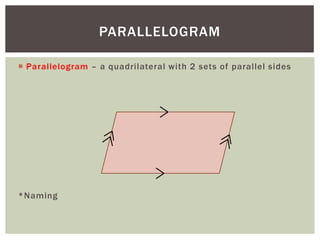
 Parallelogram – a quadrilateral with 2 sets of parallel sides


*Naming
PROPERTIES (THEOREMS)

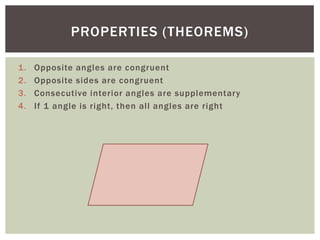
1.   Opposite angles are congruent
2.   Opposite sides are congruent
3.   Consecutive interior angles are supplementary
4.   If 1 angle is right, then all angles are right
THEOREMS

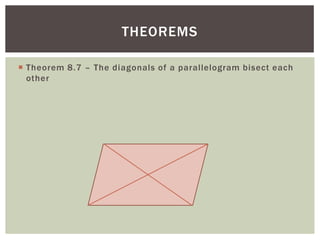
 Theorem 8.7 – The diagonals of a parallelogram bisect each
  other
THEOREMS

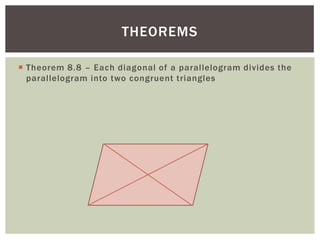
 Theorem 8.8 – Each diagonal of a parallelogram divides the
  parallelogram into two congruent triangles
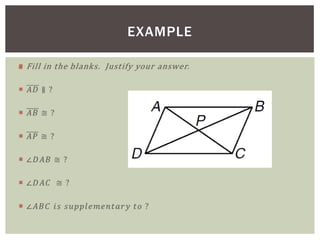
EXAMPLE


EXAMPLE




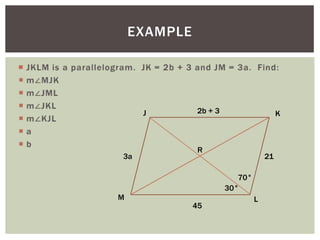
         J         2b + 3                     K


                   R
    3a                                   21

                               70°
                            30°
    M                                L
                  45
EXAMPLES

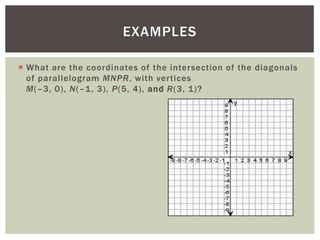
 What are the coordinates of the intersection of the diagonals
  of parallelogram MNPR, with vertices
  M(–3, 0), N(–1 , 3), P(5, 4), and R(3, 1)?
HOMEWORK

 Worksheet
LESSON PLAN

 Intro
     The first quadrilateral we will discuss is the parallelogram
   Standards- 8.2 (Power)
   Supplies – slides, whiteboard, handouts,
   Timing - 1 day 1 review day and a quiz
   Essential Questions- slide 2
   Input – slides 3-6
   Guided Practice – slides 7-9
   Independent Practice – Worksheet

Geometry/Notes 8.2

  • 1.
    SECTION 8.2 Parallelograms
  • 2.
    PARALLELOGRAMS  How canI recognize a parallelogram using the sides and angles?  How do I apply the properties of the diagonals of parallelograms?
  • 3.
    PARALLELOGRAM  Parallelogram –a quadrilateral with 2 sets of parallel sides *Naming
  • 4.
    PROPERTIES (THEOREMS) 1. Opposite angles are congruent 2. Opposite sides are congruent 3. Consecutive interior angles are supplementary 4. If 1 angle is right, then all angles are right
  • 5.
    THEOREMS  Theorem 8.7– The diagonals of a parallelogram bisect each other
  • 6.
    THEOREMS  Theorem 8.8– Each diagonal of a parallelogram divides the parallelogram into two congruent triangles
  • 7.
  • 8.
    EXAMPLE  J 2b + 3 K R 3a 21 70° 30° M L 45
  • 9.
    EXAMPLES  What arethe coordinates of the intersection of the diagonals of parallelogram MNPR, with vertices M(–3, 0), N(–1 , 3), P(5, 4), and R(3, 1)?
  • 10.
  • 11.
    LESSON PLAN  Intro  The first quadrilateral we will discuss is the parallelogram  Standards- 8.2 (Power)  Supplies – slides, whiteboard, handouts,  Timing - 1 day 1 review day and a quiz  Essential Questions- slide 2  Input – slides 3-6  Guided Practice – slides 7-9  Independent Practice – Worksheet