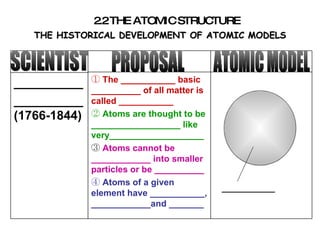
THE HISTORICAL DEVELOPMENT OF ATOMIC MODELS SCIENTIST PROPOSAL ATOMIC MODEL ____________ 2.2 THE ATOMIC STRUCTURE __________ __________ (1766-1844) The ___________ basic __________ of all matter is called ___________ Atoms are thought to be __________________ like very___________________ Atoms cannot be ____________ into smaller particles or be __________ Atoms of a given element have ___________, ____________and _______
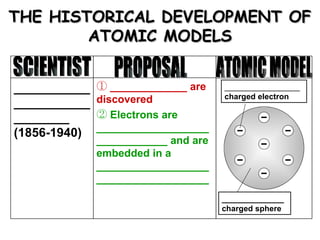
THE HISTORICAL DEVELOPMENT OF ATOMIC MODELS SCIENTIST PROPOSAL ATOMIC MODEL ______________charged sphere _________________ charged electron ______________________________ (1856-1940) _____________ are discovered Electrons are _______________________________ and are embedded in a ______________________________________
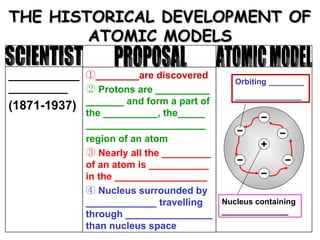
THE HISTORICAL DEVELOPMENT OF ATOMIC MODELS SCIENTIST PROPOSAL ATOMIC MODEL Nucleus containing _______________ Orbiting ________ _______________ ______________________  (1871-1937) ________are discovered Protons are __________ _______ and form a part of the __________, the_____ ______________________ region of an atom Nearly all the _________ of an atom is ___________ in the _________________ Nucleus surrounded by _____________ travelling through ________________ than nucleus space
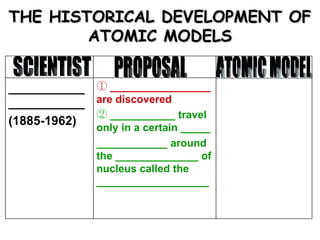
THE HISTORICAL DEVELOPMENT OF ATOMIC MODELS SCIENTIST PROPOSAL ATOMIC MODEL ______________________ (1885-1962) _________________ are discovered ___________ travel only in a certain _____ ____________ around the ______________ of nucleus called the ___________________
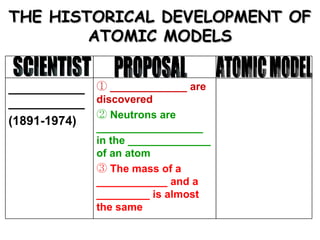
THE HISTORICAL DEVELOPMENT OF ATOMIC MODELS SCIENTIST PROPOSAL ATOMIC MODEL PROPOSAL SCIENTIST PROPOSAL ______________________ (1891-1974) _____________ are discovered Neutrons are __________________ in the ______________ of an atom The mass of a ____________ and a _________ is almost the same
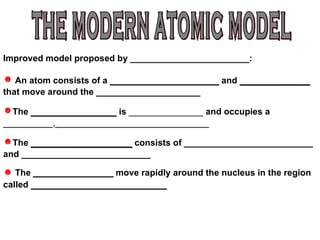
THE MODERN ATOMIC MODEL Improved model proposed by ________________________: An atom consists of a  ______________  and  _________   that move around the _____________________ The  ___________   is   _______________  and occupies a   __________,_______________________________ The  _____________   consists of __________________________ and __________________________ The  ____________  move rapidly around the nucleus in the region called  _________________________
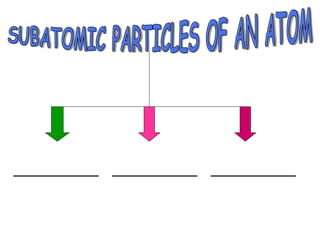
SUBATOMIC PARTICLES OF AN ATOM
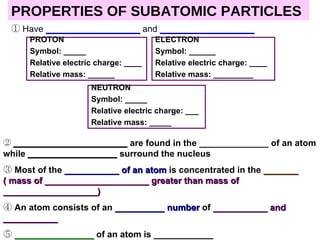
PROPERTIES OF SUBATOMIC PARTICLES Have  ___________________  and  ___________________ _______________________  are found in the ______________ of an atom while  __________________  surround the nucleus Most of the  ___________ of an atom  is concentrated in the   _______  ( mass of _____________________ greater than mass of ___________________) An atom consists of an  __________ number  of  ___________ and ___________ ________________  of an atom is  ____________ PROTON Symbol: _____ Relative electric charge: ____ Relative mass: ______ ELECTRON Symbol: ______ Relative electric charge: ____ Relative mass: _________ NEUTRON Symbol: _____ Relative electric charge: ___ Relative mass: _____
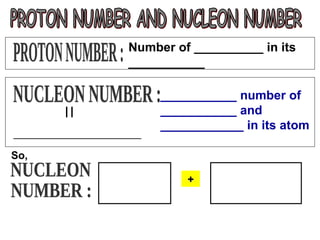
PROTON NUMBER AND NUCLEON NUMBER PROTON NUMBER : Number of __________ in its ___________ ___________ number of ___________ and ____________ in its atom So,   NUCLEON  NUMBER :  NUCLEON NUMBER :  +
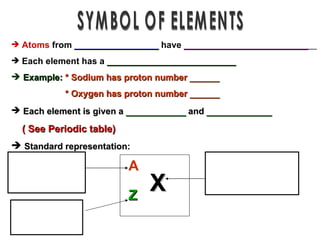
SYMBOL OF ELEMENTS Atoms  from  _________________  have  _________________________ __ Each element has a  __________________________ Example:  * Sodium has proton number ______ * Oxygen has proton number ______  Each element is given a   ___________   and  ____________ ( See Periodic table) Standard representation: X A Z
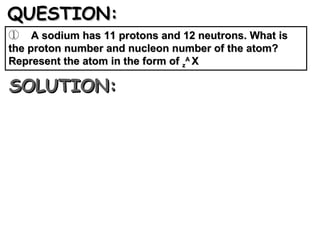
QUESTION: A sodium has 11 protons and 12 neutrons. What is the proton number and nucleon number of the atom? Represent the atom in the form of  z A  X  SOLUTION:
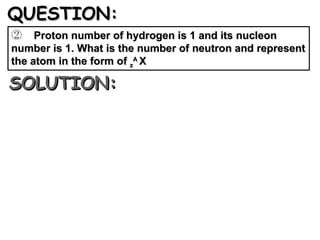
QUESTION: Proton number of hydrogen is 1 and its nucleon number is 1. What is the number of neutron and represent the atom in the form of  z A  X  SOLUTION:

Notechap2

  • 1.
    THE HISTORICAL DEVELOPMENTOF ATOMIC MODELS SCIENTIST PROPOSAL ATOMIC MODEL ____________ 2.2 THE ATOMIC STRUCTURE __________ __________ (1766-1844) The ___________ basic __________ of all matter is called ___________ Atoms are thought to be __________________ like very___________________ Atoms cannot be ____________ into smaller particles or be __________ Atoms of a given element have ___________, ____________and _______
  • 2.
    THE HISTORICAL DEVELOPMENTOF ATOMIC MODELS SCIENTIST PROPOSAL ATOMIC MODEL ______________charged sphere _________________ charged electron ______________________________ (1856-1940) _____________ are discovered Electrons are _______________________________ and are embedded in a ______________________________________
  • 3.
    THE HISTORICAL DEVELOPMENTOF ATOMIC MODELS SCIENTIST PROPOSAL ATOMIC MODEL Nucleus containing _______________ Orbiting ________ _______________ ______________________ (1871-1937) ________are discovered Protons are __________ _______ and form a part of the __________, the_____ ______________________ region of an atom Nearly all the _________ of an atom is ___________ in the _________________ Nucleus surrounded by _____________ travelling through ________________ than nucleus space
  • 4.
    THE HISTORICAL DEVELOPMENTOF ATOMIC MODELS SCIENTIST PROPOSAL ATOMIC MODEL ______________________ (1885-1962) _________________ are discovered ___________ travel only in a certain _____ ____________ around the ______________ of nucleus called the ___________________
  • 5.
    THE HISTORICAL DEVELOPMENTOF ATOMIC MODELS SCIENTIST PROPOSAL ATOMIC MODEL PROPOSAL SCIENTIST PROPOSAL ______________________ (1891-1974) _____________ are discovered Neutrons are __________________ in the ______________ of an atom The mass of a ____________ and a _________ is almost the same
  • 6.
    THE MODERN ATOMICMODEL Improved model proposed by ________________________: An atom consists of a ______________ and _________ that move around the _____________________ The ___________ is _______________ and occupies a __________,_______________________________ The _____________ consists of __________________________ and __________________________ The ____________ move rapidly around the nucleus in the region called _________________________
  • 7.
  • 8.
    PROPERTIES OF SUBATOMICPARTICLES Have ___________________ and ___________________ _______________________ are found in the ______________ of an atom while __________________ surround the nucleus Most of the ___________ of an atom is concentrated in the _______ ( mass of _____________________ greater than mass of ___________________) An atom consists of an __________ number of ___________ and ___________ ________________ of an atom is ____________ PROTON Symbol: _____ Relative electric charge: ____ Relative mass: ______ ELECTRON Symbol: ______ Relative electric charge: ____ Relative mass: _________ NEUTRON Symbol: _____ Relative electric charge: ___ Relative mass: _____
  • 9.
    PROTON NUMBER ANDNUCLEON NUMBER PROTON NUMBER : Number of __________ in its ___________ ___________ number of ___________ and ____________ in its atom So, NUCLEON NUMBER : NUCLEON NUMBER : +
  • 10.
    SYMBOL OF ELEMENTSAtoms from _________________ have _________________________ __ Each element has a __________________________ Example: * Sodium has proton number ______ * Oxygen has proton number ______ Each element is given a ___________ and ____________ ( See Periodic table) Standard representation: X A Z
  • 11.
    QUESTION: A sodiumhas 11 protons and 12 neutrons. What is the proton number and nucleon number of the atom? Represent the atom in the form of z A X SOLUTION:
  • 12.
    QUESTION: Proton numberof hydrogen is 1 and its nucleon number is 1. What is the number of neutron and represent the atom in the form of z A X SOLUTION: