1. Background
The Sendai Framework for Disaster Risk
Reduction 2015-2030 (SFDRR) was agreed in
2015. The SFDRR guides the reduction and
prevention of disaster risk globally and within
countries. Governments from the Pacific played
a lead role in shaping the SFDRR.1
Consultations
also benefited from the active participation of
persons with disabilities from the region.2
The SFDRR stresses that reducing and preventing
disaster risk is everyone’s business and that whole-
society engagement and an inclusive approach
are needed. Persons with disabilities and their
representative organisations are included in the
SFDRR as contributing stakeholders.The SFDRR
reminds us that it is only through inclusive and
meaningful collaboration that the safety of all can
be achieved.
The SFDRR promotes disability inclusive DRR
as good DRR. It is how DRR should be done.
However, a lack of data and evidence has been
an obstacle to transforming commitments
to disability inclusive DRR into action. This
brief outlines key findings from the research
component of the Building Evidence and Capacity
for Disability Inclusive Disaster Risk Reduction
project implemented in Vanuatu following Tropical
Cyclone Pam in 2015. The findings are based on
research from 648 households conducted by the
Nossal Institute and in-country partners including
disabled people’s organisations from 2015 to 2016.
2. Key findings
The findings confirm that disasters
disproportionately affect persons with disabilities.
Disproportionate risk for persons with disabilities
related particularly to difficulties an individual
may have functioning, such as walking or
hearing, and barriers to accessing information
and services. Persons with disabilities had less
access to safety information prior to the cyclone
and to response services following the cyclone in
comparison to persons without disabilities. The
following are key findings:
Disability inclusion in disaster
risk reduction in the Pacific:
Policy Brief
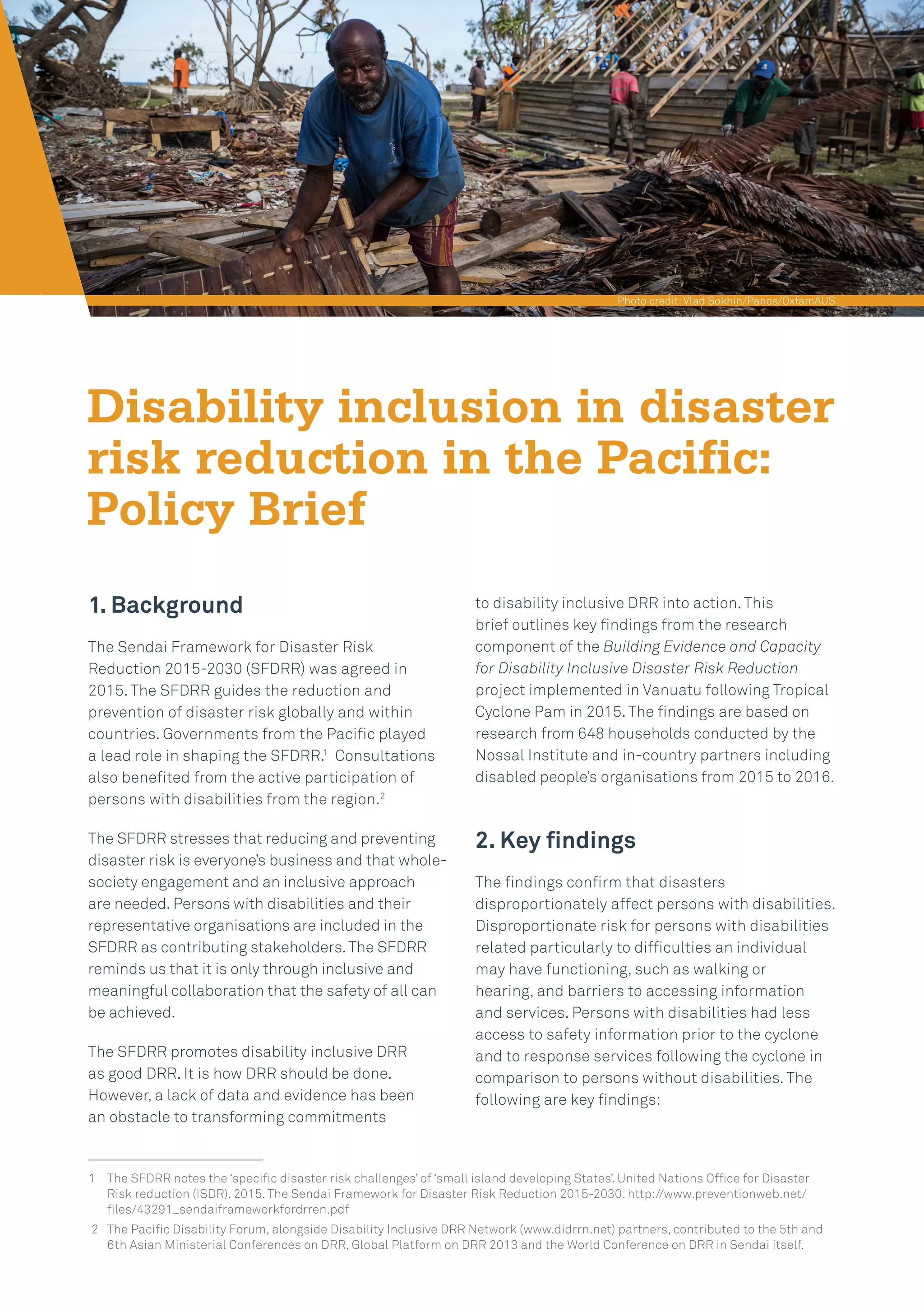
Photo credit: Vlad Sokhin/Panos/OxfamAUS
1	 The SFDRR notes the ‘specific disaster risk challenges’ of ‘small island developing States’. United Nations Office for Disaster
Risk reduction (ISDR). 2015. The Sendai Framework for Disaster Risk Reduction 2015-2030. http://www.preventionweb.net/
files/43291_sendaiframeworkfordrren.pdf
2	 The Pacific Disability Forum, alongside Disability Inclusive DRR Network (www.didrrn.net) partners, contributed to the 5th and
6th Asian Ministerial Conferences on DRR, Global Platform on DRR 2013 and the World Conference on DRR in Sendai itself.
•	 Persons with disabilities were over two times
(2.45 times) more likely to be injured during
the cyclone than persons without disabilities.
•	 The most common difficulties reported by
adults with disabilities concerned walking
(36%) and seeing (34%).
•	 Almost half of all persons with disabilities
(47%) reported having more than one
functioning difficulty.
•	 	78% of adults with disabilities reported
needing an assistive device. For example,
crutches, wheelchair or cane. During the
cyclone, 14 persons with disabilities reported
losing their assistive device.
•	 60% of persons with disabilities reported
a lack of information on what to do in an
emergency before the cyclone.
•	 62% of adults with disabilities did not have
information on evacuation centres prior to
the cyclone.
•	 74% of women with disabilities reported
barriers to accessing evacuation centres
compared to 50% of men with disabilities.
•	 Access to services prior to and following the
cyclone was consistently lower for women
with disabilities than men with disabilities.
This includes access to information.
Relatedly, only one third of women with
disabilities reported they had ever attended
school compared to two thirds of men with
disabilities.
3.	 Key recommendations
The following recommendations are based on
the above findings and support commitments to
disability inclusion in the SFDRR:
i.	 Mainstream disability inclusion throughout
DRR, including preparedness for response,
and consult with persons with disabilities
and their representative organisations at all
levels of DRR policy and programming.
ii.	 Strengthen community preparedness
initiatives and mechanisms, including
forums and committees, and promote the
leadership of persons with disabilities and
particularly women with disabilities.
iii.	 Leave no one behind, by ensuring households
and communities are prepared to safely
evacuate all community members including
women, children and men with disabilities
along with any assistive device they may use.
iv.	 Strengthen the organizational capacity of
all actors to work in a disability inclusive
way and to ensure equal access to services,
by training staff and through establishing
effective partnerships with persons with
disabilities and their representative
organisations.
v.	 Ensure persons with disabilities are
identified and included in any assessment
of risk and the related design of appropriate
safety measures.
vi.	 Address the specific needs of men, women
and children with disabilities in all stages of
DRR planning and implementation.
vii. 	 Take active measures to remove the barriers
that increase risk for women with disabilities
and ensure the meaningful participation
of women with diverse disabilities in the
development and implementation of DRR
policy and programming.
viii. 	Ensure child-friendly DRR activities at all
stages of preparedness and response are
inclusive of children with disabilities and
their families.
Contact:
Dr Alex Robinson
The Nossal Institute for Global Health
University of Melbourne
alex.robinson@unimelb.edu.au
CBM - Nossal Institute Partnership for Disability Inclusive Development

Nossal disability inclusion policy brief 2017 web

  • 1.
    1. Background The SendaiFramework for Disaster Risk Reduction 2015-2030 (SFDRR) was agreed in 2015. The SFDRR guides the reduction and prevention of disaster risk globally and within countries. Governments from the Pacific played a lead role in shaping the SFDRR.1 Consultations also benefited from the active participation of persons with disabilities from the region.2 The SFDRR stresses that reducing and preventing disaster risk is everyone’s business and that whole- society engagement and an inclusive approach are needed. Persons with disabilities and their representative organisations are included in the SFDRR as contributing stakeholders.The SFDRR reminds us that it is only through inclusive and meaningful collaboration that the safety of all can be achieved. The SFDRR promotes disability inclusive DRR as good DRR. It is how DRR should be done. However, a lack of data and evidence has been an obstacle to transforming commitments to disability inclusive DRR into action. This brief outlines key findings from the research component of the Building Evidence and Capacity for Disability Inclusive Disaster Risk Reduction project implemented in Vanuatu following Tropical Cyclone Pam in 2015. The findings are based on research from 648 households conducted by the Nossal Institute and in-country partners including disabled people’s organisations from 2015 to 2016. 2. Key findings The findings confirm that disasters disproportionately affect persons with disabilities. Disproportionate risk for persons with disabilities related particularly to difficulties an individual may have functioning, such as walking or hearing, and barriers to accessing information and services. Persons with disabilities had less access to safety information prior to the cyclone and to response services following the cyclone in comparison to persons without disabilities. The following are key findings: Disability inclusion in disaster risk reduction in the Pacific: Policy Brief Photo credit: Vlad Sokhin/Panos/OxfamAUS 1 The SFDRR notes the ‘specific disaster risk challenges’ of ‘small island developing States’. United Nations Office for Disaster Risk reduction (ISDR). 2015. The Sendai Framework for Disaster Risk Reduction 2015-2030. http://www.preventionweb.net/ files/43291_sendaiframeworkfordrren.pdf 2 The Pacific Disability Forum, alongside Disability Inclusive DRR Network (www.didrrn.net) partners, contributed to the 5th and 6th Asian Ministerial Conferences on DRR, Global Platform on DRR 2013 and the World Conference on DRR in Sendai itself.
  • 2.
    • Persons withdisabilities were over two times (2.45 times) more likely to be injured during the cyclone than persons without disabilities. • The most common difficulties reported by adults with disabilities concerned walking (36%) and seeing (34%). • Almost half of all persons with disabilities (47%) reported having more than one functioning difficulty. • 78% of adults with disabilities reported needing an assistive device. For example, crutches, wheelchair or cane. During the cyclone, 14 persons with disabilities reported losing their assistive device. • 60% of persons with disabilities reported a lack of information on what to do in an emergency before the cyclone. • 62% of adults with disabilities did not have information on evacuation centres prior to the cyclone. • 74% of women with disabilities reported barriers to accessing evacuation centres compared to 50% of men with disabilities. • Access to services prior to and following the cyclone was consistently lower for women with disabilities than men with disabilities. This includes access to information. Relatedly, only one third of women with disabilities reported they had ever attended school compared to two thirds of men with disabilities. 3. Key recommendations The following recommendations are based on the above findings and support commitments to disability inclusion in the SFDRR: i. Mainstream disability inclusion throughout DRR, including preparedness for response, and consult with persons with disabilities and their representative organisations at all levels of DRR policy and programming. ii. Strengthen community preparedness initiatives and mechanisms, including forums and committees, and promote the leadership of persons with disabilities and particularly women with disabilities. iii. Leave no one behind, by ensuring households and communities are prepared to safely evacuate all community members including women, children and men with disabilities along with any assistive device they may use. iv. Strengthen the organizational capacity of all actors to work in a disability inclusive way and to ensure equal access to services, by training staff and through establishing effective partnerships with persons with disabilities and their representative organisations. v. Ensure persons with disabilities are identified and included in any assessment of risk and the related design of appropriate safety measures. vi. Address the specific needs of men, women and children with disabilities in all stages of DRR planning and implementation. vii. Take active measures to remove the barriers that increase risk for women with disabilities and ensure the meaningful participation of women with diverse disabilities in the development and implementation of DRR policy and programming. viii. Ensure child-friendly DRR activities at all stages of preparedness and response are inclusive of children with disabilities and their families. Contact: Dr Alex Robinson The Nossal Institute for Global Health University of Melbourne alex.robinson@unimelb.edu.au CBM - Nossal Institute Partnership for Disability Inclusive Development