REGENERATIONMASTERPLAN
2014
REGENERATIONMASTERPLAN
2014
JAIME CASTRO
Ba(Hons) Architecture Venue Design
100152598
3 Contents
Brief							4
The Site						5
Our City Our River				 6
Planning						8
Site history					9
Evolution						10
Maps						11
Heritage and architecture		 12
The Derby Canal				13
Morphology					14
Permeability and vistas			 15
Transport					16
Economic overview			18
Flooding, risk assessment		 19
Flood simulation				20
Ecology						21
Green spaces				22
Sustainable masterplan		 23
The Canal					25
The ‘Green Heart’ Garden		 26
The Spencer Pavillion			 27
The Riverbank Quarter			 28
Development site vistas		 29
Development site renders		 30
4
Brief INTRODUCTION
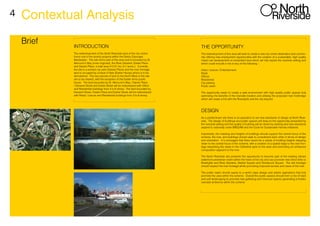
The redevelopment of the North Riverside area of the city centre
forms one of the priority projects within the Derby Cityscape
Masterplan. The site forms part of this area and is bounded by St.
Alkmund’s Way (inner ringroad), the River Derwent, Exeter Place
and Darwin Place, a total area of 2.31 ha ( 5.7 acres ). Currently
the site is a surface car park (Darwin Place) and the river frontage
land is occupied by a block of flats (Exeter House) which is to be
demolished. The two parcels of land to the North West of the site
are to be cleared, with the exception of the Exeter Arms public
house. The land bounded by St. Alkmund’s Way / Darwin Place
/ Derwent Street and Exeter Street will be redeveloped with Office
and Residential buildings from 4 to 6 storey. The land bounded by
Derwent Street / Exeter Place and Exeter Street will be redeveloped
with Retail / Leisure and Residential buildings from 3 to 6 storey.
THE OPPORTUNITY
The redevelopment of this area will seek to create a new city centre destination and commu-
nity offering new employment opportunities with the creation of a sustainable, high quality
mixed use development on brownfield land which will fully exploit the riverside setting and
which could include a mix of any of the following :-
Hotel / Leisure / Entertainment
Retail
Offices
Residential
Car parking
Public realm
The opportunity exists to create a safe environment with high quality public spaces fully
optimising the benefits of the riverside location and utilising the proposed river footbridge
which will create a link with the Riverlights and the city beyond.
DESIGN
As a predominant site there is an aspiration to set new standards of design at North River-
side. The design of buildings and public spaces will draw on the opportunity presented by
the riverside setting and the quality of building will be driven by existing and new standards
aspired to nationally under BREEAM and the Code for Sustainable Homes initiatives.
Importantly, the massing and heights of buildings should support the central focus of the
scheme, the river, and buildings should seek to compliment each other in terms of design
and orientation. It is envisaged that there would be a variety of building heights stepping
down to the central focus of the scheme, with a creation of a spatial edge to the river fron-
tage respecting the views to the Cathedral spire to the west and promoting an enhanced
composition adjacent to the river.
The North Riverside site presents the opportunity to become part of the existing vibrant
waterfront pedestrian realm within the heart of the city and can promote new direct links to
Riverlights and River Gardens, Market Square and Osnabruck Square. The site frontage
should respect the river frontage whilst promoting improved access and views of the river.
The public realm should aspire to a world class design and artistic aspirations that fully
promote the uses within the scheme. Overall the public spaces should form a mix of hard
and soft landscaping to promote new gathering and forecourt spaces generating a holistic
riverside ambience within the scheme.
Contextual Analysis
5 The Site
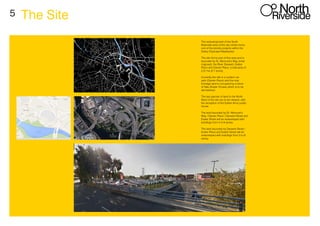
The redevelopment of the North
Riverside area of the city centre forms
one of the priority projects within the
Derby Cityscape Masterplan.
The site forms part of this area and is
bounded by St. Alkmund’s Way (inner
ringroad), the River Derwent, Exeter
Place and Darwin Place, a total area of
2.31 ha (5.7 acres).
Currently the site is a surface car
park (Darwin Place) and the river
frontage land is occupied by a block
of flats (Exeter House) which is to be
demolished.
The two parcels of land to the North
West of the site are to be cleared, with
the exception of the Exeter Arms public
house.
The land bounded by St. Alkmund’s
Way / Darwin Place / Derwent Street and
Exeter Street will be redeveloped with
buildings from 4 to 6 storey.
The land bounded by Derwent Street /
Exeter Place and Exeter Street will be
redeveloped with buildings from 3 to 6
storey.
6 Contextual Analysis
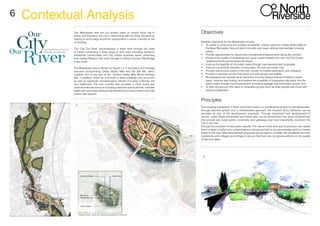
This Masterplan sets out our shared vision to reduce flood risk in
Derby and transform the City’s relationship with the River Derwent by
helping to encourage economic regeneration in areas currently at risk
of flooding.
‘Our City Our River’ encompasses a linear area through the heart
of Derby comprising a wide range of land uses including farmland,
residential communities and City Centre business areas, stretching
from Darley Abbey in the north through to Derby Junction Rail Bridge
in the south.
The Masterplan area is shown on Figure 1.2. It includes a rich heritage
resource incorporating Darley Abbey Mills and the Silk Mill, which
together form a key part of the Derwent Valley Mills World Heritage
Site. In addition, there are a number of listed buildings and structures
as well as significant archaeological interest including a Roman fort
and settlement. The river corridor also provides a much loved and
used recreational resource including extensive sports pitches, riverside
walks and cycle ways linking local facilities and communities to the City
Centre and beyond.
Objectives
Detailed objectives for the Masterplan include:
•	 To create a continuous and publicly accessible  orbital route from Darley Abbey Mills to
the Bass Recreation Ground which includes sub-loops utilising intermediate crossing
points;
•	 Provide opportunities for leisure and recreational enhancements along the corridor;
•	 Enhance the quality of pedestrian and cycle routes between the river, the City Centre,
neighbourhoods and employment areas;
•	 Improve the legibility of the public realm through new development proposals;
•	 Improve connectivity between communities, the river and wider City;
•	 Provide new access points to the river corridor to enable exploration and utilisation;
•	 Provide a riverside corridor that works for both people and wildlife;
•	 Re-engaging the riverside as an attraction and key integral feature of Derby’s public
realm, improve way finding, and explore the possibility of integrating education into the
public realm through the enhancement of existing signage and information points; and
•	 To take into account the need of vulnerable groups such as older people and those with
physical disabilities.
Principles
Encouraging investment in these prominent areas is a fundamental priority for the Masterplan,
through planned growth and a collaborative approach the required flood defences can be
provided as part of the development proposals. Through investment and development of
vacant, under-utilised brownfield land these sites can be transformed into areas of betterment
that provide key nodal points, landmarks and gateways and most importantly reconnect the
City to the river
through the provision of new public spaces. The nature of the land and its previous use means
that it is likely to suffer from contamination in the ground and in the groundwater which is closely
linked to the river. New development proposals would need to consider this alongside the other
constraints and mitigate accordingly to ensure that there are no adverse effects on the quality
of the river water.
1 2
3
7
8
Planning Background
Regeneration and development in Derby is a major priority for the City
Council and its partners. There is a clear and long standing desire to
use potential investment within the river corridor as a catalyst for the
regeneration. Improving connectivity to the river and making the most
of the heritage assets is also a key priority. Currently development is
subject to the guidance in national Planning Policy Statement 25:
Development and Flood Risk
‘Our City Our River’ encompasses a linear area through the heart
of Derby comprising a wide range of land usesincluding farmland,
residential communities and CityCentre business areas, stretching
from Darley Abbey in thenorth through to Derby Junction Rail Bridge
in the south.The Masterplan area is shown on Figure 1.2. It includesa
rich heritage resource incorporating Darley Abbey Millsand the Silk
Mill, which together form a key part of theDerwent Valley Mills World
Heritage Site. In addition, thereare a number of listed buildings and
structures as well assignificant archaeological interest including
a Roman fortand settlement. The river corridor also provides a
muchloved and used recreational resource including extensivesports
pitches, riverside walks and cycle ways linking localfacilities and
communities to the City Centre and beyond.
NATIONAL PLANNING POLICY
Derby City Council’s Cabinet has approved the Masterplan as guidance, which will be a
material consideration when determining planning applications. The Masterplan should
be read alongside the relevant adopted policies in the Council’s statutory City of Derby
Local Plan (2006) and national planning guidance as set out in the National Planning Policy
Framework (NPPF).
The NPPF states (para 94) that Local Planning Authorities should adopt positive strategies
to mitigate and adapt to climate change, taking full account of flood risk and other factors.
It retains the policies of the previous PPS25 in terms of the application of the ‘sequential
test’ and ‘exception test’ in preparing Local Plans for areas of flood risk. The overall aim of
the sequential test is to steer development to areas of lower flood risk. However if this is not
possible the exception test can be applied. For the exception test to be passed:
• the development should provide “wider sustainability benefits to the community that
outweigh flood risk”1;and
• “a site-specific flood risk assessment must demonstrate that the development will be
safe,without increasing flood risk elsewhere, and where possible will reduce flood risk
overall”2. In considering planning applications the Council will have regard to this national
guidance. It will also have appropriate regard to the relevant local plan polices and the content
of the Masterplan.
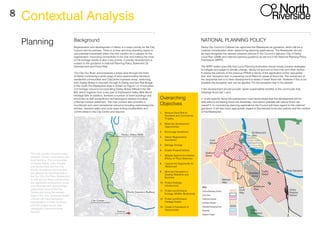
Overarching
Objectives
1.	 Reduce Flood Risk to
Residents and Commercial
Property
2.	 Maximise Development
Opportunities
3.	 Encourage Investment
4.	 Deliver Regeneration
Aspirations
5.	 Manage Change
6.	 Enable Phased Delivery
7.	 Mitigate Against the Adverse
Effects of ‘Flood Defences’
8.	 Capture the Opportunity for
‘Betterment’
9.	 Minimise Disruption to
Existing Residents and
Business
10.	 Protect Strategic
Infrastructure
11.	 Protect and Enhance
Ecology, Wildlife, Biodiversity
12.	 Protect and Enhance
Heritage Assets
13.	 Create a Framework of
Opportunities
Contextual Analysis
The river corridor includes many
peoples’ homes, businesses and
local facilities. The communities
of Darley Abbey, Little Chester
and Strutts Park and the City
Centre all address the river and
are affected by the proposals in
the Our City Our River Masterplan.
In and around these communities
are significant employment areas
and development opportunities,
particularly close to the City
Centre and along the eastern
bank of the river. Increased levels
of flood risk have hampered
regeneration in these locations
and this project would help
developers overcome those
barriers.
9
Site history
Contextual Analysis
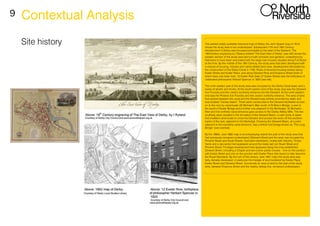
The earliest widely available historical map of Derby, the John Speed map of 1610,
shows the study area to be undeveloped. Subsequent 17th and 18th Century
development in Derby was focussed principally to the west of the Derwent. The
18thCentury engraving by I Ryland entitled ‘The East View of Derby’ (see left) shows the
western section of the study area laid out with orchards and gardens: understood by
historians to have been associated with the large town houses situated along Full Street
at the time. By the middle of the 19th Century, the study area had been developed with
a mixture of housing, industry and canal-related land uses, development stimulated by
the construction of the Derby Canal in 1795. Rows of terraced housing existed along
Exeter Street and Exeter Place, and along Derwent Row and Erasmus Street (both of
which have now been lost). 12 Exeter Row (later 27 Exeter Street) was the birthplace of
celebrated philosopher Herbert Spencer in 1820 (see left).
The north eastern part of the study area was occupied by the Derby Canal basin and a
series of wharfs and docks. At the south eastern end of the study area was the Derwent
Iron Foundry and the canal’s southerly entrance into the Derwent. At the north western
end was the Phoenix Iron Foundry and the canal’s northerly entrance. The area of land
that existed between the canal and the Derwent was entirely encircled by water and
was dubbed ‘Canary Island’. Three weirs constructed in the Derwent facilitated access
on to the river by canal boats (St Michael’s Weir south of St Mary’s Bridge, a weir to
the south of Exeter Bridge and a further one adjacent to the Morledge). St Michael’s
Weir and the northerly canal entrance gave access to the Darley Abbey Mills. The two
southerly weirs resulted in the formation of the Derwent Basin, a calm body of water
that enabled canal boats to cross the Derwent and access the locks off the southern
banks of the river, adjacent to the Morledge. Crossing the Derwent Basin, at a point
adjacent to the southerly canal entrance, was a timber foot bridge known as ‘The Long
Bridge’ (see overleaf).
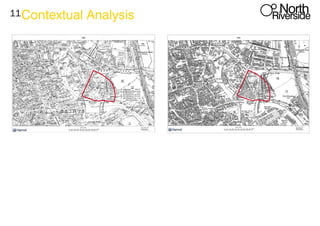
By the 1880s, (see 1882 map in accompanying report) the part of the study area that
had previously remained undeveloped (Derwent Street and the area now occupied by
Phoenix Street and Stuart Street), had been developed, mostly with industry. Timber
Yards and a dye works had appeared around the newly laid out Stuart Street and
Phoenix Street. Frontage development had appeared along the long established
Derwent Street, including a Chapel and two corner public houses – one on the junction
with Exeter Street and one on the junction with Exeter Place (the tavern to later become
the Royal Standard). By the turn of the century, (see 1901 map) the study area was
fairly densely developed, in particular the triangle of land bordered by Exeter Place,
Exeter Street and Derwent Street. Conversely an area of land to the east of the study
area, between Erasmus Street and the nearby railway line, remained undeveloped.
10Contextual Analysis
The 1930s saw the clearance of residential and industrial
buildings alongside Exeter Place and Derwent Street
and the construction of Exeter House and Compton
House (James Harwood printing works, now the
NatWest Bank). The clearance works also allowed for
the widening of Derwent Street.
By 1951, (see map) industrial buildings had encroached
on to the area north of Exeter Street that was formerly
occupied by canal docks and wharfs. The canal itself
remained, although the basin had by this time been
reduced in size. Development had also begun to appear
on the area of previously undeveloped land to the east
of Erasmus Street, with the addition of a wholesale
market and omnibus depot.
By the 1960s the canal had fallen into disuse, and had
started to be filled in. The 1970s saw the construction
of the inner ring road, and with it the loss of Erasmus
Street and Derwent Row, and the remaining remnants of
the canal. Terraced housing between Exeter House and
Exeter Bridge was also removed, leaving the modernist
housing complex to finally enjoy the open aspect that
had previously been planned for it.
The subsequent decades saw comparatively little
change, but for the construction of Greenwood Court
off Stuart Street, the construction of a series of riverside
office buildings to the south of Stuart Street in the 1990s,
and minor alterations to existing warehouse buildings in
and around Exeter Street.
Site history Evolution
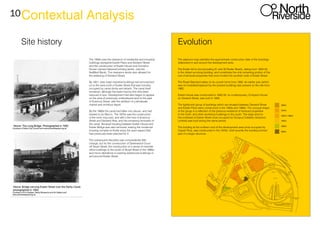
The adjacent map identifies the approximate construction date of the buildings
stillpresent in and around the development area.
The Exeter Arms (incorporating 31 and 32 Exeter Street), dating from 1820-22,
is the oldest surviving building, and constitutes the only remaining portion of the
row of terraced properties that once fronted the southern side of Exeter Street.
The Royal Standard dates (in its current form) from 1892. An earlier pub (which
was re-modelled/replaced by the present building) was present on the site from
1862.
Exeter House was constructed in 1932-33. Its contemporary, Compton House
on Derwent Street, was built in 1935.
The tightly-knit group of buildings which are situated between Derwent Street
and Exeter Place were constructed in the 1950s and 1960s. The unusual shape
of the group is a reflection of the previous existence of terraced properties
to the north, and other workshop buildings to the south. The large shed to
the northeast of Exeter Street (now occupied by Octopus Collation Solutions
Limited) was built during the same period.
The building at the northern end of the development area (now occupied by
Carpet Plus), was constructed in the 1970s. Until recently the building formed
part of a larger structure.
11Contextual Analysis
12
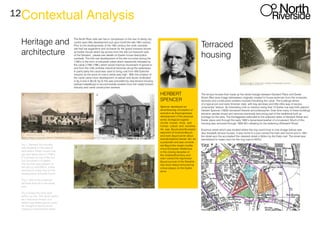
The North River side site has in comparison to the rest of derby city
centre seen little development put upon ituntil the late 18th century.
Prior to the developments of the 18th century the north riverside
site had sat asgardens and orchards for the grand mansion known
as Exeter House which lay across from the site (on thesouth side
of the Derwent , please see details on Exeter house description
overleaf). The first real development of the site occurred during the
1790’s in the form of industrial unites which wasshortly followed by
the canal (1795-1796 ) which would improve movement of goods to
and from the mills andnew industrial factories along the waterways.
In particularly the canal was used to bring coal from little Eatonfor
industry as the price of coal in derby was high. With the creation of
the canal came more development of awharf and docks (indicated
in fig 3 and in BLUE fig 5) this was preceded by new terrace housing
(artisan’sdwellings) to accommodate workers from the newly formed
industry and canal construction workers
Contextual Analysis
Heritage and
architecture
Terraced
housing
Fig 1. Derwent iron foundry
was situated on the area of
land where Exeter house now
sits and dates back to1790’s.
IT is known as one of the first
iron foundries in England.
The foundry was present on
the site up until1920’s. It was
removed to make way for the
development of Exeter house
Fig 2. One of the industrial
factories that sat in the wharf
area
Fig 3 shows the dock area
within our site. The docks acted
as a historical version of a
deliver bay where goods could
be brought to and from the
industry’s that lined the wharf.
1 2
3
The terrace houses that made up the street triangle between Derwent Place and Exeter
Street (Red area image below)were originally created to house workman from the ironworks,
factories and construction workers involved inbuilding the canal. The buildings where
of a typical pre and early Victorian style, with bay windows and little inthe way of excess
ornamental feature. An interesting note to mention being that 12 Exeter row was birth placeof
Herbert Spencer (1820) renowned theorist and philosopher. Over time many of these buildings
became usedas shops and services eventually becoming part of the traditional built up
frontage for the area. The frontagealso extended to the adjacent sides of Derwent Street and
Exeter place and through the early 1900’s becamesomewhat of a boulevard. Much of this
housing was removed through 1920-30’s allowing for the widening ofDerwent Street.
Erasmus street which was located where the ring round loop is now (image below) was
also linedwith terrace houses. It was home to a pub named the hare and hound and in 1931
the street won the accoladeof the cleanest street in Briton by the Daily mail. The street was
demolished to make room for the ring road in1970’s.
HERBERT
SPENCER
Spencer developed an
all-embracing conception of
evolution as theprogressive
development of the physical
world, biological organis-
ms,the human mind, and
human culture and societies.
He was "anenthusiastic
exponent of evolution"
and even "wrote about
evolutionbefore Darwin did. As
a polymath and was conside-
red "the single mostfa-
mous European intellectual
in the closing decades of
the nineteenthcentury and
even coined the expression
"survival of the fittestHe
has since being honoured by
a blue plaque on the Exeter
arms.
13Contextual Analysis
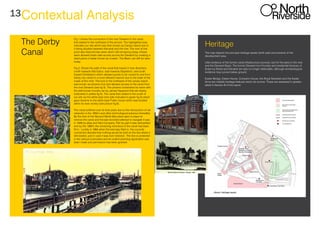
The Derby
Canal
Fig 1 shows the connection of the river Derwent to the canal
that started to the northwest of the picture. The highlighted area
indicates our site which was then known as Canary Island due to
it being situated between thecanal and the river. The river at this
point also featured two weirs which still remaining today, theses
weirs allowed boats safe access across the Derwent by creating a
slack piece of water known as a basin. The Basin can still be seen
today.
Fig 2. Shows the path of the canal that travels in tree directions
(north towards little Eaton, east towards Stapleford, and south
toward Chellaston) which allowed goods to be moved to and from
Derby city centre in a more efficient manner due to the state of the
roads at this time. The lock to the northwest of the canary island
was known as phoenix lock and allowed access to the canal from
the river Derwent (see fig 5). The phoenix lockshared its name with
the well-known foundry ran by James Haywood that sat nearby
(indicated in yellow fig 5). The canal then exited to the south of
our site via the white bear lock (site indicated in green fig 5) which
gave itsname to the white bear Public house which was located
within its near vicinity (see picture fig 6).
The canal suffered over its final years due to the introduction of rail
networks in the 1850’s and other technological advance thereafter.
By the time of the Second World War plans were in place to
remove the canal and the last recorded attempt to navigate it was
in 1946 by atlas and Vela Company. Part by part it was dismantled
and by the 1960’s the remaining reminisce of the canal had been
fill in. Luckily in 1964 when the bed was filled in, the councils
concerned decided that nothing would be built on the line where it
still existed, just in case it was ever restored , The line is protected
in the various local plans and an outline planning application was
been made and permission has been granted.
Heritage
The map depicts the principal heritage assets (both past and present) of the
development area.
Little evidence of the former canal infrastructure survives, but for the weirs in the river
and the Derwent Basin. The former Derwent Iron Foundry and residential terraces of
Erasmus Street and Derwent are also no longer detectable, although archaeological
evidence may survive below ground.
Exeter Bridge, Exeter House, Compton House, the Royal Standard and the Exeter
Arms are notable heritage features which do survive. These are assessed in greater
detail in Section B of the report.
14Contextual Analysis
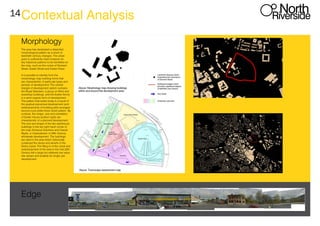
Morphology
The area has developed a disjointed
morphological pattern as a result of
twentieth century changes. The urban
grain is sufficiently intact however for
key historical patterns to be identified on
the map, such as the routes of Derwent
Street, Exeter Street and Exeter Place.
It is possible to identify from the
morphology map building forms that
are characteristic of particular types and
periods of development. The central
triangle of development (which contains
the Royal Standard, a group of office and
workshop buildings, and the Exeter Arms)
is a semi-organic form of development.
The pattern that exists today is a result of
the gradual piecemeal development (and
redevelopment) of building plots arranged
around a pre-determined street pattern. By
contrast, the shape, size and orientation
of Exeter House (bottom right) are
characteristic of a planned development.
The size and shape of the two warehouse
buildings in the top right hand corner of
the map (Octopus Solutions and Carpet
Right), is characteristic of 20th Century
wholesale development. The buildings
are sited in the area which historically
contained the docks and wharfs of the
Derby Canal. The filling-in of the canal and
redevelopment of the area in the mid 20th
Century left a large but relatively low value
site vacant and suitable for single use
development.
Edge
15Permeability/vistas
Cathedral
Green
Council
Building
Riverlights
Silk
Mill
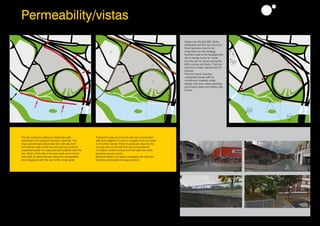
The site presents particular challenges with
pedestrian and transport access in general. The
ring road alienates physically and optically from
the northern side of the city and acts as a natural
unwanted barrier for adequate permeability onto the
site. South of the site is the river bank and only the
west side (in black arrows) allows for accessibility
and integration with the rest of the urban grain.
Transport routes accross the site are complicated
with poor legibility of how to navigate from one plate
to the other. Darwin Place in particular disjoints the
circular area on the left from any full pedestrian
circulation routes coming from the east and north
potential access points.
Derwent street is an historic transport link that can
become a desirable frontage location.
Vistas over the Silk Mill, Derby
Cathedral and the City Council’s
River Gardens need to be
integrated into the strategy.
Northern side of the development
site is ideally locate for vistas
into the site for drivers along the
A52 coming into Derby. This can
become a major optical point of
interest.
Pictures below showing
unexploited areas with no
contribution towards urban
design and poor urban planning
just meters away from Derby City
Centre.
16Transport
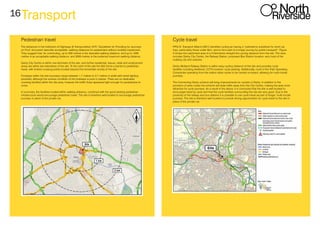
Pedestrian travel
The distances in the Institution of Highways & Transportation (IHT) ‘Guidelines for Providing for Journeys
on Foot’ document describe acceptable walking distances for pedestrians without mobility impairment.
They suggest that, for commuting, up to 500 metres is the desirable walking distance, and up to 1000
metres is an acceptable walking distance, and 2000 metres is the preferred maximum walking distance.
Derby City Centre is within one kilometre of the site, and further residential, leisure, retail and employment
areas are within two kilometres of the site. To the north of the site the A52 forms a barrier to pedestrian
travel, with limited crossing points located beyond the immediate vicinity of the site.
Footways within the site boundary range between 1.7 metres to 3.7 metres in width,with street lighting
provided, although the surface condition of the footways is poor in places. There are no dedicated
crossing facilities within the site area, however the traffic flows appeared light enough for pedestrians to
cross.
In summary, the facilities located within walking distance, combined with the good existing pedestrian
infrastructure would encourage pedestrian travel. The site is therefore well located to encourage pedestrian
journeys in place of the private car.
Cycle travel
PPG13: Transport (March 2001) identifies cycling as having a “potential to substitute for short car
trips, particularly those under 5km, and to form part of a longer journey by public transport”. Figure
5 shows the catchment area of a 5 kilometres straight line cycling distance from the site. The area
includes Derby City Centre, the Railway Station, proposed Bus Station location, and most of the
outlying city and suburbs.
Derby Midland Railway Station is within easy cycling distance of the site and provides cycle
facilities including sheltered, CCTV-covered, cycle parking. Additionally, most of the Train Operating
Companies operating from the station allow cycles to be carried on-board, allowing for multi-modal
journeys.
The Connecting Derby scheme will bring improvements for cyclists in Derby. In addition to the
provision of extra routes the scheme will draw traffic away from the City Centre, making the area more
attractive for cycle journeys. As a result of the above, it is concluded that the site is well located to
encourage travel by cycle and that the cycle facilities surrounding the site are very good. Due to the
proximity of the railway and bus stations it is possible to use cycle travel as part of longer, multi-modal
journeys. The site is therefore well located to provide strong opportunities for cycle travel to the site in
place of the private car.
17Transport
Site uses
Public transport
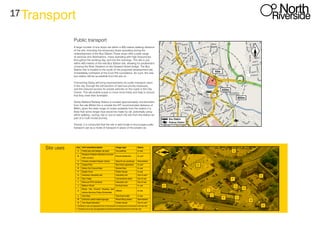
A large number of bus stops are within a 400 metres walking distance
of the site, including the temporary stops operating during the
redevelopment of the Bus Station.These stops offer a wide range
of services and destinations, many operating with high frequencies
throughout the working day, and into the evenings. The site is just
within 400 metres of the new Bus Station site, allowing for pedestrians
crossing the River Derwent on the Derwent Street bridge. The Bus
Station site is located to the south of the proposed development site,
immediately northwest of the Cock Pitt roundabout. As such, the new
bus station will be accessible from the site on
Connecting Derby will bring improvements for public transport users
in the city, through the introduction of new bus priority measures
and the reduced access for private vehicles on the roads in the City
Centre. This will enable buses to move more freely and help to ensure
that they meet their timetable.
Derby Midland Railway Station is located approximately one kilometre
from the site.Whilst this is outside the IHT recommended distance of
800m, given the wide range of routes available from the station it is
likely that some longer trips would be made by rail, potentially using
either walking, cycling, taxi or bus to reach the site from the station as
part of a multi-modal journey.
Overall, it is concluded that the site is well locate to encourage public
transport use as a mode of transport in place of the private car.
18Economic overview
Over the last decade Derby’s economy has grown at a faster rate
than any other city in England, with employment growth ranked in
the top five of the UK’s cities. Building on this recent success, a
Masterplan is in place which will guide over £2bn of investment into
the city centre over the next 15 years.
Since opening in 2007, Westfield Derby has repositioned Derby as a
major retaildestination in the East Midlands. The city’s enhanced retail
and leisure offer will be bolstered by major mixed-use schemes and
complemented by improvements to the Cathedral Quarter area.
With Pride Park approaching completion, the healthy demand for
office space evident in Derby will be refocused on the city centre,
with a number of key schemes expected to complete over the next 18
months and provision for 1.4m sq ft of space in the Masterplan.
Strong house price growth and 5,000 new units proposed indicates
the confidence in the city’s residential market. Major new schemes,
such as in Castleward, will support the anticipated economic growth
and increase the provision of new family-sized accommodation.
Office spaces
Supply of good quality office space in the city centre has been long overdue and new
office developments are certain to bring a new headline rent for the city centre. With Pride
Park approaching completion, the healthy demand for office space evident in Derby will be
refocused on the city centre.
Provided that the sizeable office pipeline is phased appropriately and a range of floorplate
sizes are offered which accommodate a range business types, the city centre market should
capitalise further on Derby’s strategic transport links.
Retail and leisure
Westfield Derby should establish Derby as a magnet for mainstream and emerging retailers
who previously may not have considered locating in the city. As the centre matures and
Derby’s retail offer re-adjusts, the city will strengthenits dominant position within the primary
catchment area over the coming years and reduce spending leakage to other centres in the
East Midlands.
Significant leisure schemes both underway and proposed within the Masterplan will augment
and complement the improved retail sector, bringing the city’s leisure offer to a level more in
line with its population and catchment.
Residential
The city of Derby has established itself as one of the UK’s economic growth hotspots, a
view endorsed by the ‘Centre for Cities 2008’ report which ranked Derby among the top
five UK cities for employment growth. Alongside this economic buoyancy, the city has
recently received a significant £3.8m investment as part of the New Growth Point strategy, a
national initiative that has identified particular locations where additional housing could be
concentrated. Consequently, Derby could see at least 20% more housing over and above the
5,000 new homes under the Masterplan already been proposed.
While much of the local employment wealth has previously ‘leaked’ beyond Derby’s city
boundaries, regeneration plans are now in place to create a diverse selection of housing that
will help retain wealth and attract a wider range of residents. A significant amount of emphasis
is being placed on the provision of family-sized accommodation within central areas such as
Castleward, and the inclusion of larger units is key to the retention of the city’s wealth.
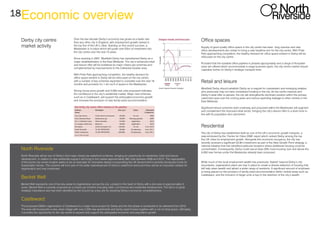
North Riverside
North Riverside will be one of Derby’s first major mixed-use waterfront schemes, bringing an opportunity for residential, hotel and leisure
development. In relation to new residential supply it will bring to the market approximately 390 units between 2009 and 2012. The regeneration
of this prime city centre location seeks to be an exemplar for innovative design incorporating the UK Government’s recently introduced Code for
Sustainable Homes. This scheme will form part of the wider redevelopment of Derby’s waterfront arena and thus will be an important catalyst for
regeneration and new investment.
Becket Well
Becket Well represents one of five key areas for regeneration across the city. Located in the heart of Derby with a site area of approximately 3
acres, Becket Well is currently proposed as a mixed-use scheme including retail, commercial and residential development. The site is of great
strategic importance and has been identified by the Council as a key site for boosting Derby’s economic competitiveness.
Castleward
The proposed £300m regeneration of Castleward is a major future project for Derby and the first phase is scheduled to be delivered from 2010.
The area will incorporate a new urban village with over 2,500 new apartments and family sized homes together with a mix of retail space. Ultimately,
it provides the opportunity for the city centre to expand and support the anticipated economic and population growth.
Derby city centre
market activity
19
Flooding/
Risk assessment
Environmental Analysis
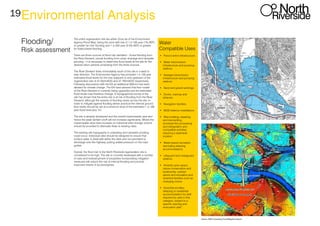
The entire regeneration site lies within Zone 3a of the Environment
Agency Flood Map, being the zone with risk of 1 in 100 year (1% AEP)
or greater for river flooding and 1 in 200 year (0.5% AEP) or greater
for tidal/coastal flooding.
There are three sources of flood risk identified – fluvial flooding from
the River Derwent, pluvial flooding from urban drainage and rainwater
ponding – it is necessary to determine flood levels at the site for the
desired return periods emanating from the three sources.
The River Derwent flows immediately south of the site in a west to
east direction. The Environment Agency has provided 1 in 100 year
estimated flood levels for the river adjacent to and upstream of the
regeneration site of 47.552mAOD and 47.792mAOD respectively.
Following discussions with the EA an additional 500mm has been
allowed for climate change. The EA have advised that their model
of the River Derwent is currently being upgraded and the estimated
flood levels may therefore change. A topographical survey of the
site has shown that the entire site is at risk of flooding from the River
Derwent, although the severity of flooding varies across the site. In
order to mitigate against flooding where practical the internal ground
floor levels should be set at a minimum level of the estimated 1 in 100
year flood level plus 1m.
The site is already developed and the overall impermeable area and
hence the peak rainfall runoff will not increase significantly. Where the
impermeable area does increase on individual sites storage volume
should be provided to attenuate flows to existing rates.
The existing site topography is undulating and rainwater ponding
could occur. Individual sites should be designed to ensure that
surface water is dealt with within the sites and not permitted to
discharge onto the highway putting added pressure on the road
gullies.
Overall, the flood risk to the North Riverside regeneration site is
considered to be high. The site is currently developed with a number
of uses and redevelopment of properties incorporating mitigation
measures will reduce the risk of internal flooding and provide
improved means of access/egress.
Water
Compatible Uses
•	 Flood control infrastructure.
•	 Water transmission
infrastructure and pumping
stations.
•	 Sewage transmission
infrastructure and pumping
stations.
•	 Sand and gravel workings.
•	 Docks, marinas and
wharves.
•	 Navigation facilities.
•	 MOD defence installations.
•	 Ship building, repairing
and dismantling,
dockside fish processing
and refrigeration and
compatible activities
requiring a waterside
location.
•	 Water-based recreation
(excluding sleeping
accommodation).
•	 Lifeguard and coastguard
stations.
•	 Amenity open space,
nature conservation and
biodiversity, outdoor
sports and recreation and
essential facilities such as
changing rooms.
•	 Essential ancillary
sleeping or residential
accommodation for staff
required by uses in this
category, subject to a
specific warning and
evacuation plan”.
20Environmental Analysis
Flooding/
Simulation
1 5
2 6
3 7
4 8
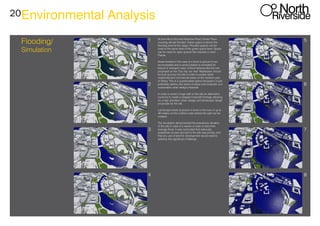
At level 46 at this level Meadow Road, Exeter Place
crossing will get flooded. Green space is above the
flooding level at this stage. Flooded spaces can be
rised to the same level of the green space level. Space
can be rised for open spaces like marinas or even
Piazas.
Areas flooded in the case of a flood in picture 5 can
be excavated and a canal created or recreated for
leisure or transport uses. A flood defense like the one
proposed on the ‘Our city, our river’ Masterplan should
be built accross the site in order to protect wider
residential and commercial areas on the northern part
of Derby. This is a questionable option because it could
potentialy destroy the sense of place and character of a
sustainable urban design proposal.
In order to avoid a huge wall on the site an alternative
could be to create a stepped riverside frontage allowing
for a high standard urban design and landscape design
proposals for the site.
Landscape levels at picture 4 close to the river of up to
49 meters on the northern side behind the wall can be
created.
The simulation demonstrated the precarious situation
of the site in case of a severe or even a more than
average flood. It was concluded that adecuate
pedestrian access and exit to the site was priority, and
that any use of land for development would need to
address this significant challenge.
21
Ecology
Environmental Analysis
RPS was commissioned by Mace Limited on behalf of Derby
Cityscape Ltd toundertake a Phase 1 Habitat Survey and Ecological
Scoping Survey of NorthRiverside, Derby. The surveys were carried
out on the 7th March 2008, in addition to a desk-based review of
existing ecological data.
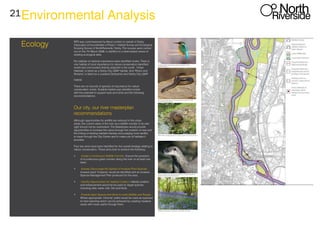
No habitats of national importance were identified onsite. There is
one habitat of local importance for nature conservation identified
onsite and one located directly adjacent to the south. ‘Urban
Habitats’ is listed as a Derby City LBAP habitat. And ‘Rivers and
Streams’ is listed as a Lowland Derbyshire and Derby City LBAP
habitat.
There are no records of species of importance for nature
conservation onsite. Suitable habitat was identified onsite
with the potential to support bats and birds and the following
recommendations.
Our city, our river masterplan
recommendations
Although opportunities for wildlife are reduced in the urban
areas, the current value of the river as a wildlife corridor in its own
right should not be overlooked. The Masterplan would provide
opportunities to increase this value through the creation of new and
the linking of existing habitats thereby encouraging more wildlife
to travel through the City Centre and to make use of habitats it
provides.
Four key aims have been identified for the overall strategy relating to
nature conservation. These aims look to achieve the following:
•	 Create a Continuous Wildlife Corridor; Ensure the provision
of a continuous green corridor along the river on at least one
bank.
•	 Actively Discourage the Spread of Invasive Plant Species;
Invasive plant ‘hotspots’ would be identified and an Invasive
Species Management Plan produced for the area.
•	 Identify Opportunities for Habitat Creation; Habitat creation
and enhancement would be focused on target species
including otter, water vole, fish and birds.
•	 Provide Open Spaces that Work for both Wildlife and People.
Where appropriate ‘informal’ paths would be used as opposed
to hard standing which can be achieved by creating meadow
areas with mown paths through them.
22Environmental Analysis
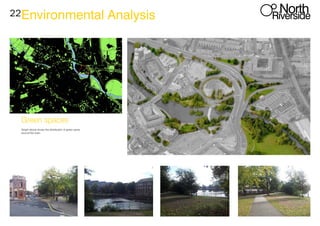
Green spaces
Graph above shows the distribution of green areas
around the town.
23Sustainable Masterplan
Objectives 1.	 Create a sustainable mixed use development which
will become a new city centre destination and will
maximise the potential of the site: its character,
heritage and location.
2.	 The proposed development is aimed to help to
integrate the site with the rest of the town’s ‘core’.
Improved accesibility and connectivity with the western
bank of the river and therefor with the ‘heart’ of the city.
3.	 The design of an environmental flood water
management strategy with the use of anti flood
techniques: ground level soil permeability, SUDS,
urban water canals, underground discharge channels,
underground car park for water discharge, amphibious
buildings, and solar powered water pumps.
4.	 The development will be integrated into the ‘Derwent
river corridor’ vision. An opportunity to recreate the
former ‘Derby Canal’ will give rthe site a unique
character and will create an attractive venue for new
businesses.
24Sustainable Masterplan
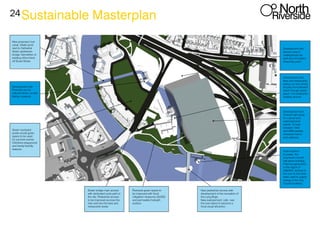
New proposed river
canal. Intake point
next to Cathedral
Green pedestrian
bridge. Demolition of
existing office block
off Stuart Street.
Development site:
Potential use for
cultural venue, on site
history museum.
Green courtyard,
public-social green
space to be used
for summer events.
Childrens playground
and family friendly
features.
Exeter bridge main access
with dedicated cycle path to
the site. Pedestrian access
to be improved accross the
river and into the bars and
restaurants areas.
Riverside green space to
be improved with flood
mitigation measures (SUDS)
and permeable footpath
surface.
New pedestrian access with
development of the recreation of
the Long Brige.
New evelopoment: cafe over
the river island to become a
focal visual attraction.
Hydro turbine
to power the
proposed concert
hall arena building.
Potential generation
in the region of
230kW/h, ientical to
the one on the other
bank used to supply
energy to the City
Council building.
Development site:
Concert hall venue
for cultural and
enterntainment
events. To host
between 1500
and 2600 people,
rehearsal rooms
and cafeteria.
Development site:
Bars and restaurants,
eating out and shops.
Access from Derwent
street through exeter
place. Full pedestrian
mobility around.
Development site:
Service area fo
underground car
park and circulation.
Assembly point.
25Sustainable Masterplan
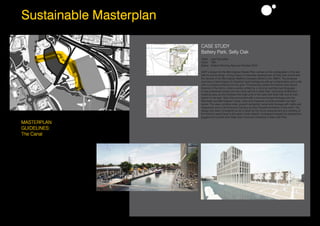
CASE STUDY
Battery Park, Selly Oak
Client: Land Securities
Value: TBC
Status: Outline Planning Approval October 2013
UNIT’s design for this Birmingham Master Plan centres on the reintegration of the site
with its surroundings. A long history of industrial development at Selly Oak ended with
the demise of the Birmingham Battery Company Works in the 1980’s. The proposal
reverses a mixed legacy of industrial canal heritage as well as contamination and a site
with no positive presence for the area. The proposal utilises the historic and natural
features of the site to create a series unified by a common architectural language.
A new pedestrian bridge over the canal will link to Selly Oak, increasing footfall and
enabling easy access between the retail units to the west and Selly Oak and its train
station to the east. Selly Oak is provided with a new and unique frontage onto the
Worcester and Birmingham Canal. Uses and character provide animation for each
space. The uses combine retail, student residential, canal side frontage with cafés and
restaurants and a Life Sciences Campus by Glen Howells Architects to the north. The
design has been considered so as to allow for the future development and relinking of
the historic Lapal Canal to the wider canal network. A pleasant towpath for pedestrians,
joggers and cyclists links Selly Oak to and the University to Selly Oak Park.
MASTERPLAN
GUIDELINES:
The Canal
This is a re-creation of the old Derby Canal that was
used across the site in victiorian times. The concept to
bring it back will use the historic links of the site with
the canal network but to different use: an attractive
urban commecial frontage for businesses, recreation
and public realm. The canal forms part of a water
management strategy onsite that uses sustainable
technologies to reduce the impact of floods. SUDS
techniques can be used to design the canal bed in
order to channel water underground through infiltration
and pumping.
The canal intake location is planned to help lower the
surge of water level over Cathedral Green, it will also
create a new visual link between both sites, historically
separated and divided by the river. Integrating Cathedral
Quater with North Riverside to create a new and dinamic
commercial axis on this part of the city.
26Sustainable Masterplan
MASTERPLAN
GUIDELINES
The ‘Green Heart’ Garden
A place to stop and slow down in a busy day is what
Derby City Centre has always lacked. Not only another
green space but a place to enjoy the outdoors in an
urban representation of a private garden. A botanic
collection of both local and foreign plants and trees,
they provide shelter from the summer sun and
protection from the winter gales.
Building materials will come from reclamation yards
and recycled sourcing. Natural materials: timbers,
stone, gravel, earth and water. The connection with the
canal gives the illusion of a countryside setting with an
architectural approach.
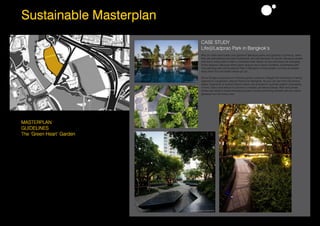
CASE STUDY
Life@Ladprao Park in Bangkok’s
Why do cities need parks and gardens? Because parks and gardens of all kinds, when
they are well-planted and well-maintained, are vital elements of city life. Because people
who live in cities need to feel a connection with nature, to see and enjoy the changing
of the seasons. Because when green spaces are in good condition, overflowing with
lush plantings like Life@Ladprao Park in Bangkok’s noisy streets, not only do people
enjoy them but real estate values go up!
Shma Designs proposed an immense green surface to mitigate the harshness of being
adjacent to congested Ladprao Road from Bangkok. As you can see from the photos
below, fragments of diverse botanic plants are arranged in quilt-like pattern contrasting
in form, colour and texture to achieve a complex yet serene beauty. Path and private
niches are nestle in these interplaying green envelop providing resident with an instant
getaway from the noisy road.
27Sustainable Masterplan
MASTERPLAN
GUIDELINES
The Spencer Pavillion
An opportinity came across to give honour to the
memory of Herbert Spencer: philosopher, biologist,
anthropologist, sociologist, and prominent classical
liberal political theorist, but more importantly a Derby
man. The concept for the proposed new concert hall
pavillion is dedicated to his work: the faceted roof
design was inspired in pages and folded paper.
The building will feature and elevated structure that will
allow the use of the entire lower footprint as a sheltered
public for an open theatre for public events. Four
inmense steel framed structural pillars will carry the
loads from the superstructure with the help of additional
reinforced concrete columns, this will make the
edifice virtually flood-proof and an urban eye catching
landmark. The four pillars will serve for natural ventilation
purposes driving fresh air from lower ground into the
building.
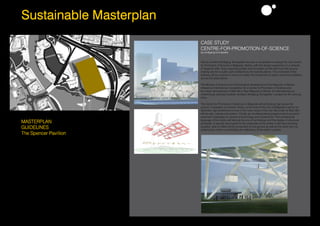
CASE STUDY
CENTRE-FOR-PROMOTION-OF-SCIENCE
by-wolfgang-tschapeller
Vienna architect Wolfgang Tschapeller has won a competition to design the new Centre
for Promotion of Science in Belgrade, Serbia, with this design supported on a network
of diagonal stilts. Only supporting pillars and circulation points will touch the ground,
making way for a public park sheltered by the building above. The underside of the
building will be covered in mirrors to reflect the movement of visitors and local residents
across the plaza below.
The Ministry of Science and Technological development of the Republic of Serbia
initiated an international competition for a Centre for Promotion of Science and
the urban development of Blok 39 in New Belgrade in Serbia. An international jury
unanimously selected Austrian architect Wolfgang Tschapeller´s project as the winning
entry.
The Centre for Promotion of Sciences in Belgrade will be floating high above the
ground. It operates on 3 levels. Firstly, on the level of the City of Belgrade it will be an
optimistic sign positioned on one of the main routes of the city. Secondly for Blok 39 it
will be sign, canopy and portico. Thirdly, as a building being programmed to promote
sciences it (dis)plays on visions of technology and construction. The architectural
language of the centre will strongly be one of technology and the display of structural
principles. A special role is given to the underside of the centre; it will have mirroring
qualities, able to reflect all the movement on the ground as well as the visitor who by
entering the centre is penetrating the reflections of the earth’s surface.
28Sustainable Masterplan
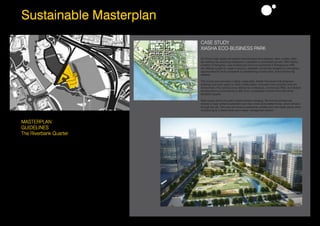
CASE STUDY
XIASHA ECO-BUSINESS PARK
As China’s high-speed rail system reduces travel time between cities, smaller cities
are seeking new planning strategies to capitalize on anticipated growth. With Xiasha,
a district of Hangzhou, now located just one-hour southwest of Shanghai by HSR,
city officials sought to create a dynamic, walkable community designed to strengthen
opportunities for local companies by establishing a world class, brand-enhancing
address.
This master plan provides a highly sustainable, flexible framework that integrates
buildings and open space to foster collaboration, innovation and a healthy work-life
environment. Five nested zones defined by conference, commercial, R&D, and lifestyle
development is connected by a sixth zone, a pedestrian corridor lined with small
exhibition spaces.
Open space drives the plan’s implementation strategy. The first two phases will
include a major wetland restoration and new constructed wetland loop, which will wind
through the city. This loop will enhance pedestrian mobility and real estate values while
contributing to a district wide storm water management system.
MASTERPLAN
GUIDELINES
The Riverbank Quarter
This Commercial district will make use of the canal
side to create a unique blend of sustainable landscape
design and small retail space for shops, bars,
restaurants and exhibition centres. Emphasis on the
reinforment of Derwent Street frontage as the gateway
into the rest of the development. Full pedestrian area
with connections across the riverside pathways and
pedestrian bridges on Cathedral Green and New
proposed Long Bridge.
Green roofs to be sculpted from the riverbank into the
buildings as in the case study (see image at the right).
Existing wildlife (birds) will have an active role in creating
an ecological commercial quarter.
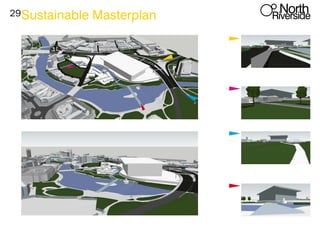
29Sustainable Masterplan
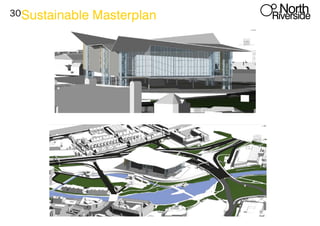
30Sustainable Masterplan

Northriverside Research web

  • 1.
  • 2.
  • 3.
    3 Contents Brief 4 The Site 5 OurCity Our River 6 Planning 8 Site history 9 Evolution 10 Maps 11 Heritage and architecture 12 The Derby Canal 13 Morphology 14 Permeability and vistas 15 Transport 16 Economic overview 18 Flooding, risk assessment 19 Flood simulation 20 Ecology 21 Green spaces 22 Sustainable masterplan 23 The Canal 25 The ‘Green Heart’ Garden 26 The Spencer Pavillion 27 The Riverbank Quarter 28 Development site vistas 29 Development site renders 30
  • 4.
    4 Brief INTRODUCTION The redevelopmentof the North Riverside area of the city centre forms one of the priority projects within the Derby Cityscape Masterplan. The site forms part of this area and is bounded by St. Alkmund’s Way (inner ringroad), the River Derwent, Exeter Place and Darwin Place, a total area of 2.31 ha ( 5.7 acres ). Currently the site is a surface car park (Darwin Place) and the river frontage land is occupied by a block of flats (Exeter House) which is to be demolished. The two parcels of land to the North West of the site are to be cleared, with the exception of the Exeter Arms public house. The land bounded by St. Alkmund’s Way / Darwin Place / Derwent Street and Exeter Street will be redeveloped with Office and Residential buildings from 4 to 6 storey. The land bounded by Derwent Street / Exeter Place and Exeter Street will be redeveloped with Retail / Leisure and Residential buildings from 3 to 6 storey. THE OPPORTUNITY The redevelopment of this area will seek to create a new city centre destination and commu- nity offering new employment opportunities with the creation of a sustainable, high quality mixed use development on brownfield land which will fully exploit the riverside setting and which could include a mix of any of the following :- Hotel / Leisure / Entertainment Retail Offices Residential Car parking Public realm The opportunity exists to create a safe environment with high quality public spaces fully optimising the benefits of the riverside location and utilising the proposed river footbridge which will create a link with the Riverlights and the city beyond. DESIGN As a predominant site there is an aspiration to set new standards of design at North River- side. The design of buildings and public spaces will draw on the opportunity presented by the riverside setting and the quality of building will be driven by existing and new standards aspired to nationally under BREEAM and the Code for Sustainable Homes initiatives. Importantly, the massing and heights of buildings should support the central focus of the scheme, the river, and buildings should seek to compliment each other in terms of design and orientation. It is envisaged that there would be a variety of building heights stepping down to the central focus of the scheme, with a creation of a spatial edge to the river fron- tage respecting the views to the Cathedral spire to the west and promoting an enhanced composition adjacent to the river. The North Riverside site presents the opportunity to become part of the existing vibrant waterfront pedestrian realm within the heart of the city and can promote new direct links to Riverlights and River Gardens, Market Square and Osnabruck Square. The site frontage should respect the river frontage whilst promoting improved access and views of the river. The public realm should aspire to a world class design and artistic aspirations that fully promote the uses within the scheme. Overall the public spaces should form a mix of hard and soft landscaping to promote new gathering and forecourt spaces generating a holistic riverside ambience within the scheme. Contextual Analysis
  • 5.
    5 The Site Theredevelopment of the North Riverside area of the city centre forms one of the priority projects within the Derby Cityscape Masterplan. The site forms part of this area and is bounded by St. Alkmund’s Way (inner ringroad), the River Derwent, Exeter Place and Darwin Place, a total area of 2.31 ha (5.7 acres). Currently the site is a surface car park (Darwin Place) and the river frontage land is occupied by a block of flats (Exeter House) which is to be demolished. The two parcels of land to the North West of the site are to be cleared, with the exception of the Exeter Arms public house. The land bounded by St. Alkmund’s Way / Darwin Place / Derwent Street and Exeter Street will be redeveloped with buildings from 4 to 6 storey. The land bounded by Derwent Street / Exeter Place and Exeter Street will be redeveloped with buildings from 3 to 6 storey.
  • 6.
    6 Contextual Analysis ThisMasterplan sets out our shared vision to reduce flood risk in Derby and transform the City’s relationship with the River Derwent by helping to encourage economic regeneration in areas currently at risk of flooding. ‘Our City Our River’ encompasses a linear area through the heart of Derby comprising a wide range of land uses including farmland, residential communities and City Centre business areas, stretching from Darley Abbey in the north through to Derby Junction Rail Bridge in the south. The Masterplan area is shown on Figure 1.2. It includes a rich heritage resource incorporating Darley Abbey Mills and the Silk Mill, which together form a key part of the Derwent Valley Mills World Heritage Site. In addition, there are a number of listed buildings and structures as well as significant archaeological interest including a Roman fort and settlement. The river corridor also provides a much loved and used recreational resource including extensive sports pitches, riverside walks and cycle ways linking local facilities and communities to the City Centre and beyond. Objectives Detailed objectives for the Masterplan include: • To create a continuous and publicly accessible orbital route from Darley Abbey Mills to the Bass Recreation Ground which includes sub-loops utilising intermediate crossing points; • Provide opportunities for leisure and recreational enhancements along the corridor; • Enhance the quality of pedestrian and cycle routes between the river, the City Centre, neighbourhoods and employment areas; • Improve the legibility of the public realm through new development proposals; • Improve connectivity between communities, the river and wider City; • Provide new access points to the river corridor to enable exploration and utilisation; • Provide a riverside corridor that works for both people and wildlife; • Re-engaging the riverside as an attraction and key integral feature of Derby’s public realm, improve way finding, and explore the possibility of integrating education into the public realm through the enhancement of existing signage and information points; and • To take into account the need of vulnerable groups such as older people and those with physical disabilities. Principles Encouraging investment in these prominent areas is a fundamental priority for the Masterplan, through planned growth and a collaborative approach the required flood defences can be provided as part of the development proposals. Through investment and development of vacant, under-utilised brownfield land these sites can be transformed into areas of betterment that provide key nodal points, landmarks and gateways and most importantly reconnect the City to the river through the provision of new public spaces. The nature of the land and its previous use means that it is likely to suffer from contamination in the ground and in the groundwater which is closely linked to the river. New development proposals would need to consider this alongside the other constraints and mitigate accordingly to ensure that there are no adverse effects on the quality of the river water. 1 2 3
  • 7.
  • 8.
    8 Planning Background Regeneration anddevelopment in Derby is a major priority for the City Council and its partners. There is a clear and long standing desire to use potential investment within the river corridor as a catalyst for the regeneration. Improving connectivity to the river and making the most of the heritage assets is also a key priority. Currently development is subject to the guidance in national Planning Policy Statement 25: Development and Flood Risk ‘Our City Our River’ encompasses a linear area through the heart of Derby comprising a wide range of land usesincluding farmland, residential communities and CityCentre business areas, stretching from Darley Abbey in thenorth through to Derby Junction Rail Bridge in the south.The Masterplan area is shown on Figure 1.2. It includesa rich heritage resource incorporating Darley Abbey Millsand the Silk Mill, which together form a key part of theDerwent Valley Mills World Heritage Site. In addition, thereare a number of listed buildings and structures as well assignificant archaeological interest including a Roman fortand settlement. The river corridor also provides a muchloved and used recreational resource including extensivesports pitches, riverside walks and cycle ways linking localfacilities and communities to the City Centre and beyond. NATIONAL PLANNING POLICY Derby City Council’s Cabinet has approved the Masterplan as guidance, which will be a material consideration when determining planning applications. The Masterplan should be read alongside the relevant adopted policies in the Council’s statutory City of Derby Local Plan (2006) and national planning guidance as set out in the National Planning Policy Framework (NPPF). The NPPF states (para 94) that Local Planning Authorities should adopt positive strategies to mitigate and adapt to climate change, taking full account of flood risk and other factors. It retains the policies of the previous PPS25 in terms of the application of the ‘sequential test’ and ‘exception test’ in preparing Local Plans for areas of flood risk. The overall aim of the sequential test is to steer development to areas of lower flood risk. However if this is not possible the exception test can be applied. For the exception test to be passed: • the development should provide “wider sustainability benefits to the community that outweigh flood risk”1;and • “a site-specific flood risk assessment must demonstrate that the development will be safe,without increasing flood risk elsewhere, and where possible will reduce flood risk overall”2. In considering planning applications the Council will have regard to this national guidance. It will also have appropriate regard to the relevant local plan polices and the content of the Masterplan. Overarching Objectives 1. Reduce Flood Risk to Residents and Commercial Property 2. Maximise Development Opportunities 3. Encourage Investment 4. Deliver Regeneration Aspirations 5. Manage Change 6. Enable Phased Delivery 7. Mitigate Against the Adverse Effects of ‘Flood Defences’ 8. Capture the Opportunity for ‘Betterment’ 9. Minimise Disruption to Existing Residents and Business 10. Protect Strategic Infrastructure 11. Protect and Enhance Ecology, Wildlife, Biodiversity 12. Protect and Enhance Heritage Assets 13. Create a Framework of Opportunities Contextual Analysis The river corridor includes many peoples’ homes, businesses and local facilities. The communities of Darley Abbey, Little Chester and Strutts Park and the City Centre all address the river and are affected by the proposals in the Our City Our River Masterplan. In and around these communities are significant employment areas and development opportunities, particularly close to the City Centre and along the eastern bank of the river. Increased levels of flood risk have hampered regeneration in these locations and this project would help developers overcome those barriers.
  • 9.
    9 Site history Contextual Analysis Theearliest widely available historical map of Derby, the John Speed map of 1610, shows the study area to be undeveloped. Subsequent 17th and 18th Century development in Derby was focussed principally to the west of the Derwent. The 18thCentury engraving by I Ryland entitled ‘The East View of Derby’ (see left) shows the western section of the study area laid out with orchards and gardens: understood by historians to have been associated with the large town houses situated along Full Street at the time. By the middle of the 19th Century, the study area had been developed with a mixture of housing, industry and canal-related land uses, development stimulated by the construction of the Derby Canal in 1795. Rows of terraced housing existed along Exeter Street and Exeter Place, and along Derwent Row and Erasmus Street (both of which have now been lost). 12 Exeter Row (later 27 Exeter Street) was the birthplace of celebrated philosopher Herbert Spencer in 1820 (see left). The north eastern part of the study area was occupied by the Derby Canal basin and a series of wharfs and docks. At the south eastern end of the study area was the Derwent Iron Foundry and the canal’s southerly entrance into the Derwent. At the north western end was the Phoenix Iron Foundry and the canal’s northerly entrance. The area of land that existed between the canal and the Derwent was entirely encircled by water and was dubbed ‘Canary Island’. Three weirs constructed in the Derwent facilitated access on to the river by canal boats (St Michael’s Weir south of St Mary’s Bridge, a weir to the south of Exeter Bridge and a further one adjacent to the Morledge). St Michael’s Weir and the northerly canal entrance gave access to the Darley Abbey Mills. The two southerly weirs resulted in the formation of the Derwent Basin, a calm body of water that enabled canal boats to cross the Derwent and access the locks off the southern banks of the river, adjacent to the Morledge. Crossing the Derwent Basin, at a point adjacent to the southerly canal entrance, was a timber foot bridge known as ‘The Long Bridge’ (see overleaf). By the 1880s, (see 1882 map in accompanying report) the part of the study area that had previously remained undeveloped (Derwent Street and the area now occupied by Phoenix Street and Stuart Street), had been developed, mostly with industry. Timber Yards and a dye works had appeared around the newly laid out Stuart Street and Phoenix Street. Frontage development had appeared along the long established Derwent Street, including a Chapel and two corner public houses – one on the junction with Exeter Street and one on the junction with Exeter Place (the tavern to later become the Royal Standard). By the turn of the century, (see 1901 map) the study area was fairly densely developed, in particular the triangle of land bordered by Exeter Place, Exeter Street and Derwent Street. Conversely an area of land to the east of the study area, between Erasmus Street and the nearby railway line, remained undeveloped.
  • 10.
    10Contextual Analysis The 1930ssaw the clearance of residential and industrial buildings alongside Exeter Place and Derwent Street and the construction of Exeter House and Compton House (James Harwood printing works, now the NatWest Bank). The clearance works also allowed for the widening of Derwent Street. By 1951, (see map) industrial buildings had encroached on to the area north of Exeter Street that was formerly occupied by canal docks and wharfs. The canal itself remained, although the basin had by this time been reduced in size. Development had also begun to appear on the area of previously undeveloped land to the east of Erasmus Street, with the addition of a wholesale market and omnibus depot. By the 1960s the canal had fallen into disuse, and had started to be filled in. The 1970s saw the construction of the inner ring road, and with it the loss of Erasmus Street and Derwent Row, and the remaining remnants of the canal. Terraced housing between Exeter House and Exeter Bridge was also removed, leaving the modernist housing complex to finally enjoy the open aspect that had previously been planned for it. The subsequent decades saw comparatively little change, but for the construction of Greenwood Court off Stuart Street, the construction of a series of riverside office buildings to the south of Stuart Street in the 1990s, and minor alterations to existing warehouse buildings in and around Exeter Street. Site history Evolution The adjacent map identifies the approximate construction date of the buildings stillpresent in and around the development area. The Exeter Arms (incorporating 31 and 32 Exeter Street), dating from 1820-22, is the oldest surviving building, and constitutes the only remaining portion of the row of terraced properties that once fronted the southern side of Exeter Street. The Royal Standard dates (in its current form) from 1892. An earlier pub (which was re-modelled/replaced by the present building) was present on the site from 1862. Exeter House was constructed in 1932-33. Its contemporary, Compton House on Derwent Street, was built in 1935. The tightly-knit group of buildings which are situated between Derwent Street and Exeter Place were constructed in the 1950s and 1960s. The unusual shape of the group is a reflection of the previous existence of terraced properties to the north, and other workshop buildings to the south. The large shed to the northeast of Exeter Street (now occupied by Octopus Collation Solutions Limited) was built during the same period. The building at the northern end of the development area (now occupied by Carpet Plus), was constructed in the 1970s. Until recently the building formed part of a larger structure.
  • 11.
  • 12.
    12 The North Riverside site has in comparison to the rest of derby city centre seen little development put upon ituntil the late 18th century. Prior to the developments of the 18th century the north riverside site had sat asgardens and orchards for the grand mansion known as Exeter House which lay across from the site (on thesouth side of the Derwent , please see details on Exeter house description overleaf). The first real development of the site occurred during the 1790’s in the form of industrial unites which wasshortly followed by the canal (1795-1796 ) which would improve movement of goods to and from the mills andnew industrial factories along the waterways. In particularly the canal was used to bring coal from little Eatonfor industry as the price of coal in derby was high. With the creation of the canal came more development of awharf and docks (indicated in fig 3 and in BLUE fig 5) this was preceded by new terrace housing (artisan’sdwellings) to accommodate workers from the newly formed industry and canal construction workers Contextual Analysis Heritage and architecture Terraced housing Fig 1. Derwent iron foundry was situated on the area of land where Exeter house now sits and dates back to1790’s. IT is known as one of the first iron foundries in England. The foundry was present on the site up until1920’s. It was removed to make way for the development of Exeter house Fig 2. One of the industrial factories that sat in the wharf area Fig 3 shows the dock area within our site. The docks acted as a historical version of a deliver bay where goods could be brought to and from the industry’s that lined the wharf. 1 2 3 The terrace houses that made up the street triangle between Derwent Place and Exeter Street (Red area image below)were originally created to house workman from the ironworks, factories and construction workers involved inbuilding the canal. The buildings where of a typical pre and early Victorian style, with bay windows and little inthe way of excess ornamental feature. An interesting note to mention being that 12 Exeter row was birth placeof Herbert Spencer (1820) renowned theorist and philosopher. Over time many of these buildings became usedas shops and services eventually becoming part of the traditional built up frontage for the area. The frontagealso extended to the adjacent sides of Derwent Street and Exeter place and through the early 1900’s becamesomewhat of a boulevard. Much of this housing was removed through 1920-30’s allowing for the widening ofDerwent Street. Erasmus street which was located where the ring round loop is now (image below) was also linedwith terrace houses. It was home to a pub named the hare and hound and in 1931 the street won the accoladeof the cleanest street in Briton by the Daily mail. The street was demolished to make room for the ring road in1970’s. HERBERT SPENCER Spencer developed an all-embracing conception of evolution as theprogressive development of the physical world, biological organis- ms,the human mind, and human culture and societies. He was "anenthusiastic exponent of evolution" and even "wrote about evolutionbefore Darwin did. As a polymath and was conside- red "the single mostfa- mous European intellectual in the closing decades of the nineteenthcentury and even coined the expression "survival of the fittestHe has since being honoured by a blue plaque on the Exeter arms.
  • 13.
    13Contextual Analysis The Derby Canal Fig1 shows the connection of the river Derwent to the canal that started to the northwest of the picture. The highlighted area indicates our site which was then known as Canary Island due to it being situated between thecanal and the river. The river at this point also featured two weirs which still remaining today, theses weirs allowed boats safe access across the Derwent by creating a slack piece of water known as a basin. The Basin can still be seen today. Fig 2. Shows the path of the canal that travels in tree directions (north towards little Eaton, east towards Stapleford, and south toward Chellaston) which allowed goods to be moved to and from Derby city centre in a more efficient manner due to the state of the roads at this time. The lock to the northwest of the canary island was known as phoenix lock and allowed access to the canal from the river Derwent (see fig 5). The phoenix lockshared its name with the well-known foundry ran by James Haywood that sat nearby (indicated in yellow fig 5). The canal then exited to the south of our site via the white bear lock (site indicated in green fig 5) which gave itsname to the white bear Public house which was located within its near vicinity (see picture fig 6). The canal suffered over its final years due to the introduction of rail networks in the 1850’s and other technological advance thereafter. By the time of the Second World War plans were in place to remove the canal and the last recorded attempt to navigate it was in 1946 by atlas and Vela Company. Part by part it was dismantled and by the 1960’s the remaining reminisce of the canal had been fill in. Luckily in 1964 when the bed was filled in, the councils concerned decided that nothing would be built on the line where it still existed, just in case it was ever restored , The line is protected in the various local plans and an outline planning application was been made and permission has been granted. Heritage The map depicts the principal heritage assets (both past and present) of the development area. Little evidence of the former canal infrastructure survives, but for the weirs in the river and the Derwent Basin. The former Derwent Iron Foundry and residential terraces of Erasmus Street and Derwent are also no longer detectable, although archaeological evidence may survive below ground. Exeter Bridge, Exeter House, Compton House, the Royal Standard and the Exeter Arms are notable heritage features which do survive. These are assessed in greater detail in Section B of the report.
  • 14.
    14Contextual Analysis Morphology The areahas developed a disjointed morphological pattern as a result of twentieth century changes. The urban grain is sufficiently intact however for key historical patterns to be identified on the map, such as the routes of Derwent Street, Exeter Street and Exeter Place. It is possible to identify from the morphology map building forms that are characteristic of particular types and periods of development. The central triangle of development (which contains the Royal Standard, a group of office and workshop buildings, and the Exeter Arms) is a semi-organic form of development. The pattern that exists today is a result of the gradual piecemeal development (and redevelopment) of building plots arranged around a pre-determined street pattern. By contrast, the shape, size and orientation of Exeter House (bottom right) are characteristic of a planned development. The size and shape of the two warehouse buildings in the top right hand corner of the map (Octopus Solutions and Carpet Right), is characteristic of 20th Century wholesale development. The buildings are sited in the area which historically contained the docks and wharfs of the Derby Canal. The filling-in of the canal and redevelopment of the area in the mid 20th Century left a large but relatively low value site vacant and suitable for single use development. Edge
  • 15.
    15Permeability/vistas Cathedral Green Council Building Riverlights Silk Mill The site presentsparticular challenges with pedestrian and transport access in general. The ring road alienates physically and optically from the northern side of the city and acts as a natural unwanted barrier for adequate permeability onto the site. South of the site is the river bank and only the west side (in black arrows) allows for accessibility and integration with the rest of the urban grain. Transport routes accross the site are complicated with poor legibility of how to navigate from one plate to the other. Darwin Place in particular disjoints the circular area on the left from any full pedestrian circulation routes coming from the east and north potential access points. Derwent street is an historic transport link that can become a desirable frontage location. Vistas over the Silk Mill, Derby Cathedral and the City Council’s River Gardens need to be integrated into the strategy. Northern side of the development site is ideally locate for vistas into the site for drivers along the A52 coming into Derby. This can become a major optical point of interest. Pictures below showing unexploited areas with no contribution towards urban design and poor urban planning just meters away from Derby City Centre.
  • 16.
    16Transport Pedestrian travel The distancesin the Institution of Highways & Transportation (IHT) ‘Guidelines for Providing for Journeys on Foot’ document describe acceptable walking distances for pedestrians without mobility impairment. They suggest that, for commuting, up to 500 metres is the desirable walking distance, and up to 1000 metres is an acceptable walking distance, and 2000 metres is the preferred maximum walking distance. Derby City Centre is within one kilometre of the site, and further residential, leisure, retail and employment areas are within two kilometres of the site. To the north of the site the A52 forms a barrier to pedestrian travel, with limited crossing points located beyond the immediate vicinity of the site. Footways within the site boundary range between 1.7 metres to 3.7 metres in width,with street lighting provided, although the surface condition of the footways is poor in places. There are no dedicated crossing facilities within the site area, however the traffic flows appeared light enough for pedestrians to cross. In summary, the facilities located within walking distance, combined with the good existing pedestrian infrastructure would encourage pedestrian travel. The site is therefore well located to encourage pedestrian journeys in place of the private car. Cycle travel PPG13: Transport (March 2001) identifies cycling as having a “potential to substitute for short car trips, particularly those under 5km, and to form part of a longer journey by public transport”. Figure 5 shows the catchment area of a 5 kilometres straight line cycling distance from the site. The area includes Derby City Centre, the Railway Station, proposed Bus Station location, and most of the outlying city and suburbs. Derby Midland Railway Station is within easy cycling distance of the site and provides cycle facilities including sheltered, CCTV-covered, cycle parking. Additionally, most of the Train Operating Companies operating from the station allow cycles to be carried on-board, allowing for multi-modal journeys. The Connecting Derby scheme will bring improvements for cyclists in Derby. In addition to the provision of extra routes the scheme will draw traffic away from the City Centre, making the area more attractive for cycle journeys. As a result of the above, it is concluded that the site is well located to encourage travel by cycle and that the cycle facilities surrounding the site are very good. Due to the proximity of the railway and bus stations it is possible to use cycle travel as part of longer, multi-modal journeys. The site is therefore well located to provide strong opportunities for cycle travel to the site in place of the private car.
  • 17.
    17Transport Site uses Public transport Alarge number of bus stops are within a 400 metres walking distance of the site, including the temporary stops operating during the redevelopment of the Bus Station.These stops offer a wide range of services and destinations, many operating with high frequencies throughout the working day, and into the evenings. The site is just within 400 metres of the new Bus Station site, allowing for pedestrians crossing the River Derwent on the Derwent Street bridge. The Bus Station site is located to the south of the proposed development site, immediately northwest of the Cock Pitt roundabout. As such, the new bus station will be accessible from the site on Connecting Derby will bring improvements for public transport users in the city, through the introduction of new bus priority measures and the reduced access for private vehicles on the roads in the City Centre. This will enable buses to move more freely and help to ensure that they meet their timetable. Derby Midland Railway Station is located approximately one kilometre from the site.Whilst this is outside the IHT recommended distance of 800m, given the wide range of routes available from the station it is likely that some longer trips would be made by rail, potentially using either walking, cycling, taxi or bus to reach the site from the station as part of a multi-modal journey. Overall, it is concluded that the site is well locate to encourage public transport use as a mode of transport in place of the private car.
  • 18.
    18Economic overview Over thelast decade Derby’s economy has grown at a faster rate than any other city in England, with employment growth ranked in the top five of the UK’s cities. Building on this recent success, a Masterplan is in place which will guide over £2bn of investment into the city centre over the next 15 years. Since opening in 2007, Westfield Derby has repositioned Derby as a major retaildestination in the East Midlands. The city’s enhanced retail and leisure offer will be bolstered by major mixed-use schemes and complemented by improvements to the Cathedral Quarter area. With Pride Park approaching completion, the healthy demand for office space evident in Derby will be refocused on the city centre, with a number of key schemes expected to complete over the next 18 months and provision for 1.4m sq ft of space in the Masterplan. Strong house price growth and 5,000 new units proposed indicates the confidence in the city’s residential market. Major new schemes, such as in Castleward, will support the anticipated economic growth and increase the provision of new family-sized accommodation. Office spaces Supply of good quality office space in the city centre has been long overdue and new office developments are certain to bring a new headline rent for the city centre. With Pride Park approaching completion, the healthy demand for office space evident in Derby will be refocused on the city centre. Provided that the sizeable office pipeline is phased appropriately and a range of floorplate sizes are offered which accommodate a range business types, the city centre market should capitalise further on Derby’s strategic transport links. Retail and leisure Westfield Derby should establish Derby as a magnet for mainstream and emerging retailers who previously may not have considered locating in the city. As the centre matures and Derby’s retail offer re-adjusts, the city will strengthenits dominant position within the primary catchment area over the coming years and reduce spending leakage to other centres in the East Midlands. Significant leisure schemes both underway and proposed within the Masterplan will augment and complement the improved retail sector, bringing the city’s leisure offer to a level more in line with its population and catchment. Residential The city of Derby has established itself as one of the UK’s economic growth hotspots, a view endorsed by the ‘Centre for Cities 2008’ report which ranked Derby among the top five UK cities for employment growth. Alongside this economic buoyancy, the city has recently received a significant £3.8m investment as part of the New Growth Point strategy, a national initiative that has identified particular locations where additional housing could be concentrated. Consequently, Derby could see at least 20% more housing over and above the 5,000 new homes under the Masterplan already been proposed. While much of the local employment wealth has previously ‘leaked’ beyond Derby’s city boundaries, regeneration plans are now in place to create a diverse selection of housing that will help retain wealth and attract a wider range of residents. A significant amount of emphasis is being placed on the provision of family-sized accommodation within central areas such as Castleward, and the inclusion of larger units is key to the retention of the city’s wealth. North Riverside North Riverside will be one of Derby’s first major mixed-use waterfront schemes, bringing an opportunity for residential, hotel and leisure development. In relation to new residential supply it will bring to the market approximately 390 units between 2009 and 2012. The regeneration of this prime city centre location seeks to be an exemplar for innovative design incorporating the UK Government’s recently introduced Code for Sustainable Homes. This scheme will form part of the wider redevelopment of Derby’s waterfront arena and thus will be an important catalyst for regeneration and new investment. Becket Well Becket Well represents one of five key areas for regeneration across the city. Located in the heart of Derby with a site area of approximately 3 acres, Becket Well is currently proposed as a mixed-use scheme including retail, commercial and residential development. The site is of great strategic importance and has been identified by the Council as a key site for boosting Derby’s economic competitiveness. Castleward The proposed £300m regeneration of Castleward is a major future project for Derby and the first phase is scheduled to be delivered from 2010. The area will incorporate a new urban village with over 2,500 new apartments and family sized homes together with a mix of retail space. Ultimately, it provides the opportunity for the city centre to expand and support the anticipated economic and population growth. Derby city centre market activity
  • 19.
    19 Flooding/ Risk assessment Environmental Analysis Theentire regeneration site lies within Zone 3a of the Environment Agency Flood Map, being the zone with risk of 1 in 100 year (1% AEP) or greater for river flooding and 1 in 200 year (0.5% AEP) or greater for tidal/coastal flooding. There are three sources of flood risk identified – fluvial flooding from the River Derwent, pluvial flooding from urban drainage and rainwater ponding – it is necessary to determine flood levels at the site for the desired return periods emanating from the three sources. The River Derwent flows immediately south of the site in a west to east direction. The Environment Agency has provided 1 in 100 year estimated flood levels for the river adjacent to and upstream of the regeneration site of 47.552mAOD and 47.792mAOD respectively. Following discussions with the EA an additional 500mm has been allowed for climate change. The EA have advised that their model of the River Derwent is currently being upgraded and the estimated flood levels may therefore change. A topographical survey of the site has shown that the entire site is at risk of flooding from the River Derwent, although the severity of flooding varies across the site. In order to mitigate against flooding where practical the internal ground floor levels should be set at a minimum level of the estimated 1 in 100 year flood level plus 1m. The site is already developed and the overall impermeable area and hence the peak rainfall runoff will not increase significantly. Where the impermeable area does increase on individual sites storage volume should be provided to attenuate flows to existing rates. The existing site topography is undulating and rainwater ponding could occur. Individual sites should be designed to ensure that surface water is dealt with within the sites and not permitted to discharge onto the highway putting added pressure on the road gullies. Overall, the flood risk to the North Riverside regeneration site is considered to be high. The site is currently developed with a number of uses and redevelopment of properties incorporating mitigation measures will reduce the risk of internal flooding and provide improved means of access/egress. Water Compatible Uses • Flood control infrastructure. • Water transmission infrastructure and pumping stations. • Sewage transmission infrastructure and pumping stations. • Sand and gravel workings. • Docks, marinas and wharves. • Navigation facilities. • MOD defence installations. • Ship building, repairing and dismantling, dockside fish processing and refrigeration and compatible activities requiring a waterside location. • Water-based recreation (excluding sleeping accommodation). • Lifeguard and coastguard stations. • Amenity open space, nature conservation and biodiversity, outdoor sports and recreation and essential facilities such as changing rooms. • Essential ancillary sleeping or residential accommodation for staff required by uses in this category, subject to a specific warning and evacuation plan”.
  • 20.
    20Environmental Analysis Flooding/ Simulation 1 5 26 3 7 4 8 At level 46 at this level Meadow Road, Exeter Place crossing will get flooded. Green space is above the flooding level at this stage. Flooded spaces can be rised to the same level of the green space level. Space can be rised for open spaces like marinas or even Piazas. Areas flooded in the case of a flood in picture 5 can be excavated and a canal created or recreated for leisure or transport uses. A flood defense like the one proposed on the ‘Our city, our river’ Masterplan should be built accross the site in order to protect wider residential and commercial areas on the northern part of Derby. This is a questionable option because it could potentialy destroy the sense of place and character of a sustainable urban design proposal. In order to avoid a huge wall on the site an alternative could be to create a stepped riverside frontage allowing for a high standard urban design and landscape design proposals for the site. Landscape levels at picture 4 close to the river of up to 49 meters on the northern side behind the wall can be created. The simulation demonstrated the precarious situation of the site in case of a severe or even a more than average flood. It was concluded that adecuate pedestrian access and exit to the site was priority, and that any use of land for development would need to address this significant challenge.
  • 21.
    21 Ecology Environmental Analysis RPS wascommissioned by Mace Limited on behalf of Derby Cityscape Ltd toundertake a Phase 1 Habitat Survey and Ecological Scoping Survey of NorthRiverside, Derby. The surveys were carried out on the 7th March 2008, in addition to a desk-based review of existing ecological data. No habitats of national importance were identified onsite. There is one habitat of local importance for nature conservation identified onsite and one located directly adjacent to the south. ‘Urban Habitats’ is listed as a Derby City LBAP habitat. And ‘Rivers and Streams’ is listed as a Lowland Derbyshire and Derby City LBAP habitat. There are no records of species of importance for nature conservation onsite. Suitable habitat was identified onsite with the potential to support bats and birds and the following recommendations. Our city, our river masterplan recommendations Although opportunities for wildlife are reduced in the urban areas, the current value of the river as a wildlife corridor in its own right should not be overlooked. The Masterplan would provide opportunities to increase this value through the creation of new and the linking of existing habitats thereby encouraging more wildlife to travel through the City Centre and to make use of habitats it provides. Four key aims have been identified for the overall strategy relating to nature conservation. These aims look to achieve the following: • Create a Continuous Wildlife Corridor; Ensure the provision of a continuous green corridor along the river on at least one bank. • Actively Discourage the Spread of Invasive Plant Species; Invasive plant ‘hotspots’ would be identified and an Invasive Species Management Plan produced for the area. • Identify Opportunities for Habitat Creation; Habitat creation and enhancement would be focused on target species including otter, water vole, fish and birds. • Provide Open Spaces that Work for both Wildlife and People. Where appropriate ‘informal’ paths would be used as opposed to hard standing which can be achieved by creating meadow areas with mown paths through them.
  • 22.
    22Environmental Analysis Green spaces Graphabove shows the distribution of green areas around the town.
  • 23.
    23Sustainable Masterplan Objectives 1. Create a sustainable mixed use development which will become a new city centre destination and will maximise the potential of the site: its character, heritage and location. 2. The proposed development is aimed to help to integrate the site with the rest of the town’s ‘core’. Improved accesibility and connectivity with the western bank of the river and therefor with the ‘heart’ of the city. 3. The design of an environmental flood water management strategy with the use of anti flood techniques: ground level soil permeability, SUDS, urban water canals, underground discharge channels, underground car park for water discharge, amphibious buildings, and solar powered water pumps. 4. The development will be integrated into the ‘Derwent river corridor’ vision. An opportunity to recreate the former ‘Derby Canal’ will give rthe site a unique character and will create an attractive venue for new businesses.
  • 24.
    24Sustainable Masterplan New proposedriver canal. Intake point next to Cathedral Green pedestrian bridge. Demolition of existing office block off Stuart Street. Development site: Potential use for cultural venue, on site history museum. Green courtyard, public-social green space to be used for summer events. Childrens playground and family friendly features. Exeter bridge main access with dedicated cycle path to the site. Pedestrian access to be improved accross the river and into the bars and restaurants areas. Riverside green space to be improved with flood mitigation measures (SUDS) and permeable footpath surface. New pedestrian access with development of the recreation of the Long Brige. New evelopoment: cafe over the river island to become a focal visual attraction. Hydro turbine to power the proposed concert hall arena building. Potential generation in the region of 230kW/h, ientical to the one on the other bank used to supply energy to the City Council building. Development site: Concert hall venue for cultural and enterntainment events. To host between 1500 and 2600 people, rehearsal rooms and cafeteria. Development site: Bars and restaurants, eating out and shops. Access from Derwent street through exeter place. Full pedestrian mobility around. Development site: Service area fo underground car park and circulation. Assembly point.
  • 25.
    25Sustainable Masterplan CASE STUDY BatteryPark, Selly Oak Client: Land Securities Value: TBC Status: Outline Planning Approval October 2013 UNIT’s design for this Birmingham Master Plan centres on the reintegration of the site with its surroundings. A long history of industrial development at Selly Oak ended with the demise of the Birmingham Battery Company Works in the 1980’s. The proposal reverses a mixed legacy of industrial canal heritage as well as contamination and a site with no positive presence for the area. The proposal utilises the historic and natural features of the site to create a series unified by a common architectural language. A new pedestrian bridge over the canal will link to Selly Oak, increasing footfall and enabling easy access between the retail units to the west and Selly Oak and its train station to the east. Selly Oak is provided with a new and unique frontage onto the Worcester and Birmingham Canal. Uses and character provide animation for each space. The uses combine retail, student residential, canal side frontage with cafés and restaurants and a Life Sciences Campus by Glen Howells Architects to the north. The design has been considered so as to allow for the future development and relinking of the historic Lapal Canal to the wider canal network. A pleasant towpath for pedestrians, joggers and cyclists links Selly Oak to and the University to Selly Oak Park. MASTERPLAN GUIDELINES: The Canal This is a re-creation of the old Derby Canal that was used across the site in victiorian times. The concept to bring it back will use the historic links of the site with the canal network but to different use: an attractive urban commecial frontage for businesses, recreation and public realm. The canal forms part of a water management strategy onsite that uses sustainable technologies to reduce the impact of floods. SUDS techniques can be used to design the canal bed in order to channel water underground through infiltration and pumping. The canal intake location is planned to help lower the surge of water level over Cathedral Green, it will also create a new visual link between both sites, historically separated and divided by the river. Integrating Cathedral Quater with North Riverside to create a new and dinamic commercial axis on this part of the city.
  • 26.
    26Sustainable Masterplan MASTERPLAN GUIDELINES The ‘GreenHeart’ Garden A place to stop and slow down in a busy day is what Derby City Centre has always lacked. Not only another green space but a place to enjoy the outdoors in an urban representation of a private garden. A botanic collection of both local and foreign plants and trees, they provide shelter from the summer sun and protection from the winter gales. Building materials will come from reclamation yards and recycled sourcing. Natural materials: timbers, stone, gravel, earth and water. The connection with the canal gives the illusion of a countryside setting with an architectural approach. CASE STUDY Life@Ladprao Park in Bangkok’s Why do cities need parks and gardens? Because parks and gardens of all kinds, when they are well-planted and well-maintained, are vital elements of city life. Because people who live in cities need to feel a connection with nature, to see and enjoy the changing of the seasons. Because when green spaces are in good condition, overflowing with lush plantings like Life@Ladprao Park in Bangkok’s noisy streets, not only do people enjoy them but real estate values go up! Shma Designs proposed an immense green surface to mitigate the harshness of being adjacent to congested Ladprao Road from Bangkok. As you can see from the photos below, fragments of diverse botanic plants are arranged in quilt-like pattern contrasting in form, colour and texture to achieve a complex yet serene beauty. Path and private niches are nestle in these interplaying green envelop providing resident with an instant getaway from the noisy road.
  • 27.
    27Sustainable Masterplan MASTERPLAN GUIDELINES The SpencerPavillion An opportinity came across to give honour to the memory of Herbert Spencer: philosopher, biologist, anthropologist, sociologist, and prominent classical liberal political theorist, but more importantly a Derby man. The concept for the proposed new concert hall pavillion is dedicated to his work: the faceted roof design was inspired in pages and folded paper. The building will feature and elevated structure that will allow the use of the entire lower footprint as a sheltered public for an open theatre for public events. Four inmense steel framed structural pillars will carry the loads from the superstructure with the help of additional reinforced concrete columns, this will make the edifice virtually flood-proof and an urban eye catching landmark. The four pillars will serve for natural ventilation purposes driving fresh air from lower ground into the building. CASE STUDY CENTRE-FOR-PROMOTION-OF-SCIENCE by-wolfgang-tschapeller Vienna architect Wolfgang Tschapeller has won a competition to design the new Centre for Promotion of Science in Belgrade, Serbia, with this design supported on a network of diagonal stilts. Only supporting pillars and circulation points will touch the ground, making way for a public park sheltered by the building above. The underside of the building will be covered in mirrors to reflect the movement of visitors and local residents across the plaza below. The Ministry of Science and Technological development of the Republic of Serbia initiated an international competition for a Centre for Promotion of Science and the urban development of Blok 39 in New Belgrade in Serbia. An international jury unanimously selected Austrian architect Wolfgang Tschapeller´s project as the winning entry. The Centre for Promotion of Sciences in Belgrade will be floating high above the ground. It operates on 3 levels. Firstly, on the level of the City of Belgrade it will be an optimistic sign positioned on one of the main routes of the city. Secondly for Blok 39 it will be sign, canopy and portico. Thirdly, as a building being programmed to promote sciences it (dis)plays on visions of technology and construction. The architectural language of the centre will strongly be one of technology and the display of structural principles. A special role is given to the underside of the centre; it will have mirroring qualities, able to reflect all the movement on the ground as well as the visitor who by entering the centre is penetrating the reflections of the earth’s surface.
  • 28.
    28Sustainable Masterplan CASE STUDY XIASHAECO-BUSINESS PARK As China’s high-speed rail system reduces travel time between cities, smaller cities are seeking new planning strategies to capitalize on anticipated growth. With Xiasha, a district of Hangzhou, now located just one-hour southwest of Shanghai by HSR, city officials sought to create a dynamic, walkable community designed to strengthen opportunities for local companies by establishing a world class, brand-enhancing address. This master plan provides a highly sustainable, flexible framework that integrates buildings and open space to foster collaboration, innovation and a healthy work-life environment. Five nested zones defined by conference, commercial, R&D, and lifestyle development is connected by a sixth zone, a pedestrian corridor lined with small exhibition spaces. Open space drives the plan’s implementation strategy. The first two phases will include a major wetland restoration and new constructed wetland loop, which will wind through the city. This loop will enhance pedestrian mobility and real estate values while contributing to a district wide storm water management system. MASTERPLAN GUIDELINES The Riverbank Quarter This Commercial district will make use of the canal side to create a unique blend of sustainable landscape design and small retail space for shops, bars, restaurants and exhibition centres. Emphasis on the reinforment of Derwent Street frontage as the gateway into the rest of the development. Full pedestrian area with connections across the riverside pathways and pedestrian bridges on Cathedral Green and New proposed Long Bridge. Green roofs to be sculpted from the riverbank into the buildings as in the case study (see image at the right). Existing wildlife (birds) will have an active role in creating an ecological commercial quarter.
  • 29.
  • 30.