1
Placemaking, Innovation, and Planning: Dublin 8
“There is increasing recognition that ‘quality of place’ is crucial to the
economic success of the city, in attracting FDI, attracting and retaining
key scarce talent, tourists, and residents.” Dublin City Development Plan
“ a recent trend is that in other cities, international business activities are
locating into previously neglected fringe areas “ .. “a mushrooming
digital economy in recent years has moved the new districts towards
centre stage in the modern city economy” Global Cities: The 2015
Report Knight Frank
“Placemaking happens when buildings are transformed into vibrant
urban spaces that offer wellbeing, pleasure and inspiration. Its success
can be measured by improved lives, greater happiness…” Gehl/CBRE
“To reinstate the dignity of the Liberties/Coombe …” Vision set out in
Integrated Area Plan 1998
Policy
The Development Plan sets out strong policies on the role of
placemaking in promoting economic development, the key role of
regeneration areas or ‘innovation’ districts’1
These policies are further elaborated in development principles set out in
five Strategic Development and Regeneration Areas (SDRA) for the
Liberties: St James Medical Campus and Environs; Heuston Station; St.
Teresas Gardens and Player-Wills; Newmarket and Digital Hub, and
Dolphin House. The Liberties has the greatest extent of SDRAs in
central city area, second only to Docklands, showing its great
development potential. The SDRA for St James sets out “A sense of
place” as one of its guiding principles, and objectives include to open up
(such as the Liberties) in
improving the international competitiveness of the city, and how to
capitalise on the opportunities presented by the major public investment
in healthcare facilities on the St James’s Hospital campus, such as by
improving the public realm.
1
The Brookings Institute has published a series of papers on Innovation Districts, see for example,
http://www.brookings.edu/research/papers/2015/06/24-one-year-innovation-districts-katz-vey-
wagner#.VZTfJW3L4Qs.mailto
2
new pedestrian links to Fatima/Herberton and east to Grand Canal
Harbour and the Guinness lands, and to improve the linear space at
James’s Walk. Indeed all the SDRAs set out placemaking objectives
such as to provide new streets and public spaces.
The Development Plan recognises that: “‘quality of place’, ‘clean, green,
safe’, is crucial to the economic success of the city, in attracting foreign
and domestic investment”.
The Development Plan highlights the role of innovation and the city:
“Innovation in all its dimensions will continue as the central driver of
wealth creation, economic progress and prosperity in the coming
decades. Competitive cities embed innovation across all fields of activity
including enterprise, education, tourism, public policy and civic
engagement.” It states: “cities are crucibles of innovation and .. the city
centre Z5 zoned area and inner city area including the Docklands is the
crucial metropolitan and national resource for innovation, promoting the
proximity and diversity of uses that foster innovation.” “Qualities such as
openness, diversity of people and global links all spur innovation.”
Innovation in cities often happens in serendipitous encounters between
people with different skills, backgrounds and resources in public and
semi-public places like cafes.
Challenges
The Liberties has great character and potential but also great problems
including poor quality public domain, lack of green spaces, dereliction
and vacant sites, traffic domination and the damage to the integrity of
the area by the road widening schemes of the last century. There are
also significant levels of social disadvantage.
According to the “The Liberties Greening Strategy (Dublin City Council,
2014) the area is “extremely deficient in quality green space” with
provision at a rate of 0.7m2 compared to 15m2 per person for the south
east quadrant of the Canal ring. A very high percentage (c70%) of
residents live in apartments, or in terrace housing with little private
gardens, and with many residents living in disadvantage, there is even a
greater need for quality public open space. The Greening Strategy then
sets out a vision for a network of new urban parks, heritage green
spaces, improved play areas and street tree planting, providing a road
map for improved placemaking.
3
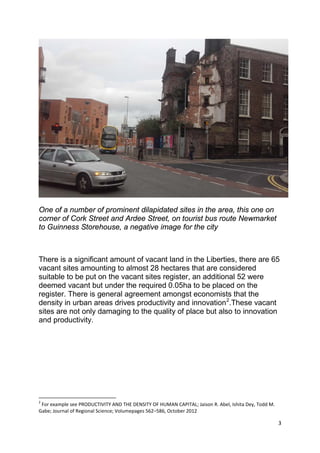
One of a number of prominent dilapidated sites in the area, this one on
corner of Cork Street and Ardee Street, on tourist bus route Newmarket
to Guinness Storehouse, a negative image for the city
There is a significant amount of vacant land in the Liberties, there are 65
vacant sites amounting to almost 28 hectares that are considered
suitable to be put on the vacant sites register, an additional 52 were
deemed vacant but under the required 0.05ha to be placed on the
register. There is general agreement amongst economists that the
density in urban areas drives productivity and innovation2
2
For example see PRODUCTIVITY AND THE DENSITY OF HUMAN CAPITAL; Jaison R. Abel, Ishita Dey, Todd M.
Gabe; Journal of Regional Science; Volumepages 562–586, October 2012
.These vacant
sites are not only damaging to the quality of place but also to innovation
and productivity.
4
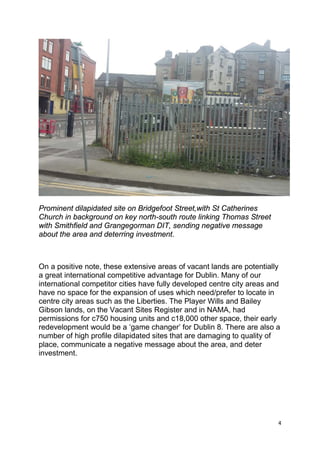
Prominent dilapidated site on Bridgefoot Street,with St Catherines
Church in background on key north-south route linking Thomas Street
with Smithfield and Grangegorman DIT, sending negative message
about the area and deterring investment.
On a positive note, these extensive areas of vacant lands are potentially
a great international competitive advantage for Dublin. Many of our
international competitor cities have fully developed centre city areas and
have no space for the expansion of uses which need/prefer to locate in
centre city areas such as the Liberties. The Player Wills and Bailey
Gibson lands, on the Vacant Sites Register and in NAMA, had
permissions for c750 housing units and c18,000 other space, their early
redevelopment would be a ‘game changer’ for Dublin 8. There are also a
number of high profile dilapidated sites that are damaging to quality of
place, communicate a negative message about the area, and deter
investment.
5
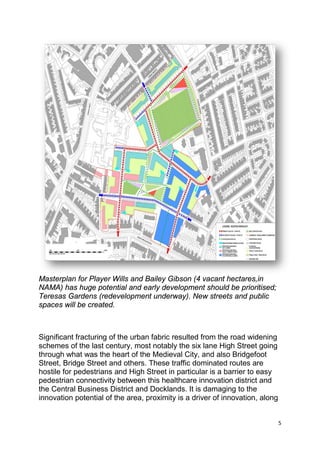
Masterplan for Player Wills and Bailey Gibson (4 vacant hectares,in
NAMA) has huge potential and early development should be prioritised;
Teresas Gardens (redevelopment underway). New streets and public
spaces will be created.
Significant fracturing of the urban fabric resulted from the road widening
schemes of the last century, most notably the six lane High Street going
through what was the heart of the Medieval City, and also Bridgefoot
Street, Bridge Street and others. These traffic dominated routes are
hostile for pedestrians and High Street in particular is a barrier to easy
pedestrian connectivity between this healthcare innovation district and
the Central Business District and Docklands. It is damaging to the
innovation potential of the area, proximity is a driver of innovation, along
6
with density and diversity as one UK study found3
. Other cities
internationally are undoing the damage of such road construction, and in
time reducing High Street to four lanes would allow for a very attractive
tree lined linear green space, a boulevard, knitting the city together4
.
Pedestrian connections to the Stephens Green business area could be
improved. Pedestrian priority is key to good placemaking and there is
great scope to improve facilities including provision of public seating.
Additional dublinbikes stations would enhance connectivity with the city
centre and Docklands.
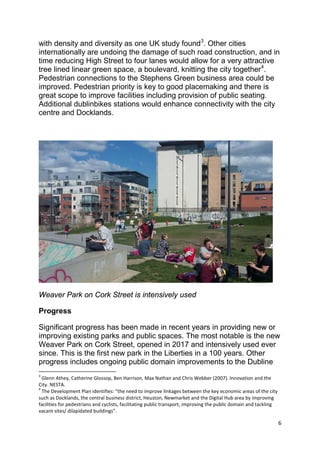
Weaver Park on Cork Street is intensively used
Progress
Significant progress has been made in recent years in providing new or
improving existing parks and public spaces. The most notable is the new
Weaver Park on Cork Street, opened in 2017 and intensively used ever
since. This is the first new park in the Liberties in a 100 years. Other
progress includes ongoing public domain improvements to the Dubline
3
Glenn Athey, Catherine Glossop, Ben Harrison, Max Nathan and Chris Webber (2007). Innovation and the
City. NESTA.
4
The Development Plan identifies: “the need to improve linkages between the key economic areas of the city
such as Docklands, the central business district, Heuston, Newmarket and the Digital Hub area by improving
facilities for pedestrians and cyclists, facilitating public transport, improving the public domain and tackling
vacant sites/ dilapidated buildings”.
7
tourist route (in association with Failte Ireland) along High Street,
Thomas Street and James Street with the renewal of St Audeons Park
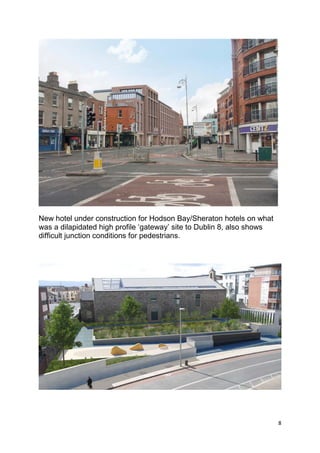
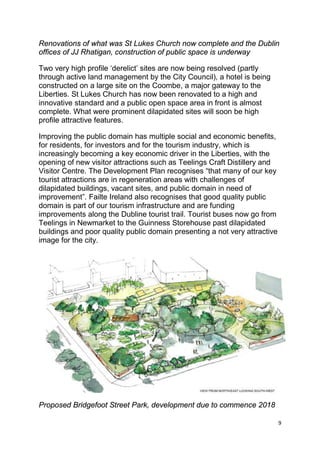
currently underway. The provision of a much needed new public park at
Bridgefoot Street is due to start this year. Planning permissions have
been secured for major public domain improvements to key public
spaces such as Newmarket and Francis Street which means that they
can proceed quite quickly once funding is available. An improvement
scheme for Dolphins Barn is due to go through the Part 8 planning
application process soon, and an improvement schemes for Cork Street
and Meath Street are to be prepared. There are many more such
placemaking initiatives in the Liberties area and these can be seen on
the website of the Liberties Business Area Improvement project, an
initiative of Dublin City Council, http://libertiesdublin.ie/ .
The Liberties is a diverse place, significant numbers of people from other
countries live in the area, about 30% overall, and diversity of background
is an important resource for innovation. The area is also diverse in
economic status, for example, more than 60% of residents in one DED
have a third level education, but this is alongside problems of
educational disadvantage, although this can be an opportunity if those
who have left school early can be reengaged with the educational and
training system. Good quality public domain provides spaces for
integration, diverse people sharing public spaces fostering social
coherence and inter-cultural understanding.
8
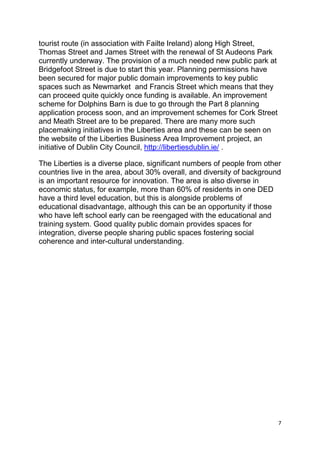
New hotel under construction for Hodson Bay/Sheraton hotels on what
was a dilapidated high profile ‘gateway’ site to Dublin 8, also shows
difficult junction conditions for pedestrians.
9
Renovations of what was St Lukes Church now complete and the Dublin
offices of JJ Rhatigan, construction of public space is underway
Two very high profile ‘derelict’ sites are now being resolved (partly
through active land management by the City Council), a hotel is being
constructed on a large site on the Coombe, a major gateway to the
Liberties. St Lukes Church has now been renovated to a high and
innovative standard and a public open space area in front is almost
complete. What were prominent dilapidated sites will soon be high
profile attractive features.
Improving the public domain has multiple social and economic benefits,
for residents, for investors and for the tourism industry, which is
increasingly becoming a key economic driver in the Liberties, with the
opening of new visitor attractions such as Teelings Craft Distillery and
Visitor Centre. The Development Plan recognises “that many of our key
tourist attractions are in regeneration areas with challenges of
dilapidated buildings, vacant sites, and public domain in need of
improvement”. Failte Ireland also recognises that good quality public
domain is part of our tourism infrastructure and are funding
improvements along the Dubline tourist trail. Tourist buses now go from
Teelings in Newmarket to the Guinness Storehouse past dilapidated
buildings and poor quality public domain presenting a not very attractive
image for the city.
Proposed Bridgefoot Street Park, development due to commence 2018
10
Events are hugely important in placemaking; as Richard Mac Cormac
puts it: “it is people and events that are the most factors of our great
public spaces … events memorialise places and gives them significance
that adds to and even refines their original meaning”5
. Even up to the
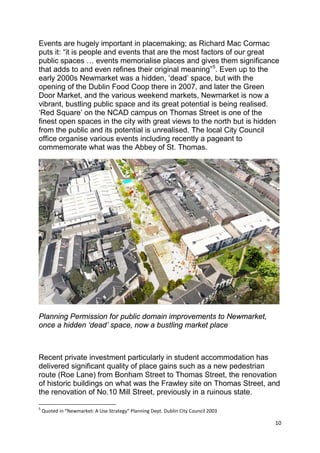
early 2000s Newmarket was a hidden, ‘dead’ space, but with the
opening of the Dublin Food Coop there in 2007, and later the Green
Door Market, and the various weekend markets, Newmarket is now a
vibrant, bustling public space and its great potential is being realised.
‘Red Square’ on the NCAD campus on Thomas Street is one of the
finest open spaces in the city with great views to the north but is hidden
from the public and its potential is unrealised. The local City Council
office organise various events including recently a pageant to
commemorate what was the Abbey of St. Thomas.
Planning Permission for public domain improvements to Newmarket,
once a hidden ‘dead’ space, now a bustling market place
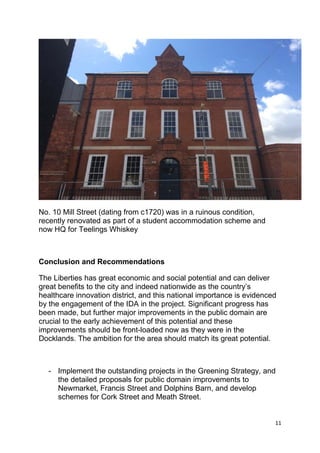
Recent private investment particularly in student accommodation has
delivered significant quality of place gains such as a new pedestrian
route (Roe Lane) from Bonham Street to Thomas Street, the renovation
of historic buildings on what was the Frawley site on Thomas Street, and
the renovation of No.10 Mill Street, previously in a ruinous state.
5
Quoted in “Newmarket: A Use Strategy” Planning Dept. Dublin City Council 2003
11
No. 10 Mill Street (dating from c1720) was in a ruinous condition,
recently renovated as part of a student accommodation scheme and
now HQ for Teelings Whiskey
Conclusion and Recommendations
The Liberties has great economic and social potential and can deliver
great benefits to the city and indeed nationwide as the country’s
healthcare innovation district, and this national importance is evidenced
by the engagement of the IDA in the project. Significant progress has
been made, but further major improvements in the public domain are
crucial to the early achievement of this potential and these
improvements should be front-loaded now as they were in the
Docklands. The ambition for the area should match its great potential.
- Implement the outstanding projects in the Greening Strategy, and
the detailed proposals for public domain improvements to
Newmarket, Francis Street and Dolphins Barn, and develop
schemes for Cork Street and Meath Street.
12
- Target five most prominent dilapidated sites for early
redevelopment.
- Target five key vacant sites for early redevelopment. Prioritise the
redevelopment of Player-Wills and Bailey Gibson sites (in NAMA)
as the next big step in the transformation of the area, and continue
redevelopment of Teresas Gardens.
- Set a target of, for example, 500 street trees to be planted every
year for the next five years.
- Provide more Dublinbikes stations in places such as Newmarket.
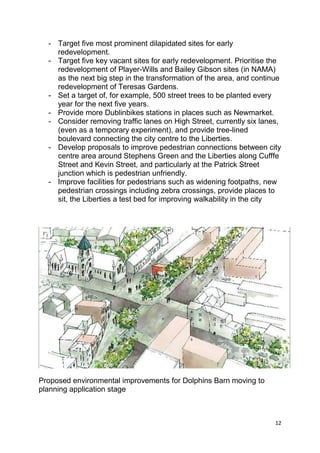
- Consider removing traffic lanes on High Street, currently six lanes,
(even as a temporary experiment), and provide tree-lined
boulevard connecting the city centre to the Liberties.
- Develop proposals to improve pedestrian connections between city
centre area around Stephens Green and the Liberties along Cufffe
Street and Kevin Street, and particularly at the Patrick Street
junction which is pedestrian unfriendly.
- Improve facilities for pedestrians such as widening footpaths, new
pedestrian crossings including zebra crossings, provide places to
sit, the Liberties a test bed for improving walkability in the city
Proposed environmental improvements for Dolphins Barn moving to
planning application stage
13
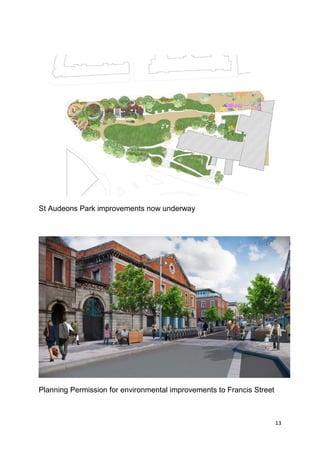
St Audeons Park improvements now underway
Planning Permission for environmental improvements to Francis Street
14
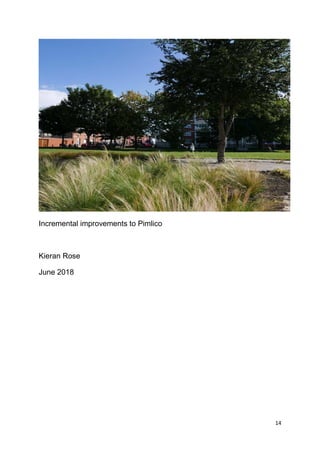
Incremental improvements to Pimlico
Kieran Rose
June 2018

Placemaking, Innovation, and Planning: Dublin 8

  • 1.
    1 Placemaking, Innovation, andPlanning: Dublin 8 “There is increasing recognition that ‘quality of place’ is crucial to the economic success of the city, in attracting FDI, attracting and retaining key scarce talent, tourists, and residents.” Dublin City Development Plan “ a recent trend is that in other cities, international business activities are locating into previously neglected fringe areas “ .. “a mushrooming digital economy in recent years has moved the new districts towards centre stage in the modern city economy” Global Cities: The 2015 Report Knight Frank “Placemaking happens when buildings are transformed into vibrant urban spaces that offer wellbeing, pleasure and inspiration. Its success can be measured by improved lives, greater happiness…” Gehl/CBRE “To reinstate the dignity of the Liberties/Coombe …” Vision set out in Integrated Area Plan 1998 Policy The Development Plan sets out strong policies on the role of placemaking in promoting economic development, the key role of regeneration areas or ‘innovation’ districts’1 These policies are further elaborated in development principles set out in five Strategic Development and Regeneration Areas (SDRA) for the Liberties: St James Medical Campus and Environs; Heuston Station; St. Teresas Gardens and Player-Wills; Newmarket and Digital Hub, and Dolphin House. The Liberties has the greatest extent of SDRAs in central city area, second only to Docklands, showing its great development potential. The SDRA for St James sets out “A sense of place” as one of its guiding principles, and objectives include to open up (such as the Liberties) in improving the international competitiveness of the city, and how to capitalise on the opportunities presented by the major public investment in healthcare facilities on the St James’s Hospital campus, such as by improving the public realm. 1 The Brookings Institute has published a series of papers on Innovation Districts, see for example, http://www.brookings.edu/research/papers/2015/06/24-one-year-innovation-districts-katz-vey- wagner#.VZTfJW3L4Qs.mailto
  • 2.
    2 new pedestrian linksto Fatima/Herberton and east to Grand Canal Harbour and the Guinness lands, and to improve the linear space at James’s Walk. Indeed all the SDRAs set out placemaking objectives such as to provide new streets and public spaces. The Development Plan recognises that: “‘quality of place’, ‘clean, green, safe’, is crucial to the economic success of the city, in attracting foreign and domestic investment”. The Development Plan highlights the role of innovation and the city: “Innovation in all its dimensions will continue as the central driver of wealth creation, economic progress and prosperity in the coming decades. Competitive cities embed innovation across all fields of activity including enterprise, education, tourism, public policy and civic engagement.” It states: “cities are crucibles of innovation and .. the city centre Z5 zoned area and inner city area including the Docklands is the crucial metropolitan and national resource for innovation, promoting the proximity and diversity of uses that foster innovation.” “Qualities such as openness, diversity of people and global links all spur innovation.” Innovation in cities often happens in serendipitous encounters between people with different skills, backgrounds and resources in public and semi-public places like cafes. Challenges The Liberties has great character and potential but also great problems including poor quality public domain, lack of green spaces, dereliction and vacant sites, traffic domination and the damage to the integrity of the area by the road widening schemes of the last century. There are also significant levels of social disadvantage. According to the “The Liberties Greening Strategy (Dublin City Council, 2014) the area is “extremely deficient in quality green space” with provision at a rate of 0.7m2 compared to 15m2 per person for the south east quadrant of the Canal ring. A very high percentage (c70%) of residents live in apartments, or in terrace housing with little private gardens, and with many residents living in disadvantage, there is even a greater need for quality public open space. The Greening Strategy then sets out a vision for a network of new urban parks, heritage green spaces, improved play areas and street tree planting, providing a road map for improved placemaking.
  • 3.
    3 One of anumber of prominent dilapidated sites in the area, this one on corner of Cork Street and Ardee Street, on tourist bus route Newmarket to Guinness Storehouse, a negative image for the city There is a significant amount of vacant land in the Liberties, there are 65 vacant sites amounting to almost 28 hectares that are considered suitable to be put on the vacant sites register, an additional 52 were deemed vacant but under the required 0.05ha to be placed on the register. There is general agreement amongst economists that the density in urban areas drives productivity and innovation2 2 For example see PRODUCTIVITY AND THE DENSITY OF HUMAN CAPITAL; Jaison R. Abel, Ishita Dey, Todd M. Gabe; Journal of Regional Science; Volumepages 562–586, October 2012 .These vacant sites are not only damaging to the quality of place but also to innovation and productivity.
  • 4.
    4 Prominent dilapidated siteon Bridgefoot Street,with St Catherines Church in background on key north-south route linking Thomas Street with Smithfield and Grangegorman DIT, sending negative message about the area and deterring investment. On a positive note, these extensive areas of vacant lands are potentially a great international competitive advantage for Dublin. Many of our international competitor cities have fully developed centre city areas and have no space for the expansion of uses which need/prefer to locate in centre city areas such as the Liberties. The Player Wills and Bailey Gibson lands, on the Vacant Sites Register and in NAMA, had permissions for c750 housing units and c18,000 other space, their early redevelopment would be a ‘game changer’ for Dublin 8. There are also a number of high profile dilapidated sites that are damaging to quality of place, communicate a negative message about the area, and deter investment.
  • 5.
    5 Masterplan for PlayerWills and Bailey Gibson (4 vacant hectares,in NAMA) has huge potential and early development should be prioritised; Teresas Gardens (redevelopment underway). New streets and public spaces will be created. Significant fracturing of the urban fabric resulted from the road widening schemes of the last century, most notably the six lane High Street going through what was the heart of the Medieval City, and also Bridgefoot Street, Bridge Street and others. These traffic dominated routes are hostile for pedestrians and High Street in particular is a barrier to easy pedestrian connectivity between this healthcare innovation district and the Central Business District and Docklands. It is damaging to the innovation potential of the area, proximity is a driver of innovation, along
  • 6.
    6 with density anddiversity as one UK study found3 . Other cities internationally are undoing the damage of such road construction, and in time reducing High Street to four lanes would allow for a very attractive tree lined linear green space, a boulevard, knitting the city together4 . Pedestrian connections to the Stephens Green business area could be improved. Pedestrian priority is key to good placemaking and there is great scope to improve facilities including provision of public seating. Additional dublinbikes stations would enhance connectivity with the city centre and Docklands. Weaver Park on Cork Street is intensively used Progress Significant progress has been made in recent years in providing new or improving existing parks and public spaces. The most notable is the new Weaver Park on Cork Street, opened in 2017 and intensively used ever since. This is the first new park in the Liberties in a 100 years. Other progress includes ongoing public domain improvements to the Dubline 3 Glenn Athey, Catherine Glossop, Ben Harrison, Max Nathan and Chris Webber (2007). Innovation and the City. NESTA. 4 The Development Plan identifies: “the need to improve linkages between the key economic areas of the city such as Docklands, the central business district, Heuston, Newmarket and the Digital Hub area by improving facilities for pedestrians and cyclists, facilitating public transport, improving the public domain and tackling vacant sites/ dilapidated buildings”.
  • 7.
    7 tourist route (inassociation with Failte Ireland) along High Street, Thomas Street and James Street with the renewal of St Audeons Park currently underway. The provision of a much needed new public park at Bridgefoot Street is due to start this year. Planning permissions have been secured for major public domain improvements to key public spaces such as Newmarket and Francis Street which means that they can proceed quite quickly once funding is available. An improvement scheme for Dolphins Barn is due to go through the Part 8 planning application process soon, and an improvement schemes for Cork Street and Meath Street are to be prepared. There are many more such placemaking initiatives in the Liberties area and these can be seen on the website of the Liberties Business Area Improvement project, an initiative of Dublin City Council, http://libertiesdublin.ie/ . The Liberties is a diverse place, significant numbers of people from other countries live in the area, about 30% overall, and diversity of background is an important resource for innovation. The area is also diverse in economic status, for example, more than 60% of residents in one DED have a third level education, but this is alongside problems of educational disadvantage, although this can be an opportunity if those who have left school early can be reengaged with the educational and training system. Good quality public domain provides spaces for integration, diverse people sharing public spaces fostering social coherence and inter-cultural understanding.
  • 8.
    8 New hotel underconstruction for Hodson Bay/Sheraton hotels on what was a dilapidated high profile ‘gateway’ site to Dublin 8, also shows difficult junction conditions for pedestrians.
  • 9.
    9 Renovations of whatwas St Lukes Church now complete and the Dublin offices of JJ Rhatigan, construction of public space is underway Two very high profile ‘derelict’ sites are now being resolved (partly through active land management by the City Council), a hotel is being constructed on a large site on the Coombe, a major gateway to the Liberties. St Lukes Church has now been renovated to a high and innovative standard and a public open space area in front is almost complete. What were prominent dilapidated sites will soon be high profile attractive features. Improving the public domain has multiple social and economic benefits, for residents, for investors and for the tourism industry, which is increasingly becoming a key economic driver in the Liberties, with the opening of new visitor attractions such as Teelings Craft Distillery and Visitor Centre. The Development Plan recognises “that many of our key tourist attractions are in regeneration areas with challenges of dilapidated buildings, vacant sites, and public domain in need of improvement”. Failte Ireland also recognises that good quality public domain is part of our tourism infrastructure and are funding improvements along the Dubline tourist trail. Tourist buses now go from Teelings in Newmarket to the Guinness Storehouse past dilapidated buildings and poor quality public domain presenting a not very attractive image for the city. Proposed Bridgefoot Street Park, development due to commence 2018
  • 10.
    10 Events are hugelyimportant in placemaking; as Richard Mac Cormac puts it: “it is people and events that are the most factors of our great public spaces … events memorialise places and gives them significance that adds to and even refines their original meaning”5 . Even up to the early 2000s Newmarket was a hidden, ‘dead’ space, but with the opening of the Dublin Food Coop there in 2007, and later the Green Door Market, and the various weekend markets, Newmarket is now a vibrant, bustling public space and its great potential is being realised. ‘Red Square’ on the NCAD campus on Thomas Street is one of the finest open spaces in the city with great views to the north but is hidden from the public and its potential is unrealised. The local City Council office organise various events including recently a pageant to commemorate what was the Abbey of St. Thomas. Planning Permission for public domain improvements to Newmarket, once a hidden ‘dead’ space, now a bustling market place Recent private investment particularly in student accommodation has delivered significant quality of place gains such as a new pedestrian route (Roe Lane) from Bonham Street to Thomas Street, the renovation of historic buildings on what was the Frawley site on Thomas Street, and the renovation of No.10 Mill Street, previously in a ruinous state. 5 Quoted in “Newmarket: A Use Strategy” Planning Dept. Dublin City Council 2003
  • 11.
    11 No. 10 MillStreet (dating from c1720) was in a ruinous condition, recently renovated as part of a student accommodation scheme and now HQ for Teelings Whiskey Conclusion and Recommendations The Liberties has great economic and social potential and can deliver great benefits to the city and indeed nationwide as the country’s healthcare innovation district, and this national importance is evidenced by the engagement of the IDA in the project. Significant progress has been made, but further major improvements in the public domain are crucial to the early achievement of this potential and these improvements should be front-loaded now as they were in the Docklands. The ambition for the area should match its great potential. - Implement the outstanding projects in the Greening Strategy, and the detailed proposals for public domain improvements to Newmarket, Francis Street and Dolphins Barn, and develop schemes for Cork Street and Meath Street.
  • 12.
    12 - Target fivemost prominent dilapidated sites for early redevelopment. - Target five key vacant sites for early redevelopment. Prioritise the redevelopment of Player-Wills and Bailey Gibson sites (in NAMA) as the next big step in the transformation of the area, and continue redevelopment of Teresas Gardens. - Set a target of, for example, 500 street trees to be planted every year for the next five years. - Provide more Dublinbikes stations in places such as Newmarket. - Consider removing traffic lanes on High Street, currently six lanes, (even as a temporary experiment), and provide tree-lined boulevard connecting the city centre to the Liberties. - Develop proposals to improve pedestrian connections between city centre area around Stephens Green and the Liberties along Cufffe Street and Kevin Street, and particularly at the Patrick Street junction which is pedestrian unfriendly. - Improve facilities for pedestrians such as widening footpaths, new pedestrian crossings including zebra crossings, provide places to sit, the Liberties a test bed for improving walkability in the city Proposed environmental improvements for Dolphins Barn moving to planning application stage
  • 13.
    13 St Audeons Parkimprovements now underway Planning Permission for environmental improvements to Francis Street
  • 14.
    14 Incremental improvements toPimlico Kieran Rose June 2018