THE TROUBLE WITH NORMAL BY MICHAEL WARNER THE EVOLUTION OF THE GAY MARRIAGE DEBATE 1999-2009 AND
GAY MARRIAGE  =   STATE REGULATED SEX? Warner makes the argument that gay marriage would result in  equality for some  but the  denial of rights to others  -- essentially a continuation of the current  dual-class society . His argument stems from the  Bowers v. Hardwick  Supreme Court decision that  upheld anti-sodomy laws  in many states across the US. But  Bowers v. Hardwick  no longer applies  to this argument.
IN THE DECADE SINCE  THE TROUBLE WITH NORMAL 'S PUBLICATION: Lawrence  v.  Texas United States Supreme Court decision in June 2003
Struck down state laws banning the practice of sodomy between consenting same-sex or heterosexual adults in private
Fundamentally altered the grounds of the state to legislate sex acts between adults
Lawrence  v.  Texas The legal arguments for striking down the sodomy ban were twofold -- both of which hold important implications for state regulation of consensual adult relationships Due Process The principle that the government must respect all of the legal rights that are owed to a person under the law, instead of respecting only some of those rights. Lawrence v. Texas  applied "substantive due process," which enabled the plaintiffs to argue that they had been denied a constitutionally-based liberty (a right to privacy) and that sodomy laws limited their full rights as citizens by intruding on their consensual private acts
Equal Protection The 14 th  Amendment states that "no state shall … deny to any person within its jurisdiction the full protection of the law." Despite the fact that the Declaration of Independence asserted that "all men are created equal," there were no provisions in place to ensure that all men are  treated  equal[ly]. The equal protection clause gave the judiciary the power to enforce that principle against the states. Justice Sandra Day O'Connor moved to strike down sodomy laws based on equal protection -- and in doing so, provided a legal argument for striking down laws that prohibited against a group, rather than an act. (Texas' sodomy law was homosexuals-only.)
In her opinion, she noted that this element of equal protection created an opportunity for recognition of same-sex couples, if the states banning marriage for gays also banned domestic partnerships and civil unions. She reasoned that laws banning same-sex marriage were permissible when they intended to "preserve" traditional marriage, but if the laws only served to bar homosexuals from rights that would be otherwise available (such as through civil unions) then they would be unconstitutional under equal protection. Lawrence  v.  Texas
IN THE DECADE SINCE  THE TROUBLE WITH NORMAL 'S PUBLICATION: Massachusetts and Connecticut fully recognize gay marriage
Vermont, New Jersey, and New Hampshire have civil unions that are explicitly defined as offering the same benefits as marriage under state law
Maine, Hawaii, DC, Oregon, Washington, and Maryland have same-sex domestic partnerships which offer some, not all, of the benefits of marriage
Rhode Island and New York recognize same-sex marriages performed in different states
Thirty  states have  constitutional amendments  that explicitly  define marriage  as between  one man and one woman , or  explicitly ban recognition  of same-sex civil unions or domestic partnerships ON THE OTHER SIDE ...
ON THE OTHER SIDE ... Three  states  prohibit any legal status  for same sex couples ON THE OTHER SIDE ...
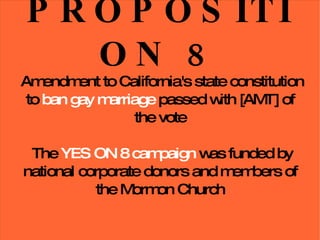
PROPOSITION 8 Amendment to California's state constitution to  ban gay marriage  passed with [AMT] of the vote
The  YES ON 8 campaign  was funded by national corporate donors and members of the Mormon Church
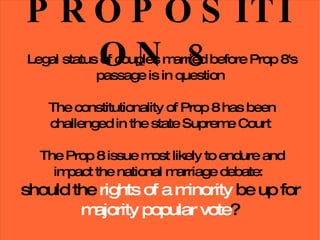
PROPOSITION 8 Legal status of couples married before Prop 8's passage is in question

normal

  • 1.
    THE TROUBLE WITHNORMAL BY MICHAEL WARNER THE EVOLUTION OF THE GAY MARRIAGE DEBATE 1999-2009 AND
  • 2.
    GAY MARRIAGE = STATE REGULATED SEX? Warner makes the argument that gay marriage would result in equality for some but the denial of rights to others -- essentially a continuation of the current dual-class society . His argument stems from the Bowers v. Hardwick Supreme Court decision that upheld anti-sodomy laws in many states across the US. But Bowers v. Hardwick no longer applies to this argument.
  • 3.
    IN THE DECADESINCE THE TROUBLE WITH NORMAL 'S PUBLICATION: Lawrence v. Texas United States Supreme Court decision in June 2003
  • 4.
    Struck down statelaws banning the practice of sodomy between consenting same-sex or heterosexual adults in private
  • 5.
    Fundamentally altered thegrounds of the state to legislate sex acts between adults
  • 6.
    Lawrence v. Texas The legal arguments for striking down the sodomy ban were twofold -- both of which hold important implications for state regulation of consensual adult relationships Due Process The principle that the government must respect all of the legal rights that are owed to a person under the law, instead of respecting only some of those rights. Lawrence v. Texas applied "substantive due process," which enabled the plaintiffs to argue that they had been denied a constitutionally-based liberty (a right to privacy) and that sodomy laws limited their full rights as citizens by intruding on their consensual private acts
  • 7.
    Equal Protection The14 th Amendment states that "no state shall … deny to any person within its jurisdiction the full protection of the law." Despite the fact that the Declaration of Independence asserted that "all men are created equal," there were no provisions in place to ensure that all men are treated equal[ly]. The equal protection clause gave the judiciary the power to enforce that principle against the states. Justice Sandra Day O'Connor moved to strike down sodomy laws based on equal protection -- and in doing so, provided a legal argument for striking down laws that prohibited against a group, rather than an act. (Texas' sodomy law was homosexuals-only.)
  • 8.
    In her opinion,she noted that this element of equal protection created an opportunity for recognition of same-sex couples, if the states banning marriage for gays also banned domestic partnerships and civil unions. She reasoned that laws banning same-sex marriage were permissible when they intended to "preserve" traditional marriage, but if the laws only served to bar homosexuals from rights that would be otherwise available (such as through civil unions) then they would be unconstitutional under equal protection. Lawrence v. Texas
  • 9.
    IN THE DECADESINCE THE TROUBLE WITH NORMAL 'S PUBLICATION: Massachusetts and Connecticut fully recognize gay marriage
  • 10.
    Vermont, New Jersey,and New Hampshire have civil unions that are explicitly defined as offering the same benefits as marriage under state law
  • 11.
    Maine, Hawaii, DC,Oregon, Washington, and Maryland have same-sex domestic partnerships which offer some, not all, of the benefits of marriage
  • 12.
    Rhode Island andNew York recognize same-sex marriages performed in different states
  • 13.
    Thirty stateshave constitutional amendments that explicitly define marriage as between one man and one woman , or explicitly ban recognition of same-sex civil unions or domestic partnerships ON THE OTHER SIDE ...
  • 14.
    ON THE OTHERSIDE ... Three states prohibit any legal status for same sex couples ON THE OTHER SIDE ...
  • 15.
    PROPOSITION 8 Amendmentto California's state constitution to ban gay marriage passed with [AMT] of the vote
  • 16.
    The YESON 8 campaign was funded by national corporate donors and members of the Mormon Church
  • 17.
    PROPOSITION 8 Legalstatus of couples married before Prop 8's passage is in question