Presentation
Shermaine Perry
Dr. Angela Smith
Constitutional and Administrative Law
10 June 2012
The Declaration of Independence
enshrines three basic rights:
“the right to life, liberty and the
pursuit of happiness.”
Let’s take a closer
look
Summary Perspective
Defense of Marriage Act

General Issue: MARRIAGE

(1996)

“Those who deny freedom to
others deserve it not for
themselves.”
–Abraham Lincoln

Specific Issue: SAME-SEX MARRIAGE
Summary Perspective (cont)
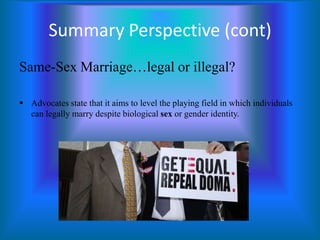
Same-Sex Marriage…legal or illegal?
 Advocates state that it aims to level the playing field in which individuals
can legally marry despite biological sex or gender identity.
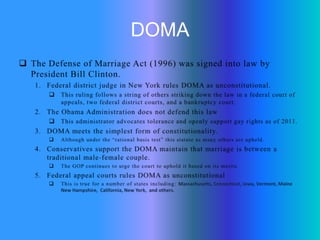
DOMA
Major Court Cases
Plessy v. Ferguson (1896)
Perez v. Sharp (1948)
Loving v. Virginia (1967)
Plessy v. Ferguson
FACTS
 Plessy (7/8’s Caucasian descent and 1/8 African American descent)
bought a first class ticket and boarded a “whites-only” railcar.
 Once confronted from staff, Plessy was removed from the railcar;
subsequently charged for violating the Separate Car Act and remanded
for trial.
 After being convicted, Plessy filed an appeal citing violations of his
13th and 14th Amendment rights.

ISSUES
 Is there an unjust implication of race inferiority?
 Violations of 13th and 14th Amendment rights, as well as Equal
Protection under the law

RULE
 Landmark U.S. Supreme Court decision of separate but equal.
Perez v. Sharp
FACTS
 Andrea Perez (Hispanic female) and Sylvester Davis (African American
male) applied for marriage license to join together as husband and
wife. The County Clerk refused to issue the license citing California
Civil Code Section 60. Perez filed suit shortly after.

ISSUES
 Do these parties have the right to get married?
 Violations of 14th Amendment rights, as well as Equal Protection
under the law.
 Did the state infringe upon Perez’s right to participate in a religious
sacrament?

RULE
 The statute was struck down. The Court ruled that the state cannot
meddle among the parties in marriage in prejudice.
 The court held that marriage is a fundamental right.
 FACTS

Loving v. Virginia

 Mildred Jeter and Richard Perry Loving eloped across state lines to D.C.
only to face criminal charges upon their return to Virginia. Loving was
sentenced by the State to one year imprisonment, with the opinion to
suspend sentencing if they agree to leave the state.

 ISSUES
 Does this statute discriminate unjustly?
 Does the act of marriage itself warrant punishment?
 Is this direct contradiction to “the pursuit of happiness” guaranteed by the
Constitution?
 Is there a violation of the due process clause and the equal protection
clause?

 RULE
 The State Court upheld the statute as it promotes “racial integrity.”
 The Supreme Court struck down the “Racial Integrity Act of 1924,” as
unlawful, thereby overturning Pace v. Alabama (1883) and ending all racebased legal restrictions on marriage in the U.S.
Legal Ramifications
Negative Consequences for your Actions

FINES
CONTEMPT
IMPRISONMENT
CASE DISMISSAL
LOSS OF BENEFITS
Legal Ramifications
Positive Consequences for your Actions

POLICY REFORM
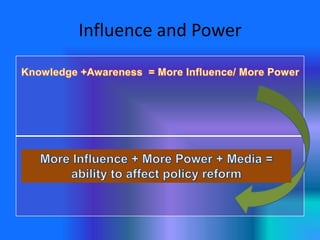
Influence and Power
Weighing the Statute
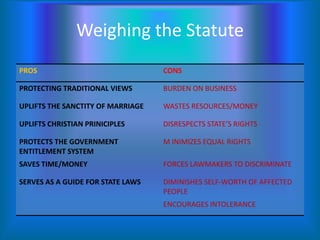
PROS

CONS

PROTECTING TRADITIONAL VIEWS

BURDEN ON BUSINESS

UPLIFTS THE SANCTITY OF MARRIAGE

WASTES RESOURCES/MONEY

UPLIFTS CHRISTIAN PRINICIPLES

DISRESPECTS STATE’S RIGHTS

PROTECTS THE GOVERNMENT
ENTITLEMENT SYSTEM

M INIMIZES EQUAL RIGHTS

SAVES TIME/MONEY

FORCES LAWMAKERS TO DISCRIMINATE

SERVES AS A GUIDE FOR STATE LAWS

DIMINISHES SELF-WORTH OF AFFECTED
PEOPLE
ENCOURAGES INTOLERANCE
Pros
Let’s examine why many avidly defend
this statute. I can attest this defense to
staunch conservative and deeply
religious views.
Cons
These advocates for reform hold fast to the
words of Abraham Lincoln. “Those who deny
freedom to others deserve it not for
themselves.
T H E E N D !!!
References
Beyond Analogy: Perez v. Sharp, Antimiscegenation Law, and the Fight for Same-Sex Marriage by Robin
Lenhardt :: SSRN. (n.d.). Going to search. Retrieved June 8, 2012, from
http://papers.ssrn.com/sol3/papers.cfm?abstract_id=1697630
Biskupic, J. (2010, July 14). Gay-marriage cases inch closer to Supreme Court. Arizona Local News - Phoenix
Arizona News - Phoenix Breaking News - azcentral.com. Retrieved June 12, 2012, from
http://www.azcentral.com/news/articles/2010/07/14/20100714gaymarriage0713.html
Chow, A. (2012, January 4). New Gay Rights Laws Take Effect in 2012 - Civil Rights - Law and Daily Life.
FindLaw Blogs. Retrieved June 8, 2012, from http://blogs.findlaw.com/law_and_life/2012/01/new-gayrights-laws-take-effect-in-2012.html
Daft, R. L., & Lane, P. G. (2011). The Leadership Experience (2010 Custom ed.). Mason, Ohio:
Thomson/South-Western.
Defense of Marriage Act (1996; 104th Congress H.R. 3396) - GovTrack.us. (1996, May 7). GovTrack.us:
Tracking the U.S. Congress. Retrieved June 8, 2012, from
http://www.govtrack.us/congress/bills/104/hr3396
Define miscegenation | Dictionary and Thesaurus. (n.d.). Define miscegenation | Dictionary and Thesaurus.
Retrieved June 8, 2012, from http://miscegenation.askdefine.com/
Defining Marriage: Defense of Marriage Acts and Same-Sex Marriage Laws. (2012, March 1). NCSL Home.
Retrieved June 8, 2012, from http://www.ncsl.org/issues-research/human-services/same-sex-marriageoverview.aspx
References (cont)
Ducat, C. R., & Chase, H. W. (2004). Constitutional Interpretation (8th ed.). Belmont, Calif:
Wadsworth/Thomson Learning.
Loving v. Virginia | Casebriefs. (n.d.). Law Cases & Case Briefs for Students. Retrieved June 8, 2012, from
http://www.casebriefs.com/blog/law/constitutional-law/constitutional-law-keyed-to-stone/equality-and-theconstitution/loving-v-virginia-4/
Mount, S. (2010, June 5). Constitutional Topic: Marriage - The U.S. Constitution Online - USConstitution.net.
Index Page - The U.S. Constitution Online - USConstitution.net. Retrieved June 8, 2012, from
http://www.usconstitution.net/consttop_marr.html
Obama: DOMA Unconstitutional, DOJ Should Stop Defending In Court. (2011, February 23). Breaking News
and Opinion on The Huffington Post. Retrieved June 12, 2012, from
http://www.huffingtonpost.com/2011/02/23/obama-doma-unconstitutional_n_827134.html
Szypszak, C. (2011). Understanding Law for Public Administration. Sudbury, Mass.: Jones and Bartlett
Publishers.
case, i. d. (n.d.). Reference for Perez v. Sharp - Search.com. Metasearch Search Engine - Search.com. Retrieved
June 8, 2012, from http://www.search.com/reference/Perez_v._Sharp

Civil Rights: Historical View

  • 1.
    Presentation Shermaine Perry Dr. AngelaSmith Constitutional and Administrative Law 10 June 2012
  • 3.
    The Declaration ofIndependence enshrines three basic rights: “the right to life, liberty and the pursuit of happiness.”
  • 4.
    Let’s take acloser look
  • 5.
    Summary Perspective Defense ofMarriage Act General Issue: MARRIAGE (1996) “Those who deny freedom to others deserve it not for themselves.” –Abraham Lincoln Specific Issue: SAME-SEX MARRIAGE
  • 6.
    Summary Perspective (cont) Same-SexMarriage…legal or illegal?  Advocates state that it aims to level the playing field in which individuals can legally marry despite biological sex or gender identity.
  • 7.
  • 8.
    Major Court Cases Plessyv. Ferguson (1896) Perez v. Sharp (1948) Loving v. Virginia (1967)
  • 9.
    Plessy v. Ferguson FACTS Plessy (7/8’s Caucasian descent and 1/8 African American descent) bought a first class ticket and boarded a “whites-only” railcar.  Once confronted from staff, Plessy was removed from the railcar; subsequently charged for violating the Separate Car Act and remanded for trial.  After being convicted, Plessy filed an appeal citing violations of his 13th and 14th Amendment rights. ISSUES  Is there an unjust implication of race inferiority?  Violations of 13th and 14th Amendment rights, as well as Equal Protection under the law RULE  Landmark U.S. Supreme Court decision of separate but equal.
  • 10.
    Perez v. Sharp FACTS Andrea Perez (Hispanic female) and Sylvester Davis (African American male) applied for marriage license to join together as husband and wife. The County Clerk refused to issue the license citing California Civil Code Section 60. Perez filed suit shortly after. ISSUES  Do these parties have the right to get married?  Violations of 14th Amendment rights, as well as Equal Protection under the law.  Did the state infringe upon Perez’s right to participate in a religious sacrament? RULE  The statute was struck down. The Court ruled that the state cannot meddle among the parties in marriage in prejudice.  The court held that marriage is a fundamental right.
  • 11.
     FACTS Loving v.Virginia  Mildred Jeter and Richard Perry Loving eloped across state lines to D.C. only to face criminal charges upon their return to Virginia. Loving was sentenced by the State to one year imprisonment, with the opinion to suspend sentencing if they agree to leave the state.  ISSUES  Does this statute discriminate unjustly?  Does the act of marriage itself warrant punishment?  Is this direct contradiction to “the pursuit of happiness” guaranteed by the Constitution?  Is there a violation of the due process clause and the equal protection clause?  RULE  The State Court upheld the statute as it promotes “racial integrity.”  The Supreme Court struck down the “Racial Integrity Act of 1924,” as unlawful, thereby overturning Pace v. Alabama (1883) and ending all racebased legal restrictions on marriage in the U.S.
  • 12.
    Legal Ramifications Negative Consequencesfor your Actions FINES CONTEMPT IMPRISONMENT CASE DISMISSAL LOSS OF BENEFITS
  • 13.
    Legal Ramifications Positive Consequencesfor your Actions POLICY REFORM
  • 14.
  • 15.
    Weighing the Statute PROS CONS PROTECTINGTRADITIONAL VIEWS BURDEN ON BUSINESS UPLIFTS THE SANCTITY OF MARRIAGE WASTES RESOURCES/MONEY UPLIFTS CHRISTIAN PRINICIPLES DISRESPECTS STATE’S RIGHTS PROTECTS THE GOVERNMENT ENTITLEMENT SYSTEM M INIMIZES EQUAL RIGHTS SAVES TIME/MONEY FORCES LAWMAKERS TO DISCRIMINATE SERVES AS A GUIDE FOR STATE LAWS DIMINISHES SELF-WORTH OF AFFECTED PEOPLE ENCOURAGES INTOLERANCE
  • 16.
    Pros Let’s examine whymany avidly defend this statute. I can attest this defense to staunch conservative and deeply religious views.
  • 17.
    Cons These advocates forreform hold fast to the words of Abraham Lincoln. “Those who deny freedom to others deserve it not for themselves.
  • 18.
    T H EE N D !!!
  • 19.
    References Beyond Analogy: Perezv. Sharp, Antimiscegenation Law, and the Fight for Same-Sex Marriage by Robin Lenhardt :: SSRN. (n.d.). Going to search. Retrieved June 8, 2012, from http://papers.ssrn.com/sol3/papers.cfm?abstract_id=1697630 Biskupic, J. (2010, July 14). Gay-marriage cases inch closer to Supreme Court. Arizona Local News - Phoenix Arizona News - Phoenix Breaking News - azcentral.com. Retrieved June 12, 2012, from http://www.azcentral.com/news/articles/2010/07/14/20100714gaymarriage0713.html Chow, A. (2012, January 4). New Gay Rights Laws Take Effect in 2012 - Civil Rights - Law and Daily Life. FindLaw Blogs. Retrieved June 8, 2012, from http://blogs.findlaw.com/law_and_life/2012/01/new-gayrights-laws-take-effect-in-2012.html Daft, R. L., & Lane, P. G. (2011). The Leadership Experience (2010 Custom ed.). Mason, Ohio: Thomson/South-Western. Defense of Marriage Act (1996; 104th Congress H.R. 3396) - GovTrack.us. (1996, May 7). GovTrack.us: Tracking the U.S. Congress. Retrieved June 8, 2012, from http://www.govtrack.us/congress/bills/104/hr3396 Define miscegenation | Dictionary and Thesaurus. (n.d.). Define miscegenation | Dictionary and Thesaurus. Retrieved June 8, 2012, from http://miscegenation.askdefine.com/ Defining Marriage: Defense of Marriage Acts and Same-Sex Marriage Laws. (2012, March 1). NCSL Home. Retrieved June 8, 2012, from http://www.ncsl.org/issues-research/human-services/same-sex-marriageoverview.aspx
  • 20.
    References (cont) Ducat, C.R., & Chase, H. W. (2004). Constitutional Interpretation (8th ed.). Belmont, Calif: Wadsworth/Thomson Learning. Loving v. Virginia | Casebriefs. (n.d.). Law Cases & Case Briefs for Students. Retrieved June 8, 2012, from http://www.casebriefs.com/blog/law/constitutional-law/constitutional-law-keyed-to-stone/equality-and-theconstitution/loving-v-virginia-4/ Mount, S. (2010, June 5). Constitutional Topic: Marriage - The U.S. Constitution Online - USConstitution.net. Index Page - The U.S. Constitution Online - USConstitution.net. Retrieved June 8, 2012, from http://www.usconstitution.net/consttop_marr.html Obama: DOMA Unconstitutional, DOJ Should Stop Defending In Court. (2011, February 23). Breaking News and Opinion on The Huffington Post. Retrieved June 12, 2012, from http://www.huffingtonpost.com/2011/02/23/obama-doma-unconstitutional_n_827134.html Szypszak, C. (2011). Understanding Law for Public Administration. Sudbury, Mass.: Jones and Bartlett Publishers. case, i. d. (n.d.). Reference for Perez v. Sharp - Search.com. Metasearch Search Engine - Search.com. Retrieved June 8, 2012, from http://www.search.com/reference/Perez_v._Sharp

Editor's Notes

  • #3 The pursuit of happiness in the 21st century.
  • #4 The Declaration of Independence enshrines three basic rights: “the right to life, liberty and the pursuit of happiness.” This presentation will refute the Defense of Marriage Act; through the analysis of Court decisions preceding and anteceding these statutes and the protection all are afforded through Constitutional guarantees. It will examine views on same-sex marriage and anti-miscegenation statutes in order to unfold issues of the marginalization of minority groups. It will illustrate the State and Federal Courts willingness in some cases to uphold the Fourteenth Amendment and Equal Protection Clause; as well as, instances where their silence speaks louder than words. This is an underlying issue in these statutes that deems on protecting the sanctity of marriage, protection of individual rights, and the pursuit of happiness.
  • #5 Although there are a great number of federal statutes that are highly controversial in nature, present in the media, and affecting the social chemistry of the community in a given manner; this document will focus on civil rights as it pertains to marriage. The definition of marriage itself remains arguable among warring ideologies.
  • #6 Specifically we will discuss the Defense of Marriage Act (DOMA). This federal statute defines marriage as the legal union of one man and one woman. “At the heart of the rule of law lie the ideal that everyone should be treated fairly and equally before the law;” (Szypszak, 2011, 66) however, the fundamental guarantees included in the Constitution afford many these rights and unfortunately marginalize and stifle the voices of others.
  • #7 The recent surge in the gay rights movement and growth of the LGBT community. The acronym LGBT collectively refers to the "lesbian, gay, bisexual, and transgender" community. The LGBT community has afforded the media attention and constitutional challenge to the law. “Invalidation may not address harm that individuals have suffered from violations of their constitutional rights. Sometimes the Court can rectify this situation” (Szypszak, 2011, p.66). In this instance the courts can, as gay-rights advocates seek to implement policy reform. My summary perspective of the statute is that it should only specify marriage as a legal union between two individuals regardless of gender. The Lesbian, Gay, Bisexual, and Transsexual community desires to legally engage in the act of marriage. This is a civil rights issue, and rightfully so.
  • #8 This statute remains highly controversial as many view the Defense of Marriage Act clearly violates the Equal Protection Clause. Each courts ruling, in the states listed, cite the regulations’ unfairness in explicitly denying equal benefits to legally married same-sex couples. Same-sex couples can marry; however, these individuals do not have the opportunity to utilize all the benefits of a married couple, as many states do not recognize their union. The U.S. appeals court in Boston became the first of its nature to act in this manner. This decision comes as a victory for the Obama administration and organizations who support gay rights; as well as dealing a detrimental blow to the GOP who defends the merit and scope of the DOMA as is. Perhaps this decision will set the tone for this dispute concerning this issue as it relates to its presence on the upcoming Supreme Court docket.
  • #9 The Prop 8 debate, the Boston decision, the marches, and the rallies all antecede these landmark cases involving state issued-mandates on marriage restrictions. “Lawsuits over gay marriage have escalated on the nation's two coasts, energizing advocates on both sides and bringing the legal battle over same-sex marriage closer to the U.S. Supreme Court” (Biskupic, 2010, para 1). Gay marriage cases inch closer to the Supreme Court.
  • #10 InPlessy, the court upheld the constitutionality of state laws requiring racial segregation in public areas adopting the doctrine of “separate but equal.” It prohibited interracial marriage, among other interrelated activities; therefore, limiting what individuals can legally engage in this institution. This statute socially and economically oppressed an entire racial group.
  • #11 The Supreme Court of California acknowledged that interracial sanctions on marriage violated the Fourteenth Amendment of the United States Constitution. The Court ruled that marriage is a fundamental right, one in which the state cannot meddle among the parties in prejudice; consequently, infringing on individual civil rights, due process, and equal protection under the law. “By its decision in this case, the California Supreme Court became the first court of the twentieth century to hold that a state miscegenation law violates the Federal Constitution and refuses to meddle in marriage” (Search, para 3). The Court’s decision in this case set the standard for case law that would naturally arise within cases to follow.
  • #12 The state of Virginia endorsed laws labeling the union itself as a felony for a white person to marry a person of the black race, and vice versa. The Supreme Court of Appeals in Virginia upheld the statute citing its inherent protection of racial integrity, and that it avoids the discrimination of race even if in terms of characteristically because the punishment applies to all involved.
  • #13 Fines, contempt, imprisonment, case dismissal, policy reform, and loss of benefits are all consequences for one’s action and/or inaction. The legal ramifications and violations of any legal subjects and/or decisions related to any constitutional principles can be detrimental to the violators finances, influence, and personal freedom. “Criminal laws also have been enacted to address civil rights violations,” (Szypszak, 2011, p.68) including imprisonment, fines, and/or both in conjunction. On the issue of disregarding the court’s orders, an individual may find themselves incurring wrath that manifest as case dismissal and contempt. Loss of benefits can describe a range of options including government assistance, loss of employment, and other organizational perks.
  • #14 There is a positive side to this as well, perhaps disobeying the rules can ignite fire for change and enlist the cooperation of others who share the same desire for policy reform. The end of slavery, civil rights movement, woman’s suffrage, securing voting rights, and educational reform have all developed as positive consequences for refusal to follow misguided legislation. Throughout history the most profound reform has been a direct result of individuals who refuse to follow the law and seek positive change.
  • #15 Simply put, the squeaky wheel gets the oil. One must seated at the table when decisions are made, or else they will be on the menu. I am impressed at the level of organization, interest, and action taken in order to influence policy reform concerning marriage throughout the years, and especially now.
  • #16 In weighing the Defense of Marriage Act, it is important to note the pros and cons, as many offer opinions that argue for and against the statute. Pros include protecting the traditional views and the government entitlement systems of the U.S. (although skewed), uplifting the sanctity of marriage, uplifting Biblical principles, saves time and money in litigation, as well as helping to guide state laws. Those who desire to repeal the statute cite issues of undue burdens it causes on business; subsequently wasting of resources and finances in litigation costs. The DOMA disrespects state rights, minimizes equal rights, forces lawmakers to discriminate, diminish self-worth of affected people, and perpetuates intolerance through our national community.
  • #17 Let’s examine why many avidly defend this statute. I can attest this defense to staunch conservative and deeply religious views. These individuals contend that same-sex legal unions negates the sanctity of marriage. Although I can understand this point of view, I do not agree.
  • #18 Those seek to repeal this statute view it as just another way in which the government dictates our social lives. This government regulation puts a burden on business, drain financial resources, and undermines the states’ ability to dictate in this area. The Defense of Marriage Act has inherent discrimination as it meddles with marriage on the basis of gender and sexual orientation. Gay rights advocates seek policy reform for issues of tolerance, safety, equal rights, and the pursuit of happiness, all of which are written guarantees.
  • #19 As a public administrator I seek to act in the best interest of the public, regardless of warring personal beliefs. I simply advocate for equal rights and ample representation for all. It is important to emit an image that shows concern for all groups, intolerance for discrimination, and aid in the efforts of law-abiding citizens to live life more abundantly.