Relations Among the States
Key Terms
extradite, civil law, interstate compact
Find Out
• What are some of the purposes of
interstate compacts?
• What provisions in Article IV of the Constitution
attempt to provide for cooperation among the
various state governments?
Relations Among the States
Understanding Concepts
Federalism Why is it necessary that the Constitution
require states to cooperate with one another?
Section Objective
Explain how the Constitution regulates
interstate relations.
The last two states to join the Union were
admitted in the same year—1959. Hawaii and
Alaska also have something else in common
that distinguishes them from all other states.
They do not have a common border with any
other state.
A. The Constitution requires each state to
recognize the laws and legal proceedings of
all other states in civil, not criminal, matters.
I. Interstate Relations (pages 103–105)
B. Each state must treat citizens of other states
equally with its own citizens and not
discriminate against them, though
nonresidents may not enjoy all the rights of
state citizens.
C. Criminals fleeing to other states may be
returned to their home state by extradition—
the legal process through which one state
government surrenders an accused criminal
to another state government.
D. States use interstate compacts, or
agreements among themselves, to settle
border or jurisdiction conflicts and to deal
with common problems, such as toxic waste
disposal, but these compacts must be
approved by Congress.
E. Lawsuits brought by a state against another
state are tried in the Supreme Court.
I. Interstate Relations (pages 103–105)
Do you think interstate compacts are a
good way to deal with issues such as air
and water pollution and the disposal of
hazardous waste? Why or why not?
Answers will vary. Students should support
their opinions with examples.
I. Interstate Relations (pages 103–105)
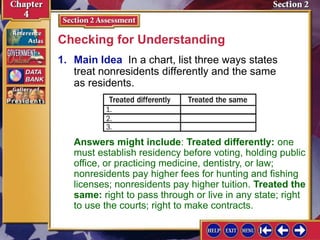
1. Main Idea In a chart, list three ways states
treat nonresidents differently and the same
as residents.
Checking for Understanding
Answers might include: Treated differently: one
must establish residency before voting, holding public
office, or practicing medicine, dentistry, or law;
nonresidents pay higher fees for hunting and fishing
licenses; nonresidents pay higher tuition. Treated the
same: right to pass through or live in any state; right
to use the courts; right to make contracts.
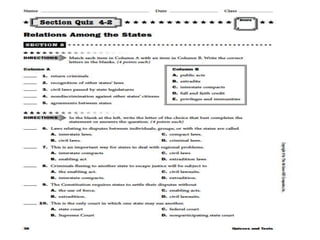
___ civil law
___ extradite
___ interstate compact
A. a written agreement
between two or more
states
B. one relating to disputes
among two or more
individuals or between
individuals and the
government
C. to return a criminal or
fugitive who flees across
state lines back to the
original state
Checking for Understanding
B
C
A
Match the term with the correct definition.
3. Identify “full faith and credit,” “privileges and
immunities.”
Checking for Understanding
“Full faith and credit” is the clause in the
Constitution that requires each state to
recognize the laws and legal proceedings of the
other states.
“Privileges and immunities” is the clause in
the Constitution that requires states to provide
citizens of another state the same privileges
and immunities it provides its own citizens.
4. What three constitutional provisions are aimed
at promoting cooperation among the states?
Checking for Understanding
States must give “full faith and credit” to the
laws of other states, give citizens from every
state the same privileges and immunities, and
extradite fugitives who cross state lines.
5. Understanding Cause and Effect What
environmental problems could interstate
compacts address, and what solutions could
they achieve?
Critical Thinking
They could address transportation of hazardous
wastes or garbage, problems dealing with water
pollution of rivers or lakes, acid rain, and so on.
Solutions that they could achieve include
imposing restrictions at the source and requiring
compensation for damage.
Federalism Imagine you have moved to a
new state. Find out if and how a driver’s
license, automobile registration, and voting
registration are changed. Write a report on
your findings.
Chapter 4 section 2

Chapter 4 section 2

  • 1.
    Relations Among theStates Key Terms extradite, civil law, interstate compact Find Out • What are some of the purposes of interstate compacts? • What provisions in Article IV of the Constitution attempt to provide for cooperation among the various state governments?
  • 2.
    Relations Among theStates Understanding Concepts Federalism Why is it necessary that the Constitution require states to cooperate with one another? Section Objective Explain how the Constitution regulates interstate relations.
  • 3.
    The last twostates to join the Union were admitted in the same year—1959. Hawaii and Alaska also have something else in common that distinguishes them from all other states. They do not have a common border with any other state.
  • 4.
    A. The Constitutionrequires each state to recognize the laws and legal proceedings of all other states in civil, not criminal, matters. I. Interstate Relations (pages 103–105) B. Each state must treat citizens of other states equally with its own citizens and not discriminate against them, though nonresidents may not enjoy all the rights of state citizens. C. Criminals fleeing to other states may be returned to their home state by extradition— the legal process through which one state government surrenders an accused criminal to another state government.
  • 5.
    D. States useinterstate compacts, or agreements among themselves, to settle border or jurisdiction conflicts and to deal with common problems, such as toxic waste disposal, but these compacts must be approved by Congress. E. Lawsuits brought by a state against another state are tried in the Supreme Court. I. Interstate Relations (pages 103–105)
  • 6.
    Do you thinkinterstate compacts are a good way to deal with issues such as air and water pollution and the disposal of hazardous waste? Why or why not? Answers will vary. Students should support their opinions with examples. I. Interstate Relations (pages 103–105)
  • 7.
    1. Main IdeaIn a chart, list three ways states treat nonresidents differently and the same as residents. Checking for Understanding Answers might include: Treated differently: one must establish residency before voting, holding public office, or practicing medicine, dentistry, or law; nonresidents pay higher fees for hunting and fishing licenses; nonresidents pay higher tuition. Treated the same: right to pass through or live in any state; right to use the courts; right to make contracts.
  • 8.
    ___ civil law ___extradite ___ interstate compact A. a written agreement between two or more states B. one relating to disputes among two or more individuals or between individuals and the government C. to return a criminal or fugitive who flees across state lines back to the original state Checking for Understanding B C A Match the term with the correct definition.
  • 9.
    3. Identify “fullfaith and credit,” “privileges and immunities.” Checking for Understanding “Full faith and credit” is the clause in the Constitution that requires each state to recognize the laws and legal proceedings of the other states. “Privileges and immunities” is the clause in the Constitution that requires states to provide citizens of another state the same privileges and immunities it provides its own citizens.
  • 10.
    4. What threeconstitutional provisions are aimed at promoting cooperation among the states? Checking for Understanding States must give “full faith and credit” to the laws of other states, give citizens from every state the same privileges and immunities, and extradite fugitives who cross state lines.
  • 11.
    5. Understanding Causeand Effect What environmental problems could interstate compacts address, and what solutions could they achieve? Critical Thinking They could address transportation of hazardous wastes or garbage, problems dealing with water pollution of rivers or lakes, acid rain, and so on. Solutions that they could achieve include imposing restrictions at the source and requiring compensation for damage.
  • 12.
    Federalism Imagine youhave moved to a new state. Find out if and how a driver’s license, automobile registration, and voting registration are changed. Write a report on your findings.