W T O  R E G I O N A L  S E M I N A R  O N  E L E C T R O N I C  C O M M E R C E Geneva, Switzerland    22 April 2002 Revenue Implications Of E-Commerce Government and Private Sector Experiences MALAYSIA Presentation by: Suhaimi Nordin Senior Manager - Borderless Marketing / E-Business Multimedia Development Corporation [email_address]
Agenda Background –  Overview of Malaysia’s Broad Vision and Strategy E-Commerce – The Scenario  Implications / Challenges of E-Commerce (The Malaysia Experience) Closing Remarks
VISION 2020 Vision 2020 – a national vision of creating a developed nation in our own mould Characteristics of a Vision 2020 society: Strong moral and ethical values self-regulating and self-managing empowered through  information  and  knowledge  based on the concept of the dignity of human-kind Characteristics of a Vision 2020 economy: Robust and resilient competitive and dynamic, but with fair and  equitable distribution of wealth
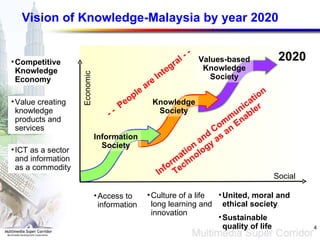
Vision of Knowledge-Malaysia by year 2020 Information Society Knowledge Society Values-based Knowledge Society 2020 Economic Social - -  People are Integral - -  Information and Communication Technology as an Enabler Access to information ICT as a sector and information as a commodity Culture of a life long learning and innovation United, moral and ethical society Sustainable quality of life Value creating knowledge products and services Competitive Knowledge Economy
Multimedia Super Corridor’s Vision – Conceived As the Next Engine of Growth for Malaysia The MSC was set up based on: The recognition that Malaysia was losing its  comparative advantage in its traditional economic sectors; Need to drive the economy towards higher productivity through technology and high value-added economic activities; Knowledge Economy and converging technologies presented the best opportunities for socio-economic transformation. The need for the adoption & application of ICT to enhance national competitiveness and to help bridge the Digital Divide.
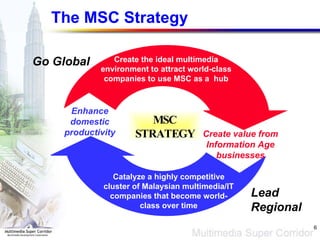
The MSC Strategy Create the ideal multimedia environment to attract world-class companies to use MSC as a  hub Catalyze a highly competitive cluster of Malaysian multimedia/IT companies that become world-class over time MSC STRATEGY Go Global Lead Regional Create value from Information Age businesses Enhance domestic productivity
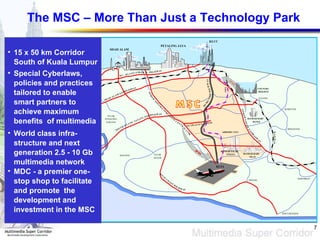
The MSC – More Than Just a Technology Park 15 x 50 km Corridor South of Kuala Lumpur Special Cyberlaws, policies and practices tailored to enable smart partners to achieve maximum benefits  of multimedia World class infra-structure and next generation 2.5 - 10  Gb multimedia network MDC - a premier one-stop shop to facilitate and promote  the development and  investment in the MSC PELABUHAN KLANG KLANG PETALING JAYA KLCC PULAU CAREY BANTING TELOK PANGLIMA GARANG TELOK DATOK BANDAR BARU NILAI KLIA SEPANG PORT DICKSON SEREMBAN BERANANG SEMENYIH COUNTRY HEIGHTS KAJANG SHAH ALAM 2 5 k m BANDAR BARU BANGI 2 0 k m S H A H A L A M E X P R E S S W A Y S O U T H K L A N G V A L L E Y E X P R E S S W A Y N O R T H - S O U T H E X P R E S S W A Y ED ER AL HI K L - K L A N G F G H W A Y N O R T H - S O U T H E X P R E S S W A Y C E N T R A L L I N K PULAU INDAH D E D I C A T E D H I G H W A Y AIRPORT CITY BANDAR SALAK TINGGI P U T R A J A Y A L I N K E R L R A A Y I L W Y W E S C O T A H S I G T H W A
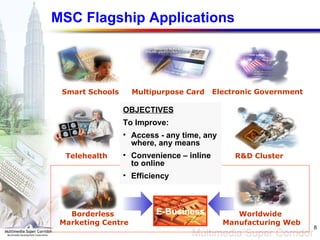
MSC Flagship Applications Telehealth Smart Schools Multipurpose Card R&D Cluster Electronic Government Worldwide  Manufacturing Web Borderless  Marketing Centre E-Business OBJECTIVES   To Improve: Access - any time, any where, any means Convenience – inline to online  Efficiency
Progress To-date 670 MSC Status companies, 50 world class Government Multi-Purpose Card (GMPC) Flagship Application Roll-Out Growing investments in technology  and high value-added economic activities Rapid growth in sales and exports New knowledge-based employment opportunities created Growth in institutions of higher learning and supply of knowledge workers Growth in SME participation Spin-offs to economy including productivity increases
World Class Companies With Regional Initiatives in the MSC
Other World Class Companies in the MSC
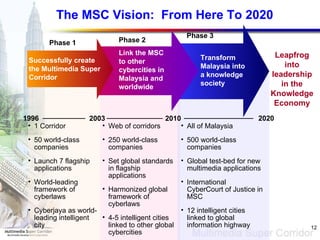
The MSC Vision:  From Here To 2020 Leapfrog into leadership in the Knowledge Economy 1 Corridor 50 world-class companies Launch 7 flagship applications World-leading framework of cyberlaws Cyberjaya as world-leading intelligent city Web of corridors 250 world-class companies Set global standards in flagship applications Harmonized global framework of cyberlaws 4-5 intelligent cities linked to other global cybercities All of Malaysia 500 world-class companies Global test-bed for new multimedia applications International CyberCourt of Justice in MSC 12 intelligent cities linked to global information highway Transform Malaysia into a knowledge society Phase 3 Phase 2 Link the MSC  to other cybercities in Malaysia and worldwide Phase 1 Successfully create the Multimedia Super Corridor 1996 2020 2003 2010
Agenda Background – Overview of Malaysia’s Broad Vision and Strategy E-Commerce – The Scenario  Implications / Challenges of E-Commerce (The Malaysia Experience) Closing Remarks
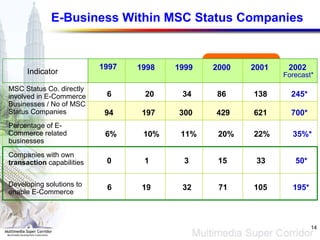
E-Business Within MSC Status Companies Companies with own  transaction  capabilities Developing solutions to enable E-Commerce 1997 1998 1999 2000 2001 2002 Forecast* MSC Status Co. directly involved in E-Commerce Businesses / No of MSC Status Companies 138 621 86 429 Percentage of E-Commerce related businesses 22% 20% 300 197 94 700* 34 11% 20 10% 35%* 245* 33 105 15 71 3 32 50* 195* Indicator 6 6% 0 6 19 1
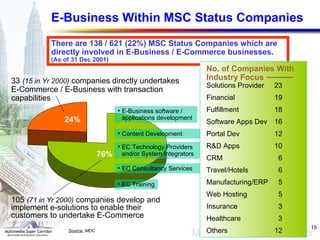
E-Business Within MSC Status Companies 33  (15 in Yr 2000)  companies directly undertakes  E-Commerce / E-Business with transaction capabilities There are 138 / 621 (22%) MSC Status Companies which are directly involved in E-Business / E-Commerce businesses.  (As of 31 Dec 2001) 24% 76% 105  (71 in Yr 2000)  companies develop and implement e-solutions to enable their customers to undertake E-Commerce Source:  MDC EC Technology Providers and/or System Integrators EC Consultancy Services Content Development EC Training E-Business software / applications development No. of Companies With Industry Focus Solutions Provider   23 Financial   19 Fulfillment   18 Software Apps Dev   16 Portal Dev   12 R&D Apps   10 CRM   6 Travel/Hotels   6 Manufacturing/ERP   5 Web Hosting   5 Insurance   3 Healthcare   3 Others   12
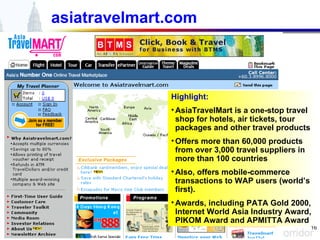
asiatravelmart.com Highlight: AsiaTravelMart is a one-stop travel shop for hotels, air tickets, tour packages and other travel products Offers more than 60,000 products from over 3,000 travel suppliers in more than 100 countries Also, offers mobile-commerce transactions to WAP users (world’s first). Awards, including PATA Gold 2000, Internet World Asia Industry Award, PIKOM Award and APMITTA Award
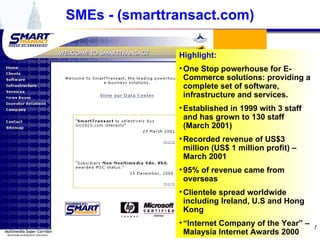
SMEs - (smarttransact.com) Highlight: One Stop powerhouse for E-Commerce solutions: providing a complete set of software, infrastructure and services. Established in 1999 with 3 staff and has grown to 130 staff (March 2001) Recorded revenue of US$3 million (US$ 1 million profit) – March 2001 95% of revenue came from overseas Clientele spread worldwide including Ireland, U.S and Hong Kong “ Internet Company of the Year” – Malaysia Internet Awards 2000
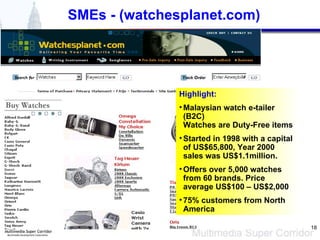
SMEs - (watchesplanet.com) Highlight: Malaysian watch e-tailer (B2C) Watches are Duty-Free items Started in 1998 with a capital of US$65,800, Year 2000 sales was US$1.1million. Offers over 5,000 watches from 60 brands. Price average US$100 – US$2,000 75% customers from North America
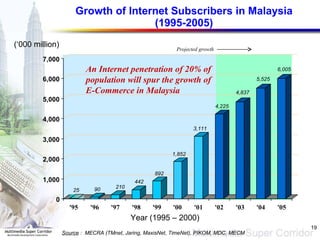
Growth of Internet Subscribers in Malaysia (1995-2005) Source  :  MECRA (TMnet, Jaring, MaxisNet, TimeNet), PIKOM, MDC, MECM 25 90 210 442 892 1,852 3,111 4,225 4,837 5,525 6,005 0 1,000 2,000 3,000 4,000 5,000 6,000 7,000 '95 '96 '97 '98 '99 '00 '01 '02 '03 '04 '05 Year (1995 – 2000) (‘000 million) Projected growth An Internet penetration of 20% of population will spur the growth of E-Commerce in Malaysia
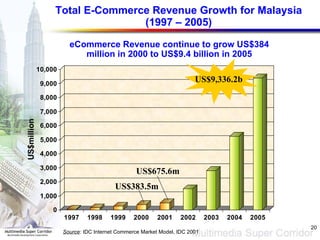
Total E-Commerce Revenue Growth for Malaysia (1997 – 2005) Source : IDC Internet Commerce Market Model, IDC 2001 eCommerce Revenue continue to grow US$384 million in 2000 to US$9.4 billion in 2005 US$383.5m US$675.6m US$million US$9,336.2b
Agenda Background – Overview of Malaysia’s Broad Vision and Strategy E-Commerce – The Scenario  Implications / Challenges of E-Commerce (The Malaysia Experience) Closing Remarks
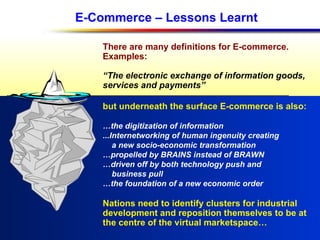
E-Commerce – Lessons Learnt There are many definitions for E-commerce. Examples: “ The electronic exchange of information goods, services and payments” but underneath the surface E-commerce is also: … the digitization of information ...Internetworking of human ingenuity creating a new socio-economic transformation … propelled by BRAINS instead of BRAWN … driven off by both technology push and  business pull … the foundation of a new economic order Nations need to identify clusters for industrial  development and reposition themselves to be at  the centre of the virtual marketspace…
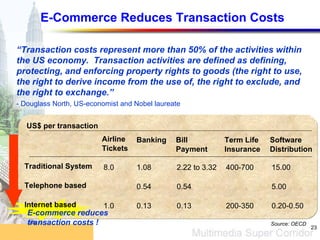
E-Commerce Reduces Transaction Costs “ Transaction costs represent more than 50% of the activities within the US economy.  Transaction activities are defined as defining, protecting, and enforcing property rights to goods (the right to use, the right to derive income from the use of, the right to exclude, and the right to exchange.” - Douglass North, US-economist and Nobel laureate   Source: OECD 8.0 1.0 Airline Tickets 1.08 0.54 0.13 2.22 to 3.32 0.54 0.13 400-700 200-350 15.00 5.00 0.20-0.50 Banking Bill Payment Term Life Insurance Software Distribution US$ per transaction E-commerce reduces  transaction costs ! Traditional System Telephone based Internet based
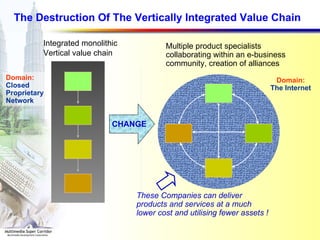
The Destruction Of The Vertically Integrated Value Chain Integrated monolithic Vertical value chain Multiple product specialists collaborating within an e-business community, creation of alliances Domain: Closed Proprietary Network Domain: The Internet CHANGE These Companies can deliver products and services at a much lower cost and utilising fewer assets !
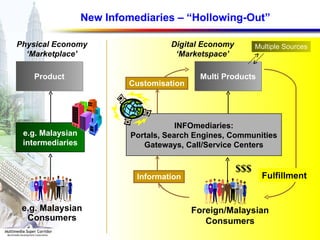
New Infomediaries – “Hollowing-Out” Physical Economy ‘ Marketplace’ Digital Economy ‘ Marketspace’ Product e.g. Malaysian Consumers $$$ Foreign/Malaysian Consumers e.g. Malaysian intermediaries Multi Products INFOmediaries: Portals, Search Engines, Communities Gateways, Call/Service Centers Information Customisation Fulfillment Multiple Sources
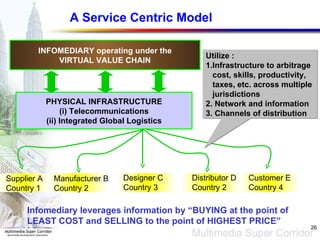
A Service Centric Model Infomediary leverages information by “BUYING at the point of LEAST COST and SELLING to the point of HIGHEST PRICE” INFOMEDIARY operating under the VIRTUAL VALUE CHAIN PHYSICAL INFRASTRUCTURE (i) Telecommunications (ii) Integrated Global Logistics Supplier A Country 1 Manufacturer B Country 2 Designer C Country 3 Distributor D Country 2 Customer E Country 4 Utilize : 1.Infrastructure to arbitrage  cost, skills, productivity,  taxes, etc. across multiple  jurisdictions 2. Network and information 3. Channels of distribution
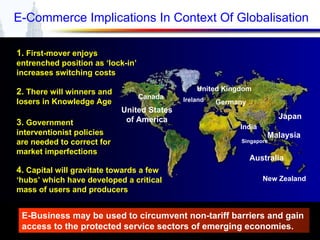
E-Commerce Implications In Context Of Globalisation 1.  First-mover enjoys entrenched position as ‘lock-in’ increases switching costs 2.  There will winners and losers in Knowledge Age 3.  Government interventionist policies are needed to correct for market imperfections 4.  Capital will gravitate towards a few ‘hubs’ which have developed a critical mass of users and producers  E-Business may be used to circumvent non-tariff barriers and gain access to the protected service sectors of emerging economies. United States of America Canada Australia New Zealand Japan United Kingdom Germany Singapore Ireland India Malaysia
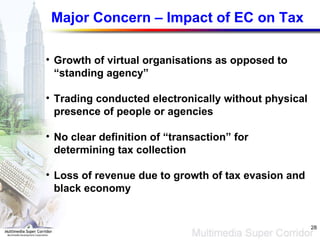
Major Concern – Impact of EC on Tax Growth of virtual organisations as opposed to “standing agency” Trading conducted electronically without physical presence of people or agencies No clear definition of “transaction” for determining tax collection Loss of revenue due to growth of tax evasion and black economy
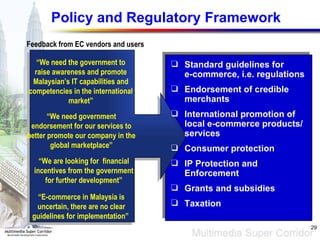
Policy and Regulatory Framework “ We need the government to raise awareness and promote Malaysian’s IT capabilities and competencies in the international market” “ We need government endorsement for our services to better promote our company in the global marketplace” “ E-commerce in Malaysia is uncertain, there are no clear guidelines for implementation”  “ We are looking for  financial incentives from the government for further development” Feedback from EC vendors and users Standard guidelines for  e-commerce, i.e. regulations Endorsement of credible merchants International promotion of local e-commerce products/services Consumer protection IP Protection and Enforcement Grants and subsidies Taxation
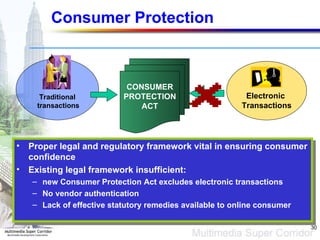
Consumer Protection Proper legal and regulatory framework vital in ensuring consumer confidence Existing legal framework insufficient: new Consumer Protection Act excludes electronic transactions No vendor authentication Lack of effective statutory remedies available to online consumer CONSUMER PROTECTION ACT Traditional transactions Electronic  Transactions
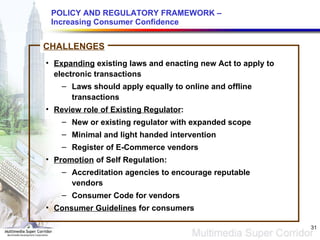
POLICY AND REGULATORY FRAMEWORK – Increasing Consumer Confidence Expanding  existing laws and enacting new Act to apply to electronic transactions  Laws should apply equally to online and offline transactions Review role of Existing Regulator : New or existing regulator with expanded scope  Minimal and light handed intervention  Register of E-Commerce vendors Promotion  of Self Regulation: Accreditation agencies to encourage reputable vendors  Consumer Code for vendors Consumer Guidelines  for consumers CHALLENGES
Intellectual Property Management & Commercial Code Intellectual Property Management Conflict between trademark rights  and registration of domain names Inequality of bargaining power in registration of domain names Commercial Code Application of general contractual principles to E-Commerce, particularly cross border transactions
Intellectual Property Management & Commercial Code Commercial Code Enacting  new laws based on UNCITRAL Model Law to apply contractual principles to E-Commerce Intellectual Property Management Accord  Domain Name protection and management under the Communication and Multimedia Commission Develop  an IP management systems for the distribution and management of the intellectual property especially content services. Educate  consumer on the importance of the protection as well as its rules and regulation Implement  cyber laws that have already been implemented as well as keeping track of new technology to make a more proactive legislation CHALLENGES
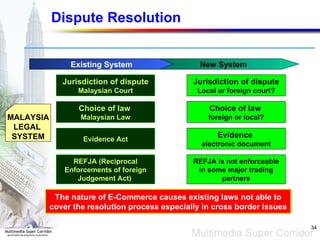
Dispute Resolution MALAYSIA LEGAL  SYSTEM New System Jurisdiction of dispute  Malaysian Court Choice of law   Malaysian Law Evidence Act REFJA (Reciprocal Enforcements of foreign Judgement Act)  REFJA is not enforceable in some major trading partners Evidence  electronic document Choice of law   foreign or local? Jurisdiction of dispute Local or foreign court? Existing System The nature of E-Commerce causes existing laws not able to cover the resolution process especially in cross border issues
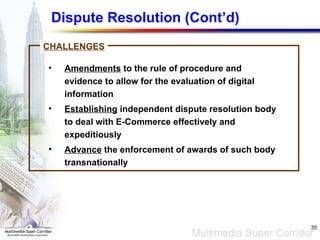
Dispute Resolution (Cont’d) Amendments  to the rule of procedure and evidence to allow for the evaluation of digital information Establishing  independent dispute resolution body to deal with E-Commerce effectively and expeditiously Advance  the enforcement of awards of such body transnationally CHALLENGES
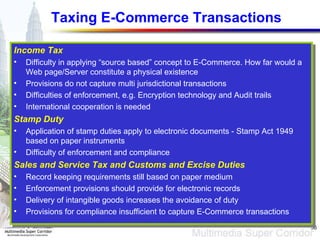
Taxing E-Commerce Transactions Income Tax Difficulty in applying “source based” concept to E-Commerce. How far would a Web page/Server constitute a physical existence Provisions do not capture multi jurisdictional transactions Difficulties of enforcement, e.g. Encryption technology and Audit trails International cooperation is needed Stamp Duty Application of stamp duties apply to electronic documents - Stamp Act 1949 based on paper instruments Difficulty of enforcement and compliance Sales and Service Tax and Customs and Excise Duties Record keeping requirements still based on paper medium Enforcement provisions should provide for electronic records Delivery of intangible goods increases the avoidance of duty  Provisions for compliance insufficient to capture E-Commerce transactions
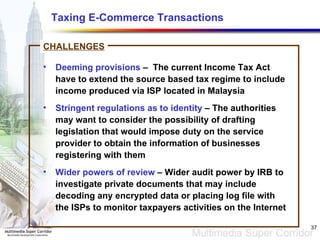
Taxing E-Commerce Transactions   Deeming provisions  –  The current Income Tax Act have to extend the source based tax regime to include income produced via ISP located in Malaysia  Stringent regulations as to identity  – The authorities may want to consider the possibility of drafting legislation that would impose duty on the service provider to obtain the information of businesses registering with them Wider powers of review  – Wider audit power by IRB to investigate private documents that may include decoding any encrypted data or placing log file with the ISPs to monitor taxpayers activities on the Internet CHALLENGES
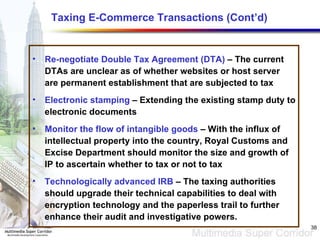
Taxing E-Commerce Transactions (Cont’d) Re-negotiate Double Tax Agreement (DTA)  – The current DTAs are unclear as of whether websites or host server are permanent establishment that are subjected to tax Electronic stamping  – Extending the existing stamp duty to electronic documents Monitor the flow of intangible goods  – With the influx of intellectual property into the country, Royal Customs and Excise Department should monitor the size and growth of IP to ascertain whether to tax or not to tax Technologically advanced IRB  – The taxing authorities should upgrade their technical capabilities to deal with encryption technology and the paperless trail to further enhance their audit and investigative powers.
Agenda Background – Overview of Malaysia’s Broad Vision and Strategy E-Commerce – The Scenario  Implications / Challenges of E-Commerce (The Malaysia Experience) Closing Remarks
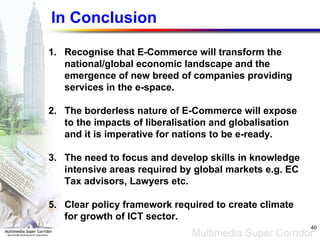
In Conclusion Recognise that E-Commerce will transform the national/global economic landscape and the emergence of new breed of companies providing services in the e-space. The borderless nature of E-Commerce will expose to the impacts of liberalisation and globalisation and it is imperative for nations to be e-ready. The need to focus and develop skills in knowledge intensive areas required by global markets e.g. EC Tax advisors, Lawyers etc. Clear policy framework required to create climate for growth of ICT sector.
Thank-You

Nordin Malaysia

  • 1.
    W T O R E G I O N A L S E M I N A R O N E L E C T R O N I C C O M M E R C E Geneva, Switzerland  22 April 2002 Revenue Implications Of E-Commerce Government and Private Sector Experiences MALAYSIA Presentation by: Suhaimi Nordin Senior Manager - Borderless Marketing / E-Business Multimedia Development Corporation [email_address]
  • 2.
    Agenda Background – Overview of Malaysia’s Broad Vision and Strategy E-Commerce – The Scenario Implications / Challenges of E-Commerce (The Malaysia Experience) Closing Remarks
  • 3.
    VISION 2020 Vision2020 – a national vision of creating a developed nation in our own mould Characteristics of a Vision 2020 society: Strong moral and ethical values self-regulating and self-managing empowered through information and knowledge based on the concept of the dignity of human-kind Characteristics of a Vision 2020 economy: Robust and resilient competitive and dynamic, but with fair and equitable distribution of wealth
  • 4.
    Vision of Knowledge-Malaysiaby year 2020 Information Society Knowledge Society Values-based Knowledge Society 2020 Economic Social - - People are Integral - - Information and Communication Technology as an Enabler Access to information ICT as a sector and information as a commodity Culture of a life long learning and innovation United, moral and ethical society Sustainable quality of life Value creating knowledge products and services Competitive Knowledge Economy
  • 5.
    Multimedia Super Corridor’sVision – Conceived As the Next Engine of Growth for Malaysia The MSC was set up based on: The recognition that Malaysia was losing its comparative advantage in its traditional economic sectors; Need to drive the economy towards higher productivity through technology and high value-added economic activities; Knowledge Economy and converging technologies presented the best opportunities for socio-economic transformation. The need for the adoption & application of ICT to enhance national competitiveness and to help bridge the Digital Divide.
  • 6.
    The MSC StrategyCreate the ideal multimedia environment to attract world-class companies to use MSC as a hub Catalyze a highly competitive cluster of Malaysian multimedia/IT companies that become world-class over time MSC STRATEGY Go Global Lead Regional Create value from Information Age businesses Enhance domestic productivity
  • 7.
    The MSC –More Than Just a Technology Park 15 x 50 km Corridor South of Kuala Lumpur Special Cyberlaws, policies and practices tailored to enable smart partners to achieve maximum benefits of multimedia World class infra-structure and next generation 2.5 - 10 Gb multimedia network MDC - a premier one-stop shop to facilitate and promote the development and investment in the MSC PELABUHAN KLANG KLANG PETALING JAYA KLCC PULAU CAREY BANTING TELOK PANGLIMA GARANG TELOK DATOK BANDAR BARU NILAI KLIA SEPANG PORT DICKSON SEREMBAN BERANANG SEMENYIH COUNTRY HEIGHTS KAJANG SHAH ALAM 2 5 k m BANDAR BARU BANGI 2 0 k m S H A H A L A M E X P R E S S W A Y S O U T H K L A N G V A L L E Y E X P R E S S W A Y N O R T H - S O U T H E X P R E S S W A Y ED ER AL HI K L - K L A N G F G H W A Y N O R T H - S O U T H E X P R E S S W A Y C E N T R A L L I N K PULAU INDAH D E D I C A T E D H I G H W A Y AIRPORT CITY BANDAR SALAK TINGGI P U T R A J A Y A L I N K E R L R A A Y I L W Y W E S C O T A H S I G T H W A
  • 8.
    MSC Flagship ApplicationsTelehealth Smart Schools Multipurpose Card R&D Cluster Electronic Government Worldwide Manufacturing Web Borderless Marketing Centre E-Business OBJECTIVES To Improve: Access - any time, any where, any means Convenience – inline to online Efficiency
  • 9.
    Progress To-date 670MSC Status companies, 50 world class Government Multi-Purpose Card (GMPC) Flagship Application Roll-Out Growing investments in technology and high value-added economic activities Rapid growth in sales and exports New knowledge-based employment opportunities created Growth in institutions of higher learning and supply of knowledge workers Growth in SME participation Spin-offs to economy including productivity increases
  • 10.
    World Class CompaniesWith Regional Initiatives in the MSC
  • 11.
    Other World ClassCompanies in the MSC
  • 12.
    The MSC Vision: From Here To 2020 Leapfrog into leadership in the Knowledge Economy 1 Corridor 50 world-class companies Launch 7 flagship applications World-leading framework of cyberlaws Cyberjaya as world-leading intelligent city Web of corridors 250 world-class companies Set global standards in flagship applications Harmonized global framework of cyberlaws 4-5 intelligent cities linked to other global cybercities All of Malaysia 500 world-class companies Global test-bed for new multimedia applications International CyberCourt of Justice in MSC 12 intelligent cities linked to global information highway Transform Malaysia into a knowledge society Phase 3 Phase 2 Link the MSC to other cybercities in Malaysia and worldwide Phase 1 Successfully create the Multimedia Super Corridor 1996 2020 2003 2010
  • 13.
    Agenda Background –Overview of Malaysia’s Broad Vision and Strategy E-Commerce – The Scenario Implications / Challenges of E-Commerce (The Malaysia Experience) Closing Remarks
  • 14.
    E-Business Within MSCStatus Companies Companies with own transaction capabilities Developing solutions to enable E-Commerce 1997 1998 1999 2000 2001 2002 Forecast* MSC Status Co. directly involved in E-Commerce Businesses / No of MSC Status Companies 138 621 86 429 Percentage of E-Commerce related businesses 22% 20% 300 197 94 700* 34 11% 20 10% 35%* 245* 33 105 15 71 3 32 50* 195* Indicator 6 6% 0 6 19 1
  • 15.
    E-Business Within MSCStatus Companies 33 (15 in Yr 2000) companies directly undertakes E-Commerce / E-Business with transaction capabilities There are 138 / 621 (22%) MSC Status Companies which are directly involved in E-Business / E-Commerce businesses. (As of 31 Dec 2001) 24% 76% 105 (71 in Yr 2000) companies develop and implement e-solutions to enable their customers to undertake E-Commerce Source: MDC EC Technology Providers and/or System Integrators EC Consultancy Services Content Development EC Training E-Business software / applications development No. of Companies With Industry Focus Solutions Provider 23 Financial 19 Fulfillment 18 Software Apps Dev 16 Portal Dev 12 R&D Apps 10 CRM 6 Travel/Hotels 6 Manufacturing/ERP 5 Web Hosting 5 Insurance 3 Healthcare 3 Others 12
  • 16.
    asiatravelmart.com Highlight: AsiaTravelMartis a one-stop travel shop for hotels, air tickets, tour packages and other travel products Offers more than 60,000 products from over 3,000 travel suppliers in more than 100 countries Also, offers mobile-commerce transactions to WAP users (world’s first). Awards, including PATA Gold 2000, Internet World Asia Industry Award, PIKOM Award and APMITTA Award
  • 17.
    SMEs - (smarttransact.com)Highlight: One Stop powerhouse for E-Commerce solutions: providing a complete set of software, infrastructure and services. Established in 1999 with 3 staff and has grown to 130 staff (March 2001) Recorded revenue of US$3 million (US$ 1 million profit) – March 2001 95% of revenue came from overseas Clientele spread worldwide including Ireland, U.S and Hong Kong “ Internet Company of the Year” – Malaysia Internet Awards 2000
  • 18.
    SMEs - (watchesplanet.com)Highlight: Malaysian watch e-tailer (B2C) Watches are Duty-Free items Started in 1998 with a capital of US$65,800, Year 2000 sales was US$1.1million. Offers over 5,000 watches from 60 brands. Price average US$100 – US$2,000 75% customers from North America
  • 19.
    Growth of InternetSubscribers in Malaysia (1995-2005) Source : MECRA (TMnet, Jaring, MaxisNet, TimeNet), PIKOM, MDC, MECM 25 90 210 442 892 1,852 3,111 4,225 4,837 5,525 6,005 0 1,000 2,000 3,000 4,000 5,000 6,000 7,000 '95 '96 '97 '98 '99 '00 '01 '02 '03 '04 '05 Year (1995 – 2000) (‘000 million) Projected growth An Internet penetration of 20% of population will spur the growth of E-Commerce in Malaysia
  • 20.
    Total E-Commerce RevenueGrowth for Malaysia (1997 – 2005) Source : IDC Internet Commerce Market Model, IDC 2001 eCommerce Revenue continue to grow US$384 million in 2000 to US$9.4 billion in 2005 US$383.5m US$675.6m US$million US$9,336.2b
  • 21.
    Agenda Background –Overview of Malaysia’s Broad Vision and Strategy E-Commerce – The Scenario Implications / Challenges of E-Commerce (The Malaysia Experience) Closing Remarks
  • 22.
    E-Commerce – LessonsLearnt There are many definitions for E-commerce. Examples: “ The electronic exchange of information goods, services and payments” but underneath the surface E-commerce is also: … the digitization of information ...Internetworking of human ingenuity creating a new socio-economic transformation … propelled by BRAINS instead of BRAWN … driven off by both technology push and business pull … the foundation of a new economic order Nations need to identify clusters for industrial development and reposition themselves to be at the centre of the virtual marketspace…
  • 23.
    E-Commerce Reduces TransactionCosts “ Transaction costs represent more than 50% of the activities within the US economy. Transaction activities are defined as defining, protecting, and enforcing property rights to goods (the right to use, the right to derive income from the use of, the right to exclude, and the right to exchange.” - Douglass North, US-economist and Nobel laureate Source: OECD 8.0 1.0 Airline Tickets 1.08 0.54 0.13 2.22 to 3.32 0.54 0.13 400-700 200-350 15.00 5.00 0.20-0.50 Banking Bill Payment Term Life Insurance Software Distribution US$ per transaction E-commerce reduces transaction costs ! Traditional System Telephone based Internet based
  • 24.
    The Destruction OfThe Vertically Integrated Value Chain Integrated monolithic Vertical value chain Multiple product specialists collaborating within an e-business community, creation of alliances Domain: Closed Proprietary Network Domain: The Internet CHANGE These Companies can deliver products and services at a much lower cost and utilising fewer assets !
  • 25.
    New Infomediaries –“Hollowing-Out” Physical Economy ‘ Marketplace’ Digital Economy ‘ Marketspace’ Product e.g. Malaysian Consumers $$$ Foreign/Malaysian Consumers e.g. Malaysian intermediaries Multi Products INFOmediaries: Portals, Search Engines, Communities Gateways, Call/Service Centers Information Customisation Fulfillment Multiple Sources
  • 26.
    A Service CentricModel Infomediary leverages information by “BUYING at the point of LEAST COST and SELLING to the point of HIGHEST PRICE” INFOMEDIARY operating under the VIRTUAL VALUE CHAIN PHYSICAL INFRASTRUCTURE (i) Telecommunications (ii) Integrated Global Logistics Supplier A Country 1 Manufacturer B Country 2 Designer C Country 3 Distributor D Country 2 Customer E Country 4 Utilize : 1.Infrastructure to arbitrage cost, skills, productivity, taxes, etc. across multiple jurisdictions 2. Network and information 3. Channels of distribution
  • 27.
    E-Commerce Implications InContext Of Globalisation 1. First-mover enjoys entrenched position as ‘lock-in’ increases switching costs 2. There will winners and losers in Knowledge Age 3. Government interventionist policies are needed to correct for market imperfections 4. Capital will gravitate towards a few ‘hubs’ which have developed a critical mass of users and producers E-Business may be used to circumvent non-tariff barriers and gain access to the protected service sectors of emerging economies. United States of America Canada Australia New Zealand Japan United Kingdom Germany Singapore Ireland India Malaysia
  • 28.
    Major Concern –Impact of EC on Tax Growth of virtual organisations as opposed to “standing agency” Trading conducted electronically without physical presence of people or agencies No clear definition of “transaction” for determining tax collection Loss of revenue due to growth of tax evasion and black economy
  • 29.
    Policy and RegulatoryFramework “ We need the government to raise awareness and promote Malaysian’s IT capabilities and competencies in the international market” “ We need government endorsement for our services to better promote our company in the global marketplace” “ E-commerce in Malaysia is uncertain, there are no clear guidelines for implementation” “ We are looking for financial incentives from the government for further development” Feedback from EC vendors and users Standard guidelines for e-commerce, i.e. regulations Endorsement of credible merchants International promotion of local e-commerce products/services Consumer protection IP Protection and Enforcement Grants and subsidies Taxation
  • 30.
    Consumer Protection Properlegal and regulatory framework vital in ensuring consumer confidence Existing legal framework insufficient: new Consumer Protection Act excludes electronic transactions No vendor authentication Lack of effective statutory remedies available to online consumer CONSUMER PROTECTION ACT Traditional transactions Electronic Transactions
  • 31.
    POLICY AND REGULATORYFRAMEWORK – Increasing Consumer Confidence Expanding existing laws and enacting new Act to apply to electronic transactions Laws should apply equally to online and offline transactions Review role of Existing Regulator : New or existing regulator with expanded scope Minimal and light handed intervention Register of E-Commerce vendors Promotion of Self Regulation: Accreditation agencies to encourage reputable vendors Consumer Code for vendors Consumer Guidelines for consumers CHALLENGES
  • 32.
    Intellectual Property Management& Commercial Code Intellectual Property Management Conflict between trademark rights and registration of domain names Inequality of bargaining power in registration of domain names Commercial Code Application of general contractual principles to E-Commerce, particularly cross border transactions
  • 33.
    Intellectual Property Management& Commercial Code Commercial Code Enacting new laws based on UNCITRAL Model Law to apply contractual principles to E-Commerce Intellectual Property Management Accord Domain Name protection and management under the Communication and Multimedia Commission Develop an IP management systems for the distribution and management of the intellectual property especially content services. Educate consumer on the importance of the protection as well as its rules and regulation Implement cyber laws that have already been implemented as well as keeping track of new technology to make a more proactive legislation CHALLENGES
  • 34.
    Dispute Resolution MALAYSIALEGAL SYSTEM New System Jurisdiction of dispute Malaysian Court Choice of law Malaysian Law Evidence Act REFJA (Reciprocal Enforcements of foreign Judgement Act) REFJA is not enforceable in some major trading partners Evidence electronic document Choice of law foreign or local? Jurisdiction of dispute Local or foreign court? Existing System The nature of E-Commerce causes existing laws not able to cover the resolution process especially in cross border issues
  • 35.
    Dispute Resolution (Cont’d)Amendments to the rule of procedure and evidence to allow for the evaluation of digital information Establishing independent dispute resolution body to deal with E-Commerce effectively and expeditiously Advance the enforcement of awards of such body transnationally CHALLENGES
  • 36.
    Taxing E-Commerce TransactionsIncome Tax Difficulty in applying “source based” concept to E-Commerce. How far would a Web page/Server constitute a physical existence Provisions do not capture multi jurisdictional transactions Difficulties of enforcement, e.g. Encryption technology and Audit trails International cooperation is needed Stamp Duty Application of stamp duties apply to electronic documents - Stamp Act 1949 based on paper instruments Difficulty of enforcement and compliance Sales and Service Tax and Customs and Excise Duties Record keeping requirements still based on paper medium Enforcement provisions should provide for electronic records Delivery of intangible goods increases the avoidance of duty Provisions for compliance insufficient to capture E-Commerce transactions
  • 37.
    Taxing E-Commerce Transactions Deeming provisions – The current Income Tax Act have to extend the source based tax regime to include income produced via ISP located in Malaysia Stringent regulations as to identity – The authorities may want to consider the possibility of drafting legislation that would impose duty on the service provider to obtain the information of businesses registering with them Wider powers of review – Wider audit power by IRB to investigate private documents that may include decoding any encrypted data or placing log file with the ISPs to monitor taxpayers activities on the Internet CHALLENGES
  • 38.
    Taxing E-Commerce Transactions(Cont’d) Re-negotiate Double Tax Agreement (DTA) – The current DTAs are unclear as of whether websites or host server are permanent establishment that are subjected to tax Electronic stamping – Extending the existing stamp duty to electronic documents Monitor the flow of intangible goods – With the influx of intellectual property into the country, Royal Customs and Excise Department should monitor the size and growth of IP to ascertain whether to tax or not to tax Technologically advanced IRB – The taxing authorities should upgrade their technical capabilities to deal with encryption technology and the paperless trail to further enhance their audit and investigative powers.
  • 39.
    Agenda Background –Overview of Malaysia’s Broad Vision and Strategy E-Commerce – The Scenario Implications / Challenges of E-Commerce (The Malaysia Experience) Closing Remarks
  • 40.
    In Conclusion Recognisethat E-Commerce will transform the national/global economic landscape and the emergence of new breed of companies providing services in the e-space. The borderless nature of E-Commerce will expose to the impacts of liberalisation and globalisation and it is imperative for nations to be e-ready. The need to focus and develop skills in knowledge intensive areas required by global markets e.g. EC Tax advisors, Lawyers etc. Clear policy framework required to create climate for growth of ICT sector.
  • 41.

Editor's Notes

  • #15 Over 150% growth between 1999 – 2000 E-business/E-commerce companies: 22% of total MSC status (2001), estimated an increase of 13% in 2002 (35% of total MSC status co.)
  • #16 Solutions/Technology Provider [Global e-comz, Neuroweb, Netcel360] Financial [WorldStock.com, Surf88.com] Fulfillment [Ship & Track S/B, e-Basis Bay] Software Apps Dev [CyberVillage S/B, Xen.com] Portal Dev [Autohub S/B, Global Vmall.com] R&D Apps [e-Smart Systems, Buzznet] CRM [Mastek MSC, Wired For Biz] Travel/Hotels [AsiaTravelMart, World Net Services Manufacturing/ERP [Global ERP, Logic Instinct] Web Hosting [Asia On Time] Healthcare [eHealth4all.com] Others: Online Learning, Online Advertising, HR Apps, Warehousing