Topic: Third Sector, social
enterprise, Non profit organization
Asmaalsadat mousavinia
‘A’ Section , ‘A1’ Batch
M.com, CM112016
Manasagangotri
 Introduction of NPO
 Meaning of NPO
 Key characteristics of Npo
 Third sector
 Social enterprises
 Difference between social enterprises and
NPO
 Conclusion
Definition: An organization in which no
owner, stockholder or trustee shares in profits
and losses, and which exists not to earn
revenue but to promote a mission that
enhances the public welfare. These
organizations are often eligible for tax-
exempt status and some, but not all, can
receive tax deductible contributions.
 Nonprofit refers to groups whose purposes
are to benefit the public. A nonprofit is
exempt from income tax under
Sections 501(c)(3) or 501(c)(4) of the federal
Internal Revenue Code. There are actually 20
categores of tax-exampt organizations under
Section 501 of the tax code. All of these are
considered "nonprofit" organizations.
 Charities are classified as 501(c)(3) tax-exempt
organizations. These include organizations
whose purposes are:
 charitable
 religious
 educational
 scientific
 literary
 testing for public safety
 fostering national or international amateur
athletic competition
 preventing cruelty to children or animals.
 Furthermore, "charitable purposes" are defined as
activities beneficial to the public interest and
serving an open class of people, not a limited
number of identified people.
 01. purpose
 02. ownership
 03. control
 04. accountability
 The voluntary sector or community
sector (also non-profit sector or "not-for-
profit" sector) is the sphere of social activity
undertaken by organizations that are not for
profit[1] and non-governmental. This sector is
also called the third sector, in reference to
the public sectorand the private sector. Civic
sector is another term for the sector,
emphasizing the sector's relationship to civil
society.
 The Cabinet Office defined the ‘Third Sector’
as “the place between State and (the) private
sector”.[1]
 In India this sector is commonly called the
"joint sector", and includes the industries run
in partnership by the state and Private Sector.
In a wider sense the initial investment is
made by the state and later the handling is
done by the private sector.
A Social Enterprise has been defined by
the UK government as:
‘a business or service with primarily
social objectives whose surpluses are
principally reinvested for that purpose
in the community, rather than being
driven by the need to maximise profit
for shareholders and owners.’
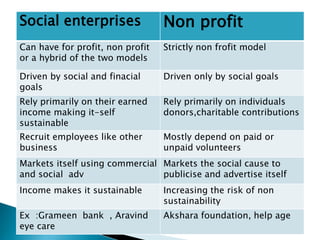
Social enterprises Non profit
Can have for profit, non profit
or a hybrid of the two models
Strictly non frofit model
Driven by social and finacial
goals
Driven only by social goals
Rely primarily on their earned
income making it-self
sustainable
Rely primarily on individuals
donors,charitable contributions
Recruit employees like other
business
Mostly depend on paid or
unpaid volunteers
Markets itself using commercial
and social adv
Markets the social cause to
publicise and advertise itself
Income makes it sustainable Increasing the risk of non
sustainability
Ex :Grameen bank , Aravind
eye care
Akshara foundation, help age
 Nonprofit organizations serve the public,
providing a wide range of services to improve the
quality of life of individuals or communities. They
are often heavily staffed with volunteers or
temporary workers with diverse skill sets, who
are strongly motivated by altruism,The transient
nature of personnel and short-term inconsistent
funding, contribute to nonprofits’ general lack of
ability to provide for long term technology plans

Nonprofit organization

  • 1.
    Topic: Third Sector,social enterprise, Non profit organization Asmaalsadat mousavinia ‘A’ Section , ‘A1’ Batch M.com, CM112016 Manasagangotri
  • 2.
     Introduction ofNPO  Meaning of NPO  Key characteristics of Npo  Third sector  Social enterprises  Difference between social enterprises and NPO  Conclusion
  • 3.
    Definition: An organizationin which no owner, stockholder or trustee shares in profits and losses, and which exists not to earn revenue but to promote a mission that enhances the public welfare. These organizations are often eligible for tax- exempt status and some, but not all, can receive tax deductible contributions.
  • 4.
     Nonprofit refersto groups whose purposes are to benefit the public. A nonprofit is exempt from income tax under Sections 501(c)(3) or 501(c)(4) of the federal Internal Revenue Code. There are actually 20 categores of tax-exampt organizations under Section 501 of the tax code. All of these are considered "nonprofit" organizations.
  • 5.
     Charities areclassified as 501(c)(3) tax-exempt organizations. These include organizations whose purposes are:  charitable  religious  educational  scientific  literary  testing for public safety  fostering national or international amateur athletic competition  preventing cruelty to children or animals.  Furthermore, "charitable purposes" are defined as activities beneficial to the public interest and serving an open class of people, not a limited number of identified people.
  • 6.
     01. purpose 02. ownership  03. control  04. accountability
  • 7.
     The voluntarysector or community sector (also non-profit sector or "not-for- profit" sector) is the sphere of social activity undertaken by organizations that are not for profit[1] and non-governmental. This sector is also called the third sector, in reference to the public sectorand the private sector. Civic sector is another term for the sector, emphasizing the sector's relationship to civil society.
  • 8.
     The CabinetOffice defined the ‘Third Sector’ as “the place between State and (the) private sector”.[1]  In India this sector is commonly called the "joint sector", and includes the industries run in partnership by the state and Private Sector. In a wider sense the initial investment is made by the state and later the handling is done by the private sector.
  • 9.
    A Social Enterprisehas been defined by the UK government as: ‘a business or service with primarily social objectives whose surpluses are principally reinvested for that purpose in the community, rather than being driven by the need to maximise profit for shareholders and owners.’
  • 10.
    Social enterprises Nonprofit Can have for profit, non profit or a hybrid of the two models Strictly non frofit model Driven by social and finacial goals Driven only by social goals Rely primarily on their earned income making it-self sustainable Rely primarily on individuals donors,charitable contributions Recruit employees like other business Mostly depend on paid or unpaid volunteers Markets itself using commercial and social adv Markets the social cause to publicise and advertise itself Income makes it sustainable Increasing the risk of non sustainability Ex :Grameen bank , Aravind eye care Akshara foundation, help age
  • 11.
     Nonprofit organizationsserve the public, providing a wide range of services to improve the quality of life of individuals or communities. They are often heavily staffed with volunteers or temporary workers with diverse skill sets, who are strongly motivated by altruism,The transient nature of personnel and short-term inconsistent funding, contribute to nonprofits’ general lack of ability to provide for long term technology plans