S. Sumriddetchkajorn
TAD2: The First Truly Non-Intrusive Lie Detection
System Deployed in Real Crime Cases
Sarun Sumriddetchkajorn
Armote Somboonkaew
Photonics Technology Laboratory
Intelligent Devices and Systems Research Unit
National Electronics and Computer Technology Center (NECTEC)
National Science and Technology Development Agency (NSTDA)
112 Thailand Science Park, Phahonyothin Rd., Klong 1, Klong Luang
Pathumthani 12120, Thailand
E-mails: sarun.sumriddetchkajorn@nectec.or.th, sarunphotonics@gmail.com
S. Sumriddetchkajorn
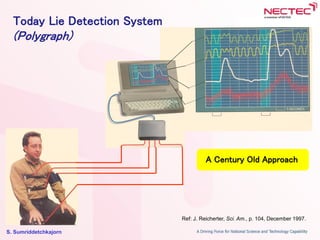
Today Lie Detection System
(Polygraph)
Ref: J. Reicherter, Sci. Am., p. 104, December 1997.
A Century Old Approach
S. Sumriddetchkajorn
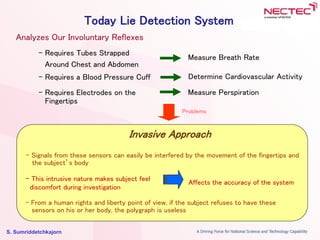
Today Lie Detection System
Analyzes Our Involuntary Reflexes
Invasive Approach
- From a human rights and liberty point of view, if the subject refuses to have these
sensors on his or her body, the polygraph is useless
Problems
- Signals from these sensors can easily be interfered by the movement of the fingertips and
the subject’s body
- This intrusive nature makes subject feel
discomfort during investigation
Affects the accuracy of the system
Measure Breath Rate
- Requires a Blood Pressure Cuff Determine Cardiovascular Activity
- Requires Tubes Strapped
Around Chest and Abdomen
- Requires Electrodes on the
Fingertips
Measure Perspiration
S. Sumriddetchkajorn
Better Solutions
?
S. Sumriddetchkajorn
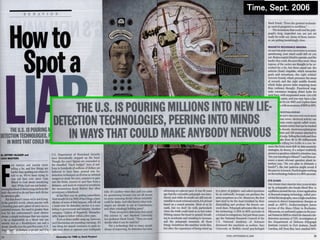
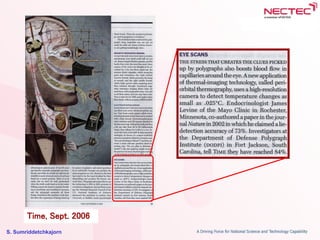
Time, Sept. 2006
S. Sumriddetchkajorn
Time, Sept. 2006
S. Sumriddetchkajorn
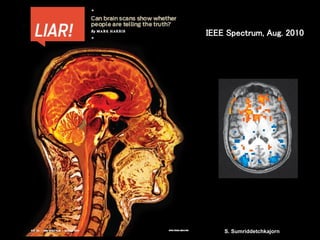
IEEE Spectrum, Aug. 2010
S. Sumriddetchkajorn
Our Motivations
Implement A Non-Invasive Lie
Detection System
via
Thermal Imaging Analysis
S. Sumriddetchkajorn
Time, Sept. 2006
S. Sumriddetchkajorn
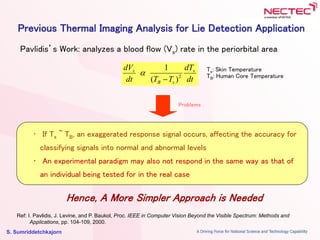
Previous Thermal Imaging Analysis for Lie Detection Application
Pavlidis’s Work: analyzes a blood flow (Vs) rate in the periorbital area
Problems
• If Ts ~ TB, an exaggerated response signal occurs, affecting the accuracy for
classifying signals into normal and abnormal levels
• An experimental paradigm may also not respond in the same way as that of
an individual being tested for in the real case
Hence, A More Simpler Approach is Needed
dt
dT
TTdt
dV s
sB
s
2
)(
1


dt
dT
TTdt
dV s
sB
s
2
)(
1

 Ts: Skin Temperature
TB: Human Core Temperature
Ref: I. Pavlidis, J. Levine, and P. Baukol, Proc. IEEE in Computer Vision Beyond the Visible Spectrum: Methods and
Applications, pp. 104-109, 2000.
S. Sumriddetchkajorn
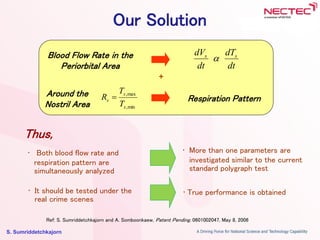
Our Solution
Blood Flow Rate in the
Periorbital Area
Respiration Pattern
dt
dT
dt
dV ss

• Both blood flow rate and
respiration pattern are
simultaneously analyzed
• More than one parameters are
investigated similar to the current
standard polygraph test
Thus,
+
Around the
Nostril Area min,
max,
s
s
s
T
T
R 
Ref: S. Sumriddetchkajorn and A. Somboonkaew, Patent Pending, 0601002047, May 8, 2006
• It should be tested under the
real crime scenes
• True performance is obtained
S. Sumriddetchkajorn
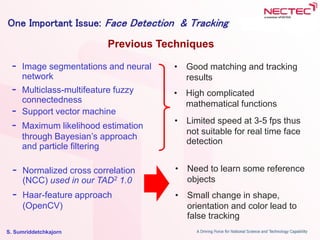
- Image segmentations and neural
network
- Multiclass-multifeature fuzzy
connectedness
- Support vector machine
- Maximum likelihood estimation
through Bayesian’s approach
and particle filtering
Previous Techniques
One Important Issue: Face Detection & Tracking
• Good matching and tracking
results
• Limited speed at 3-5 fps thus
not suitable for real time face
detection
• High complicated
mathematical functions
- Normalized cross correlation
(NCC) used in our TAD2 1.0
- Haar-feature approach
(OpenCV)
• Need to learn some reference
objects
• Small change in shape,
orientation and color lead to
false tracking
S. Sumriddetchkajorn
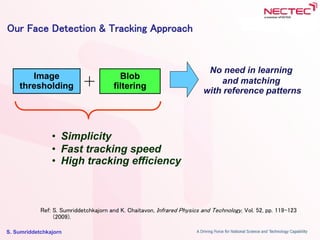
No need in learning
and matching
with reference patterns
Image
thresholding
Blob
filtering
• Simplicity
• Fast tracking speed
• High tracking efficiency
Ref: S. Sumriddetchkajorn and K. Chaitavon, Infrared Physics and Technology, Vol. 52, pp. 119-123
(2009).
Our Face Detection & Tracking Approach
S. Sumriddetchkajorn
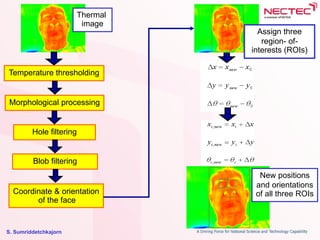
Temperature thresholding
Morphological processing
Hole filtering
Blob filtering
Coordinate & orientation
of the face
Thermal
image
Assign three
region- of-
interests (ROIs)
New positions
and orientations
of all three ROIs
New positions
and orientations
of all three ROIs
S. Sumriddetchkajorn
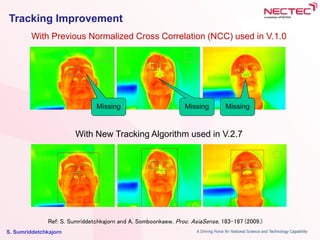
Tracking Improvement
With Previous Normalized Cross Correlation (NCC) used in V.1.0
With New Tracking Algorithm used in V.2.7
Missing Missing Missing
Ref: S. Sumriddetchkajorn and A. Somboonkaew, Proc. AsiaSense, 183-187 (2009.)
S. Sumriddetchkajorn
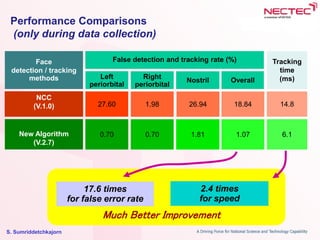
Performance Comparisons
(only during data collection)
Nose
Face
detection / tracking
methods
NCC
(V.1.0)
New Algorithm
(V.2.7)
False detection and tracking rate (%)
Left
periorbital
Right
periorbital
Nostril Overall
Tracking
time
(ms)
27.60 1.98 26.94 18.84 14.8
0.70 0.70 1.81 1.07 6.1
17.6 times
for false error rate
17.6 times
for false error rate
2.4 times
for speed
2.4 times
for speed
Much Better Improvement
S. Sumriddetchkajorn
Another Important Issue: Standard Tests
Embedded with Three Standard Tests
10 Questions: Qs 1, 2, 4, 7  Irrelevant Qs
Qs 6, 10  Control Qs
Qs 3, 5, 8, 9  Relevant Qs
• Modified General Question Test (MGQT): Test Time  5-6 minutes
10 Questions: Qs 1, 2  Irrelevant Qs
Qs 4, 6, 9  Control Qs
Qs 5, 7, 10  Relevant Qs
Qs 3, 8  Specific (Relevant) Issues
• Modified Zone Comparison Test (MZCT): Test Time  5-6 minutes
Multiple Questions: Qs 1, 2, 5, 8, 11, …  Irrelevant Qs
Qs 4, 7, 10, 13, …  Control Qs
Qs 3, 6, 9, 12, …  Relevant Qs
• Irrelevant & Relevant Test (I&R): Test Time depends on number of questions
S. Sumriddetchkajorn
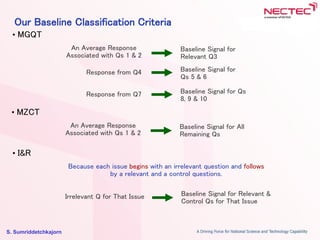
Our Baseline Classification Criteria
An Average Response
Associated with Qs 1 & 2
Baseline Signal for
Relevant Q3
Response from Q4 Baseline Signal for
Qs 5 & 6
Response from Q7 Baseline Signal for Qs
8, 9 & 10
• MGQT
An Average Response
Associated with Qs 1 & 2
Baseline Signal for All
Remaining Qs
• MZCT
Because each issue begins with an irrelevant question and follows
by a relevant and a control questions.
Baseline Signal for Relevant &
Control Qs for That Issue
• I&R
Irrelevant Q for That Issue
S. Sumriddetchkajorn
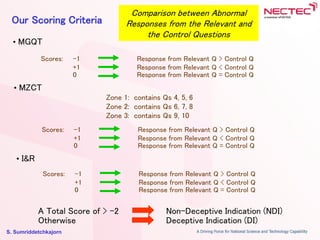
Our Scoring Criteria
Comparison between Abnormal
Responses from the Relevant and
the Control Questions
Comparison between Abnormal
Responses from the Relevant and
the Control Questions
Scores: -1 Response from Relevant Q > Control Q
+1 Response from Relevant Q < Control Q
0 Response from Relevant Q = Control Q
• MGQT
Scores: -1 Response from Relevant Q > Control Q
+1 Response from Relevant Q < Control Q
0 Response from Relevant Q = Control Q
• MZCT
Zone 1: contains Qs 4, 5, 6
Zone 2: contains Qs 6, 7, 8
Zone 3: contains Qs 9, 10
Scores: -1 Response from Relevant Q > Control Q
+1 Response from Relevant Q < Control Q
0 Response from Relevant Q = Control Q
• I&R
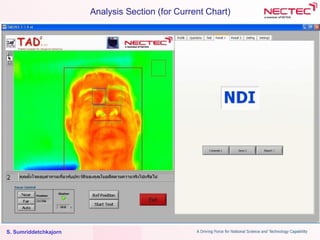
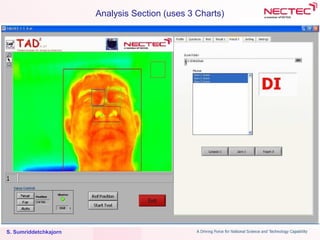
A Total Score of > -2 Non-Deceptive Indication (NDI)
Otherwise Deceptive Indication (DI)
S. Sumriddetchkajorn
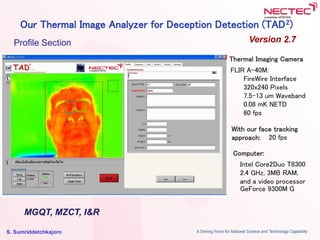
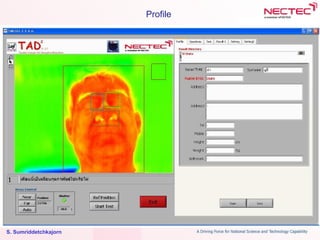
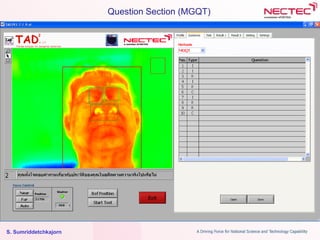
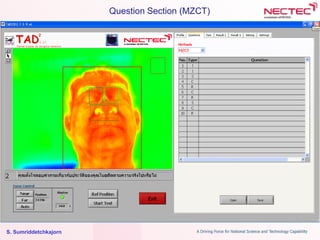
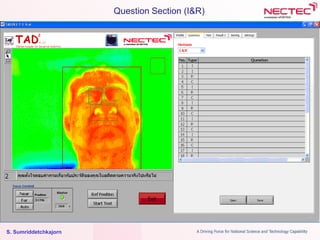
Our Thermal Image Analyzer for Deception Detection (TAD2)
Version 2.7Profile Section
MGQT, MZCT, I&R
FLIR A-40M:
FireWire Interface
320x240 Pixels
7.5-13 um Waveband
0.08 mK NETD
60 fps
Thermal Imaging Camera
With our face tracking
approach: 20 fps
Computer:
Intel Core2Duo T8300
2.4 GHz, 3MB RAM,
and a video processor
GeForce 9300M G
S. Sumriddetchkajorn
Profile
S. Sumriddetchkajorn
Question Section (MGQT)
S. Sumriddetchkajorn
Question Section (MZCT)
S. Sumriddetchkajorn
Question Section (I&R)
S. Sumriddetchkajorn
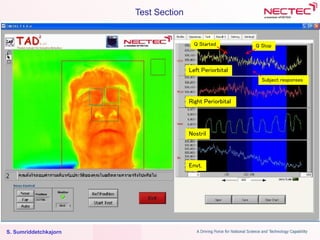
Test Section
Left Periorbital
Right Periorbital
Nostril
Envt.
Q Started Q Stop
Subject responses
S. Sumriddetchkajorn
Analysis Section (for Current Chart)
S. Sumriddetchkajorn
Analysis Section (uses 3 Charts)
S. Sumriddetchkajorn
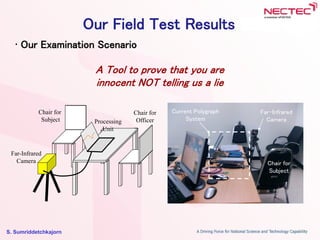
Far-Infrared
Camera
Current Polygraph
System
Chair for
Subject
Far-Infrared
Camera
Chair for
Subject Processing
Unit
Chair for
Officer
Our Field Test Results
• Our Examination Scenario
A Tool to prove that you are
innocent NOT telling us a lie
S. Sumriddetchkajorn
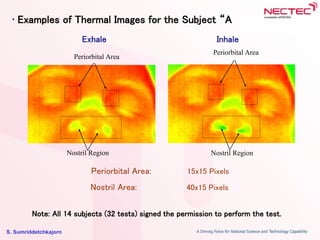
Nostril Region
Periorbital Area
Nostril Region
Periorbital Area
Exhale
• Examples of Thermal Images for the Subject “A
Inhale
Periorbital Area: 15x15 Pixels
Nostril Area: 40x15 Pixels
Note: All 14 subjects (32 tests) signed the permission to perform the test.
S. Sumriddetchkajorn
0
0.1
0.2
0.3
0.4
0 1 2 3 4 5 6 7 8 9 10 11 12
Time (seconds)
RelativeBloodVelocity
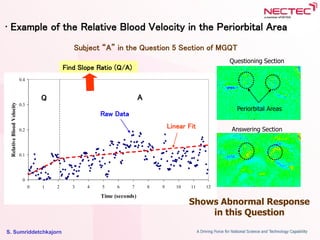
• Example of the Relative Blood Velocity in the Periorbital Area
Linear Fit
Raw Data
Q A
Find Slope Ratio (Q/A)
Shows Abnormal Response
in this Question
Periorbital Areas
Questioning Section
Answering Section
Subject “A” in the Question 5 Section of MGQT
S. Sumriddetchkajorn
1.01
1.02
1.03
1.04
1.05
2 3 4 5 6 7 8 9 10 11 12
Ts,max/Ts,min
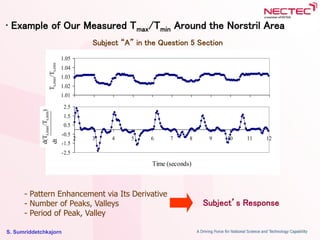
• Example of Our Measured Tmax/Tmin Around the Norstril Area
Subject “A” in the Question 5 Section
- Pattern Enhancement via Its Derivative
- Number of Peaks, Valleys
- Period of Peak, Valley
Subject’s Response
Time (seconds)
-2.5
-1.5
-0.5
0.5
1.5
2.5
2 3 4 5 6 7 8 9 10 11 12
Time (seconds)
d(Ts,max/Ts,min)
dt
S. Sumriddetchkajorn
0
0.02
0.04
0.06
0.08
0.1
0.12
0.14
0.16
0.18
1 2 3 4 5 6 7 8 9 10
Question
|Slope|
0
0.2
0.4
0.6
0.8
1
1.2
1.4
1 2 3 4 5 6 7 8 9 10
Question
|Slope|
Valley
AmplitudeBaseline
Valley
Period
Slope Value
0
5
10
15
20
25
1 2 3 4 5 6 7 8 9 10
Question
|SlopeRatio|
Baseline
Slope Ratio
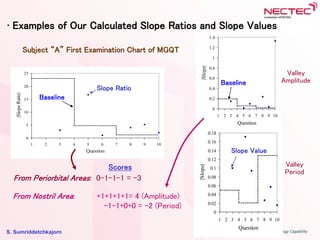
Subject “A” First Examination Chart of MGQT
• Examples of Our Calculated Slope Ratios and Slope Values
From Periorbital Areas: 0-1-1-1 = -3
Scores
From Nostril Area: +1+1+1+1= 4 (Amplitude)
-1-1+0+0 = -2 (Period)
S. Sumriddetchkajorn
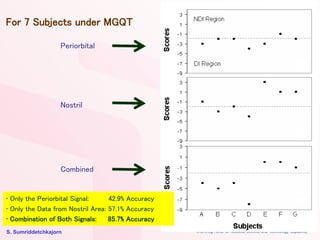
For 7 Subjects under MGQT
• Only the Periorbital Signal: 42.9% Accuracy
• Only the Data from Nostril Area: 57.1% Accuracy
• Combination of Both Signals: 85.7% Accuracy
Periorbital
Nostril
Combined
S. Sumriddetchkajorn
Conclusion
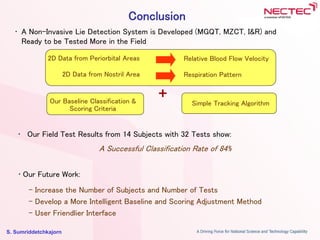
• A Non-Invasive Lie Detection System is Developed (MGQT, MZCT, I&R) and
Ready to be Tested More in the Field
2D Data from Periorbital Areas
2D Data from Nostril Area
Relative Blood Flow Velocity
Respiration Pattern
Our Baseline Classification &
Scoring Criteria
Simple Tracking Algorithm
+
• Our Field Test Results from 14 Subjects with 32 Tests show:
A Successful Classification Rate of 84%
• Our Future Work:
- Increase the Number of Subjects and Number of Tests
- Develop a More Intelligent Baseline and Scoring Adjustment Method
- User Friendlier Interface
S. Sumriddetchkajorn
References
1. S. Sumriddetchkajorn and A. Somboonkaew, “A non invasive method for analyzing psychophysiological
data,” Thailand Patent Application, 0601002047, May 8, 2006.
2. S. Sumriddetchkajorn and A. Somboonkaew, “A non invasive deceptive detection system and methods for
assigning regions of interest and for distinguishing deceptive levels,” Thailand Patent Application,
0701000585, Feb. 9, 2007.
3. S. Sumriddetchkajorn, A. Somboonkaew, T. Sodsong, I. Promduang, and N. Sumriddetchkajorn, “A field test
study of our non-invasive thermal image analyzer for deceptive detection,” Proc. SPIE 6633, 66331F
(2007).
4. S. Sumriddetchkajorn and A. Somboonkaew, “A study of normalized cross correlation pattern matching
algorithm in thermal imagery,” Proc. ECTI 2, 1125-1127 (2007).
5. S. Sumriddetchkajorn and A. Somboonkaew, “A field test study of our non-invasive thermal image
analyzer for deceptive detection,” Proc. SPIE 6633, 66331F (2007).
6. S. Sumriddetchkajorn and A. Somboonkaew, “Face detection in thermal imagery using an Open Source
Computer Vision Library,” Proc. SPIE 7299, 729906 (2009).
7. S. Sumriddetchkajorn and A. Somboonkaew, “Tracking improvement in our far infrared-based non-invasive
lie sensing system,” Proc. AsiaSense, 183-187 (2009).
8. S. Sumriddetchkajorn and K. Chaitavon, “Field test studies of our infrared-based human temperature
screening system embedded with a parallel measurement approach,” Infra.Phys. and Technol., Vol. 52, pp.
119-123 (2009).

Noninvesive Lie Detection

  • 1.
    S. Sumriddetchkajorn TAD2: TheFirst Truly Non-Intrusive Lie Detection System Deployed in Real Crime Cases Sarun Sumriddetchkajorn Armote Somboonkaew Photonics Technology Laboratory Intelligent Devices and Systems Research Unit National Electronics and Computer Technology Center (NECTEC) National Science and Technology Development Agency (NSTDA) 112 Thailand Science Park, Phahonyothin Rd., Klong 1, Klong Luang Pathumthani 12120, Thailand E-mails: sarun.sumriddetchkajorn@nectec.or.th, sarunphotonics@gmail.com
  • 2.
    S. Sumriddetchkajorn Today LieDetection System (Polygraph) Ref: J. Reicherter, Sci. Am., p. 104, December 1997. A Century Old Approach
  • 3.
    S. Sumriddetchkajorn Today LieDetection System Analyzes Our Involuntary Reflexes Invasive Approach - From a human rights and liberty point of view, if the subject refuses to have these sensors on his or her body, the polygraph is useless Problems - Signals from these sensors can easily be interfered by the movement of the fingertips and the subject’s body - This intrusive nature makes subject feel discomfort during investigation Affects the accuracy of the system Measure Breath Rate - Requires a Blood Pressure Cuff Determine Cardiovascular Activity - Requires Tubes Strapped Around Chest and Abdomen - Requires Electrodes on the Fingertips Measure Perspiration
  • 4.
  • 5.
  • 6.
    S. Sumriddetchkajorn Time, Sept.2006 S. Sumriddetchkajorn
  • 7.
  • 8.
    S. Sumriddetchkajorn IEEE Spectrum,Aug. 2010 S. Sumriddetchkajorn
  • 9.
    S. Sumriddetchkajorn Our Motivations ImplementA Non-Invasive Lie Detection System via Thermal Imaging Analysis
  • 10.
  • 11.
    S. Sumriddetchkajorn Previous ThermalImaging Analysis for Lie Detection Application Pavlidis’s Work: analyzes a blood flow (Vs) rate in the periorbital area Problems • If Ts ~ TB, an exaggerated response signal occurs, affecting the accuracy for classifying signals into normal and abnormal levels • An experimental paradigm may also not respond in the same way as that of an individual being tested for in the real case Hence, A More Simpler Approach is Needed dt dT TTdt dV s sB s 2 )( 1   dt dT TTdt dV s sB s 2 )( 1   Ts: Skin Temperature TB: Human Core Temperature Ref: I. Pavlidis, J. Levine, and P. Baukol, Proc. IEEE in Computer Vision Beyond the Visible Spectrum: Methods and Applications, pp. 104-109, 2000.
  • 12.
    S. Sumriddetchkajorn Our Solution BloodFlow Rate in the Periorbital Area Respiration Pattern dt dT dt dV ss  • Both blood flow rate and respiration pattern are simultaneously analyzed • More than one parameters are investigated similar to the current standard polygraph test Thus, + Around the Nostril Area min, max, s s s T T R  Ref: S. Sumriddetchkajorn and A. Somboonkaew, Patent Pending, 0601002047, May 8, 2006 • It should be tested under the real crime scenes • True performance is obtained
  • 13.
    S. Sumriddetchkajorn - Imagesegmentations and neural network - Multiclass-multifeature fuzzy connectedness - Support vector machine - Maximum likelihood estimation through Bayesian’s approach and particle filtering Previous Techniques One Important Issue: Face Detection & Tracking • Good matching and tracking results • Limited speed at 3-5 fps thus not suitable for real time face detection • High complicated mathematical functions - Normalized cross correlation (NCC) used in our TAD2 1.0 - Haar-feature approach (OpenCV) • Need to learn some reference objects • Small change in shape, orientation and color lead to false tracking
  • 14.
    S. Sumriddetchkajorn No needin learning and matching with reference patterns Image thresholding Blob filtering • Simplicity • Fast tracking speed • High tracking efficiency Ref: S. Sumriddetchkajorn and K. Chaitavon, Infrared Physics and Technology, Vol. 52, pp. 119-123 (2009). Our Face Detection & Tracking Approach
  • 15.
    S. Sumriddetchkajorn Temperature thresholding Morphologicalprocessing Hole filtering Blob filtering Coordinate & orientation of the face Thermal image Assign three region- of- interests (ROIs) New positions and orientations of all three ROIs New positions and orientations of all three ROIs
  • 16.
    S. Sumriddetchkajorn Tracking Improvement WithPrevious Normalized Cross Correlation (NCC) used in V.1.0 With New Tracking Algorithm used in V.2.7 Missing Missing Missing Ref: S. Sumriddetchkajorn and A. Somboonkaew, Proc. AsiaSense, 183-187 (2009.)
  • 17.
    S. Sumriddetchkajorn Performance Comparisons (onlyduring data collection) Nose Face detection / tracking methods NCC (V.1.0) New Algorithm (V.2.7) False detection and tracking rate (%) Left periorbital Right periorbital Nostril Overall Tracking time (ms) 27.60 1.98 26.94 18.84 14.8 0.70 0.70 1.81 1.07 6.1 17.6 times for false error rate 17.6 times for false error rate 2.4 times for speed 2.4 times for speed Much Better Improvement
  • 18.
    S. Sumriddetchkajorn Another ImportantIssue: Standard Tests Embedded with Three Standard Tests 10 Questions: Qs 1, 2, 4, 7  Irrelevant Qs Qs 6, 10  Control Qs Qs 3, 5, 8, 9  Relevant Qs • Modified General Question Test (MGQT): Test Time  5-6 minutes 10 Questions: Qs 1, 2  Irrelevant Qs Qs 4, 6, 9  Control Qs Qs 5, 7, 10  Relevant Qs Qs 3, 8  Specific (Relevant) Issues • Modified Zone Comparison Test (MZCT): Test Time  5-6 minutes Multiple Questions: Qs 1, 2, 5, 8, 11, …  Irrelevant Qs Qs 4, 7, 10, 13, …  Control Qs Qs 3, 6, 9, 12, …  Relevant Qs • Irrelevant & Relevant Test (I&R): Test Time depends on number of questions
  • 19.
    S. Sumriddetchkajorn Our BaselineClassification Criteria An Average Response Associated with Qs 1 & 2 Baseline Signal for Relevant Q3 Response from Q4 Baseline Signal for Qs 5 & 6 Response from Q7 Baseline Signal for Qs 8, 9 & 10 • MGQT An Average Response Associated with Qs 1 & 2 Baseline Signal for All Remaining Qs • MZCT Because each issue begins with an irrelevant question and follows by a relevant and a control questions. Baseline Signal for Relevant & Control Qs for That Issue • I&R Irrelevant Q for That Issue
  • 20.
    S. Sumriddetchkajorn Our ScoringCriteria Comparison between Abnormal Responses from the Relevant and the Control Questions Comparison between Abnormal Responses from the Relevant and the Control Questions Scores: -1 Response from Relevant Q > Control Q +1 Response from Relevant Q < Control Q 0 Response from Relevant Q = Control Q • MGQT Scores: -1 Response from Relevant Q > Control Q +1 Response from Relevant Q < Control Q 0 Response from Relevant Q = Control Q • MZCT Zone 1: contains Qs 4, 5, 6 Zone 2: contains Qs 6, 7, 8 Zone 3: contains Qs 9, 10 Scores: -1 Response from Relevant Q > Control Q +1 Response from Relevant Q < Control Q 0 Response from Relevant Q = Control Q • I&R A Total Score of > -2 Non-Deceptive Indication (NDI) Otherwise Deceptive Indication (DI)
  • 21.
    S. Sumriddetchkajorn Our ThermalImage Analyzer for Deception Detection (TAD2) Version 2.7Profile Section MGQT, MZCT, I&R FLIR A-40M: FireWire Interface 320x240 Pixels 7.5-13 um Waveband 0.08 mK NETD 60 fps Thermal Imaging Camera With our face tracking approach: 20 fps Computer: Intel Core2Duo T8300 2.4 GHz, 3MB RAM, and a video processor GeForce 9300M G
  • 22.
  • 23.
  • 24.
  • 25.
  • 26.
    S. Sumriddetchkajorn Test Section LeftPeriorbital Right Periorbital Nostril Envt. Q Started Q Stop Subject responses
  • 27.
  • 28.
  • 29.
    S. Sumriddetchkajorn Far-Infrared Camera Current Polygraph System Chairfor Subject Far-Infrared Camera Chair for Subject Processing Unit Chair for Officer Our Field Test Results • Our Examination Scenario A Tool to prove that you are innocent NOT telling us a lie
  • 30.
    S. Sumriddetchkajorn Nostril Region PeriorbitalArea Nostril Region Periorbital Area Exhale • Examples of Thermal Images for the Subject “A Inhale Periorbital Area: 15x15 Pixels Nostril Area: 40x15 Pixels Note: All 14 subjects (32 tests) signed the permission to perform the test.
  • 31.
    S. Sumriddetchkajorn 0 0.1 0.2 0.3 0.4 0 12 3 4 5 6 7 8 9 10 11 12 Time (seconds) RelativeBloodVelocity • Example of the Relative Blood Velocity in the Periorbital Area Linear Fit Raw Data Q A Find Slope Ratio (Q/A) Shows Abnormal Response in this Question Periorbital Areas Questioning Section Answering Section Subject “A” in the Question 5 Section of MGQT
  • 32.
    S. Sumriddetchkajorn 1.01 1.02 1.03 1.04 1.05 2 34 5 6 7 8 9 10 11 12 Ts,max/Ts,min • Example of Our Measured Tmax/Tmin Around the Norstril Area Subject “A” in the Question 5 Section - Pattern Enhancement via Its Derivative - Number of Peaks, Valleys - Period of Peak, Valley Subject’s Response Time (seconds) -2.5 -1.5 -0.5 0.5 1.5 2.5 2 3 4 5 6 7 8 9 10 11 12 Time (seconds) d(Ts,max/Ts,min) dt
  • 33.
    S. Sumriddetchkajorn 0 0.02 0.04 0.06 0.08 0.1 0.12 0.14 0.16 0.18 1 23 4 5 6 7 8 9 10 Question |Slope| 0 0.2 0.4 0.6 0.8 1 1.2 1.4 1 2 3 4 5 6 7 8 9 10 Question |Slope| Valley AmplitudeBaseline Valley Period Slope Value 0 5 10 15 20 25 1 2 3 4 5 6 7 8 9 10 Question |SlopeRatio| Baseline Slope Ratio Subject “A” First Examination Chart of MGQT • Examples of Our Calculated Slope Ratios and Slope Values From Periorbital Areas: 0-1-1-1 = -3 Scores From Nostril Area: +1+1+1+1= 4 (Amplitude) -1-1+0+0 = -2 (Period)
  • 34.
    S. Sumriddetchkajorn For 7Subjects under MGQT • Only the Periorbital Signal: 42.9% Accuracy • Only the Data from Nostril Area: 57.1% Accuracy • Combination of Both Signals: 85.7% Accuracy Periorbital Nostril Combined
  • 35.
    S. Sumriddetchkajorn Conclusion • ANon-Invasive Lie Detection System is Developed (MGQT, MZCT, I&R) and Ready to be Tested More in the Field 2D Data from Periorbital Areas 2D Data from Nostril Area Relative Blood Flow Velocity Respiration Pattern Our Baseline Classification & Scoring Criteria Simple Tracking Algorithm + • Our Field Test Results from 14 Subjects with 32 Tests show: A Successful Classification Rate of 84% • Our Future Work: - Increase the Number of Subjects and Number of Tests - Develop a More Intelligent Baseline and Scoring Adjustment Method - User Friendlier Interface
  • 36.
    S. Sumriddetchkajorn References 1. S.Sumriddetchkajorn and A. Somboonkaew, “A non invasive method for analyzing psychophysiological data,” Thailand Patent Application, 0601002047, May 8, 2006. 2. S. Sumriddetchkajorn and A. Somboonkaew, “A non invasive deceptive detection system and methods for assigning regions of interest and for distinguishing deceptive levels,” Thailand Patent Application, 0701000585, Feb. 9, 2007. 3. S. Sumriddetchkajorn, A. Somboonkaew, T. Sodsong, I. Promduang, and N. Sumriddetchkajorn, “A field test study of our non-invasive thermal image analyzer for deceptive detection,” Proc. SPIE 6633, 66331F (2007). 4. S. Sumriddetchkajorn and A. Somboonkaew, “A study of normalized cross correlation pattern matching algorithm in thermal imagery,” Proc. ECTI 2, 1125-1127 (2007). 5. S. Sumriddetchkajorn and A. Somboonkaew, “A field test study of our non-invasive thermal image analyzer for deceptive detection,” Proc. SPIE 6633, 66331F (2007). 6. S. Sumriddetchkajorn and A. Somboonkaew, “Face detection in thermal imagery using an Open Source Computer Vision Library,” Proc. SPIE 7299, 729906 (2009). 7. S. Sumriddetchkajorn and A. Somboonkaew, “Tracking improvement in our far infrared-based non-invasive lie sensing system,” Proc. AsiaSense, 183-187 (2009). 8. S. Sumriddetchkajorn and K. Chaitavon, “Field test studies of our infrared-based human temperature screening system embedded with a parallel measurement approach,” Infra.Phys. and Technol., Vol. 52, pp. 119-123 (2009).