National Institute for Interdisciplinary
Science & Technology, Trivandrum
Council of Scientific and Industrial Research
Indian Patent System and Patent Drafting
by
R.S. PRAVEEN RAJ
Scientist – IP Management
Patentable subject matter
Only Invention are patentable
relate to a Process
Process or Product
Product or both
be new (Novel)
involve an inventive step
inventive step
be capable of industrial application
industrial application
not fall under Sections 3 and 4
Sections 3 and 4
“NEW”
MEANS
Invention must not be
Published in India or elsewhere.
In prior public knowledge or prior public use
within India.
Claimed in claims in any Patent specification in
India
What is claimed must be different from
what is already known.
Inventive step
• An invention shall be considered as involving
an inventive step if, having regard to the state of
the art, it is not obvious to a person skilled in
the art.
To Put it simply, Inventive step is the
Novelty in Technical effect
Inventive step - who is the skilled
person?
• Knows everything in the
state of the art
• Lacks inventive
imagination and does not
engage in creative thinking
• Has a practical orientation
• Has a cautious attitude
• Cannot be expected to
perform scientific research
in areas not yet explored
• Follows normally the path
indicated in the state of the
art
X
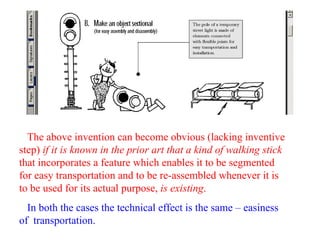
The above invention can become obvious (lacking inventive
step) if it is known in the prior art that a kind of walking stick
that incorporates a feature which enables it to be segmented
for easy transportation and to be re-assembled whenever it is
to be used for its actual purpose, is existing.
In both the cases the technical effect is the same – easiness
of transportation.
How does an invention becomes obvious with respect to two or more
prior art documents (combining the technical effects) ?
Claim: Dining table having a wooden top and a number of legs,
characterised in that the number of legs is equal to three.
Prior art:
D1: Table with four legs
D2: Milk stool with three legs for use on grazing land
1. Closest prior art: D1
2. Distinguishing feature: three leg instead of four
3. Technical effect: No wobbling on uneven surface
4. Problem: How to improve the table known from D1 such that it does
not wobble on uneven surface
5. Milk stool disclosed in D2 has 3 legs only . The grazing land is an
indication of uneven surface
6. The skilled person would therefore apply the teaching of D2 to D1 in
order to solve the wobbling problem
7. In doing so, he would reduce the number of legs to three and thereby
arrive at the claimed table
8. Conclusion: The claimed table is not inventive.
INVENTIONS WHICH ARE
NOT PATENTABLE IN INDIA
(S.3 and S.4)
a) An invention which is frivolous or which claims
anything obviously contrary to well established
natural laws.
e.g (1)perpetual motion machine giving output
without input.
(2) Claim for a method of plating copper with iron
comprising the step of immersing a copper piece in
an aqueous solution containing iron layer on said
copper piece.
b) An invention the primary or intended use or
commercial exploitation of which could be
contrary to public order or morality or which
causes serious prejudice to human,animal or plant
life or health or to the environment;
eg. (1) An apparatus for gambling or machine for
theft ,gambling apparatus or method of gambling.
(2)Method of adulteration of food/drug/medicine.
c) The mere discovery of a scientific principle or
the formulation of an abstract theory or discovery of
any living thing or non-living substances occurring in
nature.
E.g.. (1) laws of preservation of energy
(2) the law of universal gravitation
(3)theory of relativity
(4)discovery of an ore or natural phenomena
d) the mere discovery of any new property or “mere”
new use for a known substance or of the mere use
of a known process, machine or apparatus unless
such known process results in a new product or
employs at least one new reactant,
e.g.(1) a new use of aspirin for cardiovascular disease.
(2) “mere” new use for a known substance is also
not patentable i.e 2nd
or 3rd use for a known
substance.
e) a substance obtained by a mere admixture
resulting only in the aggregation of the properties
of the components thereof or a process for
producing such substance,
e.g.(1) sand and salt mixture not showing any new
property.
(2) a mixture of sugar and colorants in water to
produce a soft drink.
(3) a composition of two drugs ,I.e paracetamol
and ibuprofen for curing fever&pain.
f) the mere arrangement or re-arrangement or
duplication of known devices each functioning
independently of one another in a known way,
e.g.(1) umbrella with fan
(2) bucket fitted with torch.
(3) Clock with transistor in a single cabinet.
(4) Play-cum educational device.
g) a methods of agriculture or horticulture,
e.g.(1) method of cultivation of algae
(2) method of producing mushroom plant
(3) a method of producing new form of a known
plant.
(4) method of producing improved soil from soil
with nematodes by treating the soil with preparation
contained specified phosphorathioates.
i) any process for the medicinal, surgical, curative,
prophylactic diagnostic, or therapeutic or other
treatment of human beings or any process for a
similar treatment of animals to render them free of
disease or to increase their economic value or that of
their products,
e.g.(1) a method of treatment of Cancer or removal of
dental plaque.
(2) a method for measuring the condition of
internal organs of the human body by X-ray
(3) preparatory methods for diagnosis.
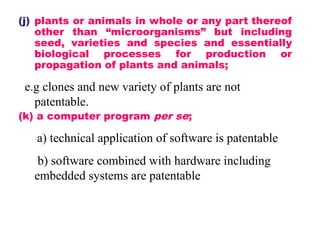
(j) plants or animals in whole or any part thereof
other than “microorganisms” but including
seed, varieties and species and essentially
biological processes for production or
propagation of plants and animals;
e.g clones and new variety of plants are not
patentable.
(k) a computer program per se;
a) technical application of software is patentable
b) software combined with hardware including
embedded systems are patentable
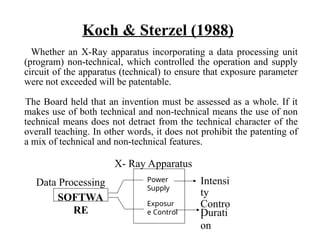
Koch & Sterzel (1988)
Whether an X-Ray apparatus incorporating a data processing unit
(program) non-technical, which controlled the operation and supply
circuit of the apparatus (technical) to ensure that exposure parameter
were not exceeded will be patentable.
The Board held that an invention must be assessed as a whole. If it
makes use of both technical and non-technical means the use of non
technical means does not detract from the technical character of the
overall teaching. In other words, it does not prohibit the patenting of
a mix of technical and non-technical features.
Durati
on
SOFTWA
RE
Power
supply
Exposur
e control
Power
Supply
Exposur
e Control
Intensi
ty
Contro
l
X- Ray Apparatus
Data Processing
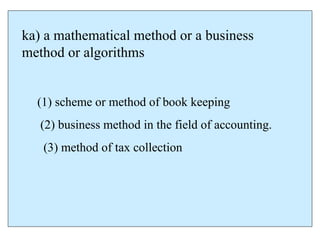
ka) a mathematical method or a business
method or algorithms
(1) scheme or method of book keeping
(2) business method in the field of accounting.
(3) method of tax collection
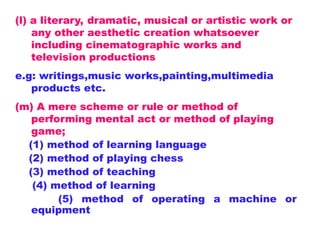
(l) a literary, dramatic, musical or artistic work or
any other aesthetic creation whatsoever
including cinematographic works and
television productions
e.g: writings,music works,painting,multimedia
products etc.
(m) A mere scheme or rule or method of
performing mental act or method of playing
game;
(1) method of learning language
(2) method of playing chess
(3) method of teaching
(4) method of learning
(5) method of operating a machine or
equipment
(n) A presentation of information
e.g Any manner, means or method of expressing
information whether visual, audible or tangible
by words, codes, signals, symbols, diagrams or
any other mode of representation.
(o) Topography of integrated circuits
e.g Three-Dimensional configuration of the
electronic circuits used in microchips and
semiconductor chips.
(p)An invention which in effect, is traditional
knowledge or which is an aggregation or
duplication of known properties of
traditionally known component or
components.
(a) use of turmeric in wound healing.
(b) Method for controlling fungi on plants by the aid
of a hydrophobic extracted neem oil.
Traditional Knowledge
• Traditional knowledge refers to the knowledge, innovations
and practices of indigenous and local communities around
the world.
• Developed from experience gained over the centuries and
adapted to the local culture and environment, traditional
knowledge is transmitted orally from generation to
generation.
• It tends to be collectively owned and takes the form of
stories, songs, folklore, proverbs, cultural values, beliefs,
rituals, community laws, local language, and agricultural
practices, including the development of plant species and
animal breeds.
• Traditional knowledge is mainly of a practical nature,
particularly in such fields as agriculture, fisheries, health,
horticulture, and forestry.
Atomic Energy
Atomic Energy Related Inventions
Related Inventions
Not Patentable
Not Patentable
No patent shall be granted in respect of
an invention relating to Atomic energy
e.g. Inventions relating to compounds of
Uranium, Beryllium, Thorium, Plutonium,
Radium, Graphite, Lithium and more as
notified by Central Government from
time to time.
WHO CAN APPLY FOR A PATENT IN INDIA? (S.6)
a) True and first Inventor (S. 2(1)(y))
b) His/her assignee
c) Legal representative of deceased inventor
or assignee.
either alone or jointly with another
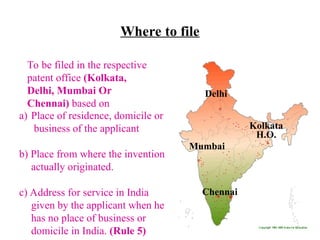
Where to file
Delhi
Mumbai
Chennai
Kolkata
H.O.
a) Place of residence, domicile or
business of the applicant
b) Place from where the invention
actually originated.
c) Address for service in India
given by the applicant when he
has no place of business or
domicile in India. (Rule 5)
To be filed in the respective
patent office (Kolkata,
Delhi, Mumbai Or
Chennai) based on
ADDRESS – Patent Office Chennai
PATENT OFFICE ,
GOVERNMENT OF INDIA,
Intellectual Property Building,
GST Road, Guindy,
Chennai – 600 032.
E-Mail: chennai-patent@nic.in
Telephone:+91-2250 2081, 2250 2082, 2250 2083.
Fax: 2250 2066.
Website: http://www.ipindia.gov.in
How to apply for a Patent?
Application for patent (Form 1 in
duplicate) should be accompanied by
a) Fee (Rs.1000 /- for individual or Rs.4000 /-
for legal entity)
and
b) Provisional or complete specification
(Form 2) and drawings (if any) in duplicate
Filing of a patent application in India
PatentApplication is made on Form 1
Name of Applicant
Address
Nationality
Name of inventors and their address and nationality
Provisional/Complete/Divisional/Patent of addition
Priority Claimed if any
Address of service in India
Declaration by the inventors as to the assignee
Attachments
Fee enclosed
Dated and signed
REQUEST FOR EXAMINATION
The applications will be taken up for
examination only on request in Form 18 made (within
48 months from the date of filing) by the applicant or
the person interested (S.2 (1)(t)) with the prescribed fee
(Rs. 2500 for individual and Rs. 10000 for legal entity)
Patent Grant Procedure
Filing of patent application
Publication after 18 months
Pre Grant Representation by any
person.
Request for examination
Examination: Grant or Refusal
Publication of Grant of patent
Post Grant Opposition to grant of patent
(Constitution of Opposition Board)
Early Publication
Decision By Controller
One day an inventor files a patent
• FORM1,FORM2 (in
duplicate) with fees
• This is the filing date
Classification and Publication
• According to
International
classification and it will
be published in Patent
office journal after 18
months from filing date.
• Early publication can be
done by filing Form 9
(2500/10000)
It then comes to an examiner..
. Request of Examination has
to be filed within 48 months
from the filing date in form
18 (2500/10000)
• Checked for formal &
technical objections
• File is thoroughly read,
analysed
Examination (Only after receiving
request for Examination)
• Novelty search
• Most relevant documents
cited
• Examination report (FER)
stating, with arguments, and
citations what may be
wrong with the application.
Next step……
• The inventor can either
decide to continue with the
examination
• or withdraw his application
• or can clear his stand by
proving novelty and
inventive step over citations.
• The claims may be modified
if the inventor wishes it or as
required by the Controller
The inventor replies……
• The inventor has to
reply to the examination
report with in 12
months from the date of
issue of FER in a
written form
• Can request an
interview with examiner
If Patent Office agrees
• Report is written
• No formal or technical
objections.
• Explaining that patent
application should be
granted.
• Check for pre-grant
representation
If Patent Office disagrees
• Get together to discuss the
case and
• If still no agreement drawn
• An oral hearing is held to
which the inventor is
summoned to the office to
put his/her case to the
Controller.
If they say no – Refusal!!!!
• If they say no, the case will
be refused.
• This decision is appealable
in IPAB
If they say yes –the grant
• If the inventor either
modifies the claims
• or Persuades them that their
point of view is wrong
• Then they will accept the
application for grant of
patent at the end of the oral
hearing
After GRANT?? Post grant
Opposition
• Its published in Patent Office Journal
• within 1 year period is open for any person
interested to file an opposition to the grant in Form
7 (1500/6000)
• Examine the case, arguments of both the inventor
and the opponent by the opposition board on
why it should be modified or revoked.
• Hearing
• Decision by the Controller
• Appeal
GROUNDS OF OPPOSITION Sec. 25 (2)
1. Patent is wrongfully obtained
2. Prior publication in any document
3. Prior claiming
4. Prior public use
5. Obviousness
6. Not an invention
7. Insufficiency of description
8. Failure to disclose information regarding
corresponding foreign applications
9. Conventional application is filed after 12 months from
the date of filing in conventional countries.
10. Not disclose/wrongly mention geographical origin of
biological material
11. Anticipated reg. Traditional knowledge
Every Patent application (Form 1)
should be accompanied by a Provisional or
Complete Specification.
The complete/provisional specification is required to be
submitted in Form 2. The first page of the Form 2 should
contain
a) The title of the invention,
b) the name, the address and nationality of each of the applicants
for the patent and
c) a preamble to the description
FORM 2
THE PATENTS ACT, 1970
[39 of 1970]
COMPLETE SPECIFICATION
(Section 10; Rule 13)
“TITLE”
Name, Address and Nationality
The following specification particularly describes the nature
of this invention and the manner in which it is to be performed
FORM 2
THE PATENTS ACT, 1970
[39 of 1970]
PROVISIONAL SPECIFICATION
(Section 10; Rule 13)
“TITLE”
Name, Address and Nationality
The following specification describes the nature of this
invention
Description of the invention should start from the second
page of the specification (Form 2). An abstract should be included
after the full disclosure of the invention. Drawings if any referred
in the specification can be attached to the specification thereafter.
Why provisional specification ?
When the applicant finds that his invention has reached
a presentable form, then he may prepare a disclosure of the
invention in the form of a written description and submit it to
patent office. This disclosure is called a provisional
specification. By filing a provisional specification that simply
describes the nature of the invention, the applicant attains the
priority over any other person who is likely to file an
application for patent in respect of the same invention being
developed concurrently in some other part of the world.
It does not confer any legal patent rights to the
applicants since there are no claims included therein. Therefore
the Complete specification should be submitted within 12
months from the date of filing the provisional specification. It is
permitted to file any number of provisional specifications
within this period
What is meant by Complete Specification ?
Complete Specification is a techno-legal
document, which fully and particularly
describes the invention and the best method
of performing it.
It should be described in such a way
that it should enable any person skilled in
the art to make or use the invention without
involving in extensive experimentation
Contents of Complete Specification (S.10)
a) A Title
b) Field of the invention.
c) State of the art in the field
d) Summary of the invention
1) Object of the invention (Problem & Solution) &
2) Statement of invention
e) Detailed description of the invention with reference to the
drawings. (Details of deposition, source and geographical
origin of the biological material if such material is
mentioned in description).
f) Scope and/or ambit of the invention
g) Claims
h) Abstract
The title should give a fair indication of the art or
industry to which the invention relates. It should be brief,
free from fancy expressions, free from ambiguity and as
precise and definite as possible but it need not go into the
details of the invention itself.
Personal name, trade name, abbreviation, the word ‘patent’,
the word ‘novel’ or ‘new’, words in other languages, fancy
words etc. are not permitted in TITLE.
TITLE
The description should preferably begin with a short
general statement of the invention so as to show its scope, and
to indicate briefly the subject matter to which the invention
relates, e.g. “This invention relates to . . . . . . . . . . . . . . . . . . . .
.. ”. It should be defined in general terms and also described
with particularity.
e.g. “More particularly the invention relates to ……..” .
Accurately ………
The technical field shall be explained in three or four
sentences, initially mentioning the broad field and then
narrowing it down further to indicate the specific area or field
to which the invention belongs.
FIELD OF THE INVENTION
State of the art in the field
This part should indicate the status of the technology in the
field of invention with reference to experiments going on in the field,
patents and pending patent applications in the specific art with
emphasis on the ‘prior art’ relevant to the invention. When the
invention relates to an improvement on an existing apparatus or
process a short statement of closest prior art may also be given.
However, the description should fully and particularly describe the
invention, by clearly distinguishing it from such closest prior art if
available. If the applicant is not aware of any prior art such statement
may be given.
This part shall also contain the reason for investigating
in the direction, which yielded the result. It can be either to
provide an improved technology in the field or to
solve a long-standing technical problem in the field
of the invention.
In abstract, the purpose of this part is to clearly bring
out the necessity of the invention. It shall state clearly the
technical problems associated with the existing
technology and the solution for that, bringing out
the obvious difference between the claimed
invention and the prior art.
Summary of the invention
It contains two parts
1) Object of the invention
The solution sought by the invention should be clearly
brought out with statements like “With a view to solve the
drawbacks in the existing art, it has been proposed . . . . . . . . .
. . . . . . . . . . . . . . . . ..” followed by the objects which the
inventions has in view
e.g. “The principal object of this invention
is . . . . . . . . . . . . . . . . . . . . . . . . . .”,
“Another object of this invention is . . . . . . . . . . . . . . . . . . . . .
. . .”,
“A further object of this invention
is . . . . . . . . . . . . . . . . . . . . . . . . . . . . . .” etc.
Statement of the invention
The description should include a statement of invention
before giving the details of the invention and the method of
performing it. The statement should clearly set forth the
distinguishing novel features of the invention for which
protection is desired. This part is intended to declare the
different aspects of the invention in verbatim with the claims
and is required to complement the omnibus claim in situations
of infringement proceedings.
It usually starts like
“Accordingly the invention provides an apparatus consisting of
--------------------------- which is characterized in that ----------------------”.
Or
[Accordingly the invention provides Claim 1]
Here Claim1 is the principal claim
Other aspects and processes if any also can be stated
e.g. “There is also provided a method for performing ------------------”
Or
[ There is also provided Claim5]
Here Claim5 is another independent Claim
It may be followed by minute features of the invention as defined in
the dependent Claims
e.g.“According to a feature of the invention the chemical reaction is
preferably carried out at an atmosphere pressure of 1atm”
BRIEF DESCRIPTION OF DRAWINGS
A brief description of the drawings appended may be given
before the detailed description.
Fig 1 illustrates…
Fig 2 shows …… etc..
The following statement may be included after brief description of
drawings (before starting the complete disclosure of the invention)
“These and other objects, features and advantages of the
present invention will become more readily apparent from
a reading of the following detailed description taken in
conjunction with the drawings”
Detailed description of the invention with reference to the
drawings.
This part has to give a complete picture of the invention
and can start with a preamble as given below
“In order to facilitate a better understanding of the invention a
detailed description of the preferred embodiments of the present
invention will now be explained with reference to the
accompanying drawings. It should be understood that the disclosed
embodiments are merely exemplary of the invention, which may
be embodied in various forms. Therefore the details disclosed
herein are not to be interpreted as limiting but merely as the basis
for the claims and as a basis for teaching one skilled in the art how
to make or use the invention”
The nature of the improvements or modifications effected
with respect to the prior art should be clearly and sufficiently
described. The details of the invention described here should be
sufficient for an average person skilled in the art to perform the
invention by developing the necessary technical know how by
himself. It can include examples/drawings or both for clearly
describing and ascertaining the nature of the invention. Sufficient
number of examples can be appended to the description
especially in the case of chemical/biological inventions.
It should provide clear support or antecedent basis for all
terms used in the claims
If an apparatus or product is described then , function of each
part, how they work together etc. shall be depicted in detail.
In case of process, describe each step, starting material,
how any change is made, the end result etc.
In case of compound,
chemical formula, the structure, process which could be used to
make it etc.
The patent application must disclose
the invention in a manner sufficiently
clear and complete for it to be carried
out by a person skilled in art.
If biological material used in an invention cannot be
reproducibly obtained, a sample thereof has to be
deposited at a cell collection institution
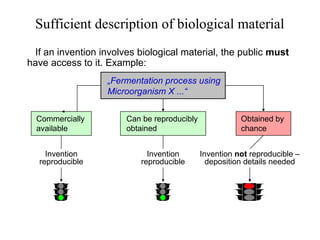
Sufficient description of biological material
If an invention involves biological material, the public must
have access to it. Example:
Commercially
available
Can be reproducibly
obtained
„Fermentation process using
Microorganism X ...“
Obtained by
chance
Invention
reproducible
Invention
reproducible
Invention not reproducible –
deposition details needed
Scope and/or ambit of the invention
There is no need to give a sub-title as above. But this
part of the specification should bring out the areas of application
of the invention and the preferable use of the invention. The
applicant can substantiate the industrial applicability of the
invention in this part and call for the protection against duplication
of the invention in the related fields by specifying the scope and
ambit. The advantages of the invention also can be described in
this part of the specification.
The complete disclosure of the invention may be ended by
a statement of the form
“ Although the invention has been described with reference to
specific embodiments, this description is not meant to be
construed in a limiting sense. Various modifications of the
disclosed embodiments, as well as alternate embodiments of the
invention, will become apparent to persons skilled in the art
upon reference to the description of the invention. It is therefore
contemplated that such modifications can be made without
departing from the spirit or scope of the present invention as
defined.”
Claims
The description in the Complete Specification should be
followed by a clear and succinct statement of “Claims” preceded
by the prescribed preamble, “I claim” or “We claim”, as the case
may be. It shall preferably start from the next page after the full
description of the invention with the claims serially numbered.
The object of the statement of Claims is to show with conciseness,
precision and accuracy as to how much of what is described in the
specification has been sought the protection so that what is not
claimed is open to public use.
CLAIMS DEFINE BOUNDARY OF PROTECTION
Claims are that part of a complete specification which
defines the boundaries of the protection sought by the patent.
They provide legal protection for the invention. They form a
protective boundary line (around the invention) defined by the
words and phrasing in the claims. What is not claimed in the
‘claims’ will be considered as disclaimer, even if the matter is
disclosed in the description.
Object of the claims
The object of the claims is to define clearly with
conciseness, precision and accuracy the monopoly claimed, so that
others may know the exact boundaries of the area of protection in
which they should not trespass. Their primary object is to limit and
not to extend the monopoly being granted and they let others know
when they are infringing on the rights of the patentee. What is not
claimed is considered disclaimed and therefore open to public use.
In other words ‘no’ monopoly is obtained for any matter described
in the complete specification unless it is claimed in claims.
Each claim is evaluated on its own merit and therefore if one of
the claims is objected does not mean that the rest of the claims are
invalid. This is why it is important to make claims on all aspects of
the invention to ensure that the applicant receives the most
protection possible
Scope of the claims
As the value of a patent depends largely upon the scope of
the claims, special care is necessary to ensure that the claims
include neither more nor less than what the applicant desires to
protect by his patent. The claims must not be too extensive so as to
embrace more than what the applicant has in fact invented. A
claim, which is too wide, encroaches upon the subject matter,
which is in public domain. However a claim must not be too
narrow also. Because such a claim would not be sufficiently
effective in preventing the infringement of the patent and the
infringers would go scot-free if the claim were too narrow.
CHARACTERISTICS OF CLAIMS
A claim must be clear, complete and supported by description. A
claim must be clear in the sense that it should not cause the reader
to speculate about the claim. If the words like "thin", "strong", "a
major part", "such as", "when required", “any” etc. are used then it
forces the reader to make a subjective judgment and not an
objective observation. I.e. A claim must be specific and not vague,
ambiguous, speculative or hypothetical in nature.
Each claim should be complete, so that it covers the
inventive feature and enough elements around it to put the
invention in the proper context.
The claims have to be supported by the description (fairly
based on the description). This means that all the characteristics
of the invention that form part of the claims must be fully
explained in the description. In addition, any terms, which are used
in the claims, must be either found in the description or clearly
inferred from the description.
A claim shall call for the protection of either a product or process
as if it is his personal property and shall be preferably in one
sentence.
1) An apparatus for catching mice comprising, a base member for
placement on a flat surface, a spring member...
2) "A chemical for cleaning windows comprised of 10-15%
ammonia, ...",
The claims of a chemical invention can include a chemical
formula or representation of a chemical molecule
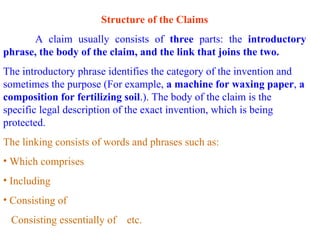
Structure of the Claims
A claim usually consists of three parts: the introductory
phrase, the body of the claim, and the link that joins the two.
The introductory phrase identifies the category of the invention and
sometimes the purpose (For example, a machine for waxing paper, a
composition for fertilizing soil.). The body of the claim is the
specific legal description of the exact invention, which is being
protected.
The linking consists of words and phrases such as:
• Which comprises
• Including
• Consisting of
Consisting essentially of etc.
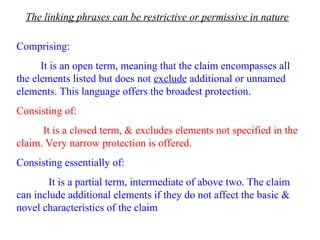
The linking phrases can be restrictive or permissive in nature
Comprising:
It is an open term, meaning that the claim encompasses all
the elements listed but does not exclude additional or unnamed
elements. This language offers the broadest protection.
Consisting of:
It is a closed term, & excludes elements not specified in the
claim. Very narrow protection is offered.
Consisting essentially of:
It is a partial term, intermediate of above two. The claim
can include additional elements if they do not affect the basic &
novel characteristics of the claim
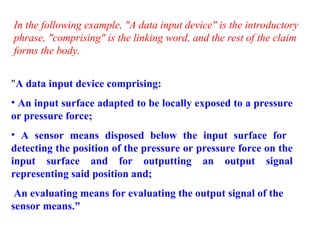
"A data input device comprising:
• An input surface adapted to be locally exposed to a pressure
or pressure force;
• A sensor means disposed below the input surface for
detecting the position of the pressure or pressure force on the
input surface and for outputting an output signal
representing said position and;
An evaluating means for evaluating the output signal of the
sensor means."
In the following example, "A data input device" is the introductory
phrase, "comprising" is the linking word, and the rest of the claim
forms the body.
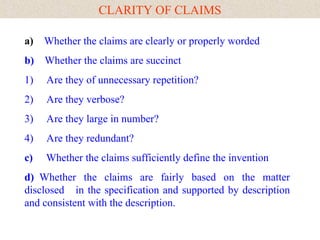
CLARITY OF CLAIMS
a) Whether the claims are clearly or properly worded
b) Whether the claims are succinct
1) Are they of unnecessary repetition?
2) Are they verbose?
3) Are they large in number?
4) Are they redundant?
c) Whether the claims sufficiently define the invention
d) Whether the claims are fairly based on the matter
disclosed in the specification and supported by description
and consistent with the description.
Example1
A structure comprising a semiconductor substrate made of silicon,
said structure further characterized by comprising a near-amorphous
film comprising ZrO2
.
It does not have a precise or well-recognized meaning for a
skilled person. The term ‘near-amorphous’ used in the claim is
vague and unclear and leaves the reader in doubt as to the meaning
of the technical feature to which it refers, thereby rendering the
definition of the subject-matter of said claim unclear
Assessing the clarity of claims
Example 2
A Diesel engine comprising an engine block and a cylinder head
made of an Aluminum-Titanium alloy having a melting point
between 1000 K and 1100 K.
The syntax of the claim is open to different interpretation: Either
the engine block as well as the cylinder head are made of the alloy,
or only the cylinder head is made of the alloy.
Example3
A digital photo-camera comprising a VLSI processing unit and a
CCD image sensor, characterized in that it is adapted to operate
at temperatures down to 200 K.
The camera is defined in terms of the object to be achieved
(operation at very low temperatures) rather than in terms of the
technical features (e.g. selected semiconductor materials,
thermal insulation, etc.) that achieve the desired object. The
claim attempts to define the subject matter in terms of the result
to be achieved. In this instance, however such as formulation is
not allowable because it appears possible to define the subject-
matter in more concrete terms, i.e. in terms of how the effect is
to be achieved.
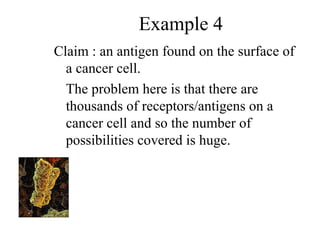
Example 4
Claim : an antigen found on the surface of
a cancer cell.
The problem here is that there are
thousands of receptors/antigens on a
cancer cell and so the number of
possibilities covered is huge.
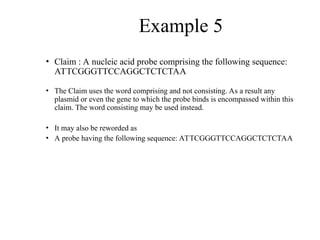
Example 5
• Claim : A nucleic acid probe comprising the following sequence:
ATTCGGGTTCCAGGCTCTCTAA
• The Claim uses the word comprising and not consisting. As a result any
plasmid or even the gene to which the probe binds is encompassed within this
claim. The word consisting may be used instead.
• It may also be reworded as
• A probe having the following sequence: ATTCGGGTTCCAGGCTCTCTAA
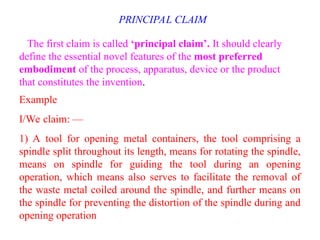
PRINCIPAL CLAIM
The first claim is called ‘principal claim’. It should clearly
define the essential novel features of the most preferred
embodiment of the process, apparatus, device or the product
that constitutes the invention.
Example
I/We claim: —
1) A tool for opening metal containers, the tool comprising a
spindle split throughout its length, means for rotating the spindle,
means on spindle for guiding the tool during an opening
operation, which means also serves to facilitate the removal of
the waste metal coiled around the spindle, and further means on
the spindle for preventing the distortion of the spindle during and
opening operation
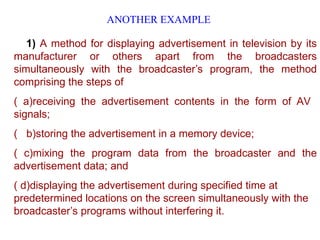
ANOTHER EXAMPLE
1) A method for displaying advertisement in television by its
manufacturer or others apart from the broadcasters
simultaneously with the broadcaster’s program, the method
comprising the steps of
( a)receiving the advertisement contents in the form of AV
signals;
( b)storing the advertisement in a memory device;
( c)mixing the program data from the broadcaster and the
advertisement data; and
( d)displaying the advertisement during specified time at
predetermined locations on the screen simultaneously with the
broadcaster’s programs without interfering it.
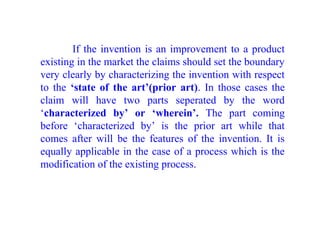
If the invention is an improvement to a product
existing in the market the claims should set the boundary
very clearly by characterizing the invention with respect
to the ‘state of the art’(prior art). In those cases the
claim will have two parts seperated by the word
‘characterized by’ or ‘wherein’. The part coming
before ‘characterized by’ is the prior art while that
comes after will be the features of the invention. It is
equally applicable in the case of a process which is the
modification of the existing process.
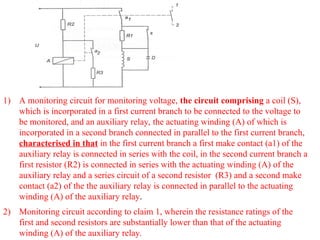
1) A monitoring circuit for monitoring voltage, the circuit comprising a coil (S),
which is incorporated in a first current branch to be connected to the voltage to
be monitored, and an auxiliary relay, the actuating winding (A) of which is
incorporated in a second branch connected in parallel to the first current branch,
characterised in that in the first current branch a first make contact (a1) of the
auxiliary relay is connected in series with the coil, in the second current branch a
first resistor (R2) is connected in series with the actuating winding (A) of the
auxiliary relay and a series circuit of a second resistor (R3) and a second make
contact (a2) of the the auxiliary relay is connected in parallel to the actuating
winding (A) of the auxiliary relay.
2) Monitoring circuit according to claim 1, wherein the resistance ratings of the
first and second resistors are substantially lower than that of the actuating
winding (A) of the auxiliary relay.
SUBSIDIARY CLAIMS - INDEPENDENT AND DEPENDENT CLAIMS
The alternate embodiment of the inventive concept and the
optional features may be claimed in the ‘subsidiary claims’. Subsidiary
claims may include independent claims or dependent claims.
Independent claim is a claim which stands on its own. It Broadly
defines the invention.
Independent claims are used to define an alternate embodiment
of the invention claimed in the principal claim or an invention
supplementary to the principal claim (If claim1 defines coder this claim
can be for decoder) or an invention directly linked to the principal
claim (Product or process or apparatus constituting unity of invention).
INDEPENDENT CLAIMS
2. A method for displaying advertisement in television by its
manufacturer or others apart from the broadcasters
simultaneously with the broadcaster’s program, the method
comprising the steps of
(a) receiving the broadcaster’s program using a first tuner
circuit;
(b) receiving the advertisement contents using a second
tuner circuit and processing the output of the second tuner
circuit with a separate video processing circuitry;
(c) mixing the program data from the broadcaster and the
advertisement data; and
(d) displaying the advertisement during specified time at
predetermined locations on the screen simultaneously with
the broadcaster’s programs without interfering it.
3. A method for displaying advertisement in television by its
manufacturer or others apart from the broadcasters
simultaneously with the broadcaster’s program, the method
comprising the steps of
(a) receiving the advertisement contents in the form of AV
signals;
(b) storing the advertisement in a memory device; and
(c) displaying the advertisement in a separate display device
simultaneously and continuously while the broadcaster’s
program is displayed in the other screen.
(See Claims 2 and 3 in the following example)
“We claim:—
1. A gramophone record in which the surface of the record
containing the record grooves comprises 12 to 15 per cent. of
amorphous carbon, thermoplastic material and a filler consisting of
non-fibrous natural mineral material.
2. A gramophone record according to Claim 1, wherein the
percentage of filler employed in the record is from 1 to 70 per cent.
3. A record according to Claim 2, wherein the percentage of
thermoplastic material is 20 to 60 per cent.
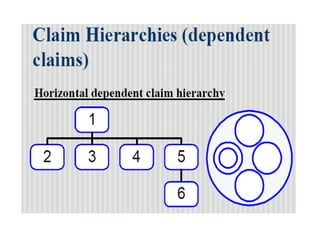
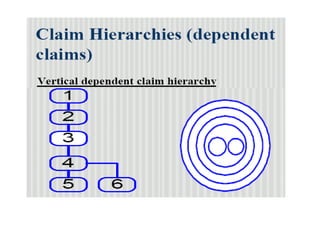
DEPENDENT CLAIMS
Dependant claim is the one worded with reference to an independent
claim or any other dependent claim and contains even the minute
aspects and optional features. A Dependent claim is narrower in its
scope
There is no restriction for the number of claims. Having
many claims, where each one has a different scope allows the
applicant to have legal title to several aspects of the invention. In
a good drafting it begins with broad claims and develops towards
claims that are narrower in scope. In general a narrow claim
specifies more details than a broader claim.
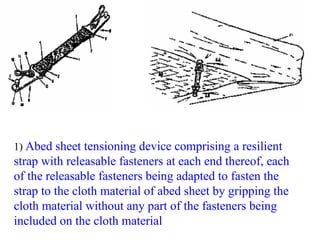
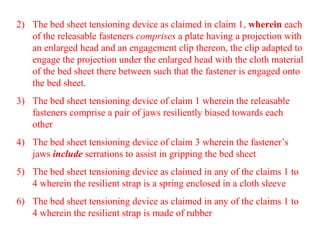
1) Abed sheet tensioning device comprising a resilient
strap with releasable fasteners at each end thereof, each
of the releasable fasteners being adapted to fasten the
strap to the cloth material of abed sheet by gripping the
cloth material without any part of the fasteners being
included on the cloth material
2) The bed sheet tensioning device as claimed in claim 1, wherein each
of the releasable fasteners comprises a plate having a projection with
an enlarged head and an engagement clip thereon, the clip adapted to
engage the projection under the enlarged head with the cloth material
of the bed sheet there between such that the fastener is engaged onto
the bed sheet.
3) The bed sheet tensioning device of claim 1 wherein the releasable
fasteners comprise a pair of jaws resiliently biased towards each
other
4) The bed sheet tensioning device of claim 3 wherein the fastener’s
jaws include serrations to assist in gripping the bed sheet
5) The bed sheet tensioning device as claimed in any of the claims 1 to
4 wherein the resilient strap is a spring enclosed in a cloth sleeve
6) The bed sheet tensioning device as claimed in any of the claims 1 to
4 wherein the resilient strap is made of rubber
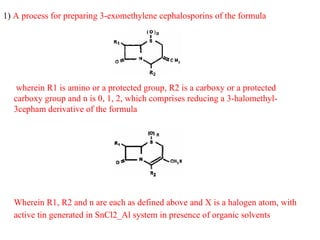
1) A process for preparing 3-exomethylene cephalosporins of the formula
wherein R1 is amino or a protected group, R2 is a carboxy or a protected
carboxy group and n is 0, 1, 2, which comprises reducing a 3-halomethyl-
3cepham derivative of the formula
Wherein R1, R2 and n are each as defined above and X is a halogen atom, with
active tin generated in SnCl2_Al system in presence of organic solvents
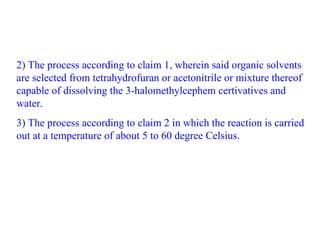
2) The process according to claim 1, wherein said organic solvents
are selected from tetrahydrofuran or acetonitrile or mixture thereof
capable of dissolving the 3-halomethylcephem certivatives and
water.
3) The process according to claim 2 in which the reaction is carried
out at a temperature of about 5 to 60 degree Celsius.
Abstract
An abstract should be included after the claims to provide
brief technical information on the invention. It should give a
concise summary of the invention preferably within 150 words and
shall start from a fresh page. It has to be prepared in such a way
that one can understand the technical problem and solution with its
usefulness. If necessary most relevant figure of the drawings
should also be included in the abstract particularly in case of
Engineering/chemical inventions. However, it cannot be used for
the purpose of interpreting the scope of protection in legal
proceedings.
The controller may amend the abstract for providing better
information to third parties.
DRAWINGS
Complete specification should be followed by Drawings that are
referred in the specification. Drawing should be filed on standard
A4 size sheet in duplicate. Drawing should be preferably drawn in
black Indian indelible ink on thick & durable paper with margin of
2.5 cm on each side, in upright position with respect to top &
bottom position of the sheet. At left-hand top corner of the sheet the
name of the applicant should be mentioned. Total number of sheets
& consequential sheet number should be mentioned at the right
hand top corner. At the right-hand bottom signature of the
applicant/agent should be given along with the name of signatory
there under. A reference letter/numerals as used in the description
should also be used in denoting the corresponding component/part
in the figure (s).
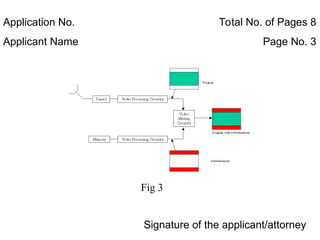
Application No. Total No. of Pages 8
Applicant Name Page No. 3
Signature of the applicant/attorney
Fig 3
No descriptive matter should appear on the drawing except under
certain cases such as flow sheet, chemical & other reaction etc.
The same letters or numerals should be used in different figures
for the same parts. In complicated drawings or when there is no
room to write the reference letters in their proper places, the
letters should be shown outside the figures and connected by fine
lines with the parts to which they refer.
E-mail:praveenrajrs@yahoo.com
Phone:0471-2515255
Mobile : 9995632522

Indian Patent System and Patent drafting.ppt

  • 1.
    National Institute forInterdisciplinary Science & Technology, Trivandrum Council of Scientific and Industrial Research Indian Patent System and Patent Drafting by R.S. PRAVEEN RAJ Scientist – IP Management
  • 2.
    Patentable subject matter OnlyInvention are patentable Only Invention are patentable relate to a Process Process or Product Product or both be new (Novel) involve an inventive step inventive step be capable of industrial application industrial application not fall under Sections 3 and 4 Sections 3 and 4
  • 3.
    “NEW” MEANS Invention must notbe Invention must not be Published in India or elsewhere. In prior public knowledge or prior public use within India. Claimed in claims in any Patent specification in India What is claimed must be different from what is already known.
  • 4.
    Inventive step • Aninvention shall be considered as involving an inventive step if, having regard to the state of the art, it is not obvious to a person skilled in the art. To Put it simply, Inventive step is the Novelty in Technical effect
  • 5.
    Inventive step -who is the skilled person? • Knows everything in the state of the art • Lacks inventive imagination and does not engage in creative thinking • Has a practical orientation • Has a cautious attitude • Cannot be expected to perform scientific research in areas not yet explored • Follows normally the path indicated in the state of the art X
  • 6.
    The above inventioncan become obvious (lacking inventive step) if it is known in the prior art that a kind of walking stick that incorporates a feature which enables it to be segmented for easy transportation and to be re-assembled whenever it is to be used for its actual purpose, is existing. In both the cases the technical effect is the same – easiness of transportation.
  • 7.
    How does aninvention becomes obvious with respect to two or more prior art documents (combining the technical effects) ? Claim: Dining table having a wooden top and a number of legs, characterised in that the number of legs is equal to three. Prior art: D1: Table with four legs D2: Milk stool with three legs for use on grazing land 1. Closest prior art: D1 2. Distinguishing feature: three leg instead of four 3. Technical effect: No wobbling on uneven surface 4. Problem: How to improve the table known from D1 such that it does not wobble on uneven surface 5. Milk stool disclosed in D2 has 3 legs only . The grazing land is an indication of uneven surface 6. The skilled person would therefore apply the teaching of D2 to D1 in order to solve the wobbling problem 7. In doing so, he would reduce the number of legs to three and thereby arrive at the claimed table 8. Conclusion: The claimed table is not inventive.
  • 8.
    INVENTIONS WHICH ARE NOTPATENTABLE IN INDIA (S.3 and S.4)
  • 9.
    a) An inventionwhich is frivolous or which claims anything obviously contrary to well established natural laws. e.g (1)perpetual motion machine giving output without input. (2) Claim for a method of plating copper with iron comprising the step of immersing a copper piece in an aqueous solution containing iron layer on said copper piece.
  • 10.
    b) An inventionthe primary or intended use or commercial exploitation of which could be contrary to public order or morality or which causes serious prejudice to human,animal or plant life or health or to the environment; eg. (1) An apparatus for gambling or machine for theft ,gambling apparatus or method of gambling. (2)Method of adulteration of food/drug/medicine.
  • 11.
    c) The merediscovery of a scientific principle or the formulation of an abstract theory or discovery of any living thing or non-living substances occurring in nature. E.g.. (1) laws of preservation of energy (2) the law of universal gravitation (3)theory of relativity (4)discovery of an ore or natural phenomena
  • 12.
    d) the merediscovery of any new property or “mere” new use for a known substance or of the mere use of a known process, machine or apparatus unless such known process results in a new product or employs at least one new reactant, e.g.(1) a new use of aspirin for cardiovascular disease. (2) “mere” new use for a known substance is also not patentable i.e 2nd or 3rd use for a known substance.
  • 13.
    e) a substanceobtained by a mere admixture resulting only in the aggregation of the properties of the components thereof or a process for producing such substance, e.g.(1) sand and salt mixture not showing any new property. (2) a mixture of sugar and colorants in water to produce a soft drink. (3) a composition of two drugs ,I.e paracetamol and ibuprofen for curing fever&pain.
  • 14.
    f) the merearrangement or re-arrangement or duplication of known devices each functioning independently of one another in a known way, e.g.(1) umbrella with fan (2) bucket fitted with torch. (3) Clock with transistor in a single cabinet. (4) Play-cum educational device.
  • 15.
    g) a methodsof agriculture or horticulture, e.g.(1) method of cultivation of algae (2) method of producing mushroom plant (3) a method of producing new form of a known plant. (4) method of producing improved soil from soil with nematodes by treating the soil with preparation contained specified phosphorathioates.
  • 16.
    i) any processfor the medicinal, surgical, curative, prophylactic diagnostic, or therapeutic or other treatment of human beings or any process for a similar treatment of animals to render them free of disease or to increase their economic value or that of their products, e.g.(1) a method of treatment of Cancer or removal of dental plaque. (2) a method for measuring the condition of internal organs of the human body by X-ray (3) preparatory methods for diagnosis.
  • 17.
    (j) plants oranimals in whole or any part thereof other than “microorganisms” but including seed, varieties and species and essentially biological processes for production or propagation of plants and animals; e.g clones and new variety of plants are not patentable. (k) a computer program per se; a) technical application of software is patentable b) software combined with hardware including embedded systems are patentable
  • 18.
    Koch & Sterzel(1988) Whether an X-Ray apparatus incorporating a data processing unit (program) non-technical, which controlled the operation and supply circuit of the apparatus (technical) to ensure that exposure parameter were not exceeded will be patentable. The Board held that an invention must be assessed as a whole. If it makes use of both technical and non-technical means the use of non technical means does not detract from the technical character of the overall teaching. In other words, it does not prohibit the patenting of a mix of technical and non-technical features. Durati on SOFTWA RE Power supply Exposur e control Power Supply Exposur e Control Intensi ty Contro l X- Ray Apparatus Data Processing
  • 19.
    ka) a mathematicalmethod or a business method or algorithms (1) scheme or method of book keeping (2) business method in the field of accounting. (3) method of tax collection
  • 20.
    (l) a literary,dramatic, musical or artistic work or any other aesthetic creation whatsoever including cinematographic works and television productions e.g: writings,music works,painting,multimedia products etc. (m) A mere scheme or rule or method of performing mental act or method of playing game; (1) method of learning language (2) method of playing chess (3) method of teaching (4) method of learning (5) method of operating a machine or equipment
  • 21.
    (n) A presentationof information e.g Any manner, means or method of expressing information whether visual, audible or tangible by words, codes, signals, symbols, diagrams or any other mode of representation. (o) Topography of integrated circuits e.g Three-Dimensional configuration of the electronic circuits used in microchips and semiconductor chips.
  • 22.
    (p)An invention whichin effect, is traditional knowledge or which is an aggregation or duplication of known properties of traditionally known component or components. (a) use of turmeric in wound healing. (b) Method for controlling fungi on plants by the aid of a hydrophobic extracted neem oil.
  • 23.
    Traditional Knowledge • Traditionalknowledge refers to the knowledge, innovations and practices of indigenous and local communities around the world. • Developed from experience gained over the centuries and adapted to the local culture and environment, traditional knowledge is transmitted orally from generation to generation. • It tends to be collectively owned and takes the form of stories, songs, folklore, proverbs, cultural values, beliefs, rituals, community laws, local language, and agricultural practices, including the development of plant species and animal breeds. • Traditional knowledge is mainly of a practical nature, particularly in such fields as agriculture, fisheries, health, horticulture, and forestry.
  • 24.
    Atomic Energy Atomic EnergyRelated Inventions Related Inventions Not Patentable Not Patentable No patent shall be granted in respect of an invention relating to Atomic energy e.g. Inventions relating to compounds of Uranium, Beryllium, Thorium, Plutonium, Radium, Graphite, Lithium and more as notified by Central Government from time to time.
  • 25.
    WHO CAN APPLYFOR A PATENT IN INDIA? (S.6) a) True and first Inventor (S. 2(1)(y)) b) His/her assignee c) Legal representative of deceased inventor or assignee. either alone or jointly with another
  • 26.
    Where to file Delhi Mumbai Chennai Kolkata H.O. a)Place of residence, domicile or business of the applicant b) Place from where the invention actually originated. c) Address for service in India given by the applicant when he has no place of business or domicile in India. (Rule 5) To be filed in the respective patent office (Kolkata, Delhi, Mumbai Or Chennai) based on
  • 27.
    ADDRESS – PatentOffice Chennai PATENT OFFICE , GOVERNMENT OF INDIA, Intellectual Property Building, GST Road, Guindy, Chennai – 600 032. E-Mail: chennai-patent@nic.in Telephone:+91-2250 2081, 2250 2082, 2250 2083. Fax: 2250 2066. Website: http://www.ipindia.gov.in
  • 28.
    How to applyfor a Patent? Application for patent (Form 1 in duplicate) should be accompanied by a) Fee (Rs.1000 /- for individual or Rs.4000 /- for legal entity) and b) Provisional or complete specification (Form 2) and drawings (if any) in duplicate
  • 29.
    Filing of apatent application in India PatentApplication is made on Form 1 Name of Applicant Address Nationality Name of inventors and their address and nationality Provisional/Complete/Divisional/Patent of addition Priority Claimed if any Address of service in India Declaration by the inventors as to the assignee Attachments Fee enclosed Dated and signed
  • 30.
    REQUEST FOR EXAMINATION Theapplications will be taken up for examination only on request in Form 18 made (within 48 months from the date of filing) by the applicant or the person interested (S.2 (1)(t)) with the prescribed fee (Rs. 2500 for individual and Rs. 10000 for legal entity)
  • 31.
    Patent Grant Procedure PatentGrant Procedure Filing of patent application Publication after 18 months Pre Grant Representation by any person. Request for examination Examination: Grant or Refusal Publication of Grant of patent Post Grant Opposition to grant of patent (Constitution of Opposition Board) Early Publication Decision By Controller
  • 32.
    One day aninventor files a patent • FORM1,FORM2 (in duplicate) with fees • This is the filing date
  • 33.
    Classification and Publication •According to International classification and it will be published in Patent office journal after 18 months from filing date. • Early publication can be done by filing Form 9 (2500/10000)
  • 34.
    It then comesto an examiner.. . Request of Examination has to be filed within 48 months from the filing date in form 18 (2500/10000) • Checked for formal & technical objections • File is thoroughly read, analysed
  • 35.
    Examination (Only afterreceiving request for Examination) • Novelty search • Most relevant documents cited • Examination report (FER) stating, with arguments, and citations what may be wrong with the application.
  • 36.
    Next step…… • Theinventor can either decide to continue with the examination • or withdraw his application • or can clear his stand by proving novelty and inventive step over citations. • The claims may be modified if the inventor wishes it or as required by the Controller
  • 37.
    The inventor replies…… •The inventor has to reply to the examination report with in 12 months from the date of issue of FER in a written form • Can request an interview with examiner
  • 38.
    If Patent Officeagrees • Report is written • No formal or technical objections. • Explaining that patent application should be granted. • Check for pre-grant representation
  • 39.
    If Patent Officedisagrees • Get together to discuss the case and • If still no agreement drawn • An oral hearing is held to which the inventor is summoned to the office to put his/her case to the Controller.
  • 40.
    If they sayno – Refusal!!!! • If they say no, the case will be refused. • This decision is appealable in IPAB
  • 41.
    If they sayyes –the grant • If the inventor either modifies the claims • or Persuades them that their point of view is wrong • Then they will accept the application for grant of patent at the end of the oral hearing
  • 42.
    After GRANT?? Postgrant Opposition • Its published in Patent Office Journal • within 1 year period is open for any person interested to file an opposition to the grant in Form 7 (1500/6000) • Examine the case, arguments of both the inventor and the opponent by the opposition board on why it should be modified or revoked. • Hearing • Decision by the Controller • Appeal
  • 43.
    GROUNDS OF OPPOSITIONSec. 25 (2) 1. Patent is wrongfully obtained 2. Prior publication in any document 3. Prior claiming 4. Prior public use 5. Obviousness 6. Not an invention 7. Insufficiency of description 8. Failure to disclose information regarding corresponding foreign applications 9. Conventional application is filed after 12 months from the date of filing in conventional countries. 10. Not disclose/wrongly mention geographical origin of biological material 11. Anticipated reg. Traditional knowledge
  • 44.
    Every Patent application(Form 1) should be accompanied by a Provisional or Complete Specification. The complete/provisional specification is required to be submitted in Form 2. The first page of the Form 2 should contain a) The title of the invention, b) the name, the address and nationality of each of the applicants for the patent and c) a preamble to the description
  • 45.
    FORM 2 THE PATENTSACT, 1970 [39 of 1970] COMPLETE SPECIFICATION (Section 10; Rule 13) “TITLE” Name, Address and Nationality The following specification particularly describes the nature of this invention and the manner in which it is to be performed
  • 46.
    FORM 2 THE PATENTSACT, 1970 [39 of 1970] PROVISIONAL SPECIFICATION (Section 10; Rule 13) “TITLE” Name, Address and Nationality The following specification describes the nature of this invention
  • 47.
    Description of theinvention should start from the second page of the specification (Form 2). An abstract should be included after the full disclosure of the invention. Drawings if any referred in the specification can be attached to the specification thereafter.
  • 48.
    Why provisional specification? When the applicant finds that his invention has reached a presentable form, then he may prepare a disclosure of the invention in the form of a written description and submit it to patent office. This disclosure is called a provisional specification. By filing a provisional specification that simply describes the nature of the invention, the applicant attains the priority over any other person who is likely to file an application for patent in respect of the same invention being developed concurrently in some other part of the world. It does not confer any legal patent rights to the applicants since there are no claims included therein. Therefore the Complete specification should be submitted within 12 months from the date of filing the provisional specification. It is permitted to file any number of provisional specifications within this period
  • 49.
    What is meantby Complete Specification ? Complete Specification is a techno-legal document, which fully and particularly describes the invention and the best method of performing it. It should be described in such a way that it should enable any person skilled in the art to make or use the invention without involving in extensive experimentation
  • 50.
    Contents of CompleteSpecification (S.10) a) A Title b) Field of the invention. c) State of the art in the field d) Summary of the invention 1) Object of the invention (Problem & Solution) & 2) Statement of invention e) Detailed description of the invention with reference to the drawings. (Details of deposition, source and geographical origin of the biological material if such material is mentioned in description). f) Scope and/or ambit of the invention g) Claims h) Abstract
  • 51.
    The title shouldgive a fair indication of the art or industry to which the invention relates. It should be brief, free from fancy expressions, free from ambiguity and as precise and definite as possible but it need not go into the details of the invention itself. Personal name, trade name, abbreviation, the word ‘patent’, the word ‘novel’ or ‘new’, words in other languages, fancy words etc. are not permitted in TITLE. TITLE
  • 52.
    The description shouldpreferably begin with a short general statement of the invention so as to show its scope, and to indicate briefly the subject matter to which the invention relates, e.g. “This invention relates to . . . . . . . . . . . . . . . . . . . . .. ”. It should be defined in general terms and also described with particularity. e.g. “More particularly the invention relates to ……..” . Accurately ……… The technical field shall be explained in three or four sentences, initially mentioning the broad field and then narrowing it down further to indicate the specific area or field to which the invention belongs. FIELD OF THE INVENTION
  • 53.
    State of theart in the field This part should indicate the status of the technology in the field of invention with reference to experiments going on in the field, patents and pending patent applications in the specific art with emphasis on the ‘prior art’ relevant to the invention. When the invention relates to an improvement on an existing apparatus or process a short statement of closest prior art may also be given. However, the description should fully and particularly describe the invention, by clearly distinguishing it from such closest prior art if available. If the applicant is not aware of any prior art such statement may be given.
  • 54.
    This part shallalso contain the reason for investigating in the direction, which yielded the result. It can be either to provide an improved technology in the field or to solve a long-standing technical problem in the field of the invention. In abstract, the purpose of this part is to clearly bring out the necessity of the invention. It shall state clearly the technical problems associated with the existing technology and the solution for that, bringing out the obvious difference between the claimed invention and the prior art.
  • 55.
    Summary of theinvention It contains two parts 1) Object of the invention The solution sought by the invention should be clearly brought out with statements like “With a view to solve the drawbacks in the existing art, it has been proposed . . . . . . . . . . . . . . . . . . . . . . . . . ..” followed by the objects which the inventions has in view e.g. “The principal object of this invention is . . . . . . . . . . . . . . . . . . . . . . . . . .”, “Another object of this invention is . . . . . . . . . . . . . . . . . . . . . . . .”, “A further object of this invention is . . . . . . . . . . . . . . . . . . . . . . . . . . . . . .” etc.
  • 56.
    Statement of theinvention The description should include a statement of invention before giving the details of the invention and the method of performing it. The statement should clearly set forth the distinguishing novel features of the invention for which protection is desired. This part is intended to declare the different aspects of the invention in verbatim with the claims and is required to complement the omnibus claim in situations of infringement proceedings.
  • 57.
    It usually startslike “Accordingly the invention provides an apparatus consisting of --------------------------- which is characterized in that ----------------------”. Or [Accordingly the invention provides Claim 1] Here Claim1 is the principal claim Other aspects and processes if any also can be stated e.g. “There is also provided a method for performing ------------------” Or [ There is also provided Claim5] Here Claim5 is another independent Claim It may be followed by minute features of the invention as defined in the dependent Claims e.g.“According to a feature of the invention the chemical reaction is preferably carried out at an atmosphere pressure of 1atm”
  • 58.
    BRIEF DESCRIPTION OFDRAWINGS A brief description of the drawings appended may be given before the detailed description. Fig 1 illustrates… Fig 2 shows …… etc.. The following statement may be included after brief description of drawings (before starting the complete disclosure of the invention) “These and other objects, features and advantages of the present invention will become more readily apparent from a reading of the following detailed description taken in conjunction with the drawings”
  • 59.
    Detailed description ofthe invention with reference to the drawings. This part has to give a complete picture of the invention and can start with a preamble as given below “In order to facilitate a better understanding of the invention a detailed description of the preferred embodiments of the present invention will now be explained with reference to the accompanying drawings. It should be understood that the disclosed embodiments are merely exemplary of the invention, which may be embodied in various forms. Therefore the details disclosed herein are not to be interpreted as limiting but merely as the basis for the claims and as a basis for teaching one skilled in the art how to make or use the invention”
  • 60.
    The nature ofthe improvements or modifications effected with respect to the prior art should be clearly and sufficiently described. The details of the invention described here should be sufficient for an average person skilled in the art to perform the invention by developing the necessary technical know how by himself. It can include examples/drawings or both for clearly describing and ascertaining the nature of the invention. Sufficient number of examples can be appended to the description especially in the case of chemical/biological inventions. It should provide clear support or antecedent basis for all terms used in the claims
  • 61.
    If an apparatusor product is described then , function of each part, how they work together etc. shall be depicted in detail. In case of process, describe each step, starting material, how any change is made, the end result etc. In case of compound, chemical formula, the structure, process which could be used to make it etc.
  • 62.
    The patent applicationmust disclose the invention in a manner sufficiently clear and complete for it to be carried out by a person skilled in art. If biological material used in an invention cannot be reproducibly obtained, a sample thereof has to be deposited at a cell collection institution
  • 63.
    Sufficient description ofbiological material If an invention involves biological material, the public must have access to it. Example: Commercially available Can be reproducibly obtained „Fermentation process using Microorganism X ...“ Obtained by chance Invention reproducible Invention reproducible Invention not reproducible – deposition details needed
  • 64.
    Scope and/or ambitof the invention There is no need to give a sub-title as above. But this part of the specification should bring out the areas of application of the invention and the preferable use of the invention. The applicant can substantiate the industrial applicability of the invention in this part and call for the protection against duplication of the invention in the related fields by specifying the scope and ambit. The advantages of the invention also can be described in this part of the specification.
  • 65.
    The complete disclosureof the invention may be ended by a statement of the form “ Although the invention has been described with reference to specific embodiments, this description is not meant to be construed in a limiting sense. Various modifications of the disclosed embodiments, as well as alternate embodiments of the invention, will become apparent to persons skilled in the art upon reference to the description of the invention. It is therefore contemplated that such modifications can be made without departing from the spirit or scope of the present invention as defined.”
  • 66.
    Claims The description inthe Complete Specification should be followed by a clear and succinct statement of “Claims” preceded by the prescribed preamble, “I claim” or “We claim”, as the case may be. It shall preferably start from the next page after the full description of the invention with the claims serially numbered. The object of the statement of Claims is to show with conciseness, precision and accuracy as to how much of what is described in the specification has been sought the protection so that what is not claimed is open to public use.
  • 67.
    CLAIMS DEFINE BOUNDARYOF PROTECTION Claims are that part of a complete specification which defines the boundaries of the protection sought by the patent. They provide legal protection for the invention. They form a protective boundary line (around the invention) defined by the words and phrasing in the claims. What is not claimed in the ‘claims’ will be considered as disclaimer, even if the matter is disclosed in the description.
  • 68.
    Object of theclaims The object of the claims is to define clearly with conciseness, precision and accuracy the monopoly claimed, so that others may know the exact boundaries of the area of protection in which they should not trespass. Their primary object is to limit and not to extend the monopoly being granted and they let others know when they are infringing on the rights of the patentee. What is not claimed is considered disclaimed and therefore open to public use. In other words ‘no’ monopoly is obtained for any matter described in the complete specification unless it is claimed in claims. Each claim is evaluated on its own merit and therefore if one of the claims is objected does not mean that the rest of the claims are invalid. This is why it is important to make claims on all aspects of the invention to ensure that the applicant receives the most protection possible
  • 69.
    Scope of theclaims As the value of a patent depends largely upon the scope of the claims, special care is necessary to ensure that the claims include neither more nor less than what the applicant desires to protect by his patent. The claims must not be too extensive so as to embrace more than what the applicant has in fact invented. A claim, which is too wide, encroaches upon the subject matter, which is in public domain. However a claim must not be too narrow also. Because such a claim would not be sufficiently effective in preventing the infringement of the patent and the infringers would go scot-free if the claim were too narrow.
  • 70.
    CHARACTERISTICS OF CLAIMS Aclaim must be clear, complete and supported by description. A claim must be clear in the sense that it should not cause the reader to speculate about the claim. If the words like "thin", "strong", "a major part", "such as", "when required", “any” etc. are used then it forces the reader to make a subjective judgment and not an objective observation. I.e. A claim must be specific and not vague, ambiguous, speculative or hypothetical in nature. Each claim should be complete, so that it covers the inventive feature and enough elements around it to put the invention in the proper context.
  • 71.
    The claims haveto be supported by the description (fairly based on the description). This means that all the characteristics of the invention that form part of the claims must be fully explained in the description. In addition, any terms, which are used in the claims, must be either found in the description or clearly inferred from the description.
  • 72.
    A claim shallcall for the protection of either a product or process as if it is his personal property and shall be preferably in one sentence. 1) An apparatus for catching mice comprising, a base member for placement on a flat surface, a spring member... 2) "A chemical for cleaning windows comprised of 10-15% ammonia, ...", The claims of a chemical invention can include a chemical formula or representation of a chemical molecule
  • 73.
    Structure of theClaims A claim usually consists of three parts: the introductory phrase, the body of the claim, and the link that joins the two. The introductory phrase identifies the category of the invention and sometimes the purpose (For example, a machine for waxing paper, a composition for fertilizing soil.). The body of the claim is the specific legal description of the exact invention, which is being protected. The linking consists of words and phrases such as: • Which comprises • Including • Consisting of Consisting essentially of etc.
  • 74.
    The linking phrasescan be restrictive or permissive in nature Comprising: It is an open term, meaning that the claim encompasses all the elements listed but does not exclude additional or unnamed elements. This language offers the broadest protection. Consisting of: It is a closed term, & excludes elements not specified in the claim. Very narrow protection is offered. Consisting essentially of: It is a partial term, intermediate of above two. The claim can include additional elements if they do not affect the basic & novel characteristics of the claim
  • 75.
    "A data inputdevice comprising: • An input surface adapted to be locally exposed to a pressure or pressure force; • A sensor means disposed below the input surface for detecting the position of the pressure or pressure force on the input surface and for outputting an output signal representing said position and; An evaluating means for evaluating the output signal of the sensor means." In the following example, "A data input device" is the introductory phrase, "comprising" is the linking word, and the rest of the claim forms the body.
  • 76.
    CLARITY OF CLAIMS a)Whether the claims are clearly or properly worded b) Whether the claims are succinct 1) Are they of unnecessary repetition? 2) Are they verbose? 3) Are they large in number? 4) Are they redundant? c) Whether the claims sufficiently define the invention d) Whether the claims are fairly based on the matter disclosed in the specification and supported by description and consistent with the description.
  • 77.
    Example1 A structure comprisinga semiconductor substrate made of silicon, said structure further characterized by comprising a near-amorphous film comprising ZrO2 . It does not have a precise or well-recognized meaning for a skilled person. The term ‘near-amorphous’ used in the claim is vague and unclear and leaves the reader in doubt as to the meaning of the technical feature to which it refers, thereby rendering the definition of the subject-matter of said claim unclear Assessing the clarity of claims
  • 78.
    Example 2 A Dieselengine comprising an engine block and a cylinder head made of an Aluminum-Titanium alloy having a melting point between 1000 K and 1100 K. The syntax of the claim is open to different interpretation: Either the engine block as well as the cylinder head are made of the alloy, or only the cylinder head is made of the alloy.
  • 79.
    Example3 A digital photo-cameracomprising a VLSI processing unit and a CCD image sensor, characterized in that it is adapted to operate at temperatures down to 200 K. The camera is defined in terms of the object to be achieved (operation at very low temperatures) rather than in terms of the technical features (e.g. selected semiconductor materials, thermal insulation, etc.) that achieve the desired object. The claim attempts to define the subject matter in terms of the result to be achieved. In this instance, however such as formulation is not allowable because it appears possible to define the subject- matter in more concrete terms, i.e. in terms of how the effect is to be achieved.
  • 80.
    Example 4 Claim :an antigen found on the surface of a cancer cell. The problem here is that there are thousands of receptors/antigens on a cancer cell and so the number of possibilities covered is huge.
  • 81.
    Example 5 • Claim: A nucleic acid probe comprising the following sequence: ATTCGGGTTCCAGGCTCTCTAA • The Claim uses the word comprising and not consisting. As a result any plasmid or even the gene to which the probe binds is encompassed within this claim. The word consisting may be used instead. • It may also be reworded as • A probe having the following sequence: ATTCGGGTTCCAGGCTCTCTAA
  • 82.
    PRINCIPAL CLAIM The firstclaim is called ‘principal claim’. It should clearly define the essential novel features of the most preferred embodiment of the process, apparatus, device or the product that constitutes the invention. Example I/We claim: — 1) A tool for opening metal containers, the tool comprising a spindle split throughout its length, means for rotating the spindle, means on spindle for guiding the tool during an opening operation, which means also serves to facilitate the removal of the waste metal coiled around the spindle, and further means on the spindle for preventing the distortion of the spindle during and opening operation
  • 83.
    ANOTHER EXAMPLE 1) Amethod for displaying advertisement in television by its manufacturer or others apart from the broadcasters simultaneously with the broadcaster’s program, the method comprising the steps of ( a)receiving the advertisement contents in the form of AV signals; ( b)storing the advertisement in a memory device; ( c)mixing the program data from the broadcaster and the advertisement data; and ( d)displaying the advertisement during specified time at predetermined locations on the screen simultaneously with the broadcaster’s programs without interfering it.
  • 84.
    If the inventionis an improvement to a product existing in the market the claims should set the boundary very clearly by characterizing the invention with respect to the ‘state of the art’(prior art). In those cases the claim will have two parts seperated by the word ‘characterized by’ or ‘wherein’. The part coming before ‘characterized by’ is the prior art while that comes after will be the features of the invention. It is equally applicable in the case of a process which is the modification of the existing process.
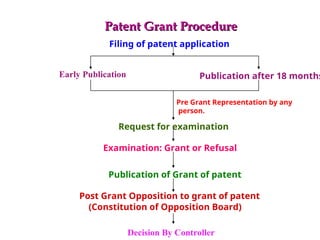
  • 85.
    1) A monitoringcircuit for monitoring voltage, the circuit comprising a coil (S), which is incorporated in a first current branch to be connected to the voltage to be monitored, and an auxiliary relay, the actuating winding (A) of which is incorporated in a second branch connected in parallel to the first current branch, characterised in that in the first current branch a first make contact (a1) of the auxiliary relay is connected in series with the coil, in the second current branch a first resistor (R2) is connected in series with the actuating winding (A) of the auxiliary relay and a series circuit of a second resistor (R3) and a second make contact (a2) of the the auxiliary relay is connected in parallel to the actuating winding (A) of the auxiliary relay. 2) Monitoring circuit according to claim 1, wherein the resistance ratings of the first and second resistors are substantially lower than that of the actuating winding (A) of the auxiliary relay.
  • 86.
    SUBSIDIARY CLAIMS -INDEPENDENT AND DEPENDENT CLAIMS The alternate embodiment of the inventive concept and the optional features may be claimed in the ‘subsidiary claims’. Subsidiary claims may include independent claims or dependent claims. Independent claim is a claim which stands on its own. It Broadly defines the invention. Independent claims are used to define an alternate embodiment of the invention claimed in the principal claim or an invention supplementary to the principal claim (If claim1 defines coder this claim can be for decoder) or an invention directly linked to the principal claim (Product or process or apparatus constituting unity of invention).
  • 87.
    INDEPENDENT CLAIMS 2. Amethod for displaying advertisement in television by its manufacturer or others apart from the broadcasters simultaneously with the broadcaster’s program, the method comprising the steps of (a) receiving the broadcaster’s program using a first tuner circuit; (b) receiving the advertisement contents using a second tuner circuit and processing the output of the second tuner circuit with a separate video processing circuitry; (c) mixing the program data from the broadcaster and the advertisement data; and (d) displaying the advertisement during specified time at predetermined locations on the screen simultaneously with the broadcaster’s programs without interfering it.
  • 88.
    3. A methodfor displaying advertisement in television by its manufacturer or others apart from the broadcasters simultaneously with the broadcaster’s program, the method comprising the steps of (a) receiving the advertisement contents in the form of AV signals; (b) storing the advertisement in a memory device; and (c) displaying the advertisement in a separate display device simultaneously and continuously while the broadcaster’s program is displayed in the other screen.
  • 89.
    (See Claims 2and 3 in the following example) “We claim:— 1. A gramophone record in which the surface of the record containing the record grooves comprises 12 to 15 per cent. of amorphous carbon, thermoplastic material and a filler consisting of non-fibrous natural mineral material. 2. A gramophone record according to Claim 1, wherein the percentage of filler employed in the record is from 1 to 70 per cent. 3. A record according to Claim 2, wherein the percentage of thermoplastic material is 20 to 60 per cent. DEPENDENT CLAIMS Dependant claim is the one worded with reference to an independent claim or any other dependent claim and contains even the minute aspects and optional features. A Dependent claim is narrower in its scope
  • 90.
    There is norestriction for the number of claims. Having many claims, where each one has a different scope allows the applicant to have legal title to several aspects of the invention. In a good drafting it begins with broad claims and develops towards claims that are narrower in scope. In general a narrow claim specifies more details than a broader claim.
  • 92.
    1) Abed sheettensioning device comprising a resilient strap with releasable fasteners at each end thereof, each of the releasable fasteners being adapted to fasten the strap to the cloth material of abed sheet by gripping the cloth material without any part of the fasteners being included on the cloth material
  • 93.
    2) The bedsheet tensioning device as claimed in claim 1, wherein each of the releasable fasteners comprises a plate having a projection with an enlarged head and an engagement clip thereon, the clip adapted to engage the projection under the enlarged head with the cloth material of the bed sheet there between such that the fastener is engaged onto the bed sheet. 3) The bed sheet tensioning device of claim 1 wherein the releasable fasteners comprise a pair of jaws resiliently biased towards each other 4) The bed sheet tensioning device of claim 3 wherein the fastener’s jaws include serrations to assist in gripping the bed sheet 5) The bed sheet tensioning device as claimed in any of the claims 1 to 4 wherein the resilient strap is a spring enclosed in a cloth sleeve 6) The bed sheet tensioning device as claimed in any of the claims 1 to 4 wherein the resilient strap is made of rubber
  • 95.
    1) A processfor preparing 3-exomethylene cephalosporins of the formula wherein R1 is amino or a protected group, R2 is a carboxy or a protected carboxy group and n is 0, 1, 2, which comprises reducing a 3-halomethyl- 3cepham derivative of the formula Wherein R1, R2 and n are each as defined above and X is a halogen atom, with active tin generated in SnCl2_Al system in presence of organic solvents
  • 96.
    2) The processaccording to claim 1, wherein said organic solvents are selected from tetrahydrofuran or acetonitrile or mixture thereof capable of dissolving the 3-halomethylcephem certivatives and water. 3) The process according to claim 2 in which the reaction is carried out at a temperature of about 5 to 60 degree Celsius.
  • 97.
    Abstract An abstract shouldbe included after the claims to provide brief technical information on the invention. It should give a concise summary of the invention preferably within 150 words and shall start from a fresh page. It has to be prepared in such a way that one can understand the technical problem and solution with its usefulness. If necessary most relevant figure of the drawings should also be included in the abstract particularly in case of Engineering/chemical inventions. However, it cannot be used for the purpose of interpreting the scope of protection in legal proceedings. The controller may amend the abstract for providing better information to third parties.
  • 98.
    DRAWINGS Complete specification shouldbe followed by Drawings that are referred in the specification. Drawing should be filed on standard A4 size sheet in duplicate. Drawing should be preferably drawn in black Indian indelible ink on thick & durable paper with margin of 2.5 cm on each side, in upright position with respect to top & bottom position of the sheet. At left-hand top corner of the sheet the name of the applicant should be mentioned. Total number of sheets & consequential sheet number should be mentioned at the right hand top corner. At the right-hand bottom signature of the applicant/agent should be given along with the name of signatory there under. A reference letter/numerals as used in the description should also be used in denoting the corresponding component/part in the figure (s).
  • 99.
    Application No. TotalNo. of Pages 8 Applicant Name Page No. 3 Signature of the applicant/attorney Fig 3
  • 100.
    No descriptive mattershould appear on the drawing except under certain cases such as flow sheet, chemical & other reaction etc. The same letters or numerals should be used in different figures for the same parts. In complicated drawings or when there is no room to write the reference letters in their proper places, the letters should be shown outside the figures and connected by fine lines with the parts to which they refer.
  • 101.