BY MOHAMED YASIR
1
 Respondents evaluate only one object at
a time, and for this reason non
comparative scales often referred to as
monadic scales.
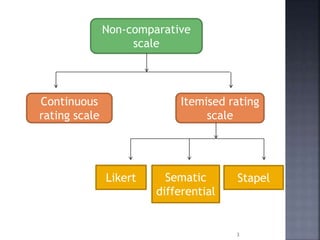
 Non comparative techniques consist of
continuous and itemized rating scale
 Each item is scaled independently of
others. Examples : how do you feel about
coke ?
2
Non-comparative
scale
Continuous
rating scale
Itemised rating
scale
Likert Sematic
differential
Stapel
3
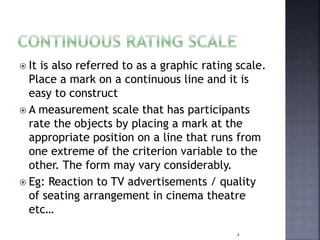
 It is also referred to as a graphic rating scale.
Place a mark on a continuous line and it is
easy to construct
 A measurement scale that has participants
rate the objects by placing a mark at the
appropriate position on a line that runs from
one extreme of the criterion variable to the
other. The form may vary considerably.
 Eg: Reaction to TV advertisements / quality
of seating arrangement in cinema theatre
etc…
4
How would you rate the quality of seating at Odeon
cinemas?
Version 1
Probably the worst ------------------------------------Probably the best
Version 2
Probably the worst ------------------------------------Probably the best
10 20 30 40 50 60 70 80 90 100
Version 3
Probably the worst ------------------------------------Probably the best
10 20 30 40 50 60 70 80 90 100
Very bad Neither good Very good
not bad
5
 The respondents are provided with a scale
that has a number or brief description
associated with each category
 The categories are ordered in terms of
scale position, and the respondents are
required to select the specified category
that best describes the object being rated
 The commonly used itemized rating scales
are the Likert, semantic differential and
stapel scale
6
 A measurement scale with, typically, five
response categories ranging from ‘strongly
disagree’ to ‘strongly agree’ that requires
participants to indicate a degree of
agreement or disagreement with each of a
series of statements related to the stimulus
objects.
 Degree of agreement on a 1 (strongly
disagree) to 5 (strongly agree) scale. It is
easy to construct, administer and
understand.
Eg: Measurement of attitudes
7
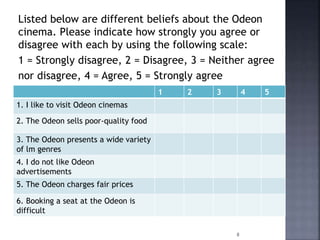
Listed below are different beliefs about the Odeon
cinema. Please indicate how strongly you agree or
disagree with each by using the following scale:
1 = Strongly disagree, 2 = Disagree, 3 = Neither agree
nor disagree, 4 = Agree, 5 = Strongly agree
1 2 3 4 5
1. I like to visit Odeon cinemas
2. The Odeon sells poor-quality food
3. The Odeon presents a wide variety
of lm genres
4. I do not like Odeon
advertisements
5. The Odeon charges fair prices
6. Booking a seat at the Odeon is
difficult
8
 A seven-point rating scale with end points
associated with bipolar labels. it is
Versatile in nature.
 Its versatility makes the semantic
differential a popular rating scale in
marketing research.It has also been used
to develop advertising and promotion
strategies and in new-product
development studies.
 Eg : Brand, product and company images
9
 What does visiting an Odeon cinema mean to
you? The following descriptive scales,
bounded at each end by bipolar adjectives,
summaries characteristics of a visit. Please
mark ‘X’ in the blank that best indicates
what a visit to an Odeon cinema means to
you.
10
Boring Exciting
Special Routine
Thrifty Indulgent
Cosy Uncomfor-
table
Peaceful Noisy
Youthful Mature
11
 Unipolar 10-point scale, –5 to +5, without
a neutral point (zero)
 A scale for measuring attitudes that
consists of a single adjective in the
middle of an even numbered range of
values.
Eg: Measurement of attitudes and images
12
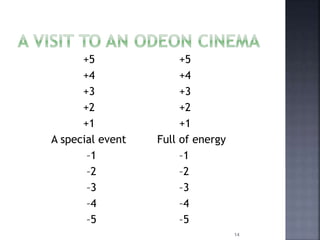
 Please evaluate how accurately each phrase
describes a visit to an Odeon cinema. Select a
positive number for the phrases you think
describe a visit accurately. The more accurately
you think the phrase describes a visit, the larger
the positive number you should choose. You
should select a minus number if you do not think
the phrase accurately describes a visit. The less
accurately you think it describes a visit, the
larger the negative number you should choose.
You can select any number from +5 for phrases
you think are very accurate, to –5 for phrases
you think are very inaccurate.
13
+5 +5
+4 +4
+3 +3
+2 +2
+1 +1
A special event Full of energy
–1 –1
–2 –2
–3 –3
–4 –4
–5 –5
14
1. Number of categories : Although there is
no single, optimal number, traditional
guidelines suggest that there should be
between five and nine categories
2. Balanced versus unbalanced : In general,
the scale should be balanced to obtain the
most objective data
3. Odd or even number of categories : If a
neutral or indifferent scale response is
possible from at least some of the
participants, an odd number of categories
should be used
15
4. Forced versus unforced : In situations
where the participants are expected to
have no opinion, the accuracy of the data
may be improved by a non-forced scale
5. Verbal description : An argument can be
made for labelling all or many scale
categories. The category descriptions
should be located as close to the response
categories as possible
6. Physical form : A number of options
should be tried and the best one selected
16
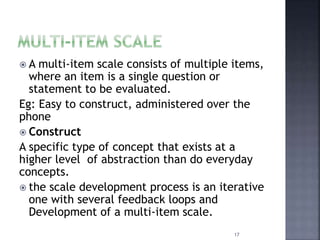
 A multi-item scale consists of multiple items,
where an item is a single question or
statement to be evaluated.
Eg: Easy to construct, administered over the
phone
 Construct
A specific type of concept that exists at a
higher level of abstraction than do everyday
concepts.
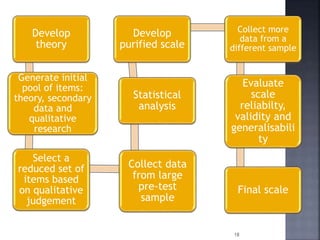
 the scale development process is an iterative
one with several feedback loops and
Development of a multi-item scale.
17
Develop
theory
Generate initial
pool of items:
theory, secondary
data and
qualitative
research
Select a
reduced set of
items based
on qualitative
judgement
Collect data
from large
pre-test
sample
Statistical
analysis
Develop
purified scale
Collect more
data from a
different sample
Evaluate
scale
reliabilty,
validity and
generalisabili
ty
Final scale
18
19

Non comparative scaling technique

  • 1.
  • 2.
     Respondents evaluateonly one object at a time, and for this reason non comparative scales often referred to as monadic scales.  Non comparative techniques consist of continuous and itemized rating scale  Each item is scaled independently of others. Examples : how do you feel about coke ? 2
  • 3.
  • 4.
     It isalso referred to as a graphic rating scale. Place a mark on a continuous line and it is easy to construct  A measurement scale that has participants rate the objects by placing a mark at the appropriate position on a line that runs from one extreme of the criterion variable to the other. The form may vary considerably.  Eg: Reaction to TV advertisements / quality of seating arrangement in cinema theatre etc… 4
  • 5.
    How would yourate the quality of seating at Odeon cinemas? Version 1 Probably the worst ------------------------------------Probably the best Version 2 Probably the worst ------------------------------------Probably the best 10 20 30 40 50 60 70 80 90 100 Version 3 Probably the worst ------------------------------------Probably the best 10 20 30 40 50 60 70 80 90 100 Very bad Neither good Very good not bad 5
  • 6.
     The respondentsare provided with a scale that has a number or brief description associated with each category  The categories are ordered in terms of scale position, and the respondents are required to select the specified category that best describes the object being rated  The commonly used itemized rating scales are the Likert, semantic differential and stapel scale 6
  • 7.
     A measurementscale with, typically, five response categories ranging from ‘strongly disagree’ to ‘strongly agree’ that requires participants to indicate a degree of agreement or disagreement with each of a series of statements related to the stimulus objects.  Degree of agreement on a 1 (strongly disagree) to 5 (strongly agree) scale. It is easy to construct, administer and understand. Eg: Measurement of attitudes 7
  • 8.
    Listed below aredifferent beliefs about the Odeon cinema. Please indicate how strongly you agree or disagree with each by using the following scale: 1 = Strongly disagree, 2 = Disagree, 3 = Neither agree nor disagree, 4 = Agree, 5 = Strongly agree 1 2 3 4 5 1. I like to visit Odeon cinemas 2. The Odeon sells poor-quality food 3. The Odeon presents a wide variety of lm genres 4. I do not like Odeon advertisements 5. The Odeon charges fair prices 6. Booking a seat at the Odeon is difficult 8
  • 9.
     A seven-pointrating scale with end points associated with bipolar labels. it is Versatile in nature.  Its versatility makes the semantic differential a popular rating scale in marketing research.It has also been used to develop advertising and promotion strategies and in new-product development studies.  Eg : Brand, product and company images 9
  • 10.
     What doesvisiting an Odeon cinema mean to you? The following descriptive scales, bounded at each end by bipolar adjectives, summaries characteristics of a visit. Please mark ‘X’ in the blank that best indicates what a visit to an Odeon cinema means to you. 10
  • 11.
    Boring Exciting Special Routine ThriftyIndulgent Cosy Uncomfor- table Peaceful Noisy Youthful Mature 11
  • 12.
     Unipolar 10-pointscale, –5 to +5, without a neutral point (zero)  A scale for measuring attitudes that consists of a single adjective in the middle of an even numbered range of values. Eg: Measurement of attitudes and images 12
  • 13.
     Please evaluatehow accurately each phrase describes a visit to an Odeon cinema. Select a positive number for the phrases you think describe a visit accurately. The more accurately you think the phrase describes a visit, the larger the positive number you should choose. You should select a minus number if you do not think the phrase accurately describes a visit. The less accurately you think it describes a visit, the larger the negative number you should choose. You can select any number from +5 for phrases you think are very accurate, to –5 for phrases you think are very inaccurate. 13
  • 14.
    +5 +5 +4 +4 +3+3 +2 +2 +1 +1 A special event Full of energy –1 –1 –2 –2 –3 –3 –4 –4 –5 –5 14
  • 15.
    1. Number ofcategories : Although there is no single, optimal number, traditional guidelines suggest that there should be between five and nine categories 2. Balanced versus unbalanced : In general, the scale should be balanced to obtain the most objective data 3. Odd or even number of categories : If a neutral or indifferent scale response is possible from at least some of the participants, an odd number of categories should be used 15
  • 16.
    4. Forced versusunforced : In situations where the participants are expected to have no opinion, the accuracy of the data may be improved by a non-forced scale 5. Verbal description : An argument can be made for labelling all or many scale categories. The category descriptions should be located as close to the response categories as possible 6. Physical form : A number of options should be tried and the best one selected 16
  • 17.
     A multi-itemscale consists of multiple items, where an item is a single question or statement to be evaluated. Eg: Easy to construct, administered over the phone  Construct A specific type of concept that exists at a higher level of abstraction than do everyday concepts.  the scale development process is an iterative one with several feedback loops and Development of a multi-item scale. 17
  • 18.
    Develop theory Generate initial pool ofitems: theory, secondary data and qualitative research Select a reduced set of items based on qualitative judgement Collect data from large pre-test sample Statistical analysis Develop purified scale Collect more data from a different sample Evaluate scale reliabilty, validity and generalisabili ty Final scale 18
  • 19.