PRIORITY BASED BUDGETING (Part I)
Achieving Fiscal HealthTools & Techniques for
Diagnosis & Treatment

Kathie Novak, Jon Johnson &
Chris Fabian
November 13, 2013
1
A Brief Introduction

JON JOHNSON

CHRIS FABIAN

2
3
4
5
6
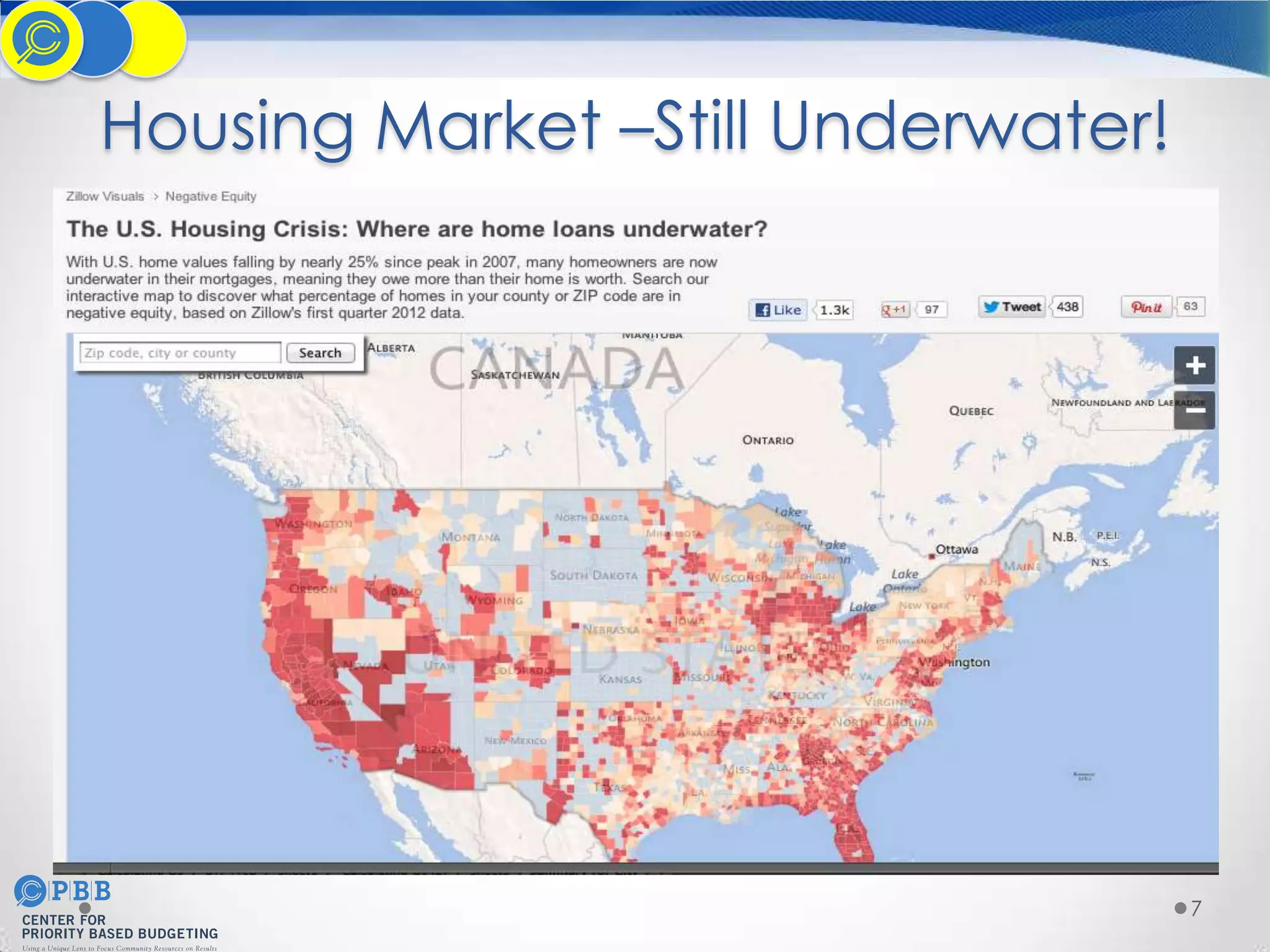
Housing Market –Still Underwater!

7
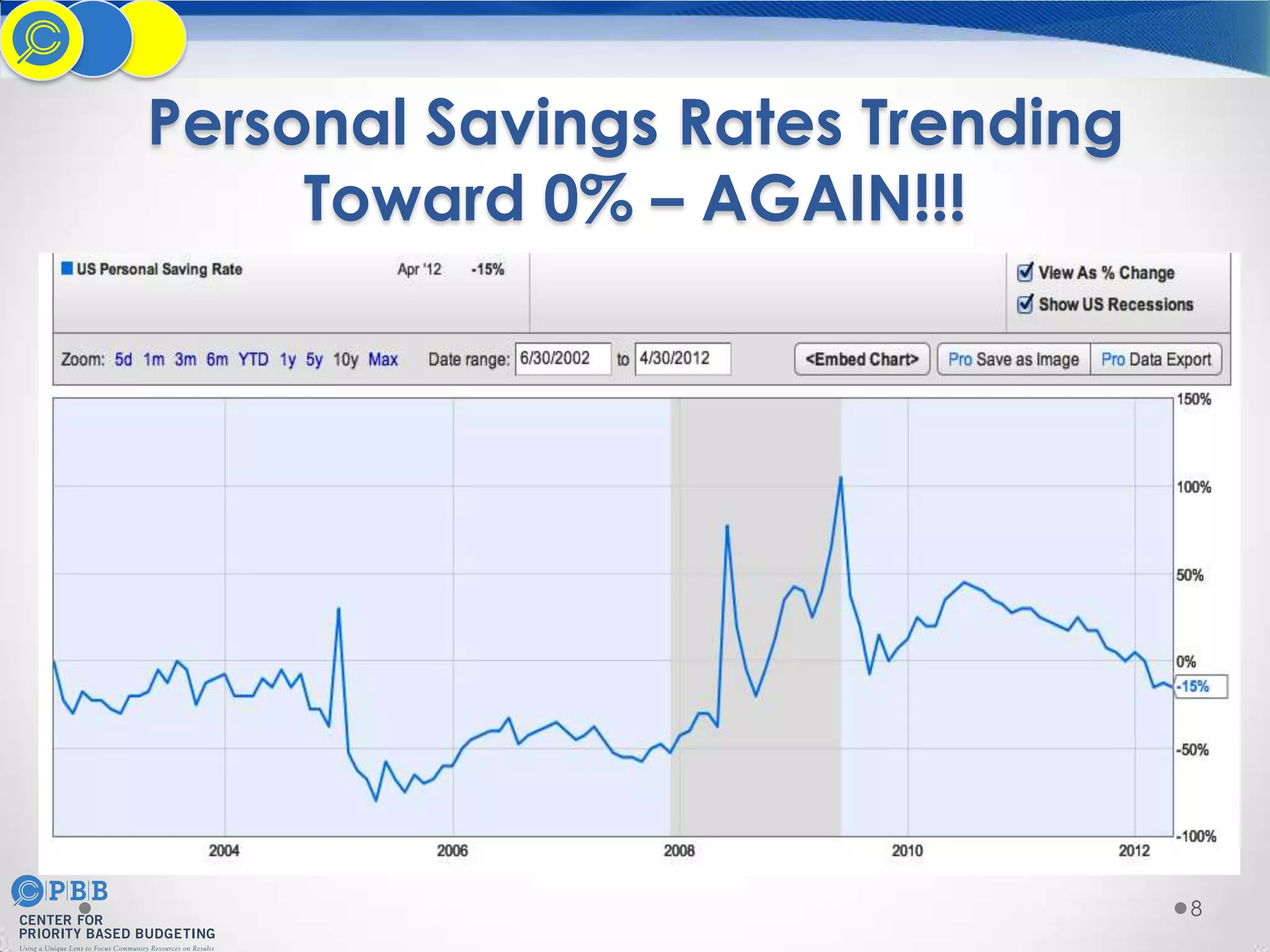
Personal Savings Rates Trending
Toward 0% – AGAIN!!!

8
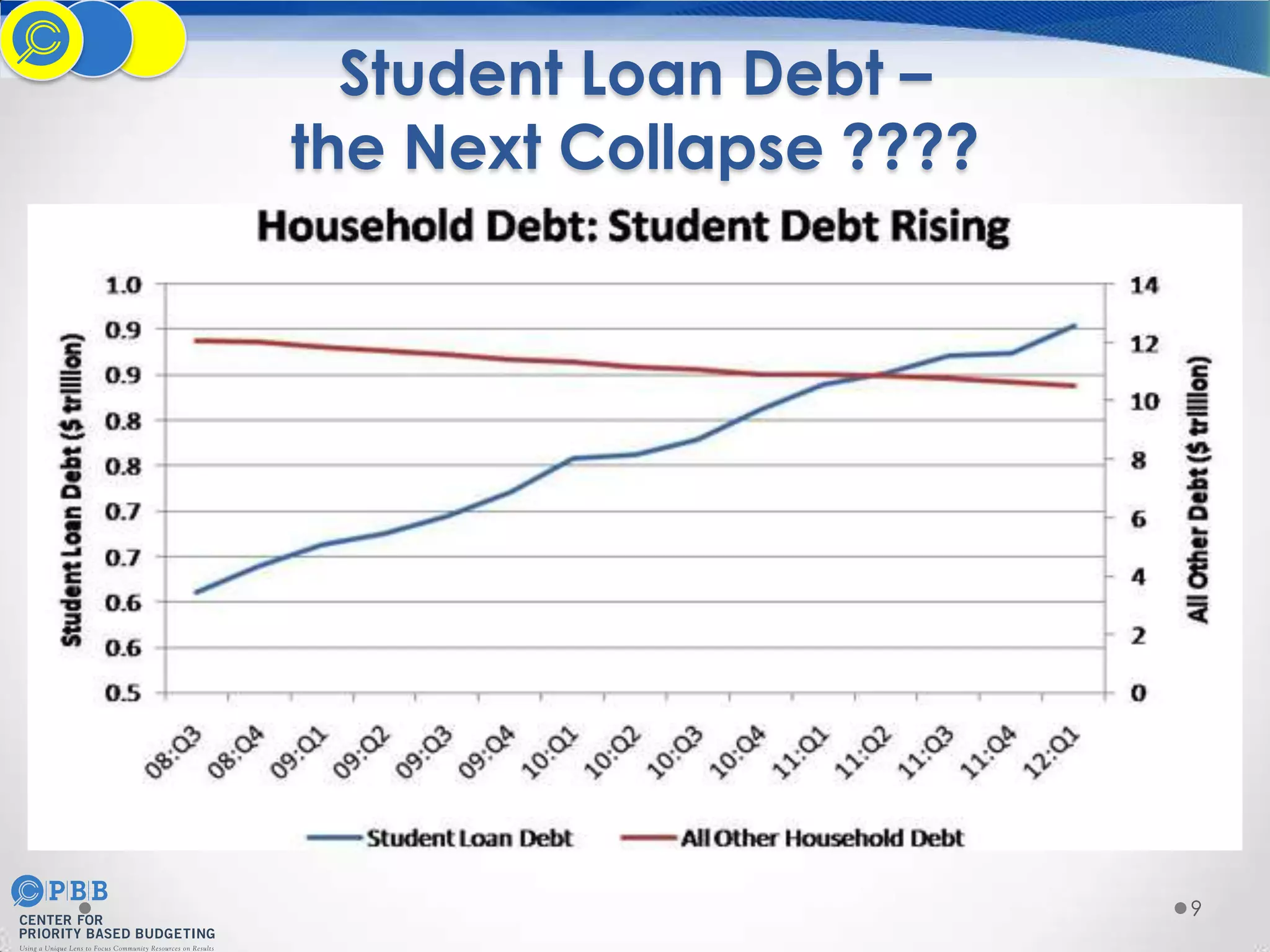
Student Loan Debt –
the Next Collapse ????

9
So - as an Elected Official:
o What does this mean for me?
o What should be I be paying attention to?
o Who should be watching?
o What else is on the horizon?

10
The Financials ….

From an Elected Officials
Perspective
11
12
13
14
15
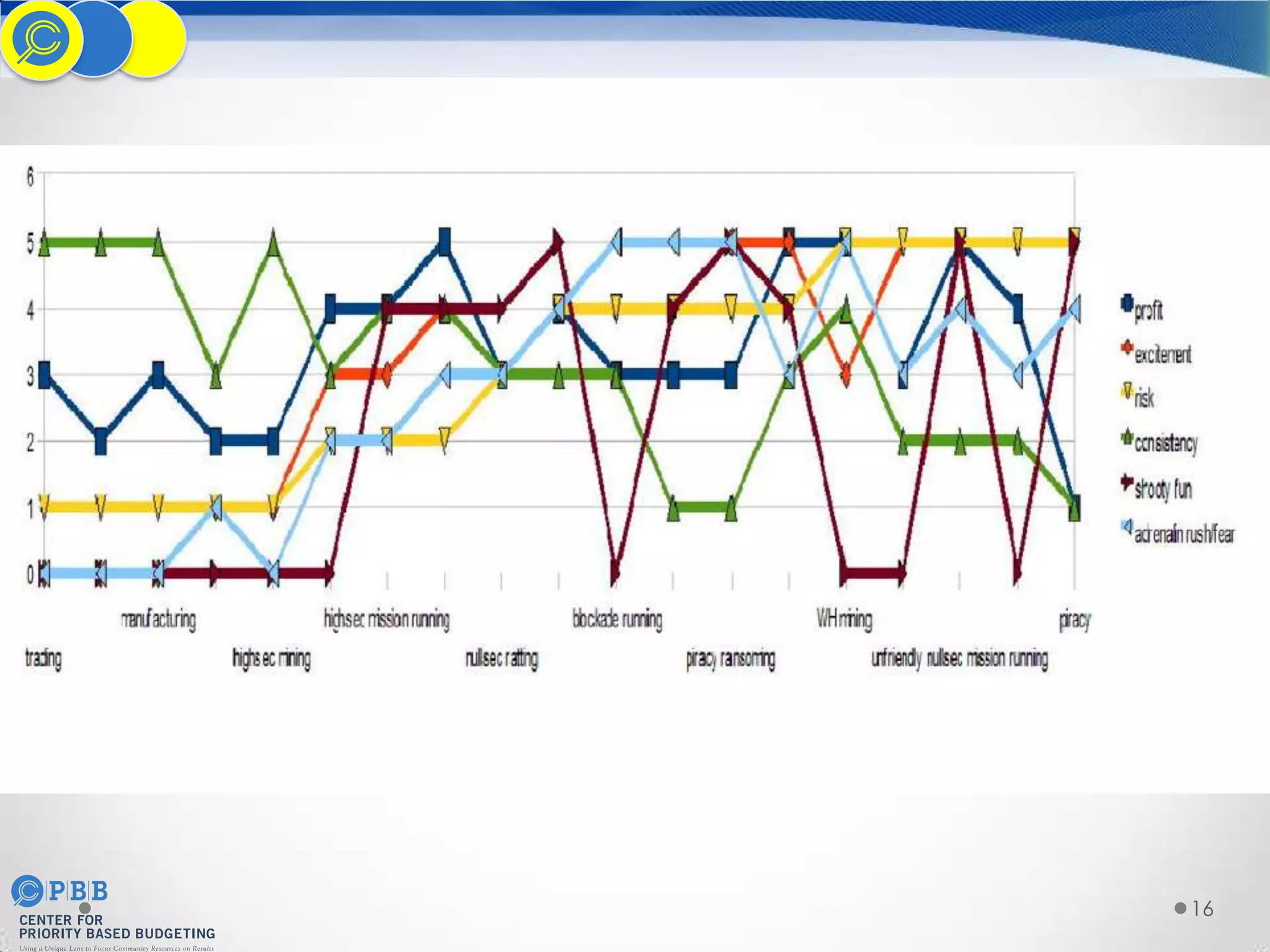
16
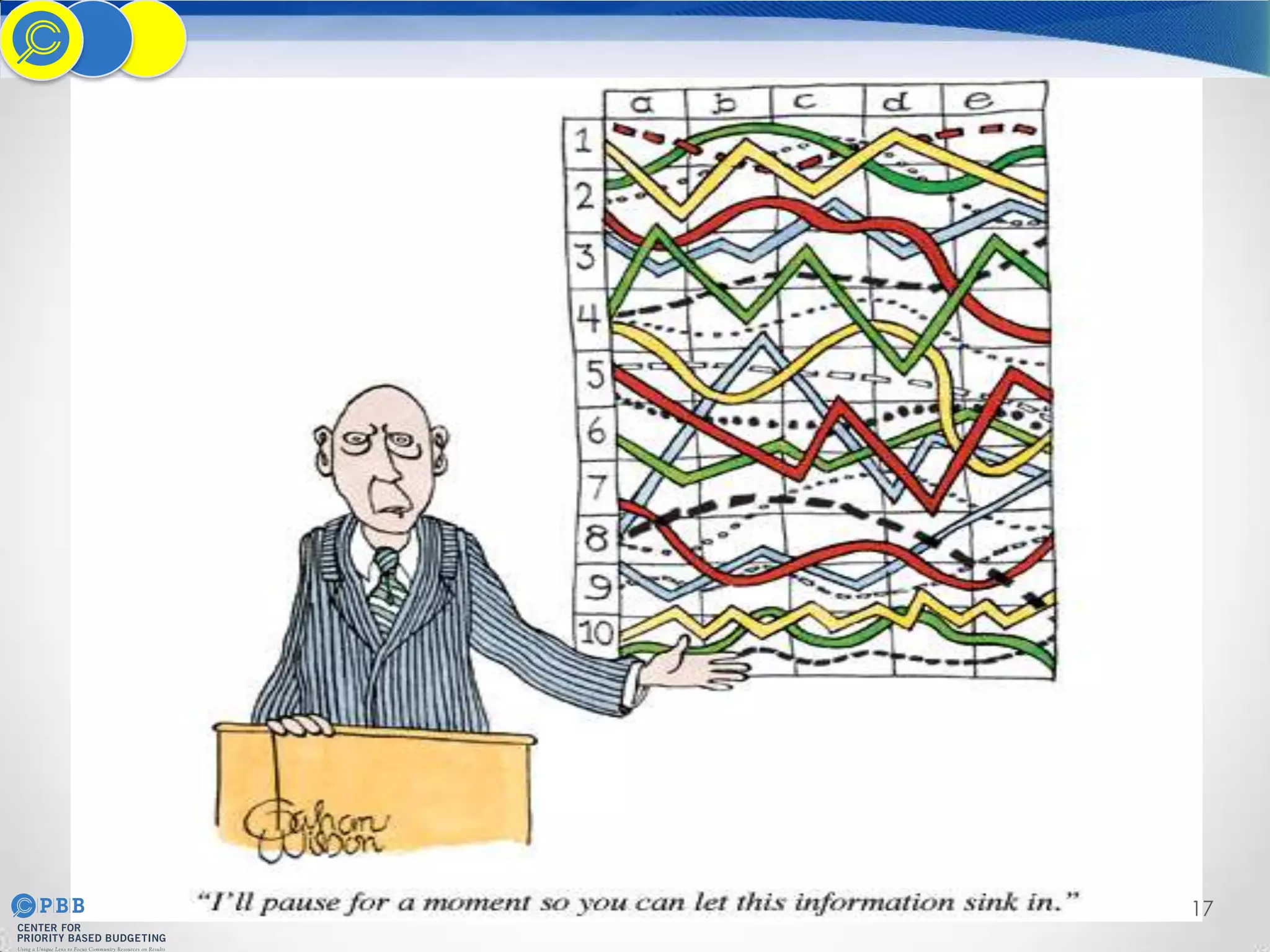
17
18
What are your Elected Officials
really thinking?
• What does all this financial information really tell me?
o Are you saying everything is fine ?
o Are you saying we need to make cuts ?
o Are you saying we need to raise taxes ?
o Are you saying we have more money to spend ?
• What are you asking me to decide ?
OR

• Are you just wanting my “rubber stamp” of approval ?
19
Are We Headed in the Right Direction?
• “If you don’t know where you are and
you don’t know where you are going –
any road will get you there.”
• "You've got to be very careful if you don't
know where you're going, because you
might not get there.” Yogi Berra
- SO Show me where we ARE and show me
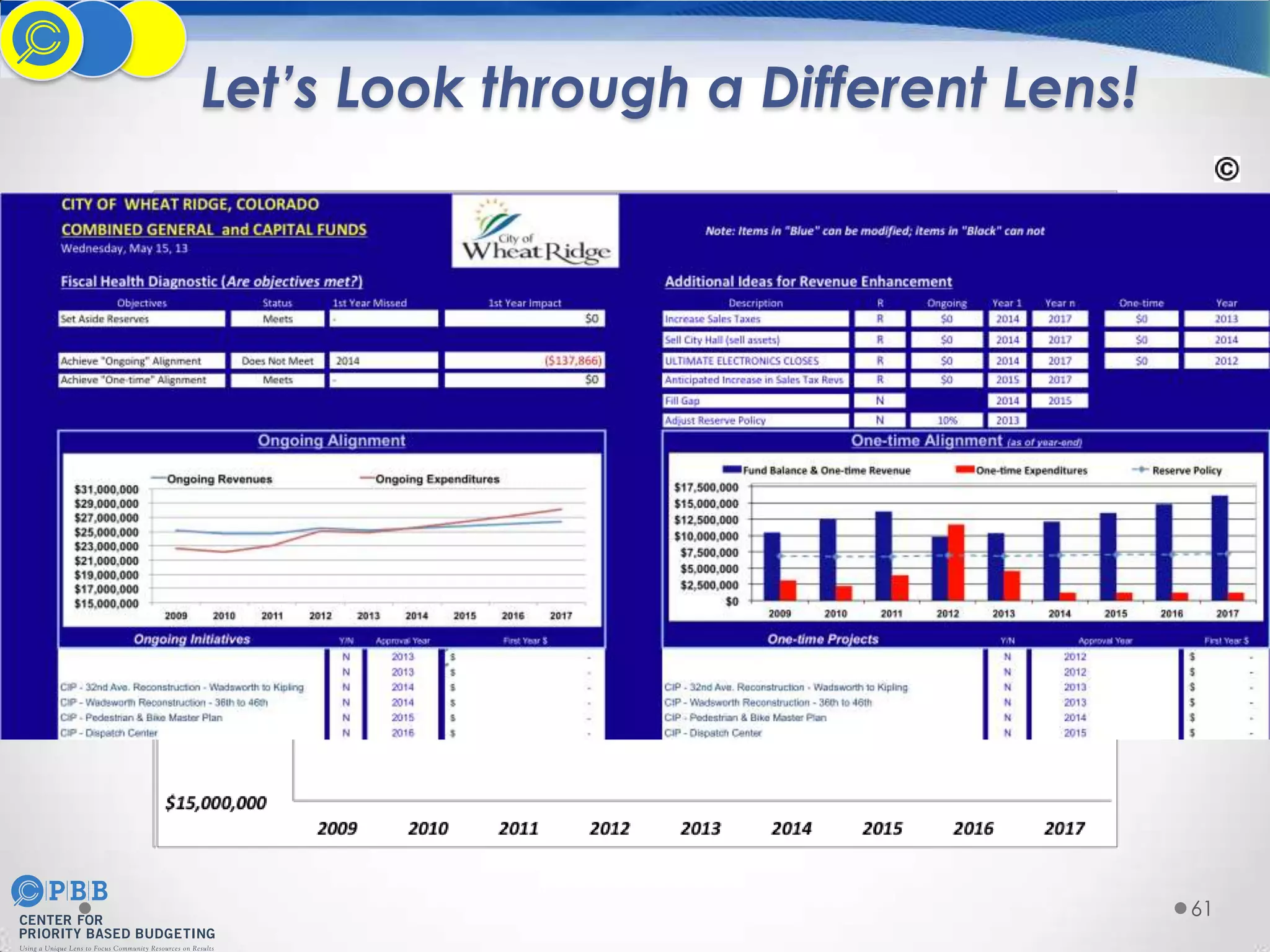
where we are GOING!
20
The Beginnings ….
Fiscal Health &
Priority Based Budgeting

21
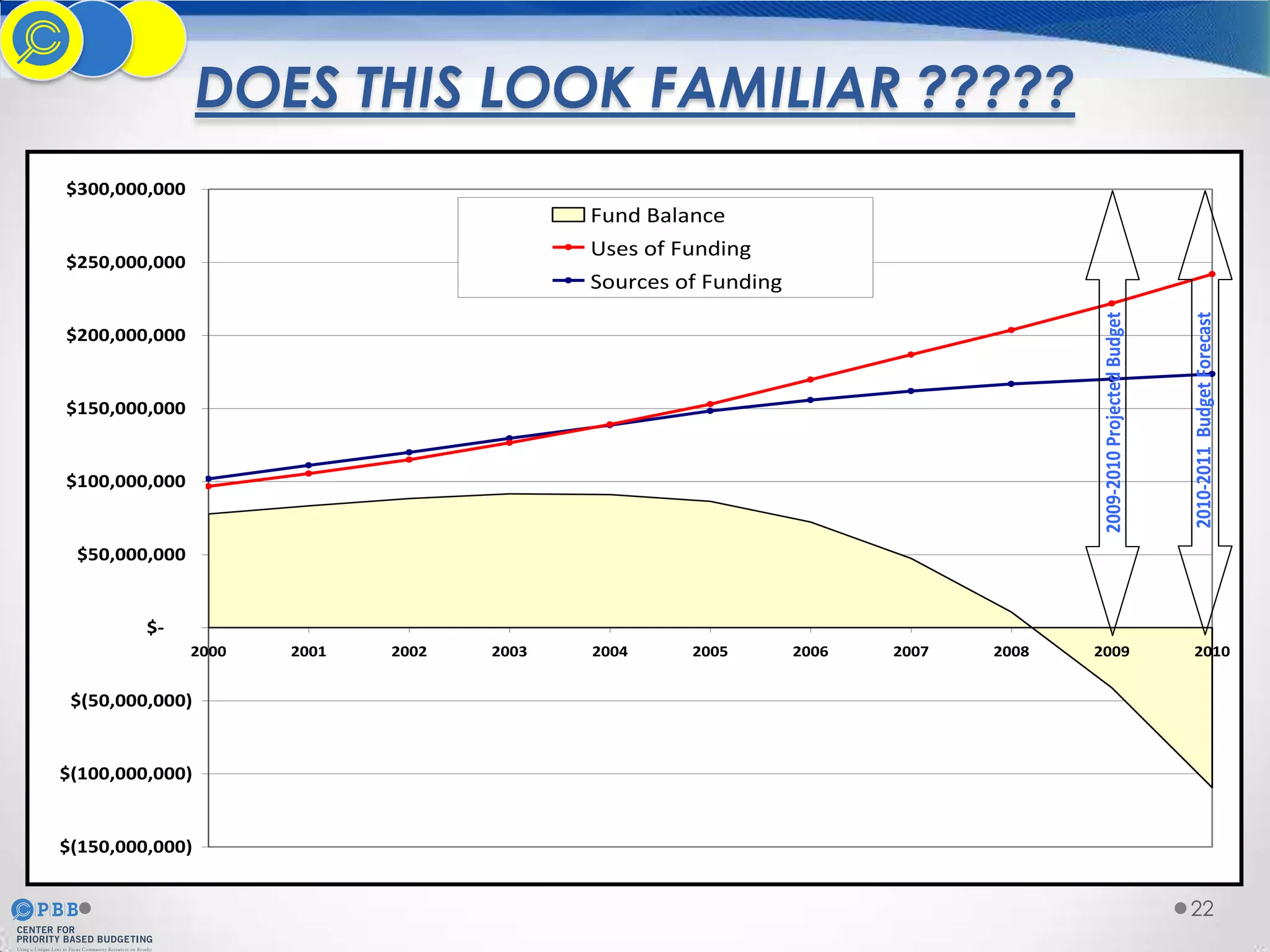
DOES THIS LOOK FAMILIAR ?????
$300,000,000

Fund Balance
Uses of Funding

$250,000,000

$200,000,000

$150,000,000

$100,000,000

2010-2011 Budget Forecast

2009-2010 Projected Budget

Sources of Funding

$50,000,000

$2000

2001

2002

2003

2004

2005

2006

2007

2008

2009

2010

$(50,000,000)

$(100,000,000)

$(150,000,000)

22
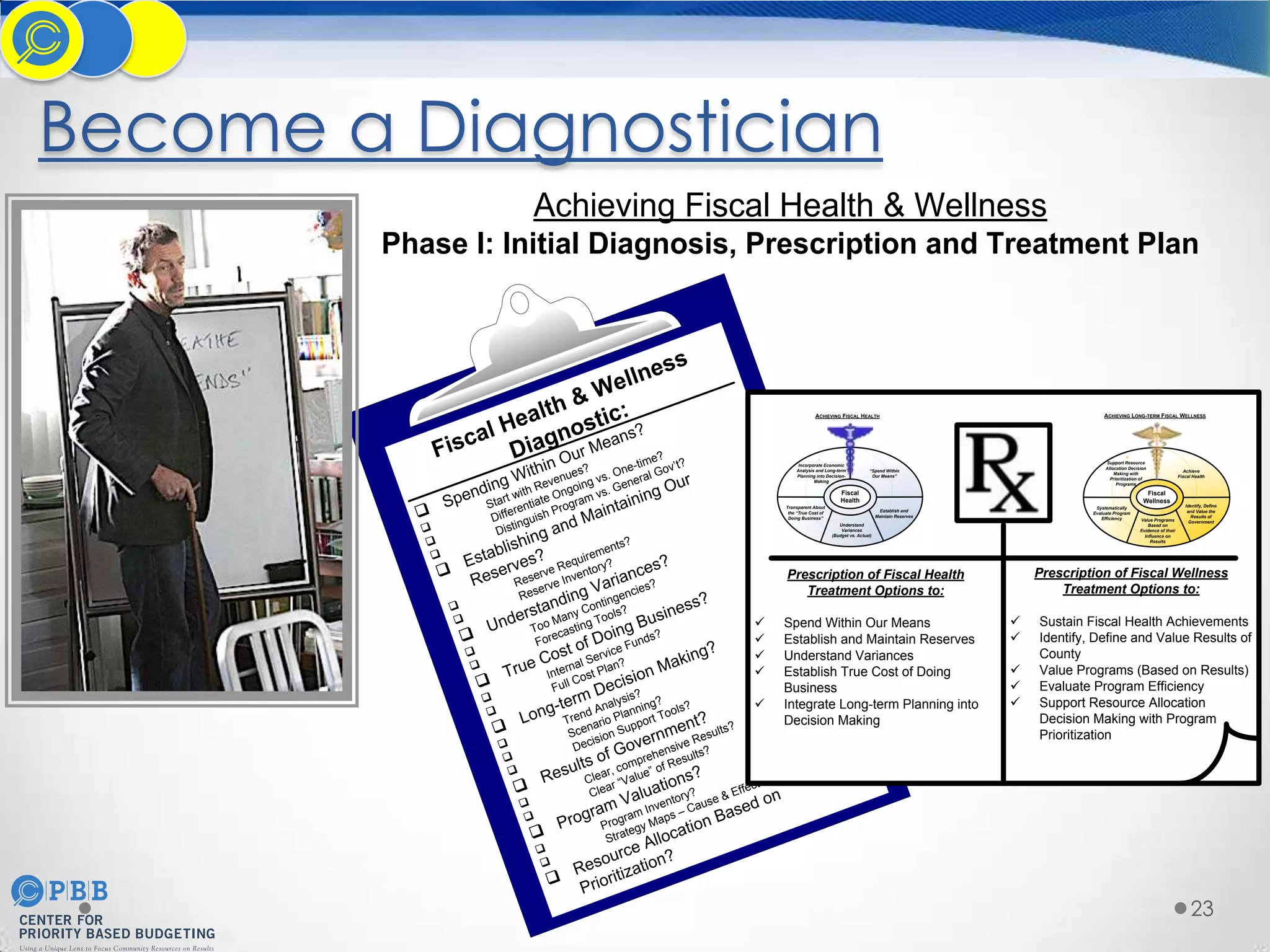
Become a Diagnostician
Solano County, California
Achieving Fiscal Health & Wellness
Phase I: Initial Diagnosis, Prescription and Treatment Plan

ess
elln
&W
alth stic:
?
o
l He
sca Diagnur Means ?
Fi
e
-tim
’t?
nO

ACHIEVING LONG-TERM FISCAL WELLNESS

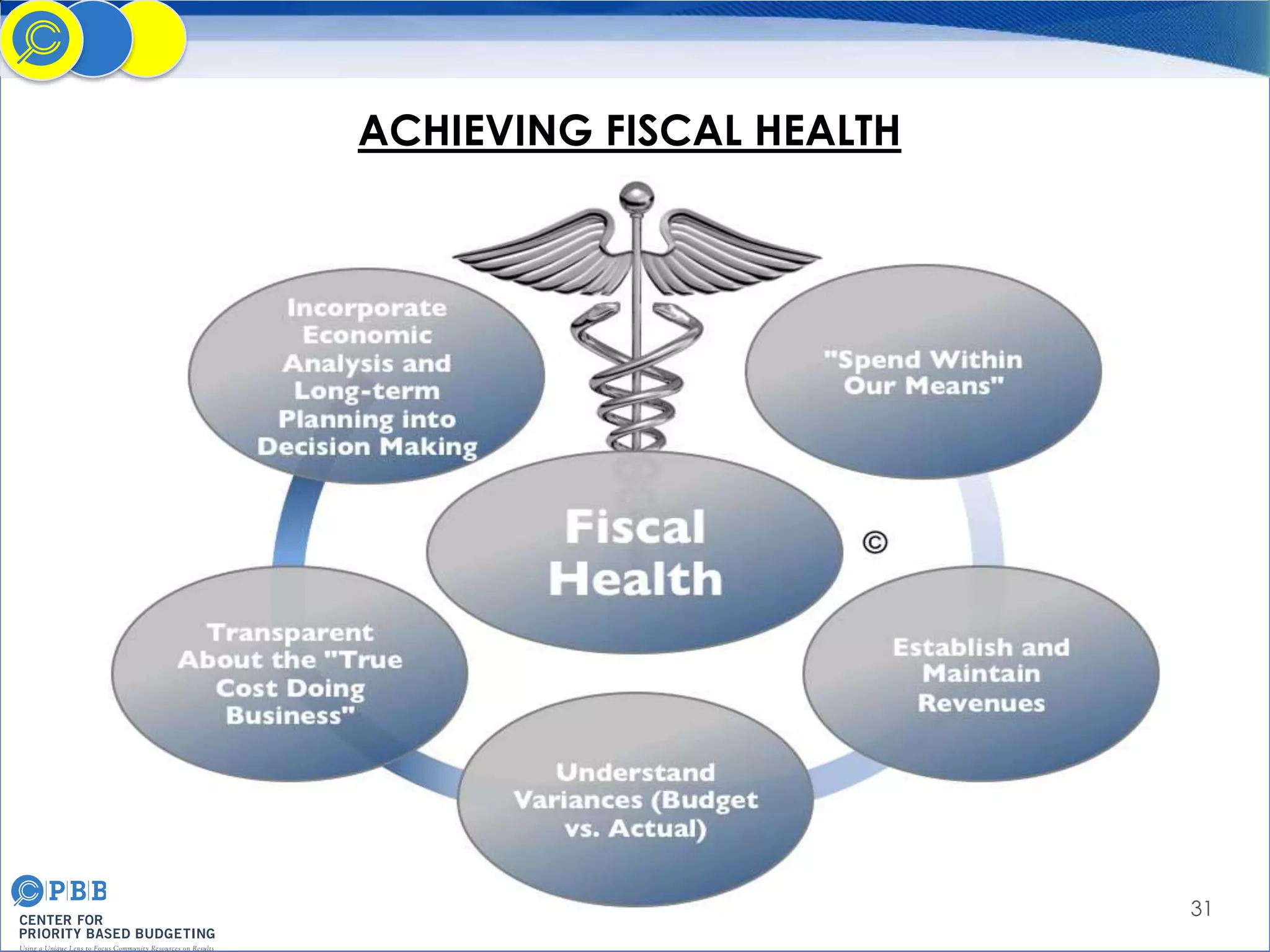
ACHIEVING FISCAL HEALTH

i
?
ov
ne
With enues vs. O ral G
ing with RevOngoing vs. Gene g Our
nd
Spe Starterentiate Program intainin
q
a
Diff nguish
i
nd M
q
D i st
ng a
q
hi
ts?
blis
me n
q
Esta rves? e Requirte ry?
?
e
ce s
no
q
rv
Prescription of Fiscal Health
Res Reseerve Inve Varianies?
Treatment Options to:
c
Res
?
ding ontingen
s
n
q
rsta Many C Tools? usines
e
q
ü Spend Within Our Means
Und Too ecasting ing B ?
q
ü Establish and Maintain Reserves
For
f Doce Funds
o rvi
q
ü Understand Variances
o st
ng?
e Cnternal StePlan? n Maki
q
ü Establish True Cost of Doing
Tru I Cos
io
is
q
Full
Business
Decsis?
q
erm aly ng?
ü Integrate Long-term Planning into
q
ng-tTrend Ano Planniort Tools? ?
Lo
Decision Making
pp
n a ri
ent ults?
q
Sce sion Su
ernmive Res
ci
q
De
ov
s
q
of G prehen sults?
ultslear, comlue” of Re ?
q
s
Res C ar “Va
?
tion
fect
q
Cle
aluaentory? use & Ef d on
V Inv
q
a
C
a se
s–
gram am
q
Pro Progrtegy Map ation B
a
q
Str
lloc
eA
q
ourc tion?
q
Res itiza
r
q
Prio
Incorporate Economic
Analysis and Long-term
Planning into DecisionMaking

Support Resource
Allocation Decision
Making with
Prioritization of
Programs

“Spend Within
Our Means”

Fiscal
Health

Transparent About
the “True Cost of
Doing Business”

Achieve
Fiscal Health

Fiscal
Wellness
Systematically
Evaluate Program
Efficiency

Establish and
Maintain Reserves

Understand
Variances
(Budget vs. Actual)

Value Programs
Based on
Evidence of their
Influence on
Results

Identify, Define
and Value the
Results of
Government

Prescription of Fiscal Wellness
Treatment Options to:
ü
ü
ü
ü
ü

Sustain Fiscal Health Achievements
Identify, Define and Value Results of
County
Value Programs (Based on Results)
Evaluate Program Efficiency
Support Resource Allocation
Decision Making with Program
Prioritization

23
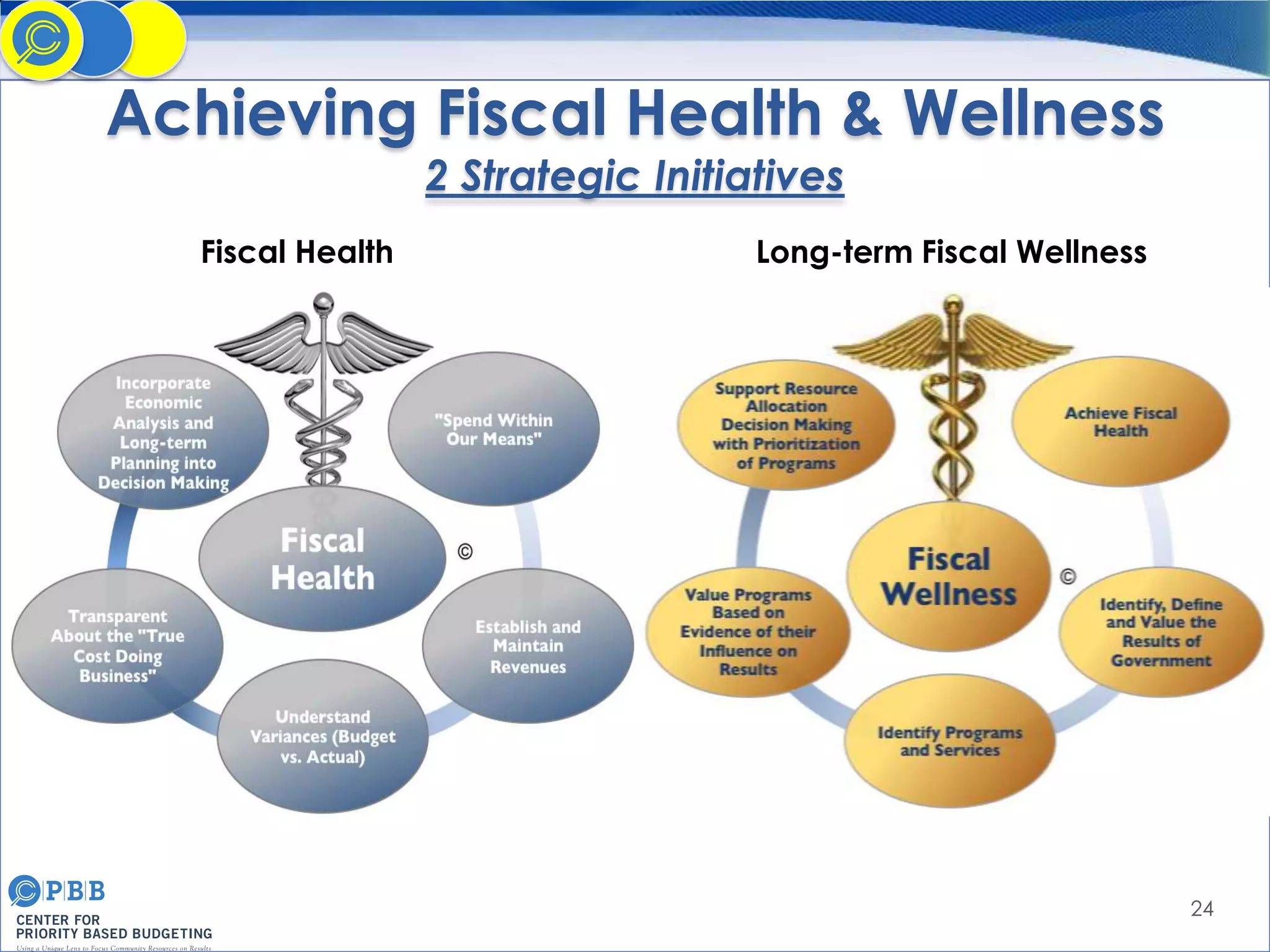
Achieving Fiscal Health & Wellness
2 Strategic Initiatives

Fiscal Health

Long-term Fiscal Wellness

24
BRINGING VISION INTO FOCUS
WITH A NEW “LENS”

25
26
27
Fiscal Health & Wellness through

Priority Based Budgeting

28
29
Achieving Fiscal Health
-ORConfessions of a 30-year
Finance Director !

30
ACHIEVING FISCAL HEALTH

31
Strategic Questions
1. How much do we have available to spend?
- (not “How much do you need”?)

32
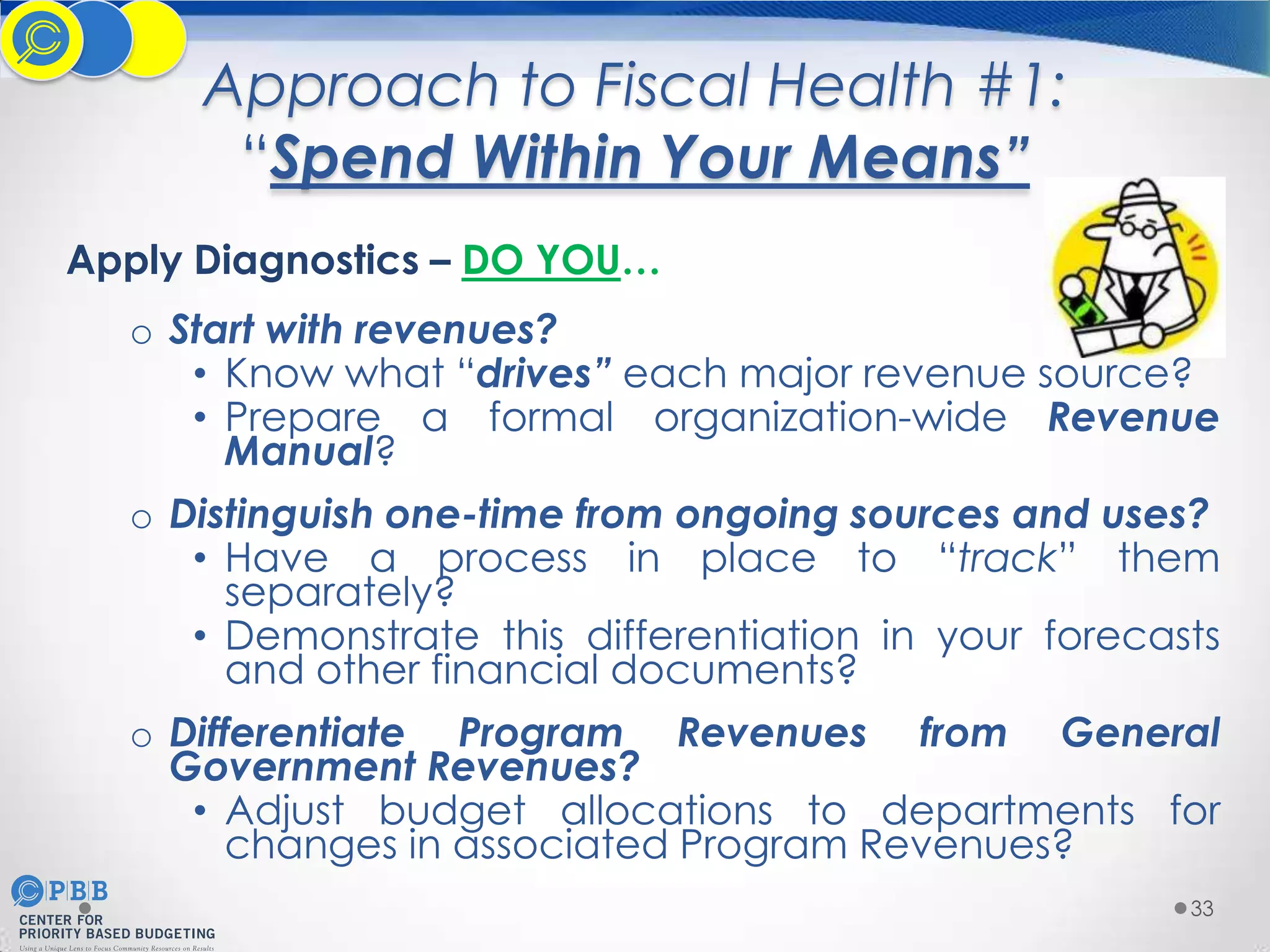
Approach to Fiscal Health #1:
“Spend Within Your Means”
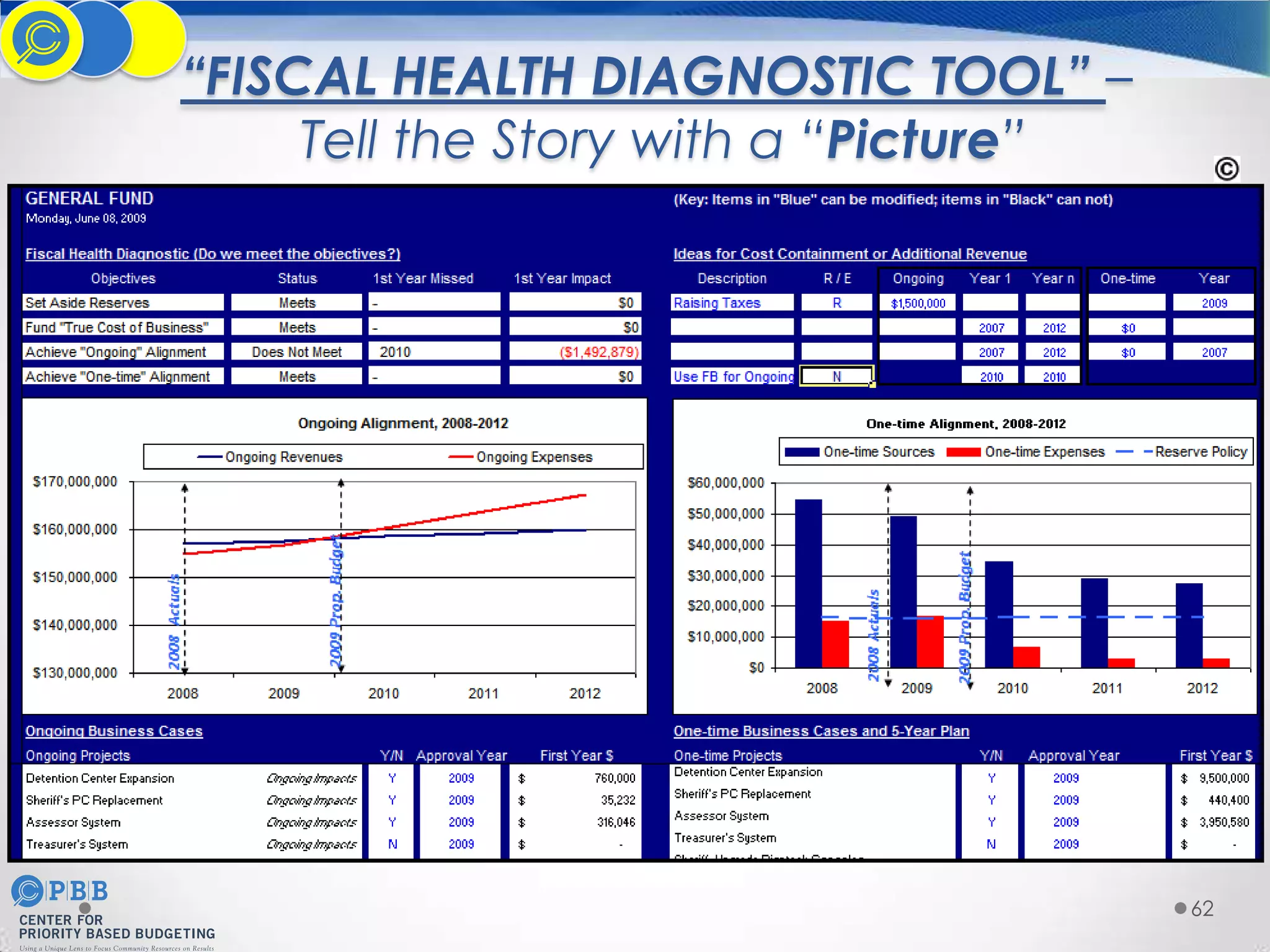
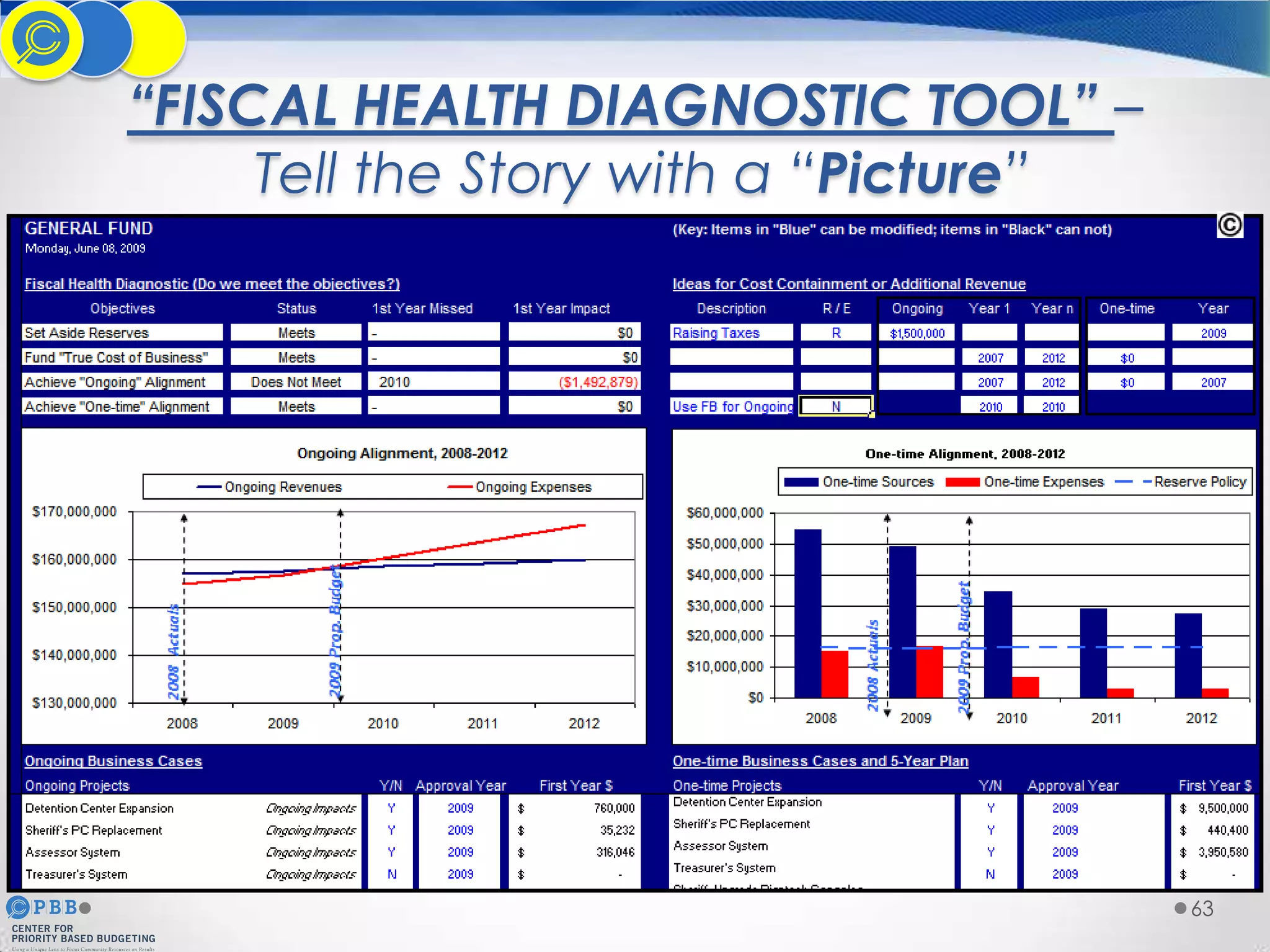
Apply Diagnostics – DO YOU…
o Start with revenues?
• Know what “drives” each major revenue source?
• Prepare a formal organization-wide Revenue
Manual?
o Distinguish one-time from ongoing sources and uses?
• Have a process in place to “track” them
separately?
• Demonstrate this differentiation in your forecasts
and other financial documents?
o Differentiate Program Revenues from General
Government Revenues?
• Adjust budget allocations to departments for
changes in associated Program Revenues?
33
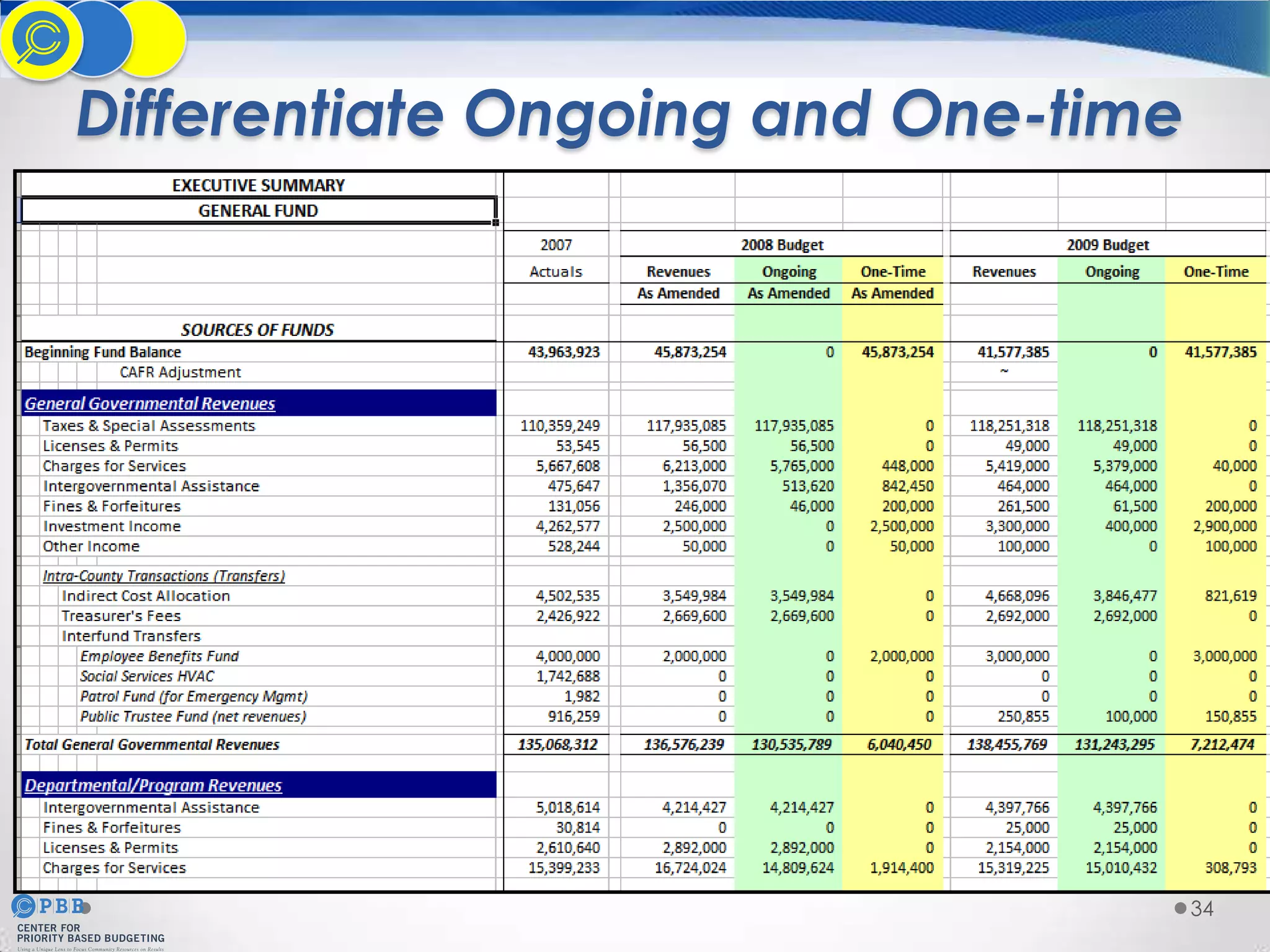
Differentiate Ongoing and One-time

34
Approach to Fiscal Health #1:
“Spend Within Your Means”
Available Treatments:
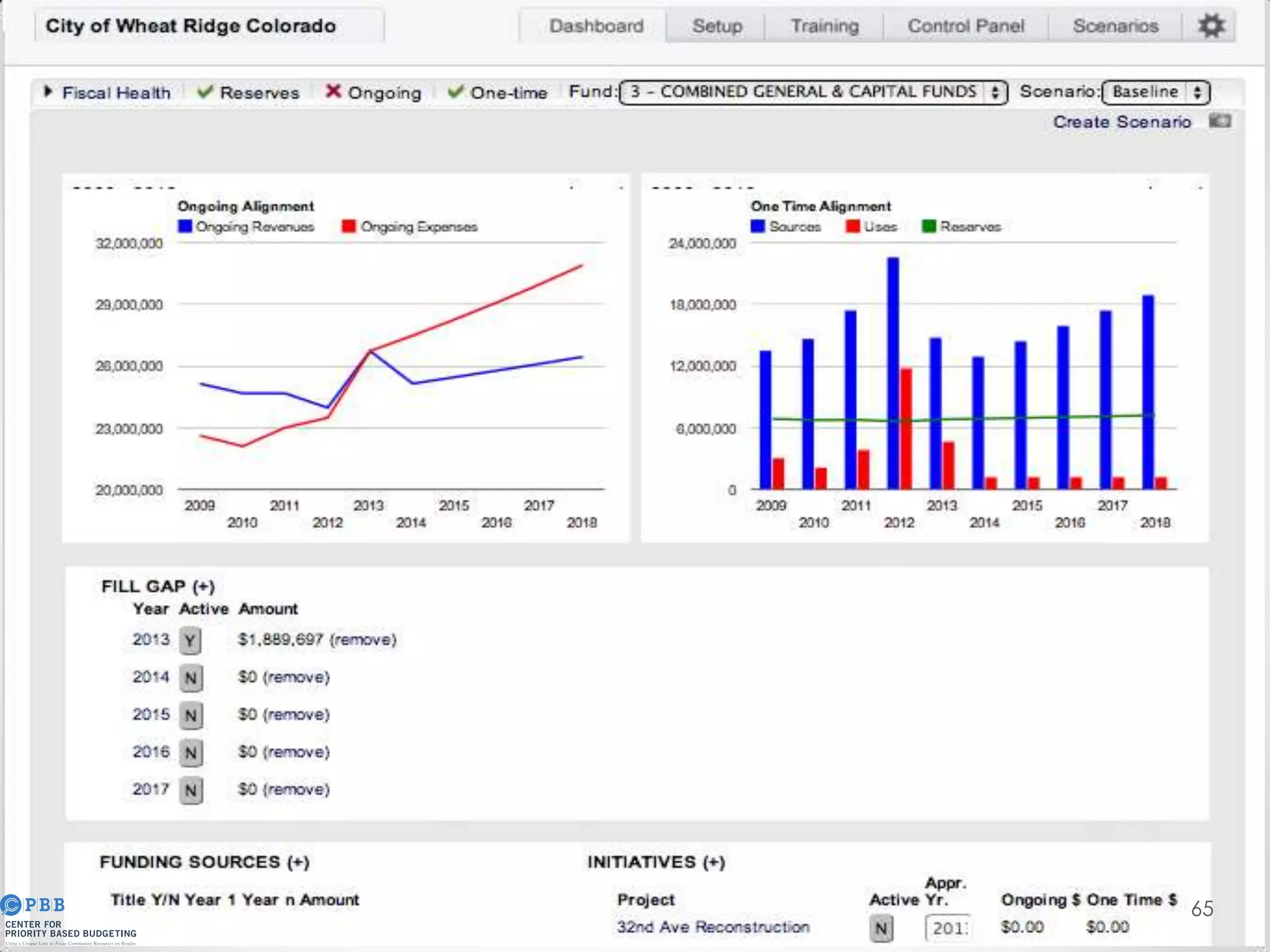
o Achieve ongoing alignment
• Fund operating expenditures with reliable ongoing
revenues
• Prevent reliance on volatile revenues (that might not
come in!)

o Achieve one-time alignment
• Fund one-time costs with one-time sources
• Ensure reserves aren’t used for ongoing expenses

o Promote revenue diversification and enhancement
35
Strategic Questions
1. How much do we have available to spend? -

(not “How much do you need”?)

2. Why do we need to keep “money in the
bank”?

36
Approach to Fiscal Health #2:
Establish and Maintain Reserves
Apply Diagnostics – DO YOU…
 Understand what makes up Fund Balance(s) and why you

hold reserves?
 Have a formal “inventory” of all restricted or designated
fund balance reserves, stating their purpose, the authority
establishing them and how they are to be calculated?

 Have a written fund balance reservation policy?



Monitor fund balances to ensure that reserves are
maintained?
Ensure established working capital reserves are sufficient to
meet emergency needs or short-term revenue shortfalls?

 Monitor Fund Balance levels to ensure they “aren’t too little”

OR “too much”, but “just right”?

37
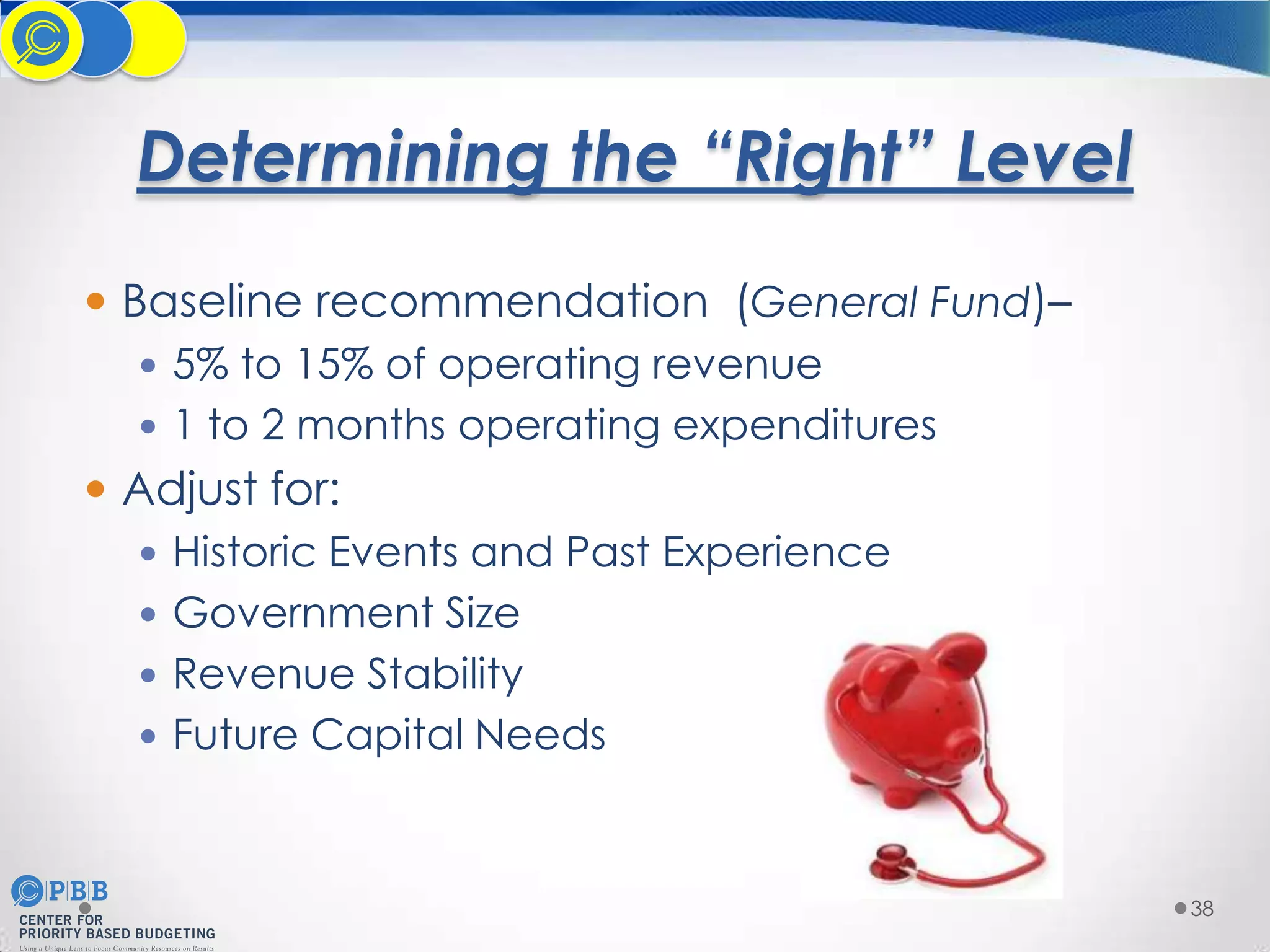
Determining the “Right” Level
 Baseline recommendation (General Fund)–
 5% to 15% of operating revenue
 1 to 2 months operating expenditures
 Adjust for:
 Historic Events and Past Experience
 Government Size
 Revenue Stability
 Future Capital Needs

38
Standard & Poor's Views
 Low

= 0% or “below”

 Adequate

=1% to 4%

 Good

= 4% to 8%

 Strong

= 8% to 15%

 Very Strong

= Above 15%

39
Approach to Fiscal Health #2:
Establish and Maintain Reserves
Available Treatments
o Establish a written Working Capital/Emergency
Reserve policy
• Provides back-up plan for emergencies, revenue
shortfalls, or other unforeseen changes
o Identify, document and understand all reserves

o Review adequacy of Fund Balance levels
• Hold only appropriate amount in reserve to
establish credibility with internal and external
stakeholders
o Set aside funding for long-range plans, major
maintenance and asset replacement
40
Strategic Questions
1. How much do we have available to spend? -

(not “How much do you need”?)
2. Why do we need to keep “money in the bank”?

3. What’s the “difference”?

41
Approach to Fiscal Health #3:
Understand Variances
Apply Diagnostics – DO YOU…
 Include cyclical (one-time) expenditures in ongoing

operating budgets?

 Allow Departments to budget for contingencies?
 Consistently have revenue/expenditure variances at

year-end?
 Overlook thorough analysis of budget-to-actual
variances?

 Count on “savings” resulting from budget-to-actual

variances?

 Have large capital project “carry-forwards” at year

end?

42
Types of Variance Analysis
o Revenues & Expenditures
•
•
•
•

Budget to Actual
Historical year to year actuals
Cyclical trends
Ongoing vs. one-time occurrence

o Multi-year Capital Projects

• Eliminate Carry-forwards
• Avoid excessive “change orders”

43
Types of Variance Analysis
o Employee Compensation

• Comp Plan vs. Actual Wages Paid
o Hiring Range
o Maximum Range

• Market Comparison - based on total
compensation
• Approved FTE Count

o Accounts Receivable

• Difference between amounts due
and amounts billed?
• Difference between amounts billed
and amounts collected
44
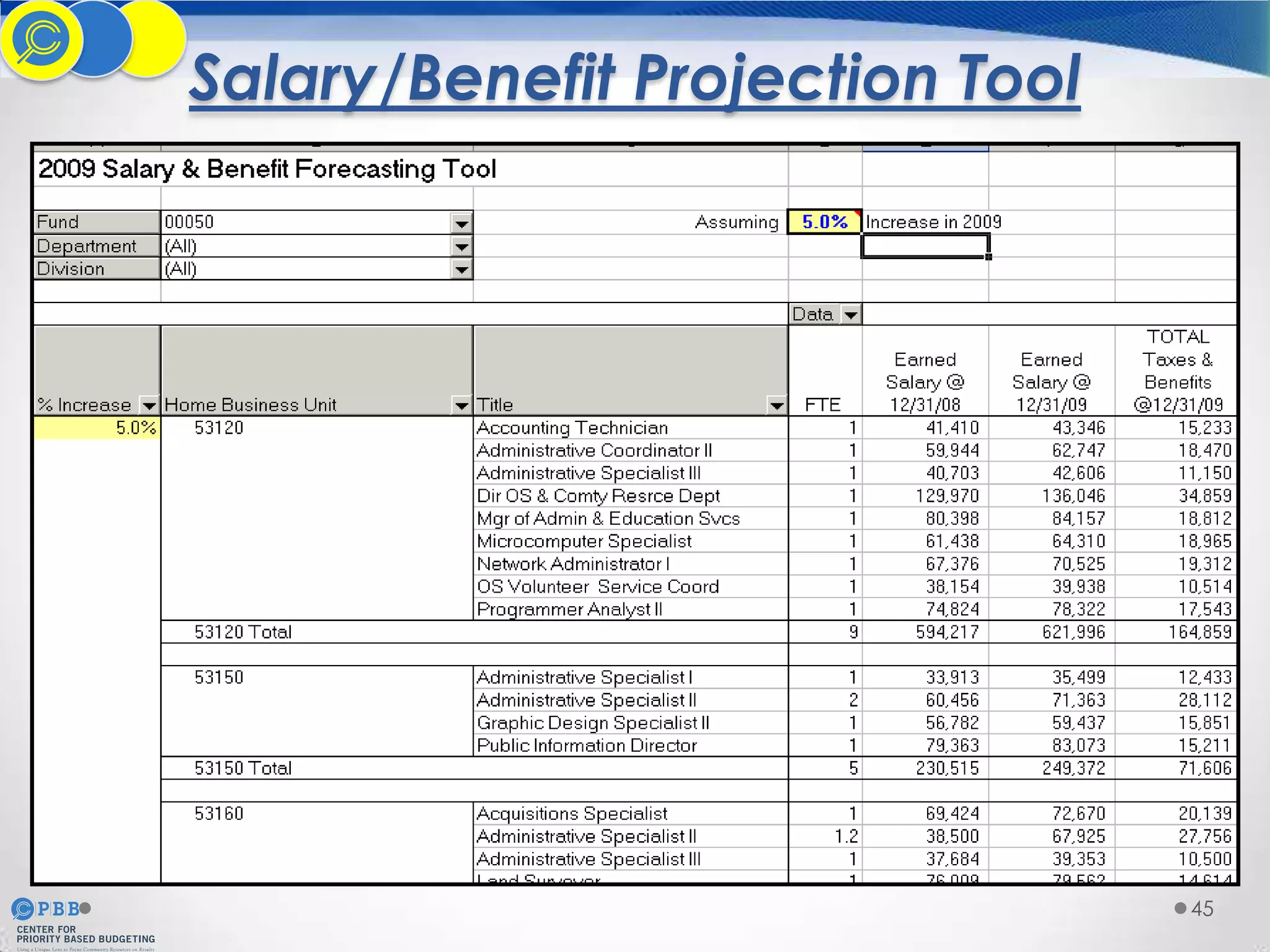
Salary/Benefit Projection Tool

45
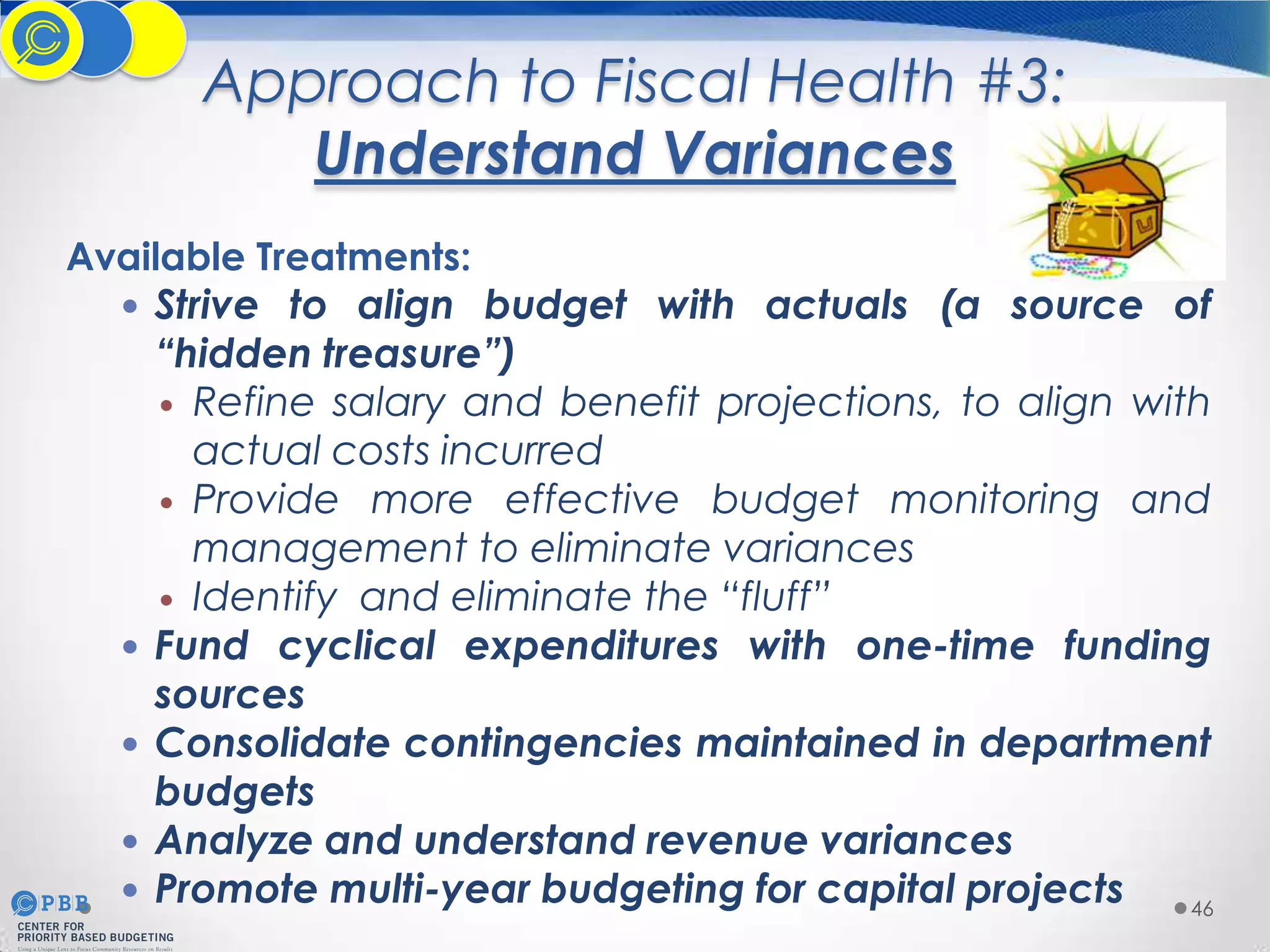
Approach to Fiscal Health #3:
Understand Variances
Available Treatments:
 Strive to align budget with actuals (a source of
“hidden treasure”)
 Refine salary and benefit projections, to align with
actual costs incurred
 Provide more effective budget monitoring and
management to eliminate variances
 Identify and eliminate the “fluff”
 Fund cyclical expenditures with one-time funding
sources
 Consolidate contingencies maintained in department
budgets
 Analyze and understand revenue variances
 Promote multi-year budgeting for capital projects
46
Strategic Questions
1. How much do we have available to spend? -

(not “How much do you need”?)
2. Why do we need to keep “money in the bank”?
3. What’s the “difference”?

4. “It costs how much”????????

47
Approach to Fiscal Health #4:
Transparent About “True Cost of Doing Business”
Apply Diagnostics – DO YOU…
o Allocate overhead and administrative costs to Funds
and/or Departments that benefit from those services?
o Utilize Internal Service Funds to align delivery and
cost of internal services with customer demand?
• Know what services are best adapted to an
Internal Service Fund approach?
• Understand how internal charges are established
and distributed?
• Ensure that internal customers perceive that costs
are transparent and there is an ability to influence
those costs by altering their own demand?
48
Key Components of Understanding the
“True Cost of Doing Business”
• Program Inventory

o Identify programs – distinct from “tasks” (too small) or
divisions (too large)
o Determine base level of service
o Determine discretionary levels of service above base
levels

• Program Costs

o Direct costs
o Indirect costs (internal services have these too!)
o Organizational administrative/overhead costs

• Basis for “Charging” Program Costs to End
User
o Identify how “demand” or “need” is generated
o Determine appropriate allocation methodology

49
Developing Program Inventories
 Create a comprehensive listing of all services

offered by each operating division (to both
“external” and “internal” users)

 Provide a better understanding of “what we do” to

staff, administration, elected officials and citizens

 Provide a framework to better understand how

resources are used to support “what we do”

 Provide a valuable tool for staff, management and

elected officials to use when faced with budgetary
“choices” about how funds are distributed.

 Allow for the preparation and discussion of a

“program budget” rather than a “line-item budget”
50
Developing Program Costs
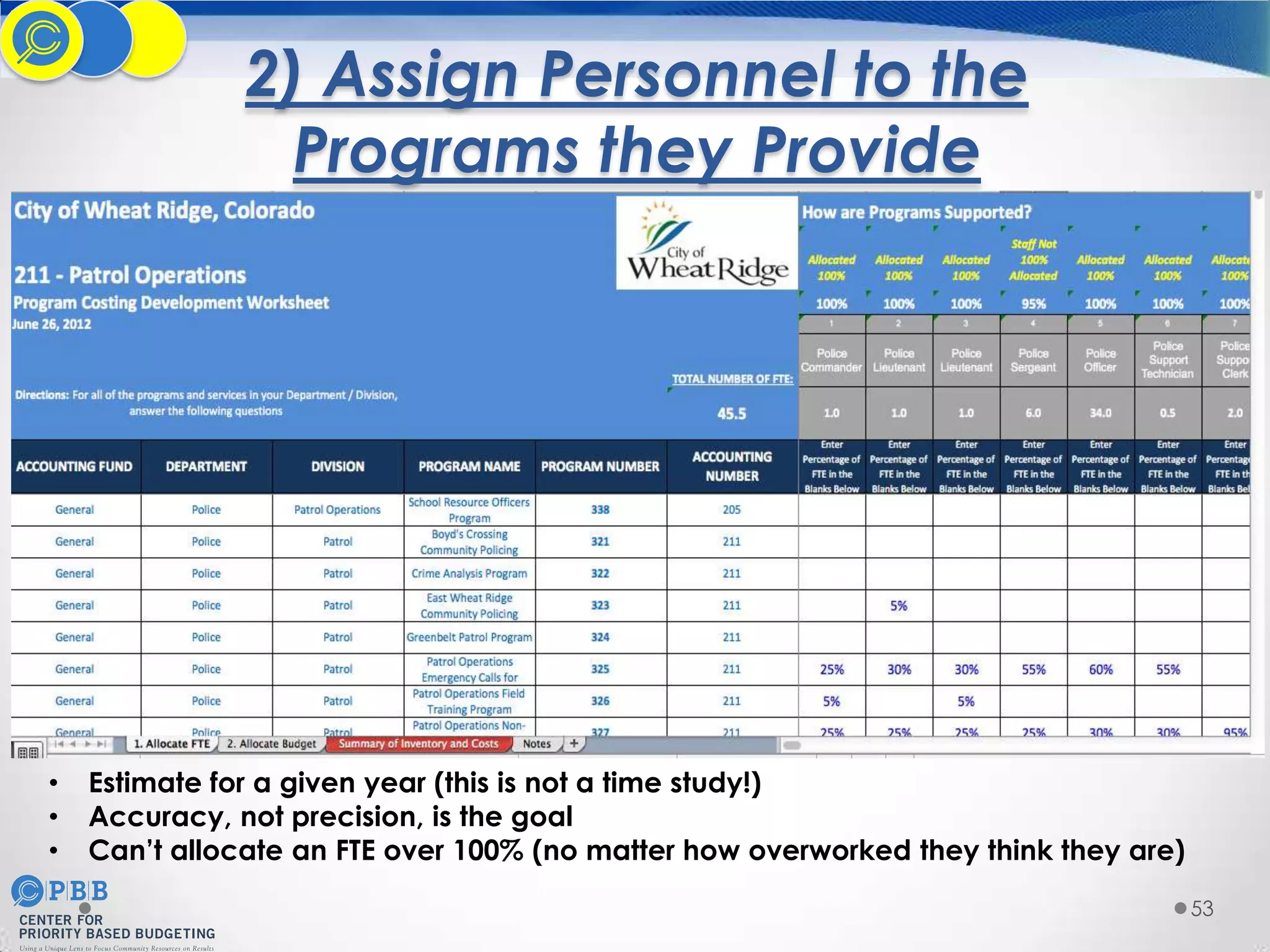
 1) Associate Salary & Benefit Costs with your
Personnel
 2) Assign Personnel to the Programs they

Provide

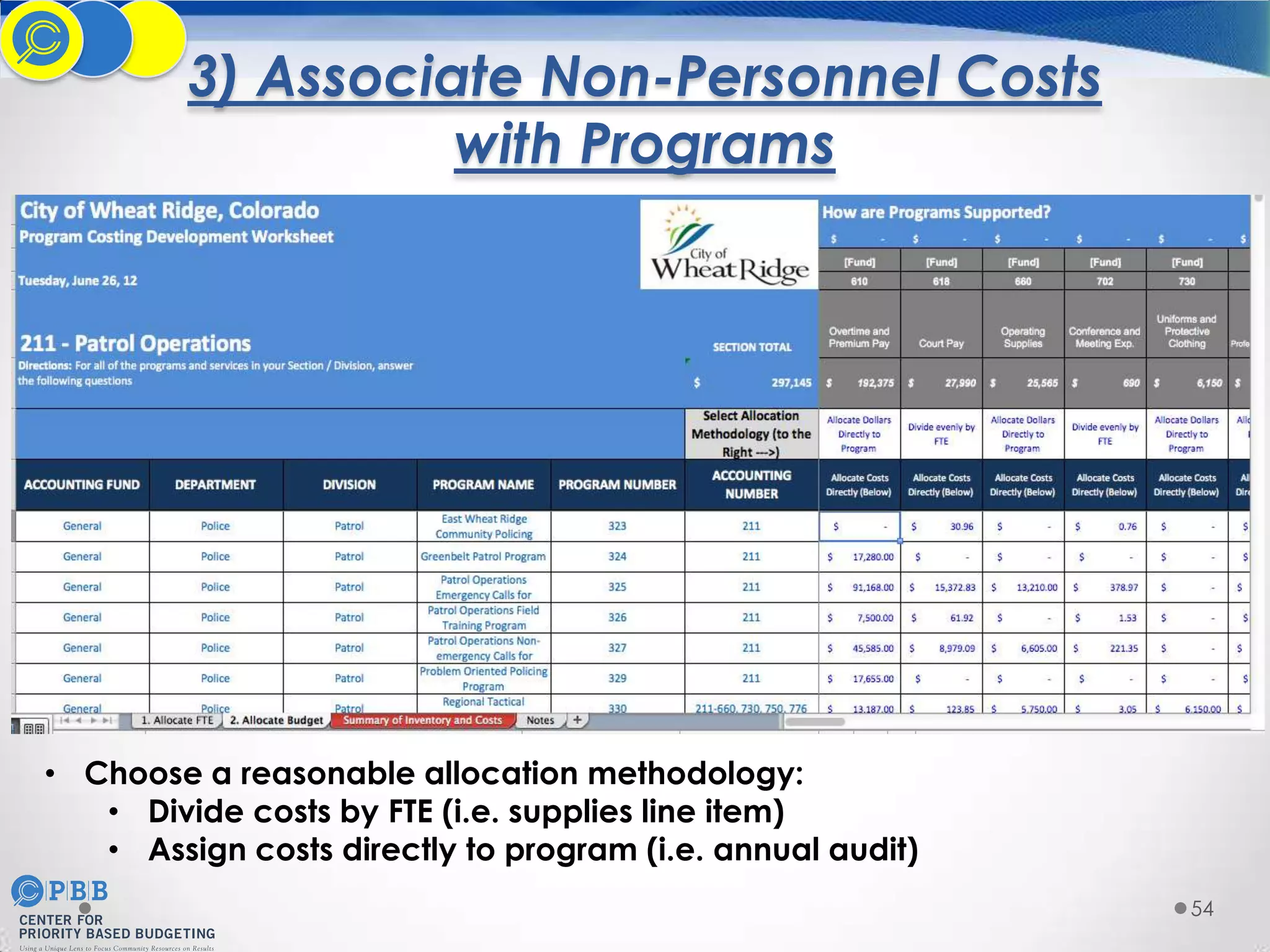
 3) Associate Non-Personnel Costs with
Programs
 4) Line item Budget is now expressed as a
Program Budget!
51
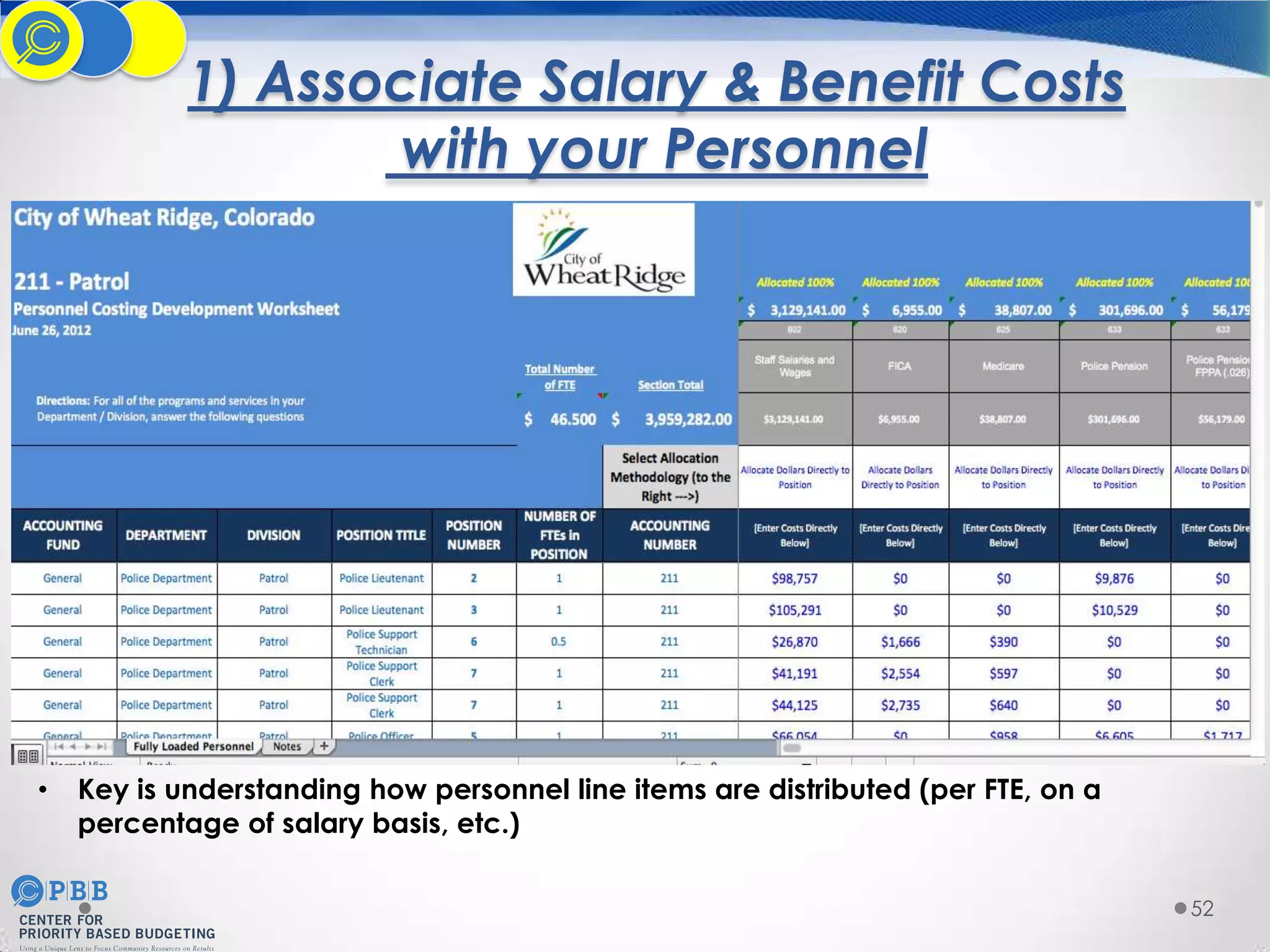
1) Associate Salary & Benefit Costs
with your Personnel

•

Key is understanding how personnel line items are distributed (per FTE, on a
percentage of salary basis, etc.)
52
2) Assign Personnel to the
Programs they Provide

•
•
•

Estimate for a given year (this is not a time study!)
Accuracy, not precision, is the goal
Can’t allocate an FTE over 100% (no matter how overworked they think they are)
53
3) Associate Non-Personnel Costs
with Programs

• Choose a reasonable allocation methodology:
• Divide costs by FTE (i.e. supplies line item)
• Assign costs directly to program (i.e. annual audit)
54
Approach to Fiscal Health #4:
Transparent About “True Cost of Doing Business”
Available Treatments:
 Establish Internal Service Funds and engage
Departments in assessing demands for these services

 Promote enhancement of cost recovery for programs
where appropriate
 Diversify cost burden from General Fund by
appropriately sharing costs among other dedicated
revenue streams
 Inventory and cost all programs
• Utilize Full Cost Plans to better determine the true
cost (direct and indirect) of offering programs/
services
55
Strategic Questions
1. How much do we have available to spend?

- (not “How much do you need”?)
2. Why do we need to keep “money in the
bank”?
3. What’s the “difference”?
4. “It costs how much”????????

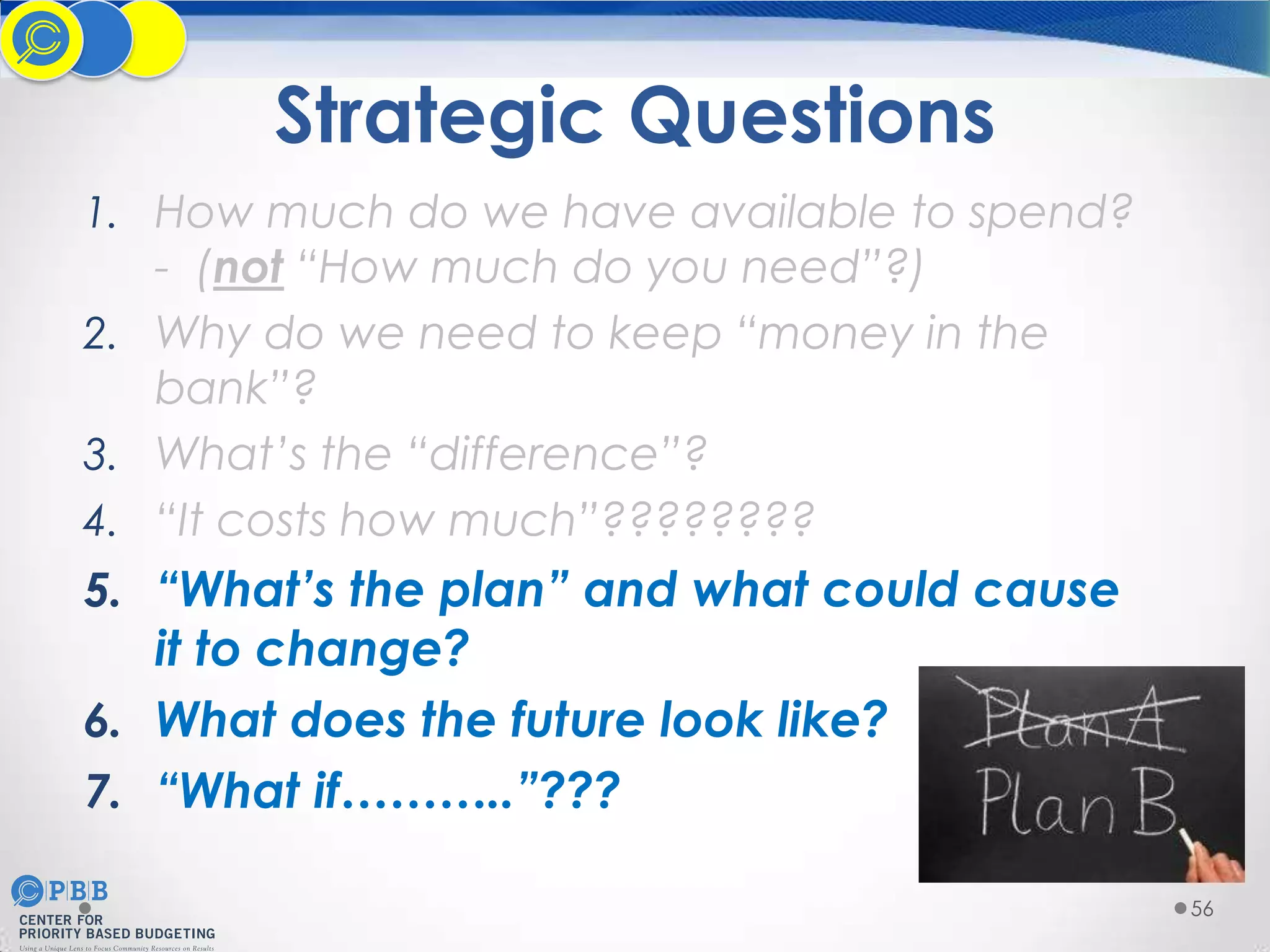
5. “What’s the plan” and what could cause
it to change?
6. What does the future look like?
7. “What if………..”???
56
Approach to Fiscal Health #5:
Economic Analysis & Long-term Planning
Apply Diagnostics – DO YOU…
 Incorporate ALL long-term plans developed within the
organization into your financial forecasts?
 Prepare comprehensive, multi-year Capital
Improvement Plan, and clearly identify associated
ongoing operating costs?
• Understand how the CIP impacts the budget
process and your long-term financial forecasts?
 Identify only relevant economic indicators to
monitor?
 Effectively utilize appropriate “tools” to communicate
financial position to all stakeholders (elected officials,
citizens and staff)?
57
KEY ECONOMIC INDICATORS
o Both External and Internal

o Focus on only what is relevant!!!!!!
o Utilize TRENDS over Benchmarks

o Demonstrate organizational impacts

58
Approach to Fiscal Health #5:
Economic Analysis & Long-term Planning
Available Treatments:
 Prepare a 5 to 10 year financial forecast




Use relevant key indicators and trend analysis to improve
decision-making
Update and present on regular basis throughout the year
Identify potential points of failure and plan for needed
changes

 Utilize simple, graphic communication tool to illustrate fiscal

health position to all stakeholders
 Keep decision makers focused on high-level stewardship
role
 Access impact of “today’s” decisions on future financial
sustainability
 Allow scenario-planning which encourages flexible and
adaptive decision-making

59
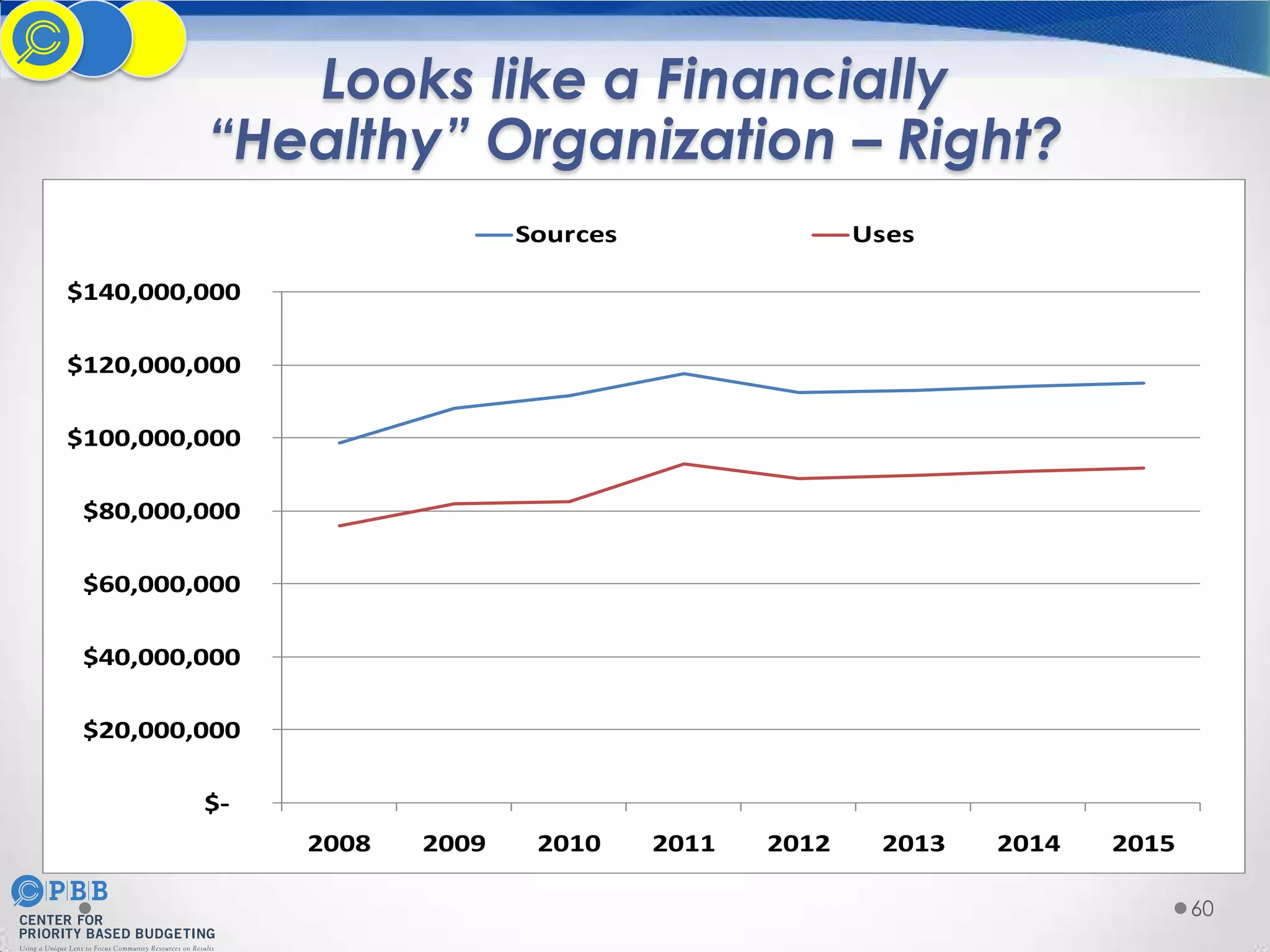
Looks like a Financially
“Healthy” Organization – Right?
Sources

Uses

$140,000,000
$120,000,000
$100,000,000
$80,000,000
$60,000,000
$40,000,000
$20,000,000
$2008

2009

2010

2011

2012

2013

2014

2015
60
Let’s Look through a Different Lens!

61
“FISCAL HEALTH DIAGNOSTIC TOOL” –
Tell the Story with a “Picture”

62
“FISCAL HEALTH DIAGNOSTIC TOOL” –
Tell the Story with a “Picture”

63
64
65
Thank You !

www.pbbcenter.org

Jon Johnson, Co-Founder
303-909-9052 (cell)
jjohnson@pbbcenter.org

Chris Fabian, Co-Founder
303-520-1356 (cell)
cfabian@pbbcenter.org

Kathie Novak, Senior Advisor
720-339-5845 (cell)
the.kathie.novak@gmail.com
Copyright ©2009 by Chris Fabian and Jon Johnson d/b/a the Center for Priority Based Budgeting,
Denver, Colorado.

66
Diagnostic Questions to Ask
Does your organization differentiate between
ONE-TIME
and
ONGOING
revenues
and
expenditures?
If yes, how are they tracked? Does your forecast
demonstrate this differentiation?

How does your organization differentiate
“program” revenues from “enterprise” revenues
such as taxes, earnings on investments, franchise
fees, etc.?
Does your organization prepare a formal Revenue
Manual?
If yes, what type of information is included?

67
Diagnostic Questions to Ask
Does your organization have a written fund balance
reservation policy?
If yes, how are you monitoring those reserves to ensure
that they are properly and adequately maintained?

Are established working capital reserves sufficient to
meet emergency needs or short-term revenue
shortfalls?
Does your organization have an inventory of all
restricted or designated fund balance (reserves)?
If yes, does it indicate the purpose for the reserve, cite
the authority for its establishment and show how it is
calculated?
68
Diagnostic Questions to Ask
Are variances between budgeted and actual
revenues and expenditures analyzed and
explained?
If yes, how do those variances impact future
budget cycles?

Does your organization utilize
Compensation Plan to establish
salary/wage ranges?

a formal
employee

If yes, how often is the plan updated?

When assessing the adequacy of employee
compensation, are employee benefit packages
included in this assessment?
69
Diagnostic Questions to Ask
Does your organization utilize Internal Service
Funds?

If yes, what are the services provided by each fund and
how are internal charges established and distributed?
Are appropriate demand metrics evaluated when
determining how internal charges are to be assessed or
distributed?
Do internal customers perceive that the calculation and
assessment of those internal charges is transparent and
that they can influence those charges by altering their
own demand?

Does your organization prepare a Full Cost
Allocation plan in addition to an OMB A-87 Cost
Allocation Plan?
If yes, how is this plan incorporated into the budget
process?
70
Diagnostic Questions to Ask
Does your Five-Year forecast incorporate ALL other
long-term plans developed by your organization?

Does your organization
Improvement Plan (CIP) ?

prepare

a

Capital

If yes, what information is included and how is it
utilized in your budget process and your financial
forecasts?

What tools does your organization use to
communicate financial information to its elected
decision-makers?

71

Nlc fiscal health presentation

  • 1.
    PRIORITY BASED BUDGETING(Part I) Achieving Fiscal HealthTools & Techniques for Diagnosis & Treatment Kathie Novak, Jon Johnson & Chris Fabian November 13, 2013 1
  • 2.
    A Brief Introduction JONJOHNSON CHRIS FABIAN 2
  • 3.
  • 4.
  • 5.
  • 6.
  • 7.
  • 8.
    Personal Savings RatesTrending Toward 0% – AGAIN!!! 8
  • 9.
    Student Loan Debt– the Next Collapse ???? 9
  • 10.
    So - asan Elected Official: o What does this mean for me? o What should be I be paying attention to? o Who should be watching? o What else is on the horizon? 10
  • 11.
    The Financials …. Froman Elected Officials Perspective 11
  • 12.
  • 13.
  • 14.
  • 15.
  • 16.
  • 17.
  • 18.
  • 19.
    What are yourElected Officials really thinking? • What does all this financial information really tell me? o Are you saying everything is fine ? o Are you saying we need to make cuts ? o Are you saying we need to raise taxes ? o Are you saying we have more money to spend ? • What are you asking me to decide ? OR • Are you just wanting my “rubber stamp” of approval ? 19
  • 20.
    Are We Headedin the Right Direction? • “If you don’t know where you are and you don’t know where you are going – any road will get you there.” • "You've got to be very careful if you don't know where you're going, because you might not get there.” Yogi Berra - SO Show me where we ARE and show me where we are GOING! 20
  • 21.
    The Beginnings …. FiscalHealth & Priority Based Budgeting 21
  • 22.
    DOES THIS LOOKFAMILIAR ????? $300,000,000 Fund Balance Uses of Funding $250,000,000 $200,000,000 $150,000,000 $100,000,000 2010-2011 Budget Forecast 2009-2010 Projected Budget Sources of Funding $50,000,000 $2000 2001 2002 2003 2004 2005 2006 2007 2008 2009 2010 $(50,000,000) $(100,000,000) $(150,000,000) 22
  • 23.
    Become a Diagnostician SolanoCounty, California Achieving Fiscal Health & Wellness Phase I: Initial Diagnosis, Prescription and Treatment Plan ess elln &W alth stic: ? o l He sca Diagnur Means ? Fi e -tim ’t? nO ACHIEVING LONG-TERM FISCAL WELLNESS ACHIEVING FISCAL HEALTH i ? ov ne With enues vs. O ral G ing with RevOngoing vs. Gene g Our nd Spe Starterentiate Program intainin q a Diff nguish i nd M q D i st ng a q hi ts? blis me n q Esta rves? e Requirte ry? ? e ce s no q rv Prescription of Fiscal Health Res Reseerve Inve Varianies? Treatment Options to: c Res ? ding ontingen s n q rsta Many C Tools? usines e q ü Spend Within Our Means Und Too ecasting ing B ? q ü Establish and Maintain Reserves For f Doce Funds o rvi q ü Understand Variances o st ng? e Cnternal StePlan? n Maki q ü Establish True Cost of Doing Tru I Cos io is q Full Business Decsis? q erm aly ng? ü Integrate Long-term Planning into q ng-tTrend Ano Planniort Tools? ? Lo Decision Making pp n a ri ent ults? q Sce sion Su ernmive Res ci q De ov s q of G prehen sults? ultslear, comlue” of Re ? q s Res C ar “Va ? tion fect q Cle aluaentory? use & Ef d on V Inv q a C a se s– gram am q Pro Progrtegy Map ation B a q Str lloc eA q ourc tion? q Res itiza r q Prio Incorporate Economic Analysis and Long-term Planning into DecisionMaking Support Resource Allocation Decision Making with Prioritization of Programs “Spend Within Our Means” Fiscal Health Transparent About the “True Cost of Doing Business” Achieve Fiscal Health Fiscal Wellness Systematically Evaluate Program Efficiency Establish and Maintain Reserves Understand Variances (Budget vs. Actual) Value Programs Based on Evidence of their Influence on Results Identify, Define and Value the Results of Government Prescription of Fiscal Wellness Treatment Options to: ü ü ü ü ü Sustain Fiscal Health Achievements Identify, Define and Value Results of County Value Programs (Based on Results) Evaluate Program Efficiency Support Resource Allocation Decision Making with Program Prioritization 23
  • 24.
    Achieving Fiscal Health& Wellness 2 Strategic Initiatives Fiscal Health Long-term Fiscal Wellness 24
  • 25.
    BRINGING VISION INTOFOCUS WITH A NEW “LENS” 25
  • 26.
  • 27.
  • 28.
    Fiscal Health &Wellness through Priority Based Budgeting 28
  • 29.
  • 30.
    Achieving Fiscal Health -ORConfessionsof a 30-year Finance Director ! 30
  • 31.
  • 32.
    Strategic Questions 1. Howmuch do we have available to spend? - (not “How much do you need”?) 32
  • 33.
    Approach to FiscalHealth #1: “Spend Within Your Means” Apply Diagnostics – DO YOU… o Start with revenues? • Know what “drives” each major revenue source? • Prepare a formal organization-wide Revenue Manual? o Distinguish one-time from ongoing sources and uses? • Have a process in place to “track” them separately? • Demonstrate this differentiation in your forecasts and other financial documents? o Differentiate Program Revenues from General Government Revenues? • Adjust budget allocations to departments for changes in associated Program Revenues? 33
  • 34.
  • 35.
    Approach to FiscalHealth #1: “Spend Within Your Means” Available Treatments: o Achieve ongoing alignment • Fund operating expenditures with reliable ongoing revenues • Prevent reliance on volatile revenues (that might not come in!) o Achieve one-time alignment • Fund one-time costs with one-time sources • Ensure reserves aren’t used for ongoing expenses o Promote revenue diversification and enhancement 35
  • 36.
    Strategic Questions 1. Howmuch do we have available to spend? - (not “How much do you need”?) 2. Why do we need to keep “money in the bank”? 36
  • 37.
    Approach to FiscalHealth #2: Establish and Maintain Reserves Apply Diagnostics – DO YOU…  Understand what makes up Fund Balance(s) and why you hold reserves?  Have a formal “inventory” of all restricted or designated fund balance reserves, stating their purpose, the authority establishing them and how they are to be calculated?  Have a written fund balance reservation policy?   Monitor fund balances to ensure that reserves are maintained? Ensure established working capital reserves are sufficient to meet emergency needs or short-term revenue shortfalls?  Monitor Fund Balance levels to ensure they “aren’t too little” OR “too much”, but “just right”? 37
  • 38.
    Determining the “Right”Level  Baseline recommendation (General Fund)–  5% to 15% of operating revenue  1 to 2 months operating expenditures  Adjust for:  Historic Events and Past Experience  Government Size  Revenue Stability  Future Capital Needs 38
  • 39.
    Standard & Poor'sViews  Low = 0% or “below”  Adequate =1% to 4%  Good = 4% to 8%  Strong = 8% to 15%  Very Strong = Above 15% 39
  • 40.
    Approach to FiscalHealth #2: Establish and Maintain Reserves Available Treatments o Establish a written Working Capital/Emergency Reserve policy • Provides back-up plan for emergencies, revenue shortfalls, or other unforeseen changes o Identify, document and understand all reserves o Review adequacy of Fund Balance levels • Hold only appropriate amount in reserve to establish credibility with internal and external stakeholders o Set aside funding for long-range plans, major maintenance and asset replacement 40
  • 41.
    Strategic Questions 1. Howmuch do we have available to spend? - (not “How much do you need”?) 2. Why do we need to keep “money in the bank”? 3. What’s the “difference”? 41
  • 42.
    Approach to FiscalHealth #3: Understand Variances Apply Diagnostics – DO YOU…  Include cyclical (one-time) expenditures in ongoing operating budgets?  Allow Departments to budget for contingencies?  Consistently have revenue/expenditure variances at year-end?  Overlook thorough analysis of budget-to-actual variances?  Count on “savings” resulting from budget-to-actual variances?  Have large capital project “carry-forwards” at year end? 42
  • 43.
    Types of VarianceAnalysis o Revenues & Expenditures • • • • Budget to Actual Historical year to year actuals Cyclical trends Ongoing vs. one-time occurrence o Multi-year Capital Projects • Eliminate Carry-forwards • Avoid excessive “change orders” 43
  • 44.
    Types of VarianceAnalysis o Employee Compensation • Comp Plan vs. Actual Wages Paid o Hiring Range o Maximum Range • Market Comparison - based on total compensation • Approved FTE Count o Accounts Receivable • Difference between amounts due and amounts billed? • Difference between amounts billed and amounts collected 44
  • 45.
  • 46.
    Approach to FiscalHealth #3: Understand Variances Available Treatments:  Strive to align budget with actuals (a source of “hidden treasure”)  Refine salary and benefit projections, to align with actual costs incurred  Provide more effective budget monitoring and management to eliminate variances  Identify and eliminate the “fluff”  Fund cyclical expenditures with one-time funding sources  Consolidate contingencies maintained in department budgets  Analyze and understand revenue variances  Promote multi-year budgeting for capital projects 46
  • 47.
    Strategic Questions 1. Howmuch do we have available to spend? - (not “How much do you need”?) 2. Why do we need to keep “money in the bank”? 3. What’s the “difference”? 4. “It costs how much”???????? 47
  • 48.
    Approach to FiscalHealth #4: Transparent About “True Cost of Doing Business” Apply Diagnostics – DO YOU… o Allocate overhead and administrative costs to Funds and/or Departments that benefit from those services? o Utilize Internal Service Funds to align delivery and cost of internal services with customer demand? • Know what services are best adapted to an Internal Service Fund approach? • Understand how internal charges are established and distributed? • Ensure that internal customers perceive that costs are transparent and there is an ability to influence those costs by altering their own demand? 48
  • 49.
    Key Components ofUnderstanding the “True Cost of Doing Business” • Program Inventory o Identify programs – distinct from “tasks” (too small) or divisions (too large) o Determine base level of service o Determine discretionary levels of service above base levels • Program Costs o Direct costs o Indirect costs (internal services have these too!) o Organizational administrative/overhead costs • Basis for “Charging” Program Costs to End User o Identify how “demand” or “need” is generated o Determine appropriate allocation methodology 49
  • 50.
    Developing Program Inventories Create a comprehensive listing of all services offered by each operating division (to both “external” and “internal” users)  Provide a better understanding of “what we do” to staff, administration, elected officials and citizens  Provide a framework to better understand how resources are used to support “what we do”  Provide a valuable tool for staff, management and elected officials to use when faced with budgetary “choices” about how funds are distributed.  Allow for the preparation and discussion of a “program budget” rather than a “line-item budget” 50
  • 51.
    Developing Program Costs 1) Associate Salary & Benefit Costs with your Personnel  2) Assign Personnel to the Programs they Provide  3) Associate Non-Personnel Costs with Programs  4) Line item Budget is now expressed as a Program Budget! 51
  • 52.
    1) Associate Salary& Benefit Costs with your Personnel • Key is understanding how personnel line items are distributed (per FTE, on a percentage of salary basis, etc.) 52
  • 53.
    2) Assign Personnelto the Programs they Provide • • • Estimate for a given year (this is not a time study!) Accuracy, not precision, is the goal Can’t allocate an FTE over 100% (no matter how overworked they think they are) 53
  • 54.
    3) Associate Non-PersonnelCosts with Programs • Choose a reasonable allocation methodology: • Divide costs by FTE (i.e. supplies line item) • Assign costs directly to program (i.e. annual audit) 54
  • 55.
    Approach to FiscalHealth #4: Transparent About “True Cost of Doing Business” Available Treatments:  Establish Internal Service Funds and engage Departments in assessing demands for these services  Promote enhancement of cost recovery for programs where appropriate  Diversify cost burden from General Fund by appropriately sharing costs among other dedicated revenue streams  Inventory and cost all programs • Utilize Full Cost Plans to better determine the true cost (direct and indirect) of offering programs/ services 55
  • 56.
    Strategic Questions 1. Howmuch do we have available to spend? - (not “How much do you need”?) 2. Why do we need to keep “money in the bank”? 3. What’s the “difference”? 4. “It costs how much”???????? 5. “What’s the plan” and what could cause it to change? 6. What does the future look like? 7. “What if………..”??? 56
  • 57.
    Approach to FiscalHealth #5: Economic Analysis & Long-term Planning Apply Diagnostics – DO YOU…  Incorporate ALL long-term plans developed within the organization into your financial forecasts?  Prepare comprehensive, multi-year Capital Improvement Plan, and clearly identify associated ongoing operating costs? • Understand how the CIP impacts the budget process and your long-term financial forecasts?  Identify only relevant economic indicators to monitor?  Effectively utilize appropriate “tools” to communicate financial position to all stakeholders (elected officials, citizens and staff)? 57
  • 58.
    KEY ECONOMIC INDICATORS oBoth External and Internal o Focus on only what is relevant!!!!!! o Utilize TRENDS over Benchmarks o Demonstrate organizational impacts 58
  • 59.
    Approach to FiscalHealth #5: Economic Analysis & Long-term Planning Available Treatments:  Prepare a 5 to 10 year financial forecast    Use relevant key indicators and trend analysis to improve decision-making Update and present on regular basis throughout the year Identify potential points of failure and plan for needed changes  Utilize simple, graphic communication tool to illustrate fiscal health position to all stakeholders  Keep decision makers focused on high-level stewardship role  Access impact of “today’s” decisions on future financial sustainability  Allow scenario-planning which encourages flexible and adaptive decision-making 59
  • 60.
    Looks like aFinancially “Healthy” Organization – Right? Sources Uses $140,000,000 $120,000,000 $100,000,000 $80,000,000 $60,000,000 $40,000,000 $20,000,000 $2008 2009 2010 2011 2012 2013 2014 2015 60
  • 61.
    Let’s Look througha Different Lens! 61
  • 62.
    “FISCAL HEALTH DIAGNOSTICTOOL” – Tell the Story with a “Picture” 62
  • 63.
    “FISCAL HEALTH DIAGNOSTICTOOL” – Tell the Story with a “Picture” 63
  • 64.
  • 65.
  • 66.
    Thank You ! www.pbbcenter.org JonJohnson, Co-Founder 303-909-9052 (cell) jjohnson@pbbcenter.org Chris Fabian, Co-Founder 303-520-1356 (cell) cfabian@pbbcenter.org Kathie Novak, Senior Advisor 720-339-5845 (cell) the.kathie.novak@gmail.com Copyright ©2009 by Chris Fabian and Jon Johnson d/b/a the Center for Priority Based Budgeting, Denver, Colorado. 66
  • 67.
    Diagnostic Questions toAsk Does your organization differentiate between ONE-TIME and ONGOING revenues and expenditures? If yes, how are they tracked? Does your forecast demonstrate this differentiation? How does your organization differentiate “program” revenues from “enterprise” revenues such as taxes, earnings on investments, franchise fees, etc.? Does your organization prepare a formal Revenue Manual? If yes, what type of information is included? 67
  • 68.
    Diagnostic Questions toAsk Does your organization have a written fund balance reservation policy? If yes, how are you monitoring those reserves to ensure that they are properly and adequately maintained? Are established working capital reserves sufficient to meet emergency needs or short-term revenue shortfalls? Does your organization have an inventory of all restricted or designated fund balance (reserves)? If yes, does it indicate the purpose for the reserve, cite the authority for its establishment and show how it is calculated? 68
  • 69.
    Diagnostic Questions toAsk Are variances between budgeted and actual revenues and expenditures analyzed and explained? If yes, how do those variances impact future budget cycles? Does your organization utilize Compensation Plan to establish salary/wage ranges? a formal employee If yes, how often is the plan updated? When assessing the adequacy of employee compensation, are employee benefit packages included in this assessment? 69
  • 70.
    Diagnostic Questions toAsk Does your organization utilize Internal Service Funds? If yes, what are the services provided by each fund and how are internal charges established and distributed? Are appropriate demand metrics evaluated when determining how internal charges are to be assessed or distributed? Do internal customers perceive that the calculation and assessment of those internal charges is transparent and that they can influence those charges by altering their own demand? Does your organization prepare a Full Cost Allocation plan in addition to an OMB A-87 Cost Allocation Plan? If yes, how is this plan incorporated into the budget process? 70
  • 71.
    Diagnostic Questions toAsk Does your Five-Year forecast incorporate ALL other long-term plans developed by your organization? Does your organization Improvement Plan (CIP) ? prepare a Capital If yes, what information is included and how is it utilized in your budget process and your financial forecasts? What tools does your organization use to communicate financial information to its elected decision-makers? 71