Building Great Public Spaces
Design from Health & Wellness
Perspective to Build a Healthier
Environment
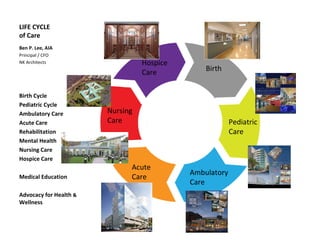
LIFE CYCLE
of Care
Ben P. Lee, AIA
Principal / CFO
NK Architects
Birth Cycle
Pediatric Cycle
Ambulatory Care
Acute Care
Rehabilitation
Mental Health
Nursing Care
Hospice Care
Medical Education
Advocacy for Health &
Wellness
Birth
Pediatric
Care
Ambulatory
Care
Acute
Care
Nursing
Care
Hospice
Care
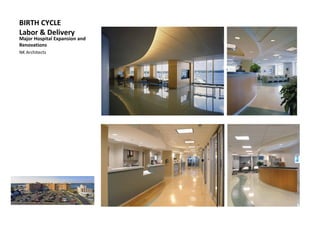
BIRTH CYCLE
Labor & Delivery
Major Hospital Expansion and
Renovations
NK Architects
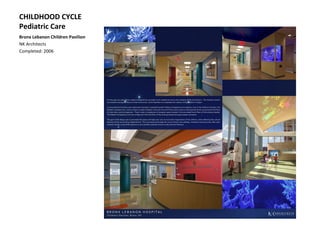
CHILDHOOD CYCLE
Pediatric Care
Bronx Lebanon Children Pavilion
NK Architects
Completed: 2006
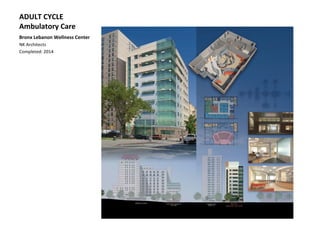
ADULT CYCLE
Ambulatory Care
Bronx Lebanon Wellness Center
NK Architects
Completed: 2014
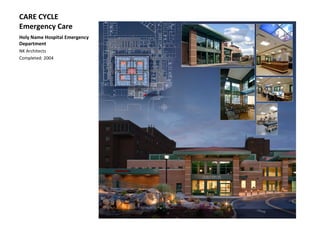
CARE CYCLE
Emergency Care
Holy Name Hospital Emergency
Department
NK Architects
Completed: 2004
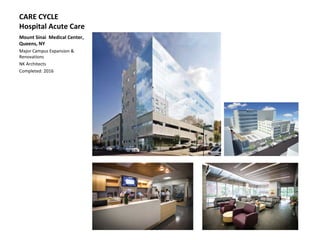
CARE CYCLE
Hospital Acute Care
Mount Sinai Medical Center,
Queens, NY
Major Campus Expansion &
Renovations
NK Architects
Completed: 2016
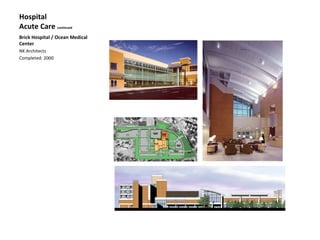
Hospital
Acute Care continued
Brick Hospital / Ocean Medical
Center
NK Architects
Completed: 2000
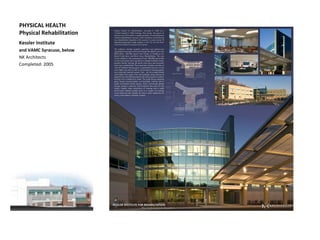
PHYSICAL HEALTH
Physical Rehabilitation
Kessler Institute
and VAMC Syracuse, below
NK Architects
Completed: 2005
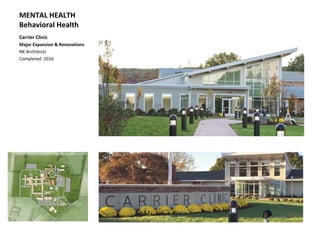
MENTAL HEALTH
Behavioral Health
Carrier Clinic
Major Expansion & Renovations
NK Architects
Completed: 2016
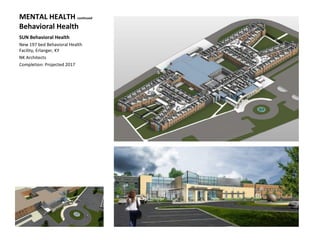
MENTAL HEALTH continued
Behavioral Health
SUN Behavioral Health
New 197 bed Behavioral Health
Facility, Erlanger, KY
NK Architects
Completion: Projected 2017
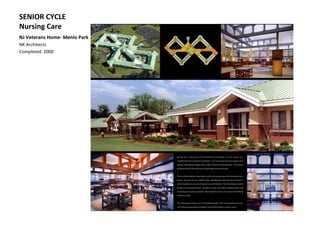
SENIOR CYCLE
Nursing Care
NJ Veterans Home- Menlo Park
NK Architects
Completed: 2000
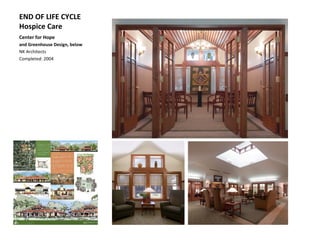
END OF LIFE CYCLE
Hospice Care
Center for Hope
and Greenhouse Design, below
NK Architects
Completed: 2004
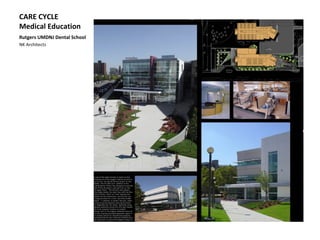
CARE CYCLE
Medical Education
Rutgers UMDNJ Dental School
NK Architects
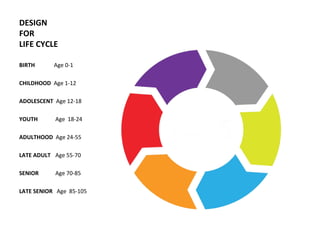
DESIGN
FOR
LIFE CYCLE
BIRTH Age 0-1
CHILDHOOD Age 1-12
ADOLESCENT Age 12-18
YOUTH Age 18-24
ADULTHOOD Age 24-55
LATE ADULT Age 55-70
SENIOR Age 70-85
LATE SENIOR Age 85-105
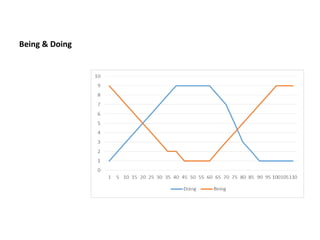
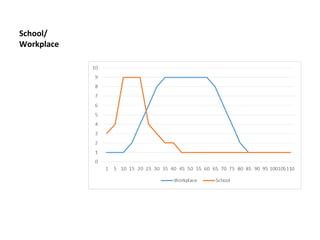
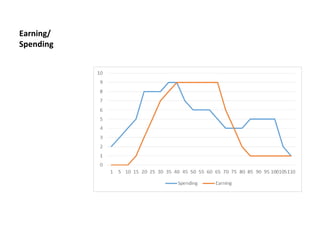
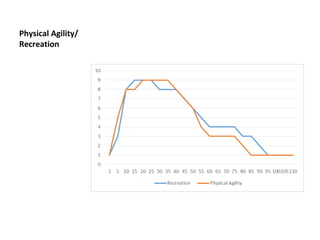
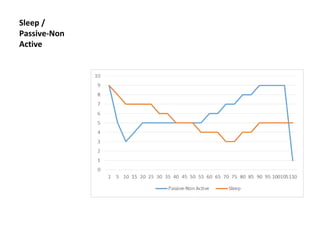
Being & Doing
School/
Workplace
Earning/
Spending
Physical Agility/
Recreation
Sleep /
Passive-Non
Active
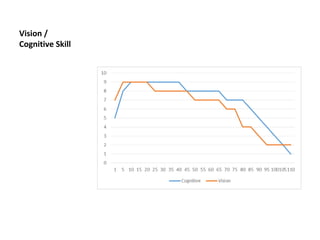
Vision /
Cognitive Skill
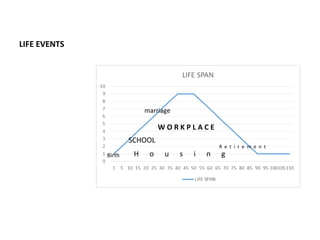
LIFE EVENTS
Birth H o u s i n g
W O R K P L A C E
marriage
R e t i r e m e n t
SCHOOL
DESIGN FOR
Every Stage of
LIFE CYCLE
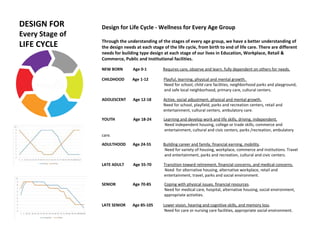
Design for Life Cycle - Wellness for Every Age Group
Through the understanding of the stages of every age group, we have a better understanding of
the design needs at each stage of the life cycle, from birth to end of life care. There are different
needs for building type design at each stage of our lives in Education, Workplace, Retail &
Commerce, Public and Institutional facilities.
NEW BORN Age 0-1 Requires care, observe and learn, fully dependent on others for needs.
CHILDHOOD Age 1-12 Playful, learning, physical and mental growth.
Need for school, child care facilities, neighborhood parks and playground,
and safe local neighborhood, primary care, cultural centers.
ADOLESCENT Age 12-18 Active, social adjustment, physical and mental growth.
Need for school, playfield, parks and recreation centers, retail and
entertainment, cultural centers, ambulatory care.
YOUTH Age 18-24 Learning and develop work and life skills, driving, independent.
Need independent housing, college or trade skills, commerce and
entertainment, cultural and civic centers, parks /recreation, ambulatory
care.
ADULTHOOD Age 24-55 Building career and family, financial earning, mobility.
Need for variety of housing, workplace, commerce and institutions. Travel
and entertainment, parks and recreation, cultural and civic centers.
LATE ADULT Age 55-70 Transition toward retirement, financial concerns, and medical concerns.
Need for alternative housing, alternative workplace, retail and
entertainment, travel, parks and social environment.
SENIOR Age 70-85 Coping with physical issues, financial resources.
Need for medical care, hospital, alternative housing, social environment,
appropriate activities.
LATE SENIOR Age 85-105 Lower vision, hearing and cognitive skills, and memory loss.
Need for care or nursing care facilities, appropriate social environment.
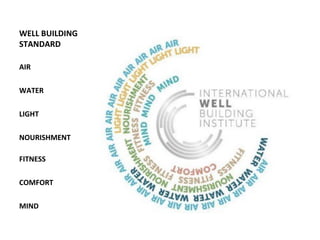
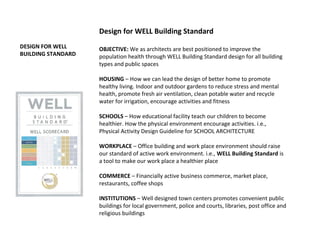
WELL BUILDING
STANDARD
AIR
WATER
LIGHT
NOURISHMENT
FITNESS
COMFORT
MIND
DESIGN FOR WELL
BUILDING STANDARD
Design for WELL Building Standard
OBJECTIVE: We as architects are best positioned to improve the
population health through WELL Building Standard design for all building
types and public spaces
HOUSING – How we can lead the design of better home to promote
healthy living. Indoor and outdoor gardens to reduce stress and mental
health, promote fresh air ventilation, clean potable water and recycle
water for irrigation, encourage activities and fitness
SCHOOLS – How educational facility teach our children to become
healthier. How the physical environment encourage activities. i.e.,
Physical Activity Design Guideline for SCHOOL ARCHITECTURE
WORKPLACE – Office building and work place environment should raise
our standard of active work environment. i.e., WELL Building Standard is
a tool to make our work place a healthier place
COMMERCE – Financially active business commerce, market place,
restaurants, coffee shops
INSTITUTIONS – Well designed town centers promotes convenient public
buildings for local government, police and courts, libraries, post office and
religious buildings
HEALTHY & LIVABLE
COMMUNITY
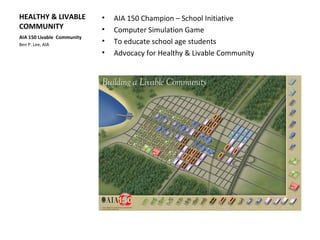
• AIA 150 Champion – School Initiative
• Computer Simulation Game
• To educate school age students
• Advocacy for Healthy & Livable Community
AIA 150 Livable Community
Ben P. Lee, AIA
DESIGN FOR
HEALTHY
COMMUNITY
It’s not just about
BUILDINGS
It’s about the
connected fabric
of our
COMMUNITY
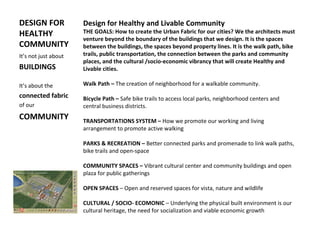
Design for Healthy and Livable Community
THE GOALS: How to create the Urban Fabric for our cities? We the architects must
venture beyond the boundary of the buildings that we design. It is the spaces
between the buildings, the spaces beyond property lines. It is the walk path, bike
trails, public transportation, the connection between the parks and community
places, and the cultural /socio-economic vibrancy that will create Healthy and
Livable cities.
Walk Path – The creation of neighborhood for a walkable community.
Bicycle Path – Safe bike trails to access local parks, neighborhood centers and
central business districts.
TRANSPORTATIONS SYSTEM – How we promote our working and living
arrangement to promote active walking
PARKS & RECREATION – Better connected parks and promenade to link walk paths,
bike trails and open-space
COMMUNITY SPACES – Vibrant cultural center and community buildings and open
plaza for public gatherings
OPEN SPACES – Open and reserved spaces for vista, nature and wildlife
CULTURAL / SOCIO- ECOMONIC – Underlying the physical built environment is our
cultural heritage, the need for socialization and viable economic growth
HEALTHY & LIVABLE
COMMUNITY
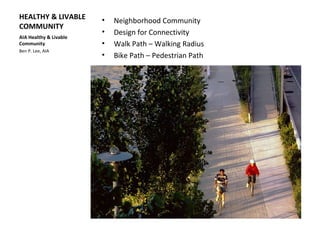
• Neighborhood Community
• Design for Connectivity
• Walk Path – Walking Radius
• Bike Path – Pedestrian Path
AIA Healthy & Livable
Community
Ben P. Lee, AIA
HEALTHY & LIVABLE
COMMUNITY
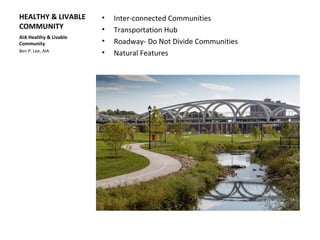
• Inter-connected Communities
• Transportation Hub
• Roadway- Do Not Divide Communities
• Natural Features
AIA Healthy & Livable
Community
Ben P. Lee, AIA
HEALTHY & LIVABLE
COMMUNITY
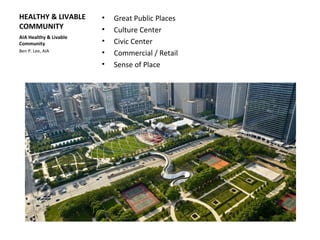
• Great Public Places
• Culture Center
• Civic Center
• Commercial / Retail
• Sense of Place
AIA Healthy & Livable
Community
Ben P. Lee, AIA

NJ Future Redevelopment Forum 2017 Lee

  • 1.
    Building Great PublicSpaces Design from Health & Wellness Perspective to Build a Healthier Environment
  • 2.
    LIFE CYCLE of Care BenP. Lee, AIA Principal / CFO NK Architects Birth Cycle Pediatric Cycle Ambulatory Care Acute Care Rehabilitation Mental Health Nursing Care Hospice Care Medical Education Advocacy for Health & Wellness Birth Pediatric Care Ambulatory Care Acute Care Nursing Care Hospice Care
  • 3.
    BIRTH CYCLE Labor &Delivery Major Hospital Expansion and Renovations NK Architects
  • 4.
    CHILDHOOD CYCLE Pediatric Care BronxLebanon Children Pavilion NK Architects Completed: 2006
  • 5.
    ADULT CYCLE Ambulatory Care BronxLebanon Wellness Center NK Architects Completed: 2014
  • 6.
    CARE CYCLE Emergency Care HolyName Hospital Emergency Department NK Architects Completed: 2004
  • 7.
    CARE CYCLE Hospital AcuteCare Mount Sinai Medical Center, Queens, NY Major Campus Expansion & Renovations NK Architects Completed: 2016
  • 8.
    Hospital Acute Care continued BrickHospital / Ocean Medical Center NK Architects Completed: 2000
  • 9.
    PHYSICAL HEALTH Physical Rehabilitation KesslerInstitute and VAMC Syracuse, below NK Architects Completed: 2005
  • 10.
    MENTAL HEALTH Behavioral Health CarrierClinic Major Expansion & Renovations NK Architects Completed: 2016
  • 11.
    MENTAL HEALTH continued BehavioralHealth SUN Behavioral Health New 197 bed Behavioral Health Facility, Erlanger, KY NK Architects Completion: Projected 2017
  • 12.
    SENIOR CYCLE Nursing Care NJVeterans Home- Menlo Park NK Architects Completed: 2000
  • 13.
    END OF LIFECYCLE Hospice Care Center for Hope and Greenhouse Design, below NK Architects Completed: 2004
  • 14.
    CARE CYCLE Medical Education RutgersUMDNJ Dental School NK Architects
  • 15.
    DESIGN FOR LIFE CYCLE BIRTH Age0-1 CHILDHOOD Age 1-12 ADOLESCENT Age 12-18 YOUTH Age 18-24 ADULTHOOD Age 24-55 LATE ADULT Age 55-70 SENIOR Age 70-85 LATE SENIOR Age 85-105
  • 16.
  • 17.
  • 18.
  • 19.
  • 20.
  • 21.
  • 22.
    LIFE EVENTS Birth Ho u s i n g W O R K P L A C E marriage R e t i r e m e n t SCHOOL
  • 23.
    DESIGN FOR Every Stageof LIFE CYCLE Design for Life Cycle - Wellness for Every Age Group Through the understanding of the stages of every age group, we have a better understanding of the design needs at each stage of the life cycle, from birth to end of life care. There are different needs for building type design at each stage of our lives in Education, Workplace, Retail & Commerce, Public and Institutional facilities. NEW BORN Age 0-1 Requires care, observe and learn, fully dependent on others for needs. CHILDHOOD Age 1-12 Playful, learning, physical and mental growth. Need for school, child care facilities, neighborhood parks and playground, and safe local neighborhood, primary care, cultural centers. ADOLESCENT Age 12-18 Active, social adjustment, physical and mental growth. Need for school, playfield, parks and recreation centers, retail and entertainment, cultural centers, ambulatory care. YOUTH Age 18-24 Learning and develop work and life skills, driving, independent. Need independent housing, college or trade skills, commerce and entertainment, cultural and civic centers, parks /recreation, ambulatory care. ADULTHOOD Age 24-55 Building career and family, financial earning, mobility. Need for variety of housing, workplace, commerce and institutions. Travel and entertainment, parks and recreation, cultural and civic centers. LATE ADULT Age 55-70 Transition toward retirement, financial concerns, and medical concerns. Need for alternative housing, alternative workplace, retail and entertainment, travel, parks and social environment. SENIOR Age 70-85 Coping with physical issues, financial resources. Need for medical care, hospital, alternative housing, social environment, appropriate activities. LATE SENIOR Age 85-105 Lower vision, hearing and cognitive skills, and memory loss. Need for care or nursing care facilities, appropriate social environment.
  • 24.
  • 25.
    DESIGN FOR WELL BUILDINGSTANDARD Design for WELL Building Standard OBJECTIVE: We as architects are best positioned to improve the population health through WELL Building Standard design for all building types and public spaces HOUSING – How we can lead the design of better home to promote healthy living. Indoor and outdoor gardens to reduce stress and mental health, promote fresh air ventilation, clean potable water and recycle water for irrigation, encourage activities and fitness SCHOOLS – How educational facility teach our children to become healthier. How the physical environment encourage activities. i.e., Physical Activity Design Guideline for SCHOOL ARCHITECTURE WORKPLACE – Office building and work place environment should raise our standard of active work environment. i.e., WELL Building Standard is a tool to make our work place a healthier place COMMERCE – Financially active business commerce, market place, restaurants, coffee shops INSTITUTIONS – Well designed town centers promotes convenient public buildings for local government, police and courts, libraries, post office and religious buildings
  • 26.
    HEALTHY & LIVABLE COMMUNITY •AIA 150 Champion – School Initiative • Computer Simulation Game • To educate school age students • Advocacy for Healthy & Livable Community AIA 150 Livable Community Ben P. Lee, AIA
  • 27.
    DESIGN FOR HEALTHY COMMUNITY It’s notjust about BUILDINGS It’s about the connected fabric of our COMMUNITY Design for Healthy and Livable Community THE GOALS: How to create the Urban Fabric for our cities? We the architects must venture beyond the boundary of the buildings that we design. It is the spaces between the buildings, the spaces beyond property lines. It is the walk path, bike trails, public transportation, the connection between the parks and community places, and the cultural /socio-economic vibrancy that will create Healthy and Livable cities. Walk Path – The creation of neighborhood for a walkable community. Bicycle Path – Safe bike trails to access local parks, neighborhood centers and central business districts. TRANSPORTATIONS SYSTEM – How we promote our working and living arrangement to promote active walking PARKS & RECREATION – Better connected parks and promenade to link walk paths, bike trails and open-space COMMUNITY SPACES – Vibrant cultural center and community buildings and open plaza for public gatherings OPEN SPACES – Open and reserved spaces for vista, nature and wildlife CULTURAL / SOCIO- ECOMONIC – Underlying the physical built environment is our cultural heritage, the need for socialization and viable economic growth
  • 28.
    HEALTHY & LIVABLE COMMUNITY •Neighborhood Community • Design for Connectivity • Walk Path – Walking Radius • Bike Path – Pedestrian Path AIA Healthy & Livable Community Ben P. Lee, AIA
  • 29.
    HEALTHY & LIVABLE COMMUNITY •Inter-connected Communities • Transportation Hub • Roadway- Do Not Divide Communities • Natural Features AIA Healthy & Livable Community Ben P. Lee, AIA
  • 30.
    HEALTHY & LIVABLE COMMUNITY •Great Public Places • Culture Center • Civic Center • Commercial / Retail • Sense of Place AIA Healthy & Livable Community Ben P. Lee, AIA

Editor's Notes

  • #3 Board certified Healthcare Architect, full life cycle of cares.
  • #4 At RMC, reorganized roadway and circulation pattern like airport drop-off. Take advantage of the Riverfront Park and view of the Navasink River.
  • #5 BLHC Ped Pavilion by creating a theme of nature museum that is friendly to children.
  • #6 BLHC ACC on Mount Eden Parkway, define a new building identity for ambulatory care.
  • #7 HNH after 911, new ED w/ circulation pattern for emergency access.
  • #8 Mount Sinai Queens, urban site with urban issues.
  • #9 OMC suburban campus, capture of space between Hospital and Ambulatory buildings.
  • #10 Physical Rehab facility for physically challenged patients.
  • #11 Mental Health at CC, clear circulation and way finding. Create an natural serene environment w/ natural daylight and access to outdoor.
  • #12 Kentucky major crossroad of interstate highways, to create a landmark w/ circular drive and sphere as focal point.
  • #13 Veterans home with town center, Broadway and access to outdoor courtyard.
  • #14 Small scale hospice with individual pods, day space, read area and porch facing south.