The numbers are in….
Now what?
1. Find Ways to Reduce Your Obligation
2. Look at All Your Options
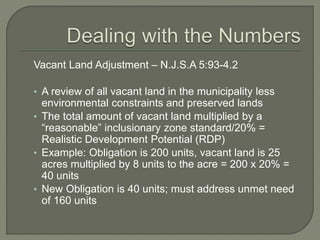
Vacant Land Adjustment – N.J.S.A 5:93-4.2
• A review of all vacant land in the municipality less
environmental constraints and preserved lands
• The total amount of vacant land multiplied by a
“reasonable” inclusionary zone standard/20% =
Realistic Development Potential (RDP)
• Example: Obligation is 200 units, vacant land is 25
acres multiplied by 8 units to the acre = 200 x 20% =
40 units
• New Obligation is 40 units; must address unmet need
of 160 units
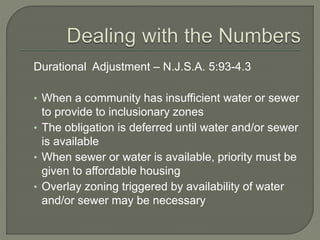
Durational Adjustment – N.J.S.A. 5:93-4.3
• When a community has insufficient water or sewer
to provide to inclusionary zones
• The obligation is deferred until water and/or sewer
is available
• When sewer or water is available, priority must be
given to affordable housing
• Overlay zoning triggered by availability of water
and/or sewer may be necessary
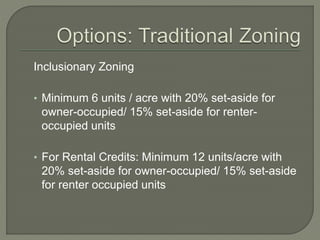
Inclusionary Zoning
• Minimum 6 units / acre with 20% set-aside for
owner-occupied/ 15% set-aside for renter-
occupied units
• For Rental Credits: Minimum 12 units/acre with
20% set-aside for owner-occupied/ 15% set-aside
for renter occupied units
Can be applied over current zone and only
triggered if property redevelops
Target older strip malls, office complexes,
under-utilized properties
May incentivize redevelopment
Redevelopment Plans offer flexibility
PILOT programs and other negotiations
may provide incentives for higher than
minimum set-asides, i.e. 20% for rentals
Focused design standards may help
address neighborhood character
Can provide for affordable housing in
single family neighborhoods
Has added bonus of helping homes to
become more affordable for owner
Units must be deed restricted
Recommend an affordable housing trust
fund to assist in producing units
Purchase, deed-restrict and sell or rent the
unit
Can be single family or multi-family
Can apply to municipally-owned and
general foreclosures
Need seed money to start the program
Groups like Habitat for Humanity can help
Leverage municipally-owned property
Reduce need for overall unit counts
Many reputable and experienced
developers working with LIHTC
Can utilize existing properties or homes
owned by the municipality
Research if any exist that haven’t been
counted
Can use money in your trust fund to assist
service providers in purchasing a home

NJ Future Redevelopment Forum 2017 Caldwell

  • 1.
    The numbers arein…. Now what? 1. Find Ways to Reduce Your Obligation 2. Look at All Your Options
  • 2.
    Vacant Land Adjustment– N.J.S.A 5:93-4.2 • A review of all vacant land in the municipality less environmental constraints and preserved lands • The total amount of vacant land multiplied by a “reasonable” inclusionary zone standard/20% = Realistic Development Potential (RDP) • Example: Obligation is 200 units, vacant land is 25 acres multiplied by 8 units to the acre = 200 x 20% = 40 units • New Obligation is 40 units; must address unmet need of 160 units
  • 3.
    Durational Adjustment –N.J.S.A. 5:93-4.3 • When a community has insufficient water or sewer to provide to inclusionary zones • The obligation is deferred until water and/or sewer is available • When sewer or water is available, priority must be given to affordable housing • Overlay zoning triggered by availability of water and/or sewer may be necessary
  • 4.
    Inclusionary Zoning • Minimum6 units / acre with 20% set-aside for owner-occupied/ 15% set-aside for renter- occupied units • For Rental Credits: Minimum 12 units/acre with 20% set-aside for owner-occupied/ 15% set-aside for renter occupied units
  • 5.
    Can be appliedover current zone and only triggered if property redevelops Target older strip malls, office complexes, under-utilized properties May incentivize redevelopment
  • 6.
    Redevelopment Plans offerflexibility PILOT programs and other negotiations may provide incentives for higher than minimum set-asides, i.e. 20% for rentals Focused design standards may help address neighborhood character
  • 7.
    Can provide foraffordable housing in single family neighborhoods Has added bonus of helping homes to become more affordable for owner Units must be deed restricted Recommend an affordable housing trust fund to assist in producing units
  • 8.
    Purchase, deed-restrict andsell or rent the unit Can be single family or multi-family Can apply to municipally-owned and general foreclosures Need seed money to start the program Groups like Habitat for Humanity can help
  • 9.
    Leverage municipally-owned property Reduceneed for overall unit counts Many reputable and experienced developers working with LIHTC
  • 10.
    Can utilize existingproperties or homes owned by the municipality Research if any exist that haven’t been counted Can use money in your trust fund to assist service providers in purchasing a home