Properties of PETN Used in the
Automated Detonator Manufacturing
Plant at Modderfontein
CONTENTS
• INTRODUCTION
• PROPERTIES
• MANUFACTURE
– Biazzi Process
– Troisdorf Process
• PETN PARAMETERS for ISAP PLANT
• DOSING & PRESSING TRIALS
• MASTERSIZER MS2000 RESULTS
• FT4 – POWDER RHEOMETER
• FT4 RESULTS
- Stability [REP] Test
- Permeability Test
INTRODUCTION
• Pentaerythritol-tetranitrate [PETN] first mentioned in a
German patent issued in 1894
• Manufacture of PETN and Cordtex detonating fuse was
started at the Somerset West Factory early in 1953
• In 1959 packing of PETN for use in detonator manufacture at
Modderfontein was begun
• Construction of PETN plant at Modderfontein commenced in
April 1967 and completed in April 1968
PROPERTIES
• Chemical formula – C5H8N4O12
• Molecular mass – 316.15 a.m.u
• Forms colorless prismatic crystals that together appear white
and opaque
• Density TMD: 1.78 g/cm3
Nominal: 1.76 g/cm3
• Melting Point [pure]: 141 – 142 °C
• Critical Temperature: 192 °C
• Velocity of Detonation: 7.975 km/s @ ρ=1.67 g/cm3
Detonation Pressure ρ=1.77 ρ=1.67 ρ=0.99 g/cm3
Measured 33.5 30.0 8.7 GPa
Calculated 33.2 28.0 10.0 GPa
VIDEO
• Johannesburg to Cape Town – 1393 km @ 6.5 km/s
There and back: approx 7 minutes
• HMX – Velocity of Detonation: 9.11 km/s @ ρ=1.89g/cm3
- Detonation Pressure [GPa] ρ=1.900g/cm3
Measured 39.0 GPa
• Pdet = 0.25xρ0xVOD2
Shock tube
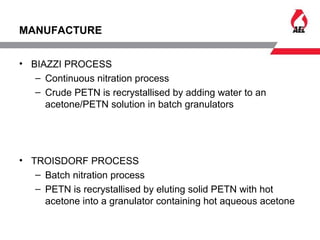
MANUFACTURE
• BIAZZI PROCESS
– Continuous nitration process
– Crude PETN is recrystallised by adding water to an
acetone/PETN solution in batch granulators
• TROISDORF PROCESS
– Batch nitration process
– PETN is recrystallised by eluting solid PETN with hot
acetone into a granulator containing hot aqueous acetone
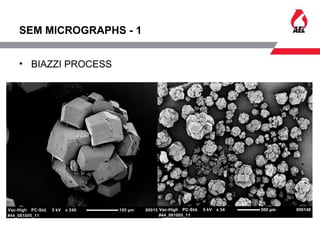
SEM MICROGRAPHS - 1
• BIAZZI PROCESS
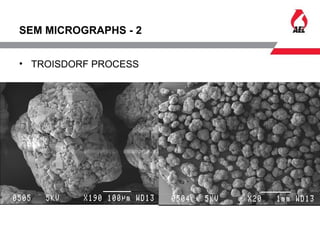
SEM MICROGRAPHS - 2
• TROISDORF PROCESS
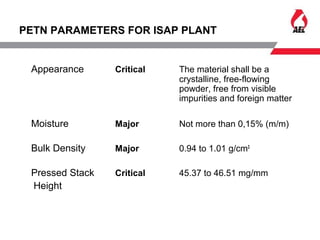
PETN PARAMETERS FOR ISAP PLANT
Appearance Critical The material shall be a
crystalline, free-flowing
powder, free from visible
impurities and foreign matter
Moisture Major Not more than 0,15% (m/m)
Bulk Density Major 0.94 to 1.01 g/cm3
Pressed Stack Critical 45.37 to 46.51 mg/mm
Height
DOSING & PRESSING TRIALS
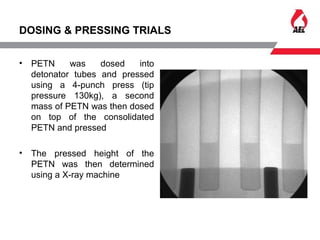
• PETN was dosed into
detonator tubes and pressed
using a 4-punch press (tip
pressure 130kg), a second
mass of PETN was then dosed
on top of the consolidated
PETN and pressed
• The pressed height of the
PETN was then determined
using a X-ray machine
DOSING & PRESSING TRIALS - 2
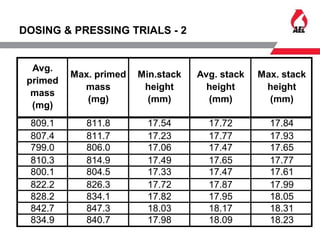
809.1 811.8 17.54 17.72 17.84
807.4 811.7 17.23 17.77 17.93
799.0 806.0 17.06 17.47 17.65
810.3 814.9 17.49 17.65 17.77
800.1 804.5 17.33 17.47 17.61
822.2 826.3 17.72 17.87 17.99
828.2 834.1 17.82 17.95 18.05
842.7 847.3 18.03 18.17 18.31
834.9 840.7 17.98 18.09 18.23
Max. primed
mass
(mg)
Max. stack
height
(mm)
Avg.
primed
mass
(mg)
Avg. stack
height
(mm)
Min.stack
height
(mm)
DOSING & PRESSING TRIALS - 3
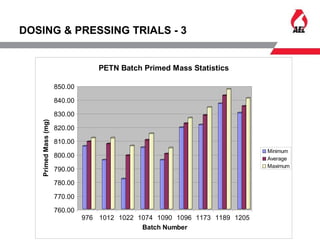
760.00
770.00
780.00
790.00
800.00
810.00
820.00
830.00
840.00
850.00
PrimedMass(mg)
976 1012 1022 1074 1090 1096 1173 1189 1205
Batch Number
PETN Batch Primed Mass Statistics
Minimum
Average
Maximum
DOSING & PRESSING TRIALS - 4
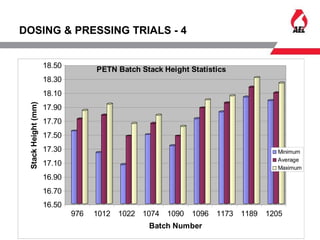
16.50
16.70
16.90
17.10
17.30
17.50
17.70
17.90
18.10
18.30
18.50
StackHeight(mm)
976 1012 1022 1074 1090 1096 1173 1189 1205
Batch Number
PETN Batch Stack Height Statistics
Minimum
Average
Maximum
DOSING & PRESSING TRIALS - 5
PETN Batch Comparison
17
17.2
17.4
17.6
17.8
18
18.2
18.4
780 790 800 810 820 830 840 850
PETN mass (mg)
PressedStackHeight(mm)
PETN Bx 976 [det grade] PD = 1.001g/cc PETN Bx1012 [det grade] PD = 0.999g/cc PETN Bx1022 [det grade] PD = 0.989g/cc
PETN Bx 1074 [det grade] PD = 1.003g/cc PETN Bx 1090 [det grade] PD = 0.990g/cc PETN Bx 1205 [det grade] PD = 1.033g/cc
PETN Bx 1096 [det grade] PD = 1.017g/cc PETN Bx 1173 [det grade] PD = 1.025g/cc PETN Bx 1189 [det grade] PD = 1.043g/cc
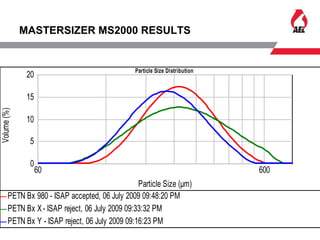
MASTERSIZER MS2000 RESULTS
Particle Size Distribution
60 600
Particle Size (µm)
0
5
10
15
20
Volume(%)
PETN Bx 980 - ISAP accepted, 06 July 2009 09:48:20 PM
PETN Bx X- ISAP reject, 06 July 2009 09:33:32 PM
PETN Bx Y - ISAP reject, 06 July 2009 09:16:23 PM
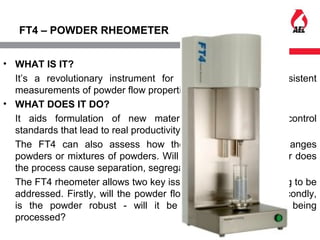
FT4 – POWDER RHEOMETER
• WHAT IS IT?
It’s a revolutionary instrument for providing fast and consistent
measurements of powder flow properties.
• WHAT DOES IT DO?
It aids formulation of new materials, provides quality control
standards that lead to real productivity and quality gains.
The FT4 can also assess how the act of processing changes
powders or mixtures of powders. Will it still flow for instance or does
the process cause separation, segregation or attrition?
The FT4 rheometer allows two key issues of powder processing to be
addressed. Firstly, will the powder flow satisfactorily? And secondly,
is the powder robust - will it be adversely affected by being
processed?
FT4 – POWDER RHEOMETER [2]
• FT4 Principle of Operation
Blade rotates and moves down and up through powder at a
defined helix angle and speed
• Measured Parameters are: -
Torque
Force
Height
FT4 – POWDER RHEOMETER [3]
FT4 – POWDER RHEOMETER [4]
CONDITIONING
Variation in the packing state of the powder will significantly change the flow
properties.
It is essential to prepare the sample before the test by Conditioning.
The Conditioning process involves gentle displacement of the whole powder
sample in order to loosen and slightly aerate the powder into an homogenised
state.
Powder that is consolidated during filling will flow differently to one that was
filled gently, possibly trapping air.
FT4 – POWDER RHEOMETER [5]
FT4 – POWDER RHEOMETER [6]
FT4 – POWDER RHEOMETER [7]
FT4 – POWDER RHEOMETER [8]
FT4 – POWDER RHEOMETER [9]
FT4 – POWDER RHEOMETER [10]
FT4 – POWDER RHEOMETER [11]
FT4 – POWDER RHEOMETER [12]
FT4 – POWDER RHEOMETER [13]
FT4 – POWDER RHEOMETER [14]
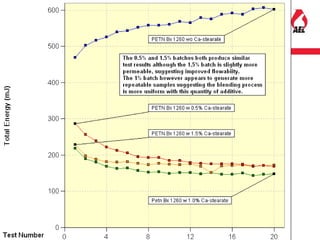
FT4 RESULTS
Stability [REP] Test
• The standard Stability Test is a combination of Conditioning
and Test cycles, designed to assess if the powder is going to
change as a result of being made to flow. Therefore, unlike
other test programs, this test does not intentionally introduce
a variable, such as flow rate or air velocity. Hence, any
change in the flow energy during the test has to be a result of
the powder flow properties changing.
FT4 RESULTS
FT4 RESULTS
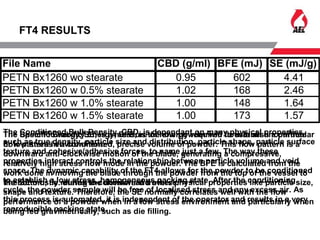
File Name CBD (g/ml) BFE (mJ) SE (mJ/g)
PETN Bx1260 wo stearate 0.95 602 4.41
PETN Bx1260 w 0.5% stearate 1.02 168 2.46
PETN Bx1260 w 1.0% stearate 1.00 148 1.64
PETN Bx1260 w 1.5% stearate 1.00 173 1.57
The Conditioned Bulk Density, CBD, is dependant on many physical properties,
such as true density, particle size and distribution, particle shape, particle surface
texture and cohesive/adhesive forces, to name just a few. The way these
properties interact controls the relationship between particle volume and void
space. The dynamic capability of the FT4 allows for the powder to be conditioned
to establish a low stress, homogeneous packing state. After the conditioning
cycle, the powder sample will be free of localised stress and any excess air. As
this process is automated, it is independent of the operator and results in a very
reproducible packing state.
The Basic Flowability Energy, BFE, is the energy required to establish a particular
flow pattern in a conditioned, precise volume of powder. This flow pattern is a
downward anti-clockwise motion of the blade, generating a compressive,
relatively high stress flow mode in the powder. The BFE is calculated from the
work done in moving the blade through the powder from the top of the vessel to
the bottom, i.e. during the downward traverse.
The Specific Energy, SE, is a measure of how powder will flow in an unconfined
or low stress environment.
The SE mostly relates to cohesion and other physical properties like particle size,
shape and texture. Therefore, the SE normally correlates well with the flow
performance of a powder when in a low stress environment and particularly when
being fed gravimetrically, such as die filling.
FT4 RESULTS
• Permeability Test
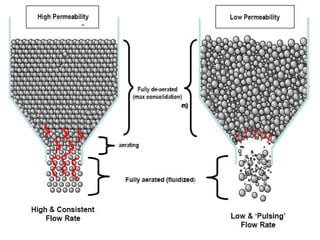
– Permeability (k) is the ability of a gas to penetrate and
move through a powder bed
– Low permeability may cause low and pulsing (two phase)
flow rate
– In a dosing operation can cause low throughput and
inconsistent priming mass
FT4 RESULTS
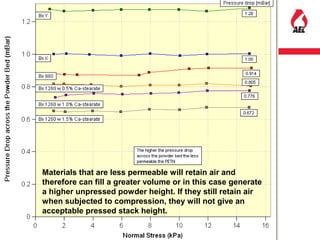
Materials that are less permeable will retain air and
therefore can fill a greater volume or in this case generate
a higher unpressed powder height. If they still retain air
when subjected to compression, they will not give an
acceptable pressed stack height.
NIXT Presentation - 23 July 2009

NIXT Presentation - 23 July 2009

  • 1.
    Properties of PETNUsed in the Automated Detonator Manufacturing Plant at Modderfontein
  • 2.
    CONTENTS • INTRODUCTION • PROPERTIES •MANUFACTURE – Biazzi Process – Troisdorf Process • PETN PARAMETERS for ISAP PLANT • DOSING & PRESSING TRIALS • MASTERSIZER MS2000 RESULTS • FT4 – POWDER RHEOMETER • FT4 RESULTS - Stability [REP] Test - Permeability Test
  • 3.
    INTRODUCTION • Pentaerythritol-tetranitrate [PETN]first mentioned in a German patent issued in 1894 • Manufacture of PETN and Cordtex detonating fuse was started at the Somerset West Factory early in 1953 • In 1959 packing of PETN for use in detonator manufacture at Modderfontein was begun • Construction of PETN plant at Modderfontein commenced in April 1967 and completed in April 1968
  • 4.
    PROPERTIES • Chemical formula– C5H8N4O12 • Molecular mass – 316.15 a.m.u • Forms colorless prismatic crystals that together appear white and opaque • Density TMD: 1.78 g/cm3 Nominal: 1.76 g/cm3 • Melting Point [pure]: 141 – 142 °C • Critical Temperature: 192 °C • Velocity of Detonation: 7.975 km/s @ ρ=1.67 g/cm3 Detonation Pressure ρ=1.77 ρ=1.67 ρ=0.99 g/cm3 Measured 33.5 30.0 8.7 GPa Calculated 33.2 28.0 10.0 GPa
  • 5.
    VIDEO • Johannesburg toCape Town – 1393 km @ 6.5 km/s There and back: approx 7 minutes • HMX – Velocity of Detonation: 9.11 km/s @ ρ=1.89g/cm3 - Detonation Pressure [GPa] ρ=1.900g/cm3 Measured 39.0 GPa • Pdet = 0.25xρ0xVOD2 Shock tube
  • 6.
    MANUFACTURE • BIAZZI PROCESS –Continuous nitration process – Crude PETN is recrystallised by adding water to an acetone/PETN solution in batch granulators • TROISDORF PROCESS – Batch nitration process – PETN is recrystallised by eluting solid PETN with hot acetone into a granulator containing hot aqueous acetone
  • 7.
    SEM MICROGRAPHS -1 • BIAZZI PROCESS
  • 8.
    SEM MICROGRAPHS -2 • TROISDORF PROCESS
  • 9.
    PETN PARAMETERS FORISAP PLANT Appearance Critical The material shall be a crystalline, free-flowing powder, free from visible impurities and foreign matter Moisture Major Not more than 0,15% (m/m) Bulk Density Major 0.94 to 1.01 g/cm3 Pressed Stack Critical 45.37 to 46.51 mg/mm Height
  • 10.
    DOSING & PRESSINGTRIALS • PETN was dosed into detonator tubes and pressed using a 4-punch press (tip pressure 130kg), a second mass of PETN was then dosed on top of the consolidated PETN and pressed • The pressed height of the PETN was then determined using a X-ray machine
  • 11.
    DOSING & PRESSINGTRIALS - 2 809.1 811.8 17.54 17.72 17.84 807.4 811.7 17.23 17.77 17.93 799.0 806.0 17.06 17.47 17.65 810.3 814.9 17.49 17.65 17.77 800.1 804.5 17.33 17.47 17.61 822.2 826.3 17.72 17.87 17.99 828.2 834.1 17.82 17.95 18.05 842.7 847.3 18.03 18.17 18.31 834.9 840.7 17.98 18.09 18.23 Max. primed mass (mg) Max. stack height (mm) Avg. primed mass (mg) Avg. stack height (mm) Min.stack height (mm)
  • 12.
    DOSING & PRESSINGTRIALS - 3 760.00 770.00 780.00 790.00 800.00 810.00 820.00 830.00 840.00 850.00 PrimedMass(mg) 976 1012 1022 1074 1090 1096 1173 1189 1205 Batch Number PETN Batch Primed Mass Statistics Minimum Average Maximum
  • 13.
    DOSING & PRESSINGTRIALS - 4 16.50 16.70 16.90 17.10 17.30 17.50 17.70 17.90 18.10 18.30 18.50 StackHeight(mm) 976 1012 1022 1074 1090 1096 1173 1189 1205 Batch Number PETN Batch Stack Height Statistics Minimum Average Maximum
  • 14.
    DOSING & PRESSINGTRIALS - 5 PETN Batch Comparison 17 17.2 17.4 17.6 17.8 18 18.2 18.4 780 790 800 810 820 830 840 850 PETN mass (mg) PressedStackHeight(mm) PETN Bx 976 [det grade] PD = 1.001g/cc PETN Bx1012 [det grade] PD = 0.999g/cc PETN Bx1022 [det grade] PD = 0.989g/cc PETN Bx 1074 [det grade] PD = 1.003g/cc PETN Bx 1090 [det grade] PD = 0.990g/cc PETN Bx 1205 [det grade] PD = 1.033g/cc PETN Bx 1096 [det grade] PD = 1.017g/cc PETN Bx 1173 [det grade] PD = 1.025g/cc PETN Bx 1189 [det grade] PD = 1.043g/cc
  • 15.
    MASTERSIZER MS2000 RESULTS ParticleSize Distribution 60 600 Particle Size (µm) 0 5 10 15 20 Volume(%) PETN Bx 980 - ISAP accepted, 06 July 2009 09:48:20 PM PETN Bx X- ISAP reject, 06 July 2009 09:33:32 PM PETN Bx Y - ISAP reject, 06 July 2009 09:16:23 PM
  • 16.
    FT4 – POWDERRHEOMETER • WHAT IS IT? It’s a revolutionary instrument for providing fast and consistent measurements of powder flow properties. • WHAT DOES IT DO? It aids formulation of new materials, provides quality control standards that lead to real productivity and quality gains. The FT4 can also assess how the act of processing changes powders or mixtures of powders. Will it still flow for instance or does the process cause separation, segregation or attrition? The FT4 rheometer allows two key issues of powder processing to be addressed. Firstly, will the powder flow satisfactorily? And secondly, is the powder robust - will it be adversely affected by being processed?
  • 17.
    FT4 – POWDERRHEOMETER [2] • FT4 Principle of Operation Blade rotates and moves down and up through powder at a defined helix angle and speed • Measured Parameters are: - Torque Force Height
  • 18.
    FT4 – POWDERRHEOMETER [3]
  • 19.
    FT4 – POWDERRHEOMETER [4] CONDITIONING Variation in the packing state of the powder will significantly change the flow properties. It is essential to prepare the sample before the test by Conditioning. The Conditioning process involves gentle displacement of the whole powder sample in order to loosen and slightly aerate the powder into an homogenised state. Powder that is consolidated during filling will flow differently to one that was filled gently, possibly trapping air.
  • 20.
    FT4 – POWDERRHEOMETER [5]
  • 21.
    FT4 – POWDERRHEOMETER [6]
  • 22.
    FT4 – POWDERRHEOMETER [7]
  • 23.
    FT4 – POWDERRHEOMETER [8]
  • 24.
    FT4 – POWDERRHEOMETER [9]
  • 25.
    FT4 – POWDERRHEOMETER [10]
  • 26.
    FT4 – POWDERRHEOMETER [11]
  • 27.
    FT4 – POWDERRHEOMETER [12]
  • 28.
    FT4 – POWDERRHEOMETER [13]
  • 29.
    FT4 – POWDERRHEOMETER [14]
  • 30.
    FT4 RESULTS Stability [REP]Test • The standard Stability Test is a combination of Conditioning and Test cycles, designed to assess if the powder is going to change as a result of being made to flow. Therefore, unlike other test programs, this test does not intentionally introduce a variable, such as flow rate or air velocity. Hence, any change in the flow energy during the test has to be a result of the powder flow properties changing.
  • 31.
  • 32.
    FT4 RESULTS File NameCBD (g/ml) BFE (mJ) SE (mJ/g) PETN Bx1260 wo stearate 0.95 602 4.41 PETN Bx1260 w 0.5% stearate 1.02 168 2.46 PETN Bx1260 w 1.0% stearate 1.00 148 1.64 PETN Bx1260 w 1.5% stearate 1.00 173 1.57 The Conditioned Bulk Density, CBD, is dependant on many physical properties, such as true density, particle size and distribution, particle shape, particle surface texture and cohesive/adhesive forces, to name just a few. The way these properties interact controls the relationship between particle volume and void space. The dynamic capability of the FT4 allows for the powder to be conditioned to establish a low stress, homogeneous packing state. After the conditioning cycle, the powder sample will be free of localised stress and any excess air. As this process is automated, it is independent of the operator and results in a very reproducible packing state. The Basic Flowability Energy, BFE, is the energy required to establish a particular flow pattern in a conditioned, precise volume of powder. This flow pattern is a downward anti-clockwise motion of the blade, generating a compressive, relatively high stress flow mode in the powder. The BFE is calculated from the work done in moving the blade through the powder from the top of the vessel to the bottom, i.e. during the downward traverse. The Specific Energy, SE, is a measure of how powder will flow in an unconfined or low stress environment. The SE mostly relates to cohesion and other physical properties like particle size, shape and texture. Therefore, the SE normally correlates well with the flow performance of a powder when in a low stress environment and particularly when being fed gravimetrically, such as die filling.
  • 33.
    FT4 RESULTS • PermeabilityTest – Permeability (k) is the ability of a gas to penetrate and move through a powder bed – Low permeability may cause low and pulsing (two phase) flow rate – In a dosing operation can cause low throughput and inconsistent priming mass
  • 34.
    FT4 RESULTS Materials thatare less permeable will retain air and therefore can fill a greater volume or in this case generate a higher unpressed powder height. If they still retain air when subjected to compression, they will not give an acceptable pressed stack height.