http://www.niso.org/news/events/2012/nisowebinars/embracing_the_cloud
          /


   Embracing the Cloud:
Real Life Examples of Library
   Cloud Implementation
              February 8, 2012


Speakers: Erik Mitchell, Lynne Jacobsen,
        and Charlene McGuire
2
3
5
6
7
8
9
10
11
12
13
14
15
16
17
18
19
20
21
22
23
24
25
26
27
28
29
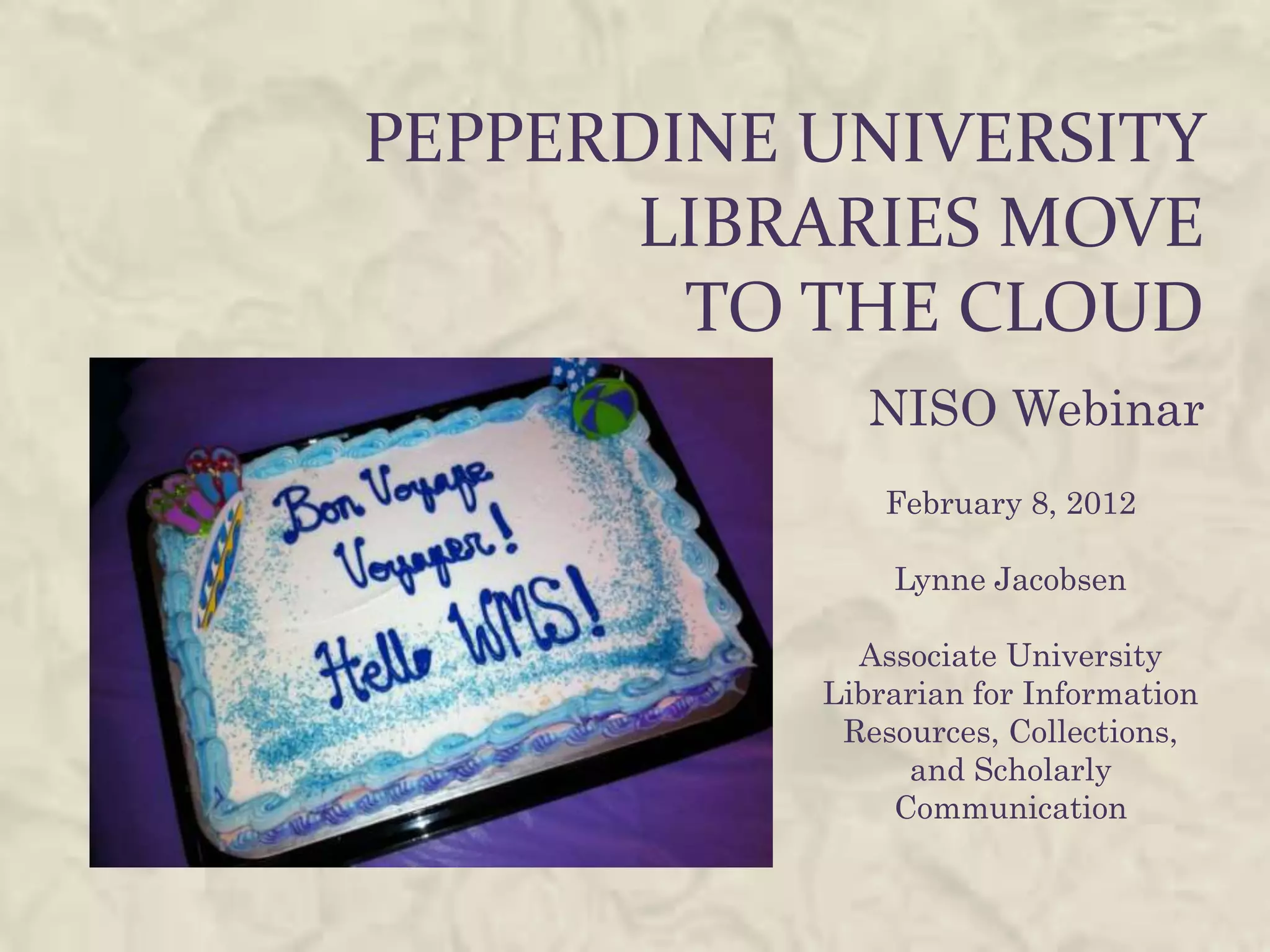
PEPPERDINE UNIVERSITY
       LIBRARIES MOVE
        TO THE CLOUD
              NISO Webinar
               February 8, 2012

               Lynne Jacobsen

             Associate University
           Librarian for Information
            Resources, Collections,
                and Scholarly
               Communication
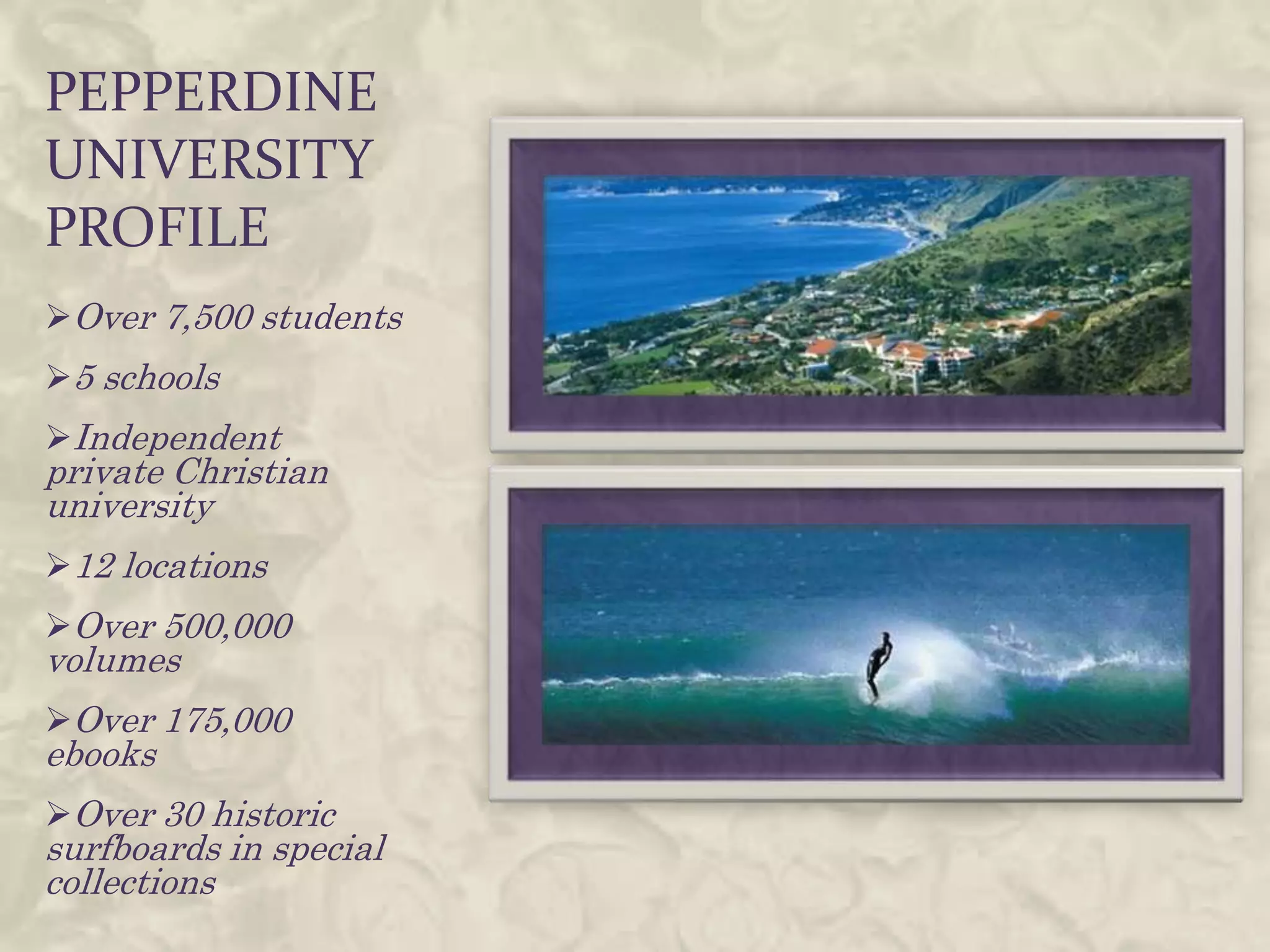
PEPPERDINE
UNIVERSITY
PROFILE
Over 7,500 students
5 schools
Independent
private Christian
university
12 locations
Over 500,000
volumes
Over 175,000
ebooks
Over 30 historic
surfboards in special
collections
REASONS FOR MOVING TO THE
         CLOUD
          Server needed replacing
          Moving to outsourced hosted solutions
          Lower the total cost of ownership
          Enable more efficient workflows in all
           areas
          Offer a better catalog with Google-like
           searching and Web 2.0 features
          Improve interoperability between various
           library systems and services
          Find a better way to manage e-resources
WHY OCLC WMS?
     Great relationship with OCLC, quality products,
      shared data, impressive roadmap
     WorldCat Local catalog –better discovery with
      increased circulation and ILL (tripled)
     Outsourced hosting—no more hardware/software
      upgrades to manage
     Significant savings in total cost of ownership—$50,000
      annually
     Many efficiencies in technical services and in the use
      of shared data
     Integration with ILLiad, CONTENTdm, and other
      services
     Potential for 3rd party apps –making technology work
      to save time
OUR LAST       Conducted an OCLC batch reclamation
MIGRATION       project
               Updated MARC holdings data in our
                local system
               Standardized OCLC number formatting
                (MARC 035 tag)
               Item and holdings records were merged
                into Local Holdings Records (LHRs)
               Migrated only current circulation data
               Patron data was loaded from
                PeopleSoft
               No acquisitions data was migrated
AN
                Reduced the number of loan
OPPORTUNITY     periods
TO STREAMLINE
POLICIES        Reduced the number of patron
                groups

                Standardized policies across
                all branches

                Improved services by offering:

                    Longer loan periods

                    No more fines

                   On-shelf holds

                   Courtesy notices
   Acquisitions and cataloging are blended
IN GENERAL,
                 Maintain one catalog instead of two
 WHAT            Accept cataloging copy
 CHANGED?        Use vendor services
                 Staff can now work on other tasks
                     One staff reassigned to ILL for 40% of
                      her job; one staff doing admin and
                      original cataloging; one position
                      created for collection development
                 A cultural shift occurred in several areas
                     Change is constant
                     Less control = freedom
                     Catalog searching now from broad to
                      narrow utilizing facets
WHAT’S DIFFERENT?
               With one motion           Copy cataloging and
                during receiving—          receiving are combined
                   Barcode is added      Edit records in Connexion
                                           only when critically
                   Call number from       important
                    bib record
                    populates field       With shelf-ready service,
                                           books go out fast
                   Item is marked as
                    received              For us, invoicing is
                                           separate from receiving
                   Holdings are
                    automatically         More time for cataloging
                    updated in OCLC        ETDs and special
                    (LHRs are              collections
                    created)
  We no longer export bibliographic records to a local system,
  edit records, conduct authority control, or update holdings in
                          a local system
CIRCULATION CHANGES
                     Reserves are much
                      improved
                     All reserve items are
                      fully cataloged
                     Holds are handled
                      differently
                     No longer check
                      items in twice
                     Student workers are
                      easily trained on
                      WMS
E-RESOURCE MANAGEMENT
             Migrated holdings to the Knowledge
              Base (KB) from OCLC Link Manager
             E-journal titles are automatically
              updated in the KB by Pubget
             The KB then automatically updates
              holdings in WorldCat
             We can add and delete titles as well
              as collections in the KB
             E-book subscriptions are also
              maintained in the KB
             Links automatically appear for held
              titles
             Just started adding license data
ARE ANY        Functions not yet ready, but coming
FUNCTIONS       soon—
MISSING?           Robust reporting
                   EDI invoicing
                   Serial pattern data
                   Serial claiming
                   Call number browsing
                   Inventory processing
                   Catalog query from ILLiad
                   Batch spine label printing
                   Single sign-on capability
SOME
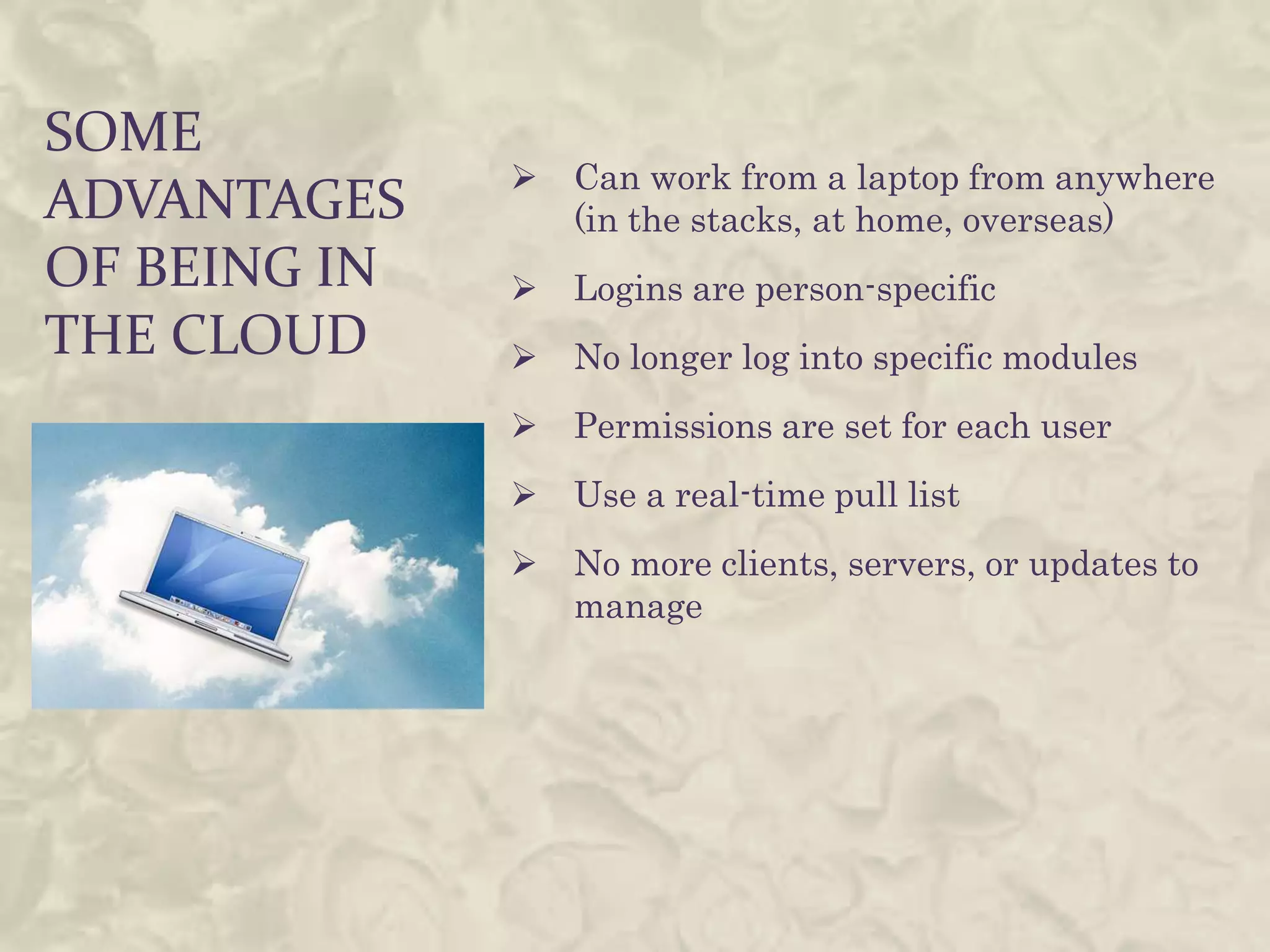
                 Can work from a laptop from anywhere
ADVANTAGES        (in the stacks, at home, overseas)
OF BEING IN      Logins are person-specific
THE CLOUD        No longer log into specific modules
                 Permissions are set for each user
                 Use a real-time pull list
                 No more clients, servers, or updates to
                  manage
CHANGE MANAGEMENT
              Manage the extent and
               frequency of change
              Communicate what we
               are doing and why
              Get people involved—
               ask for their input
              Plan—Prepare—Train
              Avoid conflicting
               messages
              Ensure quick success
              Celebrate often!
IN CONCLUSION—
                    We would do it again
                    We enjoyed being a
                     beta test site
                    We’ve started
                     forgetting how we used
                     to do things
                    WMS begins to fade
                     into the background as
                     we concentrate on
                     collections and services
                    We look forward to all
                     that webscale can offer
THANK YOU!


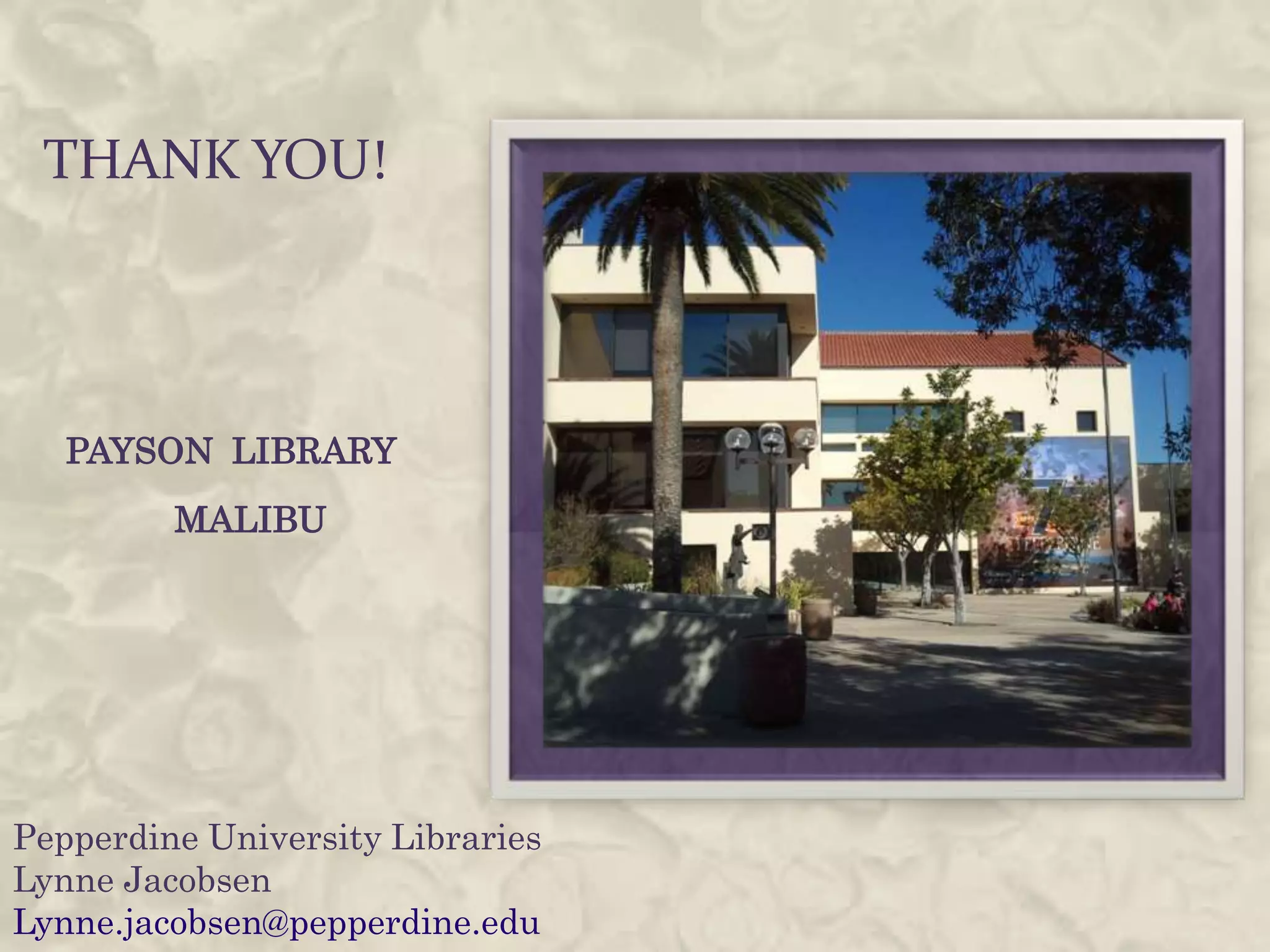
   PAYSON LIBRARY
         MALIBU


Pepperdine University Libraries
Lynne Jacobsen
Lynne.jacobsen@pepperdine.edu
Southwest Kansas Library System
                         SWKLS
Charlene McGuire, Technology Consultant
                    cmcguire@swkls.org

                       February 8, 2012
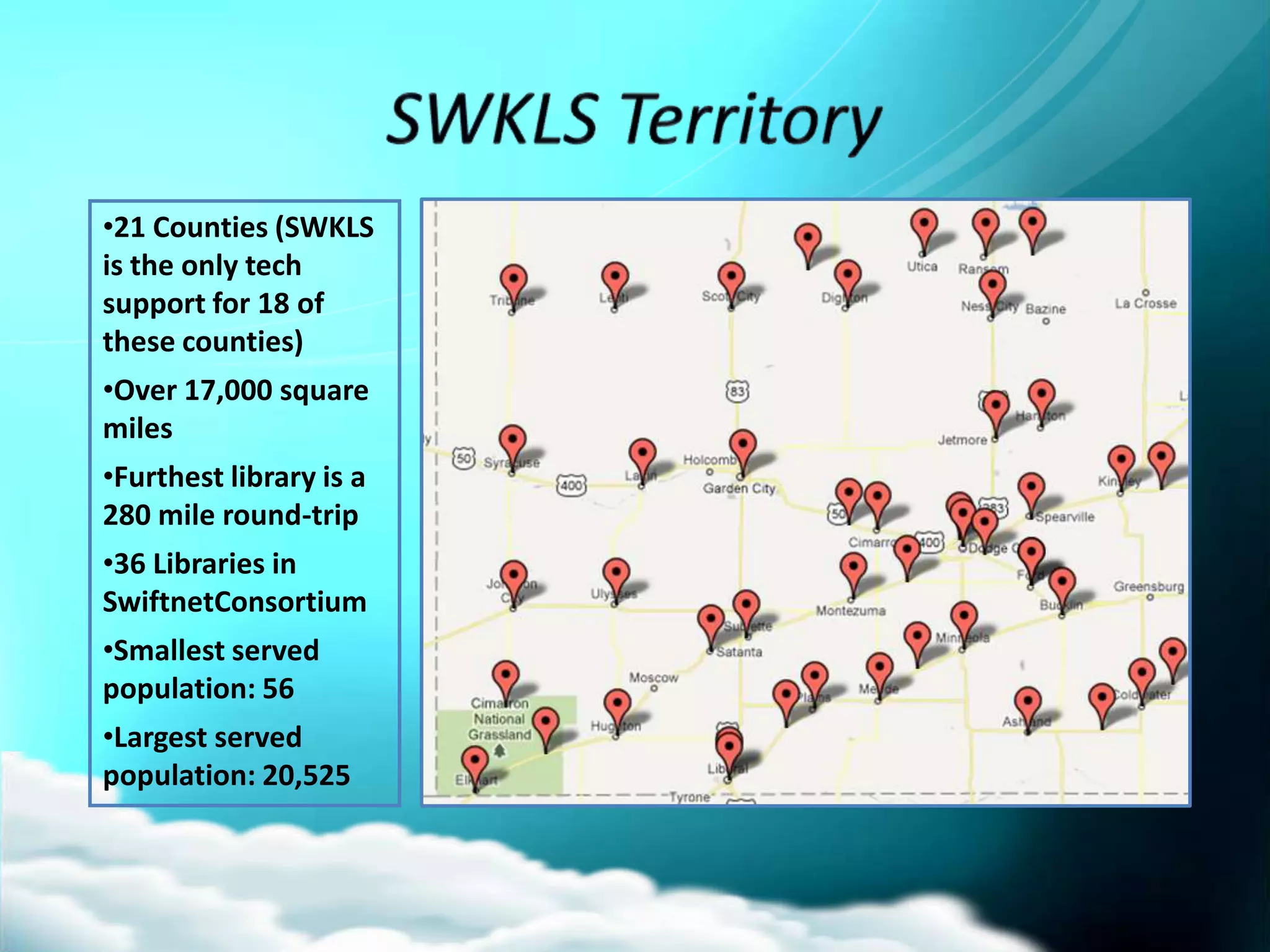
•21 Counties (SWKLS
is the only tech
support for 18 of
these counties)
•Over 17,000 square
miles
•Furthest library is a
280 mile round-trip
•36 Libraries in
SwiftnetConsortium
•Smallest served
population: 56
•Largest served
population: 20,525
Where We Started
• 2006: The State Library of Kansas challenged
  public libraries to create a statewide online card
  catalog with real time holding information and
  self-initiated interlibrary loan. The goal was to
  have at least 80% of public libraries in KS
  automated.
• SWKLS had 27 libraries on stand-alone ILS and 9
  libraries who were good candidates to automate.
  Only 12 of the 27 libraries had catalogs
  accessible on the web. Only 1 library had an ILS
  that could connect to a statewide system.
Challenges
     Major obstacles to small libraries


• Difficulty in maintaining a server
• Cost of equipment and software
• Time to implement, maintain, and wait
  for help to arrive when needed
Solution
            Hosted ILS: The Server
• The vendor provides the server
• The vendor maintains the software
• The vendor installs all upgrades
• The vendor performs database backups
Solution
             Hosted ILS: The Software
• There is no client software to load or maintain
  on multiple workstations
• Updates are instantly and seamlessly available
  at each location
• No local IT configuration is required
• Eliminates server software upgrades and
  troubleshooting
• Customizations work with each new release
Solution
           Hosted ILS: The Cost
• Again there is no costly server to buy,
  maintain, and backup
• Minimizes IT cost of visits to take care
  of hardware and software issues
• Shared costs of consortium saves
  money
Solution
           Hosted ILS: The Time
• Time not needed to install updates
• Time not needed to backup files
• Time is not wasted waiting for IT support
  to arrive when there is a problem
• Most issues can be handled online from
  any Internet accessible computer
Patron Benefits
• Access to library holdings from the web anywhere,
  any time
• Ability to see what materials are currently checked
  out and when they are due back
• Ability to renew items on the web if allowed by the
  library
• Ability to see if item is on the shelf and place reserves
• Ability to see what neighboring libraries have on the
  shelf
• Schools can see what materials the local public library
  has in its collection
Patron Benefits
• Ability to search local, regional, and state
  catalog as well as Kansas provided
  databases in one search (Google style)
• Vendor authenticates federated searches
• Vendor authenticates time management
  systems
Drawbacks
• Need a reliable, high speed Internet
  connection
• When the Internet is down, the ILS is
  down (vendor does provide a standalone
  circulation module for such occasions)
• Yearly hosting fees must be paid or
  records removed
Requirements
• A reliable, high speed Internet connection
• At least 1 circulation computer
• Barcode scanner
Examples
http://swkls-verso.auto-
  graphics.com/iluminar/home.asp#Iluminar

NISO Webinar: Embracing the Cloud: Real Life Examples of Library Cloud Implementation

  • 1.
    http://www.niso.org/news/events/2012/nisowebinars/embracing_the_cloud / Embracing the Cloud: Real Life Examples of Library Cloud Implementation February 8, 2012 Speakers: Erik Mitchell, Lynne Jacobsen, and Charlene McGuire
  • 2.
  • 3.
  • 5.
  • 6.
  • 7.
  • 8.
  • 9.
  • 10.
  • 11.
  • 12.
  • 13.
  • 14.
  • 15.
  • 16.
  • 17.
  • 18.
  • 19.
  • 20.
  • 21.
  • 22.
  • 23.
  • 24.
  • 25.
  • 26.
  • 27.
  • 28.
  • 29.
  • 30.
    PEPPERDINE UNIVERSITY LIBRARIES MOVE TO THE CLOUD NISO Webinar February 8, 2012 Lynne Jacobsen Associate University Librarian for Information Resources, Collections, and Scholarly Communication
  • 31.
    PEPPERDINE UNIVERSITY PROFILE Over 7,500 students 5schools Independent private Christian university 12 locations Over 500,000 volumes Over 175,000 ebooks Over 30 historic surfboards in special collections
  • 32.
    REASONS FOR MOVINGTO THE CLOUD  Server needed replacing  Moving to outsourced hosted solutions  Lower the total cost of ownership  Enable more efficient workflows in all areas  Offer a better catalog with Google-like searching and Web 2.0 features  Improve interoperability between various library systems and services  Find a better way to manage e-resources
  • 33.
    WHY OCLC WMS?  Great relationship with OCLC, quality products, shared data, impressive roadmap  WorldCat Local catalog –better discovery with increased circulation and ILL (tripled)  Outsourced hosting—no more hardware/software upgrades to manage  Significant savings in total cost of ownership—$50,000 annually  Many efficiencies in technical services and in the use of shared data  Integration with ILLiad, CONTENTdm, and other services  Potential for 3rd party apps –making technology work to save time
  • 34.
    OUR LAST  Conducted an OCLC batch reclamation MIGRATION project  Updated MARC holdings data in our local system  Standardized OCLC number formatting (MARC 035 tag)  Item and holdings records were merged into Local Holdings Records (LHRs)  Migrated only current circulation data  Patron data was loaded from PeopleSoft  No acquisitions data was migrated
  • 35.
    AN Reduced the number of loan OPPORTUNITY periods TO STREAMLINE POLICIES Reduced the number of patron groups Standardized policies across all branches Improved services by offering:  Longer loan periods  No more fines On-shelf holds Courtesy notices
  • 36.
    Acquisitions and cataloging are blended IN GENERAL,  Maintain one catalog instead of two WHAT  Accept cataloging copy CHANGED?  Use vendor services  Staff can now work on other tasks  One staff reassigned to ILL for 40% of her job; one staff doing admin and original cataloging; one position created for collection development  A cultural shift occurred in several areas  Change is constant  Less control = freedom  Catalog searching now from broad to narrow utilizing facets
  • 37.
    WHAT’S DIFFERENT?  With one motion  Copy cataloging and during receiving— receiving are combined  Barcode is added  Edit records in Connexion only when critically  Call number from important bib record populates field  With shelf-ready service, books go out fast  Item is marked as received  For us, invoicing is separate from receiving  Holdings are automatically  More time for cataloging updated in OCLC ETDs and special (LHRs are collections created) We no longer export bibliographic records to a local system, edit records, conduct authority control, or update holdings in a local system
  • 38.
    CIRCULATION CHANGES  Reserves are much improved  All reserve items are fully cataloged  Holds are handled differently  No longer check items in twice  Student workers are easily trained on WMS
  • 39.
    E-RESOURCE MANAGEMENT  Migrated holdings to the Knowledge Base (KB) from OCLC Link Manager  E-journal titles are automatically updated in the KB by Pubget  The KB then automatically updates holdings in WorldCat  We can add and delete titles as well as collections in the KB  E-book subscriptions are also maintained in the KB  Links automatically appear for held titles  Just started adding license data
  • 40.
    ARE ANY  Functions not yet ready, but coming FUNCTIONS soon— MISSING?  Robust reporting  EDI invoicing  Serial pattern data  Serial claiming  Call number browsing  Inventory processing  Catalog query from ILLiad  Batch spine label printing  Single sign-on capability
  • 41.
    SOME  Can work from a laptop from anywhere ADVANTAGES (in the stacks, at home, overseas) OF BEING IN  Logins are person-specific THE CLOUD  No longer log into specific modules  Permissions are set for each user  Use a real-time pull list  No more clients, servers, or updates to manage
  • 42.
    CHANGE MANAGEMENT  Manage the extent and frequency of change  Communicate what we are doing and why  Get people involved— ask for their input  Plan—Prepare—Train  Avoid conflicting messages  Ensure quick success  Celebrate often!
  • 43.
    IN CONCLUSION—  We would do it again  We enjoyed being a beta test site  We’ve started forgetting how we used to do things  WMS begins to fade into the background as we concentrate on collections and services  We look forward to all that webscale can offer
  • 44.
    THANK YOU! PAYSON LIBRARY MALIBU Pepperdine University Libraries Lynne Jacobsen Lynne.jacobsen@pepperdine.edu
  • 45.
    Southwest Kansas LibrarySystem SWKLS Charlene McGuire, Technology Consultant cmcguire@swkls.org February 8, 2012
  • 46.
    •21 Counties (SWKLS isthe only tech support for 18 of these counties) •Over 17,000 square miles •Furthest library is a 280 mile round-trip •36 Libraries in SwiftnetConsortium •Smallest served population: 56 •Largest served population: 20,525
  • 47.
    Where We Started •2006: The State Library of Kansas challenged public libraries to create a statewide online card catalog with real time holding information and self-initiated interlibrary loan. The goal was to have at least 80% of public libraries in KS automated. • SWKLS had 27 libraries on stand-alone ILS and 9 libraries who were good candidates to automate. Only 12 of the 27 libraries had catalogs accessible on the web. Only 1 library had an ILS that could connect to a statewide system.
  • 48.
    Challenges Major obstacles to small libraries • Difficulty in maintaining a server • Cost of equipment and software • Time to implement, maintain, and wait for help to arrive when needed
  • 49.
    Solution Hosted ILS: The Server • The vendor provides the server • The vendor maintains the software • The vendor installs all upgrades • The vendor performs database backups
  • 50.
    Solution Hosted ILS: The Software • There is no client software to load or maintain on multiple workstations • Updates are instantly and seamlessly available at each location • No local IT configuration is required • Eliminates server software upgrades and troubleshooting • Customizations work with each new release
  • 51.
    Solution Hosted ILS: The Cost • Again there is no costly server to buy, maintain, and backup • Minimizes IT cost of visits to take care of hardware and software issues • Shared costs of consortium saves money
  • 52.
    Solution Hosted ILS: The Time • Time not needed to install updates • Time not needed to backup files • Time is not wasted waiting for IT support to arrive when there is a problem • Most issues can be handled online from any Internet accessible computer
  • 53.
    Patron Benefits • Accessto library holdings from the web anywhere, any time • Ability to see what materials are currently checked out and when they are due back • Ability to renew items on the web if allowed by the library • Ability to see if item is on the shelf and place reserves • Ability to see what neighboring libraries have on the shelf • Schools can see what materials the local public library has in its collection
  • 54.
    Patron Benefits • Abilityto search local, regional, and state catalog as well as Kansas provided databases in one search (Google style) • Vendor authenticates federated searches • Vendor authenticates time management systems
  • 55.
    Drawbacks • Need areliable, high speed Internet connection • When the Internet is down, the ILS is down (vendor does provide a standalone circulation module for such occasions) • Yearly hosting fees must be paid or records removed
  • 56.
    Requirements • A reliable,high speed Internet connection • At least 1 circulation computer • Barcode scanner
  • 57.