1
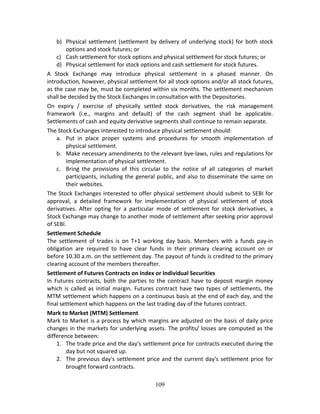
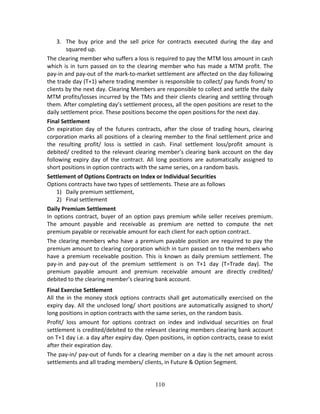
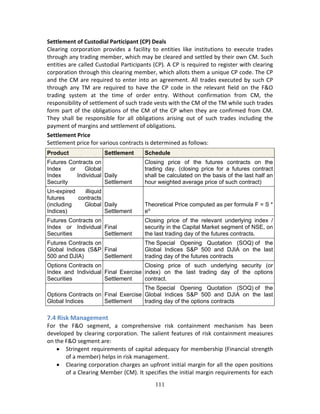
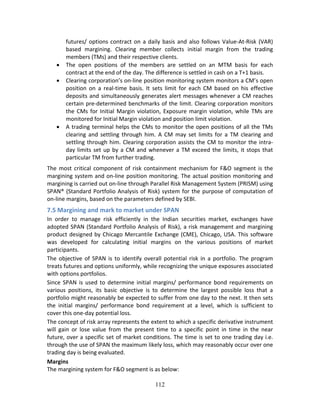
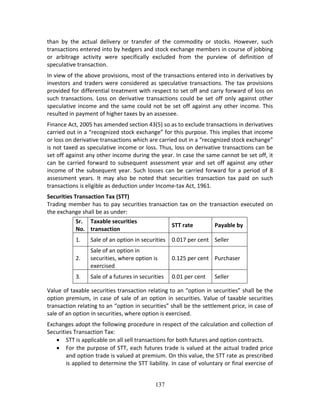
Workbook for 
NISM‐Series‐VIII:  
Equity Derivatives 
Certification Examination 


National Institute of Securities Markets  
www.nism.ac.in 
   
2
This workbook has been developed to assist candidates in preparing for the National 
Institute of Securities Markets (NISM) NISM‐Series‐VIII: Equity Derivatives Certification 
Examination (NISM‐Series‐VIII: ED Examination). 
 
Workbook Version:  September 2015 
 
Published by: 
National Institute of Securities Markets  
© National Institute of Securities Markets, 2015 
Plot 82, Sector 17, Vashi 
Navi Mumbai – 400 703, India 
 
All  rights  reserved.  Reproduction  of  this  publication  in  any  form  without  prior 
permission of the publishers is strictly prohibited. 
 
 
3
Foreword 
NISM  is  a  leading  provider  of  high  end  professional  education,  certifications,  training 
and  research  in  financial  markets.  NISM  engages  in  capacity  building  among 
stakeholders in the securities markets through professional education, financial literacy, 
enhancing governance standards and fostering policy research. NISM works closely with 
all financial sector regulators in the area of financial education. 
NISM Certification programs aim to enhance the quality and standards of professionals 
employed  in  various  segments  of  the  financial  services  sector.  NISM’s  School  for 
Certification  of  Intermediaries  (SCI)  develops  and  conducts  certification  examinations 
and  Continuing  Professional  Education  (CPE)  programs  that  aim  to  ensure  that 
professionals meet the defined minimum common knowledge benchmark for various 
critical market functions.  
NISM certification examinations and educational programs cater to different segments 
of  intermediaries  focusing  on  varied  product  lines  and  functional  areas.  NISM 
Certifications have established knowledge benchmarks for various market products and 
functions such as Equities, Mutual Funds, Derivatives, Compliance, Operations, Advisory 
and Research. 
NISM  certification  examinations  and  training  programs  provide  a  structured  learning 
plan and career path to students and job aspirants who wish to make a professional 
career  in  the  Securities  markets.  Till  May  2015,  NISM  has  certified  nearly  4  lakh 
individuals through its Certification Examinations and CPE Programs.  
NISM supports candidates by providing lucid and focused workbooks that assist them in 
understanding the subject and preparing for NISM Examinations. The book covers basics 
of  the  equity  derivatives,  trading  strategies  using  equity  futures  and  equity  options, 
clearing,  settlement  and  risk  management  as  well  as  the  regulatory  environment  in 
which the equity derivatives markets operate in India. It will be immensely useful to all 
those who want to have a better understanding of various derivatives products available 
in Indian equity derivatives markets. 
Sandip Ghose 
Director 
   
4
Disclaimer 
The contents of this publication do not necessarily constitute or imply its endorsement, 
recommendation, or favouring by the National Institute of Securities Markets (NISM) or 
the Securities and Exchange Board of India (SEBI). This publication is meant for general 
reading and educational purpose only. It is not meant to serve as guide for investment. 
The views and opinions and statements of authors or publishers expressed herein do 
not  constitute  a  personal  recommendation  or  suggestion  for  any  specific  need  of  an 
Individual. It shall not be used for advertising or product endorsement purposes.  
The statements/explanations/concepts are of general nature and may not have taken 
into  account  the  particular  objective/  move/  aim/  need/  circumstances  of  individual 
user/  reader/  organization/  institute.  Thus  NISM  and  SEBI  do  not  assume  any 
responsibility for any wrong move or action taken based on the information available in 
this publication. 
Therefore before acting on or following the steps suggested on any theme or before 
following  any  recommendation  given  in  this  publication  user/reader  should 
consider/seek professional advice. 
The publication contains information, statements, opinions, statistics and materials that 
have been obtained from sources believed to be reliable and the publishers of this title 
have made best efforts to avoid any errors. However, publishers of this material offer no 
guarantees  and  warranties  of  any  kind  to  the  readers/users  of  the  information 
contained in this publication.  
Since the work and research is still going on in all these knowledge streams, NISM and 
SEBI do not warrant the totality and absolute accuracy, adequacy or completeness of 
this information and material and expressly disclaim any liability for errors or omissions 
in this information and material herein. NISM and SEBI do not accept any legal liability 
what so ever based on any information contained herein.  
While  the  NISM  Certification  examination  will  be  largely  based  on  material  in  this 
workbook, NISM does not guarantee that all questions in the examination will be from 
material covered herein.  
Acknowledgement  
This  workbook  has  been  developed  by  NISM  in  consultation  with  the  Examination 
Committee for NISM‐Series‐VIII: Equity Derivatives Certification Examination consisting 
of  representatives  of  National  Stock  Exchange  India  Ltd  and  BSE  Ltd.  NISM  gratefully 
acknowledges the contribution of all committee members. 
About the Author 
This workbook has been developed by the Certification Team of National Institute of 
Securities Markets in co‐ordination with Mr. Manish Bansal and Mr. Ashutosh Wakhare of 
Value Ideas Investment Services Pvt. Ltd. 
5
About NISM  
National  Institute  of  Securities  Markets  (NISM)  was  established  by  the  Securities and 
Exchange Board of India (SEBI), in pursuance of the announcement made by the Finance 
Minister in his Budget Speech in February 2005. 
SEBI, by establishing NISM, articulated the desire expressed by the Government of India 
to promote securities market education and research. 
Towards  accomplishing  the  desire  of  Government  of  India  and  vision  of  SEBI,  NISM 
delivers financial and securities education at various levels and across various segments 
in  India  and  abroad.  To  implement  its  objectives,  NISM  has  established  six  distinct 
schools to cater to the educational needs of various constituencies such as investors, 
issuers,  intermediaries,  regulatory  staff,  policy  makers,  academia  and  future 
professionals of securities markets. 
NISM is mandated to implement Certification Examinations for professionals employed 
in various segments of the Indian securities markets.  
NISM also conducts numerous training programs and brings out various publications on 
securities  markets  with  a  view  to  enhance  knowledge  levels  of  participants  in  the 
securities industry. 
About NISM Certifications 
The School for Certification of Intermediaries (SCI) at NISM is engaged in developing and 
administering Certification Examinations and CPE Programs for professionals employed 
in  various  segments  of  the  Indian  securities  markets.  These  Certifications  and  CPE 
Programs are being developed and administered by NISM as mandated under Securities 
and  Exchange  Board  of  India  (Certification  of  Associated  Persons  in  the  Securities 
Markets) Regulations, 2007. 
The skills, expertise and ethics of professionals in the securities markets are crucial in 
providing effective intermediation to investors and in increasing the investor confidence 
in  market  systems  and  processes.  The  School  for  Certification  of  Intermediaries  (SCI) 
seeks to ensure that market intermediaries meet defined minimum common benchmark 
of  required  functional  knowledge  through  Certification  Examinations  and  Continuing 
Professional  Education  Programmes  on  Mutual  Funds,  Equities,  Derivatives  Securities 
Operations, Compliance, Research Analysis, Investment Advice and many more. 
Certification  creates  quality  market  professionals  and  catalyzes  greater  investor 
participation  in  the  markets.  Certification  also  provides  structured  career  paths  to 
students and job aspirants in the securities markets.   
6
 
About the Workbook 
This workbook has been developed to assist candidates in preparing for the National 
Institute  of  Securities  Markets  (NISM)  Equity  Derivatives  Certification  Examination. 
NISM‐Series‐VIII: Equity Derivatives Certification Examination seeks to create common 
minimum knowledge benchmark for associated persons functioning as approved users 
and sales personnel of the trading member of an equity derivatives exchange or equity 
derivative segment of a recognized stock exchange. 
The book covers basics of the equity derivatives, trading strategies using equity futures 
and equity options, clearing, settlement and risk management as well as the regulatory 
environment in which the equity derivatives markets operate in India. 
   
7
About the NISM‐Series‐VIII: Equity Derivatives Certification Examination  
 
The  examination  seeks  to  create  a  common  minimum  knowledge  benchmark  for 
associated  persons  functioning  as  approved  users  and  sales  personnel  of  the  trading 
member of an equity derivatives exchange or equity derivative segment of a recognized 
stock exchange.  
The examination aims to enable a better understanding of various derivatives products 
available  in  equity  derivatives  markets,  regulations  and  risks  associated  with  the 
products and the exchange mechanisms of clearing and settlement. The examination 
also  covers  knowledge  competencies  related  to  the  understanding  of  the  financial 
structure in India and the importance of the different rules and regulations governing 
the Indian securities market, especially those related to the equity derivatives segment.  
 
Examination Objectives  
On successful completion of the examination the candidate should:  
 Know the basics of the Indian equity derivatives market. 
 Understand  the  various  trading  strategies  that  can  be  built  using  futures  and 
options on both stocks and stock indices.  
 Understand  the  clearing,  settlement  and  risk  management  as  well  as  the 
operational mechanism related to equity derivatives markets. 
 Know  the  regulatory  environment  in  which  the  equity  derivatives  markets 
operate in India. 
 
Assessment Structure  
The  NISM‐Series‐VIII:  Equity  Derivatives  Certification  Examination  (NISM‐Series‐I:  ED 
Examination)  will  be  of  100  marks  consisting  of  100  questions  of  1  mark  each,  and 
should be completed in 2 hours. There will be negative marking of 25% of the marks 
assigned to each question. The passing score for the examination is 60%.   
 
How to register and take the examination  
To find out more and register for the examination please visit www.nism.ac.in  


8


This page has been 
intentionally kept blank 


9
Table	of	Contents	
Chapter 1: Basics of Derivatives .................................................................................. 11 
1.1 Basics of Derivatives ................................................................................................... 11 
1.2 Derivatives Market – History & Evolution .................................................................. 11 
1.3 Indian Derivatives Market ........................................................................................... 12 
1.4 Market Participants .................................................................................................... 13 
1.5 Types of Derivatives Market ....................................................................................... 14 
1.6 Significance of Derivatives .......................................................................................... 15 
1.7 Various risks faced by the participants in derivatives ................................................ 15 
 
Chapter 2: Understanding Index ................................................................................. 17 
2.1 Introduction to Index .................................................................................................. 17 
2.2 Significance of Index ................................................................................................... 17 
2.3 Types of Stock Market Indices .................................................................................... 17 
2.4 Attributes of an Index ................................................................................................. 20 
2.5 Index management ..................................................................................................... 21 
2.6 Major Indices in India .................................................................................................. 22 
2.7 Application of Indices .................................................................................................. 22 
 
Chapter 3: Introduction to Forwards and Futures ....................................................... 23 
3.1 Introduction to forward and futures Contracts .......................................................... 23 
3.2 Pay off Charts for Futures contract ............................................................................. 31 
3.3 Futures pricing ............................................................................................................ 33 
3.4 Commodity, Equity & Index Futures ........................................................................... 38 
3.5 Uses of futures ............................................................................................................ 39 
 
Chapter 4: Introduction to Options ............................................................................. 49 
4.1 Basics of options ......................................................................................................... 49 
4.2 Pay off Charts for Options ........................................................................................... 52 
4.3 Basics of Option Pricing and Option Greeks ............................................................... 60 
4.4 Uses of Options ........................................................................................................... 64 
 
Chapter 5: Option Trading Strategies .......................................................................... 71 
5.1 Option Spreads ............................................................................................................ 71 
5.2 Straddle ....................................................................................................................... 78 
5.3 Strangle ....................................................................................................................... 82 
5.4 Covered Call ................................................................................................................ 85 
5.5 Protective Put ............................................................................................................. 88 
5.6 Collar ........................................................................................................................... 89 
5.7 Butterfly Spread .......................................................................................................... 91 
 
 
10
 
Chapter 6: Introduction to Trading Systems ................................................................ 95 
6.1 Trading System ............................................................................................................ 95 
6.2 Selection criteria of Stocks for trading........................................................................ 99 
6.3 Selection criteria of Index for trading ....................................................................... 101 
6.4 Adjustments for Corporate Actions .......................................................................... 102 
6.5 Position Limit ............................................................................................................ 104 
6.6 Using Daily Newspapers to Track Futures and Options ............................................ 105 
 
Chapter 7: Introduction to Clearing and Settlement System ..................................... 107 
7.1 Clearing Members ..................................................................................................... 107 
7.2 Clearing Mechanism ................................................................................................. 108 
7.3 Settlement Mechanism ............................................................................................. 108 
7.4 Risk Management ..................................................................................................... 111 
7.5 Margining and mark to market under SPAN ............................................................. 112 
 
Chapter 8: Legal and Regulatory Environment .......................................................... 119 
8.1 Securities Contracts (Regulation) Act, 1956 ............................................................. 119 
8.2 Securities and Exchange Board of India Act, 1992 ................................................... 120 
8.3 Regulation in Trading ................................................................................................ 120 
8.4 Regulations in Clearing & Settlement and Risk Management .................................. 122 
8.5 Major recommendations of Dr. L. C. Gupta Committee .......................................... 125 
8.6 Major recommendations of Prof. J. R. Verma Committee ....................................... 127 
 
Chapter 9: Accounting and Taxation ......................................................................... 129 
9.1 Accounting ................................................................................................................ 129 
9.2 Taxation of derivative transaction in securities ........................................................ 136 
 
Chapter 10: Sales Practices and Investors Protection Services .................................. 139 
10.1 Understanding risk profile of the client .................................................................. 141 
10.2 Investors Grievance Mechanism ............................................................................. 147 
 
Appendix A: Sample Questions.….............................................................................152 
   
11
Chapter 1: Basics of Derivatives 


1.1 Basics of Derivatives 
Derivative is a contract or a product whose value is derived from value of some other 
asset known as underlying. Derivatives are based on wide range of underlying assets. 
These include: 
 Metals such as Gold, Silver, Aluminium, Copper, Zinc, Nickel, Tin, Lead etc. 
 Energy  resources  such  as  Oil  (crude  oil,  products,  cracks),  Coal,  Electricity, 
Natural Gas etc. 
 Agri commodities such as wheat, Sugar, Coffee, Cotton, Pulses etc, and  
 Financial assets such as Shares, Bonds and Foreign Exchange.
 
1.2 Derivatives Market – History & Evolution 
History  of  Derivatives  may  be  mapped  back  to  the  several  centuries.  Some  of  the 
specific milestones in evolution of Derivatives Market Worldwide are given below: 
12th Century‐ In European trade fairs, sellers signed contracts promising future delivery 
of the items they sold. 
13th Century‐ There are many examples of contracts entered into by English Cistercian 
Monasteries,  who  frequently  sold  their  wool  up  to  20  years  in  advance,  to  foreign 
merchants. 
1634‐1637 ‐ Tulip Mania in Holland: Fortunes were lost in after a speculative boom in 
tulip futures burst. 
Late  17th  Century  ‐  In  Japan  at  Dojima,  near  Osaka,  a  futures  market  in  rice  was 
developed to protect rice producers from bad weather or warfare. 
In 1848, The Chicago Board of Trade (CBOT) facilitated trading of forward contracts on 
various commodities. 
In 1865, the CBOT went a step further and listed the first ‘exchange traded” derivative 
contract in the US. These contracts were called ‘futures contracts”.  
In 1919, Chicago Butter and Egg Board, a spin‐off of CBOT, was reorganised to allow 
futures trading. Later its name was changed to Chicago Mercantile Exchange (CME). 
In  1972,  Chicago  Mercantile  Exchange  introduced  International  Monetary  Market 
(IMM), which allowed trading in currency futures. 
LEARNING OBJECTIVES: 
After studying this chapter, you should know about: 
 Meaning of derivatives and types of derivatives products 
 History of derivatives market 
 Significance of derivative markets 
 Risks in derivatives trading  
12
In  1973,  Chicago  Board  Options  Exchange  (CBOE)  became  the  first  marketplace  for 
trading listed options. 
In 1975, CBOT introduced Treasury bill futures contract. It was the first successful pure 
interest rate futures.  
In 1977, CBOT introduced T‐bond futures contract. 
In 1982, CME introduced Eurodollar futures contract. 
In 1982, Kansas City Board of Trade launched the first stock index futures. 
In 1983, Chicago Board Options Exchange (CBOE) introduced option on stock indexes 
with the S&P 100® (OEX) and S&P 500® (SPXSM) Indexes.  
Factors influencing the growth of derivative market globally 
Over the last four decades, derivatives market has seen a phenomenal growth. Many 
derivative contracts were launched at exchanges across the world. Some of the factors 
driving the growth of financial derivatives are: 
 Increased fluctuations in underlying asset prices in financial markets. 
 Integration of financial markets globally.  
 Use  of  latest  technology  in  communications  has  helped  in  reduction  of 
transaction costs.  
 Enhanced  understanding  of  market  participants  on  sophisticated  risk 
management tools to manage risk.  
 Frequent innovations in derivatives market and newer applications of products. 
 
1.3 Indian Derivatives Market 
As the initial step towards introduction of derivatives trading in India, SEBI set up a 24–
member committee under the Chairmanship of Dr. L. C. Gupta on November 18, 1996 to 
develop  appropriate  regulatory  framework  for  derivatives  trading  in  India.  The 
committee  submitted  its  report  on  March  17,  1998  recommending  that  derivatives 
should be declared as ‘securities’ so that regulatory framework applicable to trading of 
‘securities’ could also govern trading of derivatives. Subsequently, SEBI set up a group in 
June 1998 under the Chairmanship of Prof. J. R. Verma, to recommend measures for risk 
containment  in  derivatives  market  in  India.  The  committee  submitted  its  report  in 
October 1998. It worked out the operational details of margining system, methodology 
for  charging  initial  margins,  membership  details  and  net‐worth  criterion,  deposit 
requirements and real time monitoring of positions requirements.  
In  1999,  The  Securities  Contract  Regulation  Act  (SCRA)  was  amended  to  include 
“derivatives” within the domain of ‘securities’ and regulatory framework was developed 
for governing derivatives trading. In March 2000, government repealed a three‐decade‐
old notification, which prohibited forward trading in securities.  
The exchange traded derivatives started in India in June 2000 with SEBI permitting BSE 
and NSE to introduce equity derivative segment. To begin with, SEBI approved trading in 
index futures contracts based on CNX Nifty and BSE Sensex, which commenced trading 
13
in June 2000. Later, trading in Index options commenced in June 2001 and trading in 
options on individual stocks commenced in July 2001. Futures contracts on individual 
stocks started in November 2001. MCX‐SX (renamed as MSEI) started trading in all these 
products (Futures and options on index SX40 and individual stocks) in February 2013.  
Products in Derivatives Market 
Forwards  
It is a contractual agreement between two parties to buy/sell an underlying asset at a 
certain future date for a particular price that is pre‐decided on the date of contract. 
Both the contracting parties are committed and are obliged to honour the transaction 
irrespective of price of the underlying asset at the time of delivery. Since forwards are 
negotiated between two parties, the terms and conditions of contracts are customized.  
These are Over‐the‐counter (OTC) contracts. 
Futures  
A  futures  contract  is  similar  to  a  forward,  except  that  the  deal  is  made  through  an 
organized and regulated exchange rather than being negotiated directly between two 
parties. Indeed, we may say futures are exchange traded forward contracts. 
Options 
An Option is a contract that gives the right, but not an obligation, to buy or sell the 
underlying on or before a stated date and at a stated price. While buyer of option pays 
the  premium  and  buys  the  right,  writer/seller  of  option  receives  the  premium  with 
obligation to sell/ buy the underlying asset, if the buyer exercises his right. 
Swaps 
A swap is an agreement made between two parties to exchange cash flows in the future 
according  to  a  prearranged  formula.  Swaps  are,  broadly  speaking,  series  of  forward 
contracts. Swaps help market participants manage risk associated with volatile interest 
rates, currency exchange rates and commodity prices. 
 
1.4 Market Participants 
There are broadly three types of participants in the derivatives market ‐ hedgers, traders 
(also  called  speculators)  and  arbitrageurs.  An  individual  may  play  different  roles  in 
different market circumstances.  
Hedgers 
They  face  risk  associated  with  the  prices  of  underlying  assets  and  use  derivatives  to 
reduce  their  risk.  Corporations,  investing  institutions  and  banks  all  use  derivative 
products to hedge or reduce their exposures to market variables such as interest rates, 
share values, bond prices, currency exchange rates and commodity prices.  
Speculators/Traders 
They try to predict the future movements in prices of underlying assets and based on 
the  view,  take  positions  in  derivative  contracts.  Derivatives  are  preferred  over 
underlying asset for trading purpose, as they offer leverage, are less expensive (cost of 
14
transaction is generally lower than that of the underlying) and are faster to execute in 
size (high volumes market).  
Arbitrageurs 
Arbitrage is a deal that produces profit by exploiting a price difference in a product in 
two different markets. Arbitrage originates when a trader purchases an asset cheaply in 
one location and simultaneously arranges to sell it at a higher price in another location. 
Such opportunities are unlikely to persist for very long, since arbitrageurs would rush in 
to these transactions, thus closing the price gap at different locations. 
1.5 Types of Derivatives Market 
In the modern world, there is a huge variety of derivative products available. They are 
either  traded  on  organised  exchanges  (called  exchange  traded  derivatives)  or  agreed 
directly  between  the  contracting  counterparties  over  the  telephone  or  through 
electronic media (called Over‐the‐counter (OTC) derivatives). Few complex products are 
constructed on simple building blocks like forwards, futures, options and swaps to cater 
to the specific requirements of customers.  
Over‐the‐counter market is not a physical marketplace but a collection of broker‐dealers 
scattered across the country. Main idea of the market is more a way of doing business 
than  a  place.  Buying  and  selling  of  contracts  is  matched  through  negotiated  bidding 
process  over  a  network  of  telephone  or  electronic  media  that  link  thousands  of 
intermediaries. OTC derivative markets have witnessed a substantial growth over the 
past  few  years,  very  much  contributed  by  the  recent  developments  in  information 
technology.  The  OTC  derivative  markets  have  banks,  financial  institutions  and 
sophisticated  market  participants  like  hedge  funds,  corporations  and  high  net‐worth 
individuals. OTC derivative market is less regulated market because these transactions 
occur  in  private  among  qualified  counterparties,  who  are  supposed  to  be  capable 
enough to take care of themselves.  
The  OTC  derivatives  markets  –  transactions  among  the  dealing  counterparties,  have 
following features compared to exchange traded derivatives: 
 Contracts  are  tailor  made  to  fit  in  the  specific  requirements  of  dealing 
counterparties. 
 The management of counter‐party (credit) risk is decentralized and located within 
individual institutions. 
 There  are  no  formal  centralized  limits  on  individual  positions,  leverage,  or 
margining. 
 There are no formal rules or mechanisms for risk management to ensure market 
stability  and  integrity,  and  for  safeguarding  the  collective  interest  of  market 
participants. 
 Transactions are private with little or no disclosure to the entire market. 
On  the  contrary,  exchange‐traded  contracts  are  standardized,  traded  on  organized 
exchanges  with  prices  determined  by  the  interaction  of  buyers  and  sellers  through 
15
anonymous  auction  platform.  A  clearing  house/  clearing  corporation,  guarantees 
contract performance (settlement of transactions).  
 
1.6 Significance of Derivatives 
Like other segments of Financial Market, Derivatives Market serves following specific 
functions: 
 Derivatives market helps in improving price discovery based on actual valuations 
and expectations. 
 Derivatives market helps in transfer of various risks from those who are exposed 
to  risk  but  have  low  risk  appetite  to  participants  with  high  risk  appetite.  For 
example hedgers want to give away the risk where as traders are willing to take 
risk.  
 Derivatives market helps shift of speculative trades from unorganized market to 
organized market. Risk management mechanism and surveillance of activities of 
various participants in organized space provide stability to the financial system.  
 
1.7 Various risks faced by the participants in derivatives 
Market  Participants  must  understand  that  derivatives,  being  leveraged  instruments, 
have risks like counterparty risk (default by counterparty), price risk (loss on position 
because  of  price  move),  liquidity  risk  (inability  to  exit  from  a  position),  legal  or 
regulatory  risk  (enforceability  of  contracts),  operational  risk  (fraud,  inadequate 
documentation, improper execution, etc.) and may not be an appropriate avenue for 
someone  of  limited  resources,  trading  experience  and  low  risk  tolerance.  A  market 
participant  should  therefore  carefully  consider  whether  such  trading  is  suitable  for 
him/her based on these parameters. Market participants, who trade in derivatives are 
advised to carefully read the Model Risk Disclosure Document, given by the broker to his 
clients at the time of signing agreement.  
Model Risk Disclosure Document is issued by the members of Exchanges and contains 
important  information  on  trading  in  Equities  and  F&O  Segments  of  exchanges.  All 
prospective  participants  should  read  this  document  before  trading  on  Capital 
Market/Cash Segment or F&O segment of the Exchanges. 


16


This page has been 
intentionally kept blank 


17
Chapter 2: Understanding Index 


2.1 Introduction to Index 
Index is a statistical indicator that measures changes in the economy in general or in 
particular areas. In case of financial markets, an index is a portfolio of securities that 
represent  a  particular  market  or  a  portion  of  a  market.  Each  Index  has  its  own 
calculation  methodology  and  usually  is  expressed  in  terms  of  a  change  from  a  base 
value. The base value might be as recent as the previous day or many years in the past. 
Thus, the percentage change is more important than the actual numeric value. Financial 
indices are created to measure price movement of stocks, bonds, T‐bills and other type 
of  financial  securities.  More  specifically,  a  stock  index  is  created  to  provide  market 
participants  with  the  information  regarding  average  share  price  movement  in  the 
market. Broad indices are expected to capture the overall behaviour of equity market 
and need to represent the return obtained by typical portfolios in the country. 
 
2.2 Significance of Index 
 A stock index is an indicator of the performance of overall market or a particular 
sector.  
 It  serves  as  a  benchmark  for  portfolio  performance  ‐  Managed  portfolios, 
belonging either to individuals or mutual funds; use the stock index as a measure 
for evaluation of their performance.  
 It  is  used  as  an  underlying  for  financial  application  of  derivatives  –  Various 
products in OTC and exchange traded markets are based on indices as underlying 
asset.  
2.3 Types of Stock Market Indices 
Indices  can  be  designed  and  constructed  in  various  ways.  Depending  upon  their 
methodology, they can be classified as under: 
Market capitalization weighted index 
In  this  method  of  calculation,  each  stock  is  given  weight  according  to  its  market 
capitalization. So higher the market capitalization of a constituent, higher is its weight in 
the  index.  Market  capitalization  is  the  market  value  of  a  company,  calculated  by 
multiplying  the  total  number  of  shares  outstanding  to  its  current  market  price.  For 
example, ABC company with 5,00,00,000 shares outstanding and a share price of Rs 120 
per share will have market capitalization of 5,00,00,000 x 120 = Rs 6,00,00,00,000 i.e. 
600 Crores.  
LEARNING OBJECTIVES: 
After studying this chapter, you should know about: 
 Meaning of Index and its significance  
 Different types of stock market indices 
 Index management and maintenance  
 Application of indices 
18
Let us understand the concept with the help of an example: There are five stocks in an 
index. Base value of the index is set to 100 on the start date which is January 1, 1995. 
Calculate the present value of index based on following information.  
Sr. 
No. 
Stock 
Name 
Stock price as 
on January 1, 
1995 (in Rs.) 
Number 
of shares 
in lakhs 
Today’s 
stock price 
(in Rs.) 
1  AZ  150  20  650 
2  BY  300  12  450 
3  CX  450  16  600 
4  DW  100  30  350 
5  EU  250  8  500 
 
Old 
Price 
Shares 
in 
Lakhs 
Old M. 
Cap (in 
lakhs) 
Old 
weights
Old Value 
of Portfolio 
(price * 
weightage) 
New 
price 
New 
M. 
Cap 
New 
weight 
New Value 
of portfolio 
(price * 
weightage) 
150  20  3000  0.16  23.94  650  13000  0.31  198.82 
300  12  3600  0.19  57.45  450  5400  0.13  57.18 
450  16  7200  0.38  172.34  600  9600  0.23  135.53 
100  30  3000  0.16  15.96  350  10500  0.25  86.47 
250  8  2000  0.11  26.60  500  4000  0.09  47.06 
    18800  1  296.28    42500  1  525.06 
Market capitalization (Mcap) = Number of Shares * Market Price 
Old value of portfolio is equated to 100. Therefore, on that scale new value of portfolio 
would be (525.05/ 296.27)*100 = 177.22 
Thus,  the  present  value  of  Index  under  market  capitalization  weighted  method  is 
177.22.  
Popular indices in India Sensex and Nifty were earlier designed on market capitalization 
weighted method. 
Free‐Float Market Capitalization Index 
In various businesses, equity holding is divided differently among various stake holders – 
promoters, institutions, corporates, individuals etc. Market has started to segregate this 
on the basis of what is readily available for trading or what is not. The one available for 
immediate trading is categorized as free float. And, if we compute the index based on 
weights of each security based on free float market cap, it is called free float market 
capitalization index. Indeed, both Sensex and Nifty, over a period of time, have moved 
to free float basis. SX40, index of MSEI is also a free float market capitalization index. 
 
 
19
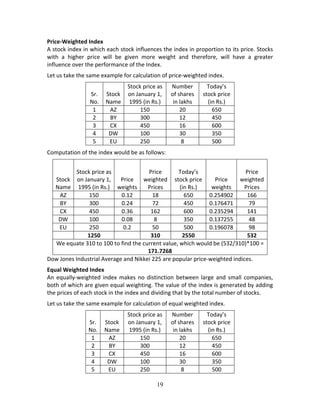
Price‐Weighted Index 
A stock index in which each stock influences the index in proportion to its price. Stocks 
with  a  higher  price  will  be  given  more  weight  and  therefore,  will  have  a  greater 
influence over the performance of the Index.  
Let us take the same example for calculation of price‐weighted index. 
Sr. 
No. 
Stock 
Name 
Stock price as 
on January 1, 
1995 (in Rs.) 
Number 
of shares 
in lakhs 
Today’s 
stock price 
(in Rs.) 
1  AZ  150  20  650 
2  BY  300  12  450 
3  CX  450  16  600 
4  DW  100  30  350 
5  EU  250  8  500 
Computation of the index would be as follows: 
Stock 
Name 
Stock price as 
on January 1, 
1995 (in Rs.) 
Price 
weights
Price 
weighted 
Prices 
Today’s 
stock price 
(in Rs.) 
Price 
weights 
Price 
weighted 
Prices 
AZ  150  0.12  18  650  0.254902  166 
BY  300  0.24  72  450  0.176471  79 
CX  450  0.36  162  600  0.235294  141 
DW  100  0.08  8  350  0.137255  48 
EU  250  0.2  50  500  0.196078  98 
  1250    310  2550    532 
We equate 310 to 100 to find the current value, which would be (532/310)*100 = 
171.7268 
Dow Jones Industrial Average and Nikkei 225 are popular price‐weighted indices. 
Equal Weighted Index 
An equally‐weighted index makes no distinction between large and small companies, 
both of which are given equal weighting. The value of the index is generated by adding 
the prices of each stock in the index and dividing that by the total number of stocks.  
Let us take the same example for calculation of equal weighted index.  
Sr. 
No. 
Stock 
Name 
Stock price as 
on January 1, 
1995 (in Rs.) 
Number 
of shares 
in lakhs 
Today’s 
stock price 
(in Rs.) 
1  AZ  150  20  650 
2  BY  300  12  450 
3  CX  450  16  600 
4  DW  100  30  350 
5  EU  250  8  500 
20
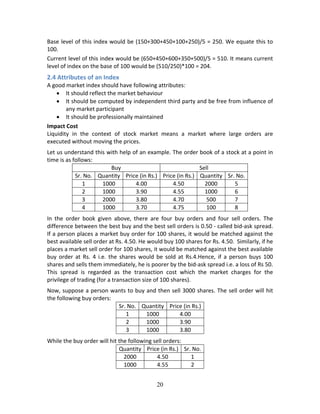
Base level of this index would be (150+300+450+100+250)/5 = 250. We equate this to 
100. 
Current level of this index would be (650+450+600+350+500)/5 = 510. It means current 
level of index on the base of 100 would be (510/250)*100 = 204. 
2.4 Attributes of an Index 
A good market index should have following attributes: 
 It should reflect the market behaviour 
 It should be computed by independent third party and be free from influence of 
any market participant 
 It should be professionally maintained 
Impact Cost 
Liquidity  in  the  context  of  stock  market  means  a  market  where  large  orders  are 
executed without moving the prices.  
Let us understand this with help of an example. The order book of a stock at a point in 
time is as follows: 
Buy  Sell 
Sr. No.  Quantity  Price (in Rs.) Price (in Rs.) Quantity Sr. No. 
1  1000  4.00  4.50  2000  5 
2  1000  3.90  4.55  1000  6 
3  2000  3.80  4.70  500  7 
4  1000  3.70  4.75  100  8 
In  the  order  book  given  above,  there  are  four  buy  orders  and  four  sell  orders.  The 
difference between the best buy and the best sell orders is 0.50 ‐ called bid‐ask spread. 
If a person places a market buy order for 100 shares, it would be matched against the 
best available sell order at Rs. 4.50. He would buy 100 shares for Rs. 4.50.  Similarly, if he 
places a market sell order for 100 shares, it would be matched against the best available 
buy  order  at  Rs.  4  i.e.  the  shares  would  be  sold  at  Rs.4.Hence,  if  a  person  buys  100 
shares and sells them immediately, he is poorer by the bid‐ask spread i.e. a loss of Rs 50. 
This  spread  is  regarded  as  the  transaction  cost  which  the  market  charges  for  the 
privilege of trading (for a transaction size of 100 shares). 
Now, suppose a person wants to buy and then sell 3000 shares. The sell order will hit 
the following buy orders: 
Sr. No. Quantity Price (in Rs.)
1  1000  4.00 
2  1000  3.90 
3  1000  3.80 
While the buy order will hit the following sell orders: 
Quantity Price (in Rs.) Sr. No.
2000  4.50  1 
1000  4.55  2 
21
There is increase in the transaction cost for an order size of 3000 shares in comparison 
to the transaction cost for order for 100 shares. The “bid‐ask spread” therefore conveys 
transaction cost for small trade. 
Now, we come across the term called impact cost. We have to start by defining the ideal 
price as the average of the best bid and offer price. In our example it is (4+4.50)/2, i.e. 
Rs. 4.25. In an infinitely liquid market, it would be possible to execute large transactions 
on both buy and sell at prices that are very close to the ideal price of Rs.4.25. However, 
while actually trading, you will pay more than Rs.4.25 per share while buying and will 
receive  less  than  Rs.4.25  per  share  while  selling.  Percentage  degradation,  which  is 
experienced vis‐à‐vis the ideal price, when shares are bought or sold, is called impact 
cost. Impact cost varies with transaction size. Also, it would be different for buy side and 
sell side. 
Buy Quantity  Buy Price (in Rs.) Sell Price (in Rs.) Sell Quantity 
1000  9.80  9.90  1000 
2000  9.70  10.00  1500 
3000  9.60  10.10  1000 
To buy 1500 shares, Ideal price = (9.8+9.9)/ 2 = Rs.9.85 
Actual buy price = [(1000*9.9)+(500*10.00)]/1500 = Rs.9.93 
Impact cost for (1500 shares) = {(9.93 ‐ 9.85)/9.85}*100 = 0.84 % 
 
2.5 Index management 
Index construction, maintenance and revision process is generally done by specialized 
agencies. For instance, all NSE indices are managed by a separate company called “India 
Index Services and Products Ltd. (IISL)”, a joint venture between Standard and Poor’s 
(S&P), National Stock Exchange (NSE) and CRISIL Ltd. (Now a part of Standard & Poor’s).  
Index  construction  is  all  about  choosing  the  index  stocks  and  deciding  on  the  index 
calculation methodology. Maintenance means adjusting the index for corporate actions 
like bonus issue, rights issue, stock split, consolidation, mergers etc. Revision of index 
deals with change in the composition of index as such i.e. replacing some existing stocks 
by the new ones because of change in the trading paradigm of the stocks / interest of 
market participants. 
Index Construction 
A good index is a trade‐off between diversification and liquidity. A well diversified index 
reflects  the  behaviour  of  the  overall  market/  economy.  While  diversification  helps  in 
reducing risk, beyond a point it may not help in the context. Going from 10 stocks to 20 
stocks gives a sharp reduction in risk. Going from 50 stocks to 100 stocks gives very little 
reduction in risk. Going beyond 100 stocks gives almost zero reduction in risk. Hence, 
there is little to gain by diversifying beyond a point.  
Stocks  in  the  index  are  chosen  based  on  certain  pre‐determined  qualitative  and 
quantitative parameters, laid down by the Index Construction Managers. Once a stock 
satisfies the eligibility criterion, it is entitled for inclusion in the index. Generally, final 
22
decision of inclusion or removal of a security from the index is taken by a specialized 
committee known as Index Committee.  
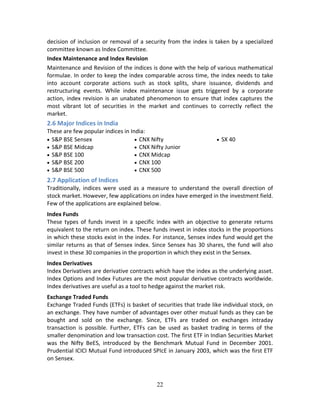
Index Maintenance and Index Revision             
Maintenance and Revision of the indices is done with the help of various mathematical 
formulae. In order to keep the index comparable across time, the index needs to take 
into  account  corporate  actions  such  as  stock  splits,  share  issuance,  dividends  and 
restructuring  events.  While  index  maintenance  issue  gets  triggered  by  a  corporate 
action, index revision is an unabated phenomenon to ensure that index captures the 
most  vibrant  lot  of  securities  in  the  market  and  continues  to  correctly  reflect  the 
market.  
2.6 Major Indices in India 
These are few popular indices in India: 
 S&P BSE Sensex  
 S&P BSE Midcap   
 S&P BSE 100  
 S&P BSE 200  
 S&P BSE 500  
 CNX Nifty  
 CNX Nifty Junior  
 CNX Midcap 
 CNX 100  
 CNX 500 
 SX 40 
2.7 Application of Indices 
Traditionally,  indices  were  used  as  a  measure  to  understand  the  overall  direction  of 
stock market. However, few applications on index have emerged in the investment field. 
Few of the applications are explained below. 
Index Funds 
These  types  of  funds  invest  in  a  specific  index  with  an  objective  to  generate  returns 
equivalent to the return on index. These funds invest in index stocks in the proportions 
in which these stocks exist in the index. For instance, Sensex index fund would get the 
similar returns as that of Sensex index. Since Sensex has 30 shares, the fund will also 
invest in these 30 companies in the proportion in which they exist in the Sensex.  
Index Derivatives 
Index Derivatives are derivative contracts which have the index as the underlying asset. 
Index Options and Index Futures are the most popular derivative contracts worldwide. 
Index derivatives are useful as a tool to hedge against the market risk.   
Exchange Traded Funds 
Exchange Traded Funds (ETFs) is basket of securities that trade like individual stock, on 
an exchange. They have number of advantages over other mutual funds as they can be 
bought  and  sold  on  the  exchange.  Since,  ETFs  are  traded  on  exchanges  intraday 
transaction  is  possible.  Further,  ETFs  can  be  used  as  basket  trading  in  terms  of  the 
smaller denomination and low transaction cost. The first ETF in Indian Securities Market 
was  the  Nifty  BeES,  introduced  by  the  Benchmark  Mutual  Fund  in  December  2001. 
Prudential ICICI Mutual Fund introduced SPIcE in January 2003, which was the first ETF 
on Sensex. 
23
Chapter 3: Introduction to Forwards and Futures


3.1 Introduction to forward and futures Contracts 
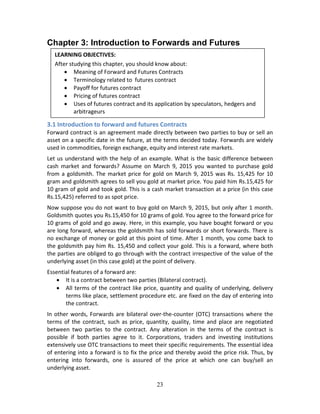
Forward contract is an agreement made directly between two parties to buy or sell an 
asset on a specific date in the future, at the terms decided today. Forwards are widely 
used in commodities, foreign exchange, equity and interest rate markets. 
Let us understand with the help of an example. What is the basic difference between 
cash  market  and  forwards?  Assume  on  March  9,  2015  you  wanted  to  purchase  gold 
from a goldsmith. The market price for gold on March 9, 2015 was Rs. 15,425 for 10 
gram and goldsmith agrees to sell you gold at market price. You paid him Rs.15,425 for 
10 gram of gold and took gold. This is a cash market transaction at a price (in this case 
Rs.15,425) referred to as spot price. 
Now suppose you do not want to buy gold on March 9, 2015, but only after 1 month. 
Goldsmith quotes you Rs.15,450 for 10 grams of gold. You agree to the forward price for 
10 grams of gold and go away. Here, in this example, you have bought forward or you 
are long forward, whereas the goldsmith has sold forwards or short forwards. There is 
no exchange of money or gold at this point of time. After 1 month, you come back to 
the goldsmith pay him Rs. 15,450 and collect your gold. This is a forward, where both 
the parties are obliged to go through with the contract irrespective of the value of the 
underlying asset (in this case gold) at the point of delivery.  
Essential features of a forward are: 
 It is a contract between two parties (Bilateral contract). 
 All terms of the contract like price, quantity and quality of underlying, delivery 
terms like place, settlement procedure etc. are fixed on the day of entering into 
the contract. 
In other words, Forwards are bilateral over‐the‐counter (OTC) transactions where the 
terms of the contract, such as price, quantity, quality, time and place are negotiated 
between  two  parties  to  the  contract.  Any  alteration  in  the  terms  of  the  contract  is 
possible  if  both  parties  agree  to  it.  Corporations,  traders  and  investing  institutions 
extensively use OTC transactions to meet their specific requirements. The essential idea 
of entering into a forward is to fix the price and thereby avoid the price risk. Thus, by 
entering  into  forwards,  one  is  assured  of  the  price  at  which  one  can  buy/sell  an 
underlying asset. 
LEARNING OBJECTIVES: 
After studying this chapter, you should know about: 
 Meaning of Forward and Futures Contracts  
 Terminology related to  futures contract 
 Payoff for futures contract 
 Pricing of futures contract 
 Uses of futures contract and its application by speculators, hedgers and 
arbitrageurs 
24
In the above‐mentioned example, if on April 9, 2015 the gold trades at Rs. 15,500 in the 
cash market, the forward contract becomes favourable to you because you can then 
purchase gold at Rs. 15,450 under the contract and sell in cash market at Rs. 15,500 i.e. 
net profit of Rs. 50. Similarly, if the spot price is 15,390 then you incur loss of Rs. 60 (buy 
price – sell price).  
Major limitations of forwards 
Liquidity Risk 
Liquidity is nothing but the ability of the market participants to buy or sell the desired 
quantity of an underlying asset. As forwards are tailor made contracts i.e. the terms of 
the  contract  are  according  to  the  specific  requirements  of  the  parties,  other  market 
participants may not be interested in these contracts. Forwards are not listed or traded 
on  exchanges,  which  makes  it  difficult  for  other  market  participants  to  easily  access 
these  contracts  or  contracting  parties.  The  tailor  made  contracts  and  their  non‐
availability on exchanges creates illiquidity in the contracts. Therefore, it is very difficult 
for parties to exit from the forward contract before the contract’s maturity.  
Counterparty risk 
Counterparty risk is the risk of an economic loss from the failure of counterparty to fulfil 
its contractual obligation. For example, A and B enter into a bilateral agreement, where 
A  will  purchase  100  kg  of  rice  at  Rs.20  per  kg  from  B  after  6  months.  Here,  A  is 
counterparty to B and vice versa. After 6 months, if price of rice is Rs.30 in the market 
then B may forego his obligation to deliver 100 kg of rice at Rs.20 to A. Similarly, if price 
of rice falls to Rs.15 then A may purchase from the market at a lower price, instead of 
honouring the contract. Thus, a party to the contract may default on his obligation if 
there is incentive to default. This risk is also called default risk or credit risk.                     
In addition to the illiquidity and counterparty risks, there are several issues like lack of 
transparency,  settlement  complications  as  it  is  to  be  done  directly  between  the 
contracting parties. Simple solution to all these issues lies in bringing these contracts to 
the centralized trading platform. This is what futures contracts do. 
Futures contract 
Futures  markets  were  innovated  to  overcome  the  limitations  of  forwards.  A  futures 
contract is an agreement made through an organized exchange to buy or sell a fixed 
amount of a commodity or a financial asset on a future date at an agreed price. Simply, 
futures  are  standardised  forward  contracts  that  are  traded  on  an  exchange.  The 
clearinghouse associated with the exchange guarantees settlement of these trades. A 
trader, who buys futures contract, takes a long position and the one, who sells futures, 
takes a short position. The words buy and sell are figurative only because no money or 
underlying asset changes hand, between buyer and seller, when the deal is signed.  
Features of futures contract 
In futures market, exchange decides all the contract terms of the contract other than 
price. Accordingly, futures contracts have following features: 
 Contract between two parties through Exchange 
25
 Centralised trading platform i.e. exchange  
 Price discovery through free interaction of buyers and sellers 
 Margins are payable by both the parties 
 Quality decided today (standardized ) 
 Quantity decided today (standardized) 
Futures terminologies 
Let us understand various terms in the futures market with the help of quotes on Nifty 
futures from NSE: 
Quotes given on the NSE website for Nifty futures as on September 16, 2015  
1. Instrument type    :  Future Index 
2. Underlying asset    :  Nifty 
3. Expiry date      :  September 24, 2015  
4. Open price (in Rs.)    :  7897.00  
5. High price (in Rs.)    :  7919.00 
6. Low price (in Rs.)    :  7852.45 
7. Closing price (in Rs.)  :  7,897.65 
8. No of contracts traded  :  4,48,314 
9. Turnover in lakhs    :  8,84,278.07 
10. Underlying value (in Rs.)  :  7899.15 
Spot Price: The price at which an asset trades in the cash market. This is the underlying 
value of Nifty on September 16, 2015 which is 7899.15.   
Futures Price: The price of the futures contract in the futures market. The closing price 
of Nifty in futures trading is Rs. 7897.65. Thus Rs. 7897.65 is the future price of Nifty, on 
a closing basis. 
Contract Cycle: It is a period over which a contract trades. On September 16, 2015, the 
maximum  number  of  index  futures  contracts  is  of  3  months  contract  cycle‐  the  near 
month (September 2015), the next month (October 2015) and the far month (November 
2015). Every futures contract expires on last Thursday of respective month (in this case 
September  24,  2015).  And,  a  new  contract  (in  this  example  ‐  December  2015)  is 
introduced on the trading day following the expiry day of the near month contract.   
Expiration Day: The day on which a derivative contract ceases to exist. It is last trading 
day of the contract. The expiry date in the quotes given is September 24, 2015. It is the 
last Thursday of the expiry month. If the last Thursday is a trading holiday, the contracts 
expire on the previous trading day. On expiry date, all the contracts are compulsorily 
settled.  If  a  contract  is  to  be  continued  then  it  must  be  rolled  to  the  near  future 
contract. For a long position, this means selling the expiring contract and buying the 
next  contract.  Both  the  sides  of  a  roll  over  should  be  executed  at  the  same  time. 
Currently,  all  equity  derivatives  contracts  (both  on  indices  and  individual  stocks)  are 
cash settled.  
26
Tick Size: It is minimum move allowed in the price quotations. Exchanges decide the tick 
sizes on traded contracts as part of contract specification. Tick size for Nifty futures is 5 
paisa. Bid price is the price buyer is willing to pay and ask price is the price seller is 
willing to sell.      
Contract Size and contract value: Futures contracts are traded in lots and to arrive at 
the contract value we have to multiply the price with contract multiplier or lot size or 
contract size.  
Basis: The difference between the spot price and the futures price is called basis. If the 
futures price is greater than spot price, basis for the asset is negative. Similarly, if the 
spot price is greater than futures price, basis for the asset is positive. On August 9, 2010, 
spot price > future price thus basis for nifty futures is positive i.e. (7899.15 ‐ 7897.65 = 
Rs 1.50). 
Importantly, basis for one‐month contract would be different from the basis for two or 
three month contracts. Therefore, definition of basis is incomplete until we define the 
basis vis‐a‐vis a futures contract i.e. basis for one month contract, two months contract 
etc. It is also important to understand that the basis difference between say one month 
and two months futures contract should essentially be equal to the cost of carrying the 
underlying asset between first and second month. Indeed, this is the fundamental of 
linking various futures and underlying cash market prices together. 
During the life of the contract, the basis may become negative or positive, as there is a 
movement in the futures price and spot price. Further, whatever the basis is, positive or 
negative, it turns to zero at maturity of the futures contract i.e. there should not be any 
difference  between  futures  price  and  spot  price  at  the  time  of  maturity/  expiry  of 
contract. This happens because final settlement of futures contracts on last trading day 
takes place at the closing price of the underlying asset. 
It may be noted that global indices are also being traded on BSE and NSE denominated 
in  Indian  Rupees.  For  example,  NSE  introduced  derivative  contracts  on  S&P  500, 
Dowjones  &  FTSE100  and  BSE  introduced  derivative  contracts  on  iBovespa  (Brazilian 
index), MICEX (Russian index), Hang Seng (Hongkong index) & FTSE/JSE Top40 (South 
African index). 
The National Stock Exchange has also launched future contracts on India Volatility Index 
(VIX)  enabling  traders  to  hedge  market  risk  arising  out  of  volatility  in  February 
2014. Other exchanges are also working on introducing derivative contracts on volatility 
index. 
Cost of Carry 
Cost of Carry is the relationship between futures prices and spot prices. It measures the 
storage cost (in commodity markets) plus the interest that is paid to finance or ‘carry’ 
the asset till delivery less the income earned on the asset during the holding period. For 
equity derivatives, carrying cost is the interest paid to finance the purchase less (minus) 
dividend earned.  
27
For example, assume the share of ABC Ltd is trading at Rs. 100 in the cash market. A 
person wishes to buy the share, but does not have money. In that case he would have to 
borrow Rs. 100 at the rate of, say, 6% per annum. Suppose that he holds this share for 
one year and in that year he expects the company to give 200% dividend on its face 
value of Rs. 1 i.e. dividend of Rs. 2. Thus his net cost of carry = Interest paid – dividend 
received = 6 – 2 = Rs. 4. Therefore, break even futures price for him should be Rs.104. 
It is important to note that cost of carry will be different for different participants. 
Margin Account 
As exchange guarantees the settlement of all the trades, to protect itself against default 
by either counterparty, it charges various margins from brokers. Brokers in turn charge 
margins from their customers. Brief about margins is as follows:  
Initial Margin 
The  amount  one  needs  to  deposit  in  the  margin  account  at  the  time  of  entering  a 
futures contract is known as the initial margin. Let us take an example ‐ On November 3, 
2015 a person decided to enter into a futures contract. He expects the market to go up 
so  he  takes  a  long  Nifty  Futures  position  for  November  expiry.  Assume  that,  on 
November 3, 2015 Nifty November month futures closes at 8000. 
The contract value = Nifty futures price * lot size = 8000 * 75 = Rs 6,00,000. 
Therefore, Rs  6,00,000  is  the  contract  value  of  one  Nifty Future  contract expiring  on 
November 26, 2015.  
Assuming that the broker charges 10% of the contract value as initial margin, the person 
has to pay him Rs. 60,000 as initial margin. Both buyers and sellers of futures contract 
pay initial margin, as there is an obligation on both the parties to honour the contract. 
The  initial  margin  is  dependent  on  price  movement  of  the  underlying  asset.  As  high 
volatility assets carry more risk, exchange would charge higher initial margin on them. 
Marking to Market (MTM) 
In futures market, while contracts have maturity of several months, profits and losses 
are  settled  on  day‐to‐day  basis  –  called  mark  to  market  (MTM)  settlement.  The 
exchange collects these margins (MTM margins) from the loss making participants and 
pays to the gainers on day‐to‐day basis.  
Let  us  understand  MTM  with  the  help  of  the  example.  Suppose  a  person  bought  a 
futures contract on November 3, 2015, when Nifty was at 8000. He paid an initial margin 
of Rs. 60,000 as calculated above. On the next trading day i.e., on November 4, 2015 
Nifty futures contract closes at 8100. This means that he/she benefits due to the 100 
points gain on Nifty futures contract. Thus, his/her net gain is Rs 100 x 75 = Rs 7,500. 
This  money  will  be  credited  to  his  account  and  next  day  the  position  will  start  from 
8100. 
Open Interest and Volumes Traded 
28
An open interest is the total number of contracts outstanding (yet to be settled) for an 
underlying asset. It is important to understand that number of long futures as well as 
number of short futures is equal to the Open Interest. This is because total number of 
long  futures  will  always  be  equal  to  total  number  of  short  futures.  Only  one  side  of 
contracts is considered while calculating / mentioning open interest. The level of open 
interest indicates depth in the market. 
Volumes  traded  give  us  an  idea  about  the  market  activity  with  regards  to  specific 
contract over a given period – volume over a day, over a week or month or over entire 
life of the contract.  
Contract Specifications 
Contract specifications include the salient features of a derivative contract like contract 
maturity, contract multiplier also referred to as lot size, contract size, tick size etc. An 
example contract specification is given below: 
NSE’s Nifty Index Futures Contracts 
Underlying index  CNX Nifty 
Contract Multiplier (Lot size)  75 
Tick  size  or  minimum  price 
difference 
0.05 index point (i.e., Re 0.05 or 5 paise) 
Last trading day/ Expiration day  Last  Thursday  of  the  expiration  month.  If  it 
happens to be a holiday, the contract will expire 
on the previous business day. 
Contract months  3 contracts of 1, 2 and 3 month’s maturity. At the 
expiry  of  the  nearest  month  contract,  a  new 
contract with 3 months maturity will start. Thus, 
at  any  point  of  time,  there  will  be  3  contracts 
available for trading. 
Daily settlement price  Settlement  price  of  the  respective  futures 
contract.  
Final settlement price  Settlement price of the cash index on the expiry 
date of the futures contract. 
Price band 
Price Band is essentially the price range within which a contract is permitted to trade 
during  a  day.  The  band  is  calculated  with  regard  to  previous  day  closing  price  of  a 
specific contract.  For  example,  previous  day  closing  price  of  a  contract  is  Rs.100  and 
price  band  for  the  contract  is  10%  then  the  contract  can  trade  between  Rs.90  and 
Rs.110 for next trading day. On the first trading day of the contract, the price band is 
decided based on the closing price of the underlying asset in cash market. For example, 
Today is first trading day of a futures contract for an underlying asset i.e. company A. 
The  price  band  for  the  contract  is  decided  on  the  previous  day’s  closing  price  of 
company  ‘A’  stock  in  cash  market.  Price  band  is  clearly  defined  in  the  contract 
specifications  so  that  all  market  participants  are  aware  of  the  same  in  advance. 
29
Sometimes, bands are allowed to be expanded at the discretion of the exchanges with 
specific trading halts.  
Positions in derivatives market 
As a market participant, you will always deal with certain terms like long, short and open 
positions in the market. Let us understand the meanings of commonly used terms:  
Long position  
Outstanding/ unsettled buy position in a contract is called “Long Position”. For instance, 
if Mr. X buys 5 contracts on Sensex futures then he would be long on 5 contracts on 
Sensex futures. If Mr. Y buys 4 contracts on Pepper futures then he would be long on 4 
contracts on pepper. 
Short Position  
Outstanding/ unsettled sell position in a contract is called “Short Position”. For instance, 
if Mr. X sells 5 contracts on Sensex futures then he would be short on 5 contracts on 
Sensex futures. If Mr. Y sells 4 contracts on Pepper futures then he would be short on 4 
contracts on pepper. 
Open position  
Outstanding/  unsettled  either  long  (buy)  or  short  (sell)  position  in  various  derivative 
contracts  is  called  “Open  Position”.  For  instance,  if  Mr.  X  shorts  say  5  contracts  on 
Infosys futures and longs say 3 contracts on Reliance futures, he is said to be having 
open position, which is equal to short on 5 contracts on Infosys and long on 3 contracts 
of Reliance. If next day, he buys 2 Infosys contracts of same maturity, his open position 
would be – short on 3 Infosys contracts and long on 3 Reliance contracts. 
Naked and calendar spread positions 
Naked position in futures market simply means a long or short position in any futures 
contract without having any position in the underlying asset. Calendar spread position is 
a combination of two positions in futures on the same underlying ‐ long on one maturity 
contract and short on a different maturity contract. For instance, a short position in near 
month contract coupled with a long position in far month contract is a calendar spread 
position. Calendar spread position is computed with respect to the near month series 
and becomes an open position once the near month contract expires or either of the 
offsetting positions is closed.  
A  calendar  spread  is  always  defined  with  regard  to  the  relevant  months  i.e.  spread 
between  August  contract  and  September  contract,  August  contract  and  October 
contract and September contract and October contract etc.  
Opening a position 
Opening a position means either buying or selling a contract, which increases client’s 
open position (long or short).  
Closing a position 
Closing a position means either buying or selling a contract, which essentially results in 
reduction of client’s open position (long or short). A client is said to be closed a position 
30
if he sells a contract which he had bought before or he buys a contract which he had 
sold earlier. 
Limitations of Futures Contract 
As  futures  are  standardized  contracts  introduced  by  the  exchanges,  they  too  have 
certain limitations in the context of limited maturities, limited underlying set, lack of 
flexibility  in  contract  design  and  increased  administrative  costs  on  account  of  MTM 
settlement etc. 
Differences between Forwards and Futures 
Feature  Forward contracts  Futures contracts 
Operational 
mechanism 
It  is  not  traded  on  the 
exchanges. 
It  is  an  exchange‐traded 
contract. 
Contract 
specifications 
Terms  of  the  contracts  differ 
from trade to trade (tailor made 
contract) according to the need 
of the participants. 
Terms  of  the  contracts  are 
standardized. 
Counter‐party 
risk 
Exists, but at times gets reduced 
by a guarantor. 
Exists  but  the  clearing  agency 
associated  with  exchanges 
becomes the counter‐party to all 
trades  assuring  guarantee  on 
their settlement. 
Liquidation 
profile 
Low,  as  contracts  are  tailor 
made  catering  to  the  needs  of 
the  parties  involved.  Further, 
contracts  are  not  easily 
accessible  to  other  market 
participants. 
 
High,  as  contracts  are 
standardised  exchange‐traded 
contracts. 
Price discovery  Not  Efficient,  as  markets  are 
scattered. 
Efficient,  centralised  trading 
platform  helps  all  buyers  and 
sellers  to  come  together  and 
discover  the  price  through 
common order book. 
Quality  of 
information 
and  its 
dissemination 
Quality  of  information  may  be 
poor.  Speed  of  information 
dissemination is week. 
Futures  are  traded  nationwide. 
Every  bit  of  decision  related 
information  is  distributed  very 
fast. 
Examples   Currency  markets  are  an 
example  of  forwards.  Today 
currency  futures  and  options 
have  been  introduced  in  India, 
but  yet  a  market  for  currency 
forwards exists through banks. 
Commodities  futures,  Currency 
futures,  Index  futures  and 
Individual stock futures in India. 
31
3.2 Pay off Charts for Futures contract 
Pay off Charts  
Pay off on a position is the likely profit/ loss that would accrue to a market participant 
with  change  in  the  price  of  the  underlying  asset  at  expiry.  The  pay  off  diagram  is 
graphical representation  showing  the  price  of the  underlying  asset  on  the  X‐axis and 
profits/ losses on the Y‐axis.  
Pay off charts for futures 
In case of futures contracts, long as well as short position has unlimited profit or loss 
potential.  This  results  into  linear  pay  offs  for  futures  contracts.  Futures  pay  offs  are 
explained in detail below: 
Pay off for buyer of futures: Long futures 
Let us say a person goes long in a futures contract at Rs.100. This means that he has 
agreed to buy the underlying at Rs. 100 on expiry. Now, if on expiry, the price of the 
underlying is Rs. 150, then this person will buy at Rs. 100, as per the futures contract 
and will immediately be able to sell the underlying in the cash market at Rs.150, thereby 
making a profit of Rs. 50. Similarly, if the price of the underlying falls to Rs. 70 at expiry, 
he would have to buy at Rs. 100, as per the futures contract, and if he sells the same in 
the cash market, he would receive only Rs. 70, translating into a loss of Rs. 30. 
This potential profit/ loss at expiry when expressed graphically, is known as a pay off 
chart. The X Axis has the market price of the underlying at expiry. It increases on the 
Right Hand Side (RHS). We do not draw the X Axis on the Left Hand Side (LHS), as prices 
cannot go below zero. The Y Axis shows profit & loss. In the upward direction, we have 
profits and in the downward direction, we show losses in the chart. 
The below table and pay off chart show long futures pay offs: 
Long Futures at 100 
Market price 
at expiry 
Long Futures 
Pay off 
50  ‐50 
60  ‐40 
70  ‐30 
80  ‐20 
90  ‐10 
100  0 
110  10 
120  20 
130  30 
140  40 
150  50 
32
 
Short Futures pay off 
As one person goes long, some other person has to go short, otherwise a deal will not 
take place. The profits and losses for the short futures position will be exactly opposite 
of the long futures position. This is shown in the below table and chart: 
Short Futures at 100 
Market price 
at expiry 
Short Futures 
Pay off 
50  50 
60  40 
70  30 
80  20 
90  10 
100  0 
110  ‐10 
120  ‐20 
130  ‐30 
140  ‐40 
150  ‐50 
Long Futures Payoff
-60
-40
-20
0
20
40
60
50 60 70 80 90 100 110 120 130 140 150
CMP @ Expiry
Profit/Loss(Rs.)
Long Futures Payoff
33
 
As can be seen, a short futures position makes profits when prices fall. If prices fall to 60 
at expiry, the person who has shorted at Rs.100 will buy from the market at 60 on expiry 
and sell at 100, thereby making a profit of Rs. 40. This is shown in the above chart. 
 
3.3 Futures pricing 
Pricing of a futures contract depends on the characteristics of underlying asset. There is 
no single way to price futures contracts because different assets have different demand 
and  supply  patterns,  different  characteristics  and  cash  flow  patterns.  This  makes  it 
difficult to design a single methodology for calculation of pricing of futures contracts. 
Market  participants  use  different  models  for  pricing  futures.  Here,  our  discussion  is 
limited  to  only  two  popular  models  of  futures  pricing  ‐  Cash  and  Carry  model  and 
Expectancy model. 
Cash and Carry Model for Futures Pricing 
Cash and Carry model is also known as non‐arbitrage model. This model assumes that in 
an efficient market, arbitrage opportunities cannot exist. In other words, the moment 
there is an opportunity to make money in the market due to mispricing in the asset 
price and its replicas, arbitrageurs will start trading to profit from these mispricing and 
thereby  eliminating  these  opportunities.  This  trading  continues  until  the  prices  are 
aligned across the products/ markets for replicating assets.  
Let us understand the entire concept with the help of an example. Practically, forward/ 
futures position in a stock can be created in following manners:  
 Enter into a forward/futures contract, or 
Short Futures Payoff
-60
-40
-20
0
20
40
60
50 60 70 80 90 100 110 120 130 140 150
CMP @ Expiry
Profit/Loss(Rs.)
Short Futures Payoff
34
 Create  a  synthetic  forward/futures  position  by  buying  in the  cash  market  and 
carrying the asset to future date. 
Price of acquiring the asset as on future date in both the cases should be same i.e. cost 
of synthetic forward/ futures contract (spot price + cost of carrying the asset from today 
to  the  future  date)  should  be  equivalent  to  the  price  of  present  forward/  futures 
contract. If prices are not same then it will trigger arbitrage and will continue until prices 
in both the markets are aligned.  
The cost of creating a synthetic futures position is the fair price of futures contract. Fair 
price of futures contract is nothing but addition of spot price of underlying asset and 
cost of carrying the asset from today until delivery. Cost of carrying a financial asset 
from today to the future date would entail different costs like transaction cost, custodial 
charges, financing cost, etc whereas for commodities, it would also include costs like 
warehousing cost, insurance cost, etc. 
Let us take an example from Bullion Market. The spot price of gold is Rs 15000 per 10 
grams.  The  cost  of  financing,  storage  and  insurance  for  carrying  the  gold  for  three 
months is Rs. 100 per 10 gram. Now you purchase 10 gram of gold from the market at 
Rs 15000 and hold it for three months. We may now say that the value of the gold after 
3 months would be Rs 15100 per 10 gram.  
Assume the 3‐month futures contract on gold is trading at Rs 15150 per 10 gram. What 
should  one  do?  Apparently,  one  should  attempt  to  exploit  the  arbitrage  opportunity 
present in the gold market by buying gold in the cash market and sell 3‐month gold 
futures simultaneously. We borrow money to take delivery of gold in cash market today, 
hold it for 3 months and deliver it in the futures market on the expiry of our futures 
contract. Amount received on honouring the futures contract would be used to repay 
the financer of our gold purchase. The net result will be a profit of Rs 50 without taking 
any risk. (In the entire process, we have not considered any transaction cost‐brokerage 
etc.) 
Because of this mispricing, as more and more people come to the cash market to buy 
gold and sell in futures market, spot gold price will go up and gold futures price will 
come  down.  This  arbitrage  opportunity  continues  until  the  prices  between  cash  and 
futures markets are aligned.  
Therefore, if futures price is more than the future fair price of asset/ synthetic futures 
price, it will trigger cash and carry arbitrage, which will continue until the prices in both 
the markets are aligned. 
Similarly, if futures prices is less than the future fair price of asset/ synthetic futures 
price, it will trigger reverse cash and carry arbitrage i.e. market participants start buying 
gold in futures markets and sell gold in cash market. Now people will borrow gold and 
deliver  it  to  honour  the  contract  in  the  cash  market  and  earn  interest  on  the  cash 
market sales proceeds. After three months, they give gold back to the lender on receipt 
of the same in futures market. This reverse arbitrage will result in reduction of gold’s 
35
spot price and increase of its futures price, until these prices are aligned to leave no 
money on the table.  
Cost of transaction and non‐arbitrage bound 
Cost components of futures transaction like margins, transaction costs (commissions), 
taxes etc. create distortions and take markets away from equilibrium. In fact, these cost 
components create a non‐arbitrage bound in the market i.e. if the futures price is within 
that bound around the future fair value/ synthetic futures value, arbitrage will not take 
place.  In  other  words,  because  of  the  frictions  in  the  market,  for  arbitrage  to  get 
triggered, it is important for the futures price to fall beyond the non arbitrage bound in 
either direction for the arbitragers to make profit from the arbitrage opportunities. 
 
 
Fair Price 
 
Non arbitrage bound 
 
Practically, every  component  of  carrying  cost  contributes  towards  widening  this  non‐
arbitrage  bound.  Here,  we  should  appreciate  that  wider  the  non‐arbitrage  bound, 
farther the markets are from the equilibrium. In other words, for markets to be efficient, 
different costs of operating in the markets should be as low as possible. Lower costs 
would narrow down the non‐arbitrage bound, which in‐turn would ensure the efficient 
price alignment across the markets. 
Extension of cash & carry model to the assets generating returns 
Let us extend the concept of cash and carry model by adding the inflows during the 
holding period of underlying assets. For instance, underlying asset like securities (equity 
or  bonds)  may  have  certain  inflows,  like  dividend  on  equity  and  interest  on  debt 
instruments,  during  the  holding  period.  These  inflows  are  adjusted  in  the  future  fair 
price. Thus, modified formula of future fair price or synthetic futures price is: 
Fair price = Spot price + Cost of carry ‐ Inflows  
In mathematical terms, F = S (1+r‐q)T
Where F is fair price of the futures contract, S is the Spot price of the underlying asset, q 
is expected return during holding period T (in years) and r is cost of carry. 
If we use the continuous compounding, we may rewrite the formula as: F= Se(r‐q)*T
 
Let us apply the above formula to the index futures market to find the synthetic futures 
price/ future fair price of an index. Suppose , you buy an index in cash market at 5000 
level i.e. purchase of all the stocks constituting the index in the same proportion as they 
are  in  the  index,  cost  of  financing  is  12%  and  the  return  on  index  is  4%  per  annum 
(spread uniformly across the year). Given this statistics, fair price of index three months 
down the line should be:  
= Spot price (1+cost of financing – holding period return) ^ (time to expiration/365)  
36
= 5000 (1+0.12‐0.04)^(90/365) 
= Rs. 5095.79 
[Alternatively, we could use exponential form for calculating the futures value as spot 
price * e(r‐q)T
. Value in that case would have been 5000 * e((0.12‐0.04)*90/365)
 = Rs. 5099.61]. 
If  index  futures  is  trading  above  5099,  we  can  buy  index  stocks  in  cash  market  and 
simultaneously sell index futures to lock the gains equivalent to the difference between 
futures price and future fair price (the cost of transaction, taxes, margins etc. are not 
considered while calculating the future fair value).  
Note: Cost of borrowing of funds and securities, return expectations on the held asset 
etc.  are  different  for  the  different  market  participants.  The  number  of  fair  values  of 
futures can be equal to the number of market participants in the market. Perhaps the 
difference  among  the  fair  values  of  futures  contracts  and  non‐arbitrage  bound  for 
different market participants is what makes the market on continuous basis.  
Assumptions in cash and carry model 
Cash and carry model of futures pricing works under certain assumptions. The important 
assumptions are stated below:* 
 Underlying asset is available in abundance in cash market. 
 Demand and supply in the underlying asset is not seasonal.  
 Holding and maintaining of underlying asset is easy and feasible. 
 Underlying asset can be sold short. 
 No transaction costs. 
 No taxes. 
 No margin requirements.
[*This is not an exhaustive list of the assumptions of the model but is the list of important assumptions] 
The assumption that underlying asset is available in abundance in the cash market i.e. 
we  can  buy  and/or  sell  as  many  units  of  the  underlying  assets  as  we  want.  This 
assumption  does  not  work  especially  when  underlying  asset  has  seasonal  pattern  of 
demand  and  supply.  The  prices  of  seasonal  assets  (especially  commodities)  vary 
drastically  in  different  demand‐supply  environments.  When  supplies  arrive  to  the 
market place, prices are generally low whereas prices are generally high immediately 
before the supply of the underlying.  
When an underlying asset is not storable i.e. the asset is not easy to hold/maintain, then 
one cannot carry the asset to the future. The cash and carry model is not applicable to 
these types of underlying assets.  
Similarly, many a times, the underlying may not be sold short. This is true in case of 
seasonal commodities.   
Even though this simple form of cash and carry model does not discount for transaction 
cost, taxes etc. we can always upgrade the formula to reflect the impact of these factors 
in  the  model.  Margins  are  not  considered  while  delivering  the  fair  value/  synthetic 
futures value. That is why this model is suitable for pricing forward contracts rather than 
futures contracts.  
37
Thus, no generalized statement can be made with regard to the use of cash and carry 
model  for  pricing  futures  contracts.  Assumptions  of  the  model  and  characteristics  of 
underlying asset can help us in deciding whether a specific asset can be priced with the 
help of this model or not. Further, suitable adjustments are made in the model to fit in 
the specific requirements of the underlying assets. 
Convenience Yield 
Let us touch one more concept in futures market called Convenience Yield. We need to 
go back and have a look at the formula for fair price of futures contract. 
Fair price of futures contract = Spot price + Cost of carry – Inflows 
As seen earlier inflows may be in the form of dividend (in case of equity) and interest (in 
case of debt). However, sometimes inflows may also be intangibles. Intangible inflows 
essentially mean values perceived by the market participants just by holding the asset. 
These values may be in the form of just convenience or perceived mental comfort by 
holding the asset.  
For  instance,  in case  of  natural  disaster  like  flood  in  a  particular  region,  people start 
storing essential commodities like grains, vegetables and energy products (heating oil) 
etc. As a human tendency we store more than what is required for our real consumption 
during  a  crisis.    If  every  person  behaves  in  similar  way  then  suddenly  a  demand  is 
created for an underlying asset in the cash market. This indirectly increases the price of 
underlying assets. In such situations people are deriving convenience, just by holding 
the asset. This is termed as convenience return or convenience yield.  
Convenience  return  for  a  commodity  is  likely  to  be  different  for  different  people, 
depending  on  the  way  they  use  it.  Further,  it  may  vary  over  a  period.  In  fact, 
convenience is a subjective issue and may be very difficult to price.  
Convenience yield sometimes may dominate the cost of carry, which leads futures to 
trade at a discount to the cash market. In this case, reverse arbitrage is also not possible 
because  no  one  lends  traders  the  assets  to  sell  short  in  the  cash  market.  In  such 
situations, practically, the cash and carry model breaks down and cannot be applied for 
pricing the underlying assets. 
Expectancy model of futures pricing 
According to the expectancy model, it is not the relationship between spot and futures 
prices but that of expected spot and futures prices, which moves the market, especially 
in cases when the asset cannot be sold short or cannot be stored. It also argues that 
futures price is nothing but the expected spot price of an asset in the future. This is why 
market participants would enter futures contract and price the futures based upon their 
estimates of the future spot prices of the underlying assets.   
According to this model, 
 Futures can trade at a premium or discount to the spot price of underlying asset.  
 Futures price give market participants an indication of the expected direction of 
movement of the spot price in the future.  
38
For instance, if futures price is higher than spot price of an underlying asset, market 
participants may expect the spot price to go up in near future. This expectedly rising 
market is called “Contango market”. Similarly, if futures price are lower than spot price 
of an asset, market participants may expect the spot price to come down in future. This 
expectedly falling market is called “Backwardation market”. 
Price discovery and convergence of cash and futures prices on the expiry 
It is important to understand what actually futures prices indicate? For instance, if say 
Jan. 2008 index futures contract is trading today (in December 2007) at 6200, what does 
it mean. We can explain this by saying that that market expects the cash index to settle 
at 6200 at the closure of the market on last Thursday (last trading day of the contract). 
Point is that every participant in the market is trying to predict the cash index level at a 
single point in time i.e. at the closure of the market on last trading day of the contract, 
which  is  Thursday  in  our  example.  This  results  in  price  discovery  of  cash  index  at  a 
specific  point  in  time.  Now,  we  may  also  state  that  futures  prices  are  essentially 
expected  spot  price  of  the  underlying  asset,  at  the  maturity  of  the  futures  contract. 
Accordingly, both futures and spot prices converge at the maturity of futures contract, 
as at that point in time there cannot be any difference between these two prices. This is 
the reason why all futures contracts on expiry settle at the underlying cash market price. 
This principal remains same for all the underlying assets.  
 
3.4 Commodity, Equity & Index Futures 
The  basic  concept  of  a  derivative  contract  remains  the  same  for  all  the  underlying 
assets, whether the underlying happens to be a commodity or equity or index futures. 
Some  features  are  very  peculiar  to  commodity  derivative  markets.  In  the  case  of 
financial derivatives, most of these contracts are cash settled whereas in the case of 
Nifty Basis
4850
5050
5250
5450
5650
5850
6050
6250
6450
12/27/200712/29/200712/31/2007
1/2/2008
1/4/2008
1/6/2008
1/8/2008
1/10/20081/12/20081/14/20081/16/20081/18/20081/20/2008
1/22/20081/24/20081/26/20081/28/20081/30/2008
Date
NiftyLevels
Spot Futures
39
commodity derivatives, some contracts may settle with physical delivery. Even in the 
case  of  physical  settlement,  financial  assets  are  not  bulky  and  do  not  need  special 
facility  for  storage,  whereas  in  commodity  market,  due  to  the  bulky  nature  of  the 
underlying  assets,  physical  settlement  in  commodity  derivatives  creates  the  need  for 
warehousing.  The  varying  quality  of  asset  does  not  really  exist  as  far  as  financial 
underlying is concerned but in case of commodities, the quality of the asset underlying a 
contract can vary significantly.  
 
3.5 Uses of futures 
Role of different participants in derivatives markets 
Hedgers 
Corporations, Investing Institutions, Banks and Governments all use derivative products 
to  hedge  or  reduce  their  exposures  to  market  variables  such  as  interest  rates,  share 
values, bond prices, currency exchange rates and commodity prices. The classic example 
is the farmer who sells futures contracts to lock into a price for delivering a crop on a 
future date. The buyer might be a food‐processing company, which wishes to fix a price 
for taking delivery of the crop in the future. Another case is that of a company due to 
receive  a  payment  in  a  foreign  currency  on  a  future  date.  It  enters  into  a  forward 
transaction  with  a  bank  agreeing  to  sell  the  foreign  currency  and  receive  a 
predetermined quantity of domestic currency.  
Speculators/Traders 
Derivatives are very well suited to trading on the prices of commodities and financial 
assets  and  on  key  market  variables  such  as  interest  rates,  stock  market  indices  and 
currency exchange rates. It is much less expensive to create a speculative position using 
derivatives than by actually trading the underlying commodity or asset. As a result, the 
potential returns are much greater. A classic application is the trader who believes that 
increasing demand or scarce production is likely to boost the price of a commodity. He 
has  two  options  with  him  ‐  first  option  is  to  buy  and  store  the  physical  commodity 
whereas other option is to go long futures contract.  Trader chooses the second option 
to go long futures contract on the underlying asset. If commodity price increases, the 
value of the contract will also rise and he can reverse back position to book his profit.  
Arbitrageurs 
An arbitrage is a deal that produces risk free profits by exploiting a mispricing in the 
market.  A  simple  arbitrage  occurs  when  a  trader  purchases  an  asset  cheaply  in  one 
location/ exchange and simultaneously arranges to sell it at another location/ exchange 
at  a  higher  price.  Such  opportunities  are  unlikely  to  persist  for  very  long,  since 
arbitrageurs would rush in to buy the asset in the cheap location and simultaneously sell 
at the expensive location, thus reducing the pricing gap.  
As  mentioned  above,  there  are  three  major  players  in  derivatives  market  –  Hedgers, 
Traders, and Arbitrageurs. Hedgers are there to hedge their risk, traders take the risk 
which hedgers plan to offload from their exposure and arbitragers establish an efficient 
link between different markets. 
40
Traders take naked positions in the futures market i.e. they go long or short in various 
futures  contracts  available  in  the  market.    Indeed,  capacity  of  derivatives  market  to 
absorb buying/selling by hedgers is directly dependent upon availability of traders, who 
act as counter‐party to hedgers. Accordingly, Traders form one of the most important 
participants of the derivatives market, providing depth to the market. Hedgers will not 
be  able  to  hedge  if  traders  were  not  present  in  the  system.  Therefore,  for  futures 
market to click, presence of both hedgers and traders is a must. 
For  instance,  assume,  a  farmer  expects  the  price  of  wheat  to  fall  in  near  future.  He 
wants to hedge his price risk on wheat produce for next 3 months till the time he has 
actual produce in his hands and so would like to lock at the forward/ futures price now. 
Accordingly, farmer can sell futures contracts on the expected quantity of produce. In 
order to sell this futures contract, he needs a buyer. This buyer may be someone who 
needs wheat after three months, may be a flour mill or a bakery. However, most of the 
times, there is a demand supply mismatch in the market and the trader fills the gap 
between demand and supply.  
Here trader, counterparty to the farmer, is thinking in contrary i.e. this buyer would buy 
only if he thinks that actual price of wheat is going to be higher than the contract price 
for  futures three  months  down  the  line.   Further,  the  profit  of  trader  would  depend 
upon actual wheat price being more than the contracted futures price at the maturity of 
futures contract. If it is so, trader would make money otherwise he would lose money. 
In addition to hedgers and traders, to establish a link between various markets like spot 
and derivatives, we need a third party called arbitragers. These arbitragers continuously 
hunt for the profit opportunities across the markets and products and seize those by 
executing  trades  in  different  markets  and  products  simultaneously.  Importantly, 
arbitragers generally lock in their profits unlike traders who trade naked contracts. 
For example at the end of day (1st
 March 2015):  
Market price of underlying asset (in Rs.)    100 
March futures           110 
Lot size              50 
Here an arbitrageur will buy in the cash market at Rs. 100 and sell in the Futures market 
at Rs. 110, thereby locking Rs. 10 as his profit on each share. 
On the expiration date, suppose price (in Rs.) of the underlying asset is 108. 
        Cash Market    Futures 
      Buy  100      Sell  110 
      Sell  108      Buy  108 
         +8         +2 
Total profit would therefore be 10*50 = Rs. 500. 
Suppose price (in Rs.) of the underlying asset is 95 on the expiration date. 
        Cash Market    Futures 
      Buy      100    Sell  110 
      Sell       95    Buy    95 
  ‐5      +15 
Total profit is 10*50 = Rs. 500. 
41
In the entire activity, the transaction cost and impact cost have not been considered. In 
real  life,  the  transaction  cost  has  to  be  considered  like  the  brokerage,  service  Tax, 
Securities Service Tax etc.   
Here, it may be interesting to look at the risks these arbitragers carry. As seen before, 
arbitragers  are  executing  positions  in  two  or  more  markets/products  simultaneously. 
Even if the systems are seamless and electronic and both the legs of transaction are 
liquid, there is a possibility of some gap between the executions of both the orders. If 
either leg of the transaction is illiquid then the risk on the arbitrage deal is huge as only 
one leg may get executed and another may not, which would open the arbitrager to the 
naked exposure of a position. Similarly, if contracts are not cash settled in both or one of 
the markets, it would need reversal of trades in the respective markets, which would 
result in additional risk on unwinding position with regard to simultaneous execution of 
the trades. 
These profit focused traders and arbitrageurs fetch enormous liquidity to the products 
traded on the exchanges. This liquidity in turn results in better price discovery, lesser 
cost of transaction and lesser manipulation in the market. 
Uses of Index futures  
Equity derivatives instruments facilitate trading of a component of price risk, which is 
inherent  to  investment  in  securities.  Price  risk  is  nothing  but  change  in  the  price 
movement of asset, held by a market participant, in an unfavourable direction. This risk 
broadly divided into two components ‐ specific risk or unsystematic risk and market risk 
or systematic risk. 
Unsystematic Risk 
Specific  risk  or  unsystematic  risk  is  the  component  of  price  risk  that  is  unique  to 
particular events of the company and/or industry. This risk is inseparable from investing 
in  the  securities.  This  risk  could  be  reduced  to  a  certain  extent  by  diversifying  the 
portfolio.  
Systematic Risk 
An  investor  can  diversify  his  portfolio  and  eliminate  major  part  of  price  risk  i.e.  the 
diversifiable/unsystematic  risk  but  what  is  left  is  the  non‐diversifiable  portion  or  the 
market risk‐called systematic risk. Variability in a security’s total returns that are directly 
associated  with  overall  movements  in  the  general  market  or  economy  is  called 
systematic risk. Thus, every portfolio is exposed to market risk. This risk is separable 
from investment and tradable in the market with the help of index‐based derivatives. 
When this particular risk is hedged perfectly with the help of index‐based derivatives, 
only specific risk of the portfolio remains. 
Therefore,  we  may  say  that  total  price  risk  in  investment  in  securities  is  the  sum  of 
systematic risk or market risk and unsystematic risk or specific risk. 
Before  we  get  to  management  of  systematic  risk  with  index  futures,  we  need  to 
understand Beta  ‐ a  measure  of  systematic  risk  of  a  security  that cannot  be  avoided 
through diversification. It measures the sensitivity of a stock / portfolio vis‐a‐vis index 
42
movement over a period of time, on the basis of historical prices. Suppose a stock has a 
beta equal to 2. This means that historically a security has moved 20% when the index 
moved 10%, indicating that the stock is more volatile than the index. Stocks / portfolios 
having beta more than 1 are called aggressive and having beta less than 1 are called 
conservative stocks / portfolios.  
In  order  to  calculate  beta  of  a  portfolio,  betas  of  individual  stocks  are  used.  It  is 
calculated as weighted average of betas of individual stocks in the portfolio based on 
their investment proportion. For example, if there are four stocks in a portfolio with 
betas 0.5, 1.1, 1.30 and 0.90 having weights 35%, 15%, 20% and 30% respectively, the 
beta of this portfolio would be 0.87 (0.5*0.35 +1.10*0.15 +1.30*0.20 +0.90*0.30). 
A generalized formula for portfolio beta can be written as W1 β1+W2 β2+…+ Wn βn= βp 
Where, W1 is weight of stock 1, β1 is the β of stock 1, W2 is weight of stock 2, β2 is the 
β of stock 2, Wn is weight of stock n, βn is the β of stock n and βp is the β of portfolio. 
Information  on  beta  of  individual  stocks  is  readily  available  in  various  financial 
newspapers, magazines and information vending networks like Bloomberg, Reuters etc. 
Now, let us get to management of systematic risk. Assume you are having a portfolio 
worth  Rs.9,00,000  in  cash  market.  You  see  the  market  may  be  volatile  due  to  some 
reasons. You are not comfortable with the market movement in the short run. At this 
point of time, you have two options: (1) sell the entire portfolio and buy later and (2) 
hedge  by  the  use  of  Index  futures  to  protect  the  value  of  this  portfolio  from  the 
expected fall in the market. 
As an investor you are comfortable with the second option. If the prices fall, you make 
loss in cash market but make profits in futures market. If prices rise, you make profits in 
cash market but losses in futures market.  
Now, the question arises how many contracts you have to sell to make a perfect hedge? 
Perfect hedge means if you make Rs. 90,000 loss in cash market then you should make 
Rs. 90,000 profit in futures market. To find the number of contracts for perfect hedge 
‘hedge ratio’ is used. Hedge ratio is calculated as: 
Number of contracts for perfect hedge = Vp * βp / Vi 
Vp – Value of the portfolio 
βp – Beta of the portfolio 
Vi – Value of index futures contract 
Value  of  index  futures  contract  or  contract  size  =  futures  index  level  *  contract 
multiplier. Readers may note that for simplification purpose, beta of futures index vis‐a‐
vis cash index is taken as one. 
Let us assume, Beta of your portfolio is 1.3 and benchmark index level is 8000, then 
hedge ratio will be (9,00,000*1.3/8000) = 146.25 indices. Assume one Futures contract 
has a lot size of 75. You will have to hedge using 146.25/ 75 = 1.95 contracts. Since you 
cannot hedge 1.95 contracts, you will have to hedge by 2 futures contracts. You have to 
pay the broker initial margin in order to take a position in futures.  
43
Hedge  against  the  systematic  risk  mainly  depends  upon  the  relationship  of  portfolio 
with the index, which is measured by beta. A portfolio has different relationships with 
different indices used for hedge hence the hedge ratio would change with the change in 
the index. Further, there is an assumption that the past relationship between the stock’s 
or portfolio’s movement and the index movement would continue in future. This may 
result in some difference between actual and expected numbers. 
Similarly, we can use single stock futures to manage the risk of the equity investment in 
cash  market.  For  instance,  use  of  single  stock  futures  would  hedge  the  market 
participant against the whole risk in the equity investment because these futures are 
comparable with underlying positions. Only difference between an underlying position 
and single stock futures is on settlement front; in case of cash transactions, settlement 
takes  place  immediately  and  in  case  of  single  stock  futures  contracts,  settlement  is 
deferred.  
Important terms in hedging 
Long hedge: Long hedge is the transaction when we hedge our position in cash market 
by going long in futures market. For example, we expect to receive some funds in future 
and want to invest the same amount in the securities market. We have not yet decided 
the  specific  company/companies,  where  investment  is  to  be  made.  We  expect  the 
market to go up in near future and bear a risk of acquiring the securities at a higher 
price. We can hedge by going long index futures today. On receipt of money, we may 
invest  in  the  cash  market  and  simultaneously  unwind  corresponding  index  futures 
positions. Any loss due to acquisition of securities at higher price, resulting from the 
upward movement in the market over intermediate period, would be partially or fully 
compensated by the profit made on our position in index futures.  
Further, while investing, suitable securities at reasonable prices may not be immediately 
available in sufficient quantity. Rushing to invest all money is likely to drive up the prices 
to our disadvantage. This situation can also be taken care of by using the futures. We 
may  buy  futures  today;  gradually  invest  money  in  the  cash  market  and  unwind 
corresponding futures positions. 
Similarly, we can take an example from the commodity market, if there is a flour mill 
and  it  is  expecting  the  price  of  wheat  to  go  up  in  near  future.  It  may  buy  wheat  in 
forwards/ futures market and protect itself against the upward movement in price of 
wheat. This would also be an example of long hedge. 
Short hedge: Short Hedge is a transaction when the hedge is accomplished by going 
short in futures market. For instance, assume, we have a portfolio and want to liquidate 
in near future but we expect the prices to go down in near future. This may go against 
our plan and may result in reduction in the portfolio value. To protect our portfolio’s 
value,  today,  we  can  short  index  futures  of  equivalent  amount.  The  amount  of  loss 
made in cash market will be partly or fully compensated by the profits on our futures 
positions.  
44
Let us take an example from currency market. Assume Company C is into export and 
import business. Company expects some dollars to flow in after say 6 months. Director 
Finance of the company is expecting the depreciation in dollar vis‐a‐vis local currency 
over this period of time. To protect against this risk of adverse movement in exchange 
rate  of  currency, company  C  may  sell  dollars  in  forward  /futures  market.  This  selling 
would protect company against any fall of dollar against the local currency.  
Cross hedge: When futures contract on an asset is not available, market participants 
look forward to an asset that is closely associated with their underlying and trades in the 
futures market of that closely associated asset, for hedging purpose. They may trade in 
futures in this asset to protect the value of their asset in cash market. This is called cross 
hedge. 
For  instance,  if  futures  contracts  on  jet  fuel  are  not  available  in  the  international 
markets then hedgers may use contracts available on other energy products like crude 
oil,  heating  oil  or  gasoline  due  to  their  close  association  with  jet  fuel  for  hedging 
purpose. This is an example of cross hedge. 
Indeed, in a crude sense, we may say that when we are using index futures to hedge 
against  the  market  risk  on  a  portfolio,  we  are  essentially  establishing  a  cross  hedge 
because we are not using the exact underlying to hedge the risk against. 
Hedge contract month: Hedge contract month is the maturity month of the contract 
through which we hedge our position. For instance, if we use August 200X contract to 
hedge  our  portfolio’s  market  risk,  our  hedge  contract  month  would  be  August  200X 
contract. Similarly, if we hedge say risk on crude oil price with the help of Mar. 200Y, 
hedge contract month would be Mar. 200Y. 
Trading in futures market 
Traders are risk takers in the derivatives market. And they take positions in the futures 
market  without  having  position  in  the  underlying  cash  market.  These  positions  are 
based upon their expectations on price movement of underlying asset. Traders either 
take naked positions or spread positions. 
A  trader  takes  a  naked  long  position  when  he  expects  the  market  to  go  up.  Money 
comes by reversing the position at higher price later. Similarly, he takes a short position 
when he expects the market to go down to book profit by reversing his position at lower 
price  in  the  future.  For  instance,  if  one  month  Sensex  futures  contract  is  trading  at 
27900  and  trader  expects  the  cash  index  at  the  maturity  of  the  one  month  contract 
should settle at a level higher than this, he would take a long position in index futures at 
a level of 27900. If his expectation comes true and index on maturity settles beyond 
27900, this trader will make money to the extent of the difference between buy and 
sell/settlement price of the index.  
Traders may also take long/short positions in single stock futures. When they expect the 
market to go up, they may take long position in these futures and when they expect the 
market to go down, they may take short position in single stock futures. 
45
Similarly, if someone wants to trade upon say steel prices, he may take long or short 
position  on  steel  futures  depending  upon  his  view  –  long  position,  if  he  expects  the 
market to move upwards and short position, if he expects the market to go downward. 
If market moves in the expected direction, trader would end up making profit. Here, it 
may be noted that if market does not move in the expected direction, trader may also 
incur a loss. Because, a position is as exposed to loss as profit, it is called the speculative 
position.  
Naked position is long or short in any of the futures contracts but in case of a spread, 
two opposite positions (one long and one short) are taken either in two contracts with 
same maturity on different products or in two contracts with different maturities on the 
same product. Former is inter‐commodity or inter‐product spread and latter is calendar 
spread/time spread or horizontal spread. Exchanges need to provide the required inputs 
to the system for it to recognize any kind of spread. At present, in equity market, the 
system  recognizes  only  calendar  spreads.  In  commodities  market,  system  recognizes 
inter‐commodity  spread  between specific commodities  like  Gold  and  Silver;  Soybean, 
Soybean meal and Soybean oil, etc. 
Calendar spread position is always computed with respect to the near month series. For 
instance, if Mr. A has say 3 contacts short in one month futures contract, 2 contracts 
long  in  two  months  futures  contract  and  3  contracts  long  in  three  months  futures 
contract, he would be said to have 2 calendar spreads between first and second months 
and 1 calendar spread between first and third month. Further, his position in remaining 
2  three  months  contracts  would  be  treated  as  naked.  A  calendar  spread  becomes  a 
naked/open  position,  when  the  near  month  contract  expires  or  either  of  the  legs  of 
spread  is  closed.  As  spread  positions  are  hedged  to  a  large  extent  because  they  are 
combinations of two opposite positions, they are treated as conservatively speculative 
positions. 
Arbitrage opportunities in futures market 
Arbitrage  is  simultaneous  purchase  and  sale  of  an  asset  or  replicating  asset  in  the 
market  in  an  attempt  to  profit  from  discrepancies  in  their  prices.  Arbitrage  involves 
activity  on  one  or  several  instruments/assets  in  one  or  different  markets, 
simultaneously. Important point to understand is that in an efficient market, arbitrage 
opportunities may exist only for shorter period or none at all. The moment an arbitrager 
spots an arbitrage opportunity, he would initiate the arbitrage to eliminate the arbitrage 
opportunity.   
Arbitrage occupies a prominent position in the futures world as a mechanism that keeps 
the prices of futures contracts aligned properly with prices of the underlying assets. The 
objective  of  arbitragers  is  to  make  profits  without  taking  risk,  but  the  complexity  of 
activity  is  such  that  it  may  result  in  losses  as  well.  Well‐informed  and  experienced 
professional  traders,  equipped  with  powerful  calculating  and  data  processing  tools, 
normally undertake arbitrage. 
Arbitrage in the futures market can typically be of three types: 
46
 Cash and carry arbitrage: Cash and carry arbitrage refers to a long position in the 
cash or underlying market and a short position in futures market. 
 Reverse cash and carry arbitrage: Reverse cash and carry arbitrage refers to long 
position in futures market and short position in the underlying or cash market.  
 Inter‐Exchange  arbitrage:  This  arbitrage  entails  two  positions  on  the  same 
contract in two different markets/ exchanges.  
These  three  positions  are  elaborated  with  the  help  of  examples.  To  simplify  the 
calculations, it is assumed that there is no resistance like transaction costs, impact cost, 
taxes etc., but in reality, arbitrage may not be as easy and costless as presumed in these 
simplified  examples.  In  a  simplified  world  of  the  kind  described  by  our  assumptions, 
actual  futures  prices  are  assumed  to  be  exactly  equal  to  the  fair  price  or  theoretical 
price, which is spot price plus cost of carry.  
In the language of simple mathematics, Fair futures price F = S + C 
where S stands for Spot price and C stands for Holding costs/carrying costs. 
If cost of carry is defined in the percentage terms, we may redefine the formula as: 
F = S(1+r)T 
Where r is the carrying cost (in percentage) and T is the Time to expiration (in years).  
If  we  use  continuous  compounding  for  computation  of  the  cost,  the  same  formula 
reduces to: 
F= SerT
 
If futures price is higher than fair/theoretical price, there would exist profitable, risk‐
free,  cash  and  carry  arbitrage  opportunity.  Thus,  unless  there  are  obstacles  to  such 
arbitrage the activities of the arbitrageurs would cause spot‐futures price relationships 
to conform to that described by the cost of carry formula. On rare occasions, however, 
there is an arbitrage opportunity that exists for some time. Practically, an arbitrage is 
feasible and will be undertaken only if it provides net cash inflow after transaction costs, 
brokerage, margin deposits etc.  
Illustrations: 
Cash and carry arbitrage 
The following data is available on stock A as on August 1, 2015. 
Cash market price          Rs. 1500  
December Futures           Rs. 1520  
Contract multiplier for stock        100 shares 
Assume an implied cost of carry of 8% p.a. i.e. 0.75% per month. 
Theoretically/ fair price of December futures is 1504.69 (= 1500 * e0.0075*5/12
). Going by 
the theoretical price, we may say that December futures on stock A are overvalued. To 
take advantage of the mispricing, an arbitrageur may buy 100 shares of stock A and sell 
1 futures contract on that at given prices. This would result in the arbitrage profit of Rs. 
1531  (=  100  X  15.31),  which  is  the  difference  between  actual  and  fair  prices  for  100 
shares. Position of the arbitrager in various scenarios of stock price would be as follows: 
47
Case I: Stock rises to Rs. 1550 on expiry day 
Profit on underlying = (1550 – 1500) x 100 = Rs. 5000 
Loss on futures = (1550 ‐ 1520) x 100 = Rs. 3000 
Gain on Arbitrage = Rs.  2,000 
Cost of Arbitrage in terms of financing (Rs. 4.69 for 100 shares) = Rs. 469 
Net gain out of arbitrage = (2000 – 469)= Rs 1531 
Case II: Stock falls to Rs.1480 on expiry day 
Loss on underlying = (1500‐ 1480) x 100 = Rs. 2000 
Profit on futures = (1520‐1480) x 100 = Rs. 4000 
Gain on Arbitrage = Rs. 2000 
Cost of Arbitrage in terms of financing (Rs. 4.69 for 100 shares) = Rs. 469 
Net gain out of arbitrage = (2000 – 469) = Rs. 1531 
Reverse cash and carry arbitrage  
The reverse cash and carry arbitrage is done when the futures are trading at a discount 
to the cash market price. Let us look at the following data on stock A as on December 1. 
Cash market price    Rs. 100 
December futures price  Rs. 90 
The  prices  trading  in  the  market  reflect  a  negative  cost  of  carry,  which  offers  an 
opportunity to the traders to execute reverse cash and carry arbitrage as cost of carry is 
expected to reverse to positive at some point in time during contract’s life. Otherwise, 
also, if the trader carries his position till the expiry, it will yield him an arbitrage profit. 
The assumption in implementing this arbitrage opportunity is that the arbitrager has got 
the stock to sell in the cash market, which will be bought back at the time of reversing 
the position. If stock is not available, arbitrager needs to borrow the stock to implement 
the arbitrage. In that case, while analyzing the profitability from the transaction, cost of 
borrowing of stock would also be taken into account.  
Assuming  the  contract  multiplier  for  futures  contract  on  stock  A  is  200  shares.  To 
execute the reverse cost and carry, arbitrager would buy one December futures at Rs.90 
and sell 200 shares of stock A at Rs.100 in cash market. This would result in the arbitrage 
profit of Rs. 2000 (200 X Rs.10). Position of the arbitrager in various scenarios of stock 
price would be as follows: 
Case I: Stock rises to Rs. 110 on expiry day  
Loss on underlying = (110 ‐ 100) x 200 = Rs. 2000 
Profit on futures = (110 ‐ 90) x 200 = Rs. 4000 
Net gain out of arbitrage = Rs. 2000 
Case II: Stock falls to Rs. 85 on expiry day  
Profit on underlying = (100 ‐ 85) x 200 = Rs. 3000 
Loss on futures = (90 ‐ 85) x 200 = Rs. 1000 
Net gain out of arbitrage = Rs. 2000 
48
On maturity, when the futures price converges with the spot price of underlying, the 
arbitrageur is in a position to buy the stock back at the closing price/ settlement price of 
the day.  
Our assumption in the above example is that both the positions (i.e. in cash and futures) 
were held until maturity. However, one can always square off one’s position before the 
expiry of the contract, whenever one feels that the market prices are favourable. Let us 
understand this point with the help of an example. If in the above example of reverse 
cost and carry, on any day in December before the maturity date, spot price of stock A is 
Rs. 130 and December futures are at Rs. 135, arbitrager could reverse both his positions 
i.e. buying the stock at Rs. 130 and selling futures at Rs. 135. This would result in the 
following position: 
Loss on underlying = (130 ‐ 100) x 200 = Rs. 6000 
Profit on futures = (135 ‐ 90) x 200 = Rs. 9000 
Net gain out of arbitrage = Rs. 3000 
The above example on reverse cash and carry arbitrage can also be expanded to include 
the interest income generated out of investing the sale proceeds of the stock.  
Inter‐market arbitrage  
This  arbitrage  opportunity  arises  because  of  some  price  differences  existing  in  same 
underlying at two different exchanges. If August futures on stock Z are trading at Rs. 101 
at NSE and Rs. 100 at BSE, the trader can buy a contract at BSE and sell at NSE. The 
positions  could  be  reversed  over  a  period  of  time  when  difference  between  futures 
prices squeeze. This would be profitable to an arbitrageur. 
It is important to note that the cost of transaction and other incidental costs involved in 
the  deal  must  be  analyzed  properly  by  the  arbitragers  before  entering  into  the 
transaction. 
In the light of above, we may conclude that futures provide market participants with a 
quick  and  less  expensive  mode  to  alter  their  portfolio  composition  to  arrive  at  the 
desired level of risk. As they could be used to either add risk to the existing portfolios or 
reduce risk of the existing portfolios, they are essentially risk management and portfolio 
restructuring tool. 
   
49
Chapter 4: Introduction to Options


4.1 Basics of options 
As  seen  in  earlier  section,  forward/futures  contract  is  a  commitment  to  buy/sell  the 
underlying and has a linear pay off, which indicates unlimited losses and profits. Some 
market participants desired to ride upside and restrict the losses. Accordingly, options 
emerged  as  a  financial  instrument,  which  restricted  the  losses  with  a  provision  of 
unlimited profits on buy or sell of underlying asset. 
An Option is a contract that gives the right, but not an obligation, to buy or sell the 
underlying asset on or before a stated date/day, at a stated price, for a price. The party 
taking a long position i.e. buying the option is called buyer/ holder of the option and the 
party  taking  a  short  position  i.e.  selling  the  option  is  called  the  seller/  writer  of  the 
option. 
The option buyer has the right but no obligation with regards to buying or selling the 
underlying asset, while the option writer has the obligation in the contract. Therefore, 
option buyer/ holder will exercise his option only when the situation is favourable to 
him, but, when he decides to exercise, option writer would be legally bound to honour 
the contract.  
Options may be categorized into two main types:‐ 
 Call Options 
 Put Options  
Option, which gives buyer a right to buy the underlying asset, is called Call option and 
the option which gives buyer a right to sell the underlying asset, is called Put option. 
Option terminology 
There are several terms used in the options market. Let us comprehend on each of them 
with the help of the following price: 
Quote for Nifty Call option as on September 17, 2015 
1. Instrument type  :  Option Index 
2. Underlying asset  :  Nifty 
3. Expiry date    :  September 24, 2015 
4. Option type   :  Call European 
5. Strike Price    :  8,000 
LEARNING OBJECTIVES: 
After studying this chapter, you should know about: 
 Concept of Options 
 Payoffs in case of option contracts 
 Fundamentals relating to option pricing 
 Option Greeks 
 Uses of Options 
50
6. Open price    :  68.00 
7. High price    :  78.00 
8. Low price       :  58.65 
9. Close price    :  71.70 
10. Traded Volume  :  6,59,304 contracts 
11. Open Interest   :  43,58,775 
12. Underlying value  :  7,899.15 
Quote for Nifty Put option as on September 17, 2015  
1. Instrument type  :  Option Index 
2. Underlying asset  :  Nifty 
3. Expiry date    :  September 24, 2015 
4. Option type   :  Put European 
5. Strike Price    :  8000 
6. Open price    :  190.00 
7. High price    :  205.75 
8. Low price       :  157.00 
9. Close price    :  174.80 
10. Traded Volume  :  85,027 contracts 
11. Open Interest   :  30,47,325 
12. Underlying value  :  7,899.15 
Index option: These options have index as the underlying asset. For example options on 
Nifty, Sensex, etc.  
Stock option: These options have individual stocks as the underlying asset. For example, 
option on ONGC, NTPC etc.  
Buyer of an option: The buyer of an option is one who has a right but not the obligation 
in the contract. For owning this right, he pays a price to the seller of this right called 
‘option premium’ to the option seller. 
Writer of an option: The writer of an option is one who receives the option premium 
and is thereby obliged to sell/buy the asset if the buyer of option exercises his right. 
American option:  The  owner of such option can exercise his right at  any time on or 
before the expiry date/day of the contract. 
European option: The owner of such option can exercise his right only on the expiry 
date/day of the contract. In India, Index options are European. 
Option price/Premium: It is the price which the option buyer pays to the option seller. 
In our examples, option price for call option is Rs. 71.70 and for put option is Rs. 174.80. 
Premium  traded  is  for  single  unit  of  nifty  and  to  arrive  at  the  total  premium  in  a 
contract, we need to multiply this premium with the lot size. 
Lot size: Lot size is the number of units of underlying asset in a contract. Lot size of Nifty 
option  contracts  is  75.  Accordingly,  in  our  examples,  total  premium  for  call  option 
51
contract would be Rs. 71.70 x 75 = 5.377.50 and total premium for put option contract 
would be Rs. 174.80 x 75 = 13,110.  
Expiration  Day:  The  day  on  which  a  derivative  contract  ceases  to  exist.  It  is  the  last 
trading date/day of the contract. In our example, the expiration day of contracts is the 
last Thursday of September month i.e. 24 September, 2015. 
Spot price (S): It is the price at which the underlying asset trades in the spot market. In 
our examples, it is the value of underlying viz. 7,899.15. 
Strike  price  or  Exercise  price  (X):  Strike  price  is  the  price  per  share  for  which  the 
underlying security may be purchased or sold by the option holder. In our examples, 
strike price for both call and put options is 8000. 
In the money (ITM) option: This option would give holder a positive cash flow, if it were 
exercised immediately. A call option is said to be ITM, when spot price is higher than 
strike price. And, a put option is said to be ITM when spot price is lower than strike 
price. In our examples, put option is in the money. 
At the money (ATM) option: At the money option would lead to zero cash flow if it 
were exercised immediately. Therefore, for both call and put ATM options, strike price is 
equal to spot price. 
Out of the money (OTM) option: Out of the money option is one with strike price worse 
than the spot price for the holder of option. In other words, this option would give the 
holder a negative cash flow if it were exercised immediately. A call option is said to be 
OTM, when spot price is lower than strike price. And a put option is said to be OTM 
when spot price is higher than strike price. In our examples, call option is out of the 
money. 
Intrinsic value: Option premium, defined above, consists of two components ‐ intrinsic 
value and time value. 
For an option, intrinsic value refers to the amount by which option is in the money i.e. 
the  amount  an  option  buyer  will  realize,  before  adjusting  for  premium  paid,  if  he 
exercises the option instantly. Therefore, only in‐the‐money options have intrinsic value 
whereas  at‐the‐money  and  out‐of‐the‐money  options  have  zero  intrinsic  value.  The 
intrinsic value of an option can never be negative.  
Thus, for call option which is in‐the‐money, intrinsic value is the excess of spot price (S) 
over the exercise price (X). Thus, intrinsic value of call option can be calculated as S‐X, 
with minimum value possible as zero because no one would like to exercise his right 
under no advantage condition. 
Similarly, for put option which is in‐the‐money, intrinsic value is the excess of exercise 
price (X) over the spot price (S). Thus, intrinsic value of put option can be calculated as 
X‐S, with minimum value possible as zero. 
52
Time  value:  It  is  the  difference  between  premium  and  intrinsic  value,  if  any,  of  an 
option. ATM and OTM options will have only time value because the intrinsic value of 
such options is zero.  
Open  Interest:  As  discussed  in  futures  section,  open  interest  is  the  total  number  of 
option contracts outstanding for an underlying asset.  
Exercise of Options  
In  case  of  American  option,  buyers  can  exercise  their  option  any  time  before  the 
maturity  of  contract.  All  these  options  are  exercised  with  respect  to  the  settlement 
value/ closing price of the stock on the day of exercise of option.    
Assignment of Options 
Assignment of options means the allocation of exercised options to one or more option 
sellers.  The  issue  of  assignment  of  options  arises  only  in  case  of  American  options 
because a buyer can exercise his options at any point of time. 
 
4.2 Pay off Charts for Options 
Having gone through the basic terminology used in the options market, let us get to the 
pay off profile of various option positions. 
Long on option 
Buyer of an option is said to be “long on option”. As described above, he/she would 
have a right and no obligation with regard to buying/ selling the underlying asset in the 
contract. When you are long on equity option contract: 
 You have the right to exercise that option. 
 Your potential loss is limited to the premium amount you paid for buying the 
option. 
 Profit  would  depend  on  the  level  of  underlying  asset  price  at  the  time  of 
exercise/expiry of the contract. 
Short on option 
Seller of an option is said to be “short on option”. As described above, he/she would 
have obligation but no right with regard to selling/buying the underlying asset in the 
contract. When you are short (i.e., the writer of) an equity option contract: 
 Your maximum profit is the premium received. 
 You  can  be  assigned  an  exercised  option  any  time  during  the  life  of  option 
contract  (for  American  Options  only).  All  option  writers  should  be  aware  that 
assignment is a distinct possibility. 
 Your potential loss is theoretically unlimited as defined below.  
Now, let us understand each of these positions in detail: 
Long Call 
On October 1, 2010, Nifty is at 6143.40. You buy a call option with strike price of 6200 at 
a  premium  of  Rs.  118.35  with  expiry  date  October  28,  2010.  A  Call  option  gives  the 
buyer the right, but not the obligation to buy the underlying at the strike price. So in this 
example, you have the right to buy Nifty at 6200. You may buy or you may not buy, 
53
there is no compulsion. If Nifty closes above 6200 at expiry, you will exercise the option, 
else you will let it expire. What will be your maximum profits/ losses under different 
conditions at expiry, we will try to find out using pay off charts.  
If Nifty closes at 6100, you will NOT exercise the right to buy the underlying (which you 
have got by buying the call option) as Nifty is available in the market at a price lower 
than your strike price. Why will you buy something at 6200 when you can have the same 
thing at 6100? So you will forego the right. In such a situation, your loss will be equal to 
the premium paid, which in this case is Rs. 118.35 
If Nifty were to close at 6318.35, you will exercise the option and buy Nifty @ 6200 and 
make  profit  by  selling  it  at  6318.5.  In  this  transaction  you  will  make  a  profit  of  Rs. 
118.35, but you have already paid this much money to the option seller right at the 
beginning, when you bought the option. So 6318.35 is the Break Even Point (BEP) for 
this option contract. A general formula for calculating BEP for call options is strike price 
plus premium (X + P). 
If Nifty were to close at 6700, you will exercise the option and buy Nifty at 6200 and sell 
it in the market at 6700, thereby making a profit of Rs. 500. But since you have already 
paid Rs. 118.35 as option premium, your actual profit would be 500 – 118.35 = 381.65. 
For profits/losses for other values, a table is given below. This table is used to draw the 
pay off chart given in the next page. 
Strike Price (X)  6200          
Premium  118.35          
 
Nifty at Expiry  Premium Paid Buy Nifty at Sell Nifty at 
Pay off for Long 
Call Position 
  A  B  C  D = A + B + C 
6100  ‐118.35  ‐6100  6100  ‐118.35 
6150  ‐118.35  ‐6150  6150  ‐118.35 
6200  ‐118.35  ‐6200  6200  ‐118.35 
6250  ‐118.35  ‐6200  6250  ‐68.35 
6300  ‐118.35  ‐6200  6300  ‐18.35 
6350  ‐118.35  ‐6200  6350  31.65 
6400  ‐118.35  ‐6200  6400  81.65 
6450  ‐118.35  ‐6200  6450  131.65 
6500  ‐118.35  ‐6200  6500  181.65 
6550  ‐118.35  ‐6200  6550  231.65 
6600  ‐118.35  ‐6200  6600  281.65 
6650  ‐118.35  ‐6200  6650  331.65 
6700  ‐118.35  ‐6200  6700  381.65 
 
54
 
The contract value for a Nifty option with lot size of 75 and strike price of 6200 is 75 * 
6200 = 465000. 
The maximum loss for such an option buyer would be equal to 118.35 * 75 = 8876.25 
As Nifty goes above 6318.35 you start making profit on exercising the option and if it 
stays  below  6318.35,  you  as  a  buyer  always  have  the  freedom  not  to  exercise  the 
option. But as seen from table and chart you can reduce your losses as soon as nifty 
goes above 6200. Long call position helps you to protect your loss to a maximum of Rs. 
5917.5 with unlimited profit.  
Short Call  
Whenever someone buys a call option, there has to be a counterparty, who has sold 
that call option. If the maximum loss for a long call position is equal to the premium 
paid, it automatically means that the maximum gain for the short call position will be 
equal  to  the  premium  received.  Similarly,  if  maximum  gain  for  long  call  position  is 
unlimited,  then  even  maximum  loss  for  the  short  call  position  has  to  be  unlimited. 
Lastly, whenever, the long call position is making losses, the short call position will make 
profits and vice versa. Hence, if we have understood long call pay off, short call pay off 
chart will be just the water image of the long call pay off. Thus at 6100 Nifty, When long 
call  position  makes  a  loss  of  Rs.  118.35,  short  call  position  will  make  a  profit  of  Rs. 
118.35. Similarly for 6700, when long call makes a profit of 381.65, short call position 
will lose 381.65. As Nifty starts rising, short call position will go deeper into losses. 
 
 
Payoff for Long Call Position
-200
-100
0
100
200
300
400
500
6100 6150 6200 6250 6300 6350 6400 6450 6500 6550 6600 6650 6700
Nifty Closing Price @ Expiry
Profit/Loss
Payoff for Long Call Position
55
Strike Price (X)  6200            
Premium  118.35            
 
Nifty at Expiry 
Premium 
Paid 
Buy Nifty 
at 
Sell Nifty 
at 
Pay off for 
Long Call 
Position 
Pay off for 
Short Call 
Position 
  A  B  C  D = A+B+C  ‐ D 
6100  ‐118.35  ‐6100  6100  ‐118.35  118.35 
6150  ‐118.35  ‐6150  6150  ‐118.35  118.35 
6200  ‐118.35  ‐6200  6200  ‐118.35  118.35 
6250  ‐118.35  ‐6200  6250  ‐68.35  68.35 
6300  ‐118.35  ‐6200  6300  ‐18.35  18.35 
6350  ‐118.35  ‐6200  6350  31.65  ‐31.65 
6400  ‐118.35  ‐6200  6400  81.65  ‐81.65 
6450  ‐118.35  ‐6200  6450  131.65  ‐131.65 
6500  ‐118.35  ‐6200  6500  181.65  ‐181.65 
6550  ‐118.35  ‐6200  6550  231.65  ‐231.65 
6600  ‐118.35  ‐6200  6600  281.65  ‐281.65 
6650  ‐118.35  ‐6200  6650  331.65  ‐331.65 
6700  ‐118.35  ‐6200  6700  381.65  ‐381.65 
The pay off chart for a short call position is shown below. Maximum gain for an option 
seller, as explained earlier, will be equal to the premium received (as long as Nifty stays 
below strike price) whereas maximum loss can be unlimited (when Nifty starts moving 
above BEP). BEP for a short call position will also be equal to X + P. BEP is independent 
of position (long or short), it is instrument specific (call option). 
 
Payoff for Short Call Position
-500
-400
-300
-200
-100
0
100
200
6100 6150 6200 6250 6300 6350 6400 6450 6500 6550 6600 6650 6700
Nifty Closing Price @ Expiry
Profit/Loss
Payoff for Short Call Position
56
For a lot size of 75, the contract value is 75 * 6200 = 465000. 
Premium is received by the seller of the option. However he has to pay the margin. This 
is because the option seller has an obligation and since his losses can be unlimited, he 
can be a potential risk for the stability of the system. 
Long Put  
On October 1, 2010, Nifty is at 6143.40. You buy a put option with strike price of 6200 at 
a premium of Rs. 141.50 with expiry date October 28, 2010. A put option gives the buyer 
of the option the right, but not the obligation, to sell the underlying at the strike price. 
In this example, you can sell Nifty at 6200. When will you do so? You will do so only 
when Nifty is at a level lower than the strike price. So if Nifty goes below 6200 at expiry, 
you will buy Nifty from market at lower price and sell at strike price. If Nifty stays above 
6200, you will let the option expire. The maximum loss in this case as well (like in long 
call position) will be equal to the premium paid; i.e. Rs. 141.50. 
What can be the maximum profit? Theoretically, Nifty can fall only till zero. So maximum 
profit will be when you buy Nifty at zero and sell it at strike price of 6200. The profit in 
this case will be Rs. 6200, but since you have already paid Rs. 141.5 as premium, your 
profit will reduce by that much to 6200 – 141.5 = 6058.5. 
Breakeven  point  in  this  case  will  be  equal  to  strike  price  –  premium  (X  –  P).  In  our 
example breakeven point will be equal to 6200 – 141.5 = 6058.5. Thus when Nifty starts 
moving below 6058.5, will you start making profits. 
The pay off chart for long put position is drawn using the below table. 
Strike Price (X)  6200          
Premium  141.5          
 
Nifty at Expiry  Premium Paid Buy Nifty at Sell Nifty at 
Pay off for 
Long Put 
Position 
  A  B  C  D = A + B + C 
5800  ‐141.5  ‐5800  6200  258.5 
5850  ‐141.5  ‐5850  6200  208.5 
5900  ‐141.5  ‐5900  6200  158.5 
5950  ‐141.5  ‐5950  6200  108.5 
6000  ‐141.5  ‐6000  6200  58.5 
6050  ‐141.5  ‐6050  6200  8.5 
6100  ‐141.5  ‐6100  6200  ‐41.5 
6150  ‐141.5  ‐6150  6200  ‐91.5 
6200  ‐141.5  ‐6200  6200  ‐141.5 
6250  ‐141.5  ‐6250  6250  ‐141.5 
6300  ‐141.5  ‐6300  6300  ‐141.5 
6350  ‐141.5  ‐6350  6350  ‐141.5 
6400  ‐141.5  ‐6400  6400  ‐141.5 
57
 
The maximum loss for the option buyer is the premium paid, which is equal to 141.5 * 
75 = 10612.50, where 75 is the lot size. Contract value for this put option is 6200 * 75 = 
465000. 
A put option buyer need not pay any margin. This is because he has already paid the 
premium and there is no more risk that he can cause to the system. A margin is paid 
only if there is any obligation. An option buyer (either buyer of a call option or a put 
option) has no obligation. 
Short Put  
What will be the position of a put option seller/writer? Just the opposite of that of the 
put option buyer. When long put makes profit, short put will make loss. If maximum loss 
for long put is the premium paid, then maximum profit for the short put has to be equal 
to the premium received. If maximum profit for long put is when price of underlying falls 
to  zero  at  expiry,  then  that  also  will  be  the  time  when  short  put  position  makes 
maximum loss. 
The table below shows the profit/ loss for short put position. An extra column is added 
to the above table to show positions for short put. The pay off chart is drawn using this 
table. 


Payoff for Long Put Position
-200
-150
-100
-50
0
50
100
150
200
250
300
5800 5850 5900 5950 6000 6050 6100 6150 6200 6250 6300 6350 6400
Nifty Closing Price @ Expiry
Profit/Loss
Payoff for Long Put Position
58
Strike Price (X)  6200             
Premium  141.5             
 
Nifty at Expiry 
Premium 
Paid  Buy Nifty at Sell Nifty at 
Pay off for 
Long Put 
Position 
Pay off for 
Short Put 
Position 
  A  B  C  D = A+B+C  ‐ D 
5800  ‐141.5  ‐5800  6200  258.5  ‐258.5 
5850  ‐141.5  ‐5850  6200  208.5  ‐208.5 
5900  ‐141.5  ‐5900  6200  158.5  ‐158.5 
5950  ‐141.5  ‐5950  6200  108.5  ‐108.5 
6000  ‐141.5  ‐6000  6200  58.5  ‐58.5 
6050  ‐141.5  ‐6050  6200  8.5  ‐8.5 
6100  ‐141.5  ‐6100  6200  ‐41.5  41.5 
6150  ‐141.5  ‐6150  6200  ‐91.5  91.5 
6200  ‐141.5  ‐6200  6200  ‐141.5  141.5 
6250  ‐141.5  ‐6250  6250  ‐141.5  141.5 
6300  ‐141.5  ‐6300  6300  ‐141.5  141.5 
6350  ‐141.5  ‐6350  6350  ‐141.5  141.5 
6400  ‐141.5  ‐6400  6400  ‐141.5  141.5 
 
Contract value in this case will be equal to 6200 * 75 = 465000 and margin received will 
be equal to 141.5 * 75 = 10612.50. 
Payoff for Short Put Position
-300
-250
-200
-150
-100
-50
0
50
100
150
200
5800 5850 5900 5950 6000 6050 6100 6150 6200 6250 6300 6350 6400
Nifty Closing Price @ Expiry
Profit/Loss
Payoff for Short Put Position
59
Seller  of  the  put  option  receives  the  premium  but  he  has  to  pay  the  margin  on  his 
position as he has an obligation and his losses can be huge. 
As can be seen above, options are products with asymmetric risk exposure i.e., the gains 
when  the  underlying  asset  moves  in  one  direction  is  significantly  different  from  the 
losses when the underlying asset moves in the opposite direction. For example, under a 
call option, when a stock price goes down, the loss incurred by the buyer of this option 
is limited to the purchase price of the option. But if the stock price goes up, the buyer of 
the call gains in proportion to the rise in the stock’s value, thereby giving asymmetric 
pay off. In contrast to this, futures have symmetric risk exposures (symmetric pay off). 
Opening a Position 
An opening transaction is one that adds to, or creates a new trading position. It can be 
either a purchase or a sale. With respect to an option transaction, we will consider both: 
 Opening  purchase  (Long  on  option)  –  A  transaction  in  which  the  purchaser’s 
intention is to create or increase a long position in a given series of options. 
 Opening sale (Short on option) – A transaction in which the seller’s intention is to 
create or increase a short position in a given series of options. 
Closing a position 
A  closing  transaction  is  one  that  reduces  or  eliminates  an  existing  position  by  an 
appropriate  offsetting  purchase  or  sale.  This  is  also  known  as  “squaring  off”  your 
position. With respect to an option transaction: 
 Closing purchase – A transaction in which the purchaser’s intention is to reduce 
or  eliminate  a  short  position  in  a  given  series  of  options.  This  transaction  is 
frequently referred to as “covering” a short position. 
 Closing  sale  –  A  transaction  in  which  the  seller’s  intention  is  to  reduce  or 
eliminate a long position in a given series of options. 
Note: A trader does not close out a long call position by purchasing a put (or any other 
similar transaction). A closing transaction for an option involves the purchase or sale of 
an option contract with the same terms.  
Leverage  
An option buyer pays a relatively small premium for market exposure in relation to the 
contract value. This is known as leverage. In our examples above (long call and long put), 
we have seen that the premium paid (Rs 8,876.25 for long call and Rs 10,612.50 for long 
put) was only a small percentage of the contract value (Rs 4,65,000 in both cases). A 
trader can see large percentage gains from comparatively small, favourable percentage 
moves in the underlying equity. 
Leverage  also  has  downside  implications.  If  the  underlying  price  does  not  rise/fall  as 
anticipated  during  the  lifetime  of  the  option,  leverage  can  magnify  the  trader’s 
percentage loss. Options offer their owners a predetermined, set risk. However, if the 
owner’s options expire with no value, this loss can be the entire amount of the premium 
paid for the option. 
60
Risk and return profile of option contracts  
  Risk  Return 
Long  Premium paid  Unlimited 
Short  Unlimited  Premium received 
A long option position has limited risk (premium paid) and unlimited profit potential. A 
short option position has unlimited downside risk, but limited upside potential (to the 
extent of premium received) 
 
4.3 Basics of Option Pricing and Option Greeks 
Option pricing fundamentals  
In our above examples, we have seen that call option premium is Rs. 118.35 and put 
option premium is Rs. 141.5. The question is from where did we get these values? On 
what basis did market participants come to these values of the premiums? What are the 
parameters that affect these values? Are these fixed by the stock exchanges or by SEBI? 
The answer lies in understanding what affects options? Prices are never fixed by stock 
exchanges or SEBI or anybody for that matter. In fact price discovery is a very critical 
and basic component of markets. Stock exchanges only provide a platform where buyers 
and sellers meet, and SEBI’s role is to ensure smooth functioning of our markets. 
Any  option’s  value  increases  or  decreases  depending  upon  different  variables.  Each 
variable has its impact on an option. The impact can be same or different for a call and 
put option. 
As explained in the earlier section, option premium is the sum of intrinsic value and time 
value.  As  long  as  the  option  is  not  expired,  there  will  always  be  some  time  value. 
Intrinsic value may or may not be there, depending upon whether the option is ITM, 
ATM or OTM. 
Time  value of  the  option  in  turn  depends  upon  how  much  time  is  remaining  for  the 
option to expire and how volatile is the underlying.  
Thus there are five fundamental parameters on which the option price depends: 
1) Spot price of the underlying asset 
2) Strike price of the option 
3) Volatility of the underlying asset’s price  
4) Time to expiration  
5) Interest rates  
These  factors  affect  the  premium/  price  of  options  (both  American  &  European)  in 
several ways. 
Spot price of the underlying asset  
The option premium is affected by the price movements in the underlying instrument. If 
price of the underlying asset goes up the value of the call option increases while the 
value of the put option decreases. Similarly if the price of the underlying asset falls, the 
value of the call option decreases while the value of the put option increases. 
61
Strike Price 
If all the other factors remain constant but the strike price of option increases, intrinsic 
value of the call option will decrease and hence its value will also decrease. On the other 
hand, with all the other factors remaining constant, increase in strike price of option 
increases the intrinsic value of the put option which in turn increases its option value.  
Volatility 
It is the magnitude of movement in the underlying asset’s price, either up or down. It 
affects both call and put options in the same way. Higher the volatility of the underlying 
stock,  higher  the  premium  because  there  is  a  greater  possibility  that  the  option  will 
move in‐the‐money during the life of the contract.  
Higher volatility = Higher premium, Lower volatility = Lower premium (for both call and 
put options). 
Time to expiration 
The effect of time to expiration on both call and put options is similar to that of volatility 
on  option  premiums.  Generally,  longer  the  maturity  of  the  option  greater  is  the 
uncertainty  and  hence  the  higher  premiums.  If  all  other  factors  affecting  an  option’s 
price remain same, the time value portion of an option’s premium will decrease with 
the passage of time. This is also known as time decay. Options are known as ‘wasting 
assets’, due to this property where the time value gradually falls to zero. 
It is also interesting to note that of the two component of option pricing (time value and 
intrinsic value), one component is inherently biased towards reducing in value; i.e. time 
value. So if all things remain constant throughout the contract period, the option price 
will always fall in price by expiry. Thus option sellers are at a fundamental advantage as 
compared to option buyers as there is an inherent tendency in the price to go down. 
Interest Rates 
Interest rates are slightly complicated because they affect different options, differently. 
For example, interest rates have a greater impact on options with individual stocks and 
indices compared to options on futures.  To put it in simpler way high interest rates will 
result in an increase in the value of a call option and a decrease in the value of a put 
option.  
Options Pricing Models 
There are various option pricing models which traders use to arrive at the right value of 
the option. Some of the most popular models are briefly discussed below: 
The Binomial Pricing Model 
The  binomial  option  pricing  model  was  developed  by  William  Sharpe  in  1978.  It  has 
proved  over  time  to  be  the  most  flexible,  intuitive  and  popular  approach  to  option 
pricing.  
The binomial model represents the price evolution of the option’s underlying asset as 
the binomial tree of all possible prices at equally‐spaced time steps from today under 
the assumption that at each step, the price can only move up and down at fixed rates 
and with respective simulated probabilities. 
This is a very accurate model as it is iterative, but also very lengthy and time consuming. 
62
The Black & Scholes Model 
The Black & Scholes model was published in 1973 by Fisher Black and Myron Scholes. It 
is one of the most popular, relative simple and fast modes of calculation. Unlike the 
binomial model, it does not rely on calculation by iteration.  
This model is used to calculate a theoretical call price (ignoring the dividends paid during 
the life of the option) using the five key determinants of an option’s price: stock price, 
strike price, volatility, time to expiration, and short‐term (risk free) interest rate. 
The original formula for calculating the theoretical Option Price (OP) is:  
OP = SN(d1)‐Xert
N(d2) 
Where, 
D1=[In(s/n)+(r+(v2
/2)t]/ vt 
D2 = d1‐vt 
And the variables are 
 S = stock price 
 X = strike price 
 t = time remaining until expiration, expressed in years 
 r = current continuously compounded risk‐free interest rate 
 v  =  annual  volatility  of  stock  price  (the  standard  deviation  of  the  short‐term 
returns over one year) 
 In = natural logarithm 
 N(x) = standard normal cumulative distribution function 
 e = the exponential function 
Option Greeks 
Option premiums change with changes in the factors that determine option pricing i.e. 
factors  such  as  strike  price,  volatility,  term  to  maturity  etc.  The  sensitivities  most 
commonly  tracked  in  the  market  are  known  collectively  as  “Greeks”  represented  by 
Delta, Gamma, Theta, Vega and Rho.  
Delta (δ or ∆) 
The most important of the ‘Greeks’ is the option’s “Delta”. This measures the sensitivity 
of the option value to a given small change in the price of the underlying asset. It may 
also  be  seen  as  the  speed  with  which  an  option  moves  with  respect  to  price  of  the 
underlying asset. 
Delta = Change in option premium/ Unit change in price of the underlying asset.  
Delta  for  call  option  buyer  is  positive.  This  means  that  the  value  of  the  contract 
increases as the share price rises. To that extent it is rather like a long or ‘bull’ position 
in the underlying asset. Delta for call option seller will be same in magnitude but with 
the opposite sign (negative).  
Delta for put option buyer is negative. The value of the contract increases as the share 
price falls. This is similar to a short or ‘bear’ position in the underlying asset. Delta for 
put option seller will be same in magnitude but with the opposite sign (positive).  
63
Therefore, delta is the degree to which an option price will move given a change in the 
underlying stock or index price, all else being equal. 
The knowledge of delta is of vital importance for option traders because this parameter 
is heavily used in margining and risk management strategies. The delta is often called 
the hedge ratio, e.g. if you have a portfolio of ‘n’ shares of a stock then ‘n’ divided by the 
delta gives you the number of calls you would need to be short (i.e. need to write) to 
create a hedge. In such a “delta neutral” portfolio, any gain in the value of the shares 
held due to a rise in the share price would be exactly offset by a loss on the value of the 
calls written, and vice versa. 
Gamma (γ) 
It measures change in delta with respect to change in price of the underlying asset. This 
is called a second derivative option with regard to price of the underlying asset. It is 
calculated  as  the  ratio  of  change  in  delta  for  a  unit  change  in  market  price  of  the 
underlying asset.  
Gamma = Change in an option delta/ Unit change in price of underlying asset 
Gamma works as an acceleration of the delta, i.e. it signifies the speed with which an 
option will go either in‐the‐money or out‐of‐the‐money due to a change in price of the 
underlying asset.  
Theta (θ) 
It is a measure of an option’s sensitivity to time decay. Theta is the change in option 
price  given  a  one‐day  decrease  in  time  to  expiration.  It  is  a  measure  of  time  decay. 
Theta  is  generally  used  to  gain  an  idea  of  how  time  decay  is  affecting  your  option 
positions.  
Theta = Change in an option premium/ Change in time to expiry 
Usually theta is negative for a long option, whether it is a call or a put. Other things 
being equal, options tend to lose time value each day throughout their life. This is due 
to the fact that the uncertainty element in the price decreases.  
Vega (ν) 
This is a measure of the sensitivity of an option price to changes in market volatility. It is 
the change of an option premium for a given change (typically 1%) in the underlying 
volatility.  
Vega = Change in an option premium/ Change in volatility 
Vega is positive for a long call and a long put. An increase in the assumed volatility of the 
underlying increases the expected payout from a buy option, whether it is a call or a 
put.  
Rho (ρ) 
Rho is the change in option price given a one percentage point change in the risk‐free 
interest rate. Rho measures the change in an option’s price per unit increase in the cost 
of funding the underlying. 
Rho = Change in an option premium/ Change in cost of funding the underlying 
64
4.4 Uses of Options 
Perspectives of Option Traders 
An important decision that a trader needs to make is which option he should trade– in‐
the‐money, at‐the‐money or out‐of‐the‐money. Among other things, a trader must also 
consider the premium of these three options in order to make an educated decision. As 
discussed earlier there are two components in the option premium – intrinsic value and 
time value. If the option is deeply in‐the‐money, the intrinsic value will be higher and so 
is  the  option  value/premium.  In  case  of  at‐the‐money  or  out‐of‐the‐money  options 
there  is  no  intrinsic  value  but  only  time  value.  Hence,  these  options  remain  cheaper 
compared to in‐the‐money options. Therefore, option buyer pays higher premium for 
in‐the‐money option compared to at‐the‐money or out‐of‐the‐money options and thus, 
the cost factor largely influences the decision of an option buyer.  
For ATM options, the uncertainty is highest as compared to ITM or OTM options. This is 
because  we  know  that  when  an  option  is  ITM  or  OTM,  even  if  the  price  moves 
somewhat, in any direction, still the option will largely remain ITM or OTM as the case 
may be. 
But in case of ATM options, even a small price movement in either direction can tip the 
option from ATM to ITM or OTM. There is a huge uncertainty here and this uncertainty 
is  a  function  of  time  to  expiry  and  volatility  of  the  underlying,  both  of  which  are 
captured in the time value 
Analysis of Call Option Trading from Buyer’s Perspective  
The spot price of Nifty on October 1, 2010, was 6143.40. Let us consider call options 
with strike prices of 6000, 6100, 6200 and 6300. A call option buyer will buy the option 
and pay the premium upfront. The premiums for various strike prices are as follows: 
Strike Price  Premium 
6000  241.85 
6100  173.95 
6200  118.35 
6300  74.7 
The 6000 strike call option is deep in the money and has an intrinsic value of 6143.40 – 
6000 = 143.40. Hence the option premium will always be at least equal to this value. The 
remaining portion of the premium is the time value (241.85 – 143.40 = 98.45) 
The 6300 strike call option is out of the money option. There is no intrinsic value here. 
The entire option premium is attributed to risk associated with time, i.e. time value. 
Pay offs for call options with different strikes and premiums 
Nifty  Closing 
on Expiry 
X  6000  6100  6200  6300 
P  241.85  173.95  118.35  74.70 
BEP  6241.85  6273.95  6318.35  6374.70 
              
5950  ‐241.85  ‐173.95  ‐118.35  ‐74.7 
6000  ‐241.85  ‐173.95  ‐118.35  ‐74.7 
65
6050  ‐191.85  ‐173.95  ‐118.35  ‐74.7 
6100  ‐141.85  ‐173.95  ‐118.35  ‐74.7 
6150  ‐91.85  ‐123.95  ‐118.35  ‐74.7 
6200  ‐41.85  ‐73.95  ‐118.35  ‐74.7 
6250  8.15  ‐23.95  ‐68.35  ‐74.7 
6300  58.15  26.05  ‐18.35  ‐74.7 
6350  108.15  76.05  31.65  ‐24.7 
6400  158.15  126.05  81.65  25.3 
6450  208.15  176.05  131.65  75.3 
6500  258.15  226.05  181.65  125.3 
6550  308.15  276.05  231.65  175.3 
6600  358.15  326.05  281.65  225.3 
 
If Nifty closes below 6000 at expiry i.e. on October 28, 2010, all options will expire out of 
the money i.e. they are worthless. The greatest loss will be for option with strike price 
6000 (Rs. 241.85) and least loss will be incurred on strike 6300 option (Rs 74.70).  
Profitability for call options  
As seen earlier when a buyer is bullish on nifty, he can buy call option with any strike 
price.  The  choice  of  option  would  be  better  understood  with  return  on  investment 
(ROI). In each case, ROI is defined as net profit as a percentage of premium paid by the 
option buyer.  
Payoff Charts for Calls with different Strikes
-300
-200
-100
0
100
200
300
400
5950 6000 6050 6100 6150 6200 6250 6300 6350 6400 6450 6500 6550 6600
Nifty @ Expiry
Profit/Loss
6000 6100 6200 6300
66
To illustrate, if Nifty goes up to 6500 at maturity, then ROI for all the four options will be 
as below: 
Profit on strike price 6000 option = 6500 – 6000 – 241.85 = 258.15 
Return on investment = 258.15/ 241.85 = 1.067 times or 106.74 % 
Profit on strike price 6100 option = 6500 – 6100 – 173.95 = 226.05 
Return on investment = 226.05/ 173.95 = 1.229 times or 129.95 % 
Profit on strike price 6200 option = 6500 – 6200 – 118.35 = 181.65 
Return on investment = 181.65/ 118.35 = 1.534 times or 153.49 % 
Profit on strike price 6300 option = 6500 – 6300 – 74.70 = 125.3 
Return on investment = 125.3/ 74.70 = 1.677 times or 167.74 % 
Seller of call option 
A call option seller has a neutral to bearish perspective regarding the underlying price. 
Pay offs for call options with different strikes and premiums 
Nifty  Closing 
on Expiry 
X  6000  6100  6200  6300 
P  241.85  173.95  118.35  74.70 
BEP  6241.85  6273.95  6318.35  6374.70 
              
5950  241.85  173.95  118.35  74.7 
6000  241.85  173.95  118.35  74.7 
6050  191.85  173.95  118.35  74.7 
6100  141.85  173.95  118.35  74.7 
6150  91.85  123.95  118.35  74.7 
6200  41.85  73.95  118.35  74.7 
6250  ‐8.15  23.95  68.35  74.7 
6300  ‐58.15  ‐26.05  18.35  74.7 
6350  ‐108.15  ‐76.05  ‐31.65  24.7 
6400  ‐158.15  ‐126.05  ‐81.65  ‐25.3 
6450  ‐208.15  ‐176.05  ‐131.65  ‐75.3 
6500  ‐258.15  ‐226.05  ‐181.65  ‐125.3 
6550  ‐308.15  ‐276.05  ‐231.65  ‐175.3 
6600  ‐358.15  ‐326.05  ‐281.65  ‐225.3 
67
 
Analysis of Put Option Trading from a Buyers’ Perspective  
Spot Nifty on October 1, 2010 was 6143.40. A person bearish on the Nifty can buy a put 
option of any strike available. Let us consider put options of strike prices 6000, 6100 & 
6200. The premiums for each of these are given below: 
Strike Price  Premium 
6000  69 
6100  98 
6200  141.5 
The 6200 strike put option is ITM whereas the 6000 strike put option if OTM. In case of 
the 6200 strike option, the intrinsic value is 6200 – 6143.4 = 56.6 and 141.5 – 56.6 = 84.9 
is the time value. 
For the other two options, the entire premium is the time value 
Pay offs for put options with different strikes and premiums 
Nifty  Closing 
on Expiry 
X  6000  6100  6200 
P  69  98  141.5 
BEP  5931  6002  6058.5 
        
5750  181  252  308.5 
5800  131  202  258.5 
5850  81  152  208.5 
5900  31  102  158.5 
5950  ‐19  52  108.5 
Payoff Charts for Short Calls with different Strikes
-400
-300
-200
-100
0
100
200
300
5950 6000 6050 6100 6150 6200 6250 6300 6350 6400 6450 6500 6550 6600
Nifty @ Expiry
Profit/Loss
6000 6100 6200 6300
68
6000  ‐69  2  58.5 
6050  ‐69  ‐48  8.5 
6100  ‐69  ‐98  ‐41.5 
6150  ‐69  ‐98  ‐91.5 
6200  ‐69  ‐98  ‐141.5 
6250  ‐69  ‐98  ‐141.5 
6300  ‐69  ‐98  ‐141.5 
6350  ‐69  ‐98  ‐141.5 
6400  ‐69  ‐98  ‐141.5 
 
The strike price of 6200 is in the money and hence the sellers are expecting a higher 
premium of Rs. 141.50 for it. Similarly strike price 6000 is out of the money and so the 
contract is selling at low premium of Rs. 69.  
In terms of return on investment criterion, buyer of deep out of the money option will 
gain the maximum return, if price of the Nifty falls drastically.  
To illustrate if Nifty falls to 5800 at maturity then ROI for all the three options will be as 
below: 
Profit on strike price 6000 option = 6000 – 5800 – 69 = 131 
Return on investment = 131/ 69 = 1.898 times or 189.86 % 
Profit on strike price 6100 option = 6100 – 5800 – 98 = 202 
Return on investment = 202/ 98 = 2.06 times or 206.12 % 
Payoff Charts for Long Puts with different Strikes
-200
-150
-100
-50
0
50
100
150
200
250
300
350
5750 5800 5850 5900 5950 6000 6050 6100 6150 6200 6250 6300 6350 6400
Nifty @ Expiry
Profit/Loss
6000 6100 6200
69
Profit on strike price 6200 option = 6200 – 5800 – 141.50 = 258.5 
Return on investment = 258.5/ 141.5 = 1.82 times or 182.69% 
Seller of put option 
Pay offs for put options with different strikes and premiums 
Nifty  Closing 
on Expiry 
X  6000  6100  6200 
P  69  98  141.50 
BEP  5931  6002  6058.50 
           
5750  ‐181  ‐252  ‐308.5 
5800  ‐131  ‐202  ‐258.5 
5850  ‐81  ‐152  ‐208.5 
5900  ‐31  ‐102  ‐158.5 
5950  19  ‐52  ‐108.5 
6000  69  ‐2  ‐58.5 
6050  69  48  ‐8.5 
6100  69  98  41.5 
6150  69  98  91.5 
6200  69  98  141.5 
6250  69  98  141.5 
6300  69  98  141.5 
6350  69  98  141.5 
6400  69  98  141.5 
 
Payoff Charts for Short Puts with different Strikes
-350
-300
-250
-200
-150
-100
-50
0
50
100
150
200
5750 5800 5850 5900 5950 6000 6050 6100 6150 6200 6250 6300 6350 6400
Nifty @ Expiry
Profit/Loss
6000 6100 6200
70
As per the table and charts, the seller of put option has more risk to sell deep in the 
money put options even though they fetch higher returns in terms of option premiums. 
On the other hand, selling deep out of the money put options is less risky but they come 
with low premium. 
Summary 
From a trader’s perspective, we may say that he has the choice of futures of various 
expiries  and  also  options  of  various  expiries  and  various  strikes.  Depending  upon  his 
analysis  of  the  then  existing  market  conditions  and  his  risk  appetite,  he  can  devise 
various strategies, which we will see in the next chapter.  
71
Chapter 5: Option Trading Strategies


Having understood the risk/ return profiles for vanilla call/ put options, now we turn to 
using these products to our advantage – called option strategies. The only limiting factor 
for strategies is the thought of the trader/ strategy designer. As long as the trader can 
think of innovative combinations of various options, newer strategies will keep coming 
to the market. Exotic products (or ‘exotics’) are nothing but a combination of different 
derivative  products.  In  this  section,  we  will  see  some  of  the  most  commonly  used 
strategies. 
5.1 Option Spreads 
Spreads involve combining options on the same underlying and of same type (call/ put) 
but  with  different  strikes  and  maturities.  These  are  limited  profit  and  limited  loss 
positions. They are primarily categorized into three sections as: 
 Vertical Spreads 
 Horizontal Spreads 
 Diagonal Spreads 
Vertical Spreads 
Vertical  spreads  are  created  by  using  options  having  same  expiry  but  different  strike 
prices.  Further,  these  can  be  created  either  using  calls  as  combination  or  puts  as 
combination. These can be further classified as: 
 Bullish Vertical Spread 
o Using Calls 
o Using Puts 
 Bearish Vertical Spread 
o Using Calls 
o Using Puts 
Bullish Vertical Spread using Calls 
A  bull  spread  is  created  when  the underlying view  on  the  market  is positive  but  the 
trader would also like to reduce his cost on position. So he takes one long call position 
with lower strike and sells a call option with higher strike. As lower strike call will cost 
more  than  the  premium  earned  by  selling  a  higher  strike  call,  although  the  cost  of 
LEARNING OBJECTIVES: 
After studying this chapter, you should know about the following option trading 
strategies: 
 Option spreads 
 Straddle 
 Strangle 
 Covered call 
 Protective Put 
 Collar 
 Butterfly Spread 
72
position reduces, the position is still a net cash outflow position to begin with. Secondly, 
as higher strike call is shorted, all gains on long call beyond the strike price of short call 
would get negated by losses of the short call. To take more profits from his long call, 
trader can  short  as  high  strike  call  as  possible,  but  this  will  result  in his  cost  coming 
down only marginally, as higher strike call will fetch lesser and lesser premium. 
Say, for example, a trader is bullish on market, so he decides to go long on 5800 strike 
call option by paying a premium of 300 and he expects market to go not above 6200, so 
he shorts a 6200 call option and receives a premium of 145. His pay off for various price 
moves will be as follows:  
Option  Call  Call   
Long/Short  Long  Short   
Strike  5800  6200   
Premium  300  145   
Spot  6000     
       
CMP  Long Call  Short Call  Net Flow
5000  ‐300  145  ‐155 
5100  ‐300  145  ‐155 
5200  ‐300  145  ‐155 
5300  ‐300  145  ‐155 
5400  ‐300  145  ‐155 
5500  ‐300  145  ‐155 
5600  ‐300  145  ‐155 
5700  ‐300  145  ‐155 
5800  ‐300  145  ‐155 
5900  ‐200  145  ‐55 
6000  ‐100  145  45 
6100  0  145  145 
6200  100  145  245 
6300  200  45  245 
6400  300  ‐55  245 
6500  400  ‐155  245 
6600  500  ‐255  245 
6700  600  ‐355  245 
6800  700  ‐455  245 
6900  800  ‐555  245 
7000  900  ‐655  245 
73
 
As  can  be  seen  from  the  above  pay  off  chart,  it  is  a  limited  profit  and  limited  loss 
position. Maximum profit in this position is 245 and maximum loss is 155. BEP for this 
spread is 5955. 
Bullish Vertical Spread using Puts 
Here again, the call on the market is bullish, hence, the trader would like to short a put 
option. If prices go up, trader would end up with the premium on sold puts. However, in 
case prices go down, the trader would be facing risk of unlimited losses. In order to put 
a floor to his downside, he may buy a put option with a lower strike. While this would 
reduce his overall upfront premium, benefit would be the embedded insurance against 
unlimited potential loss on short put. This is a net premium receipt strategy. 
Let us see this with the help of an example, where the trader goes short in a put option 
of strike 6200 and receives a premium of 220 and goes long in a put option of strike 
6000 and pays a premium of 170: 
Option  Put  Put   
Long/Short  Short  Long   
Strike  6200  6000   
Premium  220  170   
Spot  6000     
       
CMP  Short Put  Long Put  Net Flow
5000  ‐980  830  ‐150 
5100  ‐880  730  ‐150 
Bull Call Spread Payoff
-800
-600
-400
-200
0
200
400
600
800
1000
5000 5100 5200 5300 5400 5500 5600 5700 5800 5900 6000 6100 6200 6300 6400 6500 6600 6700 6800 6900 7000
CMP (Rs.)
P/L(Rs.)
Long Call Short Call Net Flow
74
5200  ‐780  630  ‐150 
5300  ‐680  530  ‐150 
5400  ‐580  430  ‐150 
5500  ‐480  330  ‐150 
5600  ‐380  230  ‐150 
5700  ‐280  130  ‐150 
5800  ‐180  30  ‐150 
5900  ‐80  ‐70  ‐150 
6000  20  ‐170  ‐150 
6100  120  ‐170  ‐50 
6200  220  ‐170  50 
6300  220  ‐170  50 
6400  220  ‐170  50 
6500  220  ‐170  50 
6600  220  ‐170  50 
6700  220  ‐170  50 
6800  220  ‐170  50 
6900  220  ‐170  50 
7000  220  ‐170  50 
 
As can be seen from the picture above, it is a limited profit and limited loss position. 
Maximum profit in this position is 50 and maximum loss is 150. BEP for this position is 
6150. 
Bull Put Spread Payoff
-1200
-1000
-800
-600
-400
-200
0
200
400
600
800
1000
5000 5100 5200 5300 5400 5500 5600 5700 5800 5900 6000 6100 6200 6300 6400 6500 6600 6700 6800 6900 7000
CMP (Rs.)
P/L(Rs.)
Short Put Long Put Net Flow
75
Bearish Vertical Spread using calls 
Here, the trader is bearish on the market and so he shorts a low strike high premium call 
option. The risk in a naked short call is that if prices rise, losses could be unlimited. So, 
to prevent his unlimited losses, he longs a high strike call and pays a lesser premium. 
Thus in this strategy, he starts with a net inflow. 
Let us see this with the help of the following table: 
Option  Call  Call   
Long/Short  Long  Short   
Strike  6200  5800   
Premium  145  300   
Spot  6000     
       
CMP  Long Call  Short Call  Net Flow
5000  ‐145  300  155 
5100  ‐145  300  155 
5200  ‐145  300  155 
5300  ‐145  300  155 
5400  ‐145  300  155 
5500  ‐145  300  155 
5600  ‐145  300  155 
5700  ‐145  300  155 
5800  ‐145  300  155 
5900  ‐145  200  55 
6000  ‐145  100  ‐45 
6100  ‐145  0  ‐145 
6200  ‐145  ‐100  ‐245 
6300  ‐45  ‐200  ‐245 
6400  55  ‐300  ‐245 
6500  155  ‐400  ‐245 
6600  255  ‐500  ‐245 
6700  355  ‐600  ‐245 
6800  455  ‐700  ‐245 
6900  555  ‐800  ‐245 
7000  655  ‐900  ‐245 
76
 
As can be seen from the picture above, it is a limited profit and limited loss position. 
Maximum profit in this position is 155 and maximum loss is 245. BEP for this position is 
5955. 
Bearish Vertical Spread using puts 
Here, again the trader is bearish on the market and so goes long in one put option by 
paying  a  premium.  Further,  to  reduce  his  cost,  he  shorts  another  low  strike  put  and 
receives a premium.  
For example, if a trader goes long in a put option of strike 6200 and pays a premium of 
220 and at the same time to reduce his cost, shorts a 6000 strike put option and earns a 
premium of 170, his profits/ losses and pay off would be as under: 
Option  Put  Put   
Long/Short  Short  Long   
Strike  6000  6200   
Premium  170  220   
Spot  6000     
       
CMP  Short Put  Long Put  Net Flow
5000  ‐830  980  150 
5100  ‐730  880  150 
5200  ‐630  780  150 
5300  ‐530  680  150 
Bear Call Spread Payoff
-1000
-800
-600
-400
-200
0
200
400
600
800
5000 5100 5200 5300 5400 5500 5600 5700 5800 5900 6000 6100 6200 6300 6400 6500 6600 6700 6800 6900 7000
CMP (Rs.)
P/L(Rs.)
Long Call Short Call Net Flow
77
5400  ‐430  580  150 
5500  ‐330  480  150 
5600  ‐230  380  150 
5700  ‐130  280  150 
5800  ‐30  180  150 
5900  70  80  150 
6000  170  ‐20  150 
6100  170  ‐120  50 
6200  170  ‐220  ‐50 
6300  170  ‐220  ‐50 
6400  170  ‐220  ‐50 
6500  170  ‐220  ‐50 
6600  170  ‐220  ‐50 
6700  170  ‐220  ‐50 
6800  170  ‐220  ‐50 
6900  170  ‐220  ‐50 
7000  170  ‐220  ‐50 
 
As can be seen from the picture above, it is a limited profit and limited loss position. 
Maximum profit in this position is 150 and maximum loss is 50. BEP for this position is 
6150. 
 
Bear Put Spread Payoff
-1000
-800
-600
-400
-200
0
200
400
600
800
1000
1200
CMP (Rs.)
P/L(Rs.)
Short Put Long Put Net Flow
78
Horizontal Spread 
Horizontal spread involves same strike, same type but different expiry options. This is 
also known as time spread or calendar spread. Here, it is not possible to draw the pay 
off  chart  as  the  expiries  underlying  the  spread  are  different.    Underlying  reasoning 
behind horizontal spreads is that these two options would have different time values 
and the trader believes that difference between the time values of these two options 
would shrink or widen. This is essentially a play on premium difference between two 
options prices squeezing or widening. 
Diagonal spread 
Diagonal spread involves combination of options having same underlying but different 
expiries as well as different strikes. Again, as the two legs in a spread are in different 
maturities,  it  is  not  possible  to  draw  pay  offs  here  as  well.  These  are  much  more 
complicated in nature and in execution. These strategies are more suitable for the OTC 
market than for the exchange traded markets. 
 
5.2 Straddle 
This  strategy  involves  two  options  of  same  strike  prices  and  same  maturity.  A  long 
straddle position is created by buying a call and a put option of same strike and same 
expiry whereas a short straddle is created by shorting a call and a put option of same 
strike and same expiry. 
Let us say a stock is trading at Rs 6,000 and premiums for ATM call and put options are 
257 and 136 respectively. 
Long Straddle 
If a person buys both a call and a put at these prices, then his maximum loss will be 
equal  to  the  sum  of  these  two  premiums  paid,  which  is  equal  to  393.  And,  price 
movement from here in either direction would first result in that person recovering his 
premium  and  then  making  profit.  This  position  is  undertaken  when  trader’s  view  on 
price of the underlying is uncertain but he thinks that in whatever direction the market 
moves, it would move significantly in that direction.  
Now, let us analyze his position on various market moves. Let us say the stock price falls 
to 5300 at expiry. Then, his pay offs from position would be: 
Long Call: ‐ 257 (market price is below strike price, so option expires worthless) 
Long Put:  ‐ 136 ‐ 5300 + 6000 = 564 
Net Flow: 564 – 257 = 307 
As the stock price keeps moving down, loss on long call position is limited to premium 
paid, whereas profit on long put position keeps increasing. 
Now, consider that the stock price shoots up to 6700. 
Long Call: ‐257 – 6000 + 6700 = 443 
Long Put: ‐136 
Net Flow: 443 – 136 = 307 
79
As the stock price keeps moving up, loss on long put position is limited to premium paid, 
whereas profit on long call position keeps increasing. 
Thus, it can be seen that for huge swings in either direction the strategy yields profits. 
However, there would be a band within which the position would result into losses. This 
position would have two Break even points (BEPs) and they would lie at “Strike – Total 
Premium” and “Strike + Total Premium”. Combined pay‐off may be shown as follows: 
Option  Call  Put   
Long/Short  Long  Long   
Strike  6000  6000   
Premium  257  136   
Spot  6000     
       
CMP  Long Call  Long Put  Net Flow
5000  ‐257  864  607 
5100  ‐257  764  507 
5200  ‐257  664  407 
5300  ‐257  564  307 
5400  ‐257  464  207 
5500  ‐257  364  107 
5600  ‐257  264  7 
5700  ‐257  164  ‐93 
5800  ‐257  64  ‐193 
5900  ‐257  ‐36  ‐293 
6000  ‐257  ‐136  ‐393 
6100  ‐157  ‐136  ‐293 
6200  ‐57  ‐136  ‐193 
6300  43  ‐136  ‐93 
6400  143  ‐136  7 
6500  243  ‐136  107 
6600  343  ‐136  207 
6700  443  ‐136  307 
6800  543  ‐136  407 
6900  643  ‐136  507 
7000  743  ‐136  607 
80
 
It may be noted from the table and picture, that maximum loss of Rs. 393 would occur 
to  the  trader  if  underlying  expires  at  strike  of  option  viz.  6000.  Further,  as  long  as 
underlying expires between 6393  and 5607, he would always incur the loss and that 
would depend on the level of underlying. His profit would start only after recovery of his 
total  premium  of  Rs.  393  in  either  direction  and  that  is  the  reason  there  are  two 
breakeven points in this strategy. 
Short Straddle 
This would be the exact opposite of long straddle. Here, trader’s view is that the price of 
underlying would not move much or remain stable. So, he sells a call and a put so that 
he can profit from the premiums. As position of short straddle is just opposite of long 
straddle, the pay off chart would be just inverted, so what was loss for long straddle 
would become profit for short straddle. Position may be shown as follows: 
Option  Call  Put   
Long/Short  Short  Short   
Strike  6000  6000   
Premium  257  136   
Spot  6000     
       
CMP  Short Call  Short Put  Net Flow
5000  257  ‐864  ‐607 
5100  257  ‐764  ‐507 
5200  257  ‐664  ‐407 
Straddle Payoff
-600
-400
-200
0
200
400
600
800
1000
5000 5100 5200 5300 5400 5500 5600 5700 5800 5900 6000 6100 6200 6300 6400 6500 6600 6700 6800 6900 7000
CMP (Rs.)
P/L(Rs.)
Long Call Long Put Net Flow
81
5300  257  ‐564  ‐307 
5400  257  ‐464  ‐207 
5500  257  ‐364  ‐107 
5600  257  ‐264  ‐7 
5700  257  ‐164  93 
5800  257  ‐64  193 
5900  257  36  293 
6000  257  136  393 
6100  157  136  293 
6200  57  136  193 
6300  ‐43  136  93 
6400  ‐143  136  ‐7 
6500  ‐243  136  ‐107 
6600  ‐343  136  ‐207 
6700  ‐443  136  ‐307 
6800  ‐543  136  ‐407 
6900  ‐643  136  ‐507 
7000  ‐743  136  ‐607 
 
It  should  be  clear  that  this  strategy  is  limited  profit  and  unlimited  loss  strategy  and 
should be undertaken with significant care. Further, it would incur the loss for trader if 
market moves significantly in either direction – up or down. 
Short Straddle Payoff
-1000
-800
-600
-400
-200
0
200
400
600
5000 5100 5200 5300 5400 5500 5600 5700 5800 5900 6000 6100 6200 6300 6400 6500 6600 6700 6800 6900 7000
CMP (Rs.)
P/L(Rs.)
Short Call Short Put Net Flow
82
5.3 Strangle 
This strategy is similar to straddle in outlook but different in implementation, aggression 
and cost. 
Long Strangle 
As in case of straddle, the outlook here (for the long strangle position) is that the market 
will move substantially in either direction, but while in straddle, both options have same 
strike price, in case of a strangle, the strikes are different. Also, both the options (call 
and put) in this case are out‐of‐the‐money and hence the premium paid is low.  
Let us say the cash market price of a stock is 6100. 6200 strike call is available at 145 and 
6000 put is trading at a premium of 140. Both these options are out‐of‐the‐money. 
If a trader goes long on both these options, then his maximum cost would be equal to 
the sum of the premiums of both these options. This would also be his maximum loss in 
worst case situation. However, if market starts moving in either direction, his loss would 
remain  same  for  some  time  and  then  reduce.  And,  beyond  a  point  (BEP)  in  either 
direction, he would make money. Let us see this with various price points. 
If spot price falls to 5700 on maturity, his long put would make profits while his long call 
option would expire worthless. 
Long Call: ‐ 145 
Long Put: ‐140 – 5700 + 6000 = 160 
Net Position: 160 – 145 = 15 
As price continues to go south, long put position will become more and more profitable 
and long call’s loss would be maximum limited to the premium paid. 
In case stock price goes to 6800 at expiry, long call would become profitable and long 
put would expire worthless. 
Long Call: ‐145 – 6200 + 6800 = 455 
Long Put: ‐140 
Net Position: 455 – 140 = 315 
The pay off chart for long strangle is shown below: 
Option  Call  Put   
Long/Short  Long  Long   
Strike  6200  6000   
Premium  145  140   
Spot  6100     
       
CMP  Long Call  Long Put  Net Flow
5100  ‐145  760  615 
5200  ‐145  660  515 
5300  ‐145  560  415 
5400  ‐145  460  315 
83
5500  ‐145  360  215 
5600  ‐145  260  115 
5700  ‐145  160  15 
5800  ‐145  60  ‐85 
5900  ‐145  ‐40  ‐185 
6000  ‐145  ‐140  ‐285 
6100  ‐145  ‐140  ‐285 
6200  ‐145  ‐140  ‐285 
6300  ‐45  ‐140  ‐185 
6400  55  ‐140  ‐85 
6500  155  ‐140  15 
6600  255  ‐140  115 
6700  355  ‐140  215 
6800  455  ‐140  315 
6900  555  ‐140  415 
7000  655  ‐140  515 
7100  755  ‐140  615 
 
In this position, maximum profit for the trader would be unlimited in both the directions 
–  up  or  down  and  maximum  loss  would  be  limited  to  Rs.  285,  which  would  occur  if 
underlying expires at any price between 6000 and 6200. Position would have two BEPs 
at 5715 and 6485. Until underlying crosses either of these prices, trader would always 
incur loss. 
Long Strangle Payoff
-400
-200
0
200
400
600
800
1000
5100 5200 5300 5400 5500 5600 5700 5800 5900 6000 6100 6200 6300 6400 6500 6600 6700 6800 6900 7000 7100
CMP (Rs.)
P/L(Rs.)
Long Call Long Put Net Flow
84
Short Strangle 
This is exactly opposite to the long strangle with two out‐of‐the‐money options (call and 
put) shorted. Outlook, like short straddle, is that market will remain stable over the life 
of options. Pay offs for this position will be exactly opposite to that of a long strangle 
position. As always, the short position will make money, when the long position is in loss 
and vice versa. 
Option  Call  Put   
Long/Short  Short  Short   
Strike  6200  6000   
Premium  145  140   
Spot  6100     
       
CMP  Short Call  Short Put  Net Flow
5100  145  ‐760  ‐615 
5200  145  ‐660  ‐515 
5300  145  ‐560  ‐415 
5400  145  ‐460  ‐315 
5500  145  ‐360  ‐215 
5600  145  ‐260  ‐115 
5700  145  ‐160  ‐15 
5800  145  ‐60  85 
5900  145  40  185 
6000  145  140  285 
6100  145  140  285 
6200  145  140  285 
6300  45  140  185 
6400  ‐55  140  85 
6500  ‐155  140  ‐15 
6600  ‐255  140  ‐115 
6700  ‐355  140  ‐215 
6800  ‐455  140  ‐315 
6900  ‐555  140  ‐415 
7000  ‐655  140  ‐515 
7100  ‐755  140  ‐615 
85
 
In this position, maximum loss for the trader would be unlimited in both the directions – 
up  or  down  and  maximum  profit  would  be  limited  to  Rs.  285,  which  would  occur  if 
underlying expires at any price between 6000 and 6200. Position would have two BEPs 
at 5715 and 6485. Until underlying crosses either of these prices, trader would always 
make profit. 
 
5.4 Covered Call 
This strategy is used to generate extra income from existing holdings in the cash market. 
If an investor has bought shares and intends to hold them for some time, then he would 
like to earn some income on that asset, without selling it, thereby reducing his cost of 
acquisition. So how does an investor continue to hold on to the stock, earn income and 
reduce acquisition cost? Lets us see: 
Suppose an investor buys a stock in the cash market at Rs. 1590 and also sells a call 
option with a strike price of 1600, thereby earning Rs. 10 as premium. If the stock price 
moves up from 1590 level, he makes profit in the cash market but starts losing in the 
option trade. For example, if Stock goes to 1640, 
Long Cash: Profit of 1640 – 1590 = 50 
Short Call: – 1640 + 1600 + 10 = ‐30 
Net Position: 50 – 30 = 20 
If the stock moves below 1590 level, he loses in the cash market, but gets to keep the 
premium as income. For example, if Stock goes to 1520, 
Short Strangle Payoff
-1000
-800
-600
-400
-200
0
200
400
5100 5200 5300 5400 5500 5600 5700 5800 5900 6000 6100 6200 6300 6400 6500 6600 6700 6800 6900 7000 7100
CMP (Rs.)
P/L(Rs.)
Short Call Short Put Net Flow
86
Long Cash: 1520 – 1590 = ‐70 
Short Call: + 10 (Long call holder will not exercise his right as he can buy the stock from 
the market at a price lower than strike, so he will let the option expire and the seller 
gets to keep the premium) 
Net Position: ‐70 + 10 = ‐60 
Therefore, combined position of long stock and short call would generate the pay‐off as 
defined in the table and picture below: 
Long Stock  1590     
Strike Price  1600     
Premium  10     
       
CMP  Stock  Call  Net 
1490  ‐100  10  ‐90 
1500  ‐90  10  ‐80 
1510  ‐80  10  ‐70 
1520  ‐70  10  ‐60 
1530  ‐60  10  ‐50 
1540  ‐50  10  ‐40 
1550  ‐40  10  ‐30 
1560  ‐30  10  ‐20 
1570  ‐20  10  ‐10 
1580  ‐10  10  0 
1590  0  10  10 
1600  10  10  20 
1610  20  0  20 
1620  30  ‐10  20 
1630  40  ‐20  20 
1640  50  ‐30  20 
1650  60  ‐40  20 
1660  70  ‐50  20 
1670  80  ‐60  20 
1680  90  ‐70  20 
1690  100  ‐80  20 
87
 
From the table and the pay off chart we can see that the net position of a covered call 
strategy looks like ‘short put’ with a strike of 1600. This is called synthetic short put 
position. 
If at that point of time, a 1600 strike put is available at any price other than Rs.20 (let us 
say Rs.17), an arbitrage opportunity exists, where the trader can create a synthetic short 
put position (covered call), earn a Rs. 20 premium and use the proceeds to buy a 1600 
put  for  Rs.17,  thereby  making  a  risk  free  profit  of  Rs.3.  Indeed,  one  needs  to  also 
provide for frictions in the market like brokerage, taxes, administrative costs, funding 
costs etc. 
The most important factor in this strategy is the strike of the sold call option. If strike is 
close to the prevailing price of underlying stock, it would fetch higher premium upfront 
but would lock the potential gain from the stock early. And, if strike is too far from the 
current price of underlying, while it would fetch low upfront premium, would provide 
for longer ride of money on underlying stock. One has to decide on this subject based on 
one’s  view  on  the  stock  and  choice  between  upfront  premium  from  the  option  and 
potential gain from underlying. 
A  simple  perspective  on  strike  choice  for  covered  call  is  that,  till  the  time  the  cash 
market price does not reach the pre determined exit price, the long cash position can be 
used to sell calls of that target strike price. As long as price stays below that target price 
(let’s say 1600 in our case), we can write call option of 1600 strike and keep earning the 
premium.  The  moment  1600  is  reached  in  the  spot  market,  we  can  sell  in  the  cash 
market and also cover the short call position. 
Covered Call Payoff
-150
-100
-50
0
50
100
150
1490 1500 1510 1520 1530 1540 1550 1560 1570 1580 1590 1600 1610 1620 1630 1640 1650 1660 1670 1680 1690
CMP (Rs.)
P/L(Rs.)
Net Stock Call
88
5.5 Protective Put 
Any investor, long in the cash market, always runs the risk of a fall in prices and thereby 
reduction  of  portfolio  value  and  MTM  losses.  A  mutual  fund  manager,  who  is 
anticipating  a  fall,  can  either  sell  his  entire  portfolio  or  short  futures  to  hedge  his 
portfolio.  In  both  cases,  he  is  out  of  the  market,  as  far  as  profits  from  upside  are 
concerned. What can be done to remain in the market, reduce losses but gain from the 
upside? Buy insurance! 
By  buying  put  options,  the  fund  manager  is  effectively  taking  a  bearish  view  on  the 
market and if his view turns right, he will make profits on long put, which will be useful 
to negate the MTM losses in the cash market portfolio. 
Let us say an investor buys a stock in the cash market at 1600 and at the same time buys 
a put option with strike of 1600 by paying a premium of Rs. 20. 
Now, if prices fall to 1530 from here: 
Long Cash: Loss of 1600 – 1530 = ‐ 70 
Long Put: Profit of – 20 – 1530 + 1600 = 50 
Net Position: ‐20 
For all falls in the market, the long put will turn profitable and the long cash will turn 
loss making, thereby reducing the overall losses only to the extent of premium paid (if 
strikes are different, losses will be different from premium paid) 
In case prices rise to 1660 
Long Cash: Profit of 1660 – 1600 = 60 
Long Put: Loss of 20 
Net Position: 60 – 20 = 40 
As price keeps rising, the profits will keep rising as losses in long put will be maximum to 
the  extent  of  premium  paid,  but  profits  in  long  cash  will  keep  increasing.  Combined 
position would look like as follows: 
Long Cash  1600     
Strike Price  1600     
Premium  20     
       
CMP  Long Cash  Long Put  Net 
1500  ‐100  80  ‐20 
1510  ‐90  70  ‐20 
1520  ‐80  60  ‐20 
1530  ‐70  50  ‐20 
1540  ‐60  40  ‐20 
1550  ‐50  30  ‐20 
1560  ‐40  20  ‐20 
1570  ‐30  10  ‐20 
1580  ‐20  0  ‐20 
1590  ‐10  ‐10  ‐20 
89
1600  0  ‐20  ‐20 
1610  10  ‐20  ‐10 
1620  20  ‐20  0 
1630  30  ‐20  10 
1640  40  ‐20  20 
1650  50  ‐20  30 
1660  60  ‐20  40 
1670  70  ‐20  50 
1680  80  ‐20  60 
1690  90  ‐20  70 
1700  100  ‐20  80 
A protective put pay off is similar to that of long call. This is called synthetic long call 
position. 
 
5.6 Collar 
A collar strategy is an extension of covered call strategy. Readers may recall that in case 
of covered call, the downside risk remains for falling prices; i.e. if the stock price moves 
down, losses keep increasing (covered call is similar to short put).To put a floor to this 
downside, we long a put option, which essentially negates the downside of the short 
underlying/futures (or the synthetic short put). 
In our example, we had assumed that a trader longs a stock @ 1590 and shorts a call 
option with a strike price of 1600 and receives Rs. 10 as premium. In this case, the BEP 
Protective Put Payoff
-150
-100
-50
0
50
100
150
1500 1510 1520 1530 1540 1550 1560 1570 1580 1590 1600 1610 1620 1630 1640 1650 1660 1670 1680 1690 1700
CMP (Rs.)
P/L(Rs.)
Net Long Cash Long Put
90
was 1580. If price fell below 1580, loss could be unlimited whereas if price rose above 
1600, the profit was capped at Rs. 20. 
To prevent the downside, let us say, we now buy an out‐of‐the‐money put option of 
strike 1580 by paying a small premium of Rs. 7. 
Now, if price of underlying falls to 1490 on maturity: 
Long Stock: ‐1590 + 1490 = ‐100 
Short Call: 10 
Long Put: ‐7 – 1490 + 1580 = 83 
Net Position: ‐100 + 10 + 83 = ‐ 7 (in case of covered call this would have been ‐90) 
If price rises to 1690 on maturity: 
Long Stock: ‐1590 + 1690 = 100 
Short Call: 10 – 1690 +1600 = ‐ 80 
Long Put: ‐ 7 
Net Position: 100 – 80 – 7 = 13 (in case of covered call this would have been + 20) 
Combined position (i.e. long underlying, short call and long put) is as follows: 
Long Stock  1590    Long Put  1580 
Short Call  1600    Premium 7 
Call Premium  10       
         
CMP  Long Stock  Short Call  Long Put  Net 
1490  ‐100  10  83  ‐7 
1500  ‐90  10  73  ‐7 
1510  ‐80  10  63  ‐7 
1520  ‐70  10  53  ‐7 
1530  ‐60  10  43  ‐7 
1540  ‐50  10  33  ‐7 
1550  ‐40  10  23  ‐7 
1560  ‐30  10  13  ‐7 
1570  ‐20  10  3  ‐7 
1580  ‐10  10  ‐7  ‐7 
1590  0  10  ‐7  3 
1600  10  10  ‐7  13 
1610  20  0  ‐7  13 
1620  30  ‐10  ‐7  13 
1630  40  ‐20  ‐7  13 
1640  50  ‐30  ‐7  13 
1650  60  ‐40  ‐7  13 
1660  70  ‐50  ‐7  13 
1670  80  ‐60  ‐7  13 
1680  90  ‐70  ‐7  13 
1690  100  ‐80  ‐7  13 
91
 
It is important to note here is that while the long put helps in reducing the downside 
risk, it also reduces the maximum profit, which a covered call would have generated. 
Also, the BEP has moved higher by the amount of premium paid for buying the out‐of‐
the‐money put option. 
 
5.7 Butterfly Spread 
As  collar  is  an  extension  of  covered  call,  butterfly  spread  is  an  extension  of  short 
straddle. We may recollect that downside in short straddle is unlimited if market moves 
significantly  in  either  direction.  To  put  a  limit  to  this  downside,  along  with  short 
straddle,  trader  buys  one  out  of  the  money  call  and  one  out  of  the  money  put. 
Resultantly, a position is created with pictorial pay‐off, which looks like a butterfly and 
so this strategy is called “Butterfly Spread”. 
Butterfly spread can be created with only calls, only puts or combinations of both calls 
and puts. Here, we are creating this position with help of only calls. To do so, trader has 
to take following positions in three different strikes and same maturity options:  
Long Call 1 with strike of 6000 and premium paid Rs. 230 
Short Call 2 with strike of 6100 and premium received Rs. 150 
Long Call 3 with strike of 6200 and premium paid of Rs. 100 
Short Call 2 with strike of 6100 and premium received Rs. 150 
Let us see what happens if on expiry price is: 
 Less than or equal to 6000 
 Equal to 6100 
 More than or equal to 6200 
Collar Payoff
-150
-100
-50
0
50
100
150
1490
CMP (Rs.)
P/L(Rs.)
Net Long Stock Short Call Long Put
92
Case I: Price at 6000 
Long Call 1: ‐230  
Short Call 2: 150 
Long Call 3: ‐ 100 
Short Call 2: 150 
Net Position: ‐230 + 150 – 100 + 150 = ‐30  
For any price lower than 6000, all calls will be out‐of‐the‐money so nobody will exercise. 
Hence buyers will lose premium and sellers/ writers will get to keep the premium. In all 
these situations, trader’s loss would be flat Rs. 30. 
Case II: Price at 6100 
Long Call 1: ‐ 230 – 6000 + 6100 = ‐ 130 
Short Call 2: 150 
Long Call 3: ‐ 100 
Short Call 2: 150 
Net Position: ‐ 130 + 150 – 100 + 150 = 70 
This  is  the  maximum  profit  point  for  this  position.  Both  the  shorted  calls  earn  the 
premium for the trader. This entire premium is kept by the trader for all prices less than 
or equal to 6100. 
Case III: Price at 6200 or higher 
Long Call 1: ‐ 230 – 6000 + 6200 = ‐ 30 (This will keep increasing as price rises) 
Short Call 2: 150 – 6200 + 6100 = 50 (This will start getting losses as price increases) 
Long Call 3: ‐ 100 
Short Call 2: 150 – 6200 + 6100 = 50 (This will start getting losses as price increases) 
Net Position: ‐ 30 + 50 – 100 + 50 = ‐ 30 
From 6200 or higher, the long calls will start making money for the trader whereas the 
short calls will be in losses. And, total of all 4 would always be equal to – 30. Following 
table and picture explain this position: 
Option  Call  Call  Call  Call   
Long/Short  Long  Short  Long  Short   
Strike  6000  6100  6200  6100   
Premium  230  150  100  150   
Spot  6100         
           
CMP  Long Call 1  Short Call 2  Long Call 3  Short Call 2  Net Flow
5100  ‐230  150  ‐100  150  ‐30 
5200  ‐230  150  ‐100  150  ‐30 
5300  ‐230  150  ‐100  150  ‐30 
5400  ‐230  150  ‐100  150  ‐30 
5500  ‐230  150  ‐100  150  ‐30 
5600  ‐230  150  ‐100  150  ‐30 
5700  ‐230  150  ‐100  150  ‐30 
5800  ‐230  150  ‐100  150  ‐30 
93
5900  ‐230  150  ‐100  150  ‐30 
6000  ‐230  150  ‐100  150  ‐30 
6100  ‐130  150  ‐100  150  70 
6200  ‐30  50  ‐100  50  ‐30 
6300  70  ‐50  0  ‐50  ‐30 
6400  170  ‐150  100  ‐150  ‐30 
6500  270  ‐250  200  ‐250  ‐30 
6600  370  ‐350  300  ‐350  ‐30 
6700  470  ‐450  400  ‐450  ‐30 
6800  570  ‐550  500  ‐550  ‐30 
6900  670  ‐650  600  ‐650  ‐30 
7000  770  ‐750  700  ‐750  ‐30 
7100  870  ‐850  800  ‐850  ‐30 
 
Cost of creating butterfly spread: ‐230 + 150 – 100 + 150 = ‐ 30 
Lower BEP = 6000 + 30 = 6030 
Higher BEP = 6200 – 30 = 6170 
This position can also be created with the help of only puts or combination of calls and 
puts. To create this position from puts, one needs to buy one highest strike option, sell 
two middle strike options and then again buy one lowest strike option. And, to create 
this position from combination of calls and puts, one need to buy one call at lowest 
strike, sell one call at middle strike, buy one put at highest strike and sell one put at 
middle strike. This is limited profit and limited loss strategy. 
   
Butterfly Spread Payoff
-1000
-800
-600
-400
-200
0
200
400
600
800
1000
5100 5200 5300 5400 5500 5600 5700 5800 5900 6000 6100 6200 6300 6400 6500 6600 6700 6800 6900 7000 7100
CMP (Rs.)
P/L(Rs.)
Long Call 1 Short Call 2 Long Call 3 Short Call 2 Net Flow
94


This page has been 
intentionally kept blank 


95
Chapter 6: Introduction to Trading Systems


6.1 Trading System 
In this chapter we shall take a brief look at the trading system of futures and options on 
exchanges,  including  various  types  of  orders.  However,  the  best  way  to  develop  an 
understanding of the trading system is to actually watch the screen and observe trading. 
As stated earlier, futures and options are standardized contracts and like shares, they 
are  traded  on  exchanges.  Markets  around  the  world  can  be  classified  into  two  main 
types based on the methods of booking a trade namely an “open outcry” market and 
the  “electronic”  market.  Open  outcry  is  the  way  of  communication  between 
professionals on an exchange, which involves shouting, or using hand signals to transfer 
information about buy and sell orders. In an open outcry markets, usually the trading 
takes place in a large hall known as “pit” where members are present and contracts are 
traded  through  continuous  bids  and  offers.  Thus,  such  a  market  brings  together  the 
buyers and sellers (through their brokers) on a platform for trading. In case of electronic 
trading,  there  are  screen  based  broker  dealing  terminals,  instead  of  the  trading  pit. 
Futures and options trading in India is electronic in nature, with the bids and offers, and 
the acceptance being displayed on the terminal continuously.  
 All the exchanges in India (BSE, NSE and MSEI) provide a fully automated screen‐based 
trading platform for index futures, index options, stock futures and stock options. These 
trading systems support an order driven market and simultaneously provide complete 
transparency  of  trading  operations.  Derivative  trading  is  similar  to  that  of  trading  of 
equities in the cash market segment. 
All these exchanges have developed software for the F&O market to facilitate efficient 
and transparent trading in futures and options instruments.  
Entities in the trading system 
Broadly there are four entities in the trading system  
 Trading Members 
 Trading cum Clearing Members (TM‐CM) 
 Professional Clearing Members  (PCM)  
 Self Clearing Member (SCM) 
 Participants 
 
LEARNING OBJECTIVES: 
After studying this chapter, you should know about the: 
 Trading System for futures and options 
 Different entities in the trading system 
 Different types of orders in the trading system and order matching rule 
 Selection criteria of stocks and index for futures and option trading 
 Position Limits for equity derivatives
96
Trading Members: 
They are members of Stock Exchanges. They can trade either on behalf of their clients or 
on their own account. The exchange assigns a trading member ID to each of its trading 
member. A trading member can have more than one user.  
The number of users allowed for each trading member is decided by the exchange from 
time  to  time.  A  user  must  be  registered  with  the  exchange  where  he  is  assigned  a 
unique user ID. 
The  unique  trading  member  ID  is  common  for  all  the  users  of  a  particular  trading 
member.  Therefore,  it  functions  as  a  reference  for  all  users  of  a  particular  trading 
member.  Trading  member  is  responsible  to  maintain  adequate  control  over  persons 
having access to the firm’s User IDs.  
Trading cum Clearing Members: 
A Clearing Member (CM) who is also a Trading Member (TM) of the exchange. Such CMs 
may clear and settle their own proprietary trades, their clients' trades as well as trades 
of other TM's & Custodial Participants 
Professional Clearing Member: 
Professional  clearing  member  clears  the  trades  of  his  associate  Trading  Member  and 
institutional clients. PCM is not a Trading Member of the exchange. Typically banks or 
custodians  become  a  PCM  and  clear  and  settle  for  TM's  as  well  as  for  Custodial 
Participants 
Self Clearing Member (SCM) 
A Self Clearing Member is also a Trading Member on the exchange. Such CMs may clear 
and settle only their own proprietary trades and their clients' trades but cannot clear 
and settle trades of other TM's. 
Participants: 
Participant is a client of a trading member. Clients may trade through various trading 
members but settle through a single clearing member.  
Market Timing of Derivative segment  
Trading on the derivatives segment takes place on all working days of the week between 
9:15 am and 3:30 pm.  
Corporate Hierarchy 
In the Futures and options trading software, trading member will have a provision of 
defining the hierarchy amongst users of the system. This hierarchy comprises:  
 Corporate Manager  
 Branch Manager and  
 Dealer 
Corporate Manager: 
As a user, it is the highest level in a trading firm. Corporate Manager can perform all the 
functions such as order and trade related activities, receiving reports for all branches of 
the trading member firm and also all dealers of the firm. Along with this he can also 
97
define exposure limits for the branches of the firm. This facility is available only to the 
corporate manager. 
Branch Manager: 
As a user, it is placed under the corporate manager. Branch Manager can perform and 
view order and trade related activities for all dealers under that branch.  
Dealer: 
Dealer is at the lowest level of the user hierarchy. He can only view his own orders and 
trades and does not have access to information on other dealers under either the same 
branch or in other branches. 
Client Broker Relationship 
A  trading  member  would  be  responsible  for  various  compliance  related  activities 
including  Know  Your  Client  (KYC)  form,  execution  of  Client  Broker  agreement,  timely 
execution of orders given by clients, collection of adequate margins, maintain separate 
client bank account for segregation of client money, ensure timely pay‐in and pay‐out of 
funds,  timely  issue  of  contract  notes,  resolve  clients’  complaints,  sending  periodical 
statement of accounts, maintain unique client code, etc.  
Order types and conditions 
In  the  trading  system,  trading  members  are  allowed  to  enter  orders  with  various 
conditions attached to them as per their requirements. These conditions are broadly 
divided into the following categories: 
 Time conditions 
 Price conditions 
 Various combinations of the above are allowed providing flexibility to the users.  
Time conditions 
Day order: A Day order is an order which is valid for a single day on which it is entered. If 
the  order  is  not  executed  during  the  day,  the  trading  system  cancels  the  order 
automatically at the end of the day.  
Immediate or cancel (IOC): User is allowed to buy/sell a contract as soon as the order is 
released into the trading system. An unmatched order will be immediately cancelled. 
Partial order match is possible in this order, and the unmatched portion of the order is 
cancelled immediately.  
Price condition 
Limit order: It is an order to buy or sell a contract at a specified price. The user has to 
specify this limit price while placing the order and the order gets executed only at this 
specified limit price or at a better price than that (lower in case of buy order and higher 
in case of a sell order).  
Market order: A market order is an order to buy or sell a contract at the best bid/offer 
price currently available in the market. Price is not specified at the time of placing this 
order. The price will be the currently available price in the market i.e., a buy market 
98
order will get executed at the best price at which the seller is ready to sell and a sell 
market order will get executed at the best price at which the buyer is ready to buy. 
Stop‐loss order: A stop loss is an order to buy (or sell) a security once the price of the 
security  climbed  above  (or  dropped  below)  a  trigger  price.  The  stop‐loss  order  gets 
activated when the trigger price is reached/crossed and enters the market as a market 
order  or  as  a  limit  order,  as  defined  at  the  time  of  placing  this  stop‐loss  order.  To 
illustrate, suppose a trader buys ABC Ltd. shares at Rs 100 in expectation that the price 
will rise. However, prices starts declining below his buy price, trader would like to limit 
his losses. Trader may place a limit sell order specifying a trigger price of Rs 95 and a 
limit price of Rs 92. The trigger price has to be between last traded price and limit price 
while placing the sell limit order. Once the market price of ABC breaches the trigger 
price i.e. Rs 95, the order gets converted to a limit sell order at Rs 92. (Trigger Price is 
the price at which the order gets triggered from the stop loss book.)  
Order Matching Rules 
In  India,  F&O  platforms  offer  an  order  driven  market,  wherein  orders  match 
automatically on price time priority basis.  
Orders, as and when they are received, are first time stamped and then immediately 
processed for potential match. If a match is not found, then the orders are stored in 
different  'books'.  Orders  are  stored  in  price‐time  priority  in  various  books  in  the 
following sequence: 
 Best Price 
 Within Price, by time priority. 
The best buy order will match with the best sell order. An order may match partially 
with another order resulting in multiple trades. For order matching, the best buy order 
is the one with highest price and the best sell order is the one with lowest price. This is 
because the computer views all buy orders available from the point of view of a seller 
and all sell orders from the point of view of the buyers in the market. 
Price Band 
There are no price bands applicable in the derivatives segment. However, in order to 
prevent erroneous order entry, operating ranges and day minimum/maximum ranges 
are kept as below: 
 For Index Futures: at 10% of the base price 
 For Futures on Individual Securities: at 10% of the base price 
 For Index and Stock Options: A contract specific price range based on its delta 
value is computed and updated on a daily basis. 
In view of this, orders placed at prices which are beyond the operating ranges would 
reach the Exchange as a price freeze. 
The Trader Workstation  
The market watch window 
The following windows are displayed on the trader workstation screen: 
 Title bar 
99
 Ticker window of futures and options market 
 Ticker window of underlying (capital) market 
 Toolbar 
 Market watch window 
 Inquiry window 
 Snap quote 
 Order/trade window 
 System message window 
The best way to familiarize oneself with the screen is to spend some time studying a live 
screen.  
Placing orders on the trading system 
While  entering  orders  on  the  trading  system  for  both  the  futures  and  the  options 
market, trading member are required to identify orders as being proprietary or clients. 
‘Pro’  identifies  proprietary  orders  while  ‘Cli’  identifies  client  orders.  Client  account 
number should be provided for client orders.  
Futures and Options Market Instruments  
The  F&O  segment  of  the  derivatives  exchanges  provides  trading  facilities  for  the 
following derivative Instruments: 
 Index based futures (including futures on foreign stock indices) 
 Index based options (including options on foreign stock indices) 
 Individual stock options 
 Individual stock futures 
 
6.2 Selection criteria of Stocks for trading 
Contract specifications for single stock futures contracts  
Underlying  Individual Securities 
Security Descriptor  FUTSTK 
Contract Size (Lot Size)  As specified by the exchange (minimum value of Rs 5,00,000) 
Price Steps (Tick Size)  Rs 0.05 
Trading Cycle 
3 month trading cycle ‐ the near month (one), the next month 
(two) and the far month (three). New contract is introduced 
on the next trading day following the expiry of near month 
contract. 
Last Trading / Expiration 
Date 
Last Thursday of the expiry month. If the last Thursday is a 
trading holiday, then the expiry day is the previous trading 
day. 
Settlement Basis 
Mark‐to‐Mark and final settlement are cash settled on T+1 
basis 
100
Settlement Price 
Daily Settlement price is the closing price of the futures 
contract for the trading day (calculated on the basis of the last 
half an hour weighted average price of such contract) and the 
final settlement price is the closing price of the relevant 
underlying security in the Capital Market segment of the 
exchange, on the last trading day of the futures contracts. 
Contract specifications for single stock options contracts  
Underlying  Individual Security 
Security Descriptor  OPTSTK 
Option Type  European (CE/PE) 
Strike Price Interval  As specified by the exchange 
Contract Size (Lot Size)  As specified by the exchange (minimum value of Rs 5,00,000) 
Price Steps (Tick Size)  Rs 0.05 
Trading Cycle 
3 month trading cycle ‐ the near month (one), the next 
month (two) and the far month (three). New contract is 
introduced on the next trading day following the expiry of 
near month contract. 
Last Trading / 
Expiration Date 
Last Thursday of the expiry month. If the last Thursday is a 
trading holiday, then the expiry day is the previous trading 
day. 
Settlement Basis 
Mark‐to‐Mark and final settlement are cash settled on T+1 
basis. 
Daily settlement  
Premium settlement is cash settled with the pay‐in and pay‐
out of the premium settlement is on T+1 day. 
Final Settlement Price 
Closing price of such underlying security on the last trading 
day of the options contract. 
For further details on product specifications, please refer to the websites of exchanges: 
www.nseindia.com 
www.bseindia.com 
www.msei.in 
Eligibility Criteria for stock selection 
The stock selection criteria for derivatives trading in India ensure that stock is large in 
terms  of  market  capitalization,  turnover  and  has  sufficient  liquidity  in  the  underlying 
market and there are no adverse issues related to market manipulation. 
Eligibility criteria of stocks 
A stock on which stock option and single stock futures contracts are proposed to be 
introduced shall conform to the following broad eligibility criteria:  
101
a) The stock shall be chosen from amongst the top 500 stocks in terms of average 
daily  market  capitalization  and  average  daily  traded  value  in  the  previous  six 
months on a rolling basis.  
b) The stock’s median quarter‐sigma order size (MQSOS) over the last six months 
shall be not less than Rs.10 Lakhs (Rupees Ten Lakhs). For this purpose, a stocks 
quarter‐sigma order size shall mean the order size (in value terms) required to 
cause a change in the stock price equal to one‐quarter of a standard deviation.  
c) The market wide position limit (MWPL) in the stock shall not be less than Rs.300 
crores (Rupees Three Hundred crores). The market wide position limit (number 
of shares) shall be valued taking the closing prices of stocks in the underlying 
cash market on the date of expiry of contract in the month. The market wide 
position limit of open position (in terms of the number of underlying stock) on 
futures and option contracts on a particular underlying stock shall be 20% of the 
number of shares held by non‐promoters in the relevant underlying security i.e. 
free‐float holding.  
Continued eligibility criteria for stocks in equity derivatives  
The criteria for retention of stock in equity derivatives segment are as under:  
a) The stock’s median quarter‐sigma order size over last six months shall not be less 
than Rs. 5 lakhs (Rupees Five Lakhs).  
b) The market wide position limit (MWPL) of the stock shall not be less than Rs. 200 
crores (Rupees Two Hundred crores).  
c) The  stock’s  average  monthly  turnover  in  derivatives  segment  over  last  three 
months shall not be less than Rs. 100 crores (Rupees Hundred crores). 
If a stock fails to meet these retention criteria for three months consecutively, then no 
fresh  month  contract  shall  be  issued  on  that  stock.  However,  the  existing  unexpired 
contracts may be permitted to trade till expiry and new strikes may also be introduced 
in the existing contract months.  
Further, once the stock is excluded from the F&O list, it shall not be considered for re‐
inclusion for a period of one year. 
Re‐introduction of dropped stocks 
A stock which is dropped from derivatives trading may become eligible once again. In 
such instances, the stock is required to fulfil the eligibility criteria for three consecutive 
months to be re‐introduced for derivatives trading. Derivative contracts on such stocks 
may be re‐introduced by the exchange subject to SEBI approval.  
 
6.3 Selection criteria of Index for trading 
Eligibility criteria of Indices 
The Exchange may consider introducing derivative contracts on an index, if weightage of 
constituent stocks of the index, which are individually eligible for derivatives trading, is 
at least 80%. However, no single ineligible stock in the index shall have a weightage of 
more  than  5%  in  the  index.  The  index  on  which  futures  and  options  contracts  are 
permitted shall be required to comply with the eligibility criteria on a continuous basis. 
102
The Exchange shall check whether the index continues to meet the aforesaid eligibility 
criteria  on  a  monthly  basis.  If  the  index  fails  to  meet  the  eligibility  criteria  for  three 
consecutive months, then no fresh contract shall be issued on that index. However, the 
existing unexpired contracts shall be permitted to trade till expiry and new strikes may 
also be introduced in the existing contracts. 
 
6.4 Adjustments for Corporate Actions  
Adjustments for Corporate Actions for Stock Options would be as follows:  
1. The basis for any adjustment for corporate action shall be such that the value of 
the position of the market participants on cum and ex‐date for corporate action 
shall  continue  to  remain  the  same  as  far  as  possible.  This  will  facilitate  in 
retaining  the  relative  status  of  positions  viz.  in‐the‐money,  at‐the‐money  and 
out‐of‐money. This will also address issues related to exercise and assignments.  
2. Any  adjustment  for  corporate  actions  shall  be  carried  out  on  the  last  day  on 
which a security is traded on a ‘cum’ basis in the underlying cash market, after 
the close of trading hours. 
3. Adjustments shall mean modifications to positions and/or contract specifications 
as listed below such that the basic premise of adjustment laid down in the above 
paragraph is satisfied: 
(a) Strike Price  
(b) Position  
(c) Market Lot/Multiplier 
The adjustments shall be carried out on any or all of the above based on the nature of 
the corporate action. The adjustments for corporate actions shall be carried out on all 
open  positions.  The  corporate  actions  may  be  broadly classified  under  stock  benefits 
and cash benefits as follows:  
 Bonus  
 Rights  
 Merger/De‐merger  
 Amalgamation  
 Splits  
 Consolidations  
 Hive‐off  
 Warrants  
 Secured Premium Notes (SPNs)  
 Extraordinary dividends  
Following  elaborates  the  adjustment  for  Bonus,  Stock  splits,  consolidation  and 
extraordinary dividends  
Bonus, Stock Splits and Consolidations  
Strike Price: The new strike price shall be arrived at by dividing the old strike price by the 
adjustment factor as under.  
103
Market Lot / Multiplier: The new market lot/multiplier shall be arrived at by multiplying 
the old market lot by the adjustment factor as under.  
Position:  The  new  position  shall  be  arrived  at  by  multiplying  the  old  position  by  the 
adjustment factor as under.  
The adjustment factor for Bonus, Stock Splits and Consolidations is arrived at as follows:  
Bonus 
Ratio – A: B Adjustment factor: (A+B)/B  
Stock Splits and Consolidations 
Ratio – A: B Adjustment factor: A/B  
The above methodology may result in fractions due to the corporate action e.g. a bonus 
ratio of 3:7. With a view to minimizing fraction settlements, the following methodology 
is proposed to be adopted:  
(a) Compute value of the position before adjustment  
(b) Compute value of the position taking into account the exact adjustment factor  
(c) Carry out rounding off for the Strike Price and Market Lot  
(d) Compute value of the position based on the revised strike price and market lot  
The difference between (a) and (d) above, if any, shall be decided in the manner laid 
down by the group by adjusting Strike Price or Market Lot, so that no forced closure of 
open position is mandated.  
Dividends 
Dividends which are below 10% of the market value of the underlying stock would be 
deemed to be ordinary dividends and no adjustment in the Strike Price would be made 
for ordinary dividends. For extra‐ordinary dividends, above 10% of the market value of 
the underlying stock, the Strike Price would be adjusted. 
 To decide whether the dividend is "extra‐ordinary" (i.e. over 10% of the market 
price of the underlying stock.), the market price would mean the closing price of 
the stock on the day previous to the date on which the announcement of the 
dividend is made by the Company after the meeting of the Board of Directors. 
However, in cases where the announcement of dividend is made after the close 
of  market  hours,  the  same  day's  closing  price  would  be  taken  as  the  market 
price. Further, if the shareholders of the company in the AGM change the rate of 
dividend  declared  by  the  Board  of  Directors,  then  to  decide  whether  the 
dividend  is  extra‐ordinary  or  not  would  be  based  on  the  rate  of  dividend 
communicated to the exchange after AGM and the closing price of the stock on 
the day previous to the date of the AGM. 
 In  case  of  declaration  of  "extra‐ordinary"  dividend  by  any  company,  the  total 
dividend amount (special and / or ordinary) would be reduced from all the strike 
prices of the option contracts on that stock. 
 The revised strike prices would be applicable from the ex‐dividend date specified 
by the exchange. 
104
The basis for any adjustment for corporate actions shall be such that the value of the 
position of the market participants, on the cum‐ and ex‐dates for the corporate action, 
shall continue to remain the same as far as possible. This will facilitate in retaining the 
relative status of positions viz. in‐the‐money, at‐the‐money and out‐of‐money. This will 
also address issues related to exercise and assignments. 
6.5 Position Limit  
   Index Options   Index Futures  Stock Options   Stock Futures 
Client 
level 
The gross open position across all derivative contracts on a particular underlying 
stock should not exceed the higher of:  
1% of the free float market capitalization (in terms of number of shares).  
or  
5% of the open interest in the derivative contracts on a particular underlying 
stock (in terms of number of contracts). 
Trading 
Member 
level  / 
FII*  / 
Mutual 
Fund* 
The  trading 
member  position 
limits  in  equity 
index  option 
contracts  is  higher 
of  Rs.500  crores  or 
15%  of  the  total 
open interest in the 
market  in  equity 
index  option 
contracts. This limit 
would  be 
applicable  on  open 
positions  in  all 
option contracts on 
a  particular 
underlying index 
The  trading 
member  position 
limits  in  equity 
index  futures 
contracts  is  higher 
of  Rs.500  crores  or 
15%  of  the  total 
open interest in the 
market  in  equity 
index  futures 
contracts. This limit 
would  be 
applicable  on  open 
positions  in  all 
futures  contracts 
on  a  particular 
underlying index. 
The  trading  member‐wise  position 
limit  in  futures  and  options  in 
individual  stocks  is  related  to  the 
market‐wide  position  limit  for  the 
individual stocks. 
For  stocks  having  applicable 
market‐wide position limit (MWPL) 
of  Rs.  500  crores  or  more,  the 
combined  futures  and  options 
position  limit  is  20%  of  applicable 
MWPL or Rs. 300 crores, whichever 
is  lower  and  within  which  stock 
futures position cannot exceed 10% 
of  applicable  MWPL  or  Rs.  150 
crores, whichever is lower. 
For  stocks  having  applicable 
market‐wide position limit (MWPL) 
less  than  Rs.  500  crores,  the 
combined  futures  and  options 
position  limit  is  20%  of  applicable 
MWPL and futures position cannot 
exceed 20% of applicable MWPL or 
Rs. 50 crore whichever is lower. 
 
105
Market 
wide 
 There is no market 
wide position limits 
specified  for  index 
options contracts. 
 There is no market 
wide position limits 
specified  for  index 
futures contracts. 
The  market  wide  position  limit  for 
single  stock  futures  and  stock 
option  contracts  shall  be  linked  to 
the free float market capitalization 
and  shall  be  equal  to  20%  of  the 
number  of  shares  held  by  non‐
promoters  in  the  relevant 
underlying  security  (i.e.,  free‐float 
holding).  This  limit  would  be 
applicable  on  aggregate  open 
positions  in  all  futures  and  all 
option  contracts  on  a  particular 
underlying stock. 
*  FIIs  &  MF’s  can  take  exposure  in  equity  index  derivatives  subject  to  the  following 
limits: 
a.  Short  positions  in  index  derivatives  (short  futures,  short  calls  and  long  puts)  not 
exceeding (in notional value) the FII’s / MF’s holding of stocks. 
b.  Long  positions  in  index  derivatives  (long  futures,  long  calls  and  short  puts)  not 
exceeding (in notional value) the FII’s / MF’s holding of cash, government securities, T‐
Bills and similar instruments. 
 
6.6 Using Daily Newspapers to Track Futures and Options 
The prices of both spot and F&O markets are published by many major business dailies 
such as Economic Times, Mint, Business Standard, Financial Express, etc. They publish all 
or  some  of  the  following  details  for  the  derivatives  contracts  being  traded  on  the 
exchanges. 
Date: This gives the Trade date. 
Symbol: This gives the underlying index or stock e.g. NIFTY, ACC, etc. 
Instrument: This gives the contract descriptor for the various instruments available in 
the derivatives segment e.g. FUTSTK, OPTIDX, etc. 
Expiry date: The date on which the contract expires 
Option Type: This gives the type of option for the contract. (CE‐ Call European, PE‐ Put 
European, CA‐ Call American, PA ‐ Put American) 
Corporate Action level: This is the Corporate Action Flag. This flag changes when there is 
a corporate action on a contract, which could either be a symbol change or a dividend 
announced by the company. 
Strike Price: This gives the Strike Price of the contract. 
Opening price: This gives the price at which the contract opened for the day. 
High price: This gives the highest price at which the contract was traded during the day. 
Low price: This gives the lowest price at which the contract was traded during the day. 
Closing price: This gives the price of the contract at the end of the day. 
106
Last traded price: This gives the price at which the last contract of the day was traded. 
Open Interest: For futures contracts open interest is equivalent to the open positions in 
that futures contract multiplied by its last available closing price. For option contracts, 
open  interest  is  equivalent  to  the  open  positions  multiplied  by  the  notional  value. 
Notional value with respect to an option contract is computed as the product of the 
open position in that option contract multiplied by the last available closing price of the 
underlying. 
Total Traded Quantity: This is the total no. of contracts on which business took place 
during the day. 
Total  Traded  Value:  The  total  money  value  of  the  business  which  took  place  on  the 
contract during the day. 
Number of Trades: The total no. of trades which took place on the instrument during the 
day. 
Information on trends in F&O markets: 
 Positive trend: It gives information about the top gainers in the futures market. 
 Negative trend: It gives information about the top losers in the futures market. 
 Futures OI  gainers: It lists those futures whose % increase in Open Interest is 
among the highest on that day. 
 Futures  OI  losers:  It  lists  those  futures  whose  %  decrease  in  Open  Interest  is 
among the highest on that day. 
 Active Calls: Calls with high trading volumes on that particular day. 
 Active Puts: Puts with high trading volumes on that particular day. 
 Put/ Call ratio (PCR): It gives the information about the ratio of trading volume of 
put to call options.  


107
Chapter 7: Introduction to Clearing and Settlement System


Clearing Corporation/ Clearing House is responsible for clearing and settlement of all 
trades executed on the F&O Segment of the Exchange. Clearing Corporation acts as a 
legal  counterparty  to  all  trades  on  this  segment  and  also  guarantees  their  financial 
settlement. The Clearing and Settlement process comprises of three main activities, viz., 
Clearing, Settlement and Risk Management. 
Clearing  and  settlement  activities  in  the  F&O  segment  are  undertaken  by  Clearing 
Corporation  with  the  help  of  the  following  entities:  Clearing  Members  and  Clearing 
Banks. 
 
7.1 Clearing Members 
Broadly speaking there are three types of clearing members 
1. Self clearing member: They clear and settle trades executed by them only, either 
on their own account or on account of their clients. 
2. Trading member–cum–clearing member: They clear and settle their own trades 
as well as trades of other trading members and custodial participants.  
3. Professional clearing member: They clear and settle trades executed by trading 
members. 
Both trading‐cum‐clearing member and professional clearing member are required to 
bring in additional security deposits in respect of every trading member whose trades 
they undertake to clear and settle. 
Clearing Banks  
Funds settlement takes place through clearing banks. For the purpose of settlement all 
clearing  members  are  required  to  open  a  separate  bank  account  with  Clearing 
Corporation designated clearing bank for F&O segment. 
Clearing Member Eligibility Norms  
 Net‐worth  of  at  least  Rs.300  lakhs.  The  Net‐worth  requirement  for  a  Clearing 
Member who clears and settles only deals executed by him is Rs. 100 lakhs.  
 Deposit  of  Rs.  50  lakhs  to  clearing  corporation  which  forms  part  of  the  security 
deposit of the Clearing Member.  
 Additional  incremental  deposits  of  Rs.10  lakhs  to  clearing  corporation  for  each 
additional TM, in case the Clearing Member undertakes to clear and settle deals for 
other TMs. 
 
LEARNING OBJECTIVES: 
After studying this chapter, you should know about: 
 Different types of clearing members 
 Clearing and settlement mechanism for equity derivatives 
 Risk management in equity derivatives segment 
 Margining system in equity derivatives segment 
108
7.2 Clearing Mechanism 
The first step in clearing process is calculating open positions and obligations of clearing 
members. The open positions of a CM is arrived at by aggregating the open positions of 
all the trading members (TMs) and all custodial participants (CPs) clearing though him, 
in  the  contracts  which  they  have  traded.  The  open  position  of  a  TM  is  arrived  at  by 
adding  up  his  proprietary  open  position  and  clients’  open  positions,  in  the  contracts 
which  they  have  traded.  While  entering  orders  on  the  trading  system,  TMs  identify 
orders as either proprietary (Pro) or client (Cli). Proprietary positions are calculated on 
net  basis  (buy‐sell)  for  each  contract  and  that  of  clients  are  arrived  at  by  summing 
together  net  positions  of  each  individual  client.  A  TM’s  open  position  is  the  sum  of 
proprietary open position, client open long position and client open short position. 
To illustrate, consider a clearing member ‘A’ with trading members clearing through him 
‘PQR’ and ‘XYZ’. 
     
Proprietary 
Position 
Client 1  Client 2 
Net 
Member
TM  Security 
Buy 
Qty 
Sell 
Qty 
Net 
Qty 
Buy 
Qty 
Sell 
Qty 
Net 
Qty 
Buy 
Qty 
Sell 
Qty 
Net 
Qty 
PQR 
NIFTY 
October 
contract 
5000  3000  2000  3000 2000 1000 3000 1000  2000 
Long 
5000 
XYZ 
NIFTY 
October 
contract 
1000  2000  (1000) 2000 1000 1000 3000 4000  (1000) 
Long 
1000 
Short 
2000 
Clearing member A’s open position for Nifty October contract is: 
Member  Long Position  Short Position 
PQR  5000  0 
XYZ  1000  2000 
Total for A  6000  2000 
Here in the above example PQR’s Long Position is arrived by summing up net position of 
his proprietary position i.e. 2000 and net positions of both his clients 1 & 2 i.e. 1000 and 
2000  respectively.  Similarly,  we  have  calculated  the  long  and  short  positions  of  XYZ. 
Clearing member’s open position is arrived by adding long positions and short positions 
of both the clients i.e. 6000 long open positions and 2000 short open positions. 
7.3 Settlement Mechanism 
In India, SEBI has given the stock exchanges the flexibility to offer:  
a) Cash settlement (settlement by payment of differences) for both stock options 
and stock futures; or  
109
b) Physical settlement (settlement by delivery of underlying stock) for both stock 
options and stock futures; or  
c) Cash settlement for stock options and physical settlement for stock futures; or  
d) Physical settlement for stock options and cash settlement for stock futures.  
A  Stock  Exchange  may  introduce  physical  settlement  in  a  phased  manner.  On 
introduction, however, physical settlement for all stock options and/or all stock futures, 
as the case may be, must be completed within six months. The settlement mechanism 
shall be decided by the Stock Exchanges in consultation with the Depositories.  
On  expiry  /  exercise  of  physically  settled  stock  derivatives,  the  risk  management 
framework  (i.e.,  margins  and  default)  of  the  cash  segment  shall  be  applicable. 
Settlements of cash and equity derivative segments shall continue to remain separate.  
The Stock Exchanges interested to introduce physical settlement should:  
a. Put  in  place  proper  systems  and  procedures  for  smooth  implementation  of 
physical settlement.  
b. Make necessary amendments to the relevant bye‐laws, rules and regulations for 
implementation of physical settlement.  
c. Bring  the  provisions  of  this  circular  to  the  notice  of  all  categories  of  market 
participants, including the general public, and also to disseminate the same on 
their websites.  
The Stock Exchanges interested to offer physical settlement should submit to SEBI for 
approval,  a  detailed  framework  for  implementation  of  physical  settlement  of  stock 
derivatives.  After  opting  for  a  particular  mode  of  settlement  for  stock  derivatives,  a 
Stock Exchange may change to another mode of settlement after seeking prior approval 
of SEBI. 
Settlement Schedule  
The  settlement  of  trades  is  on  T+1  working  day  basis.  Members  with  a  funds  pay‐in 
obligation  are  required  to  have  clear  funds  in  their  primary  clearing  account  on  or 
before 10.30 a.m. on the settlement day. The payout of funds is credited to the primary 
clearing account of the members thereafter. 
Settlement of Futures Contracts on Index or Individual Securities 
In  Futures  contracts,  both  the  parties  to  the  contract  have  to  deposit  margin  money 
which is called as initial margin. Futures contract have two types of settlements, the 
MTM settlement which happens on a continuous basis at the end of each day, and the 
final settlement which happens on the last trading day of the futures contract. 
Mark to Market (MTM) Settlement  
Mark to Market is a process by which margins are adjusted on the basis of daily price 
changes in the markets for underlying assets. The profits/ losses are computed as the 
difference between: 
1. The trade price and the day's settlement price for contracts executed during the 
day but not squared up. 
2. The previous day's settlement price and the current day's settlement price for 
brought forward contracts. 
110
3. The  buy  price  and  the  sell  price  for  contracts  executed  during  the  day  and 
squared up. 
The clearing member who suffers a loss is required to pay the MTM loss amount in cash 
which is in turn passed on to the clearing member who has made a MTM profit. The 
pay‐in and pay‐out of the mark‐to‐market settlement are affected on the day following 
the trade day (T+1) where trading member is responsible to collect/ pay funds from/ to 
clients by the next day. Clearing Members are responsible to collect and settle the daily 
MTM profits/losses incurred by the TMs and their clients clearing and settling through 
them. After completing day’s settlement process, all the open positions are reset to the 
daily settlement price. These positions become the open positions for the next day. 
Final Settlement  
On  expiration  day  of  the  futures  contracts,  after  the  close  of  trading  hours,  clearing 
corporation marks all positions of a clearing member to the final settlement price and 
the  resulting  profit/  loss  is  settled  in  cash.  Final  settlement  loss/profit  amount  is 
debited/ credited to the relevant clearing member’s clearing bank account on the day 
following  expiry  day  of  the  contract.  All  long  positions  are  automatically  assigned  to 
short positions in option contracts with the same series, on a random basis. 
Settlement of Options Contracts on Index or Individual Securities 
Options contracts have two types of settlements. These are as follows 
1) Daily premium settlement,  
2) Final settlement 
Daily Premium Settlement  
In options contract, buyer of an option pays premium while seller receives premium. 
The  amount  payable  and  receivable  as  premium  are  netted  to  compute  the  net 
premium payable or receivable amount for each client for each option contract.  
The clearing members who have a premium payable position are required to pay the 
premium amount to clearing corporation which in turn passed on to the members who 
have a premium receivable position. This is known as daily premium settlement. The 
pay‐in  and  pay‐out  of  the  premium  settlement  is  on  T+1  day  (T=Trade  day).  The 
premium  payable  amount  and  premium  receivable  amount  are  directly  credited/ 
debited to the clearing member’s clearing bank account. 
Final Exercise Settlement 
All the in the money stock options contracts shall get automatically exercised on the 
expiry day. All the unclosed long/ short positions are automatically assigned to short/ 
long positions in option contracts with the same series, on the random basis.  
Profit/  loss  amount  for  options  contract  on  index  and  individual  securities  on  final 
settlement is credited/debited to the relevant clearing members clearing bank account 
on T+1 day i.e. a day after expiry day. Open positions, in option contracts, cease to exist 
after their expiration day. 
The pay‐in/ pay‐out of funds for a clearing member on a day is the net amount across 
settlements and all trading members/ clients, in Future & Option Segment. 
 
111
Settlement of Custodial Participant (CP) Deals 
Clearing  corporation  provides  a  facility  to  entities  like  institutions  to  execute  trades 
through any trading member, which may be cleared and settled by their own CM. Such 
entities are called Custodial Participants (CP). A CP is required to register with clearing 
corporation through this clearing member, which allots them a unique CP code. The CP 
and the CM are required to enter into an agreement. All trades executed by such CP 
through  any  TM  are  required  to  have  the  CP  code  in  the  relevant  field  on  the  F&O 
trading  system  at  the  time  of  order  entry.  Without  confirmation  from  CM,  the 
responsibility of settlement of such trade vests with the CM of the TM while such trades 
form part of the obligations of the CM of the CP when they are confirmed from CM. 
They  shall  be  responsible  for  all  obligations  arising  out  of  such  trades  including  the 
payment of margins and settlement of obligations. 
Settlement Price 
Settlement price for various contracts is determined as follows: 
Product Settlement Schedule
Futures Contracts on
Index or Global
Index Individual
Security
Daily
Settlement
Closing price of the futures contracts on the
trading day. (closing price for a futures contract
shall be calculated on the basis of the last half an
hour weighted average price of such contract)
Un-expired illiquid
futures contracts
(including Global
Indices)
Daily
Settlement
Theoretical Price computed as per formula F = S *
ert
Futures Contracts on
Index or Individual
Securities
Final
Settlement
Closing price of the relevant underlying index /
security in the Capital Market segment of NSE, on
the last trading day of the futures contracts.
Futures Contracts on
Global Indices (S&P
500 and DJIA)
Final
Settlement
The Special Opening Quotation (SOQ) of the
Global Indices S&P 500 and DJIA on the last
trading day of the futures contracts
Options Contracts on
Index and Individual
Securities
Final Exercise
Settlement
Closing price of such underlying security (or
index) on the last trading day of the options
contract.
Options Contracts on
Global Indices
Final Exercise
Settlement
The Special Opening Quotation (SOQ) of the
Global Indices S&P 500 and DJIA on the last
trading day of the options contracts
 
7.4 Risk Management 
For  the  F&O  segment,  a  comprehensive  risk  containment  mechanism  has  been 
developed by clearing corporation. The salient features of risk containment measures 
on the F&O segment are: 
 Stringent requirements of capital adequacy for membership (Financial strength 
of a member) helps in risk management.  
 Clearing corporation charges an upfront initial margin for all the open positions 
of a Clearing Member (CM). It specifies the initial margin requirements for each 
112
futures/ options contract on a daily basis and also follows Value‐At‐Risk (VAR) 
based  margining.  Clearing  member  collects  initial  margin  from  the  trading 
members (TMs) and their respective clients. 
 The  open  positions  of  the  members  are  settled  on  an  MTM  basis  for  each 
contract at the end of the day. The difference is settled in cash on a T+1 basis. 
 Clearing corporation’s on‐line position monitoring system monitors a CM’s open 
position  on  a  real‐time  basis.  It  sets  limit  for  each  CM  based  on  his  effective 
deposits and simultaneously generates alert messages whenever a CM reaches 
certain pre‐determined benchmarks of the limit. Clearing corporation monitors 
the CMs for Initial Margin violation, Exposure margin violation, while TMs are 
monitored for Initial Margin violation and position limit violation. 
 A trading terminal helps the CMs to monitor the open positions of all the TMs 
clearing  and  settling  through  him.  A  CM  may set  limits  for  a  TM  clearing  and 
settling through him. Clearing corporation assists the CM to monitor the intra‐
day limits set up by a CM and whenever a TM exceed the limits, it stops that 
particular TM from further trading. 
The most critical component of risk containment mechanism for F&O segment is the 
margining system and on‐line position monitoring. The actual position monitoring and 
margining is carried out on‐line through Parallel Risk Management System (PRISM) using 
SPAN® (Standard Portfolio Analysis of Risk) system for the purpose of computation of 
on‐line margins, based on the parameters defined by SEBI. 
7.5 Margining and mark to market under SPAN 
In  order  to  manage  risk  efficiently  in  the  Indian  securities  market,  exchanges  have 
adopted SPAN (Standard Portfolio Analysis of Risk), a risk management and margining 
product designed by Chicago Mercantile Exchange (CME), Chicago, USA. This software 
was  developed  for  calculating  initial  margins  on  the  various  positions  of  market 
participants.  
The objective of SPAN is to identify overall potential risk in a portfolio. The program 
treats futures and options uniformly, while recognizing the unique exposures associated 
with options portfolios.  
Since SPAN is used to determine initial margins/ performance bond requirements on 
various  positions,  its  basic  objective  is  to  determine  the  largest  possible  loss  that  a 
portfolio might reasonably be expected to suffer from one day to the next. It then sets 
the  initial  margins/  performance  bond  requirement  at  a  level,  which  is  sufficient  to 
cover this one‐day potential loss.  
The concept of risk array represents the extent to which a specific derivative instrument 
will  gain  or  lose  value  from  the  present  time  to  a  specific  point  in  time  in  the  near 
future, over a specific set of market conditions. The time is set to one trading day i.e. 
through the use of SPAN the maximum likely loss, which may reasonably occur over one 
trading day is being evaluated.  
Margins 
The margining system for F&O segment is as below: 
113
Initial margin 
Margins are computed by clearing corporation upto client level with the help of SPAN. 
Clearing  corporation  collects  initial  margin  for  all  the  open  positions  of  a  Clearing 
Member based on the margins computed. Margins are required to be paid up‐front on 
gross basis at individual client level for client positions and on net basis for proprietary 
positions. A Clearing Member collects initial margin from TM whereas TM collects from 
his clients.  
Initial margin requirements are based on 99% value at risk over a one day time horizon. 
However, in the case of futures contracts (on index or individual securities), where it 
may  not  be  possible  to  collect  mark  to  market  settlement  value,  before  the 
commencement of trading on the next day, the initial margin is computed over a two‐
day  time  horizon,  applying  the  appropriate  statistical  formula.  The  methodology  for 
computation of Value at Risk percentage is as per the recommendations of SEBI from 
time to time. 
Premium Margin 
Along with Initial Margin, Premium Margin is also charged at client level. This margin is 
required to be paid by a buyer of an option till the premium settlement is complete. 
Assignment Margin for Options on Securities 
Along with Initial Margin and Premium Margin,  assignment margin is required to be 
paid  on  assigned  positions  of  Clearing  Members  towards  final  exercise  settlement 
obligations for option contracts on individual securities, till such obligations are fulfilled. 
The  margin  is  charged  on  the  net  exercise  settlement  value  payable  by  a  Clearing 
Member towards final exercise settlement. 
Exposure Margins 
Clearing members are subject to exposure margins in addition to initial margins. 
The exposure margins for options and futures contracts are as follows: 
 For  Index  options  and  Index  futures  contracts:  3%  of  the  notional  value  of  a  futures 
contract. In case of options it is charged only on short positions and is 3% of the notional 
value of open positions. 
 For  option  contracts  and  Futures  Contract  on  individual  Securities: 
The higher of 5% or 1.5 standard deviation of the notional value of gross open position 
in futures on individual securities and gross short open positions in options on individual 
securities in a particular underlying. The standard deviation of daily logarithmic returns 
of prices in the underlying stock in the cash market in the last six months is computed 
on a rolling and monthly basis at the end of each month. 
For this purpose notional value means: 
‐  For  a  futures  contract  ‐  the  contract  value  at  last  traded  price/  closing  price. 
‐ For an options contract ‐ the value of an equivalent number of shares as conveyed by 
the options contract, in the underlying market, based on the last available closing price. 
In case of calendar spread positions in futures contract, exposure margins are levied on 
one third of the value of open position of the far month futures contract. The calendar 
spread position is granted calendar spread treatment till the expiry of the near month 
contract. 
114
Client Margins 
Clearing corporation intimates all members of the margin liability of each of their client. 
Additionally  members  are  also  required  to  report  details  of  margins  collected  from 
clients to clearing corporation, which holds in trust client margin monies to the extent 
reported by the member as having been collected from their respective clients. 
Cross Margin  
Salient features of the cross margining available on exchanges are as follows: 
1. Cross margining is available across Cash and Derivatives segment. 
2. Cross margining is available to all categories of market participants.  
3. When  a  Clearing  Member  clears  for  client/  entities  in  Cash  and  Derivatives 
segments, he is then required to intimate client details through a Collateral Interface 
for Members (CIM) to benefit from Cross margining. 
4. When different Clearing Members clear for client/entities in Cash and Derivatives 
segments they are required to enter into necessary agreements for availing cross 
margining benefit.  
5. Clients  who  wish  to  avail  cross  margining  benefit  in  respect  of  positions  in  Index 
Futures and Constituent Stock Futures only, their clearing member in the Derivatives 
segment needs to provide the details of the clients.  
Position Limits & Position calculations 
Clearing  Agency  of  the  exchange  acts  as  an  accountant  to  monitor  positions  of  all 
market  participants.  All  clients  of  an  exchange  have  a  unique  identification  numbers 
(IDs). All long and short positions of a client in a contract are netted to arrive at his open 
position  at  a  point  of  time.  Nevertheless,  the  positions  of  one  client  are  not  set‐off 
against  the  positions  of  other  client/clients,  while  arriving  at  the  open  position  of  a 
member  broker.  Therefore,  we  may  say  that  member  broker’s  open  position  is  his 
client’s net open positions on a gross basis.  
For instance, assume two clients X and Y of a member broker Z. If, on a specific day, 
client X buys 4 contracts and sells 2 out of them, his open position at the end of the day 
is long 2 contracts. Similarly, if client Y buys 2 contracts and sells 4 of them, his open 
position  at  the  end  of  the  day  is  short  2  contracts.  But,  while  calculating  the  open 
position of member broker Z, open positions of clients X and Y would not be netted. 
Therefore, open position of member broker Z would be calculated as 2 long and 2 short 
contracts.  Calculation  of  open  positions  is  important  from  the  perspective  of  risk 
management through margining.  
The market wide limit of open position on futures and option contracts on a particular 
underlying stock is 20% of the number of shares held by non‐promoters in the relevant 
underlying security i.e. free–float holding. This limit is applicable on all open positions in 
all futures and option contracts on a particular underlying stock. The enforcement of the 
market wide limits is done in the following manner: 
 At  the  end  of  each  day  the  Exchange  disseminates  the  aggregate  open  interest 
across all Exchanges in the futures and options on individual stocks along with the 
115
market  wide  position  limit  for  that  stock  and  tests  whether  the  aggregate  open 
interest for any stock exceeds 95% of the market wide position limit for that stock. If 
yes, the Exchange takes note of open positions of all client/ TMs as at the end of that 
day in that stock, and from next day onwards the client/ TMs should trade only to 
decrease their positions through offsetting positions till the normal trading in the 
stock is resumed. 
 The normal trading in the stock is resumed only after the aggregate open interest 
across Exchanges comes down to 80% or below of the market wide position limit. 
Trading Member wise Position Limits 
Index Futures Contract: 
The trading member position limits in equity index futures contracts is higher of Rs.500 
Crores or 15% of the total open interest in the market in equity index futures contracts.  
This limit would be applicable on open positions in all futures contracts on a particular 
underlying index. 
Index Options Contract: 
The trading member position limits in equity index option contracts is higher of Rs.500 
Crores or 15% of the total open interest in the market in equity index option contracts. 
This limit would be applicable on open positions in all option contracts on a particular 
underlying index. 
Futures and Option contracts on individual securities: 
For  stocks  having  applicable  market‐wise  position  limit  (MWPL)  of  Rs.  500  Crores  or 
more, the combined futures and options position limit is 20% of applicable MWPL or Rs. 
300  Crores,  whichever is  lower.  Further  stock futures  position  cannot  exceed  10%  of 
applicable MWPL or Rs. 150 Crores, whichever is lower. 
For stocks having applicable market‐wise position limit (MWPL) less than Rs. 500 Crores, 
the  combined  futures  and  options  position  limit  would  be  20%  of  applicable  MWPL. 
Further  futures  position  cannot  exceed  20%  of  applicable  MWPL  or  Rs.  50  Crores 
whichever is lower.  
The Clearing Corporation specifies the trading member‐wise position limits on the last 
trading day of the month which is reckoned for the purpose during the next month. 
To illustrate, if the MWPL of a stock is 300 Crores, the combined futures and option 
position limit is 20% of applicable MWPL i.e. 60 Crores and the futures position cannot 
exceed 20 % of the MWPL i.e. 20% of 60 Crores in this case or 50 Crores whichever is 
lower. 
Client level position limits 
The  gross  open  position  for  each  client,  across  all  the  derivative  contracts  on  an 
underlying, should not  exceed 1% of the free float market capitalization (in terms of 
number  of shares)  or  5%  of  the  open  interest in  all  derivative  contracts  in  the  same 
underlying stock (in terms of number of shares) whichever is higher. 
116
Disclosure for Client Positions in Index based contracts 
Any person or persons acting in concert who together own 15% or more of the open 
interest on a particular underlying index is required to report this fact to the Exchange/ 
Clearing Corporation. Failure to do so shall be treated as a violation and shall attract 
appropriate  penal  and  disciplinary  action  in  accordance  with  the  Rules,  Byelaws  and 
Regulations of Clearing Corporation. 
Position limits for FII, Mutual Funds 
FII & MF Position limits in Index options contracts: FII & MF position limit in all index 
options contracts on a particular underlying index is Rs.500 Crores or 15 % of the total 
open interest of the market in index options, whichever is higher. This limit would be 
applicable on open positions in all options contracts on a particular underlying index. 
FII & MF Position limits in Index futures contracts: FII & MF position limit in all index 
futures contracts on a particular underlying index is Rs. 500 Crores or 15 % of the total 
open interest of the market in index futures, whichever is higher. This limit would be 
applicable on open positions in all futures contracts on a particular underlying index. 
In  addition  to  the  above,  FIIs  &  MF’s  shall  take  exposure  in  equity  index  derivatives 
subject to the following limits: 
a) Short positions in index derivatives (short futures, short calls and long puts) not 
exceeding (in notional value) the FII’s/ MF’s holding of stocks. 
b) Long positions in index derivatives (long futures, long calls and short puts) not 
exceeding  (in  notional  value)  the  FII’s/  MF’s  holding  of  cash,  government 
securities, T‐Bills and similar instruments. 
Stock Futures & Options 
For  stocks  having  applicable  market‐wise  position  limit  (MWPL)  of  Rs.  500  Crores  or 
more, the combined futures and options position limit is 20% of applicable MWPL or Rs. 
300 Crores, whichever is lower and within which stock futures position cannot exceed 
10 % of applicable MWPL or Rs.150 Crores, whichever is lower. 
For stocks having applicable market‐wise position limit (MWPL) less than Rs. 500 Crores, 
the combined futures and options position limit is 20% of applicable MWPL and futures 
position cannot exceed 20 % of applicable MWPL or Rs. 50 Crores whichever is lower 
To illustrate; if the MWPL of a stock is 300 Crores, the combined futures and option 
position limit is 20% of applicable MWPL i.e. 60 Crores and the futures position cannot 
exceed 20 % of the MWPL i.e. 20% of 60 Crores in this case or 50 Crores whichever is 
lower.  
The FIIs should report to the clearing members (custodian) the extent of the FIIs holding 
of stocks, cash, government securities, T‐bills and similar instruments before the end of 
the  day.  The  clearing  member  (custodian)  in  turn  should  report  the  same  to  the 
exchange.  The  exchange  monitors  the  FII  position  limits.  The  position  limit  for  sub‐
account is same as that of client level position limits. 
 
117
Penalties  
A penal charge will be levied on the amount in default as per the byelaws relating to 
failure to meet obligations by any Clearing Member. The following penal charges are 
levied for failure to pay funds/ settlement obligations: 
Type of Default 
Penalty Charge 
per day 
Chargeable to 
Overnight settlement 
shortage of value more than 
Rs.5 lakhs 
0.07%  Clearing Member 
Security Deposit Shortage   0.07%  Clearing Member 
Shortage of Capital Cushion  0.07%  Clearing Member 
Any violations by the custodial participants shall be treated in line with those by the 
trading member and as a result action shall be initiated against the concerned clearing 
member.  
Short Reporting of Margins in Client Margin Reporting Files 
The  following  penalty  shall  be  levied  in  case  of  short  reporting  by  trading/clearing 
member per instance. 
Short collection for each client  Penalty percentage 
(< Rs 1 lakh) And (< 10% of applicable margin)  0.5% 
(= Rs 1 lakh) Or (= 10% of applicable margin)  1.0% 
If  short/non‐collection  of  margins  for  a  client  continues  for  more  than  3  consecutive 
days,  then  penalty  of  5%  of  the  shortfall  amount  shall  be  levied  for  each  day  of 
continued shortfall beyond the 3rd day of shortfall. 
If  short/non‐collection  of  margins  for  a  client  takes  place  for  more  than  5  days  in  a 
month, then penalty of 5% of the shortfall amount shall be levied for each day, during 
the month, beyond the 5th day of shortfall. 
Notwithstanding the above, if short collection of margin from clients is caused due to 
movement of 3% or more in the Nifty (close to close) on a given day, (day T), then, the 
penalty for short collection shall be imposed only if the shortfall continues to T+2 day. 
All instances of non‐reporting are treated as 100% short reporting for the purpose of 
levy of penalty. 
Penalty and penal charges for margin/limit violation 
Penalty  for  margin  /  limit  violation  is  levied  on  a  monthly  basis  based  on  slabs  as 
mentioned below or such other amount as specified by the Clearing Corporation from 
time to time.  
Instances of Disablement  Penalty to be levied 
1st instance  0.07% per day 
2nd to 5th instance of disablement 
0.07% per day + Rs.5,000/‐ per instance from 2nd 
to 5th instance 
6th to 10th instance of disablement  0.07% per day + Rs.20,000/‐ ( for 2nd to 5th 
118
instance) + Rs.10000/‐ per instance from 6th to 
10th instance 
11th instance onwards 
0.07% per day + Rs.70,000/‐ (for 2nd to 10th 
instance) + Rs.10,000/‐ per instance from 11th 
instance onwards.  
Additionally, the member will be referred to the 
Disciplinary Action Committee for suitable action 
Instances  as  mentioned  above  refer  to  all  disablements  during  market  hours  in  a 
calendar month. The penal charge of 0.07% per day is applicable on all disablements 
due to margin violation anytime during the day. 
FII/Mutual Fund position limit violation 
In case of violation of FII/ Mutual Fund limits a penalty of Rs. 5,000/‐ would be levied for 
each instance of violation.  
Client wise/NRI/sub account of FII/scheme of MF position limit violation 
In  case  of  open  position  of  any  Client  /  NRI  /  sub‐account  of  FII  /  scheme  of  MF 
exceeding,  the  specified  limit  following  penalty  would  be  charged  on  the  clearing 
member for each day of violation:  
1%  of  the  value  of  the  quantity  in  violation  (i.e.,  excess  quantity  over  the  allowed 
quantity, valued at the closing price of the security in the normal market of the Capital 
Market  segment  of  the  Exchange)  per  client  or  Rs.1,00,000  per  client,  whichever  is 
lower, subject to a minimum penalty of Rs.5,000/‐ per violation / per client. 
When  the  client  level/NRI/sub‐account  of  FII/scheme  of  mutual  fund  violation  is  on 
account of open position exceeding 5% of the open interest, a penalty of Rs.5,000 per 
instance would be levied to the clearing member.  
Market wide Position Limit violation 
At  the  end  of  each  day  during  which  the  ban  on  fresh  positions  is  in  force  for  any 
security, when any member or client has increased his existing positions or has created 
a new position in that security the client/trading members will be subject to a penalty 
1% of the value of increased position subject to a minimum of Rs.5000 and maximum of 
Rs.100000. The positions, for this purpose, will be valued at the underlying close price. 


119
Chapter 8: Legal and Regulatory Environment


The  trading  of  derivatives  is  governed  by  the  provisions  contained  in  the  Securities 
Contracts (Regulation) Act‐1956, the Securities Exchange Board of India Act‐1992, the 
rules  and  regulations  framed  there  under  and  other  rules  and  bye–laws  of  stock 
exchanges.  
8.1 Securities Contracts (Regulation) Act, 1956 
The Act aims to prevent undesirable transactions in securities. It governs the trading of 
securities in India. The term “securities” has been defined in the Section 2(h) of SCRA. 
The term ‘Securities’ include: 
 Shares, scrips, stocks, bonds, debentures, debenture stock or other marketable 
securities  of  a  like  nature  in  or  of  any  incorporated  company  or  other  body 
corporate 
 Derivative 
 Units or any other instrument issued by any collective investment scheme to the 
investors in such schemes 
 Government securities 
 Such other instruments as may be declared by the Central Government to be 
securities 
 Rights or interests in securities 
According to the act “Derivatives” is defined as:‐  
 A  security  derived  from  a  debt  instrument,  share,  loan  whether  secured  or 
unsecured,  risk  instrument  or  contract  for  differences  or  any  other  form  of 
security. 
 A  contract  which  derives  its  value  from  the  prices,  or  index  of  prices,  of 
underlying securities. 
 Section 18A provides that notwithstanding anything contained in any other law 
for the time being in force, contracts in derivative shall be legal and valid if such 
contracts are: 
o Traded on a recognized stock exchange 
o Settled  on  the  clearing  house  of  the  recognized  stock  exchange,  in 
accordance with the rules and bye–laws of such stock exchanges. 
LEARNING OBJECTIVES: 
After studying this chapter, you should know about: 
 Definition of securities and derivatives as per the Securities Contract 
(Regulation) Act, 1956 
 Functions of SEBI 
 Regulatory framework for derivatives market trading, clearing, settlement 
and risk management 
 Major recommendation of Dr. L.C Gupta Committee Report and Dr. J.R. 
Verma Committee Report 
120
8.2 Securities and Exchange Board of India Act, 1992 
SEBI  Act,  1992  provides  for  establishment  of  Securities  and  Exchange  Board  of  India 
(SEBI) with statutory powers for (a) protecting the interests of investors in securities (b) 
promoting the development of the securities market and (c) regulating the securities 
market. Its regulatory jurisdiction extends over corporate in the issuance of capital and 
transfer  of  securities,  in  addition  to  all  intermediaries  and  persons  associated  with 
securities market.  SEBI has been obligated to perform the aforesaid functions by such 
measures as it thinks fit. In particular, it has powers for: 
 Regulating the business in stock exchanges and any other securities markets. 
 Registering and regulating the working of stock brokers, sub–brokers etc. 
 Promoting and regulating self‐regulatory organizations. 
 Prohibiting fraudulent and unfair trade practices. 
 Calling  for  information  from,  undertaking  inspection,  conducting  inquiries  and 
audits of the stock exchanges, mutual funds and other persons associated with 
the securities market and intermediaries and self–regulatory organizations in the 
securities market. 
 Performing  such  functions  and  exercising  according  to  Securities  Contracts 
(Regulation) Act, 1956, as may be delegated to it by the Central Government. 
 
8.3 Regulation in Trading 
A 24 member committee under the chairmanship of Dr. L. C. Gupta was set by SEBI to 
develop the appropriate regulatory framework for derivatives trading in India. On May 
11,  1998  SEBI  accepted  the  recommendations  of  the  committee  and  approved  the 
phased introduction of derivatives trading in India beginning with stock index futures. 
The provisions in the SCRA and the regulatory framework developed there under govern 
trading  in  securities.  The  amendment  of  the  SCRA  to  include  derivatives  within  the 
ambit of ‘securities’ made trading in derivatives possible within the framework of that 
Act. 
 Any  Exchange  fulfilling  the  eligibility  criteria  as  prescribed  in  the  L.C.  Gupta 
committee report can apply to SEBI for grant of recognition under Section 4 of the 
SCRA, 1956 to start trading derivatives. The derivatives exchange/segment should 
have a separate governing council and representation of trading/clearing members 
shall be limited to maximum of 40% of the total members of the governing council. 
The exchange would have to regulate the sales practices of its members and would 
have  to  obtain  prior  approval  of  SEBI  before  start  of  trading  in  any  derivative 
contract. 
 The Exchange should have a minimum of 50 members.  
 The  members  of  an  existing  segment  of  the  exchange  would  not  automatically 
become  the  members  of  derivative  segment.  The  members  of  the  derivative 
segment would need to fulfil the eligibility conditions as laid down by the L.C. Gupta 
committee.   
 The clearing and settlement of derivatives trades would be through a SEBI approved 
clearing  corporation/house.  Clearing  corporations/houses  complying  with  the 
121
eligibility conditions as laid down by the committee have to apply to SEBI for grant of 
approval.   
 Derivative brokers/dealers and clearing members are required to seek registration 
from  SEBI.  This  is  in  addition  to  their  registration  as  brokers  of  existing  stock 
exchanges. The minimum Net‐worth for clearing members of the derivatives clearing 
corporation/house  shall  be  Rs.300  Lakhs.  The  Net‐worth  of  the  member  shall  be 
computed as follows: 
 Capital + Free reserves 
 Less non‐allowable assets viz., 
o Fixed assets 
o Pledged securities 
o Member’s card 
o Non‐allowable securities (unlisted securities) 
o Bad deliveries 
o Doubtful debts and advances 
o Prepaid expenses 
o Intangible assets 
o 30% marketable securities 
 The minimum contract value shall not be less than Rs 5,00,000. Exchanges have to 
submit details of the futures contract they propose to introduce. 
 The  initial  margin  requirement,  exposure  limits  linked  to  capital  adequacy  and 
margin demands related to the risk of loss on the position will be prescribed by SEBI/ 
Exchange from time to time.   
 The  L.C.  Gupta  committee  report  requires  strict  enforcement  of  “Know  your 
customer” rule and requires that every client shall be registered with the derivatives 
broker.  The  members of  the  derivatives  segment  are  also  required  to  make  their 
clients aware of the risks involved in derivatives trading by issuing to the client the 
Risk Disclosure Document and obtain a copy of the same duly signed by the client.   
 The trading members are required to have qualified approved user and sales person 
who have passed a certification programme approved by SEBI. 
Members  and  authorized  dealer  have  to  fulfil  certain  requirements  and  provide 
collateral deposits to become members of the F&O segment. All collateral deposits are 
segregated  into  cash  component  and  non‐cash  component.  Cash  component  means 
cash, bank guarantee, fixed deposit receipts, T‐bills and dated government securities. 
Non‐cash  component  mean  all  other  forms  of  collateral  deposits  like  deposit  of 
approved demat securities. 
Net‐worth criteria for Clearing Members has been provided by SEBI, while Net‐worth 
criteria for Trading Members and Limited Trading Members have been decided by stock 
exchanges. Few exchanges have a special category of members called Limited Trading 
Members, who are not cash market members of exchange.  
122
The broker is required to get a Risk Disclosure Document signed by the client, at the 
time of client registration. This document informs clients about the kind of risks that 
derivatives can involve for the client. It makes the client aware and well informed. 
Apart from other records, Trading Members are required to maintain trade confirmation 
slips and exercise notices from the trading system for a period of 5 years. 
All member brokers in the derivative segment should be inspected by the exchange at 
least once a year. 
A  default  by  a  member  in  the  derivatives  segment  will  be  treated  as  default  in  all 
segments of that exchange and as default on all exchanges where he is a member. 
The purpose of inspection of stock brokers’ records under the SEBI (Stock Broker & Sub‐ 
Brokers) Regulations, 1992 is to ensure that the books of accounts and other books are 
being maintained in the manner required. 
The recognition to a stock exchange under the Securities Contract (Regulation) Act 1956 
can be granted by the Central Government. 
A penalty or suspension of registration of a stock ‐ broker under the SEBI (Stock Broker 
& Sub ‐ Broker) Regulations, 1992 can be ordered if: 
 The stock broker violates the provisions of the Act 
 The stock broker does not follow the code of conduct 
 The stock broker fails to resolve the complaints of the investors 
 The stock broker indulges in manipulating, or price rigging or cornering of the 
market 
 The stock broker’s financial position deteriorates substantially 
 The stock broker fails to pay fees 
 The stock broker violates the conditions of registration 
 The stock broker is suspended by the stock exchange 
Position limits are the maximum exposure levels which the entire market can go up to 
and each Clearing Member or investor can go up to. Position limits for the entire market 
and Clearing Members and investors are defined by SEBI. 
Each Clearing Member may have several Trading Members with him. The trading limits 
for each such Trading Member are decided by Clearing Members on the computerized 
trading system. 
If the Trading Member reaches his position limit, he will not be able to enter any fresh 
transactions which have the impact of increase his exposure. He will enter only those 
transactions which have the impact of reducing his exposure. Thus, new positions will 
not be permitted, but squaring up will be permitted. 
 
8.4 Regulations in Clearing & Settlement and Risk Management 
The eligibility criteria for membership on the F&O segment is as given in Table 1 and 
Table 2 gives the requirements for professional clearing membership. 
123
Anybody  interested  in  taking  membership  of  F&O  segment  is  required  to  take 
membership of “Capital Market and F&O segment” or “Capital Market, Wholesale Debt 
Market  and  F&O  segment”.  A  membership  for  Capital  Markets  and  F&O  segment 
acquires a right to execute trades and to clear and settle the trades executed by the 
members  in  these  segments.  Similarly  a  membership  for  Capital  Market,  Wholesale 
Debt Market and F&O segment acquires a right to execute trades and to clear and settle 
the  trades  executed  by  the  members  in  these  segments.  An  existing  member  of  CM 
segment can also take membership of F&O segment. A trading member can also be a 
clearing member by meeting additional requirements. There can also be only clearing 
members. 
Table 1: Eligibility criteria for membership on F&O segment 
Particulars (all values in Rs. Lakhs) 
CM and F&O 
segment 
CM, WDM 
and F&O 
Net‐worth 1
  100  200 
Interest free security deposit (IFSD) 2
  125  275 
Collateral security deposit (CSD) 3
  25  25 
Annual subscription  1  2 
1
 No additional Net‐worth is required for self clearing members. However, a Net‐worth 
of Rs. 300 Lakhs is required for TM‐CM and PCM. 
2  &  3
  Additional  Rs.  25  Lakhs  is  required  for  clearing  memberships  (SCM,  TM‐CM).  In 
addition, the clearing member is required to bring in IFSD of Rs. 2 Lakhs and CSD of 
Rs. 8 Lakhs per trading member he undertakes to clear and settle. 
 
Table 2: Requirements for professional clearing membership  
Particulars (all values in Rs. 
Lakhs) 
CM, F&O segment  CM, WDM and F&O 
Eligibility  
Trading members of 
Exchange / SEBI 
registered 
custodians / recognized
banks 
Trading members of 
Exchange / SEBI 
registered 
custodians / recognized
banks 
Net‐worth  100  200 
Interest free security deposit 125  275 
Collateral security deposit   25  25 
Annual subscription  1  2 
Note: The PCM is required to bring in IFSD of Rs. 2 Lakhs and CSD of Rs. 8 Lakhs per 
trading member whose trades he undertakes to clear and settle in the F&O segment. 
The initial and exposure margin is payable upfront by Clearing Members. Initial margins 
can be paid by members in the form of Cash, Bank Guarantee, Fixed Deposit Receipts 
and approved securities. 
124
Clearing members who are clearing and settling for other trading members can specify 
the  maximum  collateral  limit  towards  initial  margins,  for  each  trading  member  and 
custodial participant clearing and settling through them. 
Such limits can be set up by the clearing member, through the facility provided on the 
trading system up to the time specified in this regard. Such collateral limits once set are 
applicable to the trading members/custodial participants for that day, unless otherwise 
modified by clearing member.  
Non‐fulfilment  of  either  whole  or  part  of  the  margin  obligations  will  be  treated  as  a 
violation of the Rules, Bye‐Laws and Regulations of clearing corporation and will attract 
penalty.  
In addition clearing corporation may at its discretion and without any further notice to 
the clearing member, initiate other disciplinary action, inter‐alia including, withdrawal of 
trading facilities and/ or clearing facility, close out of outstanding positions, imposing 
penalties,  collecting  appropriate  deposits,  invoking  bank  guarantees/  fixed  deposit 
receipts, etc. 
Liquid assets  
Clearing  member  is  required  to  provide  liquid  assets  which  adequately  cover  various 
margins and liquid Net‐worth requirements. He may deposit liquid assets in the form of 
cash, bank guarantees, fixed deposit receipts, approved securities and any other form of 
collateral as may be prescribed from time to time. The total liquid assets comprise of at 
least 50% of the cash component and the rest is non cash component.  
1. Cash Component:  
 Cash  
 Bank  fixed  deposits  (FDRs)  issued  by  approved  banks  and  deposited  with 
approved custodians or Clearing Corporation.  
 Bank Guarantees (BGs) in favour of clearing corporation from approved banks in 
the specified format.  
 Units of money market mutual fund and Gilt funds where applicable haircut is 
10%.  
 Government Securities and T‐Bills 
2. Non Cash Component:  
 Liquid (Group I) Equity Shares as per Capital Market Segment which are in demat 
form,  as  specified  by  clearing  corporation  from  time  to  time  deposited  with 
approved custodians.  
 Mutual  fund  units  other  than  those  listed  under  cash  component  decided  by 
clearing corporation from time to time deposited with approved custodians. 
Responsibilities of the Clearing Corporation include: 
 Collection of Margins on timely basis 
 Smooth operation of the Market 
 Daily Clearing and Settlement 
125
 To act as a legal counterparty for every contract 
 To monitor positions in derivatives and cash segments 
 Deciding Daily Settlement Prices 
 Keep consistent record of margins at client level 
 Take care not to appropriate client margins against brokers dues 
The  Clearing  Corporation  can  transfer  client  positions  from  one  broker  member  to 
another broker member in the event of a default by the first broker member. 
Some of the reports which a derivatives segment of a Stock Exchange has to provide to 
SEBI are: 
 Occasions when the 99% Value at Risk limit has been violated 
 Defaults by broker‐members 
 Daily market activity report 
 Daily market report 
Main objectives of Trade Guarantee Fund (TGF):  
 To  guarantee  settlement  of  bonafide  transactions  of  the  members  of  the 
exchange. 
 To inculcate confidence in the minds of market participants. 
 To protect the interest of the investors in securities. 
All active members of the Exchange are required to make initial contribution towards 
Trade Guarantee Fund of the Exchange. 
 
8.5 Major recommendations of Dr. L. C. Gupta Committee 
 Margins should be based on Value at Risk Methodology at 99% confidence. 
 Volatility should be monitored online. 
 Exposure should be monitored online. 
 Daily collection of Mark to Market Margins (on the next trading day). 
 Market participants should know volatility and margin methodology.  
 Stringent entry norms for derivative broker‐members.  
 Each dealer should  pass SEBI approved certification exams (certificate will have a 
validity of 3 years). 
 Derivatives segment must be separate from cash segment. 
 Grossing up of margins at client level. 
 Separate Investor Protection Fund must be created for derivatives segment. 
 Off line order entry is permitted. 
 The derivatives segment should attract at least 50 members. 
 Clearing Members should have a Minimum Net‐worth of Rs 3 Crores. 
 Clearing  Members  should  maintain  a  Minimum  Deposit  in  Liquid  Assets  of  Rs  50 
lakhs with the exchange or it’s Clearing Corporation. 
126
 Mark to Margins should be settled only in Cash. 
 Both speculators/traders and hedgers are required for a healthy derivatives market. 
 Both Exchanges and SEBI should work together in regulating the derivatives market. 
 Exchanges should regulate at operational day to day level, while SEBI will oversee 
the process and formulate policy. 
 Mutual Funds should be allowed to hedge in derivatives segment. 
 Derivatives  should  begin  with  Index  Futures  and  other  products  should  be 
introduced in a phased manner. 
 Members’ exposure should be linked to the amount of liquid assets maintained by 
them with the clearing corporation. 
 Cross margining (linking overall cash and derivative positions for margining) is not 
permitted. 
 All clients should pay margins. Brokers should not fund margins of clients. 
 In the long run, India should have a national level clearing corporation. 
 Clients should be provided with a Risk Disclosure Document by brokers. 
 Brokers should keep margins collected from clients in a separate bank account. 
 Brokers cannot use margins for any purpose except for payment of such margins to 
the clearing corporation. 
 Transactions should be entered in the trading system exclusive of brokerage. 
 Brokerage should be charged separately in the Contract Note. 
 In case of Clearing Member default, margins paid by the Clearing Member on his 
own account alone would be used to settle his dues. 
 All brokers in the derivatives segment should obtain SEBI Registration. 
 The  clearing  function  should  be  organized  as  a  separate  entity,  preferably  in  the 
form of a Clearing Corporation. 
 The  Clearing  Corporation  has  powers  to  levy  additional  margins,  special  margins, 
define maximum exposure limits and disable brokers from trading. 
 At the time of entering into a transaction, the broker must indicate the client on 
whose behalf the transaction is being entered into. Proprietary trading must also be 
clearly identified. 
 SEBI  should  create  a  Special  Derivatives  Cell  within  itself  to  understand  and 
supervise the market better. 
 SEBI should constitute an Advisory Council for derivatives. 
 Derivatives segment should have a separate Governing Council. 
 No  common  members  should  be  allowed  between  the  Cash  segment  Governing 
Board and the Derivatives segment Governing Council of the exchanges. 
 The exchange should set up Arbitration and Investor Grievance Cells in at least 4 
regions across the country. 
127
 Derivatives trading must be through on‐line systems. 
 Disaster recovery site (in case of computer failure) is a must. 
 Information  about  derivatives  segment  must  be  disseminated  over  at  least  two 
information vending networks (e.g. Reuters, Bloomberg). 
 All  brokers  of  the  Cash  segment  will  not  automatically  become  members  of  the 
Derivative segment. 
 An efficient cash market is a must for a healthy derivatives market. 
 Delivery levels in the cash market should improve and increase. 
 Uniform settlement cycle across all exchanges is recommended. 
 A separate Governing Board should be constituted for the Clearing Corporation of 
the Derivatives segment. 
 No broker members should be allowed to sit on the Governing Board of the Clearing 
Corporation. 
 If your client is a Trust or a Company, you (as a broker) must obtain authorization 
from the Board of Trustees or Board of Directors for trading in derivatives on their 
behalf  
 Providing Client ID for every transaction is mandatory 
 
8.6 Major recommendations of Prof. J. R. Verma Committee 
 Calendar spreads on futures will attract lower margins (minimum 1% and maximum 
3% ‐ the margin itself being 0.5% per month of spread on the far month value). 
 Detailed methodology on Value at Risk provided. 
 Volatility  should  be  calculated  based  on  standard  deviation  of  logarithmic  daily 
returns. 
 Exponential weighted average method should be used for calculation of Volatility. 
 Initial  Margin  levels  should  be  dynamic  and  recalculated  continuously  based  on 
volatility levels. 
 Exchange  should  obtain  SEBI  approval  if  it  wants  to  change  the  Initial  Margin 
calculation methodology. 
 Initial Margin, if changed, will apply to all outstanding contracts and not only to fresh 
contracts. 
 Calendar spreads carry only basis risk and no market risk ‐ hence lower margins are 
adequate. 
 Calendar spreads should be treated as open positions as the near month expires. 
 Differential margins on conversion of Calendar spread positions to open positions 
should be collected three days before expiry of the near month (technically, Prof. J. 
R. Verma Committee recommendation was different, however currently as per SEBI 
guidelines, this is the regulation). 
128
 Liquid  Assets  mean  Deposits  maintained  by  Clearing  Members  with  the  Clearing 
Corporation. 
 Liquid Assets can be in the form of Cash, Cash Equivalents (Government Securities, 
Fixed  Deposits,  Treasury  Bills,  Bank  Guarantees,  and  Investment  Grade  Debt 
Securities) and Equity Securities. 
 Equity Securities can form maximum 50% of Liquid Assets. 
 Cash and Cash Equivalents must form minimum 50% of Liquid Assets. 
 Liquid Net‐worth is defined as Liquid Assets minus Initial Margin. 
 Liquid Net‐worth of all Clearing Members at all points of time (including intraday) 
should be maintained at Rs 50 lakhs minimum level. 
 Securities placed with the Clearing Corporation shall be marked to market on weekly 
basis. 
 Hair cut on equity securities is 15%. 
 Hair cut on debt securities is 10%. 
129
Chapter 9: Accounting and Taxation


9.1 Accounting 
Accounting for Forward Contract as per Accounting Standard ‐ 11  
When forward contract is for hedging 
 The premium or discount (difference between the value at spot rate and forward 
rate) should be amortized over the life of contract. 
 Exchange difference (difference between the value of settlement date/ reporting 
date  and  value  at  previous  reporting  date/  inception  of  the  contract)  is 
recognized in Profit & Loss statement of the year. 
 Profit/ loss on cancellation/ renewal of forward contract are recognized in P&L of 
the year. 
When forward contract is for trading/ speculation 
 No premium or discount is recognized. 
 A  gain  or  loss  i.e.  the  difference  between  the  forward  rate  as  per  contract/ 
previous year end valuation rate and the forward rate available at the yearend 
(reporting date) for remaining maturity period should be recognized in the P&L 
of the period. 
 Profit/ loss on cancellation / renewal of forward contract are recognized in P&L 
of the year. 
Accounting of Equity index and Equity stock futures in the books of the client  
The  Institute  of  Chartered  Accountants  of  India  (ICAI)  has  issued  guidance  notes  on 
accounting of index futures contracts from the view point of parties who enter into such 
futures contracts as buyers or sellers. For other parties involved in the trading process, 
like brokers, trading members, clearing members and clearing corporations, a trade in 
equity index futures is similar to a trade in, say shares, and does not pose any peculiar 
accounting  problems.  Hence  in  this  section  we  shall  largely  focus  on  the  accounting 
treatment of equity index futures in the books of the client. 
Accounting at the inception of the contract (Accounting for Initial Margin) 
 Every client is required to pay to the Trading Member/ Clearing Member, initial 
margin determined by the Clearing Corporation as per the bye‐laws/ regulations 
of the Exchange for entering into equity index/stock futures contracts. 
 Such initial margin paid/ payable should be debited to "Initial Margin ‐ Equity 
Index/Equity stock Futures Account". Additional margins, if any, should also be 
accounted for in the same manner. 
LEARNING OBJECTIVES: 
After studying this chapter, you should know about: 
 Accounting treatment for forward and futures contracts 
 Taxation of derivatives transaction in securities 
130
 It  may  be  mentioned  that  at  the  time  when  the  contract  is  entered  into  for 
purchase/  sale  of  equity  index  futures,  no  entry  is  passed  for  recording  the 
contract because no payment is made at that time except for the initial margin. 
 At  the  balance  sheet  date,  the  balance  in  the  "Initial  Margin  ‐  Equity  Index/ 
Equity  Stock  Futures  Account'  should  be  shown  separately  under  the  head 
'Currency Assets'. 
 Where any amount has been paid in excess of the initial/ additional margin, the 
excess  should  be  disclosed  separately  as  a  deposit  under  the  head  'Current 
Assets'.  
 Where  instead  of  paying  initial  margin  in  cash,  the  Client  provides  bank 
guarantees or lodges securities with the member, a disclosure should be made in 
the  notes  to  the  financial  statements  of  the  Client.  This  will  not  require  any 
accounting entry. 
Deposit for Initial Margin Kept  
Deposit for Initial Margin a/c Dr.  
To Bank a/c 
Initial Margin paid / adjusted from deposit  
Initial Margin a/c Dr. 
To Bank a/c/ Deposit for initial Margin a/c 
Initial margin returned /released  
Bank a/c /Deposit for initial margin a/c Dr.    
To Initial Margin a/c 
Suppose  Mr.  X  purchases  a  Futures  Contract  on  October  5,  2009.  The  initial  margin 
calculated as per SPAN, is 50000. The margin for the subsequent days, calculated as per 
the SPAN, is as follows: 
On October 6, 2015                Rs. 55,000 
On October 7, 2015                Rs. 45,000 
On October 8, 2015                Rs. 47,000 
1. On October 5, 2015 
Initial Margin – Equity Futures a/c. Dr  Rs 50,000    
To Bank a/c          Rs 50,000  
(Being initial margin paid on Equity Futures Contracts) 
2. On October 6, 2015 
Initial Margin – Equity Futures a/c. Dr  Rs 5,000    
To Bank a/c          Rs 5,000  
(Being additional margin paid to the Exchange) 
3. On October 7, 2015 
Bank a/c. Dr            Rs 10,000    
To Initial Margin – Equity Futures a/c.    Rs 10,000  
131
(Being margin refunded by the Exchange) 
4. On October 8, 2015 
Initial Margin – Equity Futures a/c. Dr    Rs 2,000    
To Bank a/c            Rs 2,000  
(Being further margin paid to the Exchange) 
Accounting  at  the  time  of  daily  settlement  ‐  payment/receipt  of  mark‐to‐market 
margin 
 Payments made or received on account of Daily Settlement by the Client would be 
debited or credited to an account titled as "Mark‐to‐Market Margin ‐ Equity Index/ 
Equity Stock Futures Account". 
 Mark‐to‐Market Margin a/c can be maintained Index/ stock‐wise so as to facilitate 
calculation of provision for loss. 
 Such payment/receipt can be through a bank account or through a deposit kept with 
clearing member (and debited to an appropriate account say, "Deposit for Mark‐to‐
Market Margin Account"). 
 At the year‐end, any balance in the "Deposit for Mark‐to‐Market Margin Account" 
should be shown as a deposit under the head "Current Assets". 
Deposit for Mark to Market Margin Kept  
Deposit for M to M Margin a/c Dr.     
To Bank a/c 
M to M Margin paid /adjusted from deposit  
M to M Margin a/c Dr 
To Bank/Deposit for M to M Margin a/c 
M to M Margin received 
Bank /Deposit for M to M Margin a/c Dr.  
To M to M Margin a/c 
Accounting for open interests as on the balance sheet date 
 Debit/  credit  balance  in  the  "Mark‐to‐Market  Margin  ‐  Equity  Index/Equity  Stock 
Future Account” the net amount paid/ received on the basis of movement in the 
prices of index futures till the balance sheet date. 
 Keeping in view "prudence" principle, provisions should be created by a debit to the 
profit and loss account for anticipated loss equivalent to the debit balance in the 
"Mark‐to‐Market Margin Account". 
 Net amount received (represented by credit balance in the "Mark‐to‐Market Margin 
Account")  being  anticipated  profit  should  be  ignored  and  no  credit  for  the  same 
should be taken in the profit and loss account. 
 The debit balance in the said "Mark‐to‐Market Margin Account", i.e., net payment 
made to the broker, should be shown under the head "Current Assets, Loans and 
132
Advances" in the balance sheet and the provision created there‐against should be 
shown as a deduction there from. 
 On  the  other  hand,  the  credit  balance  in  the  said  account,  i.e.,  the  net  amount 
received  from  the  broker,  should  be  shown  as  a  current  liability  under  the  head 
"Current Liabilities and Provisions" in the balance sheet. 
 Such  provision  shall  be  calculated  Index  wise/Stock  wise  that  means  all  series  of 
stock shall be combined. 
Provision for loss on Equity Stock/ Equity Index futures outstanding at Balance sheet  
Opening provision was less hence increased  
Profit & Loss a/c Dr 
To Provision for loss on Equity Stock/Equity Index future a/c  
Opening provision was more hence decreased 
Provision for loss on Equity Stock/Equity Index future a/c Dr  
To Profit & Loss a/c 
To illustrate 
Suppose Mr. A pays an amount of Rs 5000, as Mark‐to‐Market Margin on Equity Futures 
Contract. The following accounting entry would be made in the books of accounts:  
Profit & Loss a/c Dr.          Rs 5000 
To Provision for loss on Equity Futures a/c     Rs 5000 
(Being  provision  made  for  the  amount  paid  to  Clearing  Member/Trading  Member 
because of movement in the prices of the futures contract)   
Accounting at the time of final settlement or squaring‐up of the contract 
 At the expiry of a series of equity index futures, the profit/ loss, on final settlement 
of the contracts in the series, should be calculated as the difference between final 
settlement price and contract prices of all the contracts in the series. 
 The profit/ loss, so computed, should be recognised in the profit and loss account by 
corresponding debit/ credit to "Mark‐to‐Market Margin Account". 
 Same  accounting  treatment  should  be  made  when  a  contract  is  squared‐up  by 
entering into a reverse contract. 
 If more than one contract in respect of the relevant series of Equity Index/ Equity 
Stock futures contract to which the squared‐up contract pertains is outstanding at 
the time of the squaring up of the contract, the contract price of the contract so 
squared‐up  should  be  determined using  weighted  average  method  for  calculating 
profit/ loss on squaring‐up. 
 On  the  settlement  of  an  Equity  Index/  Equity  Stock  futures  contract,  the  initial 
margin paid in respect of the contract is released which should be credited to Initial 
Margin Account", and a corresponding debit should be given to the bank account or 
the deposit account.  
If profit on Settlement /Squaring off  
M to M Margin a/c Dr 
133
To P & L a/c 
If Loss on Settlement/Squaring off 
P & L a/c Dr  ‐ 
To M to M Margin a/c  
Entry for release of Initial Margin will be: 
Bank a/c /Deposit for initial margin a/c Dr    
To Initial Margin a/c 
Accounting in case of a default 
 When  a  Client  default  in  making  payment  in  respect  of  Daily  Settlement,  the 
contract is closed out 
 The  amount  not  paid  by  the  Client  is  adjusted  against  the  initial  margin.  Excess 
margin if any is released and shortfall if any will be payable by the client. 
 The accounting treatment in this regard will be the same as explained earlier  
 The amount of profit or loss on the contract so closed out should be calculated and 
recognised in the profit and loss account in the manner described earlier. 
Disclosure 
 The amount of bank guarantee, and book value as also the market value of securities 
lodged  should  be  disclosed  in  respect  of  outstanding  contracts  at  the  year  end, 
where initial margin money has been paid by way of bank guarantee and/or lodging 
of securities, separately for each type of instruments.  
 The number of futures contract not settled (open interests), number of contracts, 
number of units pertaining to those contracts as of the balance sheet date should be 
disclosed separately for Long and Short Positions, in respect of each of equity index/ 
futures i.e. index/ stock wise 
Accounting for Equity Index Options in case of cash settled options  
Accounting at the inception of the contract  
 The seller/ writer of the option is required to pay initial margin for entering into the 
option contract. It should be debited to an appropriate account, say, "Equity Index/ 
Stock Option Margin Account". In the balance sheet, such account should be shown 
separately under the head "Current Assets". 
 The buyer/ holder of the option is required to pay the premium. In the books of the 
buyer/  holder,  such  premium  should  be  debited  to  an  appropriate  account,  say, 
"Equity Index/ Stock Option Premium Account". In the books of the seller/ writer 
such premium received should be credited to an appropriate account, say, "Equity 
Index/ Stock Option Premium Account". 
Accounting at the time of payment/ receipt of margin 
 Payment made or received by the seller/ writer for the margin would be credited/ 
debited  to  the  bank  account  and  the  corresponding  debit  or  credit  for  the  same 
should be made to "Equity Index/ Stock Option Margin Account". 
134
 Sometimes, the client may deposit a lump sum amount with the Trading/ Clearing 
Member in respect of the margin instead of paying/ receiving margin on daily basis. 
In such a case, the amount of margin paid/ received from/ into such account should 
be  debited/  credited  to  the  "Deposit  for  margin  account".  At  the  year‐end,  any 
balance in the "Deposit for margin account" should be shown as a deposit under the 
head "Current Assets". 
 Entries will be similar to initial margin on futures explained earlier.  
Accounting for open options as on the balance sheet date 
 The  "Equity  Index/Stock  Option  Premium  Account"  should  be  shown  under  the 
"head 'Current Asset' or 'Current Liabilities', as the case may be. 
 In  case  of  multiple  options,  entries  recommended  above  may  be  made  in  one 
“Equity Index/ Stock Option Premium Account”, in respect of options of all stocks. 
The balance of this composite account should be shown under the head "Current 
Assets' or "Current Liabilities", as the case may be. 
 But for calculating provision for loss, Stock wise / index wise a/c is advisable.  
 In the books of the buyer/ holder, a provision should be made for the amount by 
which  the  premium  paid  for  the  option  exceeds  the  premium  prevailing  on  the 
balance sheet date since the buyer/ holder can reduce his loss to the extent of the 
premium prevailing in the market, by squaring off the transaction. 
 The excess of premium prevailing in the market on the balance sheet date over the 
premium paid is not recognised on the consideration of prudence, 
 The provision so created should be credited to "Provision for Loss on Equity Index/ 
stock Option Account". The provision made as above should be shown as deduction 
from "Equity Index/ stock Option Premium" which is shown under 'Current Assets'. 
 In the books of the seller/ writer, the provision should be made for the amount by 
which premium prevailing on the balance sheet date exceeds the premium received 
for that option. 
 The excess of premium received over the premium prevailing on the balance sheet 
date is not recognised on the consideration of prudence. 
 This  provision  should  be  credited  to  "Provision  for  Loss  on  Equity  Index/  Stock 
Option  Account",  with  a  corresponding  debit  to  profit  and  loss  account.  "Equity 
index/stock  Options  Premium  Account"  and  "Provision  for  Loss  on  Equity  Index/ 
Stock Options Account" should be shown under 'Current Liabilities and Provisions'.  
 In case of multiple open options at the year‐end, a Stockwise/ lndexwise provision 
should be made considering all the open options of any strike price and any expiry 
date under that stock/ Index taken together.   
 Profit/Loss on bought and sold position of each stock be adjusted and if net result is 
loss make provision and if net result is gain ignore it. 
 The  amount  of  provision  required  in  respect  of  each  stock  or  index  should  be 
aggregated  and  a  composite"  Provision  for  Loss  on  Equity  Stock/  Index  Options 
Account" should be credited by debiting P&L a/c. 
 In case any opening balance in such provision account is there the same should be 
adjusted against the provision required in the current year and the profit and loss 
135
account be debited/ credited with the balance provision required to be made/excess 
provision written back. 
Accounting at the time of final settlement  
In the books of the buyer/ holder: 
 The  buyer/  holder  will  recognise  premium  as  an  expense  in  the  profit  and  loss 
account 
 On  exercise  of  the  option,  the  buyer/  holder  will  receive  favourable  difference, 
between  the  final  settlement  price  as  on  the  exercise/expiry  date  and  the  strike 
price, which will be recognised as income.  
In the books of the seller/writer: 
 The seller/ writer will recognise premium as an income in the profit and loss account 
 On exercise of the option, the seller/writer will pay the adverse difference, between 
the final settlement price as on the exercise/ expiry date and the strike price. Such 
payment will be recognised as a loss. 
 As  soon  as  an  option  gets  exercised,  margin  paid  towards  such  an  option  will  be 
released by the exchange, which should be credited to "Equity Index/ stock Option 
Margin Account" and the bank account will be debited.  
Accounting at the time of squaring off of an option contract 
 The  difference  between  the  premium  paid  and  received  on  the  squared  off 
transactions should be transferred to the profit and loss account. 
 Accounting  treatment  is  the  same as  above  in  the  books  of  the  seller/  writer  for 
margin  money  released  on  the  squaring  off  of  an  option  contract.  Method  for 
determination of profit/loss in multiple options situation: 
 For working out profit or loss in case of outstanding multiple options of the same 
stock / index with the same strike price and the same expiry date, weighted average 
method  should  be  followed  on  squaring  off  of  transactions  or  is/  are  exercised 
before the expiry date. 
Accounting  treatment  in  respect  of  equity  stock  options  in  case  of  delivery  settled 
options 
 The  accounting  entries  at  the  time  of  inception,  payment/receipt  of  margin  and 
open options at the balance sheet date will be the same as those in case of cash 
settled options. 
 At the time of final settlement, if an option expires unexercised then the accounting 
entries will be the same as those in case of cash settled options. 
 If the option is exercised then shares will be transferred in consideration for cash at 
the strike price. In such a case, the accounting treatment will be as recommended in 
the following paragraphs.  
In case of buyer/holder: 
 For  a  call  option  the  buyer/  holder  will  receive  equity  shares  for  which  the  call 
option was entered into. The buyer/ holder should debit the relevant equity shares 
account and credit cash/ bank. 
136
 For a put option buyer/ holder will deliver equity shares for which the put option 
was  entered  into.  The  buyer/  holder  should  credit  the  relevant  equity  shares 
account and debit cash/ bank.  
In case of seller/writer: 
 For a call option the seller/ writer will deliver equity shares for which the call option 
was entered into. The seller/ writer should credit the relevant equity shares account 
and debit cash/ bank. 
 For a put option the seller/ writer will receive equity shares for which the put option 
was entered into. The seller/ writer should debit the relevant equity shares account 
and credit cash/ bank. 
 In addition to this entry, the premium paid/received will be transferred to the profit 
and loss account, the accounting entries for which should be the same as those in 
case of cash settled options. 
Disclosure 
 The  enterprise  should  disclose  the  accounting  policies  and  the  methods  adopted, 
including criteria for recognition and the basis of measurement applied for equity 
index options and equity stock options. 
 Where initial margin is paid by way of bank guarantee and/or lodging of securities, 
the amount of such bank guarantee/ book value and market value of securities in 
respect of outstanding options at the year end. 
 The  buyer/holder  and  the  seller/  writer  of  the  option  should  give  the  following 
details in respect of the option contracts outstanding as at the year‐end for each 
Equity Index/ Stock Option. 
Accounting for Equity Stock Options 
Accounting for Equity Stock Options which are settled in Cash 
•    Accounting entries for Equity Stock Options settled in cash will be the same as that in 
the case of Equity Index Options. 
•    This is because in both the cases the settlement is done otherwise than by delivery 
of the underlying assets. 
Accounting for Equity Stock Options which are settled by delivery 
Accounting entries at the time of inception, daily receipt/ payment of margin and open 
options at the balance sheet date will be the same as that in the case of cash settled 
options. 
 
9.2 Taxation of derivative transaction in securities 
Taxation of Profit/Loss on derivative transaction in securities 
Prior  to  Financial  Year  2005–06,  transaction  in  derivatives  were  considered  as 
speculative  transactions  for  the  purpose  of  determination  of  tax  liability  under  the 
Income ‐tax Act. This is in view of section 43(5) of the Income‐tax Act which defined 
speculative transaction as a transaction in which a contract for purchase or sale of any 
commodity, including stocks and shares, is periodically or ultimately settled otherwise 
137
than  by  the  actual  delivery  or  transfer  of  the  commodity  or  stocks.  However,  such 
transactions entered into by hedgers and stock exchange members in course of jobbing 
or  arbitrage  activity  were  specifically  excluded  from  the  purview  of  definition  of 
speculative transaction. 
In view of the above provisions, most of the transactions entered into in derivatives by 
investors and traders were considered as speculative transactions. The tax provisions 
provided for differential treatment with respect to set off and carry forward of loss on 
such  transactions.  Loss  on  derivative  transactions  could  be  set  off  only  against  other 
speculative income and the same could not be set off against any other income. This 
resulted in payment of higher taxes by an assessee. 
Finance Act, 2005 has amended section 43(5) so as to exclude transactions in derivatives 
carried out in a “recognized stock exchange” for this purpose. This implies that income 
or loss on derivative transactions which are carried out in a “recognized stock exchange” 
is not taxed as speculative income or loss. Thus, loss on derivative transactions can be 
set off against any other income during the year. In case the same cannot be set off, it 
can be carried forward to subsequent assessment year and set off against any other 
income of the subsequent year. Such losses can be carried forward for a period of 8 
assessment  years.  It  may  also  be  noted  that  securities  transaction  tax  paid  on  such 
transactions is eligible as deduction under Income‐tax Act, 1961. 
Securities Transaction Tax (STT) 
Trading member has to pay securities transaction tax on the transaction executed on 
the exchange shall be as under: 
Sr. 
No. 
Taxable securities 
transaction 
STT rate  Payable by 
1.  Sale of an option in securities  0.017 per cent Seller 
2. 
Sale of an option in 
securities, where option is 
exercised 
0.125 per cent Purchaser 
3.  Sale of a futures in securities  0.01 per cent  Seller 
Value of taxable securities transaction relating to an “option in securities” shall be the 
option premium, in case of sale of an option in securities. Value of taxable securities 
transaction relating to an “option in securities” shall be the settlement price, in case of 
sale of an option in securities, where option is exercised. 
Exchanges adopt the following procedure in respect of the calculation and collection of 
Securities Transaction Tax:  
 STT is applicable on all sell transactions for both futures and option contracts.  
 For the purpose of STT, each futures trade is valued at the actual traded price 
and option trade is valued at premium. On this value, the STT rate as prescribed 
is applied to determine the STT liability. In case of voluntary or final exercise of 
138
an option contract STT is levied on settlement price on the day of exercise if the 
option contract is in the money.  
 STT payable by the clearing member is the sum total of STT payable by all trading 
members clearing under him. The trading member’s liability is the aggregate STT 
liability of clients trading through him. 


139
Chapter 10: Sales Practices and Investors Protection
Services


The finance sector has an important role to play in an economy. It has responsibility to 
ensure stable markets and support the real economy. The primary function of a financial 
institution is to be responsible and provide sustainable financial services. Giving good 
advice and having excellent customer service is a precondition for long‐term success of 
any financial institution.  
Financial Institutions should have customer‐oriented approach, where sales of products 
are  customer  lead  and  always  accompanied  by  correspondingly  efficient  and 
appropriate advice. It can be summarily stated that: “Customers have the right to get 
good advice; finance employees have the duty to give good advice.” 
A  favourable  model  should  be  developed  in  cooperation  between  company,  its 
employees  and  intermediaries  in  the  finance  sector  to  ensure  the  best  possible 
framework for increasing customer satisfaction. 
In the recent past, naïve investors have increasingly become targets of financial abuse 
and fraud. Investors should be cautious while investing in any of the financial products 
in  the  market.  Some  of  the  areas  where  investor  needs  to  be  careful  about  his 
investments are discussed below: 
“High Return” or "Risk‐Free" Investments 
Investors  should  be  careful  of  opportunities  that  promise  spectacular  profits  or 
"guaranteed" returns. The deal sounds too good to resist. An individual may claim that 
unrealistic returns can be realized from "Low‐Risk Investment Opportunities", but one 
has to keep in mind no investment is risk‐free. Returns are related to the risk taken and 
hence  there  cannot  be  a  product  in  the  market  that  gives  high  return  in  risk  free 
manner.  
Investment Advisor Services 
Investment advisor is an individual or firm responsible for making investments on behalf 
of, and/ or providing advice to, investors. He has a duty to act in the best interest of 
their  clients.  Sometimes,  however,  investment  advisors  take  advantage  of  their 
positions  of  trust  and  use  unauthorized  and  deceptive  methods  to  misappropriate 
money directly from their clients. Investors should be careful to review their monthly 
account statements and to conduct annual reviews of their investment plans with their 
investment adviser. Investors should be watchful for abnormal changes in their monthly 
account statements. 
LEARNING OBJECTIVES: 
After studying this chapter, you should know about: 
 Client Identification procedure 
 Due Diligence process for customers 
 Investor Grievance Mechanism against trading members 
 SEBI Complaints Redress System 
140
Unsuitable Investment Recommendations 
Some  unscrupulous  investment  advisers  convince  clients  to  purchase  investment 
products that don’t meet the objectives of an investor. Unsuitable recommendations 
can occur when a broker sells speculative transactions such as options, futures, or penny 
stocks  to  say  a  senior  citizen  with  low  risk  tolerance.  Investors  should  be  careful  to 
review the risk profile of each investment recommendation. 
Churning 
“Churning” refers to when securities professionals making unnecessary and excessive 
trades in customer accounts for the sole purpose of generating commissions. Investors 
should  be  careful  to  review  their  monthly  account  statements  and  investigate  any 
abnormally high trading activity. 
Investor Seminars 
Investment advisers commonly invite investors to attend seminars. At these seminars, 
advisers  often  use  sales  tactics  to  pitch  unsuitable  products.  Investors  should  avoid 
making rushed decisions at sales seminars and should seek objective third party advice 
before committing their funds. 
As sales become an integral part in financial services and proper advice to the customers 
is important. 
Contact with consumers 
 Sales  Agents  must  only  make  sales  calls  on  consumers  at  reasonable  times 
recognizing that what is regarded as reasonable can vary in different locations and in 
different types of households. Sales Agents will in any event only call between 9 am 
and 8 pm, unless it is at the consumer’s request. 
 Sales Agents will, as soon as possible on making contact, identify themselves, the 
company they represent and their purpose.  
 Sales Agents will take account of the consumer's personal circumstances and, as a 
minimum, comply with diversity obligations. 
 Sales  Agents  will  end  the  discussion  and  leave  the  premises  immediately  at  the 
consumer’s request.  
 Sales  Agents  will  voluntarily  cease  contact  with  a  consumer  who  clearly  indicates 
that contact is inconvenient, unwelcome or inappropriate.  
 A contact number must be left with any consumer, on request. 
 Sales  Agents  must  not  exploit  a  person’s  inexperience,  vulnerability,  credulity  or 
loyalties. 
 Members shall maintain records, including the date of contact with the consumer to 
allow the subsequent identification of the Sales Agent involved. This will assist in 
dealing with any complaint or query. 
 Sales Agents must at all times: 
o Be courteous and professional. 
o Seek to avoid the consumer misunderstanding any information given or making 
false assumptions, in particular over potential returns on their savings. 
o Avoid the use of high pressure/ luring tactics. 
141
10.1 Understanding risk profile of the client 
In the context of investments, “risk” refers not only to the chance that a person may 
lose his capital but more importantly to the chance that the investor may not get the 
desired return on an investment vehicle. People invest in various investment products 
that generally comprise:  
 Fixed Income Instruments, and  
 Market oriented investments.  
In the case of former, with a definite interest rate, there is little “risk” of not being able 
to get the desired returns (credit or default risk exists though) but in the case of latter, 
an investor goes with an expectation of a certain amount of return and the term “risk” 
in this context refers to the probability of the investor not getting the desired /expected 
returns. 
Financial  advisor  should  have  thorough  understanding  of  risk.  There  is  a  risk/  return 
trade‐off. That is, the greater risk accepted, the greater must be the potential return as 
reward for committing one’s funds to an uncertain outcome. Generally, as the level of 
risk rises, the expected rate of return should also rise, and vice versa. 
A risk‐averse investor would prefer investments that are more secure and thus would 
have higher portfolio allocations to debt and fixed income instruments. On the other 
hand an investor who is less risk averse would like to have greater exposure to equity 
and other risky investments. 
There is need to understand risk tolerance for a variety of reasons some of which are 
specified below: 
 To achieve level of financial independence that allows them to meet not only 
their basic human needs, but also higher level needs for self development and 
self improvement in their life. 
 Willingness to accept a certain smaller return rather than a large but uncertain 
profit from their financial decisions. 
 Individual’s  evaluations  of  their  self‐worth  and  their  levels  of  self‐esteem  are 
related to their levels of satisfaction with their financial situation. 
 Individuals need to appreciate their personal comfort zone when they trade‐off 
what they are willing to accept in terms of possible losses versus possible gains. 
 Investor’s  objectives  are  often  poorly  developed  and  unrealistic  in  terms  of 
investments. 
 It is often difficult for people to describe in their own words their attitudes about 
risk. 
 There is a good chance that new investors in particular will not understand many 
of the financial and risk concepts presented by advisors. 
 Communication  is  focused  around  an  explicit  and  understandable  score  or 
profile. 
 Very difficult for the financial advisor to arrive at an accurate risk profile. 
 Single Investment model will fit all‐ lifecycle approach does not work. 
142
Some of the key parameters on which one’s risk tolerance can depend is age, personal 
income,  combined  family  income,  sex,  number  of  dependents,  occupation,  marital 
status, education, access to other inherited sources of wealth. 
Financial  advisors  need  to  know  about  the  time  period  for  which  investors  plan  to 
invest. The objectives of the investors should be made clear to give a proper advice and 
meet his short term as well as long term needs. Generally speaking, the longer the time 
horizon,  the  more  risk  can  be  integrated  into  his  financial  expectations  about  the 
investments.  
Globally,  as  well  as  in  India,  it  is  well  established,  on  the  basis  of  track  record  of 
performance that equities as a class of asset has outperformed other asset classes and 
delivered superior returns over longer periods of time. With these statistics available, 
why  wouldn’t  everyone  at  all  times  invest  100  percent  in  stocks?  The  answer  is,  of 
course, that while over the long term stocks have outperformed, there have been many 
short term periods in which they have underperformed, and in fact, have had negative 
returns. Exactly when short term periods of underperformance occurs is unknown and 
thus, there is more risk in owning stocks if one has a short term horizon than if there 
exists a long term horizon.  
The  risk  and  complexity  vary  among  derivative  products.  While  some  derivatives  are 
relatively simple, many others, especially options, could be highly complex and would 
require additional safeguards from investors’ viewpoint. Options are a more complex 
derivative  product  than  index  futures  because  evaluating  the  fairness  of  option 
premium is a complex matter. 
It  is  essential  that  broker‐client  relationship  and  sales  practices  for  derivatives  need 
regulatory  focus.  The  potential  risk  involved  in  trading  (as  opposed  to  hedging)  with 
derivatives  is  not  understood  widely.  In  the  case  of  pricing  of  complex  derivatives 
contracts, there is a real danger of unethical sales practices. Clients may be fleeced or 
induced  to  buy  unsuitable  derivative  contracts  at  unfair  prices  and  without  properly 
understanding  the  risks  involved.  That  is  why  it  has  become  a  standard  practice  to 
require a "risk disclosure document" to be provided by broker/ dealer to every client in 
respect of the particular type of derivatives contracts being sold.  
Also, derivatives brokers/ dealers are expected to know their clients and to exercise care 
to ensure that the derivative product being sold by them to a particular client is suitable 
to  his  understanding  and  financial  capabilities.  Derivatives  may  tempt  many  people 
because of high leverage. The concept of "know‐your‐client" needs to be implemented 
and every broker/ trader should obtain a client identity form.   
Derivatives  brokers/  dealers  should  avoid  recommending  opening  futures/  options 
transaction unless they have a reasonable basis for believing that the customer has such 
knowledge  and  financial  experience  that  he  or  she  is  capable  of  evaluating,  and 
financially able to bear, the risks of the transaction.  
The  broker‐dealer  must  seek  to  obtain  and  verify  specific  categories  of  information 
about its customers including, but not limited to, their Net‐worth, annual income and 
143
investment experience and knowledge. Brokers must ensure that investors are given a 
detailed explanation of the special characteristics and risks applicable to the trading of 
derivative products.  
The disclosure document about derivative products contains information describing the 
mechanics and risks of derivatives trading, transaction costs, margin requirements and 
tax consequences of margin trading.  
Written Anti Money Laundering Procedures 
Each registered intermediary should adopt written procedures to implement the anti 
money laundering provisions as envisaged under the Anti Money Laundering Act, 2002. 
Such procedures should include inter alia, the following three specific parameters which 
are related to the overall ‘Client Due Diligence Process’: 
 Policy for acceptance of clients 
 Procedure for identifying the clients 
 Transaction  monitoring  and  reporting  especially  Suspicious  Transactions 
Reporting (STR) 
Customer Due Diligence  
The customer due diligence (“CDD”) measures comprises the following: 
 Obtaining  sufficient  information  in  order  to  identify  persons  who  beneficially 
own or control securities account. Whenever it is apparent that the securities 
acquired or maintained through an account are beneficially owned by a party 
other than the client, that party should be identified using client identification 
and  verification  procedures.  The  beneficial  owner  is  the  natural  person  or 
persons  who  ultimately  own,  control  or  influence  a  client  and/or  persons  on 
whose  behalf  a  transaction  is  being  conducted.  It  also  incorporates  those 
persons  who  exercise  ultimate  effective  control  over  a  legal  person  or 
arrangement. 
 Verify  the  customer’s  identity  using  reliable,  independent  source  documents, 
data or information; 
 Identify  beneficial  ownership  and  control,  i.e.  determine  which  individual(s) 
ultimately own(s) or control(s) the customer and/ or the person on whose behalf 
a transaction is being conducted; 
 Verify the identity of the beneficial owner of the customer and/or the person on 
whose  behalf  a  transaction  is  being  conducted,  corroborating  the  information 
provided in relation to person; and 
 Conduct ongoing due diligence and scrutiny, i.e. perform ongoing scrutiny of the 
transactions and account throughout the course of the business relationship to 
ensure that the transactions being conducted are consistent with the registered 
intermediary’s knowledge of the customer, its business and risk profile, taking 
into account, where necessary, the customer’s source of funds. 
Policy for acceptance of clients 
All  registered  intermediaries  should  develop  customer  acceptance  policies  and 
procedures that aim to identify the types of customers that are likely to pose a higher 
144
than the average risk of money laundering or terrorist financing. By establishing such 
policies  and  procedures,  they  will  be  in  a  better  position  to  apply  customer  due 
diligence  on  a  risk  sensitive  basis  depending  on  the  type  of  customer  business 
relationship or transaction. In a nutshell, the following safeguards are to be followed 
while accepting the clients: 
 No account is opened in a fictitious / benami name or on an anonymous basis. 
 Factors of risk perception (in terms of monitoring suspicious transactions) of the 
client  are  clearly  defined  having  regard  to  client’s  location  (registered  office 
address, correspondence addresses and other addresses if applicable), nature of 
business  activity,  trading  turnover  etc.  and  manner  of  making  payment  for 
transactions  undertaken.  The  parameters  should  enable  classification  of  clients 
into low, medium and high risk. Clients of special category may, if necessary, be 
classified  even  higher.  Such  clients  require  higher  degree  of  due  diligence  and 
regular update of KYC profile. 
 Documentation requirement and other information to be collected in respect of 
different classes of clients depending on perceived risk and having regard to the 
requirement to the Prevention of Money Laundering Act 2002, guidelines issued 
by RBI and SEBI from time to time. 
 Ensure that an account is not opened where the intermediary is unable to apply 
appropriate clients due diligence measures/KYC policies. This may be applicable in 
cases where it is not possible to ascertain the identity of the client, information 
provided  to  the  intermediary  is  suspected  to  be  non  genuine,  perceived  non 
cooperation of the client in providing full and complete information. The market 
intermediary should not continue to do business with such a person and file a 
suspicious  activity  report.  It  should  also  evaluate  whether  there  is  suspicious 
trading  in  determining  in  whether  to  freeze  or  close  the  account.  The  market 
intermediary should be cautious to ensure that it does not return securities of 
money that may be from suspicious trades. However, the market intermediary 
should consult the relevant authorities in determining what action it should take 
when it suspects suspicious trading. 
 The circumstances under which the client is permitted to act on behalf of another 
person/entity should be clearly laid down. It should be specified in what manner 
the account should be operated, transaction limits for the operation, additional 
authority  required  for  transactions  exceeding  a  specified  quantity/value  and 
other  appropriate  details.  Further  the  rights  and  responsibilities  of  both  the 
persons  (i.e.  the  agent‐  client  registered  with  the  intermediary,  as  well  as  the 
person  on  whose  behalf  the  agent  is  acting  should  be  clearly  laid  down). 
Adequate  verification  of  a  person’s  authority  to  act  on  behalf  the  customer 
should also be carried out. 
 Necessary checks and balance to be put into place before opening an account so 
as to ensure that the identity of the client does not match with any person having 
known criminal background or is not banned in any other manner, whether in 
terms of criminal or civil proceedings by any enforcement agency worldwide. 
145
Risk based approach  
It is generally recognized that customers can be classified into a higher or lower risk 
category  depending  on  circumstances  such  as  the  customer’s  background,  type  of 
business relationship or transaction etc. As such, the registered intermediaries should 
apply each of the customers due diligence measures on a risk sensitive basis. The basic 
principle enshrined in this approach is that the registered intermediaries should adopt 
an enhanced customer due diligence process for higher risk categories of customers. 
Conversely, a simplified customer due diligence process may be adopted for lower risk 
categories of customers. In line with the risk‐based approach, the type and amount of 
identification information and documents that registered intermediaries should obtain 
necessarily depend on the risk category of a particular customer. 
Clients of special categories (CSC) 
Such clients include the following: 
 Non resident clients. 
 High Net‐worth clients. 
 Trust, Charities, NGOs and organizations receiving donations. 
 Companies having close family shareholdings or beneficial ownership. 
 Politically exposed persons (PEP) of foreign origin. 
 Current / Former Head of State, Current or Former Senior High profile politicians 
and  connected  persons  (immediate  family,  Close  advisors  and  companies  in 
which such individuals have interest or significant influence). 
 Companies offering foreign exchange offerings. 
 Clients  in  high  risk  countries  (where  existence  /  effectiveness  of  money 
laundering controls is suspect, where there is unusual banking secrecy, Countries 
active in narcotics production, Countries where corruption (as per Transparency 
International Corruption Perception Index) is highly prevalent, Countries against 
which  government  sanctions  are  applied,  Countries  reputed  to  be  any  of  the 
following  –  Havens  /  sponsors  of  international  terrorism,  offshore  financial 
centres, tax havens, countries where fraud is highly prevalent. 
 Non face to face clients. 
 Clients with dubious reputation as per public information available.etc. 
The  above  mentioned  list  is  only  illustrative  and  the  intermediary  should  exercise 
independent judgment to ascertain whether new clients should be classified as CSC or 
not. 
Client Identification Procedure 
 The  ‘Know  your  Client’  (KYC)  policy  should  clearly  spell  out  the  client 
identification  procedure  to  be  carried  out  at  different  stages  i.e.  while 
establishing  the  intermediary  –  client  relationship,  while  carrying  out 
transactions for the client or when the intermediary has doubts regarding the 
veracity or the adequacy of previously obtained client identification data. 
 The  client  should  be  identified  by  the  intermediary  by  using  reliable  sources 
including  documents/information.  The  intermediary  should  obtain  adequate 
146
information  to  satisfactorily  establish  the  identity  of  each  new  client  and  the 
purpose of the intended nature of the relationship. 
 The information should be adequate to satisfy competent authorities (regulatory 
/  enforcement  authorities)  in  future  that  due  diligence  was  observed  by  the 
intermediary in compliance with the Guidelines. Each original document should 
be seen prior to acceptance of a copy. 
 Failure by prospective client to provide satisfactory evidence of identity should 
be noted and reported to the higher authority within the intermediary.  
 SEBI has prescribed the minimum requirements relating to KYC for certain class 
of the registered intermediaries from time to time. Taking into account the basic 
principles enshrined in the KYC norms which have already been prescribed or 
which  are  prescribed  by  SEBI  from  time  to  time,  all  registered  intermediaries 
should frame their own internal guidelines based on their experience in dealing 
with  their  clients  and  legal  requirements  as  per  the  established  practices. 
Further, the intermediary should also maintain continuous familiarity and follow‐
up where it notices inconsistencies in the information provided. The underlying 
principle should be to follow the principles enshrined in the PML Act, 2002 as 
well as the SEBI Act, 1992 so that the intermediary is aware of the clients on 
whose behalf it is dealing.  
Documents  to  be  obtained  from  customers  for  Customer  Identification  Procedure 
under KYC 
1. Accounts of Individuals  
Legal name and any other names used supported by documents given below: 
(i) Passport (ii) PAN card (iii) Voter’s Identity Card (iv) Driving License (v) Job Card issued 
by NREGA duly signed by an officer of the State Govt (vi) The letter issued by the Unique 
Identification  Authority  of  India  (  UIDAI)  containing  details  of  name,  address  and 
Aadhaar number (vii) Identity card (subject to the bank’s satisfaction) (viii) Letter from a 
recognized public authority or public servant verifying the identity and residence of the 
customer to the satisfaction of bank 
Correct Permanent Address supported by any of the following documents: 
(i)  Telephone  bill  (ii)  Bank  account  statement  (iii)  Letter  from  any  recognized  public 
authority  (iv)  Electricity  bill  (v)  Ration  card  (vi)  Letter  from  employer  (subject  to 
satisfaction of the bank) 
2. Accounts of Company  
 Name of the company  
 Principal place of business  
 Mailing address of the company  
 Telephone/Fax number 
Documents Required: 
(i) Certificate of incorporation and Memorandum & Articles of Association (ii) Resolution 
of  the  Board  of  Directors  to  open  an  account  and  identification  of  those  who  have 
147
authority to operate the account (iii) Power of Attorney granted to its managers, officers 
or  employees  to  transact  business  on  its  behalf  (iv)  Copy of  PAN  allotment  letter  (v) 
Copy of the telephone bill 
3. Accounts of Partnership Firms 
 Legal name  
 Address  
 Names of all partners and their addresses  
 Telephone numbers of the firm and partners 
Documents required: 
(i)  Registration  certificate,  if  registered  (ii)  Partnership  deed  (iii)  Power  of  Attorney 
granted to a partner or an employee of the firm to transact business on its behalf (iv) 
Any officially valid document identifying the partners and the persons holding the Power 
of Attorney and their addresses (v) Telephone bill in the name of firm/partners 
 
10.2 Investors Grievance Mechanism 
Each  Exchange  has  a  process  for  grievance  redressal.  The  general  features  of  these 
processes are mentioned below. 
Investor grievance resolution mechanism (against trading members) 
All exchanges have a dedicated department to handle grievances of investors against 
the Trading Members and Issuers. Generally these departments operate from all offices 
of  the  exchange  so  as  to  provide  easy  access  to  investors.  All  exchanges  also  have 
supervision mechanisms for the functioning of this department/ cell. These include the 
Investor  Service  Committees  (ISC)  consisting  of  Exchange  officials  and  independent 
experts whose nomination is approved by Securities and Exchange Board of India. SEBI 
also monitors exchange performance related to investor grievance redressal.  
Process 
Receipt of Complaints 
The  investor  is  required  to  submit  his  complaint  in  the  prescribed  complaint  form 
against  the  trading  member  providing  the  details  as  specified  in  the  instructions 
annexed  to  the  complaint  registration  form  along  with  supporting  documents 
substantiating his claim. 
On receipt of the complaint, exchanges scrutinize the nature of complaint and adequacy 
of  documents  submitted  along  with  the  complaint.  If  all  the  relevant  documents  are 
submitted,  the  complaint  is  recorded,  a  complaint  number  is  assigned  and  an 
acknowledgement towards receipt of complaint is sent to the investor. If the documents 
are inadequate, the investor is advised to set right the deficiencies in the documents. 
Redressal of Complaints 
Generally,  exchanges  initially  try  to  resolve  the  complaint  by  following  up  with  the 
member and the complainant. The issues raised by the complainant are analyzed and 
the  complaint  is  taken  up  the  concerned  trading  member  for  resolution  /  response 
148
within  the  set  timeframe.  Subsequently,  the  response  received  from  the  trading 
member is reviewed.  
 If  the  Trading  Member  has  agreed  with  the  contents  of  the  complaint,  he  is 
advised to settle the matter immediately and confirm 
 If the Trading Member states that he has already settled the complaint, proof of 
settlement is solicited and cross confirmation is obtained from the investor 
 If the Trading Member raises issues from his side, the comments are analyzed 
and forwarded to the investor for his views and comments. If differences persist 
the  Exchange  holds  meeting  with  the  parties  at  the  Exchange  premises  for 
expeditious  resolution  of  the  complaints.  In  case  differences  still  persist  the 
investor is informed that he may opt for Arbitration proceedings. 
 If the Trading Member has justifiable reasons for his actions which are within the 
regulatory framework, the investor is enlightened on the correct position on the 
matter. 
Nature of complaints 
Exchanges provide assistance if the complaints fall within the purview of the Exchange 
and are related to trades that are executed on the Exchange Platform. These may be of 
the following types: 
 Non‐Receipt of Corporate Benefit (Dividend/Interest/Bonus etc.) 
 Complaints against trading members on account of the following :  
o Non‐receipt of funds / securities 
o Non‐ receipt of documents such as member client agreement, contract 
notes, settlement of accounts, order trade log etc.  
o Non‐Receipt of Funds / Securities kept as margin 
o Trades executed without adequate margins  
o Delay /non –  receipt of funds  
o Squaring up of positions without consent  
o Unauthorized transaction in the account  
o Excess Brokerage charged by Trading Member / Sub‐broker  
o Unauthorized  transfer  of  funds  from  commodities  account  to  other 
accounts etc. 
 Complaints  in  cases  where  the  member  has  surrendered  his  membership  and 
the  complainant  has  approached  the  Exchange  before  expiry  of  the  time 
mentioned in the public notice  
Exchanges may not take up the following types of complaints  
a. Complaints in respect of transactions which are already subject matter of Arbitration 
proceedings,  
b. Complaints involving payment of funds and transfer of securities to entities other 
than Trading Member, 
c. Claims for mental agony/harassment and expenses incurred for pursuing the matter 
with the ISC,  
d. Claims for notional loss, opportunity loss for the disputed period or trade, 
e. Complaints pertaining to trades not executed on the Exchange by the complainant, 
149
f. Claims of sub‐broker/authorized persons for private commercial dealings with the 
trading member, 
g. Claims relating to transactions which are in the nature of loan or financing which are 
not within the framework defined by the Exchange. 
Arbitration 
SEBI has instructed the exchange to have arbitration committees so that differences, 
disputes and claims between trading members and investors can be settled effectively 
and in a short time. Arbitration is also governed by Exchange Bye‐laws.  
Arbitration  is  a  quasi  judicial  process  of  settlement  of  disputes  between  Trading 
Members,  Investors,  Sub‐brokers  &  Clearing  Members  and  between  Investors  and 
Issuers (Listed Companies). Generally the application for arbitration has to be filed at 
the Arbitration Centres established by the exchanges.  
The  parties  to  arbitration  are  required  to  select  the  arbitrator  from  the  panel  of 
arbitrators  provided  by  the  Exchange.  The  arbitrator  conducts  the  arbitration 
proceeding and passes the award normally within a period of four months from the date 
of initial hearing.   
The  arbitration  award  is  binding  on  both  the  parties.  However,  the  aggrieved  party, 
within fifteen days of the receipt of the award from the arbitrator, can file an appeal to 
the  arbitration  tribunal  for  re‐hearing  the  whole  case.  On  receipt  of  the  appeal,  the 
Exchange  appoints  an  Appellate  Bench  consisting  of  five  arbitrators  who  re‐hear  the 
case and then give the decision. The judgment of the Bench is by a ‘majority’ and is 
binding on both the parties. The final award of the Bench is enforceable as if it were the 
decree of the Court.   
Any party who is dissatisfied with the Appellate Bench Award may challenge the same in 
a Court of Law. 
SEBI Complaints Redress System (SCORES) [http://scores.gov.in] 
SEBI has launched a centralized web based complaints redress system (SCORES). This 
would enable investors to lodge and follow up their complaints and track the status of 
redressal  of  such  complaints  from  anywhere.  This  would  also  enable  the  market 
intermediaries and listed companies to receive the complaints from investors against 
them,  redress  such  complaints  and  report  redressal.  All  the  activities  starting  from 
lodging of a complaint till its disposal by SEBI would be carried online in an automated 
environment and the status of every complaint can be viewed online at any time. An 
investor, who is not familiar with SCORES or does not have access to SCORES, can lodge 
complaints in physical form. However, such complaints would be scanned and uploaded 
in SCORES for processing. SCORES would expedite disposal of investors’ complaints as 
this would obviate the need for physical movement of complaints and the possibility of 
loss, damage or misdirection of the complaints would be avoided.  It would facilitate 
easy retrieval and tracking of complaints at any time. 
150
SCORES,  which  has  been  developed  by  National  Informatics  Centre,  Government  of 
India, is web enabled and provides online access 24 x 7. This has the following salient 
features: 
 Complaints and reminders thereon are lodged online at anytime from anywhere;  
 An email is generated instantaneously acknowledging the receipt of the complaint 
and  allotting  a  unique  complaint  registration  number  for  future  reference  and 
tracking;  
 The  complaint  moves  online  to  the  entity  (intermediary  or  listed  company) 
concerned for its redressal;  
 The entity concerned uploads an Action Taken Report (ATR) on the complaint;  
 SEBI  peruses  the  ATR  and  disposes  of  the  complaint  if  it  is  satisfied  that  the 
complaint has been redressed adequately;  
 The concerned investor can view the status of the complaint online;  
 The  entity  concerned  and  the  concerned  investor  can  seek  and  provide 
clarification(s) online to each other;  
 The life cycle of a complaint has an audit trail; and  
 All the complaints are saved in a central database which would generate relevant 
MIS  reports  to  enable  SEBI  to  take  appropriate  policy  decisions  and  or  remedial 
actions. 
General Do's and Don’ts for Investors 
Investors must follow some Do’s and Don’ts while transacting in the securities market. 
Given below are some general Do’s and Don’ts for investors: 
Do’s 
Investors must: 
 Always deal with the market intermediaries registered with SEBI / stock exchanges. 
 Carry out due diligence before registering as client with any intermediary. Carefully 
read and understand the contents stated in the Risk Disclosure Document, which 
forms part of the investor registration requirement for dealing through brokers.  
 Collect  photocopies  of  all  documents  executed  for  registration  as  a  client, 
immediately on its execution.  
 Ensure that the documents or forms for registration as Client are fully filled in.  
 Give  clear  and  unambiguous  instructions  to  their  broker  /  agent  /  depository 
participant.  
 Always insist on contract notes from their brokers/sub‐brokers. In case of doubt in 
respect of the transactions, verify the genuineness of the same from the exchange.  
 Always  settle  the  dues  through  the  normal  banking  channels  with  the  market 
intermediaries. 
 Adopt trading / investment strategies commensurate with their risk‐bearing capacity 
as  all  investments  carry  some  risk,  the  degree  of  which  varies  according  to  the 
investment strategy adopted.  
 Be cautious about securities which show a sudden spurt in price or trading activity, 
especially low price stocks.  
 Remember that there are no guaranteed returns on investment in the stock market.  
151
 Read the terms and conditions and understand the risk factors associated with the 
commodity market investment  
 Always  keep  copies  of  all  investment  documentation  (e.g.  application  forms, 
acknowledgements slips, contract notes).  
 Send important documents by a reliable mode (preferably through registered post) 
to ensure delivery.  
 Ensure that they have money and will be able to pay, before you buy.  
 Ensure that they hold securities and will be able to deliver, before they sell.  
 Follow up diligently and promptly e.g. If the required documentation is not received 
within  a  reasonable  time,  investors  must  contact  the  concerned  person  at  the 
Trading Member immediately.  
Don’ts 
Investors must not: 
 Deal with unregistered brokers / sub ‐ brokers, or other unregistered intermediaries. 
 Execute any documents with any intermediary without fully understanding its terms 
and conditions.  
 Leave  the  custody  of  their  Demat  Transaction  slip  book  in  the  hands  of  any 
intermediary.  
 Make any payments in cash  
 Accept unsigned/ duplicate or incomplete contract notes  
 Deal based on rumours or 'tips'.  
 Get swayed by promises of high returns. 
 Fall prey to promises of guaranteed returns.  
 Get  misled  by  guarantees  of  repayment  of  their  investments  through  post‐dated 
cheques.  
 Get  carried  away  by  luring  advertisements  of  any  nature  in  print  and  electronic 
media. 
 Blindly follow media reports on corporate developments, as some of these could be 
misleading.  
 Blindly  imitate  investment  decisions  of  others  who  may  have  profited  from  their 
investment decisions.  
 Forgo obtaining all documents of transactions, in good faith even from people whom 
they ‘know’.  
 Delay approaching concerned authorities in case of a dispute. Written complaints 
must be filed with the Exchange as soon as possible. 


152
Appendix A: Sample Questions
1. An index option is a __________________. 
(a) Debt instrument 
(b) Derivative product 
(c) Cash market product 
(d) Money market instrument 
 
2.  The  purchase  of  a  share  in  one  market  and  the  simultaneous  sale  in  a  different 
market to benefit from price differentials is known as ____________. 
(a) Mortgage 
(b) Arbitrage 
(c) Hedging 
(d) Speculation 
 
3. Financial derivatives provide the facility for __________. 
(a) Trading 
(b) Hedging 
(c) Arbitraging 
(d) All of the above 
 
4. Operational risks include losses due to ____________. 
(a) Inadequate disaster planning 
(b) Too much of management control 
(c) Income tax regulations 
(d) Government policies 
 
5. Impact cost is low when the liquidity in the system is poor. 
(a) True 
(b) False 
 
6. You sold one XYZ Stock Futures contract at Rs. 278 and the lot size is 1,200. What is 
your profit (+) or loss (‐), if you purchase the contract back at Rs. 265? 
(a) 16,600 
(b) 15,600 
(c) ‐15,600 
(d) ‐16,600 
 
7.  You  have  taken  a  short  position  of  one  contract  in  June  XYZ  futures  (contract 
multiplier 50) at a price of Rs. 3,400. When you closed this position after a few days, you 
realized that you made a profit of  Rs. 10,000.  Which of the following  closing actions 
would have enabled you to generate this profit? (You may ignore brokerage costs.) 
(a) Selling 1 June XYZ futures contract at 3600 
(b) Buying 1 June XYZ futures contract at 3600 
153
(c) Buying 1 June XYZ futures contract at 3200 
(d) Selling 1 June XYZ futures contract at 3200 
 
8.  Which  of  the  following  is  closest  to  the  forward  price  of  a  share,  if  Cash  Price  = 
Rs.750, Forward Contract Maturity = 6 months from date, Market Interest rate = 12%? 
(a) 772.5 
(b) 795 
(c) 840 
(d) 940.8 
 
9. If you have sold a XYZ futures contract (contract multiplier 50) at 3100 and bought it 
back at 3300, what is your gain/loss? 
(a) A loss of Rs. 10,000 
(b) A gain of Rs. 10,000 
(c) A loss of Rs. 5,000 
(d) A gain of Rs. 5,000 
 
10. A calendar spread contract in index futures attracts ___________. 
(a) Same margin as sum of two independent legs of futures contract 
(b) Lower margin than sum of two independent legs of futures contract 
(c) Higher margin than sum of two independent legs of futures contract 
(d) No margin need to be paid for calendar spread positions 
 
11.  Client  A  has  purchased  10  contracts  of  December  series  and  sold  7  contracts  of 
January series of the NSE Nifty futures. How many lots will get categorized as regular 
(non‐spread) open positions? 
(a) 10 
(b) 7 
(c) 3 
(d) 17 
 
12.  In  an  equity  scheme,  fund  can  hedge  its  equity  exposure  by  selling  stock  index 
futures. 
(a) True 
(b) False 
 
13. Margins in 'Futures' trading are to be paid by _______. 
(a) Only the buyer 
(b) Only the seller 
(c) Both the buyer and the seller 
(d) The clearing corporation 
 
14. When the near leg of the calendar spread transaction on index futures expires, the 
farther leg becomes a regular open position. 
154
(a) True 
(b) False 
 
15. Selling short a stock means ___________. 
(a) Seller does not own the stock he is supposed to deliver 
(b) Seller has to deliver the stock within a short time 
(c) Seller owns the stock he is supposed to deliver 
(d) Seller has more than a year's time to deliver the stock which he sold 
 
16. The buyer of an option cannot lose more than the option premium paid. 
(a) True only for European options 
(b) True only for American options 
(c) True for all options 
(d) False for all options 
 
17. Cost of carry model states that ______________. 
(a) Price of Futures = Spot + Cost of Carry 
(b) Price of Futures = Spot ‐ Cost of Carry 
(c) Price of Futures = Spot Price 
(d) Price of Futures = Cost of Carry 
 
18. What role do speculators play in the futures market? 
(a) They take delivery of the commodities at expiration 
(b) They produce the commodities traded at futures exchanges 
(c) They add to the liquidity in the futures markets 
(d) They transfer their risk to the hedgers 
 
19. You sold a Put option on a share. The strike price of the put was Rs 245 and you 
received  a  premium  of  Rs  49  from  the  option  buyer.  Theoretically,  what  can  be  the 
maximum loss on this position? 
(a) 196 
(b) 206 
(c) 0 
(d) 49 
 
20. Current Price of XYZ Stock is Rs 286. Rs. 260 strike call is quoted at Rs 45. What is the 
Intrinsic Value? 
(a) 19 
(b) 26 
(c) 45 
(d) 0 
 
21. A European call option gives the buyer the right but not the obligation to buy from 
the seller an underlying at the prevailing market price "on or before" the expiry date. 
155
(a) True 
(b) False 
 
22. A put option gives the buyer a right to sell how much of the underlying to the writer 
of the option? 
(a) Any quantity 
(b) Only the specified quantity (lot size of the option contract) 
(c) The specified quantity or less than the specified quantity 
(d) The specified quantity or more than the specified quantity 
 
23. An in‐the‐money option is _____________. 
(a) An option with a negative intrinsic value 
(b) An option which cannot be profitably exercised by the holder immediately 
(c) An option with a positive intrinsic value 
(d) An option with zero time value 
 
24. An option with a delta of 0.5 will increase in value approximately by how much, if 
the underlying share price increases by Rs 2? 
(a) Rs 1 
(b) Rs 2 
(c) Rs 4 
(d) There would be no change 
 
25. Exchange traded options are _______________. 
(a) Standardised options 
(b) Always in‐the‐money options 
(c) Customised options 
(d) Always out‐of‐the money options 
 
26.  Higher  the  price  volatility  of  the  underlying  stock  of  the  put  option, 
______________. 
(a) Higher would be the premium 
(b) Lower would be the premium 
(c) Nil (zero) would be the premium 
(d) Volatility does not effect put value 
 
27. In which option is the strike price better than the market price (i.e., price difference 
is  advantageous  to  the  option  holder)  and  therefore  it  is  profitable  to  exercise  the 
option? 
(a) Out‐of the money option 
(b) In‐the ‐money option 
(c) At‐the‐money option 
(d) Higher‐the‐money option 
 
156
28. Mr. X purchases 100 put option on stock S at Rs 30 per call with strike price of Rs 
280.  If  on  exercise  date,  stock  price  is  Rs  350,  ignoring  transaction  cost,  Mr.  X  will 
choose _____________. 
(a) To exercise the option 
(b) Not to exercise the option 
(c) May or may not exercise the option depending on whether he is in his hometown or 
not at that time 
(d) May or may not exercise the option depending on whether he like the company S or 
not 
 
29. Three Call series of XYZ stock ‐ January, February and March are quoted. Which will 
have the lowest Option Premium (same strikes)? 
(a) January 
(b) February 
(c) March 
(d) All will be equal 
 
30. Which is the ratio of change in option premium for the unit change in interest rates? 
(a) Vega 
(b) Rho 
(c) Theta 
(d) Gamma 
 
31. If you sell a put option with strike of Rs 245 at a premium of Rs.40, how much is the 
maximum gain that you may have on expiry of this position? 
(a) 285 
(b) 40 
(c) 0 
(d) 205 
 
32. If an investor buys a call option with lower strike price and sells another call option 
with higher strike price, both on the same underlying share and same expiration date, 
the strategy is called ___________. 
(a) Bullish spread 
(b) Bearish spread 
(c) Butterfly spread 
(d) Calendar spread 
 
33. On the derivative exchanges, all the orders entered on the Trading System are at 
prices exclusive of brokerage. 
(a) True 
(b) False 
 
157
34. A trader has bought 100 shares of XYZ at Rs 780 per share. He expects the price to 
go up but wants to protect himself if the price falls. He does not want to lose more than 
Rs 1000 on this long position in XYZ. What should the trader do? 
(a) Place a limit sell order for 100 shares of XYZ at Rs 770 per share 
(b) Place a stop loss sell order for 100 shares of XYZ at Rs 770 per share 
(c) Place a limit buy order for 100 shares of XYZ at Rs 790 per share 
(d) Place a limit buy order for 100 shares of XYZ at Rs 770 per share 
 
35. Trader A wants to sell 20 contracts of August series at Rs 4500 and Trader B wants to 
sell 17 contracts of September series at Rs 4550. Lot size is 50 for both these contracts. 
The Initial Margin is fixed at 6%. How much Initial Margin is required to be collected 
from both these investors (sum of initial margins of A and B) by the broker? 
(a) 2,70,000 
(b) 5,02,050 
(c) 2,32,050 
(d) 4,10,000 
 
36. A member has two clients C1 and C2. C1 has purchased 800 contracts and C2 has 
sold 900 contracts in August XYZ futures series. What is the outstanding liability (open 
position) of the member towards Clearing Corporation in number of contracts? 
(a) 800 
(b) 1700 
(c) 900 
(d) 100 
 
37. A defaulting member's clients’ positions could be transferred to ____________ by 
the Clearing Corporation. 
(a) Another solvent member 
(b) The Exchange 
(c) A suspense account 
(d) Error account 
 
38. Clients' positions cannot be netted off against each other while calculating initial 
margin on the derivatives segment. 
(a) True 
(b) False 
 
39. Mark‐to‐market margins are collected ___________. 
(a) On a weekly basis 
(b) Every 2 days 
(c) Every 3 days 
(d) On a daily basis 
 
 
158
40. Value‐at‐risk measures ___________. 
(a) Value of proprietary portfolio 
(b) Risk level of a financial portfolio 
(c) Net‐worth of an investor 
(d) Credit rating of an investor 
 
41. A penalty or suspension of registration of a stock broker from derivatives exchange/ 
segment under the SEBI (Stock Broker and Sub‐broker) Regulations, 1992 can take place 
if _______________. 
(a) The stock broker fails to pay fees 
(b) The stock broker violates the conditions of registration 
(c) The stock broker is suspended by the stock exchange 
(d) In any of the above situations 
 
42. Clearing corporation on a derivatives exchange becomes a legal counterparty to all 
trades and be responsible for guaranteeing settlement for all open positions. 
(a) True 
(b) False 
 
43. Initial margin collection is monitored by the _________. 
(a) RBI 
(b) Clearing Corporation 
(c) SEBI 
(d) Margin Office 
 
44.  Liquid  Assets  maintained  by  Mr  A  (Clearing  Member)  are  higher  than  that 
maintained by Mr B (Clearing Member). Which of the following statements is true? 
(a) Mr A can enjoy higher exposure levels in futures than Mr B 
(b) Mr B can enjoy higher exposure levels in futures than Mr A 
(c) Both Mr A and Mr B enjoy the same exposure levels 
(d) No need to maintain liquid assets for exposure in derivatives markets 
 
45.  On  the  Clearing  Council  of  the  Clearing  Corporation  of  the  derivatives  segment, 
broker‐members are allowed. 
(a) True 
(b) False 
 
46.  The  main  objective  of  Trade  Guarantee  Fund  (TGF)  at  the  exchanges  is 
_________________. 
(a) To guarantee settlement of bonafide transactions of the members of the exchange 
(b) To inculcate confidence in the minds of market participants 
(c) To protect the interest of the investors in securities 
(d) All of the above 
 
159
47. Value‐at‐risk provides the ______________. 
(a) Expected maximum loss, which may be incurred by a portfolio over a given period of 
time and specified confidence level 
(b) Value of securities which are very risky 
(c) Value of speculative stocks 
(d) Theoretical value of illiquid stocks in a portfolio 
 
48. Who is eligible for clearing trades in index options? 
(a) All Indian citizens 
(b) All members of the stock exchange 
(c) All national level distributors 
(d)  Only  members,  who  are  registered  with  the  Derivatives  Segment  as  Clearing 
Members 
 
49.  If  price  of  a  futures  contract  decreases,  the  margin  account  of  the  buyer  of  this 
futures contract is debited for the loss. 
(a) True 
(b) False 
 
50.  When  establishing  a  relationship  with  a  new  client,  the  trading  member  takes 
reasonable  steps  to  assess  the  background,  genuineness,  beneficial  identify,  financial 
soundness of such person and his investment/trading objectives. 
(a) True 
(b) False 


160
ANSWERS 
1.  (b)    26.  (a) 
2.  (b)    27.  (b) 
3.  (d)    28.  (b) 
4.  (a)    29.  (a) 
5.  (b)    30.  (b) 
6.  (b)    31.  (b) 
7.  (c)    32.  (a) 
8.  (b)    33.  (a) 
9.  (a)    34.  (b) 
10.  (b)    35.  (b) 
11.  (c)    36.  (b) 
12.  (a)    37.  (a) 
13.  (c)    38.  (a) 
14.  (a)    39.  (d) 
15.  (a)    40.  (b) 
16.  (c)    41.  (d) 
17.  (a)    42.  (a) 
18.  (c)    43.  (b) 
19.  (a)    44.  (a) 
20.  (b)    45.  (b) 
21.  (b)    46.  (d) 
22.  (b)    47.  (a) 
23.  (c)    48.  (d) 
24.  (a)    49.  (a) 
25.  (a)    50.  (a) 


NISM Series VIII Equity Derivatives

NISM Series VIII Equity Derivatives

  • 2.
  • 3.
  • 4.
    3 Foreword  NISM  is  a leading  provider  of  high  end  professional  education,  certifications,  training  and  research  in  financial  markets.  NISM  engages  in  capacity  building  among  stakeholders in the securities markets through professional education, financial literacy,  enhancing governance standards and fostering policy research. NISM works closely with  all financial sector regulators in the area of financial education.  NISM Certification programs aim to enhance the quality and standards of professionals  employed  in  various  segments  of  the  financial  services  sector.  NISM’s  School  for  Certification  of  Intermediaries  (SCI)  develops  and  conducts  certification  examinations  and  Continuing  Professional  Education  (CPE)  programs  that  aim  to  ensure  that  professionals meet the defined minimum common knowledge benchmark for various  critical market functions.   NISM certification examinations and educational programs cater to different segments  of  intermediaries  focusing  on  varied  product  lines  and  functional  areas.  NISM  Certifications have established knowledge benchmarks for various market products and  functions such as Equities, Mutual Funds, Derivatives, Compliance, Operations, Advisory  and Research.  NISM  certification  examinations  and  training  programs  provide  a  structured  learning  plan and career path to students and job aspirants who wish to make a professional  career  in  the  Securities  markets.  Till  May  2015,  NISM  has  certified  nearly  4  lakh  individuals through its Certification Examinations and CPE Programs.   NISM supports candidates by providing lucid and focused workbooks that assist them in  understanding the subject and preparing for NISM Examinations. The book covers basics  of  the  equity  derivatives,  trading  strategies  using  equity  futures  and  equity  options,  clearing,  settlement  and  risk  management  as  well  as  the  regulatory  environment  in  which the equity derivatives markets operate in India. It will be immensely useful to all  those who want to have a better understanding of various derivatives products available  in Indian equity derivatives markets.  Sandip Ghose  Director     
  • 5.
    4 Disclaimer  The contents of this publication do not necessarily constitute or imply its endorsement,  recommendation, or favouring by the National Institute of Securities Markets (NISM) or  the Securities and Exchange Board of India (SEBI). This publication is meant for general  reading and educational purpose only. It is not meant to serve as guide for investment.  The views and opinions and statements of authors or publishers expressed herein do  not  constitute  a personal  recommendation  or  suggestion  for  any  specific  need  of  an  Individual. It shall not be used for advertising or product endorsement purposes.   The statements/explanations/concepts are of general nature and may not have taken  into  account  the  particular  objective/  move/  aim/  need/  circumstances  of  individual  user/  reader/  organization/  institute.  Thus  NISM  and  SEBI  do  not  assume  any  responsibility for any wrong move or action taken based on the information available in  this publication.  Therefore before acting on or following the steps suggested on any theme or before  following  any  recommendation  given  in  this  publication  user/reader  should  consider/seek professional advice.  The publication contains information, statements, opinions, statistics and materials that  have been obtained from sources believed to be reliable and the publishers of this title  have made best efforts to avoid any errors. However, publishers of this material offer no  guarantees  and  warranties  of  any  kind  to  the  readers/users  of  the  information  contained in this publication.   Since the work and research is still going on in all these knowledge streams, NISM and  SEBI do not warrant the totality and absolute accuracy, adequacy or completeness of  this information and material and expressly disclaim any liability for errors or omissions  in this information and material herein. NISM and SEBI do not accept any legal liability  what so ever based on any information contained herein.   While  the  NISM  Certification  examination  will  be  largely  based  on  material  in  this  workbook, NISM does not guarantee that all questions in the examination will be from  material covered herein.   Acknowledgement   This  workbook  has  been  developed  by  NISM  in  consultation  with  the  Examination  Committee for NISM‐Series‐VIII: Equity Derivatives Certification Examination consisting  of  representatives  of  National  Stock  Exchange  India  Ltd  and  BSE  Ltd.  NISM  gratefully  acknowledges the contribution of all committee members.  About the Author  This workbook has been developed by the Certification Team of National Institute of  Securities Markets in co‐ordination with Mr. Manish Bansal and Mr. Ashutosh Wakhare of  Value Ideas Investment Services Pvt. Ltd. 
  • 6.
    5 About NISM   National  Institute  of Securities  Markets  (NISM)  was  established  by  the  Securities and  Exchange Board of India (SEBI), in pursuance of the announcement made by the Finance  Minister in his Budget Speech in February 2005.  SEBI, by establishing NISM, articulated the desire expressed by the Government of India  to promote securities market education and research.  Towards  accomplishing  the  desire  of  Government  of  India  and  vision  of  SEBI,  NISM  delivers financial and securities education at various levels and across various segments  in  India  and  abroad.  To  implement  its  objectives,  NISM  has  established  six  distinct  schools to cater to the educational needs of various constituencies such as investors,  issuers,  intermediaries,  regulatory  staff,  policy  makers,  academia  and  future  professionals of securities markets.  NISM is mandated to implement Certification Examinations for professionals employed  in various segments of the Indian securities markets.   NISM also conducts numerous training programs and brings out various publications on  securities  markets  with  a  view  to  enhance  knowledge  levels  of  participants  in  the  securities industry.  About NISM Certifications  The School for Certification of Intermediaries (SCI) at NISM is engaged in developing and  administering Certification Examinations and CPE Programs for professionals employed  in  various  segments  of  the  Indian  securities  markets.  These  Certifications  and  CPE  Programs are being developed and administered by NISM as mandated under Securities  and  Exchange  Board  of  India  (Certification  of  Associated  Persons  in  the  Securities  Markets) Regulations, 2007.  The skills, expertise and ethics of professionals in the securities markets are crucial in  providing effective intermediation to investors and in increasing the investor confidence  in  market  systems  and  processes.  The  School  for  Certification  of  Intermediaries  (SCI)  seeks to ensure that market intermediaries meet defined minimum common benchmark  of  required  functional  knowledge  through  Certification  Examinations  and  Continuing  Professional  Education  Programmes  on  Mutual  Funds,  Equities,  Derivatives  Securities  Operations, Compliance, Research Analysis, Investment Advice and many more.  Certification  creates  quality  market  professionals  and  catalyzes  greater  investor  participation  in  the  markets.  Certification  also  provides  structured  career  paths  to  students and job aspirants in the securities markets.   
  • 7.
    6   About the Workbook  This workbook has been developed to assist candidates in preparing for the National  Institute  of  Securities Markets  (NISM)  Equity  Derivatives  Certification  Examination.  NISM‐Series‐VIII: Equity Derivatives Certification Examination seeks to create common  minimum knowledge benchmark for associated persons functioning as approved users  and sales personnel of the trading member of an equity derivatives exchange or equity  derivative segment of a recognized stock exchange.  The book covers basics of the equity derivatives, trading strategies using equity futures  and equity options, clearing, settlement and risk management as well as the regulatory  environment in which the equity derivatives markets operate in India.     
  • 8.
    7 About the NISM‐Series‐VIII: Equity Derivatives Certification Examination     The  examination  seeks to  create  a  common  minimum  knowledge  benchmark  for  associated  persons  functioning  as  approved  users  and  sales  personnel  of  the  trading  member of an equity derivatives exchange or equity derivative segment of a recognized  stock exchange.   The examination aims to enable a better understanding of various derivatives products  available  in  equity  derivatives  markets,  regulations  and  risks  associated  with  the  products and the exchange mechanisms of clearing and settlement. The examination  also  covers  knowledge  competencies  related  to  the  understanding  of  the  financial  structure in India and the importance of the different rules and regulations governing  the Indian securities market, especially those related to the equity derivatives segment.     Examination Objectives   On successful completion of the examination the candidate should:    Know the basics of the Indian equity derivatives market.   Understand  the  various  trading  strategies  that  can  be  built  using  futures  and  options on both stocks and stock indices.    Understand  the  clearing,  settlement  and  risk  management  as  well  as  the  operational mechanism related to equity derivatives markets.   Know  the  regulatory  environment  in  which  the  equity  derivatives  markets  operate in India.    Assessment Structure   The  NISM‐Series‐VIII:  Equity  Derivatives  Certification  Examination  (NISM‐Series‐I:  ED  Examination)  will  be  of  100  marks  consisting  of  100  questions  of  1  mark  each,  and  should be completed in 2 hours. There will be negative marking of 25% of the marks  assigned to each question. The passing score for the examination is 60%.      How to register and take the examination   To find out more and register for the examination please visit www.nism.ac.in              
  • 9.
  • 10.
    9 Table of Contents Chapter 1: Basics of Derivatives .................................................................................. 11  1.1 Basics of Derivatives ................................................................................................... 11  1.2 Derivatives Market – History & Evolution .................................................................. 11  1.3 Indian Derivatives Market ........................................................................................... 12  1.4 Market Participants .................................................................................................... 13  1.5 Types of Derivatives Market ....................................................................................... 14  1.6 Significance of Derivatives .......................................................................................... 15  1.7 Various risks faced by the participants in derivatives ................................................ 15    Chapter 2: Understanding Index ................................................................................. 17  2.1 Introduction to Index .................................................................................................. 17  2.2 Significance of Index ................................................................................................... 17  2.3 Types of Stock Market Indices .................................................................................... 17  2.4 Attributes of an Index ................................................................................................. 20  2.5 Index management ..................................................................................................... 21  2.6 Major Indices in India .................................................................................................. 22  2.7 Application of Indices .................................................................................................. 22    Chapter 3: Introduction to Forwards and Futures ....................................................... 23  3.1 Introduction to forward and futures Contracts .......................................................... 23  3.2 Pay off Charts for Futures contract ............................................................................. 31  3.3 Futures pricing ............................................................................................................ 33  3.4 Commodity, Equity & Index Futures ........................................................................... 38  3.5 Uses of futures ............................................................................................................ 39    Chapter 4: Introduction to Options ............................................................................. 49  4.1 Basics of options ......................................................................................................... 49  4.2 Pay off Charts for Options ........................................................................................... 52  4.3 Basics of Option Pricing and Option Greeks ............................................................... 60  4.4 Uses of Options ........................................................................................................... 64    Chapter 5: Option Trading Strategies .......................................................................... 71  5.1 Option Spreads ............................................................................................................ 71  5.2 Straddle ....................................................................................................................... 78  5.3 Strangle ....................................................................................................................... 82  5.4 Covered Call ................................................................................................................ 85  5.5 Protective Put ............................................................................................................. 88  5.6 Collar ........................................................................................................................... 89  5.7 Butterfly Spread .......................................................................................................... 91     
  • 11.
    10   Chapter 6: Introduction to Trading Systems ................................................................ 95  6.1 Trading System ............................................................................................................ 95  6.2 Selection criteria of Stocks for trading........................................................................ 99  6.3 Selection criteria of Index for trading ....................................................................... 101  6.4 Adjustments for Corporate Actions .......................................................................... 102  6.5 Position Limit ............................................................................................................ 104  6.6 Using Daily Newspapers to Track Futures and Options ............................................ 105    Chapter 7: Introduction to Clearing and Settlement System ..................................... 107  7.1 Clearing Members ..................................................................................................... 107  7.2 Clearing Mechanism ................................................................................................. 108  7.3 Settlement Mechanism ............................................................................................. 108  7.4 Risk Management ..................................................................................................... 111  7.5 Margining and mark to market under SPAN ............................................................. 112    Chapter 8: Legal and Regulatory Environment .......................................................... 119  8.1 Securities Contracts (Regulation) Act, 1956 ............................................................. 119  8.2 Securities and Exchange Board of India Act, 1992 ................................................... 120  8.3 Regulation in Trading ................................................................................................ 120  8.4 Regulations in Clearing & Settlement and Risk Management .................................. 122  8.5 Major recommendations of Dr. L. C. Gupta Committee .......................................... 125  8.6 Major recommendations of Prof. J. R. Verma Committee ....................................... 127    Chapter 9: Accounting and Taxation ......................................................................... 129  9.1 Accounting ................................................................................................................ 129  9.2 Taxation of derivative transaction in securities ........................................................ 136    Chapter 10: Sales Practices and Investors Protection Services .................................. 139  10.1 Understanding risk profile of the client .................................................................. 141  10.2 Investors Grievance Mechanism ............................................................................. 147    Appendix A: Sample Questions.….............................................................................152     
  • 12.
    11 Chapter 1: Basics of Derivatives          1.1 Basics of Derivatives  Derivative is a contract or a product whose value is derived from value of some other  asset known as underlying. Derivatives are based on wide range of underlying assets.  These include:   Metals such as Gold, Silver, Aluminium, Copper, Zinc, Nickel, Tin, Lead etc.   Energy resources  such  as  Oil  (crude  oil,  products,  cracks),  Coal,  Electricity,  Natural Gas etc.   Agri commodities such as wheat, Sugar, Coffee, Cotton, Pulses etc, and    Financial assets such as Shares, Bonds and Foreign Exchange.   1.2 Derivatives Market – History & Evolution  History  of  Derivatives  may  be  mapped  back  to  the  several  centuries.  Some  of  the  specific milestones in evolution of Derivatives Market Worldwide are given below:  12th Century‐ In European trade fairs, sellers signed contracts promising future delivery  of the items they sold.  13th Century‐ There are many examples of contracts entered into by English Cistercian  Monasteries,  who  frequently  sold  their  wool  up  to  20  years  in  advance,  to  foreign  merchants.  1634‐1637 ‐ Tulip Mania in Holland: Fortunes were lost in after a speculative boom in  tulip futures burst.  Late  17th  Century  ‐  In  Japan  at  Dojima,  near  Osaka,  a  futures  market  in  rice  was  developed to protect rice producers from bad weather or warfare.  In 1848, The Chicago Board of Trade (CBOT) facilitated trading of forward contracts on  various commodities.  In 1865, the CBOT went a step further and listed the first ‘exchange traded” derivative  contract in the US. These contracts were called ‘futures contracts”.   In 1919, Chicago Butter and Egg Board, a spin‐off of CBOT, was reorganised to allow  futures trading. Later its name was changed to Chicago Mercantile Exchange (CME).  In  1972,  Chicago  Mercantile  Exchange  introduced  International  Monetary  Market  (IMM), which allowed trading in currency futures.  LEARNING OBJECTIVES:  After studying this chapter, you should know about:   Meaning of derivatives and types of derivatives products   History of derivatives market   Significance of derivative markets   Risks in derivatives trading  
  • 13.
    12 In  1973,  Chicago Board  Options  Exchange  (CBOE)  became  the  first  marketplace  for  trading listed options.  In 1975, CBOT introduced Treasury bill futures contract. It was the first successful pure  interest rate futures.   In 1977, CBOT introduced T‐bond futures contract.  In 1982, CME introduced Eurodollar futures contract.  In 1982, Kansas City Board of Trade launched the first stock index futures.  In 1983, Chicago Board Options Exchange (CBOE) introduced option on stock indexes  with the S&P 100® (OEX) and S&P 500® (SPXSM) Indexes.   Factors influencing the growth of derivative market globally  Over the last four decades, derivatives market has seen a phenomenal growth. Many  derivative contracts were launched at exchanges across the world. Some of the factors  driving the growth of financial derivatives are:   Increased fluctuations in underlying asset prices in financial markets.   Integration of financial markets globally.    Use  of  latest  technology  in  communications  has  helped  in  reduction  of  transaction costs.    Enhanced  understanding  of  market  participants  on  sophisticated  risk  management tools to manage risk.    Frequent innovations in derivatives market and newer applications of products.    1.3 Indian Derivatives Market  As the initial step towards introduction of derivatives trading in India, SEBI set up a 24– member committee under the Chairmanship of Dr. L. C. Gupta on November 18, 1996 to  develop  appropriate  regulatory  framework  for  derivatives  trading  in  India.  The  committee  submitted  its  report  on  March  17,  1998  recommending  that  derivatives  should be declared as ‘securities’ so that regulatory framework applicable to trading of  ‘securities’ could also govern trading of derivatives. Subsequently, SEBI set up a group in  June 1998 under the Chairmanship of Prof. J. R. Verma, to recommend measures for risk  containment  in  derivatives  market  in  India.  The  committee  submitted  its  report  in  October 1998. It worked out the operational details of margining system, methodology  for  charging  initial  margins,  membership  details  and  net‐worth  criterion,  deposit  requirements and real time monitoring of positions requirements.   In  1999,  The  Securities  Contract  Regulation  Act  (SCRA)  was  amended  to  include  “derivatives” within the domain of ‘securities’ and regulatory framework was developed  for governing derivatives trading. In March 2000, government repealed a three‐decade‐ old notification, which prohibited forward trading in securities.   The exchange traded derivatives started in India in June 2000 with SEBI permitting BSE  and NSE to introduce equity derivative segment. To begin with, SEBI approved trading in  index futures contracts based on CNX Nifty and BSE Sensex, which commenced trading 
  • 14.
    13 in June 2000. Later, trading in Index options commenced in June 2001 and trading in  options on individual stocks commenced in July 2001. Futures contracts on individual  stocks started in November 2001. MCX‐SX (renamed as MSEI) started trading in all these  products (Futures and options on index SX40 and individual stocks) in February 2013.   Products in Derivatives Market  Forwards   It is a contractual agreement between two parties to buy/sell an underlying asset at a  certain future date for a particular price that is pre‐decided on the date of contract.  Both the contracting parties are committed and are obliged to honour the transaction  irrespective of price of the underlying asset at the time of delivery. Since forwards are  negotiated between two parties, the terms and conditions of contracts are customized.   These are Over‐the‐counter (OTC) contracts.  Futures   A  futures  contract is  similar  to  a  forward,  except  that  the  deal  is  made  through  an  organized and regulated exchange rather than being negotiated directly between two  parties. Indeed, we may say futures are exchange traded forward contracts.  Options  An Option is a contract that gives the right, but not an obligation, to buy or sell the  underlying on or before a stated date and at a stated price. While buyer of option pays  the  premium  and  buys  the  right,  writer/seller  of  option  receives  the  premium  with  obligation to sell/ buy the underlying asset, if the buyer exercises his right.  Swaps  A swap is an agreement made between two parties to exchange cash flows in the future  according  to  a  prearranged  formula.  Swaps  are,  broadly  speaking,  series  of  forward  contracts. Swaps help market participants manage risk associated with volatile interest  rates, currency exchange rates and commodity prices.    1.4 Market Participants  There are broadly three types of participants in the derivatives market ‐ hedgers, traders  (also  called  speculators)  and  arbitrageurs.  An  individual  may  play  different  roles  in  different market circumstances.   Hedgers  They  face  risk  associated  with  the  prices  of  underlying  assets  and  use  derivatives  to  reduce  their  risk.  Corporations,  investing  institutions  and  banks  all  use  derivative  products to hedge or reduce their exposures to market variables such as interest rates,  share values, bond prices, currency exchange rates and commodity prices.   Speculators/Traders  They try to predict the future movements in prices of underlying assets and based on  the  view,  take  positions  in  derivative  contracts.  Derivatives  are  preferred  over  underlying asset for trading purpose, as they offer leverage, are less expensive (cost of 
  • 15.
    14 transaction is generally lower than that of the underlying) and are faster to execute in  size (high volumes market).   Arbitrageurs  Arbitrage is a deal that produces profit by exploiting a price difference in a product in  two different markets. Arbitrage originates when a trader purchases an asset cheaply in  one location and simultaneously arranges to sell it at a higher price in another location.  Such opportunities are unlikely to persist for very long, since arbitrageurs would rush in  to these transactions, thus closing the price gap at different locations.  1.5 Types of Derivatives Market  In the modern world, there is a huge variety of derivative products available. They are  either  traded  on organised  exchanges  (called  exchange  traded  derivatives)  or  agreed  directly  between  the  contracting  counterparties  over  the  telephone  or  through  electronic media (called Over‐the‐counter (OTC) derivatives). Few complex products are  constructed on simple building blocks like forwards, futures, options and swaps to cater  to the specific requirements of customers.   Over‐the‐counter market is not a physical marketplace but a collection of broker‐dealers  scattered across the country. Main idea of the market is more a way of doing business  than  a  place.  Buying  and  selling  of  contracts  is  matched  through  negotiated  bidding  process  over  a  network  of  telephone  or  electronic  media  that  link  thousands  of  intermediaries. OTC derivative markets have witnessed a substantial growth over the  past  few  years,  very  much  contributed  by  the  recent  developments  in  information  technology.  The  OTC  derivative  markets  have  banks,  financial  institutions  and  sophisticated  market  participants  like  hedge  funds,  corporations  and  high  net‐worth  individuals. OTC derivative market is less regulated market because these transactions  occur  in  private  among  qualified  counterparties,  who  are  supposed  to  be  capable  enough to take care of themselves.   The  OTC  derivatives  markets  –  transactions  among  the  dealing  counterparties,  have  following features compared to exchange traded derivatives:   Contracts  are  tailor  made  to  fit  in  the  specific  requirements  of  dealing  counterparties.   The management of counter‐party (credit) risk is decentralized and located within  individual institutions.   There  are  no  formal  centralized  limits  on  individual  positions,  leverage,  or  margining.   There are no formal rules or mechanisms for risk management to ensure market  stability  and  integrity,  and  for  safeguarding  the  collective  interest  of  market  participants.   Transactions are private with little or no disclosure to the entire market.  On  the  contrary,  exchange‐traded  contracts  are  standardized,  traded  on  organized  exchanges  with  prices  determined  by  the  interaction  of  buyers  and  sellers  through 
  • 16.
    15 anonymous  auction  platform. A  clearing  house/  clearing  corporation,  guarantees  contract performance (settlement of transactions).     1.6 Significance of Derivatives  Like other segments of Financial Market, Derivatives Market serves following specific  functions:   Derivatives market helps in improving price discovery based on actual valuations  and expectations.   Derivatives market helps in transfer of various risks from those who are exposed  to  risk  but  have  low  risk  appetite  to  participants  with  high  risk  appetite.  For  example hedgers want to give away the risk where as traders are willing to take  risk.    Derivatives market helps shift of speculative trades from unorganized market to  organized market. Risk management mechanism and surveillance of activities of  various participants in organized space provide stability to the financial system.     1.7 Various risks faced by the participants in derivatives  Market  Participants  must  understand  that  derivatives,  being  leveraged  instruments,  have risks like counterparty risk (default by counterparty), price risk (loss on position  because  of  price  move),  liquidity  risk  (inability  to  exit  from  a  position),  legal  or  regulatory  risk  (enforceability  of  contracts),  operational  risk  (fraud,  inadequate  documentation, improper execution, etc.) and may not be an appropriate avenue for  someone  of  limited  resources,  trading  experience  and  low  risk  tolerance.  A  market  participant  should  therefore  carefully  consider  whether  such  trading  is  suitable  for  him/her based on these parameters. Market participants, who trade in derivatives are  advised to carefully read the Model Risk Disclosure Document, given by the broker to his  clients at the time of signing agreement.   Model Risk Disclosure Document is issued by the members of Exchanges and contains  important  information  on  trading  in  Equities  and  F&O  Segments  of  exchanges.  All  prospective  participants  should  read  this  document  before  trading  on  Capital  Market/Cash Segment or F&O segment of the Exchanges.         
  • 17.
  • 18.
    17 Chapter 2: UnderstandingIndex          2.1 Introduction to Index  Index is a statistical indicator that measures changes in the economy in general or in  particular areas. In case of financial markets, an index is a portfolio of securities that  represent  a  particular  market  or  a  portion  of  a  market.  Each  Index  has  its  own  calculation  methodology  and  usually  is  expressed  in  terms  of  a  change  from  a  base  value. The base value might be as recent as the previous day or many years in the past.  Thus, the percentage change is more important than the actual numeric value. Financial  indices are created to measure price movement of stocks, bonds, T‐bills and other type  of  financial  securities.  More  specifically,  a  stock  index  is  created  to  provide  market  participants  with  the  information  regarding  average  share  price  movement  in  the  market. Broad indices are expected to capture the overall behaviour of equity market  and need to represent the return obtained by typical portfolios in the country.    2.2 Significance of Index   A stock index is an indicator of the performance of overall market or a particular  sector.    It  serves  as  a  benchmark  for  portfolio  performance  ‐  Managed  portfolios,  belonging either to individuals or mutual funds; use the stock index as a measure  for evaluation of their performance.    It  is  used  as  an  underlying  for  financial  application  of  derivatives  –  Various  products in OTC and exchange traded markets are based on indices as underlying  asset.   2.3 Types of Stock Market Indices  Indices  can  be  designed  and  constructed  in  various  ways.  Depending  upon  their  methodology, they can be classified as under:  Market capitalization weighted index  In  this  method  of  calculation,  each  stock  is  given  weight  according  to  its  market  capitalization. So higher the market capitalization of a constituent, higher is its weight in  the  index.  Market  capitalization  is  the  market  value  of  a  company,  calculated  by  multiplying  the  total  number  of  shares  outstanding  to  its  current  market  price.  For  example, ABC company with 5,00,00,000 shares outstanding and a share price of Rs 120  per share will have market capitalization of 5,00,00,000 x 120 = Rs 6,00,00,00,000 i.e.  600 Crores.   LEARNING OBJECTIVES:  After studying this chapter, you should know about:   Meaning of Index and its significance    Different types of stock market indices   Index management and maintenance    Application of indices 
  • 19.
    18 Let us understand the concept with the help of an example: There are five stocks in an  index. Base value of the index is set to 100 on the start date which is January 1, 1995.  Calculate the present value of index based on following information.   Sr.  No.  Stock  Name  Stock price as  on January 1,  1995 (in Rs.)  Number  of shares  in lakhs  Today’s  stock price  (in Rs.)  1  AZ  150 20  650  2  BY  300  12  450  3  CX  450  16  600  4  DW  100  30  350  5  EU  250  8  500    Old  Price  Shares  in  Lakhs  Old M.  Cap (in  lakhs)  Old  weights Old Value  of Portfolio  (price *  weightage)  New  price  New  M.  Cap  New  weight  New Value  of portfolio  (price *  weightage)  150  20  3000  0.16  23.94  650  13000  0.31  198.82  300  12  3600  0.19  57.45  450  5400  0.13  57.18  450  16  7200  0.38  172.34  600  9600  0.23  135.53  100  30  3000  0.16  15.96  350  10500  0.25  86.47  250  8  2000  0.11  26.60  500  4000  0.09  47.06      18800  1  296.28    42500  1  525.06  Market capitalization (Mcap) = Number of Shares * Market Price  Old value of portfolio is equated to 100. Therefore, on that scale new value of portfolio  would be (525.05/ 296.27)*100 = 177.22  Thus,  the  present  value  of  Index  under  market  capitalization  weighted  method  is  177.22.   Popular indices in India Sensex and Nifty were earlier designed on market capitalization  weighted method.  Free‐Float Market Capitalization Index  In various businesses, equity holding is divided differently among various stake holders –  promoters, institutions, corporates, individuals etc. Market has started to segregate this  on the basis of what is readily available for trading or what is not. The one available for  immediate trading is categorized as free float. And, if we compute the index based on  weights of each security based on free float market cap, it is called free float market  capitalization index. Indeed, both Sensex and Nifty, over a period of time, have moved  to free float basis. SX40, index of MSEI is also a free float market capitalization index.     
  • 20.
    19 Price‐Weighted Index  A stock index in which each stock influences the index in proportion to its price. Stocks  with  a  higher price  will  be  given  more  weight  and  therefore,  will  have  a  greater  influence over the performance of the Index.   Let us take the same example for calculation of price‐weighted index.  Sr.  No.  Stock  Name  Stock price as  on January 1,  1995 (in Rs.)  Number  of shares  in lakhs  Today’s  stock price  (in Rs.)  1  AZ  150  20  650  2  BY  300  12  450  3  CX  450  16  600  4  DW  100  30  350  5  EU  250  8  500  Computation of the index would be as follows:  Stock  Name  Stock price as  on January 1,  1995 (in Rs.)  Price  weights Price  weighted  Prices  Today’s  stock price  (in Rs.)  Price  weights  Price  weighted  Prices  AZ  150  0.12  18  650  0.254902  166  BY  300  0.24  72  450  0.176471  79  CX  450  0.36  162  600  0.235294  141  DW  100  0.08  8  350  0.137255  48  EU  250  0.2  50  500  0.196078  98    1250    310  2550    532  We equate 310 to 100 to find the current value, which would be (532/310)*100 =  171.7268  Dow Jones Industrial Average and Nikkei 225 are popular price‐weighted indices.  Equal Weighted Index  An equally‐weighted index makes no distinction between large and small companies,  both of which are given equal weighting. The value of the index is generated by adding  the prices of each stock in the index and dividing that by the total number of stocks.   Let us take the same example for calculation of equal weighted index.   Sr.  No.  Stock  Name  Stock price as  on January 1,  1995 (in Rs.)  Number  of shares  in lakhs  Today’s  stock price  (in Rs.)  1  AZ  150  20  650  2  BY  300  12  450  3  CX  450  16  600  4  DW  100  30  350  5  EU  250  8  500 
  • 21.
    20 Base level of this index would be (150+300+450+100+250)/5 = 250. We equate this to  100.  Current level of this index would be (650+450+600+350+500)/5 = 510. It means current  level of index on the base of 100 would be (510/250)*100 = 204.  2.4 Attributes of an Index  A good market index should have following attributes:   It should reflect the market behaviour   It should be computed by independent third party and be free from influence of  any market participant  It should be professionally maintained  Impact Cost  Liquidity  in  the  context  of  stock  market  means  a  market  where  large  orders  are  executed without moving the prices.   Let us understand this with help of an example. The order book of a stock at a point in  time is as follows:  Buy  Sell  Sr. No.  Quantity  Price (in Rs.) Price (in Rs.) Quantity Sr. No.  1  1000  4.00  4.50  2000  5  2  1000  3.90  4.55  1000  6  3  2000  3.80  4.70  500  7  4  1000  3.70  4.75  100  8  In  the  order  book  given  above,  there  are  four  buy  orders  and  four  sell  orders.  The  difference between the best buy and the best sell orders is 0.50 ‐ called bid‐ask spread.  If a person places a market buy order for 100 shares, it would be matched against the  best available sell order at Rs. 4.50. He would buy 100 shares for Rs. 4.50.  Similarly, if he  places a market sell order for 100 shares, it would be matched against the best available  buy  order  at  Rs.  4  i.e.  the  shares  would  be  sold  at  Rs.4.Hence,  if  a  person  buys  100  shares and sells them immediately, he is poorer by the bid‐ask spread i.e. a loss of Rs 50.  This  spread  is  regarded  as  the  transaction  cost  which  the  market  charges  for  the  privilege of trading (for a transaction size of 100 shares).  Now, suppose a person wants to buy and then sell 3000 shares. The sell order will hit  the following buy orders:  Sr. No. Quantity Price (in Rs.) 1  1000  4.00  2  1000  3.90  3  1000  3.80  While the buy order will hit the following sell orders:  Quantity Price (in Rs.) Sr. No. 2000  4.50  1  1000  4.55  2 
  • 22.
    21 There is increase in the transaction cost for an order size of 3000 shares in comparison  to the transaction cost for order for 100 shares. The “bid‐ask spread” therefore conveys  transaction cost for small trade.  Now, we come across the term called impact cost. We have to start by defining the ideal  price as the average of the best bid and offer price. In our example it is (4+4.50)/2, i.e.  Rs. 4.25. In an infinitely liquid market, it would be possible to execute large transactions  on both buy and sell at prices that are very close to the ideal price of Rs.4.25. However,  while actually trading, you will pay more than Rs.4.25 per share while buying and will  receive  less  than Rs.4.25  per  share  while  selling.  Percentage  degradation,  which  is  experienced vis‐à‐vis the ideal price, when shares are bought or sold, is called impact  cost. Impact cost varies with transaction size. Also, it would be different for buy side and  sell side.  Buy Quantity  Buy Price (in Rs.) Sell Price (in Rs.) Sell Quantity  1000  9.80  9.90  1000  2000  9.70  10.00  1500  3000  9.60  10.10  1000  To buy 1500 shares, Ideal price = (9.8+9.9)/ 2 = Rs.9.85  Actual buy price = [(1000*9.9)+(500*10.00)]/1500 = Rs.9.93  Impact cost for (1500 shares) = {(9.93 ‐ 9.85)/9.85}*100 = 0.84 %    2.5 Index management  Index construction, maintenance and revision process is generally done by specialized  agencies. For instance, all NSE indices are managed by a separate company called “India  Index Services and Products Ltd. (IISL)”, a joint venture between Standard and Poor’s  (S&P), National Stock Exchange (NSE) and CRISIL Ltd. (Now a part of Standard & Poor’s).   Index  construction  is  all  about  choosing  the  index  stocks  and  deciding  on  the  index  calculation methodology. Maintenance means adjusting the index for corporate actions  like bonus issue, rights issue, stock split, consolidation, mergers etc. Revision of index  deals with change in the composition of index as such i.e. replacing some existing stocks  by the new ones because of change in the trading paradigm of the stocks / interest of  market participants.  Index Construction  A good index is a trade‐off between diversification and liquidity. A well diversified index  reflects  the  behaviour  of  the  overall  market/  economy.  While  diversification  helps  in  reducing risk, beyond a point it may not help in the context. Going from 10 stocks to 20  stocks gives a sharp reduction in risk. Going from 50 stocks to 100 stocks gives very little  reduction in risk. Going beyond 100 stocks gives almost zero reduction in risk. Hence,  there is little to gain by diversifying beyond a point.   Stocks  in  the  index  are  chosen  based  on  certain  pre‐determined  qualitative  and  quantitative parameters, laid down by the Index Construction Managers. Once a stock  satisfies the eligibility criterion, it is entitled for inclusion in the index. Generally, final 
  • 23.
    22 decision of inclusion or removal of a security from the index is taken by a specialized  committee known as Index Committee.   Index Maintenance and Index Revision              Maintenance and Revision of the indices is done with the help of various mathematical  formulae. In order to keep the index comparable across time, the index needs to take  into  account  corporate actions  such  as  stock  splits,  share  issuance,  dividends  and  restructuring  events.  While  index  maintenance  issue  gets  triggered  by  a  corporate  action, index revision is an unabated phenomenon to ensure that index captures the  most  vibrant  lot  of  securities  in  the  market  and  continues  to  correctly  reflect  the  market.   2.6 Major Indices in India  These are few popular indices in India:   S&P BSE Sensex    S&P BSE Midcap     S&P BSE 100    S&P BSE 200    S&P BSE 500    CNX Nifty    CNX Nifty Junior    CNX Midcap   CNX 100    CNX 500   SX 40  2.7 Application of Indices  Traditionally,  indices  were  used  as  a  measure  to  understand  the  overall  direction  of  stock market. However, few applications on index have emerged in the investment field.  Few of the applications are explained below.  Index Funds  These  types  of  funds  invest  in  a  specific  index  with  an  objective  to  generate  returns  equivalent to the return on index. These funds invest in index stocks in the proportions  in which these stocks exist in the index. For instance, Sensex index fund would get the  similar returns as that of Sensex index. Since Sensex has 30 shares, the fund will also  invest in these 30 companies in the proportion in which they exist in the Sensex.   Index Derivatives  Index Derivatives are derivative contracts which have the index as the underlying asset.  Index Options and Index Futures are the most popular derivative contracts worldwide.  Index derivatives are useful as a tool to hedge against the market risk.    Exchange Traded Funds  Exchange Traded Funds (ETFs) is basket of securities that trade like individual stock, on  an exchange. They have number of advantages over other mutual funds as they can be  bought  and  sold  on  the  exchange.  Since,  ETFs  are  traded  on  exchanges  intraday  transaction  is  possible.  Further,  ETFs  can  be  used  as  basket  trading  in  terms  of  the  smaller denomination and low transaction cost. The first ETF in Indian Securities Market  was  the  Nifty  BeES,  introduced  by  the  Benchmark  Mutual  Fund  in  December  2001.  Prudential ICICI Mutual Fund introduced SPIcE in January 2003, which was the first ETF  on Sensex. 
  • 24.
    23 Chapter 3: Introductionto Forwards and Futures           3.1 Introduction to forward and futures Contracts  Forward contract is an agreement made directly between two parties to buy or sell an  asset on a specific date in the future, at the terms decided today. Forwards are widely  used in commodities, foreign exchange, equity and interest rate markets.  Let us understand with the help of an example. What is the basic difference between  cash  market  and  forwards?  Assume  on  March  9,  2015  you  wanted  to  purchase  gold  from a goldsmith. The market price for gold on March 9, 2015 was Rs. 15,425 for 10  gram and goldsmith agrees to sell you gold at market price. You paid him Rs.15,425 for  10 gram of gold and took gold. This is a cash market transaction at a price (in this case  Rs.15,425) referred to as spot price.  Now suppose you do not want to buy gold on March 9, 2015, but only after 1 month.  Goldsmith quotes you Rs.15,450 for 10 grams of gold. You agree to the forward price for  10 grams of gold and go away. Here, in this example, you have bought forward or you  are long forward, whereas the goldsmith has sold forwards or short forwards. There is  no exchange of money or gold at this point of time. After 1 month, you come back to  the goldsmith pay him Rs. 15,450 and collect your gold. This is a forward, where both  the parties are obliged to go through with the contract irrespective of the value of the  underlying asset (in this case gold) at the point of delivery.   Essential features of a forward are:   It is a contract between two parties (Bilateral contract).   All terms of the contract like price, quantity and quality of underlying, delivery  terms like place, settlement procedure etc. are fixed on the day of entering into  the contract.  In other words, Forwards are bilateral over‐the‐counter (OTC) transactions where the  terms of the contract, such as price, quantity, quality, time and place are negotiated  between  two  parties  to  the  contract.  Any  alteration  in  the  terms  of  the  contract  is  possible  if  both  parties  agree  to  it.  Corporations,  traders  and  investing  institutions  extensively use OTC transactions to meet their specific requirements. The essential idea  of entering into a forward is to fix the price and thereby avoid the price risk. Thus, by  entering  into  forwards,  one  is  assured  of  the  price  at  which  one  can  buy/sell  an  underlying asset.  LEARNING OBJECTIVES:  After studying this chapter, you should know about:   Meaning of Forward and Futures Contracts    Terminology related to  futures contract   Payoff for futures contract   Pricing of futures contract   Uses of futures contract and its application by speculators, hedgers and  arbitrageurs 
  • 25.
    24 In the above‐mentioned example, if on April 9, 2015 the gold trades at Rs. 15,500 in the  cash market, the forward contract becomes favourable to you because you can then  purchase gold at Rs. 15,450 under the contract and sell in cash market at Rs. 15,500 i.e.  net profit of Rs. 50. Similarly, if the spot price is 15,390 then you incur loss of Rs. 60 (buy  price – sell price).   Major limitations of forwards  Liquidity Risk  Liquidity is nothing but the ability of the market participants to buy or sell the desired  quantity of an underlying asset. As forwards are tailor made contracts i.e. the terms of  the  contract  are according  to  the  specific  requirements  of  the  parties,  other  market  participants may not be interested in these contracts. Forwards are not listed or traded  on  exchanges,  which  makes  it  difficult  for  other  market  participants  to  easily  access  these  contracts  or  contracting  parties.  The  tailor  made  contracts  and  their  non‐ availability on exchanges creates illiquidity in the contracts. Therefore, it is very difficult  for parties to exit from the forward contract before the contract’s maturity.   Counterparty risk  Counterparty risk is the risk of an economic loss from the failure of counterparty to fulfil  its contractual obligation. For example, A and B enter into a bilateral agreement, where  A  will  purchase  100  kg  of  rice  at  Rs.20  per  kg  from  B  after  6  months.  Here,  A  is  counterparty to B and vice versa. After 6 months, if price of rice is Rs.30 in the market  then B may forego his obligation to deliver 100 kg of rice at Rs.20 to A. Similarly, if price  of rice falls to Rs.15 then A may purchase from the market at a lower price, instead of  honouring the contract. Thus, a party to the contract may default on his obligation if  there is incentive to default. This risk is also called default risk or credit risk.                      In addition to the illiquidity and counterparty risks, there are several issues like lack of  transparency,  settlement  complications  as  it  is  to  be  done  directly  between  the  contracting parties. Simple solution to all these issues lies in bringing these contracts to  the centralized trading platform. This is what futures contracts do.  Futures contract  Futures  markets  were  innovated  to  overcome  the  limitations  of  forwards.  A  futures  contract is an agreement made through an organized exchange to buy or sell a fixed  amount of a commodity or a financial asset on a future date at an agreed price. Simply,  futures  are  standardised  forward  contracts  that  are  traded  on  an  exchange.  The  clearinghouse associated with the exchange guarantees settlement of these trades. A  trader, who buys futures contract, takes a long position and the one, who sells futures,  takes a short position. The words buy and sell are figurative only because no money or  underlying asset changes hand, between buyer and seller, when the deal is signed.   Features of futures contract  In futures market, exchange decides all the contract terms of the contract other than  price. Accordingly, futures contracts have following features:   Contract between two parties through Exchange 
  • 26.
    25  Centralised trading platform i.e. exchange    Price discovery through free interaction of buyers and sellers  Margins are payable by both the parties   Quality decided today (standardized )   Quantity decided today (standardized)  Futures terminologies  Let us understand various terms in the futures market with the help of quotes on Nifty  futures from NSE:  Quotes given on the NSE website for Nifty futures as on September 16, 2015   1. Instrument type    :  Future Index  2. Underlying asset    :  Nifty  3. Expiry date      :  September 24, 2015   4. Open price (in Rs.)    :  7897.00   5. High price (in Rs.)    :  7919.00  6. Low price (in Rs.)    :  7852.45  7. Closing price (in Rs.)  :  7,897.65  8. No of contracts traded  :  4,48,314  9. Turnover in lakhs    :  8,84,278.07  10. Underlying value (in Rs.)  :  7899.15  Spot Price: The price at which an asset trades in the cash market. This is the underlying  value of Nifty on September 16, 2015 which is 7899.15.    Futures Price: The price of the futures contract in the futures market. The closing price  of Nifty in futures trading is Rs. 7897.65. Thus Rs. 7897.65 is the future price of Nifty, on  a closing basis.  Contract Cycle: It is a period over which a contract trades. On September 16, 2015, the  maximum  number  of  index  futures  contracts  is  of  3  months  contract  cycle‐  the  near  month (September 2015), the next month (October 2015) and the far month (November  2015). Every futures contract expires on last Thursday of respective month (in this case  September  24,  2015).  And,  a  new  contract  (in  this  example  ‐  December  2015)  is  introduced on the trading day following the expiry day of the near month contract.    Expiration Day: The day on which a derivative contract ceases to exist. It is last trading  day of the contract. The expiry date in the quotes given is September 24, 2015. It is the  last Thursday of the expiry month. If the last Thursday is a trading holiday, the contracts  expire on the previous trading day. On expiry date, all the contracts are compulsorily  settled.  If  a  contract  is  to  be  continued  then  it  must  be  rolled  to  the  near  future  contract. For a long position, this means selling the expiring contract and buying the  next  contract.  Both  the  sides  of  a  roll  over  should  be  executed  at  the  same  time.  Currently,  all  equity  derivatives  contracts  (both  on  indices  and  individual  stocks)  are  cash settled.  
  • 27.
    26 Tick Size: It is minimum move allowed in the price quotations. Exchanges decide the tick  sizes on traded contracts as part of contract specification. Tick size for Nifty futures is 5  paisa. Bid price is the price buyer is willing to pay and ask price is the price seller is  willing to sell.       Contract Size and contract value: Futures contracts are traded in lots and to arrive at  the contract value we have to multiply the price with contract multiplier or lot size or  contract size.   Basis: The difference between the spot price and the futures price is called basis. If the  futures price is greater than spot price, basis for the asset is negative. Similarly, if the  spot price is greater than futures price, basis for the asset is positive. On August 9, 2010,  spot price > future price thus basis for nifty futures is positive i.e. (7899.15 ‐ 7897.65 =  Rs 1.50).  Importantly, basis for one‐month contract would be different from the basis for two or  three month contracts. Therefore, definition of basis is incomplete until we define the  basis vis‐a‐vis a futures contract i.e. basis for one month contract, two months contract  etc. It is also important to understand that the basis difference between say one month  and two months futures contract should essentially be equal to the cost of carrying the  underlying asset between first and second month. Indeed, this is the fundamental of  linking various futures and underlying cash market prices together.  During the life of the contract, the basis may become negative or positive, as there is a  movement in the futures price and spot price. Further, whatever the basis is, positive or  negative, it turns to zero at maturity of the futures contract i.e. there should not be any  difference  between  futures price  and  spot  price  at  the  time  of  maturity/  expiry  of  contract. This happens because final settlement of futures contracts on last trading day  takes place at the closing price of the underlying asset.  It may be noted that global indices are also being traded on BSE and NSE denominated  in  Indian  Rupees.  For  example,  NSE  introduced  derivative  contracts  on  S&P  500,  Dowjones  &  FTSE100  and  BSE  introduced  derivative  contracts  on  iBovespa  (Brazilian  index), MICEX (Russian index), Hang Seng (Hongkong index) & FTSE/JSE Top40 (South  African index).  The National Stock Exchange has also launched future contracts on India Volatility Index  (VIX)  enabling  traders  to  hedge  market  risk  arising  out  of  volatility  in  February  2014. Other exchanges are also working on introducing derivative contracts on volatility  index.  Cost of Carry  Cost of Carry is the relationship between futures prices and spot prices. It measures the  storage cost (in commodity markets) plus the interest that is paid to finance or ‘carry’  the asset till delivery less the income earned on the asset during the holding period. For  equity derivatives, carrying cost is the interest paid to finance the purchase less (minus)  dividend earned.  
  • 28.
    27 For example, assume the share of ABC Ltd is trading at Rs. 100 in the cash market. A  person wishes to buy the share, but does not have money. In that case he would have to  borrow Rs. 100 at the rate of, say, 6% per annum. Suppose that he holds this share for  one year and in that year he expects the company to give 200% dividend on its face  value of Rs. 1 i.e. dividend of Rs. 2. Thus his net cost of carry = Interest paid – dividend  received = 6 – 2 = Rs. 4. Therefore, break even futures price for him should be Rs.104.  It is important to note that cost of carry will be different for different participants.  Margin Account  As exchange guarantees the settlement of all the trades, to protect itself against default  by either counterparty, it charges various margins from brokers. Brokers in turn charge  margins from their customers. Brief about margins is as follows:   Initial Margin  The  amount  one needs  to  deposit  in  the  margin  account  at  the  time  of  entering  a  futures contract is known as the initial margin. Let us take an example ‐ On November 3,  2015 a person decided to enter into a futures contract. He expects the market to go up  so  he  takes  a  long  Nifty  Futures  position  for  November  expiry.  Assume  that,  on  November 3, 2015 Nifty November month futures closes at 8000.  The contract value = Nifty futures price * lot size = 8000 * 75 = Rs 6,00,000.  Therefore, Rs  6,00,000  is  the  contract  value  of  one  Nifty Future  contract expiring  on  November 26, 2015.   Assuming that the broker charges 10% of the contract value as initial margin, the person  has to pay him Rs. 60,000 as initial margin. Both buyers and sellers of futures contract  pay initial margin, as there is an obligation on both the parties to honour the contract.  The  initial  margin  is  dependent  on  price  movement  of  the  underlying  asset.  As  high  volatility assets carry more risk, exchange would charge higher initial margin on them.  Marking to Market (MTM)  In futures market, while contracts have maturity of several months, profits and losses  are  settled  on  day‐to‐day  basis  –  called  mark  to  market  (MTM)  settlement.  The  exchange collects these margins (MTM margins) from the loss making participants and  pays to the gainers on day‐to‐day basis.   Let  us  understand  MTM  with  the  help  of  the  example.  Suppose  a  person  bought  a  futures contract on November 3, 2015, when Nifty was at 8000. He paid an initial margin  of Rs. 60,000 as calculated above. On the next trading day i.e., on November 4, 2015  Nifty futures contract closes at 8100. This means that he/she benefits due to the 100  points gain on Nifty futures contract. Thus, his/her net gain is Rs 100 x 75 = Rs 7,500.  This  money  will  be  credited  to  his  account  and  next  day  the  position  will  start  from  8100.  Open Interest and Volumes Traded 
  • 29.
    28 An open interest is the total number of contracts outstanding (yet to be settled) for an  underlying asset. It is important to understand that number of long futures as well as  number of short futures is equal to the Open Interest. This is because total number of  long  futures  will always  be  equal  to  total  number  of  short  futures.  Only  one  side  of  contracts is considered while calculating / mentioning open interest. The level of open  interest indicates depth in the market.  Volumes  traded  give  us  an  idea  about  the  market  activity  with  regards  to  specific  contract over a given period – volume over a day, over a week or month or over entire  life of the contract.   Contract Specifications  Contract specifications include the salient features of a derivative contract like contract  maturity, contract multiplier also referred to as lot size, contract size, tick size etc. An  example contract specification is given below:  NSE’s Nifty Index Futures Contracts  Underlying index  CNX Nifty  Contract Multiplier (Lot size)  75  Tick  size  or  minimum  price  difference  0.05 index point (i.e., Re 0.05 or 5 paise)  Last trading day/ Expiration day  Last  Thursday  of  the  expiration  month.  If  it  happens to be a holiday, the contract will expire  on the previous business day.  Contract months  3 contracts of 1, 2 and 3 month’s maturity. At the  expiry  of  the  nearest  month  contract,  a  new  contract with 3 months maturity will start. Thus,  at  any  point  of  time,  there  will  be  3  contracts  available for trading.  Daily settlement price  Settlement  price  of  the  respective  futures  contract.   Final settlement price  Settlement price of the cash index on the expiry  date of the futures contract.  Price band  Price Band is essentially the price range within which a contract is permitted to trade  during  a  day.  The  band  is  calculated  with  regard  to  previous  day  closing  price  of  a  specific contract.  For  example,  previous  day  closing  price  of  a  contract  is  Rs.100  and  price  band  for  the  contract  is  10%  then  the  contract  can  trade  between  Rs.90  and  Rs.110 for next trading day. On the first trading day of the contract, the price band is  decided based on the closing price of the underlying asset in cash market. For example,  Today is first trading day of a futures contract for an underlying asset i.e. company A.  The  price  band  for  the  contract  is  decided  on  the  previous  day’s  closing  price  of  company  ‘A’  stock  in  cash  market.  Price  band  is  clearly  defined  in  the  contract  specifications  so  that  all  market  participants  are  aware  of  the  same  in  advance. 
  • 30.
    29 Sometimes, bands are allowed to be expanded at the discretion of the exchanges with  specific trading halts.   Positions in derivatives market  As a market participant, you will always deal with certain terms like long, short and open  positions in the market. Let us understand the meanings of commonly used terms:   Long position   Outstanding/ unsettled buy position in a contract is called “Long Position”. For instance,  if Mr. X buys 5 contracts on Sensex futures then he would be long on 5 contracts on  Sensex futures. If Mr. Y buys 4 contracts on Pepper futures then he would be long on 4  contracts on pepper.  Short Position   Outstanding/ unsettled sell position in a contract is called “Short Position”. For instance,  if Mr. X sells 5 contracts on Sensex futures then he would be short on 5 contracts on  Sensex futures. If Mr. Y sells 4 contracts on Pepper futures then he would be short on 4  contracts on pepper.  Open position   Outstanding/  unsettled  either long  (buy)  or  short  (sell)  position  in  various  derivative  contracts  is  called  “Open  Position”.  For  instance,  if  Mr.  X  shorts  say  5  contracts  on  Infosys futures and longs say 3 contracts on Reliance futures, he is said to be having  open position, which is equal to short on 5 contracts on Infosys and long on 3 contracts  of Reliance. If next day, he buys 2 Infosys contracts of same maturity, his open position  would be – short on 3 Infosys contracts and long on 3 Reliance contracts.  Naked and calendar spread positions  Naked position in futures market simply means a long or short position in any futures  contract without having any position in the underlying asset. Calendar spread position is  a combination of two positions in futures on the same underlying ‐ long on one maturity  contract and short on a different maturity contract. For instance, a short position in near  month contract coupled with a long position in far month contract is a calendar spread  position. Calendar spread position is computed with respect to the near month series  and becomes an open position once the near month contract expires or either of the  offsetting positions is closed.   A  calendar  spread  is  always  defined  with  regard  to  the  relevant  months  i.e.  spread  between  August  contract  and  September  contract,  August  contract  and  October  contract and September contract and October contract etc.   Opening a position  Opening a position means either buying or selling a contract, which increases client’s  open position (long or short).   Closing a position  Closing a position means either buying or selling a contract, which essentially results in  reduction of client’s open position (long or short). A client is said to be closed a position 
  • 31.
    30 if he sells a contract which he had bought before or he buys a contract which he had  sold earlier.  Limitations of Futures Contract  As  futures  are standardized  contracts  introduced  by  the  exchanges,  they  too  have  certain limitations in the context of limited maturities, limited underlying set, lack of  flexibility  in  contract  design  and  increased  administrative  costs  on  account  of  MTM  settlement etc.  Differences between Forwards and Futures  Feature  Forward contracts  Futures contracts  Operational  mechanism  It  is  not  traded  on  the  exchanges.  It  is  an  exchange‐traded  contract.  Contract  specifications  Terms  of  the  contracts  differ  from trade to trade (tailor made  contract) according to the need  of the participants.  Terms  of  the  contracts  are  standardized.  Counter‐party  risk  Exists, but at times gets reduced  by a guarantor.  Exists  but  the  clearing  agency  associated  with  exchanges  becomes the counter‐party to all  trades  assuring  guarantee  on  their settlement.  Liquidation  profile  Low,  as  contracts  are  tailor  made  catering  to  the  needs  of  the  parties  involved.  Further,  contracts  are  not  easily  accessible  to  other  market  participants.    High,  as  contracts  are  standardised  exchange‐traded  contracts.  Price discovery  Not  Efficient,  as  markets  are  scattered.  Efficient,  centralised  trading  platform  helps  all  buyers  and  sellers  to  come  together  and  discover  the  price  through  common order book.  Quality  of  information  and  its  dissemination  Quality  of  information  may  be  poor.  Speed  of  information  dissemination is week.  Futures  are  traded  nationwide.  Every  bit  of  decision  related  information  is  distributed  very  fast.  Examples   Currency  markets  are  an  example  of  forwards.  Today  currency  futures  and  options  have  been  introduced  in  India,  but  yet  a  market  for  currency  forwards exists through banks.  Commodities  futures,  Currency  futures,  Index  futures  and  Individual stock futures in India. 
  • 32.
    31 3.2 Pay off Charts for Futures contract  Pay off Charts   Pay off on a position is the likely profit/ loss that would accrue to a market participant  with  change  in the  price  of  the  underlying  asset  at  expiry.  The  pay  off  diagram  is  graphical representation  showing  the  price  of the  underlying  asset  on  the  X‐axis and  profits/ losses on the Y‐axis.   Pay off charts for futures  In case of futures contracts, long as well as short position has unlimited profit or loss  potential.  This  results  into  linear  pay  offs  for  futures  contracts.  Futures  pay  offs  are  explained in detail below:  Pay off for buyer of futures: Long futures  Let us say a person goes long in a futures contract at Rs.100. This means that he has  agreed to buy the underlying at Rs. 100 on expiry. Now, if on expiry, the price of the  underlying is Rs. 150, then this person will buy at Rs. 100, as per the futures contract  and will immediately be able to sell the underlying in the cash market at Rs.150, thereby  making a profit of Rs. 50. Similarly, if the price of the underlying falls to Rs. 70 at expiry,  he would have to buy at Rs. 100, as per the futures contract, and if he sells the same in  the cash market, he would receive only Rs. 70, translating into a loss of Rs. 30.  This potential profit/ loss at expiry when expressed graphically, is known as a pay off  chart. The X Axis has the market price of the underlying at expiry. It increases on the  Right Hand Side (RHS). We do not draw the X Axis on the Left Hand Side (LHS), as prices  cannot go below zero. The Y Axis shows profit & loss. In the upward direction, we have  profits and in the downward direction, we show losses in the chart.  The below table and pay off chart show long futures pay offs:  Long Futures at 100  Market price  at expiry  Long Futures  Pay off  50  ‐50  60  ‐40  70  ‐30  80  ‐20  90  ‐10  100  0  110  10  120  20  130  30  140  40  150  50 
  • 33.
  • 34.
    33   As can be seen, a short futures position makes profits when prices fall. If prices fall to 60  at expiry, the person who has shorted at Rs.100 will buy from the market at 60 on expiry  and sell at 100, thereby making a profit of Rs. 40. This is shown in the above chart.    3.3 Futures pricing  Pricing of a futures contract depends on the characteristics of underlying asset. There is  no single way to price futures contracts because different assets have different demand  and  supply  patterns, different  characteristics  and  cash  flow  patterns.  This  makes  it  difficult to design a single methodology for calculation of pricing of futures contracts.  Market  participants  use  different  models  for  pricing  futures.  Here,  our  discussion  is  limited  to  only  two  popular  models  of  futures  pricing  ‐  Cash  and  Carry  model  and  Expectancy model.  Cash and Carry Model for Futures Pricing  Cash and Carry model is also known as non‐arbitrage model. This model assumes that in  an efficient market, arbitrage opportunities cannot exist. In other words, the moment  there is an opportunity to make money in the market due to mispricing in the asset  price and its replicas, arbitrageurs will start trading to profit from these mispricing and  thereby  eliminating  these  opportunities.  This  trading  continues  until  the  prices  are  aligned across the products/ markets for replicating assets.   Let us understand the entire concept with the help of an example. Practically, forward/  futures position in a stock can be created in following manners:    Enter into a forward/futures contract, or  Short Futures Payoff -60 -40 -20 0 20 40 60 50 60 70 80 90 100 110 120 130 140 150 CMP @ Expiry Profit/Loss(Rs.) Short Futures Payoff
  • 35.
    34  Create  a synthetic  forward/futures  position  by  buying  in the  cash  market  and  carrying the asset to future date.  Price of acquiring the asset as on future date in both the cases should be same i.e. cost  of synthetic forward/ futures contract (spot price + cost of carrying the asset from today  to  the  future  date)  should  be  equivalent  to  the  price  of  present  forward/  futures  contract. If prices are not same then it will trigger arbitrage and will continue until prices  in both the markets are aligned.   The cost of creating a synthetic futures position is the fair price of futures contract. Fair  price of futures contract is nothing but addition of spot price of underlying asset and  cost of carrying the asset from today until delivery. Cost of carrying a financial asset  from today to the future date would entail different costs like transaction cost, custodial  charges, financing cost, etc whereas for commodities, it would also include costs like  warehousing cost, insurance cost, etc.  Let us take an example from Bullion Market. The spot price of gold is Rs 15000 per 10  grams.  The  cost  of  financing,  storage  and  insurance  for  carrying  the  gold  for  three  months is Rs. 100 per 10 gram. Now you purchase 10 gram of gold from the market at  Rs 15000 and hold it for three months. We may now say that the value of the gold after  3 months would be Rs 15100 per 10 gram.   Assume the 3‐month futures contract on gold is trading at Rs 15150 per 10 gram. What  should  one  do?  Apparently,  one  should  attempt  to  exploit  the  arbitrage  opportunity  present in the gold market by buying gold in the cash market and sell 3‐month gold  futures simultaneously. We borrow money to take delivery of gold in cash market today,  hold it for 3 months and deliver it in the futures market on the expiry of our futures  contract. Amount received on honouring the futures contract would be used to repay  the financer of our gold purchase. The net result will be a profit of Rs 50 without taking  any risk. (In the entire process, we have not considered any transaction cost‐brokerage  etc.)  Because of this mispricing, as more and more people come to the cash market to buy  gold and sell in futures market, spot gold price will go up and gold futures price will  come  down.  This  arbitrage  opportunity  continues  until  the  prices  between  cash  and  futures markets are aligned.   Therefore, if futures price is more than the future fair price of asset/ synthetic futures  price, it will trigger cash and carry arbitrage, which will continue until the prices in both  the markets are aligned.  Similarly, if futures prices is less than the future fair price of asset/ synthetic futures  price, it will trigger reverse cash and carry arbitrage i.e. market participants start buying  gold in futures markets and sell gold in cash market. Now people will borrow gold and  deliver  it  to  honour  the  contract  in  the  cash  market  and  earn  interest  on  the  cash  market sales proceeds. After three months, they give gold back to the lender on receipt  of the same in futures market. This reverse arbitrage will result in reduction of gold’s 
  • 36.
    35 spot price and increase of its futures price, until these prices are aligned to leave no  money on the table.   Cost of transaction and non‐arbitrage bound  Cost components of futures transaction like margins, transaction costs (commissions),  taxes etc. create distortions and take markets away from equilibrium. In fact, these cost  components create a non‐arbitrage bound in the market i.e. if the futures price is within  that bound around the future fair value/ synthetic futures value, arbitrage will not take  place.  In  other words,  because  of  the  frictions  in  the  market,  for  arbitrage  to  get  triggered, it is important for the futures price to fall beyond the non arbitrage bound in  either direction for the arbitragers to make profit from the arbitrage opportunities.      Fair Price    Non arbitrage bound    Practically, every  component  of  carrying  cost  contributes  towards  widening  this  non‐ arbitrage  bound.  Here,  we  should  appreciate  that  wider  the  non‐arbitrage  bound,  farther the markets are from the equilibrium. In other words, for markets to be efficient,  different costs of operating in the markets should be as low as possible. Lower costs  would narrow down the non‐arbitrage bound, which in‐turn would ensure the efficient  price alignment across the markets.  Extension of cash & carry model to the assets generating returns  Let us extend the concept of cash and carry model by adding the inflows during the  holding period of underlying assets. For instance, underlying asset like securities (equity  or  bonds)  may  have  certain  inflows,  like  dividend  on  equity  and  interest  on  debt  instruments,  during  the  holding  period.  These  inflows  are  adjusted  in  the  future  fair  price. Thus, modified formula of future fair price or synthetic futures price is:  Fair price = Spot price + Cost of carry ‐ Inflows   In mathematical terms, F = S (1+r‐q)T Where F is fair price of the futures contract, S is the Spot price of the underlying asset, q  is expected return during holding period T (in years) and r is cost of carry.  If we use the continuous compounding, we may rewrite the formula as: F= Se(r‐q)*T   Let us apply the above formula to the index futures market to find the synthetic futures  price/ future fair price of an index. Suppose , you buy an index in cash market at 5000  level i.e. purchase of all the stocks constituting the index in the same proportion as they  are  in  the  index,  cost  of  financing  is  12%  and  the  return  on  index  is  4%  per  annum  (spread uniformly across the year). Given this statistics, fair price of index three months  down the line should be:   = Spot price (1+cost of financing – holding period return) ^ (time to expiration/365)  
  • 37.
    36 = 5000 (1+0.12‐0.04)^(90/365)  = Rs. 5095.79  [Alternatively, we could use exponential form for calculating the futures value as spot  price * e(r‐q)T . Value in that case would have been 5000 * e((0.12‐0.04)*90/365)  = Rs. 5099.61].  If  index  futures is  trading  above  5099,  we  can  buy  index  stocks  in  cash  market  and  simultaneously sell index futures to lock the gains equivalent to the difference between  futures price and future fair price (the cost of transaction, taxes, margins etc. are not  considered while calculating the future fair value).   Note: Cost of borrowing of funds and securities, return expectations on the held asset  etc.  are  different  for  the  different  market  participants.  The  number  of  fair  values  of  futures can be equal to the number of market participants in the market. Perhaps the  difference  among  the  fair  values  of  futures  contracts  and  non‐arbitrage  bound  for  different market participants is what makes the market on continuous basis.   Assumptions in cash and carry model  Cash and carry model of futures pricing works under certain assumptions. The important  assumptions are stated below:*   Underlying asset is available in abundance in cash market.   Demand and supply in the underlying asset is not seasonal.    Holding and maintaining of underlying asset is easy and feasible.   Underlying asset can be sold short.   No transaction costs.   No taxes.   No margin requirements. [*This is not an exhaustive list of the assumptions of the model but is the list of important assumptions]  The assumption that underlying asset is available in abundance in the cash market i.e.  we  can  buy  and/or  sell  as  many  units  of  the  underlying  assets  as  we  want.  This  assumption  does  not  work  especially  when  underlying  asset  has  seasonal  pattern  of  demand  and  supply.  The  prices  of  seasonal  assets  (especially  commodities)  vary  drastically  in  different  demand‐supply  environments.  When  supplies  arrive  to  the  market place, prices are generally low whereas prices are generally high immediately  before the supply of the underlying.   When an underlying asset is not storable i.e. the asset is not easy to hold/maintain, then  one cannot carry the asset to the future. The cash and carry model is not applicable to  these types of underlying assets.   Similarly, many a times, the underlying may not be sold short. This is true in case of  seasonal commodities.    Even though this simple form of cash and carry model does not discount for transaction  cost, taxes etc. we can always upgrade the formula to reflect the impact of these factors  in  the  model.  Margins  are  not  considered  while  delivering  the  fair  value/  synthetic  futures value. That is why this model is suitable for pricing forward contracts rather than  futures contracts.  
  • 38.
    37 Thus, no generalized statement can be made with regard to the use of cash and carry  model  for  pricing futures  contracts.  Assumptions  of  the  model  and  characteristics  of  underlying asset can help us in deciding whether a specific asset can be priced with the  help of this model or not. Further, suitable adjustments are made in the model to fit in  the specific requirements of the underlying assets.  Convenience Yield  Let us touch one more concept in futures market called Convenience Yield. We need to  go back and have a look at the formula for fair price of futures contract.  Fair price of futures contract = Spot price + Cost of carry – Inflows  As seen earlier inflows may be in the form of dividend (in case of equity) and interest (in  case of debt). However, sometimes inflows may also be intangibles. Intangible inflows  essentially mean values perceived by the market participants just by holding the asset.  These values may be in the form of just convenience or perceived mental comfort by  holding the asset.   For  instance,  in case  of  natural  disaster  like  flood  in  a  particular  region,  people start  storing essential commodities like grains, vegetables and energy products (heating oil)  etc. As a human tendency we store more than what is required for our real consumption  during  a  crisis.    If  every  person  behaves  in  similar  way  then  suddenly  a  demand  is  created for an underlying asset in the cash market. This indirectly increases the price of  underlying assets. In such situations people are deriving convenience, just by holding  the asset. This is termed as convenience return or convenience yield.   Convenience  return  for  a  commodity  is  likely  to  be  different  for  different  people,  depending  on  the  way  they  use  it.  Further,  it  may  vary  over  a  period.  In  fact,  convenience is a subjective issue and may be very difficult to price.   Convenience yield sometimes may dominate the cost of carry, which leads futures to  trade at a discount to the cash market. In this case, reverse arbitrage is also not possible  because  no  one  lends  traders  the  assets  to  sell  short  in  the  cash  market.  In  such  situations, practically, the cash and carry model breaks down and cannot be applied for  pricing the underlying assets.  Expectancy model of futures pricing  According to the expectancy model, it is not the relationship between spot and futures  prices but that of expected spot and futures prices, which moves the market, especially  in cases when the asset cannot be sold short or cannot be stored. It also argues that  futures price is nothing but the expected spot price of an asset in the future. This is why  market participants would enter futures contract and price the futures based upon their  estimates of the future spot prices of the underlying assets.    According to this model,   Futures can trade at a premium or discount to the spot price of underlying asset.    Futures price give market participants an indication of the expected direction of  movement of the spot price in the future.  
  • 39.
    38 For instance, if futures price is higher than spot price of an underlying asset, market  participants may expect the spot price to go up in near future. This expectedly rising  market is called “Contango market”. Similarly, if futures price are lower than spot price  of an asset, market participants may expect the spot price to come down in future. This  expectedly falling market is called “Backwardation market”.  Price discovery and convergence of cash and futures prices on the expiry  It is important to understand what actually futures prices indicate? For instance, if say  Jan. 2008 index futures contract is trading today (in December 2007) at 6200, what does  it mean. We can explain this by saying that that market expects the cash index to settle  at 6200 at the closure of the market on last Thursday (last trading day of the contract).  Point is that every participant in the market is trying to predict the cash index level at a  single point in time i.e. at the closure of the market on last trading day of the contract,  which  is  Thursday in  our  example.  This  results  in  price  discovery  of  cash  index  at  a  specific  point  in  time.  Now,  we  may  also  state  that  futures  prices  are  essentially  expected  spot  price  of  the  underlying  asset,  at  the  maturity  of  the  futures  contract.  Accordingly, both futures and spot prices converge at the maturity of futures contract,  as at that point in time there cannot be any difference between these two prices. This is  the reason why all futures contracts on expiry settle at the underlying cash market price.  This principal remains same for all the underlying assets.     3.4 Commodity, Equity & Index Futures  The  basic  concept  of  a  derivative  contract  remains  the  same  for  all  the  underlying  assets, whether the underlying happens to be a commodity or equity or index futures.  Some  features  are  very  peculiar  to  commodity  derivative  markets.  In  the  case  of  financial derivatives, most of these contracts are cash settled whereas in the case of  Nifty Basis 4850 5050 5250 5450 5650 5850 6050 6250 6450 12/27/200712/29/200712/31/2007 1/2/2008 1/4/2008 1/6/2008 1/8/2008 1/10/20081/12/20081/14/20081/16/20081/18/20081/20/2008 1/22/20081/24/20081/26/20081/28/20081/30/2008 Date NiftyLevels Spot Futures
  • 40.
    39 commodity derivatives, some contracts may settle with physical delivery. Even in the  case  of  physical settlement,  financial  assets  are  not  bulky  and  do  not  need  special  facility  for  storage,  whereas  in  commodity  market,  due  to  the  bulky  nature  of  the  underlying  assets,  physical  settlement  in  commodity  derivatives  creates  the  need  for  warehousing.  The  varying  quality  of  asset  does  not  really  exist  as  far  as  financial  underlying is concerned but in case of commodities, the quality of the asset underlying a  contract can vary significantly.     3.5 Uses of futures  Role of different participants in derivatives markets  Hedgers  Corporations, Investing Institutions, Banks and Governments all use derivative products  to  hedge  or  reduce  their  exposures  to  market  variables  such  as  interest  rates,  share  values, bond prices, currency exchange rates and commodity prices. The classic example  is the farmer who sells futures contracts to lock into a price for delivering a crop on a  future date. The buyer might be a food‐processing company, which wishes to fix a price  for taking delivery of the crop in the future. Another case is that of a company due to  receive  a  payment  in  a  foreign  currency  on  a  future  date.  It  enters  into  a  forward  transaction  with  a  bank  agreeing  to  sell  the  foreign  currency  and  receive  a  predetermined quantity of domestic currency.   Speculators/Traders  Derivatives are very well suited to trading on the prices of commodities and financial  assets  and  on  key  market  variables  such  as  interest  rates,  stock  market  indices  and  currency exchange rates. It is much less expensive to create a speculative position using  derivatives than by actually trading the underlying commodity or asset. As a result, the  potential returns are much greater. A classic application is the trader who believes that  increasing demand or scarce production is likely to boost the price of a commodity. He  has  two  options  with  him  ‐  first  option  is  to  buy  and  store  the  physical  commodity  whereas other option is to go long futures contract.  Trader chooses the second option  to go long futures contract on the underlying asset. If commodity price increases, the  value of the contract will also rise and he can reverse back position to book his profit.   Arbitrageurs  An arbitrage is a deal that produces risk free profits by exploiting a mispricing in the  market.  A  simple  arbitrage  occurs  when  a  trader  purchases  an  asset  cheaply  in  one  location/ exchange and simultaneously arranges to sell it at another location/ exchange  at  a  higher  price.  Such  opportunities  are  unlikely  to  persist  for  very  long,  since  arbitrageurs would rush in to buy the asset in the cheap location and simultaneously sell  at the expensive location, thus reducing the pricing gap.   As  mentioned  above,  there  are  three  major  players  in  derivatives  market  –  Hedgers,  Traders, and Arbitrageurs. Hedgers are there to hedge their risk, traders take the risk  which hedgers plan to offload from their exposure and arbitragers establish an efficient  link between different markets. 
  • 41.
    40 Traders take naked positions in the futures market i.e. they go long or short in various  futures  contracts  available in  the  market.    Indeed,  capacity  of  derivatives  market  to  absorb buying/selling by hedgers is directly dependent upon availability of traders, who  act as counter‐party to hedgers. Accordingly, Traders form one of the most important  participants of the derivatives market, providing depth to the market. Hedgers will not  be  able  to  hedge  if  traders  were  not  present  in  the  system.  Therefore,  for  futures  market to click, presence of both hedgers and traders is a must.  For  instance,  assume,  a  farmer  expects  the  price  of  wheat  to  fall  in  near  future.  He  wants to hedge his price risk on wheat produce for next 3 months till the time he has  actual produce in his hands and so would like to lock at the forward/ futures price now.  Accordingly, farmer can sell futures contracts on the expected quantity of produce. In  order to sell this futures contract, he needs a buyer. This buyer may be someone who  needs wheat after three months, may be a flour mill or a bakery. However, most of the  times, there is a demand supply mismatch in the market and the trader fills the gap  between demand and supply.   Here trader, counterparty to the farmer, is thinking in contrary i.e. this buyer would buy  only if he thinks that actual price of wheat is going to be higher than the contract price  for  futures three  months  down  the  line.   Further,  the  profit  of  trader  would  depend  upon actual wheat price being more than the contracted futures price at the maturity of  futures contract. If it is so, trader would make money otherwise he would lose money.  In addition to hedgers and traders, to establish a link between various markets like spot  and derivatives, we need a third party called arbitragers. These arbitragers continuously  hunt for the profit opportunities across the markets and products and seize those by  executing  trades  in  different  markets  and  products  simultaneously.  Importantly,  arbitragers generally lock in their profits unlike traders who trade naked contracts.  For example at the end of day (1st  March 2015):   Market price of underlying asset (in Rs.)    100  March futures           110  Lot size              50  Here an arbitrageur will buy in the cash market at Rs. 100 and sell in the Futures market  at Rs. 110, thereby locking Rs. 10 as his profit on each share.  On the expiration date, suppose price (in Rs.) of the underlying asset is 108.          Cash Market    Futures        Buy  100      Sell  110        Sell  108      Buy  108           +8         +2  Total profit would therefore be 10*50 = Rs. 500.  Suppose price (in Rs.) of the underlying asset is 95 on the expiration date.          Cash Market    Futures        Buy      100    Sell  110        Sell       95    Buy    95    ‐5      +15  Total profit is 10*50 = Rs. 500. 
  • 42.
    41 In the entire activity, the transaction cost and impact cost have not been considered. In  real  life,  the transaction  cost  has  to  be  considered  like  the  brokerage,  service  Tax,  Securities Service Tax etc.    Here, it may be interesting to look at the risks these arbitragers carry. As seen before,  arbitragers  are  executing  positions  in  two  or  more  markets/products  simultaneously.  Even if the systems are seamless and electronic and both the legs of transaction are  liquid, there is a possibility of some gap between the executions of both the orders. If  either leg of the transaction is illiquid then the risk on the arbitrage deal is huge as only  one leg may get executed and another may not, which would open the arbitrager to the  naked exposure of a position. Similarly, if contracts are not cash settled in both or one of  the markets, it would need reversal of trades in the respective markets, which would  result in additional risk on unwinding position with regard to simultaneous execution of  the trades.  These profit focused traders and arbitrageurs fetch enormous liquidity to the products  traded on the exchanges. This liquidity in turn results in better price discovery, lesser  cost of transaction and lesser manipulation in the market.  Uses of Index futures   Equity derivatives instruments facilitate trading of a component of price risk, which is  inherent  to  investment  in  securities.  Price  risk  is  nothing  but  change  in  the  price  movement of asset, held by a market participant, in an unfavourable direction. This risk  broadly divided into two components ‐ specific risk or unsystematic risk and market risk  or systematic risk.  Unsystematic Risk  Specific  risk  or  unsystematic  risk  is  the  component  of  price  risk  that  is  unique  to  particular events of the company and/or industry. This risk is inseparable from investing  in  the  securities.  This  risk  could  be  reduced  to  a  certain  extent  by  diversifying  the  portfolio.   Systematic Risk  An  investor  can  diversify  his  portfolio  and  eliminate  major  part  of  price  risk  i.e.  the  diversifiable/unsystematic  risk  but  what  is  left  is  the  non‐diversifiable  portion  or  the  market risk‐called systematic risk. Variability in a security’s total returns that are directly  associated  with  overall  movements  in  the  general  market  or  economy  is  called  systematic risk. Thus, every portfolio is exposed to market risk. This risk is separable  from investment and tradable in the market with the help of index‐based derivatives.  When this particular risk is hedged perfectly with the help of index‐based derivatives,  only specific risk of the portfolio remains.  Therefore,  we  may  say  that  total  price  risk  in  investment  in  securities  is  the  sum  of  systematic risk or market risk and unsystematic risk or specific risk.  Before  we  get  to  management  of  systematic  risk  with  index  futures,  we  need  to  understand Beta  ‐ a  measure  of  systematic  risk  of  a  security  that cannot  be  avoided  through diversification. It measures the sensitivity of a stock / portfolio vis‐a‐vis index 
  • 43.
    42 movement over a period of time, on the basis of historical prices. Suppose a stock has a  beta equal to 2. This means that historically a security has moved 20% when the index  moved 10%, indicating that the stock is more volatile than the index. Stocks / portfolios  having beta more than 1 are called aggressive and having beta less than 1 are called  conservative stocks / portfolios.   In  order  to calculate  beta  of  a  portfolio,  betas  of  individual  stocks  are  used.  It  is  calculated as weighted average of betas of individual stocks in the portfolio based on  their investment proportion. For example, if there are four stocks in a portfolio with  betas 0.5, 1.1, 1.30 and 0.90 having weights 35%, 15%, 20% and 30% respectively, the  beta of this portfolio would be 0.87 (0.5*0.35 +1.10*0.15 +1.30*0.20 +0.90*0.30).  A generalized formula for portfolio beta can be written as W1 β1+W2 β2+…+ Wn βn= βp  Where, W1 is weight of stock 1, β1 is the β of stock 1, W2 is weight of stock 2, β2 is the  β of stock 2, Wn is weight of stock n, βn is the β of stock n and βp is the β of portfolio.  Information  on  beta  of  individual  stocks  is  readily  available  in  various  financial  newspapers, magazines and information vending networks like Bloomberg, Reuters etc.  Now, let us get to management of systematic risk. Assume you are having a portfolio  worth  Rs.9,00,000  in  cash  market.  You  see  the  market  may  be  volatile  due  to  some  reasons. You are not comfortable with the market movement in the short run. At this  point of time, you have two options: (1) sell the entire portfolio and buy later and (2)  hedge  by  the  use  of  Index  futures  to  protect  the  value  of  this  portfolio  from  the  expected fall in the market.  As an investor you are comfortable with the second option. If the prices fall, you make  loss in cash market but make profits in futures market. If prices rise, you make profits in  cash market but losses in futures market.   Now, the question arises how many contracts you have to sell to make a perfect hedge?  Perfect hedge means if you make Rs. 90,000 loss in cash market then you should make  Rs. 90,000 profit in futures market. To find the number of contracts for perfect hedge  ‘hedge ratio’ is used. Hedge ratio is calculated as:  Number of contracts for perfect hedge = Vp * βp / Vi  Vp – Value of the portfolio  βp – Beta of the portfolio  Vi – Value of index futures contract  Value  of  index  futures  contract  or  contract  size  =  futures  index  level  *  contract  multiplier. Readers may note that for simplification purpose, beta of futures index vis‐a‐ vis cash index is taken as one.  Let us assume, Beta of your portfolio is 1.3 and benchmark index level is 8000, then  hedge ratio will be (9,00,000*1.3/8000) = 146.25 indices. Assume one Futures contract  has a lot size of 75. You will have to hedge using 146.25/ 75 = 1.95 contracts. Since you  cannot hedge 1.95 contracts, you will have to hedge by 2 futures contracts. You have to  pay the broker initial margin in order to take a position in futures.  
  • 44.
    43 Hedge  against  the systematic  risk  mainly  depends  upon  the  relationship  of  portfolio  with the index, which is measured by beta. A portfolio has different relationships with  different indices used for hedge hence the hedge ratio would change with the change in  the index. Further, there is an assumption that the past relationship between the stock’s  or portfolio’s movement and the index movement would continue in future. This may  result in some difference between actual and expected numbers.  Similarly, we can use single stock futures to manage the risk of the equity investment in  cash  market.  For  instance,  use  of  single  stock  futures  would  hedge  the  market  participant against the whole risk in the equity investment because these futures are  comparable with underlying positions. Only difference between an underlying position  and single stock futures is on settlement front; in case of cash transactions, settlement  takes  place  immediately  and  in  case  of  single  stock  futures  contracts,  settlement  is  deferred.   Important terms in hedging  Long hedge: Long hedge is the transaction when we hedge our position in cash market  by going long in futures market. For example, we expect to receive some funds in future  and want to invest the same amount in the securities market. We have not yet decided  the  specific  company/companies,  where  investment  is  to  be  made.  We  expect  the  market to go up in near future and bear a risk of acquiring the securities at a higher  price. We can hedge by going long index futures today. On receipt of money, we may  invest  in  the  cash  market  and  simultaneously  unwind  corresponding  index  futures  positions. Any loss due to acquisition of securities at higher price, resulting from the  upward movement in the market over intermediate period, would be partially or fully  compensated by the profit made on our position in index futures.   Further, while investing, suitable securities at reasonable prices may not be immediately  available in sufficient quantity. Rushing to invest all money is likely to drive up the prices  to our disadvantage. This situation can also be taken care of by using the futures. We  may  buy  futures  today;  gradually  invest  money  in  the  cash  market  and  unwind  corresponding futures positions.  Similarly, we can take an example from the commodity market, if there is a flour mill  and  it  is  expecting  the  price  of  wheat  to  go  up  in  near  future.  It  may  buy  wheat  in  forwards/ futures market and protect itself against the upward movement in price of  wheat. This would also be an example of long hedge.  Short hedge: Short Hedge is a transaction when the hedge is accomplished by going  short in futures market. For instance, assume, we have a portfolio and want to liquidate  in near future but we expect the prices to go down in near future. This may go against  our plan and may result in reduction in the portfolio value. To protect our portfolio’s  value,  today,  we  can  short  index  futures  of  equivalent  amount.  The  amount  of  loss  made in cash market will be partly or fully compensated by the profits on our futures  positions.  
  • 45.
    44 Let us take an example from currency market. Assume Company C is into export and  import business. Company expects some dollars to flow in after say 6 months. Director  Finance of the company is expecting the depreciation in dollar vis‐a‐vis local currency  over this period of time. To protect against this risk of adverse movement in exchange  rate  of  currency, company C  may  sell  dollars  in  forward  /futures  market.  This  selling  would protect company against any fall of dollar against the local currency.   Cross hedge: When futures contract on an asset is not available, market participants  look forward to an asset that is closely associated with their underlying and trades in the  futures market of that closely associated asset, for hedging purpose. They may trade in  futures in this asset to protect the value of their asset in cash market. This is called cross  hedge.  For  instance,  if  futures  contracts  on  jet  fuel  are  not  available  in  the  international  markets then hedgers may use contracts available on other energy products like crude  oil,  heating  oil  or  gasoline  due  to  their  close  association  with  jet  fuel  for  hedging  purpose. This is an example of cross hedge.  Indeed, in a crude sense, we may say that when we are using index futures to hedge  against  the  market  risk  on  a  portfolio,  we  are  essentially  establishing  a  cross  hedge  because we are not using the exact underlying to hedge the risk against.  Hedge contract month: Hedge contract month is the maturity month of the contract  through which we hedge our position. For instance, if we use August 200X contract to  hedge  our  portfolio’s  market  risk,  our  hedge  contract  month  would  be  August  200X  contract. Similarly, if we hedge say risk on crude oil price with the help of Mar. 200Y,  hedge contract month would be Mar. 200Y.  Trading in futures market  Traders are risk takers in the derivatives market. And they take positions in the futures  market  without  having  position  in  the  underlying  cash  market.  These  positions  are  based upon their expectations on price movement of underlying asset. Traders either  take naked positions or spread positions.  A  trader  takes  a  naked  long  position  when  he  expects  the  market  to  go  up.  Money  comes by reversing the position at higher price later. Similarly, he takes a short position  when he expects the market to go down to book profit by reversing his position at lower  price  in  the  future.  For  instance,  if  one  month  Sensex  futures  contract  is  trading  at  27900  and  trader  expects  the  cash  index  at  the  maturity  of  the  one  month  contract  should settle at a level higher than this, he would take a long position in index futures at  a level of 27900. If his expectation comes true and index on maturity settles beyond  27900, this trader will make money to the extent of the difference between buy and  sell/settlement price of the index.   Traders may also take long/short positions in single stock futures. When they expect the  market to go up, they may take long position in these futures and when they expect the  market to go down, they may take short position in single stock futures. 
  • 46.
    45 Similarly, if someone wants to trade upon say steel prices, he may take long or short  position  on  steel futures  depending  upon  his  view  –  long  position,  if  he  expects  the  market to move upwards and short position, if he expects the market to go downward.  If market moves in the expected direction, trader would end up making profit. Here, it  may be noted that if market does not move in the expected direction, trader may also  incur a loss. Because, a position is as exposed to loss as profit, it is called the speculative  position.   Naked position is long or short in any of the futures contracts but in case of a spread,  two opposite positions (one long and one short) are taken either in two contracts with  same maturity on different products or in two contracts with different maturities on the  same product. Former is inter‐commodity or inter‐product spread and latter is calendar  spread/time spread or horizontal spread. Exchanges need to provide the required inputs  to the system for it to recognize any kind of spread. At present, in equity market, the  system  recognizes  only  calendar  spreads.  In  commodities  market,  system  recognizes  inter‐commodity  spread  between specific commodities  like  Gold  and  Silver;  Soybean,  Soybean meal and Soybean oil, etc.  Calendar spread position is always computed with respect to the near month series. For  instance, if Mr. A has say 3 contacts short in one month futures contract, 2 contracts  long  in  two  months  futures  contract  and  3  contracts  long  in  three  months  futures  contract, he would be said to have 2 calendar spreads between first and second months  and 1 calendar spread between first and third month. Further, his position in remaining  2  three  months  contracts  would  be  treated  as  naked.  A  calendar  spread  becomes  a  naked/open  position,  when  the  near  month  contract  expires  or  either  of  the  legs  of  spread  is  closed.  As  spread  positions  are  hedged  to  a  large  extent  because  they  are  combinations of two opposite positions, they are treated as conservatively speculative  positions.  Arbitrage opportunities in futures market  Arbitrage  is  simultaneous  purchase  and  sale  of  an  asset  or  replicating  asset  in  the  market  in  an  attempt  to  profit  from  discrepancies  in  their  prices.  Arbitrage  involves  activity  on  one  or  several  instruments/assets  in  one  or  different  markets,  simultaneously. Important point to understand is that in an efficient market, arbitrage  opportunities may exist only for shorter period or none at all. The moment an arbitrager  spots an arbitrage opportunity, he would initiate the arbitrage to eliminate the arbitrage  opportunity.    Arbitrage occupies a prominent position in the futures world as a mechanism that keeps  the prices of futures contracts aligned properly with prices of the underlying assets. The  objective  of  arbitragers  is  to  make  profits  without  taking  risk,  but  the  complexity  of  activity  is  such  that  it  may  result  in  losses  as  well.  Well‐informed  and  experienced  professional  traders,  equipped  with  powerful  calculating  and  data  processing  tools,  normally undertake arbitrage.  Arbitrage in the futures market can typically be of three types: 
  • 47.
    46  Cash and carry arbitrage: Cash and carry arbitrage refers to a long position in the  cash or underlying market and a short position in futures market.   Reverse cash and carry arbitrage: Reverse cash and carry arbitrage refers to long  position in futures market and short position in the underlying or cash market.   Inter‐Exchange  arbitrage:  This  arbitrage  entails  two  positions  on  the  same  contract in two different markets/ exchanges.   These  three  positions  are  elaborated  with  the  help  of  examples.  To  simplify  the  calculations, it is assumed that there is no resistance like transaction costs, impact cost,  taxes etc., but in reality, arbitrage may not be as easy and costless as presumed in these  simplified  examples.  In  a  simplified  world  of  the  kind  described  by  our  assumptions,  actual  futures  prices  are  assumed  to  be  exactly  equal  to  the  fair  price  or  theoretical  price, which is spot price plus cost of carry.   In the language of simple mathematics, Fair futures price F = S + C  where S stands for Spot price and C stands for Holding costs/carrying costs.  If cost of carry is defined in the percentage terms, we may redefine the formula as:  F = S(1+r)T  Where r is the carrying cost (in percentage) and T is the Time to expiration (in years).   If  we  use  continuous  compounding  for  computation  of  the  cost,  the  same  formula  reduces to:  F= SerT   If futures price is higher than fair/theoretical price, there would exist profitable, risk‐ free,  cash  and  carry  arbitrage  opportunity.  Thus,  unless  there  are  obstacles  to  such  arbitrage the activities of the arbitrageurs would cause spot‐futures price relationships  to conform to that described by the cost of carry formula. On rare occasions, however,  there is an arbitrage opportunity that exists for some time. Practically, an arbitrage is  feasible and will be undertaken only if it provides net cash inflow after transaction costs,  brokerage, margin deposits etc.   Illustrations:  Cash and carry arbitrage  The following data is available on stock A as on August 1, 2015.  Cash market price          Rs. 1500   December Futures           Rs. 1520   Contract multiplier for stock        100 shares  Assume an implied cost of carry of 8% p.a. i.e. 0.75% per month.  Theoretically/ fair price of December futures is 1504.69 (= 1500 * e0.0075*5/12 ). Going by  the theoretical price, we may say that December futures on stock A are overvalued. To  take advantage of the mispricing, an arbitrageur may buy 100 shares of stock A and sell  1 futures contract on that at given prices. This would result in the arbitrage profit of Rs.  1531  (=  100  X  15.31),  which  is  the  difference  between  actual  and  fair  prices  for  100  shares. Position of the arbitrager in various scenarios of stock price would be as follows: 
  • 48.
    47 Case I: Stock rises to Rs. 1550 on expiry day  Profit on underlying = (1550 – 1500) x 100 = Rs. 5000  Loss on futures = (1550 ‐ 1520) x 100 = Rs. 3000  Gain on Arbitrage = Rs.  2,000  Cost of Arbitrage in terms of financing (Rs. 4.69 for 100 shares) = Rs. 469  Net gain out of arbitrage = (2000 – 469)= Rs 1531  Case II: Stock falls to Rs.1480 on expiry day  Loss on underlying = (1500‐ 1480) x 100 = Rs. 2000  Profit on futures = (1520‐1480) x 100 = Rs. 4000  Gain on Arbitrage = Rs. 2000  Cost of Arbitrage in terms of financing (Rs. 4.69 for 100 shares) = Rs. 469  Net gain out of arbitrage = (2000 – 469) = Rs. 1531  Reverse cash and carry arbitrage   The reverse cash and carry arbitrage is done when the futures are trading at a discount  to the cash market price. Let us look at the following data on stock A as on December 1.  Cash market price    Rs. 100  December futures price Rs. 90  The  prices  trading  in  the  market  reflect  a  negative  cost  of  carry,  which  offers  an  opportunity to the traders to execute reverse cash and carry arbitrage as cost of carry is  expected to reverse to positive at some point in time during contract’s life. Otherwise,  also, if the trader carries his position till the expiry, it will yield him an arbitrage profit.  The assumption in implementing this arbitrage opportunity is that the arbitrager has got  the stock to sell in the cash market, which will be bought back at the time of reversing  the position. If stock is not available, arbitrager needs to borrow the stock to implement  the arbitrage. In that case, while analyzing the profitability from the transaction, cost of  borrowing of stock would also be taken into account.   Assuming  the  contract  multiplier  for  futures  contract  on  stock  A  is  200  shares.  To  execute the reverse cost and carry, arbitrager would buy one December futures at Rs.90  and sell 200 shares of stock A at Rs.100 in cash market. This would result in the arbitrage  profit of Rs. 2000 (200 X Rs.10). Position of the arbitrager in various scenarios of stock  price would be as follows:  Case I: Stock rises to Rs. 110 on expiry day   Loss on underlying = (110 ‐ 100) x 200 = Rs. 2000  Profit on futures = (110 ‐ 90) x 200 = Rs. 4000  Net gain out of arbitrage = Rs. 2000  Case II: Stock falls to Rs. 85 on expiry day   Profit on underlying = (100 ‐ 85) x 200 = Rs. 3000  Loss on futures = (90 ‐ 85) x 200 = Rs. 1000  Net gain out of arbitrage = Rs. 2000 
  • 49.
    48 On maturity, when the futures price converges with the spot price of underlying, the  arbitrageur is in a position to buy the stock back at the closing price/ settlement price of  the day.   Our assumption in the above example is that both the positions (i.e. in cash and futures)  were held until maturity. However, one can always square off one’s position before the  expiry of the contract, whenever one feels that the market prices are favourable. Let us  understand this point with the help of an example. If in the above example of reverse  cost and carry, on any day in December before the maturity date, spot price of stock A is  Rs. 130 and December futures are at Rs. 135, arbitrager could reverse both his positions  i.e. buying the stock at Rs. 130 and selling futures at Rs. 135. This would result in the  following position:  Loss on underlying = (130 ‐ 100) x 200 = Rs. 6000  Profit on futures = (135 ‐ 90) x 200 = Rs. 9000  Net gain out of arbitrage = Rs. 3000  The above example on reverse cash and carry arbitrage can also be expanded to include  the interest income generated out of investing the sale proceeds of the stock.   Inter‐market arbitrage   This  arbitrage  opportunity arises  because  of  some  price  differences  existing  in  same  underlying at two different exchanges. If August futures on stock Z are trading at Rs. 101  at NSE and Rs. 100 at BSE, the trader can buy a contract at BSE and sell at NSE. The  positions  could  be  reversed  over  a  period  of  time  when  difference  between  futures  prices squeeze. This would be profitable to an arbitrageur.  It is important to note that the cost of transaction and other incidental costs involved in  the  deal  must  be  analyzed  properly  by  the  arbitragers  before  entering  into  the  transaction.  In the light of above, we may conclude that futures provide market participants with a  quick  and  less  expensive  mode  to  alter  their  portfolio  composition  to  arrive  at  the  desired level of risk. As they could be used to either add risk to the existing portfolios or  reduce risk of the existing portfolios, they are essentially risk management and portfolio  restructuring tool.     
  • 50.
    49 Chapter 4: Introductionto Options           4.1 Basics of options  As  seen  in  earlier  section,  forward/futures  contract  is  a  commitment  to  buy/sell  the  underlying and has a linear pay off, which indicates unlimited losses and profits. Some  market participants desired to ride upside and restrict the losses. Accordingly, options  emerged  as  a  financial  instrument,  which  restricted  the  losses  with  a  provision  of  unlimited profits on buy or sell of underlying asset.  An Option is a contract that gives the right, but not an obligation, to buy or sell the  underlying asset on or before a stated date/day, at a stated price, for a price. The party  taking a long position i.e. buying the option is called buyer/ holder of the option and the  party  taking  a  short  position  i.e.  selling  the  option  is  called  the  seller/  writer  of  the  option.  The option buyer has the right but no obligation with regards to buying or selling the  underlying asset, while the option writer has the obligation in the contract. Therefore,  option buyer/ holder will exercise his option only when the situation is favourable to  him, but, when he decides to exercise, option writer would be legally bound to honour  the contract.   Options may be categorized into two main types:‐   Call Options   Put Options   Option, which gives buyer a right to buy the underlying asset, is called Call option and  the option which gives buyer a right to sell the underlying asset, is called Put option.  Option terminology  There are several terms used in the options market. Let us comprehend on each of them  with the help of the following price:  Quote for Nifty Call option as on September 17, 2015  1. Instrument type  :  Option Index  2. Underlying asset  :  Nifty  3. Expiry date    :  September 24, 2015  4. Option type   :  Call European  5. Strike Price    :  8,000  LEARNING OBJECTIVES:  After studying this chapter, you should know about:   Concept of Options   Payoffs in case of option contracts   Fundamentals relating to option pricing   Option Greeks   Uses of Options 
  • 51.
    50 6. Open price    : 68.00  7. High price    :  78.00  8. Low price       :  58.65  9. Close price    :  71.70  10. Traded Volume  :  6,59,304 contracts  11. Open Interest   :  43,58,775  12. Underlying value  :  7,899.15  Quote for Nifty Put option as on September 17, 2015   1. Instrument type  :  Option Index  2. Underlying asset  :  Nifty  3. Expiry date    :  September 24, 2015  4. Option type   :  Put European  5. Strike Price    :  8000  6. Open price    :  190.00  7. High price    :  205.75  8. Low price       :  157.00  9. Close price    :  174.80  10. Traded Volume  :  85,027 contracts  11. Open Interest   :  30,47,325  12. Underlying value  :  7,899.15  Index option: These options have index as the underlying asset. For example options on  Nifty, Sensex, etc.   Stock option: These options have individual stocks as the underlying asset. For example,  option on ONGC, NTPC etc.   Buyer of an option: The buyer of an option is one who has a right but not the obligation  in the contract. For owning this right, he pays a price to the seller of this right called  ‘option premium’ to the option seller.  Writer of an option: The writer of an option is one who receives the option premium  and is thereby obliged to sell/buy the asset if the buyer of option exercises his right.  American option:  The  owner of such option can exercise his right at  any time on or  before the expiry date/day of the contract.  European option: The owner of such option can exercise his right only on the expiry  date/day of the contract. In India, Index options are European.  Option price/Premium: It is the price which the option buyer pays to the option seller.  In our examples, option price for call option is Rs. 71.70 and for put option is Rs. 174.80.  Premium  traded  is  for  single  unit  of  nifty  and  to  arrive  at  the  total  premium  in  a  contract, we need to multiply this premium with the lot size.  Lot size: Lot size is the number of units of underlying asset in a contract. Lot size of Nifty  option  contracts  is  75.  Accordingly,  in  our  examples,  total  premium  for  call  option 
  • 52.
    51 contract would be Rs. 71.70 x 75 = 5.377.50 and total premium for put option contract  would be Rs. 174.80 x 75 = 13,110.   Expiration  Day:  The day  on  which  a  derivative  contract  ceases  to  exist.  It  is  the  last  trading date/day of the contract. In our example, the expiration day of contracts is the  last Thursday of September month i.e. 24 September, 2015.  Spot price (S): It is the price at which the underlying asset trades in the spot market. In  our examples, it is the value of underlying viz. 7,899.15.  Strike  price  or  Exercise  price  (X):  Strike  price  is  the  price  per  share  for  which  the  underlying security may be purchased or sold by the option holder. In our examples,  strike price for both call and put options is 8000.  In the money (ITM) option: This option would give holder a positive cash flow, if it were  exercised immediately. A call option is said to be ITM, when spot price is higher than  strike price. And, a put option is said to be ITM when spot price is lower than strike  price. In our examples, put option is in the money.  At the money (ATM) option: At the money option would lead to zero cash flow if it  were exercised immediately. Therefore, for both call and put ATM options, strike price is  equal to spot price.  Out of the money (OTM) option: Out of the money option is one with strike price worse  than the spot price for the holder of option. In other words, this option would give the  holder a negative cash flow if it were exercised immediately. A call option is said to be  OTM, when spot price is lower than strike price. And a put option is said to be OTM  when spot price is higher than strike price. In our examples, call option is out of the  money.  Intrinsic value: Option premium, defined above, consists of two components ‐ intrinsic  value and time value.  For an option, intrinsic value refers to the amount by which option is in the money i.e.  the  amount  an  option  buyer  will  realize,  before  adjusting  for  premium  paid,  if  he  exercises the option instantly. Therefore, only in‐the‐money options have intrinsic value  whereas  at‐the‐money  and  out‐of‐the‐money  options  have  zero  intrinsic  value.  The  intrinsic value of an option can never be negative.   Thus, for call option which is in‐the‐money, intrinsic value is the excess of spot price (S)  over the exercise price (X). Thus, intrinsic value of call option can be calculated as S‐X,  with minimum value possible as zero because no one would like to exercise his right  under no advantage condition.  Similarly, for put option which is in‐the‐money, intrinsic value is the excess of exercise  price (X) over the spot price (S). Thus, intrinsic value of put option can be calculated as  X‐S, with minimum value possible as zero. 
  • 53.
    52 Time  value:  It is  the  difference  between  premium  and  intrinsic  value,  if  any,  of  an  option. ATM and OTM options will have only time value because the intrinsic value of  such options is zero.   Open  Interest:  As  discussed  in  futures  section,  open  interest  is  the  total  number  of  option contracts outstanding for an underlying asset.   Exercise of Options   In  case  of  American  option,  buyers  can  exercise  their  option  any  time  before  the  maturity  of  contract.  All  these  options  are  exercised  with  respect  to  the  settlement  value/ closing price of the stock on the day of exercise of option.     Assignment of Options  Assignment of options means the allocation of exercised options to one or more option  sellers.  The  issue  of  assignment  of  options  arises  only  in  case  of  American  options  because a buyer can exercise his options at any point of time.    4.2 Pay off Charts for Options  Having gone through the basic terminology used in the options market, let us get to the  pay off profile of various option positions.  Long on option  Buyer of an option is said to be “long on option”. As described above, he/she would  have a right and no obligation with regard to buying/ selling the underlying asset in the  contract. When you are long on equity option contract:   You have the right to exercise that option.   Your potential loss is limited to the premium amount you paid for buying the  option.   Profit  would  depend  on  the  level  of  underlying  asset  price  at  the  time  of  exercise/expiry of the contract.  Short on option  Seller of an option is said to be “short on option”. As described above, he/she would  have obligation but no right with regard to selling/buying the underlying asset in the  contract. When you are short (i.e., the writer of) an equity option contract:   Your maximum profit is the premium received.   You  can  be  assigned  an  exercised  option  any  time  during  the  life  of  option  contract  (for  American  Options  only).  All  option  writers  should  be  aware  that  assignment is a distinct possibility.   Your potential loss is theoretically unlimited as defined below.   Now, let us understand each of these positions in detail:  Long Call  On October 1, 2010, Nifty is at 6143.40. You buy a call option with strike price of 6200 at  a  premium  of  Rs.  118.35  with  expiry  date  October  28,  2010.  A  Call  option  gives  the  buyer the right, but not the obligation to buy the underlying at the strike price. So in this  example, you have the right to buy Nifty at 6200. You may buy or you may not buy, 
  • 54.
    53 there is no compulsion. If Nifty closes above 6200 at expiry, you will exercise the option,  else you will let it expire. What will be your maximum profits/ losses under different  conditions at expiry, we will try to find out using pay off charts.   If Nifty closes at 6100, you will NOT exercise the right to buy the underlying (which you  have got by buying the call option) as Nifty is available in the market at a price lower  than your strike price. Why will you buy something at 6200 when you can have the same  thing at 6100? So you will forego the right. In such a situation, your loss will be equal to  the premium paid, which in this case is Rs. 118.35  If Nifty were to close at 6318.35, you will exercise the option and buy Nifty @ 6200 and  make  profit  by selling  it  at  6318.5.  In  this  transaction  you  will  make  a  profit  of  Rs.  118.35, but you have already paid this much money to the option seller right at the  beginning, when you bought the option. So 6318.35 is the Break Even Point (BEP) for  this option contract. A general formula for calculating BEP for call options is strike price  plus premium (X + P).  If Nifty were to close at 6700, you will exercise the option and buy Nifty at 6200 and sell  it in the market at 6700, thereby making a profit of Rs. 500. But since you have already  paid Rs. 118.35 as option premium, your actual profit would be 500 – 118.35 = 381.65.  For profits/losses for other values, a table is given below. This table is used to draw the  pay off chart given in the next page.  Strike Price (X)  6200           Premium  118.35             Nifty at Expiry  Premium Paid Buy Nifty at Sell Nifty at  Pay off for Long  Call Position    A  B  C  D = A + B + C  6100  ‐118.35  ‐6100  6100  ‐118.35  6150  ‐118.35  ‐6150  6150  ‐118.35  6200  ‐118.35  ‐6200  6200  ‐118.35  6250  ‐118.35  ‐6200  6250  ‐68.35  6300  ‐118.35  ‐6200  6300  ‐18.35  6350  ‐118.35  ‐6200  6350  31.65  6400  ‐118.35  ‐6200  6400  81.65  6450  ‐118.35  ‐6200  6450  131.65  6500  ‐118.35  ‐6200  6500  181.65  6550  ‐118.35  ‐6200  6550  231.65  6600  ‐118.35  ‐6200  6600  281.65  6650  ‐118.35  ‐6200  6650  331.65  6700  ‐118.35  ‐6200  6700  381.65   
  • 55.
    54   The contract value for a Nifty option with lot size of 75 and strike price of 6200 is 75 *  6200 = 465000.  The maximum loss for such an option buyer would be equal to 118.35 * 75 = 8876.25  As Nifty goes above 6318.35 you start making profit on exercising the option and if it  stays  below  6318.35, you  as  a  buyer  always  have  the  freedom  not  to  exercise  the  option. But as seen from table and chart you can reduce your losses as soon as nifty  goes above 6200. Long call position helps you to protect your loss to a maximum of Rs.  5917.5 with unlimited profit.   Short Call   Whenever someone buys a call option, there has to be a counterparty, who has sold  that call option. If the maximum loss for a long call position is equal to the premium  paid, it automatically means that the maximum gain for the short call position will be  equal  to  the  premium  received.  Similarly,  if  maximum  gain  for  long  call  position  is  unlimited,  then  even  maximum  loss  for  the  short  call  position  has  to  be  unlimited.  Lastly, whenever, the long call position is making losses, the short call position will make  profits and vice versa. Hence, if we have understood long call pay off, short call pay off  chart will be just the water image of the long call pay off. Thus at 6100 Nifty, When long  call  position  makes  a  loss  of  Rs.  118.35,  short  call  position  will  make  a  profit  of  Rs.  118.35. Similarly for 6700, when long call makes a profit of 381.65, short call position  will lose 381.65. As Nifty starts rising, short call position will go deeper into losses.      Payoff for Long Call Position -200 -100 0 100 200 300 400 500 6100 6150 6200 6250 6300 6350 6400 6450 6500 6550 6600 6650 6700 Nifty Closing Price @ Expiry Profit/Loss Payoff for Long Call Position
  • 56.
    55 Strike Price (X)  6200            Premium  118.35               Nifty at Expiry  Premium  Paid  Buy Nifty  at  Sell Nifty  at  Pay off for  Long Call  Position  Pay off for  Short Call  Position    A  B  C  D = A+B+C  ‐ D  6100  ‐118.35  ‐6100  6100  ‐118.35  118.35  6150  ‐118.35  ‐6150  6150  ‐118.35  118.35  6200  ‐118.35  ‐6200  6200  ‐118.35  118.35  6250  ‐118.35  ‐6200  6250  ‐68.35  68.35  6300  ‐118.35  ‐6200  6300  ‐18.35  18.35  6350  ‐118.35  ‐6200  6350  31.65  ‐31.65  6400  ‐118.35  ‐6200  6400  81.65  ‐81.65  6450  ‐118.35  ‐6200  6450  131.65  ‐131.65  6500  ‐118.35  ‐6200  6500  181.65  ‐181.65  6550  ‐118.35  ‐6200  6550  231.65  ‐231.65  6600  ‐118.35  ‐6200  6600  281.65  ‐281.65  6650  ‐118.35  ‐6200  6650  331.65  ‐331.65  6700  ‐118.35  ‐6200  6700  381.65  ‐381.65  The pay off chart for a short call position is shown below. Maximum gain for an option  seller, as explained earlier, will be equal to the premium received (as long as Nifty stays  below strike price) whereas maximum loss can be unlimited (when Nifty starts moving  above BEP). BEP for a short call position will also be equal to X + P. BEP is independent  of position (long or short), it is instrument specific (call option).    Payoff for Short Call Position -500 -400 -300 -200 -100 0 100 200 6100 6150 6200 6250 6300 6350 6400 6450 6500 6550 6600 6650 6700 Nifty Closing Price @ Expiry Profit/Loss Payoff for Short Call Position
  • 57.
    56 For a lot size of 75, the contract value is 75 * 6200 = 465000.  Premium is received by the seller of the option. However he has to pay the margin. This  is because the option seller has an obligation and since his losses can be unlimited, he  can be a potential risk for the stability of the system.  Long Put   On October 1, 2010, Nifty is at 6143.40. You buy a put option with strike price of 6200 at  a premium of Rs. 141.50 with expiry date October 28, 2010. A put option gives the buyer  of the option the right, but not the obligation, to sell the underlying at the strike price.  In this example, you can sell Nifty at 6200. When will you do so? You will do so only  when Nifty is at a level lower than the strike price. So if Nifty goes below 6200 at expiry,  you will buy Nifty from market at lower price and sell at strike price. If Nifty stays above  6200, you will let the option expire. The maximum loss in this case as well (like in long  call position) will be equal to the premium paid; i.e. Rs. 141.50.  What can be the maximum profit? Theoretically, Nifty can fall only till zero. So maximum  profit will be when you buy Nifty at zero and sell it at strike price of 6200. The profit in  this case will be Rs. 6200, but since you have already paid Rs. 141.5 as premium, your  profit will reduce by that much to 6200 – 141.5 = 6058.5.  Breakeven  point  in this  case  will  be  equal  to  strike  price  –  premium  (X  –  P).  In  our  example breakeven point will be equal to 6200 – 141.5 = 6058.5. Thus when Nifty starts  moving below 6058.5, will you start making profits.  The pay off chart for long put position is drawn using the below table.  Strike Price (X)  6200           Premium  141.5             Nifty at Expiry  Premium Paid Buy Nifty at Sell Nifty at  Pay off for  Long Put  Position    A  B  C  D = A + B + C  5800  ‐141.5  ‐5800  6200  258.5  5850  ‐141.5  ‐5850  6200  208.5  5900  ‐141.5  ‐5900  6200  158.5  5950  ‐141.5  ‐5950  6200  108.5  6000  ‐141.5  ‐6000  6200  58.5  6050  ‐141.5  ‐6050  6200  8.5  6100  ‐141.5  ‐6100  6200  ‐41.5  6150  ‐141.5  ‐6150  6200  ‐91.5  6200  ‐141.5  ‐6200  6200  ‐141.5  6250  ‐141.5  ‐6250  6250  ‐141.5  6300  ‐141.5  ‐6300  6300  ‐141.5  6350  ‐141.5  ‐6350  6350  ‐141.5  6400  ‐141.5  ‐6400  6400  ‐141.5 
  • 58.
    57   The maximum loss for the option buyer is the premium paid, which is equal to 141.5 *  75 = 10612.50, where 75 is the lot size. Contract value for this put option is 6200 * 75 =  465000.  A put option buyer need not pay any margin. This is because he has already paid the  premium and there is no more risk that he can cause to the system. A margin is paid  only if there is any obligation. An option buyer (either buyer of a call option or a put  option) has no obligation.  Short Put   What will be the position of a put option seller/writer? Just the opposite of that of the  put option buyer. When long put makes profit, short put will make loss. If maximum loss  for long put is the premium paid, then maximum profit for the short put has to be equal  to the premium received. If maximum profit for long put is when price of underlying falls  to  zero  at expiry,  then  that  also  will  be  the  time  when  short  put  position  makes  maximum loss.  The table below shows the profit/ loss for short put position. An extra column is added  to the above table to show positions for short put. The pay off chart is drawn using this  table.        Payoff for Long Put Position -200 -150 -100 -50 0 50 100 150 200 250 300 5800 5850 5900 5950 6000 6050 6100 6150 6200 6250 6300 6350 6400 Nifty Closing Price @ Expiry Profit/Loss Payoff for Long Put Position
  • 59.
    58 Strike Price (X)  6200             Premium  141.5                Nifty at Expiry  Premium  Paid  Buy Nifty at Sell Nifty at  Pay off for  Long Put  Position  Pay off for  Short Put  Position    A  B  C  D = A+B+C  ‐ D  5800  ‐141.5  ‐5800  6200  258.5  ‐258.5  5850  ‐141.5  ‐5850  6200  208.5  ‐208.5  5900  ‐141.5  ‐5900  6200  158.5  ‐158.5  5950  ‐141.5  ‐5950  6200  108.5  ‐108.5  6000  ‐141.5  ‐6000  6200  58.5  ‐58.5  6050  ‐141.5  ‐6050  6200  8.5  ‐8.5  6100  ‐141.5  ‐6100  6200  ‐41.5  41.5  6150  ‐141.5  ‐6150  6200  ‐91.5  91.5  6200  ‐141.5  ‐6200  6200  ‐141.5  141.5  6250  ‐141.5  ‐6250  6250  ‐141.5  141.5  6300  ‐141.5  ‐6300  6300  ‐141.5  141.5  6350  ‐141.5  ‐6350  6350  ‐141.5  141.5  6400  ‐141.5  ‐6400  6400  ‐141.5  141.5    Contract value in this case will be equal to 6200 * 75 = 465000 and margin received will  be equal to 141.5 * 75 = 10612.50.  Payoff for Short Put Position -300 -250 -200 -150 -100 -50 0 50 100 150 200 5800 5850 5900 5950 6000 6050 6100 6150 6200 6250 6300 6350 6400 Nifty Closing Price @ Expiry Profit/Loss Payoff for Short Put Position
  • 60.
    59 Seller  of  the put  option  receives  the  premium  but  he  has  to  pay  the  margin  on  his  position as he has an obligation and his losses can be huge.  As can be seen above, options are products with asymmetric risk exposure i.e., the gains  when  the  underlying  asset  moves  in  one  direction  is  significantly  different  from  the  losses when the underlying asset moves in the opposite direction. For example, under a  call option, when a stock price goes down, the loss incurred by the buyer of this option  is limited to the purchase price of the option. But if the stock price goes up, the buyer of  the call gains in proportion to the rise in the stock’s value, thereby giving asymmetric  pay off. In contrast to this, futures have symmetric risk exposures (symmetric pay off).  Opening a Position  An opening transaction is one that adds to, or creates a new trading position. It can be  either a purchase or a sale. With respect to an option transaction, we will consider both:   Opening  purchase  (Long  on  option)  –  A  transaction  in  which  the  purchaser’s  intention is to create or increase a long position in a given series of options.   Opening sale (Short on option) – A transaction in which the seller’s intention is to  create or increase a short position in a given series of options.  Closing a position  A  closing  transaction  is  one  that  reduces  or  eliminates  an  existing  position  by  an  appropriate  offsetting  purchase  or  sale.  This  is  also  known  as  “squaring  off”  your  position. With respect to an option transaction:   Closing purchase – A transaction in which the purchaser’s intention is to reduce  or  eliminate  a  short  position  in  a  given  series  of  options.  This  transaction  is  frequently referred to as “covering” a short position.   Closing  sale  –  A  transaction  in  which  the  seller’s  intention  is  to  reduce  or  eliminate a long position in a given series of options.  Note: A trader does not close out a long call position by purchasing a put (or any other  similar transaction). A closing transaction for an option involves the purchase or sale of  an option contract with the same terms.   Leverage   An option buyer pays a relatively small premium for market exposure in relation to the  contract value. This is known as leverage. In our examples above (long call and long put),  we have seen that the premium paid (Rs 8,876.25 for long call and Rs 10,612.50 for long  put) was only a small percentage of the contract value (Rs 4,65,000 in both cases). A  trader can see large percentage gains from comparatively small, favourable percentage  moves in the underlying equity.  Leverage  also  has  downside  implications.  If  the  underlying  price  does  not  rise/fall  as  anticipated  during  the  lifetime  of  the  option,  leverage  can  magnify  the  trader’s  percentage loss. Options offer their owners a predetermined, set risk. However, if the  owner’s options expire with no value, this loss can be the entire amount of the premium  paid for the option. 
  • 61.
    60 Risk and return profile of option contracts     Risk  Return  Long Premium paid  Unlimited  Short  Unlimited  Premium received  A long option position has limited risk (premium paid) and unlimited profit potential. A  short option position has unlimited downside risk, but limited upside potential (to the  extent of premium received)    4.3 Basics of Option Pricing and Option Greeks  Option pricing fundamentals   In our above examples, we have seen that call option premium is Rs. 118.35 and put  option premium is Rs. 141.5. The question is from where did we get these values? On  what basis did market participants come to these values of the premiums? What are the  parameters that affect these values? Are these fixed by the stock exchanges or by SEBI?  The answer lies in understanding what affects options? Prices are never fixed by stock  exchanges or SEBI or anybody for that matter. In fact price discovery is a very critical  and basic component of markets. Stock exchanges only provide a platform where buyers  and sellers meet, and SEBI’s role is to ensure smooth functioning of our markets.  Any  option’s  value  increases  or  decreases  depending  upon  different  variables.  Each  variable has its impact on an option. The impact can be same or different for a call and  put option.  As explained in the earlier section, option premium is the sum of intrinsic value and time  value.  As  long  as  the  option  is  not  expired,  there  will  always  be  some  time  value.  Intrinsic value may or may not be there, depending upon whether the option is ITM,  ATM or OTM.  Time  value of  the  option  in  turn  depends  upon  how  much  time  is  remaining  for  the  option to expire and how volatile is the underlying.   Thus there are five fundamental parameters on which the option price depends:  1) Spot price of the underlying asset  2) Strike price of the option  3) Volatility of the underlying asset’s price   4) Time to expiration   5) Interest rates   These  factors  affect  the  premium/  price  of  options  (both  American  &  European)  in  several ways.  Spot price of the underlying asset   The option premium is affected by the price movements in the underlying instrument. If  price of the underlying asset goes up the value of the call option increases while the  value of the put option decreases. Similarly if the price of the underlying asset falls, the  value of the call option decreases while the value of the put option increases. 
  • 62.
    61 Strike Price  If all the other factors remain constant but the strike price of option increases, intrinsic  value of the call option will decrease and hence its value will also decrease. On the other  hand, with all the other factors remaining constant, increase in strike price of option  increases the intrinsic value of the put option which in turn increases its option value.   Volatility  It is the magnitude of movement in the underlying asset’s price, either up or down. It  affects both call and put options in the same way. Higher the volatility of the underlying  stock,  higher  the premium  because  there  is  a  greater  possibility  that  the  option  will  move in‐the‐money during the life of the contract.   Higher volatility = Higher premium, Lower volatility = Lower premium (for both call and  put options).  Time to expiration  The effect of time to expiration on both call and put options is similar to that of volatility  on  option  premiums.  Generally,  longer  the  maturity  of  the  option  greater  is  the  uncertainty  and  hence  the  higher  premiums.  If  all  other  factors  affecting  an  option’s  price remain same, the time value portion of an option’s premium will decrease with  the passage of time. This is also known as time decay. Options are known as ‘wasting  assets’, due to this property where the time value gradually falls to zero.  It is also interesting to note that of the two component of option pricing (time value and  intrinsic value), one component is inherently biased towards reducing in value; i.e. time  value. So if all things remain constant throughout the contract period, the option price  will always fall in price by expiry. Thus option sellers are at a fundamental advantage as  compared to option buyers as there is an inherent tendency in the price to go down.  Interest Rates  Interest rates are slightly complicated because they affect different options, differently.  For example, interest rates have a greater impact on options with individual stocks and  indices compared to options on futures.  To put it in simpler way high interest rates will  result in an increase in the value of a call option and a decrease in the value of a put  option.   Options Pricing Models  There are various option pricing models which traders use to arrive at the right value of  the option. Some of the most popular models are briefly discussed below:  The Binomial Pricing Model  The  binomial  option  pricing  model  was  developed  by  William  Sharpe  in  1978.  It  has  proved  over  time  to  be  the  most  flexible,  intuitive  and  popular  approach  to  option  pricing.   The binomial model represents the price evolution of the option’s underlying asset as  the binomial tree of all possible prices at equally‐spaced time steps from today under  the assumption that at each step, the price can only move up and down at fixed rates  and with respective simulated probabilities.  This is a very accurate model as it is iterative, but also very lengthy and time consuming. 
  • 63.
    62 The Black & Scholes Model  The Black & Scholes model was published in 1973 by Fisher Black and Myron Scholes. It  is one of the most popular, relative simple and fast modes of calculation. Unlike the  binomial model, it does not rely on calculation by iteration.   This model is used to calculate a theoretical call price (ignoring the dividends paid during  the life of the option) using the five key determinants of an option’s price: stock price,  strike price, volatility, time to expiration, and short‐term (risk free) interest rate.  The original formula for calculating the theoretical Option Price (OP) is:   OP = SN(d1)‐Xert N(d2)  Where,  D1=[In(s/n)+(r+(v2 /2)t]/ vt  D2 = d1‐vt  And the variables are   S = stock price   X = strike price  t = time remaining until expiration, expressed in years   r = current continuously compounded risk‐free interest rate   v  =  annual  volatility  of  stock  price  (the  standard  deviation  of  the  short‐term  returns over one year)   In = natural logarithm   N(x) = standard normal cumulative distribution function   e = the exponential function  Option Greeks  Option premiums change with changes in the factors that determine option pricing i.e.  factors  such  as  strike  price,  volatility,  term  to  maturity  etc.  The  sensitivities  most  commonly  tracked  in  the  market  are  known  collectively  as  “Greeks”  represented  by  Delta, Gamma, Theta, Vega and Rho.   Delta (δ or ∆)  The most important of the ‘Greeks’ is the option’s “Delta”. This measures the sensitivity  of the option value to a given small change in the price of the underlying asset. It may  also  be  seen  as  the  speed  with  which  an  option  moves  with  respect  to  price  of  the  underlying asset.  Delta = Change in option premium/ Unit change in price of the underlying asset.   Delta  for  call  option  buyer  is  positive.  This  means  that  the  value  of  the  contract  increases as the share price rises. To that extent it is rather like a long or ‘bull’ position  in the underlying asset. Delta for call option seller will be same in magnitude but with  the opposite sign (negative).   Delta for put option buyer is negative. The value of the contract increases as the share  price falls. This is similar to a short or ‘bear’ position in the underlying asset. Delta for  put option seller will be same in magnitude but with the opposite sign (positive).  
  • 64.
    63 Therefore, delta is the degree to which an option price will move given a change in the  underlying stock or index price, all else being equal.  The knowledge of delta is of vital importance for option traders because this parameter  is heavily used in margining and risk management strategies. The delta is often called  the hedge ratio, e.g. if you have a portfolio of ‘n’ shares of a stock then ‘n’ divided by the  delta gives you the number of calls you would need to be short (i.e. need to write) to  create a hedge. In such a “delta neutral” portfolio, any gain in the value of the shares  held due to a rise in the share price would be exactly offset by a loss on the value of the  calls written, and vice versa.  Gamma (γ)  It measures change in delta with respect to change in price of the underlying asset. This  is called a second derivative option with regard to price of the underlying asset. It is  calculated  as  the ratio  of  change  in  delta  for  a  unit  change  in  market  price  of  the  underlying asset.   Gamma = Change in an option delta/ Unit change in price of underlying asset  Gamma works as an acceleration of the delta, i.e. it signifies the speed with which an  option will go either in‐the‐money or out‐of‐the‐money due to a change in price of the  underlying asset.   Theta (θ)  It is a measure of an option’s sensitivity to time decay. Theta is the change in option  price  given  a  one‐day  decrease  in  time  to  expiration.  It  is  a  measure  of  time  decay.  Theta  is  generally  used  to  gain  an  idea  of  how  time  decay  is  affecting  your  option  positions.   Theta = Change in an option premium/ Change in time to expiry  Usually theta is negative for a long option, whether it is a call or a put. Other things  being equal, options tend to lose time value each day throughout their life. This is due  to the fact that the uncertainty element in the price decreases.   Vega (ν)  This is a measure of the sensitivity of an option price to changes in market volatility. It is  the change of an option premium for a given change (typically 1%) in the underlying  volatility.   Vega = Change in an option premium/ Change in volatility  Vega is positive for a long call and a long put. An increase in the assumed volatility of the  underlying increases the expected payout from a buy option, whether it is a call or a  put.   Rho (ρ)  Rho is the change in option price given a one percentage point change in the risk‐free  interest rate. Rho measures the change in an option’s price per unit increase in the cost  of funding the underlying.  Rho = Change in an option premium/ Change in cost of funding the underlying 
  • 65.
    64 4.4 Uses of Options  Perspectives of Option Traders  An important decision that a trader needs to make is which option he should trade– in‐ the‐money, at‐the‐money or out‐of‐the‐money. Among other things, a trader must also  consider the premium of these three options in order to make an educated decision. As  discussed earlier there are two components in the option premium – intrinsic value and  time value. If the option is deeply in‐the‐money, the intrinsic value will be higher and so  is  the  option value/premium.  In  case  of  at‐the‐money  or  out‐of‐the‐money  options  there  is  no  intrinsic  value  but  only  time  value.  Hence,  these  options  remain  cheaper  compared to in‐the‐money options. Therefore, option buyer pays higher premium for  in‐the‐money option compared to at‐the‐money or out‐of‐the‐money options and thus,  the cost factor largely influences the decision of an option buyer.   For ATM options, the uncertainty is highest as compared to ITM or OTM options. This is  because  we  know  that  when  an  option  is  ITM  or  OTM,  even  if  the  price  moves  somewhat, in any direction, still the option will largely remain ITM or OTM as the case  may be.  But in case of ATM options, even a small price movement in either direction can tip the  option from ATM to ITM or OTM. There is a huge uncertainty here and this uncertainty  is  a  function  of  time  to  expiry  and  volatility  of  the  underlying,  both  of  which  are  captured in the time value  Analysis of Call Option Trading from Buyer’s Perspective   The spot price of Nifty on October 1, 2010, was 6143.40. Let us consider call options  with strike prices of 6000, 6100, 6200 and 6300. A call option buyer will buy the option  and pay the premium upfront. The premiums for various strike prices are as follows:  Strike Price  Premium  6000  241.85  6100  173.95  6200  118.35  6300  74.7  The 6000 strike call option is deep in the money and has an intrinsic value of 6143.40 –  6000 = 143.40. Hence the option premium will always be at least equal to this value. The  remaining portion of the premium is the time value (241.85 – 143.40 = 98.45)  The 6300 strike call option is out of the money option. There is no intrinsic value here.  The entire option premium is attributed to risk associated with time, i.e. time value.  Pay offs for call options with different strikes and premiums  Nifty  Closing  on Expiry  X  6000  6100  6200  6300  P  241.85  173.95  118.35  74.70  BEP  6241.85  6273.95  6318.35  6374.70                 5950  ‐241.85  ‐173.95  ‐118.35  ‐74.7  6000  ‐241.85  ‐173.95  ‐118.35  ‐74.7 
  • 66.
    65 6050  ‐191.85  ‐173.95 ‐118.35  ‐74.7  6100  ‐141.85  ‐173.95  ‐118.35  ‐74.7  6150  ‐91.85  ‐123.95  ‐118.35  ‐74.7  6200  ‐41.85  ‐73.95  ‐118.35  ‐74.7  6250  8.15  ‐23.95  ‐68.35  ‐74.7  6300  58.15  26.05  ‐18.35  ‐74.7  6350  108.15  76.05  31.65  ‐24.7  6400  158.15  126.05  81.65  25.3  6450  208.15  176.05  131.65  75.3  6500  258.15  226.05  181.65  125.3  6550  308.15  276.05  231.65  175.3  6600  358.15  326.05  281.65  225.3    If Nifty closes below 6000 at expiry i.e. on October 28, 2010, all options will expire out of  the money i.e. they are worthless. The greatest loss will be for option with strike price  6000 (Rs. 241.85) and least loss will be incurred on strike 6300 option (Rs 74.70).   Profitability for call options   As seen earlier when a buyer is bullish on nifty, he can buy call option with any strike  price.  The  choice  of  option  would  be  better  understood  with  return  on  investment  (ROI). In each case, ROI is defined as net profit as a percentage of premium paid by the  option buyer.   Payoff Charts for Calls with different Strikes -300 -200 -100 0 100 200 300 400 5950 6000 6050 6100 6150 6200 6250 6300 6350 6400 6450 6500 6550 6600 Nifty @ Expiry Profit/Loss 6000 6100 6200 6300
  • 67.
    66 To illustrate, if Nifty goes up to 6500 at maturity, then ROI for all the four options will be  as below:  Profit on strike price 6000 option = 6500 – 6000 – 241.85 = 258.15  Return on investment = 258.15/ 241.85 = 1.067 times or 106.74 %  Profit on strike price 6100 option = 6500 – 6100 – 173.95 = 226.05  Return on investment = 226.05/ 173.95 = 1.229 times or 129.95 %  Profit on strike price 6200 option = 6500 – 6200 – 118.35 = 181.65  Return on investment = 181.65/ 118.35 = 1.534 times or 153.49 %  Profit on strike price 6300 option = 6500 – 6300 – 74.70 = 125.3  Return on investment = 125.3/ 74.70 = 1.677 times or 167.74 %  Seller of call option  A call option seller has a neutral to bearish perspective regarding the underlying price.  Pay offs for call options with different strikes and premiums  Nifty  Closing  on Expiry  X  6000 6100  6200  6300  P  241.85  173.95  118.35  74.70  BEP  6241.85  6273.95  6318.35  6374.70                 5950  241.85  173.95  118.35  74.7  6000  241.85  173.95  118.35  74.7  6050  191.85  173.95  118.35  74.7  6100  141.85  173.95  118.35  74.7  6150  91.85  123.95  118.35  74.7  6200  41.85  73.95  118.35  74.7  6250  ‐8.15  23.95  68.35  74.7  6300  ‐58.15  ‐26.05  18.35  74.7  6350  ‐108.15  ‐76.05  ‐31.65  24.7  6400  ‐158.15  ‐126.05  ‐81.65  ‐25.3  6450  ‐208.15  ‐176.05  ‐131.65  ‐75.3  6500  ‐258.15  ‐226.05  ‐181.65  ‐125.3  6550  ‐308.15  ‐276.05  ‐231.65  ‐175.3  6600  ‐358.15  ‐326.05  ‐281.65  ‐225.3 
  • 68.
    67   Analysis of Put Option Trading from a Buyers’ Perspective   Spot Nifty on October 1, 2010 was 6143.40. A person bearish on the Nifty can buy a put  option of any strike available. Let us consider put options of strike prices 6000, 6100 &  6200. The premiums for each of these are given below:  Strike Price  Premium  6000  69  6100 98  6200  141.5  The 6200 strike put option is ITM whereas the 6000 strike put option if OTM. In case of  the 6200 strike option, the intrinsic value is 6200 – 6143.4 = 56.6 and 141.5 – 56.6 = 84.9  is the time value.  For the other two options, the entire premium is the time value  Pay offs for put options with different strikes and premiums  Nifty  Closing  on Expiry  X  6000  6100  6200  P  69  98  141.5  BEP  5931  6002  6058.5           5750  181  252  308.5  5800  131  202  258.5  5850  81  152  208.5  5900  31  102  158.5  5950  ‐19  52  108.5  Payoff Charts for Short Calls with different Strikes -400 -300 -200 -100 0 100 200 300 5950 6000 6050 6100 6150 6200 6250 6300 6350 6400 6450 6500 6550 6600 Nifty @ Expiry Profit/Loss 6000 6100 6200 6300
  • 69.
    68 6000  ‐69  2 58.5  6050  ‐69  ‐48  8.5  6100  ‐69  ‐98  ‐41.5  6150  ‐69  ‐98  ‐91.5  6200  ‐69  ‐98  ‐141.5  6250  ‐69  ‐98  ‐141.5  6300  ‐69  ‐98  ‐141.5  6350  ‐69  ‐98  ‐141.5  6400  ‐69  ‐98  ‐141.5    The strike price of 6200 is in the money and hence the sellers are expecting a higher  premium of Rs. 141.50 for it. Similarly strike price 6000 is out of the money and so the  contract is selling at low premium of Rs. 69.   In terms of return on investment criterion, buyer of deep out of the money option will  gain the maximum return, if price of the Nifty falls drastically.   To illustrate if Nifty falls to 5800 at maturity then ROI for all the three options will be as  below:  Profit on strike price 6000 option = 6000 – 5800 – 69 = 131  Return on investment = 131/ 69 = 1.898 times or 189.86 %  Profit on strike price 6100 option = 6100 – 5800 – 98 = 202  Return on investment = 202/ 98 = 2.06 times or 206.12 %  Payoff Charts for Long Puts with different Strikes -200 -150 -100 -50 0 50 100 150 200 250 300 350 5750 5800 5850 5900 5950 6000 6050 6100 6150 6200 6250 6300 6350 6400 Nifty @ Expiry Profit/Loss 6000 6100 6200
  • 70.
    69 Profit on strike price 6200 option = 6200 – 5800 – 141.50 = 258.5  Return on investment = 258.5/ 141.5 = 1.82 times or 182.69%  Seller of put option  Pay offs for put options with different strikes and premiums  Nifty  Closing  on Expiry  X  6000 6100  6200  P  69  98  141.50  BEP  5931  6002  6058.50              5750  ‐181  ‐252  ‐308.5  5800  ‐131  ‐202  ‐258.5  5850  ‐81  ‐152  ‐208.5  5900  ‐31  ‐102  ‐158.5  5950  19  ‐52  ‐108.5  6000  69  ‐2  ‐58.5  6050  69  48  ‐8.5  6100  69  98  41.5  6150  69  98  91.5  6200  69  98  141.5  6250  69  98  141.5  6300  69  98  141.5  6350  69  98  141.5  6400  69  98  141.5    Payoff Charts for Short Puts with different Strikes -350 -300 -250 -200 -150 -100 -50 0 50 100 150 200 5750 5800 5850 5900 5950 6000 6050 6100 6150 6200 6250 6300 6350 6400 Nifty @ Expiry Profit/Loss 6000 6100 6200
  • 71.
  • 72.
    71 Chapter 5: OptionTrading Strategies                 Having understood the risk/ return profiles for vanilla call/ put options, now we turn to  using these products to our advantage – called option strategies. The only limiting factor  for strategies is the thought of the trader/ strategy designer. As long as the trader can  think of innovative combinations of various options, newer strategies will keep coming  to the market. Exotic products (or ‘exotics’) are nothing but a combination of different  derivative  products.  In  this  section,  we  will  see  some  of  the  most  commonly  used  strategies.  5.1 Option Spreads  Spreads involve combining options on the same underlying and of same type (call/ put)  but  with  different  strikes  and  maturities.  These  are  limited  profit  and  limited  loss  positions. They are primarily categorized into three sections as:   Vertical Spreads   Horizontal Spreads   Diagonal Spreads  Vertical Spreads  Vertical  spreads  are  created  by  using  options  having  same  expiry  but  different  strike  prices.  Further,  these  can  be  created  either  using  calls  as  combination  or  puts  as  combination. These can be further classified as:   Bullish Vertical Spread  o Using Calls  o Using Puts   Bearish Vertical Spread  o Using Calls  o Using Puts  Bullish Vertical Spread using Calls  A  bull  spread  is  created  when  the underlying view  on  the  market  is positive  but  the  trader would also like to reduce his cost on position. So he takes one long call position  with lower strike and sells a call option with higher strike. As lower strike call will cost  more  than  the  premium  earned  by  selling  a  higher  strike  call,  although  the  cost  of  LEARNING OBJECTIVES:  After studying this chapter, you should know about the following option trading  strategies:   Option spreads   Straddle   Strangle   Covered call   Protective Put   Collar   Butterfly Spread 
  • 73.
    72 position reduces, the position is still a net cash outflow position to begin with. Secondly,  as higher strike call is shorted, all gains on long call beyond the strike price of short call  would get negated by losses of the short call. To take more profits from his long call,  trader can  short  as high  strike  call  as  possible,  but  this  will  result  in his  cost  coming  down only marginally, as higher strike call will fetch lesser and lesser premium.  Say, for example, a trader is bullish on market, so he decides to go long on 5800 strike  call option by paying a premium of 300 and he expects market to go not above 6200, so  he shorts a 6200 call option and receives a premium of 145. His pay off for various price  moves will be as follows:   Option  Call  Call    Long/Short  Long  Short    Strike  5800  6200    Premium  300  145    Spot  6000              CMP  Long Call  Short Call  Net Flow 5000  ‐300  145  ‐155  5100  ‐300  145  ‐155  5200  ‐300  145  ‐155  5300  ‐300  145  ‐155  5400  ‐300  145  ‐155  5500  ‐300  145  ‐155  5600  ‐300  145  ‐155  5700  ‐300  145  ‐155  5800  ‐300  145  ‐155  5900  ‐200  145  ‐55  6000  ‐100  145  45  6100  0  145  145  6200  100  145  245  6300  200  45  245  6400  300  ‐55  245  6500  400  ‐155  245  6600  500  ‐255  245  6700  600  ‐355  245  6800  700  ‐455  245  6900  800  ‐555  245  7000  900  ‐655  245 
  • 74.
    73   As  can  be seen  from  the  above  pay  off  chart,  it  is  a  limited  profit  and  limited  loss  position. Maximum profit in this position is 245 and maximum loss is 155. BEP for this  spread is 5955.  Bullish Vertical Spread using Puts  Here again, the call on the market is bullish, hence, the trader would like to short a put  option. If prices go up, trader would end up with the premium on sold puts. However, in  case prices go down, the trader would be facing risk of unlimited losses. In order to put  a floor to his downside, he may buy a put option with a lower strike. While this would  reduce his overall upfront premium, benefit would be the embedded insurance against  unlimited potential loss on short put. This is a net premium receipt strategy.  Let us see this with the help of an example, where the trader goes short in a put option  of strike 6200 and receives a premium of 220 and goes long in a put option of strike  6000 and pays a premium of 170:  Option  Put  Put    Long/Short  Short  Long    Strike  6200  6000    Premium  220  170    Spot  6000              CMP  Short Put  Long Put  Net Flow 5000  ‐980  830  ‐150  5100  ‐880  730  ‐150  Bull Call Spread Payoff -800 -600 -400 -200 0 200 400 600 800 1000 5000 5100 5200 5300 5400 5500 5600 5700 5800 5900 6000 6100 6200 6300 6400 6500 6600 6700 6800 6900 7000 CMP (Rs.) P/L(Rs.) Long Call Short Call Net Flow
  • 75.
    74 5200  ‐780  630 ‐150  5300  ‐680  530  ‐150  5400  ‐580  430  ‐150  5500  ‐480  330  ‐150  5600  ‐380  230  ‐150  5700  ‐280  130  ‐150  5800  ‐180  30  ‐150  5900  ‐80  ‐70  ‐150  6000  20  ‐170  ‐150  6100  120  ‐170  ‐50  6200  220  ‐170  50  6300  220  ‐170  50  6400  220  ‐170  50  6500  220  ‐170  50  6600  220  ‐170  50  6700  220  ‐170  50  6800  220  ‐170  50  6900  220  ‐170  50  7000  220  ‐170  50    As can be seen from the picture above, it is a limited profit and limited loss position.  Maximum profit in this position is 50 and maximum loss is 150. BEP for this position is  6150.  Bull Put Spread Payoff -1200 -1000 -800 -600 -400 -200 0 200 400 600 800 1000 5000 5100 5200 5300 5400 5500 5600 5700 5800 5900 6000 6100 6200 6300 6400 6500 6600 6700 6800 6900 7000 CMP (Rs.) P/L(Rs.) Short Put Long Put Net Flow
  • 76.
    75 Bearish Vertical Spread using calls  Here, the trader is bearish on the market and so he shorts a low strike high premium call  option. The risk in a naked short call is that if prices rise, losses could be unlimited. So,  to prevent his unlimited losses, he longs a high strike call and pays a lesser premium.  Thus in this strategy, he starts with a net inflow.  Let us see this with the help of the following table:  Option  Call  Call   Long/Short  Long  Short    Strike  6200  5800    Premium  145  300    Spot  6000              CMP  Long Call  Short Call  Net Flow 5000  ‐145  300  155  5100  ‐145  300  155  5200  ‐145  300  155  5300  ‐145  300  155  5400  ‐145  300  155  5500  ‐145  300  155  5600  ‐145  300  155  5700  ‐145  300  155  5800  ‐145  300  155  5900  ‐145  200  55  6000  ‐145  100  ‐45  6100  ‐145  0  ‐145  6200  ‐145  ‐100  ‐245  6300  ‐45  ‐200  ‐245  6400  55  ‐300  ‐245  6500  155  ‐400  ‐245  6600  255  ‐500  ‐245  6700  355  ‐600  ‐245  6800  455  ‐700  ‐245  6900  555  ‐800  ‐245  7000  655  ‐900  ‐245 
  • 77.
    76   As can be seen from the picture above, it is a limited profit and limited loss position.  Maximum profit in this position is 155 and maximum loss is 245. BEP for this position is  5955.  Bearish Vertical Spread using puts  Here, again the trader is bearish on the market and so goes long in one put option by  paying  a  premium. Further,  to  reduce  his  cost,  he  shorts  another  low  strike  put  and  receives a premium.   For example, if a trader goes long in a put option of strike 6200 and pays a premium of  220 and at the same time to reduce his cost, shorts a 6000 strike put option and earns a  premium of 170, his profits/ losses and pay off would be as under:  Option  Put  Put    Long/Short  Short  Long    Strike  6000  6200    Premium  170  220    Spot  6000              CMP  Short Put  Long Put  Net Flow 5000  ‐830  980  150  5100  ‐730  880  150  5200  ‐630  780  150  5300  ‐530  680  150  Bear Call Spread Payoff -1000 -800 -600 -400 -200 0 200 400 600 800 5000 5100 5200 5300 5400 5500 5600 5700 5800 5900 6000 6100 6200 6300 6400 6500 6600 6700 6800 6900 7000 CMP (Rs.) P/L(Rs.) Long Call Short Call Net Flow
  • 78.
    77 5400  ‐430  580 150  5500  ‐330  480  150  5600  ‐230  380  150  5700  ‐130  280  150  5800  ‐30  180  150  5900  70  80  150  6000  170  ‐20  150  6100  170  ‐120  50  6200  170  ‐220  ‐50  6300  170  ‐220  ‐50  6400  170  ‐220  ‐50  6500  170  ‐220  ‐50  6600  170  ‐220  ‐50  6700  170  ‐220  ‐50  6800  170  ‐220  ‐50  6900  170  ‐220  ‐50  7000  170  ‐220  ‐50    As can be seen from the picture above, it is a limited profit and limited loss position.  Maximum profit in this position is 150 and maximum loss is 50. BEP for this position is  6150.    Bear Put Spread Payoff -1000 -800 -600 -400 -200 0 200 400 600 800 1000 1200 CMP (Rs.) P/L(Rs.) Short Put Long Put Net Flow
  • 79.
    78 Horizontal Spread  Horizontal spread involves same strike, same type but different expiry options. This is  also known as time spread or calendar spread. Here, it is not possible to draw the pay  off  chart  as the  expiries  underlying  the  spread  are  different.    Underlying  reasoning  behind horizontal spreads is that these two options would have different time values  and the trader believes that difference between the time values of these two options  would shrink or widen. This is essentially a play on premium difference between two  options prices squeezing or widening.  Diagonal spread  Diagonal spread involves combination of options having same underlying but different  expiries as well as different strikes. Again, as the two legs in a spread are in different  maturities,  it  is  not  possible  to  draw  pay  offs  here  as  well.  These  are  much  more  complicated in nature and in execution. These strategies are more suitable for the OTC  market than for the exchange traded markets.    5.2 Straddle  This  strategy  involves  two  options  of  same  strike  prices  and  same  maturity.  A  long  straddle position is created by buying a call and a put option of same strike and same  expiry whereas a short straddle is created by shorting a call and a put option of same  strike and same expiry.  Let us say a stock is trading at Rs 6,000 and premiums for ATM call and put options are  257 and 136 respectively.  Long Straddle  If a person buys both a call and a put at these prices, then his maximum loss will be  equal  to  the  sum  of  these  two  premiums  paid,  which  is  equal  to  393.  And,  price  movement from here in either direction would first result in that person recovering his  premium  and  then  making  profit.  This  position  is  undertaken  when  trader’s  view  on  price of the underlying is uncertain but he thinks that in whatever direction the market  moves, it would move significantly in that direction.   Now, let us analyze his position on various market moves. Let us say the stock price falls  to 5300 at expiry. Then, his pay offs from position would be:  Long Call: ‐ 257 (market price is below strike price, so option expires worthless)  Long Put:  ‐ 136 ‐ 5300 + 6000 = 564  Net Flow: 564 – 257 = 307  As the stock price keeps moving down, loss on long call position is limited to premium  paid, whereas profit on long put position keeps increasing.  Now, consider that the stock price shoots up to 6700.  Long Call: ‐257 – 6000 + 6700 = 443  Long Put: ‐136  Net Flow: 443 – 136 = 307 
  • 80.
    79 As the stock price keeps moving up, loss on long put position is limited to premium paid,  whereas profit on long call position keeps increasing.  Thus, it can be seen that for huge swings in either direction the strategy yields profits.  However, there would be a band within which the position would result into losses. This  position would have two Break even points (BEPs) and they would lie at “Strike – Total  Premium” and “Strike + Total Premium”. Combined pay‐off may be shown as follows:  Option  Call  Put   Long/Short  Long  Long    Strike  6000  6000    Premium  257  136    Spot  6000              CMP  Long Call  Long Put  Net Flow 5000  ‐257  864  607  5100  ‐257  764  507  5200  ‐257  664  407  5300  ‐257  564  307  5400  ‐257  464  207  5500  ‐257  364  107  5600  ‐257  264  7  5700  ‐257  164  ‐93  5800  ‐257  64  ‐193  5900  ‐257  ‐36  ‐293  6000  ‐257  ‐136  ‐393  6100  ‐157  ‐136  ‐293  6200  ‐57  ‐136  ‐193  6300  43  ‐136  ‐93  6400  143  ‐136  7  6500  243  ‐136  107  6600  343  ‐136  207  6700  443  ‐136  307  6800  543  ‐136  407  6900  643  ‐136  507  7000  743  ‐136  607 
  • 81.
    80   It may be noted from the table and picture, that maximum loss of Rs. 393 would occur  to  the  trader if  underlying  expires  at  strike  of  option  viz.  6000.  Further,  as  long  as  underlying expires between 6393  and 5607, he would always incur the loss and that  would depend on the level of underlying. His profit would start only after recovery of his  total  premium  of  Rs.  393  in  either  direction  and  that  is  the  reason  there  are  two  breakeven points in this strategy.  Short Straddle  This would be the exact opposite of long straddle. Here, trader’s view is that the price of  underlying would not move much or remain stable. So, he sells a call and a put so that  he can profit from the premiums. As position of short straddle is just opposite of long  straddle, the pay off chart would be just inverted, so what was loss for long straddle  would become profit for short straddle. Position may be shown as follows:  Option  Call  Put    Long/Short  Short  Short    Strike  6000  6000    Premium  257  136    Spot  6000              CMP  Short Call  Short Put  Net Flow 5000  257  ‐864  ‐607  5100  257  ‐764  ‐507  5200  257  ‐664  ‐407  Straddle Payoff -600 -400 -200 0 200 400 600 800 1000 5000 5100 5200 5300 5400 5500 5600 5700 5800 5900 6000 6100 6200 6300 6400 6500 6600 6700 6800 6900 7000 CMP (Rs.) P/L(Rs.) Long Call Long Put Net Flow
  • 82.
    81 5300  257  ‐564 ‐307  5400  257  ‐464  ‐207  5500  257  ‐364  ‐107  5600  257  ‐264  ‐7  5700  257  ‐164  93  5800  257  ‐64  193  5900  257  36  293  6000  257  136  393  6100  157  136  293  6200  57  136  193  6300  ‐43  136  93  6400  ‐143  136  ‐7  6500  ‐243  136  ‐107  6600  ‐343  136  ‐207  6700  ‐443  136  ‐307  6800  ‐543  136  ‐407  6900  ‐643  136  ‐507  7000  ‐743  136  ‐607    It  should  be  clear  that  this  strategy  is  limited  profit  and  unlimited  loss  strategy  and  should be undertaken with significant care. Further, it would incur the loss for trader if  market moves significantly in either direction – up or down.  Short Straddle Payoff -1000 -800 -600 -400 -200 0 200 400 600 5000 5100 5200 5300 5400 5500 5600 5700 5800 5900 6000 6100 6200 6300 6400 6500 6600 6700 6800 6900 7000 CMP (Rs.) P/L(Rs.) Short Call Short Put Net Flow
  • 83.
    82 5.3 Strangle  This strategy is similar to straddle in outlook but different in implementation, aggression  and cost.  Long Strangle  As in case of straddle, the outlook here (for the long strangle position) is that the market  will move substantially in either direction, but while in straddle, both options have same  strike price, in case of a strangle, the strikes are different. Also, both the options (call  and put) in this case are out‐of‐the‐money and hence the premium paid is low.   Let us say the cash market price of a stock is 6100. 6200 strike call is available at 145 and  6000 put is trading at a premium of 140. Both these options are out‐of‐the‐money.  If a trader goes long on both these options, then his maximum cost would be equal to  the sum of the premiums of both these options. This would also be his maximum loss in  worst case situation. However, if market starts moving in either direction, his loss would  remain  same  for some  time  and  then  reduce.  And,  beyond  a  point  (BEP)  in  either  direction, he would make money. Let us see this with various price points.  If spot price falls to 5700 on maturity, his long put would make profits while his long call  option would expire worthless.  Long Call: ‐ 145  Long Put: ‐140 – 5700 + 6000 = 160  Net Position: 160 – 145 = 15  As price continues to go south, long put position will become more and more profitable  and long call’s loss would be maximum limited to the premium paid.  In case stock price goes to 6800 at expiry, long call would become profitable and long  put would expire worthless.  Long Call: ‐145 – 6200 + 6800 = 455  Long Put: ‐140  Net Position: 455 – 140 = 315  The pay off chart for long strangle is shown below:  Option  Call  Put    Long/Short  Long  Long    Strike  6200  6000    Premium  145  140    Spot  6100              CMP  Long Call  Long Put  Net Flow 5100  ‐145  760  615  5200  ‐145  660  515  5300  ‐145  560  415  5400  ‐145  460  315 
  • 84.
    83 5500  ‐145  360 215  5600  ‐145  260  115  5700  ‐145  160  15  5800  ‐145  60  ‐85  5900  ‐145  ‐40  ‐185  6000  ‐145  ‐140  ‐285  6100  ‐145  ‐140  ‐285  6200  ‐145  ‐140  ‐285  6300  ‐45  ‐140  ‐185  6400  55  ‐140  ‐85  6500  155  ‐140  15  6600  255  ‐140  115  6700  355  ‐140  215  6800  455  ‐140  315  6900  555  ‐140  415  7000  655  ‐140  515  7100  755  ‐140  615    In this position, maximum profit for the trader would be unlimited in both the directions  –  up  or  down  and  maximum  loss  would  be  limited  to  Rs.  285,  which  would  occur  if  underlying expires at any price between 6000 and 6200. Position would have two BEPs  at 5715 and 6485. Until underlying crosses either of these prices, trader would always  incur loss.  Long Strangle Payoff -400 -200 0 200 400 600 800 1000 5100 5200 5300 5400 5500 5600 5700 5800 5900 6000 6100 6200 6300 6400 6500 6600 6700 6800 6900 7000 7100 CMP (Rs.) P/L(Rs.) Long Call Long Put Net Flow
  • 85.
    84 Short Strangle  This is exactly opposite to the long strangle with two out‐of‐the‐money options (call and  put) shorted. Outlook, like short straddle, is that market will remain stable over the life  of options. Pay offs for this position will be exactly opposite to that of a long strangle  position. As always, the short position will make money, when the long position is in loss  and vice versa.  Option  Call  Put   Long/Short  Short  Short    Strike  6200  6000    Premium  145  140    Spot  6100              CMP  Short Call  Short Put  Net Flow 5100  145  ‐760  ‐615  5200  145  ‐660  ‐515  5300  145  ‐560  ‐415  5400  145  ‐460  ‐315  5500  145  ‐360  ‐215  5600  145  ‐260  ‐115  5700  145  ‐160  ‐15  5800  145  ‐60  85  5900  145  40  185  6000  145  140  285  6100  145  140  285  6200  145  140  285  6300  45  140  185  6400  ‐55  140  85  6500  ‐155  140  ‐15  6600  ‐255  140  ‐115  6700  ‐355  140  ‐215  6800  ‐455  140  ‐315  6900  ‐555  140  ‐415  7000  ‐655  140  ‐515  7100  ‐755  140  ‐615 
  • 86.
    85   In this position, maximum loss for the trader would be unlimited in both the directions –  up  or  down and  maximum  profit  would  be  limited  to  Rs.  285,  which  would  occur  if  underlying expires at any price between 6000 and 6200. Position would have two BEPs  at 5715 and 6485. Until underlying crosses either of these prices, trader would always  make profit.    5.4 Covered Call  This strategy is used to generate extra income from existing holdings in the cash market.  If an investor has bought shares and intends to hold them for some time, then he would  like to earn some income on that asset, without selling it, thereby reducing his cost of  acquisition. So how does an investor continue to hold on to the stock, earn income and  reduce acquisition cost? Lets us see:  Suppose an investor buys a stock in the cash market at Rs. 1590 and also sells a call  option with a strike price of 1600, thereby earning Rs. 10 as premium. If the stock price  moves up from 1590 level, he makes profit in the cash market but starts losing in the  option trade. For example, if Stock goes to 1640,  Long Cash: Profit of 1640 – 1590 = 50  Short Call: – 1640 + 1600 + 10 = ‐30  Net Position: 50 – 30 = 20  If the stock moves below 1590 level, he loses in the cash market, but gets to keep the  premium as income. For example, if Stock goes to 1520,  Short Strangle Payoff -1000 -800 -600 -400 -200 0 200 400 5100 5200 5300 5400 5500 5600 5700 5800 5900 6000 6100 6200 6300 6400 6500 6600 6700 6800 6900 7000 7100 CMP (Rs.) P/L(Rs.) Short Call Short Put Net Flow
  • 87.
    86 Long Cash: 1520 – 1590 = ‐70  Short Call: + 10 (Long call holder will not exercise his right as he can buy the stock from  the market at a price lower than strike, so he will let the option expire and the seller  gets to keep the premium)  Net Position: ‐70 + 10 = ‐60  Therefore, combined position of long stock and short call would generate the pay‐off as  defined in the table and picture below:  Long Stock  1590     Strike Price  1600      Premium  10              CMP  Stock  Call  Net  1490  ‐100  10  ‐90  1500  ‐90  10  ‐80  1510  ‐80  10  ‐70  1520  ‐70  10  ‐60  1530  ‐60  10  ‐50  1540  ‐50  10  ‐40  1550  ‐40  10  ‐30  1560  ‐30  10  ‐20  1570  ‐20  10  ‐10  1580  ‐10  10  0  1590  0  10  10  1600  10  10  20  1610  20  0  20  1620  30  ‐10  20  1630  40  ‐20  20  1640  50  ‐30  20  1650  60  ‐40  20  1660  70  ‐50  20  1670  80  ‐60  20  1680  90  ‐70  20  1690  100  ‐80  20 
  • 88.
    87   From the table and the pay off chart we can see that the net position of a covered call  strategy looks like ‘short put’ with a strike of 1600. This is called synthetic short put  position.  If at that point of time, a 1600 strike put is available at any price other than Rs.20 (let us  say Rs.17), an arbitrage opportunity exists, where the trader can create a synthetic short  put position (covered call), earn a Rs. 20 premium and use the proceeds to buy a 1600  put  for  Rs.17, thereby  making  a  risk  free  profit  of  Rs.3.  Indeed,  one  needs  to  also  provide for frictions in the market like brokerage, taxes, administrative costs, funding  costs etc.  The most important factor in this strategy is the strike of the sold call option. If strike is  close to the prevailing price of underlying stock, it would fetch higher premium upfront  but would lock the potential gain from the stock early. And, if strike is too far from the  current price of underlying, while it would fetch low upfront premium, would provide  for longer ride of money on underlying stock. One has to decide on this subject based on  one’s  view  on  the  stock  and  choice  between  upfront  premium  from  the  option  and  potential gain from underlying.  A  simple  perspective  on  strike  choice  for  covered  call  is  that,  till  the  time  the  cash  market price does not reach the pre determined exit price, the long cash position can be  used to sell calls of that target strike price. As long as price stays below that target price  (let’s say 1600 in our case), we can write call option of 1600 strike and keep earning the  premium.  The  moment  1600  is  reached  in  the  spot  market,  we  can  sell  in  the  cash  market and also cover the short call position.  Covered Call Payoff -150 -100 -50 0 50 100 150 1490 1500 1510 1520 1530 1540 1550 1560 1570 1580 1590 1600 1610 1620 1630 1640 1650 1660 1670 1680 1690 CMP (Rs.) P/L(Rs.) Net Stock Call
  • 89.
    88 5.5 Protective Put  Any investor, long in the cash market, always runs the risk of a fall in prices and thereby  reduction  of  portfolio value  and  MTM  losses.  A  mutual  fund  manager,  who  is  anticipating  a  fall,  can  either  sell  his  entire  portfolio  or  short  futures  to  hedge  his  portfolio.  In  both  cases,  he  is  out  of  the  market,  as  far  as  profits  from  upside  are  concerned. What can be done to remain in the market, reduce losses but gain from the  upside? Buy insurance!  By  buying  put  options,  the  fund  manager  is  effectively  taking  a  bearish  view  on  the  market and if his view turns right, he will make profits on long put, which will be useful  to negate the MTM losses in the cash market portfolio.  Let us say an investor buys a stock in the cash market at 1600 and at the same time buys  a put option with strike of 1600 by paying a premium of Rs. 20.  Now, if prices fall to 1530 from here:  Long Cash: Loss of 1600 – 1530 = ‐ 70  Long Put: Profit of – 20 – 1530 + 1600 = 50  Net Position: ‐20  For all falls in the market, the long put will turn profitable and the long cash will turn  loss making, thereby reducing the overall losses only to the extent of premium paid (if  strikes are different, losses will be different from premium paid)  In case prices rise to 1660  Long Cash: Profit of 1660 – 1600 = 60  Long Put: Loss of 20  Net Position: 60 – 20 = 40  As price keeps rising, the profits will keep rising as losses in long put will be maximum to  the  extent  of  premium  paid,  but  profits  in  long  cash  will  keep  increasing.  Combined  position would look like as follows:  Long Cash  1600      Strike Price  1600      Premium  20              CMP  Long Cash  Long Put  Net  1500  ‐100  80  ‐20  1510  ‐90  70  ‐20  1520  ‐80  60  ‐20  1530  ‐70  50  ‐20  1540  ‐60  40  ‐20  1550  ‐50  30  ‐20  1560  ‐40  20  ‐20  1570  ‐30  10  ‐20  1580  ‐20  0  ‐20  1590  ‐10  ‐10  ‐20 
  • 90.
    89 1600  0  ‐20 ‐20  1610  10  ‐20  ‐10  1620  20  ‐20  0  1630  30  ‐20  10  1640  40  ‐20  20  1650  50  ‐20  30  1660  60  ‐20  40  1670  70  ‐20  50  1680  80  ‐20  60  1690  90  ‐20  70  1700  100  ‐20  80  A protective put pay off is similar to that of long call. This is called synthetic long call  position.    5.6 Collar  A collar strategy is an extension of covered call strategy. Readers may recall that in case  of covered call, the downside risk remains for falling prices; i.e. if the stock price moves  down, losses keep increasing (covered call is similar to short put).To put a floor to this  downside, we long a put option, which essentially negates the downside of the short  underlying/futures (or the synthetic short put).  In our example, we had assumed that a trader longs a stock @ 1590 and shorts a call  option with a strike price of 1600 and receives Rs. 10 as premium. In this case, the BEP  Protective Put Payoff -150 -100 -50 0 50 100 150 1500 1510 1520 1530 1540 1550 1560 1570 1580 1590 1600 1610 1620 1630 1640 1650 1660 1670 1680 1690 1700 CMP (Rs.) P/L(Rs.) Net Long Cash Long Put
  • 91.
    90 was 1580. If price fell below 1580, loss could be unlimited whereas if price rose above  1600, the profit was capped at Rs. 20.  To prevent the downside, let us say, we now buy an out‐of‐the‐money put option of  strike 1580 by paying a small premium of Rs. 7.  Now, if price of underlying falls to 1490 on maturity:  Long Stock: ‐1590 + 1490 = ‐100  Short Call: 10  Long Put: ‐7 – 1490 + 1580 = 83  Net Position: ‐100 + 10 + 83 = ‐ 7 (in case of covered call this would have been ‐90)  If price rises to 1690 on maturity:  Long Stock: ‐1590 + 1690 = 100  Short Call: 10 – 1690 +1600 = ‐ 80  Long Put: ‐ 7  Net Position: 100 – 80 – 7 = 13 (in case of covered call this would have been + 20)  Combined position (i.e. long underlying, short call and long put) is as follows:  Long Stock  1590   Long Put  1580  Short Call  1600    Premium 7  Call Premium  10                  CMP  Long Stock  Short Call  Long Put  Net  1490  ‐100  10  83  ‐7  1500  ‐90  10  73  ‐7  1510  ‐80  10  63  ‐7  1520  ‐70  10  53  ‐7  1530  ‐60  10  43  ‐7  1540  ‐50  10  33  ‐7  1550  ‐40  10  23  ‐7  1560  ‐30  10  13  ‐7  1570  ‐20  10  3  ‐7  1580  ‐10  10  ‐7  ‐7  1590  0  10  ‐7  3  1600  10  10  ‐7  13  1610  20  0  ‐7  13  1620  30  ‐10  ‐7  13  1630  40  ‐20  ‐7  13  1640  50  ‐30  ‐7  13  1650  60  ‐40  ‐7  13  1660  70  ‐50  ‐7  13  1670  80  ‐60  ‐7  13  1680  90  ‐70  ‐7  13  1690  100  ‐80  ‐7  13 
  • 92.
    91   It is important to note here is that while the long put helps in reducing the downside  risk, it also reduces the maximum profit, which a covered call would have generated.  Also, the BEP has moved higher by the amount of premium paid for buying the out‐of‐ the‐money put option.    5.7 Butterfly Spread  As  collar  is an  extension  of  covered  call,  butterfly  spread  is  an  extension  of  short  straddle. We may recollect that downside in short straddle is unlimited if market moves  significantly  in  either  direction.  To  put  a  limit  to  this  downside,  along  with  short  straddle,  trader  buys  one  out  of  the  money  call  and  one  out  of  the  money  put.  Resultantly, a position is created with pictorial pay‐off, which looks like a butterfly and  so this strategy is called “Butterfly Spread”.  Butterfly spread can be created with only calls, only puts or combinations of both calls  and puts. Here, we are creating this position with help of only calls. To do so, trader has  to take following positions in three different strikes and same maturity options:   Long Call 1 with strike of 6000 and premium paid Rs. 230  Short Call 2 with strike of 6100 and premium received Rs. 150  Long Call 3 with strike of 6200 and premium paid of Rs. 100  Short Call 2 with strike of 6100 and premium received Rs. 150  Let us see what happens if on expiry price is:   Less than or equal to 6000   Equal to 6100   More than or equal to 6200  Collar Payoff -150 -100 -50 0 50 100 150 1490 CMP (Rs.) P/L(Rs.) Net Long Stock Short Call Long Put
  • 93.
    92 Case I: Price at 6000  Long Call 1: ‐230   Short Call 2: 150  Long Call 3: ‐ 100  Short Call 2: 150  Net Position: ‐230 + 150 – 100 + 150 = ‐30   For any price lower than 6000, all calls will be out‐of‐the‐money so nobody will exercise.  Hence buyers will lose premium and sellers/ writers will get to keep the premium. In all  these situations, trader’s loss would be flat Rs. 30.  Case II: Price at 6100  Long Call 1: ‐ 230 – 6000 + 6100 = ‐ 130  Short Call 2: 150  Long Call 3: ‐ 100  Short Call 2: 150  Net Position: ‐ 130 + 150 – 100 + 150 = 70  This  is  the maximum  profit  point  for  this  position.  Both  the  shorted  calls  earn  the  premium for the trader. This entire premium is kept by the trader for all prices less than  or equal to 6100.  Case III: Price at 6200 or higher  Long Call 1: ‐ 230 – 6000 + 6200 = ‐ 30 (This will keep increasing as price rises)  Short Call 2: 150 – 6200 + 6100 = 50 (This will start getting losses as price increases)  Long Call 3: ‐ 100  Short Call 2: 150 – 6200 + 6100 = 50 (This will start getting losses as price increases)  Net Position: ‐ 30 + 50 – 100 + 50 = ‐ 30  From 6200 or higher, the long calls will start making money for the trader whereas the  short calls will be in losses. And, total of all 4 would always be equal to – 30. Following  table and picture explain this position:  Option  Call  Call  Call  Call    Long/Short  Long  Short  Long  Short    Strike  6000  6100  6200  6100    Premium  230  150  100  150    Spot  6100                      CMP  Long Call 1  Short Call 2  Long Call 3  Short Call 2  Net Flow 5100  ‐230  150  ‐100  150  ‐30  5200  ‐230  150  ‐100  150  ‐30  5300  ‐230  150  ‐100  150  ‐30  5400  ‐230  150  ‐100  150  ‐30  5500  ‐230  150  ‐100  150  ‐30  5600  ‐230  150  ‐100  150  ‐30  5700  ‐230  150  ‐100  150  ‐30  5800  ‐230  150  ‐100  150  ‐30 
  • 94.
    93 5900  ‐230  150 ‐100  150  ‐30  6000  ‐230  150  ‐100  150  ‐30  6100  ‐130  150  ‐100  150  70  6200  ‐30  50  ‐100  50  ‐30  6300  70  ‐50  0  ‐50  ‐30  6400  170  ‐150  100  ‐150  ‐30  6500  270  ‐250  200  ‐250  ‐30  6600  370  ‐350  300  ‐350  ‐30  6700  470  ‐450  400  ‐450  ‐30  6800  570  ‐550  500  ‐550  ‐30  6900  670  ‐650  600  ‐650  ‐30  7000  770  ‐750  700  ‐750  ‐30  7100  870  ‐850  800  ‐850  ‐30    Cost of creating butterfly spread: ‐230 + 150 – 100 + 150 = ‐ 30  Lower BEP = 6000 + 30 = 6030  Higher BEP = 6200 – 30 = 6170  This position can also be created with the help of only puts or combination of calls and  puts. To create this position from puts, one needs to buy one highest strike option, sell  two middle strike options and then again buy one lowest strike option. And, to create  this position from combination of calls and puts, one need to buy one call at lowest  strike, sell one call at middle strike, buy one put at highest strike and sell one put at  middle strike. This is limited profit and limited loss strategy.      Butterfly Spread Payoff -1000 -800 -600 -400 -200 0 200 400 600 800 1000 5100 5200 5300 5400 5500 5600 5700 5800 5900 6000 6100 6200 6300 6400 6500 6600 6700 6800 6900 7000 7100 CMP (Rs.) P/L(Rs.) Long Call 1 Short Call 2 Long Call 3 Short Call 2 Net Flow
  • 95.
  • 96.
    95 Chapter 6: Introductionto Trading Systems           6.1 Trading System  In this chapter we shall take a brief look at the trading system of futures and options on  exchanges,  including  various  types  of  orders.  However,  the  best  way  to  develop  an  understanding of the trading system is to actually watch the screen and observe trading.  As stated earlier, futures and options are standardized contracts and like shares, they  are  traded  on  exchanges.  Markets  around  the  world  can  be  classified  into  two  main  types based on the methods of booking a trade namely an “open outcry” market and  the  “electronic”  market.  Open  outcry  is  the  way  of  communication  between  professionals on an exchange, which involves shouting, or using hand signals to transfer  information about buy and sell orders. In an open outcry markets, usually the trading  takes place in a large hall known as “pit” where members are present and contracts are  traded  through  continuous  bids  and  offers.  Thus,  such  a  market  brings  together  the  buyers and sellers (through their brokers) on a platform for trading. In case of electronic  trading,  there  are  screen  based  broker  dealing  terminals,  instead  of  the  trading  pit.  Futures and options trading in India is electronic in nature, with the bids and offers, and  the acceptance being displayed on the terminal continuously.    All the exchanges in India (BSE, NSE and MSEI) provide a fully automated screen‐based  trading platform for index futures, index options, stock futures and stock options. These  trading systems support an order driven market and simultaneously provide complete  transparency  of  trading  operations.  Derivative  trading  is  similar  to  that  of  trading  of  equities in the cash market segment.  All these exchanges have developed software for the F&O market to facilitate efficient  and transparent trading in futures and options instruments.   Entities in the trading system  Broadly there are four entities in the trading system    Trading Members   Trading cum Clearing Members (TM‐CM)   Professional Clearing Members  (PCM)    Self Clearing Member (SCM)   Participants    LEARNING OBJECTIVES:  After studying this chapter, you should know about the:   Trading System for futures and options   Different entities in the trading system   Different types of orders in the trading system and order matching rule   Selection criteria of stocks and index for futures and option trading   Position Limits for equity derivatives
  • 97.
    96 Trading Members:  They are members of Stock Exchanges. They can trade either on behalf of their clients or  on their own account. The exchange assigns a trading member ID to each of its trading  member. A trading member can have more than one user.   The number of users allowed for each trading member is decided by the exchange from  time  to  time. A  user  must  be  registered  with  the  exchange  where  he  is  assigned  a  unique user ID.  The  unique  trading  member  ID  is  common  for  all  the  users  of  a  particular  trading  member.  Therefore,  it  functions  as  a  reference  for  all  users  of  a  particular  trading  member.  Trading  member  is  responsible  to  maintain  adequate  control  over  persons  having access to the firm’s User IDs.   Trading cum Clearing Members:  A Clearing Member (CM) who is also a Trading Member (TM) of the exchange. Such CMs  may clear and settle their own proprietary trades, their clients' trades as well as trades  of other TM's & Custodial Participants  Professional Clearing Member:  Professional  clearing  member  clears  the  trades  of  his  associate  Trading  Member  and  institutional clients. PCM is not a Trading Member of the exchange. Typically banks or  custodians  become  a  PCM  and  clear  and  settle  for  TM's  as  well  as  for  Custodial  Participants  Self Clearing Member (SCM)  A Self Clearing Member is also a Trading Member on the exchange. Such CMs may clear  and settle only their own proprietary trades and their clients' trades but cannot clear  and settle trades of other TM's.  Participants:  Participant is a client of a trading member. Clients may trade through various trading  members but settle through a single clearing member.   Market Timing of Derivative segment   Trading on the derivatives segment takes place on all working days of the week between  9:15 am and 3:30 pm.   Corporate Hierarchy  In the Futures and options trading software, trading member will have a provision of  defining the hierarchy amongst users of the system. This hierarchy comprises:    Corporate Manager    Branch Manager and    Dealer  Corporate Manager:  As a user, it is the highest level in a trading firm. Corporate Manager can perform all the  functions such as order and trade related activities, receiving reports for all branches of  the trading member firm and also all dealers of the firm. Along with this he can also 
  • 98.
    97 define exposure limits for the branches of the firm. This facility is available only to the  corporate manager.  Branch Manager:  As a user, it is placed under the corporate manager. Branch Manager can perform and  view order and trade related activities for all dealers under that branch.   Dealer:  Dealer is at the lowest level of the user hierarchy. He can only view his own orders and  trades and does not have access to information on other dealers under either the same  branch or in other branches.  Client Broker Relationship  A  trading  member would  be  responsible  for  various  compliance  related  activities  including  Know  Your  Client  (KYC)  form,  execution  of  Client  Broker  agreement,  timely  execution of orders given by clients, collection of adequate margins, maintain separate  client bank account for segregation of client money, ensure timely pay‐in and pay‐out of  funds,  timely  issue  of  contract  notes,  resolve  clients’  complaints,  sending  periodical  statement of accounts, maintain unique client code, etc.   Order types and conditions  In  the  trading  system,  trading  members  are  allowed  to  enter  orders  with  various  conditions attached to them as per their requirements. These conditions are broadly  divided into the following categories:   Time conditions   Price conditions   Various combinations of the above are allowed providing flexibility to the users.   Time conditions  Day order: A Day order is an order which is valid for a single day on which it is entered. If  the  order  is  not  executed  during  the  day,  the  trading  system  cancels  the  order  automatically at the end of the day.   Immediate or cancel (IOC): User is allowed to buy/sell a contract as soon as the order is  released into the trading system. An unmatched order will be immediately cancelled.  Partial order match is possible in this order, and the unmatched portion of the order is  cancelled immediately.   Price condition  Limit order: It is an order to buy or sell a contract at a specified price. The user has to  specify this limit price while placing the order and the order gets executed only at this  specified limit price or at a better price than that (lower in case of buy order and higher  in case of a sell order).   Market order: A market order is an order to buy or sell a contract at the best bid/offer  price currently available in the market. Price is not specified at the time of placing this  order. The price will be the currently available price in the market i.e., a buy market 
  • 99.
    98 order will get executed at the best price at which the seller is ready to sell and a sell  market order will get executed at the best price at which the buyer is ready to buy.  Stop‐loss order: A stop loss is an order to buy (or sell) a security once the price of the  security  climbed  above (or  dropped  below)  a  trigger  price.  The  stop‐loss  order  gets  activated when the trigger price is reached/crossed and enters the market as a market  order  or  as  a  limit  order,  as  defined  at  the  time  of  placing  this  stop‐loss  order.  To  illustrate, suppose a trader buys ABC Ltd. shares at Rs 100 in expectation that the price  will rise. However, prices starts declining below his buy price, trader would like to limit  his losses. Trader may place a limit sell order specifying a trigger price of Rs 95 and a  limit price of Rs 92. The trigger price has to be between last traded price and limit price  while placing the sell limit order. Once the market price of ABC breaches the trigger  price i.e. Rs 95, the order gets converted to a limit sell order at Rs 92. (Trigger Price is  the price at which the order gets triggered from the stop loss book.)   Order Matching Rules  In  India,  F&O  platforms  offer  an  order  driven  market,  wherein  orders  match  automatically on price time priority basis.   Orders, as and when they are received, are first time stamped and then immediately  processed for potential match. If a match is not found, then the orders are stored in  different  'books'.  Orders  are  stored  in  price‐time  priority  in  various  books  in  the  following sequence:   Best Price   Within Price, by time priority.  The best buy order will match with the best sell order. An order may match partially  with another order resulting in multiple trades. For order matching, the best buy order  is the one with highest price and the best sell order is the one with lowest price. This is  because the computer views all buy orders available from the point of view of a seller  and all sell orders from the point of view of the buyers in the market.  Price Band  There are no price bands applicable in the derivatives segment. However, in order to  prevent erroneous order entry, operating ranges and day minimum/maximum ranges  are kept as below:   For Index Futures: at 10% of the base price   For Futures on Individual Securities: at 10% of the base price   For Index and Stock Options: A contract specific price range based on its delta  value is computed and updated on a daily basis.  In view of this, orders placed at prices which are beyond the operating ranges would  reach the Exchange as a price freeze.  The Trader Workstation   The market watch window  The following windows are displayed on the trader workstation screen:   Title bar 
  • 100.
    99  Ticker window of futures and options market   Ticker window of underlying (capital) market  Toolbar   Market watch window   Inquiry window   Snap quote   Order/trade window   System message window  The best way to familiarize oneself with the screen is to spend some time studying a live  screen.   Placing orders on the trading system  While  entering  orders  on  the  trading  system  for  both  the  futures  and  the  options  market, trading member are required to identify orders as being proprietary or clients.  ‘Pro’  identifies  proprietary  orders  while  ‘Cli’  identifies  client  orders.  Client  account  number should be provided for client orders.   Futures and Options Market Instruments   The  F&O  segment  of  the  derivatives  exchanges  provides  trading  facilities  for  the  following derivative Instruments:   Index based futures (including futures on foreign stock indices)   Index based options (including options on foreign stock indices)   Individual stock options   Individual stock futures    6.2 Selection criteria of Stocks for trading  Contract specifications for single stock futures contracts   Underlying  Individual Securities  Security Descriptor  FUTSTK  Contract Size (Lot Size)  As specified by the exchange (minimum value of Rs 5,00,000)  Price Steps (Tick Size)  Rs 0.05  Trading Cycle  3 month trading cycle ‐ the near month (one), the next month  (two) and the far month (three). New contract is introduced  on the next trading day following the expiry of near month  contract.  Last Trading / Expiration  Date  Last Thursday of the expiry month. If the last Thursday is a  trading holiday, then the expiry day is the previous trading  day.  Settlement Basis  Mark‐to‐Mark and final settlement are cash settled on T+1  basis 
  • 101.
    100 Settlement Price  Daily Settlement price is the closing price of the futures  contract for the trading day (calculated on the basis of the last  half an hour weighted average price of such contract) and the  final settlement price is the closing price of the relevant  underlying security in the Capital Market segment of the  exchange, on the last trading day of the futures contracts.  Contract specifications for single stock options contracts   Underlying  Individual Security  Security Descriptor  OPTSTK  Option Type European (CE/PE)  Strike Price Interval  As specified by the exchange  Contract Size (Lot Size)  As specified by the exchange (minimum value of Rs 5,00,000)  Price Steps (Tick Size)  Rs 0.05  Trading Cycle  3 month trading cycle ‐ the near month (one), the next  month (two) and the far month (three). New contract is  introduced on the next trading day following the expiry of  near month contract.  Last Trading /  Expiration Date  Last Thursday of the expiry month. If the last Thursday is a  trading holiday, then the expiry day is the previous trading  day.  Settlement Basis  Mark‐to‐Mark and final settlement are cash settled on T+1  basis.  Daily settlement   Premium settlement is cash settled with the pay‐in and pay‐ out of the premium settlement is on T+1 day.  Final Settlement Price  Closing price of such underlying security on the last trading  day of the options contract.  For further details on product specifications, please refer to the websites of exchanges:  www.nseindia.com  www.bseindia.com  www.msei.in  Eligibility Criteria for stock selection  The stock selection criteria for derivatives trading in India ensure that stock is large in  terms  of  market  capitalization,  turnover  and  has  sufficient  liquidity  in  the  underlying  market and there are no adverse issues related to market manipulation.  Eligibility criteria of stocks  A stock on which stock option and single stock futures contracts are proposed to be  introduced shall conform to the following broad eligibility criteria:  
  • 102.
    101 a) The stock shall be chosen from amongst the top 500 stocks in terms of average  daily  market capitalization  and  average  daily  traded  value  in  the  previous  six  months on a rolling basis.   b) The stock’s median quarter‐sigma order size (MQSOS) over the last six months  shall be not less than Rs.10 Lakhs (Rupees Ten Lakhs). For this purpose, a stocks  quarter‐sigma order size shall mean the order size (in value terms) required to  cause a change in the stock price equal to one‐quarter of a standard deviation.   c) The market wide position limit (MWPL) in the stock shall not be less than Rs.300  crores (Rupees Three Hundred crores). The market wide position limit (number  of shares) shall be valued taking the closing prices of stocks in the underlying  cash market on the date of expiry of contract in the month. The market wide  position limit of open position (in terms of the number of underlying stock) on  futures and option contracts on a particular underlying stock shall be 20% of the  number of shares held by non‐promoters in the relevant underlying security i.e.  free‐float holding.   Continued eligibility criteria for stocks in equity derivatives   The criteria for retention of stock in equity derivatives segment are as under:   a) The stock’s median quarter‐sigma order size over last six months shall not be less  than Rs. 5 lakhs (Rupees Five Lakhs).   b) The market wide position limit (MWPL) of the stock shall not be less than Rs. 200  crores (Rupees Two Hundred crores).   c) The  stock’s  average  monthly  turnover  in  derivatives  segment  over  last  three  months shall not be less than Rs. 100 crores (Rupees Hundred crores).  If a stock fails to meet these retention criteria for three months consecutively, then no  fresh  month  contract  shall  be  issued  on  that  stock.  However,  the  existing  unexpired  contracts may be permitted to trade till expiry and new strikes may also be introduced  in the existing contract months.   Further, once the stock is excluded from the F&O list, it shall not be considered for re‐ inclusion for a period of one year.  Re‐introduction of dropped stocks  A stock which is dropped from derivatives trading may become eligible once again. In  such instances, the stock is required to fulfil the eligibility criteria for three consecutive  months to be re‐introduced for derivatives trading. Derivative contracts on such stocks  may be re‐introduced by the exchange subject to SEBI approval.     6.3 Selection criteria of Index for trading  Eligibility criteria of Indices  The Exchange may consider introducing derivative contracts on an index, if weightage of  constituent stocks of the index, which are individually eligible for derivatives trading, is  at least 80%. However, no single ineligible stock in the index shall have a weightage of  more  than  5%  in  the  index.  The  index  on  which  futures  and  options  contracts  are  permitted shall be required to comply with the eligibility criteria on a continuous basis. 
  • 103.
    102 The Exchange shall check whether the index continues to meet the aforesaid eligibility  criteria  on  a monthly  basis.  If  the  index  fails  to  meet  the  eligibility  criteria  for  three  consecutive months, then no fresh contract shall be issued on that index. However, the  existing unexpired contracts shall be permitted to trade till expiry and new strikes may  also be introduced in the existing contracts.    6.4 Adjustments for Corporate Actions   Adjustments for Corporate Actions for Stock Options would be as follows:   1. The basis for any adjustment for corporate action shall be such that the value of  the position of the market participants on cum and ex‐date for corporate action  shall  continue  to  remain  the  same  as  far  as  possible.  This  will  facilitate  in  retaining  the  relative  status  of  positions  viz.  in‐the‐money,  at‐the‐money  and  out‐of‐money. This will also address issues related to exercise and assignments.   2. Any  adjustment  for  corporate  actions  shall  be  carried  out  on  the  last  day  on  which a security is traded on a ‘cum’ basis in the underlying cash market, after  the close of trading hours.  3. Adjustments shall mean modifications to positions and/or contract specifications  as listed below such that the basic premise of adjustment laid down in the above  paragraph is satisfied:  (a) Strike Price   (b) Position   (c) Market Lot/Multiplier  The adjustments shall be carried out on any or all of the above based on the nature of  the corporate action. The adjustments for corporate actions shall be carried out on all  open  positions.  The  corporate  actions  may  be  broadly classified  under  stock  benefits  and cash benefits as follows:    Bonus    Rights    Merger/De‐merger    Amalgamation    Splits    Consolidations    Hive‐off    Warrants    Secured Premium Notes (SPNs)    Extraordinary dividends   Following  elaborates  the  adjustment  for  Bonus,  Stock  splits,  consolidation  and  extraordinary dividends   Bonus, Stock Splits and Consolidations   Strike Price: The new strike price shall be arrived at by dividing the old strike price by the  adjustment factor as under.  
  • 104.
    103 Market Lot / Multiplier: The new market lot/multiplier shall be arrived at by multiplying  the old market lot by the adjustment factor as under.   Position:  The  new position  shall  be  arrived  at  by  multiplying  the  old  position  by  the  adjustment factor as under.   The adjustment factor for Bonus, Stock Splits and Consolidations is arrived at as follows:   Bonus  Ratio – A: B Adjustment factor: (A+B)/B   Stock Splits and Consolidations  Ratio – A: B Adjustment factor: A/B   The above methodology may result in fractions due to the corporate action e.g. a bonus  ratio of 3:7. With a view to minimizing fraction settlements, the following methodology  is proposed to be adopted:   (a) Compute value of the position before adjustment   (b) Compute value of the position taking into account the exact adjustment factor   (c) Carry out rounding off for the Strike Price and Market Lot   (d) Compute value of the position based on the revised strike price and market lot   The difference between (a) and (d) above, if any, shall be decided in the manner laid  down by the group by adjusting Strike Price or Market Lot, so that no forced closure of  open position is mandated.   Dividends  Dividends which are below 10% of the market value of the underlying stock would be  deemed to be ordinary dividends and no adjustment in the Strike Price would be made  for ordinary dividends. For extra‐ordinary dividends, above 10% of the market value of  the underlying stock, the Strike Price would be adjusted.   To decide whether the dividend is "extra‐ordinary" (i.e. over 10% of the market  price of the underlying stock.), the market price would mean the closing price of  the stock on the day previous to the date on which the announcement of the  dividend is made by the Company after the meeting of the Board of Directors.  However, in cases where the announcement of dividend is made after the close  of  market  hours,  the  same  day's  closing  price  would  be  taken  as  the  market  price. Further, if the shareholders of the company in the AGM change the rate of  dividend  declared  by  the  Board  of  Directors,  then  to  decide  whether  the  dividend  is  extra‐ordinary  or  not  would  be  based  on  the  rate  of  dividend  communicated to the exchange after AGM and the closing price of the stock on  the day previous to the date of the AGM.   In  case  of  declaration  of  "extra‐ordinary"  dividend  by  any  company,  the  total  dividend amount (special and / or ordinary) would be reduced from all the strike  prices of the option contracts on that stock.   The revised strike prices would be applicable from the ex‐dividend date specified  by the exchange. 
  • 105.
    104 The basis for any adjustment for corporate actions shall be such that the value of the  position of the market participants, on the cum‐ and ex‐dates for the corporate action,  shall continue to remain the same as far as possible. This will facilitate in retaining the  relative status of positions viz. in‐the‐money, at‐the‐money and out‐of‐money. This will  also address issues related to exercise and assignments.  6.5 Position Limit      Index Options   Index Futures Stock Options   Stock Futures  Client  level  The gross open position across all derivative contracts on a particular underlying  stock should not exceed the higher of:   1% of the free float market capitalization (in terms of number of shares).   or   5% of the open interest in the derivative contracts on a particular underlying  stock (in terms of number of contracts).  Trading  Member  level  /  FII*  /  Mutual  Fund*  The  trading  member  position  limits  in  equity  index  option  contracts  is  higher  of  Rs.500  crores  or  15%  of  the  total  open interest in the  market  in  equity  index  option  contracts. This limit  would  be  applicable  on  open  positions  in  all  option contracts on  a  particular  underlying index  The  trading  member  position  limits  in  equity  index  futures  contracts  is  higher  of  Rs.500  crores  or  15%  of  the  total  open interest in the  market  in  equity  index  futures  contracts. This limit  would  be  applicable  on  open  positions  in  all  futures  contracts  on  a  particular  underlying index.  The  trading  member‐wise  position  limit  in  futures  and  options  in  individual  stocks  is  related  to  the  market‐wide  position  limit  for  the  individual stocks.  For  stocks  having  applicable  market‐wide position limit (MWPL)  of  Rs.  500  crores  or  more,  the  combined  futures  and  options  position  limit  is  20%  of  applicable  MWPL or Rs. 300 crores, whichever  is  lower  and  within  which  stock  futures position cannot exceed 10%  of  applicable  MWPL  or  Rs.  150  crores, whichever is lower.  For  stocks  having  applicable  market‐wide position limit (MWPL)  less  than  Rs.  500  crores,  the  combined  futures  and  options  position  limit  is  20%  of  applicable  MWPL and futures position cannot  exceed 20% of applicable MWPL or  Rs. 50 crore whichever is lower.   
  • 106.
    105 Market  wide   There is no market  wide position limits  specified  for  index  options contracts.   There is no market  wide position limits  specified for  index  futures contracts.  The  market  wide  position  limit  for  single  stock  futures  and  stock  option  contracts  shall  be  linked  to  the free float market capitalization  and  shall  be  equal  to  20%  of  the  number  of  shares  held  by  non‐ promoters  in  the  relevant  underlying  security  (i.e.,  free‐float  holding).  This  limit  would  be  applicable  on  aggregate  open  positions  in  all  futures  and  all  option  contracts  on  a  particular  underlying stock.  *  FIIs  &  MF’s  can  take  exposure  in  equity  index  derivatives  subject  to  the  following  limits:  a.  Short  positions  in  index  derivatives  (short  futures,  short  calls  and  long  puts)  not  exceeding (in notional value) the FII’s / MF’s holding of stocks.  b.  Long  positions  in  index  derivatives  (long  futures,  long  calls  and  short  puts)  not  exceeding (in notional value) the FII’s / MF’s holding of cash, government securities, T‐ Bills and similar instruments.    6.6 Using Daily Newspapers to Track Futures and Options  The prices of both spot and F&O markets are published by many major business dailies  such as Economic Times, Mint, Business Standard, Financial Express, etc. They publish all  or  some  of  the  following  details  for  the  derivatives  contracts  being  traded  on  the  exchanges.  Date: This gives the Trade date.  Symbol: This gives the underlying index or stock e.g. NIFTY, ACC, etc.  Instrument: This gives the contract descriptor for the various instruments available in  the derivatives segment e.g. FUTSTK, OPTIDX, etc.  Expiry date: The date on which the contract expires  Option Type: This gives the type of option for the contract. (CE‐ Call European, PE‐ Put  European, CA‐ Call American, PA ‐ Put American)  Corporate Action level: This is the Corporate Action Flag. This flag changes when there is  a corporate action on a contract, which could either be a symbol change or a dividend  announced by the company.  Strike Price: This gives the Strike Price of the contract.  Opening price: This gives the price at which the contract opened for the day.  High price: This gives the highest price at which the contract was traded during the day.  Low price: This gives the lowest price at which the contract was traded during the day.  Closing price: This gives the price of the contract at the end of the day. 
  • 107.
    106 Last traded price: This gives the price at which the last contract of the day was traded.  Open Interest: For futures contracts open interest is equivalent to the open positions in  that futures contract multiplied by its last available closing price. For option contracts,  open  interest  is equivalent  to  the  open  positions  multiplied  by  the  notional  value.  Notional value with respect to an option contract is computed as the product of the  open position in that option contract multiplied by the last available closing price of the  underlying.  Total Traded Quantity: This is the total no. of contracts on which business took place  during the day.  Total  Traded  Value:  The  total  money  value  of  the  business  which  took  place  on  the  contract during the day.  Number of Trades: The total no. of trades which took place on the instrument during the  day.  Information on trends in F&O markets:   Positive trend: It gives information about the top gainers in the futures market.   Negative trend: It gives information about the top losers in the futures market.   Futures OI  gainers: It lists those futures whose % increase in Open Interest is  among the highest on that day.   Futures  OI  losers:  It  lists  those  futures  whose  %  decrease  in  Open  Interest  is  among the highest on that day.   Active Calls: Calls with high trading volumes on that particular day.   Active Puts: Puts with high trading volumes on that particular day.   Put/ Call ratio (PCR): It gives the information about the ratio of trading volume of  put to call options.                                      
  • 108.
    107 Chapter 7: Introductionto Clearing and Settlement System           Clearing Corporation/ Clearing House is responsible for clearing and settlement of all  trades executed on the F&O Segment of the Exchange. Clearing Corporation acts as a  legal  counterparty  to  all  trades  on  this  segment  and  also  guarantees  their  financial  settlement. The Clearing and Settlement process comprises of three main activities, viz.,  Clearing, Settlement and Risk Management.  Clearing  and  settlement  activities  in  the  F&O  segment  are  undertaken  by  Clearing  Corporation  with  the  help  of  the  following  entities:  Clearing  Members  and  Clearing  Banks.    7.1 Clearing Members  Broadly speaking there are three types of clearing members  1. Self clearing member: They clear and settle trades executed by them only, either  on their own account or on account of their clients.  2. Trading member–cum–clearing member: They clear and settle their own trades  as well as trades of other trading members and custodial participants.   3. Professional clearing member: They clear and settle trades executed by trading  members.  Both trading‐cum‐clearing member and professional clearing member are required to  bring in additional security deposits in respect of every trading member whose trades  they undertake to clear and settle.  Clearing Banks   Funds settlement takes place through clearing banks. For the purpose of settlement all  clearing  members  are  required  to  open  a  separate  bank  account  with  Clearing  Corporation designated clearing bank for F&O segment.  Clearing Member Eligibility Norms    Net‐worth  of  at  least  Rs.300  lakhs.  The  Net‐worth  requirement  for  a  Clearing  Member who clears and settles only deals executed by him is Rs. 100 lakhs.    Deposit  of  Rs.  50  lakhs  to  clearing  corporation  which  forms  part  of  the  security  deposit of the Clearing Member.    Additional  incremental  deposits  of  Rs.10  lakhs  to  clearing  corporation  for  each  additional TM, in case the Clearing Member undertakes to clear and settle deals for  other TMs.    LEARNING OBJECTIVES:  After studying this chapter, you should know about:   Different types of clearing members   Clearing and settlement mechanism for equity derivatives   Risk management in equity derivatives segment   Margining system in equity derivatives segment 
  • 109.
    108 7.2 Clearing Mechanism  The first step in clearing process is calculating open positions and obligations of clearing  members. The open positions of a CM is arrived at by aggregating the open positions of  all the trading members (TMs) and all custodial participants (CPs) clearing though him,  in  the  contracts which  they  have  traded.  The  open  position  of  a  TM  is  arrived  at  by  adding  up  his  proprietary  open  position  and  clients’  open  positions,  in  the  contracts  which  they  have  traded.  While  entering  orders  on  the  trading  system,  TMs  identify  orders as either proprietary (Pro) or client (Cli). Proprietary positions are calculated on  net  basis  (buy‐sell)  for  each  contract  and  that  of  clients  are  arrived  at  by  summing  together  net  positions  of  each  individual  client.  A  TM’s  open  position  is  the  sum  of  proprietary open position, client open long position and client open short position.  To illustrate, consider a clearing member ‘A’ with trading members clearing through him  ‘PQR’ and ‘XYZ’.        Proprietary  Position  Client 1  Client 2  Net  Member TM  Security  Buy  Qty  Sell  Qty  Net  Qty  Buy  Qty  Sell  Qty  Net  Qty  Buy  Qty  Sell  Qty  Net  Qty  PQR  NIFTY  October  contract  5000  3000  2000  3000 2000 1000 3000 1000  2000  Long  5000  XYZ  NIFTY  October  contract  1000  2000  (1000) 2000 1000 1000 3000 4000  (1000)  Long  1000  Short  2000  Clearing member A’s open position for Nifty October contract is:  Member  Long Position  Short Position  PQR  5000  0  XYZ  1000  2000  Total for A  6000  2000  Here in the above example PQR’s Long Position is arrived by summing up net position of  his proprietary position i.e. 2000 and net positions of both his clients 1 & 2 i.e. 1000 and  2000  respectively.  Similarly,  we  have  calculated  the  long  and  short  positions  of  XYZ.  Clearing member’s open position is arrived by adding long positions and short positions  of both the clients i.e. 6000 long open positions and 2000 short open positions.  7.3 Settlement Mechanism  In India, SEBI has given the stock exchanges the flexibility to offer:   a) Cash settlement (settlement by payment of differences) for both stock options  and stock futures; or  
  • 110.
    109 b) Physical settlement (settlement by delivery of underlying stock) for both stock  options and stock futures; or   c) Cash settlement for stock options and physical settlement for stock futures; or   d)Physical settlement for stock options and cash settlement for stock futures.   A  Stock  Exchange  may  introduce  physical  settlement  in  a  phased  manner.  On  introduction, however, physical settlement for all stock options and/or all stock futures,  as the case may be, must be completed within six months. The settlement mechanism  shall be decided by the Stock Exchanges in consultation with the Depositories.   On  expiry  /  exercise  of  physically  settled  stock  derivatives,  the  risk  management  framework  (i.e.,  margins  and  default)  of  the  cash  segment  shall  be  applicable.  Settlements of cash and equity derivative segments shall continue to remain separate.   The Stock Exchanges interested to introduce physical settlement should:   a. Put  in  place  proper  systems  and  procedures  for  smooth  implementation  of  physical settlement.   b. Make necessary amendments to the relevant bye‐laws, rules and regulations for  implementation of physical settlement.   c. Bring  the  provisions  of  this  circular  to  the  notice  of  all  categories  of  market  participants, including the general public, and also to disseminate the same on  their websites.   The Stock Exchanges interested to offer physical settlement should submit to SEBI for  approval,  a  detailed  framework  for  implementation  of  physical  settlement  of  stock  derivatives.  After  opting  for  a  particular  mode  of  settlement  for  stock  derivatives,  a  Stock Exchange may change to another mode of settlement after seeking prior approval  of SEBI.  Settlement Schedule   The  settlement  of  trades  is  on  T+1  working  day  basis.  Members  with  a  funds  pay‐in  obligation  are  required  to  have  clear  funds  in  their  primary  clearing  account  on  or  before 10.30 a.m. on the settlement day. The payout of funds is credited to the primary  clearing account of the members thereafter.  Settlement of Futures Contracts on Index or Individual Securities  In  Futures  contracts,  both  the  parties  to  the  contract  have  to  deposit  margin  money  which is called as initial margin. Futures contract have two types of settlements, the  MTM settlement which happens on a continuous basis at the end of each day, and the  final settlement which happens on the last trading day of the futures contract.  Mark to Market (MTM) Settlement   Mark to Market is a process by which margins are adjusted on the basis of daily price  changes in the markets for underlying assets. The profits/ losses are computed as the  difference between:  1. The trade price and the day's settlement price for contracts executed during the  day but not squared up.  2. The previous day's settlement price and the current day's settlement price for  brought forward contracts. 
  • 111.
    110 3. The  buy price  and  the  sell  price  for  contracts  executed  during  the  day  and  squared up.  The clearing member who suffers a loss is required to pay the MTM loss amount in cash  which is in turn passed on to the clearing member who has made a MTM profit. The  pay‐in and pay‐out of the mark‐to‐market settlement are affected on the day following  the trade day (T+1) where trading member is responsible to collect/ pay funds from/ to  clients by the next day. Clearing Members are responsible to collect and settle the daily  MTM profits/losses incurred by the TMs and their clients clearing and settling through  them. After completing day’s settlement process, all the open positions are reset to the  daily settlement price. These positions become the open positions for the next day.  Final Settlement   On  expiration  day  of  the  futures  contracts,  after  the  close  of  trading  hours,  clearing  corporation marks all positions of a clearing member to the final settlement price and  the  resulting  profit/  loss  is  settled  in  cash.  Final  settlement  loss/profit  amount  is  debited/ credited to the relevant clearing member’s clearing bank account on the day  following  expiry  day  of  the  contract.  All  long  positions  are  automatically  assigned  to  short positions in option contracts with the same series, on a random basis.  Settlement of Options Contracts on Index or Individual Securities  Options contracts have two types of settlements. These are as follows  1) Daily premium settlement,   2) Final settlement  Daily Premium Settlement   In options contract, buyer of an option pays premium while seller receives premium.  The  amount  payable  and  receivable  as  premium  are  netted  to  compute  the  net  premium payable or receivable amount for each client for each option contract.   The clearing members who have a premium payable position are required to pay the  premium amount to clearing corporation which in turn passed on to the members who  have a premium receivable position. This is known as daily premium settlement. The  pay‐in  and  pay‐out  of  the  premium  settlement  is  on  T+1  day  (T=Trade  day).  The  premium  payable  amount  and  premium  receivable  amount  are  directly  credited/  debited to the clearing member’s clearing bank account.  Final Exercise Settlement  All the in the money stock options contracts shall get automatically exercised on the  expiry day. All the unclosed long/ short positions are automatically assigned to short/  long positions in option contracts with the same series, on the random basis.   Profit/  loss  amount  for  options  contract  on  index  and  individual  securities  on  final  settlement is credited/debited to the relevant clearing members clearing bank account  on T+1 day i.e. a day after expiry day. Open positions, in option contracts, cease to exist  after their expiration day.  The pay‐in/ pay‐out of funds for a clearing member on a day is the net amount across  settlements and all trading members/ clients, in Future & Option Segment.   
  • 112.
    111 Settlement of Custodial Participant (CP) Deals  Clearing  corporation  provides a  facility  to  entities  like  institutions  to  execute  trades  through any trading member, which may be cleared and settled by their own CM. Such  entities are called Custodial Participants (CP). A CP is required to register with clearing  corporation through this clearing member, which allots them a unique CP code. The CP  and the CM are required to enter into an agreement. All trades executed by such CP  through  any  TM  are  required  to  have  the  CP  code  in  the  relevant  field  on  the  F&O  trading  system  at  the  time  of  order  entry.  Without  confirmation  from  CM,  the  responsibility of settlement of such trade vests with the CM of the TM while such trades  form part of the obligations of the CM of the CP when they are confirmed from CM.  They  shall  be  responsible  for  all  obligations  arising  out  of  such  trades  including  the  payment of margins and settlement of obligations.  Settlement Price  Settlement price for various contracts is determined as follows:  Product Settlement Schedule Futures Contracts on Index or Global Index Individual Security Daily Settlement Closing price of the futures contracts on the trading day. (closing price for a futures contract shall be calculated on the basis of the last half an hour weighted average price of such contract) Un-expired illiquid futures contracts (including Global Indices) Daily Settlement Theoretical Price computed as per formula F = S * ert Futures Contracts on Index or Individual Securities Final Settlement Closing price of the relevant underlying index / security in the Capital Market segment of NSE, on the last trading day of the futures contracts. Futures Contracts on Global Indices (S&P 500 and DJIA) Final Settlement The Special Opening Quotation (SOQ) of the Global Indices S&P 500 and DJIA on the last trading day of the futures contracts Options Contracts on Index and Individual Securities Final Exercise Settlement Closing price of such underlying security (or index) on the last trading day of the options contract. Options Contracts on Global Indices Final Exercise Settlement The Special Opening Quotation (SOQ) of the Global Indices S&P 500 and DJIA on the last trading day of the options contracts   7.4 Risk Management  For  the  F&O  segment,  a  comprehensive  risk  containment  mechanism  has  been  developed by clearing corporation. The salient features of risk containment measures  on the F&O segment are:   Stringent requirements of capital adequacy for membership (Financial strength  of a member) helps in risk management.    Clearing corporation charges an upfront initial margin for all the open positions  of a Clearing Member (CM). It specifies the initial margin requirements for each 
  • 113.
    112 futures/ options contract on a daily basis and also follows Value‐At‐Risk (VAR)  based  margining.  Clearing member  collects  initial  margin  from  the  trading  members (TMs) and their respective clients.   The  open  positions  of  the  members  are  settled  on  an  MTM  basis  for  each  contract at the end of the day. The difference is settled in cash on a T+1 basis.   Clearing corporation’s on‐line position monitoring system monitors a CM’s open  position  on  a  real‐time  basis.  It  sets  limit  for  each  CM  based  on  his  effective  deposits and simultaneously generates alert messages whenever a CM reaches  certain pre‐determined benchmarks of the limit. Clearing corporation monitors  the CMs for Initial Margin violation, Exposure margin violation, while TMs are  monitored for Initial Margin violation and position limit violation.   A trading terminal helps the CMs to monitor the open positions of all the TMs  clearing  and  settling  through  him.  A  CM  may set  limits  for  a  TM  clearing  and  settling through him. Clearing corporation assists the CM to monitor the intra‐ day limits set up by a CM and whenever a TM exceed the limits, it stops that  particular TM from further trading.  The most critical component of risk containment mechanism for F&O segment is the  margining system and on‐line position monitoring. The actual position monitoring and  margining is carried out on‐line through Parallel Risk Management System (PRISM) using  SPAN® (Standard Portfolio Analysis of Risk) system for the purpose of computation of  on‐line margins, based on the parameters defined by SEBI.  7.5 Margining and mark to market under SPAN  In  order  to  manage  risk  efficiently  in  the  Indian  securities  market,  exchanges  have  adopted SPAN (Standard Portfolio Analysis of Risk), a risk management and margining  product designed by Chicago Mercantile Exchange (CME), Chicago, USA. This software  was  developed  for  calculating  initial  margins  on  the  various  positions  of  market  participants.   The objective of SPAN is to identify overall potential risk in a portfolio. The program  treats futures and options uniformly, while recognizing the unique exposures associated  with options portfolios.   Since SPAN is used to determine initial margins/ performance bond requirements on  various  positions,  its  basic  objective  is  to  determine  the  largest  possible  loss  that  a  portfolio might reasonably be expected to suffer from one day to the next. It then sets  the  initial  margins/  performance  bond  requirement  at  a  level,  which  is  sufficient  to  cover this one‐day potential loss.   The concept of risk array represents the extent to which a specific derivative instrument  will  gain  or  lose  value  from  the  present  time  to  a  specific  point  in  time  in  the  near  future, over a specific set of market conditions. The time is set to one trading day i.e.  through the use of SPAN the maximum likely loss, which may reasonably occur over one  trading day is being evaluated.   Margins  The margining system for F&O segment is as below: 
  • 114.
    113 Initial margin  Margins are computed by clearing corporation upto client level with the help of SPAN.  Clearing  corporation  collects initial  margin  for  all  the  open  positions  of  a  Clearing  Member based on the margins computed. Margins are required to be paid up‐front on  gross basis at individual client level for client positions and on net basis for proprietary  positions. A Clearing Member collects initial margin from TM whereas TM collects from  his clients.   Initial margin requirements are based on 99% value at risk over a one day time horizon.  However, in the case of futures contracts (on index or individual securities), where it  may  not  be  possible  to  collect  mark  to  market  settlement  value,  before  the  commencement of trading on the next day, the initial margin is computed over a two‐ day  time  horizon,  applying  the  appropriate  statistical  formula.  The  methodology  for  computation of Value at Risk percentage is as per the recommendations of SEBI from  time to time.  Premium Margin  Along with Initial Margin, Premium Margin is also charged at client level. This margin is  required to be paid by a buyer of an option till the premium settlement is complete.  Assignment Margin for Options on Securities  Along with Initial Margin and Premium Margin,  assignment margin is required to be  paid  on  assigned  positions  of  Clearing  Members  towards  final  exercise  settlement  obligations for option contracts on individual securities, till such obligations are fulfilled.  The  margin  is  charged  on  the  net  exercise  settlement  value  payable  by  a  Clearing  Member towards final exercise settlement.  Exposure Margins  Clearing members are subject to exposure margins in addition to initial margins.  The exposure margins for options and futures contracts are as follows:   For  Index  options  and  Index  futures  contracts:  3%  of  the  notional  value  of  a  futures  contract. In case of options it is charged only on short positions and is 3% of the notional  value of open positions.   For  option  contracts  and  Futures  Contract  on  individual  Securities:  The higher of 5% or 1.5 standard deviation of the notional value of gross open position  in futures on individual securities and gross short open positions in options on individual  securities in a particular underlying. The standard deviation of daily logarithmic returns  of prices in the underlying stock in the cash market in the last six months is computed  on a rolling and monthly basis at the end of each month.  For this purpose notional value means:  ‐  For  a  futures  contract  ‐  the  contract  value  at  last  traded  price/  closing  price.  ‐ For an options contract ‐ the value of an equivalent number of shares as conveyed by  the options contract, in the underlying market, based on the last available closing price.  In case of calendar spread positions in futures contract, exposure margins are levied on  one third of the value of open position of the far month futures contract. The calendar  spread position is granted calendar spread treatment till the expiry of the near month  contract. 
  • 115.
    114 Client Margins  Clearing corporation intimates all members of the margin liability of each of their client.  Additionally  members  are also  required  to  report  details  of  margins  collected  from  clients to clearing corporation, which holds in trust client margin monies to the extent  reported by the member as having been collected from their respective clients.  Cross Margin   Salient features of the cross margining available on exchanges are as follows:  1. Cross margining is available across Cash and Derivatives segment.  2. Cross margining is available to all categories of market participants.   3. When  a  Clearing  Member  clears  for  client/  entities  in  Cash  and  Derivatives  segments, he is then required to intimate client details through a Collateral Interface  for Members (CIM) to benefit from Cross margining.  4. When different Clearing Members clear for client/entities in Cash and Derivatives  segments they are required to enter into necessary agreements for availing cross  margining benefit.   5. Clients  who  wish  to  avail  cross  margining  benefit  in  respect  of  positions  in  Index  Futures and Constituent Stock Futures only, their clearing member in the Derivatives  segment needs to provide the details of the clients.   Position Limits & Position calculations  Clearing  Agency  of  the  exchange  acts  as  an  accountant  to  monitor  positions  of  all  market  participants.  All  clients  of  an  exchange  have  a  unique  identification  numbers  (IDs). All long and short positions of a client in a contract are netted to arrive at his open  position  at  a  point  of  time.  Nevertheless,  the  positions  of  one  client  are  not  set‐off  against  the  positions  of  other  client/clients,  while  arriving  at  the  open  position  of  a  member  broker.  Therefore,  we  may  say  that  member  broker’s  open  position  is  his  client’s net open positions on a gross basis.   For instance, assume two clients X and Y of a member broker Z. If, on a specific day,  client X buys 4 contracts and sells 2 out of them, his open position at the end of the day  is long 2 contracts. Similarly, if client Y buys 2 contracts and sells 4 of them, his open  position  at  the  end  of  the  day  is  short  2  contracts.  But,  while  calculating  the  open  position of member broker Z, open positions of clients X and Y would not be netted.  Therefore, open position of member broker Z would be calculated as 2 long and 2 short  contracts.  Calculation  of  open  positions  is  important  from  the  perspective  of  risk  management through margining.   The market wide limit of open position on futures and option contracts on a particular  underlying stock is 20% of the number of shares held by non‐promoters in the relevant  underlying security i.e. free–float holding. This limit is applicable on all open positions in  all futures and option contracts on a particular underlying stock. The enforcement of the  market wide limits is done in the following manner:   At  the  end  of  each  day  the  Exchange  disseminates  the  aggregate  open  interest  across all Exchanges in the futures and options on individual stocks along with the 
  • 116.
    115 market  wide  position limit  for  that  stock  and  tests  whether  the  aggregate  open  interest for any stock exceeds 95% of the market wide position limit for that stock. If  yes, the Exchange takes note of open positions of all client/ TMs as at the end of that  day in that stock, and from next day onwards the client/ TMs should trade only to  decrease their positions through offsetting positions till the normal trading in the  stock is resumed.   The normal trading in the stock is resumed only after the aggregate open interest  across Exchanges comes down to 80% or below of the market wide position limit.  Trading Member wise Position Limits  Index Futures Contract:  The trading member position limits in equity index futures contracts is higher of Rs.500  Crores or 15% of the total open interest in the market in equity index futures contracts.   This limit would be applicable on open positions in all futures contracts on a particular  underlying index.  Index Options Contract:  The trading member position limits in equity index option contracts is higher of Rs.500  Crores or 15% of the total open interest in the market in equity index option contracts.  This limit would be applicable on open positions in all option contracts on a particular  underlying index.  Futures and Option contracts on individual securities:  For  stocks  having  applicable  market‐wise  position  limit  (MWPL)  of  Rs.  500  Crores  or  more, the combined futures and options position limit is 20% of applicable MWPL or Rs.  300  Crores,  whichever is  lower.  Further  stock futures  position  cannot  exceed  10%  of  applicable MWPL or Rs. 150 Crores, whichever is lower.  For stocks having applicable market‐wise position limit (MWPL) less than Rs. 500 Crores,  the  combined  futures  and  options  position  limit  would  be  20%  of  applicable  MWPL.  Further  futures  position  cannot  exceed  20%  of  applicable  MWPL  or  Rs.  50  Crores  whichever is lower.   The Clearing Corporation specifies the trading member‐wise position limits on the last  trading day of the month which is reckoned for the purpose during the next month.  To illustrate, if the MWPL of a stock is 300 Crores, the combined futures and option  position limit is 20% of applicable MWPL i.e. 60 Crores and the futures position cannot  exceed 20 % of the MWPL i.e. 20% of 60 Crores in this case or 50 Crores whichever is  lower.  Client level position limits  The  gross  open  position  for  each  client,  across  all  the  derivative  contracts  on  an  underlying, should not  exceed 1% of the free float market capitalization (in terms of  number  of shares)  or  5%  of  the  open  interest in  all  derivative  contracts  in  the  same  underlying stock (in terms of number of shares) whichever is higher. 
  • 117.
    116 Disclosure for Client Positions in Index based contracts  Any person or persons acting in concert who together own 15% or more of the open  interest on a particular underlying index is required to report this fact to the Exchange/  Clearing Corporation. Failure to do so shall be treated as a violation and shall attract  appropriate  penal  and disciplinary  action  in  accordance  with  the  Rules,  Byelaws  and  Regulations of Clearing Corporation.  Position limits for FII, Mutual Funds  FII & MF Position limits in Index options contracts: FII & MF position limit in all index  options contracts on a particular underlying index is Rs.500 Crores or 15 % of the total  open interest of the market in index options, whichever is higher. This limit would be  applicable on open positions in all options contracts on a particular underlying index.  FII & MF Position limits in Index futures contracts: FII & MF position limit in all index  futures contracts on a particular underlying index is Rs. 500 Crores or 15 % of the total  open interest of the market in index futures, whichever is higher. This limit would be  applicable on open positions in all futures contracts on a particular underlying index.  In  addition  to  the  above,  FIIs  &  MF’s  shall  take  exposure  in  equity  index  derivatives  subject to the following limits:  a) Short positions in index derivatives (short futures, short calls and long puts) not  exceeding (in notional value) the FII’s/ MF’s holding of stocks.  b) Long positions in index derivatives (long futures, long calls and short puts) not  exceeding  (in  notional  value)  the  FII’s/  MF’s  holding  of  cash,  government  securities, T‐Bills and similar instruments.  Stock Futures & Options  For  stocks  having  applicable  market‐wise  position  limit  (MWPL)  of  Rs.  500  Crores  or  more, the combined futures and options position limit is 20% of applicable MWPL or Rs.  300 Crores, whichever is lower and within which stock futures position cannot exceed  10 % of applicable MWPL or Rs.150 Crores, whichever is lower.  For stocks having applicable market‐wise position limit (MWPL) less than Rs. 500 Crores,  the combined futures and options position limit is 20% of applicable MWPL and futures  position cannot exceed 20 % of applicable MWPL or Rs. 50 Crores whichever is lower  To illustrate; if the MWPL of a stock is 300 Crores, the combined futures and option  position limit is 20% of applicable MWPL i.e. 60 Crores and the futures position cannot  exceed 20 % of the MWPL i.e. 20% of 60 Crores in this case or 50 Crores whichever is  lower.   The FIIs should report to the clearing members (custodian) the extent of the FIIs holding  of stocks, cash, government securities, T‐bills and similar instruments before the end of  the  day.  The  clearing  member  (custodian)  in  turn  should  report  the  same  to  the  exchange.  The  exchange  monitors  the  FII  position  limits.  The  position  limit  for  sub‐ account is same as that of client level position limits.   
  • 118.
    117 Penalties   A penal charge will be levied on the amount in default as per the byelaws relating to  failure to meet obligations by any Clearing Member. The following penal charges are  levied for failure to pay funds/ settlement obligations:  Type of Default  Penalty Charge  per day  Chargeable to  Overnight settlement  shortage of value more than  Rs.5 lakhs  0.07%  Clearing Member  Security Deposit Shortage   0.07% Clearing Member  Shortage of Capital Cushion  0.07%  Clearing Member  Any violations by the custodial participants shall be treated in line with those by the  trading member and as a result action shall be initiated against the concerned clearing  member.   Short Reporting of Margins in Client Margin Reporting Files  The  following  penalty  shall  be  levied  in  case  of  short  reporting  by  trading/clearing  member per instance.  Short collection for each client  Penalty percentage  (< Rs 1 lakh) And (< 10% of applicable margin)  0.5%  (= Rs 1 lakh) Or (= 10% of applicable margin)  1.0%  If  short/non‐collection  of  margins  for  a  client  continues  for  more  than  3  consecutive  days,  then  penalty  of  5%  of  the  shortfall  amount  shall  be  levied  for  each  day  of  continued shortfall beyond the 3rd day of shortfall.  If  short/non‐collection  of  margins  for  a  client  takes  place  for  more  than  5  days  in  a  month, then penalty of 5% of the shortfall amount shall be levied for each day, during  the month, beyond the 5th day of shortfall.  Notwithstanding the above, if short collection of margin from clients is caused due to  movement of 3% or more in the Nifty (close to close) on a given day, (day T), then, the  penalty for short collection shall be imposed only if the shortfall continues to T+2 day.  All instances of non‐reporting are treated as 100% short reporting for the purpose of  levy of penalty.  Penalty and penal charges for margin/limit violation  Penalty  for  margin  /  limit  violation  is  levied  on  a  monthly  basis  based  on  slabs  as  mentioned below or such other amount as specified by the Clearing Corporation from  time to time.   Instances of Disablement  Penalty to be levied  1st instance  0.07% per day  2nd to 5th instance of disablement  0.07% per day + Rs.5,000/‐ per instance from 2nd  to 5th instance  6th to 10th instance of disablement  0.07% per day + Rs.20,000/‐ ( for 2nd to 5th 
  • 119.
    118 instance) + Rs.10000/‐ per instance from 6th to  10th instance  11th instance onwards  0.07% per day + Rs.70,000/‐ (for 2nd to 10th  instance) + Rs.10,000/‐ per instance from 11th  instance onwards.   Additionally, the member will be referred to the  Disciplinary Action Committee for suitable action  Instances  as  mentioned above  refer  to  all  disablements  during  market  hours  in  a  calendar month. The penal charge of 0.07% per day is applicable on all disablements  due to margin violation anytime during the day.  FII/Mutual Fund position limit violation  In case of violation of FII/ Mutual Fund limits a penalty of Rs. 5,000/‐ would be levied for  each instance of violation.   Client wise/NRI/sub account of FII/scheme of MF position limit violation  In  case  of  open  position  of  any  Client  /  NRI  /  sub‐account  of  FII  /  scheme  of  MF  exceeding,  the  specified  limit  following  penalty  would  be  charged  on  the  clearing  member for each day of violation:   1%  of  the  value  of  the  quantity  in  violation  (i.e.,  excess  quantity  over  the  allowed  quantity, valued at the closing price of the security in the normal market of the Capital  Market  segment  of  the  Exchange)  per  client  or  Rs.1,00,000  per  client,  whichever  is  lower, subject to a minimum penalty of Rs.5,000/‐ per violation / per client.  When  the  client  level/NRI/sub‐account  of  FII/scheme  of  mutual  fund  violation  is  on  account of open position exceeding 5% of the open interest, a penalty of Rs.5,000 per  instance would be levied to the clearing member.   Market wide Position Limit violation  At  the  end  of  each  day  during  which  the  ban  on  fresh  positions  is  in  force  for  any  security, when any member or client has increased his existing positions or has created  a new position in that security the client/trading members will be subject to a penalty  1% of the value of increased position subject to a minimum of Rs.5000 and maximum of  Rs.100000. The positions, for this purpose, will be valued at the underlying close price.             
  • 120.
    119 Chapter 8: Legaland Regulatory Environment                       The  trading  of  derivatives  is  governed  by  the  provisions  contained  in  the  Securities  Contracts (Regulation) Act‐1956, the Securities Exchange Board of India Act‐1992, the  rules  and  regulations  framed  there  under  and  other  rules  and  bye–laws  of  stock  exchanges.   8.1 Securities Contracts (Regulation) Act, 1956  The Act aims to prevent undesirable transactions in securities. It governs the trading of  securities in India. The term “securities” has been defined in the Section 2(h) of SCRA.  The term ‘Securities’ include:   Shares, scrips, stocks, bonds, debentures, debenture stock or other marketable  securities  of  a  like  nature  in  or  of  any  incorporated  company  or  other  body  corporate   Derivative   Units or any other instrument issued by any collective investment scheme to the  investors in such schemes   Government securities   Such other instruments as may be declared by the Central Government to be  securities   Rights or interests in securities  According to the act “Derivatives” is defined as:‐    A  security  derived  from  a  debt  instrument,  share,  loan  whether  secured  or  unsecured,  risk  instrument  or  contract  for  differences  or  any  other  form  of  security.   A  contract  which  derives  its  value  from  the  prices,  or  index  of  prices,  of  underlying securities.   Section 18A provides that notwithstanding anything contained in any other law  for the time being in force, contracts in derivative shall be legal and valid if such  contracts are:  o Traded on a recognized stock exchange  o Settled  on  the  clearing  house  of  the  recognized  stock  exchange,  in  accordance with the rules and bye–laws of such stock exchanges.  LEARNING OBJECTIVES:  After studying this chapter, you should know about:   Definition of securities and derivatives as per the Securities Contract  (Regulation) Act, 1956   Functions of SEBI   Regulatory framework for derivatives market trading, clearing, settlement  and risk management   Major recommendation of Dr. L.C Gupta Committee Report and Dr. J.R.  Verma Committee Report 
  • 121.
    120 8.2 Securities and Exchange Board of India Act, 1992  SEBI  Act,  1992 provides  for  establishment  of  Securities  and  Exchange  Board  of  India  (SEBI) with statutory powers for (a) protecting the interests of investors in securities (b)  promoting the development of the securities market and (c) regulating the securities  market. Its regulatory jurisdiction extends over corporate in the issuance of capital and  transfer  of  securities,  in  addition  to  all  intermediaries  and  persons  associated  with  securities market.  SEBI has been obligated to perform the aforesaid functions by such  measures as it thinks fit. In particular, it has powers for:   Regulating the business in stock exchanges and any other securities markets.   Registering and regulating the working of stock brokers, sub–brokers etc.   Promoting and regulating self‐regulatory organizations.   Prohibiting fraudulent and unfair trade practices.   Calling  for  information  from,  undertaking  inspection,  conducting  inquiries  and  audits of the stock exchanges, mutual funds and other persons associated with  the securities market and intermediaries and self–regulatory organizations in the  securities market.   Performing  such  functions  and  exercising  according  to  Securities  Contracts  (Regulation) Act, 1956, as may be delegated to it by the Central Government.    8.3 Regulation in Trading  A 24 member committee under the chairmanship of Dr. L. C. Gupta was set by SEBI to  develop the appropriate regulatory framework for derivatives trading in India. On May  11,  1998  SEBI  accepted  the  recommendations  of  the  committee  and  approved  the  phased introduction of derivatives trading in India beginning with stock index futures.  The provisions in the SCRA and the regulatory framework developed there under govern  trading  in  securities.  The  amendment  of  the  SCRA  to  include  derivatives  within  the  ambit of ‘securities’ made trading in derivatives possible within the framework of that  Act.   Any  Exchange  fulfilling  the  eligibility  criteria  as  prescribed  in  the  L.C.  Gupta  committee report can apply to SEBI for grant of recognition under Section 4 of the  SCRA, 1956 to start trading derivatives. The derivatives exchange/segment should  have a separate governing council and representation of trading/clearing members  shall be limited to maximum of 40% of the total members of the governing council.  The exchange would have to regulate the sales practices of its members and would  have  to  obtain  prior  approval  of  SEBI  before  start  of  trading  in  any  derivative  contract.   The Exchange should have a minimum of 50 members.    The  members  of  an  existing  segment  of  the  exchange  would  not  automatically  become  the  members  of  derivative  segment.  The  members  of  the  derivative  segment would need to fulfil the eligibility conditions as laid down by the L.C. Gupta  committee.     The clearing and settlement of derivatives trades would be through a SEBI approved  clearing  corporation/house.  Clearing  corporations/houses  complying  with  the 
  • 122.
    121 eligibility conditions as laid down by the committee have to apply to SEBI for grant of  approval.     Derivative brokers/dealers and clearing members are required to seek registration  from  SEBI. This  is  in  addition  to  their  registration  as  brokers  of  existing  stock  exchanges. The minimum Net‐worth for clearing members of the derivatives clearing  corporation/house  shall  be  Rs.300  Lakhs.  The  Net‐worth  of  the  member  shall  be  computed as follows:   Capital + Free reserves   Less non‐allowable assets viz.,  o Fixed assets  o Pledged securities  o Member’s card  o Non‐allowable securities (unlisted securities)  o Bad deliveries  o Doubtful debts and advances  o Prepaid expenses  o Intangible assets  o 30% marketable securities   The minimum contract value shall not be less than Rs 5,00,000. Exchanges have to  submit details of the futures contract they propose to introduce.   The  initial  margin  requirement,  exposure  limits  linked  to  capital  adequacy  and  margin demands related to the risk of loss on the position will be prescribed by SEBI/  Exchange from time to time.     The  L.C.  Gupta  committee  report  requires  strict  enforcement  of  “Know  your  customer” rule and requires that every client shall be registered with the derivatives  broker.  The  members of  the  derivatives  segment  are  also  required  to  make  their  clients aware of the risks involved in derivatives trading by issuing to the client the  Risk Disclosure Document and obtain a copy of the same duly signed by the client.     The trading members are required to have qualified approved user and sales person  who have passed a certification programme approved by SEBI.  Members  and  authorized  dealer  have  to  fulfil  certain  requirements  and  provide  collateral deposits to become members of the F&O segment. All collateral deposits are  segregated  into  cash  component  and  non‐cash  component.  Cash  component  means  cash, bank guarantee, fixed deposit receipts, T‐bills and dated government securities.  Non‐cash  component  mean  all  other  forms  of  collateral  deposits  like  deposit  of  approved demat securities.  Net‐worth criteria for Clearing Members has been provided by SEBI, while Net‐worth  criteria for Trading Members and Limited Trading Members have been decided by stock  exchanges. Few exchanges have a special category of members called Limited Trading  Members, who are not cash market members of exchange.  
  • 123.
    122 The broker is required to get a Risk Disclosure Document signed by the client, at the  time of client registration. This document informs clients about the kind of risks that  derivatives can involve for the client. It makes the client aware and well informed.  Apart from other records, Trading Members are required to maintain trade confirmation  slips and exercise notices from the trading system for a period of 5 years.  All member brokers in the derivative segment should be inspected by the exchange at  least once a year.  A  default  by a  member  in  the  derivatives  segment  will  be  treated  as  default  in  all  segments of that exchange and as default on all exchanges where he is a member.  The purpose of inspection of stock brokers’ records under the SEBI (Stock Broker & Sub‐  Brokers) Regulations, 1992 is to ensure that the books of accounts and other books are  being maintained in the manner required.  The recognition to a stock exchange under the Securities Contract (Regulation) Act 1956  can be granted by the Central Government.  A penalty or suspension of registration of a stock ‐ broker under the SEBI (Stock Broker  & Sub ‐ Broker) Regulations, 1992 can be ordered if:   The stock broker violates the provisions of the Act   The stock broker does not follow the code of conduct   The stock broker fails to resolve the complaints of the investors   The stock broker indulges in manipulating, or price rigging or cornering of the  market   The stock broker’s financial position deteriorates substantially   The stock broker fails to pay fees   The stock broker violates the conditions of registration   The stock broker is suspended by the stock exchange  Position limits are the maximum exposure levels which the entire market can go up to  and each Clearing Member or investor can go up to. Position limits for the entire market  and Clearing Members and investors are defined by SEBI.  Each Clearing Member may have several Trading Members with him. The trading limits  for each such Trading Member are decided by Clearing Members on the computerized  trading system.  If the Trading Member reaches his position limit, he will not be able to enter any fresh  transactions which have the impact of increase his exposure. He will enter only those  transactions which have the impact of reducing his exposure. Thus, new positions will  not be permitted, but squaring up will be permitted.    8.4 Regulations in Clearing & Settlement and Risk Management  The eligibility criteria for membership on the F&O segment is as given in Table 1 and  Table 2 gives the requirements for professional clearing membership. 
  • 124.
    123 Anybody  interested  in taking  membership  of  F&O  segment  is  required  to  take  membership of “Capital Market and F&O segment” or “Capital Market, Wholesale Debt  Market  and  F&O  segment”.  A  membership  for  Capital  Markets  and  F&O  segment  acquires a right to execute trades and to clear and settle the trades executed by the  members  in  these  segments.  Similarly  a  membership  for  Capital  Market,  Wholesale  Debt Market and F&O segment acquires a right to execute trades and to clear and settle  the  trades  executed  by  the  members  in  these  segments.  An  existing  member  of  CM  segment can also take membership of F&O segment. A trading member can also be a  clearing member by meeting additional requirements. There can also be only clearing  members.  Table 1: Eligibility criteria for membership on F&O segment  Particulars (all values in Rs. Lakhs)  CM and F&O  segment  CM, WDM  and F&O  Net‐worth 1   100  200  Interest free security deposit (IFSD) 2   125  275  Collateral security deposit (CSD) 3   25  25  Annual subscription  1  2  1  No additional Net‐worth is required for self clearing members. However, a Net‐worth  of Rs. 300 Lakhs is required for TM‐CM and PCM.  2  &  3   Additional  Rs.  25  Lakhs  is  required  for  clearing  memberships  (SCM,  TM‐CM).  In  addition, the clearing member is required to bring in IFSD of Rs. 2 Lakhs and CSD of  Rs. 8 Lakhs per trading member he undertakes to clear and settle.    Table 2: Requirements for professional clearing membership   Particulars (all values in Rs.  Lakhs)  CM, F&O segment  CM, WDM and F&O  Eligibility   Trading members of  Exchange / SEBI  registered  custodians / recognized banks  Trading members of  Exchange / SEBI  registered  custodians / recognized banks  Net‐worth  100  200  Interest free security deposit 125  275  Collateral security deposit   25  25  Annual subscription  1  2  Note: The PCM is required to bring in IFSD of Rs. 2 Lakhs and CSD of Rs. 8 Lakhs per  trading member whose trades he undertakes to clear and settle in the F&O segment.  The initial and exposure margin is payable upfront by Clearing Members. Initial margins  can be paid by members in the form of Cash, Bank Guarantee, Fixed Deposit Receipts  and approved securities. 
  • 125.
    124 Clearing members who are clearing and settling for other trading members can specify  the  maximum  collateral limit  towards  initial  margins,  for  each  trading  member  and  custodial participant clearing and settling through them.  Such limits can be set up by the clearing member, through the facility provided on the  trading system up to the time specified in this regard. Such collateral limits once set are  applicable to the trading members/custodial participants for that day, unless otherwise  modified by clearing member.   Non‐fulfilment  of  either  whole  or  part  of  the  margin  obligations  will  be  treated  as  a  violation of the Rules, Bye‐Laws and Regulations of clearing corporation and will attract  penalty.   In addition clearing corporation may at its discretion and without any further notice to  the clearing member, initiate other disciplinary action, inter‐alia including, withdrawal of  trading facilities and/ or clearing facility, close out of outstanding positions, imposing  penalties,  collecting  appropriate  deposits,  invoking  bank  guarantees/  fixed  deposit  receipts, etc.  Liquid assets   Clearing  member  is  required  to  provide  liquid  assets  which  adequately  cover  various  margins and liquid Net‐worth requirements. He may deposit liquid assets in the form of  cash, bank guarantees, fixed deposit receipts, approved securities and any other form of  collateral as may be prescribed from time to time. The total liquid assets comprise of at  least 50% of the cash component and the rest is non cash component.   1. Cash Component:    Cash    Bank  fixed  deposits  (FDRs)  issued  by  approved  banks  and  deposited  with  approved custodians or Clearing Corporation.    Bank Guarantees (BGs) in favour of clearing corporation from approved banks in  the specified format.    Units of money market mutual fund and Gilt funds where applicable haircut is  10%.    Government Securities and T‐Bills  2. Non Cash Component:    Liquid (Group I) Equity Shares as per Capital Market Segment which are in demat  form,  as  specified  by  clearing  corporation  from  time  to  time  deposited  with  approved custodians.    Mutual  fund  units  other  than  those  listed  under  cash  component  decided  by  clearing corporation from time to time deposited with approved custodians.  Responsibilities of the Clearing Corporation include:   Collection of Margins on timely basis   Smooth operation of the Market   Daily Clearing and Settlement 
  • 126.
    125  To act as a legal counterparty for every contract   To monitor positions in derivatives and cash segments  Deciding Daily Settlement Prices   Keep consistent record of margins at client level   Take care not to appropriate client margins against brokers dues  The  Clearing  Corporation  can  transfer  client  positions  from  one  broker  member  to  another broker member in the event of a default by the first broker member.  Some of the reports which a derivatives segment of a Stock Exchange has to provide to  SEBI are:   Occasions when the 99% Value at Risk limit has been violated   Defaults by broker‐members   Daily market activity report   Daily market report  Main objectives of Trade Guarantee Fund (TGF):    To  guarantee  settlement  of  bonafide  transactions  of  the  members  of  the  exchange.   To inculcate confidence in the minds of market participants.   To protect the interest of the investors in securities.  All active members of the Exchange are required to make initial contribution towards  Trade Guarantee Fund of the Exchange.    8.5 Major recommendations of Dr. L. C. Gupta Committee   Margins should be based on Value at Risk Methodology at 99% confidence.   Volatility should be monitored online.   Exposure should be monitored online.   Daily collection of Mark to Market Margins (on the next trading day).   Market participants should know volatility and margin methodology.    Stringent entry norms for derivative broker‐members.    Each dealer should  pass SEBI approved certification exams (certificate will have a  validity of 3 years).   Derivatives segment must be separate from cash segment.   Grossing up of margins at client level.   Separate Investor Protection Fund must be created for derivatives segment.   Off line order entry is permitted.   The derivatives segment should attract at least 50 members.   Clearing Members should have a Minimum Net‐worth of Rs 3 Crores.   Clearing  Members  should  maintain  a  Minimum  Deposit  in  Liquid  Assets  of  Rs  50  lakhs with the exchange or it’s Clearing Corporation. 
  • 127.
    126  Mark to Margins should be settled only in Cash.   Both speculators/traders and hedgers are required for a healthy derivatives market.  Both Exchanges and SEBI should work together in regulating the derivatives market.   Exchanges should regulate at operational day to day level, while SEBI will oversee  the process and formulate policy.   Mutual Funds should be allowed to hedge in derivatives segment.   Derivatives  should  begin  with  Index  Futures  and  other  products  should  be  introduced in a phased manner.   Members’ exposure should be linked to the amount of liquid assets maintained by  them with the clearing corporation.   Cross margining (linking overall cash and derivative positions for margining) is not  permitted.   All clients should pay margins. Brokers should not fund margins of clients.   In the long run, India should have a national level clearing corporation.   Clients should be provided with a Risk Disclosure Document by brokers.   Brokers should keep margins collected from clients in a separate bank account.   Brokers cannot use margins for any purpose except for payment of such margins to  the clearing corporation.   Transactions should be entered in the trading system exclusive of brokerage.   Brokerage should be charged separately in the Contract Note.   In case of Clearing Member default, margins paid by the Clearing Member on his  own account alone would be used to settle his dues.   All brokers in the derivatives segment should obtain SEBI Registration.   The  clearing  function  should  be  organized  as  a  separate  entity,  preferably  in  the  form of a Clearing Corporation.   The  Clearing  Corporation  has  powers  to  levy  additional  margins,  special  margins,  define maximum exposure limits and disable brokers from trading.   At the time of entering into a transaction, the broker must indicate the client on  whose behalf the transaction is being entered into. Proprietary trading must also be  clearly identified.   SEBI  should  create  a  Special  Derivatives  Cell  within  itself  to  understand  and  supervise the market better.   SEBI should constitute an Advisory Council for derivatives.   Derivatives segment should have a separate Governing Council.   No  common  members  should  be  allowed  between  the  Cash  segment  Governing  Board and the Derivatives segment Governing Council of the exchanges.   The exchange should set up Arbitration and Investor Grievance Cells in at least 4  regions across the country. 
  • 128.
    127  Derivatives trading must be through on‐line systems.   Disaster recovery site (in case of computer failure) is a must.  Information  about  derivatives  segment  must  be  disseminated  over  at  least  two  information vending networks (e.g. Reuters, Bloomberg).   All  brokers  of  the  Cash  segment  will  not  automatically  become  members  of  the  Derivative segment.   An efficient cash market is a must for a healthy derivatives market.   Delivery levels in the cash market should improve and increase.   Uniform settlement cycle across all exchanges is recommended.   A separate Governing Board should be constituted for the Clearing Corporation of  the Derivatives segment.   No broker members should be allowed to sit on the Governing Board of the Clearing  Corporation.   If your client is a Trust or a Company, you (as a broker) must obtain authorization  from the Board of Trustees or Board of Directors for trading in derivatives on their  behalf    Providing Client ID for every transaction is mandatory    8.6 Major recommendations of Prof. J. R. Verma Committee   Calendar spreads on futures will attract lower margins (minimum 1% and maximum  3% ‐ the margin itself being 0.5% per month of spread on the far month value).   Detailed methodology on Value at Risk provided.   Volatility  should  be  calculated  based  on  standard  deviation  of  logarithmic  daily  returns.   Exponential weighted average method should be used for calculation of Volatility.   Initial  Margin  levels  should  be  dynamic  and  recalculated  continuously  based  on  volatility levels.   Exchange  should  obtain  SEBI  approval  if  it  wants  to  change  the  Initial  Margin  calculation methodology.   Initial Margin, if changed, will apply to all outstanding contracts and not only to fresh  contracts.   Calendar spreads carry only basis risk and no market risk ‐ hence lower margins are  adequate.   Calendar spreads should be treated as open positions as the near month expires.   Differential margins on conversion of Calendar spread positions to open positions  should be collected three days before expiry of the near month (technically, Prof. J.  R. Verma Committee recommendation was different, however currently as per SEBI  guidelines, this is the regulation). 
  • 129.
    128  Liquid  Assets mean  Deposits  maintained  by  Clearing  Members  with  the  Clearing  Corporation.   Liquid Assets can be in the form of Cash, Cash Equivalents (Government Securities,  Fixed  Deposits,  Treasury  Bills,  Bank  Guarantees,  and  Investment  Grade  Debt  Securities) and Equity Securities.   Equity Securities can form maximum 50% of Liquid Assets.   Cash and Cash Equivalents must form minimum 50% of Liquid Assets.   Liquid Net‐worth is defined as Liquid Assets minus Initial Margin.   Liquid Net‐worth of all Clearing Members at all points of time (including intraday)  should be maintained at Rs 50 lakhs minimum level.   Securities placed with the Clearing Corporation shall be marked to market on weekly  basis.   Hair cut on equity securities is 15%.   Hair cut on debt securities is 10%. 
  • 130.
    129 Chapter 9: Accountingand Taxation       9.1 Accounting  Accounting for Forward Contract as per Accounting Standard ‐ 11   When forward contract is for hedging   The premium or discount (difference between the value at spot rate and forward  rate) should be amortized over the life of contract.   Exchange difference (difference between the value of settlement date/ reporting  date  and  value  at  previous  reporting  date/  inception  of  the  contract)  is  recognized in Profit & Loss statement of the year.   Profit/ loss on cancellation/ renewal of forward contract are recognized in P&L of  the year.  When forward contract is for trading/ speculation   No premium or discount is recognized.   A  gain  or  loss  i.e.  the  difference  between  the  forward  rate  as  per  contract/  previous year end valuation rate and the forward rate available at the yearend  (reporting date) for remaining maturity period should be recognized in the P&L  of the period.   Profit/ loss on cancellation / renewal of forward contract are recognized in P&L  of the year.  Accounting of Equity index and Equity stock futures in the books of the client   The  Institute  of  Chartered  Accountants  of  India  (ICAI)  has  issued  guidance  notes  on  accounting of index futures contracts from the view point of parties who enter into such  futures contracts as buyers or sellers. For other parties involved in the trading process,  like brokers, trading members, clearing members and clearing corporations, a trade in  equity index futures is similar to a trade in, say shares, and does not pose any peculiar  accounting  problems.  Hence  in  this  section  we  shall  largely  focus  on  the  accounting  treatment of equity index futures in the books of the client.  Accounting at the inception of the contract (Accounting for Initial Margin)   Every client is required to pay to the Trading Member/ Clearing Member, initial  margin determined by the Clearing Corporation as per the bye‐laws/ regulations  of the Exchange for entering into equity index/stock futures contracts.   Such initial margin paid/ payable should be debited to "Initial Margin ‐ Equity  Index/Equity stock Futures Account". Additional margins, if any, should also be  accounted for in the same manner.  LEARNING OBJECTIVES:  After studying this chapter, you should know about:   Accounting treatment for forward and futures contracts   Taxation of derivatives transaction in securities 
  • 131.
    130  It  may be  mentioned  that  at  the  time  when  the  contract  is  entered  into  for  purchase/  sale  of  equity  index  futures,  no  entry  is  passed  for  recording  the  contract because no payment is made at that time except for the initial margin.   At  the  balance  sheet  date,  the  balance  in  the  "Initial  Margin  ‐  Equity  Index/  Equity  Stock  Futures  Account'  should  be  shown  separately  under  the  head  'Currency Assets'.   Where any amount has been paid in excess of the initial/ additional margin, the  excess  should  be  disclosed  separately  as  a  deposit  under  the  head  'Current  Assets'.    Where  instead  of  paying  initial  margin  in  cash,  the  Client  provides  bank  guarantees or lodges securities with the member, a disclosure should be made in  the  notes  to  the  financial  statements  of  the  Client.  This  will  not  require  any  accounting entry.  Deposit for Initial Margin Kept   Deposit for Initial Margin a/c Dr.   To Bank a/c  Initial Margin paid / adjusted from deposit   Initial Margin a/c Dr.  To Bank a/c/ Deposit for initial Margin a/c  Initial margin returned /released   Bank a/c /Deposit for initial margin a/c Dr.     To Initial Margin a/c  Suppose  Mr.  X  purchases  a  Futures  Contract  on  October  5,  2009.  The  initial  margin  calculated as per SPAN, is 50000. The margin for the subsequent days, calculated as per  the SPAN, is as follows:  On October 6, 2015                Rs. 55,000  On October 7, 2015                Rs. 45,000  On October 8, 2015                Rs. 47,000  1. On October 5, 2015  Initial Margin – Equity Futures a/c. Dr  Rs 50,000     To Bank a/c          Rs 50,000   (Being initial margin paid on Equity Futures Contracts)  2. On October 6, 2015  Initial Margin – Equity Futures a/c. Dr  Rs 5,000     To Bank a/c          Rs 5,000   (Being additional margin paid to the Exchange)  3. On October 7, 2015  Bank a/c. Dr            Rs 10,000     To Initial Margin – Equity Futures a/c.    Rs 10,000  
  • 132.
    131 (Being margin refunded by the Exchange)  4. On October 8, 2015  Initial Margin – Equity Futures a/c. Dr    Rs 2,000     To Bank a/c           Rs 2,000   (Being further margin paid to the Exchange)  Accounting  at  the  time  of  daily  settlement  ‐  payment/receipt  of  mark‐to‐market  margin   Payments made or received on account of Daily Settlement by the Client would be  debited or credited to an account titled as "Mark‐to‐Market Margin ‐ Equity Index/  Equity Stock Futures Account".   Mark‐to‐Market Margin a/c can be maintained Index/ stock‐wise so as to facilitate  calculation of provision for loss.   Such payment/receipt can be through a bank account or through a deposit kept with  clearing member (and debited to an appropriate account say, "Deposit for Mark‐to‐ Market Margin Account").   At the year‐end, any balance in the "Deposit for Mark‐to‐Market Margin Account"  should be shown as a deposit under the head "Current Assets".  Deposit for Mark to Market Margin Kept   Deposit for M to M Margin a/c Dr.      To Bank a/c  M to M Margin paid /adjusted from deposit   M to M Margin a/c Dr  To Bank/Deposit for M to M Margin a/c  M to M Margin received  Bank /Deposit for M to M Margin a/c Dr.   To M to M Margin a/c  Accounting for open interests as on the balance sheet date   Debit/  credit  balance  in  the  "Mark‐to‐Market  Margin  ‐  Equity  Index/Equity  Stock  Future Account” the net amount paid/ received on the basis of movement in the  prices of index futures till the balance sheet date.   Keeping in view "prudence" principle, provisions should be created by a debit to the  profit and loss account for anticipated loss equivalent to the debit balance in the  "Mark‐to‐Market Margin Account".   Net amount received (represented by credit balance in the "Mark‐to‐Market Margin  Account")  being  anticipated  profit  should  be  ignored  and  no  credit  for  the  same  should be taken in the profit and loss account.   The debit balance in the said "Mark‐to‐Market Margin Account", i.e., net payment  made to the broker, should be shown under the head "Current Assets, Loans and 
  • 133.
    132 Advances" in the balance sheet and the provision created there‐against should be  shown as a deduction there from.   On  the other  hand,  the  credit  balance  in  the  said  account,  i.e.,  the  net  amount  received  from  the  broker,  should  be  shown  as  a  current  liability  under  the  head  "Current Liabilities and Provisions" in the balance sheet.   Such  provision  shall  be  calculated  Index  wise/Stock  wise  that  means  all  series  of  stock shall be combined.  Provision for loss on Equity Stock/ Equity Index futures outstanding at Balance sheet   Opening provision was less hence increased   Profit & Loss a/c Dr  To Provision for loss on Equity Stock/Equity Index future a/c   Opening provision was more hence decreased  Provision for loss on Equity Stock/Equity Index future a/c Dr   To Profit & Loss a/c  To illustrate  Suppose Mr. A pays an amount of Rs 5000, as Mark‐to‐Market Margin on Equity Futures  Contract. The following accounting entry would be made in the books of accounts:   Profit & Loss a/c Dr.          Rs 5000  To Provision for loss on Equity Futures a/c     Rs 5000  (Being  provision  made  for  the  amount  paid  to  Clearing  Member/Trading  Member  because of movement in the prices of the futures contract)    Accounting at the time of final settlement or squaring‐up of the contract   At the expiry of a series of equity index futures, the profit/ loss, on final settlement  of the contracts in the series, should be calculated as the difference between final  settlement price and contract prices of all the contracts in the series.   The profit/ loss, so computed, should be recognised in the profit and loss account by  corresponding debit/ credit to "Mark‐to‐Market Margin Account".   Same  accounting  treatment  should  be  made  when  a  contract  is  squared‐up  by  entering into a reverse contract.   If more than one contract in respect of the relevant series of Equity Index/ Equity  Stock futures contract to which the squared‐up contract pertains is outstanding at  the time of the squaring up of the contract, the contract price of the contract so  squared‐up  should  be  determined using  weighted  average  method  for  calculating  profit/ loss on squaring‐up.   On  the  settlement  of  an  Equity  Index/  Equity  Stock  futures  contract,  the  initial  margin paid in respect of the contract is released which should be credited to Initial  Margin Account", and a corresponding debit should be given to the bank account or  the deposit account.   If profit on Settlement /Squaring off   M to M Margin a/c Dr 
  • 134.
    133 To P & L a/c  If Loss on Settlement/Squaring off  P & L a/c Dr  ‐  To M to M Margin a/c   Entry for release of Initial Margin will be:  Bank a/c /Deposit for initial margin a/c Dr     To Initial Margin a/c  Accounting in case of a default   When  a Client  default  in  making  payment  in  respect  of  Daily  Settlement,  the  contract is closed out   The  amount  not  paid  by  the  Client  is  adjusted  against  the  initial  margin.  Excess  margin if any is released and shortfall if any will be payable by the client.   The accounting treatment in this regard will be the same as explained earlier    The amount of profit or loss on the contract so closed out should be calculated and  recognised in the profit and loss account in the manner described earlier.  Disclosure   The amount of bank guarantee, and book value as also the market value of securities  lodged  should  be  disclosed  in  respect  of  outstanding  contracts  at  the  year  end,  where initial margin money has been paid by way of bank guarantee and/or lodging  of securities, separately for each type of instruments.    The number of futures contract not settled (open interests), number of contracts,  number of units pertaining to those contracts as of the balance sheet date should be  disclosed separately for Long and Short Positions, in respect of each of equity index/  futures i.e. index/ stock wise  Accounting for Equity Index Options in case of cash settled options   Accounting at the inception of the contract    The seller/ writer of the option is required to pay initial margin for entering into the  option contract. It should be debited to an appropriate account, say, "Equity Index/  Stock Option Margin Account". In the balance sheet, such account should be shown  separately under the head "Current Assets".   The buyer/ holder of the option is required to pay the premium. In the books of the  buyer/  holder,  such  premium  should  be  debited  to  an  appropriate  account,  say,  "Equity Index/ Stock Option Premium Account". In the books of the seller/ writer  such premium received should be credited to an appropriate account, say, "Equity  Index/ Stock Option Premium Account".  Accounting at the time of payment/ receipt of margin   Payment made or received by the seller/ writer for the margin would be credited/  debited  to  the  bank  account  and  the  corresponding  debit  or  credit  for  the  same  should be made to "Equity Index/ Stock Option Margin Account". 
  • 135.
    134  Sometimes, the client may deposit a lump sum amount with the Trading/ Clearing  Member in respect of the margin instead of paying/ receiving margin on daily basis.  In such a case, the amount of margin paid/ received from/ into such account should  be  debited/ credited  to  the  "Deposit  for  margin  account".  At  the  year‐end,  any  balance in the "Deposit for margin account" should be shown as a deposit under the  head "Current Assets".   Entries will be similar to initial margin on futures explained earlier.   Accounting for open options as on the balance sheet date   The  "Equity  Index/Stock  Option  Premium  Account"  should  be  shown  under  the  "head 'Current Asset' or 'Current Liabilities', as the case may be.   In  case  of  multiple  options,  entries  recommended  above  may  be  made  in  one  “Equity Index/ Stock Option Premium Account”, in respect of options of all stocks.  The balance of this composite account should be shown under the head "Current  Assets' or "Current Liabilities", as the case may be.   But for calculating provision for loss, Stock wise / index wise a/c is advisable.    In the books of the buyer/ holder, a provision should be made for the amount by  which  the  premium  paid  for  the  option  exceeds  the  premium  prevailing  on  the  balance sheet date since the buyer/ holder can reduce his loss to the extent of the  premium prevailing in the market, by squaring off the transaction.   The excess of premium prevailing in the market on the balance sheet date over the  premium paid is not recognised on the consideration of prudence,   The provision so created should be credited to "Provision for Loss on Equity Index/  stock Option Account". The provision made as above should be shown as deduction  from "Equity Index/ stock Option Premium" which is shown under 'Current Assets'.   In the books of the seller/ writer, the provision should be made for the amount by  which premium prevailing on the balance sheet date exceeds the premium received  for that option.   The excess of premium received over the premium prevailing on the balance sheet  date is not recognised on the consideration of prudence.   This  provision  should  be  credited  to  "Provision  for  Loss  on  Equity  Index/  Stock  Option  Account",  with  a  corresponding  debit  to  profit  and  loss  account.  "Equity  index/stock  Options  Premium  Account"  and  "Provision  for  Loss  on  Equity  Index/  Stock Options Account" should be shown under 'Current Liabilities and Provisions'.    In case of multiple open options at the year‐end, a Stockwise/ lndexwise provision  should be made considering all the open options of any strike price and any expiry  date under that stock/ Index taken together.     Profit/Loss on bought and sold position of each stock be adjusted and if net result is  loss make provision and if net result is gain ignore it.   The  amount  of  provision  required  in  respect  of  each  stock  or  index  should  be  aggregated  and  a  composite"  Provision  for  Loss  on  Equity  Stock/  Index  Options  Account" should be credited by debiting P&L a/c.   In case any opening balance in such provision account is there the same should be  adjusted against the provision required in the current year and the profit and loss 
  • 136.
    135 account be debited/ credited with the balance provision required to be made/excess  provision written back.  Accounting at the time of final settlement   In the books of the buyer/ holder:   The  buyer/ holder  will  recognise  premium  as  an  expense  in  the  profit  and  loss  account   On  exercise  of  the  option,  the  buyer/  holder  will  receive  favourable  difference,  between  the  final  settlement  price  as  on  the  exercise/expiry  date  and  the  strike  price, which will be recognised as income.   In the books of the seller/writer:   The seller/ writer will recognise premium as an income in the profit and loss account   On exercise of the option, the seller/writer will pay the adverse difference, between  the final settlement price as on the exercise/ expiry date and the strike price. Such  payment will be recognised as a loss.   As  soon  as  an  option  gets  exercised,  margin  paid  towards  such  an  option  will  be  released by the exchange, which should be credited to "Equity Index/ stock Option  Margin Account" and the bank account will be debited.   Accounting at the time of squaring off of an option contract   The  difference  between  the  premium  paid  and  received  on  the  squared  off  transactions should be transferred to the profit and loss account.   Accounting  treatment  is  the  same as  above  in  the  books  of  the  seller/  writer  for  margin  money  released  on  the  squaring  off  of  an  option  contract.  Method  for  determination of profit/loss in multiple options situation:   For working out profit or loss in case of outstanding multiple options of the same  stock / index with the same strike price and the same expiry date, weighted average  method  should  be  followed  on  squaring  off  of  transactions  or  is/  are  exercised  before the expiry date.  Accounting  treatment  in  respect  of  equity  stock  options  in  case  of  delivery  settled  options   The  accounting  entries  at  the  time  of  inception,  payment/receipt  of  margin  and  open options at the balance sheet date will be the same as those in case of cash  settled options.   At the time of final settlement, if an option expires unexercised then the accounting  entries will be the same as those in case of cash settled options.   If the option is exercised then shares will be transferred in consideration for cash at  the strike price. In such a case, the accounting treatment will be as recommended in  the following paragraphs.   In case of buyer/holder:   For  a  call  option  the  buyer/  holder  will  receive  equity  shares  for  which  the  call  option was entered into. The buyer/ holder should debit the relevant equity shares  account and credit cash/ bank. 
  • 137.
    136  For a put option buyer/ holder will deliver equity shares for which the put option  was  entered into.  The  buyer/  holder  should  credit  the  relevant  equity  shares  account and debit cash/ bank.   In case of seller/writer:   For a call option the seller/ writer will deliver equity shares for which the call option  was entered into. The seller/ writer should credit the relevant equity shares account  and debit cash/ bank.   For a put option the seller/ writer will receive equity shares for which the put option  was entered into. The seller/ writer should debit the relevant equity shares account  and credit cash/ bank.   In addition to this entry, the premium paid/received will be transferred to the profit  and loss account, the accounting entries for which should be the same as those in  case of cash settled options.  Disclosure   The  enterprise  should  disclose  the  accounting  policies  and  the  methods  adopted,  including criteria for recognition and the basis of measurement applied for equity  index options and equity stock options.   Where initial margin is paid by way of bank guarantee and/or lodging of securities,  the amount of such bank guarantee/ book value and market value of securities in  respect of outstanding options at the year end.   The  buyer/holder  and  the  seller/  writer  of  the  option  should  give  the  following  details in respect of the option contracts outstanding as at the year‐end for each  Equity Index/ Stock Option.  Accounting for Equity Stock Options  Accounting for Equity Stock Options which are settled in Cash  •    Accounting entries for Equity Stock Options settled in cash will be the same as that in  the case of Equity Index Options.  •    This is because in both the cases the settlement is done otherwise than by delivery  of the underlying assets.  Accounting for Equity Stock Options which are settled by delivery  Accounting entries at the time of inception, daily receipt/ payment of margin and open  options at the balance sheet date will be the same as that in the case of cash settled  options.    9.2 Taxation of derivative transaction in securities  Taxation of Profit/Loss on derivative transaction in securities  Prior  to  Financial  Year  2005–06,  transaction  in  derivatives  were  considered  as  speculative  transactions  for  the  purpose  of  determination  of  tax  liability  under  the  Income ‐tax Act. This is in view of section 43(5) of the Income‐tax Act which defined  speculative transaction as a transaction in which a contract for purchase or sale of any  commodity, including stocks and shares, is periodically or ultimately settled otherwise 
  • 138.
    137 than  by  the actual  delivery  or  transfer  of  the  commodity  or  stocks.  However,  such  transactions entered into by hedgers and stock exchange members in course of jobbing  or  arbitrage  activity  were  specifically  excluded  from  the  purview  of  definition  of  speculative transaction.  In view of the above provisions, most of the transactions entered into in derivatives by  investors and traders were considered as speculative transactions. The tax provisions  provided for differential treatment with respect to set off and carry forward of loss on  such  transactions.  Loss  on  derivative  transactions  could  be  set  off  only  against  other  speculative income and the same could not be set off against any other income. This  resulted in payment of higher taxes by an assessee.  Finance Act, 2005 has amended section 43(5) so as to exclude transactions in derivatives  carried out in a “recognized stock exchange” for this purpose. This implies that income  or loss on derivative transactions which are carried out in a “recognized stock exchange”  is not taxed as speculative income or loss. Thus, loss on derivative transactions can be  set off against any other income during the year. In case the same cannot be set off, it  can be carried forward to subsequent assessment year and set off against any other  income of the subsequent year. Such losses can be carried forward for a period of 8  assessment  years.  It  may  also  be  noted  that  securities  transaction  tax  paid  on  such  transactions is eligible as deduction under Income‐tax Act, 1961.  Securities Transaction Tax (STT)  Trading member has to pay securities transaction tax on the transaction executed on  the exchange shall be as under:  Sr.  No.  Taxable securities  transaction  STT rate  Payable by  1.  Sale of an option in securities  0.017 per cent Seller  2.  Sale of an option in  securities, where option is  exercised  0.125 per cent Purchaser  3.  Sale of a futures in securities  0.01 per cent  Seller  Value of taxable securities transaction relating to an “option in securities” shall be the  option premium, in case of sale of an option in securities. Value of taxable securities  transaction relating to an “option in securities” shall be the settlement price, in case of  sale of an option in securities, where option is exercised.  Exchanges adopt the following procedure in respect of the calculation and collection of  Securities Transaction Tax:    STT is applicable on all sell transactions for both futures and option contracts.    For the purpose of STT, each futures trade is valued at the actual traded price  and option trade is valued at premium. On this value, the STT rate as prescribed  is applied to determine the STT liability. In case of voluntary or final exercise of 
  • 139.
  • 140.
    139 Chapter 10: SalesPractices and Investors Protection Services           The finance sector has an important role to play in an economy. It has responsibility to  ensure stable markets and support the real economy. The primary function of a financial  institution is to be responsible and provide sustainable financial services. Giving good  advice and having excellent customer service is a precondition for long‐term success of  any financial institution.   Financial Institutions should have customer‐oriented approach, where sales of products  are  customer  lead  and  always  accompanied  by  correspondingly  efficient  and  appropriate advice. It can be summarily stated that: “Customers have the right to get  good advice; finance employees have the duty to give good advice.”  A  favourable  model  should  be  developed  in  cooperation  between  company,  its  employees  and  intermediaries  in  the  finance  sector  to  ensure  the  best  possible  framework for increasing customer satisfaction.  In the recent past, naïve investors have increasingly become targets of financial abuse  and fraud. Investors should be cautious while investing in any of the financial products  in  the  market.  Some  of  the  areas  where  investor  needs  to  be  careful  about  his  investments are discussed below:  “High Return” or "Risk‐Free" Investments  Investors  should  be  careful  of  opportunities  that  promise  spectacular  profits  or  "guaranteed" returns. The deal sounds too good to resist. An individual may claim that  unrealistic returns can be realized from "Low‐Risk Investment Opportunities", but one  has to keep in mind no investment is risk‐free. Returns are related to the risk taken and  hence  there  cannot  be  a  product  in  the  market  that  gives  high  return  in  risk  free  manner.   Investment Advisor Services  Investment advisor is an individual or firm responsible for making investments on behalf  of, and/ or providing advice to, investors. He has a duty to act in the best interest of  their  clients.  Sometimes,  however,  investment  advisors  take  advantage  of  their  positions  of  trust  and  use  unauthorized  and  deceptive  methods  to  misappropriate  money directly from their clients. Investors should be careful to review their monthly  account statements and to conduct annual reviews of their investment plans with their  investment adviser. Investors should be watchful for abnormal changes in their monthly  account statements.  LEARNING OBJECTIVES:  After studying this chapter, you should know about:   Client Identification procedure   Due Diligence process for customers   Investor Grievance Mechanism against trading members   SEBI Complaints Redress System 
  • 141.
    140 Unsuitable Investment Recommendations  Some  unscrupulous  investment advisers  convince  clients  to  purchase  investment  products that don’t meet the objectives of an investor. Unsuitable recommendations  can occur when a broker sells speculative transactions such as options, futures, or penny  stocks  to  say  a  senior  citizen  with  low  risk  tolerance.  Investors  should  be  careful  to  review the risk profile of each investment recommendation.  Churning  “Churning” refers to when securities professionals making unnecessary and excessive  trades in customer accounts for the sole purpose of generating commissions. Investors  should  be  careful  to  review  their  monthly  account  statements  and  investigate  any  abnormally high trading activity.  Investor Seminars  Investment advisers commonly invite investors to attend seminars. At these seminars,  advisers  often  use  sales  tactics  to  pitch  unsuitable  products.  Investors  should  avoid  making rushed decisions at sales seminars and should seek objective third party advice  before committing their funds.  As sales become an integral part in financial services and proper advice to the customers  is important.  Contact with consumers   Sales  Agents  must  only  make  sales  calls  on  consumers  at  reasonable  times  recognizing that what is regarded as reasonable can vary in different locations and in  different types of households. Sales Agents will in any event only call between 9 am  and 8 pm, unless it is at the consumer’s request.   Sales Agents will, as soon as possible on making contact, identify themselves, the  company they represent and their purpose.    Sales Agents will take account of the consumer's personal circumstances and, as a  minimum, comply with diversity obligations.   Sales  Agents  will  end  the  discussion  and  leave  the  premises  immediately  at  the  consumer’s request.    Sales  Agents  will  voluntarily  cease  contact  with  a  consumer  who  clearly  indicates  that contact is inconvenient, unwelcome or inappropriate.    A contact number must be left with any consumer, on request.   Sales  Agents  must  not  exploit  a  person’s  inexperience,  vulnerability,  credulity  or  loyalties.   Members shall maintain records, including the date of contact with the consumer to  allow the subsequent identification of the Sales Agent involved. This will assist in  dealing with any complaint or query.   Sales Agents must at all times:  o Be courteous and professional.  o Seek to avoid the consumer misunderstanding any information given or making  false assumptions, in particular over potential returns on their savings.  o Avoid the use of high pressure/ luring tactics. 
  • 142.
    141 10.1 Understanding risk profile of the client  In the context of investments, “risk” refers not only to the chance that a person may  lose his capital but more importantly to the chance that the investor may not get the  desired return on an investment vehicle. People invest in various investment products  that generally comprise:    Fixed Income Instruments, and    Market oriented investments.   In the case of former, with a definite interest rate, there is little “risk” of not being able  to get the desired returns (credit or default risk exists though) but in the case of latter,  an investor goes with an expectation of a certain amount of return and the term “risk”  in this context refers to the probability of the investor not getting the desired /expected  returns.  Financial advisor  should  have  thorough  understanding  of  risk.  There  is  a  risk/  return  trade‐off. That is, the greater risk accepted, the greater must be the potential return as  reward for committing one’s funds to an uncertain outcome. Generally, as the level of  risk rises, the expected rate of return should also rise, and vice versa.  A risk‐averse investor would prefer investments that are more secure and thus would  have higher portfolio allocations to debt and fixed income instruments. On the other  hand an investor who is less risk averse would like to have greater exposure to equity  and other risky investments.  There is need to understand risk tolerance for a variety of reasons some of which are  specified below:   To achieve level of financial independence that allows them to meet not only  their basic human needs, but also higher level needs for self development and  self improvement in their life.   Willingness to accept a certain smaller return rather than a large but uncertain  profit from their financial decisions.   Individual’s  evaluations  of  their  self‐worth  and  their  levels  of  self‐esteem  are  related to their levels of satisfaction with their financial situation.   Individuals need to appreciate their personal comfort zone when they trade‐off  what they are willing to accept in terms of possible losses versus possible gains.   Investor’s  objectives  are  often  poorly  developed  and  unrealistic  in  terms  of  investments.   It is often difficult for people to describe in their own words their attitudes about  risk.   There is a good chance that new investors in particular will not understand many  of the financial and risk concepts presented by advisors.   Communication  is  focused  around  an  explicit  and  understandable  score  or  profile.   Very difficult for the financial advisor to arrive at an accurate risk profile.   Single Investment model will fit all‐ lifecycle approach does not work. 
  • 143.
    142 Some of the key parameters on which one’s risk tolerance can depend is age, personal  income,  combined  family income,  sex,  number  of  dependents,  occupation,  marital  status, education, access to other inherited sources of wealth.  Financial  advisors  need  to  know  about  the  time  period  for  which  investors  plan  to  invest. The objectives of the investors should be made clear to give a proper advice and  meet his short term as well as long term needs. Generally speaking, the longer the time  horizon,  the  more  risk  can  be  integrated  into  his  financial  expectations  about  the  investments.   Globally,  as  well  as  in  India,  it  is  well  established,  on  the  basis  of  track  record  of  performance that equities as a class of asset has outperformed other asset classes and  delivered superior returns over longer periods of time. With these statistics available,  why  wouldn’t  everyone  at  all  times  invest  100  percent  in  stocks?  The  answer  is,  of  course, that while over the long term stocks have outperformed, there have been many  short term periods in which they have underperformed, and in fact, have had negative  returns. Exactly when short term periods of underperformance occurs is unknown and  thus, there is more risk in owning stocks if one has a short term horizon than if there  exists a long term horizon.   The  risk  and  complexity  vary  among  derivative  products.  While  some  derivatives  are  relatively simple, many others, especially options, could be highly complex and would  require additional safeguards from investors’ viewpoint. Options are a more complex  derivative  product  than  index  futures  because  evaluating  the  fairness  of  option  premium is a complex matter.  It  is  essential  that  broker‐client  relationship  and  sales  practices  for  derivatives  need  regulatory  focus.  The  potential  risk  involved  in  trading  (as  opposed  to  hedging)  with  derivatives  is  not  understood  widely.  In  the  case  of  pricing  of  complex  derivatives  contracts, there is a real danger of unethical sales practices. Clients may be fleeced or  induced  to  buy  unsuitable  derivative  contracts  at  unfair  prices  and  without  properly  understanding  the  risks  involved.  That  is  why  it  has  become  a  standard  practice  to  require a "risk disclosure document" to be provided by broker/ dealer to every client in  respect of the particular type of derivatives contracts being sold.   Also, derivatives brokers/ dealers are expected to know their clients and to exercise care  to ensure that the derivative product being sold by them to a particular client is suitable  to  his  understanding  and  financial  capabilities.  Derivatives  may  tempt  many  people  because of high leverage. The concept of "know‐your‐client" needs to be implemented  and every broker/ trader should obtain a client identity form.    Derivatives  brokers/  dealers  should  avoid  recommending  opening  futures/  options  transaction unless they have a reasonable basis for believing that the customer has such  knowledge  and  financial  experience  that  he  or  she  is  capable  of  evaluating,  and  financially able to bear, the risks of the transaction.   The  broker‐dealer  must  seek  to  obtain  and  verify  specific  categories  of  information  about its customers including, but not limited to, their Net‐worth, annual income and 
  • 144.
    143 investment experience and knowledge. Brokers must ensure that investors are given a  detailed explanation of the special characteristics and risks applicable to the trading of  derivative products.   The disclosure document about derivative products contains information describing the  mechanics and risks of derivatives trading, transaction costs, margin requirements and  tax consequences of margin trading.   Written Anti Money Laundering Procedures  Each registered intermediary should adopt written procedures to implement the anti  money laundering provisions as envisaged under the Anti Money Laundering Act, 2002.  Such procedures should include inter alia, the following three specific parameters which  are related to the overall ‘Client Due Diligence Process’:   Policy for acceptance of clients   Procedure for identifying the clients  Transaction  monitoring  and  reporting  especially  Suspicious  Transactions  Reporting (STR)  Customer Due Diligence   The customer due diligence (“CDD”) measures comprises the following:   Obtaining  sufficient  information  in  order  to  identify  persons  who  beneficially  own or control securities account. Whenever it is apparent that the securities  acquired or maintained through an account are beneficially owned by a party  other than the client, that party should be identified using client identification  and  verification  procedures.  The  beneficial  owner  is  the  natural  person  or  persons  who  ultimately  own,  control  or  influence  a  client  and/or  persons  on  whose  behalf  a  transaction  is  being  conducted.  It  also  incorporates  those  persons  who  exercise  ultimate  effective  control  over  a  legal  person  or  arrangement.   Verify  the  customer’s  identity  using  reliable,  independent  source  documents,  data or information;   Identify  beneficial  ownership  and  control,  i.e.  determine  which  individual(s)  ultimately own(s) or control(s) the customer and/ or the person on whose behalf  a transaction is being conducted;   Verify the identity of the beneficial owner of the customer and/or the person on  whose  behalf  a  transaction  is  being  conducted,  corroborating  the  information  provided in relation to person; and   Conduct ongoing due diligence and scrutiny, i.e. perform ongoing scrutiny of the  transactions and account throughout the course of the business relationship to  ensure that the transactions being conducted are consistent with the registered  intermediary’s knowledge of the customer, its business and risk profile, taking  into account, where necessary, the customer’s source of funds.  Policy for acceptance of clients  All  registered  intermediaries  should  develop  customer  acceptance  policies  and  procedures that aim to identify the types of customers that are likely to pose a higher 
  • 145.
    144 than the average risk of money laundering or terrorist financing. By establishing such  policies  and  procedures, they  will  be  in  a  better  position  to  apply  customer  due  diligence  on  a  risk  sensitive  basis  depending  on  the  type  of  customer  business  relationship or transaction. In a nutshell, the following safeguards are to be followed  while accepting the clients:   No account is opened in a fictitious / benami name or on an anonymous basis.   Factors of risk perception (in terms of monitoring suspicious transactions) of the  client  are  clearly  defined  having  regard  to  client’s  location  (registered  office  address, correspondence addresses and other addresses if applicable), nature of  business  activity,  trading  turnover  etc.  and  manner  of  making  payment  for  transactions  undertaken.  The  parameters  should  enable  classification  of  clients  into low, medium and high risk. Clients of special category may, if necessary, be  classified  even  higher.  Such  clients  require  higher  degree  of  due  diligence  and  regular update of KYC profile.   Documentation requirement and other information to be collected in respect of  different classes of clients depending on perceived risk and having regard to the  requirement to the Prevention of Money Laundering Act 2002, guidelines issued  by RBI and SEBI from time to time.   Ensure that an account is not opened where the intermediary is unable to apply  appropriate clients due diligence measures/KYC policies. This may be applicable in  cases where it is not possible to ascertain the identity of the client, information  provided  to  the  intermediary  is  suspected  to  be  non  genuine,  perceived  non  cooperation of the client in providing full and complete information. The market  intermediary should not continue to do business with such a person and file a  suspicious  activity  report.  It  should  also  evaluate  whether  there  is  suspicious  trading  in  determining  in  whether  to  freeze  or  close  the  account.  The  market  intermediary should be cautious to ensure that it does not return securities of  money that may be from suspicious trades. However, the market intermediary  should consult the relevant authorities in determining what action it should take  when it suspects suspicious trading.   The circumstances under which the client is permitted to act on behalf of another  person/entity should be clearly laid down. It should be specified in what manner  the account should be operated, transaction limits for the operation, additional  authority  required  for  transactions  exceeding  a  specified  quantity/value  and  other  appropriate  details.  Further  the  rights  and  responsibilities  of  both  the  persons  (i.e.  the  agent‐  client  registered  with  the  intermediary,  as  well  as  the  person  on  whose  behalf  the  agent  is  acting  should  be  clearly  laid  down).  Adequate  verification  of  a  person’s  authority  to  act  on  behalf  the  customer  should also be carried out.   Necessary checks and balance to be put into place before opening an account so  as to ensure that the identity of the client does not match with any person having  known criminal background or is not banned in any other manner, whether in  terms of criminal or civil proceedings by any enforcement agency worldwide. 
  • 146.
    145 Risk based approach   It is generally recognized that customers can be classified into a higher or lower risk  category  depending  on circumstances  such  as  the  customer’s  background,  type  of  business relationship or transaction etc. As such, the registered intermediaries should  apply each of the customers due diligence measures on a risk sensitive basis. The basic  principle enshrined in this approach is that the registered intermediaries should adopt  an enhanced customer due diligence process for higher risk categories of customers.  Conversely, a simplified customer due diligence process may be adopted for lower risk  categories of customers. In line with the risk‐based approach, the type and amount of  identification information and documents that registered intermediaries should obtain  necessarily depend on the risk category of a particular customer.  Clients of special categories (CSC)  Such clients include the following:   Non resident clients.   High Net‐worth clients.   Trust, Charities, NGOs and organizations receiving donations.   Companies having close family shareholdings or beneficial ownership.   Politically exposed persons (PEP) of foreign origin.   Current / Former Head of State, Current or Former Senior High profile politicians  and  connected  persons  (immediate  family,  Close  advisors  and  companies  in  which such individuals have interest or significant influence).   Companies offering foreign exchange offerings.   Clients  in  high  risk  countries  (where  existence  /  effectiveness  of  money  laundering controls is suspect, where there is unusual banking secrecy, Countries  active in narcotics production, Countries where corruption (as per Transparency  International Corruption Perception Index) is highly prevalent, Countries against  which  government  sanctions  are  applied,  Countries  reputed  to  be  any  of  the  following  –  Havens  /  sponsors  of  international  terrorism,  offshore  financial  centres, tax havens, countries where fraud is highly prevalent.   Non face to face clients.   Clients with dubious reputation as per public information available.etc.  The  above  mentioned  list  is  only  illustrative  and  the  intermediary  should  exercise  independent judgment to ascertain whether new clients should be classified as CSC or  not.  Client Identification Procedure   The  ‘Know  your  Client’  (KYC)  policy  should  clearly  spell  out  the  client  identification  procedure  to  be  carried  out  at  different  stages  i.e.  while  establishing  the  intermediary  –  client  relationship,  while  carrying  out  transactions for the client or when the intermediary has doubts regarding the  veracity or the adequacy of previously obtained client identification data.   The  client  should  be  identified  by  the  intermediary  by  using  reliable  sources  including  documents/information.  The  intermediary  should  obtain  adequate 
  • 147.
    146 information  to  satisfactorily establish  the  identity  of  each  new  client  and  the  purpose of the intended nature of the relationship.   The information should be adequate to satisfy competent authorities (regulatory  /  enforcement  authorities)  in  future  that  due  diligence  was  observed  by  the  intermediary in compliance with the Guidelines. Each original document should  be seen prior to acceptance of a copy.   Failure by prospective client to provide satisfactory evidence of identity should  be noted and reported to the higher authority within the intermediary.    SEBI has prescribed the minimum requirements relating to KYC for certain class  of the registered intermediaries from time to time. Taking into account the basic  principles enshrined in the KYC norms which have already been prescribed or  which  are  prescribed  by  SEBI  from  time  to  time,  all  registered  intermediaries  should frame their own internal guidelines based on their experience in dealing  with  their  clients  and  legal  requirements  as  per  the  established  practices.  Further, the intermediary should also maintain continuous familiarity and follow‐ up where it notices inconsistencies in the information provided. The underlying  principle should be to follow the principles enshrined in the PML Act, 2002 as  well as the SEBI Act, 1992 so that the intermediary is aware of the clients on  whose behalf it is dealing.   Documents  to  be  obtained  from  customers  for  Customer  Identification  Procedure  under KYC  1. Accounts of Individuals   Legal name and any other names used supported by documents given below:  (i) Passport (ii) PAN card (iii) Voter’s Identity Card (iv) Driving License (v) Job Card issued  by NREGA duly signed by an officer of the State Govt (vi) The letter issued by the Unique  Identification  Authority  of  India  (  UIDAI)  containing  details  of  name,  address  and  Aadhaar number (vii) Identity card (subject to the bank’s satisfaction) (viii) Letter from a  recognized public authority or public servant verifying the identity and residence of the  customer to the satisfaction of bank  Correct Permanent Address supported by any of the following documents:  (i)  Telephone  bill  (ii)  Bank  account  statement  (iii)  Letter  from  any  recognized  public  authority  (iv)  Electricity  bill  (v)  Ration  card  (vi)  Letter  from  employer  (subject  to  satisfaction of the bank)  2. Accounts of Company    Name of the company    Principal place of business    Mailing address of the company    Telephone/Fax number  Documents Required:  (i) Certificate of incorporation and Memorandum & Articles of Association (ii) Resolution  of  the  Board  of  Directors  to  open  an  account  and  identification  of  those  who  have 
  • 148.
    147 authority to operate the account (iii) Power of Attorney granted to its managers, officers  or  employees  to transact  business  on  its  behalf  (iv)  Copy of  PAN  allotment  letter  (v)  Copy of the telephone bill  3. Accounts of Partnership Firms   Legal name    Address    Names of all partners and their addresses    Telephone numbers of the firm and partners  Documents required:  (i)  Registration  certificate,  if  registered  (ii)  Partnership  deed  (iii)  Power  of  Attorney  granted to a partner or an employee of the firm to transact business on its behalf (iv)  Any officially valid document identifying the partners and the persons holding the Power  of Attorney and their addresses (v) Telephone bill in the name of firm/partners    10.2 Investors Grievance Mechanism  Each  Exchange  has  a  process  for  grievance  redressal.  The  general  features  of  these  processes are mentioned below.  Investor grievance resolution mechanism (against trading members)  All exchanges have a dedicated department to handle grievances of investors against  the Trading Members and Issuers. Generally these departments operate from all offices  of  the  exchange  so  as  to  provide  easy  access  to  investors.  All  exchanges  also  have  supervision mechanisms for the functioning of this department/ cell. These include the  Investor  Service  Committees  (ISC)  consisting  of  Exchange  officials  and  independent  experts whose nomination is approved by Securities and Exchange Board of India. SEBI  also monitors exchange performance related to investor grievance redressal.   Process  Receipt of Complaints  The  investor  is  required  to  submit  his  complaint  in  the  prescribed  complaint  form  against  the  trading  member  providing  the  details  as  specified  in  the  instructions  annexed  to  the  complaint  registration  form  along  with  supporting  documents  substantiating his claim.  On receipt of the complaint, exchanges scrutinize the nature of complaint and adequacy  of  documents  submitted  along  with  the  complaint.  If  all  the  relevant  documents  are  submitted,  the  complaint  is  recorded,  a  complaint  number  is  assigned  and  an  acknowledgement towards receipt of complaint is sent to the investor. If the documents  are inadequate, the investor is advised to set right the deficiencies in the documents.  Redressal of Complaints  Generally,  exchanges  initially  try  to  resolve  the  complaint  by  following  up  with  the  member and the complainant. The issues raised by the complainant are analyzed and  the  complaint  is  taken  up  the  concerned  trading  member  for  resolution  /  response 
  • 149.
    148 within  the  set timeframe.  Subsequently,  the  response  received  from  the  trading  member is reviewed.    If  the  Trading  Member  has  agreed  with  the  contents  of  the  complaint,  he  is  advised to settle the matter immediately and confirm   If the Trading Member states that he has already settled the complaint, proof of  settlement is solicited and cross confirmation is obtained from the investor   If the Trading Member raises issues from his side, the comments are analyzed  and forwarded to the investor for his views and comments. If differences persist  the  Exchange  holds  meeting  with  the  parties  at  the  Exchange  premises  for  expeditious  resolution  of  the  complaints.  In  case  differences  still  persist  the  investor is informed that he may opt for Arbitration proceedings.   If the Trading Member has justifiable reasons for his actions which are within the  regulatory framework, the investor is enlightened on the correct position on the  matter.  Nature of complaints  Exchanges provide assistance if the complaints fall within the purview of the Exchange  and are related to trades that are executed on the Exchange Platform. These may be of  the following types:   Non‐Receipt of Corporate Benefit (Dividend/Interest/Bonus etc.)   Complaints against trading members on account of the following :   o Non‐receipt of funds / securities  o Non‐ receipt of documents such as member client agreement, contract  notes, settlement of accounts, order trade log etc.   o Non‐Receipt of Funds / Securities kept as margin  o Trades executed without adequate margins   o Delay /non –  receipt of funds   o Squaring up of positions without consent   o Unauthorized transaction in the account   o Excess Brokerage charged by Trading Member / Sub‐broker   o Unauthorized  transfer  of  funds  from  commodities  account  to  other  accounts etc.   Complaints  in  cases  where  the  member  has  surrendered  his  membership  and  the  complainant  has  approached  the  Exchange  before  expiry  of  the  time  mentioned in the public notice   Exchanges may not take up the following types of complaints   a. Complaints in respect of transactions which are already subject matter of Arbitration  proceedings,   b. Complaints involving payment of funds and transfer of securities to entities other  than Trading Member,  c. Claims for mental agony/harassment and expenses incurred for pursuing the matter  with the ISC,   d. Claims for notional loss, opportunity loss for the disputed period or trade,  e. Complaints pertaining to trades not executed on the Exchange by the complainant, 
  • 150.
    149 f. Claims of sub‐broker/authorized persons for private commercial dealings with the  trading member,  g. Claims relating to transactions which are in the nature of loan or financing which are  not within the framework defined by the Exchange.  Arbitration  SEBI has instructed the exchange to have arbitration committees so that differences,  disputes and claims between trading members and investors can be settled effectively  and in a short time. Arbitration is also governed by Exchange Bye‐laws.   Arbitration is  a  quasi  judicial  process  of  settlement  of  disputes  between  Trading  Members,  Investors,  Sub‐brokers  &  Clearing  Members  and  between  Investors  and  Issuers (Listed Companies). Generally the application for arbitration has to be filed at  the Arbitration Centres established by the exchanges.   The  parties  to  arbitration  are  required  to  select  the  arbitrator  from  the  panel  of  arbitrators  provided  by  the  Exchange.  The  arbitrator  conducts  the  arbitration  proceeding and passes the award normally within a period of four months from the date  of initial hearing.    The  arbitration  award  is  binding  on  both  the  parties.  However,  the  aggrieved  party,  within fifteen days of the receipt of the award from the arbitrator, can file an appeal to  the  arbitration  tribunal  for  re‐hearing  the  whole  case.  On  receipt  of  the  appeal,  the  Exchange  appoints  an  Appellate  Bench  consisting  of  five  arbitrators  who  re‐hear  the  case and then give the decision. The judgment of the Bench is by a ‘majority’ and is  binding on both the parties. The final award of the Bench is enforceable as if it were the  decree of the Court.    Any party who is dissatisfied with the Appellate Bench Award may challenge the same in  a Court of Law.  SEBI Complaints Redress System (SCORES) [http://scores.gov.in]  SEBI has launched a centralized web based complaints redress system (SCORES). This  would enable investors to lodge and follow up their complaints and track the status of  redressal  of  such  complaints  from  anywhere.  This  would  also  enable  the  market  intermediaries and listed companies to receive the complaints from investors against  them,  redress  such  complaints  and  report  redressal.  All  the  activities  starting  from  lodging of a complaint till its disposal by SEBI would be carried online in an automated  environment and the status of every complaint can be viewed online at any time. An  investor, who is not familiar with SCORES or does not have access to SCORES, can lodge  complaints in physical form. However, such complaints would be scanned and uploaded  in SCORES for processing. SCORES would expedite disposal of investors’ complaints as  this would obviate the need for physical movement of complaints and the possibility of  loss, damage or misdirection of the complaints would be avoided.  It would facilitate  easy retrieval and tracking of complaints at any time. 
  • 151.
    150 SCORES,  which  has been  developed  by  National  Informatics  Centre,  Government  of  India, is web enabled and provides online access 24 x 7. This has the following salient  features:   Complaints and reminders thereon are lodged online at anytime from anywhere;    An email is generated instantaneously acknowledging the receipt of the complaint  and  allotting  a  unique  complaint  registration  number  for  future  reference  and  tracking;    The  complaint  moves  online  to  the  entity  (intermediary  or  listed  company)  concerned for its redressal;    The entity concerned uploads an Action Taken Report (ATR) on the complaint;    SEBI  peruses  the  ATR  and  disposes  of  the  complaint  if  it  is  satisfied  that  the  complaint has been redressed adequately;    The concerned investor can view the status of the complaint online;    The  entity  concerned  and  the  concerned  investor  can  seek  and  provide  clarification(s) online to each other;    The life cycle of a complaint has an audit trail; and    All the complaints are saved in a central database which would generate relevant  MIS  reports  to  enable  SEBI  to  take  appropriate  policy  decisions  and  or  remedial  actions.  General Do's and Don’ts for Investors  Investors must follow some Do’s and Don’ts while transacting in the securities market.  Given below are some general Do’s and Don’ts for investors:  Do’s  Investors must:   Always deal with the market intermediaries registered with SEBI / stock exchanges.   Carry out due diligence before registering as client with any intermediary. Carefully  read and understand the contents stated in the Risk Disclosure Document, which  forms part of the investor registration requirement for dealing through brokers.    Collect  photocopies  of  all  documents  executed  for  registration  as  a  client,  immediately on its execution.    Ensure that the documents or forms for registration as Client are fully filled in.    Give  clear  and  unambiguous  instructions  to  their  broker  /  agent  /  depository  participant.    Always insist on contract notes from their brokers/sub‐brokers. In case of doubt in  respect of the transactions, verify the genuineness of the same from the exchange.    Always  settle  the  dues  through  the  normal  banking  channels  with  the  market  intermediaries.   Adopt trading / investment strategies commensurate with their risk‐bearing capacity  as  all  investments  carry  some  risk,  the  degree  of  which  varies  according  to  the  investment strategy adopted.    Be cautious about securities which show a sudden spurt in price or trading activity,  especially low price stocks.    Remember that there are no guaranteed returns on investment in the stock market.  
  • 152.
    151  Read the terms and conditions and understand the risk factors associated with the  commodity market investment    Always keep  copies  of  all  investment  documentation  (e.g.  application  forms,  acknowledgements slips, contract notes).    Send important documents by a reliable mode (preferably through registered post)  to ensure delivery.    Ensure that they have money and will be able to pay, before you buy.    Ensure that they hold securities and will be able to deliver, before they sell.    Follow up diligently and promptly e.g. If the required documentation is not received  within  a  reasonable  time,  investors  must  contact  the  concerned  person  at  the  Trading Member immediately.   Don’ts  Investors must not:   Deal with unregistered brokers / sub ‐ brokers, or other unregistered intermediaries.   Execute any documents with any intermediary without fully understanding its terms  and conditions.    Leave  the  custody  of  their  Demat  Transaction  slip  book  in  the  hands  of  any  intermediary.    Make any payments in cash    Accept unsigned/ duplicate or incomplete contract notes    Deal based on rumours or 'tips'.    Get swayed by promises of high returns.   Fall prey to promises of guaranteed returns.    Get  misled  by  guarantees  of  repayment  of  their  investments  through  post‐dated  cheques.    Get  carried  away  by  luring  advertisements  of  any  nature  in  print  and  electronic  media.   Blindly follow media reports on corporate developments, as some of these could be  misleading.    Blindly  imitate  investment  decisions  of  others  who  may  have  profited  from  their  investment decisions.    Forgo obtaining all documents of transactions, in good faith even from people whom  they ‘know’.    Delay approaching concerned authorities in case of a dispute. Written complaints  must be filed with the Exchange as soon as possible.           
  • 153.
    152 Appendix A: SampleQuestions 1. An index option is a __________________.  (a) Debt instrument  (b) Derivative product  (c) Cash market product  (d) Money market instrument    2.  The  purchase  of  a  share  in  one  market  and  the  simultaneous  sale  in  a  different  market to benefit from price differentials is known as ____________.  (a) Mortgage  (b) Arbitrage  (c) Hedging  (d) Speculation    3. Financial derivatives provide the facility for __________.  (a) Trading  (b) Hedging  (c) Arbitraging  (d) All of the above    4. Operational risks include losses due to ____________.  (a) Inadequate disaster planning  (b) Too much of management control  (c) Income tax regulations  (d) Government policies    5. Impact cost is low when the liquidity in the system is poor.  (a) True  (b) False    6. You sold one XYZ Stock Futures contract at Rs. 278 and the lot size is 1,200. What is  your profit (+) or loss (‐), if you purchase the contract back at Rs. 265?  (a) 16,600  (b) 15,600  (c) ‐15,600  (d) ‐16,600    7.  You  have  taken  a  short  position  of  one  contract  in  June  XYZ  futures  (contract  multiplier 50) at a price of Rs. 3,400. When you closed this position after a few days, you  realized that you made a profit of  Rs. 10,000.  Which of the following  closing actions  would have enabled you to generate this profit? (You may ignore brokerage costs.)  (a) Selling 1 June XYZ futures contract at 3600  (b) Buying 1 June XYZ futures contract at 3600 
  • 154.
    153 (c) Buying 1 June XYZ futures contract at 3200  (d) Selling 1 June XYZ futures contract at 3200    8.  Which  of the  following  is  closest  to  the  forward  price  of  a  share,  if  Cash  Price  =  Rs.750, Forward Contract Maturity = 6 months from date, Market Interest rate = 12%?  (a) 772.5  (b) 795  (c) 840  (d) 940.8    9. If you have sold a XYZ futures contract (contract multiplier 50) at 3100 and bought it  back at 3300, what is your gain/loss?  (a) A loss of Rs. 10,000  (b) A gain of Rs. 10,000  (c) A loss of Rs. 5,000  (d) A gain of Rs. 5,000    10. A calendar spread contract in index futures attracts ___________.  (a) Same margin as sum of two independent legs of futures contract  (b) Lower margin than sum of two independent legs of futures contract  (c) Higher margin than sum of two independent legs of futures contract  (d) No margin need to be paid for calendar spread positions    11.  Client  A  has  purchased  10  contracts  of  December  series  and  sold  7  contracts  of  January series of the NSE Nifty futures. How many lots will get categorized as regular  (non‐spread) open positions?  (a) 10  (b) 7  (c) 3  (d) 17    12.  In  an  equity  scheme,  fund  can  hedge  its  equity  exposure  by  selling  stock  index  futures.  (a) True  (b) False    13. Margins in 'Futures' trading are to be paid by _______.  (a) Only the buyer  (b) Only the seller  (c) Both the buyer and the seller  (d) The clearing corporation    14. When the near leg of the calendar spread transaction on index futures expires, the  farther leg becomes a regular open position. 
  • 155.
    154 (a) True  (b) False    15. Selling short a stock means ___________.  (a) Seller does not own the stock he is supposed to deliver  (b) Seller has to deliver the stock within a short time  (c) Seller owns the stock he is supposed to deliver  (d) Seller has more than a year's time to deliver the stock which he sold    16. The buyer of an option cannot lose more than the option premium paid.  (a) True only for European options  (b) True only for American options  (c) True for all options  (d) False for all options    17. Cost of carry model states that ______________.  (a) Price of Futures = Spot + Cost of Carry  (b) Price of Futures = Spot ‐ Cost of Carry  (c) Price of Futures = Spot Price  (d) Price of Futures = Cost of Carry    18. What role do speculators play in the futures market?  (a) They take delivery of the commodities at expiration  (b) They produce the commodities traded at futures exchanges  (c) They add to the liquidity in the futures markets  (d) They transfer their risk to the hedgers    19. You sold a Put option on a share. The strike price of the put was Rs 245 and you  received  a  premium of  Rs  49  from  the  option  buyer.  Theoretically,  what  can  be  the  maximum loss on this position?  (a) 196  (b) 206  (c) 0  (d) 49    20. Current Price of XYZ Stock is Rs 286. Rs. 260 strike call is quoted at Rs 45. What is the  Intrinsic Value?  (a) 19  (b) 26  (c) 45  (d) 0    21. A European call option gives the buyer the right but not the obligation to buy from  the seller an underlying at the prevailing market price "on or before" the expiry date. 
  • 156.
    155 (a) True  (b) False    22. A put option gives the buyer a right to sell how much of the underlying to the writer  of the option?  (a) Any quantity  (b) Only the specified quantity (lot size of the option contract)  (c) The specified quantity or less than the specified quantity  (d) The specified quantity or more than the specified quantity    23. An in‐the‐money option is _____________.  (a) An option with a negative intrinsic value  (b) An option which cannot be profitably exercised by the holder immediately  (c) An option with a positive intrinsic value  (d) An option with zero time value    24. An option with a delta of 0.5 will increase in value approximately by how much, if  the underlying share price increases by Rs 2?  (a) Rs 1  (b) Rs 2  (c) Rs 4  (d) There would be no change    25. Exchange traded options are _______________.  (a) Standardised options  (b) Always in‐the‐money options  (c) Customised options  (d) Always out‐of‐the money options    26.  Higher  the price  volatility  of  the  underlying  stock  of  the  put  option,  ______________.  (a) Higher would be the premium  (b) Lower would be the premium  (c) Nil (zero) would be the premium  (d) Volatility does not effect put value    27. In which option is the strike price better than the market price (i.e., price difference  is  advantageous  to  the  option  holder)  and  therefore  it  is  profitable  to  exercise  the  option?  (a) Out‐of the money option  (b) In‐the ‐money option  (c) At‐the‐money option  (d) Higher‐the‐money option   
  • 157.
    156 28. Mr. X purchases 100 put option on stock S at Rs 30 per call with strike price of Rs  280.  If  on exercise  date,  stock  price  is  Rs  350,  ignoring  transaction  cost,  Mr.  X  will  choose _____________.  (a) To exercise the option  (b) Not to exercise the option  (c) May or may not exercise the option depending on whether he is in his hometown or  not at that time  (d) May or may not exercise the option depending on whether he like the company S or  not    29. Three Call series of XYZ stock ‐ January, February and March are quoted. Which will  have the lowest Option Premium (same strikes)?  (a) January  (b) February  (c) March  (d) All will be equal    30. Which is the ratio of change in option premium for the unit change in interest rates?  (a) Vega  (b) Rho  (c) Theta  (d) Gamma    31. If you sell a put option with strike of Rs 245 at a premium of Rs.40, how much is the  maximum gain that you may have on expiry of this position?  (a) 285  (b) 40  (c) 0  (d) 205    32. If an investor buys a call option with lower strike price and sells another call option  with higher strike price, both on the same underlying share and same expiration date,  the strategy is called ___________.  (a) Bullish spread  (b) Bearish spread  (c) Butterfly spread  (d) Calendar spread    33. On the derivative exchanges, all the orders entered on the Trading System are at  prices exclusive of brokerage.  (a) True  (b) False   
  • 158.
    157 34. A trader has bought 100 shares of XYZ at Rs 780 per share. He expects the price to  go up but wants to protect himself if the price falls. He does not want to lose more than  Rs 1000 on this long position in XYZ. What should the trader do?  (a) Place a limit sell order for 100 shares of XYZ at Rs 770 per share  (b) Place a stop loss sell order for 100 shares of XYZ at Rs 770 per share  (c) Place a limit buy order for 100 shares of XYZ at Rs 790 per share  (d) Place a limit buy order for 100 shares of XYZ at Rs 770 per share    35. Trader A wants to sell 20 contracts of August series at Rs 4500 and Trader B wants to  sell 17 contracts of September series at Rs 4550. Lot size is 50 for both these contracts.  The Initial Margin is fixed at 6%. How much Initial Margin is required to be collected  from both these investors (sum of initial margins of A and B) by the broker?  (a) 2,70,000  (b) 5,02,050  (c) 2,32,050  (d) 4,10,000    36. A member has two clients C1 and C2. C1 has purchased 800 contracts and C2 has  sold 900 contracts in August XYZ futures series. What is the outstanding liability (open  position) of the member towards Clearing Corporation in number of contracts?  (a) 800  (b) 1700  (c) 900  (d) 100    37. A defaulting member's clients’ positions could be transferred to ____________ by  the Clearing Corporation.  (a) Another solvent member  (b) The Exchange  (c) A suspense account  (d) Error account    38. Clients' positions cannot be netted off against each other while calculating initial  margin on the derivatives segment.  (a) True  (b) False    39. Mark‐to‐market margins are collected ___________.  (a) On a weekly basis  (b) Every 2 days  (c) Every 3 days  (d) On a daily basis     
  • 159.
    158 40. Value‐at‐risk measures ___________.  (a) Value of proprietary portfolio  (b) Risk level of a financial portfolio  (c) Net‐worth of an investor  (d) Credit rating of an investor    41. A penalty or suspension of registration of a stock broker from derivatives exchange/  segment under the SEBI (Stock Broker and Sub‐broker) Regulations, 1992 can take place  if _______________.  (a) The stock broker fails to pay fees  (b) The stock broker violates the conditions of registration  (c) The stock broker is suspended by the stock exchange  (d) In any of the above situations    42. Clearing corporation on a derivatives exchange becomes a legal counterparty to all  trades and be responsible for guaranteeing settlement for all open positions.  (a) True  (b) False    43. Initial margin collection is monitored by the _________.  (a) RBI  (b) Clearing Corporation  (c) SEBI  (d) Margin Office    44.  Liquid  Assets maintained  by  Mr  A  (Clearing  Member)  are  higher  than  that  maintained by Mr B (Clearing Member). Which of the following statements is true?  (a) Mr A can enjoy higher exposure levels in futures than Mr B  (b) Mr B can enjoy higher exposure levels in futures than Mr A  (c) Both Mr A and Mr B enjoy the same exposure levels  (d) No need to maintain liquid assets for exposure in derivatives markets    45.  On  the  Clearing  Council  of  the  Clearing  Corporation  of  the  derivatives  segment,  broker‐members are allowed.  (a) True  (b) False    46.  The  main  objective  of  Trade  Guarantee  Fund  (TGF)  at  the  exchanges  is  _________________.  (a) To guarantee settlement of bonafide transactions of the members of the exchange  (b) To inculcate confidence in the minds of market participants  (c) To protect the interest of the investors in securities  (d) All of the above   
  • 160.
    159 47. Value‐at‐risk provides the ______________.  (a) Expected maximum loss, which may be incurred by a portfolio over a given period of  time and specified confidence level  (b) Value of securities which are very risky  (c) Value of speculative stocks  (d) Theoretical value of illiquid stocks in a portfolio    48. Who is eligible for clearing trades in index options?  (a) All Indian citizens  (b) All members of the stock exchange  (c) All national level distributors  (d)  Only  members, who  are  registered  with  the  Derivatives  Segment  as  Clearing  Members    49.  If  price  of  a  futures  contract  decreases,  the  margin  account  of  the  buyer  of  this  futures contract is debited for the loss.  (a) True  (b) False    50.  When  establishing  a  relationship  with  a  new  client,  the  trading  member  takes  reasonable  steps  to  assess  the  background,  genuineness,  beneficial  identify,  financial  soundness of such person and his investment/trading objectives.  (a) True  (b) False                                         
  • 161.
    160 ANSWERS  1.  (b)   26.  (a)  2.  (b)    27.  (b)  3.  (d)    28.  (b)  4.  (a)    29.  (a)  5.  (b)    30.  (b)  6.  (b)    31.  (b)  7.  (c)    32.  (a)  8.  (b)    33.  (a)  9.  (a)    34.  (b)  10.  (b)    35.  (b)  11.  (c)    36.  (b)  12.  (a)    37.  (a)  13.  (c)    38.  (a)  14.  (a)    39.  (d)  15.  (a)    40.  (b)  16.  (c)    41.  (d)  17.  (a)    42.  (a)  18.  (c)    43.  (b)  19.  (a)    44.  (a)  20.  (b)    45.  (b)  21.  (b)    46.  (d)  22.  (b)    47.  (a)  23.  (c)    48.  (d)  24.  (a)    49.  (a)  25.  (a)    50.  (a)