EGYPT
Nile
Valley
Historical cities:
Cairo, Alexandria,
Luxor, Aswan...
Felucca on the Nile River
Contents
P.6-9

P.10-19
P.10-11
P.12-13
          WELCOME TO THE NILE VALLEY

          ATMOSPHERE
                                     u
          ROMANCE...SAILING THE NILE RIVER
          URBAN LIFE
P.14-15   NATURE
P.16-17   GASTRONOMY
P.18-19   PHARAONIC EGYPT


P.20-41   GEOGRAPHICAL APPROACH
P.20-21   THE COAST: FROM MARSA MATRUH
          TO DAMIETTA AND PORT SAID
P.22-23   ALEXANDRIA
P.24-27   CAIRO AND GIZA
P.28-29   EL FAYOUM TO HERMOPOLIS
P.30-31   ASYUT TO DANDARA
P.32-35   LUXOR AND THE EAST BANK
P.36-37   VALLEY OF THE KINGS AND
          THE WEST BANK
P.38-39   ASWAN
P.40-41   ABU SIMBEL

P.42-45   PLANNING THE TRIP

P.46-47   PRATICAL INFORMATION

P.48-51   ACCOMMODATION

P.52-53   ALTERNATIVE PRODUCTS

P.54      DO’S & DON’TS

P.55      EGYPT GENERAL MAP

                                             5
Nile Valley
E G Y P T
              G U I D E


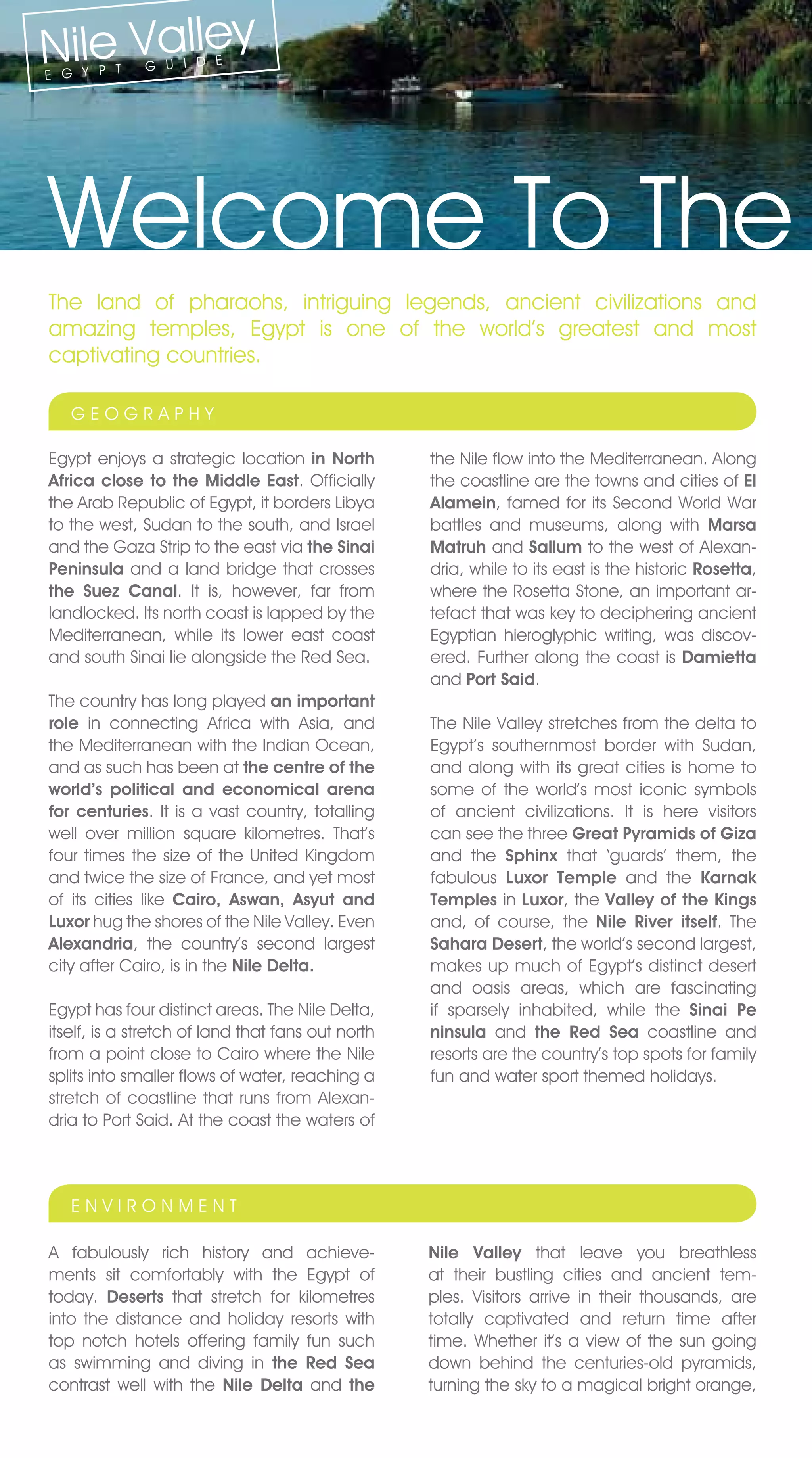
Welcome To The
The land of pharaohs, intriguing legends, ancient civilizations and
amazing temples, Egypt is one of the world’s greatest and most
captivating countries.

   GEOGRAPHY

Egypt enjoys a strategic location in North         the Nile flow into the Mediterranean. Along
Africa close to the Middle East. Officially        the coastline are the towns and cities of El
the Arab Republic of Egypt, it borders Libya       Alamein, famed for its Second World War
to the west, Sudan to the south, and Israel        battles and museums, along with Marsa
and the Gaza Strip to the east via the Sinai       Matruh and Sallum to the west of Alexan-
Peninsula and a land bridge that crosses           dria, while to its east is the historic Rosetta,
the Suez Canal. It is, however, far from           where the Rosetta Stone, an important ar-
landlocked. Its north coast is lapped by the       tefact that was key to deciphering ancient
Mediterranean, while its lower east coast          Egyptian hieroglyphic writing, was discov-
and south Sinai lie alongside the Red Sea.         ered. Further along the coast is Damietta
                                                   and Port Said.
The country has long played an important
role in connecting Africa with Asia, and           The Nile Valley stretches from the delta to
the Mediterranean with the Indian Ocean,           Egypt’s southernmost border with Sudan,
and as such has been at the centre of the          and along with its great cities is home to
world’s political and economical arena             some of the world’s most iconic symbols
for centuries. It is a vast country, totalling     of ancient civilizations. It is here visitors
well over million square kilometres. That’s        can see the three Great Pyramids of Giza
four times the size of the United Kingdom          and the Sphinx that ‘guards’ them, the
and twice the size of France, and yet most         fabulous Luxor Temple and the Karnak
of its cities like Cairo, Aswan, Asyut and         Temples in Luxor, the Valley of the Kings
Luxor hug the shores of the Nile Valley. Even      and, of course, the Nile River itself. The
Alexandria, the country’s second largest           Sahara Desert, the world’s second largest,
city after Cairo, is in the Nile Delta.            makes up much of Egypt’s distinct desert
                                                   and oasis areas, which are fascinating
Egypt has four distinct areas. The Nile Delta,     if sparsely inhabited, while the Sinai Pe
itself, is a stretch of land that fans out north   ninsula and the Red Sea coastline and
from a point close to Cairo where the Nile         resorts are the country’s top spots for family
splits into smaller flows of water, reaching a     fun and water sport themed holidays.
stretch of coastline that runs from Alexan-
dria to Port Said. At the coast the waters of


   ENVIRONMENT

A fabulously rich history and achieve-             Nile Valley that leave you breathless
ments sit comfortably with the Egypt of            at their bustling cities and ancient tem-
today. Deserts that stretch for kilometres         ples. Visitors arrive in their thousands, are
into the distance and holiday resorts with         totally captivated and return time after
top notch hotels offering family fun such          time. Whether it’s a view of the sun going
as swimming and diving in the Red Sea              down behind the centuries-old pyramids,
contrast well with the Nile Delta and the          turning the sky to a magical bright orange,
Nile Valley
or seeing the mesmerising sun-scorched           Muslim, although over 12 million are Chris-
Sphinx, the priceless treasures contained        tians. The atmosphere is one of friendship.
tantalisingly behind glass in Cairo’s Egyp-      Egyptians like to work hard and live life to
tian Museum or standing in awe of the            the full, and tend to work in the heart of the
fabulous temples the sights of the world’s       cities which have seen many changes in
most entrancing country stay with visitors       recent years and are now at the forefront
for a lifetime.                                  of world politics, or working the agricultural
                                                 lands of the Nile Valley or in tourism. Every-
Add to this experiences of seeing one of         one can enjoy lively cultural experiences
Egypt’s most trusted residents, the camel,       too - everything from the latest art sensa-
make its way casually across the sands,          tions to music, theatre and dance.
perhaps dressed in brightly coloured rugs
and tassels for a festival, street vendors       Egypt is a warm country for most of the
selling their goods in the bustling souks,       year. Some days in summer the tempera-


                                                                                                  WELCOME TO THE NILE VALLEY
children playing in the streets, craftspeople    tures can reach 25-35C (95F) in Cairo, and
weaving carpets or locals mingling in an         so the way Egyptians live tends to reflect
animated fashion around the streets, all of      this as it has done for centuries. The pace
which sit well with innovative new commer-       of life is generally slow, and although city
cial buildings, and you have a country that      centres often appear bustling it isn’t long
will become part of your soul.                   before everyone gives in and finds a cool
                                                 place to rest awhile.
Egypt is a religious country. Islam is the
official religion and most Egyptians are

   HISTORY

The history of Egypt stretches back to           a series of dynasties that ruled the coun-
unimaginable times. It is a country prob-        try, began in around 3100 BC. The first
ably best known to the world over for its        pharaoh is generally believed to have
pharaohs, such as Tutankhamun, and               been Menes, who was instrumental in
its ancient civilizations that largely existed   joining a then divided Egypt into one. The
along the banks of the Nile River and            country was known as tawy, meaning ‘two
created so many of its iconic structures.        lands’.

The earliest signs of civilization have been     A total of 30 dynasties ruled over the next
dated to prehistoric times, although the         three millennia until around the year 30 BC.
towns and cities of today can probably           Many, if not all of the pharaohs, wanted
trace their roots back to around 8000            to put their own mark on Egypt and had
BC when the Sahara was formed and                supremely beautiful palaces, temples,
settlers started moving closer to the fertile    tombs and structures built. It was dur-
land of the Nile River banks and eventually      ing this time that most of the astonishing
created communities. These ancient               sights that can still be seen today were
civilisations developed and grew almost          constructed, among them the Pyra-
entirely because of the Nile during a period     mids of Giza and the Sphinx of the Old
known as the predynastic, a time before          Kingdom, and the Temples of Luxor in
the pharaohs ruled the country.                  the New Kingdom.

The dynastic period, widely regarded as          Egypt has seen many periods of history
one of the oldest ever cultural periods in       since the ancient dynastic era and has
the world and so called because it was           reminders of how it flourished under
                                                 different civilizations.               7
Nile Valley
E G Y P T
             G U I D E


Welcome To The
   HISTORY

It has been occupied by the Persians,            came king in 1333 BC, becoming the
Romans, the Greeks, Arabs, Ottoman Turks,        Pharaoh of the 18th dynasty, and whose
British and the French, but it is probably       solid gold death mask is probably the most
the pharaohs that have left the most mes-        famous artefact ever found in Egypt. Or
merising legacy on the country and one           the beautiful Nefertiti, the wife of the
which makes tourism one of the country’s         Egyptian Pharaoh Akhenaton, who might
leading industry sectors today.                  have ruled in her own right before
                                                 Tutankhamun became king. Both-from
Who cannot be captivated by the story            many-make Egypt legendary.
of Tutankhamen, the young boy who be-


   SOCIOECONOMIC

Today, Egypt is one of the key political         Far fewer people live in areas like the
and cultural leaders in the Middle East.         Sahara Desert, which although massive is
It has a buoyant economy as a result of          unsympathetic to human needs, while Si-
economic reforms and foreign investment          nai and the Red Sea coastal areas have
and a rapidly evolving high technology           strong population figures, especially in the
communications sector. Its government            major towns which have good general
continues to pledge investment into its in-      infrastructures and amenities. There are
frastructure of highways, railways and wa-       healthcare facilities, shops, restaurants,
terways that stretch from the north coast        many sports centres, especially those for
and the Nile Delta to the southern points of     water sports, and top hotels. The popu-
the Nile Valley at Aswan and Abu Simbel,         lation in these areas is bolstered by the
into the Western Desert and across to the        many visitors who arrive during the summer
Red Sea coast and into Sinai.                    months on leisure, sea & land adventures,
                                                 spa and wellness holidays, golf lovers, and
Egypt also has one of the highest popula-        short breaks.
tions of all the countries in this part of the
world with around 75.5 million people.           Egyptian society is geared very much
Many live in the densely populated cities        around the family, and it is not uncommon
                                                 to see all generations dining together or
of Cairo, Alexandria, Luxor and Aswan,
                                                 on an outing. Religion is important, with
where they are engaged in commerce,
                                                 Muslims and Christians living and work-
politics, retailing and tourism, while others
                                                 ing together in harmony. As a visitor, you
live in rural areas near the banks of the Nile
                                                 will always be made to feel welcome and
River and are engaged in agriculture. The
                                                 protected.
rich soil of the banks provides the most ara-
ble agricultural land in Egypt today as it has
done for around 10,000 years. It is on this
land that man has relied on since ancient
times. Without the river the country would
likely only ever have been desert. Much of
Egypt’s national income relies on agricul-
ture, along with tourism, petroleum exports
and capital generated by traffic using the
Suez Canal.
                                                                                Giza Pyramids
Nile Valley
   THE NILE VALLEY

                                               to see the Colossus of Ramses II, the
                                               Serapeum and the ancient cemetery
                                               too. Spend time in Old Cairo. It’s rather
                                               like a living museum of historic and reli-
                                               gious buildings, plus traditional markets
                                               to snap up some souvenirs to take home.
                                               And, of course, no visit to Cairo would be
                                               complete without a visit to the Egyptian
                                               Museum. It is one of the world’s most fa-
                                               mous museums with an astonishing collec-
                                               tion of ancient artefacts. Its most famous


                                                                                              WELCOME TO THE NILE VALLEY
                                               displays are treasures from Tutankhamun’s
                                               tomb.

                                               Heading south, the Nile River flows through
                                               Al-Fayoum, Biba, Beni Mazar and on
                                               to the delightful El Minya. It has beauti-
  Karnak Temple                                ful villas reminiscent of those found in old
                                               Tuscany which were built by the cotton
The second longest river in the world,
                                               merchants who made the town wealthy.
the Nile follows a path along the length of
                                               The trading centre of Asyut and famou
Egypt from its southernmost boundary to
                                                Dandara are reached, and then it’s on to
the north Mediterranean coast, Damietta,
                                               the wondrous Luxor and Thebes with their
and on to its sources, the White Nile and
                                               fabulous temples, museums and tombs.
the Blue Nile, in the depths of Africa.
                                               Here the world famous iconic Karnak
Alexandria, the country’s second largest
                                               Temples and the Luxor Temple, the
city and founded by Alexander the Great,
                                               Valley of the Kings and the Valley
hugs the Mediterranean coastline to the
                                               of the Queens, the Temple of Hat-
north and forms part of the Nile Delta along
                                               shepsut, the colossi of Memnon and
with two branches Damietta and Rosetta
                                               the Ramesseum are just some of the
which embrace the highly fertile agricul-
                                               sights that simply cannot be missed.
tural lands of the Delta
                                               Every visit to Egypt should include time
                                               spent in Luxor.
Visitors to Egypt should always schedule
into their agenda a stay in Cairo. One of
                                               Finally, the Nile Valley reaches Esna and
the last remaining seven wonders of the
                                               Kom Ombo, both historic sites, Aswan
ancient world, the Pyramids at Giza are
                                               which has a large Nubian community,
‘must sees’. The Great Pyramid was built
                                               temples and the feat of engineering the
by King Cheops of the 5th dynasty around
                                               Aswan Dam to see, and finally to Abu
2600 BC and stands some 137 metres
                                               Simbel where the notable Great Temple
high. It’s well worth stepping inside to see
                                               of Abu Simbel and the Temple of Hathor
the fabulous chambers. There are two
                                               make a remarkable sight carved into sheer
other large pyramids to see, plus lots of
                                               rock faces.
smaller ones dedicated to family mem-
bers of the kings.
                                               The Nile Valley is a mix of the old and the
A few steps away is the huge Sphinx with its
                                               new, the classic and the innovative. It is
body of a lion and a human head. Make
                                               cultural Egypt at its best.
a point of visiting Memphis and Saqqara
                                                                                              9
Romance
             Sailing the Nile...
There’s nothing quite like a touch of       The Nile has held a fascination for
romance under the stars with that           centuries and even today conjures
special person, and if you happen           up images of whimsical days and
to be on the Nile drifting slowly along     romantic nights on board elegant
past temples and sand dunes watch-          steamers, but then perhaps that’s all
ing the sun set together then it doesn’t    down to English novelist Agatha Chris-
get much more memorable than                tie and her famous work “Death on
that. It will be a highlight of a holiday   the Nile”. The book was later made
in Egypt.                                   into a film starring Peter Ustinov as the
                                            Belgian detective Hercule Poirot and
                                            much of the filming was done in the
                                            Nile Valley.


      Cruising on the Nile has been
      a popular pastime for count-
      less visitors since the 19th cen-
      tury. Florence Nightingale was so
      captivated by the river and wrote
      about it in glowing terms, and
      Thomas Cook, the entrepreneur
      behind the leading travel com-
      pany, was so smitten he began
      offering cruises to his clientele,
      one of the first to do so.


    To enjoy your ultimate romantic
    adventure make sure you book
    your cruise between Luxor
    & Aswan around the time of
    El Sadda El Shitwia ( the time
    of closing the Nile, lock of Esna
    two weeks each December &
     June otherwise you will use land
    transportation to reach Luxor
    from Esna
ROMANCE
There are a number of ways to sail on     or head north towards Luxor. Your
the Nile. You can take a short hop        cruise might then see you sailing
of a few hours on a cruise boat or        to Kom Ombo to see the Temple of
a felucca, a small wooden sailing         Sobek and Hareoeris, a captivat-
boat, and while this doesn’t give you     ing sight from the river. Then it’s on-
the full experience of a romantic jour-   wards to Edfu and maybe stopping
ney elegantly drifting down the Nile it   awhile to visit the Temple of Horus and
does give you a taste. It’s especially    Esna to see the Temple of Khunum.
good way to sail if you have a limited    Finally, your cruise might end in Lux-
amount of time.                           or where you can visit the fabulous
                                          Karnak Temples, the Luxor Temple and
Another way is to take a journey          the museum, or take a trip to the
of several days on board one of           extraordinary Valley of the Kings.
the cruise ships or restored ornate
steamers that are a familiar sight        Some ships may start at Luxor and so
along the Nile. Many are to a luxuri-     your journey will be in reverse, or you
ous 5-star standard, complete with        may choose to travel beyond Luxor
wood-cladded walls, top notch lin-        and see Dandara or Abydos, but all will
ens and gourmet cuisine. They have        sail at a slow pace, giving you time
become as much a part of the Egypt        to see the sights, relax and take in the
scene as the Pyramids.                    atmosphere. You will be able to wave
                                          to children on the riverbank and see
Typically, a cruise will see you board-   fishing boats go by.
ing the ship at Aswan, setting sail       It’s a great way to combine a trip on
and seeing great sights. You can          the river with seeing the ancient sites
take a luxury cruise to Abu Simbel        along the way too. Be sure to share
passing by Kalabsha, Bait el-Walli,       the memorable experience with
Wadi el-Subua and Amada Temple            loved ones.
                                                                                     11
Urban life...
While Egypt will be forever famous            The country’s people work mainly in
for its ancient civilizations and             agriculture, the petroleum industry,
pharaohs, it is also home to around           commerce, government and tourism,
75.5 million people who live and              although real estate linked to
work here today. Egypt has a strong           tourist hotspots is starting to be-
political, religious and cultural identity.   come a buoyant sector too. The vast
In addition, you can experience both          majority of Egyptians live and work in
the feel of ancient life when you             the cities of the Nile Valley. Here you
visit the historical places as well as        can find trendy cafes and restau-
modern life through technology                rants serving Egyptian and Interna-
found throughout the country.                 tional cuisine, bustling souks, leisure
                                              opportunities, sports and venues full
                                              of cultural experiences from art to
                                              theatre and dance.


      Much of daily urban life revolves
      around the cities’ souks and
      markets. Cairo’s Khan el-Khalili,
      for instance, is an astonishing
      labyrinth of shops teeming with
      locals and tourists alike.
      Almost every neighbourhood will
      have a market selling fruit and
      vegetables, and it is from these
      that most Egyptians will buy their
      fresh products.
                                                Khan el-Khalili


     Egypt’s economy is booming
     through tourism, oil and gas
     exports, revenue from the Suez
     Canal and foreign investment.

                                                            City Stars Mall
URBAN LIFE
                                                            Bibliotheca Alexandrina


Egypt is changing though and now           Art galleries and cultural centres,
more shopping malls complete with          conference venues, theatres and
glass lifts, shiny decors, swish shops     cinemas are all growing in number.
and even cinemas are emerging.             The El Sawy Culture Wheel art centre
A casual stroll around one of the malls    in Zamalek, which hosts contempo-
will reveal names like Nike and Adi-       rary art collections, and the fabulous
das, with music from the likes of Justin   Cairo Opera House where the Cairo
Timberlake emerging from stores sell-      Symphony Orchestra perform.
ing CDs. The malls tend to be located      There are venues in Luxor, Aswan and
in modern Cairo, or cities such as Al-     the Sinai and Red Sea resorts.
exandria.
                                           In Alexandria, Opera House and Sayed
The trendy set is leading the way when     Darwish Theatre has concerts and
it comes to nightlife and culture, es-     dance events, while the city’s Biblioth-
pecially in Cairo and Alexandria. Where    eca Alexandrina is a futuristic build-
once entertainment consisted solely        ing containing a library of millions of
of traditional music and dancing the       books and multimedia, three muse-
choice is expanding as Egyptians be-       ums, a planetarium, four art galleries
come more accustomed to western            and numerous exhibition centres. It is
styles too. Concerts by worldwide rock     a fabulous facility for the people of
stars and westernised classical music,     Egypt.
musical theatre, opera and ballet
can all be found. Even the historic
sights have adopted new technology
by offering sound and light shows (at
the Pyramids of Giza, the Karnak Temples
in Luxor, Philae temple in Aswan, and in
Abu Simbel)


                                                                                      13
Nature
Much of the Nile Valley lies in what       The climate provides the perfect
is known as the Upper Egypt,               environment for many species of
a stretch of fertile land that runs        animals, reptiles and amphibians.
from the southernmost boundar-             This area is home to turtles and tor-
ies of Cairo due south to Aswan.           toises, frogs, mongooses and the
To the north it is bordered by the         Nile Monitor, a fabulous if some-
Nile Delta. To the east there’s the        what menacing prehistoric-like liz-
Eastern Desert and the Western             ard that can grow up to two metres
Desert to the west.                        long.

Upper Egypt has by far the richest
soil and it is here that most of the
crops is grown. Almost all of the
75.5 million population relies on
the region for food. It is also here,
that most of the plants and wildlife
species of Egypt thrive. Look out
for the Lotus Flower. Its bright petals
provide a carpet of colour over the
Nile riverbanks in summer months.
Also the bright yellow pom-poms of
the Acacia tree can be spotted.

Middle Egypt and the northern
areas of Upper Egypt enjoy a warm
climate, with dry summers and very
little rainfall. July and August are the
hottest months.
Egyptian countryside


                                                                                NATURE
The Nile Valley is also a birdwatch-   3.5 per cent of the total million
ers paradise. Ornithologists come      or more square kilometres being
to see the incredible number           cultivated.
of birds that live or winter in the
region, including Little Gulls,        The Nile Valley becomes more
Whiskered Terns and the small          desert-like the closer you get to
wader, the Kentish Plover. The Grey    Aswan and beyond to Kom Ombo
Heron makes a dramatic sight           and Abu Simbel. The desert envi-
in the marshy areas too, as does       ronment is ideal for Fennec foxes,
similar species of egret. Birds have   the Desert Lynx, snakes such as
always played an important role        the Spitting Cobra, the iconic
in both day-to-day life and the        symbol of Pharaonic Egypt, and
sacred culture of Egypt. There are     scorpions, all of which should be
over 150 indigenous species of         treated with respect.
birds that live here all year round,
with a further 280 or more species     The Nile Valley, the delta and
migrating in the summer months.        the surrounding desert is a
                                       fabulous mix of contrasts with vastly
As you travel further south along      different natural environments and
the Nile the temperature rises.        habitats.
Summer temperatures in Aswan
are dry and warm, although if
planning an excursion into the des-
ert go in the morning before the
sun is high. The desert makes up
well over 90 per cent of the land
mass of Egypt, leaving only around
                                                                                15
k
Gastronomy
      Egyptian cuisine...
Some of the world’s most delicious         such as melokiyah made from
and healthiest cuisine can be found        green leafy vegetables.
in Egypt. With influences from the         There are many soup recipes
Mediterranean and Europe, Africa           that use tomatoes, watercress,
and the Middle East, the dishes of         pulses or beans, with herbs such as
modern day Egypt combine fresh             fennel giving them a real kick.
often brightly coloured vegetables         Garlic is used lavishly, as is onion.
and fruit straight off the trees with      Spices too.
fish, seafood, meats and an abun-
dance of pulses, aromatic herbs
and strong spices.

While many cooking practices are
much the same as they were in
Pharaonic times, the periods of
history that saw, among others,
the Ottomans and the French live
alongside the Egyptians, bringing
with them their very distinct style of
cooking, has left an indelible mark.
Typically, a meal will start with soup,


                                            Traditional herbs


    When the Great Pyramids of Giza
    were excavated it was found that
    workers in Ancient Egypt were paid
    with onions and a type of bread
    that would have been coarse and
    filling. The two remain staple foods       Egyptian bread

    of the Egyptian diet today. It was
    discovered that many workers also
    received beer made from cereals
k
                                                                              Salads


                                                                                        EGYPTIAN CUISINE
Egyptian restaurants will have rows         beans served with boiled eggs, and
of dishes full of brightly coloured         the popular falafel, a dish of spicy
spices that are a key ingredient.           beans mashed together with herbs
Soups are served with flatbreads like       into patties and fried.
aish or pitta.
                                            Almost all meals will be served with a
Fresh fish (samak), seafood or fish         fresh salad, and probably some dips
stew accompanied by rice may                like hummus or tahini, or the local
follow. Meat is prepared to perfec-         babaganoush, a dip made from
tion. Chicken, lamb and veal are the        pureed eggplant. Foul is a flavour-
most popular, and usually slow roast-       some dip made from beans, mashed
ed, grilled with lots of herbs, or minced   with olive oil, lemon and herbs.
and added to dishes like stuffed vine
leaves. Pigeon, hamaam, is consid-          Egyptian desserts usually take the
ered a delicacy, and you will find it’s     form of a rice pudding made with
always delicious as it is cooked with       rosewater and sprinkled with spice,
much care.                                  or yoghurt or pastries filled with
                                            figs, nuts or dates. Honey is often
Koshari is a national dish and can          drenched over desserts in much the
be found delicately prepared on             same way as is done in Middle East-
gourmet menus, as well as in ‘fast          ern or Mediterranean countries. Fresh
food’ outlets or on street carts. Made      fruit, especially figs and dates, as well
from macaroni or spaghetti, rice,           as oranges will almost certainly be
lentils and chickpeas, all served with      served at the end of a meal.
a thick garlic and tomato sauce,
topped with fried onions and herbs, it
may sound a rare combination but is
truly delicious. Other traditional dishes
include Foul Medames, a dish of
                                                                                        17
Pharaonic Egypt
The history of Egypt can be traced     ers, or Nefertiti, the wife of the
back to prehistoric times and when     Egyptian pharaoh Akhenaten,
the Sahara Desert wasformed            who might have ruled in her
in around 8000 BC, prompting           own right. Her life, as well as the
early civilizations to move closer     location of her tomb, remains a
towards the Nile in order to catch     tantalising mystery.
fish and grow crops, but it is Phar-
aonic Egypt that began some            The start of Pharaonic Egypt saw
5,000 years ago that truly cap-        more than 3000 years of remark-
tures the imagination of people        able achievements and pros-
the world over. Great people           perity, with the pharaohs being
from 30 different dynasties, their     the most important people in
lives, cultures and phenomenal         the land. They created strong
knowledge of mummification,            government, military and reli-
mathematics and astronomy              gious structures, held court and
have created iconic images of          ruled the land unquestioned.
an ancient Egypt.                      They were worshipped as if gods
                                       and had phenomenal wealth,
Who cannot be intrigued by             which they lavished on building
the lives of ancient kings like        temples and other monuments.
Tutankhamun, the young boy
who came to the throne in                              Abu Simbel Temple

around 1333 BC. He ruled for
just ten years and his golden
death mask unearthed when his
tomb was discovered the Valley
of the Kings near Luxor in 1922 is
one of the most fabulous trea-
sures in the world today.

Or the great female pharaoh
Hatshepsut    who    was   the
longest ruling Egyptian king
(indeed people considered her
as a king and not a queen) the
mighty Ramses II who changed            Giza Pyramid
the face of ancient Egypt and
defended it against invad-
PHARAONIC EGYPT
                                                           Tutankhamun’s mask


The Pharaonic period, known as the        understanding of the science of
Dynastic era because Egypt was            mathematics and still perplex
ruled by a series of dynasties, in fact   experts today.
30 in total, began around 3150 BC
under the first Pharaoh who united        The next period of pharaonic rule
the then divided Upper and Lower          was known as the First Intermedi-
Egypt. The first pharaoh is widely        ate Period starting in around 2150
believed to have been Menes,              BC, followed by the Middle King-
although there is belief that he was      dom from around 2000 BC when
in fact the pharaoh Narmer or Aha         the capital became Thebes, the
depicted in many archaeological           next period, the New Kingdom,
records. He established a capital         began around 1539 BC and gave
called Memphis, which became              us some of the greatest pharaohs
the heart of the country.                 of all time, including Ahmose,
                                          Hatshepsut,      Akhenaten     and
There is little known about the kings     Tutankhamun. In around 1279 BC
of the 1st and 2nd dynasties, but         the heroic Ramses II came to the
it is the kings from the 3rd dynasty      throne where he stayed for over
onwards in a period that became           67 years.
known as the Old Kingdom who              Pharaonic Egypt, meaning a
made Egypt one of the wealthiest          land ruled by Pharaohs, ended in
in the ancient world. Massive and         around 30 BC, although a form of
elaborate buildings were erected,         monarchy continued for several
the culmination of which was the          thousand years until the country
Pyramids and the Sphinx in Giza.          was conquered by the Romans.
The Pyramids are an extraordinary ex-     Leading figures include Alexander
ample of the pharaoh’s advanced           the Great and Cleopatra.
                                                                                19
Marsa Matruh Beach


The Coast: from Marsa
Matruh to Damietta,
Rosetta and Port Said
With its jugged coastline, bays and long sweeps of golden sands, the north coast of
Egypt is quiet, supremely beautiful and attracts a steady stream of visitors. It stretches
from Sallum to the west, the last Egyptian town before hitting the Libyan border which
perches high on the cliff looking out to sea, along the coast road to Marsa Matruh,
El-Alamein, the huge colonial city of Alexandria to Abu Quir in the Nile Delta,
the famous Rosetta and to Damietta and Port Said at the mouth of the Suez Canal.
Along the way you will see historic monuments and wonderful beaches.
  MARSA MATROUH

Located    some 290 kilometres from Alexandria, Marsa
Matrouh is a gem. It is hugely popular with Egyptians looking for
their own escape from the busy cities, and families can often be
seen enjoying the seven or so kilometres of soft white sand that
are protected by a necklace of natural rocky breakwaters. Calm
turquoise seas lap the shores of the bay.

There are several beaches, including the Cleopatra Beach that
lies just to the west of the town, the quiet and relaxing Ra-as
Al-Hakma Beach, Al-Abyad Beach and Agiba Beach. Marsa Ma-
truth town, itself, is said to have been founded by Alexander the
Great on his way to Siwa where he was to pay homage to the
god Amun.

Other attractions for visitors are the remains of a navel fleet
anchorage built by the Ptolemies, a Coptic chapel and the
Rommel Museum created within a cave where Erwin
Rommel, a German Commander, is said to have finalised his
military plans during the Second World War. The museum
displays arms and tools from the period.                              Marsa Matruh, Agiba Beach

  EL-ALAMEIN


El-Alamein is 200 kilometres or so further along the coast road from Marsa Matruh. A
small village that is developing into a popular tourist spot, it is best known for the
important role it played in the Second World War. Visitors can visit a war museum
that tells of the battles that changed the campaign in the Allies’ favour, as well as
the Commonwealth War Cemetery with monuments dedicated to the Greek, South
African, Australian and New Zealand troops who fought on the British side, and
                             cemeteries commemorating the bravery of the Italian
                             and German soldiers.
          DON’T              There were two battles fought in El Alamein, the first inJuly
          MISS               1942, when Axis troops tried unsuccessfully to advan-
 Agiba Beach, meaning        ceon Alexandria, and the second when British General
 wonder, which lives up      Montgomery’s 8th Army fought a bitter battle withRom-
 to its name with natural    mel’s troops who were forced to retreat to Tunisia. Brit-
 caves and coves to          ish Prime Minister Winston Churchill said of the battles,
 explore.                    “Before Alamein we had no victory and after it we had
                             no defeats.”
INFO POINT
Continuing along the coast road, you
pass the road to Abu Mina and its beau-
tiful Coptic Monastery of Abu Mina, Deir
Mari Mina, which honours the saint Mina                     Mediterranean Coast
or Mena as it is sometimes spelt. He is one
of the best known Egyptian saints and, as          Marsa                                    Damietta
the story goes, many miracles have been            Matruh                           Rosetta
                                                              Sidi Abd
attributed to him. It is believed he was                     El Rahman                     Port Said


                                                                                      Th
                                                                            Alexandria Nil


                                                                                         e
tortured and killed for his religious beliefs                                             eD
                                                                                              elta
                                                        El Alamein       Porto
by Asia Minor rulers in the 3rd century and                              Marina
today pilgrims regularly visit the site, es-                                            Cairo
pecially on November 11, St Mina’s Day.


                                                                                             ile River
The monastery, which is relatively new and
stands on the site of an ancient basilica, is                                Fayoum
                                                                              Oasis
known throughout Egypt. The village, itself,


                                                                                          eN
is a World Heritage Site and well worth a


                                                                                                                     THE COAST : FROM MARSA MATRUH TO DAMIETTA, ROSETTA AND PORT SAID
                                                                                        Th
visit.

The resort of Agami has been top of the
list Legende
      for holidaying professionals from Cairo          EASY TRAVEL
and Alexandria since the 1950s. It is the         Alexandria and Marsa Matruth have air-
last town along the coast before you en-
ter the environs of the elegant Alexandria,       ports with regular flights most of the year,
Egypt’s second largest city and known as          and the coast is well served by train and
the ‘Pearl of the Mediterranean’.                 bus services from Alexandria and Cairo.

                                                  Port Said Tourist Office :
                                                  Phone : 066 3235289 - Fax : 066 3235289
                                                  Marsa Matruh Tourist Office :
                                                  Phone : 046 4931841 - Fax : 046 4931841


  Rosetta, Muallaq Mosque


  ROSETTA (RASHID)
                                                                                              Rosetta Stone

Rosetta, or Rashid as it is historically known,
lies 60 or so kilometres east of Alexandria.
A bustling port town, Rosetta can trace its
history way back to 800 AD when it was
founded by the Muslim governor of Egypt,
Ibn Tulun. Known for its beautiful Ottoman
mansions from the time of the Ottoman
conquest when, as a port, it was immensely
prosperous, its citrus groves and its elegant
feel, Rosetta has long been a popular holi-
day spot. What really puts it on the map
however is the fact that it was here that the
Rosetta Stone was discovered in 1799.

An Egyptian stone slab from the Ptolemaic                                                                Port Said
era, the Rosetta Stone has proved key to de-
ciphering the ancient hieroglyphic style of
writing discovered in places like the tombs                  DID YOU KNOW?
of the Valley of the Kings. Hieroglyphic was
                                                             The north coast was Cleopatra’s
the form of writing used in Egypt 3,000 years
ago, but it took until the discovery of the                  a favourite spot and, accord-
stone and the work of a 19th century sci-                    ing to legend, she would bathe
entist and professor to understand it. Finally,              in the clear waters. Cleopatra
the coastal journey ends at Damietta and                     was the monarch of Egypt dur-
Port Said, both busy ports, and the famous                   ing the time of Caesar as the
Suez Canal.                                                  country entered its Roman era.

                                                                                                                     21
The Bibliotheca Alexandrina


Alexandria
  PEARL OF THE MEDITERRANEAN

A 20 kilometre-long palm tree-lined esplanade and boulevards, swish hotels, long stretches
of fine sandy beach and gardens characterise Alexandria, widely considered to be one of
the finest summer resorts in this part of the world. Unlike many other areas of Egypt, its cultural
heritage, climate of warm summers, mild winters and pleasingly warm spring and autumn
months and its cosmopolitan atmosphere give it a Mediterranean feel. Alexandria is known
as the ‘Pearl of the Mediterranean’.

Egypt’s second largest city with a population of around
four million, Alexandria is the country’s largest seaport
and the centre of much of its maritime activity. It is
also one of the oldest cities in Egypt and lies around
225 kilometres northwest of Cairo. As records suggest,
Alexandria was established by Alexander the Great
in around 332 BC on the site of a small village called
Rhakotis. He wanted to create one of the finest capital
cities in the world, and one for which his reign would go
down in history.

Alexandria remained the capital of Egypt for nearly a
thousand years and was immensely prosperous be-
cause of its strategic trading location between the
Mediterranean and the Red Sea. It also became the
centre of learning for the ancient world, and retains its
academic importance to this day.                                                 Alexandria seafront


Among the sights for visitors to see is the beautiful Montazah Palace, which is perched on a
hill overlooking the sea. It was once the summer home of the Egyptian royal family and now
houses a museum in their honour. Built to a Turkish and Italian architectural design, it stands
in some of the prettiest gardens in Alexandria. They are open to the public and well worth a
visit.

Holidaying visitors flock to Alexandria for its good diving sites, and its beaches which are
among the best in Egypt if not the Mediterranean. Its most famous are the beaches of
                               Al-Ma’moura, Mandara, Al-Assafrah, Mami, Sidi Bishr
                               and Montazah, as well as Sidi Gaber, Rushdi, Stanley,
         DON’T                 Gleem and Cleopatra. All are dotted along the corniche, the
                               seafront boulevard.
          MISS
 The Shallalat Gardens         Qaitbay Citadel, a turreted fortress that was built in the 15th
 in the Al Shatby district     century on the site of the Lighthouse of Alexandria, one of the
 is a massive expanse of       Seven Wonders of the Ancient World, is a ‘must see’. It is said
 lawns, trees and shrubs       that stones from the original lighthouse built in the 3rd century
 with lakes designed so        BC on an island in the harbour were used in its construction.
 that the water tumbles        Excavations in the harbour continue to this day, and recently
 in waterfalls. It is a calm   there have been more ancient stone found which in all likeli-
 space in a busy city.         hood once formed part of the lighthouse’s structure. The city
 Also the Mediterranean-       has many mosques too, the most notable being the Al-Mursi
 style street cafes.           Abul Abbas with a towering minaret and domes that dominate
                               the city’s skyline, and the 14th century Al-Attareen Mosque.
INFO POINT
The Graeco-Roman Museum, located in
                                                                                  To Abu Quir and Rosetta
the heart of modern Alexandria, houses an
impressive collection of 40,000 or more ar-


                                                                                a
                                                                                                   Montazah


                                                                              Se
tefacts found in and around the city, some                                    a                     Palace


                                                                            n
dating as far back to 332 BC. The museum                                    ne
                                                                         rra
was founded in the 19th century, quickly                              ite San Stefano
                                                                  Med
became an important exhibitor of ancient                                      Stanley
artefacts and remains a key amenity in
                                                                   Qaitbay
Alexandria today, along with the National                          Citadel


                                                                                                           a
Museum of Alexandria.


                                                                                                       Delt
                                                           Al-Mursi
                                                          Abul Abbas          Bibliotheca Alexandrina
                                                            Mosque            National Museum of Alexandrina
                                                                Roman        Graeco-Roman Museum


                                                                                                     le
                                                                                                   Ni
                                                          Amphitheatre                                e
                                                                           Pompey’s Pillar          Th
                                                                  Catacombs at
                                                                 Kom el Shoqafa            Desert Highway,
                                                            To El Alamein                  To Wadi El Natroun
                                                                                           and Cairo


                                                               EASY TRAVEL
                                                          Alexandria has its own international air-
                                                          port, as well as being a seaport for cruise
                                                          ships. It is served by the express service
                                                          buses and rail network that link it to Cairo
                                                          and other major towns and cities.
                                           Fish market


                                                                                                                 ALEXANDRIA
Alexandria also has lots of archaeological
sites too, including a Roman amphitheatre                 You can live different experiences by
at Kom Al-Dekka, a Serapium pillar dat-                   exploring the under-water treasures in
ing from the 3rd century known as Pompey’s                Alexandria. Don’t miss also the Wadi El
Pillar, the ancient catacombs at Kom el Sho-              Natroun Monasteries.
qafa that show a mix of Pharaonic and Greco
Roman art, the Al-Shatby Necropolis site and a            Along the Mediterrean coast luxurious
series of tombs.                                          resorts open their endless possibilities for
                                                          memorable vacations (one of them is
The city, however, while celebrating its glorious         Porto Marina).
past also has a thoroughly modern approach
to providing facilities for its residents and visitors.
This is supremely evident in the opening of the
Bibliotheca Alexandrina, an important library             Alexandria Tourist Office :
and cultural centre designed to put Alexandria            Phone : 034843380/51556
back on the academic map. It stands near the              Fax : 034843380
site of the ancient Library of Alexandria dating
from the 3rd century, which was considered
to be the largest library in the ancient world.
Among the famous scholars who studied here
are mathematicians Euclid in 300 BC and Her-
on in 62 AD, and philosopher and astronomer
Eratosthenes in around 200 BC.
The Bibliotheca Alexandrina opened in 2002
following a competition organised by UNESCO
to find the best architectural design for the
commemorative building. A futuristic design
was chosen, complete with a glass roof angled
so that it faces the sea. There are specialised
libraries for children, those who are blind or visu-
ally impaired and the young, along with sec-
tions dedicated to the arts, multimedia, audio-
visual, microforms and rare books.
This extraordinary facility also has four art galler-
                                                                                                Kom el-Shoqafa
ies for temporary exhibitions and a further nine
for permanent displays, three museums dedi-
cated to antiquities, manuscripts and science,
a planetarium, internet archive, a manuscript                       DID YOU KNOW?
restoration laboratory and seven academic
research centres. Its cultural centre has nine                      The Bibliotheca Alexandrina
screens for projection presentations, and an                        has a library capable of hold-
interactive environment. It is a fabulous facility                  ing eight million books, and is
for the people of Alexandria, an award-winner                       one of the largest libraries in the
and considered one of the leading such cen-                         world.
tres in the world.
                                                                                                                 23
Giza, Sphinx and the Pyramids


Cairo and Giza
To say Cairo is a city of contrasts is perhaps an under-
statement. It is an astonishing mix of reminders from
an ancient world that sit, surprisingly comfortably, with
modern day life. You can see historic buildings and
market squares in Old Cairo, fabulous Mamluk and
Ottoman mosques, Christian churches, swish hotels and
contemporary commercial offices in Greater Cairo, lush
parks, residential areas and the amazing area where
the Pyramids of Giza and the Sphinx in Giza dominate
the skyline and the city meets the desert.

Add to this the chance of visiting the Egyptian Muse-
um where exhibits are too ancient and too fabulous
to comprehend, the streets of Khan el-Khalili, the old-
est bazaar in the world, and the huge museum and
cultural centre complex of the Opera House and you
have a city that captivates. To visit Cairo, one of the
largest and most densely populated cities in the world
with a population said to be almost 8 million in the
metropolitan area alone, will be a thoroughly memo-
rable, if hectic, and at times bewildering, experience.
                                                                                        Sphinx


                                                                  Millions of Egyptian live
                                                                  and work in the city,
                                                                  with the total number of
                                                                  people bolstered by tour-
                                                                  ists from every corner of
                                                                  the world at most times
                                                                  of the years. Spring and
                                                                  autumn tend to be the
                                                                  busiest times as the sun is
                                                                  not so hot, although winter
                                                                  and summer see many
                                                                  visitors too. Expect to hear
                                                                  Japanese and Chinese,
                                                                  American voices, Cana-
                                                                  dians, French, Italian and
                                                                  English among the throngs
  Tutankhamum’s treasures                                         of people who gather to
                                                                  see the sights of this glori-
                                                                  ous city.
           DON’T
           MISS                                                   Cairo lies on the banks of
 The Sound and Light show at the Pyramids of Giza – the           the Nile River, at the point
 narrator of Egypt’s ancient history is the Sphinx itself.
                                                                  where it splits in a fan-like
                                                                  manner for its onward
 Languages include French, English, Spanish, Arabic, Italian      route north through the
 and Japanese. Also don’t miss the chance of lunch or din-        low-lying Nile Delta to the
 ner on a floating restaurant – the often luxurious boats can     Mediterranean. It is a warm
 be seen moored along the riverside.                              city, although has a raising
                                                                  humidly level due to the
DID YOU KNOW?
            The best way to avoid having to queue to get into the Cairo Museum is to book
            in advance or join a group visit. Mid-morning tends to be especially busy, so try
            visiting early in the day or in the afternoon when it is quieter.


Nile. July to August are the hottest months when temperatures tend to be 30-40°C
(107.6oF), while in winter it is cooler at around 24-30°C (86oF). It has little rainfall.

Cairo is divided into several main areas, each with their own character and many
attractions that should be a ‘must’ on every visitors’ itinerary. Central Cairo, or Greater
Cairo, is where the administrative heart of the city, and indeed the country, is located. It
lies to the north of the city and takes in part of Giza on the western side of the river and
a large expanse of area to the east. The area feels contemporary and modern with a
network of wide 19th century boulevards resembling the layout of cities such as Paris,
shiny futuristic buildings, parklands, swish restaurants and hotels. It is quite different to
almost all other areas of the city.

The Corniche el-Nil runs along the length of the Nile on the east side and offers bridges
across the water to the island of Gezira in the Zamalek district, and in turn to the west
bank. The Cairo Tower, a tall television tower with a lattice-like exterior, is a famous land-


                                                                                                 CAIRO AND GIZA


  The Citadel

mark of the island and can be seen for some distance. You can go to the top for a
great panoramic view of the city. Central Cairo contains some fabulous sights, such as
the 19th century Midan Opera and Midan Ataba, the Mausoleum of former Prime Minister
Saad Zaghloul, Manial Palace which was once a royal home and the new sprawling
Opera House complex where residents and visitors can hear classical music and op-
era, and see dance performances, theatre and ballet.

Midan Tahrir is the busy heart of Central Cairo, and it is here where there are numerous
shops, cafes and restaurants in streets such as Qasr el-Nil. There’s also the American
University housed in a grand neo-Islamic building, plus the city’s absolute ‘must do’ at-
traction, the Egyptian Museum. You can reach it via the Sadat subway station.
Housed in a neo-classical building colour washed in pink, it is the home of the largest
collection of ancient Egyptian antiquities in the world. In fact, it is said there are around
120,000 pieces on display, including mummies, numerous sarcophagi and, of course,
the world famous Tut Ankh Amum (Tutankhamun) collection of gold and alabaster trea-
sures found when the boy pharaoh’s tomb was discovered in 1922.
You can also see a replica of the Rosetta Stone in the foyer as you enter the museum.
The original was discovered in Rosetta, Rashid, on the north coast and was
                                                                                                 25
The Egyptian Museum
instrumental in deciphering hieroglyphics, the ancient
Egyptian form of handwriting that dates from before
Pharaonic Egypt times. If visiting the museum you can
book a guided tour or purchase a book and wander
around at your own pace. Allow several hours or, if a
dedicated Egyptologist, many days.
East of Central Cairo is the Islamic part of the city, while to
the south is the oldest. Full of atmosphere and charm,
they both are characterised by narrow streets and laby-
rinths of tiny alleyways and lanes, ancient architecture
seen on mosques and churches, and residential streets
that stretch for several kilometres into the distance.
Khan el-Khalili, the famous network of streets that
make up the largest bazaar in the Middle East, and
one of the oldest markets in the world, is in the Is-
lamic part of Cairo. It was built by Emir Djaharks el-
Khalili who created a khan, a caravanserai for trad-
ers. From as far back as 1382 traders have plied their
goods of gems, gold and silver, copper and highly
scented spices. Today, similar items can be found
although they are joined by trinkets more suited to                            Al-Azhar Mosque
holidaying visitors looking for a souvenir to take home.
To      wander      around      the    bazaar       is   fascinating,    and    good        fun.
Nearby, is the great Mosque of Sayyidna al-Hussein, considered the holiest site in Cairo,
which is well worth seeing, along with the fabulously old Mosque of al-Azhar, the Mosque
of Ibn Tulun, the 12th century citadel built by Salah El Din to protect the city from invad-
ers, the Mosque of Mohamed Ali on the Citadel and the Wikalat al-Ghouri, a medieval
former caravanserai that now houses an arts and crafts centre. The Islamic part of the
city is generally bustling, but is a key area for visitors new to Cairo to experience.
To the west of Central Cairo are the Pyramids of Giza on the Giza plateau, not far from
the site of the ancient city of Memphis and Saqqara. The last remaining Seven Wonders
of the Ancient World, the pyramids are the iconic image of Egypt. You can visit the
Great Pyramid built for King Khufu of the 4th dynasty, the slightly smaller Pyramid of
Khafre dated from around 2500 BC and the Pyramid of Menkaure. Dotted around are
several smaller pyramids where members of the kings’ families would have been en-
tombed. To one side stands the much-photographed Sphinx with its body of a lion and
the head of a human, while a short walk away is the Solar Boat Museum that houses a
full-size ancient Egyptian boat that was discovered in pieces but put together again
with much care. It is fascinating to see.
Saqqara complex of pyramids and monuments, the centrepieces of which are the Step
INFO POINT
Pyramid of Djoser and the Pyramid of Sekhm-
ket, along with the city of Memphis that dur-
ing much of the Pharaonic Egypt period


                                                                      ta
was the capital city.


                                                                  el
                                                                      D
                                                                 le                              International
                                                              Ni
                                                          The                                       Airport
                                                                       Egyptian
                                                                       Museum
                                                                                    Islamic Cairo /
                                                          Cairo Tower           Khan el-Khalili bazaar
                                                     Sultan Hasan Mosque /
                                                            El Rifai’ Mosque    Citadel
                                                                           Coptic Monuments
                                                        Giza Old Cairo
                                                        Pyramids             Coptic Museum
                                                                             The
                                                                                 N
                                                       Sphinx


                                                                                  ile
                                                                                     River
                                                                          Sakkarah
                                                                                 Memphis


                                                          EASY TRAVEL
                                                     Shuttle buses run regularly from Cairo
                                                     International Airport into the city centre,
                                                     plus there’s limousine and car hire
  Coptic Cairo, St Georges’ Church                   facilities available. In town, there are


                                                                                                                      CAIRO AND GIZA
                                                     taxis galore. Look out for the black and
While the Pyramids of Giza and the beautiful         white cars, which can be hailed, or book
Sphinx that ‘guards’ them date from Phara-           a bright yellow air-conditioned City Cab.
onic times and are one of the oldest monu-           Taxis also wait outside hotels. Cairo has
ments in the city today, Old Cairo, or Coptic        a good metro and railway system and a
Cairo as it is known, is where the city actually     bus network too.
began. In fact, the area, along with Mem-
phis, Saqqara and Dahshur, predates the              Pyramids Tourist Office :
city as we know it today.                            Phone : 33838823 - Fax : 33853526
Old Cairo was founded in around the 6th              Dowtown Cairo Tourist Office :
century AD, at a time when Alexandria was            Phone : 23913454 - Fax : 23913454
the capital of Egypt and the Pyramids and            Railway Station Ramses Tourist Office :
Sphinx lay way beyond the small commu-
nity’s boundary. Then the site that was to           Phone : 25790767 - Fax : 25790767
become Cairo was little more than a few
dwellings on the banks of the Nile and a            Cairo. Look out for the delicately carved
Roman fortress that guarded the route be-           mashrabiya windows. Inside, the muse-
tween the ancient cities of Memphis and             um offers a surprise at every turn. With
Heliopolis.                                         one of the finest collections of Coptic art
                                                    in the world, it covers the periods from
As the stories go, an Arab general, Amr Ibn         Pharaonic times through to Graeco-Ro-
al-Aas, decided the area was a good spot            man and Islamic. On display are pulpits,
for establishing a much larger community            ancient textiles and embroidered silks,
and began to construct homes and places             icons, manuscripts and ceramics.
of worship. The community grew and grew
at a time when the country was predomi-         Cairo’s history is wondrous. It has seen
nately Christian. Today, some of the most       pharaohs, Christians and Islam follow-
historic and important Christian buildings      ers, and has also been the seat of the
and churches in the city can be found in        ruling Royal dynasty, the Fatimid Caliph-
the narrow little alleyways and streets of      ate, the capital during the Mamluk and
Coptic Cairo. Be sure to visit the Church of    Ottoman periods, and the centre of Na-
                                                poleon’s empire when France occupied
St Barbara, one of the largest in Egypt, is still
used regularly for worship.                     Egypt in the 18th century. It retained its
                                                capital city status under British rule until
Other buildings to look out for in this area Egypt became independent in 1922.
are the Church of St George, the Church of St Today, it is the administrative capital and
Sergius, which is the oldest church in Coptic heart of the country.
Cairo and lies a few feet below street level,
the Ben Ezra Synagogue, the Amr Ibn al-Aas
Mosque and the beautiful Hanging Church,
so called because it is built high on top of
the old Roman fortress structure, the Babylon
Fort. A splendid building, it has a distinctive
front façade with twin bell towers and inside
a vaulted roof and a series of columns.
The Coptic Museum tucked away down one
of the alleyways not far away is well worth
a visit too. It hides a lovely courtyard gar-
den behind its walls, which is a quiet place
to visit amongst the hustle and bustle of
                                                                                             Khan el-Khalili Bazaar
                                                                                                                      27
El Fayoum Oasis


El Fayoum
to Hermopolis
The stretch of Nile Valley from El Fayoum to Hermopolis, taking in the towns and areas
of Biba, Beni Suef, Beni Mazar, El Minya with its famous Beni Hassan Tombs, Mallawi
and Tel El Amarna is as popular with visitors as it is with residents of Cairo looking for a
break away from the city’s hustle and bustle. The landscape is one of beautiful scenery
and tall date palms combined with great expanses of land dedicated to agriculture, and
yet has a desert-like ambience.

  EL FAYOUM

El Fayoum lies just to the west of the Nile, a few kilometres
south of Abusir, one of the most ancient archaeological sites in
Egypt. Its monuments include the Pyramid of Sahure, the Pyra-
mid of Nyuserre, the Pyramid of Neferirkare and the Pyramid of
Neferefere.

El Fayoum is a wondrous site. An exceptionally lush and green area
that comes into view as you head out through the sand dunes
of the Western Desert to the west of the Nile, it is Egypt’s largest
oasis. Surrounded by high plateaux, the city revolves around the
great and ancient Lake Qarun, which is fed by water from the Nile
via the Bahr Youssef. A series of canals were constructed by the
Pharaoh Amenemhat III of the 12th dynasty, around the time when
it was part of the ancient Moeris Lake, which lies 43 metres below
sea level.

Enjoying a temperate climate, the area is noted for its significant
leisure, cultural and historical importance. Said to have been a
favourite holiday spot of the pharaohs, the oasis saw many build-
ings constructed during the dynastic reigns and, indeed, in later
                                                                                  Qarun Lake
years meaning there are many reminders of ancient Pharaonic,
Graeco-Roman, Coptic and Islamic times.

Of the Pharaonic monuments to see there is the Hawara Pyramid built by Amenemhat III,
the Al-Lahoun Pyramid and the remains of the Amenemhat III pyramid, plus the fascinating
Senousert I Obelisk that stands at the entrance to El Fayoum. Look out also for the Medinet
Madi Temple dating from the 12th dynasty, the small temple of Qasr Al Sagha that lies just
                             to the north of the lake and Kiman Fares where the remains of
                             the original ancient city can be seen.

         DON’T               To see monuments from later periods head off north to the ruins
                             of the Karanis Town. Here there are temples, a Roman bath,
         MISS                winery and the remains of Coptic, early Arab and the ancient
 The cemetery at             Ptolemaic communities. Closer to the oasis are the remains
 Mallawi, famous for         of the ancient city of Um Al-Atal to see, the ruins of Demiet
 its displays of beauti-     al-Sebaa complete with ancient Greek monuments and the
 ful ancient Pharaonic       astonishing Qasr Qarum Temple where much of its original
 and Greek art seen on       decorative carvings and inscriptions can still be seen. Be sure
 murals.                     to see the Pyramid of Meidum, a beautiful step structure that
                             is believed to have been built for the last pharaoh of the 3rd
                             Dynasty, Huni, and the nearby UNESCO sites of Wadi Rayyan
                             and Wadi El Hitan in the Valley of the Whales.
INFO POINT
El Fayoum has been both an ancient Christian
                                                                                To Cairo     Pyramid of
and Islamic settlement during its history, and                 Qasr Qarun Lake Qarun          Meidum
there are beautiful churches and mosques to                        Temple                Pyramid of
see too. The finest examples are the Al-Azab                  Valley      El Fayoum       Hawara
Monastery in Al-Azab village, which is easy               of Whales


                                                                                                  r
                                                                                               ve
to find just a few kilometres south of the city,


                                                                                              Ri
                                                              Wadi          Beni Suef


                                                                                           ile
and contains a fascinating Coptic museum.                El Rayyan


                                                                                         eN
There is also the Al-Malak Monastery and the                                                 Eastern Desert


                                                                                         Th
                                                           Western Desert


                                                                                f
                                                                                           and the Red Sea
Islamic monuments of Qaitbay Mosque that


                                                                             Bahr Yuse
dates from the Mameluke period and has the                                               Bani Mazar
most delighted rostrum inlaid with ivory, plus
the Suspended Mosque to Prince Sulaiman,
so called because it is built on the side of a hill.                     El Minya
It dates from the Ottoman period.                                                          Bani Hassan
                                                                         Hermopolis        Tombs
                                                                                          Mallawi
Travelling south along the Nile from El Fayoum                             To Luxor
                                                                     and the Valley
you pass through the small town of Biba, Beni                          of the Kings           Tel El Amarna
Suef which is famous for its cotton, and the
traditional village of Beni Mazar. You then
arrive in the beautiful town of El Minya.                     EASY TRAVEL


                                                                                                                   EL FAYOUM TO HERMOPOLIS
                                                        El Fayoum is reached by train and coach
                                                        from Cairo and the major towns and cit-
                                                        ies of the Nile Valley. Organised guided
                                                        tours can be provided by the tourist office
                                                        for exploring the area around El Minya.


  El Fayoum Oasis

   EL MINYA

El Minya is in North Upper Egypt and the capi-
tal of Minya Governorate . It is a rural area on
the west bank of the Nile that has prospered
over the years since the early 20th century
through its cotton industry. Merchants built Ital-
ian styled houses that can still been seen to-
day. With the town’s pretty tree-lined corniche
and squares, and its monuments from Phara-
onic, Greco Roman, Byzantine, Coptic and
Islamic eras, El Minya is an attractive and lively
town with a great cultural heritage.                                                                  Wadi Hitan

                                                         HERMOPOLIS
It is best known for Beni Hassan, a collection of
paintings that date from the Pharaonic Egypt’s
                                                       Nearby are temples built by the female
Middle Kingdom. They display astonishing
                                                       pharaoh Hatshepsut and Thutmosis III,
engravings that are considered important for
                                                       along with Pharaonic tombs at Deir El Bar-
they show a change of style from the Old to the
                                                       sha and remains of a city and tombs from
Middle Kingdom. Amenemhat’s tomb, which
                                                       the period at Tell Al-Amarna. It is said to be
shows hunting scenes, and those of the 12th
                                                       the home of the pharaoh Akhenaton and
Dynasty governor Khunum Hotep, and Baket
                                                       his wife, the famous Nefertiti. At Mallawi,
and Khety from the 11th Dynasty are the most
                                                       just along the Nile riverbank, is the remains
important.
                                                       of the Graeco-Roman capital Ashmounein
                                                       where the ruins of a acropolis-style basilica
                                                       can still be seen. Finally, you will arrive at
              DID YOU KNOW?                            the important site of Hermopolis, or Tuna El
              Lake Qarun is a protected area and,      Gebel as it is known locally, and although it
              along with the nearby springs of Ein     offers only a few remains to see today such
              Silleen and waterways of Wadi Al         as the archaeological sites of the Tomb
              Rayan, are famous for water sports,      of Petosiris, the catacombs where mum-
              fishing and bird watching.               mified birds and animals were found and
                                                       Isadora, it was one of the most prosperous
                                                       cities in ancient Egyptian times.
                                                                                                                   29
Felucca riding the Nile


Asyut to Dandara
With a combination of fabulously ancient temples, some of the holiest places in Egypt,
great expanses of agricultural lands and a wealth of modern amenities, the stretch of
the Nile Valley from Asyut to Dandera has one step in the past and the other very much
in the future.

  ASYUT

Characterised by its Coptic Christian population which grew as a result of an apparition
of the Virgin Mary that was said to have appeared in the city, an event acknowledged
in the Coptic Orthodox Church, Asyut is one of the holiest places in Egypt. It is also one
of the largest, in fact the largest in Upper Egypt. With a population of around 400,000,
many of its residents are students studying at one of the country’s foremost universities,
the University of Asyut.

Asyut has a modern feel and yet can trace its history back centuries. The first communities
are said to have settled during the Pharaonic period and named it Syut. Later it became
known as Lycopolis, prompting a distinct local dialect in Graeco-Roman times to be
called Lycopolitan. For a spell it was a capital city, although lost out to Thebes which
took the crown during the New Kingdom period. Today, though, Asyut does have many
reminders of its ancient past.

One of its most valuable treasures is the major archaeological site of the Tombs of
Assiut, located to the west of the city. The tombs are carved into the limestone rock of
the mountain, and are said to include those of pharaohs from the 9th, 10th and 12th
dynasties such as Kheti I and II. Other ancient sites around the city include the Meir
Rocky Tombs that contain the Princes of Qusseia, the Deir El Gabrawy in Abnub where
tombs can be found in the monastery, and the Deir el-Bersha necropolis which was an
important cemetery in the Middle Kingdom and where leading nobles and governors
were entombed.

Nearby, is the Deir Al Adra, otherwise known as the Virgin’s Monastery, where it is said the
holy family crossed on their way back from the holy land, and in Shatub village, just to
the south of Asyut, is the Al Muharraq Monastery where a church bears the Virgin Mary’s
name. It was here the family is said to have stayed during their journey to Egypt. Its alter
stone is believed to have been the exact same one that blocked the entrance to a
cave where the holy family lived. Every summer, festivals are held at both venues when
pilgrims from the world over gather.

                             In more recent times, Asyut became known for being at the
                             end of the camel caravan route from Darfur in the Sudan and,
          DON’T              as a result, was home to the largest slave market in Egypt.
                             Today, it has thriving cotton, grain and carpet industries,
          MISS               and a prosperous feel. One of the relatively modern sights
 The astronomical ceiling    of the city, if compared to its ancient monuments, is the
 inside the Temple of        Asyut Barrage. It was built in the late 1800s to regulate the
 Hathor at Dendera – its     water flow from the Nile into the main canal, the Ibrahimiyya
 detailing is exquisite.     Canal, which is a key resource for irrigating the agricultural
                             land upon which the population relies.
INFO POINT
                                                              To Cairo
                                                                                                  Eastern Desert
                                                           Asyut                                 and the Red Sea


                                                                    Th
                                                                      eN
                                                          Tombs
                                                         of Asyut


                                                                        ile
                                                                              ve


                                                                         Ri
                                                                                 r
                                                           The White
                                                           Monastery                 Sohag

                                                         Western                                              Qena
                                                         Desert
                                                                              Abydos Tombs
                                                                                                 Dandara
                                                                                              Temple Complex
                                                                                             (Temple of Hathor)
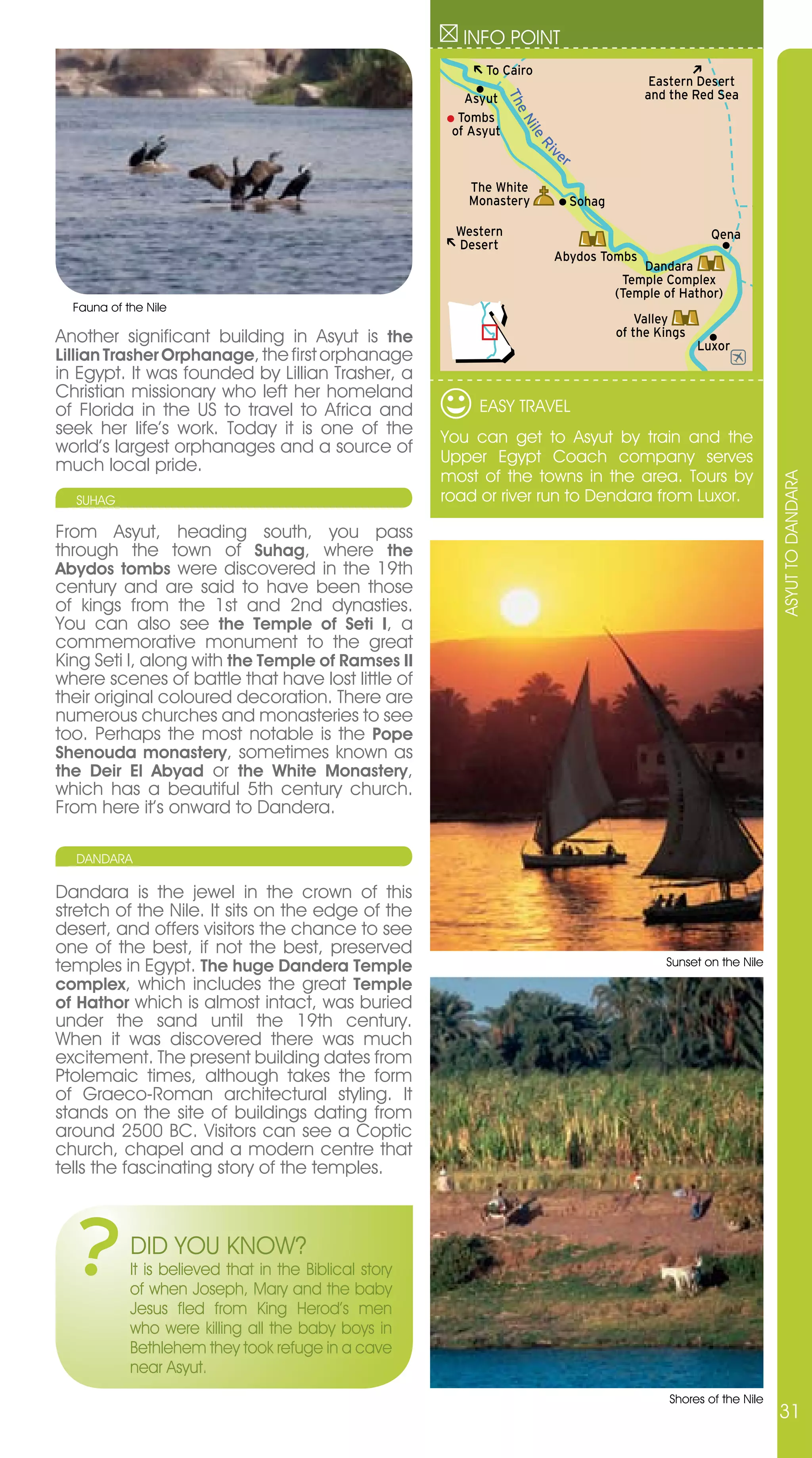
  Fauna of the Nile
                                                                                                 Valley
Another significant building in Asyut is the                                                 of the Kings
                                                                                                            Luxor
Lillian Trasher Orphanage, the first orphanage
in Egypt. It was founded by Lillian Trasher, a
Christian missionary who left her homeland
of Florida in the US to travel to Africa and                 EASY TRAVEL
seek her life’s work. Today it is one of the            You can get to Asyut by train and the
world’s largest orphanages and a source of
                                                        Upper Egypt Coach company serves
much local pride.
                                                        most of the towns in the area. Tours by


                                                                                                                           ASYUT TO DANDARA
  SUHAG                                                 road or river run to Dendara from Luxor.

From Asyut, heading south, you pass
through the town of Suhag, where the
Abydos tombs were discovered in the 19th
century and are said to have been those
of kings from the 1st and 2nd dynasties.
You can also see the Temple of Seti I, a
commemorative monument to the great
King Seti I, along with the Temple of Ramses II
where scenes of battle that have lost little of
their original coloured decoration. There are
numerous churches and monasteries to see
too. Perhaps the most notable is the Pope
Shenouda monastery, sometimes known as
the Deir El Abyad or the White Monastery,
which has a beautiful 5th century church.
From here it’s onward to Dandera.

  DANDARA

Dandara is the jewel in the crown of this
stretch of the Nile. It sits on the edge of the
desert, and offers visitors the chance to see
one of the best, if not the best, preserved
temples in Egypt. The huge Dandera Temple                                                            Sunset on the Nile
complex, which includes the great Temple
of Hathor which is almost intact, was buried
under the sand until the 19th century.
When it was discovered there was much
excitement. The present building dates from
Ptolemaic times, although takes the form
of Graeco-Roman architectural styling. It
stands on the site of buildings dating from
around 2500 BC. Visitors can see a Coptic
church, chapel and a modern centre that
tells the fascinating story of the temples.


            DID YOU KNOW?
            It is believed that in the Biblical story
            of when Joseph, Mary and the baby
            Jesus fled from King Herod’s men
            who were killing all the baby boys in
            Bethlehem they took refuge in a cave
            near Asyut.
                                                                                                      Shores of the Nile
                                                                                                                           31
Luxor Temple


Luxor and the East
Bank
To say Luxor is one of the world’s greatest cities is nothing
less than an understatement. It is, in fact, one of its most
astonishing, if not singularly the best, outdoor museum
anywhere on the planet and offers visitors the chance of
seeing almost a third of all the ancient antiquities known
to man in just a few kilometres. The temples and structures
that have stood for thousands of years are beautifully pre-
served.

Home to the city of Thebes, the ancient capital of
Egypt during the Pharaonic New Kingdom period,
along with the fabulous Karnak Temples, Luxor Temple
and the necropolis of the Valley of the Kings and the
Valley of the Queens, Luxor can trace its history back
to unimaginable times. It actually has three distinct
areas, the city centre on the East Bank of the Nile,
Karnak which is a town in its own right and lies just to the
north and Thebes, location of the Valley of the Kings.
                                                                            Luxor, Karnak Temple


                                                                The city is said to have
                                                                gained importance as
                                                                early as around 2000 BC
                                                                under the rule of the 11th
                                                                dynasty. In ancient times
                                                                it was known as Waset, a
                                                                name that indicated its
                                                                power, and later Thebes
                                                                under the Greeks. Homer
                                                                is said to have described
                                                                Luxor as the ‘City of the
                                                                Hundred Gates’. It was, for
                                                                a great many years, one of
                                                                the most important cities in
                                                                the world, and certainly at
                                                                the centre of political, eco-
                                                                nomic, religious and military
                                                                life of Ancient Egypt.

  Luxor Temple and the Nile corniche                             The Luxor of today is a com-
                                                                 pact city, running length-
                                                                ways along the banks of
           DON’T                                                the Nile and bordered by
           MISS                                                 the desert. Its population
                                                                stands at around 380,000
 The Sound and Light show at the Karnak Temples.                with a regular stream
 A narration in several languages, including English, French,   of    international     visitors
 Arabic and Japanese, tells the story of the temples to         increasing this figure during
 light and music. Also a day cruise from Luxor to Dandera       the spring and autumn
 or Abydos with sight-seeing and lunch.                         months when the tempera-
                                                                ture is at a pleasing level
for sightseeing. Temperatures of 31-40°C (107.6°F) in June to August are not uncommon.

Luxor’s size makes it easy to navigate. It’s a short hop of 20 minutes or so from the Luxor
International Airport into the city centre, which largely only comprises three main roads. The
corniche, a pretty tree-lined boulevard that runs along the banks of the Nile in an espla-
nade fashion, is central for all the city’s attractions. It is home to the Winter Palace Hotel,
now run by the hotel group Sofitel, that was where Agatha Christie is said to have penned
her classic work ‘Death on the Nile’.

The two other main roads are the street al-Mahatta in which lies the train station, and the
street al-Karnak that runs from the Karnak Temple into town past the Luxor Temple. For visi-
tors the size and layout of Luxor means that all the sites are within a short distance of each
other and easy to find.

Getting across from the East Bank or city centre to the West Bank to visit the Valley of the
Kings and the Valley of the Queens is now straightforward by road with the opening of a
bridge ten years ago. It’s just a few kilometres upstream. Before the bridge opened it was
very much a case of hopping on one of the frequent and inexpensive ferries or motorboats
that ran, and still do run, across the Nile. There’s a landing just opposite the Luxor Temple.


                                                                                                     LUXOR AND THE EAST BANK


                                                                       Ramasseum, Ramses II Temple

It’s a great way to cross the river. Visitors have a wealth of opportunities to sightsee in Luxor.
There are the two big attractions of the Luxor Temple and the Karnak Temples, of course,
plus the fabulous Luxor Museum and the Mummification Museum.

The Luxor Temple is an astonishing sight from the corniche. It is particularly attrac-
tive when subtlety lit in the evening. Dating from the time of Amenhotep II and Ramses
II, it is dedicated to the god Amon Ra and his wife Mut. You enter it from an entrance
facing north, at the point where at one time it would have been connected to the Karnak
Temples via a causeway. The causeway, which is currently being restored and is set to be
a highlight of Luxor, would have been lined with sphinx statues. A later addition was a long
road, a dromos, built by Nectanebo I in the 30th dynasty. Sadly, most of the sphinxes have
disappeared over the years, but a few exceptionally good examples still exist close to the
temple today.

Built during the New Kingdom, the temple is entered past a huge pylon built by Ramses
II, with two of the original six statues representing the king on either side. There is also the
remaining one of two matching 25-metre high granite obelisks. The other is erected in the


          DID YOU KNOW?
          The Arabs once dubbed Luxor the ‘City of Palaces’ because of the astonishing
          number of great buildings that were beautifully preserved.


                                                                                                     33
Karnak Temple

Place de la Concorde in Paris, and a much loved and photographed landmark.

Inside, there are courtyards, columns and fabulous colonnades, one a hundred me-
tres in length and built by Amenhotep III. Its columns are topped with carvings of the
papyrus plant. Along the way there are inscriptions, scenes from ancient Egypt and even
Roman stuccoes that can be seen partially covering ancient Egyptian hieroglyphics. On the
outer wall of the pylon are inscriptions that tell of the battle between Ramses II and
Hittites. The temple is a glorious celebration of the power of the pharaohs of the New King-
dom and a ‘must see’ sight.

Heading out of the Luxor Temple towards the next
‘must see’ sight, the Karnak Temples, you will reach the
Luxor Museum on the corniche. Be sure to go inside.
Quite modern in appearance, it was founded in 1975
to house antiquities dating from the ancient civilizations
of the area found in more recent times, including
some of the Tutankhamun treasures. While the Egyptian
Museum in Cairo displays ancient artefacts to
perfection, it is quite moving to see such extraordinary
items exhibited in Luxor, the city where they were found.

The Karnak Temples barely need an introduction, they are
so famous. The largest ancient religious site in the
world, the complex takes its name from the village of
Al-Karnak and, in fact, comprises three distinct temples.
The largest, the Precinct of Amun-Re, is ancient and
dedicated to the god Amon. It is the only area open to the
public. There is also the Precinct of Montu, the Precinct of
Mut and a now dismantled building, the Temple of Amen-
hotep IV. The triad of Luxor is Amun, Mut and Khonsu.
                                                                 Medinet Habu, Ramses III Temple
The site dates from as far back as 2000 BC and although building would have been
low key in the beginning it is said that around 30 pharaohs added buildings, tem-
ples, chapels and architectural wonders to it over a period of about 2,000 years from
the Middle Kingdom right through to Ptolemaic times. The result is a fabulous trea-
sure trove of ancient buildings and structures, columns, courtyards, pylons and
obelisks, even a sacred lake, the scale of which is unparalleled anywhere in the world.

At the entrance you pass over what is believed to have been a canal connected to the
Nile, complete with an ancient dock. Sadly, there is little remaining of the dock today.
The entrance road, dromos, is lined with a row of statues either side and is known as the
Avenue of Rams. The statues represent Amon and are beautifully preserved. Once inside
the building be sure to see the huge statue of Ramses II, one of the iconic images of the
Karnak Temples.
INFO POINT
                                                                                           Dandara
Other major sights to see on the East Bank of             Necropolis of
                                                        Valley of the Kings
Luxor include the Mummification Museum,
which is located right on the corniche. It has                           Hatshepsout
                                                                         Temple
a huge sign outside and is really easy to find.         Old Gurna                          Eastern Desert
Inside, there’s a graphic display of how the                             Valley of        and the Red Sea
                                                        Valley of       the Nobles
ancient Egyptians would mummify not only               the Queens       THEBES
humans, but also crocodiles, of which there                                               Karnak Temples
were plenty in the Nile, household pets and                         New Gurna          Luxor Museum
even fish. All are exhibited in mummified form,
                                                                                     Mummification Museum
including the body of Masaharta, a High Priest          Western
of Amun in Thebes around 1050 BC.                       Desert               Luxor      LUXOR
                                                                            Temple


                                                                       er
                                                                    Riv
In the museum you can also see examples
of the tools used to remove bodies’ vital or-          Khnoum


                                                                  ile
                                                       Temple


                                                               eN
gans and drain fluids, and to replace voids             Esna


                                                             Th
with salt, plus artefacts like embalming fluid,                          To Aswan
canopic jars and coffins. Like the Cairo Mum-
mification Museum inside the Egyptian Mu-                  EASY TRAVEL
seum, this is fascinating place but not one for


                                                                                                                LUXOR AND THE EAST BANK
the faint hearted.                                    Luxor is served by its international airport,
                                                      and has a good bus network which
                                                      is mainly used by locals, lots of taxis
Look out also for the oldest mosque in Luxor,         and horse-drawn carriages known as
the El-Mekashkesh Mosque, where it is said            caleches for getting around the city
to contain the remains of a 10th century              centre. Access from the East Bank to
Islamic saint, several churches and the great         the West Bank can be done by road
Coptic basilica next to Luxor Temple. For a lei-      using a modern bridge a few kilometres
surely way to see Luxor from the river, take a fe-    upstream or by ferry or motorboat across
lucca, which is a wooden sailing boat, or one         the river. A landing is located opposite
of the motorboats that can be seen making             the Luxor Temple. There are regular trains
                                                      and sleeping luxurious one that run from
their way up or downstream at most times of           Cairo to Aswan via Luxor. Wi-Fi service is
the day. The landing stages along the East            now available in Luxor.
Bank are the starting point for many of the
cruise ships that run to and from Aswan too.          To travel between Luxor and Aswan by
                                                      land, you will have to follow one of the
On the West Bank, the Valley of the Kings, the        Police Convoys.
Valley of the Queens and the Valley of the            Tourist Office :
Nobles, plus many other fabulous temples              Louxor (Head Office) :
and structures can be seen. Look out for the
                                                      Phone : 0952373294 - Fax : 0952373294
Madinet Habu Temple, which includes tem-
ples to Amenhotep I and Ramses III, the two
huge statues known as the Colossi of Memnon,
the funerary temple of Ramesseum and the
landmark temple to the great female pha-
raoh Hatshepsut, the elegant building known
as the Temple of Queen Hatshepsut at Deir
El Bahari.
Carved into the sheer limestone rock face,
the beautiful temple has three floors and a
long sweep of steps and a walkway as its en-


                                                                                            Hatshepsut Temple

                                                     trance. It is said to have been designed
                                                     by the pharaoh’s own architect Senen-
                                                     mut during the time of the 18th dynasty.
                                                     It makes an astonishing, almost haunting,
                                                     sight from the East Bank.
                                                     To one side of Hatshepsut’s temple are the
                                                     ruins of the Temple of Montuhotep II, while
                                                     to the other is the Shrine to Amun and the
                                                     Sanctuary of the Sun. A row of statues are
                                                     said to depict the queen, although ap-
                                                     pear in a male form. You can also visit the
                                                     Chapel of Anubis where the paintings and
                                                     reliefs on the walls and columns are fas-
                                                     cinating and retain much of their original
                                                     colour. They tell the story of Hatshepsut,
                                                     one of only three females to have ruled
                                                     Egypt.
  Luxor, the West Bank
                                                                                                                35
Medinet Habu and Ramses III Temple, Luxor West Bank


Valley of the Kings
and the West Bank
  VALLEY OF THE KINGS


The astonishing landscape of the Valley of the Kings with its sand dunes that stretch al-
most to the waters-edge of the Nile opposite Luxor to the high mountains is matched only
by the treasures the area has hidden for centuries, and may still even hide.

Many tombs have been discov-
ered, such as those of Tut Ankh
Amon (Tutankhamun), Ramses I,
Ramses II, Ramses III and Ramses
VI, Amenhotep II, Seti I, Sipteh,
Thutmose     III and Horemheb,
and their treasures displayed in
museums such as the Egyptian
Museum in Cairo or in the Luxor
Museum, but you can’t help but
wonder what other fascinating riches
are hidden underground just waiting
to be discovered. Over 60 tombs and
chambers are known to be in the
valley, but as excavations continue
and more tombs are found it is
believed there could be many more.
                                                               Deir el Medina Tomb, West Bank, Luxor

Of course, the pharaohs who chose the site as their graveyard and had astonishing
tombs built way underground thought the strategy would stop robbers from removing
the priceless treasures that were buried with them when they died. They believed in the
afterlife and by burying their possessions with them they would everything they needed,
materially, when they entered their new life. Sadly, most of the tombs were robbed over
time, with only a few having been discovered intact. The most notable of these is the
tomb of Tutankhamun.

The Valley of the Kings dates back to around the 16th to the 11th centuries BC as a ne-
cropolis of the Pharaonic Egypt’s New Kingdom dynasties. It is believed to have been
used for around 500 years, and is the resting place of the kings and other nobles of the
18th through to the 21st dynasties. In 1979 it was made a World Heritage Site and remains
one of the most important and famous archaeological sites in the world.

                              If visiting the Valley of the Kings from Luxor you will cross the
                              bridge over the Nile and pass by the villages of New and
                              Old Gurna (Qurna), which gives a fascinating glimpse into
          DON’T               how local residents have lived and farmed their land for
          MISS                centuries. Old Gurna, particularly, has a collection of bright-
                              ly painted mud houses that have stood for years. Some are
  The chance to see           today used as alabaster factories.
  alabaster delicately
  carved into vases and       The Valley of the Kings, itself, though is intriguing. Following
  ornaments in Qurna, on      the remote road through the valley (wadi) to the entrance
  your way to the Valley of   you will past barren sand dunes and hills. You then reach an
  the Kings.                  interesting information centre from where you can hop on a
                              small train provided for visitors that eases the sun-scorched
INFO POINT
walk to the first of the tombs enormously, and
                                                       Necropolis of                    Dandara
then you are at the heart of the valley. It is       Valley of the Kings
here that most of the more significant tombs
                                                                      Hatshepsout
are located.                                                          Temple
                                                    Old Gurna                           Eastern Desert
                                                                      Valley of        and the Red Sea
To the right is the tomb of Tutankhamun,             Valley of       the Nobles
numbered KV62, and almost everyone who              the Queens       THEBES
                                                                                       Karnak Temples
visits the valley will wish to enter the boy
pharaoh’s last resting place. The tomb was                      New Gurna           Luxor Museum
discovered in November 1922 by British ar-                                        Mummification Museum
chaeologist Howard Carter, who spent days,           Western
                                                     Desert               Luxor      LUXOR
months, years in his search for the tomb.                                Temple


                                                                    er
Carter’s small domed house where he lived


                                                                 Riv
during this time can still be seen as you jour-


                                                                                                           VALLEY OF THE KINGS AND THE WEST BANK
                                                    Khnoum


                                                               ile
ney to the valley.                                  Temple


                                                            eN
                                                     Esna


                                                          Th
                                                                      To Aswan
When Carter found steps leading to the
tomb and then an antechamber full of gold
and ivory treasures it caused worldwide ex-             EASY TRAVEL
citement. He then went on to find a sealed         The Valley of the Kings is easily reached
door which, when opened, contained the             from Luxor by car or guided tour bus. A
outer sarcophagus of Tutankhamun. He was           little train takes you from the entrance
buried in coffins one inside the other. Some       gate and information centre to the heart
were solid gold, others wood with gold. The        of the valley.
treasures are now contained in the Egyptian
Museum in Cairo, and include the sarcoph-         Another tomb, that of the Pharaoh
aguses, jewellery, smaller sarcophaguses for      Akhenre Setepenre Siptah (KV47) of the
his organs that would have been removed           19th dynasty, is one of the longest in the
during the mummification process and the          Valley of the Kings, however his mummy
iconic gold death mask that is the image of       was oddly discovered in the tomb of
ancient Egypt.                                    Amenhotep II (KV35) in 1898.
The tomb, itself, is quite small and undeco-      A visit to the Valley of the Kings is an ab-
rated, but the tombs of other pharaohs, like      solute must on any agenda, and the fact
Ramses I and Ramses III, for example, are         that it is so easily accessible from Luxor
highly decorated and colourful. These lie to      city centre where there is a good choice
the left of Tutankhamun’s tomb.                   of hotel accommodation makes a family
You enter by stairways that lead down             excursion straightforward. Tickets include
past extraordinary wall paintings and             visits to many tombs, although King Tut-
hieroglyphics. The colours yellow, orange         ankhamun’s is extra. Many guided tours
and red feature strongly, and are so bright       include a visit to the nearby Valley of the
it is hard to imagine that they were              Queens too, and perhaps even the Val-
drawn so many centuries ago.                      ley of the Nobles, which lies just to the
                                                  south of the Valley of the Kings and con-
The Tomb of Ramses I (KV16), the second           tains hundreds of tombs of high officials
pharaoh of the 19th dynasty, is particularly      of the day. Nearby, too, is Deir El-Madi-
enchanting, as is the Tomb of Ramses III          na, where there are the tombs of artisans
(KV11), which was discovered in the 18th          and workmen who worked on the kings’
century. It is known as The Harper’s Tomb af-     tombs. It dates from the Ptolemic era.
ter drawings depicting musicians were found
inside. It is sometimes known as Bruce’s Tomb
too, after the man, James Bruce, who dis-
covered it.


         DID YOU KNOW?
         The Curse of the Pharaohs, a
         phenomenon said to be be-
         stowed on anyone who disturbs an
         ancient Egyptian mummy, origi-
         nated after many of Howard
         Carter’s archaeological team
         were said to have contracted
         lethal diseases and viruses when
         opening Tutankhamen’s tomb.
                                                                                       Hatshepsut Temple
                                                                                                           37
Aswan, Felucca and the Aga Khan Mauso-
                                                                       leum on the West Bank


Aswan
Aswan is Egypt’s southernmost city and lies, like Luxor and Cairo, on the shores of the Nile
River, at its first cataract. To its north lies some 750 miles of the Nile until it reaches the Nile
Delta and the Mediterranean Sea. What sets this beautiful city apart from Cairo and Luxor,
however, is that its buildings occupy only the East Bank and two islands in the river, with
its barren West Bank’s sand dunes, literally, on the watersedge. The West Bank has only a
handful, albeit supremely notable, structures including the Monastery of St Simeon, the
Aga Khan Mausoleum and the Tombs of the Nobles.

Aswan is located roughly where the Western Desert and
the Eastern Desert meet, and just north of the great
expanse of water created by the Aswan Dam known as
Lake Nasser. Aswan has a gorgeous winter climate and is
a popular sun resort from November through to March with
Egyptians as well as international holidaymakers. Tempera-
tures tend to be around 22-32°C (89.6°F).

Hugely attractive, Aswan is the busy market centre of the
region. In fact, its ancient name of Swenet, if translated
literally from symbols of the time, means ‘trade’. It can
trace its history back to ancient times when it is believed to
have been the site of the very first Egyptian community.
Its people had moved from the desert dunes to the fertile
banks of the Nile in search of a supply of water, fish and
land on which to grow produce. They would then trade their
goods and so its reputation as a trading centre developed.
                                                                                            Bazaar

As Swenet, the city had the important role of protecting Egypt from invaders at its southern-
most boundary. In Pharaonic Egypt times, during it is believed every dynasty, the city was a
military town. Its stone quarries are said to have provided the granite rock known as Syenite
for most of the fabulous temples, columns and obelisks built by the pharaohs, including
the Pyramids of Giza.

Today, Aswan is characterised by its abundance of palm trees and tropical gardens,
standing beside one of the widest parts of the Nile River. As such, it has many islands
dotted off its shores. Two of the largest are Kitchener’s Island, known for being covered with
exotic plants, and the much larger Elephantine Island.

                                          Kitchener’s Island lies mid-stream and is so called
          DON’T                           because it was given to Lord Kitchener in recog-
          MISS                            nition of his services to the Egyptian army during
 The Unfinished Obelisk, an               the Sudan Campaign of the late 1800s. A keen
 important relic from the New             horticulturist, Lord Kitchener created an island of
 Kingdom because it clearly               fantastic trees and plants. In fact, it would not be
 shows how the ancient Egyptians          inaccurate to call it a botanical exhibition. Many of the
 created such structures.                 species were imported from around the world, and
                                          include huge palms where birds nest. Today, it is one
INFO POINT
of the loveliest places along the Nile and a                                     Kitchener’s   To
great place to relax. You can hop across on                  Tombs of the Nobles    Island     Luxor
a boat and go ashore to take advantage of                   Monastery of
                                                                            Elephantine Island
                                                              St Simeon
the shade.                                                                                  ASWAN
                                                        Aga Khan Mausoleum           Aswan Museum
The much larger Elephantine Island can
trace its history back to ancient times when,                                              Nubian Museum
                                                       Western
as a fort, its role was to defend the city.            Desert
                                                                                                  Eastern Desert


                                                                                r
It marked the southern border with Nubia.


                                                                   The Nile Rive
                                                                                                 and the Red Sea
Dotted around the island are reminders that
it once was home to many people, in fact it
is believed to have been one of the oldest
inhabited areas of the city.
                                                                          Aswan Dam
There are the remains of the temple                   To High Dam
                                                                                     Lake
                                                     and Abu Simbel
dedicated to Khnum, the ram-headed god of                                           Nasser      Philae Temple
the cataracts, which dates from the Old King-
dom. You can also visit the Aswan Museum
where there is a fascinating collection of arti-          EASY TRAVEL
facts from the Graeco-Roman period on dis-           The local carrier EgyptAir operates regu-
play, and see the Roman Nilometer, the de-           lar flights to Aswan, express trains, and
vice used to establish the level of the Nile. This   luxurious sleeping ones link the city with
one in particular was also used to assess the        Cairo and Luxor. Aswan is a popular start-
circumference of the earth in around 200 BC.         ing and disembarkation point of the Nile
                                                     cruise ships that are as much a part of
The great Philae Temple (dedicated to                Egypt as the pyramids. Luxury cruises go
the goddess Isis), was dismantled and


                                                                                                                         ASWAN
                                                     from Aswan to Abu Simbel too. Aswan
reconstructed on Agilika Island after Aswan          has a plentiful number of taxis and cars
dam was constructed.                                 available for hire.

The Nubians, renowned for their love of              Tourist Office :
festivals and colourful dress, lived on the          Aswan (Head Office) :
shores of the Nile as they had done for              Phone: 0972312811 - Fax: 0972312811
centuries until quite recently. In fact, the
area is widely believed to be where the first
Nubian civilization lived as far back as 2000
BC. The Nubian Musuem in well worth a visit to
have a better idea about this rich culture.

Modern day Egyptian Nubians moved to
Aswan, along with Cairo and Luxor, when the
Aswan Dam was built and huge areas of the
desert became Lake Nasser.


                                                                                      Elephantine Island, Khnum Temple


                                                                 DID YOU KNOW?
                                                                 Aswan offers a sightseeing
                                                                 programmes that takes in
                                                                 the High Dam, the Unfinished
                                                                 Obelisk and the Philae Temple,
                                                                 plus sailing with a Felucìa. Also
                                                                 see the great bazaar in Aswan,
                                                                 the Sound and Light Show in
                                                                 Philae and the Museum of
                                                                 Nubian Civilization.
  Nubian village, West Bank
                                                                                                                         39
Abu Simbel, Ramses II Temple


Abu Simbel
  ABU SIMBEL

The stretch of the Nile Valley that runs from Aswan, past the great Philae Temple dedicated
to the goddess Isis, which was dismantled and reconstructed on Agilikia Island before its
former site, Philae Island, was flooded when the old dam was constructed, onwards past the
Aswan Dam and the huge manmade lake, Lake Nasser, comes to a halt at Abu Simbel. The
town is around 280 kilometres from Aswan and some 100 kilometres from the Sudan border.

Abu Simbel is best known for its two
magnificent temples that were origi-
nally carved out of solid rock on a
mountainside way back in the 13th
century BC. An UNESCO World Heri-
tage Site, they are known as the Nubi-
an Monuments and dedicated to the
great deities of the day Ra-Horakhty or
Horus, Ptah and Amun. They were built
to honour the great pharaoh Ramses
II and his wife Nefertari.

Such was their historical importance
and the glimpse they gave the world
of an ancient civilization that when
the new dam was built to regulate
the waters of the Nile, and create
the massive Lake Nasser, the tem-
ples were the subject of much dis-
cussion. A subsequent rise in water
levels threatened to submerge them.
A mammoth project to save the
temples was conceived and work
began in the early 1960s.
                                                                                       Abu Simbel
UNESCO stepped in with expert knowledge of ancient buildings, as well as funds created
largely from international donations, and managed the project to relocate them to a hill high
above the water level of the new lake. The project was a lengthy, but highly successful, one.
Massive blocks of rock were cut, dismantled and reassembled over a period of several years.

                                          The temples were, literally, cut from the mountainside
                                          and moved to higher ground. They were positioned
          DON’T                           against manmade semi domes so that the statues on
          MISS                            the front facades looked out over the waters as they
 The Sound and Light show at the          have done for centuries.
 Abu Simbel temples. Through
                                          The temples, known as the Great Temple of Abu
 narration, lights and sounds the         Simbel for Ramses II, and the Small Temple of Abu
 wondrous story of Abu Simbel is told.    Simbel for Nefertari, date back to Pharaonic Egypt
 Also the fabulous sights that can be     and the reign of Ramses II. As the story goes, he want-
 seen on a cruise between Aswan           ed to create a lasting monument to his reign, and that
 and Abu Simbel: Kalabsha, Wadi           of his queen Nefertari. A victory at the Battle of Kadesh
 El-Subua, Amada, Qasr Ibram.             proved the perfect opportunity to build the complex.
                                          It is believed that work started on the great temple in
INFO POINT
the mid-1200s BC and took around 20 years
                                                           To Aswan, Luxor                      Aswan
to complete. The smaller temple’s construction                                  Kalabsha         Dam
started a little later.                                Western
                                                       Desert                            Eastern Desert
At the entrance to the largest temple there are                                         and the Red Sea
four mighty statues of Ramses II in which he
can clearly be seen wearing the double crown
of the Upper Egypt and Lower Egypt regions.
They are some 20 metres high and, astonish-
ingly, were delicately carved from the rock of                                       Lake Nasser
the mountainside where they originally stood.
Sadly, one is badly damaged, but it does not                                  Wadi El Subua
distract from their magnificence. The temple’s
frieze is way above their heads.                                       Qasr
                                                                      Ibram Amada
                                                         Tushka
There are various scenes of battle, including                           ABU SIMBEL
one of Qadesh that show Ramses II’s victories.                   Great Temple for Ramses II     To Sudan
There are many statues within the complex,                       Great Temple for Nefertari
including those depicting his wife Nefertari, his
sons and daughters, and the deities to which
the temple is dedicated. The temple was, in               EASY TRAVEL
fact, built on an east-west axis so that the early   EgyptAir flies to Abu Simbel’s small airfield
morning sun reached the inside of the temple         daily from Cairo and Aswan. Guarded
and shone on some of the statues it contained.
This is particularly evident on February 22 and      convoys of buses and cars depart twice
October 22 every year. The smaller temple            a day from Aswan.
to Nefertari, sometimes referred to as the
Temple of Hathor, stands 50 or so metres


                                                                                                                 ABU SIMBEL
from the great temple. It is beautifully
decorated with scenes of Ramses II and his
wife making sacrifices to the gods, as well as
statues showing the pharaoh and Nefertari.

Interestingly, unlike other statues from ancient
Egypt where a pharaoh is depicted with his
queen, the statues are the same size. Tradition-
ally, the queen was always at knee height to
the pharaoh.

At the time they would have been important
monuments, but as subsequent dynasties took
the reign, and invaders from around the world
made their mark on Egypt, the temples of Abu
Simbel became all but forgotten. Over many
centuries the winds of the desert whipped up
the sand until eventually the temples were cov-                                            Temple of Ramses II
ered. In 1813, the temples were discovered
lying under a massive layer of sand by the fa-
mous Swiss traveller Johann Ludwig Burckhardt.
He spotted the top frieze of the largest temple
and so began the work to unearth them.

Today, they are one of the top tourist attrac-
tions in Egypt, and widely considered the
greatest temples ever built to honour Ramses
II. Escorted buses and coaches full or visitors
arrive daily from Aswan.


                                                                                                   Abu Simbel


                                                              DID YOU KNOW?
                                                              As legend has it, Abu Simbel
                                                              was a young boy who, having
                                                              had glimpses of the buried
                                                              temples when the sands
                                                              moved, had guided travellers
                                                              to the site.
  Temple of Hator
                                                                                                                 41
The Nile River


Planning the trip
Egypt, and especially the Nile Valley, has so many wonderful sights to see it would be
impossible to do everything on one short trip. A first visit to Cairo will almost inevitably
mean you will wish to see the Pyramids of Giza, the Sphinx and the Egyptian Museum,
while a visit to Luxor would not be complete without going to the Karnak Temples, the
Luxor Temple and of course, the fabulous Valley of the Kings.

Many people will choose a holiday featuring several destinations. For example, you
may stay a day or two in Cairo, take the short 45-minute flight to Luxor for a few more days
and then, maybe, board a cruise boat for a trip up the Nile to Aswan. There are flights
from Aswan directly back to Cairo. Alternatively, a trip to the Nile Valley may be extended
with a visit to an oasis in the Western Desert, to the Red Sea coast or to Sinai. We offer
suggestions for the ‘must see’ sights and excursions :

  ALEXANDRIA AND THE NORTH COAST

Alexandria is a great summer holiday
destination. Be sure to visit Montazah
Palace, once the summer home of the
Egyptian royal family. It houses a museum
and has a great view of the coastline
and sea (Allow 2 hour). Visit the Graeco-
Roman Museum, located in the heart of
the city (Allow 2 hour) and the Qaitbay
Citadel, built on the site of the Lighthouse
of Alexandria, one of the Seven Wonders
of the Ancient World (Allow 1 to 2 hours
to appreciate the atmosphere of the
waterside and maybe have some lunch).

You can then head out to one of
Alexandria’s archaeological sites, such
as the Roman amphitheatre at Kom
Al-Dekka, Pompey’s Pillar, the ancient
catacombs at Kom el Shoqafa or the Al-
Shatby Necropolis site. All are within easy
                                                                              Qaitbay Citadel
reach and make great detours. Choose the
ones you prefer, look them up on the map,        A pleasant excursion from Alexandria
and then allow good time to appreciate           would be a visit to El-Alamein to visit
their ancient history (Allow 3 to 4 hours).      the war museum that tells of the area’s
                                                  Legende
Finally, no visit to Alexandria would be         role in the Second World War, and the
complete without a visit to the Bibliotheca      Commonwealth War Cemetery or the
Alexandrina. It may be something you             Italian and German cemeteries (Allow 1
would wish to do on a first visit or a second,   day). Rosetta, or Rashid, is another great
but you should allow plenty of time in your      excursion. Located around 60 kilometres
schedule to see the massive libraries,           east of Alexandria, it was where the
the art galleries, museums dedicated to          Rosetta stone was discovered in 1799.
antiquities, manuscripts and science, and        The stone was instrumental in deciphering
its planetarium (Allow 1 day or 3 hours for      the ancient Egyptian hieroglyphic style of
a quick visit).                                  writing. (Allow a half day).
CAIRO AND GIZA                                 Take time to explore Central Cairo. It has
                                                 the Corniche el-Nil that runs alongside
                                                 the Nile, which makes a pleasant morning
                                                 walk. You can cross to Gezira Island and
                                                 go up the Cairo Tower for a panoramic
                                                 view of the city, or visit the 19th century
                                                 Opera Square and Ataba square, or
                                                 the Manial Palace (Allow 1 day). In the
                                                 evening head for the new Opera House
                                                 for a spot of classical music, opera,
                                                 theatre or ballet.

                                                 The Egyptian Museum is home to one of
                                                 the largest collection of ancient Egyptian
                                                 antiquities in the world. You could spend
                                                 a few hours here and see only a fraction
                                                 of the 250,000 or so antique pieces
                                                 on display, including the famous Tut
                                                 Ankh Amum (Tutankhamun) collection
                                                 of treasures. There are mummies and
                                                 tombs, ancient architectural pieces, an
                                                 embalming table and a replica of the
                                                 Rosetta Stone in the foyer (Allow 2 hours
                                                 to several days).


                                                                                                 PLANNING THE TRIP
  The Pyramids of Giza                            East of Central Cairo is the Islamic part
                                                  of the city, where you will find the famous
Cairo is a city where you would get a            network of streets of the Khan el-Khalili.
glimpse of its wonders in just a day or so.      It is the largest bazaar in the Middle
Conversely, you could spend days in the          East and one of the oldest markets in
Egyptian Museum alone. You may even              the world. You can buy everything from
wish to spend several weeks in the city          spices to gold, copper and silver pieces,
to really explore its fabulous streets and       fashions, leatherwear and traditional
sights. Top of the list will almost inevitably   Egyptian musical instruments (Allow 1 to
the Pyramids.

The Pyramids of Giza stands to the
west of Central Cairo, as they have for
centuries. The site is not far from those
of the ancient cities of Memphis and
Saqqara. The Pyramids, including the
Great Pyramid built for pharaoh Cheops
of the 4th dynasty, the slightly smaller
Pyramid of Chrephren dated from
around 2500 BC and the Pyramid of
Mykerinos, plus several smaller ones for
the kings’ families, are the last remaining
Seven Wonders of the Ancient World.
You can go inside the Great Pyramid
and Chephren’s Pyramid. From here it’s a         2 hours).                 The Egyptian Museum
short hop by vehicle to the Sphinx (Allow
3 hours in total). If you plan to visit the      Old Cairo has some of the most historic
Solar Boat Museum that houses a full-size        and important Christian buildings and
ancient Egyptian boat allow a bit extra          churches in the city, including the Church
time, say around a further half hour.            of St Barbara, one of the largest in Egypt,
                                                 the Church of St George and the oldest
Don’t miss Saqqara and The Step                  the Church of St Sergius. There’s also the
Pyramid of Zoser.                                enchanting Ben Ezra Synagogue, the
                                                 Amr Ibn al-As Mosque and the beautiful
                                                 Hanging Church, so called because it is
                                                 built high on top of the old Roman fortress
                                                 structure, the Babylon Fort. The Coptic
                                                 Museum has one of the finest collections
                                                 of Coptic art in the world dating from
                                                 Pharaonic times to Graeco-Roman and
                                                 Islamic. The little alleyways of Coptic Cairo
                                                 are a delight to explore (Allow 2 hours).

                                                 Don’t miss the El Fayoum oasis in the
                                                 Western Desert, including Lake Qarun and
                                                 some fine monuments, the remains of the
                                                 Hawara Pyramid built by Amenemhat III.
  Saqqara Pyramid
                                                                                                 43
Islamic Cairo, Sultan Hassan Mosque

  LUXOR

Luxor is, arguably, the finest outdoor           crocodile and fish, plus tools used to
museum in the world. Depending on                remove bodies’ vital organs and drain
your depth of fascination with ancient           fluids, embalming fluid, canopic jars
Egypt, you could spend hours, days               and coffins (Allow 2 hour). Take time
or even weeks exploring its fabulous             to explore the East Bank of Luxor too.
temples, visiting the Luxor Museum full of       See the Winter Palace Hotel where
ancient antiquities and seeing the tombs         Agatha Christie is said to have penned
of the Valley of the Kings.                      her classic work ‘Death on the Nile’,
                                                 the El-Mekashkesh Mosque and the
The Karnak Temples is the largest ancient        great Coptic basilica next to Luxor Temple
religious site in the world. Visitors can see    (Allow 2 hours).
the Precinct of Amun-Re, the only area
open to the public. There are three other
areas, the Precinct of Montu, the Precinct
of Mut and the now dismantled building,
the Temple of Amenhotep IV. It is a
fabulous collection of ancient buildings
and structures, columns, courtyards,
statues including one of Ramses II with his
wife Nefertari, pylons and obelisks, even
a sacred lake. The entrance dromos is
lined with a row of statues both sides, and
is known as the Avenue of Rams. It is a
‘must’ (Allow 2 hours).

The Luxor Temple, located right on the
corniche, and wonderful lit up at night,
can be easily combined with a visit to the
Karnak Temples. They lie along the same
road within a short distance of each other.
Dating from the time of Amenhotep II and                         Ramasseum, Temple of Ramses II
Ramses II, the temple has pylons, statues,
columns and fabulous colonnades, one             The Valley of the Kings on the West
a hundred metres in length and built by          Bank of Luxor at Thebes is easy to reach
Amenhotep III himself, courtyards and an         by a bridge a little way upstream. Allow
obelisk. It is a twin. The other is erected in   about 30 minutes or so for the journey by
the Place de la Concorde in Paris. There         vehicle and schedule in more time if you
are also some good examples of Roman             wish to take an excursion to the bank’s
stuccoes (Allow 2 hours).                        other main sights, the Madinet Habu
                                                 Temple, the two huge statues known
Allow some time to visit the Mum-                as the Colossi of Memnon, the funerary
mification Museum on the corniche.               temple of Ramesseum and the Temple
On display are a mummified human,                of Queen Hatshepsut at Deir El Bahari.
CRUSING ON THE NILE AND LAKE NASSER


                                                CRUSING ON THE NILE
                                                AND LAKE NASSER
                                            A great way to relax and see the sights
                                            is to take a cruise along the Nile or a sail
                                            around Lake Nasser. From the decks of
                                            a felucca, a traditional wooden sailing
                                            boat, or a luxury boat you can see many
                                            temples along the way. On the shores
                                            of Lake Nasser, for example, there’s the
                                            wonderful sight of the Great Temples of
                                            Abu Simbel for Ramses II and the Small
                                            Temple of Abu Simbel for Nefertari, which
                                            date back to Pharaonic Egypt and the
                                            reign of Ramses II. They were moved in
                                            an UNESCO project to their present site
                                            when the Aswan Dam caused water levels
                                            to rise and they were in danger of being
                                            submerged under the water. They were,


                                                                                            PLANNING THE TRIP
                                            literally, carved out of the mountainside
                                            (Allow 2 to 3 hours). Motorboats take
                                            visitors on shorter trips too.

                                            Luxor’s East Bank is the spot where most
                                            of the cruise ships leave for their trip to
                                            Aswan. The sight of the cruise ships or
                                            ornate steamers, many affording top
                                            notch luxury facilities, making their way
                                            upstream is a familiar sight. They have
                                            comfy air-conditioned guest suites,
                                            often complete with King-size beds, and
                                            gourmet restaurants and bars on board.
                                            From Luxor you will pass by the Valley of
                                            the Kings to Esna, on through Edfu and
                                            Kom Ombo where you will see the Temple
                                            of Sobek and Hareoeris, and on to Aswan.
                                            Cruise ships also start at Aswan and so the
                                            journey will be in reverse. At Aswan you
                                            will see Elephantine Island, which once
                                            marked the southernmost border with
                                            Nubia, and the beautiful Kitchener’s Island
                                            full of exotic plants. They lie in the centre
                                            of the river. Cruising is a wonderful way to
                                            see the stretch of the Nile between Luxor
                                            and Aswan (Allow from 3 to 4 days). If you
                                            wish to continue your cruise experience,
                                            take a boat from Aswan to Abu Simbel.
                                            You will see some wondrous sights like the
                                            Temple of Wadi El-Subua and the Temple
                                            of Amada along the way.


You may also like to stop awhile at the villages of New and Old Gurna (Allow 3 hours).
Once at the Valley of the Kings you could spend hours.

The Valley of the Kings dates back to around the 16th to the 11th centuries BC as a
necropolis of the Pharaonic Egypt’s New Kingdom dynasties. It is approached through a
barren landscape of sand dunes and hills until you reach the centre of the valley. Here
you will be able to visit several tombs, including that of Ramses I and Ramses III, plus
probably the most famous of all the tomb of Tut Ankh Amon (Tutankhamen) discovered
in 1922 (Allow 3 hours).
                                                                                            45
Practical Info
  ENTRY AND DEPARTURE                              INFORMATION AND BOOKING

Visitors will need a single-visit visa to en-    Flying to Egypt, and in particular the
ter Egypt. The visa is valid for 90 days. If     Nile Valley, is relatively straightforward.
the planned trip involves travel in and out      The main airline, EgyptAir (www.egyptair.
of Egypt over the same period, then the          com), runs a regular and efficient service
best option is a multiple-visit visa. Obtain-    to Cairo, Alexandria, Luxor and Aswan
ing a visa is pretty straightforward. It can     from airports around the world. It also
simply be arranged in advance through            provides inexpensive domestic flights.
one of the Egyptian consulates dotted            Some visitors can arrive by road or by
around the world or purchased on entry           sea. Cruise ships often make Egypt a key
at Cairo or Luxor airports. All visitors will    stop on their itineraries. Booking holidays
need to have a passport which must               or short trips to Egypt is easily done via
have at least six months remaining of its        links from the Egyptian Tourist Authority’s
validity on the date of entry. Egypt, like all   website (www.egypt.travel) online direct
other countries, apply strict customs rules      with local agents or by visiting your near-
about bringing items such as alcohol and         est travel agent.
cigarettes into the country, so to avoid
any misunderstandings it is probably ad-
visable to buy at an airport shop. Under           COMMUNICATIONS
no circumstances should you attempt to
leave the country with antiquities.              Egypt has embraced internet services
                                                 and now it is easy to go online at hotels,
                                                 offices and internet cafes. Egypt has Wi-
                                                 fi – Wimax wireless internet that enables
  HEALTH
                                                 you to access the internet in most of the
There are no vaccinations needed to visit        popular places in the country, particularly
Egypt. Sunburn and dehydration can be            around Luxor. The telephone system is ef-
avoided by using plenty of sun cream,            ficient and visitors should have no prob-
wearing light cotton clothing and a hat,         lem in finding public phones that take
and drinking lots of water. The health care      cards. You can buy visitor mobile cards
facilities in Egypt are generally good and       that enable you to use your mobile. The
it is advisable to have health insurance.        bright yellow and green half booths fa-
                                                 voured by one of the leading telecom
                                                 providers, Menatel, are usually easy to
  CLIMATE
                                                 spot. Cards are available from most
                                                 newspaper stalls and shops showing the
The Nile Valley region stretches nearly          Menatel sign and come in 10 and 30
1532 kilometres and as such the weather          denominations for local and international
can differ quite considerably from               use. You can buy stamps and post your
Alexandria on the coast in the north,            letter at post offices or from your hotel.
along the river to Luxor, Aswan or Abu           Post offices are closed on Fridays.
Simbel further south. Generally, though,
the climate in the Nile Valley is moderate
with lots of sunshine and very few rainy           ELECTRICITY
days, unlike the desert areas that have
                                                 Egypt’s electricity works on 220v with sock-
much hotter temperatures. The best
times to go are from mid-April onwards           ets being of the two-pin European main-
and May or September and October,                land variety. It’s a good idea to pack an
November when the temperatures are               adaptor if planning to use personal items
lower, therefore making it easier to sight-      like mobile phone chargers.
see and explore. Between the months
of July and August the sun is at its
                                                   LANGUAGE
hottest. Average temperatures in Cairo
are around 25-35°C (95°F), while in Luxor        The official language of Egypt is Arabic
they are 30-40°C (107.6°F) and in Aswan          and other languages are widely spoken
hotter still at 31-42°C (107.6°F).               too, especially in tourist areas.
air. There are long distance buses and
  Cruising the Nile
                                                  trains available which are cheaper,
                                                  but of course take much longer to
                                                  reach their destination. Travel within
                                                  cities is probably best done by taxi or
                                                  minibus, although car hire is an option.
                                                  Hire a car with a guide by the day,
                                                  which is a good idea if you have a tight


                                                                                                 PRACTICAL INFORMATION
                                                  schedule and want to see all the sights.
                                                  If planning to go into the desert it is a
                                                  must to take a guide to avoid becoming
                                                  disorientated. Cairo also has an
                                                  underground rail system, which is a good
                                                  way to travel around the city.

                                                    PUBLIC HOLIDAYS
  MONEY AND CREDIT CARDS
                                                  Holidays include the Coptic Christmas in
The currency of Egypt is the Egyptian             January 7, Labour Day in May 1, Revolution
pound, which is divided into 100 piasters.        Day in July 23, Armed Forces Day in
Cash is generally easily obtained from            October 6. The Islamic New Year, the Birth
ATMs, which can be found in larger towns          of the Prophet and Ramadan, the major
and cities. Most of the major hotels and          religious period of fasting that precedes
stores accept credit cards, such as Visa          the Bairam Feast, change every year.
and Mastercard, along with travellers’
cheques and certain foreign currencies
                                                    BUSINESS HOURS
like euro, sterling and dollars. If venturing
off the beaten track you will find that gen-      Government, administrative offices and
erally only the Egyptian pound in cash will       Banks are generally open from 9am
be accepted.                                      to 2pm each day, except for Fridays,
                                                  Saturdays and public holidays. Most shops
  SPORTS                                          are open from 10am to 10pm every day
                                                  except Sunday. Please note that all these
While other areas of Egypt are synony-            times may vary in shopping centres and
mous with scuba diving and snorkelling,           during Ramadan. Most historic sites and
such as the Red Sea resorts of Hurgha-            museums are open from 9am to 5pm
da, El Gouna, Marsa Alam, Dahab and               daily, and often until 6pm in the summer.
Sharm el-Sheikh in Sinai, the Nile Valley is
known for its balloon trips over the Valley         PRACTICAL NUMBERS
of the Kings, its excellent golf courses,
particularly in and around Cairo and              - Tourist Police                        126
Luxor, and its felucca sailing opportunities.     - Fire                                  180
For the energetic there’s horse and               - Ambulance                             123
camel riding, organised hikes and safa-
                                                  - Telephone guide                       140
ris, while for those who like to take it really
slow there’s some superb spas just waiting        - Cairo Airport Shuttle Bus service
to be enjoyed.                                                                          19970
                                                  - Flying hospital service         37766393/2
  TIME

Egypt is two hours ahead of GMT,                  - Information tourist offices :
except at the start of May and the end of         * Cairo                             391 3454
September when it is three hours ahead            * Pyramids                          383 8823
until the beginning or end of British Sum-        * Alexandria                        485 1556
mer Time.
                                                  * Marsa Matrouh                     493 1841
  TRANSPORT
                                                  * Luxor                             237 2306
                                                  * Aswan                             231 2811
As Egypt is such a vast country the best
way for holidaying visitors who may have
a limited amount of time to explore
is to travel from one city to another by
                                                                                                 47
Accommodation

Hilton Luxor Resort & Spa
Whether you plan a stay in a fabulous five-star or four-star hotel, a float-
ing hotel on the River Nile or you are set to enjoy a backpacking experi-
ence with overnight stops along the way you can expect an increas-
ingly high standard of facilities in Egypt. The country enjoys a high level


                                                                                                      ACCOMMODATION
of amenities and comfort at exceptional value-for-money.

                                                            With its history dating back to ancient
                                                            civilisations, its world-class archaeo-
                                                            logical sites, landmarks like the Pyra-
                                                            mids of Giza and the Valley of the
                                                            Kings, its deserts, diving waters and
                                                            vibrant resorts along its coastline,
                                                            Egypt attracts visitors from every cor-
                                                            ner of the globe. Whether visitors opt
                                                            for a top class luxury hotel in Alex-
                                                            andria or along the Mediterranean
                                                            Coast, the Nile Valley’s Cairo, Luxor
                                                            or Aswan, at one of the fabulous re-
                                                            sorts in the Red Sea and Sinai regions
                                                            or choose a specialist venue like a
                                                            spa centre, a boutique or historical
                                                            hotel, an ecolodge, golf resort or a
                                                            desert camp, the hotels in Egypt ca-
                                                            ter for all tastes and budgets, mak-
                                                            ing visitors’ stays a memory that will
                                                            last a lifetime.

               Marriott, Italian Restaurant, Taba Heights
                                            Visitors to Egypt have lots of choice
when deciding where and in what type of accommodation to stay. In the luxury
and historical sector of the market there’s the former hunting lodge the Mena
House Oberoi overlooking the Pyramids, or the 19th century Cairo Marriott that
opened at the same time as the Suez Canal, the five-star Sofitel Old Cataract,
one of ‘Death on the Nile’ writer Agatha Christie’s favourite hotels and one of
Egypt’s most famous. It is located on the banks of the Nile at Aswan. In Luxor,
the Sofitel Winter Palace is a landmark five-star hotel next to the Nile. You get a
great view of the Valley of the Kings on the opposite of the river. Or, El Salamlek
in Alexandria, which used to be the residence of the Royal family.

Many visitors to Egypt do so to enjoy a spa and wellbeing break or the chance
to enjoy several rounds of golf. The lavish Intercontinental Citystars in Cairo, the
Four Seasons Health Club and Spa in Alexandria, the Charm Life El Alamein,
Luxor’s Hilton Resort and Spa, and Sofitel Karnak, or the Mena Ville resort at
Safaga, the Stella Di Mare Ain Sokhna on the Red Sea coast or the Savoy and

                                                                                                      49
Grand Rotana at Sharm el-Sheikh are all among the hotels specialising in spa
breaks.


The JW Marriott in Cairo, the Porto Marina in El Alamein, the Steigenberger Al Dau
in Hurghada and the Cascades in Soma Bay are just four of Egypt’s top hotels
with golf courses.


  Al Tarfa Lodge & Luxury Spa

If you are planning to go ‘off the beaten track’ with a tour you may have the en
viable opportunity to stay in one of the country’s ecolodge hotels. At the amaz-
ingly beautiful Bahariya Oasis you can stay at the Qasr El-Bawity ecolodge hotel,
while at Dakhla the Al Tarfa Desert Sanctuary Luxury Lodge and Spa. Both are
located in the Western Desert. In the town of Siwa, one of the western desert’s
largest communities, the Adrere Amellal is an ecolodge hotel that has amenities
such as its own swimming pool and guestrooms full of character. A similar experi-
ence can be enjoyed in the Sinai region at Basata ecolodge in Nuweiba.


Whatever type of hotel you choose you can have the peace of mind in knowing
that we are passionate that you should have a wonderful stay in Egypt.


• The hotels mentioned in this section are just a small selection from a great
many establishments available in Egypt. For a full list please visit the Egyptian
Hotel Association website at www.eha.org.eg
ACCOMMODATION
                              ACCOMMODATION


Marsa Alam, Kharamana Hotel
                               51
                              51
The White Desert


Alternatives
  THE WESTERN DESERT AND THE OASES


Bahariya Oasis, located around 365 kilometres west of Giza in Cairo is one of the
most popular oases in the Western Desert. The Siwa Oasis further into the desert is
another. Date palms grow in abundance and are key to the success of making an
oasis productive as they form a cover and therefore shade for other smaller trees and
plants to thrive. Fig trees, olives trees and some fruit trees can grow in these conditions,
as well as vegetables.
Bahariya Oasis is famous for its natural ancient Roman hot and cold springs that are
said to have therapeutic benefits. Visitors come from far and wide to experience the
waters. Culturally, it has a number of ruins from the Graeco-Roman period to see.

                                              Similarly, visit the Siwa Oasis where
                                              ancient Egypt enthusiasts can visit the
          DON’T                               Gabal Al Mawta which houses ancient
          MISS                                mummies, the Amun temple with some
 The chance to take a ferry boat from         good examples of paintings and
 Sharm el-Sheikh to Hurghada. Boats           engravings, and the Amun Prophecy
 leave for the 90 minute crossing. If you     Temple dating from the 26th dynasty.
 are lucky you will see dolphins. You can     There’s a fabulous citadel in old Siwa City
 also join an overland excursion for a trip   too, which is striking and well worth visiting.
 from Luxor to Hurghada in about 4.30         Other Western Desert oases include the
 hours.                                       Kharga Oasis, the Dakhla Oasis and the
                                              Farafra Oasis, all of which have great
                                              ancient sights to see.


                                                                        The Desert near Bahariya
INFO POINT
  THE RED SEA & SINAI
                                                        EASY TRAVEL
The Red Sea Rivera coastline offers an
                                                    Flights arrive into Hurghada and Marsa
entirely different experience of Egypt.
                                                    Alam airports on the Red Sea coast and
Although featuring many kilometres square           Sharm el-Sheikh and Taba in south Sinai
of desert, it also has some bustling holiday        regularly. Taxis and car hire available in
resorts. Hurghada is one. Home to around            most areas, with a few exceptions in the
40,000 people, a figure boosted during              Western Desert.
the late spring and summer months with
holidaymakers who adore the fact that,
like many places in Egypt, it manages to north Sinai head for the cities of Al Arish.
combine a modern approach to life with a The National Parks of Al Zaraneek and Al
long and fascinating history.                      Bardaweel are famous for their migrating
                                                   birds and are often full with bird watching
As a former fishing village and home to enthusiasts.
fishermens’ families for centuries, it is a living
history museum in its own right. Hurghada, From the Nile to the Red Sea, you will
which is a town of two halves, Ad-Dahar to find a immense mountain range along
the north and Sigala to the south, changed the coast where the monasteries of St.
little until the 1990s when it began to Anthony and St. Paul, the Roman Ruins of


                                                                                                     ALTERNATIVE PRODUCTS
grow into the holiday hotspot it is today. Mons Porphyrites and Mons Claudianus
Stretching some 20 kilometres along the are located in Eastern Desert.
shorelines, it is famous for its great beaches
and watersports.
20km from Hurghada, El Gouna family
and luxury resorts : you will find to suit each
your family needs.
The much smaller Marsa Alam is further
south along the coast. It is quieter compared
to Hurghada and tourism is only just starting
to make an impact. Several five-star resorts
have opened in the past few years. It is a
pretty unspoilt village, set right on the coast
from where the most strenuous activity is
taking a boat out to see the fish, turtles and
dolphins or dining in one of its waterside
restaurants. The more active can take
Red Sea desert adventures on quad bikes,
camels or horses, combining day activities
with dining under the stars in a traditional
Bedouin village.
Near Marsa Alam, you will find, Port Ghalib
luxury resort with all facilities and services to
awaken your sense .

Sinai is an important area too. Sharm
el-Sheikh lies just north of Ras Mohammed
National Park on the southernmost tip of
Sinai. It is a lively resort, with two distinct
areas. The tourist area of Naama Bay,
which was created in the late 1980s and
continues to flourish as a tourist hotspot, and
the town and port to the south, along with
Sinai Taba, Taba Heights, Nuweiba and                                   Diving spot in the Red Sea
Dahab are popular spots too.

The area around Sharm el-Sheikh has a
good choice of hotel accommodation                         DID YOU KNOW?
and restaurants, plus lots of excursions                   Egypt makes an ideal place to
to places like St Catherine’s Monastery,                   visit for a long weekend. Base
believed to be the oldest such structure in                your stay in a city such as Cairo
the world, and standing serenely at the foot               or Luxor and see the sights,
of the Moses’s Mountain. You can take trips                or opt for a spa and wellbeing
to the national park and boats for snorkelling             resort for a relaxing few days.
and diving in the Red Sea. If venturing to
                                                                                                     53
Do’s & Don’ts
                Do respect the monuments archaeo-              Don’t go for desert excursions without
                logical sites are human heritage don’t         experienced guide and good driver.
                touch scratch or sit on it.
                                                               Don’t forget to check the time of Esna
                Do dress correctly whilst there is no spe-     Lock during booking your Nile cruise
                cific dress code in the cities, women will
                feel more comfortable if they do not wear      Don’t miss to attend one of the sound
                shorts or have their shoulders uncovered.      and light shows along the archaeologi-
                This is particularly relevant when visiting    cal hot spots through the Nile.
                churches and mosques.
DO’S & DON’TS


                                                               Above all, do have a lovely time and
                Do drink lots of water be sure to drink lots   don’t take long to return to Egypt!
                of water and apply sun cream.


                Do have Egyptian money with you
                Hotels and the main shops in tourist areas
                are likely to accept credit cards and
                foreign currencies, but smaller restaurants
                and stores are unlikely to, especially the
                further you go out into the desert and
                away from the tourist areas. Souk traders
                will expect cash.

                Do buy souvenirs one of the joys of ho-
                lidaying in a country as fascinating as
                Egypt is the variety of souvenirs you can
                buy to take home as a reminder of your
                stay. Beautiful souks and numerous Egyp-
                tian handcrafts reflect the culture of dif-
                ferent destinations along the Nile such as
                blown glass rugs, perfumes, alabaster,
                basketware, textile and jewellery. Howe-
                ver, do not attempt to take any antiquity.
                This is strictly forbidden.

                Don’t miss your camera otherwise you‘ll
                miss enjoyable memories with your loved
                ones.


54

Nile valley brochure

  • 1.
  • 2.
    Felucca on theNile River
  • 3.
    Contents P.6-9 P.10-19 P.10-11 P.12-13 WELCOME TO THE NILE VALLEY ATMOSPHERE u ROMANCE...SAILING THE NILE RIVER URBAN LIFE P.14-15 NATURE P.16-17 GASTRONOMY P.18-19 PHARAONIC EGYPT P.20-41 GEOGRAPHICAL APPROACH P.20-21 THE COAST: FROM MARSA MATRUH TO DAMIETTA AND PORT SAID P.22-23 ALEXANDRIA P.24-27 CAIRO AND GIZA P.28-29 EL FAYOUM TO HERMOPOLIS P.30-31 ASYUT TO DANDARA P.32-35 LUXOR AND THE EAST BANK P.36-37 VALLEY OF THE KINGS AND THE WEST BANK P.38-39 ASWAN P.40-41 ABU SIMBEL P.42-45 PLANNING THE TRIP P.46-47 PRATICAL INFORMATION P.48-51 ACCOMMODATION P.52-53 ALTERNATIVE PRODUCTS P.54 DO’S & DON’TS P.55 EGYPT GENERAL MAP 5
  • 4.
    Nile Valley E GY P T G U I D E Welcome To The The land of pharaohs, intriguing legends, ancient civilizations and amazing temples, Egypt is one of the world’s greatest and most captivating countries. GEOGRAPHY Egypt enjoys a strategic location in North the Nile flow into the Mediterranean. Along Africa close to the Middle East. Officially the coastline are the towns and cities of El the Arab Republic of Egypt, it borders Libya Alamein, famed for its Second World War to the west, Sudan to the south, and Israel battles and museums, along with Marsa and the Gaza Strip to the east via the Sinai Matruh and Sallum to the west of Alexan- Peninsula and a land bridge that crosses dria, while to its east is the historic Rosetta, the Suez Canal. It is, however, far from where the Rosetta Stone, an important ar- landlocked. Its north coast is lapped by the tefact that was key to deciphering ancient Mediterranean, while its lower east coast Egyptian hieroglyphic writing, was discov- and south Sinai lie alongside the Red Sea. ered. Further along the coast is Damietta and Port Said. The country has long played an important role in connecting Africa with Asia, and The Nile Valley stretches from the delta to the Mediterranean with the Indian Ocean, Egypt’s southernmost border with Sudan, and as such has been at the centre of the and along with its great cities is home to world’s political and economical arena some of the world’s most iconic symbols for centuries. It is a vast country, totalling of ancient civilizations. It is here visitors well over million square kilometres. That’s can see the three Great Pyramids of Giza four times the size of the United Kingdom and the Sphinx that ‘guards’ them, the and twice the size of France, and yet most fabulous Luxor Temple and the Karnak of its cities like Cairo, Aswan, Asyut and Temples in Luxor, the Valley of the Kings Luxor hug the shores of the Nile Valley. Even and, of course, the Nile River itself. The Alexandria, the country’s second largest Sahara Desert, the world’s second largest, city after Cairo, is in the Nile Delta. makes up much of Egypt’s distinct desert and oasis areas, which are fascinating Egypt has four distinct areas. The Nile Delta, if sparsely inhabited, while the Sinai Pe itself, is a stretch of land that fans out north ninsula and the Red Sea coastline and from a point close to Cairo where the Nile resorts are the country’s top spots for family splits into smaller flows of water, reaching a fun and water sport themed holidays. stretch of coastline that runs from Alexan- dria to Port Said. At the coast the waters of ENVIRONMENT A fabulously rich history and achieve- Nile Valley that leave you breathless ments sit comfortably with the Egypt of at their bustling cities and ancient tem- today. Deserts that stretch for kilometres ples. Visitors arrive in their thousands, are into the distance and holiday resorts with totally captivated and return time after top notch hotels offering family fun such time. Whether it’s a view of the sun going as swimming and diving in the Red Sea down behind the centuries-old pyramids, contrast well with the Nile Delta and the turning the sky to a magical bright orange,
  • 5.
    Nile Valley or seeingthe mesmerising sun-scorched Muslim, although over 12 million are Chris- Sphinx, the priceless treasures contained tians. The atmosphere is one of friendship. tantalisingly behind glass in Cairo’s Egyp- Egyptians like to work hard and live life to tian Museum or standing in awe of the the full, and tend to work in the heart of the fabulous temples the sights of the world’s cities which have seen many changes in most entrancing country stay with visitors recent years and are now at the forefront for a lifetime. of world politics, or working the agricultural lands of the Nile Valley or in tourism. Every- Add to this experiences of seeing one of one can enjoy lively cultural experiences Egypt’s most trusted residents, the camel, too - everything from the latest art sensa- make its way casually across the sands, tions to music, theatre and dance. perhaps dressed in brightly coloured rugs and tassels for a festival, street vendors Egypt is a warm country for most of the selling their goods in the bustling souks, year. Some days in summer the tempera- WELCOME TO THE NILE VALLEY children playing in the streets, craftspeople tures can reach 25-35C (95F) in Cairo, and weaving carpets or locals mingling in an so the way Egyptians live tends to reflect animated fashion around the streets, all of this as it has done for centuries. The pace which sit well with innovative new commer- of life is generally slow, and although city cial buildings, and you have a country that centres often appear bustling it isn’t long will become part of your soul. before everyone gives in and finds a cool place to rest awhile. Egypt is a religious country. Islam is the official religion and most Egyptians are HISTORY The history of Egypt stretches back to a series of dynasties that ruled the coun- unimaginable times. It is a country prob- try, began in around 3100 BC. The first ably best known to the world over for its pharaoh is generally believed to have pharaohs, such as Tutankhamun, and been Menes, who was instrumental in its ancient civilizations that largely existed joining a then divided Egypt into one. The along the banks of the Nile River and country was known as tawy, meaning ‘two created so many of its iconic structures. lands’. The earliest signs of civilization have been A total of 30 dynasties ruled over the next dated to prehistoric times, although the three millennia until around the year 30 BC. towns and cities of today can probably Many, if not all of the pharaohs, wanted trace their roots back to around 8000 to put their own mark on Egypt and had BC when the Sahara was formed and supremely beautiful palaces, temples, settlers started moving closer to the fertile tombs and structures built. It was dur- land of the Nile River banks and eventually ing this time that most of the astonishing created communities. These ancient sights that can still be seen today were civilisations developed and grew almost constructed, among them the Pyra- entirely because of the Nile during a period mids of Giza and the Sphinx of the Old known as the predynastic, a time before Kingdom, and the Temples of Luxor in the pharaohs ruled the country. the New Kingdom. The dynastic period, widely regarded as Egypt has seen many periods of history one of the oldest ever cultural periods in since the ancient dynastic era and has the world and so called because it was reminders of how it flourished under different civilizations. 7
  • 6.
    Nile Valley E GY P T G U I D E Welcome To The HISTORY It has been occupied by the Persians, came king in 1333 BC, becoming the Romans, the Greeks, Arabs, Ottoman Turks, Pharaoh of the 18th dynasty, and whose British and the French, but it is probably solid gold death mask is probably the most the pharaohs that have left the most mes- famous artefact ever found in Egypt. Or merising legacy on the country and one the beautiful Nefertiti, the wife of the which makes tourism one of the country’s Egyptian Pharaoh Akhenaton, who might leading industry sectors today. have ruled in her own right before Tutankhamun became king. Both-from Who cannot be captivated by the story many-make Egypt legendary. of Tutankhamen, the young boy who be- SOCIOECONOMIC Today, Egypt is one of the key political Far fewer people live in areas like the and cultural leaders in the Middle East. Sahara Desert, which although massive is It has a buoyant economy as a result of unsympathetic to human needs, while Si- economic reforms and foreign investment nai and the Red Sea coastal areas have and a rapidly evolving high technology strong population figures, especially in the communications sector. Its government major towns which have good general continues to pledge investment into its in- infrastructures and amenities. There are frastructure of highways, railways and wa- healthcare facilities, shops, restaurants, terways that stretch from the north coast many sports centres, especially those for and the Nile Delta to the southern points of water sports, and top hotels. The popu- the Nile Valley at Aswan and Abu Simbel, lation in these areas is bolstered by the into the Western Desert and across to the many visitors who arrive during the summer Red Sea coast and into Sinai. months on leisure, sea & land adventures, spa and wellness holidays, golf lovers, and Egypt also has one of the highest popula- short breaks. tions of all the countries in this part of the world with around 75.5 million people. Egyptian society is geared very much Many live in the densely populated cities around the family, and it is not uncommon to see all generations dining together or of Cairo, Alexandria, Luxor and Aswan, on an outing. Religion is important, with where they are engaged in commerce, Muslims and Christians living and work- politics, retailing and tourism, while others ing together in harmony. As a visitor, you live in rural areas near the banks of the Nile will always be made to feel welcome and River and are engaged in agriculture. The protected. rich soil of the banks provides the most ara- ble agricultural land in Egypt today as it has done for around 10,000 years. It is on this land that man has relied on since ancient times. Without the river the country would likely only ever have been desert. Much of Egypt’s national income relies on agricul- ture, along with tourism, petroleum exports and capital generated by traffic using the Suez Canal. Giza Pyramids
  • 7.
    Nile Valley THE NILE VALLEY to see the Colossus of Ramses II, the Serapeum and the ancient cemetery too. Spend time in Old Cairo. It’s rather like a living museum of historic and reli- gious buildings, plus traditional markets to snap up some souvenirs to take home. And, of course, no visit to Cairo would be complete without a visit to the Egyptian Museum. It is one of the world’s most fa- mous museums with an astonishing collec- tion of ancient artefacts. Its most famous WELCOME TO THE NILE VALLEY displays are treasures from Tutankhamun’s tomb. Heading south, the Nile River flows through Al-Fayoum, Biba, Beni Mazar and on to the delightful El Minya. It has beauti- Karnak Temple ful villas reminiscent of those found in old Tuscany which were built by the cotton The second longest river in the world, merchants who made the town wealthy. the Nile follows a path along the length of The trading centre of Asyut and famou Egypt from its southernmost boundary to Dandara are reached, and then it’s on to the north Mediterranean coast, Damietta, the wondrous Luxor and Thebes with their and on to its sources, the White Nile and fabulous temples, museums and tombs. the Blue Nile, in the depths of Africa. Here the world famous iconic Karnak Alexandria, the country’s second largest Temples and the Luxor Temple, the city and founded by Alexander the Great, Valley of the Kings and the Valley hugs the Mediterranean coastline to the of the Queens, the Temple of Hat- north and forms part of the Nile Delta along shepsut, the colossi of Memnon and with two branches Damietta and Rosetta the Ramesseum are just some of the which embrace the highly fertile agricul- sights that simply cannot be missed. tural lands of the Delta Every visit to Egypt should include time spent in Luxor. Visitors to Egypt should always schedule into their agenda a stay in Cairo. One of Finally, the Nile Valley reaches Esna and the last remaining seven wonders of the Kom Ombo, both historic sites, Aswan ancient world, the Pyramids at Giza are which has a large Nubian community, ‘must sees’. The Great Pyramid was built temples and the feat of engineering the by King Cheops of the 5th dynasty around Aswan Dam to see, and finally to Abu 2600 BC and stands some 137 metres Simbel where the notable Great Temple high. It’s well worth stepping inside to see of Abu Simbel and the Temple of Hathor the fabulous chambers. There are two make a remarkable sight carved into sheer other large pyramids to see, plus lots of rock faces. smaller ones dedicated to family mem- bers of the kings. The Nile Valley is a mix of the old and the A few steps away is the huge Sphinx with its new, the classic and the innovative. It is body of a lion and a human head. Make cultural Egypt at its best. a point of visiting Memphis and Saqqara 9
  • 8.
    Romance Sailing the Nile... There’s nothing quite like a touch of The Nile has held a fascination for romance under the stars with that centuries and even today conjures special person, and if you happen up images of whimsical days and to be on the Nile drifting slowly along romantic nights on board elegant past temples and sand dunes watch- steamers, but then perhaps that’s all ing the sun set together then it doesn’t down to English novelist Agatha Chris- get much more memorable than tie and her famous work “Death on that. It will be a highlight of a holiday the Nile”. The book was later made in Egypt. into a film starring Peter Ustinov as the Belgian detective Hercule Poirot and much of the filming was done in the Nile Valley. Cruising on the Nile has been a popular pastime for count- less visitors since the 19th cen- tury. Florence Nightingale was so captivated by the river and wrote about it in glowing terms, and Thomas Cook, the entrepreneur behind the leading travel com- pany, was so smitten he began offering cruises to his clientele, one of the first to do so. To enjoy your ultimate romantic adventure make sure you book your cruise between Luxor & Aswan around the time of El Sadda El Shitwia ( the time of closing the Nile, lock of Esna two weeks each December & June otherwise you will use land transportation to reach Luxor from Esna
  • 9.
    ROMANCE There are anumber of ways to sail on or head north towards Luxor. Your the Nile. You can take a short hop cruise might then see you sailing of a few hours on a cruise boat or to Kom Ombo to see the Temple of a felucca, a small wooden sailing Sobek and Hareoeris, a captivat- boat, and while this doesn’t give you ing sight from the river. Then it’s on- the full experience of a romantic jour- wards to Edfu and maybe stopping ney elegantly drifting down the Nile it awhile to visit the Temple of Horus and does give you a taste. It’s especially Esna to see the Temple of Khunum. good way to sail if you have a limited Finally, your cruise might end in Lux- amount of time. or where you can visit the fabulous Karnak Temples, the Luxor Temple and Another way is to take a journey the museum, or take a trip to the of several days on board one of extraordinary Valley of the Kings. the cruise ships or restored ornate steamers that are a familiar sight Some ships may start at Luxor and so along the Nile. Many are to a luxuri- your journey will be in reverse, or you ous 5-star standard, complete with may choose to travel beyond Luxor wood-cladded walls, top notch lin- and see Dandara or Abydos, but all will ens and gourmet cuisine. They have sail at a slow pace, giving you time become as much a part of the Egypt to see the sights, relax and take in the scene as the Pyramids. atmosphere. You will be able to wave to children on the riverbank and see Typically, a cruise will see you board- fishing boats go by. ing the ship at Aswan, setting sail It’s a great way to combine a trip on and seeing great sights. You can the river with seeing the ancient sites take a luxury cruise to Abu Simbel along the way too. Be sure to share passing by Kalabsha, Bait el-Walli, the memorable experience with Wadi el-Subua and Amada Temple loved ones. 11
  • 10.
    Urban life... While Egyptwill be forever famous The country’s people work mainly in for its ancient civilizations and agriculture, the petroleum industry, pharaohs, it is also home to around commerce, government and tourism, 75.5 million people who live and although real estate linked to work here today. Egypt has a strong tourist hotspots is starting to be- political, religious and cultural identity. come a buoyant sector too. The vast In addition, you can experience both majority of Egyptians live and work in the feel of ancient life when you the cities of the Nile Valley. Here you visit the historical places as well as can find trendy cafes and restau- modern life through technology rants serving Egyptian and Interna- found throughout the country. tional cuisine, bustling souks, leisure opportunities, sports and venues full of cultural experiences from art to theatre and dance. Much of daily urban life revolves around the cities’ souks and markets. Cairo’s Khan el-Khalili, for instance, is an astonishing labyrinth of shops teeming with locals and tourists alike. Almost every neighbourhood will have a market selling fruit and vegetables, and it is from these that most Egyptians will buy their fresh products. Khan el-Khalili Egypt’s economy is booming through tourism, oil and gas exports, revenue from the Suez Canal and foreign investment. City Stars Mall
  • 11.
    URBAN LIFE Bibliotheca Alexandrina Egypt is changing though and now Art galleries and cultural centres, more shopping malls complete with conference venues, theatres and glass lifts, shiny decors, swish shops cinemas are all growing in number. and even cinemas are emerging. The El Sawy Culture Wheel art centre A casual stroll around one of the malls in Zamalek, which hosts contempo- will reveal names like Nike and Adi- rary art collections, and the fabulous das, with music from the likes of Justin Cairo Opera House where the Cairo Timberlake emerging from stores sell- Symphony Orchestra perform. ing CDs. The malls tend to be located There are venues in Luxor, Aswan and in modern Cairo, or cities such as Al- the Sinai and Red Sea resorts. exandria. In Alexandria, Opera House and Sayed The trendy set is leading the way when Darwish Theatre has concerts and it comes to nightlife and culture, es- dance events, while the city’s Biblioth- pecially in Cairo and Alexandria. Where eca Alexandrina is a futuristic build- once entertainment consisted solely ing containing a library of millions of of traditional music and dancing the books and multimedia, three muse- choice is expanding as Egyptians be- ums, a planetarium, four art galleries come more accustomed to western and numerous exhibition centres. It is styles too. Concerts by worldwide rock a fabulous facility for the people of stars and westernised classical music, Egypt. musical theatre, opera and ballet can all be found. Even the historic sights have adopted new technology by offering sound and light shows (at the Pyramids of Giza, the Karnak Temples in Luxor, Philae temple in Aswan, and in Abu Simbel) 13
  • 12.
    Nature Much of theNile Valley lies in what The climate provides the perfect is known as the Upper Egypt, environment for many species of a stretch of fertile land that runs animals, reptiles and amphibians. from the southernmost boundar- This area is home to turtles and tor- ies of Cairo due south to Aswan. toises, frogs, mongooses and the To the north it is bordered by the Nile Monitor, a fabulous if some- Nile Delta. To the east there’s the what menacing prehistoric-like liz- Eastern Desert and the Western ard that can grow up to two metres Desert to the west. long. Upper Egypt has by far the richest soil and it is here that most of the crops is grown. Almost all of the 75.5 million population relies on the region for food. It is also here, that most of the plants and wildlife species of Egypt thrive. Look out for the Lotus Flower. Its bright petals provide a carpet of colour over the Nile riverbanks in summer months. Also the bright yellow pom-poms of the Acacia tree can be spotted. Middle Egypt and the northern areas of Upper Egypt enjoy a warm climate, with dry summers and very little rainfall. July and August are the hottest months.
  • 13.
    Egyptian countryside NATURE The Nile Valley is also a birdwatch- 3.5 per cent of the total million ers paradise. Ornithologists come or more square kilometres being to see the incredible number cultivated. of birds that live or winter in the region, including Little Gulls, The Nile Valley becomes more Whiskered Terns and the small desert-like the closer you get to wader, the Kentish Plover. The Grey Aswan and beyond to Kom Ombo Heron makes a dramatic sight and Abu Simbel. The desert envi- in the marshy areas too, as does ronment is ideal for Fennec foxes, similar species of egret. Birds have the Desert Lynx, snakes such as always played an important role the Spitting Cobra, the iconic in both day-to-day life and the symbol of Pharaonic Egypt, and sacred culture of Egypt. There are scorpions, all of which should be over 150 indigenous species of treated with respect. birds that live here all year round, with a further 280 or more species The Nile Valley, the delta and migrating in the summer months. the surrounding desert is a fabulous mix of contrasts with vastly As you travel further south along different natural environments and the Nile the temperature rises. habitats. Summer temperatures in Aswan are dry and warm, although if planning an excursion into the des- ert go in the morning before the sun is high. The desert makes up well over 90 per cent of the land mass of Egypt, leaving only around 15
  • 14.
    k Gastronomy Egyptian cuisine... Some of the world’s most delicious such as melokiyah made from and healthiest cuisine can be found green leafy vegetables. in Egypt. With influences from the There are many soup recipes Mediterranean and Europe, Africa that use tomatoes, watercress, and the Middle East, the dishes of pulses or beans, with herbs such as modern day Egypt combine fresh fennel giving them a real kick. often brightly coloured vegetables Garlic is used lavishly, as is onion. and fruit straight off the trees with Spices too. fish, seafood, meats and an abun- dance of pulses, aromatic herbs and strong spices. While many cooking practices are much the same as they were in Pharaonic times, the periods of history that saw, among others, the Ottomans and the French live alongside the Egyptians, bringing with them their very distinct style of cooking, has left an indelible mark. Typically, a meal will start with soup, Traditional herbs When the Great Pyramids of Giza were excavated it was found that workers in Ancient Egypt were paid with onions and a type of bread that would have been coarse and filling. The two remain staple foods Egyptian bread of the Egyptian diet today. It was discovered that many workers also received beer made from cereals
  • 15.
    k Salads EGYPTIAN CUISINE Egyptian restaurants will have rows beans served with boiled eggs, and of dishes full of brightly coloured the popular falafel, a dish of spicy spices that are a key ingredient. beans mashed together with herbs Soups are served with flatbreads like into patties and fried. aish or pitta. Almost all meals will be served with a Fresh fish (samak), seafood or fish fresh salad, and probably some dips stew accompanied by rice may like hummus or tahini, or the local follow. Meat is prepared to perfec- babaganoush, a dip made from tion. Chicken, lamb and veal are the pureed eggplant. Foul is a flavour- most popular, and usually slow roast- some dip made from beans, mashed ed, grilled with lots of herbs, or minced with olive oil, lemon and herbs. and added to dishes like stuffed vine leaves. Pigeon, hamaam, is consid- Egyptian desserts usually take the ered a delicacy, and you will find it’s form of a rice pudding made with always delicious as it is cooked with rosewater and sprinkled with spice, much care. or yoghurt or pastries filled with figs, nuts or dates. Honey is often Koshari is a national dish and can drenched over desserts in much the be found delicately prepared on same way as is done in Middle East- gourmet menus, as well as in ‘fast ern or Mediterranean countries. Fresh food’ outlets or on street carts. Made fruit, especially figs and dates, as well from macaroni or spaghetti, rice, as oranges will almost certainly be lentils and chickpeas, all served with served at the end of a meal. a thick garlic and tomato sauce, topped with fried onions and herbs, it may sound a rare combination but is truly delicious. Other traditional dishes include Foul Medames, a dish of 17
  • 16.
    Pharaonic Egypt The historyof Egypt can be traced ers, or Nefertiti, the wife of the back to prehistoric times and when Egyptian pharaoh Akhenaten, the Sahara Desert wasformed who might have ruled in her in around 8000 BC, prompting own right. Her life, as well as the early civilizations to move closer location of her tomb, remains a towards the Nile in order to catch tantalising mystery. fish and grow crops, but it is Phar- aonic Egypt that began some The start of Pharaonic Egypt saw 5,000 years ago that truly cap- more than 3000 years of remark- tures the imagination of people able achievements and pros- the world over. Great people perity, with the pharaohs being from 30 different dynasties, their the most important people in lives, cultures and phenomenal the land. They created strong knowledge of mummification, government, military and reli- mathematics and astronomy gious structures, held court and have created iconic images of ruled the land unquestioned. an ancient Egypt. They were worshipped as if gods and had phenomenal wealth, Who cannot be intrigued by which they lavished on building the lives of ancient kings like temples and other monuments. Tutankhamun, the young boy who came to the throne in Abu Simbel Temple around 1333 BC. He ruled for just ten years and his golden death mask unearthed when his tomb was discovered the Valley of the Kings near Luxor in 1922 is one of the most fabulous trea- sures in the world today. Or the great female pharaoh Hatshepsut who was the longest ruling Egyptian king (indeed people considered her as a king and not a queen) the mighty Ramses II who changed Giza Pyramid the face of ancient Egypt and defended it against invad-
  • 17.
    PHARAONIC EGYPT Tutankhamun’s mask The Pharaonic period, known as the understanding of the science of Dynastic era because Egypt was mathematics and still perplex ruled by a series of dynasties, in fact experts today. 30 in total, began around 3150 BC under the first Pharaoh who united The next period of pharaonic rule the then divided Upper and Lower was known as the First Intermedi- Egypt. The first pharaoh is widely ate Period starting in around 2150 believed to have been Menes, BC, followed by the Middle King- although there is belief that he was dom from around 2000 BC when in fact the pharaoh Narmer or Aha the capital became Thebes, the depicted in many archaeological next period, the New Kingdom, records. He established a capital began around 1539 BC and gave called Memphis, which became us some of the greatest pharaohs the heart of the country. of all time, including Ahmose, Hatshepsut, Akhenaten and There is little known about the kings Tutankhamun. In around 1279 BC of the 1st and 2nd dynasties, but the heroic Ramses II came to the it is the kings from the 3rd dynasty throne where he stayed for over onwards in a period that became 67 years. known as the Old Kingdom who Pharaonic Egypt, meaning a made Egypt one of the wealthiest land ruled by Pharaohs, ended in in the ancient world. Massive and around 30 BC, although a form of elaborate buildings were erected, monarchy continued for several the culmination of which was the thousand years until the country Pyramids and the Sphinx in Giza. was conquered by the Romans. The Pyramids are an extraordinary ex- Leading figures include Alexander ample of the pharaoh’s advanced the Great and Cleopatra. 19
  • 18.
    Marsa Matruh Beach TheCoast: from Marsa Matruh to Damietta, Rosetta and Port Said With its jugged coastline, bays and long sweeps of golden sands, the north coast of Egypt is quiet, supremely beautiful and attracts a steady stream of visitors. It stretches from Sallum to the west, the last Egyptian town before hitting the Libyan border which perches high on the cliff looking out to sea, along the coast road to Marsa Matruh, El-Alamein, the huge colonial city of Alexandria to Abu Quir in the Nile Delta, the famous Rosetta and to Damietta and Port Said at the mouth of the Suez Canal. Along the way you will see historic monuments and wonderful beaches. MARSA MATROUH Located some 290 kilometres from Alexandria, Marsa Matrouh is a gem. It is hugely popular with Egyptians looking for their own escape from the busy cities, and families can often be seen enjoying the seven or so kilometres of soft white sand that are protected by a necklace of natural rocky breakwaters. Calm turquoise seas lap the shores of the bay. There are several beaches, including the Cleopatra Beach that lies just to the west of the town, the quiet and relaxing Ra-as Al-Hakma Beach, Al-Abyad Beach and Agiba Beach. Marsa Ma- truth town, itself, is said to have been founded by Alexander the Great on his way to Siwa where he was to pay homage to the god Amun. Other attractions for visitors are the remains of a navel fleet anchorage built by the Ptolemies, a Coptic chapel and the Rommel Museum created within a cave where Erwin Rommel, a German Commander, is said to have finalised his military plans during the Second World War. The museum displays arms and tools from the period. Marsa Matruh, Agiba Beach EL-ALAMEIN El-Alamein is 200 kilometres or so further along the coast road from Marsa Matruh. A small village that is developing into a popular tourist spot, it is best known for the important role it played in the Second World War. Visitors can visit a war museum that tells of the battles that changed the campaign in the Allies’ favour, as well as the Commonwealth War Cemetery with monuments dedicated to the Greek, South African, Australian and New Zealand troops who fought on the British side, and cemeteries commemorating the bravery of the Italian and German soldiers. DON’T There were two battles fought in El Alamein, the first inJuly MISS 1942, when Axis troops tried unsuccessfully to advan- Agiba Beach, meaning ceon Alexandria, and the second when British General wonder, which lives up Montgomery’s 8th Army fought a bitter battle withRom- to its name with natural mel’s troops who were forced to retreat to Tunisia. Brit- caves and coves to ish Prime Minister Winston Churchill said of the battles, explore. “Before Alamein we had no victory and after it we had no defeats.”
  • 19.
    INFO POINT Continuing alongthe coast road, you pass the road to Abu Mina and its beau- tiful Coptic Monastery of Abu Mina, Deir Mari Mina, which honours the saint Mina Mediterranean Coast or Mena as it is sometimes spelt. He is one of the best known Egyptian saints and, as Marsa Damietta the story goes, many miracles have been Matruh Rosetta Sidi Abd attributed to him. It is believed he was El Rahman Port Said Th Alexandria Nil e tortured and killed for his religious beliefs eD elta El Alamein Porto by Asia Minor rulers in the 3rd century and Marina today pilgrims regularly visit the site, es- Cairo pecially on November 11, St Mina’s Day. ile River The monastery, which is relatively new and stands on the site of an ancient basilica, is Fayoum Oasis known throughout Egypt. The village, itself, eN is a World Heritage Site and well worth a THE COAST : FROM MARSA MATRUH TO DAMIETTA, ROSETTA AND PORT SAID Th visit. The resort of Agami has been top of the list Legende for holidaying professionals from Cairo EASY TRAVEL and Alexandria since the 1950s. It is the Alexandria and Marsa Matruth have air- last town along the coast before you en- ter the environs of the elegant Alexandria, ports with regular flights most of the year, Egypt’s second largest city and known as and the coast is well served by train and the ‘Pearl of the Mediterranean’. bus services from Alexandria and Cairo. Port Said Tourist Office : Phone : 066 3235289 - Fax : 066 3235289 Marsa Matruh Tourist Office : Phone : 046 4931841 - Fax : 046 4931841 Rosetta, Muallaq Mosque ROSETTA (RASHID) Rosetta Stone Rosetta, or Rashid as it is historically known, lies 60 or so kilometres east of Alexandria. A bustling port town, Rosetta can trace its history way back to 800 AD when it was founded by the Muslim governor of Egypt, Ibn Tulun. Known for its beautiful Ottoman mansions from the time of the Ottoman conquest when, as a port, it was immensely prosperous, its citrus groves and its elegant feel, Rosetta has long been a popular holi- day spot. What really puts it on the map however is the fact that it was here that the Rosetta Stone was discovered in 1799. An Egyptian stone slab from the Ptolemaic Port Said era, the Rosetta Stone has proved key to de- ciphering the ancient hieroglyphic style of writing discovered in places like the tombs DID YOU KNOW? of the Valley of the Kings. Hieroglyphic was The north coast was Cleopatra’s the form of writing used in Egypt 3,000 years ago, but it took until the discovery of the a favourite spot and, accord- stone and the work of a 19th century sci- ing to legend, she would bathe entist and professor to understand it. Finally, in the clear waters. Cleopatra the coastal journey ends at Damietta and was the monarch of Egypt dur- Port Said, both busy ports, and the famous ing the time of Caesar as the Suez Canal. country entered its Roman era. 21
  • 20.
    The Bibliotheca Alexandrina Alexandria PEARL OF THE MEDITERRANEAN A 20 kilometre-long palm tree-lined esplanade and boulevards, swish hotels, long stretches of fine sandy beach and gardens characterise Alexandria, widely considered to be one of the finest summer resorts in this part of the world. Unlike many other areas of Egypt, its cultural heritage, climate of warm summers, mild winters and pleasingly warm spring and autumn months and its cosmopolitan atmosphere give it a Mediterranean feel. Alexandria is known as the ‘Pearl of the Mediterranean’. Egypt’s second largest city with a population of around four million, Alexandria is the country’s largest seaport and the centre of much of its maritime activity. It is also one of the oldest cities in Egypt and lies around 225 kilometres northwest of Cairo. As records suggest, Alexandria was established by Alexander the Great in around 332 BC on the site of a small village called Rhakotis. He wanted to create one of the finest capital cities in the world, and one for which his reign would go down in history. Alexandria remained the capital of Egypt for nearly a thousand years and was immensely prosperous be- cause of its strategic trading location between the Mediterranean and the Red Sea. It also became the centre of learning for the ancient world, and retains its academic importance to this day. Alexandria seafront Among the sights for visitors to see is the beautiful Montazah Palace, which is perched on a hill overlooking the sea. It was once the summer home of the Egyptian royal family and now houses a museum in their honour. Built to a Turkish and Italian architectural design, it stands in some of the prettiest gardens in Alexandria. They are open to the public and well worth a visit. Holidaying visitors flock to Alexandria for its good diving sites, and its beaches which are among the best in Egypt if not the Mediterranean. Its most famous are the beaches of Al-Ma’moura, Mandara, Al-Assafrah, Mami, Sidi Bishr and Montazah, as well as Sidi Gaber, Rushdi, Stanley, DON’T Gleem and Cleopatra. All are dotted along the corniche, the seafront boulevard. MISS The Shallalat Gardens Qaitbay Citadel, a turreted fortress that was built in the 15th in the Al Shatby district century on the site of the Lighthouse of Alexandria, one of the is a massive expanse of Seven Wonders of the Ancient World, is a ‘must see’. It is said lawns, trees and shrubs that stones from the original lighthouse built in the 3rd century with lakes designed so BC on an island in the harbour were used in its construction. that the water tumbles Excavations in the harbour continue to this day, and recently in waterfalls. It is a calm there have been more ancient stone found which in all likeli- space in a busy city. hood once formed part of the lighthouse’s structure. The city Also the Mediterranean- has many mosques too, the most notable being the Al-Mursi style street cafes. Abul Abbas with a towering minaret and domes that dominate the city’s skyline, and the 14th century Al-Attareen Mosque.
  • 21.
    INFO POINT The Graeco-RomanMuseum, located in To Abu Quir and Rosetta the heart of modern Alexandria, houses an impressive collection of 40,000 or more ar- a Montazah Se tefacts found in and around the city, some a Palace n dating as far back to 332 BC. The museum ne rra was founded in the 19th century, quickly ite San Stefano Med became an important exhibitor of ancient Stanley artefacts and remains a key amenity in Qaitbay Alexandria today, along with the National Citadel a Museum of Alexandria. Delt Al-Mursi Abul Abbas Bibliotheca Alexandrina Mosque National Museum of Alexandrina Roman Graeco-Roman Museum le Ni Amphitheatre e Pompey’s Pillar Th Catacombs at Kom el Shoqafa Desert Highway, To El Alamein To Wadi El Natroun and Cairo EASY TRAVEL Alexandria has its own international air- port, as well as being a seaport for cruise ships. It is served by the express service buses and rail network that link it to Cairo and other major towns and cities. Fish market ALEXANDRIA Alexandria also has lots of archaeological sites too, including a Roman amphitheatre You can live different experiences by at Kom Al-Dekka, a Serapium pillar dat- exploring the under-water treasures in ing from the 3rd century known as Pompey’s Alexandria. Don’t miss also the Wadi El Pillar, the ancient catacombs at Kom el Sho- Natroun Monasteries. qafa that show a mix of Pharaonic and Greco Roman art, the Al-Shatby Necropolis site and a Along the Mediterrean coast luxurious series of tombs. resorts open their endless possibilities for memorable vacations (one of them is The city, however, while celebrating its glorious Porto Marina). past also has a thoroughly modern approach to providing facilities for its residents and visitors. This is supremely evident in the opening of the Bibliotheca Alexandrina, an important library Alexandria Tourist Office : and cultural centre designed to put Alexandria Phone : 034843380/51556 back on the academic map. It stands near the Fax : 034843380 site of the ancient Library of Alexandria dating from the 3rd century, which was considered to be the largest library in the ancient world. Among the famous scholars who studied here are mathematicians Euclid in 300 BC and Her- on in 62 AD, and philosopher and astronomer Eratosthenes in around 200 BC. The Bibliotheca Alexandrina opened in 2002 following a competition organised by UNESCO to find the best architectural design for the commemorative building. A futuristic design was chosen, complete with a glass roof angled so that it faces the sea. There are specialised libraries for children, those who are blind or visu- ally impaired and the young, along with sec- tions dedicated to the arts, multimedia, audio- visual, microforms and rare books. This extraordinary facility also has four art galler- Kom el-Shoqafa ies for temporary exhibitions and a further nine for permanent displays, three museums dedi- cated to antiquities, manuscripts and science, a planetarium, internet archive, a manuscript DID YOU KNOW? restoration laboratory and seven academic research centres. Its cultural centre has nine The Bibliotheca Alexandrina screens for projection presentations, and an has a library capable of hold- interactive environment. It is a fabulous facility ing eight million books, and is for the people of Alexandria, an award-winner one of the largest libraries in the and considered one of the leading such cen- world. tres in the world. 23
  • 22.
    Giza, Sphinx andthe Pyramids Cairo and Giza To say Cairo is a city of contrasts is perhaps an under- statement. It is an astonishing mix of reminders from an ancient world that sit, surprisingly comfortably, with modern day life. You can see historic buildings and market squares in Old Cairo, fabulous Mamluk and Ottoman mosques, Christian churches, swish hotels and contemporary commercial offices in Greater Cairo, lush parks, residential areas and the amazing area where the Pyramids of Giza and the Sphinx in Giza dominate the skyline and the city meets the desert. Add to this the chance of visiting the Egyptian Muse- um where exhibits are too ancient and too fabulous to comprehend, the streets of Khan el-Khalili, the old- est bazaar in the world, and the huge museum and cultural centre complex of the Opera House and you have a city that captivates. To visit Cairo, one of the largest and most densely populated cities in the world with a population said to be almost 8 million in the metropolitan area alone, will be a thoroughly memo- rable, if hectic, and at times bewildering, experience. Sphinx Millions of Egyptian live and work in the city, with the total number of people bolstered by tour- ists from every corner of the world at most times of the years. Spring and autumn tend to be the busiest times as the sun is not so hot, although winter and summer see many visitors too. Expect to hear Japanese and Chinese, American voices, Cana- dians, French, Italian and English among the throngs Tutankhamum’s treasures of people who gather to see the sights of this glori- ous city. DON’T MISS Cairo lies on the banks of The Sound and Light show at the Pyramids of Giza – the the Nile River, at the point narrator of Egypt’s ancient history is the Sphinx itself. where it splits in a fan-like manner for its onward Languages include French, English, Spanish, Arabic, Italian route north through the and Japanese. Also don’t miss the chance of lunch or din- low-lying Nile Delta to the ner on a floating restaurant – the often luxurious boats can Mediterranean. It is a warm be seen moored along the riverside. city, although has a raising humidly level due to the
  • 23.
    DID YOU KNOW? The best way to avoid having to queue to get into the Cairo Museum is to book in advance or join a group visit. Mid-morning tends to be especially busy, so try visiting early in the day or in the afternoon when it is quieter. Nile. July to August are the hottest months when temperatures tend to be 30-40°C (107.6oF), while in winter it is cooler at around 24-30°C (86oF). It has little rainfall. Cairo is divided into several main areas, each with their own character and many attractions that should be a ‘must’ on every visitors’ itinerary. Central Cairo, or Greater Cairo, is where the administrative heart of the city, and indeed the country, is located. It lies to the north of the city and takes in part of Giza on the western side of the river and a large expanse of area to the east. The area feels contemporary and modern with a network of wide 19th century boulevards resembling the layout of cities such as Paris, shiny futuristic buildings, parklands, swish restaurants and hotels. It is quite different to almost all other areas of the city. The Corniche el-Nil runs along the length of the Nile on the east side and offers bridges across the water to the island of Gezira in the Zamalek district, and in turn to the west bank. The Cairo Tower, a tall television tower with a lattice-like exterior, is a famous land- CAIRO AND GIZA The Citadel mark of the island and can be seen for some distance. You can go to the top for a great panoramic view of the city. Central Cairo contains some fabulous sights, such as the 19th century Midan Opera and Midan Ataba, the Mausoleum of former Prime Minister Saad Zaghloul, Manial Palace which was once a royal home and the new sprawling Opera House complex where residents and visitors can hear classical music and op- era, and see dance performances, theatre and ballet. Midan Tahrir is the busy heart of Central Cairo, and it is here where there are numerous shops, cafes and restaurants in streets such as Qasr el-Nil. There’s also the American University housed in a grand neo-Islamic building, plus the city’s absolute ‘must do’ at- traction, the Egyptian Museum. You can reach it via the Sadat subway station. Housed in a neo-classical building colour washed in pink, it is the home of the largest collection of ancient Egyptian antiquities in the world. In fact, it is said there are around 120,000 pieces on display, including mummies, numerous sarcophagi and, of course, the world famous Tut Ankh Amum (Tutankhamun) collection of gold and alabaster trea- sures found when the boy pharaoh’s tomb was discovered in 1922. You can also see a replica of the Rosetta Stone in the foyer as you enter the museum. The original was discovered in Rosetta, Rashid, on the north coast and was 25
  • 24.
    The Egyptian Museum instrumentalin deciphering hieroglyphics, the ancient Egyptian form of handwriting that dates from before Pharaonic Egypt times. If visiting the museum you can book a guided tour or purchase a book and wander around at your own pace. Allow several hours or, if a dedicated Egyptologist, many days. East of Central Cairo is the Islamic part of the city, while to the south is the oldest. Full of atmosphere and charm, they both are characterised by narrow streets and laby- rinths of tiny alleyways and lanes, ancient architecture seen on mosques and churches, and residential streets that stretch for several kilometres into the distance. Khan el-Khalili, the famous network of streets that make up the largest bazaar in the Middle East, and one of the oldest markets in the world, is in the Is- lamic part of Cairo. It was built by Emir Djaharks el- Khalili who created a khan, a caravanserai for trad- ers. From as far back as 1382 traders have plied their goods of gems, gold and silver, copper and highly scented spices. Today, similar items can be found although they are joined by trinkets more suited to Al-Azhar Mosque holidaying visitors looking for a souvenir to take home. To wander around the bazaar is fascinating, and good fun. Nearby, is the great Mosque of Sayyidna al-Hussein, considered the holiest site in Cairo, which is well worth seeing, along with the fabulously old Mosque of al-Azhar, the Mosque of Ibn Tulun, the 12th century citadel built by Salah El Din to protect the city from invad- ers, the Mosque of Mohamed Ali on the Citadel and the Wikalat al-Ghouri, a medieval former caravanserai that now houses an arts and crafts centre. The Islamic part of the city is generally bustling, but is a key area for visitors new to Cairo to experience. To the west of Central Cairo are the Pyramids of Giza on the Giza plateau, not far from the site of the ancient city of Memphis and Saqqara. The last remaining Seven Wonders of the Ancient World, the pyramids are the iconic image of Egypt. You can visit the Great Pyramid built for King Khufu of the 4th dynasty, the slightly smaller Pyramid of Khafre dated from around 2500 BC and the Pyramid of Menkaure. Dotted around are several smaller pyramids where members of the kings’ families would have been en- tombed. To one side stands the much-photographed Sphinx with its body of a lion and the head of a human, while a short walk away is the Solar Boat Museum that houses a full-size ancient Egyptian boat that was discovered in pieces but put together again with much care. It is fascinating to see. Saqqara complex of pyramids and monuments, the centrepieces of which are the Step
  • 25.
    INFO POINT Pyramid ofDjoser and the Pyramid of Sekhm- ket, along with the city of Memphis that dur- ing much of the Pharaonic Egypt period ta was the capital city. el D le International Ni The Airport Egyptian Museum Islamic Cairo / Cairo Tower Khan el-Khalili bazaar Sultan Hasan Mosque / El Rifai’ Mosque Citadel Coptic Monuments Giza Old Cairo Pyramids Coptic Museum The N Sphinx ile River Sakkarah Memphis EASY TRAVEL Shuttle buses run regularly from Cairo International Airport into the city centre, plus there’s limousine and car hire Coptic Cairo, St Georges’ Church facilities available. In town, there are CAIRO AND GIZA taxis galore. Look out for the black and While the Pyramids of Giza and the beautiful white cars, which can be hailed, or book Sphinx that ‘guards’ them date from Phara- a bright yellow air-conditioned City Cab. onic times and are one of the oldest monu- Taxis also wait outside hotels. Cairo has ments in the city today, Old Cairo, or Coptic a good metro and railway system and a Cairo as it is known, is where the city actually bus network too. began. In fact, the area, along with Mem- phis, Saqqara and Dahshur, predates the Pyramids Tourist Office : city as we know it today. Phone : 33838823 - Fax : 33853526 Old Cairo was founded in around the 6th Dowtown Cairo Tourist Office : century AD, at a time when Alexandria was Phone : 23913454 - Fax : 23913454 the capital of Egypt and the Pyramids and Railway Station Ramses Tourist Office : Sphinx lay way beyond the small commu- nity’s boundary. Then the site that was to Phone : 25790767 - Fax : 25790767 become Cairo was little more than a few dwellings on the banks of the Nile and a Cairo. Look out for the delicately carved Roman fortress that guarded the route be- mashrabiya windows. Inside, the muse- tween the ancient cities of Memphis and um offers a surprise at every turn. With Heliopolis. one of the finest collections of Coptic art in the world, it covers the periods from As the stories go, an Arab general, Amr Ibn Pharaonic times through to Graeco-Ro- al-Aas, decided the area was a good spot man and Islamic. On display are pulpits, for establishing a much larger community ancient textiles and embroidered silks, and began to construct homes and places icons, manuscripts and ceramics. of worship. The community grew and grew at a time when the country was predomi- Cairo’s history is wondrous. It has seen nately Christian. Today, some of the most pharaohs, Christians and Islam follow- historic and important Christian buildings ers, and has also been the seat of the and churches in the city can be found in ruling Royal dynasty, the Fatimid Caliph- the narrow little alleyways and streets of ate, the capital during the Mamluk and Coptic Cairo. Be sure to visit the Church of Ottoman periods, and the centre of Na- poleon’s empire when France occupied St Barbara, one of the largest in Egypt, is still used regularly for worship. Egypt in the 18th century. It retained its capital city status under British rule until Other buildings to look out for in this area Egypt became independent in 1922. are the Church of St George, the Church of St Today, it is the administrative capital and Sergius, which is the oldest church in Coptic heart of the country. Cairo and lies a few feet below street level, the Ben Ezra Synagogue, the Amr Ibn al-Aas Mosque and the beautiful Hanging Church, so called because it is built high on top of the old Roman fortress structure, the Babylon Fort. A splendid building, it has a distinctive front façade with twin bell towers and inside a vaulted roof and a series of columns. The Coptic Museum tucked away down one of the alleyways not far away is well worth a visit too. It hides a lovely courtyard gar- den behind its walls, which is a quiet place to visit amongst the hustle and bustle of Khan el-Khalili Bazaar 27
  • 26.
    El Fayoum Oasis ElFayoum to Hermopolis The stretch of Nile Valley from El Fayoum to Hermopolis, taking in the towns and areas of Biba, Beni Suef, Beni Mazar, El Minya with its famous Beni Hassan Tombs, Mallawi and Tel El Amarna is as popular with visitors as it is with residents of Cairo looking for a break away from the city’s hustle and bustle. The landscape is one of beautiful scenery and tall date palms combined with great expanses of land dedicated to agriculture, and yet has a desert-like ambience. EL FAYOUM El Fayoum lies just to the west of the Nile, a few kilometres south of Abusir, one of the most ancient archaeological sites in Egypt. Its monuments include the Pyramid of Sahure, the Pyra- mid of Nyuserre, the Pyramid of Neferirkare and the Pyramid of Neferefere. El Fayoum is a wondrous site. An exceptionally lush and green area that comes into view as you head out through the sand dunes of the Western Desert to the west of the Nile, it is Egypt’s largest oasis. Surrounded by high plateaux, the city revolves around the great and ancient Lake Qarun, which is fed by water from the Nile via the Bahr Youssef. A series of canals were constructed by the Pharaoh Amenemhat III of the 12th dynasty, around the time when it was part of the ancient Moeris Lake, which lies 43 metres below sea level. Enjoying a temperate climate, the area is noted for its significant leisure, cultural and historical importance. Said to have been a favourite holiday spot of the pharaohs, the oasis saw many build- ings constructed during the dynastic reigns and, indeed, in later Qarun Lake years meaning there are many reminders of ancient Pharaonic, Graeco-Roman, Coptic and Islamic times. Of the Pharaonic monuments to see there is the Hawara Pyramid built by Amenemhat III, the Al-Lahoun Pyramid and the remains of the Amenemhat III pyramid, plus the fascinating Senousert I Obelisk that stands at the entrance to El Fayoum. Look out also for the Medinet Madi Temple dating from the 12th dynasty, the small temple of Qasr Al Sagha that lies just to the north of the lake and Kiman Fares where the remains of the original ancient city can be seen. DON’T To see monuments from later periods head off north to the ruins of the Karanis Town. Here there are temples, a Roman bath, MISS winery and the remains of Coptic, early Arab and the ancient The cemetery at Ptolemaic communities. Closer to the oasis are the remains Mallawi, famous for of the ancient city of Um Al-Atal to see, the ruins of Demiet its displays of beauti- al-Sebaa complete with ancient Greek monuments and the ful ancient Pharaonic astonishing Qasr Qarum Temple where much of its original and Greek art seen on decorative carvings and inscriptions can still be seen. Be sure murals. to see the Pyramid of Meidum, a beautiful step structure that is believed to have been built for the last pharaoh of the 3rd Dynasty, Huni, and the nearby UNESCO sites of Wadi Rayyan and Wadi El Hitan in the Valley of the Whales.
  • 27.
    INFO POINT El Fayoumhas been both an ancient Christian To Cairo Pyramid of and Islamic settlement during its history, and Qasr Qarun Lake Qarun Meidum there are beautiful churches and mosques to Temple Pyramid of see too. The finest examples are the Al-Azab Valley El Fayoum Hawara Monastery in Al-Azab village, which is easy of Whales r ve to find just a few kilometres south of the city, Ri Wadi Beni Suef ile and contains a fascinating Coptic museum. El Rayyan eN There is also the Al-Malak Monastery and the Eastern Desert Th Western Desert f and the Red Sea Islamic monuments of Qaitbay Mosque that Bahr Yuse dates from the Mameluke period and has the Bani Mazar most delighted rostrum inlaid with ivory, plus the Suspended Mosque to Prince Sulaiman, so called because it is built on the side of a hill. El Minya It dates from the Ottoman period. Bani Hassan Hermopolis Tombs Mallawi Travelling south along the Nile from El Fayoum To Luxor and the Valley you pass through the small town of Biba, Beni of the Kings Tel El Amarna Suef which is famous for its cotton, and the traditional village of Beni Mazar. You then arrive in the beautiful town of El Minya. EASY TRAVEL EL FAYOUM TO HERMOPOLIS El Fayoum is reached by train and coach from Cairo and the major towns and cit- ies of the Nile Valley. Organised guided tours can be provided by the tourist office for exploring the area around El Minya. El Fayoum Oasis EL MINYA El Minya is in North Upper Egypt and the capi- tal of Minya Governorate . It is a rural area on the west bank of the Nile that has prospered over the years since the early 20th century through its cotton industry. Merchants built Ital- ian styled houses that can still been seen to- day. With the town’s pretty tree-lined corniche and squares, and its monuments from Phara- onic, Greco Roman, Byzantine, Coptic and Islamic eras, El Minya is an attractive and lively town with a great cultural heritage. Wadi Hitan HERMOPOLIS It is best known for Beni Hassan, a collection of paintings that date from the Pharaonic Egypt’s Nearby are temples built by the female Middle Kingdom. They display astonishing pharaoh Hatshepsut and Thutmosis III, engravings that are considered important for along with Pharaonic tombs at Deir El Bar- they show a change of style from the Old to the sha and remains of a city and tombs from Middle Kingdom. Amenemhat’s tomb, which the period at Tell Al-Amarna. It is said to be shows hunting scenes, and those of the 12th the home of the pharaoh Akhenaton and Dynasty governor Khunum Hotep, and Baket his wife, the famous Nefertiti. At Mallawi, and Khety from the 11th Dynasty are the most just along the Nile riverbank, is the remains important. of the Graeco-Roman capital Ashmounein where the ruins of a acropolis-style basilica can still be seen. Finally, you will arrive at DID YOU KNOW? the important site of Hermopolis, or Tuna El Lake Qarun is a protected area and, Gebel as it is known locally, and although it along with the nearby springs of Ein offers only a few remains to see today such Silleen and waterways of Wadi Al as the archaeological sites of the Tomb Rayan, are famous for water sports, of Petosiris, the catacombs where mum- fishing and bird watching. mified birds and animals were found and Isadora, it was one of the most prosperous cities in ancient Egyptian times. 29
  • 28.
    Felucca riding theNile Asyut to Dandara With a combination of fabulously ancient temples, some of the holiest places in Egypt, great expanses of agricultural lands and a wealth of modern amenities, the stretch of the Nile Valley from Asyut to Dandera has one step in the past and the other very much in the future. ASYUT Characterised by its Coptic Christian population which grew as a result of an apparition of the Virgin Mary that was said to have appeared in the city, an event acknowledged in the Coptic Orthodox Church, Asyut is one of the holiest places in Egypt. It is also one of the largest, in fact the largest in Upper Egypt. With a population of around 400,000, many of its residents are students studying at one of the country’s foremost universities, the University of Asyut. Asyut has a modern feel and yet can trace its history back centuries. The first communities are said to have settled during the Pharaonic period and named it Syut. Later it became known as Lycopolis, prompting a distinct local dialect in Graeco-Roman times to be called Lycopolitan. For a spell it was a capital city, although lost out to Thebes which took the crown during the New Kingdom period. Today, though, Asyut does have many reminders of its ancient past. One of its most valuable treasures is the major archaeological site of the Tombs of Assiut, located to the west of the city. The tombs are carved into the limestone rock of the mountain, and are said to include those of pharaohs from the 9th, 10th and 12th dynasties such as Kheti I and II. Other ancient sites around the city include the Meir Rocky Tombs that contain the Princes of Qusseia, the Deir El Gabrawy in Abnub where tombs can be found in the monastery, and the Deir el-Bersha necropolis which was an important cemetery in the Middle Kingdom and where leading nobles and governors were entombed. Nearby, is the Deir Al Adra, otherwise known as the Virgin’s Monastery, where it is said the holy family crossed on their way back from the holy land, and in Shatub village, just to the south of Asyut, is the Al Muharraq Monastery where a church bears the Virgin Mary’s name. It was here the family is said to have stayed during their journey to Egypt. Its alter stone is believed to have been the exact same one that blocked the entrance to a cave where the holy family lived. Every summer, festivals are held at both venues when pilgrims from the world over gather. In more recent times, Asyut became known for being at the end of the camel caravan route from Darfur in the Sudan and, DON’T as a result, was home to the largest slave market in Egypt. Today, it has thriving cotton, grain and carpet industries, MISS and a prosperous feel. One of the relatively modern sights The astronomical ceiling of the city, if compared to its ancient monuments, is the inside the Temple of Asyut Barrage. It was built in the late 1800s to regulate the Hathor at Dendera – its water flow from the Nile into the main canal, the Ibrahimiyya detailing is exquisite. Canal, which is a key resource for irrigating the agricultural land upon which the population relies.
  • 29.
    INFO POINT To Cairo Eastern Desert Asyut and the Red Sea Th eN Tombs of Asyut ile ve Ri r The White Monastery Sohag Western Qena Desert Abydos Tombs Dandara Temple Complex (Temple of Hathor) Fauna of the Nile Valley Another significant building in Asyut is the of the Kings Luxor Lillian Trasher Orphanage, the first orphanage in Egypt. It was founded by Lillian Trasher, a Christian missionary who left her homeland of Florida in the US to travel to Africa and EASY TRAVEL seek her life’s work. Today it is one of the You can get to Asyut by train and the world’s largest orphanages and a source of Upper Egypt Coach company serves much local pride. most of the towns in the area. Tours by ASYUT TO DANDARA SUHAG road or river run to Dendara from Luxor. From Asyut, heading south, you pass through the town of Suhag, where the Abydos tombs were discovered in the 19th century and are said to have been those of kings from the 1st and 2nd dynasties. You can also see the Temple of Seti I, a commemorative monument to the great King Seti I, along with the Temple of Ramses II where scenes of battle that have lost little of their original coloured decoration. There are numerous churches and monasteries to see too. Perhaps the most notable is the Pope Shenouda monastery, sometimes known as the Deir El Abyad or the White Monastery, which has a beautiful 5th century church. From here it’s onward to Dandera. DANDARA Dandara is the jewel in the crown of this stretch of the Nile. It sits on the edge of the desert, and offers visitors the chance to see one of the best, if not the best, preserved temples in Egypt. The huge Dandera Temple Sunset on the Nile complex, which includes the great Temple of Hathor which is almost intact, was buried under the sand until the 19th century. When it was discovered there was much excitement. The present building dates from Ptolemaic times, although takes the form of Graeco-Roman architectural styling. It stands on the site of buildings dating from around 2500 BC. Visitors can see a Coptic church, chapel and a modern centre that tells the fascinating story of the temples. DID YOU KNOW? It is believed that in the Biblical story of when Joseph, Mary and the baby Jesus fled from King Herod’s men who were killing all the baby boys in Bethlehem they took refuge in a cave near Asyut. Shores of the Nile 31
  • 30.
    Luxor Temple Luxor andthe East Bank To say Luxor is one of the world’s greatest cities is nothing less than an understatement. It is, in fact, one of its most astonishing, if not singularly the best, outdoor museum anywhere on the planet and offers visitors the chance of seeing almost a third of all the ancient antiquities known to man in just a few kilometres. The temples and structures that have stood for thousands of years are beautifully pre- served. Home to the city of Thebes, the ancient capital of Egypt during the Pharaonic New Kingdom period, along with the fabulous Karnak Temples, Luxor Temple and the necropolis of the Valley of the Kings and the Valley of the Queens, Luxor can trace its history back to unimaginable times. It actually has three distinct areas, the city centre on the East Bank of the Nile, Karnak which is a town in its own right and lies just to the north and Thebes, location of the Valley of the Kings. Luxor, Karnak Temple The city is said to have gained importance as early as around 2000 BC under the rule of the 11th dynasty. In ancient times it was known as Waset, a name that indicated its power, and later Thebes under the Greeks. Homer is said to have described Luxor as the ‘City of the Hundred Gates’. It was, for a great many years, one of the most important cities in the world, and certainly at the centre of political, eco- nomic, religious and military life of Ancient Egypt. Luxor Temple and the Nile corniche The Luxor of today is a com- pact city, running length- ways along the banks of DON’T the Nile and bordered by MISS the desert. Its population stands at around 380,000 The Sound and Light show at the Karnak Temples. with a regular stream A narration in several languages, including English, French, of international visitors Arabic and Japanese, tells the story of the temples to increasing this figure during light and music. Also a day cruise from Luxor to Dandera the spring and autumn or Abydos with sight-seeing and lunch. months when the tempera- ture is at a pleasing level
  • 31.
    for sightseeing. Temperaturesof 31-40°C (107.6°F) in June to August are not uncommon. Luxor’s size makes it easy to navigate. It’s a short hop of 20 minutes or so from the Luxor International Airport into the city centre, which largely only comprises three main roads. The corniche, a pretty tree-lined boulevard that runs along the banks of the Nile in an espla- nade fashion, is central for all the city’s attractions. It is home to the Winter Palace Hotel, now run by the hotel group Sofitel, that was where Agatha Christie is said to have penned her classic work ‘Death on the Nile’. The two other main roads are the street al-Mahatta in which lies the train station, and the street al-Karnak that runs from the Karnak Temple into town past the Luxor Temple. For visi- tors the size and layout of Luxor means that all the sites are within a short distance of each other and easy to find. Getting across from the East Bank or city centre to the West Bank to visit the Valley of the Kings and the Valley of the Queens is now straightforward by road with the opening of a bridge ten years ago. It’s just a few kilometres upstream. Before the bridge opened it was very much a case of hopping on one of the frequent and inexpensive ferries or motorboats that ran, and still do run, across the Nile. There’s a landing just opposite the Luxor Temple. LUXOR AND THE EAST BANK Ramasseum, Ramses II Temple It’s a great way to cross the river. Visitors have a wealth of opportunities to sightsee in Luxor. There are the two big attractions of the Luxor Temple and the Karnak Temples, of course, plus the fabulous Luxor Museum and the Mummification Museum. The Luxor Temple is an astonishing sight from the corniche. It is particularly attrac- tive when subtlety lit in the evening. Dating from the time of Amenhotep II and Ramses II, it is dedicated to the god Amon Ra and his wife Mut. You enter it from an entrance facing north, at the point where at one time it would have been connected to the Karnak Temples via a causeway. The causeway, which is currently being restored and is set to be a highlight of Luxor, would have been lined with sphinx statues. A later addition was a long road, a dromos, built by Nectanebo I in the 30th dynasty. Sadly, most of the sphinxes have disappeared over the years, but a few exceptionally good examples still exist close to the temple today. Built during the New Kingdom, the temple is entered past a huge pylon built by Ramses II, with two of the original six statues representing the king on either side. There is also the remaining one of two matching 25-metre high granite obelisks. The other is erected in the DID YOU KNOW? The Arabs once dubbed Luxor the ‘City of Palaces’ because of the astonishing number of great buildings that were beautifully preserved. 33
  • 32.
    Karnak Temple Place dela Concorde in Paris, and a much loved and photographed landmark. Inside, there are courtyards, columns and fabulous colonnades, one a hundred me- tres in length and built by Amenhotep III. Its columns are topped with carvings of the papyrus plant. Along the way there are inscriptions, scenes from ancient Egypt and even Roman stuccoes that can be seen partially covering ancient Egyptian hieroglyphics. On the outer wall of the pylon are inscriptions that tell of the battle between Ramses II and Hittites. The temple is a glorious celebration of the power of the pharaohs of the New King- dom and a ‘must see’ sight. Heading out of the Luxor Temple towards the next ‘must see’ sight, the Karnak Temples, you will reach the Luxor Museum on the corniche. Be sure to go inside. Quite modern in appearance, it was founded in 1975 to house antiquities dating from the ancient civilizations of the area found in more recent times, including some of the Tutankhamun treasures. While the Egyptian Museum in Cairo displays ancient artefacts to perfection, it is quite moving to see such extraordinary items exhibited in Luxor, the city where they were found. The Karnak Temples barely need an introduction, they are so famous. The largest ancient religious site in the world, the complex takes its name from the village of Al-Karnak and, in fact, comprises three distinct temples. The largest, the Precinct of Amun-Re, is ancient and dedicated to the god Amon. It is the only area open to the public. There is also the Precinct of Montu, the Precinct of Mut and a now dismantled building, the Temple of Amen- hotep IV. The triad of Luxor is Amun, Mut and Khonsu. Medinet Habu, Ramses III Temple The site dates from as far back as 2000 BC and although building would have been low key in the beginning it is said that around 30 pharaohs added buildings, tem- ples, chapels and architectural wonders to it over a period of about 2,000 years from the Middle Kingdom right through to Ptolemaic times. The result is a fabulous trea- sure trove of ancient buildings and structures, columns, courtyards, pylons and obelisks, even a sacred lake, the scale of which is unparalleled anywhere in the world. At the entrance you pass over what is believed to have been a canal connected to the Nile, complete with an ancient dock. Sadly, there is little remaining of the dock today. The entrance road, dromos, is lined with a row of statues either side and is known as the Avenue of Rams. The statues represent Amon and are beautifully preserved. Once inside the building be sure to see the huge statue of Ramses II, one of the iconic images of the Karnak Temples.
  • 33.
    INFO POINT Dandara Other major sights to see on the East Bank of Necropolis of Valley of the Kings Luxor include the Mummification Museum, which is located right on the corniche. It has Hatshepsout Temple a huge sign outside and is really easy to find. Old Gurna Eastern Desert Inside, there’s a graphic display of how the Valley of and the Red Sea Valley of the Nobles ancient Egyptians would mummify not only the Queens THEBES humans, but also crocodiles, of which there Karnak Temples were plenty in the Nile, household pets and New Gurna Luxor Museum even fish. All are exhibited in mummified form, Mummification Museum including the body of Masaharta, a High Priest Western of Amun in Thebes around 1050 BC. Desert Luxor LUXOR Temple er Riv In the museum you can also see examples of the tools used to remove bodies’ vital or- Khnoum ile Temple eN gans and drain fluids, and to replace voids Esna Th with salt, plus artefacts like embalming fluid, To Aswan canopic jars and coffins. Like the Cairo Mum- mification Museum inside the Egyptian Mu- EASY TRAVEL seum, this is fascinating place but not one for LUXOR AND THE EAST BANK the faint hearted. Luxor is served by its international airport, and has a good bus network which is mainly used by locals, lots of taxis Look out also for the oldest mosque in Luxor, and horse-drawn carriages known as the El-Mekashkesh Mosque, where it is said caleches for getting around the city to contain the remains of a 10th century centre. Access from the East Bank to Islamic saint, several churches and the great the West Bank can be done by road Coptic basilica next to Luxor Temple. For a lei- using a modern bridge a few kilometres surely way to see Luxor from the river, take a fe- upstream or by ferry or motorboat across lucca, which is a wooden sailing boat, or one the river. A landing is located opposite of the motorboats that can be seen making the Luxor Temple. There are regular trains and sleeping luxurious one that run from their way up or downstream at most times of Cairo to Aswan via Luxor. Wi-Fi service is the day. The landing stages along the East now available in Luxor. Bank are the starting point for many of the cruise ships that run to and from Aswan too. To travel between Luxor and Aswan by land, you will have to follow one of the On the West Bank, the Valley of the Kings, the Police Convoys. Valley of the Queens and the Valley of the Tourist Office : Nobles, plus many other fabulous temples Louxor (Head Office) : and structures can be seen. Look out for the Phone : 0952373294 - Fax : 0952373294 Madinet Habu Temple, which includes tem- ples to Amenhotep I and Ramses III, the two huge statues known as the Colossi of Memnon, the funerary temple of Ramesseum and the landmark temple to the great female pha- raoh Hatshepsut, the elegant building known as the Temple of Queen Hatshepsut at Deir El Bahari. Carved into the sheer limestone rock face, the beautiful temple has three floors and a long sweep of steps and a walkway as its en- Hatshepsut Temple trance. It is said to have been designed by the pharaoh’s own architect Senen- mut during the time of the 18th dynasty. It makes an astonishing, almost haunting, sight from the East Bank. To one side of Hatshepsut’s temple are the ruins of the Temple of Montuhotep II, while to the other is the Shrine to Amun and the Sanctuary of the Sun. A row of statues are said to depict the queen, although ap- pear in a male form. You can also visit the Chapel of Anubis where the paintings and reliefs on the walls and columns are fas- cinating and retain much of their original colour. They tell the story of Hatshepsut, one of only three females to have ruled Egypt. Luxor, the West Bank 35
  • 34.
    Medinet Habu andRamses III Temple, Luxor West Bank Valley of the Kings and the West Bank VALLEY OF THE KINGS The astonishing landscape of the Valley of the Kings with its sand dunes that stretch al- most to the waters-edge of the Nile opposite Luxor to the high mountains is matched only by the treasures the area has hidden for centuries, and may still even hide. Many tombs have been discov- ered, such as those of Tut Ankh Amon (Tutankhamun), Ramses I, Ramses II, Ramses III and Ramses VI, Amenhotep II, Seti I, Sipteh, Thutmose III and Horemheb, and their treasures displayed in museums such as the Egyptian Museum in Cairo or in the Luxor Museum, but you can’t help but wonder what other fascinating riches are hidden underground just waiting to be discovered. Over 60 tombs and chambers are known to be in the valley, but as excavations continue and more tombs are found it is believed there could be many more. Deir el Medina Tomb, West Bank, Luxor Of course, the pharaohs who chose the site as their graveyard and had astonishing tombs built way underground thought the strategy would stop robbers from removing the priceless treasures that were buried with them when they died. They believed in the afterlife and by burying their possessions with them they would everything they needed, materially, when they entered their new life. Sadly, most of the tombs were robbed over time, with only a few having been discovered intact. The most notable of these is the tomb of Tutankhamun. The Valley of the Kings dates back to around the 16th to the 11th centuries BC as a ne- cropolis of the Pharaonic Egypt’s New Kingdom dynasties. It is believed to have been used for around 500 years, and is the resting place of the kings and other nobles of the 18th through to the 21st dynasties. In 1979 it was made a World Heritage Site and remains one of the most important and famous archaeological sites in the world. If visiting the Valley of the Kings from Luxor you will cross the bridge over the Nile and pass by the villages of New and Old Gurna (Qurna), which gives a fascinating glimpse into DON’T how local residents have lived and farmed their land for MISS centuries. Old Gurna, particularly, has a collection of bright- ly painted mud houses that have stood for years. Some are The chance to see today used as alabaster factories. alabaster delicately carved into vases and The Valley of the Kings, itself, though is intriguing. Following ornaments in Qurna, on the remote road through the valley (wadi) to the entrance your way to the Valley of you will past barren sand dunes and hills. You then reach an the Kings. interesting information centre from where you can hop on a small train provided for visitors that eases the sun-scorched
  • 35.
    INFO POINT walk tothe first of the tombs enormously, and Necropolis of Dandara then you are at the heart of the valley. It is Valley of the Kings here that most of the more significant tombs Hatshepsout are located. Temple Old Gurna Eastern Desert Valley of and the Red Sea To the right is the tomb of Tutankhamun, Valley of the Nobles numbered KV62, and almost everyone who the Queens THEBES Karnak Temples visits the valley will wish to enter the boy pharaoh’s last resting place. The tomb was New Gurna Luxor Museum discovered in November 1922 by British ar- Mummification Museum chaeologist Howard Carter, who spent days, Western Desert Luxor LUXOR months, years in his search for the tomb. Temple er Carter’s small domed house where he lived Riv during this time can still be seen as you jour- VALLEY OF THE KINGS AND THE WEST BANK Khnoum ile ney to the valley. Temple eN Esna Th To Aswan When Carter found steps leading to the tomb and then an antechamber full of gold and ivory treasures it caused worldwide ex- EASY TRAVEL citement. He then went on to find a sealed The Valley of the Kings is easily reached door which, when opened, contained the from Luxor by car or guided tour bus. A outer sarcophagus of Tutankhamun. He was little train takes you from the entrance buried in coffins one inside the other. Some gate and information centre to the heart were solid gold, others wood with gold. The of the valley. treasures are now contained in the Egyptian Museum in Cairo, and include the sarcoph- Another tomb, that of the Pharaoh aguses, jewellery, smaller sarcophaguses for Akhenre Setepenre Siptah (KV47) of the his organs that would have been removed 19th dynasty, is one of the longest in the during the mummification process and the Valley of the Kings, however his mummy iconic gold death mask that is the image of was oddly discovered in the tomb of ancient Egypt. Amenhotep II (KV35) in 1898. The tomb, itself, is quite small and undeco- A visit to the Valley of the Kings is an ab- rated, but the tombs of other pharaohs, like solute must on any agenda, and the fact Ramses I and Ramses III, for example, are that it is so easily accessible from Luxor highly decorated and colourful. These lie to city centre where there is a good choice the left of Tutankhamun’s tomb. of hotel accommodation makes a family You enter by stairways that lead down excursion straightforward. Tickets include past extraordinary wall paintings and visits to many tombs, although King Tut- hieroglyphics. The colours yellow, orange ankhamun’s is extra. Many guided tours and red feature strongly, and are so bright include a visit to the nearby Valley of the it is hard to imagine that they were Queens too, and perhaps even the Val- drawn so many centuries ago. ley of the Nobles, which lies just to the south of the Valley of the Kings and con- The Tomb of Ramses I (KV16), the second tains hundreds of tombs of high officials pharaoh of the 19th dynasty, is particularly of the day. Nearby, too, is Deir El-Madi- enchanting, as is the Tomb of Ramses III na, where there are the tombs of artisans (KV11), which was discovered in the 18th and workmen who worked on the kings’ century. It is known as The Harper’s Tomb af- tombs. It dates from the Ptolemic era. ter drawings depicting musicians were found inside. It is sometimes known as Bruce’s Tomb too, after the man, James Bruce, who dis- covered it. DID YOU KNOW? The Curse of the Pharaohs, a phenomenon said to be be- stowed on anyone who disturbs an ancient Egyptian mummy, origi- nated after many of Howard Carter’s archaeological team were said to have contracted lethal diseases and viruses when opening Tutankhamen’s tomb. Hatshepsut Temple 37
  • 36.
    Aswan, Felucca andthe Aga Khan Mauso- leum on the West Bank Aswan Aswan is Egypt’s southernmost city and lies, like Luxor and Cairo, on the shores of the Nile River, at its first cataract. To its north lies some 750 miles of the Nile until it reaches the Nile Delta and the Mediterranean Sea. What sets this beautiful city apart from Cairo and Luxor, however, is that its buildings occupy only the East Bank and two islands in the river, with its barren West Bank’s sand dunes, literally, on the watersedge. The West Bank has only a handful, albeit supremely notable, structures including the Monastery of St Simeon, the Aga Khan Mausoleum and the Tombs of the Nobles. Aswan is located roughly where the Western Desert and the Eastern Desert meet, and just north of the great expanse of water created by the Aswan Dam known as Lake Nasser. Aswan has a gorgeous winter climate and is a popular sun resort from November through to March with Egyptians as well as international holidaymakers. Tempera- tures tend to be around 22-32°C (89.6°F). Hugely attractive, Aswan is the busy market centre of the region. In fact, its ancient name of Swenet, if translated literally from symbols of the time, means ‘trade’. It can trace its history back to ancient times when it is believed to have been the site of the very first Egyptian community. Its people had moved from the desert dunes to the fertile banks of the Nile in search of a supply of water, fish and land on which to grow produce. They would then trade their goods and so its reputation as a trading centre developed. Bazaar As Swenet, the city had the important role of protecting Egypt from invaders at its southern- most boundary. In Pharaonic Egypt times, during it is believed every dynasty, the city was a military town. Its stone quarries are said to have provided the granite rock known as Syenite for most of the fabulous temples, columns and obelisks built by the pharaohs, including the Pyramids of Giza. Today, Aswan is characterised by its abundance of palm trees and tropical gardens, standing beside one of the widest parts of the Nile River. As such, it has many islands dotted off its shores. Two of the largest are Kitchener’s Island, known for being covered with exotic plants, and the much larger Elephantine Island. Kitchener’s Island lies mid-stream and is so called DON’T because it was given to Lord Kitchener in recog- MISS nition of his services to the Egyptian army during The Unfinished Obelisk, an the Sudan Campaign of the late 1800s. A keen important relic from the New horticulturist, Lord Kitchener created an island of Kingdom because it clearly fantastic trees and plants. In fact, it would not be shows how the ancient Egyptians inaccurate to call it a botanical exhibition. Many of the created such structures. species were imported from around the world, and include huge palms where birds nest. Today, it is one
  • 37.
    INFO POINT of theloveliest places along the Nile and a Kitchener’s To great place to relax. You can hop across on Tombs of the Nobles Island Luxor a boat and go ashore to take advantage of Monastery of Elephantine Island St Simeon the shade. ASWAN Aga Khan Mausoleum Aswan Museum The much larger Elephantine Island can trace its history back to ancient times when, Nubian Museum Western as a fort, its role was to defend the city. Desert Eastern Desert r It marked the southern border with Nubia. The Nile Rive and the Red Sea Dotted around the island are reminders that it once was home to many people, in fact it is believed to have been one of the oldest inhabited areas of the city. Aswan Dam There are the remains of the temple To High Dam Lake and Abu Simbel dedicated to Khnum, the ram-headed god of Nasser Philae Temple the cataracts, which dates from the Old King- dom. You can also visit the Aswan Museum where there is a fascinating collection of arti- EASY TRAVEL facts from the Graeco-Roman period on dis- The local carrier EgyptAir operates regu- play, and see the Roman Nilometer, the de- lar flights to Aswan, express trains, and vice used to establish the level of the Nile. This luxurious sleeping ones link the city with one in particular was also used to assess the Cairo and Luxor. Aswan is a popular start- circumference of the earth in around 200 BC. ing and disembarkation point of the Nile cruise ships that are as much a part of The great Philae Temple (dedicated to Egypt as the pyramids. Luxury cruises go the goddess Isis), was dismantled and ASWAN from Aswan to Abu Simbel too. Aswan reconstructed on Agilika Island after Aswan has a plentiful number of taxis and cars dam was constructed. available for hire. The Nubians, renowned for their love of Tourist Office : festivals and colourful dress, lived on the Aswan (Head Office) : shores of the Nile as they had done for Phone: 0972312811 - Fax: 0972312811 centuries until quite recently. In fact, the area is widely believed to be where the first Nubian civilization lived as far back as 2000 BC. The Nubian Musuem in well worth a visit to have a better idea about this rich culture. Modern day Egyptian Nubians moved to Aswan, along with Cairo and Luxor, when the Aswan Dam was built and huge areas of the desert became Lake Nasser. Elephantine Island, Khnum Temple DID YOU KNOW? Aswan offers a sightseeing programmes that takes in the High Dam, the Unfinished Obelisk and the Philae Temple, plus sailing with a Felucìa. Also see the great bazaar in Aswan, the Sound and Light Show in Philae and the Museum of Nubian Civilization. Nubian village, West Bank 39
  • 38.
    Abu Simbel, RamsesII Temple Abu Simbel ABU SIMBEL The stretch of the Nile Valley that runs from Aswan, past the great Philae Temple dedicated to the goddess Isis, which was dismantled and reconstructed on Agilikia Island before its former site, Philae Island, was flooded when the old dam was constructed, onwards past the Aswan Dam and the huge manmade lake, Lake Nasser, comes to a halt at Abu Simbel. The town is around 280 kilometres from Aswan and some 100 kilometres from the Sudan border. Abu Simbel is best known for its two magnificent temples that were origi- nally carved out of solid rock on a mountainside way back in the 13th century BC. An UNESCO World Heri- tage Site, they are known as the Nubi- an Monuments and dedicated to the great deities of the day Ra-Horakhty or Horus, Ptah and Amun. They were built to honour the great pharaoh Ramses II and his wife Nefertari. Such was their historical importance and the glimpse they gave the world of an ancient civilization that when the new dam was built to regulate the waters of the Nile, and create the massive Lake Nasser, the tem- ples were the subject of much dis- cussion. A subsequent rise in water levels threatened to submerge them. A mammoth project to save the temples was conceived and work began in the early 1960s. Abu Simbel UNESCO stepped in with expert knowledge of ancient buildings, as well as funds created largely from international donations, and managed the project to relocate them to a hill high above the water level of the new lake. The project was a lengthy, but highly successful, one. Massive blocks of rock were cut, dismantled and reassembled over a period of several years. The temples were, literally, cut from the mountainside and moved to higher ground. They were positioned DON’T against manmade semi domes so that the statues on MISS the front facades looked out over the waters as they The Sound and Light show at the have done for centuries. Abu Simbel temples. Through The temples, known as the Great Temple of Abu narration, lights and sounds the Simbel for Ramses II, and the Small Temple of Abu wondrous story of Abu Simbel is told. Simbel for Nefertari, date back to Pharaonic Egypt Also the fabulous sights that can be and the reign of Ramses II. As the story goes, he want- seen on a cruise between Aswan ed to create a lasting monument to his reign, and that and Abu Simbel: Kalabsha, Wadi of his queen Nefertari. A victory at the Battle of Kadesh El-Subua, Amada, Qasr Ibram. proved the perfect opportunity to build the complex. It is believed that work started on the great temple in
  • 39.
    INFO POINT the mid-1200sBC and took around 20 years To Aswan, Luxor Aswan to complete. The smaller temple’s construction Kalabsha Dam started a little later. Western Desert Eastern Desert At the entrance to the largest temple there are and the Red Sea four mighty statues of Ramses II in which he can clearly be seen wearing the double crown of the Upper Egypt and Lower Egypt regions. They are some 20 metres high and, astonish- ingly, were delicately carved from the rock of Lake Nasser the mountainside where they originally stood. Sadly, one is badly damaged, but it does not Wadi El Subua distract from their magnificence. The temple’s frieze is way above their heads. Qasr Ibram Amada Tushka There are various scenes of battle, including ABU SIMBEL one of Qadesh that show Ramses II’s victories. Great Temple for Ramses II To Sudan There are many statues within the complex, Great Temple for Nefertari including those depicting his wife Nefertari, his sons and daughters, and the deities to which the temple is dedicated. The temple was, in EASY TRAVEL fact, built on an east-west axis so that the early EgyptAir flies to Abu Simbel’s small airfield morning sun reached the inside of the temple daily from Cairo and Aswan. Guarded and shone on some of the statues it contained. This is particularly evident on February 22 and convoys of buses and cars depart twice October 22 every year. The smaller temple a day from Aswan. to Nefertari, sometimes referred to as the Temple of Hathor, stands 50 or so metres ABU SIMBEL from the great temple. It is beautifully decorated with scenes of Ramses II and his wife making sacrifices to the gods, as well as statues showing the pharaoh and Nefertari. Interestingly, unlike other statues from ancient Egypt where a pharaoh is depicted with his queen, the statues are the same size. Tradition- ally, the queen was always at knee height to the pharaoh. At the time they would have been important monuments, but as subsequent dynasties took the reign, and invaders from around the world made their mark on Egypt, the temples of Abu Simbel became all but forgotten. Over many centuries the winds of the desert whipped up the sand until eventually the temples were cov- Temple of Ramses II ered. In 1813, the temples were discovered lying under a massive layer of sand by the fa- mous Swiss traveller Johann Ludwig Burckhardt. He spotted the top frieze of the largest temple and so began the work to unearth them. Today, they are one of the top tourist attrac- tions in Egypt, and widely considered the greatest temples ever built to honour Ramses II. Escorted buses and coaches full or visitors arrive daily from Aswan. Abu Simbel DID YOU KNOW? As legend has it, Abu Simbel was a young boy who, having had glimpses of the buried temples when the sands moved, had guided travellers to the site. Temple of Hator 41
  • 40.
    The Nile River Planningthe trip Egypt, and especially the Nile Valley, has so many wonderful sights to see it would be impossible to do everything on one short trip. A first visit to Cairo will almost inevitably mean you will wish to see the Pyramids of Giza, the Sphinx and the Egyptian Museum, while a visit to Luxor would not be complete without going to the Karnak Temples, the Luxor Temple and of course, the fabulous Valley of the Kings. Many people will choose a holiday featuring several destinations. For example, you may stay a day or two in Cairo, take the short 45-minute flight to Luxor for a few more days and then, maybe, board a cruise boat for a trip up the Nile to Aswan. There are flights from Aswan directly back to Cairo. Alternatively, a trip to the Nile Valley may be extended with a visit to an oasis in the Western Desert, to the Red Sea coast or to Sinai. We offer suggestions for the ‘must see’ sights and excursions : ALEXANDRIA AND THE NORTH COAST Alexandria is a great summer holiday destination. Be sure to visit Montazah Palace, once the summer home of the Egyptian royal family. It houses a museum and has a great view of the coastline and sea (Allow 2 hour). Visit the Graeco- Roman Museum, located in the heart of the city (Allow 2 hour) and the Qaitbay Citadel, built on the site of the Lighthouse of Alexandria, one of the Seven Wonders of the Ancient World (Allow 1 to 2 hours to appreciate the atmosphere of the waterside and maybe have some lunch). You can then head out to one of Alexandria’s archaeological sites, such as the Roman amphitheatre at Kom Al-Dekka, Pompey’s Pillar, the ancient catacombs at Kom el Shoqafa or the Al- Shatby Necropolis site. All are within easy Qaitbay Citadel reach and make great detours. Choose the ones you prefer, look them up on the map, A pleasant excursion from Alexandria and then allow good time to appreciate would be a visit to El-Alamein to visit their ancient history (Allow 3 to 4 hours). the war museum that tells of the area’s Legende Finally, no visit to Alexandria would be role in the Second World War, and the complete without a visit to the Bibliotheca Commonwealth War Cemetery or the Alexandrina. It may be something you Italian and German cemeteries (Allow 1 would wish to do on a first visit or a second, day). Rosetta, or Rashid, is another great but you should allow plenty of time in your excursion. Located around 60 kilometres schedule to see the massive libraries, east of Alexandria, it was where the the art galleries, museums dedicated to Rosetta stone was discovered in 1799. antiquities, manuscripts and science, and The stone was instrumental in deciphering its planetarium (Allow 1 day or 3 hours for the ancient Egyptian hieroglyphic style of a quick visit). writing. (Allow a half day).
  • 41.
    CAIRO AND GIZA Take time to explore Central Cairo. It has the Corniche el-Nil that runs alongside the Nile, which makes a pleasant morning walk. You can cross to Gezira Island and go up the Cairo Tower for a panoramic view of the city, or visit the 19th century Opera Square and Ataba square, or the Manial Palace (Allow 1 day). In the evening head for the new Opera House for a spot of classical music, opera, theatre or ballet. The Egyptian Museum is home to one of the largest collection of ancient Egyptian antiquities in the world. You could spend a few hours here and see only a fraction of the 250,000 or so antique pieces on display, including the famous Tut Ankh Amum (Tutankhamun) collection of treasures. There are mummies and tombs, ancient architectural pieces, an embalming table and a replica of the Rosetta Stone in the foyer (Allow 2 hours to several days). PLANNING THE TRIP The Pyramids of Giza East of Central Cairo is the Islamic part of the city, where you will find the famous Cairo is a city where you would get a network of streets of the Khan el-Khalili. glimpse of its wonders in just a day or so. It is the largest bazaar in the Middle Conversely, you could spend days in the East and one of the oldest markets in Egyptian Museum alone. You may even the world. You can buy everything from wish to spend several weeks in the city spices to gold, copper and silver pieces, to really explore its fabulous streets and fashions, leatherwear and traditional sights. Top of the list will almost inevitably Egyptian musical instruments (Allow 1 to the Pyramids. The Pyramids of Giza stands to the west of Central Cairo, as they have for centuries. The site is not far from those of the ancient cities of Memphis and Saqqara. The Pyramids, including the Great Pyramid built for pharaoh Cheops of the 4th dynasty, the slightly smaller Pyramid of Chrephren dated from around 2500 BC and the Pyramid of Mykerinos, plus several smaller ones for the kings’ families, are the last remaining Seven Wonders of the Ancient World. You can go inside the Great Pyramid and Chephren’s Pyramid. From here it’s a 2 hours). The Egyptian Museum short hop by vehicle to the Sphinx (Allow 3 hours in total). If you plan to visit the Old Cairo has some of the most historic Solar Boat Museum that houses a full-size and important Christian buildings and ancient Egyptian boat allow a bit extra churches in the city, including the Church time, say around a further half hour. of St Barbara, one of the largest in Egypt, the Church of St George and the oldest Don’t miss Saqqara and The Step the Church of St Sergius. There’s also the Pyramid of Zoser. enchanting Ben Ezra Synagogue, the Amr Ibn al-As Mosque and the beautiful Hanging Church, so called because it is built high on top of the old Roman fortress structure, the Babylon Fort. The Coptic Museum has one of the finest collections of Coptic art in the world dating from Pharaonic times to Graeco-Roman and Islamic. The little alleyways of Coptic Cairo are a delight to explore (Allow 2 hours). Don’t miss the El Fayoum oasis in the Western Desert, including Lake Qarun and some fine monuments, the remains of the Hawara Pyramid built by Amenemhat III. Saqqara Pyramid 43
  • 42.
    Islamic Cairo, SultanHassan Mosque LUXOR Luxor is, arguably, the finest outdoor crocodile and fish, plus tools used to museum in the world. Depending on remove bodies’ vital organs and drain your depth of fascination with ancient fluids, embalming fluid, canopic jars Egypt, you could spend hours, days and coffins (Allow 2 hour). Take time or even weeks exploring its fabulous to explore the East Bank of Luxor too. temples, visiting the Luxor Museum full of See the Winter Palace Hotel where ancient antiquities and seeing the tombs Agatha Christie is said to have penned of the Valley of the Kings. her classic work ‘Death on the Nile’, the El-Mekashkesh Mosque and the The Karnak Temples is the largest ancient great Coptic basilica next to Luxor Temple religious site in the world. Visitors can see (Allow 2 hours). the Precinct of Amun-Re, the only area open to the public. There are three other areas, the Precinct of Montu, the Precinct of Mut and the now dismantled building, the Temple of Amenhotep IV. It is a fabulous collection of ancient buildings and structures, columns, courtyards, statues including one of Ramses II with his wife Nefertari, pylons and obelisks, even a sacred lake. The entrance dromos is lined with a row of statues both sides, and is known as the Avenue of Rams. It is a ‘must’ (Allow 2 hours). The Luxor Temple, located right on the corniche, and wonderful lit up at night, can be easily combined with a visit to the Karnak Temples. They lie along the same road within a short distance of each other. Dating from the time of Amenhotep II and Ramasseum, Temple of Ramses II Ramses II, the temple has pylons, statues, columns and fabulous colonnades, one The Valley of the Kings on the West a hundred metres in length and built by Bank of Luxor at Thebes is easy to reach Amenhotep III himself, courtyards and an by a bridge a little way upstream. Allow obelisk. It is a twin. The other is erected in about 30 minutes or so for the journey by the Place de la Concorde in Paris. There vehicle and schedule in more time if you are also some good examples of Roman wish to take an excursion to the bank’s stuccoes (Allow 2 hours). other main sights, the Madinet Habu Temple, the two huge statues known Allow some time to visit the Mum- as the Colossi of Memnon, the funerary mification Museum on the corniche. temple of Ramesseum and the Temple On display are a mummified human, of Queen Hatshepsut at Deir El Bahari.
  • 43.
    CRUSING ON THENILE AND LAKE NASSER CRUSING ON THE NILE AND LAKE NASSER A great way to relax and see the sights is to take a cruise along the Nile or a sail around Lake Nasser. From the decks of a felucca, a traditional wooden sailing boat, or a luxury boat you can see many temples along the way. On the shores of Lake Nasser, for example, there’s the wonderful sight of the Great Temples of Abu Simbel for Ramses II and the Small Temple of Abu Simbel for Nefertari, which date back to Pharaonic Egypt and the reign of Ramses II. They were moved in an UNESCO project to their present site when the Aswan Dam caused water levels to rise and they were in danger of being submerged under the water. They were, PLANNING THE TRIP literally, carved out of the mountainside (Allow 2 to 3 hours). Motorboats take visitors on shorter trips too. Luxor’s East Bank is the spot where most of the cruise ships leave for their trip to Aswan. The sight of the cruise ships or ornate steamers, many affording top notch luxury facilities, making their way upstream is a familiar sight. They have comfy air-conditioned guest suites, often complete with King-size beds, and gourmet restaurants and bars on board. From Luxor you will pass by the Valley of the Kings to Esna, on through Edfu and Kom Ombo where you will see the Temple of Sobek and Hareoeris, and on to Aswan. Cruise ships also start at Aswan and so the journey will be in reverse. At Aswan you will see Elephantine Island, which once marked the southernmost border with Nubia, and the beautiful Kitchener’s Island full of exotic plants. They lie in the centre of the river. Cruising is a wonderful way to see the stretch of the Nile between Luxor and Aswan (Allow from 3 to 4 days). If you wish to continue your cruise experience, take a boat from Aswan to Abu Simbel. You will see some wondrous sights like the Temple of Wadi El-Subua and the Temple of Amada along the way. You may also like to stop awhile at the villages of New and Old Gurna (Allow 3 hours). Once at the Valley of the Kings you could spend hours. The Valley of the Kings dates back to around the 16th to the 11th centuries BC as a necropolis of the Pharaonic Egypt’s New Kingdom dynasties. It is approached through a barren landscape of sand dunes and hills until you reach the centre of the valley. Here you will be able to visit several tombs, including that of Ramses I and Ramses III, plus probably the most famous of all the tomb of Tut Ankh Amon (Tutankhamen) discovered in 1922 (Allow 3 hours). 45
  • 44.
    Practical Info ENTRY AND DEPARTURE INFORMATION AND BOOKING Visitors will need a single-visit visa to en- Flying to Egypt, and in particular the ter Egypt. The visa is valid for 90 days. If Nile Valley, is relatively straightforward. the planned trip involves travel in and out The main airline, EgyptAir (www.egyptair. of Egypt over the same period, then the com), runs a regular and efficient service best option is a multiple-visit visa. Obtain- to Cairo, Alexandria, Luxor and Aswan ing a visa is pretty straightforward. It can from airports around the world. It also simply be arranged in advance through provides inexpensive domestic flights. one of the Egyptian consulates dotted Some visitors can arrive by road or by around the world or purchased on entry sea. Cruise ships often make Egypt a key at Cairo or Luxor airports. All visitors will stop on their itineraries. Booking holidays need to have a passport which must or short trips to Egypt is easily done via have at least six months remaining of its links from the Egyptian Tourist Authority’s validity on the date of entry. Egypt, like all website (www.egypt.travel) online direct other countries, apply strict customs rules with local agents or by visiting your near- about bringing items such as alcohol and est travel agent. cigarettes into the country, so to avoid any misunderstandings it is probably ad- visable to buy at an airport shop. Under COMMUNICATIONS no circumstances should you attempt to leave the country with antiquities. Egypt has embraced internet services and now it is easy to go online at hotels, offices and internet cafes. Egypt has Wi- fi – Wimax wireless internet that enables HEALTH you to access the internet in most of the There are no vaccinations needed to visit popular places in the country, particularly Egypt. Sunburn and dehydration can be around Luxor. The telephone system is ef- avoided by using plenty of sun cream, ficient and visitors should have no prob- wearing light cotton clothing and a hat, lem in finding public phones that take and drinking lots of water. The health care cards. You can buy visitor mobile cards facilities in Egypt are generally good and that enable you to use your mobile. The it is advisable to have health insurance. bright yellow and green half booths fa- voured by one of the leading telecom providers, Menatel, are usually easy to CLIMATE spot. Cards are available from most newspaper stalls and shops showing the The Nile Valley region stretches nearly Menatel sign and come in 10 and 30 1532 kilometres and as such the weather denominations for local and international can differ quite considerably from use. You can buy stamps and post your Alexandria on the coast in the north, letter at post offices or from your hotel. along the river to Luxor, Aswan or Abu Post offices are closed on Fridays. Simbel further south. Generally, though, the climate in the Nile Valley is moderate with lots of sunshine and very few rainy ELECTRICITY days, unlike the desert areas that have Egypt’s electricity works on 220v with sock- much hotter temperatures. The best times to go are from mid-April onwards ets being of the two-pin European main- and May or September and October, land variety. It’s a good idea to pack an November when the temperatures are adaptor if planning to use personal items lower, therefore making it easier to sight- like mobile phone chargers. see and explore. Between the months of July and August the sun is at its LANGUAGE hottest. Average temperatures in Cairo are around 25-35°C (95°F), while in Luxor The official language of Egypt is Arabic they are 30-40°C (107.6°F) and in Aswan and other languages are widely spoken hotter still at 31-42°C (107.6°F). too, especially in tourist areas.
  • 45.
    air. There arelong distance buses and Cruising the Nile trains available which are cheaper, but of course take much longer to reach their destination. Travel within cities is probably best done by taxi or minibus, although car hire is an option. Hire a car with a guide by the day, which is a good idea if you have a tight PRACTICAL INFORMATION schedule and want to see all the sights. If planning to go into the desert it is a must to take a guide to avoid becoming disorientated. Cairo also has an underground rail system, which is a good way to travel around the city. PUBLIC HOLIDAYS MONEY AND CREDIT CARDS Holidays include the Coptic Christmas in The currency of Egypt is the Egyptian January 7, Labour Day in May 1, Revolution pound, which is divided into 100 piasters. Day in July 23, Armed Forces Day in Cash is generally easily obtained from October 6. The Islamic New Year, the Birth ATMs, which can be found in larger towns of the Prophet and Ramadan, the major and cities. Most of the major hotels and religious period of fasting that precedes stores accept credit cards, such as Visa the Bairam Feast, change every year. and Mastercard, along with travellers’ cheques and certain foreign currencies BUSINESS HOURS like euro, sterling and dollars. If venturing off the beaten track you will find that gen- Government, administrative offices and erally only the Egyptian pound in cash will Banks are generally open from 9am be accepted. to 2pm each day, except for Fridays, Saturdays and public holidays. Most shops SPORTS are open from 10am to 10pm every day except Sunday. Please note that all these While other areas of Egypt are synony- times may vary in shopping centres and mous with scuba diving and snorkelling, during Ramadan. Most historic sites and such as the Red Sea resorts of Hurgha- museums are open from 9am to 5pm da, El Gouna, Marsa Alam, Dahab and daily, and often until 6pm in the summer. Sharm el-Sheikh in Sinai, the Nile Valley is known for its balloon trips over the Valley PRACTICAL NUMBERS of the Kings, its excellent golf courses, particularly in and around Cairo and - Tourist Police 126 Luxor, and its felucca sailing opportunities. - Fire 180 For the energetic there’s horse and - Ambulance 123 camel riding, organised hikes and safa- - Telephone guide 140 ris, while for those who like to take it really slow there’s some superb spas just waiting - Cairo Airport Shuttle Bus service to be enjoyed. 19970 - Flying hospital service 37766393/2 TIME Egypt is two hours ahead of GMT, - Information tourist offices : except at the start of May and the end of * Cairo 391 3454 September when it is three hours ahead * Pyramids 383 8823 until the beginning or end of British Sum- * Alexandria 485 1556 mer Time. * Marsa Matrouh 493 1841 TRANSPORT * Luxor 237 2306 * Aswan 231 2811 As Egypt is such a vast country the best way for holidaying visitors who may have a limited amount of time to explore is to travel from one city to another by 47
  • 46.
  • 47.
    Whether you plana stay in a fabulous five-star or four-star hotel, a float- ing hotel on the River Nile or you are set to enjoy a backpacking experi- ence with overnight stops along the way you can expect an increas- ingly high standard of facilities in Egypt. The country enjoys a high level ACCOMMODATION of amenities and comfort at exceptional value-for-money. With its history dating back to ancient civilisations, its world-class archaeo- logical sites, landmarks like the Pyra- mids of Giza and the Valley of the Kings, its deserts, diving waters and vibrant resorts along its coastline, Egypt attracts visitors from every cor- ner of the globe. Whether visitors opt for a top class luxury hotel in Alex- andria or along the Mediterranean Coast, the Nile Valley’s Cairo, Luxor or Aswan, at one of the fabulous re- sorts in the Red Sea and Sinai regions or choose a specialist venue like a spa centre, a boutique or historical hotel, an ecolodge, golf resort or a desert camp, the hotels in Egypt ca- ter for all tastes and budgets, mak- ing visitors’ stays a memory that will last a lifetime. Marriott, Italian Restaurant, Taba Heights Visitors to Egypt have lots of choice when deciding where and in what type of accommodation to stay. In the luxury and historical sector of the market there’s the former hunting lodge the Mena House Oberoi overlooking the Pyramids, or the 19th century Cairo Marriott that opened at the same time as the Suez Canal, the five-star Sofitel Old Cataract, one of ‘Death on the Nile’ writer Agatha Christie’s favourite hotels and one of Egypt’s most famous. It is located on the banks of the Nile at Aswan. In Luxor, the Sofitel Winter Palace is a landmark five-star hotel next to the Nile. You get a great view of the Valley of the Kings on the opposite of the river. Or, El Salamlek in Alexandria, which used to be the residence of the Royal family. Many visitors to Egypt do so to enjoy a spa and wellbeing break or the chance to enjoy several rounds of golf. The lavish Intercontinental Citystars in Cairo, the Four Seasons Health Club and Spa in Alexandria, the Charm Life El Alamein, Luxor’s Hilton Resort and Spa, and Sofitel Karnak, or the Mena Ville resort at Safaga, the Stella Di Mare Ain Sokhna on the Red Sea coast or the Savoy and 49
  • 48.
    Grand Rotana atSharm el-Sheikh are all among the hotels specialising in spa breaks. The JW Marriott in Cairo, the Porto Marina in El Alamein, the Steigenberger Al Dau in Hurghada and the Cascades in Soma Bay are just four of Egypt’s top hotels with golf courses. Al Tarfa Lodge & Luxury Spa If you are planning to go ‘off the beaten track’ with a tour you may have the en viable opportunity to stay in one of the country’s ecolodge hotels. At the amaz- ingly beautiful Bahariya Oasis you can stay at the Qasr El-Bawity ecolodge hotel, while at Dakhla the Al Tarfa Desert Sanctuary Luxury Lodge and Spa. Both are located in the Western Desert. In the town of Siwa, one of the western desert’s largest communities, the Adrere Amellal is an ecolodge hotel that has amenities such as its own swimming pool and guestrooms full of character. A similar experi- ence can be enjoyed in the Sinai region at Basata ecolodge in Nuweiba. Whatever type of hotel you choose you can have the peace of mind in knowing that we are passionate that you should have a wonderful stay in Egypt. • The hotels mentioned in this section are just a small selection from a great many establishments available in Egypt. For a full list please visit the Egyptian Hotel Association website at www.eha.org.eg
  • 49.
    ACCOMMODATION ACCOMMODATION Marsa Alam, Kharamana Hotel 51 51
  • 50.
    The White Desert Alternatives THE WESTERN DESERT AND THE OASES Bahariya Oasis, located around 365 kilometres west of Giza in Cairo is one of the most popular oases in the Western Desert. The Siwa Oasis further into the desert is another. Date palms grow in abundance and are key to the success of making an oasis productive as they form a cover and therefore shade for other smaller trees and plants to thrive. Fig trees, olives trees and some fruit trees can grow in these conditions, as well as vegetables. Bahariya Oasis is famous for its natural ancient Roman hot and cold springs that are said to have therapeutic benefits. Visitors come from far and wide to experience the waters. Culturally, it has a number of ruins from the Graeco-Roman period to see. Similarly, visit the Siwa Oasis where ancient Egypt enthusiasts can visit the DON’T Gabal Al Mawta which houses ancient MISS mummies, the Amun temple with some The chance to take a ferry boat from good examples of paintings and Sharm el-Sheikh to Hurghada. Boats engravings, and the Amun Prophecy leave for the 90 minute crossing. If you Temple dating from the 26th dynasty. are lucky you will see dolphins. You can There’s a fabulous citadel in old Siwa City also join an overland excursion for a trip too, which is striking and well worth visiting. from Luxor to Hurghada in about 4.30 Other Western Desert oases include the hours. Kharga Oasis, the Dakhla Oasis and the Farafra Oasis, all of which have great ancient sights to see. The Desert near Bahariya
  • 51.
    INFO POINT THE RED SEA & SINAI EASY TRAVEL The Red Sea Rivera coastline offers an Flights arrive into Hurghada and Marsa entirely different experience of Egypt. Alam airports on the Red Sea coast and Although featuring many kilometres square Sharm el-Sheikh and Taba in south Sinai of desert, it also has some bustling holiday regularly. Taxis and car hire available in resorts. Hurghada is one. Home to around most areas, with a few exceptions in the 40,000 people, a figure boosted during Western Desert. the late spring and summer months with holidaymakers who adore the fact that, like many places in Egypt, it manages to north Sinai head for the cities of Al Arish. combine a modern approach to life with a The National Parks of Al Zaraneek and Al long and fascinating history. Bardaweel are famous for their migrating birds and are often full with bird watching As a former fishing village and home to enthusiasts. fishermens’ families for centuries, it is a living history museum in its own right. Hurghada, From the Nile to the Red Sea, you will which is a town of two halves, Ad-Dahar to find a immense mountain range along the north and Sigala to the south, changed the coast where the monasteries of St. little until the 1990s when it began to Anthony and St. Paul, the Roman Ruins of ALTERNATIVE PRODUCTS grow into the holiday hotspot it is today. Mons Porphyrites and Mons Claudianus Stretching some 20 kilometres along the are located in Eastern Desert. shorelines, it is famous for its great beaches and watersports. 20km from Hurghada, El Gouna family and luxury resorts : you will find to suit each your family needs. The much smaller Marsa Alam is further south along the coast. It is quieter compared to Hurghada and tourism is only just starting to make an impact. Several five-star resorts have opened in the past few years. It is a pretty unspoilt village, set right on the coast from where the most strenuous activity is taking a boat out to see the fish, turtles and dolphins or dining in one of its waterside restaurants. The more active can take Red Sea desert adventures on quad bikes, camels or horses, combining day activities with dining under the stars in a traditional Bedouin village. Near Marsa Alam, you will find, Port Ghalib luxury resort with all facilities and services to awaken your sense . Sinai is an important area too. Sharm el-Sheikh lies just north of Ras Mohammed National Park on the southernmost tip of Sinai. It is a lively resort, with two distinct areas. The tourist area of Naama Bay, which was created in the late 1980s and continues to flourish as a tourist hotspot, and the town and port to the south, along with Sinai Taba, Taba Heights, Nuweiba and Diving spot in the Red Sea Dahab are popular spots too. The area around Sharm el-Sheikh has a good choice of hotel accommodation DID YOU KNOW? and restaurants, plus lots of excursions Egypt makes an ideal place to to places like St Catherine’s Monastery, visit for a long weekend. Base believed to be the oldest such structure in your stay in a city such as Cairo the world, and standing serenely at the foot or Luxor and see the sights, of the Moses’s Mountain. You can take trips or opt for a spa and wellbeing to the national park and boats for snorkelling resort for a relaxing few days. and diving in the Red Sea. If venturing to 53
  • 52.
    Do’s & Don’ts Do respect the monuments archaeo- Don’t go for desert excursions without logical sites are human heritage don’t experienced guide and good driver. touch scratch or sit on it. Don’t forget to check the time of Esna Do dress correctly whilst there is no spe- Lock during booking your Nile cruise cific dress code in the cities, women will feel more comfortable if they do not wear Don’t miss to attend one of the sound shorts or have their shoulders uncovered. and light shows along the archaeologi- This is particularly relevant when visiting cal hot spots through the Nile. churches and mosques. DO’S & DON’TS Above all, do have a lovely time and Do drink lots of water be sure to drink lots don’t take long to return to Egypt! of water and apply sun cream. Do have Egyptian money with you Hotels and the main shops in tourist areas are likely to accept credit cards and foreign currencies, but smaller restaurants and stores are unlikely to, especially the further you go out into the desert and away from the tourist areas. Souk traders will expect cash. Do buy souvenirs one of the joys of ho- lidaying in a country as fascinating as Egypt is the variety of souvenirs you can buy to take home as a reminder of your stay. Beautiful souks and numerous Egyp- tian handcrafts reflect the culture of dif- ferent destinations along the Nile such as blown glass rugs, perfumes, alabaster, basketware, textile and jewellery. Howe- ver, do not attempt to take any antiquity. This is strictly forbidden. Don’t miss your camera otherwise you‘ll miss enjoyable memories with your loved ones. 54