A I S T 0 8 . 0 4 . 1 6
Y E K A T E R I N B U R G , R U S S I A
N I K O L A Y K A R P O V
E D U A R D B A B K I N
A L E X A N D E R D E M I D O V S K I Y
N A T I O N A L R E S E A R C H U N I V E R S I T Y
H I G H E R S C H O O L O F E C O N O M I C S
Evolvable Semantic Platform for
Facilitating Knowledge Exchange
Motivation
 A university undoubtedly should be a catalyst for
exchanging expertise and professional knowledge in
the economic cluster.
 A specifically designed combination of automated
text processing and ontology-based knowledge
engineering may improve quality of information
analysis and reduce university’s response time.
 We propose to facilitate knowledge exchange by
seeking relevant university experts for commenting
actual information events expressed in the texts of
news.
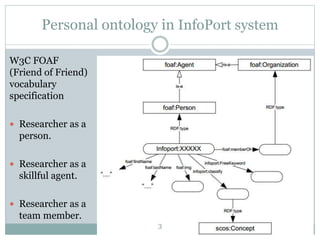
Personal ontology in InfoPort system
W3C FOAF
(Friend of Friend)
vocabulary
specification
 Researcher as a
person.
 Researcher as a
skillful agent.
 Researcher as a
team member.
3
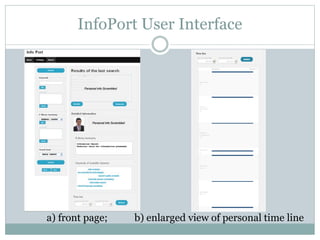
InfoPort User Interface
a) front page; b) enlarged view of personal time line
Platform implementation
 In one hand we have personal ontology which includes
skills of university experts
 In other hand we have unstructured text of news which
are expressed
 We analyze semantic in the news and match it with skills
of experts
 For semantic matching we choose an algorithm
(Momtazi and Naumann, 2013) based on a Latent
Dirichlet allocation.
 It is algorithmically implemented in the newly designed
decision support system titled EXPERTIZE.
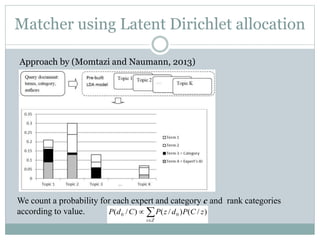
Matcher using Latent Dirichlet allocation



Zz
zCPdzPCdP )/()/()/( 00
We count a probability for each expert and category c and rank categories
according to value.
Approach by (Momtazi and Naumann, 2013)
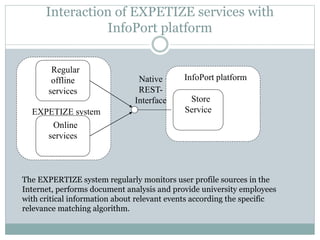
Interaction of EXPETIZE services with
InfoPort platform
InfoPort
EXPETIZE system
InfoPort platform
Store
Service
Regular
offline
services
Online
services
Native
REST-
Interface
The EXPERTIZE system regularly monitors user profile sources in the
Internet, performs document analysis and provide university employees
with critical information about relevant events according the specific
relevance matching algorithm.
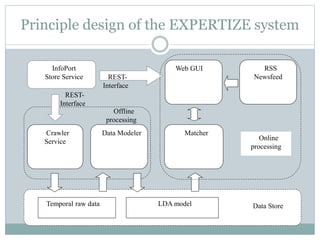
Principle design of the EXPERTIZE system
REST-
Interface
Crawler
Service
Data Modeler
Data Store
Matcher
Temporal raw data LDA model
InfoPort
Store Service
RSS
Newsfeed
Online
processing
REST-
Interface
Offline
processing
Web GUI
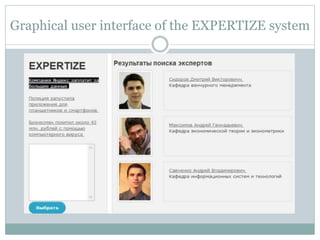
Graphical user interface of the EXPERTIZE system
Algorithm quality evaluation
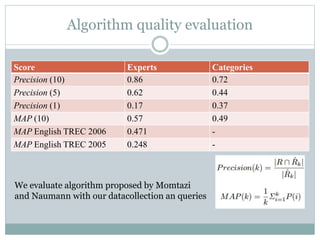
We evaluate algorithm proposed by Momtazi
and Naumann with our datacollection an queries
Score Experts Categories
Precision (10) 0.86 0.72
Precision (5) 0.62 0.44
Precision (1) 0.17 0.37
MAP (10) 0.57 0.49
MAP English TREC 2006 0.471 -
MAP English TREC 2005 0.248 -
Conclusion
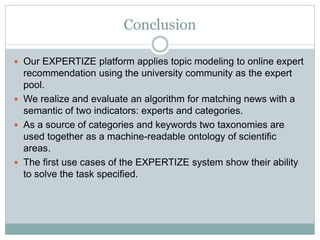
 Our EXPERTIZE platform applies topic modeling to online expert
recommendation using the university community as the expert
pool.
 We realize and evaluate an algorithm for matching news with a
semantic of two indicators: experts and categories.
 As a source of categories and keywords two taxonomies are
used together as a machine-readable ontology of scientific
areas.
 The first use cases of the EXPERTIZE system show their ability
to solve the task specified.
N I K O L A Y K A R P O V
N K A R P O V @ H S E . R U
Thank you for your attention!

Nikolay Karpov - Evolvable Semantic Platform for Facilitating Knowledge Exchange

  • 1.
    A I ST 0 8 . 0 4 . 1 6 Y E K A T E R I N B U R G , R U S S I A N I K O L A Y K A R P O V E D U A R D B A B K I N A L E X A N D E R D E M I D O V S K I Y N A T I O N A L R E S E A R C H U N I V E R S I T Y H I G H E R S C H O O L O F E C O N O M I C S Evolvable Semantic Platform for Facilitating Knowledge Exchange
  • 2.
    Motivation  A universityundoubtedly should be a catalyst for exchanging expertise and professional knowledge in the economic cluster.  A specifically designed combination of automated text processing and ontology-based knowledge engineering may improve quality of information analysis and reduce university’s response time.  We propose to facilitate knowledge exchange by seeking relevant university experts for commenting actual information events expressed in the texts of news.
  • 3.
    Personal ontology inInfoPort system W3C FOAF (Friend of Friend) vocabulary specification  Researcher as a person.  Researcher as a skillful agent.  Researcher as a team member. 3
  • 4.
    InfoPort User Interface a)front page; b) enlarged view of personal time line
  • 5.
    Platform implementation  Inone hand we have personal ontology which includes skills of university experts  In other hand we have unstructured text of news which are expressed  We analyze semantic in the news and match it with skills of experts  For semantic matching we choose an algorithm (Momtazi and Naumann, 2013) based on a Latent Dirichlet allocation.  It is algorithmically implemented in the newly designed decision support system titled EXPERTIZE.
  • 6.
    Matcher using LatentDirichlet allocation    Zz zCPdzPCdP )/()/()/( 00 We count a probability for each expert and category c and rank categories according to value. Approach by (Momtazi and Naumann, 2013)
  • 7.
    Interaction of EXPETIZEservices with InfoPort platform InfoPort EXPETIZE system InfoPort platform Store Service Regular offline services Online services Native REST- Interface The EXPERTIZE system regularly monitors user profile sources in the Internet, performs document analysis and provide university employees with critical information about relevant events according the specific relevance matching algorithm.
  • 8.
    Principle design ofthe EXPERTIZE system REST- Interface Crawler Service Data Modeler Data Store Matcher Temporal raw data LDA model InfoPort Store Service RSS Newsfeed Online processing REST- Interface Offline processing Web GUI
  • 9.
    Graphical user interfaceof the EXPERTIZE system
  • 10.
    Algorithm quality evaluation Weevaluate algorithm proposed by Momtazi and Naumann with our datacollection an queries Score Experts Categories Precision (10) 0.86 0.72 Precision (5) 0.62 0.44 Precision (1) 0.17 0.37 MAP (10) 0.57 0.49 MAP English TREC 2006 0.471 - MAP English TREC 2005 0.248 -
  • 11.
    Conclusion  Our EXPERTIZEplatform applies topic modeling to online expert recommendation using the university community as the expert pool.  We realize and evaluate an algorithm for matching news with a semantic of two indicators: experts and categories.  As a source of categories and keywords two taxonomies are used together as a machine-readable ontology of scientific areas.  The first use cases of the EXPERTIZE system show their ability to solve the task specified.
  • 12.
    N I KO L A Y K A R P O V N K A R P O V @ H S E . R U Thank you for your attention!