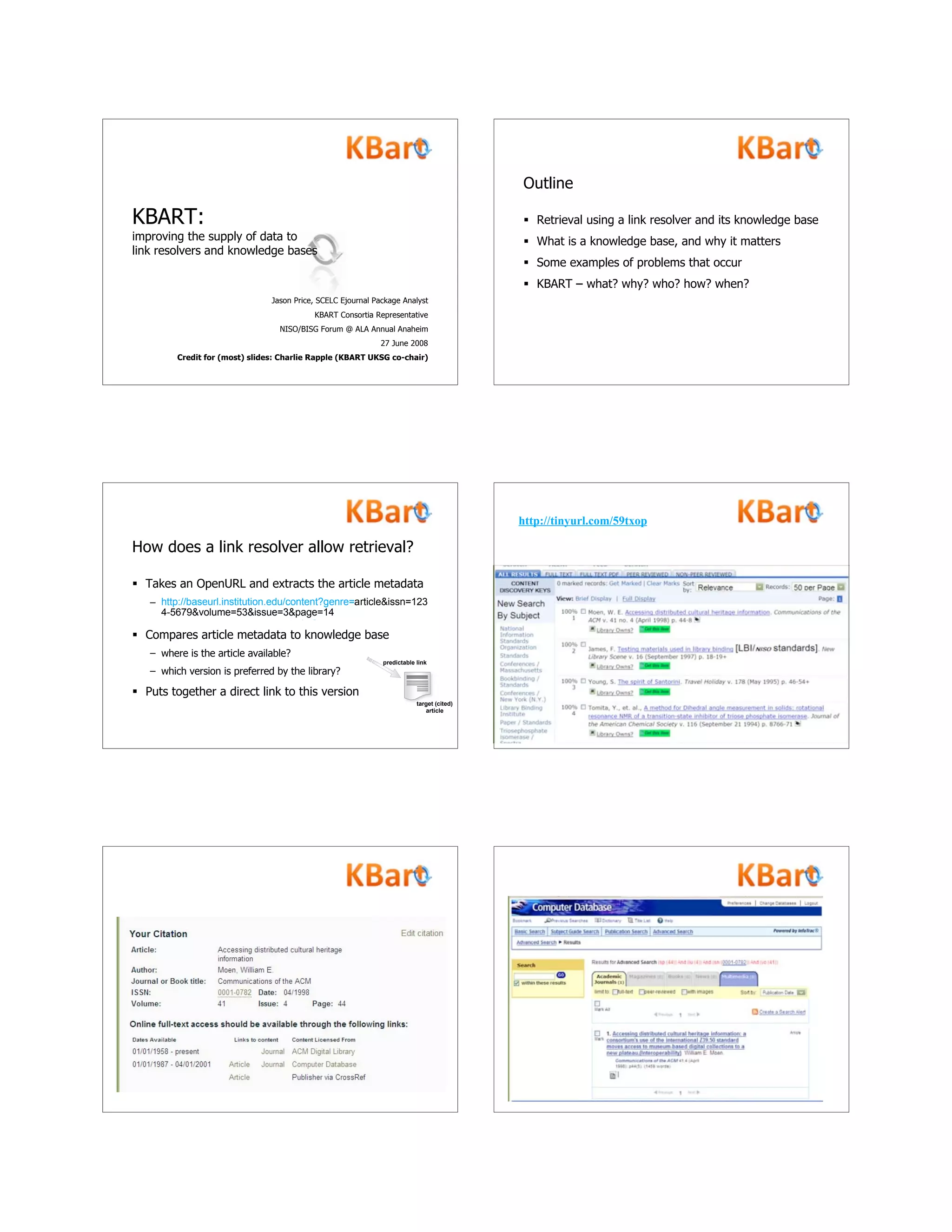
KBART:
improving the supply of data to
link resolvers and knowledge bases
Jason Price, SCELC Ejournal Package Analyst
KBART Consortia Representative
NISO/BISG Forum @ ALA Annual Anaheim
27 June 2008
Credit for (most) slides: Charlie Rapple (KBART UKSG co-chair)
Outline
 Retrieval using a link resolver and its knowledge base
 What is a knowledge base, and why it matters
 Some examples of problems that occur
 KBART – what? why? who? how? when?
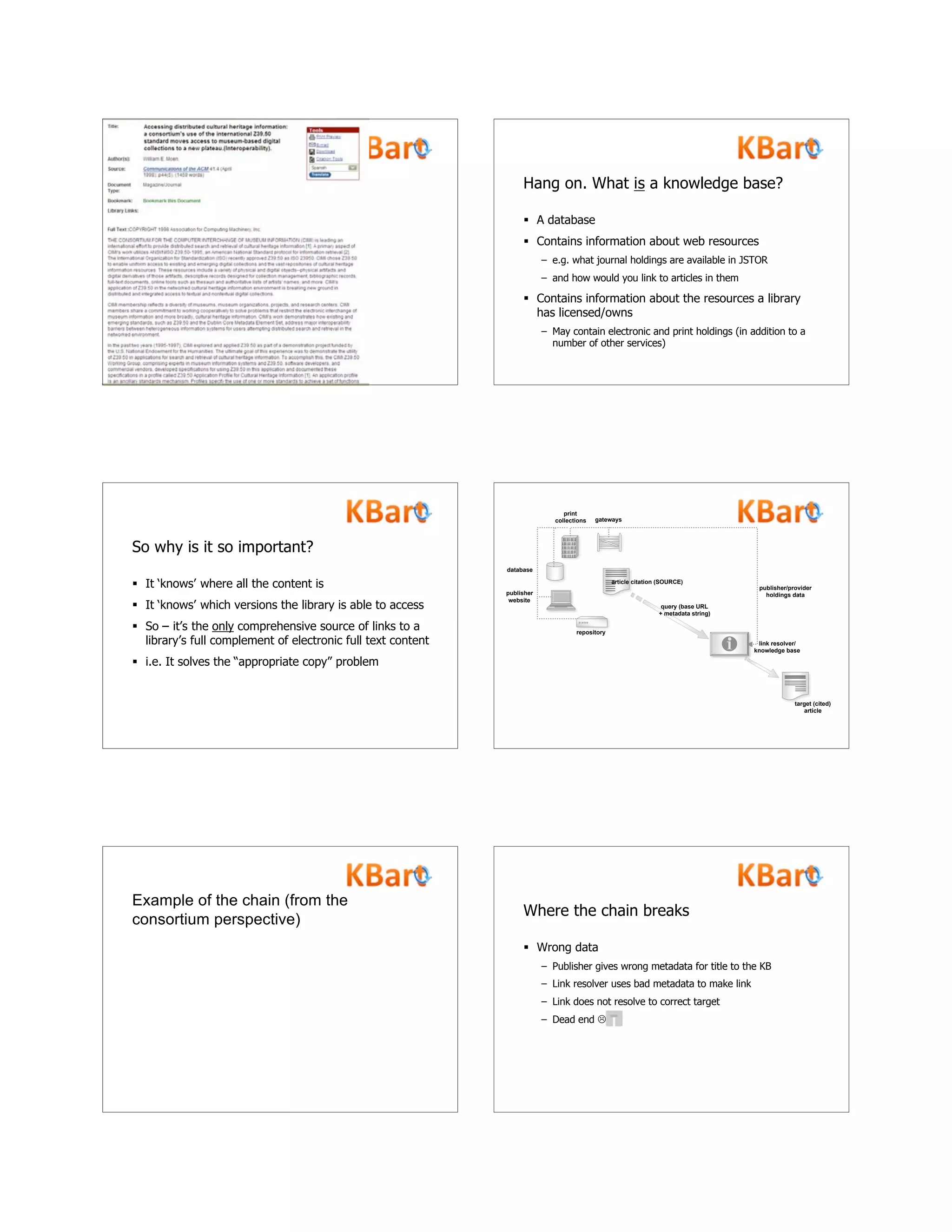
How does a link resolver allow retrieval?
 Takes an OpenURL and extracts the article metadata
– http://baseurl.institution.edu/content?genre=article&issn=12
34-5679&volume=53&issue=3&page=14
 Compares article metadata to knowledge base
– where is the article available?
– which version is preferred by the library?
 Puts together a direct link to this version
http://baseurl.institution.edu/content?genre=article&issn=123
4-5679&volume=53&issue=3&page=14
target (cited)
article
predictable link
http://tinyurl.com/59txop
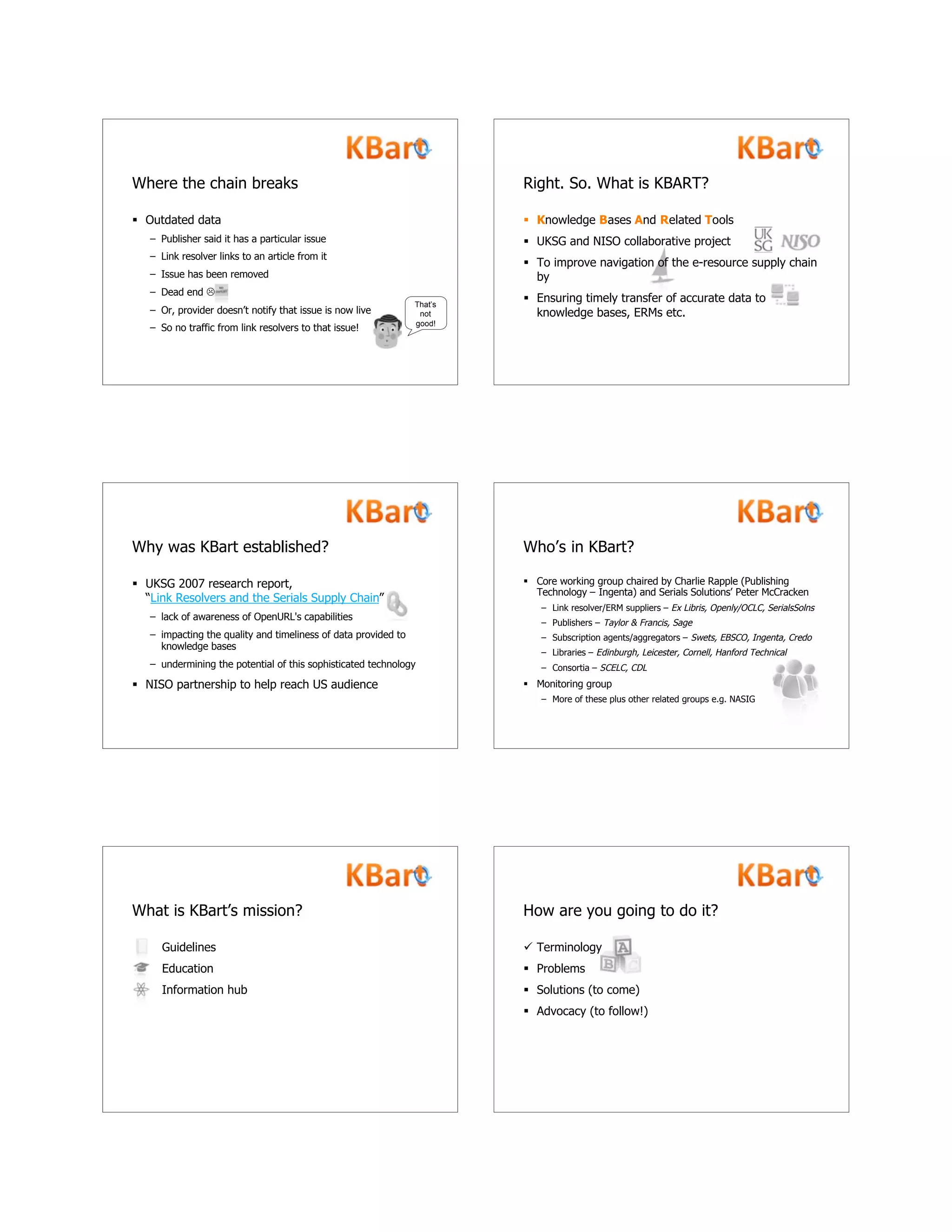
Hang on. What is a knowledge base?
 A database
 Contains information about web resources
– e.g. what journal holdings are available in JSTOR
– and how would you link to articles in them
 Contains information about the resources a library
has licensed/owns
– May contain electronic and print holdings (in addition to a
number of other services)
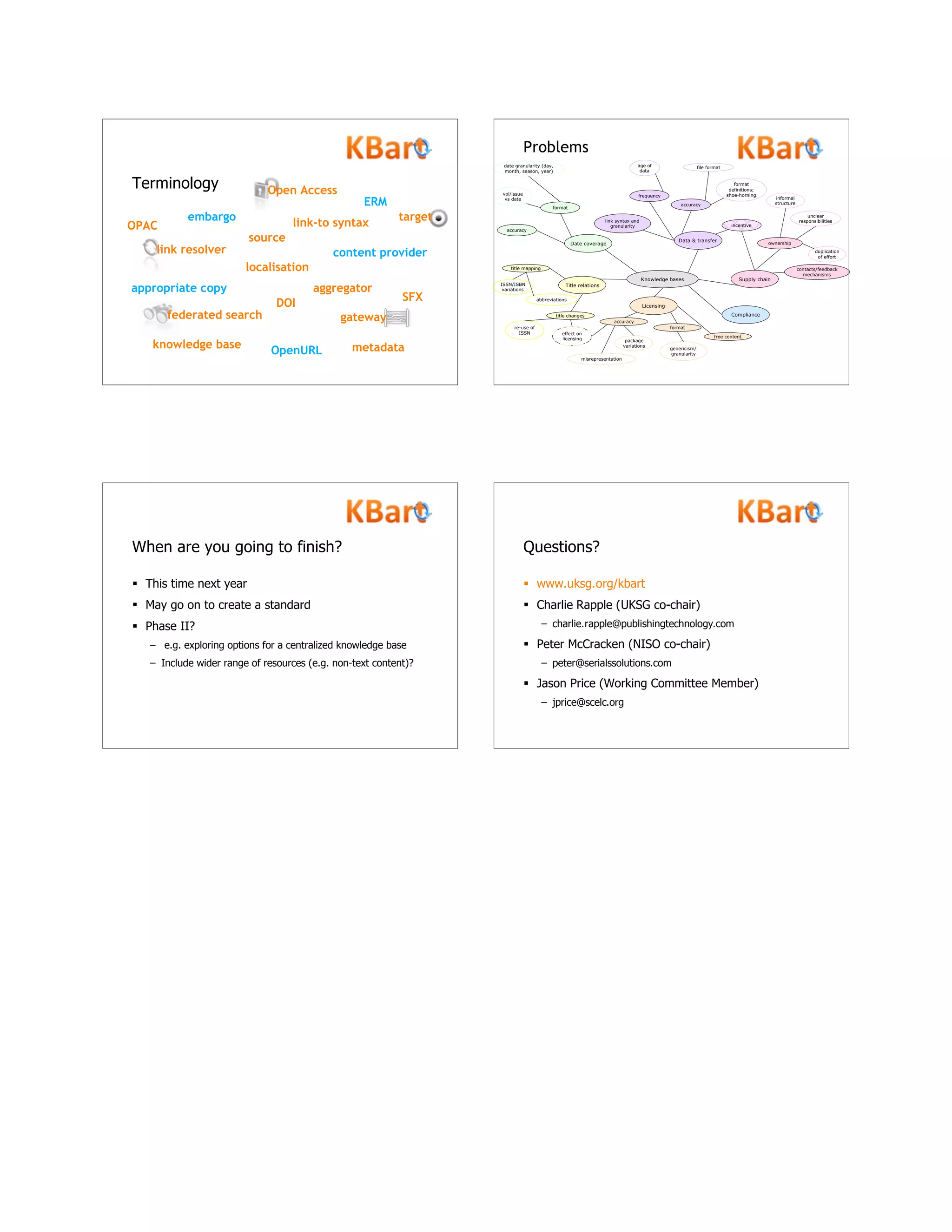
So why is it so important?
 It ‘knows’ where all the content is
 It ‘knows’ which versions the library is able to access
 So – it’s the only comprehensive source of links to a
library’s full complement of electronic full text content
 i.e. It solves the “appropriate copy” problem
article citation (SOURCE)
query (base URL
+ metadata string)
link resolver/
knowledge base
target (cited)
article
publisher
website
database
print
collections gateways
publisher/provider
holdings data
repository
Example of the chain (from the
consortium perspective)
Where the chain breaks
 Wrong data
– Publisher gives wrong metadata for title to the KB
– Link resolver uses bad metadata to make link
– Link does not resolve to correct target
– Dead end 
 Outdated data
– Publisher said it has a particular issue
– Link resolver links to an article from it
– Issue has been removed
– Dead end 
– Or, provider doesn’t notify that issue is now live
– So no traffic from link resolvers to that issue!
Where the chain breaks
That’s
not
good!
 Knowledge Bases And Related Tools
 UKSG and NISO collaborative project
 To improve navigation of the e-resource supply chain
by
 Ensuring timely transfer of accurate data to
knowledge bases, ERMs etc.
Right. So. What is KBART?
Why was KBart established?
 UKSG 2007 research report,
“Link Resolvers and the Serials Supply Chain”
– lack of awareness of OpenURL's capabilities
– impacting the quality and timeliness of data provided to
knowledge bases
– undermining the potential of this sophisticated technology
 NISO partnership to help reach US audience
Who’s in KBart?
 Core working group chaired by Charlie Rapple (Publishing
Technology – Ingenta) and Serials Solutions’ Peter McCracken
– Link resolver/ERM suppliers – Ex Libris, Openly/OCLC, SerialsSolns
– Publishers – Taylor & Francis, Sage
– Subscription agents/aggregators – Swets, EBSCO, Ingenta, Credo
– Libraries – Edinburgh, Leicester, Cornell, Hanford Technical
– Consortia – SCELC, CDL
 Monitoring group
– More of these plus other related groups e.g. NASIG
Guidelines
Education
Information hub
What is KBart’s mission? How are you going to do it?
 Terminology
 Problems
 Solutions (to come)
 Advocacy (to follow!)
Terminology
link resolver
link-to syntax
aggregatorappropriate copy
content provider
DOI
embargo
ERM
federated search gateway
knowledge base
localisation
metadata
OPAC
Open Access
OpenURL
SFX
source
target
Knowledge bases
Date coverage
Title relations
Licensing
Data & transfer
Supply chain
Compliance
accuracy
format
vol/issue
vs date
date granularity (day,
month, season, year)
title changes
title mapping
abbreviations
ISSN/ISBN
variations
re-use of
ISSN effect on
licensing
genericism/
granularity
misrepresentation
package
variations
accuracy
free content
format
ownership
contacts/feedback
mechanisms
incentive
informal
structure
unclear
responsibilities
duplication
of effort
file format
format
definitions;
shoe-horning
age of
data
accuracy
frequency
link syntax and
granularity
Problems
When are you going to finish?
 This time next year
 May go on to create a standard
 Phase II?
– e.g. exploring options for a centralized knowledge base
– Include wider range of resources (e.g. non-text content)?
Questions?
 www.uksg.org/kbart
 Charlie Rapple (UKSG co-chair)
– charlie.rapple@publishingtechnology.com
 Peter McCracken (NISO co-chair)
– peter@serialssolutions.com
 Jason Price (Working Committee Member)
– jprice@scelc.org

Price "KBART: improving the supply of data to link resolvers and knowledge bases"

  • 1.
    KBART: improving the supplyof data to link resolvers and knowledge bases Jason Price, SCELC Ejournal Package Analyst KBART Consortia Representative NISO/BISG Forum @ ALA Annual Anaheim 27 June 2008 Credit for (most) slides: Charlie Rapple (KBART UKSG co-chair) Outline  Retrieval using a link resolver and its knowledge base  What is a knowledge base, and why it matters  Some examples of problems that occur  KBART – what? why? who? how? when? How does a link resolver allow retrieval?  Takes an OpenURL and extracts the article metadata – http://baseurl.institution.edu/content?genre=article&issn=12 34-5679&volume=53&issue=3&page=14  Compares article metadata to knowledge base – where is the article available? – which version is preferred by the library?  Puts together a direct link to this version http://baseurl.institution.edu/content?genre=article&issn=123 4-5679&volume=53&issue=3&page=14 target (cited) article predictable link http://tinyurl.com/59txop
  • 2.
    Hang on. Whatis a knowledge base?  A database  Contains information about web resources – e.g. what journal holdings are available in JSTOR – and how would you link to articles in them  Contains information about the resources a library has licensed/owns – May contain electronic and print holdings (in addition to a number of other services) So why is it so important?  It ‘knows’ where all the content is  It ‘knows’ which versions the library is able to access  So – it’s the only comprehensive source of links to a library’s full complement of electronic full text content  i.e. It solves the “appropriate copy” problem article citation (SOURCE) query (base URL + metadata string) link resolver/ knowledge base target (cited) article publisher website database print collections gateways publisher/provider holdings data repository Example of the chain (from the consortium perspective) Where the chain breaks  Wrong data – Publisher gives wrong metadata for title to the KB – Link resolver uses bad metadata to make link – Link does not resolve to correct target – Dead end 
  • 3.
     Outdated data –Publisher said it has a particular issue – Link resolver links to an article from it – Issue has been removed – Dead end  – Or, provider doesn’t notify that issue is now live – So no traffic from link resolvers to that issue! Where the chain breaks That’s not good!  Knowledge Bases And Related Tools  UKSG and NISO collaborative project  To improve navigation of the e-resource supply chain by  Ensuring timely transfer of accurate data to knowledge bases, ERMs etc. Right. So. What is KBART? Why was KBart established?  UKSG 2007 research report, “Link Resolvers and the Serials Supply Chain” – lack of awareness of OpenURL's capabilities – impacting the quality and timeliness of data provided to knowledge bases – undermining the potential of this sophisticated technology  NISO partnership to help reach US audience Who’s in KBart?  Core working group chaired by Charlie Rapple (Publishing Technology – Ingenta) and Serials Solutions’ Peter McCracken – Link resolver/ERM suppliers – Ex Libris, Openly/OCLC, SerialsSolns – Publishers – Taylor & Francis, Sage – Subscription agents/aggregators – Swets, EBSCO, Ingenta, Credo – Libraries – Edinburgh, Leicester, Cornell, Hanford Technical – Consortia – SCELC, CDL  Monitoring group – More of these plus other related groups e.g. NASIG Guidelines Education Information hub What is KBart’s mission? How are you going to do it?  Terminology  Problems  Solutions (to come)  Advocacy (to follow!)
  • 4.
    Terminology link resolver link-to syntax aggregatorappropriatecopy content provider DOI embargo ERM federated search gateway knowledge base localisation metadata OPAC Open Access OpenURL SFX source target Knowledge bases Date coverage Title relations Licensing Data & transfer Supply chain Compliance accuracy format vol/issue vs date date granularity (day, month, season, year) title changes title mapping abbreviations ISSN/ISBN variations re-use of ISSN effect on licensing genericism/ granularity misrepresentation package variations accuracy free content format ownership contacts/feedback mechanisms incentive informal structure unclear responsibilities duplication of effort file format format definitions; shoe-horning age of data accuracy frequency link syntax and granularity Problems When are you going to finish?  This time next year  May go on to create a standard  Phase II? – e.g. exploring options for a centralized knowledge base – Include wider range of resources (e.g. non-text content)? Questions?  www.uksg.org/kbart  Charlie Rapple (UKSG co-chair) – charlie.rapple@publishingtechnology.com  Peter McCracken (NISO co-chair) – peter@serialssolutions.com  Jason Price (Working Committee Member) – jprice@scelc.org