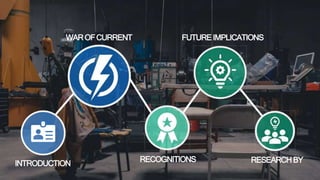
INTRODUCTION
WAROFCURRENT
RECOGNITIONS
FUTUREIMPLICATIONS
RESEARCHBY
INTRODUCTION
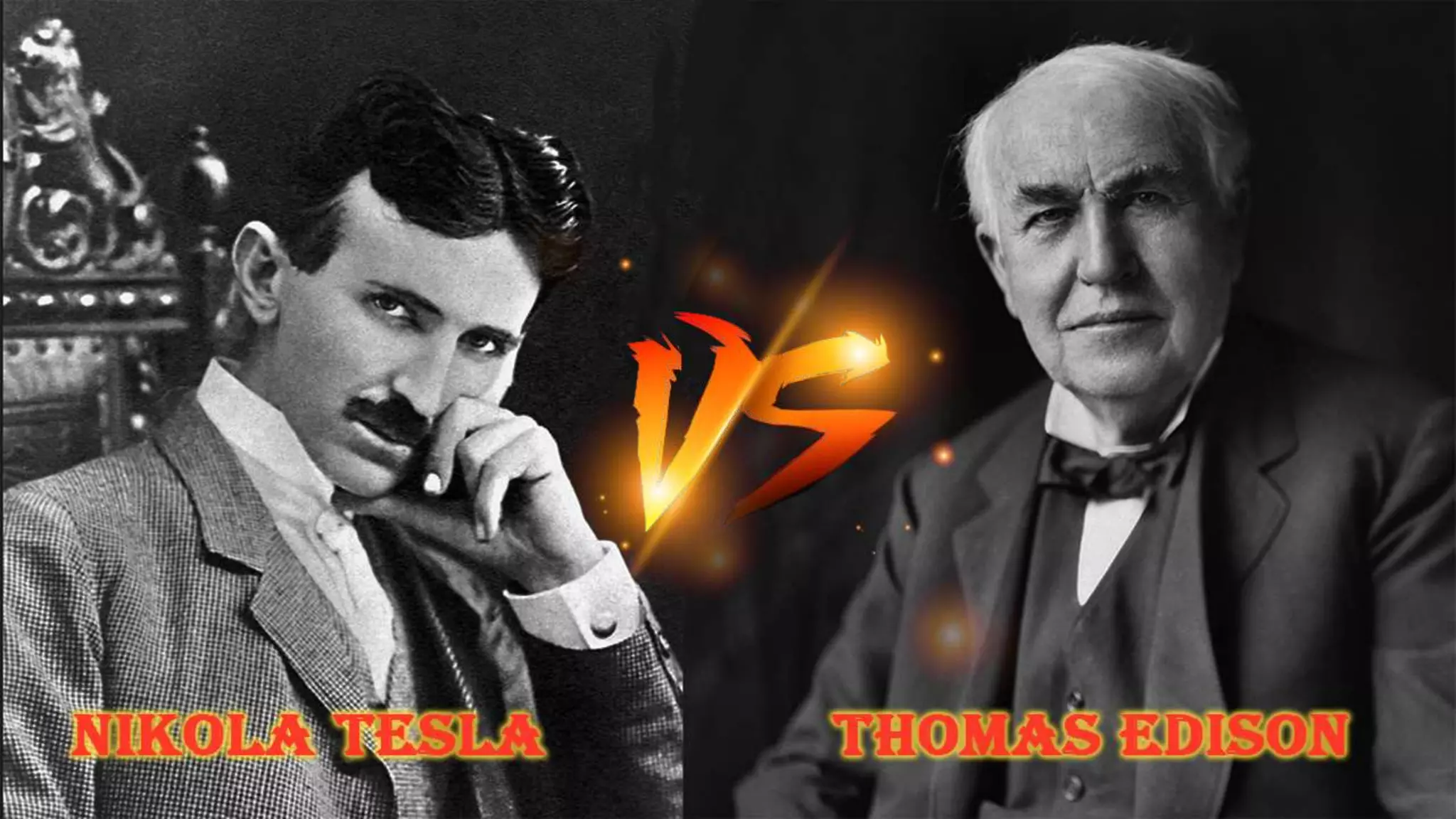
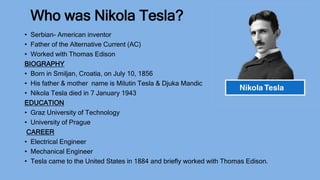
Who was Nikola Tesla?
• Serbian- American inventor
• Father of the Alternative Current (AC)
• Worked with Thomas Edison
BIOGRAPHY
• Born in Smiljan, Croatia, on July 10, 1856
• His father & mother name is Milutin Tesla & Djuka Mandic
• Nikola Tesla died in 7 January 1943
EDUCATION
• Graz University of Technology
• University of Prague
CAREER
• Electrical Engineer
• Mechanical Engineer
• Tesla came to the United States in 1884 and briefly worked with Thomas Edison.
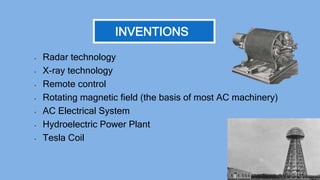
• Radar technology
• X-ray technology
• Remote control
• Rotating magnetic field (the basis of most AC machinery)
• AC Electrical System
• Hydroelectric Power Plant
• Tesla Coil
INVENTIONS
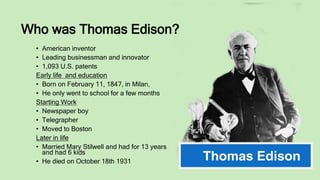
Who was Thomas Edison?
• American inventor
• Leading businessman and innovator
• 1,093 U.S. patents
Early life and education
• Born on February 11, 1847, in Milan,
• He only went to school for a few months
Starting Work
• Newspaper boy
• Telegrapher
• Moved to Boston
Later in life
• Married Mary Stilwell and had for 13 years
and had 6 kids
• He died on October 18th 1931
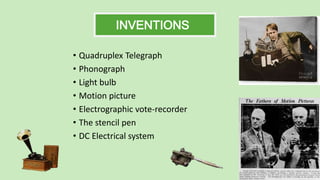
• Quadruplex Telegraph
• Phonograph
• Light bulb
• Motion picture
• Electrographic vote-recorder
• The stencil pen
• DC Electrical system
INVENTIONS
WAR OF CURRENT
Ac current is defined as that current which changes the direction on time
• Use of AC Current
• producing and transporting electricity
• to generate that power which are much less expensive and easier to
produce
• for transport in short to medium range distances
• decreasing the voltage for use in homes and other applications
•
Basic example of ac current use in home appliances and industries
• Electric motors
• Refrigerators, dishwashers, garbage disposals & toasters and many more
• He developed tesla turbine
• one of the first hydroelectric plants
• he invented the tesla coil leading to the possibility of wireless
transmission
• important contribution in radio technology.
• Nikola tesla created one of the world’s first wireless remote
controls
• he played a key role in the development of x rays Nikola tesla
had close to 300 patents
TESLA’S CONTRIBUTION
Direct current (DC) is an electric current that is uni-directional, so the flow of charge is
always in the same direction. As opposed to alternating current, the direction and
amperage of direct currents do not change. It is used in many household electronics and in
all devices that use batteries.
Direct current is defined by the constant flow of electrons from an area of high electron
density to an area of low electron density. In circuits involving batteries, this is illustrated by
the constant flow of charge from the negative terminal of the battery to the positive terminal
of the battery. It is much more expensive and difficult to change the voltage of direct current
as opposed to alternating current, making it a poor choice for the high voltage transmission
of electricity. However, for very long distances, HVDC transmission can be more efficient
than alternating current.
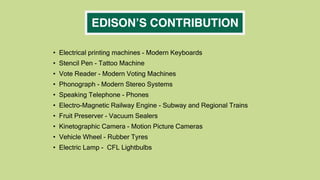
• Electrical printing machines - Modern Keyboards
• Stencil Pen - Tattoo Machine
• Vote Reader - Modern Voting Machines
• Phonograph - Modern Stereo Systems
• Speaking Telephone - Phones
• Electro-Magnetic Railway Engine - Subway and Regional Trains
• Fruit Preserver - Vacuum Sealers
• Kinetographic Camera - Motion Picture Cameras
• Vehicle Wheel - Rubber Tyres
• Electric Lamp - CFL Lightbulbs
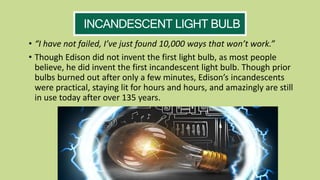
• “I have not failed, I’ve just found 10,000 ways that won’t work.”
• Though Edison did not invent the first light bulb, as most people
believe, he did invent the first incandescent light bulb. Though prior
bulbs burned out after only a few minutes, Edison’s incandescents
were practical, staying lit for hours and hours, and amazingly are still
in use today after over 135 years.
INCANDESCENT LIGHT BULB
Recognition and Honour of Tesla
• On May 18 Tesla ran out of money while building the tower and was foreclosed.
• 1917, the American Institute of Electrical Engineers awarded Tesla with the Edison Medal on
twice
• The IEEE Nikola Tesla Award is a Technical Field Award given annually to an individual.
Patent of Nikola Tesla
• Nikola Tesla was an inventor who obtained around 300 patents] worldwide for his inventions.
• Some of Tesla's patents are not accounted for, and various sources have discovered some
that have lain hidden in patent archives.
• Many inventions developed by Tesla were not put into patent protection.
• Awards named in honour of Edison
 The Edison Medal was created on February 11, 1904, by a group of Edison's friends and
associates
 On May 29, 1928, Edison received the Congressional Gold Medal.
 In 2010, Edison was honoured with a Technical Grammy Award.
Patent of Thomas Edison
• Thomas Edison was an inventor who accumulated 512 patents.
• The American Society of Mechanical Engineers concedes the Thomas
• Edison Patent Award to individual patents since 2000.
EDISON’S RECOGNITION
FUTURE IMPLICATIONS
TESLA
• Long Ranged electricity transport
• remote control
• Wireless technology
• Robotics & drones
• Smartphones
• laser beams
• X-rays
• Self driving car
EDISON
• Storage battery
• Motion picture camera
• Improvement on telegraph & telephone
• Incandescent light bulb
• Modern stereo systems
CONCLUSION
• Edison & Tesla were amongst the greatest minds, well known & celebrated
inventors in history.
• Differences in approach to problem solving
• Tesla : work using theory and calculation. photographic memory and
could simulate entire systems of working machines.
• Edison : trial and error. proceed at once with the diligence with
examination until solution is found
• While Edison is deemed as most accomplished inventor of all time &
shrewd businessman , Tesla is often undermined however, it's still an
understatement to say he was farsighted.
A GROUP PRESENTATION ON SCIENCE & HISTORY BY
• Emeline Pautu
• Bamba Abdoulaye
• Abdulsalam Uba
• Bigyan Poudel
• Vanlalrosailovi
• Mirak Nembang
THANK YOU!
STAY SAFE ! STAY HOME!

Nikolas tela vs Thomas edison

  • 2.
  • 3.
  • 4.
    Who was NikolaTesla? • Serbian- American inventor • Father of the Alternative Current (AC) • Worked with Thomas Edison BIOGRAPHY • Born in Smiljan, Croatia, on July 10, 1856 • His father & mother name is Milutin Tesla & Djuka Mandic • Nikola Tesla died in 7 January 1943 EDUCATION • Graz University of Technology • University of Prague CAREER • Electrical Engineer • Mechanical Engineer • Tesla came to the United States in 1884 and briefly worked with Thomas Edison.
  • 5.
    • Radar technology •X-ray technology • Remote control • Rotating magnetic field (the basis of most AC machinery) • AC Electrical System • Hydroelectric Power Plant • Tesla Coil INVENTIONS
  • 6.
    Who was ThomasEdison? • American inventor • Leading businessman and innovator • 1,093 U.S. patents Early life and education • Born on February 11, 1847, in Milan, • He only went to school for a few months Starting Work • Newspaper boy • Telegrapher • Moved to Boston Later in life • Married Mary Stilwell and had for 13 years and had 6 kids • He died on October 18th 1931
  • 7.
    • Quadruplex Telegraph •Phonograph • Light bulb • Motion picture • Electrographic vote-recorder • The stencil pen • DC Electrical system INVENTIONS
  • 8.
  • 9.
    Ac current isdefined as that current which changes the direction on time • Use of AC Current • producing and transporting electricity • to generate that power which are much less expensive and easier to produce • for transport in short to medium range distances • decreasing the voltage for use in homes and other applications • Basic example of ac current use in home appliances and industries • Electric motors • Refrigerators, dishwashers, garbage disposals & toasters and many more
  • 10.
    • He developedtesla turbine • one of the first hydroelectric plants • he invented the tesla coil leading to the possibility of wireless transmission • important contribution in radio technology. • Nikola tesla created one of the world’s first wireless remote controls • he played a key role in the development of x rays Nikola tesla had close to 300 patents TESLA’S CONTRIBUTION
  • 11.
    Direct current (DC)is an electric current that is uni-directional, so the flow of charge is always in the same direction. As opposed to alternating current, the direction and amperage of direct currents do not change. It is used in many household electronics and in all devices that use batteries. Direct current is defined by the constant flow of electrons from an area of high electron density to an area of low electron density. In circuits involving batteries, this is illustrated by the constant flow of charge from the negative terminal of the battery to the positive terminal of the battery. It is much more expensive and difficult to change the voltage of direct current as opposed to alternating current, making it a poor choice for the high voltage transmission of electricity. However, for very long distances, HVDC transmission can be more efficient than alternating current.
  • 12.
    • Electrical printingmachines - Modern Keyboards • Stencil Pen - Tattoo Machine • Vote Reader - Modern Voting Machines • Phonograph - Modern Stereo Systems • Speaking Telephone - Phones • Electro-Magnetic Railway Engine - Subway and Regional Trains • Fruit Preserver - Vacuum Sealers • Kinetographic Camera - Motion Picture Cameras • Vehicle Wheel - Rubber Tyres • Electric Lamp - CFL Lightbulbs
  • 13.
    • “I havenot failed, I’ve just found 10,000 ways that won’t work.” • Though Edison did not invent the first light bulb, as most people believe, he did invent the first incandescent light bulb. Though prior bulbs burned out after only a few minutes, Edison’s incandescents were practical, staying lit for hours and hours, and amazingly are still in use today after over 135 years. INCANDESCENT LIGHT BULB
  • 14.
    Recognition and Honourof Tesla • On May 18 Tesla ran out of money while building the tower and was foreclosed. • 1917, the American Institute of Electrical Engineers awarded Tesla with the Edison Medal on twice • The IEEE Nikola Tesla Award is a Technical Field Award given annually to an individual. Patent of Nikola Tesla • Nikola Tesla was an inventor who obtained around 300 patents] worldwide for his inventions. • Some of Tesla's patents are not accounted for, and various sources have discovered some that have lain hidden in patent archives. • Many inventions developed by Tesla were not put into patent protection.
  • 15.
    • Awards namedin honour of Edison  The Edison Medal was created on February 11, 1904, by a group of Edison's friends and associates  On May 29, 1928, Edison received the Congressional Gold Medal.  In 2010, Edison was honoured with a Technical Grammy Award. Patent of Thomas Edison • Thomas Edison was an inventor who accumulated 512 patents. • The American Society of Mechanical Engineers concedes the Thomas • Edison Patent Award to individual patents since 2000. EDISON’S RECOGNITION
  • 16.
    FUTURE IMPLICATIONS TESLA • LongRanged electricity transport • remote control • Wireless technology • Robotics & drones • Smartphones • laser beams • X-rays • Self driving car EDISON • Storage battery • Motion picture camera • Improvement on telegraph & telephone • Incandescent light bulb • Modern stereo systems
  • 17.
    CONCLUSION • Edison &Tesla were amongst the greatest minds, well known & celebrated inventors in history. • Differences in approach to problem solving • Tesla : work using theory and calculation. photographic memory and could simulate entire systems of working machines. • Edison : trial and error. proceed at once with the diligence with examination until solution is found • While Edison is deemed as most accomplished inventor of all time & shrewd businessman , Tesla is often undermined however, it's still an understatement to say he was farsighted.
  • 18.
    A GROUP PRESENTATIONON SCIENCE & HISTORY BY • Emeline Pautu • Bamba Abdoulaye • Abdulsalam Uba • Bigyan Poudel • Vanlalrosailovi • Mirak Nembang THANK YOU! STAY SAFE ! STAY HOME!