INVENTORS
DONE BY : MOHAMED ARIF FARHAN
GRADE: 5D ( I )
SUBJECT TEACHER: LATHA MA’AM
SUBMISSION DATE : MAY 26TH
RESEARCH ACTIVITY 2
INDEX
1. INTRODUCTION TO INVENTERS
2. WHO IS THOMAS ALVA EDISON
3. MERITS AND DEMERITS OF EDISON’S INVENTION
4. CONCLUSION
5. BIBLIOGRAPHY
INTRODUCTION TO INVENTORS
A person who invented a particular process or
device or who invents things as an occupation is
called an Inventor
THOMAS ALVA EDISON ( 1847– 1931 )
Inventor Thomas Edison created such great
innovations as the electric light bulb and the
phonograph. A savvy businessman, he held
more than a 1,000 patents for his inventions.
MAIN LIFE
Born on February 11, 1847, in Milan, Ohio, Thomas Edison rose
from humble beginnings to work as an inventor of major
technology. Setting up a lab in Menlo Park, some of the products
he developed included the telegraph, phonograph, electric light
bulb, alkaline storage batteries and Kinetograph (a camera for
motion pictures). He died on October 18, 1931, in West Orange,
New Jersey.
YOUNGER LIFE
Inventor Thomas Alva Edison was born on February 11, 1847, in Milan,
Ohio. He was the last of the seven children of Samuel and Nancy
Edison. Thomas's father was an exiled political activist from Canada.
His mother, an accomplished school teacher, was a major influence in
Thomas’ early life. An early bout with scarlet fever as well as ear
infections left him with hearing difficulties in both ears, a malady that
would eventually leave him nearly deaf as an adult. Edison would later
recount as an adult, with variations on the story, that he lost his
hearing due to a train incident where his ears were injured. But others
have tended to discount this as the sole cause of his hearing loss.
In 1854, the family moved to Port Huron, Michigan, where Edison attended public
school for a total of 12 weeks. A hyperactive child, prone to distraction, he was
deemed "difficult" by his teacher. His mother quickly pulled him from school and
taught him at home. At age 11, he showed a voracious appetite for knowledge,
reading books on a wide range of subjects. In this wide-open curriculum Edison
developed a process for self-education and learning independently that would serve
him throughout his life.
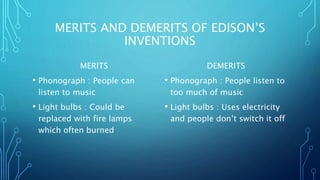
MERITS AND DEMERITS OF EDISON’S
INVENTIONS
MERITS
• Phonograph : People can
listen to music
• Light bulbs : Could be
replaced with fire lamps
which often burned
DEMERITS
• Phonograph : People listen to
too much of music
• Light bulbs : Uses electricity
and people don’t switch it off
CONCLUSION
Many of the inventions Thomas Alva Edison invented are being
developed into more efficiently working machines and his
inventions are being forgotten by the world who used to respect
him for his inventions.
BIBLIOGRAPHY
• http://www.biography.com/people/thomas-edison-9284349
Inventor - Thomas Alva Edison

Inventor - Thomas Alva Edison

  • 1.
    INVENTORS DONE BY :MOHAMED ARIF FARHAN GRADE: 5D ( I ) SUBJECT TEACHER: LATHA MA’AM SUBMISSION DATE : MAY 26TH RESEARCH ACTIVITY 2
  • 2.
    INDEX 1. INTRODUCTION TOINVENTERS 2. WHO IS THOMAS ALVA EDISON 3. MERITS AND DEMERITS OF EDISON’S INVENTION 4. CONCLUSION 5. BIBLIOGRAPHY
  • 3.
    INTRODUCTION TO INVENTORS Aperson who invented a particular process or device or who invents things as an occupation is called an Inventor
  • 4.
    THOMAS ALVA EDISON( 1847– 1931 ) Inventor Thomas Edison created such great innovations as the electric light bulb and the phonograph. A savvy businessman, he held more than a 1,000 patents for his inventions.
  • 5.
    MAIN LIFE Born onFebruary 11, 1847, in Milan, Ohio, Thomas Edison rose from humble beginnings to work as an inventor of major technology. Setting up a lab in Menlo Park, some of the products he developed included the telegraph, phonograph, electric light bulb, alkaline storage batteries and Kinetograph (a camera for motion pictures). He died on October 18, 1931, in West Orange, New Jersey.
  • 6.
    YOUNGER LIFE Inventor ThomasAlva Edison was born on February 11, 1847, in Milan, Ohio. He was the last of the seven children of Samuel and Nancy Edison. Thomas's father was an exiled political activist from Canada. His mother, an accomplished school teacher, was a major influence in Thomas’ early life. An early bout with scarlet fever as well as ear infections left him with hearing difficulties in both ears, a malady that would eventually leave him nearly deaf as an adult. Edison would later recount as an adult, with variations on the story, that he lost his hearing due to a train incident where his ears were injured. But others have tended to discount this as the sole cause of his hearing loss.
  • 7.
    In 1854, thefamily moved to Port Huron, Michigan, where Edison attended public school for a total of 12 weeks. A hyperactive child, prone to distraction, he was deemed "difficult" by his teacher. His mother quickly pulled him from school and taught him at home. At age 11, he showed a voracious appetite for knowledge, reading books on a wide range of subjects. In this wide-open curriculum Edison developed a process for self-education and learning independently that would serve him throughout his life.
  • 9.
    MERITS AND DEMERITSOF EDISON’S INVENTIONS MERITS • Phonograph : People can listen to music • Light bulbs : Could be replaced with fire lamps which often burned DEMERITS • Phonograph : People listen to too much of music • Light bulbs : Uses electricity and people don’t switch it off
  • 10.
    CONCLUSION Many of theinventions Thomas Alva Edison invented are being developed into more efficiently working machines and his inventions are being forgotten by the world who used to respect him for his inventions.
  • 11.