Ethical Decision-Making inEngineering
• Understanding and applying ethical principles is crucial in
engineering.
• This lecture provides tools for ethical decision-making.
• Focus on practical applications in real-world scenarios.
3.
Overview
• Preliminary Sorting:Understanding factual, conceptual,
application, and moral issues.
• Ethical Approaches: Line Drawing, Creative Middle Way,
Utilitarianism, Respect for Persons, and Virtue Ethics.
• Application and Examples: How to apply these methods
with real-world examples.
4.
Preliminary Sorting inEthical Decision-Making
• Ethical decision-making involves multiple layers.
• Begin with sorting issues into factual, conceptual,
application, and moral categories.
• This process clarifies the problem before applying ethical
approaches.
5.
Factual Issues
• Whatit is: Questions about the truth of statements or
existence of facts.
• Purpose: Establish a clear and accurate understanding of
the situation.
• Steps:
1. Gather data and verify facts.
2. Separate facts from assumptions.
• Example:
In a safety review for a new engineering project, a key factual issue
might be whether the materials selected meet all safety standards
under extreme conditions.
6.
Conceptual Issues
• Whatit is: Clarifying the meaning of key terms and
concepts.
• Purpose: Ensure shared understanding to avoid
ambiguity.
• Steps:
1. Define key terms.
2. Discuss definitions with stakeholders.
• Example:
In discussions about safety, it’s crucial to clarify whether safety refers
to complete elimination of risk or to reducing risk to an acceptable
level.
7.
Application Issues
• Whatit is: Determining how concepts apply to specific
situations.
• Purpose: Connect facts and concepts with the specific
ethical questions.
• Steps:
1. Interpret how ethical concepts apply to the facts.
2. Evaluate the relevance of these concepts to the situation.
• Example:
Deciding on the level of acceptable risk in a project involves applying
the concept of safety to the specific conditions and challenges of that
project.
8.
Moral Issues
• Whatit is: The core ethical dilemmas or conflicts needing
resolution.
• Purpose: Identify the key ethical questions that must be
answered.
• Steps:
1. Recognize competing interests or values.
2. Frame the moral issue that requires an ethical decision.
• Example:
A moral issue might involve deciding whether to prioritize a project’s
deadline or the safety of workers, especially when there are known
risks.
9.
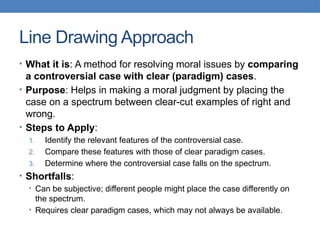
Line Drawing Approach
•What it is: A method for resolving moral issues by comparing
a controversial case with clear (paradigm) cases.
• Purpose: Helps in making a moral judgment by placing the
case on a spectrum between clear-cut examples of right and
wrong.
• Steps to Apply:
1. Identify the relevant features of the controversial case.
2. Compare these features with those of clear paradigm cases.
3. Determine where the controversial case falls on the spectrum.
• Shortfalls:
• Can be subjective; different people might place the case differently on
the spectrum.
• Requires clear paradigm cases, which may not always be available.
10.
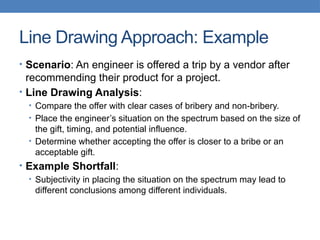
Line Drawing Approach:Example
• Scenario: An engineer is offered a trip by a vendor after
recommending their product for a project.
• Line Drawing Analysis:
• Compare the offer with clear cases of bribery and non-bribery.
• Place the engineer’s situation on the spectrum based on the size of
the gift, timing, and potential influence.
• Determine whether accepting the offer is closer to a bribe or an
acceptable gift.
• Example Shortfall:
• Subjectivity in placing the situation on the spectrum may lead to
different conclusions among different individuals.
11.
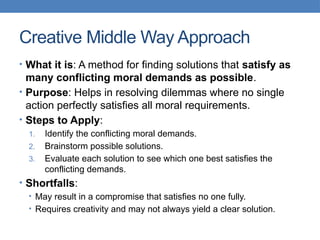
Creative Middle WayApproach
• What it is: A method for finding solutions that satisfy as
many conflicting moral demands as possible.
• Purpose: Helps in resolving dilemmas where no single
action perfectly satisfies all moral requirements.
• Steps to Apply:
1. Identify the conflicting moral demands.
2. Brainstorm possible solutions.
3. Evaluate each solution to see which one best satisfies the
conflicting demands.
• Shortfalls:
• May result in a compromise that satisfies no one fully.
• Requires creativity and may not always yield a clear solution.
12.
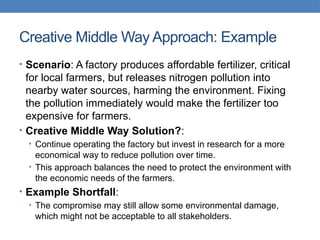
Creative Middle WayApproach: Example
• Scenario: A factory produces affordable fertilizer, critical
for local farmers, but releases nitrogen pollution into
nearby water sources, harming the environment. Fixing
the pollution immediately would make the fertilizer too
expensive for farmers.
• Creative Middle Way Solution?:
• Continue operating the factory but invest in research for a more
economical way to reduce pollution over time.
• This approach balances the need to protect the environment with
the economic needs of the farmers.
• Example Shortfall:
• The compromise may still allow some environmental damage,
which might not be acceptable to all stakeholders.
13.
Utilitarian Approach
• Focuseson maximizing overall good.
• Weighs benefits and harms.
• Common in cost-benefit analysis.
• Steps to Apply:
1. Identify all possible actions and their consequences.
2. Estimate the benefits and harms for each action.
3. Quantify the benefits and harms as much as possible.
4. Compare the net benefits (benefits minus harms) of each action.
5. Choose the action that maximizes the overall good for the most people.
• Shortfalls:
• May sacrifice individual rights for the greater good.
• Difficult to accurately quantify all benefits and harms.
• Risk of overlooking minority or vulnerable groups if the majority benefits.
14.
Utilitarian Approach: Example
•Scenario: Emission of pollutants from a plant.
A utilitarian might justify allowing the emission of pollutants from a plant
that will severely harm a few people if the benefits from the plant, such as
providing good jobs and boosting the local economy, outweigh the harms
to the few.
• Utilitarian Analysis?:
• Assess the overall economic and social benefits against the health risks.
• Calculate whether the economic benefits to the community justify the
health risks to the affected individuals.
• Choose the option that maximizes overall well-being, even if it results in
harm to a small group.
• Example Shortfall:
This approach could lead to unjust outcomes, as it might prioritize
economic benefits over the severe health consequences for a minority
group.
15.
Respect for PersonsApproach
• Emphasizes individual rights.
• Respects autonomy and dignity.
• Involves fair treatment and non-exploitation.
• Steps to Apply:
1. Identify the rights and dignity of all individuals involved.
2. Ensure that actions respect these rights and do not exploit anyone.
3. Consider the autonomy of individuals in decision-making.
4. Avoid actions that would treat individuals as mere means to an end.
5. Choose actions that uphold fairness and respect for all individuals.
• Shortfalls:
• Can be rigid in upholding rights, even when there are broader societal
benefits at stake.
• Conflicts may arise when individual rights clash with collective needs.
• Difficult to prioritize rights when they conflict between different groups.
16.
Respect for PersonsApproach: Example
• Scenario: Compensation for occupational disease.
A worker's health was severely damaged by exposure to hazardous
conditions at work*. The respect for persons approach would emphasize
the worker's right to health and demand compensation, regardless of the
economic costs to the company.
• Respect for Persons Analysis:
• Prioritize the worker's right to fair compensation and a safe working
environment.
• Reject any action that sacrifices the worker’s health for economic gain.
• Ensure that the worker's dignity and autonomy are respected, even if it
incurs higher costs for the company.
• Example Shortfall:
While upholding the worker's rights, this approach might result in
significant financial burdens for the company and could potentially lead to
job losses if the company struggles to cover the costs.
17.
Virtue Ethics Approach
•Focuses on moral character – original philosophy – Plato & Aristotle
• Encourages ethical habits and virtues.
• Suitable for open-ended situations.
• Steps to Apply:
1. Identify the virtues relevant to the situation (e.g., honesty, responsibility).
2. Reflect on how a person of good character would act in this situation.
3. Cultivate the habit of acting according to these virtues.
4. Evaluate the consistency of actions with these virtues.
5. Make decisions that align with virtuous behavior.
• Shortfalls:
• Subjective: What counts as virtuous can vary between individuals and cultures.
• Does not provide clear guidance for resolving conflicts between virtues (e.g.,
honesty vs. compassion).
• May not provide enough structure in highly regulated or complex situations.
18.
Virtue Ethics Approach:Example
• Scenario: Job interview dilemma.
A chemical engineer is faced with a dilemma about interviewing for a job
at a company that conflicts with his personal beliefs about environmental
protection.
• Virtue Ethics Analysis:
• The engineer must consider virtues such as honesty, integrity, and
loyalty.
• He could (a) refuse to interview, (b) interview and be honest about his
views, or (c) interview and misrepresent his views to get the job.
• The virtuous choice would align with honesty and integrity, even if it
means not getting the job.
• Example Shortfall:
While acting with integrity, the engineer might face financial difficulties if
he doesn’t get the job, which could impact his ability to support his family.
19.
Application of MoralTheories
• Use theories to analyze ethical dilemmas.
• No one-size-fits-all solution.
• Choose the approach that best fits the situation.
• Steps to Apply:
1. Review the ethical dilemma and relevant details.
2. Select the ethical theory that best applies to the situation.
3. Analyze the dilemma using the chosen theory.
4. Consider alternative theories if the situation is complex.
5. Make a decision that is consistent with the most appropriate ethical theory.
• Shortfalls:
• Different theories may lead to conflicting recommendations.
• Combining multiple theories may complicate decision-making.
• Each theory has limitations that may not address all aspects of the dilemma.
20.
Application of MoralTheories: Example
• Scenario: A new technology has potential privacy concerns.
• Option 1: Proceed with the technology and manage privacy risks later.
• Option 2: Delay the project to address privacy concerns upfront.
• Combined Analysis:
• Utilitarianism: Assess the overall benefits of the technology against
privacy risks.
• Respect for Persons: Consider the rights of individuals to privacy.
• Virtue Ethics: Reflect on the virtues of responsibility and transparency.
• Decision: Choose the option that best balances the benefits, respects
individual rights, and aligns with virtuous behavior.
• Example Shortfall:
Balancing multiple ethical approaches may lead to indecision or overly
complex solutions, making it hard to prioritize the best course of action.
21.
Summary
• Ethical decision-makingrequires understanding and
sorting issues before applying approaches.
• Line Drawing, Creative Middle Way, Utilitarianism,
Respect for Persons, and Virtue Ethics offer different
lenses for analysis.
• Each method has strengths and limitations.
• Real-world examples help in understanding how to apply
these methods effectively (Case Studies!).
22.
Next Time: Responsibilityin Engineering
• We will explore the standards of care, legal liability, and
moral responsibility in engineering, focusing on how
engineers can fulfill their professional obligations while
navigating complex challenges.
Editor's Notes
#2 This session introduces the ethical tools you’ll need to navigate complex decisions in engineering. We’ll explore different methods and how to apply them effectively.
Book case study:
Cadaver Crash Test Case (Heidelberg, 1993)
200+ cadavers, incl. 8 children
Public outrage → dignity of dead
Catholic Bishops: “Even dead possess dignity”
ADAC (auto club): unacceptable, even animal tests questioned
Heidelberg defense
Family consent (per German law)
Data needed → 120+ crash dummies developed
Lives saved, incl. children
U.S. context (Wayne State, CDC)
PMHS tests only if dummy/simulation insufficient
Contributed to seatbelts, windshields, airbags
Ethical conditions (Ditlow):
No other data source
Prior consent of deceased
Family informed consent
Ethical tension
Safety/public good vs. dignity of dead
Codes of ethics silent on dignity after death
Need for broader frameworks (utilitarian, respect for persons, virtue ethics)
Current status
Rare, controlled use today (research validation)
Main reliance: ATDs (Hybrid III, THOR) + digital models (THUMS)
#3 We’ll start with preliminary sorting of issues, move on to ethical approaches, and finally, look at how these can be applied in practical scenarios.
#4 Sorting helps to clarify the situation before diving into complex ethical analysis, ensuring that decisions are based on solid ground.
#5 Factual issues form the foundation for ethical analysis. Misjudging the factual data can lead to significant consequences.
Is it really the case that important factual information that will save lives can only be gained from crash testing with cadavers?
#6 Misunderstandings often arise from unclear definitions. Different stakeholders might have different understandings of what key terms mean.
For example, “public health”, “safety,” and “welfare,” “conflict of interest,” “bribery,” “extortion,” “confidentiality,” “trade secret,” and “loyalty” are key terms for ethics in engineering, but their meanings are not always obvious.
In the case at the beginning of the chapter, the concept of “human dignity” is crucial.
#7 Application issues bridge the gap between theory and practice, helping to determine the best course of action in a specific context.
An application issue is the question whether using cadavers for testing can be considered an example of respecting human dignity.
#8 Moral issues focus on the actual ethical choices that need to be made. These are often where the most challenging decisions arise.
#9 Line drawing is useful when the moral status of an action is unclear. By comparing it with uncontroversial examples, we can make a more informed decision.
#10 Victor Line-Drawing Example
Victor (engineer) → recommends ACME studs
ACME rep offers Jamaica trip (~$1,500, part educational, part vacation)
Victor’s Case
Gift: substantial (trip), personal benefit
Timing: after recommendation
Authority: strong influence, but not sole decision-maker
Product quality/cost: ACME studs = good quality, fair price
Overall: between extremes → not clear bribe, but questionable
Concerns: size of gift, possible future influence, company policy, industry practice
Question: Is this a bribe?
Line-Drawing Method
Paradigm bribe: $10,000 gift, before decision, personal gain, poor/high-cost product, sole authority
Paradigm non-bribe: trivial gift (pen), after decision, no personal gain, shared authority, best/low-cost product
Bribery Not Bribery
Gift Size Large $10,000 Small $2
Timing Before decision to buy After decision to buy
Reason Personal Gain No Personal Gain
Responsibility Sole Doesn’t Make Final decision
Product quality Lowest Highest
Product cost Highest Lowest
#11 The Creative Middle Way approach is particularly useful when dealing with complex moral dilemmas where strict adherence to one principle may cause significant harm in another area.
One of the most common conflicts faced by engineers, one in which obligation to an employer seems to conflict with an obligation to the public.
#12 This example illustrates how the Creative Middle Way can help find a balanced solution that considers both economic and environmental concerns.
Assume pollution is below environmental legal thresholds.
Notes: Nitrogen - Balancing Benefits and Harms
Environmental Impacts:
Water Pollution: Leads to eutrophication, algal blooms, dead zones.
Air Pollution: N₂O contributes to climate change, ozone depletion.
Soil Degradation: Excess nitrogen harms soil health, reduces biodiversity.
Agricultural Benefits:
Essential Nutrient: Nitrogen is critical for plant growth, ensuring high crop yields.
Food Security: Supports commercial farming to feed growing populations.
Economic Dependence: Many farmers rely on affordable nitrogen-based fertilizers for profitability.
Monitoring/Regulation:
Water: EPA sets MCLs for nitrates/nitrites in drinking water.
Air: N₂O regulated as a greenhouse gas under the Clean Air Act.
Runoff: Managed through Clean Water Act's TMDLs and voluntary programs.
Industrial Discharges: NPDES permits regulate nitrogen emissions.
The Balance: Sustainable practices and innovative technologies are needed to reduce nitrogen’s environmental impact while maintaining its agricultural benefits.
#13 Utilitarianism is useful in large-scale decisions, but it can lead to unfair outcomes for individuals when their rights are sacrificed for the larger good.
Compare to engineering design – design for average load, will fail for extreme loads.
The next 3 methods are grouped under “moral theories” these are an attempt to find a “common morality” – utilitarian, respect for persons, virtue ethics – attempts to identify fundamental ideas in common morality. Better to use more than one approach.
Philosopher Gert’s “common morality” rules:
G1. Don t kill.
G2. Don t cause pain.
G3. Don t disable.
G4. Don t deprive of freedom.
G5. Don t deprive of pleasure.
G6. Don t deceive.
G7. Keep your promise (or don t break your promise).
G8. Don t cheat.
G9. Obey the law (or don t disobey the law).
G10. Do your duty (or don t fail to do your duty)
what if there are conflicting rules…?
#14 While utilitarianism can guide decisions that benefit the majority, it can sometimes lead to neglecting the rights and well-being of vulnerable populations.
Engineers are probably most prone to thinking in a utilitarian way but…
Utilitarian-type thinking lead to economies built on slavery and child labor…
#15 While the respect for persons approach strongly protects individual rights, it can become problematic when there’s a need to balance individual interests with those of society as a whole.
Tests:
OK if situation reversed? (Golden Rule Test: put yourself on the other side – is it still OK?)
OK if everyone did it? (The Self Defeating Test: If everyone behaved in the same way, would it break the system? For example, If no one paid back loans, no one would make loans, and the economy would come to a standstill)
Does is take away someone's basic rights? Life, physical integrity, mental health, consent to risks, possessions, not to be defamed, etc.
“moral theories” – utilitarian, respect for persons, virtue ethics – attempts to identify fundamental ideas in common morality. Better to use more than one approach.
#16 This example highlights how the respect for persons approach can protect individual rights, but it may also have broader economic implications that need to be considered.
*Assume the worker was told about the hazardous conditions and was compensated for hazardous working conditions. The question is: was he compensated enough, was he fully ware of the hazardous conditions, is it fair to offer higher pay to sacrifice your health?
Another example is health care. If a few peoples need drive the cost so high, that the majority can’t afford healthcare, do you sacrifice the few for the many?
#17 Virtue ethics focuses on developing good character, but it may not provide concrete answers when different virtues are in conflict, or when the situation requires specific guidelines.
Virtue ethics is the oldest ethical philosophy. Virtue ethics originated from ancient Greek philosophy, particularly with the work of Plato and Aristotle. It focuses on the development of good character traits (virtues) like courage, wisdom, and temperance, rather than on rules or consequences as in other ethical theories like deontology or consequentialism.
“moral theories” – utilitarian, respect for persons, virtue ethics – attempts to identify fundamental ideas in common morality. Better to use more than one approach.
#18 This example illustrates how virtue ethics guides the engineer toward a choice that maintains his moral integrity, but it also highlights the practical challenges of adhering to virtues in difficult situations.
#19 Different ethical theories provide different perspectives. Depending on the situation, one theory might be more appropriate than another, but it’s important to recognize that no theory is without its shortfalls.
“moral theories” – utilitarian, respect for persons, virtue ethics – attempts to identify fundamental ideas in common morality. Better to use more than one approach.
#20 This example illustrates how different ethical theories can be applied to analyze a complex ethical dilemma. However, combining multiple theories can sometimes result in conflicts or complications.
#21 To make ethical decisions in engineering, it's crucial to first understand the facts, concepts, and moral issues. Applying the appropriate ethical approach can help navigate complex situations, but it’s important to be aware of the limitations of each method.
When you write up your engineering case study – were any of the decision-making methods used? Should they have been used? What would have been the most applicable.?
#22 The next lecture will delve into the responsibilities that engineers have in their professional roles, including the legal and moral dimensions of their work. We’ll discuss the standard of care expected in engineering practice and how to handle potential impediments to responsibility.