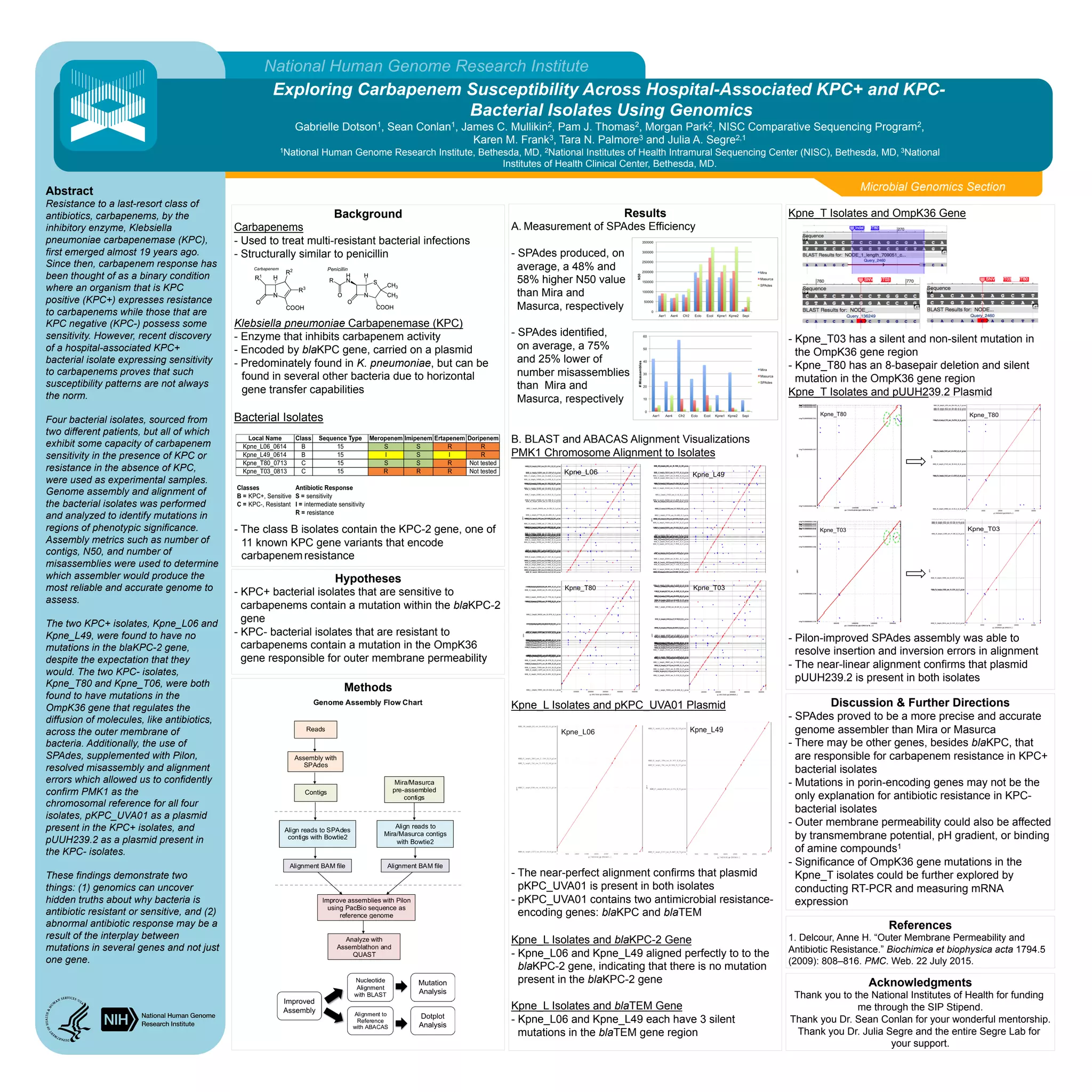
Abstract
Resistance to a last-resort class of
antibiotics, carbapenems, by the
inhibitory enzyme, Klebsiella
pneumoniae carbapenemase (KPC),
first emerged almost 19 years ago.
Since then, carbapenem response has
been thought of as a binary condition
where an organism that is KPC
positive (KPC+) expresses resistance
to carbapenems while those that are
KPC negative (KPC-) possess some
sensitivity. However, recent discovery
of a hospital-associated KPC+
bacterial isolate expressing sensitivity
to carbapenems proves that such
susceptibility patterns are not always
the norm.
Four bacterial isolates, sourced from
two different patients, but all of which
exhibit some capacity of carbapenem
sensitivity in the presence of KPC or
resistance in the absence of KPC,
were used as experimental samples.
Genome assembly and alignment of
the bacterial isolates was performed
and analyzed to identify mutations in
regions of phenotypic significance.
Assembly metrics such as number of
contigs, N50, and number of
misassemblies were used to determine
which assembler would produce the
most reliable and accurate genome to
assess.
The two KPC+ isolates, Kpne_L06 and
Kpne_L49, were found to have no
mutations in the blaKPC-2 gene,
despite the expectation that they
would. The two KPC- isolates,
Kpne_T80 and Kpne_T06, were both
found to have mutations in the
OmpK36 gene that regulates the
diffusion of molecules, like antibiotics,
across the outer membrane of
bacteria. Additionally, the use of
SPAdes, supplemented with Pilon,
resolved misassembly and alignment
errors which allowed us to confidently
confirm PMK1 as the
chromosomal reference for all four
isolates, pKPC_UVA01 as a plasmid
present in the KPC+ isolates, and
pUUH239.2 as a plasmid present in
the KPC- isolates.
These findings demonstrate two
things: (1) genomics can uncover
hidden truths about why bacteria is
antibiotic resistant or sensitive, and (2)
abnormal antibiotic response may be a
result of the interplay between
mutations in several genes and not just
one gene.
1National Human Genome Research Institute, Bethesda, MD, 2National Institutes of Health Intramural Sequencing Center (NISC), Bethesda, MD, 3National
Institutes of Health Clinical Center, Bethesda, MD.
Gabrielle Dotson1, Sean Conlan1, James C. Mullikin2, Pam J. Thomas2, Morgan Park2, NISC Comparative Sequencing Program2,
Karen M. Frank3, Tara N. Palmore3 and Julia A. Segre2,1
Exploring Carbapenem Susceptibility Across Hospital-Associated KPC+ and KPC-
Bacterial Isolates Using Genomics
National Human Genome Research Institute
Microbial Genomics Section
Acknowledgments
Thank you to the National Institutes of Health for funding
.dnepitSPISehthguorhtem
Thank you Dr. Sean Conlan .pihsrotnemlufrednowruoyrof
Thank you Dr. Julia Segre and the entire Segre Lab for
.troppusruoy
Hypotheses
- KPC+ bacterial isolates that are sensitive to
carbapenems contain a mutation within the blaKPC-2
gene
- KPC- bacterial isolates that are resistant to
carbapenems contain a mutation in the OmpK36
gene responsible for outer membrane permeability
Discussion & Further Directions
- SPAdes proved to be a more precise and accurate
genome assembler than Mira or Masurca
- There may be other genes, besides blaKPC, that
are responsible for carbapenem resistance in KPC+
bacterial isolates
- Mutations in porin-encoding genes may not be the
only explanation for antibiotic resistance in KPC-
bacterial isolates
- Outer membrane permeability could also be affected
by transmembrane potential, pH gradient, or binding
of amine compounds1
- Significance of OmpK36 gene mutations in the
Kpne_T isolates could be further explored by
conducting RT-PCR and measuring mRNA
expression
References
1. Delcour, Anne H. “Outer Membrane Permeability and
Antibiotic Resistance.” Biochimica et biophysica acta 1794.5
(2009): 808–816. PMC. Web. 22 July 2015.
Kpne_T Isolates and OmpK36 Gene
- Kpne_T03 has a silent and non-silent mutation in
the OmpK36 gene region
- Kpne_T80 has an 8-basepair deletion and silent
mutation in the OmpK36 gene region
Kpne_T Isolates and pUUH239.2 Plasmid
- Pilon-improved SPAdes assembly was able to
resolve insertion and inversion errors in alignment
- The near-linear alignment confirms that plasmid
pUUH239.2 is present in both isolates
Background
Carbapenems
- Used to treat multi-resistant bacterial infections
- Structurally similar to penicillin
Klebsiella pneumoniae Carbapenemase (KPC)
- Enzyme that inhibits carbapenem activity
- Encoded by blaKPC gene, carried on a plasmid
- Predominately found in K. pneumoniae, but can be
found in several other bacteria due to horizontal
gene transfer capabilities
Bacterial Isolates
- The class B isolates contain the KPC-2 gene, one of
11 known KPC gene variants that encode
carbapenem resistance
Results
A. Measurement of SPAdes Efficiency
- SPAdes produced, on
average, a 48% and
58% higher N50 value
than Mira and
Masurca, respectively
- SPAdes identified,
on average, a 75%
and 25% lower of
number misassemblies
than Mira and
Masurca, respectively
B. BLAST and ABACAS Alignment Visualizations
PMK1 Chromosome Alignment to Isolates
Kpne_L Isolates and pKPC_UVA01 Plasmid
- The near-perfect alignment confirms that plasmid
pKPC_UVA01 is present in both isolates
- pKPC_UVA01 contains two antimicrobial resistance-
encoding genes: blaKPC and blaTEM
Kpne_L Isolates and blaKPC-2 Gene
- Kpne_L06 and Kpne_L49 aligned perfectly to to the
blaKPC-2 gene, indicating that there is no mutation
present in the blaKPC-2 gene
Kpne_L Isolates and blaTEM Gene
- Kpne_L06 and Kpne_L49 each have 3 silent
mutations in the blaTEM gene region
Methods

NIH Summer 2015 Poster_GabrielleDotson

  • 1.
    Abstract Resistance to alast-resort class of antibiotics, carbapenems, by the inhibitory enzyme, Klebsiella pneumoniae carbapenemase (KPC), first emerged almost 19 years ago. Since then, carbapenem response has been thought of as a binary condition where an organism that is KPC positive (KPC+) expresses resistance to carbapenems while those that are KPC negative (KPC-) possess some sensitivity. However, recent discovery of a hospital-associated KPC+ bacterial isolate expressing sensitivity to carbapenems proves that such susceptibility patterns are not always the norm. Four bacterial isolates, sourced from two different patients, but all of which exhibit some capacity of carbapenem sensitivity in the presence of KPC or resistance in the absence of KPC, were used as experimental samples. Genome assembly and alignment of the bacterial isolates was performed and analyzed to identify mutations in regions of phenotypic significance. Assembly metrics such as number of contigs, N50, and number of misassemblies were used to determine which assembler would produce the most reliable and accurate genome to assess. The two KPC+ isolates, Kpne_L06 and Kpne_L49, were found to have no mutations in the blaKPC-2 gene, despite the expectation that they would. The two KPC- isolates, Kpne_T80 and Kpne_T06, were both found to have mutations in the OmpK36 gene that regulates the diffusion of molecules, like antibiotics, across the outer membrane of bacteria. Additionally, the use of SPAdes, supplemented with Pilon, resolved misassembly and alignment errors which allowed us to confidently confirm PMK1 as the chromosomal reference for all four isolates, pKPC_UVA01 as a plasmid present in the KPC+ isolates, and pUUH239.2 as a plasmid present in the KPC- isolates. These findings demonstrate two things: (1) genomics can uncover hidden truths about why bacteria is antibiotic resistant or sensitive, and (2) abnormal antibiotic response may be a result of the interplay between mutations in several genes and not just one gene. 1National Human Genome Research Institute, Bethesda, MD, 2National Institutes of Health Intramural Sequencing Center (NISC), Bethesda, MD, 3National Institutes of Health Clinical Center, Bethesda, MD. Gabrielle Dotson1, Sean Conlan1, James C. Mullikin2, Pam J. Thomas2, Morgan Park2, NISC Comparative Sequencing Program2, Karen M. Frank3, Tara N. Palmore3 and Julia A. Segre2,1 Exploring Carbapenem Susceptibility Across Hospital-Associated KPC+ and KPC- Bacterial Isolates Using Genomics National Human Genome Research Institute Microbial Genomics Section Acknowledgments Thank you to the National Institutes of Health for funding .dnepitSPISehthguorhtem Thank you Dr. Sean Conlan .pihsrotnemlufrednowruoyrof Thank you Dr. Julia Segre and the entire Segre Lab for .troppusruoy Hypotheses - KPC+ bacterial isolates that are sensitive to carbapenems contain a mutation within the blaKPC-2 gene - KPC- bacterial isolates that are resistant to carbapenems contain a mutation in the OmpK36 gene responsible for outer membrane permeability Discussion & Further Directions - SPAdes proved to be a more precise and accurate genome assembler than Mira or Masurca - There may be other genes, besides blaKPC, that are responsible for carbapenem resistance in KPC+ bacterial isolates - Mutations in porin-encoding genes may not be the only explanation for antibiotic resistance in KPC- bacterial isolates - Outer membrane permeability could also be affected by transmembrane potential, pH gradient, or binding of amine compounds1 - Significance of OmpK36 gene mutations in the Kpne_T isolates could be further explored by conducting RT-PCR and measuring mRNA expression References 1. Delcour, Anne H. “Outer Membrane Permeability and Antibiotic Resistance.” Biochimica et biophysica acta 1794.5 (2009): 808–816. PMC. Web. 22 July 2015. Kpne_T Isolates and OmpK36 Gene - Kpne_T03 has a silent and non-silent mutation in the OmpK36 gene region - Kpne_T80 has an 8-basepair deletion and silent mutation in the OmpK36 gene region Kpne_T Isolates and pUUH239.2 Plasmid - Pilon-improved SPAdes assembly was able to resolve insertion and inversion errors in alignment - The near-linear alignment confirms that plasmid pUUH239.2 is present in both isolates Background Carbapenems - Used to treat multi-resistant bacterial infections - Structurally similar to penicillin Klebsiella pneumoniae Carbapenemase (KPC) - Enzyme that inhibits carbapenem activity - Encoded by blaKPC gene, carried on a plasmid - Predominately found in K. pneumoniae, but can be found in several other bacteria due to horizontal gene transfer capabilities Bacterial Isolates - The class B isolates contain the KPC-2 gene, one of 11 known KPC gene variants that encode carbapenem resistance Results A. Measurement of SPAdes Efficiency - SPAdes produced, on average, a 48% and 58% higher N50 value than Mira and Masurca, respectively - SPAdes identified, on average, a 75% and 25% lower of number misassemblies than Mira and Masurca, respectively B. BLAST and ABACAS Alignment Visualizations PMK1 Chromosome Alignment to Isolates Kpne_L Isolates and pKPC_UVA01 Plasmid - The near-perfect alignment confirms that plasmid pKPC_UVA01 is present in both isolates - pKPC_UVA01 contains two antimicrobial resistance- encoding genes: blaKPC and blaTEM Kpne_L Isolates and blaKPC-2 Gene - Kpne_L06 and Kpne_L49 aligned perfectly to to the blaKPC-2 gene, indicating that there is no mutation present in the blaKPC-2 gene Kpne_L Isolates and blaTEM Gene - Kpne_L06 and Kpne_L49 each have 3 silent mutations in the blaTEM gene region Methods